Category Archives: NRI’s / PIO’s

Revealed: Sheikh Abdullah’s grand-daughter says her grandmother NEVER wed ‘Lawrence of Arabia’

When Prof Nyla Ali Khan, a US-based Kashmiri academic and granddaughter of Sheikh Muhammad Abdullah, writes about her grandmother Begam Akbar Jehan, she demolishes “many a myth”.

According to her, the biggest fiction being peddled as history is that Sheikh Abdullah was Akbar Jehan’s second husband, after the latter’s divorce from T.E. Lawrence, alias “The Lawrence of Arabia”.

Leftist historian Tariq Ali had written that Jehan married Lawrence in 1928, while he was on a visit to Kashmir.
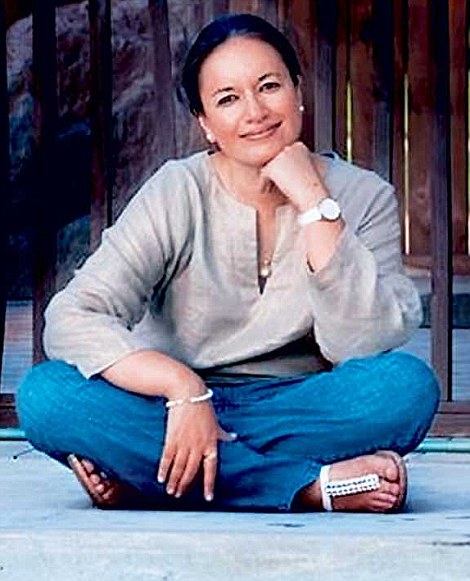
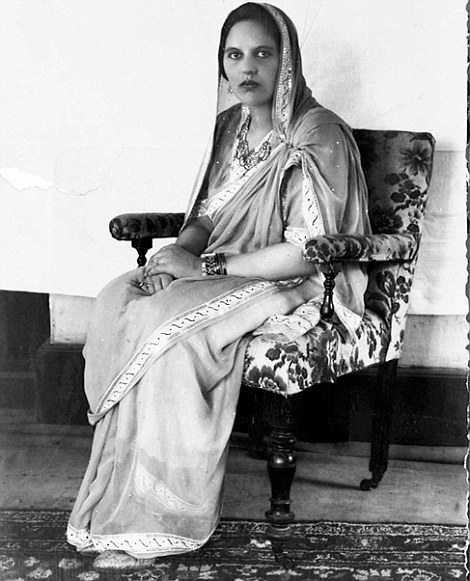
Nyla Ali Khan has written a biography of her grandmother, Begum Akbar Jehan (below), who was married to Sheikh Muhammad Abdullah


Begum Akbar Jehan  who was married to Sheikh Muhammad Abdullah
Begum Akbar Jehan who was married to Sheikh Muhammad Abdullah

Prof Khan, the niece of Farooq Abdullah, is a faculty member at the University of Oklahoma in the US and member of Scholars Strategy Network. She is the author of Fiction of Nationality in an Era of Transnationalism, Islam, Women, and Violence in Kashmir, and the editor of The Parchment of Kashmir.

In an interview with Mail Today, she said: “The biography of Jehan provides an insight into the history, politics, and society of Kashmir in the major part of the 20th century.”

While debunking the Lawrence theory, Khan said that Jehan herself had told her that “this tall tale was just another fabrication, the purpose of which was to denigrate her and to belittle her work”.

Khan quoted Stephen E. Tabachnick, a renowned Lawrence scholar, to make her point: “Tabachnick unequivocally pointed out the story of that betrothal or marriage is completely false. If it had happened, it would have been impossible to keep it a secret, considering Lawrence’s world-wide fame. And given Lawrence’s homosexual tendencies and flagellation compulsion, the odds are really against it being true.

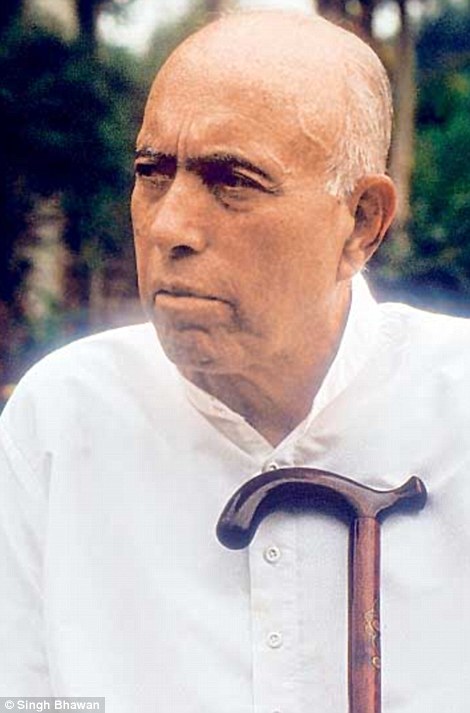
Prof Khan says her grandmother was never married to - or divorced from - T.E. Lawrence , known to history as 'Lawrence of Arabia', and that this was a tale told to denigrate her. Kashmiri statesman Sheikh Abdullah (below) married her in 1933.
Prof Khan says her grandmother was never married to – or divorced from – T.E. Lawrence , known to history as ‘Lawrence of Arabia’, and that this was a tale told to denigrate her. Kashmiri statesman Sheikh Abdullah (below) married her in 1933.


Prof Khan says her grandmother was never married to - or divorced from - T.E. Lawrence  known to history as 'Lawrence of Arabia', and that this was a tale told to denigrate her. Kashmiri statesman Sheikh Abdullah  (above) married her in 1933.
Prof Khan says her grandmother was never married to – or divorced from – T.E. Lawrence known to history as ‘Lawrence of Arabia’, and that this was a tale told to denigrate her. Kashmiri statesman Sheikh Abdullah (above) married her in 1933.

“He pointed out that John Mack and Jeremy Wilson have written the best Nyla Ali Khan’s (right) biography is an insight into Kashmir in the major part of the 20th century and Begum Akbar Jehan (above). biographies of Lawrence. But, neither had mentioned this apocryphal story nor do any of the other biographies that he was familiar with.”

Khan’s biography, titled The Life of a Kashmiri Woman: Dialectic of Resistance and Accommodation is published by Palgrave Macmillan, and available in North America and the United Kingdom. The book is likely to be available in India in mid-summer this year.

For Khan, Jehan had a substantive role in “public events”, and she cannot sink into the shadows or be “memorialised into the realm of abstractions”.

Jehan’s father, Michael Henry [Harry] Nedou, later Sheikh Ahmed Hussain, of Slovak and British descent, was a charming hotelier. Her mother, Rani Jee, was an indomitable Gujjar (pastoral tribe) woman, with her clan’s lineage traced to the martial, patrilineal, and traditional Rajputs of Rajasthan.

“Jehan, born with the proverbial silver spoon in her mouth, made the intransigent decision to throw in her lot with a determined and politically savvy young man, Sheikh Abdullah.”

Khan said: “The Sheikh’s fiefdom was the political battlefield; his entourage comprised the poverty-stricken, disenfranchised, dispossessed, denigrated masses; his palace was his home in Soura, on the outskirts of Srinagar.”

“During her husband, Sheikh Abdullah’s incarceration, Jehan was burdened with the arduous task of raising five children in a politically repressive environment that sought to undo her husband’s mammoth political, cultural, legal attempts to restore the faith of Kashmiri society in itself.”

Jehan’s forebears, the Nedous, had emigrated from the Croatian city of Dubrovnik to Lahore in the 1800s.

Croatia, now independent, was in the Austrian Empire from 1815 to 1918 and part of Yugoslavia from 1918 to 1991.

source: http://www.dailymail.co.uk / Mail Online India / Home>India / by Naseer Ganai / February 08th, 2015

Medical tourism explored in first forum

Quality care stepping stone for medical tourism

Dubai:

The Dubai Health Authority (DHA) has rolled out the first phase of the medical tourism pacakges which caters to the domestic market.

UAE residents and those already in the country such as delegates to the conference can avail of discounts of up to 70 per cent in areas such as wellness, weight loss, dentistry, orthopaedics, breast cancer screening and fertility treatments. The domestic packages do not offer visa and hotel stay.

Delegates from around the globe attended the first day of a two-day inaugural health regulation conference in Dubai which looked at major efforts by Dubai to become a medical tourism hub.

Medical tourism packages aimed at tourists will be rolled out soon, marking the second phase. A host of partners such as DHA, Dubai Tourism and Commerce Marketing (DTCM), and members of the private health-care and hospitality sector, among others, are working in tandem to make this possible shortly. These packages will be made available to DTCM-approved tour operators who will be allowed to market these.

According to Dr Layla Marzouqi, acting head of DHA’s health regulation committee, everything has been worked out and the second phase of the medical tourism packages will become a reality in the coming months.

One of the ideas explored was plans by Dubai health authorities to rate hospitals similar to the hotel industry which bases gradings on customer service and satisfaction.

Public-private partnerships are also seen as key to unifying efforts to draw investment to new projects that will attract those interested in medical travel, said experts examining the issues in panels and workshops.

Eisa Al Maidour, DHA Director-General, inaugurated the conference which has drawn more than 1,000 professionals from the field of health regulation and medical tourism and key stakeholders in the public and private health care sector.

Other stakeholders such as pharmaceutical companies and health care providers are also attending.

Enhancing the quality of health care to augment medical tourism was discussed, said the director-general in his inaugural speech.

“Health regulation is fundamental to achieve quality health services and protect patient safety; a strong health regulatory system leads to sustained growth of the health sector which in itself is a catalyst for medical tourism. This conference provides an opportunity for stakeholders to discuss the latest advances as well as share their experiences in the field of health regulation and medical tourism,” he said.

How public private partnerships could promote investment and take medical tourism to the next level is key, he added.

Dr Layla said, “Public private partnerships (PPP) are a very important concept in medical tourism in all the countries that have a robust health sector. In India, for example, it is the private sector which is partnering with the government to strengthen the infrastructure while the government is ensuring quality control, thus complementing each other. In the UAE we are very aware of this as more than 70 per cent of our hospitals are in the private sector. In Dubai, out of the 20 hospitals we have only four are government. Of the 2.700 health-care facilities in the emirate, only 17 are government. We want the private sector to collaborate with us, come forward with investments and take medical tourism to the next level.”

Dr Layla said that DHA’s health regulation department was in the process of creating a grading protocol for hospitals where hospitals would have hotel-like gradings beginning from five-star based on certain criteria.

“The most important criteria is that of quality health care. This will cover the quality of doctors and other health-care professionals at the hospital, the number of surgeries carried out, the incidence of surgical errors and the number of customer complaints. The next criteria was of ambience which will take into account patient care, the presence of a translator, food and nutrition facility to support the needs of the patient, among other things,” she said.

“The focus of medical tourism is good quality and reasonable pricing. The regulation department will work closely with the funding department to determine the prices that graded hospitals can charge and we will make sure we freeze those. If a hospital is found lowering its standards, it will not be able to increase its prices and that will create healthy competition among such facilities,” she said.

Dr Azad Moopen, Chairman and Managing Director of Aster and DM Healthcare, said his group was keen to take up PPP projects and added that the private sector needed to raise the bar on quality health care and make investments in good doctors to attract medical tourists.

His organisation, he said, was ready to work with DHA to bring those standards to the emirates.

“There are three main reasons why people around the world seek medical travel. They are looking for expertise that is available, the cost of the procedure and the turnaround time to carry out the procedure. If we can provide them with high-quality medical care at reasonable costs and within a short period of time, it will attract people from around the world.” He recommended that the private sector needed to focus on further increasing the number of hospitals, specialist medical centres, hospital beds, diagnostic centres and pharmacies, state-of-the-art surgical and trauma care facilities, wellness and cosmetic care centres along with introduction of cutting-edge medical technologies.

Dr Jameel Ahmad, Managing Director of Prime Healthcare Group, felt PPP was a welcome move, benefiting both the public and private sector. “We are ready for this kind of a collaboration as we tie in the concept of hospital and hospitality very well, being situated next to two major hotels and the Dubai airport. We are in a position to offer medical tourism packages in the area of orthopaedics, sports medicine, dentistry and cosmetic surgery,” he said.

source: http://www.gulfnews.com /  Gulf News / Home> UAE> Health / by Suchitra Bajpai Chaudhry, Senior Reporter / October 22nd, 2014

Tamil poet Iqbal named for Singapore’s highest cultural award

Indian-origin Singaporean poet and writer K.T.M. Iqbal will be awarded Cultural Medallion, the country’s highest cultural award by President Tony Tan Keng Yam on Thursday night in Singapore.

It is the highest recognition for the 74-year-old Tamil poet whose achievements include more than 200 children’s songs written for Radio Singapore in the 1970s and 1980s, as well as seven collections of poetry.

Mr. Iqbal said he was “delighted” to receive the award which was “an incredible honour”.

“My first love is poetry. We have been together for 60 years. I never imagined this would bring me the Cultural Medallion award,” The Straits Times quoted Mr. Iqbal as saying.

Mr. Iqbal learned the basics of Venpa, a form of classical Tamil poetry from a poetry-writing workshop. “I would sit on the street in the evening to write or an idea might come when I was on the bus,” said Mr. Iqbal.

The poet, also a retired bank executive, has received recognition in the education system of Singapore also.

Mr. Iqbal’s compositions are studied in schools and some of them have appeared in the subway stations as part of efforts to bring the arts close to the community.

Mr. Iqbal migrated to Singapore at the age of 11 with his father from Kadayanallur in South India in 1951.

A Tamil newspaper Malaya Nanban, which is now defunct, introduced him to the simple but evocative compositions of Tamil poet Mathithasan. The poet’s vivid depiction of people and values in society inspired the young Iqbal to start penning poems.

The retired bank executive continues to pen poems and hopes to produce an edited collection of his best Tamil poems and an English translation of it.

Along with the award, Mr. Iqbal will get 80,000 Singapore Dollar grant, which can be used to fund artistic endeavours over their lifetime, according to The Straits Times.

“The money once spent is gone. But to have the nation recognise your contribution is great and it will encourage people to keep writing poetry,” said Mr. Iqbal.

The award will also be given to sculptor Chong Fah Cheong, 68, and 51-year old Alvin Tan, the artistic director of a theatre company, The Necessary Stage. Recipients are each eligible for a 80,000 Singapore Dollar grant.

The award, instituted 35 years ago, has been presented to 115 artists to date, including Mr. Iqbal, Mr. Chong and Mr. Tan.

source: http://www.thehindu.com / The Hindu / Home> News> National / by PTI / Singapore , October 16th, 2014

Thumbay Group among Forbes ME ‘Top 100’ in Arab world

Ajman :

Thumbay Group has crossed another milestone today. Thumbay Group has been listed in “Top 100 making an impact in the Arab World”, a list compiled by Forbes Middle East Magazine in the May 2013 Issue 14. Rankings, awards, undoubtedly play an important role in recognizing an organization’s success. Thumbay Group, UAE ranks 44 in the list of “Top 100 Making An Impact In The Arab World”.

ThumbayMoideenMPOs12oct2014

Thumbay Group, UAE established in the year 1997 has come a long way. It has developed into a conglomerate having multifarious business activities and operations spread across the globe. The Thumbay Group, UAE today is a leading conglomerate with a host of medical and healthcare institutions under its ambit. The Group encompasses Gulf Medical University, GMC Hospital and Research Centre, Gulf Medical Centre & GMC Pharmacies in Dubai, Sharjah, Ajman and Fujairah.

Gulf Medical University has a student cohort from 67 nationalities, majority of them are locals and Arabs from the GCC, medical professionals and staff from 22 countries. Patients from over 175 nationalities ranging as far as Africa, Iran, Afghanistan, Pakistan, GCC countries and Western Europe receive treatment at GMC Hospitals & Research Centre, a constituent private teaching university hospital with a capacity of 250 beds housed with ultra-modern facilities. The Group also owns and manages international chain of Health Clubs and Coffee Shoppe, Chain of GMC Diagnostic laboratories, Chain of Pharmacies, Chain of Optical Centres.

“In a short span of time we have worked our way to reach to this position today. I thank the Almighty God, the great leaders of this country, all our staff members for their continued support in achieving this proud status today. We have very big and ambitious plans and God willing with each and every immeasurable support we will be able to reach to the pinnacle of success one day” commented Thumbay Moideen, founder president of Thumbay Group, UAE.

source: http://www.daijiworld.com / DaijiWorld.com / Home> Gulf / Media Release / Ajman – May 22nd, 2013 / posted Wednesday – May 22nd, 2013

Sir Syed Day 2014 in San Francisco Bay Area

San Francisco:

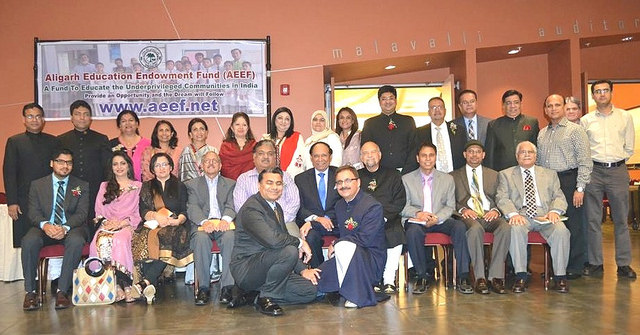
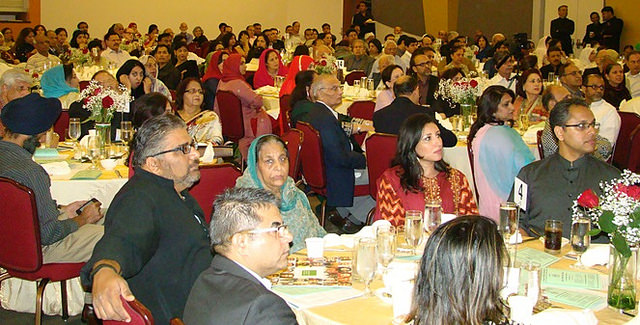
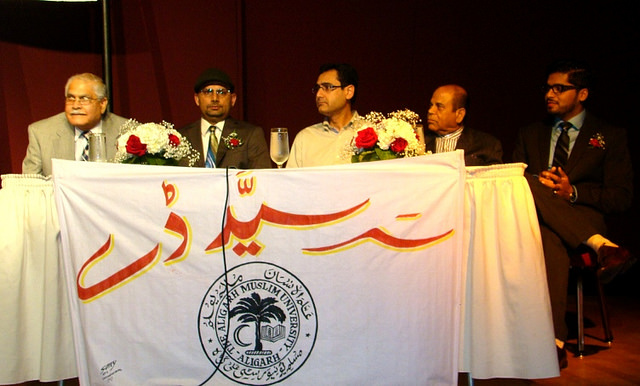
The Aligarh Muslim University Alumni Association of Northern California carried on its annual tradition of holding Sir Syed Day in the San Francisco Bay Area with a fine evening of cultural expression, reflection and entertainment at the ICC in Milpitas on Saturday, September 20th.

Funds were also collected on the occasion for the Aligarh Education Endowment Fund (AEEF) which supports those whose path to education is impacted by lack of funds or social mobility. Both children and youth are assisted through this AEEF vehicle and one can commend Aligarh Muslim University (AMU) alumni for making their annual homage to Sir Syed Ahmad Khan, the founder of their Alma Mater an added purpose.

SirSyed1MPOs30sept2014

After a fine dinner of Mughlai cuisine the formalities began with the traditional recitation from the Holy Qur’an by Mohammed Nadeem. Emcee for the evening Dr. Shaheer Khan made the necessary introductions. He said that everyone here needs to be thanked for their dedication, because the hall tonight is full to its maximum capacity and people unfortunately had to be turned away. He added that the Mushaira or Urdu poetry recital held here attracts many people but it is the cause which is the prime reason for this gathering, which is Sir Syed and AMU. He said that Aligarh was and is a movement and not just a place. He also took the opportunity to thank the sponsors and supporters along with the ICC for making this event possible. He also recognized local South Asians who are running for positions in the upcoming elections (Mohammed Nadeem running for Santa Clara City Council and Moina Shaiq running for Fremont School Board were here. Congressional candidate Ro Khanna was to arrive later).

Next was the President’s Welcome which this year was given by the new head of the AMU Alumni Association of Northern California, Mr. Shachindra Nath. In his short speech Shachindra Sahib welcomed everyone and took the opportunity to share his familial connection with Aligarh Muslim University (AMU) which his father also had the good fortune to attend. He pointed out the mutual respect and tolerance which he found at AMU. “I am so proud to be an Aligarian,” he said. Shachindra Sahib has been a dedicated member of the AMU Alumni Association for several years and it should come as no surprise that today he is the President of this organization.

The Sir Syed Day keynote address this year was presented by Ambassador Islam A. Siddiqui. Dr. Siddiqui till recently served as Chief Agricultural Negotiator in the Office of the U.S. Trade Representative and has now joined a think tank, the Center for Strategic and International Studies (CSIS) as a senior adviser in its Global Food Security Project in Washington DC. He is also a very familiar face to many of us in northern California because of his many years working for the State of California in Sacramento and for his long-time community activism; he is one of the founders of UMA and has been the President of the Downtown Sacramento Muslim Mosque. Although not an alumni of AMU, Dr. Siddiqui said that he was forever indebted to the campus because that is where he met his wife over 40 years ago!

“When I think of Sir Syed Ahmad Khan’s contributions to India and the world at large, it is about Education, Economic Empowerment and Moderation,” said Siddiqui. Giving the audience a backdrop of British-Indian history, and the poor state of Muslims after the 1857 revolt (the first attempt by Indians to gain independence) which failed, Sir Syed’s unique role was highlighted. “Here came a thinker and a visionary, who had worked for the British East India Company, had studied the causes of the Indian revolt, published a commentary on the Bible and was even instrumental in establishing The Scientific Society of Aligarh,” he said. He added that Sir Syed was fighting for the educational, social and economic uplift of Indian Muslims about the same time as President Abraham Lincoln was fighting for the cause of African Americans to abolish slavery in the United States.

He said that today the situation of the Muslim masses in India is not great and cited some relevant statistics from the Sachar Committee Report of 2006 which concluded that “When it comes to education the situation of Indian Muslims is indeed depressing as compared to other socio-religious communities and the problem is more acute among girls and women”. Siddiqui remained hopeful that as India’s economy grows, economic opportunities for all Indians will expand. “As the saying goes: A rising tide lifts all boats,” he said. He also reinforced the charter of the AEEF and its fundraising activity by saying that it is our moral obligation to give back to the under-privileged in the community and country that made it possible for us to reach where we are today.

SirSyed2MPOs30sept2014

Dr. Shaheer Khan returned to present an AEEF Update. The Aligarh Education Endowment Fund needs about $100,000 for 2014-2015 academic year to fund its projects which include the sponsorship of excellence in education through scholarships, Aligarh Modern School, Hamara School Aligarh, Faizabad Public school (Faizabad), Faiz-e Aam Muslim Inter College (Faizabad), Hira Public School (Ambedkar Nagar), J.A.B.I.C. Bhadarsa (Ambedkar Nagar), J.D.J.B. Anand P.G. College (Faizabad), M.I. Girls Inter College (Faizabad), Rishiraz Singh Maha Vidyalya (Faizabad), and many others.

It is also supporting Saiema Mansoor Public School (Hathras), vocational training for women, a mentorship program and students at premier institutions in India. A short fundraising appeal was made with a target of $60,000 in mind. And in the process, just before the entertainment, the Aligarh Tarana or anthem was enthusiastically played and sung by some of the alumni of AMU present.

The second part of Sir Syed Day is the “International Mushaira” which brings together some of the finest poets or practitioners of Urdu language poetry from around the globe (mainly from where it is used most, India and Pakistan). Countries can be partitioned but one cannot do that with a language. Urdu’s birthplace is in India where AMU is physically located too, but Urdu ironically is the national language of Pakistan. Where borders and governments divide, language-culture and family unite. I did get an opportunity at this event to meet the Consul of India in San Francisco and air the trials and tribulations of getting a visa for India for a person of Pakistani origin!

This year the list of poets was “Pakistan heavy” for the lack of a better term. The Mezban or host poets in order of appearance were Shahid Siddiqi (Canada), Misum Samer (Bay Area), Faisal Azeem (Canada), and Ahmar Shehwaar and Tashie Zaheer (both from the Bay Area). The Mehman or guest poets were Ambareen Haseeb ‘Amber’ (Pakistan), Nusrat Mehdi (India), Abbas Tabish (Pakistan) and Sarfraz Shahid (Pakistan). Two new aspects were noted in this year’s Mushaira. One the Nizamat was done by a young lady (Amber) and two the Sadarat and closing poet (Sarfraz) was the one who provided comic relief (possibly designed so that people went home in a good mood).

It would take another full article here just to cover the Mushaira segment of the evening. But just to highlight some of the activity here, senior poet Abbas Tabish aptly described the entire Mezbaan Shayir group (locals) as amongst the most talented that he has ever seen. All of them were worthy and it was good to see young Faisal Azeem back in this area. I just had to thank Tashie Bhai personally for his one line that made us proud. In a nutshell none of the local “amateur” poets were less than professional!

SirSyed3MPOs30sept2014

Amongst the four Mehman Shayir’s (guests) Ambareen was extremely entertaining both as a poet and in her “Tum Bhi Naa” and in her Nizamat role. Nusrat Mehdi was the feminist voice of the evening and she was amazing in Tarannum especially with her “Mein Bhi to Hoon”. Abbas Tabish was his usual pensive self with his “Intizar ke Lamhe” and his ode to mothers everywhere. And last but not least Sarfraz Shahid who in his Sadarat role provided enough comic relief to us that many had smiles on our faces as we made our way out of the door. His take on “Maulana and Hoorain”, romance in Cricket “Musalman mard ko char hi run ki Ijazat Hai” and his political cutlery were all very well received.

The Annual Sir Syed Day Aligarh magazine was also released on this occasion. The magazine is dedicated to Hali and Shibli. This year marks the 100th death anniversary of Maulana Altaf Husain Hali and Maulana Shibli Nomani, two pivotal members of the team of Sir Syed’s ‘Rufaqaa’ in the establishment of the MAO College.

In conclusion we did not stay for the doosra daur (round two) of the poetry but it was already quite a rewarding and satisfying event for us. The Aligarh Alumni Association of Northern California once again needs to be congratulated for holding this gathering where everyone enjoyed the food, revisited Sir Syed’s vison and participated in quality entertainment.

source: http://www.twocircles.net / TwoCircles.net / Home> News / by Ras H. Siddiqui, TwoCircles.net / September 30th, 2014

Heroism of Indian Muslim woman in World War II inspires today

Bruce.Lipsky@jacksonville.com // Noor Inayat Khan is pictured during the film. She was recruited as an operative to help the Allies.
Bruce.Lipsky@jacksonville.com //
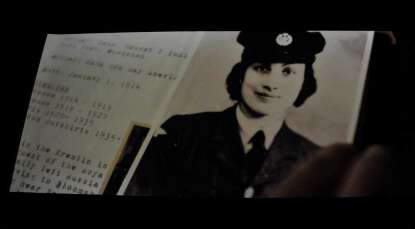
Noor Inayat Khan is pictured during the film. She was recruited as an operative to help the Allies.

The quiet, unwavering heroism of a young Indian Muslim woman who sacrificed her life to fight against Nazi domination during World War II offers lessons of faith, courage and inspiration as relevant now as it was back then, say those who heard her story Sunday.

Bruce.Lipsky@jacksonville.com /  Noor Inayat Khan is pictured during the film. The University of North Florida Distinguished Voices Lecture Series presented "Enemy of the Reich: The Noor Inayat Khan Story" Sunday, September 28, 2014, in Jacksonville, Florida, on campus in the Robinson Theater. (Florida Times-Union/Bruce Lipsky)
Bruce.Lipsky@jacksonville.com /
Noor Inayat Khan is pictured during the film. The University of North Florida Distinguished Voices Lecture Series presented “Enemy of the Reich: The Noor Inayat Khan Story” Sunday, September 28, 2014, in Jacksonville, Florida, on campus in the Robinson Theater. (Florida Times-Union/Bruce Lipsky)

“It really makes you think. What would I do in a situation like that? … I hope I would have had her courage,” said K.C. Emerson of Jacksonville, who decided at the last minute Sunday afternoon to attend the screening of “Enemy of the Reich: The Noor Inayat Khan Story” followed by a panel discussion at the University of North Florida’s Andrew A. Robinson Jr. Theater.

The film is the true story of Khan, who sacrificed her life to fight against Nazi domination during World War II. The daughter of an American mother and Indian Muslim father, Khan grew up in a home that nurtured interfaith dialogue and cooperation at a Sufi center of learning in Paris.

In early 1943, she was recruited as a covert operative into Winston Churchill’s Special Operations Executive. By then Khan had trained as a wireless operator in Britain’s Women’s Auxiliary Air Force. As a covert agent, Khan was instrumental to the French Underground’s direct attack on Nazi units in preparation for the Allies’ D-Day invasions.

In August 1943, Khan was the last surviving clandestine radio operator in Paris and signaled London for additional weapons and explosives for the French underground. Khan ultimately was captured and executed at Dachau, the Nazi concentration camp in Germany.

On Sunday, Emerson was among Northeast Florida residents as well as UNF students nearly filling the theater for the screening and panel discussion, part of the 2014 Distinguished Voices Lecture Series. The program co-hosted by UNF and Better Together at UNF, a student organization composed of religiously diverse students with a mission of mobilizing their peers to voice their values, engage with others, and act together to make the world a better place.

“It’s an exploration into meaning and purpose of life, and what values might be worth risking it,” Tarah Trueblood, director of UNF Interfaith Center, said of the program.

Such dialogue, she said, is especially crucial now, given the conflict in the Middle East and fear generated by ISIS and other terrorist groups.

“Peace happens one relationship at a time. And getting to know your neighbor can be that one big step you take today,” said Trueblood, adding sometimes that can take a lot of courage to reach out to our neighbors if they are different from us.

“We want our politicians to make peace or somebody else to make peace. But making peace takes us going over to our neighbors and getting to know them,” Trueblood said.

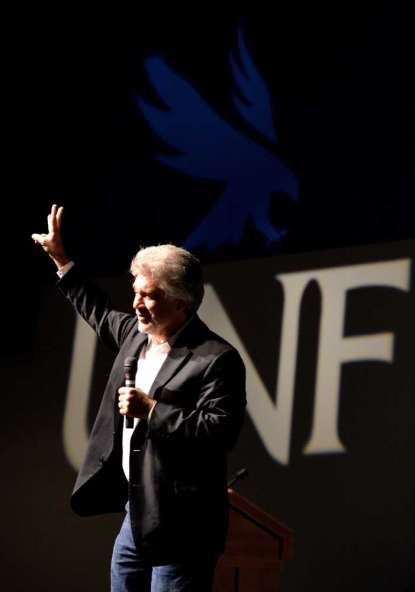
Bruce.Lipsky@jacksonville.com /  Alex Kronemer, executive producer of the film about Noor Inayat Khan, speaks before the screening of his film.
Bruce.Lipsky@jacksonville.com /
Alex Kronemer, executive producer of the film about Noor Inayat Khan, speaks before the screening of his film.

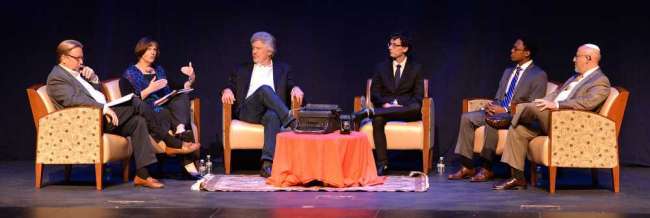
The panelists included Alex Kronemer, one of the film’s producers, UNF Interfaith students, Cheryl Tupper of the OneJax Institute at UNF and vice president of the Arthur Vining Davis Foundation and Rabbi Jonathan Lubliner of the Jacksonville Jewish Center. UNF President John Delaney facilitated the discussion.

Kronemer is co-founder and executive producer for Unity Productions Foundation. A Muslim, he has delivered talks on religious diversity and Islam for the U.S. departments of Justice and State, FBI and other organizations.

Refusing an order to return to England, Khan stayed in Paris and continued radioing information to the Allies after all her comrades were captured by the Nazis.

“In her case, she just had the determination. She had come with these people, bonded with these people and they had all been captured, but she didn’t want their sacrifice to be meaningless. In retrospect, it was a giant decision to make because it led to her ultimately being killed. But at the time, it was a small decision of heroism,” Kronemer said. “That’s really where I think heroes are made. … Today, what are the small decisions of heroism that we’re making?”

Parvez Ahmed, a faculty mentor and UNF professor, encouraged the audience to continue the conversation sparked Sunday through the program.

“I want us to draw upon the inspiration that Noor gave us through our life and our sacrifices. It would be nice if we could all go beyond the lip service that we often give such inspiration and do something that is actually long-lasting and sustainable,” Ahmed said.

To that end, Ahmed said the UNF Interfaith Center is instituting a service award to be presented annually to one or more deserving students. In the form of a scholarship, it will be the Noor Inayat Khan Interfaith Service Award, he said.

Khan was posthumously awarded the George Cross, the highest civilian medal for bravery and sacrifice in Great Britain. The French awarded her the Croix de Guerre with Gold Star. A plaque bearing her name hangs at Dachau, and a memorial statue of her was erected in London’s Gordon Square in 2012.

source: http://www.members.jacksonville.com / The Florida Times-Union / Home> News / by Teresa Stepzinski: (904) 359-4075 / Sunday – September 28th, 2014

Farah Pandith, Special Envoy to Muslims, Leaving for Harvard

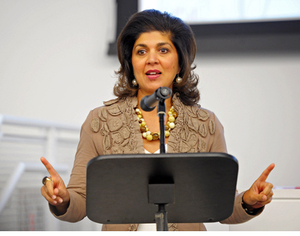
File photo of Special Representative to Muslim Communities Farah Pandith addressing the audience during the UN International Year of Youth Culmination Celebration Summit at the United Nations on Aug. 11, 2011 in New York City. (Getty Images)

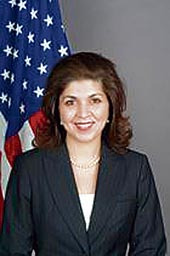
Farah Pandith, appointed in June 2009 as the first-ever Special Representative to Muslim Communities by former Secretary of State Hillary Clinton, will be leaving her position to join the Institute of Politics at Harvard University.

Pandith always places people above politics, and she has performed groundbreaking work since her appointment, Secretary of State John Kerry said Jan. 23.

Her legacy “is an extraordinary record of thoughtfulness, balance, and sheer guts and determination. Anyone who’s worked with Farah will note her uncommon ability to bring people of different backgrounds together. I’ve seen that commitment firsthand in her pioneering work to reach out to countries with both Muslim majorities and minorities,” Kerry said in a statement.

Pandith will be joining the Institute of Politics as a Resident Fellow for the spring semester. As a Fellow, the Indian American will lead weekly study groups on a range of topics.

Kerry, in his statement, said of Pandith, “On so many issues, Farah Pandith has been a trailblazer and a visionary,” adding, “It’s in her DNA as a first-generation immigrant who achieved historic firsts for America, from changing the way our embassies engage with Muslim communities in Europe to getting a Quran placed in the White House Library.”

Pandith’s deputy, Adnan Kifayat, will serve as the acting special representative until a permanent replacement is named.

Pandith, originally from Srinagar, has a master’s degree from The Fletcher School of Law and Diplomacy at Tufts University, Boston, Mass., and an A.B. from Smith College.

source: http://www.indiawest.com / India West / Home> News / by A Staff Reporter / Wednesday – January 22nd, 2014

Kashmir gives US its Muslim face

FarahMPOs24sept2014

Srinagar :

The highest-ranked South Asian in the White House traces her roots to the separatist stronghold of Sopore in Kashmir.

Farah Pandith was today appointed special representative to Muslim communities in the US state department headed by Hillary Clinton.

“This is not just an honour for our family but the entire Kashmir,” said her maternal uncle Mian Mushtaq Ahmad, a former chief engineer of the Jammu and Kashmir government.

“I spoke to her this morning and she was obviously very happy,” added the Srinagar resident.

Farah, in her early 40s according to her relatives, will be in charge of a new office that is responsible for reaching out to Muslims across the world, according to a release by the state department. They will take forward Clinton’s efforts to “engage with Muslims around the world at a people-to-people and organisational level”, it added.

Farah and Hillary : Indian connection

The Pandiths left for the US in 1970, when Farah was only four. Her father, Mohammad Anwar Pandith, is a businessman originally from Sopore, a place that has been in news for all the wrong reasons over the past 20 years. It is the hometown of Hurriyat hawk Syed Ali Shah Geelani and has been a separatist bastion all these years.

Her mother Mehbooba, from Srinagar, is a chest specialist. With their younger son, they live in Boston.

Farah, an alumni of the Fletcher School of Law and Diplomacy, has kept coming back to Kashmir over the years, her uncle said. She even did her postgraduation thesis on the Kashmir insurgency.

Earlier, she was a senior adviser on Muslim engagement at the state department, serving under the assistant secretary of state for European and Eurasian affairs.

“The last time she was here was some three years back. She was not allowed to come to this (troubled) region after that because she was working in the White House,” said Ahmad, many of whose relations are settled in the US.

The Pandiths are a respected business family in Sopore and Farah’s grandfather Abdul Samad Pandith was the first to set up a cinema there. Samad Talkies shut its doors after militants banned cinema in the Valley in 1990.

The appointment comes a year after the George W. Bush administration gave Neel Kashkari, a man of Kashmiri origin, the task of bailing out the US economy as the interim assistant secretary of the treasury for financial stability.

source: http://www.telegraphindia.com /  The Telegraph, Calcutta / Front Page> Nation> Story / by Muzaffar Raina / Srinagar, June 25th / Friday – June 26th, 2009

The Husain on the wall

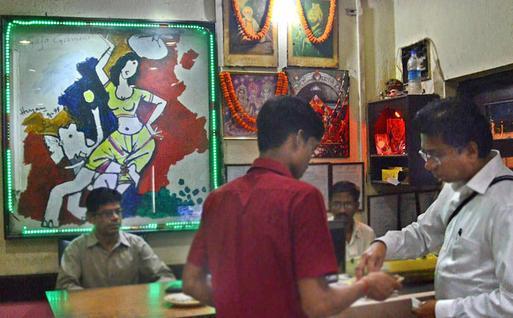
The wall of the Azad Hind Dhaba in Kolkata adorned with M.F. Husain’s Gaja Gamini. Photo: SUSHANTA PATRONOBISH

The now-famous painting, titled Gaja Gamini (one with a walk like an elephant), depicts a dancing woman, in a bright red background, while a white elephant looks on with its trunk held aloft

The memory of seeing M.F. Husain colouring one of his sketches back in 1999 is still fresh in the mind of Madan Sharma, one of the owners of Azad Hind Dhaba, a popular eatery in south Kolkata.

One fine afternoon years back, Mr. Husain walked into the dhaba, which he frequented during his visits here, and all of a sudden started adding colour to the black and white sketch on the wall that he had drawn three years before.

“The experience made me speechless,” Mr. Sharma said, on the eve of the 99th birth anniversary of the iconic painter.

The now-famous painting, titled Gaja Gamini (one with a walk like an elephant), depicts a dancing woman, in a bright red background, while a white elephant looks on with its trunk held aloft. Mr. Husain arranged a private show of his film Gaja Gamini at Azad Hind in 1999.

Sitting at the cash counter with the painting behind him, Mr. Sharma fondly recalled his memories of the famous artist. He remembers Mr. Husain as a “moody and humble person” who would come to the restaurant and sit quietly in one corner sipping his favourite “kadak chai [strong tea].”

“He did not talk much. But sometimes told me what kind of food he wants,” Mr. Sharma said. He was initially apprehensive of talking to an artist of Mr. Husain’s calibre, but eventually they became friends. “Mr. Husain could mingle with adults and children with equal ease. He was totally devoid of arrogance.” Whenever schoolchildren spotted him at the eatery, they flocked to him and asked for autographs. The world-famous painter complied with their demands with a smile and even drew them impromptu sketches.

When asked about the controversy that erupted in 2006 over Mr. Husain’s depiction of Hindu gods and goddesses, Mr. Sharma said the thought of removing the painting never entered his mind. “Nobody asked me to remove the painting even when the controversy erupted.”

Mr. Husain eventually had to leave the country under pressure from Hindu nationalist forces. He passed away in London in August 2011.

Meanwhile, the dancing woman with an elephant walk lives on happily on the central wall of Azad Hind Dhaba, in the company of numerous Hindu gods and goddesses.

source: http://www.thehindu.com / The Hindu / Home> Features> Friday Review> Art / by Soumya Das / Kolkata – September 17th, 2014

Son Of The Soil

Mehmood Khan, Unilever’s global innovation head, goes back to his native village with a plan to turn it around.

Nai Nangla in Haryana’s Mewat district could be just another Indian village, ridden with the usual problems of a people trapped in poverty: Lack of healthcare and clean water, low productivity, high unemployment and illiteracy. But Haji Siddiq Ahmed, a local farmer in his late 60s, sees a different vision. “I want this village to be an adarsh (model) village. Others should look up to this village — that this is what an ideal village should be like,” he says.
The image Ahmed sees is actually taking shape in this quiet village with a majority Muslim population. What’s more surprising is the way the change is taking hold. It may be difficult to imagine the humble folk of Nai Nangla as business executives, but the cool concepts reviving the economy of the village are no less professional.

Take dairy farming, which engages nearly 80 percent of the villagers. Earlier, all they could get was Rs. 12 for a litre of milk; today they can get as much as Rs. 25. Three years ago, female literacy was at 2 percent; today, almost 85 percent of the female population can sign their names and 86 percent of the children in the district are enrolled in schools. Some women are also learning to sew and are setting up their own tailoring units. Companies like insurance provider Aviva, ICICI Bank and Larsen & Toubro are beginning to look at Mewat both as a market and as a field for recruitment. They have hired locals, offering dramatically higher incomes.

Image: Amit Verma / CHARGING UP: Memhood Khan's plans changed Ramzaan's life for the better. The young man treats Khan to a ride on his new motorcycle
Image: Amit Verma /
CHARGING UP: Memhood Khan’s plans changed Ramzaan’s life for the better. The young man treats Khan to a ride on his new motorcycle

The man behind these changes is a Nai Nangla native, someone who left the village nearly 40 years ago in search of an education and a career. His name is Mehmood Khan. Now 54, he is Unilever’s innovation head.

Now, thanks to him an experiment in introducing market economy is taking shape at Nai Nangla and the district of Mewat. An impossible feat for an outsider, but something the people of Nai Nangla have welcomed from one of their own. “Focus on education and use enterprise to bring change by leveraging resources in villages,” he says.

Khan has worked and lived in many countries over the years, making London his home for the last nine. But his link to his roots always remained alive; he would visit his village two or three times a year. He still remembers trudging a couple of kilometres to school everyday and taking cattle out to graze.
“I somehow landed a seat in university and then got into IIM-Ahmedabad. I was ejected by the system,” he says.
For the last five years, Khan has been hard at work to change “the system”.

He is converting a local resource, livestock, into a productive enterprise. He roped in the National Dairy Development Board’s Mother Dairy to spur Nai Nangla’s milk output and break the stranglehold that milk vendors had on local dairy farmers. At one time, these vendors — middlemen really — would lend money to farmers to buy milch animals.
In return, they would demand milk supply at low fixed prices until the loans were repaid. For most farmers, their income was too low to enable them to repay the debt. The result: They remained trapped in debt.
Khan was troubled by this age-old exploitation. He spoke to Mother Dairy and ushered in a new system to break this debt trap. Debt-laden farmers were given loans from institutions so they could repay the vendor and start selling direct to Mother Dairy. “Almost 25 people got loans to buy cattle, without having to pay any bribes,” says Ahmed.

Others who could repay on their own, did so and started selling to Mother Dairy for a better price. This competition forced the milk vendors to match market prices. Overall, incomes improved.
In July 2008, Mother Dairy set up milk collection centres in Nai Nangla and six other villages. In the first week, it got 70 litres of milk. Today, Nai Nangla alone gets 250 litres a day. “Gross income from agriculture has gone up from Rs. 80 lakh to Rs. 1.2 crore,” says Khan. “Milk (has become) a constant income source in a village which has seasonal income due to Kharif and Rabi crops.”

source: http://www.forbesindia.com / Forbes India / Home> Features – Beyond Business / by Neelima Mahajan-Bansal / June 05th, 2009