Category Archives: NRI’s / PIO’s

Abracadabra : Passing thoughts on men and mice

Kennedy, Sabu and Anekaroti
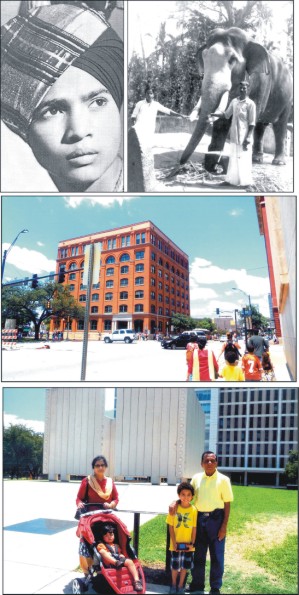
(1-Top Left )Sabu, the elephant boy. (2-Top Right) Sabu with his father, a mahout (3- Middle) This is the rear of the building from where Kennedy was shot and killed. (4-Bottom) The memorial like a wall with vertical lines at the spot where Kennedy delivered his last speech. Dr. Sunder Raj is seen standing by the side of the information plaque.
(1-Top Left )Sabu, the elephant boy.
(2-Top Right) Sabu with his father, a mahout
(3- Middle) This is the rear of the building from where Kennedy was shot and killed.
(4-Bottom) The memorial like a wall with vertical lines at the spot where Kennedy delivered his last speech. Dr. Sunder Raj is seen standing by the side of the information plaque.

A couple of days back, an old friend of mine from Bangalore had come to meet me and casually asked if Dr. J.K. Sunder Raj, a well-known family doctor of our city, had hung his stethoscope. Since I am in regular contact with him either in the Sports Club or Mysore Race Club or in connection with the Zoo (where he treats the gorillas), I answered in the negative.

“What makes you think Dr. Sunder Raj has called it a day and closed shop?” I asked.

It seems my friend had gone to see him at his clinic on Old Mysore Bank Road in city and found there was no clinic. That was news for me too. I called him on telephone to check. Yes, indeed he had closed his city clinic, but continues his service to the sick families from his house on Vivekananda Road in Yadavagiri. It was then that the good doctor said he was wanting to see me personally to hand over a unique newspaper that he had purchased in Dallas, Texas, where he had been recently to be with his daughter.

As promised, he came to my office with his special newspaper and more. The cover page of the newspaper is produced here… and the headline is self-speaking.

The daily newspaper ‘The Dallas Times Herald’, in its Friday evening Nov. 22, 1963 Final Edition, had carried world’s most shocking and tragic news of the day that happened in the city from where the paper was published. The assassination of US President John F. Kennedy. Looking at the paper that appeared as pulled out from the well-preserved archive, I wondered how our doctor managed to get the paper which will have huge antique value ! He asked me to take it easy. There is nothing like grabbing an old copy of that day of tragedy of Nov. 22, 1963. The credit for making available this copy of the newspaper to tourists should go to the Curator of Kennedy Museum at Dallas where Dr. Sunder Raj purchased it by paying $ 4.60. The cover price of the newspaper in 1963 was five cents.

The Museum authorities periodically print this historic newspaper as it was printed on that tragic day and sell them. What better souvenir one would want for visiting the Kennedy Museum ?

I took a copy of it before returning the original to the doctor and wondered if anything like this is being done at Gandhi Museum or Nehru Museum in our country. Readers with information on this may please write or e-mail to me.

Dr. Sunder Raj also gave me two photographs he had taken — one of the building from where Lee Oswald, the assassin, shot the President from the sixth floor which has now been converted into a Museum and another, the spot where President Kennedy delivered his last speech.

Dr. Sunder Raj also had two more surprise photographs with him which were of personal nature. One was a photograph he had clicked in the year 1951-52 at the elephant stables of the Maharaja, known famously as ‘Anekaroti.’ Now the new generation as also of the old generation may not know that the Anekaroti ever existed in Mysore, attracting huge number of tourists those days.

The stable was located where the JSS Hospital Complex is now. There used to be 20 to 25 elephants, well fed and healthy, says the doctor. The area of the Anekaroti used to be green and cool with plenty of trees, adds Dr. Sunder Raj.

The doctor recalls: Once a team of Hollywood film-makers visited Mysore in around 1950. They also visited the then famous Anekaroti. As they went around Anekaroti, they saw a young, bright and handsome boy playing with a huge elephant. His name was Sabu Dastagir who later became a famous Hollywood actor under the name Mysore Sabu (27.1.1924 – 2.12.1963). He was born in Karapore in H.D. Kote, the famous hunting forest of the Maharaja of Mysore. His father was a mahout (elephant attendant) and trainer of elephants. Sabu, his son, too was following his father’s profession where he was spotted by the Hollywood film-maker Robert J. Flaherty.

Dr. Sunder Raj says that Robert Flaherty persuaded Sabu’s father to let him take Sabu to Hollywood. Once in the US, Sabu was taught English and given training in acting.

Sabu acted in several English movies, specially connected to the jungles. His first movie was ‘Elephant Boy’ which was a great hit. Other movies were ‘Song of India,’ ‘The Jungle Book,’ ‘The Thief of Baghdad’ etc. It is sad that such a talented Mysore boy died young at the age of 39.

To those working to develop Mysore as a tourist destination, I may suggest that they revive the ‘Anekaroti’ which is sure to become a tourist attraction. Some lessons from the ‘elephant show’ of Bangkok’s ‘Rose Garden’ may be learnt and incorporated to this Anekaroti. Howzzat?

source: http://www.starofmysore.com / Star of Mysore / Home> Abracadabra….Abracadabra / by  K.B. Ganapathy, Editor  e-mail kbg@starofmysore.com / November 18th, 2013
Forever in search of reality

Chronicler of cinema

The 1950s. When 12-year-old Nasreen Munni Kabir sat in the darkened Scala Theatre in Charlotte Street, London, catching her first glimpse of Hindi films, little did she ever imagine that years later, she would plunge headlong into making documentaries and authoring 14 books on Indian cinema. 

Like millions of NRIs, Nasreen says her family also kept connected to the mother country through food and films. “More than Indian cinema, I would say Hindi film songs,” she says, a brightness shining in her dark eyes as she travelled down decades. This was the 1950s, an era when the DVD or the Internet were far from even entering the scene. At such a time, there was even more romanticism attached to cinema and songs. “They not only defined the idea of home, but also defined the idea of romance,” Nasreen said, “like the song Chandni raatein, pyaar ki baaten.”

Some distributors in London showed Indian films on Sunday mornings when regular business was low, and this is where the love for the flickering images on screen was born. And it was obvious that those memories were still fresh, as a luminous smile lit up her face when she recalled them. “The first images that I can remember are that of Nimmi running through mustard fields in Mehboob Khan’s Aan, and she is singing ‘Aaj meri man mein saki bansuri bajaye koi…’ More than the song, I was struck by Lataji’s beautiful singing. And who is standing at the end of the field on a black horse but Dilip Kumar. Now, anybody growing up in the 1950s had to fall in love with Dilip Kumar, otherwise they were pure idiots!” she exclaimed delightedly.

Hindi film music strengthened her affair with the world of Indian cinema, and the beautiful songs led her to the films themselves. By this time, the young girl was clear in her mind that she wanted to be a part of the film industry. She was 18 and was already working as an aide in several films. French films were causing ripples at the time, and she even worked as assistant director to the path-breaking French new wave director Robert Bresson in Four Nights of a Dreamer in 1971. “He was a master! And my name is there in the credits,” she said, with a fresh young girl’s pride that belied all the years of carving a name for herself as a documentary-maker of repute.

It soon became clear to young Nasreen that she had tochoose a different path in the world of cinema. “I always wanted to work in films, but I always thought I did not have the personality or the talent to make fiction films. I thought I was better at recording reality, so I wanted to go down the documentary route. So when I was in France in the 1980s — I had already done a doctorate in cinema studies from the Sorbonne — I started thinking of doing a thesis on four Indian directors — Bimal Roy, Guru Dutt, Mehboob Khan and Raj Kapoor, because I thought they were the best. This was in 1982-83.”

Instead of beginning her thesis, she started programming Indian film festivals at the Pompidou Centre, getting 100 films to be shown there in 1983. “This was big. Satyajit Ray, G Aravindam and others came!” In 1985, she followed it up with another festival of popular Indian cinema. By this time, it became clear to her that the films of Guru Dutt had caught her imagination.

“Because he combined many forces, a deep understanding of cinema, and had a singular voice and vision. You see two shots and you would know this was Guru Dutt. Same as Bimal Roy, Mehboob sahab, but you cannot pretend to put the same energy into four people. Either you go wide, or you go deep. It’s better to go deep and do one thing properly. And I thought to myself that I would spend most of my next 10 years doing research on Guru Dutt, because his films moved me the most. He was a romanticist, but had a fantastic understanding of cinema, it was brilliant.”

What followed was a three-part documentary series called In Search of Guru Dutt that was produced by Nasreen for UK’s Channel 4. While Dutt himself had passed away by then, the documentary traces his life through extensive interviews with colleagues and family members, and excerpts from his films.

That was the beginning of many documentaries that followed through the years on Hindi films and personalities, including Follow That Star (Amitabh Bachchan), Lata in Her Own Voice (Lata Mangeshkar), and The Inner/Outer World of Shah Rukh Khan. Her deep research for her documentaries led her to publish 14 books. Interestingly, two of the books are immortal dialogues from Mughal-E-Azam and Awaara, with notes and comments.

We return to Hindi songs, and Nasreen said the beautiful lyrics, songs, singers and music composers had played a large part in immortalising the first 50 years of Indian cinema. We discuss maestros like S D Burman, writers like Sahir Ludhianvi, Lata Mangeshkar and Mohammed Rafi, and many eternal hit songs, as the clock ticked away relentlessly. She didn’t have the clichéd view that the music and lyrics of the past were far better than that being produced today. “That was good for those days; this is good for today. Even Gulzar sahab continues to write lyrics today.”

We veer towards Hollywood taking over cinema in most parts of the world. She cuts in. “Hollywood has taken over. For the past 30 years! Where do you see German productions? There are (just) 12 films a year in England.” She said Hindi cinema has withstood the onslaught of Hollywood. “You name one country in the world that still produces 100 films a year,” she said, refusing to get into a debate about form.

“We are not talking of aesthetics. I am talking of employment, industry. In the world today, I believe it’s India, China (Hong Kong films) and then it’s Hollywood. I am not talking reach and moneymaking. In terms of moneymaking, I think Hollywood is No. 1. Here they get very happy with 100 crore. There it would be the weekend earning of Batman!” she said with a twinkle in her eye.

As she hurries away to join a discussion with other writers, the energy I had witnessed made me very sure that there would be many more documentaries and books from this incisive director and author.

source: http://www.deccanherald.com / Deccan Herald / Home> Supplements> Sunday Herald Entertainment / by S. Nanda Kumar / November 17th, 2013

Husain’s ‘Bhopal’ to go under the hammer

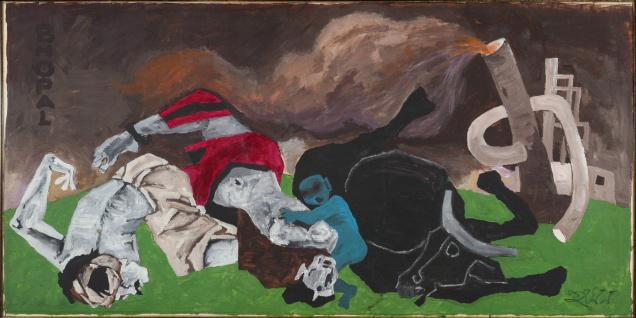
M.F. Husain’s “Bhopal”. / Photo: Special Arrangement / The Hindu

The oil on canvas has been valued at £200,000-300,000

‘Bhopal’, Maqbool Fida Husain’s anguished representation of the terrible consequences of industrial negligence in Bhopal, is to go under the hammer on October 8 at the Bonhams Auction House in London.

Husain’s framed and signed oil on canvas, with ‘Bhopal’ painted boldly on the side of the canvas — as if to leave no doubt on which disaster he is depicting — has been valued between £200,000 and 300,000, a press release from the auctioneers said.

“Just as Pablo Picasso’s passion and outrage towards the Spanish Civil War had inspired him to create ‘Guernica’ (1937), ‘Bhopal’ was the result of Husain’s horror at the long-lasting effects of the leak,” the press release said, though attributing the work’s energy to Husain’s own genius that was moulded by life around him. The Bhopal disaster occurred on December 3, 1984 when a poison gas leak from a Union Carbide factory killed around 2000 people.

Headlined by Husain’s ‘Bhopal,’ the October 8 auction of Indian and Islamic art will also auction ‘Bindu’ by Syed Haidar Raza (b.1922) that has been valued between £100,000 and 150,000, and ‘Untitled’ by Francis Newton Souza (1924-2002) valued between £40,000 and 60,000.

Raza started painting the Bindu series in the 1980s. “An act of meditation and the ‘Bindu’ is the centre of calm” the press release says.

Yet another highlight of the auction is ‘Four Figures” by Pakistani artist Sadequain (1937-1987) with an estimated valuation of £45,000-65,000.

This is not the first time that Husain’s paintings have been sold by Bonham’s, which specialises in Asian art. This April, an untitled Husain painting of horses was sold for £205,250; and in 2007, at the height of Husain’s troubles with right wing Hindu nationalist groups who hounded him for painting disrespectful and nude representations of Hindu goddesses, the same auction house sold his ‘Nude Woman’, a masterly painting of the naked female form, one that unfortunately had to find its home outside the country that inspired all his art.

source: http://www.thehindu.com / The Hindu / Home> Arts / by Parvathi Menon / London – September 20th, 2013

Rani Hamid — Anand’s cheer girl from Dhaka

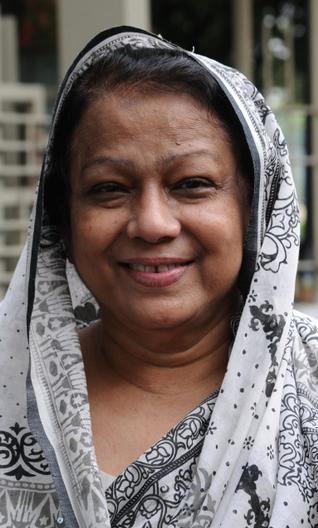
Rani Hamid /. Photo: R. Ragu / The Hindu

Rani Hamid is 69, but at the Jawaharlal Nehru Stadium here on Wednesday afternoon, she looks as excited as a little girl.

“I would be watching Viswanathan Anand playing the World championship and that is something I have been looking forward to for the past one week,” she says, even as she waits for the bus that would take her to Hyatt Regency. “I would be cheering for him.”

Rani is not your average grandmother who loves chess as a hobby. She is actually the grand old lady of Asian chess. She is a Woman International Master, the first from Bangladesh. And she is a veteran of several Chess Olympiads.

“I don’t remember how many Olympiads I have played exactly, but I have been representing Bangladesh since 1982 and I played at the Olympiad last year too,” she says. “I have also played on the men’s team.”

She has also won the British women’s championship on three occasions.

Proud achievement

And there is also another achievement she is proud about. “I could stretch Anand a bit when I played him at the Fakhruddin Ali Ahmed tournament in New Delhi, about three decades ago,” she says.

“Anand was a young boy and he was playing at lightning speed; he used to win in no time against his opponents, but our game was taking much longer than usual; I remember his mother getting a bit restless and worried because of that. I was an exchange up at one stage, but Anand of course won.”

She wants Anand to win the World championship. “He is not just the pride of India, he belongs to whole Asia,” she says. “Besides, I was an Indian too, till I was three years; you know I was born in 1944. So I have been the citizen of three countries – India, Pakistan and Bangladesh.”

Rani is here for the International Woman Grandmaster tournament. “I decided to play in the tournament largely because I wanted to watch the World championship,” she says.

“I have been playing in India for several decades and have many pleasant memories. I remember the Khadilkar sisters pioneering women’s chess in India and Bhagyashree Thipsay telling me that she would one day beat them. She did beat them, of course.”

Talented youngsters

She is happy to note that India has grown in stature in world chess over the years. “It’s nice to find that there are many talented youngsters around,” she says. “And I think Koneru Humpy is a potential women’s World champion.”

She has also noticed chess becoming a sport for the young. “Back in my time, it used to be an old man’s game,” she recalls. “And I used to be told that little girls should not play chess.”

Rani is fond of India for another reason. “My son Kaiser Hamid played for Mohammedan Sporting, Kolkata,” she says. “He has captained Bangladesh. Another son, Sohel Hamid has been a National squash champion.”

source: http://www.thehindu.com / The Hindu / Home> Sport> Other Sports / by P.K. Ajith Kumar / Chennai – November 14th, 2013

‘There is anger because the Muslim world feels targeted, essentially for 9/11. And its millions of people had nothing to do with that’

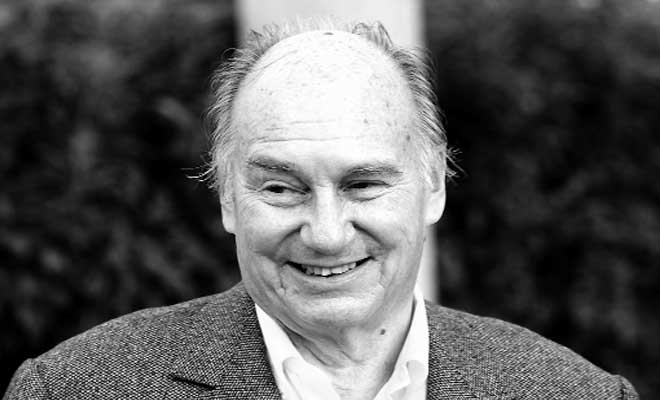
AgaKhanMPos07nov2013

In this Walk the Talk on NDTV 24X7 at his foundation’s latest initiative, the Aga Khan Academy near Hyderabad, His Highness the Aga Khan talks to The Indian Express Editor-in-Chief Shekhar Gupta about the growing Shia-Sunni tension that worries him, and the roots of the lack of understanding between the Western and Muslim world. However, he adds, most of the conflicts one sees today have little to do with faith but have a political dimension.

It’s been said about you that no human being today bridges so many divides as gracefully and as powerfully as you do. And how many divides: the East and West, Islam and Christianity, material and the spiritual and, if I may add, ancient to the medieval, the modern and the future.

Thank you very much and I’m very happy to talk with you.

And welcome to a country which is in many ways your homeland.

Yes, yes. My grandfathers… way back.

He was born in undivided India.

He was, and the place where he was born is still there. Still in the family.

And the first school set up (as part of the Aga Khan network) was in India.

In Mundra (Gujarat).

And now there are 80-90,000 students… So what’s this thing about the Aga Khans and education?

My grandfather and I have always felt that education is an essential part of a community’s life, a country’s life, an individual’s life. It is the unavoidable building block for all people all around the world. This academy (the Aga Khan Academy on the outskirts of Hyderabad) is a part of that exercise.

Education is also a healer of the mind.

It’s a healer of the mind, but it’s also a way of making rational judgments. What we need in society is rational judgment. It helps evaluate, it helps position issues…

So before we get into the more profound discussion on making rational judgments in times when all wisdom is presumed to be given, tell us a little bit about the Hyderabad academy.

Some 10 years ago we started asking ourselves, ‘Where are we? What do we need?’. We came to the conclusion that there were a number of countries where secondary education was a critical issue. We decided that instead of trying to respond on a country-by-country basis, we would try to make a network of institutions to move intelligent children from one society to another, from one language to another, so that we would try and build global capacity and bring it in at the secondary level of education, not retard it until tertiary education or career.

And an academy like this is not limited. Access is not confined to your followers or only people of one faith?

No, no, not at all.

Purely on merit?

Purely on merit and, it goes further than that, it’s ‘means blind’. So the moment a child is qualified, it’s our responsibility to find the ability to fund that.

I haven’t heard this wonderful expression before, ‘means blind’. It’s fascinating to hear it from somebody who doesn’t like the word ‘philanthropy’.

Well I think philanthropy is very close to the notion of charity. And in Islam it’s very clear — Charity is desirable, necessary, but the best form of charity is to enable an individual to manage their own destiny, to improve his or her condition of life so that they become autonomous.

I remember something you said in an interview. You said becoming an imam doesn’t mean you distance yourself, you renounce the world. It actually means engaging with your community even more, improving their quality of life and giving them protection. It doesn’t mean sanyaas, if I may use something from the Hindu way of life.

No. And it’s not just in the Hindu way of life, there are Christian schools where engaging in life is not desirable. In Islam that doesn’t exist. It’s the contrary actually. Imams are responsible for the security of their community, for the quality of life of their community — they must engage, but they have to engage ethically.

You make a very unlikely imam. You don’t look like one — as we know the stereotype now — don’t talk like one, don’t act like one. And don’t play like one — you still suffer skiing accidents.

If you look at the life of the Prophet, he led a normal life. And in a sense he showed that Islam is part of life. It’s not separated from life.

And that’s the inspiration for you.

It’s what I believe to be correct.

And that’s what should apply to all Muslims.

All Muslims, I think, live in the real world. I don’t know of many leaders who have removed themselves totally from life. It’s not part of our religious tradition.

What about the Sufis, the dervishes?

The whole domain of mysticism, as we all know, it exists in many, many, faiths. And that is an evidence of a personal search, not of an institutional search.

And religion and spirituality should be a personal exercise.

It’s both in Islam. It’s a community approach to life, there are community responsibilities, social responsibilities, but there are also personal responsibilities. Certainly, in my interpretation of Islam, the two must go hand in hand. You can’t abandon one for the other.

There’s another fascinating thing you said — there is no clash of civilisations, there’s a clash of ignorances. But that clash of ignorances — what someone called ‘scars on our mind’, in a different context, the Cold War — is now a reality. How do you deal with it?

I’ve used all the methods I thought I had to try and help bridge civilisations rather than have them continue to look at each other in ignorance and discover each other in conflict, and all the rest.

Why call it a ‘clash of ignorances’? Let me add something to that. If the stereotypes about Islam are today cast in stone, you defy all those stereotypes.

That’s very kind. I did my degree at university on Islamic history, so I should know…

And you went to Harvard.

So in that sense, I may have had a certain amount of comfort. But if I take what was the definition of an educated child in 1957 (when he became the imam) and ask you, what was the composition of the curriculum at that time, there was nothing on Asia, nothing on Islam, very little on Africa, if anything. The industrialised world was turning around on itself. And today you still see decisions taken between the industrialised world and the Muslim world that would not have been taken if they had known each other back then.

If I can take a little chance and be sort of indiscreet, in a way the Islamic world knocked at the doors of the Western world — in the form of those planes slamming into the World Trade Center buildings.

Yes…

I’m oversimplifying.

Well it would be difficult to associate what we call the Ummah — the totality of the Muslim world — with that. I don’t think that would be right.

But that stereotype did get built.

That stereotype did get built, without doubt. But I don’t think you can attribute that to the totality of the Ummah. That’s simply not correct. So the stereotype itself is massively incorrect, which then raises another question: what is the form of communication we’re living in? How can miscommunication be as acute as it has been?

What do you tell your friends in the Western world about their new stereotypes of Islam? And what do you tell your Muslim brothers and sisters and followers about their stereotypes of the Western world?

Well I would start by asking a very simple question: in 2013 — what is the definition of an educated person? The knowledge that that person requires is more and more understanding the world, not understanding little parts of it. Understanding the world is a massively complex goal, but I think that we’ve got to admit that that’s what’s necessary. It’s unavoidable. We’re more of one world than ever before.

Because your community has also suffered, it has now come to be represented by people of a certain kind. People who hog the headlines, sort of prime-time TV, and whose silhouette usually has as an AK-47 or worse. How much damage have they done to your community?

I don’t think the community is seen as a community that is in any way engaged in this sort of concept.

Because a Muslim passport at a Western airport… I’m again using a stereotype, but it is a reality.

Well I’m not sure that is really true of all Muslims. I think there are certain areas of the Muslim world which are more, let’s say, questioned than others, but I don’t think that’s universal. And that has happened in other faiths — let’s be quite clear.

Absolutely. The Muslim world, the Ummah exists in so many countries. Your own followers are all over the world, including India.

There exists right there a fundamental point. Unless you understand the plurality of the Ummah, you are not going to think correctly with regard to that part of the world. You need to have a basic understanding of its pluralism. We are, in our part of the world, as pluralistic, if not more pluralistic, than others.

source: http://www.indianexpress.com / The Indian Express / Home / by Shekhar Gupta / Tuesday – October 08th, 2013