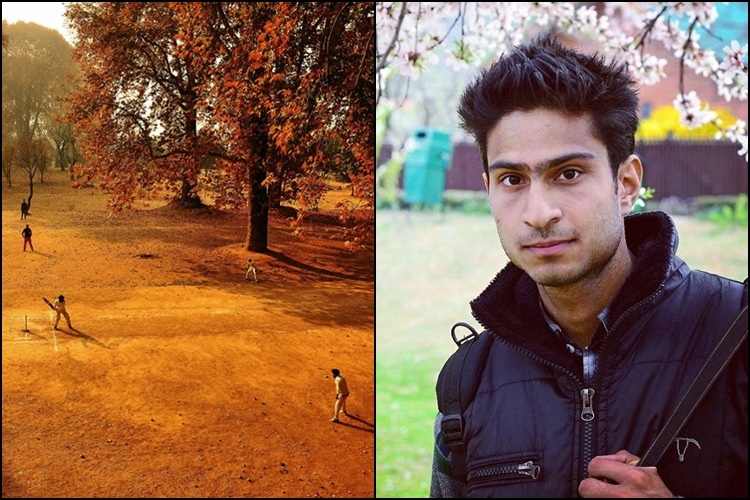
Saqib Majeed is the first Kashmiri and second Asian after Atul Kamble to receive the prestigious award.
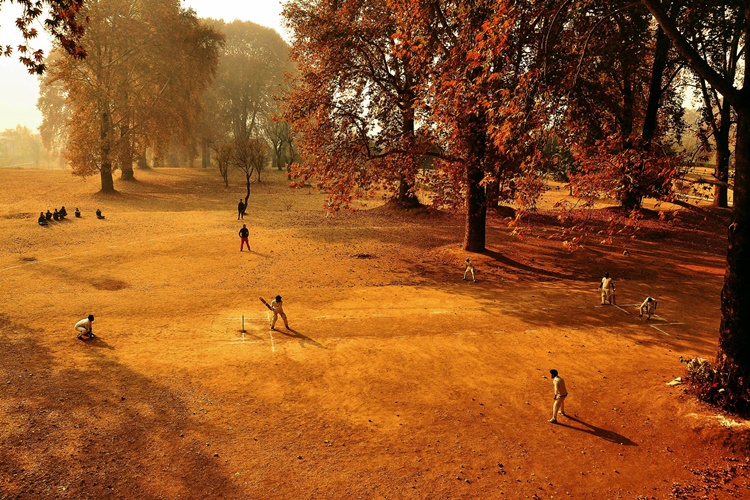
A Srinagar based freelance photographer has done Kashmir proud, pocketing the prestigious 2016 Wisden-MCC (Melbourne Cricket Council) Cricket Photograph of the Year for a stunning image, which captured boys playing cricket in the outskirts of the city, clicked by him.
Saqib Majeed, an engineer by profession clicked the award-winning picture at the Nishat garden in Srinagar.
Majeed is the first Kashmiri and second Asian after Atul Kamble to receive the prestigious award. Every year MCC publishes a book titled Wisden Cricketer Almanack, which includes best sports pictures from across the globe.
This year’s edition includes Majeed’s picture.
Majeed’s picture in Kashmir’s autumn setting certainly had all the ingredients to make the cut. It had nature’s own beauty coupled with cricketers playing the game in their own way that typify the sport with the man behind the camera having a feel of the occasion to capture the decisive moment.
“The historic Lords Cricket Ground will display my image for a year,” said a visibly happy Majeed, who was chosen among 450 participants.
“It was an autumn day when I visited the Nishat Garden with a friend to click some pictures. When I reached the garden, some guys were playing cricket under the shade of Chinar trees. I started to click the pictures for next half-an-hour,” he said.
Majeed recalls trying different angles to get a perfect shot, but ended up clicking only a few.
“I am very thankful to my family, friends and The Counselor Magazine, who always encouraged me,” he added.
source: http://www.inuth.com / inUth.com / Home> Sports> Cricket / by ANI News Agency / May 06th, 2017
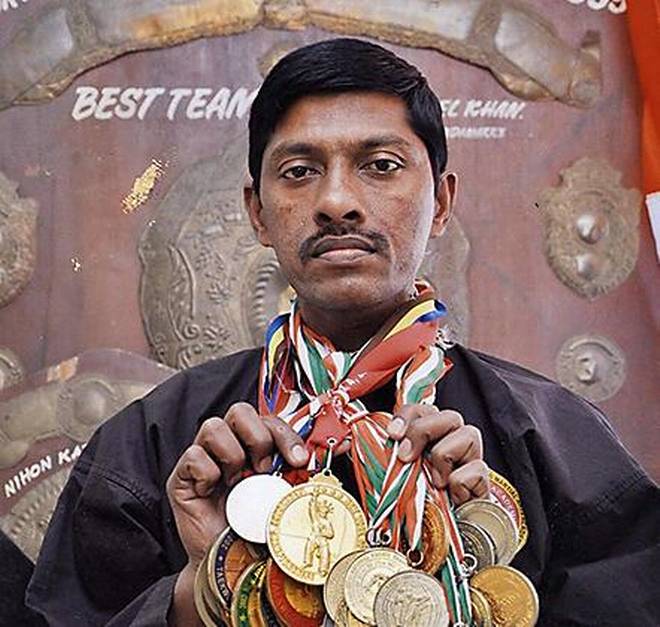
Martial arts exponent Pathan Jameel Khan represents the other side of Indian sport?
Well, yes, if his ordeal in getting even a decent job or sponsorship to take part in international sporting events is any hint. For this 40-year-old Jameel, winner of 15 gold, 13 silver and 17 bronze at the national and international events including two 2016 World Cup silver in the US is now struggling to meet both ends for want of financial support.
At a time, when cash incentives are being showered on truly deserving outstanding achievers, Jameel gently asks what is that he should do more to get the attention of the powers-that-be.
A native of Mandamarri village in Adilabad district, Jameel, whose father is a vegetable vendor, moved over to Hyderabad to pursue his passion in karate. His diligence and consistency at the highest level have won acclaim including an offer from a martial arts organisation to settle down in US with a chance to represent US. But for the love of the country, he spurned that and came back to India with hope of getting some help. But, as things stand, Jameel, a BA from Dr.Ambedkar Open University, is still staring at an uncertain future – even shunted out from one rented accommodation to the other for not being able to raise even the rental by the first week of the month. His lone source of income – training about 20 karate kids in Mehdipatnam – is always doubtful as it depends on the payment of fee by the students. Still, he has the grace to train about 500 girls of a Government-aided school free of cost to make them good in self-defence daily even now.
It may be recalled here that Telangana Government has been pretty generous in showering cash incentives on some of the deserving athletes in the recent past, running into lakhs but the fact that there are some big achievers like Jameel who are out of its radar is a sorry story of the powers-that-be not getting the right info. “May be, I am paying a price of not having the right connection or Godfathers to take up my cause,” moans a dejected Jameel even as he pursues the dream of representing India at this age in the 2020 Tokyo Olympics where karate is being introduced for the first time.
source: http://www.thehindu.com / The Hindu / Home> News> Cities> Hyderabad / by V.V. Subrahmanyam / Hyderabad – September 29th, 2016
The 24-year-old golfer from Bengaluru had produced amazing play over the last two days, including a hole-in-one at Nedumbassery’s CIAL Golf Club, but suddenly everything appeared to be going up in smoke.
Bengaluru golfer Syed Saqib Ahmed with the PGTI Cochin Masters Trophy, his maiden pro title, on Saturday. – STAN RAYAN
For a brief moment, as he came up with successive bogeys on the 15th and 16th holes in the final round on Saturday, Syed Saqib Ahmedfelt his title chances slipping away in the PGTI Cochin Masters.
He then found out from his friends that Delhi’s Honey Baisoya, his nearest challenger who had started half hour earlier, had finished with a seven under and realised that he had to buck up. And Saqib found his touch just in time, produced birdies in the last two holes, and lifted his maiden professional title.
“I really felt the pressure after the bogeys on the 15th and 16th because both the par fives are actually easy holes,” said Saqib who finished with a three-shot lead (total 278) over the pre-tournament favourite Baisoya who came second.
“But I had a birdie on the 17th, which I think is one of the toughest holes. And the 18th went like a dream, I really didn’t think I could handle it so well. This is really a big burden off my head.”
The title ended three years of waiting for Saqib. “I dedicate this, my first pro title, to my parents and to my grandfather,” said the young man and then turned emotional.
Another Bengaluru player, M. Dharma, and Chandigarh’s Abhijit Singh Chadha finished joint third. V.J. Kurian, Managing Director, Cochin International Airport Limited, gave away the prizes. The Pro-Am event will be played on Sunday.
The final placings (par 288, four day total, top 10): 1. Syed Saqib Ahmed (278), 2. Honey Baisoya (281), 3. M. Dharma & Abhijit Singh Chadha (both 283), 5. Ankur Chadha (284), 6. Veer Ahlawat, Maniram, Gaurav Pratap Singh (all 285), 9. Arjun Prasad & Karandeep Kochhar (286).
source: http://www.sportstarlive.com / SportStar / Home> Golf / by Stan Ryan / Kochi – February 03rd, 2018
Arwa Imtiyaz Bhat is not a coach or player, but performs a more important role for deaf and mute sportspersons in Srinagar
‘I will keep fighting for them, their rights.’ (Express photo by Shuaib Masoodi)
It’s a white winter morning in Srinagar, and a 16-year-old girl has set out from her cramped home on the city’s outskirts to help a group of badminton players prepare for a tournament at the indoor stadium.
Arwa Imtiyaz Bhat is not a coach, or a player. But this Class X student performs a more important role. She translates the sound of silence.
The players are among the around 250 sportspersons registered with the J&K Sports Association for the Deaf, and Arwa, who is well versed in sign language, is their voice, their mentor. Often giving up classes at school, she’s accompanied J&K teams to tournaments across the country, from Delhi to Chennai, fielding calls from worried families, helping liaise with organisers and officials.
She says the reward is not money — she’s not paid any — but moments such as those last December when the J&K team won four gold, three silver and two bronze medals in the National Games for the Deaf in Ranchi.
“My mother Rehana can’t speak or hear. Her brother Mohammad Saleem, a good badminton player, is also deaf and mute. And ever since I can remember, I have seen them struggle, facing discrimination outside and within our family. I could not stand that, and decided to do whatever I could to help anyone in that situation… I learned how to communicate in sign language from my uncle who had undergone training in Delhi,” says Arwa.
It hasn’t been easy, she admits, especially convincing parents of deaf and mute children to let go.
“When the J&K deaf team was planning to go to Ranchi, the parents sought an assurance from me that they would be safe and secure. I had to finally give them a guarantee. At times, I have had to fight with the families of players for permission to let them play,’’ she says.
According to Waheed ur Rehmad Parra, secretary, J&K Sports Council, Arwa is an inspiration.
“I am surprised by the dedication of this girl. And I try my best to help out and speed up paperwork of any team with which this girl is involved. She is an inspiration for all of us, and she should never feel that she has been let down by the system,” he says.
“There are very few people in the world who really care about deaf and mute children such as mine,” says Nazir Ahmad Bhat from Baramulla, whose two sons Mohammad Ashraf and Showkat Ahmad are sportspersons.
“Whenever my children go for any sports activity, Arwa keeps me informed, even when they are outside the state. At times, we call her so many times every day for information about my sons, she never loses patience,’’ says Bhat.
But for Arwa, who dreams of becoming a doctor, and her family, all of this has come at a cost.
“Last year, I had to accompany these players to different parts of Kashmir and various offices of sports organisations. I missed a lot of classes and was reprimanded by my teachers,” says Arwa.
At home, Arwa’s parents say it’s time someone showed similar concern for their daughter.
“I am an autorickshaw driver, and I want to provide my children, especially Arwa, with a good education. But I struggle to do that because I find it very difficult to keep my house running,’’ says Arwa’s father, Imtiyaz Ahmad Bhat. Arwa’s younger brother Abu Zar is a student of Class V but her elder brother Arbaz dropped out of school in Class X four years ago after he met an accident.
“I don’t think my dream of becoming a doctor will ever come true because I belong to a very poor family. At times, my father doesn’t have money to even deposit my school fees. This is why I was moved from the Fayaz Educational Institute in Naikbagh to the Government High School in Nowgam. But I will still try to complete my education,’’ says Arwa.
Yet, at the end of the day, Arwa says the joy that she sees on the faces of her players is what makes her go to sleep with a smile.
“Whenever they win any game or event, I hug them. At that moment, many of these players struggle to control their emotions and finally break down… I will keep fighting for them, their rights. Here, I am the only person who can highlight their misery.’’
source: http://www.indianexpress.com / The Indian Express / Home> India / by Mir Ehsan / Srinagar / February 05th, 2018
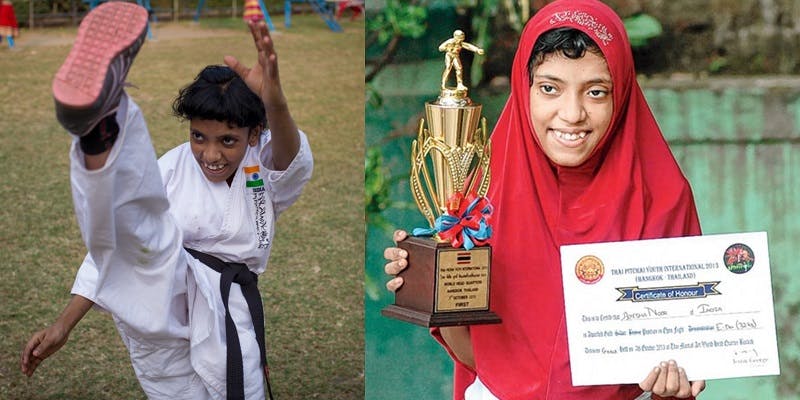
Ayesha Noor was born in a slum in Kolkata. Suffering from epileptic seizures, Ayesha was asked to leave school when she was just five. Only a year later, she decided to learn karate. Today, at the age of 19, Ayesha is an inspiration for many.
Images (L) Huffington Post (R) YourStory.com
Ayesha is the winner of two gold medals at the national level and has brought home three gold medals from international events. She also trains girls in Kolkata in self-defence. “I become a sherni (tigress) when I teach karate,” Ayesha told Huffington Post.
Ayesha’s journey hasn’t been an easy one. Her father passed away when she was just 13. Life has been difficult for the family of three that lives in a one-room house in a Kolkata slum. While her mother works as a tailor, her brother sells slippers to make a living.
Despite her inspirational triumphs in the international arena, Ayesha wants to teach karate to people across the world. Her coach and mentor MA Ali told Business Standard, “She is a completely different personality once she hits the ring and the fighter in her takes over.”
source: http://www.yourstory.com / YourStory.com / Home> HerStory> Think Change India / November 16th, 2016
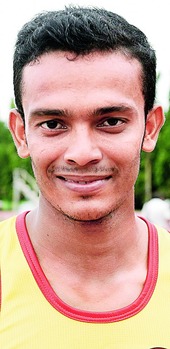
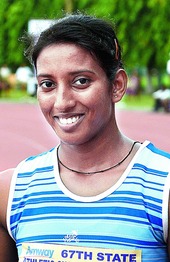
Safikul Mondal and Rokeya Khatun emerged the fastest man and woman in the Amway 67th West Bengal State Athletic Championship on Sunday.
Safikul Mondal
There were two meet records on the concluding day. Trisha Dhar set a meet mark in women’s U-20 heptathlon and East Bengal’s 4×400 U-20 relay team clinched the gold with a record performance.
North 24 Parganas emerged overall champions while East Bengal were runners-up. Nadia took the third spot.
Trisha, who is a first year student at Charu Chandra College, trains under Kuntal Roy at SAI campus and Sodepur Coaching Centre. The heptathlete, who accumulated 4218 points, broke the 21-year-old record set by another of Kuntal’s students, Soma Biswas. “I don’t get time to attend college regularly but Somadi’s husband Samir Bera, who works at Charu Chandra, has ensured that I don’t face problems… I haven’t spoken to Somadi yet,” said Trisha with a sheepish smile.
She had won the event last year too but an ankle injury had prevented her from performing at her best. She plans to participate in the Inter-state Open meet in Guntur later this month.
The East Bengal quartet of Chandan Barui, Santu Biswas, Sourav Ghosh and Sujoy Soren won the 4x400m relay with a record timing of 3:24.60. They bettered the record set last year by North 24 Parganas DSA (3:32.20).
Safikul has had a rich haul this time with three gold medals – 100m, 200m and 4x100m. The 21-year-old from Debagram in Nadia recorded 10.7 seconds edging out Tanmoy Chakraborty (10.8) in a photo finish. “I didn’t know I had won… Later I was informed by my coach,” he said. “I had a hamstring injury last month and haven’t fully recovered. There’s still tightness which prevents me from running at full tilt… I could have done much better had I been full fit,” said Safikul.
Rokeya Khatun
The women’s 100m gold is Rokeya’s second in this meet after having won the 100m hurdles. The Chapra girl, whose parents struggle to make ends meet, finished in 11.9 seconds.
“My parents wish I continue with the sport and that has kept me going. It pretty expensive to stay alone here. If I can finish in the top-4 in Inter-state Open meet, I will get a seat in the SAI hostel… That will help,” said the 20-year-old.
source: http://www.telegraphindia.com / The Telegraph, Calcutta,India / Front Page> Sports> Story / Monday – July 03rd, 2017
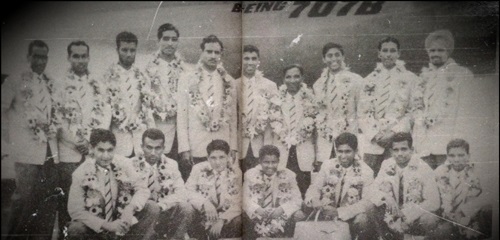
It was the year 1962, the year of the Asian Games in Indonesia.
The gold-winning football team of India was perhaps the best ever in its history.
India’s chef-de-mission to the 1962 Asian Games had criticised the hosts for excluding Israel and Taiwan from the Games for political reasons. Thus, right from the beginning, the crowds were hostile to India. Amidst such circumstances in Indonesia in front of the anti-India crowd, India came out on top beating a formidable Korea team 2-1 in the final, a team that India had lost 2-0 to in the opening match of the group stage.
These Indian footballers belonged to a tough breed of athletes. It was a matter of life and death for them. If one had to choose that one member who stood out in this team, it was none other than the midfield maestro Mohammed Yousuf Khan.
Born in Andhra Pradesh on 5th August, 1937, Yousuf Khan is considered one of the best all-round players in Indian football history. When he used to play, he used to gallop on the pitch like a horse, controlling the play in midfield, for which he was famously known as “the bearded horse.” He played a huge part in India’s triumph in the 1962 Asian Games, and was deservedly awarded the Arjuna Award in 1966.
Khan, who passed away in 2006, was a key member of the famous Hyderabad City police team in the late ’50s and the early ’60s. He was one of the only two Indians to be selected in the 1965 Asian All Stars XI. Such was his authority on the games that even the association acknowledged it.
However, life wasn’t all rosy – as it seldom is even now – for Indian athletes back then. Lack of proper infrastructure has been an obstacle since time immemorable. The determination and the will to do well for the country, to see the national flag fly high was what drove them to put their lives at stakes and achieve what they set on to.
Yousuf Khan was one of those athletes whose life faced an unfathombale and drastic turn of events so much so that one won’t get an answer to that even if one keeps wondering what and how something could go wrong.
Continuing to play in spite of the three head injuries during his playing days is a testimonial to the fact that football was much more than a game to him. When he was on the pitch, he had no second thoughts than to give it all for the team.
The 1960 Rome Olympian may have brought the best of defences to its knees on his day but, as he aged, he was waging a grim battle for survival, almost on his own with little support coming by.
This ageing footballer was clearly wondering whether players of his generation were right in sacrificing so much on the personal front, not even concerned about health, to earn name and fame for the country. But, why did such a thought even occur to him?
The head injuries were cited as the reason for the Parkinson’s Syndrome he would go on to suffer from 1994.The legs that created magic on the field by then, were swollen and unable to even support him. His struggle to walk even a few paces at home and feeling pain while getting up indicated that the champion player was going through a real torture. It was a sight that any sportsperson would not dare dream about in the worst of scenarios.
It is a tragedy that Yousuf Khan was being forced to live on the Rs. 3500 monthly pension which he got by virtue of retiring from the Police Department and the Central Government monthly grant of Rs. 2000. But, most of that was spent towards his medical expenses with little to cater to the needs of his family members — one son and five daughters.
Worse, even the Rs. 50,000, presented by Mr. H. J. Dora, former DGP and president of AP Olympic Association, was blocked in a private finance firm.
The time when he needed the utmost support from the country, the Indian Government took a backseat.
source: http://www.sportskeeda.com / Sports Keeda / Home> Feature> Football / by Ashish Shettyt / May 23rd, 2014
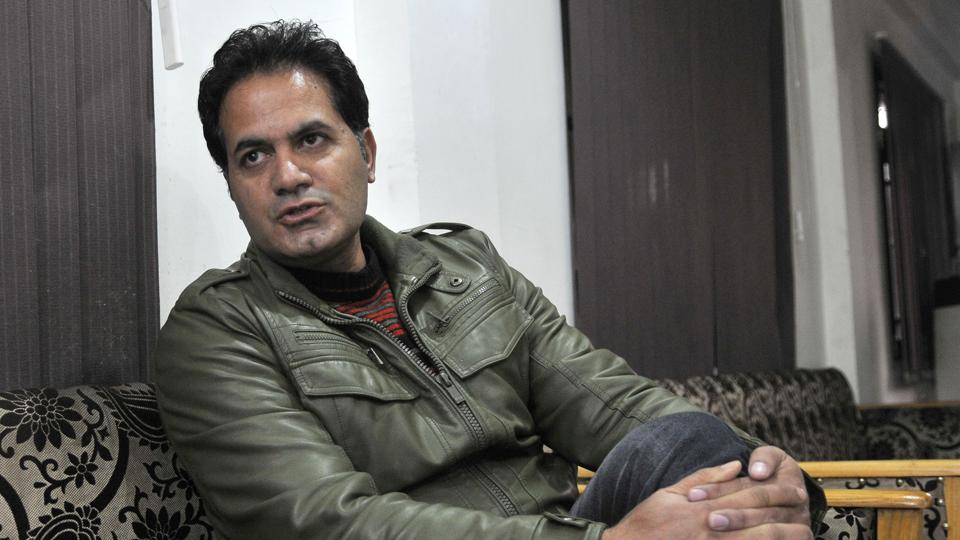
Sajid Yousuf Dar, 42, is the first and only Kashmiri so far to coach any Indian soccer team for international events.(Waseem Andrabi / HT Photo)
In the last week of November, the All India Football Federation (AIFF) appointed Sajid Yousuf Dar as coach of the women’s national football team for the upcoming SAFF women’s championship 2016.
As a teenager, Sajid Yousuf Dar played football in Kashmir during curfew breaks at the height of militancy. Now, the 42-year-old Dar’s dedication to the game has earned him a third stint as head coach of the Indian women’s football team for the South Asian Federation Games.
Dar is also the first and only Kashmiri so far to coach any Indian soccer team for international events.
In the last week of November, the All India Football Federation (AIFF) appointed Dar as coach of the women’s national football team for the upcoming SAFF women’s championship 2016.
Dar told HT that the team was gearing up for the championship, which is slated to kick-off in Siliguri from December 26. Defending champions India have been placed in Group B along with Bangladesh and Afghanistan. A total of seven countries are taking part in the competition.
“We have to be on our toes to defend the title as more and more countries in the region are working and developing their game,” Dar, who is currently in Srinagar, says.
Owing to his impressive record as coach for the under-14 and under-19 boys’ soccer teams of the country, Dar was first roped in by the AIFF for the women’s team in March 2015 when ahead of the Olympic qualifiers. He was also chosen as the technical advisor for football development in India.
Under his guidance the women’s team got gold in the 12th South Asian Games earlier this year in Shillong. “The AIFF provided us with the facilities and we had enough time to prepare leading to our success. I am proud that our women’s team got gold. The men’s team had to settle for silver,” he says.
Dar has come a long way since the time he started playing football in Shri Pratap (SP) higher secondary school in 1991-92.
This was the time when militancy had just erupted in Kashmir and youth were crossing the line of control in hordes for arms training fuelled by the idea of “freedom from Indian rule”. The violence derailed all developmental work and virtually stopped sports activities.
But it didn’t quite deter Dar, then 18, from pursuing his first love. “I was mad about the game. Despite the bad situation all around a few friends and I continued to practice in the otherwise empty grounds,” he says.
In fact football is in his blood. His father Mohammad Yousuf was the first Kashmiri to play any international game for the Indian team.
But pursuing the game with violence all around was never easy for Dar junior. Owing to the violence and mass protests, curfew used to be imposed for days at a stretch in the early 1990s.
“They would give relaxation for a few hours and I would rush to the ground to play,” Dar remembers.
In fact, young men in Kashmir fancied football more than cricket before the start of militancy. Abdul Majid Kakroo was the first Kashmiri to captain the Indian squad in 1986-87 and played for the national team for nine years.
A resident of Dalgate in the heart of Srinagar, Dar was fortunate that there were at least three grounds near his home where he could hone his skills.
Dar’s perseverance finally paid and he captained Srinagar’s YMCA team in the Federation Cup in 1998 held at Chandigarh and later represented state in the Santosh Trophy three times from 2000 to 2002.
“It was only after playing outside the state that I realized how absence of professional coaches was hampering game in our state,” he says.
He started training youngsters and went for different coaching courses, AFC licenses and degrees in physical education and also started coaching Kashmir University team since 2006. “My first break at national level came in 2012 when I was chosen as assistant coach by AIFF for the under-19 boys’ team,” he says.
Since then, Dar has not looked back.
source: http://www.hindustantimes.com / Hindustan Times / Home> India / by Ashiq Hussain, Hindustan Times / December 03rd, 2016
Nasser Hussain, former India rugby captain, is involved with rugby taking roots across the nation as Rugby India general manager.
The Societe Generale Junior National Rugby Sevens at the Bombay Gymkhana attracted participation from 18 States. He talks about tribals in Odisha taking up the sport, switch over from athletics, kabaddi to rugby.
Excerpts from a chat:
Rugby Sevens is the route to the Olympic Games. Looking ahead to making a mark at the Asian level before that, can you explain the roadmap for India?
Globally as well as within India, being an Olympic sport puts you in a different bracket and get taken a bit more seriously. We would love to be part of Olympics rugby sevens. Realistically, 2024 or 2028 is the vision we need to have to be part of the Summer Games. Tokyo 2020 is unrealistic to even consider being a part of the competition.
Our approach is to focus at U-18 representative teams and junior tournaments. Five to 10 years from now, they will be 25 or 27 by then. We work with the School Games Federation of India (SGFI) and have U-19, U-18, U-17 teams. The federation is pushing for U-14 tournaments as part of the National School Games by the next academic year.
Schools Nationals is the starting point for Rugby India to do talent-spotting. Having convinced SGFI to include rugby, what is the next step for talented kids to represent India?
Through the National School Games, we send the national team for the U-18 Asian Schools Rugby Sevens. The event is held once every two years. Federation cannot send an entry directly, it has to be routed through SGFI and they supported us. If there is scope, India might look at hosting the Asian U-18 event in future.
Eighteen States taking part in Junior Nationals 2016, five more than last year, shows the spread of rugby sevens. Which States have a headstart ovevr the rest? Why?
Eighteen States took part in the Junior Nationals here, 18 States send teams for the Senior Nationals in Patna. Junior representation is the same as the seniors, which is encouraging. Odisha in particular has fantastic talent in the juniors age group. Tribals are part of it. They are naturally fit and rugby fits in what they are.
Odisha is winning titles at the School Games, junior Nationals and senior Nationals, hence rugby is promoted by the State Government. Players are getting benefits, like scholarships for an India girls team member, others have joined the police, so they see the sport offering career path.
Rugby is supposed to have caught on at the Kalinga Institute of Social Sciences, Bhubaneshwar. How did this happen?
Rugby India is involved with different States, approaching different schools to get involved. Mr Ashok Mohanty, involved with Odisha Rugby, had a contract with Dr Achyuta Samanta, founder of Kalinga Institute of Social Sciences (KISS). We did an exhibition match and demonstration in 2006-2007 and they got interested.
KISS is home to 20,000 students who stay and study. They have taken up rugby, probably the number one sport at the institute. Players have gone on to represent India, girls were part of the national squad at the Asian event. We are seeing a culture developing for rugby.
For parents or young rugby players, injury is a worry, like in any contact sport. Does rugby sevens cut down the risk factor, at tournaments like the juniors Nationals?
We have faced misconception in the past about rugby being a violent game. Our approach is to let kids play non-contact rugby, called ‘touch rugby’, at the U-14 level with all the schools we approach. It promotes fitness, teamwork, leadership, all these are values of the game. We don’t push them to get into contact rugby till they move to U-16. Internationally, contact rugby is played at U-13 with slight variations.
Patna hosted the Sr. Nationals, Bhubaneshwar hosted the Jr. Nationals Rugby Sevens last year. Going by the following for the sport there, anything different in players there.
We see transfer of talent from athletics to rugby in girls’ category. Shweta Sahi, one of the India players who went to Sri Lanka for the Asian Rugby Sevens championships, is a sprinter and started rugby two years ago. Rugby has attracted football players. Mumbai police men and women sides are kabaddi players, similar skill sets are required and kabaddi or football are also a contact sport, adapting is easy. We are open to players from different sports enjoying rugby.
For junior Nationals performers, U-18 girls/boys, any future camp finalised?
U-18 girls will have a training camp in early November, maybe in Mumbai. Girls have been shortlisted from earlier competitions, we will have a relook at them and add more names, if required.
Dubai is hosting the Asian Girls U-18, the first time Asian Rugby is hosting a girls U-18 event, featuring eight teams from Asia. India has confirmed participation. For the boys, there is an U-20 in future and we are looking at sending a team to gain international exposure. We don’t get experience playing sides better than us, more professional in their approach.
source: http://www.thehindu.com / The Hindu / Home> Sports> Other Sports / by Nandakumar Marar / October 23rd, 2016
India put up a stellar show in the Special Olympics World Games in Los Angeles, that got over on Sunday. India, competing under the banner Special Olympics (Bharat).
The Indian softball team won a gold medal on debut. The athletes made the country proud, by winning a fistful of medals in track and field, including winning three 100m races in various divisions.
Bincy John won the sprint in division 32, Mariya Joy won in division 14 and Platni Maran won in division 59.
Every two years, Special Olympics athletes come together to compete at the Special Olympics World Games.
GOLD MEDAL WINNERS
Softball team (Div. 3): Mihir Shailesh Soni, Abdul Shaquib, Tukaram Shivaji Sangaonkar, Dhrupadsinh Mahendrasinh Raj, Sunilkumar Becharbhai Patel, Manoj Uttamrao Naik, Mohammad Shaban, Pallav Mehrotra, A Matroo, Vinay Vilas Ghadge; Prateek Jain, Vipul Kantilal Jain, Shrey Kadian, Shahnawaz Khan, Ponnanna Kokkalera Thammaiah.
Golf: Ranveer Singh Saini and Monica Jajoo: Golf Level 2 alternate shot team play (Div. 1).
Ranveer Saini
Table tennis: Anish Hasan Delawala and Sree Latha Yelikeri: mixed doubles (Div. XD16-21D3).