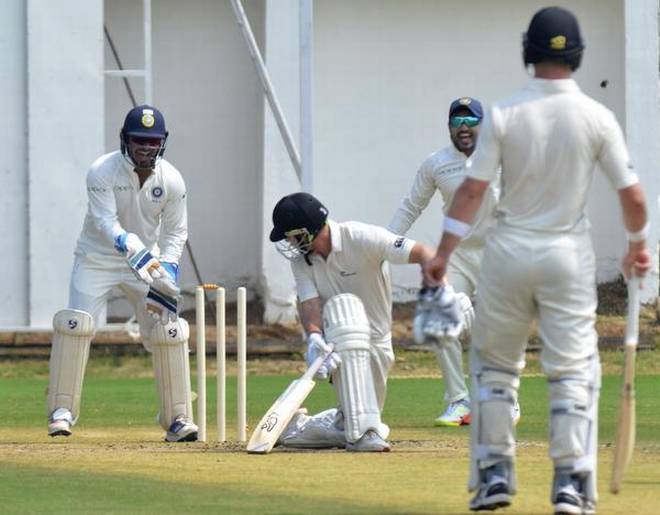
Oh no! New Zealand-A opener George Worker looks back to see his bails dislodged by Karn Sharma. | Photo Credit: V RAJU.
Mulapadu, VIJAYAWADA :
The spin duo of leggie Karn Sharma and left-armer Shabaz Nadeem turned out to be too hot to handle once again as the two picked four wickets apiece to bowl India-A to an innings and 31-run win over New Zealand-A in the first of the two, four-day ‘Test’ matches at Mulapadu CricketComplex here on Monday.
After a 30-minute delayed start because of sharp drizzle in the morning, the Kiwis, resuming at the overnight score of 64 for two, were never really in the game – losing wickets at regular intervals.
This despite there being no devil in the pitch. It was all in the minds and obviously Kiwis lost the psychological battle as the batsmen were found way short of the technical competence required to tackle the spinners who simply stuck to the basics – bowl a good line and length, make the batsmen play at every ball and most bowl importantly to the field.
If one thought there would be the much needed improvement in the second innings, it was not to be as both Karn and Nadeem enjoyed bowling at the New Zealanders who were just not equal to the task.
Once Karn got the first breakthrough in the sixth over of the day when he had the well-set opener, it was a real struggle for the those who followed him to the crease. When Will Young was also dismissed – top-edging a sweep shot off Karn to be caught at silly-point by Hanuma Vihari, the Kiwis were reduced to 81 for four.
At lunch, the Kiwis were 118 for six and the only issue then was whether the innings defeat could be avoided or not. But, both Karn and Nadeem had other intentions and mopped up the tail in 11 overs after the break to bring curtains on what was a thoroughly disappointing batting display.
The scores:
New Zealand-A— 1st innings: 147.
India-A — 1st innings: 320.
New Zealand-A — 2nd innings: George Worker b Karn 35, Jeet Raval b Nadeem 21, Henry Nicholls lbw b Karn 1, Will Young c Vihari b Karn 14, Tom Blundell lbw b Shardul 12, Tim Seifert lbw b Karn 14, Todd Astle b Shardul 0, Scott Kuggeleijn c Rishabh b Nadeem 15, Ish Sodhi c Karun b Nadeem 13, Matt Henry b Nadeem 0, Lockie Ferguson (not out) 10; Extras: (lb-3, nb-4) 7; Total: (in 63.1 overs): 142.
Fall of wickets: 1-41, 2-42, 3-74, 4-81, 5-89, 6-99, 7-118, 8-118, 9-120.
In the men’s title clash, Sai Tejesh rallied defeat Anandnagar Welfare Association player Aravind 4-3 for the top honours.
In the Women’s event, Nikhat faced a stiff challenge from GSM’s M Monica but the experienced campaigner managed to brush aside the resistance to win 4-3
Hyderabad:
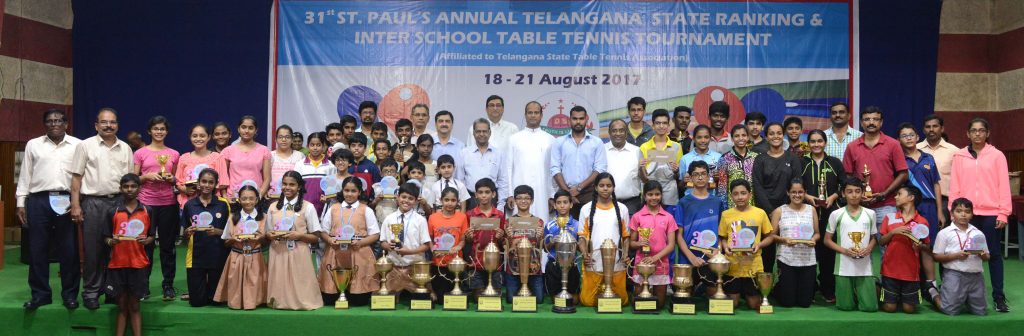
Gujarati Seva Mandal’s Sai Tejesh and Reserve Bank of India’s Nikhat Banu had to dig in deep to emerge champions in the men and women’s categories of the 31st St Paul’s Annual Telangana State Ranking and Inter-School table tennis championship at the St Paul’s High School on Monday.
In the men’s title clash, Sai Tejesh rallied to defeat Anandnagar Welfare Association player Arvind 4-3 for the top honours. In the women’s event, Nikhat faced a stiff challenge from GSM’s M Monica but the experienced campaigner managed to brush aside the resistance to win 4-3.
In the inter-school team championship, St Paul’s High School ‘B’ team defeated Prakasam Vidya Nikethan 3-1 to win the boys’ title while Rosary Convent ‘A’ team thrashed Gitanjali Devashray 3-1 for the title in girls category.
In the inter-institutional team championship, SBI got the better of Postal 3-1 for the title.
Results: All Finals:
Boys: St Paul’s High School B bt Prakasam Vidya Nikethan (3-1) Girls: Rosary Convent – A bt Gitanjali Devashray (3-1)
Inter-Institutional Team Championship:
SBI bt Postal (3-1)
Mohd Imbrahim Khan (SBI) bt Deepesh Singh (Postal) (3-1), 11-08,11-07,09-11,11-06; P Nagender Reddy (SBI) bt Sreedhar (Postal) (3-2) 09-11,11-07,11-05,08-11,11-08; Deepesh Singh & Ramesh (Postal) bt Mohd Imbrahim Khan & D Ajay Kumar (SBI) (3-1) 07-11,11-06,11-08,11-05; Mohd Imbrahim Khan (SBI) bt K Sreedhar (Postal)
(3-1), 11-08,11-13,11-07,11-09.
source: http://www.telanganatoday.com / Telangana Today / Home> Sports> Other Sports / by Telangana Today / August 22nd, 2017
proud moment:Andhra Ranji cricketer Shahabuddin being felicitated by the Rural Development Trust at Anantapur in Friday.— PHOTO: BY ARRANGEMENT
BCCI senior selection committee member and former India stumper M.S.K. Prasad on Friday said that the flamboyant Andhra Ranji cricketer S.K. Shahabuddin was a best all-rounder ever in Andhra cricket and hailed him as a game changer.
Speaking at the felicitation organised by Rural Development Trust here on his retirement, he said though Shahabuddin had immense amount of talent he failed to make it to the Indian team.
Andhra Cricket Association (ACA) general secretary Gokaraju Gangaraju recollected the services of the Anantapur all-rounder and exhorted the youngsters to emulate him.
“For 18 years he played cricket with dedication and passion. We will cherish his on-field exploits for years to come”. Anantapur District Cricket Association (ADCA) president Moncho Ferrer said Shahabuddin was a natural athlete and always enjoyed his presence on the field. “Though I am sad he had retired, I am happy that he has taken up the responsibility as the operation head of the RDT cricket team. I wish to see him as a member of the Indian support team”.
Mr. Shahabuddin in his thanks giving speech recollected the roles of ADCA and ACA in providing him the unflinching support. “My exposure in England and at Chennai League helped me to perform well in first class cricket”.
Venkat Siva Reddy, vice president, ACA, Satyaprasad, South Zone Head, ACA, and Vijay Anand, legal advisor, Tamilnadu Cricket Association were present.
source: http://www.thehindu.com / The Hindu / Home> News> States> Andhra Pradesh / by Special Correspondent / Anantapur – April 30th, 2016
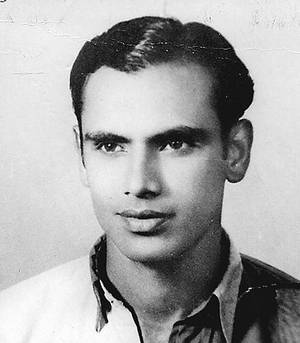
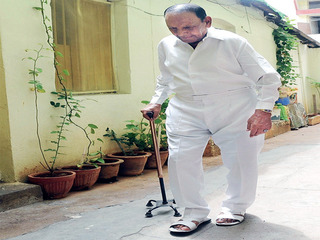
Ahmed Khan, the last of India’s glorious generation of barefooted footballers who made a mark on the 1948 Olympic Games, passed away here on Sunday.
He was 90 and died due to age-related issues. Khan, who was also part of the Indian sides that won gold at the Asian Games of 1951 and went to the 1952 Olympics in Helsinki, will be remembered as a gifted inside-left who mesmerised spectators with his ball control.
He played for East Bengal for a decade, and formed part of a feared five-member forward-line — Sale, Dhanaraj, Appa Rao and Venkatesh the others — nicknamed the ‘pancha pandavas’.
“His close control was so good that they called him the snake-charmer, for he could make the ball do his bidding,” recalled I. Arumainayagam, who turned out for India at the 1962 Asian Games.
“We used to call him paambati. His death is a big loss to Indian football.”
Khan was born in 1926 into a family of footballers. His father, Baba Khan, was captain of local club Bangalore Crescent, while two of his uncles turned out for Mohammedan Sporting in Kolkata.
Ahmed’s three brothers — Amjad Khan, Sharmat Khan and Latif Khan — all played football at various levels.
As early as 1938, Ahmed joined Bangalore Crescent, where he played alongside his father.
He is best remembered, however, for his role in the 1948 Olympics in London, where India lost its first-round match in heartbreaking fashion to France but made a deep impression on the public.
In a report for The Hindu dated September 25, 1948, A. Ramaswamy Aiyar wrote: “Raman and Ahmed, the left-extreme and the left-inside, hail from Bangalore. They showed uncanny control over the ball and had perfect understanding.
“It was a treat to watch them move with the ball, interchange positions and run rings round the defence. They kept the audience spellbound and moved with such ease that they were described as a pair of wizards.”
“After winning the Rovers Cup with Bangalore Muslims, he joined East Bengal in 1949 and played for the club for the next 10 years.”
In a statement, East Bengal general secretary Kalyan Majumder hailed him as a “barefooted genius” and perhaps the greatest player the club had ever seen.
“With outstanding individual brilliance the barefooted Khan was capable of deciding the fate of any match all by himself. Even after boots were made mandatory I recall his outstanding performance in the 1958 IFA Shield final when he along with Balaram destroyed Mohun Bagan to win the Trophy,” he said.
“One also recalls the spectacular goal he scored against Yugoslavia playing barefooted in the 1952 Helsinki Olympics.”
Khan’s death was condoled by the Karnataka State Football Association. He is survived by his wife, Rabia Begum, and children Majid Khan and Parveen Begum.
source: http://www.thehindu.com / The Hindu / Home> Sport> Football / by Special Correspondent / Bengaluru – August 28th, 2017
As Ahmed Khan is laid to rest, kin feel blessed to belong to the same family as the football great; contemporaries remember him as a humble man who loved the game
Amjad Khan sat quietly sipping chai, unmindful of the cacophony raised by a line of four-wheelers jostling for space on the narrow, single-laned Mackan Road. His brother Ahmed, arguably India’s greatest footballer who passed away on Sunday, had just been laid to rest and the mourning — for now — was over. The multitude, that had turned out to pay their respects and attend the funeral, had departed and house #75 — the house of ‘Ahmed, the Olympian’ — was slowly returning to ‘normal’.
A smile spread across Amjad’s face when he was asked about his brother. With every sip of chai that he took, Amjad’s eyes took on an even more vacant look as his mind went back in time. “What makes a man great? This is how I analyse it,” Amjad, also a former India international, said. “You could say Ahmed played up to 1958, right? Public memory is generally short. We watch a good movie and don’t remember it a month later. But if people remember this man, after 60 years of his playing career, then he must have done something extraordinary.”
There was pride in Amjad’s every breath. It was the predominant feeling shared by those in house #75. A feeling that stemmed from simply being associated with the bloodline of India’s greatest dribbler, fondly nicknamed ‘the Snake Charmer’ by the English media. Even Mannan, a grandson who was born decades after Ahmed hung up his boots, said he was “proud to just be born in the same family as Ahmed”.
Inside the house, Mannan proudly pointed to Ahmed’s trophies, a collection that was put on display just above the freezer box that contained Ahmed’s remains only hours ago. Numerous tributes by East Bengal, Ahmed’s club in Kolkata, were laid out. “The Padmashri has lost a bit of its sheen today because it was never awarded to Ahmed,” Amjad remarked on the conspicuous lapse of the Central government’s attention to a man who had bagged the gold in the 1951 Asian Games.
Among India’s greatest football heroes, Ahmed is right up there. As an inside-left (withdraw striker), Ahmed played in two Olympics (1948 and 1952) and won every domestic trophy that was up for grabs with East Bengal. “You know the thing about cotton? Whatever you throw on cotton, it never bounces back. That was Ahmed’s dribbling prowess,” Amjad said. “My father used to say that if Ahmed had not become a footballer, he would have become India’s best athlete. You know, when he was studying in the St Aloysius School in the city, he never used to carry books to the school. Instead, he used to take a small ball, a tennis ball, and practise dribbling on his way to school and back. That explains his gift.”
Ahmed was part of the deadly ‘Panchapandavas’ of EB, a forward line also comprising P Venkatesh and PB Saleh on the flanks, Apparao as the inside right and Dhanraj in the centre. When asked whether the gold medal was Ahmed’s top moment as a player, Amjad laughed. “That was just okay,” he said. “Have you heard of Sahu Mewalal, the guy who scored the winner at the 1951 Asian Games? Every year in Calcutta, where he used to play for Railways, he was the top-scorer of the league. Dhanraj wanted to overthrow Mewalal and asked Ahmed to do something for him. In one game, this gentleman (Ahmed) dribbled past everyone, even the goalkeeper, and called Dhanraj to the post to tap it in. That year, Dhanraj became the top-scorer. Scoring goals was Ahmed’s wish when he was playing.”
I Arumainayagam, the 1962 Asian Games gold medallist from the other time that India ruled globally, called Ahmed an inspiration. “We used to learn from watching him play,” he said. “We used to name ourselves ‘Ahmed’, ‘Dhanraj’, ‘Basheer’ and emulate their style. We, of course, couldn’t play as well as they did, but they influenced us greatly.”
More than anything, Ahmed was a fine human being. The 1952 Helsinki Olympics showed that. India were humiliated 1-10 by Yugoslavia and Ahmed repents that he was able to score only one goal in that game. Outside the Olympics, he often used to skip practice sessions while playing for East Bengal which made people wonder at his talent. He also preferred to play barefoot, shunning boots when the occasion afforded it. He was also fond of playing cards and often drew players from rival club Mohun Bagan into a round after a football game. During one such game, he was up against Sailen Manna, Bagan’s top defender of that era. “Manna was trying to convince Ahmed to play for Bagan,” SS Shreekumar, a former journalist and Ahmed’s friend, said. “This was in a room packed with footballers from Bagan and their supporters who were watching them. Eventuall, Ahmed agreed to play for Bagan. The entire room was stunned on hearing it. But Ahmed had one condition.
Manna asked him what it was. He told Manna that he will have to play for EB and the room burst into laughter.”
Shreekumar wonders what could have been had Ahmed accepted an offer to play for Swedish club IFK Göteborg. “He was named East Bengal’s best forward of the millennium,” Shreekumar said. “But when IFK Göteborg contacted Ahmed, his father asked him to consult his club, East Bengal. Jyotish Chandra Guha, a former secretary of EB who had scouted Ahmed, was worried about losing him. He downplayed Ahmed’s future in Sweden by suggesting it would be too cold and that the locals might put him down because he would be the only Indian there.”
While the tributes kept pouring in, Amjad’s tea was done. But the smile remained. “There are two things which makes football interesting – scoring goals and dribbling,” he added. “Ahmed found it interesting because of the second reason.”
Today, Ahmed Khan is no more. But ‘Ahmed Khan Olympian’ will live on forever.
source: http://www.bangaloremirror.indiatimes.com / Bangalore Mirror / Home> Sports> Football / by Aravind Suchindran, Bangalore MIrror Bureau / August 29th, 2017
Rithvik, Anjali, Varun too take titles at state table tennis event
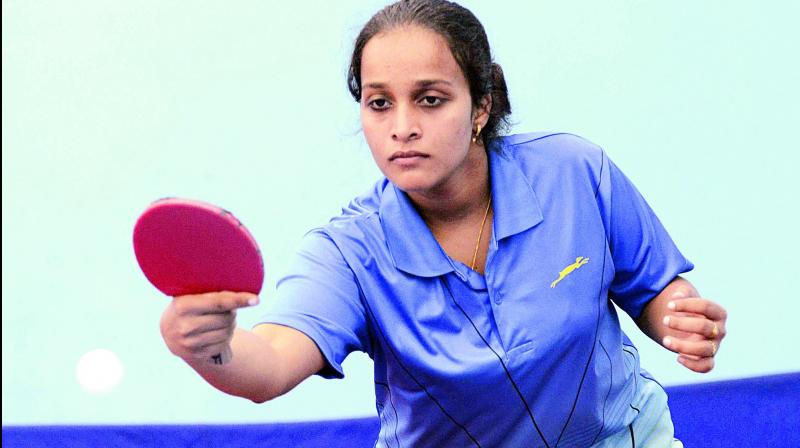
Nikhat Banu plays a shot on way to winning the women’s title at the 3rd Telangana state ranking tournament.
Rithvik U. from the Stag Academy continued his fine form as he emerged victor in the finals of the Cadet boys category of the 3rd Telangana State Stag Inter District and State Ranking Table Tennis championships being conducted by the Stag Table Tennis Academy under the auspices of Telangana State Table Tennis Association at Malakpet in Hyderabad. Rithvik outclassed AWA’s Raju (3-0) 14-12, 11-7, 11-8 to pocket the summit clash.
B. Varun Shanker won the finals in the sub-junior boys category.
In the women’s finals Nikhat Banu of Gujarati Seva Mandal proved too powerful for Naina from Lal Bhadur Stadium as she outclassed her 4-0 — 11-7, 11-7, 11-2, 11-4.
Meanwhile, in the boys sub-junior finals B. Varun Shanker comfortably won the match against Adavit, edging him 4-1 — 11-8, 10-12, 11-5, 11-7, 11-7 while GSM’s Anjali N. outclassed Ayushi G. to beat her 4-2 — 12-10, 2-11, 11-7, 11-9, 6-11, 11-8 in the finals of the sub junior girls category.
In the finals of the men’s inter-district championship, Hyderabad swept Nalgonda 3-0 to take the top honours.
The Results
Cadet boys finals: Rithvik U. (Stag Academy) bt Raju (AWA) (3-0) 14-12, 11-7, 11-8.
Inter-district team championship (men): Hyderabad bt Nalgonda 3-0.
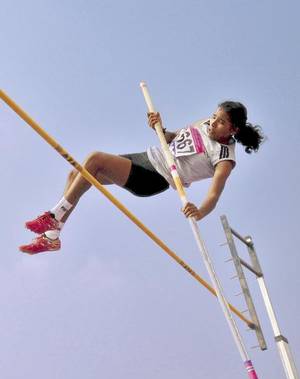
SOARING HIGH: A. Nisha Banu of Tamil Nadu, who won the pole vault gold in the girls’ under-20 category.
Coleshiya, Nisha and Hemamalini make it a golden day for TN
Ashish Jakhar of Haryana won the hammer gold in the under-18 boys’ category with a new mark of 75.45m on the second day of the Sri Krishna 32nd National junior athletics championship at the Nehru Stadium here on Friday.
The Asian junior champion and youth silver medallist improved his own mark of 72.04m set last year at the Goa youth Nationals.
Vikranta of Uttar Pradesh was probably inspired by Ashish as he too ended up bettering the record with a throw of 73.34m.
J. Coleshiya, A. Nisha Banu and N. Hemamalini made it a golden day for Tamil Nadu by finishing on top of the podium in the girls’ under-14 triathlon, under-20 pole vault and under-18 javelin respectively.
A student of St. Teresa’s School in Vadakankulam in Tirunelveli, Coleshiya tallied 1577 points for her maiden national gold.
“After I came up with decent performances in both the 100m (13.25s) and long jump (4.95m), I knew the gold would go my way,” said the little girl, who has battled several odds in life.
Nisha won the under-20 pole vault gold, clearing a height of 3.30m. Nisha was not at her best, but still managed to beat the rest with ease.
Hemamalini, who represented the country in the World School Games in Turkey this year, clinched the under-18 javelin gold with a 45.26m effort.
After two days of solid battle under the sun, Haryana was sitting pretty at the top of the combined table with 123 points followed by Uttar Pradesh (100), Kerala (95) and Tamil Nadu (80).
Sportstar caught up with distinguished former India hockey goalkeeper Muneer Sait, who was part of the Indian team that won the bronze in the 1968 Olympics in Mexico. He had arrived at the launch of Sportstarlive.
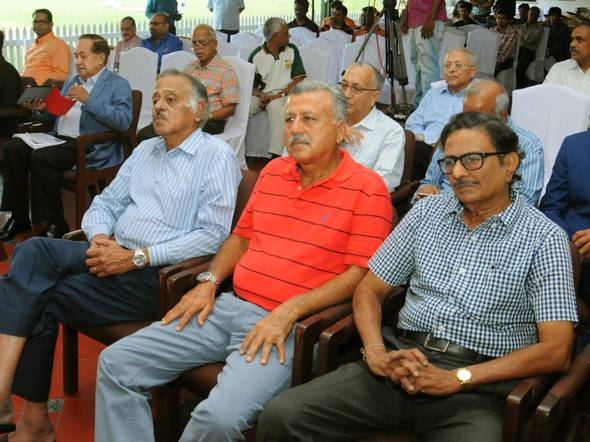
‘During my time, when hockey was popular, we played in front of packed stadiums and having fans chant your name really gave me a kick’, said Muneer Sait (seated centre). – R.RAGU
One of the outstanding hockey goalkeepers of his time, Muneer Sait was part of the Indian team that won the bronze in the 1968 Olympics in Mexico. For his work on field hockey, the International Hockey Federation awarded Sait the President’s Award in 2005. Hockey India inducted Sait as part of the five-member selection committee in 2009 and he is also associated with Squash Rackets Federation of Tamil Nadu. We caught up with the Olympian for an informal chat during the launch of Sportstarlive.
Edited excerpts:
What’s your impression of Sportstar? We are going live with our website…
The launch party was very well organised. It is nice to see a variety of sportspersons attending this event. Good representation from tennis, cricket, squash, snooker and also chess. I’ve been a regular reader of Sportstar and The Hindu. Actually, I’ve been recognised by The Hindu and have been getting complementary issues of the magazine.
What is the best part of being a sportsman in India?
I’ve loved sports every since my schooldays. We never had the distraction of the television, Twitter and Facebook so we had plenty of time to play. I have played hockey since my Loyola college days. During my time, when hockey was popular, we played in front of packed stadiums and having fans chant your name really gave me a kick. As a matter of fact, I played the 1966 national championships in Madurai in front of a full house. Everyday my photo would come in The Hindu as the outstanding goalkeeper. That boosted my image all over the country and got me selected for the Indian team.
What’s the flipside of being a sportsman?
The negative side, especially with respect to hockey, was the lack of money and encouragement from the associations. Those days we had to make our own arrangements for travel and accommodation for different national tournaments. I paid from my own pocket to go to Jalandhar via New Delhi for different competitions. It was a difficult time but we got through thanks to the love for the sport.
source: http://www.sportstarlive.com / SportsStar Live / Home> More Sports> Hockey / by Amrit Ramakrishnan / Chennai – February 06th, 2017
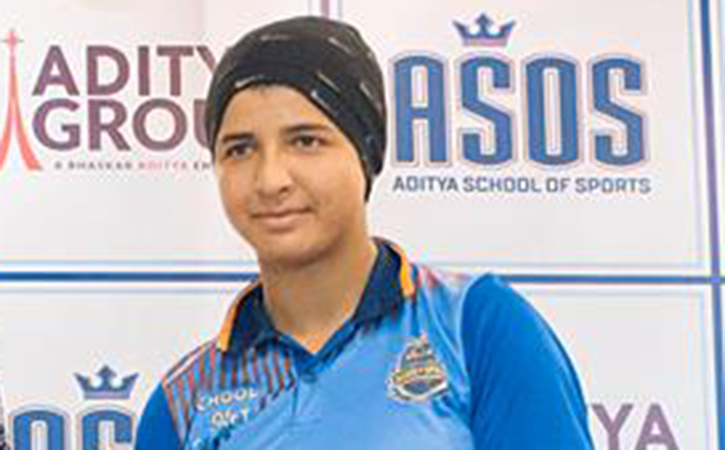
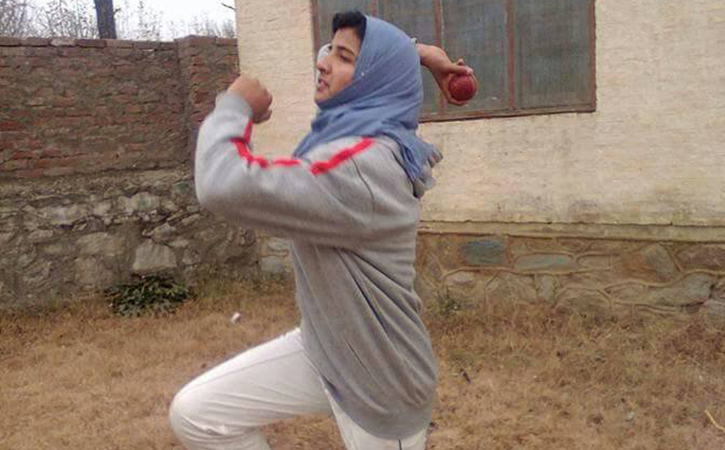
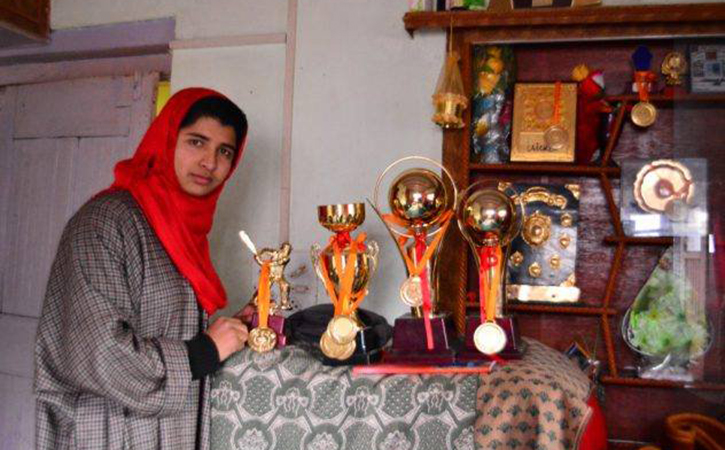
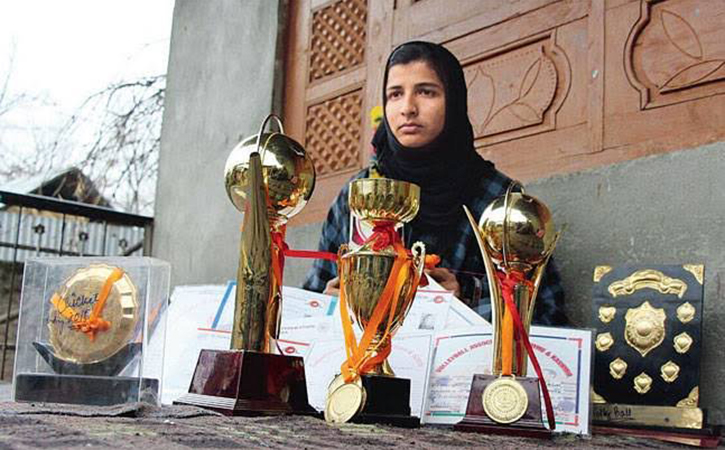
The last cricketer we heard of from the valley was Parvez Rasool. Now here’s a woman cricketer named Iqra Rasool, who is trying to beat the odds and play for the women’s Indian cricket team.
Currently, Rasool is aspiring to play for Bengal and then represent India after getting a No Objection Certificate (NOC) from Jammu & Kashmir Cricket Association.
Facebook
The 17-year-old relocated to West Bengal after limited opportunities for women stood in the way of her ambitions. She has represented Jammu & Kashmir at the U-19 and U-23 level.
Twitter
Iqra is now training at the indoor facilities of the Eden Gardens with permission from Cricket Association of Bengal (CAB), the state’s parent body of the sport. The NOC certificate has been signed by J&K cricket association General Secretary Iqbal Ahmad Shah. It cleared Iqra to play for any state association affiliated to the Board of Control for Cricket in India (BCCI).
“I want to play for India and that’s why when Aditya School of Sports contacted me I lapped up the opportunity,” Iqra told IANS on Wednesday.
Twitter
Iqra faced a lot of opposition initially when she started out. More than her parents, it was the relatives and neighbours back in Kashmir who raised objection. “I was asked ‘kyun khel rahi ho’ (why are you playing). I was looked at differently as I slowly became popular and TV channels started covering me,” the 5ft-8inch tall bowler said.
“My father told me to leave my state after I finish my 12th standard,” Iqra, now a class XI student, added. It was three months ago in May that Iqra came to West Bengal and joined Aditya School of Sports.
“We came to know about her from television. We have our scouts everywhere and they brought her here. Jhulan Goswami took her trials and she was accompanied by her parents,” a teacher of the school said without wanting to be named for administrative purposes.
Twitter
Abdul Monayem, one of Iqra’s two coaches, said the lanky bowler has raw pace and is extremely determined to don the India colours. “She has good pace and is very serious about her cricket. If she is guided properly, she can play for India. She has the talent and the will.”
“I have loved my stint so far in Bengal,” Iqra said. “I want to play for my nation and before that represent Bengal at the domestic level as the facilities here are great. It’s not the same in Jammu & Kashmir,” she said.
The Cricket Academy of Pathans (CAP), a coaching institute of Indian cricketers Irfan Pathan and his brother Yusuf Pathan, who have collaborated with the Indian Army, has sponsored two youngsters from Jammu & Kashmir to train in their Noida-based academy.
Danish Qadeer (18 years) and Shahrukh Husssein (20 years) were selected in the trials conducted by the Indian Army in Kupwara district.
“Kids were selected by the Indian army for which they had conducted trials at Kupwara district of J&K. Out of 100 cricket enthusiasts, two were selected by the Indian Army for training under CAP,” Irfan said.
When asked about the youngsters’ future, Irfan said: “These kids have just enrolled in the academy. They would be going through the preliminary module of CAP and after completing the preliminary module they would advance to the other levels of CAP modules.”
Irfan also praised the Army for the move and said they will always support and promote the game.
“We are always there to support and promote cricket. It is a very noble move by the Indian Army to support these kids,” he said.
source: http://www.news18.com / News18.com / Home> News / by IANS / August 22nd, 2017