Two teachers from the district will fly to the city of Manchester in the U.K. next week to a participate in the International English Teachers’ conference being organised by the International Association of Teachers of English as a Foreign Language (IATEFL), a forum working for linking, developing and supporting English language teaching professionals from across the world.
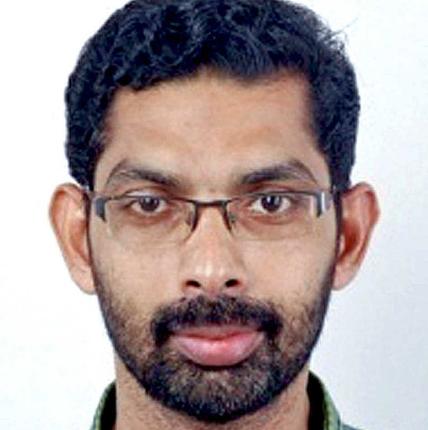
K.T. Muhammed Hashim
“We are the only two from the State to attend the conference this time, as far as we know,” said K.T. Muhammed Hashim, one of the invited teachers. While Mr. Hashim is working with the Government Girls Higher Secondary School, Koyilandy, A.K. Syke, is a teacher with the Government Higher Secondary School Chorode, Vadakara.
A.K. Syke
The conference will be held from April 10 to 14.th. The teachers will be provided free admission to the conference besides food and shared accommodation. The duo was selected from many IATEFL member teachers who applied for the event after due screening process and presentation of assignments, said the teachers. “Both of us have earlier presented papers at international conferences, including the Teacher Educators’ conference (TEC) of British Council held at Hyderabad,” said Mr. Hashim.
The conference, a major English Language Teaching (ELT) event comprising pre-conference sessions, symposiums, interactive sessions and exhibitions will have over 500 talks, workshops and seminars. “
source: http://www.thehindu.com / The Hindu / Home> National> Karnataka / by Jabir Mushthari / Kozhikode – April 02nd, 2015
The 32-year-old Indo-Arab Chamber of Commerce and Industries (IACCI) has set up its South India chapter in the city with Asif Iqbal as its Executive Director and singer-actor Lucky Ali as the Cultural Director. “The chapter will identify new areas of mutual cooperation to ensure the smooth flow of trade, investments, joint ventures, and technology between Indian and Arab industries,” Mr. Iqbal said in a statement on Aug. 4. The chapter will cover Karnataka, Andhra Pradesh, Tamil Nadu, Kerala, and Goa. In the Arab world, it will cover 18 countries.
Established in 1980, the IACCI aims to provide a link for promotion of commercial and economic relations between India and the Arab world. It is also an active forum for Indian businessmen who have close contacts with the Arab world.
The IACCI has supplied manpower and made a breakthrough in construction and project exports, thus ensuring the economic development of the Arab world. The Gulf chapter of the IACCI is in Muscat, Oman. The Bangalore office is located at World Trade Centre, 22nd Floor, Unit 2201A, Brigade Gateway, 26/1. Ph: +91 80-49365431, 98455-84891. Fax:+91 80 49365301. E-mail: asif@indoarabchamber.org
source: http://www.karnatakamuslims.com / Karnataka Muslims / Home> District> Bangalore / by Staff Reporter, KMNM / August 05th, 2012
Nobel laureate Malala Yousafzai chose Kolkata — after running a web check of a number of cities worldwide — for the treatment of a close friend who was suffering from a heart ailment.
The girl, Syeda Gulalay Jahid, is a former classmate of Malala in Peshawar. She had been advised surgery for a congenital cardiac problem but Malala’s homework proved spot-on. Doctors in Kolkata said Syeda need not get under the scalpel and she was sent home with a course of medication — and plenty of blessings and good wishes.
Malala was overjoyed by the quick recovery of her friend and plans to find out more about Kolkata, said her father from the UK. “Doctors in Kolkata and members of the Rotary Club were truly helpful. We had not expected such whole-hearted support from Kolkata when we called them for help. But they went out of their way to help Gulalay, who is just as touched as Malala and myself. Kolkata is truly a friendly city and Malala might be sending more such patients to Kolkata,” Ziauddin Yousafzai told TOI from UK on Tuesday.
It was in August last year that Rotary Club South City president Tapas Mukherjee got a call that set his nerves tingling. A soft-spoken man identified himself as Ziauddin Yousafzai and asked for help to get her daughter’s friend Syeda treated in Kolkata.
Before Mukherjee could get over the thrill of the name ‘Yousafzai’, the man said Malala would like to talk to him and passed the phone to the teenage Nobel laureate. “I was really excited when she came on the line. In fact, I couldn’t believe it for a few seconds. She was extremely courteous and spoke very softly. Malala sounded extremely worried about her friend who had a complicated congenital heart ailment that couldn’t be treated in Pakistan. She told me that she would be grateful if we could arrange for the treatment. It was to be sponsored by The Malala Fund in Pakistan,” said Mukherjee.
“Malala zeroed in on Kolkata after a thorough research . She told me that Kolkata would be the right place,” said Yousafzai. She had learnt of other Pakistani children being treated here, some of whom were helped by the Rotary Club.
More phone calls followed as preparations were made for the treatment. The city Rotary Club sought a formal communication from the Rotary Club of Swat, Peshawar. Syeda’s medical reports were sent to AMRI Hospital, Dhakuria. A panel of doctors was formed to recommend a line of treatment and she got admitted on March 11.
The panel was headed by cardiac surgeon P K Hazra. After four days in hospital, Syeda walked out without having to undergo a surgery. According to Hazra, Gulalay can lead a normal life on medicines alone.
“The pulmonary valve in her right ventricle is shut. It hinders the flow of blood to her lungs, but she has developed channels from her left ventricle that manages to carry the blood. With medication, she would be fine for the rest of her life. A surgery will be too risky at this stage,” said Hazra.
Malala personally wrote to AMRI Hospital, Dhakuria, and thanked the doctors. “I am truly touched by your kind gesture of overseeing Syeda’s admission,” she wrote, ending the letter by saying that she will remain “forever indebted to you and Rotarian Tapas Mukherjee”. .
Malala, the youngest Nobel laureate, is now studying in UK and preparing for an exam in June. “She is at the school hostel and won’t be back till June. She would be extremely happy to interact with people from Kolkata once she is back,” said Yousafzai.
Syeda will return to the city next year for a check-up. “We will be happy to arrange her treatment again and hope she is accompanied by Malala. It will then be a truly great occasion,” said Utpal Majumdar, a former trustee of East India Rotary Welfare Trust.
source: http://www.timesofindia.indiatimes.com / The Times of India / Home> City> Kolkata / by Prithvijit Mirta, TNN / April 01st, 2015
To deliver valedictory address of Golden Jubilee celebration at SJCE on Mar.31
Mysuru :
Former President of India Dr. A.P.J. Abdul Kalam will be arriving in city to take part in the valedictory of the Golden Jubilee celebrations of Sri Jayachamarajendra College of Engineering (SJCE) on Mar. 31. He will deliver the valedictory address at 10.30 am.
Maj. Gen. Nasser Al Sayed Abdul Razak Al Razooqi, Chairman of Al Razooqi Group, Dubai, will be the guest of honour.
Sri Shivaratri Deshikendra Swamiji of Suttur Mutt will grace the occasion.
B.N. Betkerur, Executive Secretary of JSS Mahavidyapeetha, Prof. M.H. Dhananjaya, Director (Technical) and Dr. B. Suresh, Vice-Chancellor of JSS University, will be present as guests. Minister for Higher Education and Tourism R.V. Deshpande will preside.
Later, Dr. Kalam will interact with the students.
source: http: //www.starofmysore.com / Star of Mysore / Home> General News / March 26th, 2015
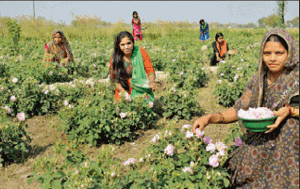
At Khitoli village, Hasayn, Hathras district, mid-March is when the process for extracting rose essence (ruh) begins. The process will go on till the end of April, over a period of 40 days. There is a big rose mandi here. Ask farmers what the secret of the rich aroma of the roses of this region is, and the answer is unanimous – human poop.
The rose of this region is called “Noorjehan” – jewel of the world — after the wife of Mughal emperor Jahangir. The air in the village at this time year is laden with the aroma of roses.
Workers are seen plucking roses early in the morning, while dewdrops are still on the buds. They measure the roses, add bunches of them into water to steam in a large copper container called degh to extract ruh. About 250 kg of flowers yield just 40 gm of ruh.
Work on the floriculture crop begins in October each year, with the sowing of seeds.
“The good yield of the rose is because of fertile land – and if you are thinking what makes the soil here especially fertile, it is human poop,” says Mahesh Pal Singh, former pradhan of the village whose father Veer Pal Singh started the work of rose essence extraction some 65 years ago in Khatoli. Veer Pal Singh died at the age of 108 last week.
“The farmer is also a scientist,” Singh says. “He knows what is good, what is not. Most of us avoid cow dung and prefer human poop in our fields as manure. Almost 95% of our villagers don’t have toilets at home. All the men, women and children answer the call of nature in the fields. That is why the produce in the village is far better than what is grown in farms away from human habitation.”
One cannot then help wonder if toilets in village homes is at all a good idea then, in this part of Hathras district.
“The toilets are only part of the big houses here. Just about five village homes here have toilets – the rest go to the field. That is what is best, not just for the rose crop, but also for potatoes. We need bijli (electricity) and sadak (roads) rather more urgently that toilets. It would save us the bother of going out of the way to transport our produce,” farmer Bahadur Singh says.
“And what when every house has a toilet?”
“There will be no roses then,” the farmer says, with quiet conviction.
The essence extracted from the rose is later used in tobacco, perfume and soap manufacturing.
Horticulture officer Kaushal Kumar of Aligarh says, “Yes, there is truth to the belief that human excrement is good manure – there is a good quantity of micro-nutrients in excrement, as well as nitrogen, potassium and potash. But for the sake of hygiene, it should first be treated well.”
It is human poop that also breeds earthworms, farmers say. “They make the land fertile, dig the ground and make soil breathe,” Bahadur Singh says.
Kaushal, however, said it was not as if there was a direct link between foul-smelling human excrement and sweet-smelling roses: “The excrement makes the land fertile and aids in growth. Without it, some nutrients would be lost to the soil. Even the farmers are aware that the transition is no direct one, he says.
Besides poop and earthworms, the rose crop also needs moisture-laden easterly winds at the beginning of the growing season – rain in that time could damage the crop, farmers say.
source: http://www.timesofindia.indiatimes.com / The Times of India / Home> City> Agra / by Eram Agha, TNN / March 29th, 2015
When Intizar Hussain writes, everyone pays attention. The India-born-Pakistani writer, well-known even beyond the boundaries of the sub-continent, recently wrote about the Jashn-e-Rekhta — the two-day Urdu literary festival held in Delhi earlier this month.
He said: “I am returning (to Pakistan) after witnessing the biggest literary festival. This festival of Urdu was celebrated under the title Jashn-e-Rekhta and held at the India International Center, a central place in the Indian capital.”
He added: “Friends and others believed that the tradition of Urdu has come to an end in Delhi. Oh! no. This is not the case. Like the sun, Urdu went down here and has reemerged there. It is the magic of Urdu that is mesmerizing the public. Such big gathering; such big crowds might not have been seen at the India International Centre before. The crowd was not that of the traditional Urdu audience that are seen at mushairas trying to bring down the roof with their wah wah, subhanalla and repetition demand. This crowd was that of the sons and daughters of Delhi who have got introduced to the thrill of Urdu through Hindi and English.”
Clearly, from the tone of his two-part article published by a Pakistani daily, it is certain that the Man Booker nominee of 2013 was suitably impressed with the language gathering new admirers.
A Hyderabad-based academic Shams Imran who attended the festival is baffled at the response the event received. “While there is no denying the fact that hordes of people from Gen X are flocking to Urdu for its emotional quotient, the event became a roaring success not merely because of the celebrity participants but because of the imaginative public-friendly planning,” he said.
But why name it Jashn-e-Rekhta (a name that preceded Urdu, the language as it is known today) and not Jashn-e-Urdu?
While the answer could be there in the tombs of information available on the popular Rekhta website, what comes to mind on hearing it is the history of Urdu, the language that represents one of the finest examples of the fusion of Indo-Islamic cultures.
According to some scholars, the first seeds of Urdu were sown with the arrival of Muslim groups from Arabia to India some 1,300 years ago, who brought with them the Arabic language. The later groups came from Afghanistan and Central Asia who carried with them the Persian language and Turkic dialects. It took a distinct form during the last phase of the Sultanate that coincides with the era of Amir Khusrau who used a language that had words from Sanskrit, Bhasha, Persian, Turkish, Arabic and Persian. As Persian or Farsi was taking roots during the Mughal era in Delhi, down in the Deccan, Mohammed Quli Qutb Shah was writing poetry-Piya baaj pyala piya jayena…It was called Deccani in the South then.
The Rekhta or an initial variant of Urdu was still not considered a language to pen poetry. It was merely the lingo of the common folk in bazaars, streets and lanes. Two men from the Deccan, Wali Deccani and Siraj Aurangabadi, discovered the potential of Rektha to be used as the medium of poetry. The popularity of their poetry reached the doorsteps of the North, especially Delhi. Rekhta was no more a language that could be looked down upon. Meer, Sauda and later Ghalib began writing in this language and in the process created a treasure trove of new words, compound words and adage. But by then, Rekhta had graduated to be called Urdu.
So Rektha, according to some, has returned as the language of all those who had felt some connection with Urdu.
The question here is this: When Hyderabad organised a literary festival with Urdu as the language in focus in January, only two months before Jashn-e-Rekhta in Delhi, why it did not click?
According to some observers the reason lies in the fact that except for Javed Akhtar and Rakshanda Jaleel, there were hardly any other popular names in the festival that could help in attracting crowds. The organisers had not even bothered to invite the two award winning writers from within Hyderabad–Padmashri Jeelani Bano and Padmashree Mujhtaba Hussain.
Guess the organisers back home need to take a leaf out of Sanjiv Saraf’s book – the man who made Jashn-e-Rekhta such a huge success.’
source: http://www.timesofindia.indiatimes.com / The Times of India / Home> City> Hyderabad / by Mir Ayoob Ali Khan, TNN / March 29th, 2015
With Mani Ratnam, there are many-layered feelings, according to the maestro. / by Special Arrangement
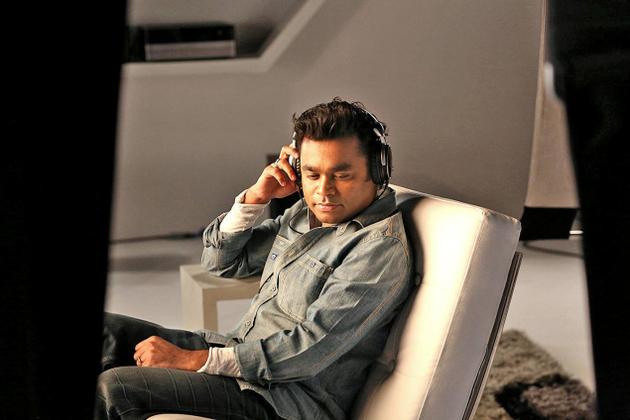
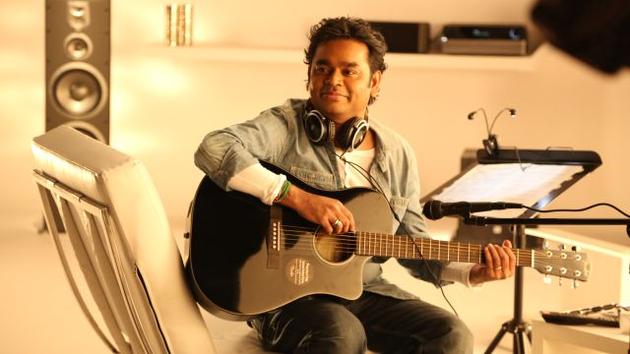
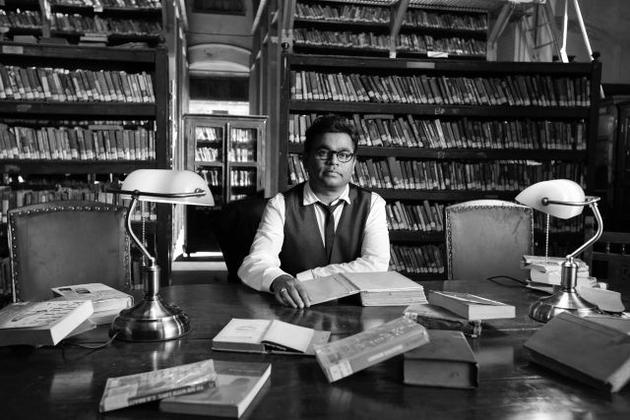
A.R. Rahman talks about his trendsetting musical journey, his forays into other areas of filmmaking and the inexorable charm of being himself
Allah Rakha Rahman is relaxed, worried and anxious — all at the same time.
As a composer, he’s happy; his Mental Manadhil from O Kadhal Kanmani (OKK)is doing well and the rest of the album will be out on April 1. As a son, he’s concerned; his mother took ill recently and is still recuperating. As a producer, he’s eager; things are neatly falling into place with his first project.
When I catch up with him on Thursday evening at his Kodambakkam studio, a few hours after India has lost to Australia in the cricket World Cup, he’s a picture of poise. In an hour-long interview, the musician — clad in a simple brown kurta and jeans — opens up on upcoming releases, working for the famed Iranian director Majid Majidi, his relationship with Ilaiyaraaja and life so far.
‘Mental Manadhil’, from his upcoming O Kadhal Kanmani, is a light-hearted song, he says. / by Special Arrangement
Your latest release, Mental Manadhil, which you’ve written, composed and sung is almost a sensation. How does it feel?
It’s supposed to be a light-hearted song. Lyricist Vairamuthu was off on a holiday and Mani wanted a song immediately. The two of us had already written Endrendrum Punnagai in Alaipayuthe and so, we plunged into that zone again.
What is it about Mani Ratnam that brings out the best in you?
With him, there are many-layered feelings. He introduced me to films, as you all know, but now, the three of us — Mani, Vairamuthu and me — have become a brand. Even if we want to be complacent, we cannot because of people’s expectations. It works like a trigger. We have done our bit in the last few years, but because people expect so much, we want to give them what they we want.
I was told that the three of you even have serious disagreements during composing sessions. Elaborate on that with respect to OKK…
I don’t like certain things. Sometimes, you have to compromise words for the sound — the sound is very important, it de-clutters from the words. People don’t have as much bandwidth as before; we have to catch their attention immediately.
In one of the songs in OKK (Naane Varuvaen), we had an antara that was beautiful but had very complicated words. So, instead of that, we came up with repetitive lyrics. The word (chinnanchiru) repeats itself again and again. It’s like the formula used in traditional performing arts. Take thumris, for example. They have the same thing again and again…. because the tunes get complicated, the words cannot. In songs like Yaad Piya and More Sajni, we keep hearing the same line because it’s easier for the mind to concentrate.
You’re writing a screenplay, producing a Hindi film… why are you branching out into areas other than music?
I want to see if my growth as an artiste can fill the void that I feel is missing in India. Mostly, our industry is driven by what’s going to click commercially. When something clicks, it is replicated. Very few people do it for the art. I do not want to be both — I want to find that balance between what people like and the lost flavour in our music. I’ve been working on it for four years to see if we’ve covered it in all aspects.
How disappointed are you when your films don’t do as well as expected? We hadKaaviya Thalaivan and Lingaa last year…
See, I made a mistake by doing too many films. I should have said no to some of them. As a team, our backs were broken. There was intense pressure, sleepless nights — I feel it’s just not worth anymore. Life has given me something that what I’m drawn to like naturally… when you’re overworked with too many demands and deadlines, it’s not a good thing.
So, you’re admitting that Lingaa was one of them?
We had to finish things fast to match the film’s release on Superstar’s birthday. People know exactly what happened with respect to that film. We had to deliver in three languages — Tamil, Telugu and Hindi — check the sound mixes, do the background score and everything. Simultaneously, I was also doing Kaaviya Thalaivan. It all happened came at once… it was so unfortunate.
There are a group of people who feel say your music now isn’t as good as it was in the 90s…
I am flattered; at least they like something of me! (laughs)
When you hear such comments, what goes through your mind?
As a creative person, I have to move on. There are fans for what I did then, and there are fans for what I’m doing now. You cannot go to a yesteryear actress and say, ‘I don’t like you anymore’, can you?
You worked with Vasanthabalan recently. You’re working with Vikram Kumar this year. Why are you going for newer combinations while you can safely opt for time-tested ones?
After a while, we take some people for granted. This is a good and a bad thing. With people like Mani or Ashutosh Gowarikar or Shankar, it’s never a bad thing because they present new challenges and anyway do movies once in two years. New directors give me the option of discovering something afresh.
What’s the status on Muhammad, your Iranian film, and why did you take that up?
It’s still a work in progress because the movie needs to be edited. I’ve been a big fan of Iranian films, especially Majid Majidi’s. Suddenly, one day, Imtiaz Ali called me to say that UTV got a message from Majidi that he wanted me for his project. I was like, ‘Wow’. It will be one of the most ambitious in the history of cinema.
But it wouldn’t have been easy…
His expectations were very, very high. In a way, it was good because I wanted to learn their school of thought. I wanted to know how they produce, how they way they write their scenes. I’ve been to Iran twice for two trips and it was an amazing experience.
You’re busy travelling all over the world, are you able to spend enough time with your three children?
We watch a lot of movies together, especially 3D animation films.
Is your mother still your emotional anchor?
That’s what you learn from life… where your priorities ought to be and why you should respect every family member. Amma has just recovered from a serious illness — she’s better now, but still, it’s not like before….
From being just a boy from Habibullah Road, Madras, to an international composer… how have you changed to fit the bill?
When climate and time zones change, everything changes. There, I’ve three more layers of clothing. The ease of resources, with respect to studios, we have here isn’t available there at times. All the musical notes need to be prepared in advance, not like how it works here. But then, you adapt. It took me 10 years to get used to all that.
It’s well-known that you played for Ilaiyaraaja before branching out individually. Are you still in touch with him?
The last I met him was at a music function. See, when I’m abroad, I bump into other composers all the time — at screenings or events. It’s unfortunate that Chennai isn’t that much of a social place for me; I’m usually caught up in my own work. And then, there’s family, the school… there’s not much social time. We have the respect in our hearts.
Do you read a lot?
(Thinks for a while) The last book that I read was… the screenplays of The Hundred Foot Journey andPele. Those are books anyway.
Coming back to music, there are several exciting new composers. There’s Santhosh Narayan, whom you’ve spoken highly of, and Anirudh and G.V. Prakash. In Hindi, there are many others. Would you say music is in safe hands?
There’s much more to explore in music. The demands should not be to make just hit songs. Each composer has to set a rule for himself to create timeless music. Why do we love works of the past? Because some of them are timeless; audiences still have a connection with them. That’s what I try to do and that’s what I’d like younger composers to do too.
There’s much more to explore in music, says Rahman. The demands should not be to make just hit songs. / by Special Arrangement
Your school, KM Music Conservatory, has come a long way since its inception. What are your future plans for it?
It was a huge task for us to have a new building and now we have that. It seems to be a great place to hang out and study music. Sometimes, I feel jealous of the kids studying in the school because I never had such a place while growing up. We want the students to serve in the entertainment business with a unique identity… and yes, make people smile.
You say you’re always running against time, but still do your daily namaaz (prayers)…
That’s my oxygen.
So, everyday life must be a balance…
You have to keep everything you do in multi-tracks. There’s no ‘I will do that tomorrow’. That’s what I’ve realised of late. I don’t say ‘I’ll do my prayers tomorrow, compose for this beautiful idea tomorrow, or say I love you tomorrow…’ If you want to do something, do it now.
source: http://www.thehindu.com / The Hindu / Home> Features> MetroPlus / by Srinivasa Ramanujam / March 27th, 2015
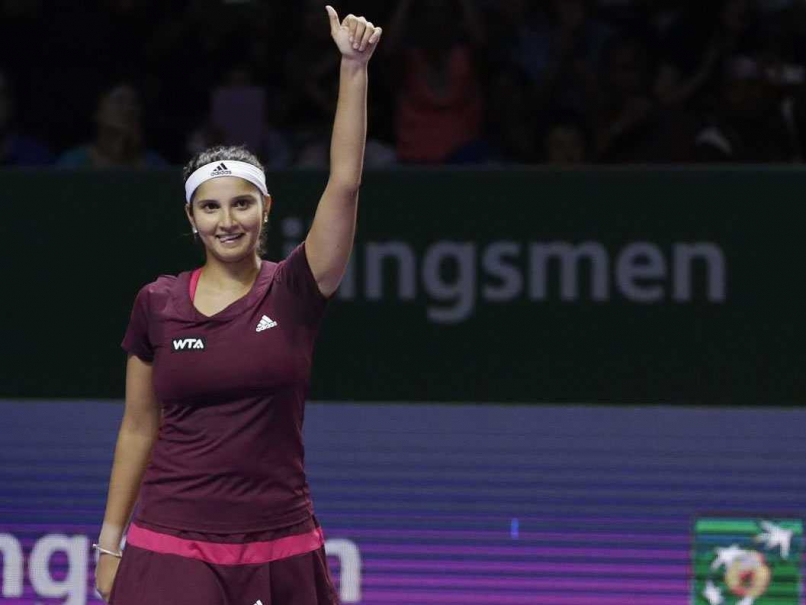
Sania Mirza gained two places to jump to career-best rank of three in doubles. Leander Paes slipped four places to 25.
File photo of Sania Mirza.
New Delhi:
Sania Mirza jumped to her career-best rank of three in the doubles, following her stupendous title win at the BNP Paribas Open with Swiss great Martina Hingis. Sania now sits at number three with 6885 points, behind Italians Roberta Vinci and Sara Errani, who share the top spot with 7640 points each.
Courtesy her win at the Indian Wells, Sania earned 1000 points and gained two places on the WTA chart. She had reached the final of the same tournament last year with Cara Black.
“It’s thrilling to achieve my career-best rank. Being the number one is a dream and I hope I can get there some day,” Sania told PTI from the US.
In the WTA singles chart, Ankita Raina continues to be numero uno player at number 253, up by two spots. In the ATP rankings, Somdev Devvarman maintained his 176th rank while Ramkumar Ramanathan was number two after gaining 10 places to be at 247.
Yuki Bhambri was the next best at 257 as he jumped 27 spots.
In the doubles, Leander Paes slid to 25, a loss of four places and just behind him was Rohan Bopanna, who lost one spot on the ladder.
source: http://www.sports.ndtv.com / NDTV Sports / Home> NDTV Sports> News / by Press Trust of India / Monday – March 23rd, 2015
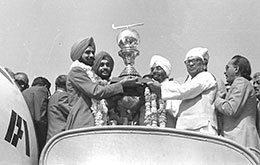
40 years back, on 15 March 1975, the Indian men hockey team accomplished a historic feat against Pakistan in the finals of the 1975 Hockey World Cup wherein they beat the opponents 2-1 to earn the title of ‘Champions’. It was a moment of pride that day and it is a moment of pride for every Indian today. Remembering the occasion and the achievement, Hockey India congratulates the team who made this possible.
Led by Captain Ajit Pal Singh, the team left no stone unturned to ensure that they got the Cup home. The team was placed in Group B of the tournament where they played against West Germany, Australia, England, Argentina and Ghana. Winning 3 matches, losing 1 and drawing 1 in the pool phase, India advanced to the semi-finals to play against Malaysia wherein they beat them 3-2. They had a close contest against Pakistan in the finals and it was Ashok Kumar the all important winning goal helping India win the title that year.
Speaking on the proud occasion Dr. Narinder Batra, President, Hockey India said “After 40 years I still feel proud of the moment when we earned the title of Champions. I would like to congratulate each member of the winning squad and would like thank them that they made this day possible for every Indian. It is this feat 40 years back, which gives us the motivation that we can repeat history and win the title again.”
Ajit Pal Singh captained and led the team to victory during the 1975 World Cup. He even has to his credit of representing the prestigious tournament on three occasions where he represented the team for 1971 World Cup, Barcelona wherein the team bagged the Bronze and in 1973 World Cup, Amsterdam where they bought back the Silver. He even was part of two Olympics Games in Mexico 1968 (Bronze) and 1972 (Bronze). He won the Arjuna Award in 1970 and Padamshree in 1992 for his contribution to the sport from the Government of India.
Ashok Kumar, son of legendary Late Major Dhyan Chand is the first of two Indians who represented India for 4 World Cup tournaments which included Barcelona 1971 (Bronze), 1973 Amsterdam (Silver), Kuala Lumpur 1975 (Gold) and Buenos Aires 1978. He was also instrumental in scoring the winning goal for India against Pakistan in the finale of the 1975 World Cup. Mr. Ashok Kumar also participated in the two Olympic Games in Munich 1972 (Bronze) and Montreal 1976.
Mohd. Aslam Sher Khan, defender and his contribution during the 1975 World Cup cannot be forgotten. He even represented India during the Olympic Games in Munich 1972 (Bronze), Brig.
Harcharan Singh VSM also represented India at three World Cups in Barcelona 1971 (Bronze), Amsterdam 1973 (Silver) and Kuala Lumpur 1975 (Gold) alongwith one Olympic bronze medal in Munich 1972.
Leslie Fernandez whose goalkeeping is still talked about after so many years was also part of the World Cup winning squad.
Dhyan Chand Life Time Achievement Awardee Varinder Singh was also part of the Indian Team that won Silver Medal at the World Cup in Amsterdam 1973 and represented India at two Olympic Teams in 1972 (Bronze) and 1976.
Ashok Diwan a Dhyan Chand Life Time Achievement Awardee in 2002.
Michael Kindo who played at the full back position and was honored with the Arjuna Award for his achievements. He represented India at 3 World Cups which also included Barcelona 1971 (Bronze) and Amsterdam 1973 (Silver) alongwith one Olympic Games in Munich 1972 (Bronze).
BP Govinda, current Chairman of the Selection Committee of Hockey India apart from being a part of the winning team in 1975 was also in the team of World Cup in Amsterdam 1973 (Silver) alogwith two Olympic Games in Munich 1972 (Bronze) and Montreal 1976, Brig.
HJS Chimni who played at the centre forward position during the World Cup and whose contribution was vital for the win.
V J Phillips who captained India at the Buenos Aires World Cup in 1978 was crucial member of 1975 World Cup winning team and also represented India at the two Olympic Games in Munich 1972 (Bronze) and Montreal 1978.
Onkar Singh, youngest member of the World Cup 1975 winning team, later participated in the 1981 World Cup held at Mumbai.
Kaliah P.E. the talented inside forward was also a part of the winning squad.
Late Surjit Singh who played three World Cups in Amsterdam 1973 (Silver), Kuala- Lumpur 1975 and Mumbai 1982 finally has to his credit of ensuring that the team won the tournament in 1975. He also played two Olympic Games in Munich 1972 (Bronze) and Montreal 1976, he was one of those players who scored 4 Olympic goals and which a player will be proud of on any given day. He even was part of the 1978 Asian Games and where the team bagged the Silver medal.
Late Shivaji Pawar the great center forward was also instrumental in the win of the 1975 World Cup. Late Mohinder Singh was also one of the key player of the 1975 winning squad.
source: http://www.indiansportsnews.com / Indian Sports News / Home> Hockey / March 15th, 2015
Tamil films are going places. After Vasantha Balan’sVeyil was selected in the Tous les Cinemas du Mondesection at the Cannes film festival last year, it is the turn of Paruthiveeran , one of the most realistic films made in 2007 to shine.
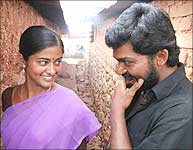
Paruthiveeran, by Ameer Sulthan, was honoured with a “special mention” from the Network for the Promotion of Asian Cinema (NETPAC) at the 58th Berlin International film festival. The three-member NETPAC jury included Indian film critic Meenakshi Shedde.
The main NETPAC prize went to “United Army” by Japanese director Wakamatsu Koji.
Both Paruthiveeran‘s director and the lead actor Karthi attended the film’s international premiere at the Berlinale.
This is not the first award for the film. It was adjudged the best film at the 9th OSIAN’s-Cinefan film festival for Asia and the Arab world while the lead actress Priya Mani won the Best Actress award.
Awards are not new to director Ameer Sulthan, either. His earlier film Ram won two awards — Best Film and Best Actor (Jeeva) at the Cyprus International film festival.
International awards to three of his lead performers — Jeeva, Karthi and Priya Mani — just shows how powerful the characters he creates.
About performing for Paruthiveeran, Karthi told rediff.com last year, “I had faith in my director. He first told me to grow my hair and beard. I did that. He asked me to reduce my weight. Every week, I used to meet him and ask, are you happy with the progress I have made? He would then ask me to reduce again; and reduce my waist, increase my biceps, etc. Once the shooting started, it was Ameer who guided me. He can act very well, and he would act it out for me. But the toughest part was reproducing what he did.”
It was the same with Priya Mani too. She admitted that she followed the director’s instructions completely, as she was unaware of how a village girl from Madurai behaved and spoke. “If I have performed well, it’s all due to Ameer, the director. He overlooked every minute aspect of the character, from the body language to the modulation of the dialogue, to what my expression should be when the male lead delivered his lines. So, all credit goes to him.”
The film is a success because the film has a powerful story, excellent performances and a sincere director. No wonder Ameer Sulthan is reaping the harvest for all the hard work he had done.
source: http://www.rediff.com / Rediff.com / Home> Movies / by Shobha Warrier, Chennai / February 18th, 2008