An Indian Muslim was the Anadolu Agency’s first employee in war-torn Anatolia.
Istanbul:
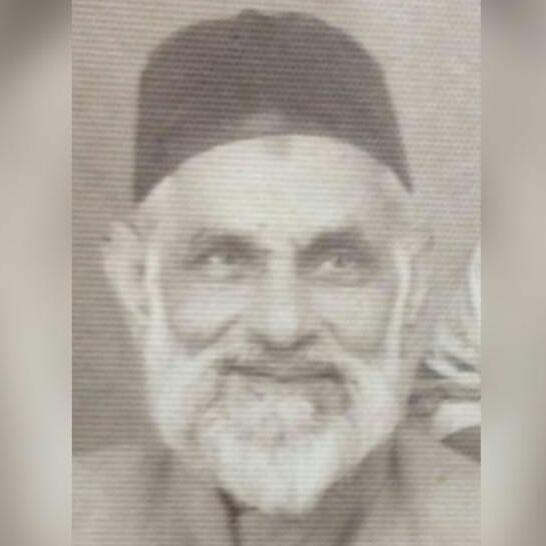
During the turbulent days of Turkey’s Independence War following the Ottoman Empire defeat in World War I, an Indian Muslim who fled his country to lend a hand to the ailing Ottomans became the first journalist for the Anadolu Agency, the nascent Turkey’s first news outlet and their first foreign affairs officer.
Working beside the Anadolu Agency’s two founders, the famous novelist Halide Edip (Adivar) and renowned journalist Yunus Nadi (Abalioglu), Abdurrahman Peshawari wrote his news stories in a small office, typing stories of wartime atrocities, victories and losses and sending them out, with only one finger “flying” over a typewriter, according to Yunus Nadi’s memoirs.
Abdurrahman Peshawari was born in the city of Peshawar in the famed Khyber Valley, and was only 26 when he sold his clothes and books to pay for his sea journey, despite the wishes of his wealthy family, who urged him to continue his studies.
Peshawari sailed with 26 Indian Muslims in an Italian ship from Mumbai to Istanbul, the capital of the Ottoman Empire, and during the long journey volunteer doctors in the group trained him in first aid. Peshawari was motivated by high Islamic ideals, fought with the Ottoman army and was injured three times while fighting at Gallipoli against the British Imperial navy, during which Ottoman troops managed to repel invading forces from the Dardanelles Strait.
He later joined with an Ottoman Red Crescent group, bringing financial aid from Indian Muslims to purchase medical equipment for the Ottoman armies fighting in the Balkans. Indian Muslim communities supported the Ottomans during the empire’s collapse and Peshawari was a notable member of this group, said Mucahit Arslan, a Turkish history researcher who uncovered the story of this “unknown hero” of Turkey’s Independence War.
The Caliphate Movement by Muslim communities in “British Raj” India began as early as 1912, while the Ottomans were fighting in the Balkans, and many Indian Muslims contributed, either financially or in person. Some wealthy Indians studying medicine in Europe established a field hospital during the battle of Gallipoli.
Peshawari joined the Ottoman army and saw active service in Beirut and Gallipoli during World War I.
After the war, despite his family urging him to return home, he chose to stay where the Turkish Republic was being established in Ankara in the midst of shattered and war-torn Anatolia, refusing his mother’s pleas to return by saying, “I cannot come back while the Muslim nation is under invasion.”
Peshawari served the nascent Turkish Republic, appointed by Ataturk as ambassador to Afghanistan until his story ended tragically when he was assassinated in Istanbul in 1925, apparently mistaken for a military commander.
This abrupt end to Peshawari’s career meant that he was denied the international fame which many other 20th century reporters found. Martha Gellhorn, George Orwell, Ernest Hemingway and Walter Cronkite are just some of the names who documented the most terrible conflicts of their time. However, in Turkey, Peshawari can truly be said to have been in a league of his own.
englishnews@aa.com.tr
source: http://www.aa.com.tr / Anadolu Agency / Home> Archive / May 07th, 2014
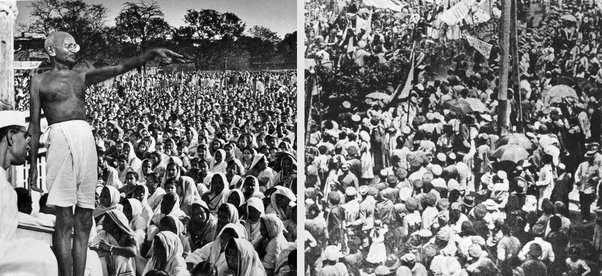
A diorama of Mahatma Gandhi leading satyagrahis in burning British clothes at Gandhi Smriti, New Delhi
Shaikh Mohammed Elias, son of Shaikh Mohammed Younus Fakhre Quaum often heard the story of his great-grandfather’s sacrifice for freedom.
Fazal e Elahi Gorey Fakhre Quaum was a wealthy dealer of foreign goods in the 1940s when the British Empire had reached its zenith in glory and power.
In that pre-Independence era, all rich Indian merchants did well by shipping exorbitant British products from Britain and selling them in India. Because of his buoyant import-export business, Fazal e Elahi and his family lived in the lap of luxury. In those days, when no one had big branded cars, he was driving his grand Impala car around!
He and his family lived in Delhi. However, due to the exponential trade with Kolkata as the British capital, he moved there for business prospects. Since he was dealing with the British, he was given the moniker of Gorey Wale by the local people for a person who traded with the ‘whites’.
Rukhshi Kadiri Elias, entrepreneur and founder of Taajira-The Businesswoman, is the great grand-daughter-in-law of Fazal e Elahi. She told Awaz-The Voice that her great grand-father-in-law’s nickname Gorey Wale stuck on with him until an incident happened that elevated his name to a title awarded to him by the community, “Fakhre Quaum (Pride of the community).
Her father-in-law Shaikh Mohammed Younus Fakhre Quaum told her that even Mahatma Gandhi who fought vigilantly for the freedom of India would visit Kolkata and stay with him in his home during his visits. The family shares that Fazal e Elahi was a grand, gracious, and dignified man who lived by ethics.
Fazal e Elahi Gorey Fakhre Quaum
The Swadeshi movement was gaining momentum with passions running high, and at this time, the boycott of British goods started to take on a fresh vigour. Ruskshi’s husband, Elias Mohammad Shaikh shares with the family how his great-grandfather, Fazal-e-Elahi in a defining moment took a bold step to join the Swadeshi movement.
Not thinking about himself, his family, or his future, he gathered the massive pile of British products from his warehouse, transported them to the Kolutolla crossing near the Mohammed Ali Library, and stacked them into a mountainous heap before the gaping crowds, he set the entire lot of goods ablaze in a roaring fire. His business days with the British were over and the Gorey Wale sealed all doors shut for any future trade with the British. Impressed, the crowds gave him the grand title of Fakhre Quaum, meaning “pride of the community.”
It only takes a spark to set a fire blazing. The locals watching him inspired by his sacrifice rushed back to their homes and gathered all the British products they were using, started to make little piles on that road and burn them up and soon the road was aflame with British merchandise. This was the start of the boycott movement in the Muslim community as well as all over Kolkata
Fazal-e-Elahi as a freedom fighter turned all his words into actions by bringing his entire warehouse of goods onto the streets to burn them. Setting an example to the others who never expected him to take this step, losing most of his business overnight, they perceived this act as going beyond mere words or loud speeches. It was a big turning point for himself as well as his family which would negatively impact his children bringing them financially down from this point forward.
He also used the remaining parts of his wealth to give make monetary contributions to the freedom struggle. To survive, he diversified into different Indian products and started making handmade candles, ink and other products and trading in the same. His son, Mohammad Younis also started on a small scale at a time when Bangladesh and West Bengal were one big state. During the Partition, while they had to shift from Bangladesh to Kolkata, they went through pain and struggle. Properties were confiscated and there was a great loss all around.
During the partition, many families of the freedom fighters split. Shaikh Mohammed Younus FakhreQuaum had nine brothers and two sisters with most of the family living in Pakistan, while four remained in India.
Gandhi addressing Satyagrahis
Fazal-e-Elahi’s family was from Sargodha located in Punjab province of Pakistan. In the 1900s, looking for better prospects in trade, they traveled by caravan to the courts of the Mughal emperor of Delhi. The emperor encouraged people to come and settle down in the new city of Delhi. Learning about this, the family embarked on a journey to Delhi. During their travels on the way, the Hindu Punjabi traders met a seer by the name of Hazrat Shams Tabrez.
Highly influenced by his inspiring speeches and extraordinary demeanor, the entire party in the caravan converted to Islam. When they came and settled in Delhi, they became Delhi wallas known as Delhiwal meaning they were Punjabis settled in Delhi. They adopted Urdu, the court language of Delhi. Even today, while settled all over the world, they are known as Delhiwal and these groups of people are mostly concentrated in Kolkata and Delhi and all called Delhiwal.
While propagating the Quit India Movement, Fazal-e-Elahi rose quickly to become the president of the Baradari (brotherhood) of the Delhiwal community in Kolkata. When travelling down narrow lanes to build up the movement of Quit India, he abandoned driving his Impala car and started to use a horse.
Quoting her father-in-law, Rukshi says that India saw amazing unity during the Freedom Movement. Those days, one could make friends so easily, and it was the most normal thing to build bonding friendships with anyone across different communities. The freedom movement drew Indians into close ties where Indians forgot all their differences and only had the motive to defeat the Enemy.
Fazal-e-Elahi Gorey Fakhre Quaum sacrificed his flourishing business without thinking twice about it towards establishing the freedom of India setting patriotism waves over the community. Rukhshi says, “How many people will do that today is the question in this materialistically attached generation that we live in today. It was pure selflessness because Fazal-e-Elahi Gorey Fakhre Quaum considered India his own country. Such people will revive the spirit of India, sacrifice, and unity.” With a laugh she adds, “I could never think of throwing away my lovely tea set I bought in Britain, but he did it so easily.”
Rita Farhat Mukand is an independent writer and author
source: http://www.awazthevoice.in / Awaz, The Voice / Home> Story / by Rita Farhat Mukand / August 12th, 2024
To celebrate the declaration of India as a democratic country, an Urdu periodical ‘Jamhoor’ was started from Aligarh, on the same day when the Indian Constitution came into force, i.e., on 26th January 1950.
Aligarh :
The Constitution of India was enacted in our country on 26th January 1950, after repealing an earlier act known as Government of India Act-1935. This implementation marked the beginning of the democratic form of government in India.
To celebrate the declaration of India as a democratic country, an Urdu periodical ‘Jamhoor’ was started from Aligarh, on the same day when the Indian Constitution came into force, i.e., on 26th January 1950. It was published three times a month, on 6th, 16th, and 26th day of the month. It was owned and edited by Mohammad Umar Khan Chattarvi (1924-2003), a well-known literary and pro-Urdu figure from Aligarh. Chattarvi was also the founding Secretary of the Urdu Board Aligarh and Idara-e- Ilm-o-Adab, Aligarh, under which he organised various Urdu literary activities and worked to promote Urdu education. He was a good poet and carried the pseudonym, “Samar”. In addition, he also held the posts of Secretary of Anjuman Taraaqi Urdu, Aligarh, and the National Anti-Communal Committee. He also served as the vice-president of the Aligarh Congress Committee.
Mohammad Umar Khan Chattarvi (1924-2003)
In 1957, in his editorials, he raised his protest against corruption in government circles and vehemently criticised its policies against the people. He questioned many decisions of the government, and in this regard, he exposed many faces. The then government did not appreciate his views, and he was soon arrested and sent to jail. Thereafter, protests started in Aligarh for his release. In 1958, the district court acquitted him honourably. Even after his release, he continued to edit ‘Jamhoor’. He believed that the strength of a democratic system rests on questioning and analysing the government’s work. He passed away on 16th March 2003, at the age of 77.
Every year, on the occasion of the Republic Day (26th January), “The Jamhoor” used to publish a special issue ‘Jamhooriat Number’ in which it meticulously examined Indian democracy and identified the real issues of the country, such as corruption in the government sector, educational inequality, poverty, illiteracy, minority issues, and communal problems, and so on. This special number was continuously published for thirteen years until it ceased its publication in 1962.
Jamhoor also started publishing a series of special articles on Indian democracy, contributed by Dr. Mohammad Hashim Kidwai who was then a young assistant professor of political science at AMU. This series was published continuously for about ten years. In his articles, Kidwai analysed and explored the political activities related to India over the previous year, highlighting the points that would contribute to the weakening of the Indian democracy.
On the cover page of the Republic Day special issue of 1951, under the title ‘Heroes of India’s Independence’, sketches of Mahatma Gandhi, Maulana Abul Kalam Azad, Pandit Jawaharlal Nehru, Acharya Kirpalani, and Sardar Patel were published. The same issue carried articles of Dr. Parasram, and Mohammad Hashim Kidwai, respectively titled “Position of Minorities in the Republic of India” and “Some Disturbing Thoughts on Democracy”.
‘Jamhoor’ helped the helpless Muslims at every stage of the post-independence period by fostering national unity and integrity and debunking Pakistan’s propaganda. Through their editorials and columns, ‘Jamhoor’ pulled Indian Muslims out of their inferiority complex and tried to convince them that their future is safe in India and they should not fall into Pakistan’s mischievous propaganda. For this purpose, it published messages, statements, and speeches of national leaders from time to time, so that the atmosphere of peace and tranquilly in the country can be maintained.
‘Jamhoor’ made a unique and indelible mark in the field of journalism. Its editorials and columns highlighted public concerns and issues in independent India, and helped to find new avenues. These features of ‘Jamhoor’ guaranteed its success and advanced its popularity.
At a critical juncture, during the early years of the post-independence years, when Hindus and Muslims were looking at each other suspiciously, there was a lot of prejudice on both sides, this newspaper played a significant role in promoting national unity and a peaceful society. Jamhoor apprised the government of the basic problems of the people, and exhorted both Hindus and Muslims to exercise patience and take steps towards the development of the country.
Many eminent scholars, such as Dr. Hashim Kidwai, Riyazur Rahman Sherwani, Muqtada Khan Sherwani, Waseem Alig, Dr. Ashraf, Haroon Khan Sherwani, Dr. Parasram, Zia Ahmed Badayuni, Abdul Shahid Sherwani, Zaheer Ahmad Siddiqui, Abu Anjum Qamar Sohouri, Aziz Ahmad Siddiqui, etc. immensely contributed to Jamhoor through their writings.
References:
Farooqui, Asad Faisal. Aligarh Ke Sahafat, Educationl Book House, 2016
Jamhoor, Aligarh (1951-1960) preserved in MAL library, AMU.
Idara-e-Ilm-o-Adab, Salana Report, 1959 (Annual Report, Compiled by Mohammad Umar Khan Chattarvi Samar)
The author may be contacted at asadfaisalamu@gmail.com
source: http://www.milligazette.com / The Milli Gazette / Home> News> Special Reports / by The Milli Gazette Online / by Asad Faisal Farooqui / March 16th, 2023
Ruins of Haveli of Basi Bangar, Bulandshahr, Uttar Pradesh
The history of the Khanpur Estate and Bara Basti (twelve villages) goes back to the reign of the Mughal Emperor Jahangir when a son of a Daudzai Afghan chieftain, Sheikh Ruknuddin Afghan founded a village on the banks of Ganga and gave it the name of “Basi Bangar”.
As a valiant warrior, Ruknuddin was inducted in the Mughal army. Later, his fortunes rose to the rank of Mansabdar and the title of Sher Khan was given to him. After his death, the emperor bestowed a portion of his jagir and rank to his brother and children. Later, his younger brother, Shaikh Allu Afghan was also inducted into the Mughal aristocracy and was awarded many grants.
Resting place of Shaikh Allu Afghan founder of Khanpur estate
A village with the name of “Khanpur” was established by Shaikh Allu Afghan. During his lifetime, he built a large mud fort, mosque and other structures in this village. This is how Khanpur became the administrative headquarters of Bara Basti, the settlements of Daudzai Afghans in the area.
Ruins of Khanpur fort
Role of Erstwhile Khanpur estate in the Great Uprising of 1857
During the Mughal era, there were only few taluqdar estates in the current Bulandshahr district and these were Khanpur Chattari, Kuchesar, Pahasu and Shikarpur. When the great Uprising of 1857 broke out, there wasn’t much force at Meerut camp.
Brand Sapte wrote letters to the taluqdars of district Bulandshahr asking for assistance of troops and horses. This request was positively responded immediately. However, the Khanpur Estate decided to join the Uprising.
Nawab Walidad Khan of Malagarh came to the Doab with a sanad from Emperor Bahadur Shah Zafar.
Azim Khan alias Azam Khan was the deputy of Nawab Walidad Khan of Malagarh in the Bulandshahr district of the former United Provinces. The family owned the erstwhile Khanpur Estate in the same district.
During the Great Uprising of 1857, Nawab Walidad Khan, who was related the Mughal emperor, Bahadur Shah Zafar by virtue of marriage within the royal family, was chosen as a leader of this movement to overthrow the colonial government.
On 10 October 1857, British forces attacked Malagarh. Azim Khan put up a stiff resistance under the overall command of Nawab Walidad Khan at Khurja and paralysed the British for a few days. He was finally arrested by Khusi Ram, the Police Officer of Anupshahr, while trying to cross the Ganga to move into Rohilkhand. He was tried by a court martial and subsequently hanged.
Haji Munir Khan was the only son of Azim Khan, the landlord of the Khanpur estate in Bulandshahr district. Munir Khan was the chief commander of the revolutionaries of the Bulandshahr district during the Great Uprising of 1857.
In the famous second battle of Gulaothi which was fought on 29 July 1857, British forces wanted to take control of the whole of the Bulandshahr district.
To stop their advance, Nawab Walidad Khan of Malagarh deputed his main commanders, Haji Munir Khan and Ismail Khan, to Gulaothi. Both of them established a picket on the canal just before Gulaothi to stop the colonial forces from entering the Bulandshahr district. In the ensuing battle, both Haji Munir Khan and Ismail Khan received severe sword cuts on their faces. Later, Haji Munir Khan crossed the Ganga with Walidad Khan and joined Khan Bahadur Khan’s forces and fought at Kachhlaghat and also served as Naib Kotwal under government of Khan Bahadur Khan rebel government. He continued fighting until his last breath.
Abdul Latif Khan was the nephew of Azim Khan, the landlord of the Khanpur’s estate in the Bulandshahr district. Abdul Latif Khan was the second wealthiest landholder in the district and the proprietor of 225 villages, with its headquarters in the Barah Basti villages.
During the Great Uprising of 1857, the British District Magistrate of Bulanshahr called upon all the principal landholders of the district, including Abdul Latif Khan, to help him by furnishing troops to suppress the revolt. Abdul Latif Khan initially refused to help the British, but when on 4 October 1857, Bulandshahr was occupied by the British force under Lieutenant Colonel Farquhar, he paid his due balance of land revenue to the British government. But he soon shifted his allegiance to Bahadur Shah Zafar.
Mosque in Basi Bangar on the shore of river Ganga and it’s very first village of Bara Basti settlement.
Though he never came to the battlefield, Abdul Latif Khan gave shelter to the revolutionaries of Bulandshahr district including Nawul Gujjar, Raheemoddeen and the Pathans of Barah Basti villages when they were engaged in fighting the British forces. For these acts, he was tried by a military court and sentenced to transportation for life to Andamans or Kala Pani for aiding the revolt of 1857.
The family’s erstwhile Khanpur estate in Bulandshahr district was subsequently confiscated by the British after the 1857 uprising was crushed by the colonial forces.
source: http://www.milligazette.com / The Milli Gazette / Home> News> Special Reports / by The Milli Gazette Online / by Musa Munir Khan / July 31st, 2024
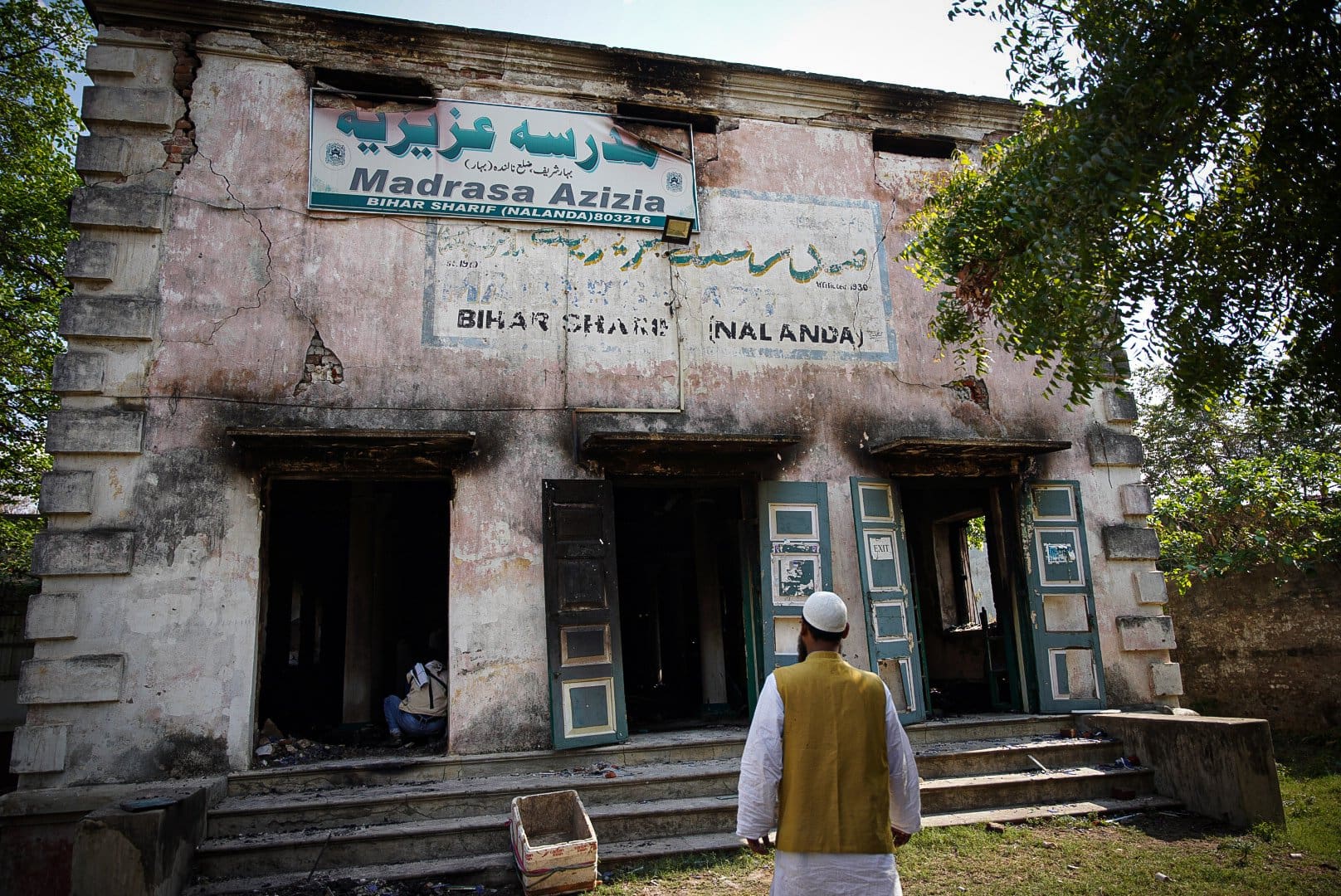
110-year-old madrasa and library set ablaze by Hindutva mob during Ram Navami rally in Bihar. Photo: Meer Faisal/Maktoob
The 46th World Heritage Committee meeting is being held in India from July 21-31, 2024. The event’s webpage proudly displays the iconic Taj Mahal, a grand symbol of India’s resplendent past. However, using this monument to showcase India’s heritage is both ironic and deeply painful. The Taj Mahal, a symbol of India’s architectural grandeur and a testament to the rich cultural contributions of the Mughal era (1526-1857), is being showcased even as the country engages in a systematic erasure of its Muslim heritage. This stark juxtaposition highlights a troubling contradiction: while the Taj Mahal is celebrated globally as a symbol of India’s beauty, the political will of the government and segments of the public are actively undermining and erasing the broader historical and cultural presence of Muslims in India. The assault on the place of Muslims began many decades ago in 1992 with the destruction of the Babri Mosque, built by the first Mughal ruler of India, Zahir-ud-din Babur, in 1527 A.D.
On December 6th, 1992, the Babri Mosque was destroyed by Hindu Kar Sevaks affiliated with the Bharatiya Janata Party (BJP). This mob, led by L.K. Advani, a prominent BJP figure and future Deputy Prime Minister (2002-2004), dismantled the over 400-year-old mosque. The world largely overlooked this deliberate destruction, perhaps viewing it as another in a series of violent riots between Hindus and Muslims in India. However, this was not just another riot. The destruction of the Babri Mosque was a political as well as an ontological act against Muslims, bringing their identity as Indians into question. Muslim history and heritage, and Muslims—collectively and individually—continue to be violated, undoing the secular national body.
I experienced the aftermath of the destruction of the Babri Mosque firsthand. Arriving in New Delhi from the US on the morning of December 8th, I encountered an eerily desolate airport, flights cancelled, and the skeleton staff at work refused to provide any assistance or guidance after checking my passport and recognizing that I am a Muslim. There was nowhere I could go; Delhi, the capital city of India, was under curfew. Sitting in the terminal, enveloped in a deadly silence and feeling a great sense of anxiety for my safety, I realized that the India I knew, my home, had undergone a seismic shift. The demolition signalled a significant turning point: Muslims and their history were now being cast as “outsiders,” foreigners who did not belong, and their legacy of nearly a millennium was under threat of erasure by charged religious-nationalist politics. Religion was no longer a private matter for personal practice and moral guidance; it had become a public discourse and weapon to use. Indian Muslims, the largest religious minority in India and globally, were under serious threat of survival. The Babri Mosque’s demolition was the beginning of erasing Muslims from the landscape of India; the extensive campaign aimed at obliterating the Muslim historical presence is ongoing.
In the years following the demolition, numerous other Muslim heritage sites, including mosques, Sufi shrines, libraries, community spaces, and private homes have faced similar fates. The deliberate and planned destruction of Muslim history has become a matter of celebration to claim Hindu pride. Every act of the physical destruction of a Muslim building is a public community event with men armed with different tools, supported by the tacit backing of the state, breaking and demolishing buildings. At the same time, thousands watch the violent spectacle of nationalism. Buildings are not just made of bricks and mortars, they are the storehouse of precious memories of a previous era and stand as silent reminders of people interconnected over generations—their sacrifices, dreams, everyday lives, emotions, and sentiments. For the destroyers of Muslim heritage, the sentiments of the past etched into the buildings do not matter; rather their concern is to disconnect Indian Muslims from India’s past, denying them a place in India’s future. The message is clear: Muslims are a minority, and as such, their life, death, memory, and future are controlled by the majority. Muslims’ claim of contributing to India’s rich heritage is no longer accepted in some political circles. This ontological destruction is the heart of the attack on Muslims in India—to cripple the community into the unknowability of its identity as Indian Muslims.
Would the 46th World Heritage Committee meeting in Delhi take account of the death of Muslim history in India? As a historian of India, I am deeply aware of the pain I felt when the Babri Mosque was demolished. I ask the leaders of the Heritage Committee: do they feel the pain of Muslims in India who are denied their heritage because some people want to make them “foreign” and irrelevant to India’s history? Can history be obliterated because one ethnic community, although a majority, wants to deny it to another ethnic community, a minority? Can history be made to disappear simply by the will and violence of the majority community? These and many more questions should be discussed and deliberated in the 46th World Heritage Committee meeting.
Mourning the destroyed buildings
The list of destruction of Muslim sites is far too many to do a comprehensive study; it is ongoing. In this frightful and destructive scenario, nothing is spared in the rampant violence – historic as well as newly built and permitted mosques, tombs of Sufis who preached coexistence and pluralism, public libraries, madrasas, cemeteries, public spaces, and so on are merrily destroyed or intentionally neglected. The destruction is justified as pay-back time for Muslims who supposedly destroyed 880 Hindu sites in the past, though historians’ rich empirical studies carefully document the falsity of such populist claims. By reclaiming these sites by force, the BJP leaders and followers advocate they will cleanse India culturally and spatially and make Hindus the rightful owners of India.
The mass carnival of destruction of Muslim sites commenced in 2002 in Gujarat during the Godhra genocide. In Khuldabad, Gujarat, 230 unique buildings were destroyed, including a 400-year-old mosque and the tomb of Sufi Vali Gujarati, and old Qurans were set on fire. The damage was so extensive that experts compare it with the much-publicized destruction of the Bamiyan Buddhas in Afghanistan or the wrecking of Tibet’s monasteries by the Maoist Red Guards.
Since then, religious nationalists have destroyed numerous mosques and tombs in Delhi and across India. In Delhi alone, a millennium-old Sufi shrine of Baba Haji Rozbih was demolished, as well as the 700-year-old Akhondji Mosque, the landmark Jannatul Firdaus Mosque, and the Sarai Kala Khan Mosque and Madrasa were razed to the ground. During the 2020 riots in East Delhi, 16 mosques were destroyed. The Shahi Masjid in Prayagraj city and the 300-year-old historic mosque in Muzaffarnagar were recently demolished under the pretext of road-widening projects. Similar fates befell several mosques in Gujarat, Hyderabad, Maharashtra, Madhya Pradesh, and Karnataka. Meanwhile, the fate of the historic Sunheri Mosque in Delhi, the 800-year-old national heritage Shamsi Jama Masjid in Badaun, the Gyanvapi Mosque Complex in Varanasi, the Shahi Idgah Mosque in Mathura, the Dargah of Mumin Chup in Hyderabad, the Shahi Masjid in Gaya, the Chhoti Sona Masjid in West Bengal, and the mosque in the Qutb Minar Complex in the outskirts of Delhi, to name just a few, hang in the balance.
The government’s newest plan is to rename India to Bharat and connect the modern state to the religious knowledge of the Rigveda and the Mahabharata, where Bharatvarsha was used to describe the Indian subcontinent. Renaming India is the state’s effort to sever the knowledge of Muslims as Indians and their connections to the place, leading to a loss of historical continuity and identity.
“Nobody is crying about the loss of a building structure …It is the loss of our secular ethos,” Anand Patwardhan reminds us about the demolition of the Babri Mosque and the Muslim heritage buildings. The destruction of the Babri Mosque and various other mosques has not only eroded the secular ethos of India but has also diminished our capacity to appreciate the beauty, emotions, sentiments, sacrifices, skills, art, and painstaking work embodied in these structures. These buildings testify to the very project of humanity. Destroying them is tantamount to erasing our human capacity to value the people of the past as if they were less human. This is what we, as a collective of humans, should mourn, and this is what the 46th Heritage Meeting should take a moment to ponder. When the human element is destroyed, there will be no heritage left to preserve.
Why heritage matters
Cultural heritage is not simply a building nor just a resource to be protected: It is a central element in the stories that society tells about itself—its origins, the mixes and syntheses over time, future projects, values, and aspirations. David Lowenthal’s The Past is a Foreign Country (1985) explores the intricate relationships between the past and future by exploring the meaning of objects, calling for navigating the complexities of memory and politics that are imbued in them. The Muslim past of India is not of a foreign people who invaded, looted, and destroyed the country. Nor was India, for Muslims, a place for mere economic or geographic expansion where people came for personal gain, although this is how M.S. Golwalkar, a founding father of the Rashtriya Swayamsevak Sangh (RSS), described the Muslim interest in India in We, or Our Nationhood Defined (1939) and Bunch of Thoughts (1966).
For Muslims, as the renowned historian Barbara Metcalf poignantly discussed in her 1995 Presidential Address to the Association for Asian Studies, India is their motherland and a “resting place of angels.” This deep attachment was evocatively inscribed on the Babri Mosque entrance. The paradisiacal imagery of India was enunciated as early as the thirteenth century by the Muslim poet Hazrat Amir Khusrau and it was repeated in the seventeenth-century Diwan-e Khas (Hall of Private Audiences) in the Red Fort of the Mughal Emperor, Shah Jahan which is also showcased on the webpage of the 46th World Heritage Committee meeting. The couplet reads: “If there is heaven on earth, it is this, it is this, it is this!” Downplaying this deep attachment to India for Muslims and making the history they created into a battleground for strategic manipulation to construct a monolithic national Hindu identity resonates with Lowenthal’s arguments about the political uses of the past in the present.
The destruction of Muslim heritage sites severs the historical knowledge and continuity of Muslims as integral contributors to the nation’s history and India’s cultural and historical fabric. The deliberate destruction dislocates the Muslim community’s sense of place and belonging; a strategic act of ‘culturecide’. The Hague Convention for the Protection of Cultural Property in the Event of Armed Conflict (1954) requires states to ensure heritage is not damaged or misappropriated in war. But what about the destruction of heritage buildings during normal times? The 46th World Heritage Committee meeting should consider this question very seriously in their deliberations in India.
Preserving Muslim heritage in India is ultimately a human rights issue, connected to their freedom of expression, thought, conscience, and religion. Protecting the Muslim heritage of India cannot be overlooked any longer. The international group of leaders meeting in Delhi to discuss and deliberate on the importance of heritage can play an important role in stopping future violence not only to the buildings but to the people whose human security should be paramount. For Indian Muslims, India is their home; Muslims must feel safe and protected in India.
Yasmin Saikia is a professor of South Asian History and Peace Studies at Arizona State University. Her latest books are On Othering: The Processes and Politics of Unpeace (Athabasca University Press: 2024) and Cambridge Companion to Sayyid Ahmad Khan (Cambridge University Press: 2019)
source: http://www.maktoobmedia.com / Maktoob Media / Home> Features / by Yasmin Saikia / July 21st, 2024
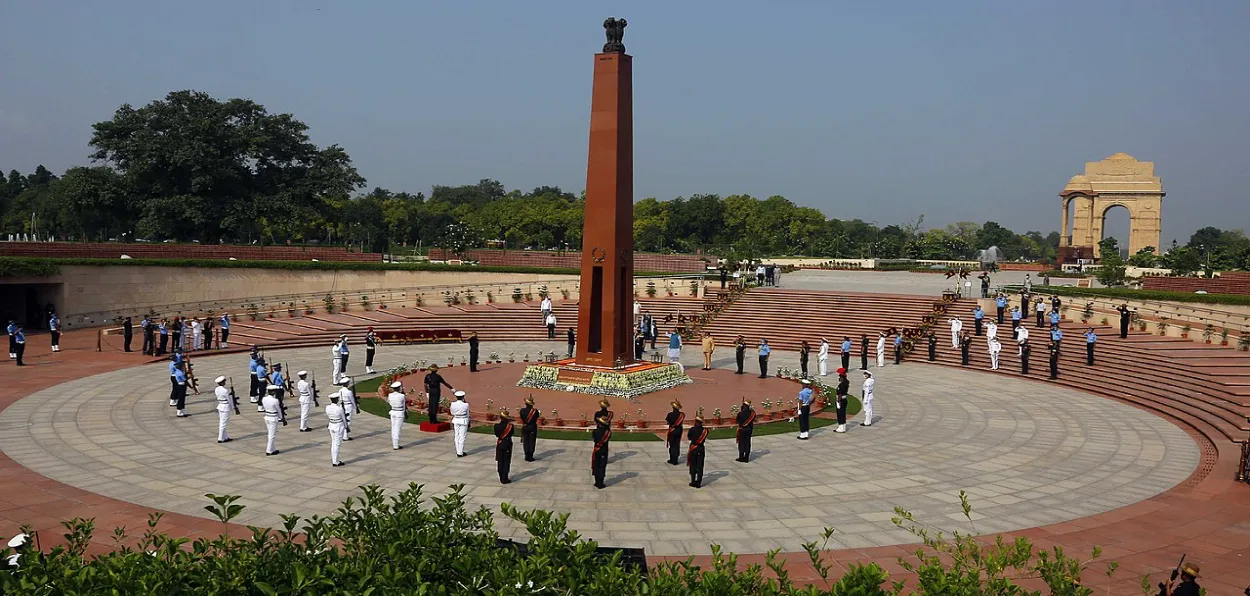
Wing Commander (retd) Mushtaq Ahmed Afraz lives up to the saying that a soldier is always on duty. Having served in the armed forces, Afraz has taken up the responsibility of documenting the stories of the martyrs and keeping their spirit of valour alive in the mind of public.
So far, he has collected 26,000 stories which are posted on his portal honourpoint.in. These are the soldiers and officers who laid down their lives in wars post-independence.
The Bengaluru-based Afraz says, “During my college days and job, I visited many memorials in the country. There are more than 200 memorials and almost half of them are inside the military cantonments. I would collect details of the martyrs from there.”
Afraz belongs to a Military family and he was brought up in Cantonments across the country. His father was in the Army; like him, his wife was in the Indian Air Force. His brother-in-law and many close relatives were in the Armed Forces.
He narrated a few stories about the martyrs, who would be forgotten and he made their memories come alive. Wing Commander Afraz talks about Flying Officer Farokh Dara Bunsha.
A post on the Facebook page of honourpoint.in commemorarting martyrs
Bunsha was martyred in the 1965 war. Soon his name was relegated to the pages of military history. Not many knew the poignant story of a young woman to whom Farokh Bunsha was betrothed.
After his story was posted on honourpoint.in it came up that this young woman had decided to live with his memory and never married.
Today, Farokh Bunsha’s fiancée is about 75 years old. She had no connection with the family of her martyred fiancé. However, when Wing Commander MA Afraz wrote the story, their families met and befriended each other.
He says, “When the Kargil war broke out, I was in the Air Force. I closely monitored the media coverage of soldiers who sacrificed their lives for the nation.
“I noticed within two or three days, that the stories of martyrs would be shoved into inside pages and gradually people lost interest in them and even forgot their names. It made me realize there is a dire need to commemorate our martyrs.”
A poster announcement prize winners of the competition held by honourpoint.in
After he retired from the IAF in 2008, he decided to turn his dream of commemorating the martyrs’ memories into a reality.
He started working on his project in 2015 and launched his portal within two years.
“Collecting data was a major challenge for us. These forgotten soldiers had fought in the wars of 1947, 1962, 1965, 1971, and 1999. I focused on those who didn’t receive awards or commendations.
Back then there was no internet or a single source for us to collect information. Most of their families lived in far-flung villages.
Afraz says, “I realised that while the countrymen have expectations from our soldiers, nobody has any idea of the martyrs’ expectations from their countrymen.”
Kargil War memorial at Drass, Ladakh
Besides maintaining the portal, Afraz organises gatherings of the families of martyrs with civil society members. “It’s difficult to describe in words the feelings of martyrs’ families when people talk about their sons. Pride and honour are important for these families and no medal or financial help can match it,” he says.
Wing Commander Afraz says, “It is the moral responsibility of every citizen to contribute to the country; the contribution can be of any kind.”
The portal team posts the stories of martyrs on social media platforms like Facebook and Instagram almost daily.
He says, “We are also spreading awareness offline. For example, we are continuously working on making people and students aware with the help of our association with the CSR partners from companies.
“We also organize marathons, radio, and print in memory of the martyrs.
Wg Cdr (Retd) M A Afraz
We are also connecting with people through print media and television.”
Afraz’s team has been organising ‘Rang De Veer‘ events all over India level for six years. These events held on Republic Day, Independence Day, and Kargil Divas (26 July), are attended by schools from India and abroad.
Afraz says, “Civil society should get in touch with these families. The government can only provide them with pensions and schemes. When the stories of the martyrs come to light, I have noticed that common people tend to stand up for their families who need help. For example, lawyers fight their cases for free; doctors provide free treatment.”
Another story that Afraz narrates is of Flight Lieutenant Akash Yadav of Kosli village in Rewari, Haryana. He was martyred in November 2010 at the age of 26 years.
Flight Lieutenant Akash Yadav and Flying Officer Farokh Dara Bunsha
Aakash was a helicopter pilot and his chopper crashed on the India-China border. He was the only child of his parents and they fell into mental depression after his death. Both parents felt there was nothing left for them to live for; they cut themselves off from everyone and lived like a recluse.
In 2017, M.A. Afraz’s portal invited the family of Flight Lieutenant Akash Yadav to a program where the families of martyrs and members of civil society interacted.
After the function, the Yadav’s father said he would now onwards live the his life positively.
He set up an organization named ‘Flight Lieutenant Akash Yadav Yuva Prerana Samiti’ in their village. Under its aegis, the founder moves to the villages around Kosli and motivates the youth to join the armed forces.
He adopted children from slums and is educating them. Today he is fully involved in social service.
source: http://www.awazthevoice.in / Awaz, The Voice / Home> Story/ by Rajeev Kumar Singh, New Delhi / August 14th, 2024
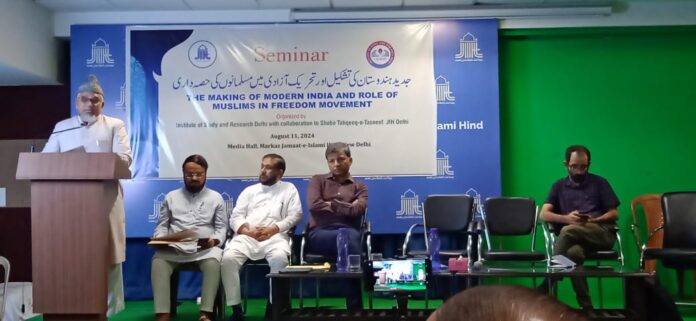
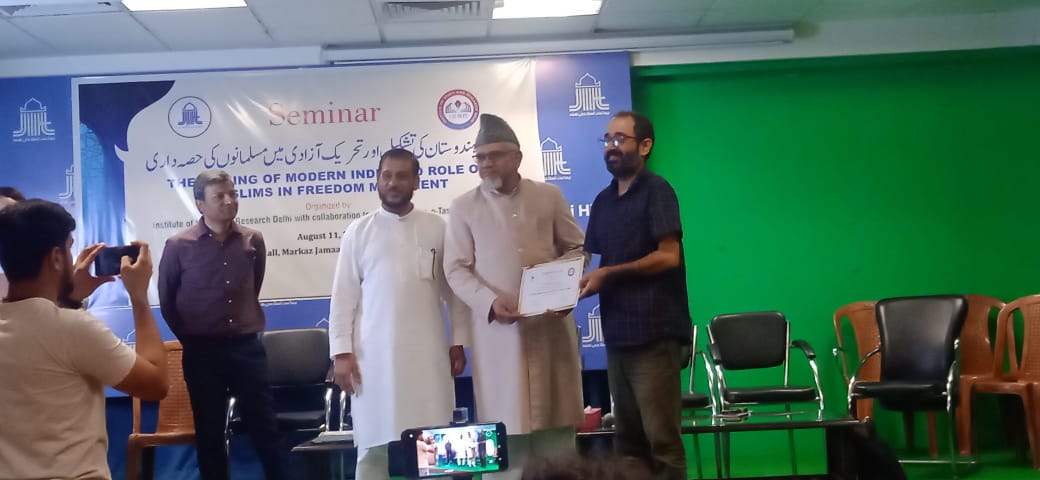
JIH vice-president Prof. Salim Engineer speaks at the history seminar organized by the Delhi unit of the Jamaat-e-Islami Hind.
New Delhi :
Various speakers at a seminar here on Sunday said that the Muslim role in India’s independence and making of modern India was being overlooked by most of the historians.
The seminar titled “Making of Modern India and Role of Muslims in Freedom Movement” was part of a year-long campaign of the Jamaat-e-Islami Hind (JIH), Delhi unit, to create awareness about the role Muslims played in India’s struggle for freedom from Britishers.
In his inaugural speech, JIH Delhi state president Salimullah Khan emphasizing the importance of compiling and presenting historical facts from various sources across the country.
He expressed concern over the current trend of rewriting history by omitting the Muslim contribution to serve vested interests, which he believes, is creating misunderstandings and communal hatred in the country.
“We are making efforts to collect historical facts, heritage, and monument information that exists in Delhi and will present it to the people,” Salimullah Khan stated.
He quoted Ayash Khan, former director of the renowned Khuda Bakhsh Oriental Public Library in Patna, who highlighted the discrepancy between historical reality and its presentation by historians, often influenced by personal interests and inclinations.
The JIH state chief also cited renowned Islamic scholar Maulana Sadruddin Islahi, who emphasized the importance of genuine history writing and deplored the modification of historical narratives to suit personal agendas. He stressed that writing genuine history in the current climate is a significant service to humanity.
JIH Vice President Prof. Salim Engineer, in his presidential address, praised the seminar’s theme as timely and appropriate amid rising Islamophobia and propaganda against Muslims worldwide and rising hatred in the country. He urged scholars and academicians to counter these narratives by presenting the overlooked contributions of Muslims and Islam to the nation.
“This government is not just a government of a political party but an ideological one,” Prof. Salim stated.
“Their agenda includes creating hatred and division in society against Muslims and Islam.” Prof. Salim reiterated this point, highlighting the ongoing attempts by the ruling government to rewrite history in a biased manner.
He emphasized that history should serve as a lesson for the future, advocating for collective action across communities to promote unity, reminiscent of the collaborative spirit against British colonialism. He emphasized the need for more conferences and seminars throughout the country to counter rising propaganda and hatred against Muslims.
The JIH Vice President asserted that Muslim participation in the freedom struggle was inspired by Islamic teachings, which fundamentally oppose injustice and oppression. He criticized both the British colonial distortion of history and current efforts by the ruling dispensation to rewrite history with bias against Muslims and Islam. Calling for more such events throughout the country, he emphasized the need for rigorous research, documentation, and public education to ensure historical accuracy in shaping national discourse and identity.
Unsung Heroes of the Freedom Struggle
Syed Ubaidur Rahman, a prominent who has authored several books on the history of Muslims in India, provided a comprehensive account of Muslim contributions to the freedom struggle. He highlighted the Faraizi Movement of 1819 as the first freedom movement, predating the widely acknowledged 1857 uprising.
“The Faraizi Movement, launched by Haji Shariatullah in 1819, was not just a religious reform movement but a revolt against oppressive landlords patronized by British colonizers,” Syed Ubaid explained. He emphasized that this movement, which lasted for 50 to 60 years, offered significant sacrifices and impact.
Syed Ubaid also shed light on the role of the last Mughal emperor, Bahadur Shah Zafar, in the 1857 revolt. “Zafar had nothing to lose, as Mughal rule had already deteriorated to the lowest level before he took charge,” he clarified. “But for the sake of freedom, he revolted against the British Raj, leaving his luxurious life and power behind,” he pointed out.
The writer listed numerous prominent freedom fighters who made great sacrifices, including Imam Bakhsh Sahbai, Mufti Sadroddin Azoorda, Maulana Azad Subhani, and Maulvi Abdullah Shah.
Syed Ubaidur Rahman drew attention to many unsung heroes, including Maulvi Abdullah Shah and Azeemullah Khan, who played pivotal roles in the freedom movement. He enumerated the sacrifices of various freedom fighters, such as Imam Bakhsh Sahbai, Maulana Jafar Thaneswi, and Maulvi Liaquat Ali, all of whom displayed unwavering commitment to India’s independence, often at the cost of their lives and liberty.
Syed Ubaid also highlighted the pivotal role of the Reshmi Rumal Movement, led by the esteemed Deobandi scholar Shaikhul Hind Maulana Mahmoodul Hasan. This revolutionary movement, noted by the British Rowlatt Committee as a significant threat to British rule, garnered substantial support from the Ottoman Empire, Germany, Russia, and Afghanistan in its quest to destabilize British India. Maulana Hasan even travelled to Mecca seeking military assistance against the British government. However, the outbreak of World War I led to the unravelling of their plans, resulting in the imprisonment of many Indian revolutionaries, including Maulana Hasan, who was later released from Malta jail due to ill health.
Ubaid also remembered key figures like Haji Sahib of Turangzai, who bravely fought against British forces during the 1897 Frontier Revolt, and Maulana Barkatullah Bhopali, who served as the Prime Minister of India’s first Provisional Government in Afghanistan in 1915. He further shed light on Mohammad Iqbal Shedai, who established the Azad Hind Government in exile in Rome in 1941, and the tragic fate of Imam Bakhsh Sehbai, a scholar and poet executed by the British after the 1857 uprising, alongside his family members.
Syed Ubaid stressed the need to document and raise awareness about these unsung heroes of the freedom struggle, many of whom remain unknown to the general public.
Highlighting Women’s Contributions
Mrs. Syedah Swaleha Jabeen, a freelance journalist, focused on the contributions of Muslim women to India’s freedom struggle. She asserted that while their role was strong and leading, it has not been adequately documented. “Thousands of Indian Muslim women joined the freedom war, sacrificing their lives or facing acute suffering,”Swaleha Jabeen stated. She mentioned prominent figures such as Begum Hazrat Mahal, Abidi Bano Begum, and Aruna Asif Ali, among others. Jabeen recounted how Begum Hazrat Mahal, dressed as a soldier, led a group of fighters during the 1857 uprising, demonstrating the active involvement of women in the struggle for independence.
Swaleha Jabeen highlighted the significant contributions of Abadi Bano Begum, affectionately known as Bi Amma, during the Indian freedom struggle. As the mother of prominent freedom fighters Maulana Mohammad Ali Johar and Maulana Shaukat Ali, Bi Amma played an active role in the movement for independence. Her sons became key figures in both the Khilafat Movement and the broader Indian independence movement, significantly impacting the non-cooperation movement against British rule. Notably, they were also founders of the esteemed Jamia Millia Islamia, furthering their commitment to education and social reform.
She quoted Mahatma Gandhi, who wrote in Young India newspaper that “without mentioning the contributions of Muslim women, the history of the Indian freedom movement is absolutely incomplete.”
Political Leadership and Community Contributions
Dr. Abdullah Chishti, Assistant Professor at Jamia Millia Islamia, discussed Muslim political leadership in shaping the discourse of India’s freedom movement. He emphasized the need to focus on the role of the masses across all communities, rather than just leaders or religious groups.
“We talk much about the leaders and religious groups but less discuss the role of masses cutting across casts, sects, race, and religious divides,” Chishti noted. He pointed out that figures like Bhagat Singh and Subhash Chandra Bose had a significant following among Muslim masses.
Chishti also addressed the issue of communal periodization of Indian history, tracing it back to British scholar James Mill’s division of Indian history into Hindu and Muslim periods in 1817. He argued that this division paved the way for the two-nation theory during the British colonial period.
However, Chishti emphasized that not all Muslims favoured a separate homeland. He cited examples of prominent figures like Maulana Abul Kalam Azad, Khan Abdul Ghaffar Khan, and Allama Mashriqi, who were strong opponents of partition.
Dr. Abhay Kumar, a former History Scholar from JNU, spoke about the enduring impact of Muslim heritage on modern India’s cultural fabric. He stressed the importance of understanding and communicating history to counter ongoing efforts to distort it.
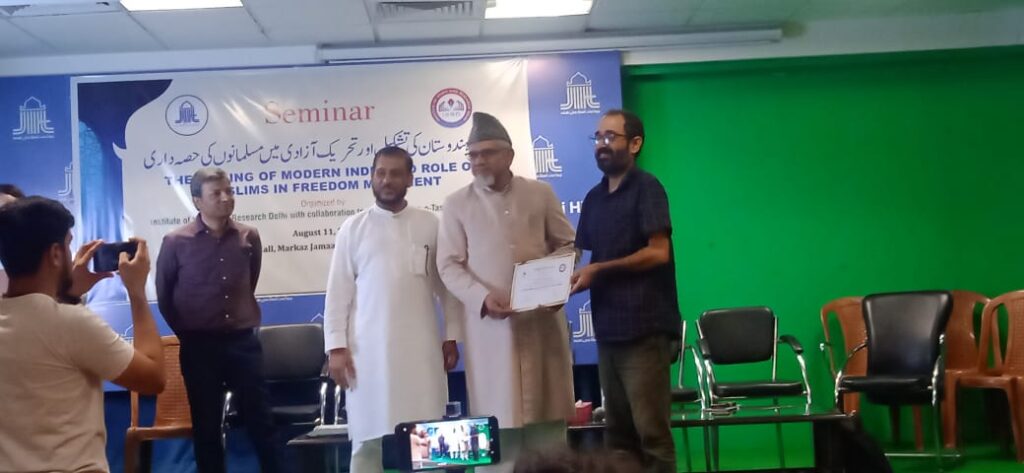
Prof. Salim Engineer presenting a memento to former JNU scholar Dr. Abhay Kumar.
“If you want to save India, you have to first understand the history of the country and then tell it to the common people in popular language,” Kumar asserted. He criticized the common approach of memorizing history in chronological order without understanding the ‘why’ and ‘how’ behind historical events. He emphasized the importance of understanding the ‘why’ and ‘how’ behind historical events, rather than merely memorizing dates and facts.
Kumar traced the roots of historical distortion back to the colonial period, criticizing early European writers for their biased portrayals of Indian history. He pointed out that many colonial historians, such as James Mill, wrote about India without ever visiting the country.
“To understand the distortion of history, we have to trace it back to the colonial period,” Kumar explained. “When the British came to India, they started writing history as a systematic institution, even colonial historians who wrote Indian history often never visited India.”
Kumar also addressed the visible bias and prejudice against Muslims in the writings of European scholars like Max Muller. He argued that these prejudices were partly because Muslim rulers were in power when the British arrived in India, and Muslims were among the first to resist foreign rule.
He also addressed the need for genuine history writing, urging efforts to preserve public-level history rather than relying solely on government or agency accounts.
JIH Delhi state secretary and organizer of the seminar Asif Iqbal provided an overview of the event’s objectives. He explained that the seminar aimed to highlight the contributions of Muslims in the freedom struggle and the reconstruction of the country, facts that a vast majority of the country is not well aware of or has overlooked.
Asif Iqbal announced that this seminar is a precursor to an upcoming grand history conference to be held in February next year in Delhi. He also revealed plans for about 10 similar history conferences to be held across different major cities in India, covering various themes including architecture, art and culture, spirituality, social reforms, textiles and craftsmanship, environmental contributions, cultural syncretic festivals, struggle heritage, mass movements, and Muslim personalities and their contributions.
source: http://www.indiatomorrow.net / India Tomorrow/ Home> National Interest / by Anwarulhaq Baig / August 14th, 2024
Khan is a professional bodybuilder from Hyderabad and has earned many national and international titles including a silver medal in Mr World Body Building Championship, in the heavyweight category.
Internationally acclaimed Bodybuilder Mir Mohtesham
Hyderabad:
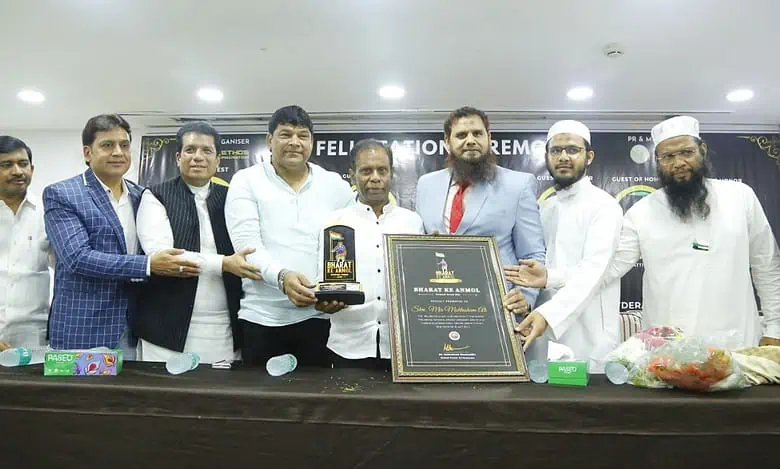
A celebration was held in Hyderabad’s Media Plus Auditorium to celebrate Mohtesham Ali Khan, who received the prestigious national award ‘Bharat Ke Anmol’ for his journey of determination, perseverance, and excellence in the realm of bodybuilding and fitness.
Khan is a professional bodybuilder from Hyderabad and has earned many national and international titles including a silver medal in Mr World Body Building Championship, in the heavyweight category.
The event which was held on Sunday, August 14, witnessed the presence of dignitaries and supporters who gathered to honour Khan’s accomplishments.
The chief guest Abdul Khayyum Khan, minority affairs advisor for the government lauded Khan’s unwavering commitment to his craft.
Other prominent figures including AIMIM leader Ather Farooqui, BRS leader Khaleequr Rahman, Pathergatti Corporator, Syed Sohail Quadri and chairman of Vandhe Bharat, Ramesh Eppalapalli were also present at the event.
The felicitation ceremony was organised by the founder and CEO of Ethos Imagination, Varaprasad who emphasised that the evening was not merely a tribute to Mir Mohtesham Ali Khan’s individual accomplishments but also a testament to the power of dedication and hard work.
At the event, Khan expressed his heartfelt gratitude to everyone who contributed to his journey and stood by him both during challenges and triumphs.
source: http://www.siasat.com / The Siasat Daily / Home> News> Hyderabad / by Sayma Ahmed / August 13th, 2023
The Urdu Academy Jeddah, in collaboration with the Hyderabad Education Center, organized a gold medal and merit certificate distribution ceremony for SSC top-performing students and best teachers from Telangana government Urdu medium schools. The event was held at the Education Center in Nezampet, Bownampally on Saturday.
The ceremony was presided over by Mr. Saleem Farooqui, Founder and Patron of the Urdu Academy Jeddah, and Mr. Sheikh Ibrahim, President of the Urdu Academy Jeddah.
The guests included General Secretary Syed Naeemuddin Bari, Manwar Khan, Qudrat Nawaz Baig, Vice President of Hyderabad, Ahmeduddin, Rifat Siddiqui, and Mohammad Bashir Ali.
The event began with a recitation from the Quran by Hafiz and Qari Syed Naeemuddin, followed by a Hamd (praise of God) and Naat (praise of the Prophet Muhammad ﷺ) by Hafiz Ameenuddin Ansari.
Special tributes were paid to the late Mr. Syed Jamalullah Qadri, former President, and Mr. Asif Samadani, former Patron-in-Chief, for their invaluable contributions to Urdu language and literature.
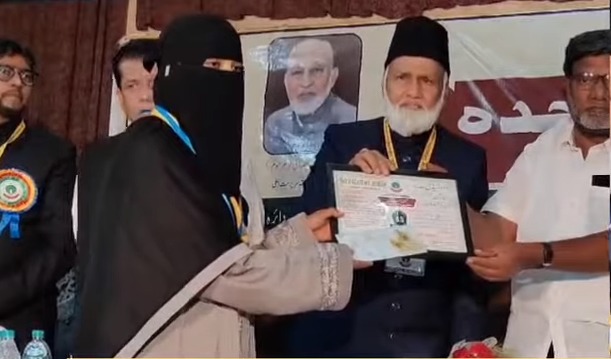
The event continued with the distribution of gold medals to top-performing SSC students and certificates of appreciation to outstanding teachers.
The distinguished guests included Mr. Obaidullah Kotwal, Chairman of Telangana Minorities Finance Corporation, Mr. S.A. Ashkour, Director of Ma’arif University Osmania, Mr. Haqayuqur Rahman Baig, Coordinator of All India Congress Committee, and Mr. Imtiaz Ishaq, former Chairman of the Minority Financial Commission.
Ms. Saadia Fatima Khan from Maharashtra, representing the Urdu Academy Jeddah, conducted the ceremony with great skill. She extended a warm welcome to the guests of honor, patrons, and attendees, expressing gratitude for their continuous support.
The Urdu Academy Jeddah has always strived to support Urdu medium students, teachers, and schools. Their efforts aim to promote and preserve the Urdu language. The academy’s dedication has illuminated the path of knowledge not only in Hyderabad and Telangana but also in other cities, spreading the light of education.
The ceremony concluded with the announcement of awards for 25 students who achieved top grades in the SSC exams, including gold medals and cash prizes. Twelve outstanding teachers and two exemplary schools also received honors, including shawls and mementos.
Prominent figures at the event emphasized the importance of creating a supportive home environment for learning, encouraging families to maintain a library at home. The ceremony was a celebration of academic excellence and a tribute to the ongoing efforts to promote Urdu language and education.
source: http://www.radiancenews.com / Radiance News / Home> Pride of the Nation / by Radiance News Bureau / July 03rd, 2024
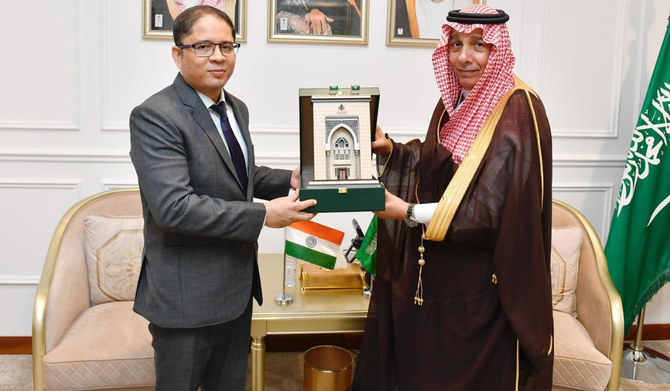
Mazin Hammad Al-Himali receives Mohammed Shahid Alam in Jeddah. (Supplied)
Director of Foreign Ministry Branch in Makkah Region Receives Indian Consul General in Jeddah
Director-General of the Ministry of Foreign Affairs’ branch in Makkah Mazin Hammad Al-Himali met with Indian Consul General Mohammed Shahid Alam in Jeddah on Monday.
The meeting was held on the occasion of the end of Alam’s tenure, the Saudi Press Agency reported.
Alam took over as India’s consul general in Jeddah in February 2021. He previously served in Jeddah as the Hajj consul from 2015 to 2018.
An upright officer of the Indian Foreign Service, he has now been posted to the Indian High Commission in London.
source: http://www.arabnews.com /Arab News / Home> News> Middle East / August 06th, 2024