In Sikh history, December is called the ‘month of sacrifices’ as it was in this month that the family of the tenth Guru Gobind Singh was martyred.
The tenth Sikh Guru was fighting a war against the Mughals when his family – wife and four sons – attained martyrdom. Countless Muslim families supported Guru Gobind Singh in the war even at the risk of being targeted.
Their stories have been recorded with the utmost respect in the pages of Sikh history.
Some of the relics and symbols related to Guru Gobind Singh continue to be preserved by Muslim families with utmost devotion and purity.
One of these is ‘Gangasagar‘.
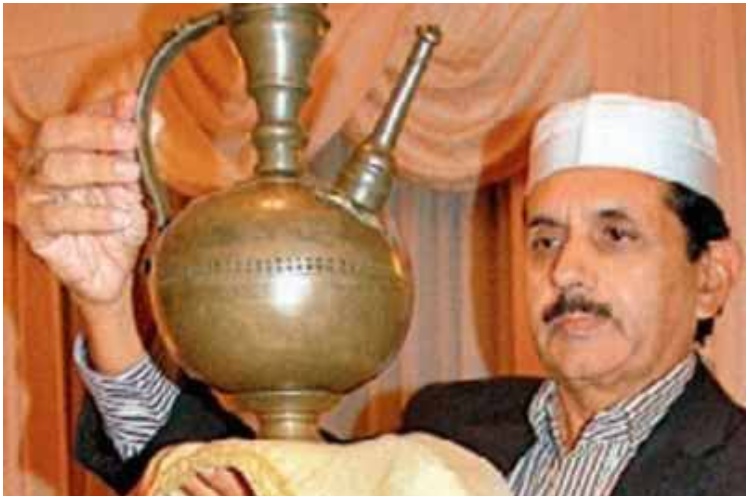
Gangasagar is a priceless vessel made of an alloy of copper-brass and some other metals, that Guru Gobid Singh used for drinking milk and water etc. He always kept it with him.
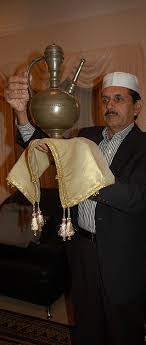
Rai Aziz Ullah Khan holding Gangasagar
It’s said that he carried Gangasagar to the war and also in the final battle of his life with the Mughals.
His sons Sahibzade Baba Jujhar Singh and Baba Ajit Singh were martyred in the fort of Chamkaur.
Just before this, Guru Gobind Singh had left the fort of Anandpur Sahib and parted ways with his family on the banks of river Sarsa.Guru Gobind Singh reached Machhiwada fighting his way against the Mughal army where he met two Muslim brothers Navi Khan and Gani Khan. They offered him shelter.
The brothers served him with devotion and with utmost dignity.
The Khan brothers were horse traders. Before taking their leave, Guru Gobind Singh accorded them the status of Pir in recognition of their services.
Navi Khan and Ghani Khan were well aware of the Mughals’ power, yet they carried Guru Gobind Singh on their shoulders and took him safely out of Machhiwada with proper protocol. Some other Muslim notables also accompanied them.
A portrait of Rai Kallan
At that time, the area was surrounded by the Mughal forces and their spies were keeping track of Guru Gobind Singh’s movements.
Guruji came face to face with the Mughal army at many places outside Machhiwada. At that time the saying “patta-patta sher ka Dushman ho gaya hai (Each leaf of the jungle has turned into the enemy of the Lion)” become commonplace. It was about the spies let loose by Mughal rulers against Guru Gobind Singh.”
When Gobind Singh reached the village of Heran in the Muslim princely state of Raikot, he met a shepherd in the fields. His name was Nooran Mahi. Nooran Mahi had heard about the martyrdom of Gobind Singh’s sons and yet he had no idea of the man he was meeting.
Guru Gobind Singh was tired and he asked him for milk to drink. As a host, Mahi filled his Gangasagar with milk. Mahi sensed that he was meeting an extraordinary person and had no clue about his identity.
He went to Raikot and informed his boss Rai Kallan about his encounter. After listening to Nooran Mahi’s words, Rai Kallan could make out that he had met Gobind Singh.
A painting of Guru Gobind Singh
Throwing caution to the winds, he ran to the place where Mahi had met Gobind Singh and took him to his mansion. Again he served the Guru with utmost affection and devotion.
Gobind Singh told Rai Kallan that he got separated from his family at Sarsa river and he wanted to know about the whereabouts of his wife and sons.
He requested Rai Kallan to depute a reliable person to Sirhind to find out about them.
Rai sent Nooran Mahi for the secret mission. On return, he broke the sad news to Guruji that his wife and sons have been killed. Nooran Mahi’s name is mentioned in the pages of Sikh history. After Guru Gobind Singh decided to continue his journey and the war against the Mughal Empire.
Guru Gobind Singh Rai was so pleased with Kallan’s service and spirit that he gifted his favorite jug ‘Gangasagar‘ to him.
He also gifted him some other items that he used. Among the gifts was a Peedi (a low-lying table) that has been used by generations in Rai Kallan’s family to place the Holy Quran for recitation.
A poster of Guru Gobind Singh
Raikot and its adjacent Talwandi Rai were Muslim-majority states and had Muslim administrators.
To commemorate the visit of Guru Gobind Singh to Raikot, the Muslims and Sikhs of Raikot and Talwandi built the historic Gurudwara ‘Rahaliana Sahib’.
Every day thousands of Sikhs, Hindus, and Muslims pay obeisance there. This place stands as testimony to unity and harmony among Indians.
Also, Guru Gobind Singhji’s favorite jug, or Surahi ‘Gangasagar‘ is still being handled with full devotion and protection by a Muslim family. At present, the head of the family is Rai Aziz Ullah Khan, who was born n Pakistan and is now settled in Surry, Canada.
Rai Aziz Khan represents the ninth generation of the Rai Kallan family. He was 27 years old when he was told about Gangasagar and other relics of Guru Gobind Singh.
Gangasagar
Rai Aziz Ullah Khan inherited this jug along with other things.
When he left Pakistan, he carried all these valuables with him with the full procedure. He had kept these things in the locker of a bank.
In 1999, on the occasion of Baisakhi, an international-level function was organized at Anandpur Sahib to commemorate 300 years of the martyrdom of the family of Guru Gobind Singh, Rai Aziz brought ‘Gangasagar’ and other relics for the darshan of the devotees.
He was provided a chartered flight by the then Government of India. Prime Minister Atal Bihari Vajpayee also visited Anandpur Sahib to have a darshan of the relics of Gobind Singh.
source: http://www.awazthevoice.in / Awaz, The Voice / Home> Culture> by Amrik Singh, Jalandhar / January 02nd, 2022
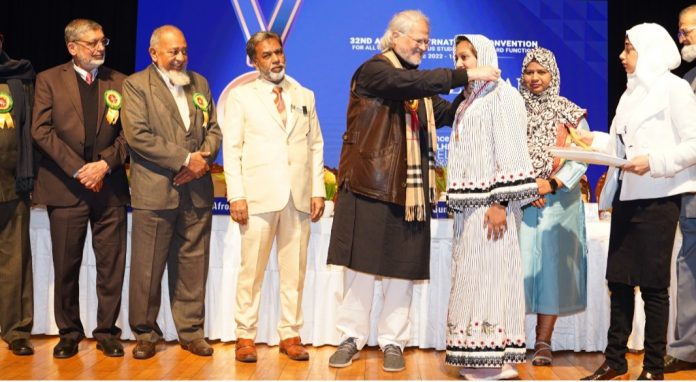
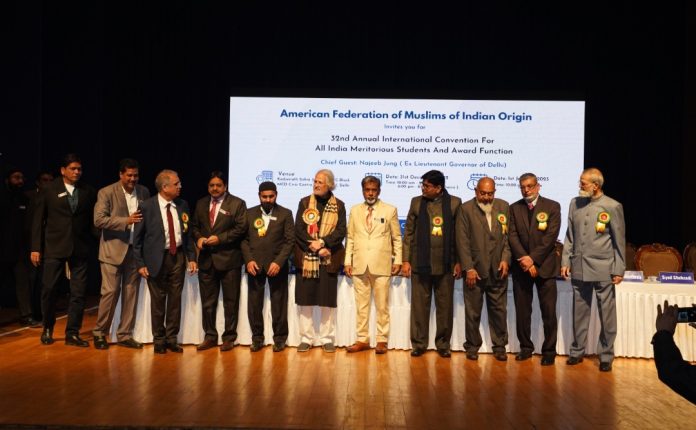
Najeeb Jung, former LG, Delhi, felicitating a meritorious student at the convention.
New Delhi:
Students along with their parents from 19 states convened in the national capital for the event. More than 80 students who passed class 10th and 12th in the year 2022 received medals, certificates and cash prizes.
“I was truly impressed when I got to know that people in America are so committed to contribute to the welfare of students here in India. This is very motivating,” said Ifrah Rauf, who received silver medal. Ifrah scored 95.6 per cent in class 12th and is now pursuing B.C.A from Indraprastha University. Ifrah’s mother is a teacher and father, a software professional. “This is encouraging for parents as well. This makes us believe that we took the right step by getting our daughter educated,” said Ifrah’s mother, Tayyaba Rehman who was present the convention.
Dr Tabrez Taj, senior journalist, Afroz Alam, member, AFMI, Seraj Thakore, former president, AFMI. Mohammad Naeem, president, DYWA and Najeeb Jung, former L,G, Delhi, felicitating meritorous students during the convention.
Sixty one out of 84 awardees were girls. Gold, silver and bronze medallists received Rs 7,000, Rs 5,000 and Rs 3,000 respectively.
“It is fantastic to see so many students, especially girls, scoring so high in schools,” said Najeeb Jung, former LG, Delhi, who was the chief guest at the programme. “We should remember that knowledge is different from education. While you get educated through curriculum, it is also important to get knowledge because knowledge tells you how to be a better human being and how to treat people around you. Good scores will get you a job but knowledge will change your perspective,” said Jung.
He cautioned the audience against the dangers of technology. “It is good that we learn and use social media but we have to avoid addiction and ensure that the tech companies don’t manipulate us,” he said.
AFMI was formed in 1989 in Detroit (USA). AFMI has held conventions all over the country since its inception in 1989. It has honored more than 4,000 students from over 400 of India’s districts.
DYWA, formed in Delhi’s Walled City in 1990, works to promote education for under privileged children. It runs scholarship schemes, course distribution and a library housing more than 4000 books, among other initiatives.
Khalil Ahmed, patron, DYWA, said that in the present age and time, we should not always associate education with jobs and career. “Get educated to understand yourself, the world and the journey of life,” he said. “If you get a job, it is an added bonus. If you don’t get one, it is not the end of the world. If you have a family business, focus on expanding the same and take it to new heights. Don’t look down at it,” said Ahmed.
The awardees included two sisters from Telangana. Nargis Sultana (gold medal) and Nafees Sultana (silver medal) scored 95 per cent and 93 per cent in grade 12th. Nargis wants to be a doctor and is preparing for NEET. Nafees is pursuing Bachelors in pharmacy in Telangana. Their father, Mohammad Abdul Saleem accompanied them for the ceremony. “Both myself and my wife could not finish school education. We were clear that we would get out daughters educated and make them self- dependent,” said Saleem who works as a supervisor in a borewell. “Events like this one boosts our morale,” he added.
This was AFMI’s 32nd convention to honour student achievers in the country.
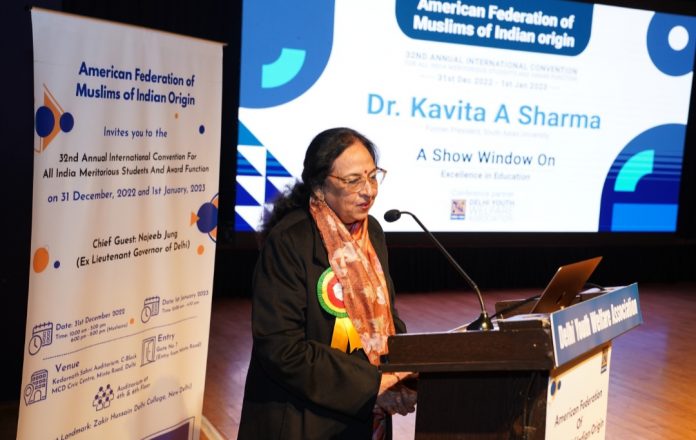
Dr Kavita Sharma, former president, South Asian University speaking at the convention.
Dr Kavita Sharma, former president, South Asian University, Dr Akhtarul Wasey, president, Maulana Azad University, Jodhpur, historians Swapna Liddle and Samina Mishra were also present at the event,
“In a jungle, trees compete to get sunlight. In the process, they outgrow each other. Similarly, we have tried to create a healthy competition among students. They get motivated and inspired when they see each other at such events,” said Shafi Lokhandwala, member, AFMI.
source: http://www.muslimmirror.com / Muslim Mirror / Home> Communal Harmony> Positive Story / by Muslim Mirror Network / January 01st, 2023
According to food delivery platform Swiggy, last year, Bawarchi clocked a sale of 2 biryanis per minute on the same day. The restaurant is planning to break that record this time.
Representational Image
Hyderabad:
Bawarchi restaurant in Hyderabad, for new year’s eve, has readied 15000 kgs of Biryani to cater to thousands of food lovers who are celebrating the end of another year.
According to food delivery platform Swiggy, last year, Bawarchi clocked a sale of 2 biryanis per minute on the same day. The restaurant is planning to break that record this time.
Chicken Biryani continued to be the most ordered on the food delivery platform Swiggy for the third consecutive year, showing statistics from the company. This pretty much sums up the city’s food culture, which if it has to be summed up in one line is: Biryani is king.
Interestingly, the number one snack item ordered on Swiggy in Hyderabad was everyone’s favourite – Idly. Apart from the usual chicken wings, samosas and veg puff – which are regularly on the most ordered items on Swiggy – the traditional Bun Maska (usually sold in Irani cafes) also found its way up on the most ordered list for snacks.
Another traditional item, Khubani Ka Meetha or Apricot Delight, turned out to be the most favourite dessert for Hyderabadis, while Double Ka Meetha was the most ordered dessert in Telangana, showed stats from Swiggy.
What people of Hyderabad and Telangana love to Eat on Swiggy Food Marketplace
Top 3 most ordered dishes: Chicken Biryani, Apricot delight, Mutton Biryani
Top 3 most ordered non-dishes – Thums up (drink), Milk Products, Tomatoes
Top 3 most ordered snacks: Idli, Maska Bun, Masala Dosa
Top 3 most ordered desserts on Swiggy: Apricot Delight, Double ka Meetha, Fruit Salad with Ice Cream
source: http://www.siasat.com / The Siasat Daily / Home> News> Hyderabad / by News Desk, posted by P N Sree Harsha / December 31st, 2022
During his tenure as Viceroy General of India, Charles Hardinge, the 1st Baron Hardinge of Penshurst, came in touch with many practising hakims and vaidyas while opening medical colleges in India.
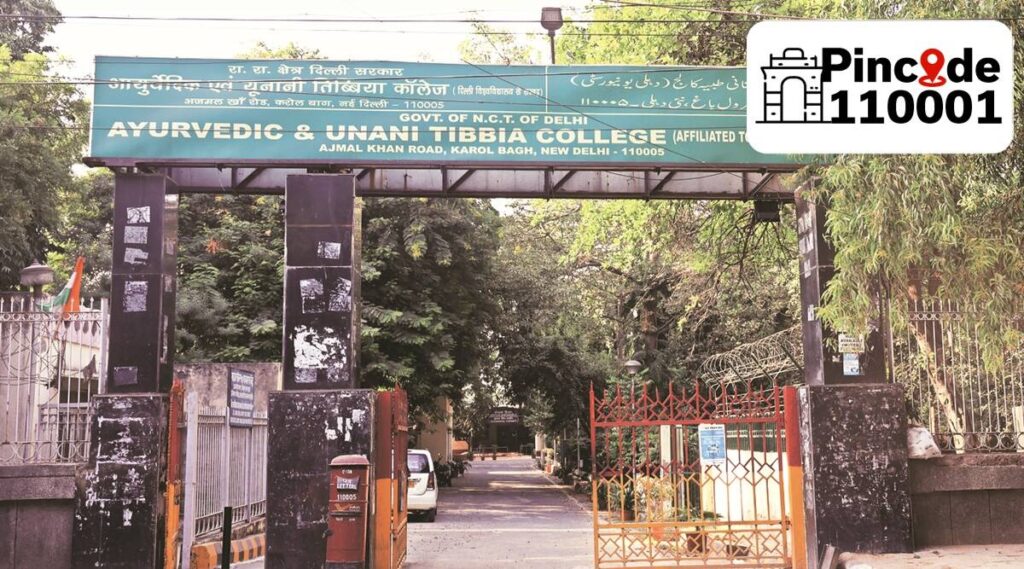
Ayurvedic and Unani Tibbia College in Karol Bagh. (Express Photo by Amit Mehra)
During the middle of the 18th Century, India had physicians from diverse backgrounds including vaidyas and hakims who practised Ayurveda and Unani respectively, and freely borrowed medicine recipes from each other. But, with the arrival of the British, both practices were sidelined.
During his tenure as Viceroy General of India, Charles Hardinge, the 1st Baron Hardinge of Penshurst, came in touch with many practising hakims and vaidyas while opening medical colleges in India. It was his friendship with Hakim Ajmal Khan, a practising Unani medical physician from the lineage of hakims of Mughal rulers, that made him lay the foundation stone of the Ayurvedic and Unani Tibbia College in 1916.
Prior to the college, currently situated in Karol Bagh, Hakim Ajmal Khan and his two elder brothers Hakim Abdul Majid Khan and Hakim Mohamed Wasal Khan worked under their father, Hakim Gulam Mehmood Khan, in their house, Sharif Manzil, in Chandni Chowk’s Ballimaran. Their father ran a small Unani school, named Unani Madrasa Tibbia, where they practised and taught Unani and Ayurvedic medicine to young scholars.
Hakim Ajmal Khan’s grandfather, Hakim Sharif Khan, was a physician to Mughal Emperor Shah Alam and had built Sharif Manzil, after which the family came to be known as “Sharifi”. Hakim Sharif Khan’s ancestors had come to India during the reign of Babar and were of imminent importance during Shah Jahan’s rule. They were then known as the aristocrats of Delhi and enjoyed a high social status.
Speaking with The Indian Express, the great grandson of Hakim Ajmal Khan, 80-year-old Masroor Ahmed Khan, said the Unani Madrasa Tibbia was opened in 1882. “We have 300 years of history and were known as royal hakims. When the Britishers came, they were bringing a new ordinance under which Allopathy medicine was going to be promoted more and Unani, Ayurveda were being sidelined. Until then, the education of Unani medicine was not institutionalised. Fearing that their practices will fade out, they started a college from Sharif Manzil,” he said.
Masroor added that he is the first in his family to not practise medicine.
He said the three brothers taught at Sharif Manzil and after the death of his two elder brothers, Hakim Ajmal Khan continued as the head of the college and raised the quality of the institution. “His popularity grew further, and he went on to become chief physician to the Nawab of Rampur. He was also a consultant for the royal families of Patiala, Jind, Gwalior, Gaikwad,” said Masroor.
The Unani Madrasa Tibbia was flourishing alongside Hakim Ajmal Khan’s popularity, and he then decided to buy land to build a new college for which a board of trustees was formed. With some influence and a promise that a wing of the hospital will be dedicated to Lady Hardinge, the trust received land from the British India government. The land in Karol Bagh was granted to the Anjuman-I-Tibbia on February 14, 1916, by the imperial Delhi Committee.
The foundation stone was laid on March 29, 1916, by Lord Hardinge after the board sent him a letter inviting him for the same.
Masroor said it was Hakim Ajmal Khan’s nationalistic approach because of which he named the college Ayurvedic and Unani Tibbia College, where 99% practitioners were of Unani medicine and only 2-3% of Ayurveda. “Hakim Ajmal Khan was also one of the founders of Jamia Millia Islamia and he was the only Muslim to chair a session of the Hindu Mahasabha. He was elected as president of the Indian National Congress from 1921-22 and also became president of the Muslim League and the All India Khilafat Committee,” said Masroor.
During his Khilafat movement days, Hakim Ajmal Khan had corresponded with Mahatma Gandhi to inaugurate the college, which the latter agreed to, and launched it on February 13, 1921.
Much before the Parliament, North and South avenues and India Gate, the college was an architectural marvel in the newly founded capital of India. The buildings represent a mix of Indian and Mughal architecture and house classrooms, laboratories, hospital pharmacies, hostels, office and staff quarters.
Hakim Ajmal Khan also helped in developing the college of more than 50 acres and also established a garden of herbs on the road across the college. The garden has now been named after him as ‘Ajmal Khan Park’ and is maintained by the MCD. The road has also been named after him – Ajmal Khan Road is now a popular shopping area of Delhi.
During the Partition, a majority of hakims of the family left for Pakistan and the college was taken over by Hakim Jamil Khan, son of Hakim Ajmal Khan, and while he was using the college as his own personal space, the then education minister Maulana Abul Kalam Azad decided to take over the college and run it as a government institution.
The matter reached the Supreme Court, which announced that the college will be a government run institution. The college is now being run by the Delhi government and admits students through the NEET exam.
According to college principal Mohammed Zubair, a total of 75 seats are through NEET. He said the college also provides courses in BUMS and BAMS and MD.
He added that post Covid, the perspective of students and patients in general has changed and a large number of students have opted for these courses. “We had students even before Covid but now a number of students who have done courses in physiotherapy and have done their BSc have come to study here.”
Not only this. Mohammed Zubair said a large number of patients too still believe in Unani and Ayurvedic medicine. “We have a footfall of 1,000 patients in our OPD. We also provide minor surgeries. The Delhi government had also established the Ayush Centre in our college where we admitted 989 Covid patients,” he said.
According to writer and historian Sohail Hashmi, there are a lot of people in smaller towns and remote places, where allopathy hasn’t reached or is not enough, who opt for traditional systems of medicines including Ayurveda, Unani and Siddha.
“Once we were colonised, it was then that our traditional systems were discarded. Colonisation colonised our minds. The Indian system of Ayurveda and Unani function on the basis of five groups of illnesses; so did Hippocrates’ four humors theory. There are a whole lot of commonalities in what Hippocrates discovered and it came to India from Greece via Iran and Arabia,” he said.
source: http://www.indianexpress.com / The Indian Express / Home> Cities> Delhi / by Ankita Upadhyay / New Delhi – November 13th, 2022
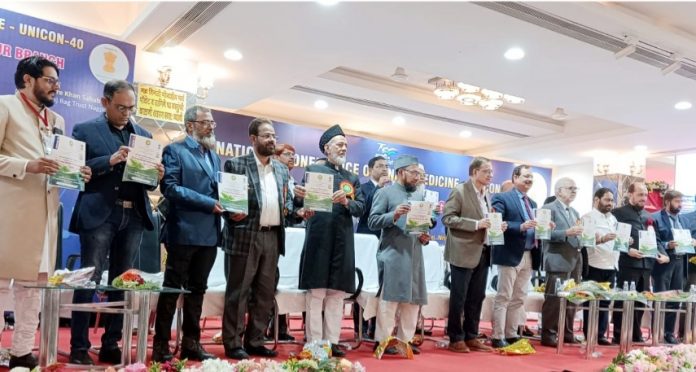
Maharashtra Chief Minister Eknath Shinde announced that Unani physicians will have a 10% reservation quota in the state’s public hospitals and primary healthcare facilities. He also said that the state needed a government-run Unani medical college. He made these commitments through a video message during the 40th National Unani Medicine Conference, which was hosted by the Nagpur branch of the All India Unani Tibbi Congress.
The Chief Minister thanked Unani physicians for their services during the deadly Covid epidemic in a brief speech. He assured the conference that every effort would be made to advance Unani medicine in the state.
Dr Wajahat Mirza, a Congress MLC and the head of the Maharashtra State Waqf Board, welcomed the Chief Minister’s decision in his speech and assured the gathering that he would exert all of his political power to see that the proposed government Unani Tibbi College would be realised. He claimed that if there had been no conflict over the city, the college would have been founded much earlier.
Former Congress minister and MLA Nitin Raut echoed his sentiments, saying that Unani medicine is a very efficient and cost-effective treatment and that it should be given every chance to flourish.
Dr Anis Ahmad, a former minister of Maharashtra, proposed building an Unani house with full facilities. He also offered to provide a plot of land to the intended centre.
AIUTC national president Professor Mushtaq Ahmad, who was presiding over the conference, praised the Maharashtra chief minister and noted that this was the first time the Maharashtra government has made a significant announcement about the development of Unani medicine. He also expressed his joy at the All India Unani Tibbi Congress Nagpur branch’s pompous arrangement of this magnificent conference, in which devoted Unani physicians from all across the country took part with great zeal.
In his keynote address Dr Syed Ahmed Khan, general secretary of AIUTC provided a snapshot of the organisation’s activities. He listed problems faced by the Unani fraternity at the national and state levels. He pointed out that Unani representation was overlooked in the new decision-making process as it was clubbed with a regional medicine of system. He called upon the Unani fraternity to make concentrated efforts for the advancement of Unani Tibb.
As far as Maharashtra is concerned, according to the conference’s organising chairman Dr Niyazuddin Siddiqui, it is a model state for Unani medicine because it enjoys the support of the state government. He claimed that there are 200 Unani doctors practising in and around Nagpur city and demanded the revival of the Unani Tibbi college, which was shut down in 20024. The college was started in 1991. He claimed Nagpur had become a hub for unani medicine.
In a similar vein, Special Guest Dr Vaidya Jayant Devpujari (Chairman, NCISM Government of India) stated in his speech that our primary goal is to standardise medical colleges. He said, “Such a conference is very important for the promotion of Unani medicine, and the role played by Unani medicine in Covid-19 is commendable. I also wish to congratulate the members of the All India Unani Tibbi Congress Nagpur for organising a very standard and grand programme which will send a strong message about Unani medicine throughout the country.
Dr Nadim Usmani, the advisor to AIUTC Maharasthra, also shed light on the activities of State Unani unit. He said Unani medicine is a bright future in the state.
The 40th Conference titled ‘Role of Unani Medicine In present Scenario’has sessions on specialised lectures on some major diseases. The experts and academics presented their papers through power-point. Professor Ahsan Farooqui presented his paper on Fasd(Venesection): Concept and Application with Demonstration. Dr Shabbir Raja’s topic was Dialysis and RenalTransplant: Myths and Facts. Cancer Management with Unani Medicine by Dr Mastan Shaikh, Pain Management in Unani Medicine by Prof Khan Mohammad Qiaser and Management of PCOS in Unani Medicine by Prof Nafees Bano.
Prof. Arif Zaidi, Dean, Faculty of Unani Medicine, Jamia Hamdard also spoke on the occasion.
The conference held on December 25 also released a souvenir highlighting the achievements of Unani Tibb in Maharashtra.
In the end, the 40th conference also passed several resolutions including the Directorate of AYUSH, Government of Maharashtra must create a post, Deputy Director – Unani, Assistant Director – Unani in the Directorate to represent the Unani System of Medicine in the State of Maharashtra.
The other resolutions are as follows:
*- Ministry of Food and Drugs Administration, Government of Maharashtra must create a post of Licensing Authority – Unani / Technical Officer- Unani / Drug Inspector – Unani in FDA to serve as an expert of Unani under provisions given in Drugs and Cosmetic Act 1940 and Rules 1945.
* Follow up to complete implementation for the establishment of Government Unani Medical College in the State of Maharashtra As per the declaration of Chief Minister of Maharashtra Shri Eknath Shinde Ji on 25th Dec 2022 at Nagpur to establish one Government Unani Medical College in the State of Maharashtra.
* Central Government and Delhi NCR must declare and approve Ayurvedic and Unani Tibbia College, karol baugh as Hakim Ajmal khan Ayurvedic and Unani Tibbia University.
* Ministry of AYUSH and NCISM, New Delhi must proposed to amend the Act NCISM 2020 to felicitate separate Unani Board under NCISM
* There are No proper representation in NCISM and its constituted authority/committee, hence a sufficient number of Unani representatives must be there.
* Strong recommendation for Empanelment of Unani System of Medicine in the Ministry of Defence / Defence Department to serve healthcare services to Defence personnel as Ayurveda is already empanelled.
source: http://www.muslimmirror.com / Muslim Mirror / Home> Health> Indian Muslim / by Abdul Bari Masoud / December 30th, 2022
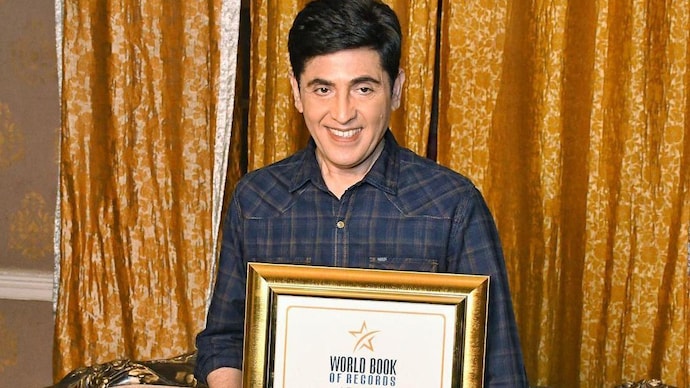
Aasif Sheikh has been honoured by the World Book Of Records for playing 300 different characters on Bhabiji Ghar Par Hai. The actor shared his picture with the certificate on social media.
Aasif Sheikh holding his certificate from World Book of Records.
Who doesn’t love Bhabhiji Ghar Par Hai’s Vibhuti Narayan Mishra? With his quirky ways of flirting with the neighbour’s wife to portraying different hilarious characters, Vibhuti is the show’s favourite. Did you know that Aasif Sheikh, who plays the role of Vibhuti, has also portrayed 300 different characters on the show? The actor has now been bestowed with a special certificate from the World Book of Records, London, for crossing 300 characters in Bhabiji Ghar Par Hain.
Aasif Sheikh Honoured by World Book of Records
Aasif Sheikh has won a million hearts with his constant hard work and amazing comic timing. He has now received a special award for portraying various characters on Bhabhiji Ghar Par Hai. Aasif posted his picture with the certificate on his Instagram account and wrote, “Thank you guys for making it happen. Crossed 300 different characters in bhabhiji ghar par hai (sic).” In the picture, the actor looks elated holding his certificate while wearing a blue check shirt.
Saumya Tandon is ‘Super, Super Proud’ of Aasif Sheikh
Saumya Tandon, who earlier played the role of Anita bhabi on the show congratulated Aasif Sheikh and commented, “Huge Congratulations, no one else deserves this more than you. It’s all the years of hard work , labour of love and passion for your craft. Super proud (sic).”
About Aasif Sheikh
Aasif started his journey in 1984 with India’s first TV serial Hum Log. He then appeared in a number of TV shows and Bollywood films. The actor featured in popular shows such as Yug, Champion, Tanha, Muskaan, Gul Sanobar, Chandrakanta, Yes Boss, Dill Mill Gayye, CID and Chidiya Ghar to name a few.
source: http://www.indiatoday.in / India Today / Home> News> Television> Celebrity / by Grace Cyril, Mumbai / October 21st, 2021
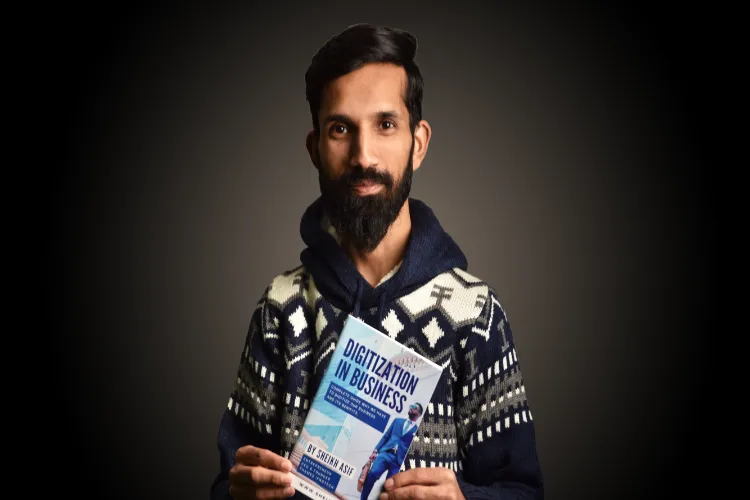
Sheikh Asif, founder, Thames Infotech, holding one of his books
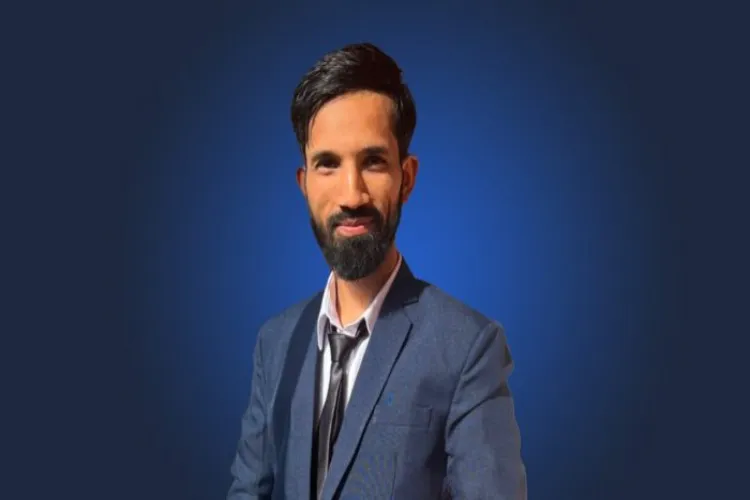
Breaking the stereotype of a company chief, Srinagar’s Asif Sheikh, a school dropout, is the CEO and founder of Thames Infotech, a Manchester-based company with a turnover of Rs 5 crore! He has just turned 28.
“I believe that a person who works hard, with dedication and honesty is always successful; he can never give up even when many a time one loses the courage to carry on. There were setbacks and at the time I did seem to lose courage, but I did not give up,” Sheikh Asif told Awaz-the Voice in a telephonic interview.
Asif’s success is extraordinary given his poor educational background and reaching a position that many persons with degrees from top-end colleges aspire to.
Besides being a successful entrepreneur, Asif is also a professional web designer, developer, graphic designer, digital marketer, and writer. He also gives back to society by giving free tuition to students from all over the world.
Sheikh Asif’s work profile is interesting: he worked with a tour and travel company, sold medical equipment for a company, and with telecom companies like Airtel, Vodafone, and Aircel.
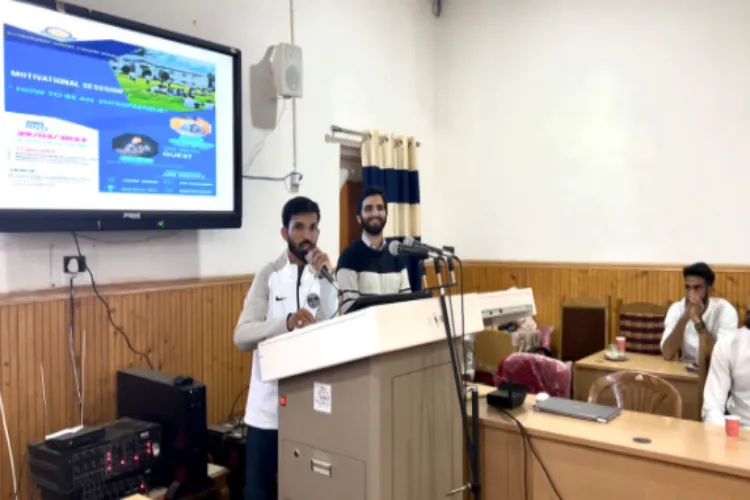
Sheikh Asif deliving a talk on business
In the year 2000, Sheikh Asif was 8 years old when his father’s health deteriorated. His father was a head constable. Due to his father’s illness, the family was reduced to penury. Sheikh Asif says that his father’s illness remains a mystery as the family consulted experts and eminent doctors but nobody could diagnose it.
Sheikh Asif told Awaz-the Voice that his mother sold most of the household assets and took loans to pay for his father’s treatment.
Recalling those days, Asif says that he can never forget one particular day when he was studying in the eighth grade and was to write his exam, but he had no pen. “I was leaving for the examination hall and was worried. My mother came to know the reason for my worry, she sold a copper dish from her kitchen to buy me a pen.”
He says that his mother often sold household goods for the family, especially to meet the needs of the children.
The conditions at home were not conducive for Sheikh Asif to continue his studies. He left school and started working to support his family.
“I went against my mother’s wishes, as she wanted me to become a doctor most parents in Kashmir do, but I gave up my studies to support my financially broke family,” said. He was 15 years old in 2008 when he started earning for his family by doing odd jobs.
Sheikh Asif
Sheikh Asif was always fascinated by computers and spent a lot of time on them. Due to this, he got his first job as a data entry operator with a local tour and travel company at the age of 16. He earned a salary of Rs 1500.
Sheikh Asif said seeing his interest his father took a loan from a bank to buy him a computer. The turning point in his life came as he watched an interview with Microsoft founder Bill Gates on BBC.
He took full advantage of his computer and yet the challenge was the lack of a high-speed broadband facility in Kashmir. While the rest of the world was running 4G internet, in his locality only 2G internet was available.
He left his first job within two months and started working in a local shop as a salesman for four years. Here he honed his skills and learned all the basics including graphics designing, web designing, etc.
Again there was a rough patch in his life as in the 2014 Kashmir floods, his house was washed away. He used all his savings in rebuilding his house. The family had to start from scratch as all their household belonging had got damaged and washed away.
In the year 2014, he quit his job and started his business, but it turned out to be a year full of troubles for him.
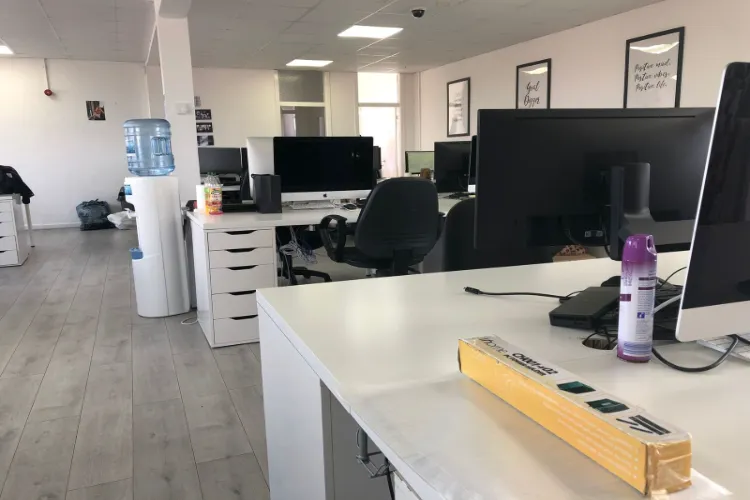
Sheikh Asif’s Srinagar office
However, fortunately, the next year Asif got an opportunity to work in Delhi, and the exposure there opened his mind to a bigger canvas.
“The 2014 flood severely damaged our house and we had to repair or renovate it periodically for four consecutive years after the flood and finally had to sell the house in 2018,” he said.
In the meantime, he worked with OLX from April 2015, and from there he was offered a job at Trimax Printing and Graphics, a UK-based company owned by Tajinder Singh. He was working for the company Hayes Harlington. The company runs an online general store and it had no element of graphic designing till then.
Sheikh Asif told Awaz-The Voice: “I worked for Chanda Trimax Printings & Graphics. Meanwhile, the killing of a militant in Kashmir saw the valley under lockdown for nearly three months. For this reason, I left for Delhi.”
When he met Tajinder Singh in Delhi, the latter was facing issues with his business. His business was suffering due to low sales. Having seen his latent, Tajinder Singh offered him a job at Hayes, Harlington, UK, where Tajinder’s brothers were already working.
Sheikh Asif says he consulted his mother before picking the UKL job. He signed an agreement to work for 18 months and an assured return flight ticket to India.
“They told me that they had changed the name of Trimax Printings & Graphics to Thames Infotech on June 6, 2016,” Asif said.
He set foot on foreign soil for the first time in the first week of November 2016. However, the business did not show positive results there either, thus Tajinder’s brother advised him to find a part-time job in the UK to meet his expenses.
“When I was looking for a part-time job, I met Rizwan, a Kashmiri man originally from Baramulla district in North Kashmir, who came to Manchester in 2000 and now runs a restaurant, Riz Spices.
Sheikh Rizwan offered him a space in his restaurant to set up a part-time business. “Two months later I met another man, Hamza Salim, a senior software engineer at Google, who asked me to build a website for his tech company, on the condition that only if he liked my work I would be paid,” he said.
After approving his website design, Hamza Salim offered him 50 percent equity in his firm.
pix05
During this time, Asif meet many people including natives and others, and kept looking for opportunities.
One such person was Rudrigo Ruiz Karvajal, who frequented the restaurant. He offered me a place that was quite conveniently located. He told me that his father had started his business from there.
“I got my first order for a logo for which I was paid 500 pounds and I was only expecting 30-40 pounds. They gave me another order to build a website for which I was paid 7000 pounds.”
“I was wondering if it’s a dream. Never expected such high remuneration. This order was from the largest food chain in London called Zabka.”
On June 9, 2016, Asif took over the Thames Infotech Manchester UK company which has a current turnover of Rs 5 crore.
It has an office at Advent Colony in Naugam, Srinagar, Kashmir. He employs 35 locals including 32 in UK and 3 in Kashmir for website designing and development, digital marketing, graphics designing, personal branding, social media handling, etc.
Sheikh Asif told Awaz-The Voice that our company is a leading web designing company and has won the 2017, 2018, 2019, and 2020 awards as the Three Best Rated UK, and Best IT Service Provider Award 2018, 2019 organized by Top Developers USA, he claims.
Sheikh Asif said that he received the first award in the year 2003, less than one year after his launching of his company.
So far, Asif has trained around 1000 students, helped 40 businesses through the Covid-19 pandemic, and has published three books – Digitization In Business, Online Business Idea, and Start a Business.
Sheikh Asif was named Entrepreneur of the year 2022 by The Fireboxx. There he was honored by Google as a Digital Marketing Expert in 2018.
To the youth, Sheikh Asif says they must never lose hope and always keep their focus on business. Secondly, they must avoid drugs. They shouldn’t waste their lives by getting immersed in romantic liaison and heartbreaks; these are temporary phases of life and not a goal. “Your personality is your work,” he says.
source: http://www.awazthevoice.in / Awaz, The Voice / Home> Youth / by Shah Imran Hasan, New Delhi / December 17th, 2022
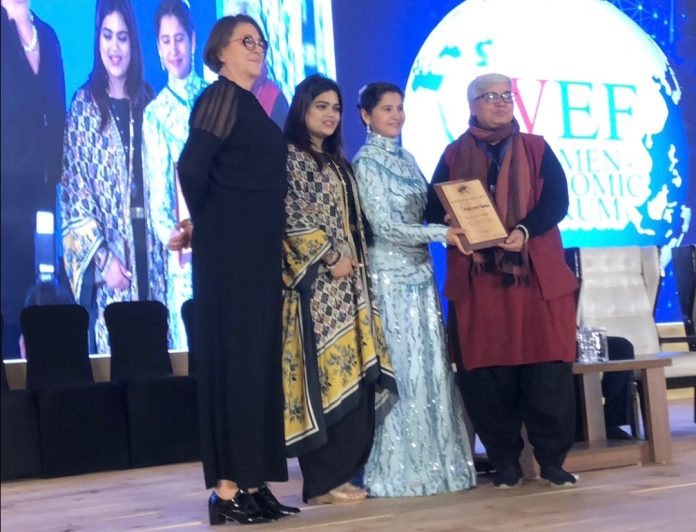
Anhad’s founder Shabnam Hashmi receiving Woman of the Decade award
84th Global Edition of Annual Women Economic Forum 2022 (WEF) – G100 Meetings in Delhi, India was inaugurated on 27th and the deliberations will continue till 31st December 2022 at JW Marriott Hotel, New Delhi Aerocity. India.
The summit coincides with the Presidency of India at the G20.
Shabnam Hashmi , a well known social activist and founder of Anhad was invited to speak in the Plenary session on the second day of the summit on human rights .
Dr. Harbeen Arora Rai, Founder & President, G100 , ALL Ladies League (ALL) | Women Economic Forum (WEF), WICCI, Women’s Indian Chamber of Commerce and Industry conferred on Shabnam Hashmi the “Woman of the Decade” award.*
The WEF together with participants hopes to influence and shape global policies in order to extend more support for women in all walks of life globally.
Presented by Women’s Indian Chamber of Commerce and Industry (WICCI), and held along with the G100 India meetings, the theme for this edition of the Women Economic Forum (WEF) is “Bridge the Gap: Agenda for G20.”
As an outcome, it will launch 100 recommendations that will be presented to the G20 leaders, UN bodies, governments and stakeholders globally to make gender equality a priority for all in this decade.
G100 is a group of influential global women leaders including Nobel Laureates and Heads of States who have come together with the purpose to make gender equality a reality in this decade and fulfil the vision of the UN SDGs by 2030. G100 is supported by the G100 Denim Club, group of leading 100 He for She champions from across the world who are supporting this epic endeavour.
The G100 is holding 100 global meetings worldwide. G100 missions have taken place in Switzerland (UN), Netherlands, Belgium, USA (UN-NY), UAE, UK, Spain, Romania, Malta, Portugal, Sweden, Malaysia, Indonesia, Singapore, Thailand and continue in 8 Balkan Countries, Ivy Leagues-USA, Turkey, France, Bangladesh, Egypt and the gala event in India.
source: http://www.muslimmirror.com / Muslim Mirror / Home> Indian Muslim> Positive Story / by Muslim Mirror Network / December 28th, 2022
When the English imprisoned Abu Zafar Sirajuddin Muhammad Bahadur Shah Zafar (1775-1862), the last Indian Moghul Emperor, in the Jail of Rangoon in 1857, instead of Indian Flag, Union Jack started hoisting at Dehli’s Red Fort and Queen Victoria became the full-fledged ruler of India without any obstacle, at that time, many country patriots came into field united to fight against the British rule.
Maulana Muhammad Qasmi Nanautavi (1832-1879) was one of them too.
In 1857, one Fatwa for Jihad against the English was issued.
The Fatwa carried the signature of 34 prominent Ulama. One among them was Maulana Nanautavi himself. As other elders had participated in the Jihad of Shamli in 1857, Maulana Nanautavi also had participated personally with his colleagues. Briefly in the battle of Shamli, Nanautavi and his colleagues got defeated to British forces.
He was a far sighted scholar. He comprehended that the British has not only occupied India and would attack the Indian culture, but even the faith of Indians would be at risk. Therefore, while on the one hand, he started fighting against the English, he began debating with clergyman on the other. But to that time, the freedom wasn’t destined for India, so he didn’t succeed in the mission.
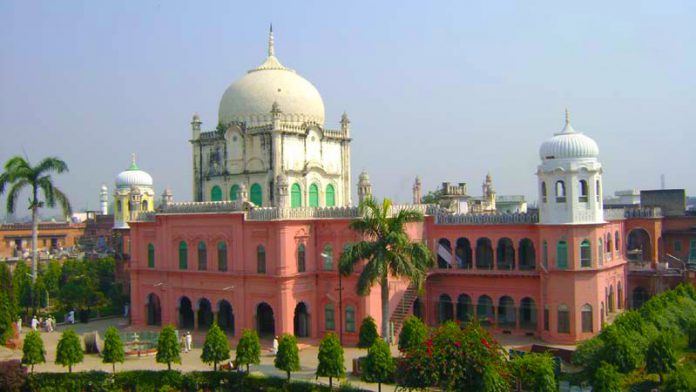
In this situation, intending to free India from the British rule, in the company of some friends, Maulana Nanautavi adopted another policy to establish a Madrasa on 21st May, 1866 (a famous learning centre of Indian Subcontinent, Darul Uloom, Deoband) beneath a pomegranate tree in Chattah Masjid of Deoband. So that the trained products of the Madrasa would sacrifice themselves to preserve the country and Islam both in British India. Alhamdulillah, Nanautavi succeeded in his mission and a good number of Darul Uloom’s product gave sacrifices for the sake of Indian freedom and Islam.
The noted Islamic scholar Maulana Manazir Ahsan Gilani (1892-1956) quoted in his book, “Ihaatae Darul Uloom Men Beete Huwe Din” (The Days Passed in the Campus of Darul Uloom) from his teacher and the first graduate of the seminary, Shaikhul Hind Mahmood Hasan Deobandi (1851-1920) saying:“Did my teacher (Maulana Muhammad Qasim Nanautavi) establish this seminary only for the teaching and learning? The seminary was established before me, as far as my knowledge goes, my teacher established this one in 1866 to compensate the defeat of 1857 from the British. I have chosen the same mission for which it was established before me.”
Very few people know the fact: “In the meeting of Jamiat Ulama-e-Hind at Kolkata in 1926, the participants included graduates of Darul Uloom, Deoband and they supported the group which called for complete independence of India from the British rule.
Indian National Congress was to declare complete independence as its goal three years later, in its session at Lahore.” (Wikipedia, Darul Uloom Deoband)The famous freedom fighter, Frontier Gandhi, Khan Abdu Ghaffar Khan (1890-1988), who visited Darul Uloom, during his visit to India in 1969, had said, “I have had relation with Darul Uloom since the time, Shaikhul Hind Maulana Mahmood Hasan, was alive. Sitting here, we used to make plans for the independence movement, as to how we might drive away the English from this country and how we could make India free the yoke of slavery of the British Raj. This institution has made great efforts for the freedom of this country.” (Wikipedia, Darul Uloom Deoband)Due to the great interest in India’s freedom struggle, Shaikhul Hind became an icon of Indian independence movement. Though he was a teacher of Darul Uloom, but made much effort to start an armed revolution against British rule from the both inside and outside India.
He started a programme to train volunteers and his students in the seminary from India and abroad for that goal. The most eminent among those who joined the movement were his students: Maulana Ubaidullah Sindhi (1872-1944), Maulana Husain Ahmad Madani (1879-1957), Maulana Muhammad Mian Mansoor Ansari etc.Shaikhul Hind sent Maulana Sindhi to Kabul and Ansari to the North-West Frontier Province to mobilize the popular support and recruit volunteers. And he with Maulana Husain Ahmad Madani travelled to Hijaz (KSA) to secure Turkish support. Getting the Turkish governor, Ghalib Pasha’s signature on a declaration of Jihad against the British, he planned to return to India via Baghdad and Bluchistan to start the rebellion.When Shaikhul Hind planned to return, the Silken Letter Movement was captured by Punjab CID.
Due to this movement, Shaikhul Hind was arrested in Hijaz. He was imprisoned in Malta, where he was tortured mercilessly, for more than three years.
Here it seems necessary to mention that what was the Silken Letter Movement. Shaikhul Hind wanted an armed revolution against the British rule, as I mentioned. So, he needed arms and ammunition. He and his colleagues, therefore, travelled to different countries to seek support from the anti-British countries; such as Afghanistan, Turkey and Russia. During the visiting different countries, letter exchanged between Shaikhul Hind and his colleagues, containing the outlines of the plan to recruit the volunteers for army and to establish a national government were written on silk piece of cloth. That is why the movement was known as the Silken Letter Movement/Tahreeke Reshmi Rumal (in Urdu)/Silk Letter Conspiracy (according to British government).When he returned to India, after release, was conferred upon by the title of Shaikhul Hind, leading leader of India.
Now he issued a Fatwa making it a duty of all Indian Muslims to support and participate with Mahatma Gandhi (1869-1948) and the Indian National Congress, who had prescribed a policy of non-cooperation and mass civil disobedience through non-violence.
He died on November 30, 1920 wishing to get martyrdom for India’s freedom.
Though Shaikhul Hind was no more, but he left a good number of students, who followed the footprint of their elders and worked tirelessly for the freedom of India.
Maulana Ubaidullah Sindhi (1872-1944), a 1891’s graduate of Darul Uloom, was also among them. He was the most active and prominent member of India’s freedom movement. He was among those leaders of Darul Uloom who left India, following the commandment of Shaikhul Hind, during World War 1, to get support of the anti-British central powers for an armed revolution against British rule.
Maulana Sindhi reached Kabul to rally the Afghan Amir Habibullah Khan.
After a period of time, he offered his support to Raja Mahendra Praratab’s plans for revolution in India with German support. He joined the Provisional Government of India formed in Kabul on 1st December, 1915. In this government, he was nominated the Minister for India. It was declared a revolutionary government in exile, which was supposed to take the charge of independent India, if the British government has been overthrown according to the plan. But unfortunately, in 1919, the provisional government was dissolved under the diplomatic pressure to Afghanistan.
He stayed in Afghanistan for 7-year nearly.
Then visiting Soviet Russia,he reached Turkey, where he issued the charter for the independence of India from Istanbul.
He left Turkey for Hijaz and remained there until 1929. He journeyed from a country to country for the sake of India’s independence. He died on 22nd August, 1944, at Deenpur in Pakistan.
Shikhul Islam Maulana Husain Ahmad Madani (1879-1957) was also one of the Shaikhul-Hind’s students and graduate and latter Professor of Hadith at Darul Uloom, Deoband.
Though he had been not convicted, but he accompanied Shaikhul Hind to Malta voluntarily, to take care of him. He stayed in Malta three years upto the release of Shaikhul Hind. Returning to India, he actively became involved in the freedom struggle. He had been imprisoned several times by the British authority for his participation in the freedom movement. It was he who dared to issue a Fatwa in the meeting of Indian National Congress at Karachi that working as British army and police is Haraam. After this Fatwa, he was rewarded two years rigorous imprisonment. He never stepped down from the freedom struggle movement, until India got freedom.
At the time of independence, the Muslim League and the Indian National Congress were at logger heads on partition of united India. On that occasion, Madani opposed the partition thoroughly. He journeyed the different provinces of India along with Maulana Abul Kalam Azad (1888-1958) and Mahatama Gandhi to assure the people safety and security and tried his level best to stop them to migrate from India to Pakistan. Many people targeted him, but he never conformed to the opinion of the partition.
After the independence, he was served a ministry, but he refused and restricted himself under the four walls of Darul Uloom and Jamiat Ulama-e-Hind for teaching and social works.
Like Madani and Sindhi, there were hundreds of Darul Uloom’s graduates, who actively took part in the freedom struggle of India. To mention the works of those patriots, the volumes and volumes are required.
It’s sorrowful matter that historians of modern India ignored completely the role played and efforts made by Darul Uloom for India’s freedom struggle. Today, most of the people aren’t aware of this historical institution. Some people know that Darul Uloom is a conservative seminary that produces merely Maulanas or a factory that only issues Fatwaas. And some say that Darul Uloom is “a Station of Terrorism” and “it produces terrorists”. This one is a famous opinion among Hindu fundamentalists, while the fact is otherwise as I stated in the essay.
It’s a bird’s eye view of the role of Darul Uloom, Deoband in India’s freedom struggle.
One who is interested on the topic, should go through the book, “Taarikhe Darul Uloom” (History of Darul Uloom).
May Allah accept the works of the seminary!
source: http://www.millattimes.com / Millat Times / Home> Special Column / by Khursheed Alam Dawood Qasmi , Email: qasmikhursheed@yahoo.co.in / August 15th, 2022
The founder and rector of Darul Uloom Markaze Islami, Ankleshwar, Maulana Moosa Makrod was almost 80 years old. He was very active in performing his day-to-day duty at the time. In spite of old age, he seemed very fit and energetic. He never complained of any sickness. However, suddenly, a message was circulated on the WhatsApp on 31st July 2020 informing that he has been sick since two days and his health condition is deteriorating. Following the illness of a few days, he passed away on 5th August 2020 at 04:00 in the morning. The news of his death spread like jungle fire. For his dear and near ones as well as the graduates of Markaze Islami, this news was very shocking and heartbreaking. May Allah grant him Jannah!
Maulana Makrod was a humble, polite, sociable, good conduct, pious, simple and kind-hearted. There is a Hadith of our beloved prophet Muhammad (SAWS): “The believer is naively noble.” (Sunan Tirmidhi: 1964) It means that a believer is a simple and kind-hearted, therefore, he can be deceived due to his gentlemanly belief in other people. This Hadith was very much applicable to Sheikh Makrod in my opinion.
The Almighty Allah has bestowed him with the great love and affection for Islamic scholars and pious people. He loved them very much. He used to invite the scholars and pious people in Markaze Islami. Whenever any scholar visited any institution of the vicinity, he tried his level best to bring them in Markaz. His habit of presenting himself among those scholars was as a faithful student before a kind teacher. It doesn’t matter either they are aged or young. He would arrange the food to host such guests from his home.
Due to Maulana Makrod’s love for the scholars, Maulana Moinuddin Gondavi (May Allah grant him Jannah!), former Sheikhul Hadith of Madrasah Imdadia, Muradabad, UP, decided to stay at Markaze Islami for a long period of time, when he had to settle down in Gujarat for his treatment. Maulana Makrod took care of him as long as he stayed at Markaz, until he breathed his last and was buried in the campus of Markaz. Maulana Gondavi felt very much comfortable during his stay at Markaz. Maulana Makrod had special love for Maulana Gondavi. I remember there was a gathering of Nikaah for Maulana Makrod’s late son: Maulana Ismail Makrod (1974-2018) (May Allah grant him Jannah!) in the Masjid of Ravedra, a village in Bharuch district. Maulana Moinuddin addressed the gathering before Nikaah. He mentioned a certain story and the tears started rolling on his cheeks. Maulana Moosa Makrod stood at once, took out the handkerchief from his pocket and started wiping his tears.
Maulana Makrod was very punctual of Salah. Be it rain, summer or winter season, in spite of his old age, he used to perform Salaah in Markaz’s Masjid. Occasionally, he used to awake the students of Markaz for Fajr Salaah. Early in the morning, he used to reach the office on the time as well. He used to complete the day-to-day affairs on the time. He was accustomed to reach the office in the morning and remained until the morning session was over for the lunch. Then he left for the home to have lunch. At Zuhr Salaah time, again he was present in the Madrasah for Salaah. Following Salaah, he sat in the office again to settle the works. Whatever was the burden of the duty, but he never expressed the tiredness. Always he was happy and active to perform his duty.
When the afternoon session was over, he used to go to the Masjid following Adhan. He performed Asr Salaah in Markaz’s Masjid. Following Salaah, commonly, he used to sit with the final year students in the Masjid and had discussion with them. He used to guide and train those students.
Maulana Makrod and his son Maulana Ismail Makrod used to treat me like a member of their family. I will always remember their kindness. Whenever there was a programme in Markaz, they used to give me chance to let me prove my mettle. They encouraged me for whatever good work I did. Whenever there was a function in the campus of Markaz, frequently they give me chance to run it. Once I got chance to run the annual function which was presided by Sheikh Tariqat Maulana Qamruz Zaman Allahabadi (May Allah protect him!).
Whenever there was a programme in an institution, Maulana Makrod mostly used to send me to participate. After coming back from the programme, he used to call me in the office to know the programme’s details. In this way, I had chance to visit several institutions in Gujarat. Whenever any new book or a magazine came in the office, he used to give me to read and write the letter of thanks to the sender.
Following my arrival in Zambia with his suggestion, I was in touch with him continuously. He and his beloved son Maulana Ismail Makrod were very delighted after knowing the educational and social works in Zambia. Maulana Ismail Makrod insisted me several times to visit Ankleshwar. When I planned to visit India in November 2011, he asked me visit Ankleshwar. I had no any option, but to follow his suggestion. When I phoned Maulana Moosa Makrod, he also invited me to come to Ankleshwar. I reached Ankleshwar. My family and I stayed at their bungalow as they had arranged our stay there. We were welcomed and hosted by them with open arms. They insisted me to stay at least a week. They treated me as a family member. I stayed two-three days and came back, due to the lake of time.
The kindness, sympathy, humanity, morality and sincerity I found in him, are hardly found in this age. Anyway, now Maulana Makrod and his son Maulana Ismail Makrod have left for heavenly abode. I am sure that the thousands of the students who learned at Darul Uloom Markaze Islami will remember them. They will make Duaa for them, In Shaa Allah.
The Almighty Allah had decided the same time for Maulana Moosa Makrod so he passed away at the appointed time without late. The Almighty Allah says: “For every people there is an appointed time. So, when their appointed time will come, they cannot be late for a moment, nor will they get ahead.” (Aaraaf: 34) He spent a number of years serving at Markaze Islami. He founded this institution as a small Madrasa and latter it became like a fruit bearing tree. Thousands of students benefited from this institution and a lot are still benefiting. It is the duty of the graduates of Markaz to make Duaa for him!
Maulana Makrod’s Birth:
Maulana Makrod was born on 22nd November 1939 at his native place called: “Diva” in Bharuch district of Gujarat. His father’s name was Maulana Ismail Makrod, who was working in Durban city of South Africa. He passed away and was buried in Durban. May Allah grant him Jannah!
Educational Journey:
Maulana Makrod received his basic education at his hometown Diva. For the further education, he got admission in Jamia Husainia Rander, Surat in 1952. He completed his Fazilat course 1959 from Jamia. He learnt Sahihul Bukhari from Maulana Ahmad who was a student of Sheikhul Islam Mualana Husain Ahmad Madani. May Allah grant them Jannah!
Following graduation from Jamia, Maulana Makrod left for Darul Uloom, Deoband to benefit from the elder scholars of Darul Uloom. He remained almost two years in Deoband. He used to participate particularly in the lectures of Allahmah Ibrahim Baliawi, Allamah Fakhruddin Muradabadi, Qari Muhammad Tayyib (May Allah grant them Jannah!) etc. While being in Deoband, he used to take part in the special gathering of elder scholars of Darul Uloom to benefit from them.
Oath of Allegiance and Khilafah
The first and foremost, Maulana Makrod took the oath of allegiance to Maulana Maseehullah Khan of Jalalabad, UP. Following his death, Maulana Makrod again took the oath of allegiance to Maulana Moinuddin Gondavi (Ex-Sheikhul Hadeeth: Madrasah Imdadia, Muradabad, UP). After his death, Maulana Makrod joined Maulana Qamruz Zaman Allahabadi (Hafizahullah!). He was blessed with Khilafah from Maulana Allahabadi and Maulana Muneer (Hafizahullah!).
His Survivor:
Allah the Almighty has blessed Maulana Makrod with three sons and four daughters. His son Maulana Ismail Makrod, deputy rector of Darul Uloom Markaze Islami and director of MIERC, Ankleshwar passed away on 17th November 2018 in a car accident. He was very much hopeful about Maulana Ismail that he would shoulder the responsibility to take Markaz ahead. But Allah Ta’ala had decided something else. As long as Maulana Ismail was alive, he assisted him in most of the activities. Maulana Moosa Makrod was much grieved after his death. Whenever I talked to him after the death of Maulana Ismail Makrod, he used to talk about him.
Following the death of Maulana Ismail Makrod, he was survived by his wife, two sons and four daughters. One of his sons is Mr. Iqbal Moosa Makrod who was resident in Leister, UK. But after his younger brother’s death, he came back to his hometown and started serving in Darul Uloom Markaze Islami to assist his elderly father and he is still serving. May Allah accept his services and grant him the best reward!
Maulana Makrod’s another son is Mr. Zubair Moosa Makrod who is settled in New York, USA with his family. One of his daughters is Bilqis Yusuf Topia, a house wife and a resident of Gloucester, England with her family members. The second daughter is Nafisah Saeed Hejazi who is a resident in New York, USA with her family members. The third daughter is Hajirah Javed Jogiat who is resident in UK with her family members. His last born daughter is Khadiajah Saeed Patel. She is resident in New York, USA. May Allah keep them happy and well!
Maulana Moosa Makrod’s Services in Educational Field
Career and Practical Life
After coming back from Deoband, Maulana Makrod taught seven years in the Maktab of Diva. Then he established a Maktab namely: Maktab Noorul Islam in 1975, in Ankleshwar Musafir Khana. Then he established Darul Uloom Markaze Islami in Ankleshwar in 1984. Then he also established a school in Goya Bazar of Ankleshwar namely Markaz Islami School. Then he established Markaze Islami Education and Research Center in the campus of Darul Uloom Markaze Islami in 2003 to equip newly graduate Ulama from different Madaaris with English language and computer science.
Establishment of Darul Uloom Markaze Islami:
Maulana Moosa Makrod offered his services in several fields. I am trying to present his services in the field of education briefly. His great and memorable service is establishment of Darul Uloom Makraze Islami. He ran this institution beautifully from the first day it was founded as its rector until he breathed his last. Briefly, I am going to shed light that when, how and why this institution was established? Then the services of this institution will be also presented to let the readers know the background of establishment of this institution.
Darul Uloom Markaze Islami, Ankleshwar is a well-known institution in Gujarat. Maulana Moosa Makrod used to tell about the foundation of this Darul Uloom that he left his village’s Maktab and started a stationary shop in Ankleshwar. Then he was suggested by his teacher, Maulana Saeed Ahmad, Rector: Jamia Husainia, Rander to start a Maktab in Ankleshwar and teach the children basic of Islamiyyat along with running his shop. Following the suggestion, he started a Maktab: Noorul Islam in Ankleshwar Musafir Khana in 1975 and started teaching along with running his shop.
After few years, due to the growing number of the pupils, Musafir Khana was not enough to accommodate all the pupils. Then with suggestion of some his friends, he decided to arrange a piece of land and found an institution. With the help of Allah, he was successful in arranging the land for Madrasah nearby the GGCL (Gujarat Gas Company Limited) in Ankleshwar. In 1405=1984, the foundation stone was laid by two great personalities of the time, Maulana Ahmad Raza Ajmeri, (Ex-Sheikhul Hadith: Darul Uloom Ashrafiyyah, Rander, Surat) and Maulana Moinuddin Gondavi (Ex-Sheikhul Hadith: Madrasah Imdadia, Muradabad) and the institution was named: Darul Uloom Markaze Islami.
After the foundation, Sheikh Ahmad Raza Ajmeri took care of Markaz as its patron. Following his death, Maulana Moinuddin was made the patron. After his death, Sheikhe Tariqat Maulana Qamruzzaman Allahabadi was made the patron of Markaz. From the foundation day, the institution is progressing by leaps and bounds. May Allah arrange the better substitute for Markaz and may it continue progressing.
Markaze Islami provides the education from the basic classes of Urdu to the final year of Alimiyyah Course. With a bit changing in the known syllabus of Darse Nizami, the English language and the computer science have been included up to the 4th standard as this is the crying need of the time. Up to now, almost 500 students have completed their Aalimiyyah course form this institution and they are serving within and outside the country. May Allah accept their services!
The memorization of the holy Qura’an is called Hifz. If a person has memorized the whole Qura’an from cover to cover, he is called Hifzul Qura’an. There is a Hifz Department in Markaz as well. There are 11 Hifz classes running under 11 expert teachers of Hifz. There are about 260 pupils in Hifz Classes currently. Almost 536 pupils have completed Hifz course up to now from Markaz.
It is essential to recite the holy Qura’an with correct pronunciation of the Arabic alphabets caring the rules of Tajweed. If a person fails to recite the Holy Qrua’an with Tajweed, he is sinner. Maulana Moosa Makrod was very careful about it, so he established a department for Tajweed and Qira’at. The department has produced 120 students who completed Hafs, 94 students who completed Sab’ah and 42 students who completed Thalathah and 9 students who completed Ashrah Kabeer and received the certificates of Qaari. These students are serving within the country and abroad as the teachers, Imams etc.
Realizing the interest of the graduating students in Islamic Jurisprudence, “Department of Specialization in Islamic Jurisprudence” (Iftaa) was introduced in 2010. Following the admission in the department, the students get expertise and proficiency in Fiqh. Up to now, 29 students have completed the course and were granted the certificates of Mufti. The statistics mentioned here are according to the annual report of 1440 AH.
For the perfection of the writing and speaking skills of the enrolled students, there are three Anjumans (Students’ unions) working under the supervision of the teachers. Under those unions, weekly programmes are held regularly. Under “Anjuman Tarbiyatut Talbah”, the pupils practice to develop their oratory and writing skills in Urdu language. For practice to develop their Arabic speaking and writing skills, they participate in the weekly progrmme held under “Al-Nadi Al-Adabi”. Under “Anjuman Tahseen Al-Qura’an Al-Kareem” the pupils practice how to recite the holy Qura’an beautifully applying the rules of Tajweed, they get trained for Khutbah of Jumah and to lead Salah etc.
Maulana Moosa Makrod established this institution with few pupils and the teachers in 1984. The Almighty Allah accepted this institution and currently about 550 pupils are getting free education and they are trained for good moral and character. After graduation, they play a constructive role in guiding the public to follow the straight path as the responsible citizens. To educate and train the students, there are 44 teachers who are working day and night. There are also 15 other auxiliary staff providing additional duties as cook, launderer, cleaner etc. All these are happening with Allah assistance, the good arrangement by the rector and the generous public donations. May Allah accept their services and grant them abundant reward! May Allah protect this institution from all types of evils!
Establishment of Markaze Islami School:
None can deny the need of Islamic school in this current age; rather the thinkers, writers and scholars are writing and speaking on the need of the establishment of Islamic schools. They ask the Muslim community, the organizations and the trusts to found Islamic school if they have resources to bear the expenses. Al-Hamdulillah, Maulana Moosa Makrod realized this need of the community decades ago and established an Islamic school namely: Markaze Islami Gujarati School, under the management of Darul Uloom Markaze Islami in Goya Bazar of Ankleshwar. The pupils are receiving modern education in Islamic environment. The school is recognized up to the 10th standard from the Gujarat government. Almost 432 pupils are learning under 15 qualified teachers. Following completion of the school, the pupils go to the different colleges and universities for higher modern education, Al-Hamdulillah.
Establishment of Markaze Islami Education & Research Center (MIERC)
The significance and need of English language in the modern age to understand the newly invented things or for preaching the true messages of Islam are not hidden for any sensible person. That was the reason that Maulana Moosa Makrod sent his son Maulana Ismail Makrod Delhi to learn English language in Markazul Ma’arif Education & Research Center. When he came back after learning English language, he tried to expand the chain of Markazul Ma’arif and requested his father to found an institution like that to educate newly graduated Ulama.
Maulana Moosa Makrod also realized the fact that thousands of Ulama are graduating each year from different Madaaris. One Markazul Ma’arif is not enough to meet the need; but establishing more institutions like that is crying need of the hour so that more Ulama after equipping with English language, can address the need of the people and can preach Islamic messages simply as English is easily understood. So, he got ready to establish an English Department. But before establishing, he thought proper to seek the opinions of the scholars, then finally to go ahead following their opinions. The scholars responded in affirmative and acknowledged the need of the English language. Then Maulana Moosa Makrod finalized to materialize this programme under the campus of Darul Uloom Markaze Islami.
Foundation of the Center
After getting positive replies, he started planning to found a center for the said purpose. According to the plan, he founded the institution namely: Markaze Islamic Education and Research Center, in 2003, under the management of Darul Uloom Markaze Islami within its campus. It was first time in the history that a two-year Diploma in English Language & Literature course was introduced in the campus of a Madrasa. Maulana Ismail Makrod was given the charge as director to run it. After the entrance exams, the newly graduated Ulama from different Madaris, who had interest in preaching the true messages of Islam as well as learning English language, were selected as the students of the first batch. Then the center started functioning practically.
The Services of the Graduates of the Center
A good number of Ulama graduated from different Madaaris try to get admission in this department being keen to learn the English language. The department is equipping the Ulama with English language and literature as well as computer science for last 17 years. In this period, the number of the students who have graduated from this institution is 270. Most of those Ulama are busy in teaching. Dozens of those Ulama are serving in other countries like: England, America, Canada, South Africa, Zambia, Zimbabwe, Botswana, Australia etc. May Allah accept their services and make it continuous charity for the both Maulana Moosa and Maulana Ismail Makrod! May Allah grant them Jannatul Firdaus!
source: http://www.millattimes.com / Millat Times / Home> Opinion / by Khursheed Alam Dawood Qasmi / December 06th, 2022