The 52-year-old Devanahalli farmer grows Avocados, Macadamia nuts, Rambutan, Bush Orange, Water Apple, Star Fruit and Lychee Thai Guava among others in his one-acre nursery.
Avocados. (Photo|Associated Press)
Bengaluru :
Eleven years ago, Mohammed Adil bid adieu to his 20-year-old gemstone business and turned to his interest in growing tropical fruit plants full-time. The decision helped him reap rich dividends as now his turnover by selling exotic saplings in Bengaluru is over Rs 1 crore annually.
The 52-year-old Devanahalli farmer grows Avocados, Macadamia nuts, Rambutan, Bush Orange, Water Apple, Star Fruit and Lychee Thai Guava among others in his one-acre nursery.
“I had 4 acres of land where I had many Jamun trees. But, since the yield was less, I searched for exotic fruit trees and my journey as a farmer began 11 years ago. I converted one acre into a nursery where I grew all the mother saplings. In Avocado alone, I have 13 types with four types named after Bengaluru nursery,” said Adil.
In the last five years, he has sold over lakh Avocado saplings. “This tropical fruit is easy to grow with zero maintenance and the yield is just in three years. All one has to do is ensure good care for the first two years,” said Adil.
source: http://www.newindianexpress.com / The New Indian Express / Home> Cities> Bengaluru / by Mohammed Yacoob , Express News Service / November 04th, 2022
The editorial titled ‘Manushyatvam Kurisherumbol’ (when humanity is crucified), by VM Ibrahim, which has been chosen for the Theruvath Raman Award is about the custodial death of tribal and Dalit activist Stan Swamy, prompting the Award Jury to comment that the editorial stood out for the facts and analysis of the case at the same time moving hearts.
Kozhikode:
Madhyamam Editor V. M. Ibrahim has been chosen for Theruvath Raman Award 2021 for the best editorial by Calicut Press Club.
The award is for the editorial titled ‘Manushyatvam Kurisherumbol’ (when humanity is crucified) published in the Madhyamam newspaper on July 6, 2021.
The editorial dealt with the custodial death of Stan Swamy, who was hunted by the state for his work on behalf of tribal and Dalit communities in India. The jury judged that the editorial touched the hearts of readers at the same time incorporating facts and analysis of the case which made the article remarkable.
The jury of the award was composed of senior media personalities P. Sujathan and P. S. Nirmala along with prominent media observer Dr. Sebastian Paul, said press club president M. Firoz Khan and Secretary P. S. Rakesh.
The award consists of a cash prize of Rs 10,000 and a certificate and was instituted by the family of Theruvath Raman, editor of the popular newspaper Pradeepam, in his memory.
V. M. Ibrahim started working as an assistant executive editor in Madhyamam in June 2001. He was also the executive editor of Gulf Madhyamam. He was appointed editor of the paper in 2021. A masters degree holder in Urdu, Ibrahim has to his credit works, ‘Chekuthanum Choonduviralum’ and a translation work ‘Theerthadakante kanavukal’.
He is the son of the late V.M. Abdurrahman and Khadija of Abdurrahman Nagar, Malappuram. He lives at Farooq College Azad Bhawan.
Wife: Hajara A.K. Children: Raja Khatun, Raji Ismail, Naji Ishaq. Son-in-law Niaz Ahmad.
source: http://www.english.madhyamam.com / Madhyamam / Home> India / Web Desk / November 02nd, 2022
Muhammadi Begum was a student of Osmania University, Hyderabad, where she topped the Bachelor’s examination in 1932.
Highlights
Having received a scholarship from the Nizam for higher education, Muhammedi Begum, a young woman from Hyderabad, travelled to Oxford University in 1934.
What makes her story even more remarkable is that she maintained an extensive record of her four years abroad.
Her diary has been translated from Urdu into English, and published, by her daughters
In 1934, a young woman from Hyderabad travelled to Oxford University in England to study, accompanied by her husband. She had received a scholarship from the Nizam of Hyderabad to pursue her higher education (for which she studied French, Arabic and English). During the nearly four years she spent in the UK, she had two children, travelled around Europe and established a pattern of living that would hold her in good stead her entire life.
The young woman was Muhammadi Begum, student of Osmania University, Hyderabad, where she topped the Bachelor’s examination in 1932. She was married to Delhi-born, Syed Jamil Husian, an alumnus of the Aligarh Muslim University.
Those days, women travelling abroad to pursue education was a rarity; although what made Muhammadi Begum’s story remarkable is a diary that she maintained at Oxford which recounted everything from her day-to-day concerns to reflections on the state of society.
Muhammadi Begum’s diary remained under a shroud till the year of her passing, in 1990. The little note-book, where she detailed her daily life as she lived across continents, was eventually a precious find. It went to her cousin first and meandered in the family, till it caught the attention of her eldest daughter towards the end of the decade.
“I was pleasantly surprised and was taken aback by it,” said Zehra Ahmad, Muhammadi Begum’s eldest daughter. “I came across the diary after she passed away. I would’ve asked her many questions if I knew about its existence.”
What followed over the years was translation (as Muhammadi wrote in Urdu), editing, followed by COVID-induced delays in publishing, before A Long Way from Hyderabad saw the light of the day in 2022. Zehra translated the book along with her sister Zainab Masud.
Translating the diary was no mean feat, as Muhammadi Begum made detailed records, even writing in the margins. The sisters read it multiple times, transcribed it, and then translated it – all of it laborious and time consuming.
Kulsoom Husein, her youngest, who came out of retirement to edit and rework her mother’s diary said, “The tone of the diary is true to her experience. It was a new experience for her to travel to England as few women did so in those days.”
Charting new paths
Muhammadi Begum belonged to a well-known family of writers. Her mother, Qaiseri Begum, was the granddaughter of famous writer Moulvi Nazeer Ahmed, who’s work Mirat-ul-aroos is often dubbed as Urdu’s first novel. Qaiseri Begum, herself was a prolific writer whose memoirs Kitab-i-Zindagi details changes in Indian social history from the 1880s to the 1960s.
The diary successfully encapsulates the journey of a young couple making their way in the London of 1930s. Her observations are detailed, precise and provide an invaluable peek into the world at the time – be it shopping at Harrod’s, visiting the Victoria and Albert Museum, eating ice-cream at a restaurant in Elliston & Cavell or taking walks in University Parks in Oxford, it paints vivid vignettes of pre-World war- II London.
The diary, according to Ahmad, who also spoke for her other sister and co-translator Zainab, brought her mother alive. “Everything she wrote was an accurate account of herself; her worries for her baby or exams, her management of the household and juggling her studies with a baby. She was on the move all the time and led a full and active life,” said she.
The writing is assured and confident. It stays true to what it is intended to be — a record of its keeper’s time in a foreign land. It comments on the English way of life (an interesting nugget is the usage of blackcurrant jam to treat colds), the trials of learning French and the easy camaraderie between students from India. Her letters to her mother Qaisari Begum were even published in a Hyderabad Urdu daily, Ismat.
It also showcases Muhammadi Begum as an independent woman with agency. Travelling in Europe along with a toddler can be a daunting task at any time, but she managed it with a remarkable spirit. It is in fact this spirit that would hold her in good stead later in life, when at 42 she lost her husband and had to look after many children.
A Long Way from Hyderabad can be nostalgic. It’s all about an era gone by, of Urdu publications in Hyderabad which have long ceased to exist (Rahbar and Tehzeeb) or local traditions like Kalzana, a medicine made from chalk and calcium, and given to pregnant women.
What she wrote holds relevance even today, as her struggles (with food, culture and money) are similar to ones faced by many students studying abroad. The diary also strikes a balance between everyday details of life, reflections of the time and personal observations.
A record of the time
Records of women travellers are rare. The few accounts which exist are those of Sikandar Begum, the ruler of Bhopal who wrote of her pilgrimage to Mecca in 1869, Maimuna Sultan who wrote an account of London in 1911 and Atiya Fyzee who published her travel writings in Zamana-I Tehsil in 1921. Typically, the women who published at the time were queens, politicians or activists; Muhammadi Begum was none of them and hence her account stands out because of its simplicity and honest rendition of her life.
Her writing is as much a record of her own life as it is of the times she lived in. The Independence movement was on in full throttle and she along with her husband eagerly took part in discussions with friends. She actively participated in cultural exchanges even though she was reluctant to lend her sarees to curious British women.
“My mother was very stirred by the experiences she had. Technology, in the form of planes and ship liners, was just coming up and when she visited the science museum she was struck by the difference in Indian and British kids. While rote learning was accepted in India, the children there were curious to explore scientific apparatus and experiments. She makes a mention of all these in her daily jottings,” observed Husein.
Indeed, the travel account shows that concerns have not changed much between 1935 and 2022. The author lamented the state of Indian museums on a visit to the V and A Museum and was entranced by a Buddha statue. She worried about land prices shooting up in Hyderabad and wondered if the family could afford to buy a house — valid concerns even after a century.
She throws light on the comfortable relationship between her and her husband. Muhammadi Begum’s husband, Jamil, took leave of absence from his work as a civil servant in Hyderabad to travel with his wife. According to Ahmad, her father was a hands-on parent. “He looked after the baby with her, which was unusual for the time. Also, they shared an equitable relationship,” she said. “He was an admirer of Gandhi and she looked up to Iqbal, which led to many discussions around each. They both liked exploring places and had a wide circle of friends.”
The years in Oxford had a lasting impact on her, as throughout her life she remained fond of open air, long strolls and staying independent. In fact, later in life, she took in paying guests in Lahore when she retired from her job and needed to supplement her income.
A nod to the past
In producing the book, Muhammadi Begum’s daughters became closer, as Husein noted, “We exchanged information about relatives mentioned and forgotten. My elder sisters have translated and I reworked the text — so it was a collaborative effort. My daughter, Amena, helped with research on key figures who were at Oxford at that time, such as educationist Sir Michael Sadler and GM Sufi, a retired University of Delhi registrar and historian, and Miss Bharti Sarabhai, who hailed from a prominent Indian civil rights activist family.”
With an account of food, state of women, culture, feelings and a life well lived, A Long Way from Hyderabad, is a perfect addition to the archives of writing from pre-Independent India. It provides a reliable record of the times gone by. It also shows the lasting impact of the written word and its ability to transcend time.
source: http://www.news9live.com / News Nine / Home> Arts & Culture / by Mallik Thatipalli / June 03rd, 2022
A one-of-its-kind campaign is providing deserving students personalised free training to appear for civil service exams
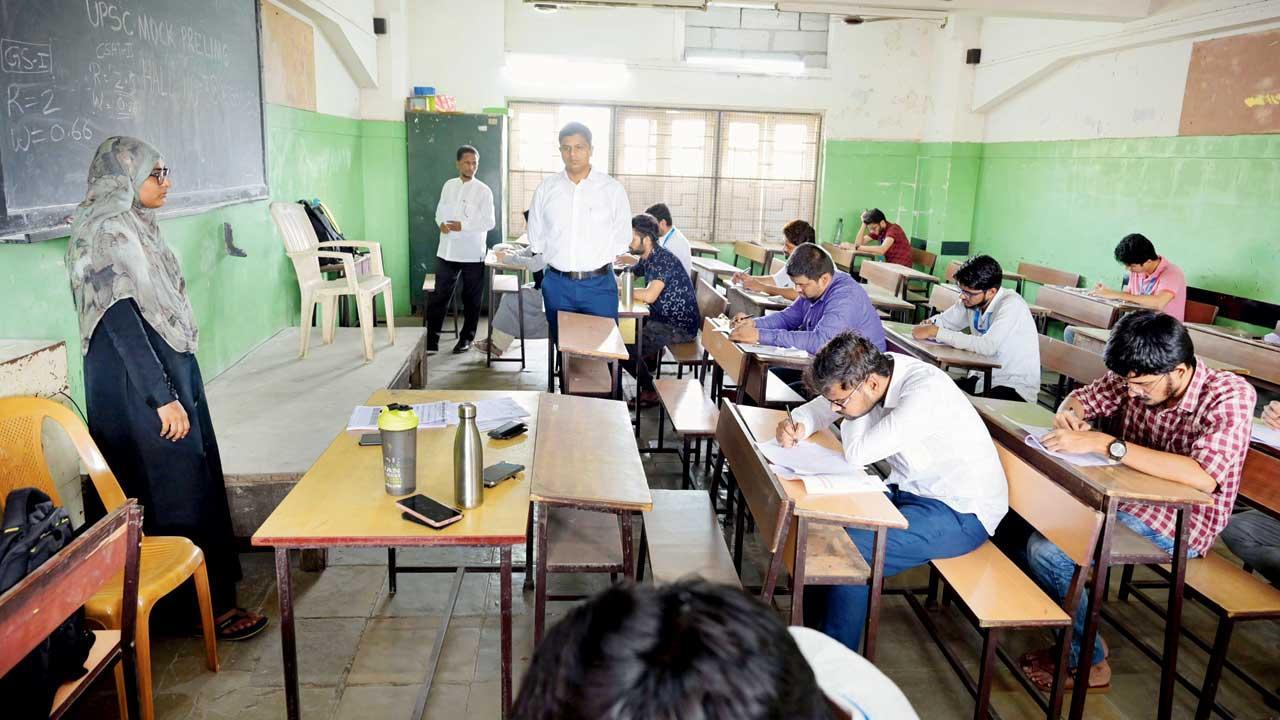
Students appear for a mock UPSC exam in May. Pic/Bipin Kokate
For 28-year-old Shabina Khan, joining the IAS always seemed like a distant dream. Born into a poor family, she had to struggle to complete her education. On Sunday, Khan, who will be sitting for the UPSC exam, will be a step closer to fulfilling her dream, thanks to the Dr APJ Abdul Kalam IAS-IPS Exam campaign, initiated in 2018.
Actively supported by Anjuman-I-Islam and All India Khilafat Committee, the campaign is providing deserving students personalised coaching, guidance and free training for the MPSC and UPSC exams. After a brief lull during the pandemic, which forced them to move all their classes online, the initiative formally launched in February this year. “Since February, 125 students have enrolled with us,” said Gulam Nabi Idrisi, founder chairman of the initiative.
According to Idrisi, several government officials are associated with the campaign, and are helping set mock test papers. The students already gave three mock tests in the month of May, and will be appearing for the UPSC preliminary exams scheduled today.
Speaking with mid-day, Shabnam Shamim Choudhary, 25, resident of Jari Mari, Kurla, said, “I wanted to become an IAS officer, but my family couldn’t afford the fees of the institute or even pay for the study material. This initiative has come as a blessing. I have managed to get at least basic training, so that I can take a shot at the UPSC exam.” Out of the 125 students enrolled with the campaign, 60 hail from Dongri. “We have been providing them with free food and accommodation. The students living in our facility belong to marginalised minority communities,” said Idrisi. The campaign is currently supporting Muslim, Buddhist, Jain, Christian, Parsi and Sikh students, who wish to appear for civil service exams.
Dr Zahir Kazi, President, Anjuman-I-Islam, said, “The administration must have representation of all sects and religions. Unfortunately, due to lack of facility and funds most of the students cannot pursue this dream.”
Sarfaraz Arzu, chairman, All India Khilafat Committee, shares his sentiments. “If we have to solve community issues, the presence of marginalised and minority officials [in administration] is a must.”
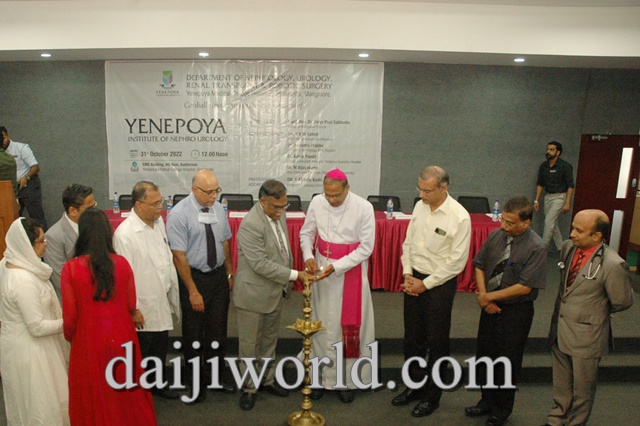
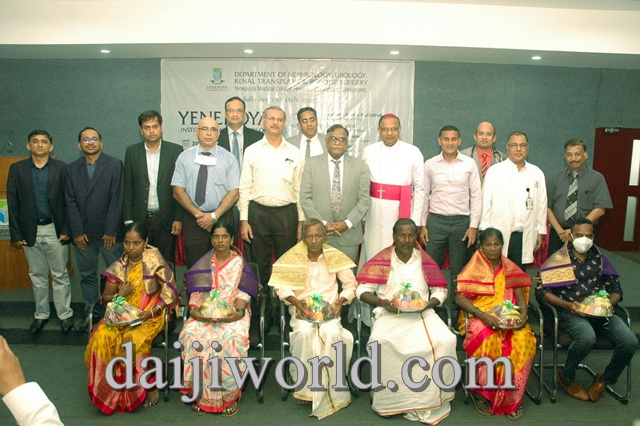
“The Yenepoya organization, which backs grief-stricken people and is in the forefront of humanitarian service, is model to all. Organ donation is very important is present times as many are dying due to organ failure. All have to think about organ donation,” opined Bishop of Mangalore Diocese Dr Peter Paul Saldanha.
The bishop was speaking after inaugurating the Yenepoya Nephro Urology organization under the aegis of Nephrology, Urology, Renal transplant and Robotic surgery departments of Deralakatte Yenepoya Medical College.
The bishop further said, “Yenepoya organization has recently given honorary doctorate to president of Gulbarga University recognising his humanitarian service. This is really appreciable. There is a possibility of giving life to five people from a person who is brain dead. Many make their death a fruitful one. We have to learn a lot from the people who are dying. Greek believed the whole world as one life. It is important to save lives.”
Prof Dr Ravindra Prabhu of Nephrology department, KMC Manipal said, “There was time when anyone with kidney ailment was going to die for sure. Very few were coming to hospital with kidney disease. Many have died due to heart attack because of psychological pressure of kidney ailment. Others were not even taking any medicine. Now many are getting cured due to innovative technology. Let the Nephro Urology department which has begun in Yenepoya, give good training to students.”
Vice chancellor of Yenepoya University Dr M Vijayakumar said, “The corporate zone is ruled by the renal department treatment method. The organ donation when one is alive shows the highest form of humanitarian values.”
Seven people who donated kidney to relatives were felicitated on the occasion. Farhad Yenepoya, Associate vice chancellor of Yenepoya deemed university, Dr Gangadhar Somayaji, registrar, Dr M S Moosabba, dean of Yenepoya Medical College, Dr Prakash R M Saldanha, medical superintendent of Yenepoya medical college were the chief guests.
Senior urologist of Yenepoya Speciality Hospital Dr Ashok Pandit, head of Nephrology department of Yenepoya Dr Santhosh Pai gave details of the felicitated people.
Dr Altaf Khan welcomed the gathering. Dr Mujib Ur Rehman did the introduction. Dr Nishchith D’Souza proposed a vote of thanks.
source: http://www.daijiworld.com / DaijiWorld.com / Home> Top Stories / by Mohan Kuthan / Daijiworld Media Network – Mangaluru (MS) / October 31st, 2022
“I have great respect for the Nizam of Hyderabad. He stood by us when it mattered most and donated millions of pounds to help Britain’s air force. It was because I have a deep regard for the Nizam that I am making this trip to Hyderabad. Now that I am here I feel a sense of happiness and satisfaction.”
These words were spoken by Raymond George Rees-Oliviere, a former air force officer of the 110 Squadron in Britain. This squadron was one that was set up during the First World War in 1917 with the money donated by the Nizam.
It was called the Hyderabad Squadron and retained that name after the Royal Flying Corps was merged with the Royal Naval Air Service to form the Royal Air Force. During the Second World War, the Nizam donated more funds and two more squadrons were set up. But the 110 Squadron was the first of these and it was the one in which Raymond served in the 1960s.
“I want to relate a very unusual coincidence that happened before I came to Hyderabad,” continued Raymond. “I live in the city of Bath. For my Visa application to travel to India, I had to go to Cardiff because the processing is done there. It turned out that the Indian gentleman, who was the Visa officer, was from Hyderabad. He asked me why I wanted to travel to Hyderabad and that is when I told him my story. How the Nizam had donated a sum of money which set up the 110 Squadron in which I had served. The gentleman was overjoyed when he heard these facts. He granted me a Visa in no time. Moreover, although I had asked for two months, he granted me six months,” said Raymond.
Raymond belongs to a family of Englishmen who lived in India for generations. His father and grandfather lived in India and Raymond was born in India in 1937. He studied at the Goethals Memorial School in the town of Kurseong in Darjeeling district. When he was ten years old the family moved back to England. There he completed his education and then joined the Air Force.
During his air force career he served as a gunner and as helicopter crewman during the Malaysian Confrontation of 1962 to 1966. He had many hair raising tales to relate but all of these cannot be retold in this article.
After retiring from the air force, he continued to work in the aviation sector. He worked in aerospace and defence in the UK and in Oman and France. He then served as Principal Airworthiness Specialist in Saudi Arabia for seven years. His dedication was given respect and recognition in Saudi Arabia. He received a letter of recommendation from the Ministry of Defence and Aviation, Civil Aviation Presidency in Jeddah. Later he worked in Norway and Germany. He worked for well known companies such as Rolls Royce, BAE Systems, Raytheon and British Airways.
He was also a keen sportsman. During his service he played hockey, boxing and rugby. In boxing he was coached by the famous Harper brothers. His fellow boxers included Jack and Brian London. The latter became world famous and was the top challenger to Muhammad Ali in 1966. However he was defeated by Ali. Another of Oliviere’s boxing teammates was Dick McTaggart who took part in the 1956 and 1960 Olympic Games and won a bronze and a gold medal.
In this hectic journey of life, he got married to Margaret and had four children. His first child was a daughter whom the couple named Tracy. She was born in Singapore in 1964. Next came Lee, Alison and Alexandra, all born in the UK. He and his wife remained married for 61 years until she passed away last December.
But for many years Raymond also cherished another dream. He wanted to visit Hyderabad and see for himself the land which was once ruled by the 7th Nizam. That dream finally materialised when he landed at the Rajiv Gandhi International airport on 28th October 2022. During a brief stay in Hyderabad he took the opportunity to visit the historical landmarks and sample the Hyderabadi cuisine.
“My life has come full circle. What began with the connection to the Nizam at the beginning of my air force career has now been completed with my visit to Hyderabad. Although my stay here was brief, I have enjoyed myself thoroughly and made very good friends. I have found that the people of Hyderabad are excellent hosts. I will carry back with me fond memories of this delightful city,” concluded Raymond who will also be going to Kurseong to catch up with his old school mates.
source: http://www.siasat.com / The Siasat Daily / Home> News> Hyderabad / by Abhijit Sen Gupta / October 31st, 2022
Mohammed Rayan Baig, an engineering graduate qualified for this national event as he won a gold medal in the (A-01) Small Bore Free Rifle Prone (NR) Championship 50M Men Individual event.]
Mohammed Rayan Baig with his father/trainer MN Baig. (Photo | EPS)
Bengaluru:
Trained by his father in just three months, Mohammed Rayan Baig has made it big in a national-level shooting championship by bagging a gold medal.
Now, all eyes are set on the young engineering graduate, who will be representing the state in the All India shooting event, held by the National Rifle Association of India from the first week of November at Thiruvananthapuram.
Baig qualified for this national event as he won a gold medal in the (A-01) Small Bore Free Rifle Prone (NR) Championship 50M Men Individual event at the 31 All India GV Mavalankar Shooting Championship in Asansol at West Bengal in the second week of this month.
He secured 581 out of 600 points in the event.
What is interesting is that Baig who resides in Frazer Town was trained by his father, MN Baig for three months to qualify for the event held in West Bengal.
His father is into agriculture and business and his mother, Shehnaz Baig is a housewife.
“My dad has been shooting for the last 7-8 years. In the 300 metres big bore competition, he has got a renowned shot certificate five times. I have been watching him, waiting for my studies to get over.”
“After I completed engineering, I started to practice at Karnataka State Rifle Association Range and simulation at home,” said Baig, who completed his B-Tech in Mechanical Engineering with 8th Rank with a Cumulative Grade Point Average of 9.04 out of 10) at PES University in the city this year.
“I dedicated myself to studies. Once I finished my engineering with a good rank, my next goal was to excel in shooting. I set my goal and got a gold medal in the All India GV Mavalankar Shooting Championship. If I set a goal, I want to achieve it. I have natural talent and was trained by my father and no professional coaching,” Baig told The New Indian Express.
Sharing his views on shooting, he said “I can say that this sport requires a lot of dedication and concentration. But if one spends time practicing, honing their skills, refining their techniques, they can even reach the Olympics.”
“My next target is the event to be held from November 20 to December 6, 2022, at Tiruvananthapuram, where all big shooters will be participating,” he concludes.
source: http://www.newindianexpress.com / The New Indian Express / Home> Sports> Others / by Yathiraju, Express News Service / October 31st, 2022
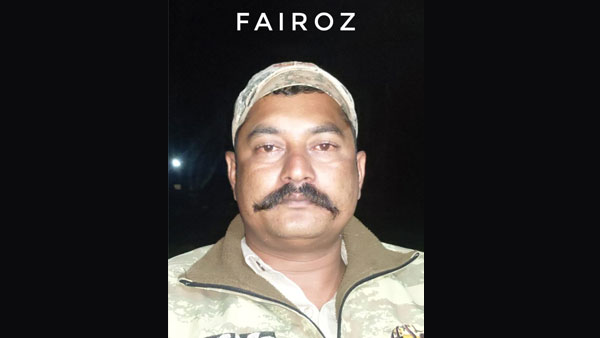
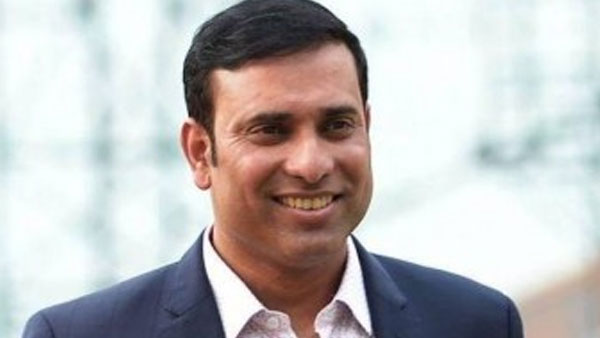
Forest watcher Fairoz has been nominated for the Wildlife Service Award 2022 by the Karnataka Forest Department. Fairoz, who is currently employed with the BRT tiger reserve, will be felicitated by former India cricketer and current National Cricket Academy director VVS Laxman on November 5 at the Global Academy of Technology campus, Rajarajeshwari Nagar Bangalore.
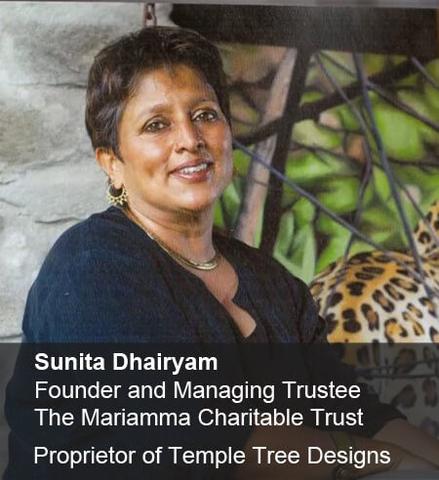
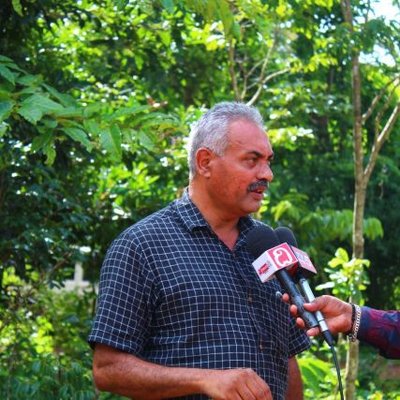
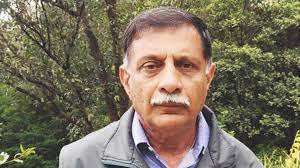
Three wildlife conservationists – Sunitha Dhairyam (Mariamma Trust, Bandipur Tiger Reserve), Akhilesh Chipli (Shimoga) and Colonel C M Muthanna (Kodagu) – will also be felicitated by VVS Laxman. Laxman is often remembered as the cricketer who in association with Rahul Dravid (180) had redefined Indian cricket in their epoch-making 376 run partnership against Australia at the Eden Gardens in 2001.
Fairoz will be the tenth forest watcher to be honoured with the prestigious Wildlife Service Award, constituted by Cricketers for Wildlife Conservation. Former Indian cricketers Sandeep Patil, Yusuf Pathan and Harbhajan Singh had conceptualised the award to motivate the unsung foot soldiers of our forest.
Fairoz will be presented with a cash award for his meritorious service to forest and wildlife protection. Besides daringly arresting 22 poachers, Fairoz has rescued 15 leopards and safely released them back in the forest.
pix: savetigersbandipur.org/founders-story/
Sunitha Dhairyam is a godsend for wildlife in Bandipur Tiger Cup. She is a guardian angel who protects tigers and leopards when they inadvertently make a cattle kill. To ensure farmers don’t poison the carcass, she pays on-the-spot compensation from her Mariamma Trust. Sunita Dhairyam has dedicated her life to wildlife conservation. She lives in the immediate vicinity of Bandipur tiger reserve.
pix: twitter.com/akhileshchipli
Akhilesh Chipli is a diehard wildlife activist from Sagar. He is the voice of the forest and its denizens in Shimoga district. Akhilesh Chipli has risked his life and fought tooth and nail to protect the flora and fauna of the Western Ghats. He has created awareness of the importance of biodiversity amongst people. In collaboration with Bangalore-based entrepreneur Suresh Kumar, he has successfully converted a barren 21-acre barren land into a verdant forest in Sagar.
pix: starofmysore.com
Colonel C P Muthanna has been at the forefront of environmental conservation of Kodagu district. He has dedicated his life for conservation for more than three decades. He has been able to bring the people of Kodagu together to stop large scale destructive projects in the Western Ghats.
Col. Muthanna has assisted the forest department in recovering 4000 acres of ecologically-sensitive forest landscape. He has been working closely with the Karnataka Forest Department and eco development committees on Human Elephant Conflict mitigation in Kodagu.
source: http://www.oneindia.com / One India / Home> News> Bengaluru / by Anuj Cariappa / pix credits under each pic / November 02nd, 2022
Ishana Ismail of Coimbatore, Tamil Nadu, used the money saved by her parents for her marriage for starting a boutique, three years ago. She was only 18 years old then. In a year, she had decided to switch over to making sanitary pads.
Today, Ishana commands a sanitary pad-making unit with nearly three dozen women tailors and has regular clients in her hometown and across India. She has also received business inquiries from the domestic and overseas markets.
With an investment of Rs 8 lakh, Ishana has made a name in the market with her brand ‘Ana Cloth Pads’. These cotton pads filled with terry towels are eco-friendly, leak-proof, and can be reused up to 25 times.
Ana Cloth Pads receives orders from companies and also delivers pads by courier to individuals across India.
Her father’s friend, Rajesh who works as a manager, also invested nearly Rs three lakh in the business. Ishana’s 19-year-old brother, Ijas finds time from his hotel job to help her.
Impressed by her healthy initiative, many colleges and universities in Tamil Nadu have invited Ishana to their campus for addressing the students about menstrual hygiene. She has also been honoured by the Rotary Inner Wheel Club, Coimbatore, and many NGOs.
Ishana Ismail
Ishana completed her Class XII from Krishnammal Girls Higher Secondary School, Coimbatore, and a course in Fashion Designing.
She has so far traveled to Karnataka, Kerela, and Tamil Nadu and yet has a global vision.
Keeping in mind the needs of her five full-time workers, Ishana also allows them to bring their children along to the unit. ” Most of the tailors carry the fabric home and only five tailors work from my premises. At present, we are facing a shortage of orders because people don’t want to reuse sanitary pads. At the same time, some people have suffered by using commercially produced sanitary pads and are now preferring to use eco-friendly pads. We are looking for bulk orders that will also support poor women, some of whom are semi-literate. We would like to give employment to 200 women.’’
After completing a course in Fashion Designing, Ishana was clear-sighted about her choice of career. Her conviction about what she wanted to do was so strong that she did not think twice before investing eight lakh saved by her parents for her marriage.
She succeeded in persuading her parents. Starting the business was not easy. She had hardly settled in when the pandemic threw normal life out of gear. Her father’s untimely death a year and a half back was a huge blow and the family had to face several financial hardships.
Ishana says that she started this boutique in 2019 with the blessings and support of her parents. When Ishana made up her mind to start her own business, the family had modest means. Her father was working as a labourer in a grinding company in Chinniyampalayam in Coimbatore and her mother was running a beauty parlour. However, Ishana was determined.
Initially, she tried selling bridal outfits and then switched over to sanitary pads. During the COVID 19 pandemic, Ishana also made facial masks. Her company recorded a net profit of Rs two lakh a month.
Ishana says that till Class XII she was using sanitary pads available in the market. “I was reluctant to use pads that could have been easily made at home because I was embarrassed about what my friends would think. I decided to use homemade pads as I fell sick. The pads available in the market also cause cancer.’’
Sanitary pads made by Ana cloth pads company
Ishana’s initiative is clearly in the public interest. Most of the sanitary napkins available in the market today are loaded with chemicals and are made using plastic, which can affect health after prolonged use. In addition, after each use, they need to be trashed because there is no recycling mechanism, and they end up clogging up landfills.
Every year, there are around 12.3 billion disposable sanitary napkins that need to be disposed of in India alone. According to the Menstrual Hygiene Alliance of India (MHAI), there are around 336 million menstruating women in the country, of whom 36 percent use disposable sanitary pads.
Initially, Ishana made sanitary napkins only for her use, but when she came to know that her friends are facing a similar problem with the use of regular sanitary pads, she began making more napkins and asked them to try the homemade pads.
Ishana said, “ I am doing this for the people of India. Every girl is facing problems because of regular sanitary napkins made of plastic. They cause health problems like rashes. According to Ishana, the pad can be soaked in turmeric powder after washing and has to be dried in the sun. Before using them the following month, I recommend placing a wet cloth over the pads and ironing it for at least two days before using them for added comfort,” she said.
She added, “Many women suffer from various health problems related to periods. This is mainly due to the synthetic fabrics used in disposable sanitary napkins. These napkins are disposable but not biodegradable.. So, I was thinking of an alternative solution to this. The result is reusable napkins.”
Ishana says, “If the pads are properly exposed to the sun, then washing and re-using will not harm our health. This pad is very easy to handle and can be washed in normal water. It should be soaked in water for 30 minutes before washing. It should be dried first in the shade and then once in the sun. It should be ironed for two days before use next time.”
She wants to educate more people about how to make sanitary pads from cotton cloth.
Ishana is also being approached by traders from Hyderabad and Kerala for pads. On her plans, Ishana said, “In the future, I would like to make pads for bedridden people and also baby diapers”.
Ishana is keen to tap CSR opportunities which will help her unit create more work for her 25 full-time tailors and five tailors.
(The Author is Research Scholar at JMI and President of MSO of India. Additional inputs by ATV)
source: http://www.awazthevoice.in / Awaz The Voice / Home> India / by Mohd Modassir Ashrafi / November 03rd, 2022
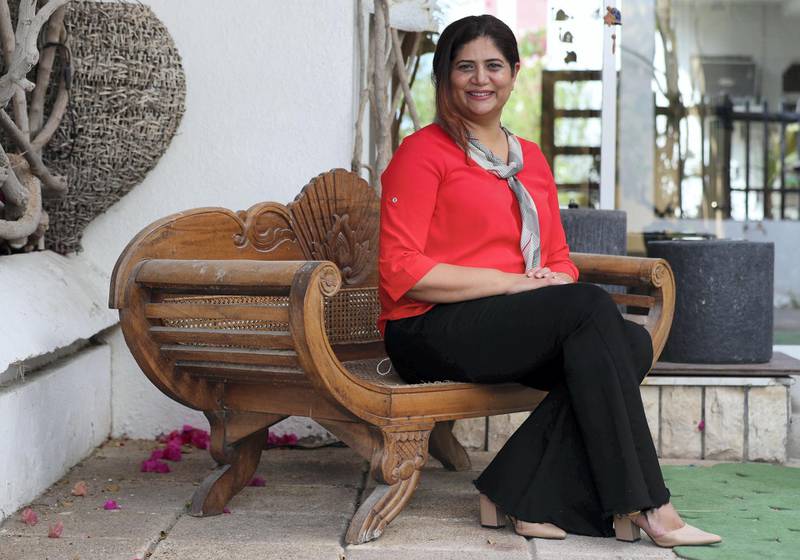
Mahnaz Faquih teams up with local charities to distribute food parcels at worker accommodation in Al Quoz.
Mahnaz Faquih has helped donate tens of thousands of iftar boxes to the needy in the past 20 years in Dubai. Chris Whiteoak / The National
Dubai resident Mahnaz Faquih, 51, feeds 500 needy people every day during Ramadan.
She started when she moved to Dubai from India in 2002, distributing food during Ramadan to those around her, including the security guard in her building.
In 2018, thanks to the help of her friends and community members, she delivered 500 iftar boxes a day to workers and unemployed people during the holy month.
That trend has continued every year since.
This year, because of Covid-19 restrictions on sharing and distributing food, Ms Faquih joined up with local charities to distribute food parcels at worker accommodation in Al Quoz.
In 2020, she worked with Sahana, a Sri Lankan Welfare Association in the UAE, to help provide meals to those who lost their jobs during the pandemic.
“I moved to the UAE from India where I lived in a joint family of 10 people and there was a lot of Ramadan fervour,” Ms Faquih said.
“For me, Ramadan meant being involved in charity.
“My parents always encouraged me to help others and I wanted to keep that tradition alive.
“I started sending iftar boxes of fruit, laban or juice to my local mosque,” she said.
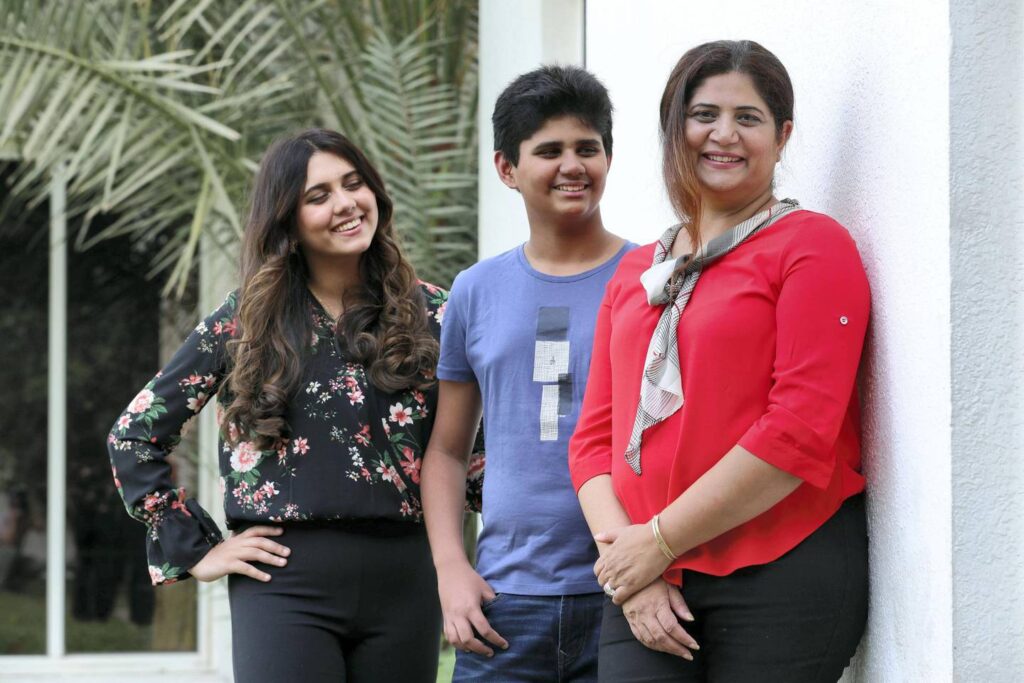
Mahnaz Faquih with her daughter Alina and son Mikhail. Chris Whiteoak / The National
Ms Faquih, an interior designer, said she ensured her children understood the importance of giving while realising their own privilege.
“The initiative has grown so big. It started with a wish to treat others to some good food or a box of biryani,” Ms Faquih said.
“Before the pandemic, I asked my children to give away the food packets so that it touched their hearts.
“I wanted them to have the consciousness that others are needy and they are privileged.
“My parents always gave away money or gifts through us, and I wanted my children to think about others.”
Her daughter, Alina Shaikh, 16, has been helping her mother since she was six and her son, Mikhail Shaikh, 12, also helps to distribute boxes.
“When we were little, we used to bring food and juices to workers every single day during Ramadan,” Alina said.
“We feel happy and grateful that we are lucky enough to help others.
“It’s such an amazing and rewarding feeling.
“It’s allowed us to understand how others live and empathise with them. It has helped us become humble and open-minded to people from different walks of life,” she said.
Mikhail also enjoyed being able to help others.
“In the past, we helped in packing the food boxes, but most of the time we handed out the iftar meals to people,” he said.
“We think that giving back is extremely important and when you have the ability to help others, why not do it?”
Ms Faquih said her friends supported her, too.
Shanu Hathiramani, an Indian from Nigeria living in Dubai, has known Ms Faquih for the past eight years and often helps her with her charitable work.
“Mahnaz is a very giving and helpful person,” Ms Hathiramani said.
“In the past, we have helped feed people during Ramadan. My son also helped out with the charity work.”
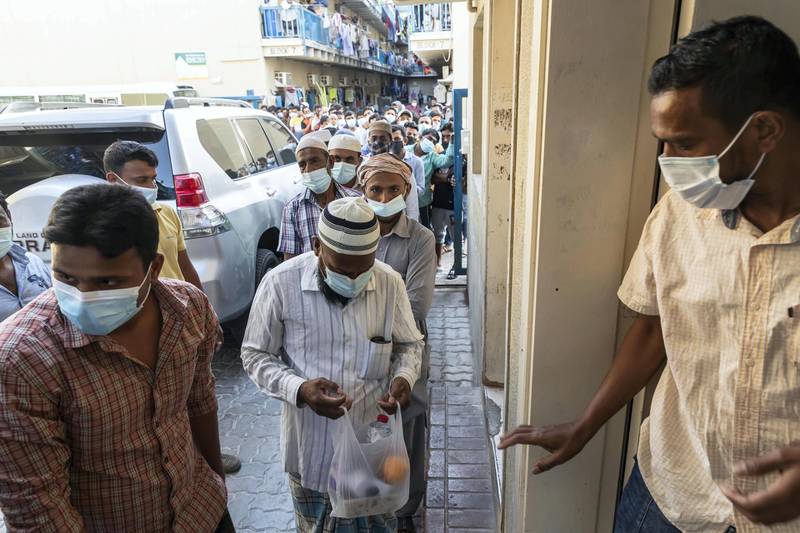
Iftar boxes being distributed at a workers’ accommodation – in picture
Sri Lankan community volunteers hand out meals for 300 people at a labour accommodation block in Sonapur, Dubai. All pictures by Antonie Robertson / The National
source: http://www.thenationalnews.com / The National / Home> UAE / by Anam Rizvi / May 07th, 2021




.webp)