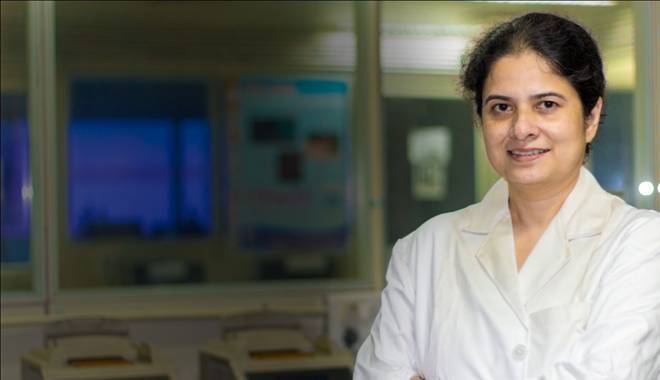
Her research group’s interest in the malaria parasite is driven by the desire to understand (a) the molecular workings and functions of the relict plastid (apicoplast) of Plasmodium, (b) mechanisms of protein translation employed by Plasmodium organelles and (c) human genetic factors and susceptibility to severe P. falciparum malaria in endemic and non-endemic regions of India.
Dr. Saman Habib, Chief Scientist and Professor (AcSIR) in Molecular Biology Division, CSIR-CDRI, Lucknow brought the laurels to the Institute again through her outstanding work for understanding the malaria parasite.
She is elected as fellow of Indian National Science Academy, New Delhi.
Her research group’s interest in the malaria parasite is driven by the desire to understand (a) the molecular workings and functions of the relict plastid (apicoplast) of Plasmodium, (b) mechanisms of protein translation employed by Plasmodium organelles and (c) human genetic factors and susceptibility to severe P. falciparum malaria in endemic and non-endemic regions of India.
Other important honours and awards in her credit:
Fellow of Indian Academy of Sciences, Bangalore (2016)
Fellow of The National Academy of Sciences India, Allahabad (2015)
National Women Bio-scientist Award, Department of Biotechnology, Govt. of India (2012)
Prof. BK Bachhawat Memorial Lecture Award, National Academy of Sciences, India (2008)
CSIR Young Scientist Award, CSIR (2001)
source: http://www.smestreet.com / SME Street / Home> News> Covid-19 / by SME Street Edit Desk / October 22nd, 2020
As many as 25,188 candidates had appeared in the preliminary exams in September 2018
New Delhi:
Twenty-four-year-old Gazi Abdullah of Gundana, a village at 9,000 feet above sea level in the mountainous Doda district, is one among the 70 youths who have been declared qualified for the Union Territory’s most prestigious Civil Services by the Jammu and Kashmir Public Service Commission (JKPSC).
These are the first results after the Commission was reconstituted as a legal requirement under the J&K Reorganisation Act of August 2019.
In the Combined Competitive Examination held in 2018-20, these 70 youth have qualified for recruitment on the equal number of vacancies in the Jammu and Kashmir Administrative Service (KAS), the Jammu and Kashmir Police (Gazetted) Service and the Jammu and Kashmir Accounts (gazetted) Service.
Those found fit in a medical test will be appointed in the three major services.
As many as 25,188 candidates had appeared in the preliminary exams in September 2018. On August 25, 2020, the UT’s reconstituted Commission ratified and confirmed the quondam PSC’s decision and held the viva voce of the 194 candidates who appeared in the test in September 2020. Finally the selection of 70 candidates was notified on September 29.
Son of an anganwadi worker
Gazi’s mother is an anganwadi helper working with the Centre-sponsored Integrated Child Development Scheme (ICDS) for a monthly honorarium of Rs 3,000. She has never shared with her only child how her husband had died when he was just two-year-old in 1998.
How did Gazi’s father die? “I don’t know. I have never asked my mother,” he told Indianarrative.com in a conversation.
After receiving elementary education upto the fourth standard at his village’s Rafeeq Memorial Academy, his mother managed Gazi’s admission in an orphanage at Bemina in Srinagar.
From a downtrodden family with no support
He stayed at the orphanage’s boarding and lodging facility for seven years and passed his 11th standard exam before completing his 10+2 from Srinagar’s Iqbal Memorial Institute.
Thereafter, Gazi returned to his home across the Pir Panjal mountains and completed BSc from Government Degree College, Doda. His elementary schooling happened in the period of the peak of militancy in Jammu’s Chenab valley.
“I knew that I was from a downtrodden family with no support. So there was no compromise on seriousness, perseverance and focus on the studies. I used to read interviews of the IAS and other UPSC exam toppers which gave me inspiration and confidence to crack the JKPSC exam.
“I learned how to convert challenges into opportunities with full self-confidence and dedication. Finally it paid me off and I have made it to the civil services,” Gazi said.
First sparks of success
He revealed that the first sparks of success through competition came from the lectures some visiting officers and bureaucrats delivered at the orphanage from time to time.
Unlike most of the successful candidates of his batch, Gazi has not received any coaching for the JKPSC exam.
“After BSc, I completed MSc in Botany from the Aligarh Muslim University (AMU) where I devoted maximum time to my preps for the KAS exam. I am expecting the PG results from the AMU in a few days,” said Gazi, figuring at rank 46 in the JKAS final list.
Hailing from a backward area, he has fourth rank in the RBA category.
“I am lucky enough to be one of the youngest in my batch,” he said. With the age on his side, he would rise to the rank of a Principal Secretary in his 36 years of service in the UT.
Civil Services is popular among Kashmiris
The batch’s topper Malik Kamila Mushtaq of Karan Nagar, Srinagar, is B Tech in Civil Engineering from the National Institute of Technology (NIT), Srinagar. Her father is a retired government employee and her mother is still in the public service. She picked anthropology as her optional subject and cracked the JKPSC exam in her first attempt.
“I had coaching for just one month in the beginning but later I relied on self-studies. My mother is the only source of inspiration for my dreams of higher civil service. She is an embodiment of courage and dedication and commitment from day one. I have inherited many of her values and attributes,” Kamila asserted.
Kamila’s younger sister has completed M Tech in electrical engineering from NIT Srinagar and her younger brother is currently in the counselling process for B Tech.
How did she trust the system in the wake of allegations of irregularities against the JKPSC which had to once cancel its declared results for the JKAS Preliminary? How was she confident that she would make it to the JKAS?
“Cynicism and scepticism are cureless diseases. Once you enter a competition, you must have full faith in the system. I am not aware of the past practices but I had full faith in the system which I found completely transparent and flawless,” Kamila said.
The number of the aspirants for IAS, IPS, IFS and the UT’s JKAS, JKPS and other gazetted service examinations has remarkably increased after Shah Faesal of Kupwara was declared as the IAS topper by the UPSC in 2010.
Even as few candidates qualified for the All-India services from J&K in the first 20 years of militancy, over 60 youths have cracked the country’s most competitive and prestigious civil services exam in the last 10 years. Hundreds of others have entered the civil administrative services, Police and Accounts service through the JKPSC exam during the same period.
The UT’s youngsters have shown remarkable enthusiasm in all the all-India competitive exams as thousands of them have appeared in 2020 not only in the National Eligibility Entrance Test for medical and engineering colleges and institutes but also for the tests of National Defence Academy which picks recruits for commissioned ranks in Army, Navy and Air Force.
(This content is being carried under an arrangement with indianarrative.com)
source: http://www.ummid.com / Ummid.com / Home> India> Education & Careers / by Ahmed Ali Fayyaz, IANS / October 03rd, 2020
A snapshot from Tinge by Sabrina Suhail’s range | Photo Credit: Special Arrangement
Sabrina Suhail on creating a homegrown and toxic-free make-up brand suited for Indian skin
If Covid-19 has changed one thing in our perception, it is that everything we consume — from food to cosmetics — impacts our overall health. Tinge by Sabrina Suhail is a testament to this. After launching in July 2018, the brand gained popularity for its clean, customised lipsticks and foundation. It may seem that the make-up line garnered much attention in a short span, but Bengaluru-based Suhail has spent several years in preparation.
“I was never a person who knew anything about beauty; I studied chemistry, botany, zoology and psychology in college,” she says. After a second degree in fine arts, she worked as a make-up artist for 10 years, and took a course each year to learn more. “At one point, my clientèle got conscious about toxins in products and gave me a list of ingredients to avoid.” As she started reading labels — which were easy to decipher because of her chemistry background — she realised that she could create the products herself. Suhail then enrolled for a two-year diploma in colour cosmetics and formulation in New York, and took another four years to set up a studio and get certifications in place.
Sabrina Suhail | Photo Credit: Special Arrangement
Recreating beauty
“I decided to start with only lipsticks because it was the easiest, and something Indian women gravitate towards,” she says. First, it was just word-of-mouth as she didn’t want to invest in marketing. Even though there was an influx in the initial months, her clientele slowly started petering out. “But after December last year I’ve seen a massive change. People come to me with lipsticks they want me to recreate with safer formulation and aroma.”
I have tried Suhail’s bespoke lipsticks, foundation and powder (all gifted by her), so I understand why her products work. With just a couple of Instagram messages, she understood the exact creamy caramel colour I wanted in my lipstick. And without meeting me even once, she delivered the correct shade of concealer and powder to match my skin tone.
________________
Green check
As per American cosmetic biggie Aveda’s website, the brand that has been 100% vegan as of July 2019 is planning to have all vegan products on shelves by January 1, 2021. aveda.com
Closer home, celebrity make-up artist Bianca Louzado’s CODE Beauty is now offering everything from cosmetic sanitisers and brush-and-sponge cleansing balms to anti-bacterial cosmetic sanitising wipes and sprays. codebeauty.in
Another new launch to keep an eye out for is aša beauty. The clean beauty brand’s first drop includes an easy-blend concealer, corrector, crème and matte lipsticks, lip and cheek tints, and mascara. @asabeautyindia on Instagram
_______________
Checks and balances
I was curious to understand if she had avoided talc, classified as possibly carcinogenic, but a common ingredient in some organic make-up brands. Thankfully, she does. Her formulations are based on clay, “which may not have the same slip as talc but is definitely safer and more pigmented”. All of Suhail’s raw materials are from India and everything is certified. “When I started the company, it was important for me to have my licensing.” She has the MSDS (Materials Safety Data Sheet), SDS (Safety Data Sheet) and PETA cruelty-free certificate. The second part is when she puts the raw material together and gets the Bureau Veritas certification, world leaders in inspection and testing.
“If I make a lipstick for you, it has to go through many checks before it comes to you,” says Suhail, who also got the CDSCO (Central Drugs Standard Control Organisation) certification that approves of the manufacturing license, machinery, manufacturing facility, and contents used in the physical product. “Even though I don’t have that kind of space or machinery, I got the certification because it ensures that your products are made safely.”
___________
Scent of a lipstick
I personally do not have a problem with fragrance in colour cosmetics. In fact, the scent of lipstick is the reason I fell in love with make-up. Chanel Misia is my favourite perfume because it smells like powder and lipstick. Besides, the fragrances used in Suhail’s lipsticks are FDA approved and have no traces of phthalates, which are known endocrine disruptors.
_________
Get online
While Suhail still customises colours for lips and the base, she also has a line that can be readily bought online. Tinge by Sabrina Suhail offers eye pencils, multi-sticks, balms, scrubs, wax and liquid lipsticks, plus powder foundations for Indian skin tones that range from medium to milk chocolate. The full ingredient list is mentioned on tingestore.com, and she has a ‘Return to Refill’ policy where you can send an empty tube to be refilled with a 15% off on the lipstick.
In the current beauty landscape, where new brands are launched in a short amount of time without former training, a long prep period, attention to detail and certification are rare. This brand is homegrown, clean, cruelty-free, customised, luxurious and eco-conscious. What more do we want?
source: http://www.thehindu.com / The Hindu / Home> Life & Style / by Vasudha Rai / October 30th, 2020
Irfana Zargar was settling in after a long day at work when she received a desperate call from a woman asking for sanitary napkins. Despite the lockdown, Irfana set off to deliver the napkins in person. In a dilapidated house in the downtown locality of Srinagar, she met Sabia Khan who was in a wheelchair. Sabia was the one who had made the call. Due to the restrictions imposed by the coronavirus lockdown, Sabia was unable to buy essentials for herself.
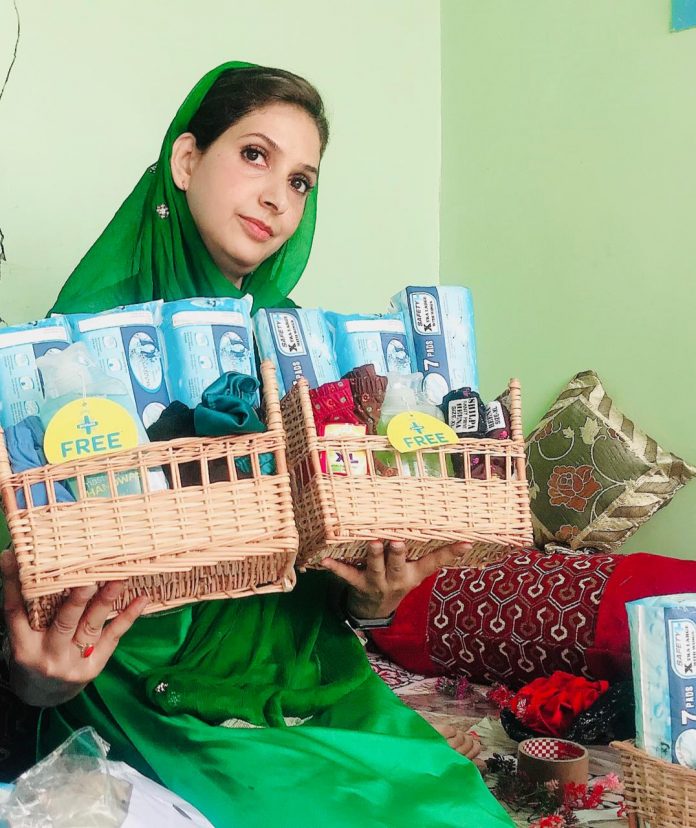
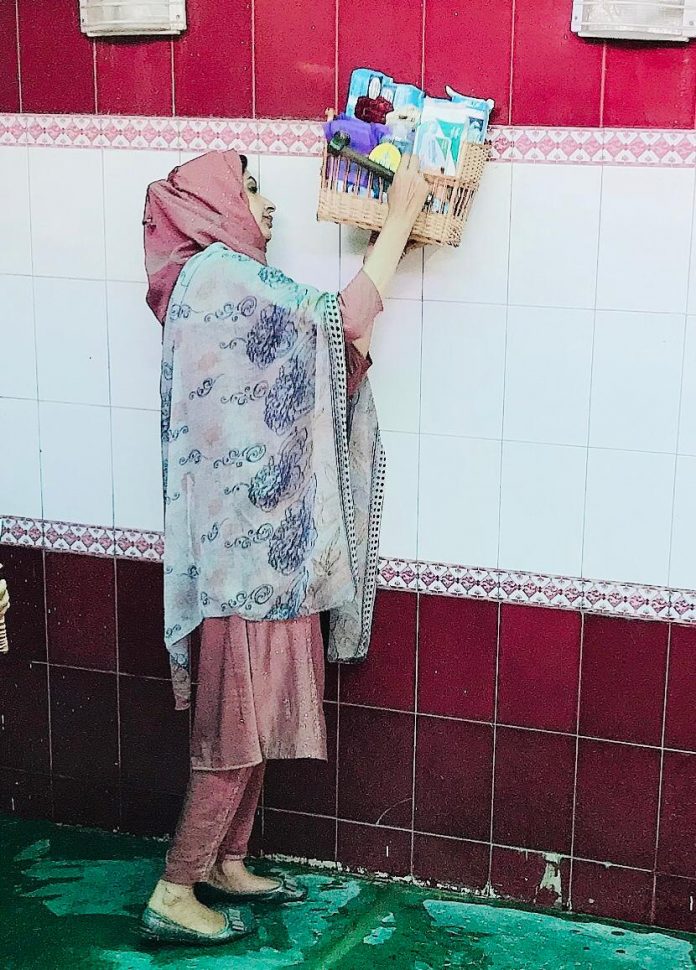
Five years ago, Irfana – who stocks public toilets in Kashmir with sanitary napkins, took an initiative to help Kashmiri women meet feminine hygiene needs. She would prepare an ‘Eva Safety Door’ kit consisting of sanitary napkins, underwear and handwash, for women who cannot afford to buy them. All the arrangements are done from Irfana’s personal savings although, she says, a lot of people are now coming forward to help her.
“Menstruation is a natural phenomenon and I don’t understand why people shy away from talking about it. Some women do not buy pads because they feel ashamed. I want to change this. We have been asked to stay silent all our lives, enough is enough,” says 28-year-old Irfana who works as a Helpline Assistant in Srinagar Municipal Corporation on a consolidated-basis.
Providing kits to women in Covid wards
Irfana came across the case of a woman being treated for coronavirus in a hospital in Kashmir. Due to unavailability of sanitary napkins, the woman was forced to wear a cloth pad cut out of a curtain during her menstrual cycles. Shocked by the incident, Irfana prepared several kits and distributed them in different wards of the hospital.
On the onset of coronavirus lockdown, Irfana received hundreds of calls from women asking for kits as they could not buy pads from the local stores. As people were hoarding up essentials in the initial days of lockdown, a shortage of menstrual products was reported from all over the country. Apparently, it was not looked upon as an essential commodity. When a countrywide lockdown was imposed in India, pads did not make it to the list of essentials, the delivery of which was allowed despite restrictions. Only when the grocery stores and chemist shops ran out of supplies did the government deemed it a necessity.
“I was very anxious at that time. Not everyone can afford to hoard. Also, hospitals should take special care of stocking sanitary napkins. Pandemic or not, periods do not stop,” says Irfana.
According to Irfana, she delivered 19000 sanitary napkins and 16 Eva Safety Door kits during the lockdown. Even then, she could not reach many women due to restrictions on movement. After meeting them in person, Irfana would make sure that they received sanitary napkins every month.
“It was a complete mess. There were days when I could not help these women and it was starting to take a toll on my mental health. This was when I realized that buying sanitary napkins is a privilege a lot of us cannot afford,” says Irfana.
Unaffordable for people with lower incomes
17-year-old Zainab (name changed) lives in a one-storey house in Srinagar with her parents. Her father, a daily wager, experienced financial constraints as his income was seriously affected during the lockdown. Trying to make ends meet, her family struggled to survive the pandemic. Zainab could not muster the courage to ask her parents for money to buy pads.
“One packet of sanitary napkins costs around 40 rupees and you at least require two or three packs a month. For some people, it might be a small cost but for us, it meant a day’s meal. I had no option but to use cloth and cotton,” says Zainab.
Irfana says that under the Pradhan Mantri Bhartiya Janaushdhi Pariyojna (PMBJP), sanitary pads were being sold for Rs 1 per pad at Janaushadhi Kendras. Despite this many women are still unable to make use of such schemes due to lack of awareness.
Zainab is thankful that her father managed to find work after the lockdown. Some of her friends are still facing hardships and continue to use cloth. According to a report of BBC, only 15% of girls had access to sanitary napkins during the lockdown.
“When it comes to food or menstrual products, the obvious choice would be food. But I am happy that I am able to buy pads again,” says Zainab.
Period shaming and Menstrual health
Irfana’s journey started in 2014 when she was walking the streets in one of the busiest places in Srinagar. She got her period and was unable to buy a napkin due to lack of money. Going inside a public washroom, she was appalled to see its condition.
“There was no soap and water. I had no option but to travel like this. Period shaming is so common here and in case you have a stain, you will be landed with insults,” recalls Irfana.
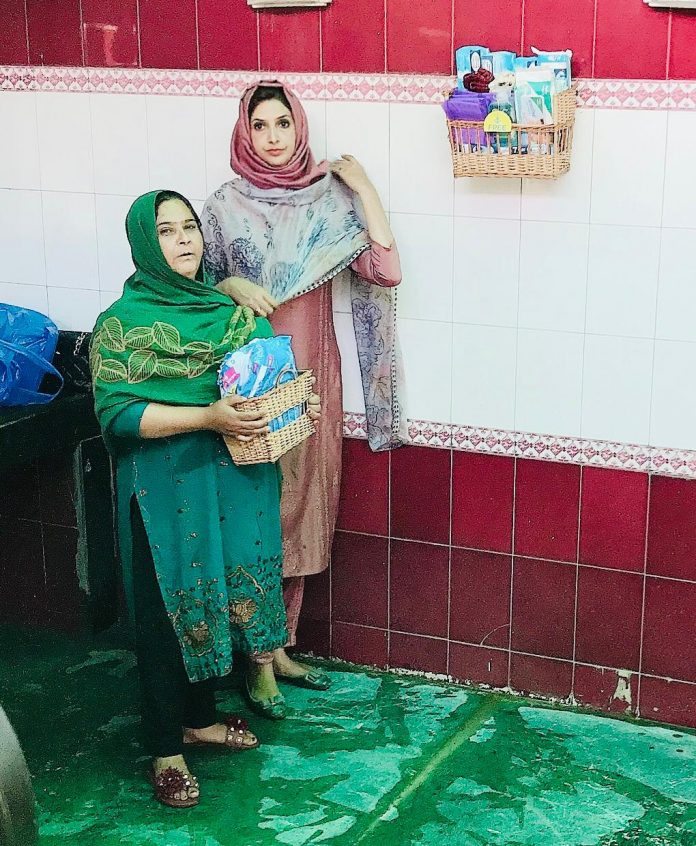
Since that day, Irfana made sure to donate sanitary napkins to public washrooms. Till date, she stocks around 15 washrooms in Srinagar district. After losing her father, Irfana wanted to make him proud by helping people and so she ventured out to help women in need.
Talking to TwoCircles.net about the harmful effects of using dirty or unsterilized cloth during periods, Seema Zahra, a gynaecologist based in Kashmir says, “It can be very dangerous and can cause serious health issues. It can expose them to infections which can later turn out to be more sinister.”
Dr Seema says most of the patients that come for treatment related to this problem are from lower-income groups. Due to their financial state, they are forced to look for alternatives like rags and cloths.
Even though Irfana has not received her salary for months now, she is adamant about working for the cause of women. She says these women look up to her and she cannot abandon them in these tough times.
“I have prepared more kits and I will be distributing them soon. It is important to spread awareness about menstrual hygiene and I will keep doing so no matter what,” says Irfana.
source: http://www.twocircles.net / TwoCircles.net / Home> Indian Muslim> Jammu & Kashmir> Lead Story> TCN Positive> Women / by Asma Hafiz, Twocircles.net / October 30th, 2020
Over 2,000 students from across the country are expected to benefit
Shaheen Group of Institutions has come forward to provide scholarships to long-term National Eligibility-cum-Entrance Test (NEET) repeaters for the 2020-21 academic year. Over 2,000 students from across the country are expected to benefit from the scholarships.
The institute has set aside ₹5 crore for the purpose. Selected candidates will be given free coaching.
NEET is the gateway examination for students who wish to study medical (MBBS) and dental courses (BDS) in government or private colleges.
Interested candidates can visit the institute’s website and register on or before November 1. Candidates can also call the toll-free number 18001216235 for more information.
Abdul Qadeer, chairman, Shaheen Education Foundation, said that they have over 42 NEET coaching franchises across the country.
“We will identify students from economically deprived families who are academically brilliant and who aspire to become doctors. Such students will be sponsored, mentored, trained and motivated to achieve their aspiration of becoming doctors,” he said.
He added that Kannada-medium students will be given preference in Karnataka. Candidates will be awarded the scholarship based on marks obtained in NEET 2020. He said that students who have lost their parents due to COVID-19 will be provided free training for NEET.
Karthik Reddy and Arbaaz Ahmed, students of the institute, secured the first and third rank in the State in this year’s NEET examination.
Karthik Reddy and Arbaaz Ahmed, students of the institute, secured the first and third rank in the State in this year’s NEET examination.
source: http://www.thehindu.com / The Hindu / Home> Cities> Bengaluru / by Staff Reporter / October 30th, 2020
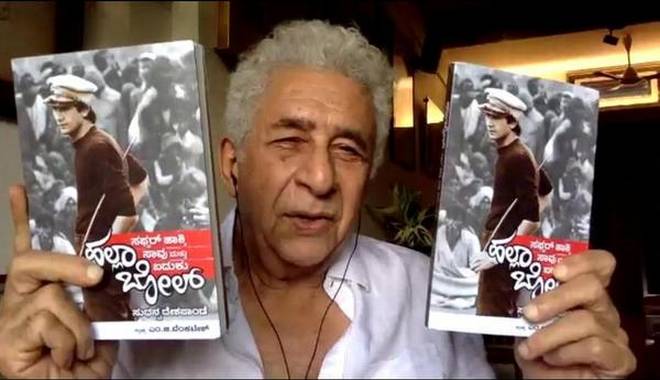
Actor Naseeruddin Shah releasing the book Halla Bol: Safdar Hashmi Savu Mattu Baduku. | Photo Credit: Handout E Mail
Actors and authors call for solidarity with activist and intellectuals
Veteran actor Naseeruddin Shah called for people to fight for their right to democratic dissent, which, he said, is increasingly being interpreted as sedition at a time when history is being replaced by mythology. He was speaking at the virtual release of Halla Bol: Safdar Hashmi Savu Mattu Baduku, a Kannada translation of Sudhanva Deshpande’s book on the playwright and director Safdar Hashmi. The book has been translated to Kannada by M.G. Venkatesh.
Safdar Hashmi was fatally injured in an attack on the theatre group when Halla Bol, a street play on exploitation and rights of factory workers, was being performed near Delhi in January 1989.
At the book launch, Mr. Shah said that the life, achievements and murder of Safdar Hashmi was a testimony as to why fascist powers and forces were so terrified about the lives of activists and intellectuals, who are being hounded in the country today. “It is high time we stand in solidarity with jailed activists and intellectuals like Varavara Rao and Anand Teltumbde,” he said.
“When I read the English and Hindi versions of Halla Bol, I was informed, amused, raged, disturbed and moved. He [Safdar Hashmi] took plays to factories, schools and streets, and informed people about their exploitation and rights. It is from his life I realised that even an actor’s life can be of use and impactful,” he added.
M.G. Venkatesh, translator of the book, said that the thoughts and writings of Safdar Hashmi are more relevant now than at the time he was killed. “The current regime is diluting labour laws, not only in a dangerous way but also in a way that insults labourers,” he added.
Author Sudhanva Deshpande spoke about the assassination of editor-activist Gauri Lankesh. “The killing of Hashmi stirred the need for the defence of freedom of art and expression,” he said.
Actor Achyuth Kumar said that the times had not changed much. “Hashmi was killed when the Congress was in power, and Gauri Lankesh was killed by the fundamental right wing. This is the way ruling dispensations suppress the voices of people. They just kill them,” he said.
Writer Bolwar Mahammad Kunhi said that we are fighting two types of viruses now. “It is said that a vaccine for COVID-19 will be available in the future. But who will and how can a vaccine be invented for those who suppress dissent, spread hatred and eulogise killings and violence?”
source: http://www.thehindu.com / The Hindu / Home> News> Cities> Bengaluru / by Staff Reporter / October 31st, 2020
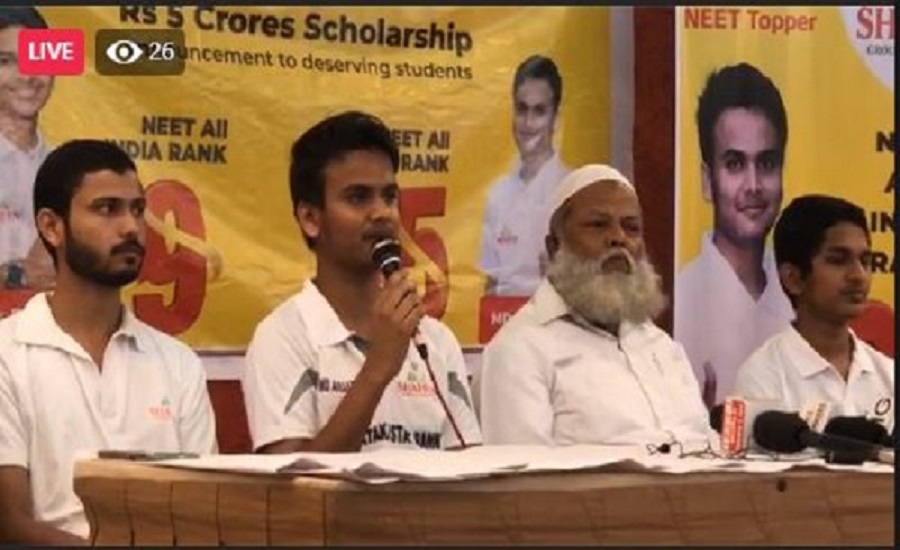
Dr Abdul Qadeer (3rd from left) with his NEET topper students at Press Club of India, New Delhi on October 28, 2020.
“Children of those parents who have died due to Coronavirus will get 100% free scholarship. And others will get scholarship up to 100% depending on their economic condition,” Shaheen Group’s chairman said.
Mumtaz Alam
New Delhi :
In extraordinary performance by any institution in India’s toughest medical entrance examination, 1640 students of Shaheen Group of Institutions have qualified NEET-2020 and more than 400 of them are expected to get free government medical seats.
Addressing a press conference in Bengaluru on Wednesday along with his two top rankers – Karthik Reddy who got Karnataka State Rank 1st and All India NEET Rank 9th, and Arbaaz Ahmed who got Karnataka State Rank 3rd and All India Rank 85th – Shaheen Group’s chairman Dr Abdul Qadeer announced to give scholarships worth Rs 5 crore to meritorious poor students who could not get good rank in NEET and want to reappear in it.
“Due to Coronavirus pandemic and floods in some parts of Karnataka and Andhra Pradesh, the economic condition of people is very bad. To help those students who want to become doctor and want to prepare for NEET, we announce Rs 5 crore scholarships on behalf of Shaheen Group of Institutions at all our branches in the country. This scholarship will be given on the basis of marks obtained in the NEET,” announced Dr Qadeer.
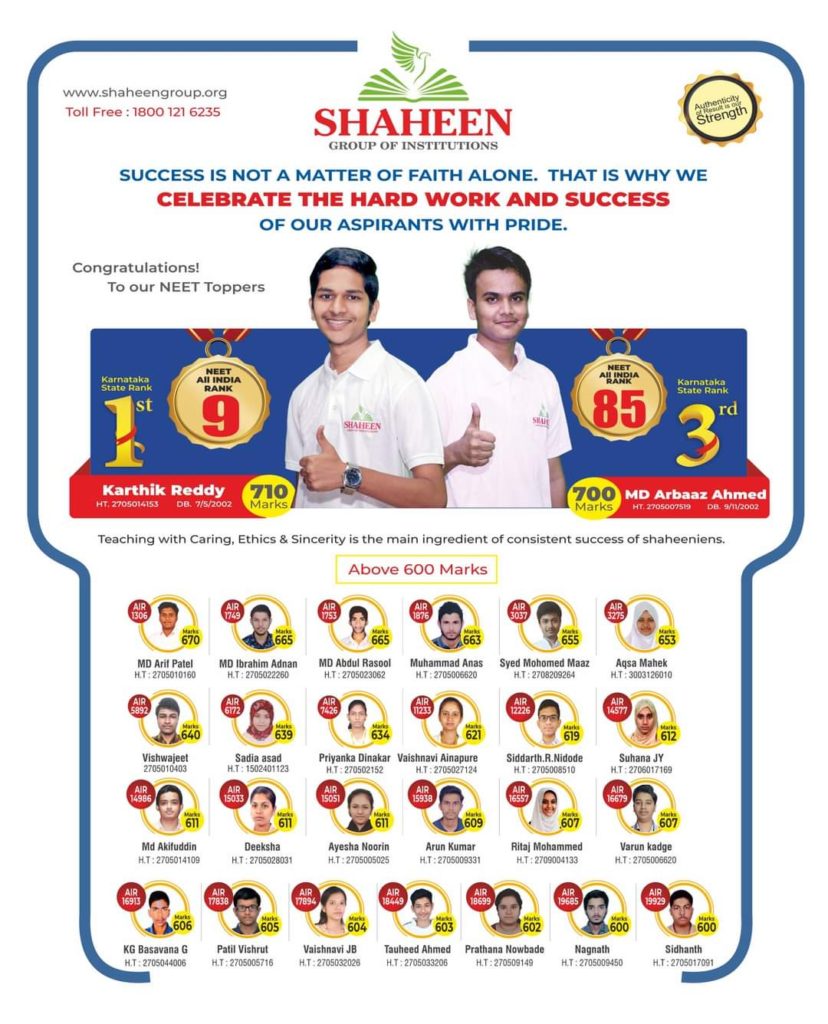
Along with Karthik and Arbaaz, 1640 students from Shaheen institution have got above 400 marks out of 720 in NEET-2020. While Karthik Reddy got 710 marks, Arbaaz Ahmed scored 700 marks. 8 students got above 650 marks, 27 students above 600 marks, 192 students above 500 marks, 347 students above 450 marks and 525 students above 400 marks.
Our NEET-2020 toppers in a single frame. Two students Karthik Reddy & Arbaaz Ahmed scored 710 and 700 Marks respectively. 8 students above 650 Marks, 27 students above 600 Marks 192 students above 500 Marks 347 students above 450 Marks 525 students above 400 Marks.
________________________________________
Explaining about its announcement of Rs. 5 Crore Scholarship, Shaheen Group said: “The world is facing a global health crisis. While the Coronavirus has affected our social life and daily activities, Students have become increasingly worried about the impact of the coronavirus on their finances and studies. Shaheen Group of Institutions, Bidar, Karnataka has made a strong resolution to aid such students who are deprived of studies due to financial crisis in the pandemic.”
Earlier talking to this scribe over phone on Sunday, Dr Qadeer had said scholarships will be available at all 42 centres across the country.
“Due to Coronavirus, a large number of students could not study well this year as their financial condition was bad. On economic ground, we would provide free scholarship to students particularly those from UP, Bihar and Delhi,” said Dr. Qadeer.
“Children of those parents who have died due to Coronavirus will get 100% free scholarship. And others will get scholarship up to 100% depending on their economic condition,” he clarified.
“Our announcement is for students from across the country, including Delhi, UP, Bihar, Madhya Pradesh. We have 40 branches across the country. This facility will be available at every branch,” said Dr Qadeer.
The 100% scholarship will be available to those students (irrespective of their economic condition) who have lost one or both parents to the Coronavirus disease.
“The only criteria is that he/she must have appeared in NEET and has reasonable marks,” said Dr Qadeer.
More than 2,000 students are expected to benefit from the Shaheen scholarships.
source: http://www.clarionindia.net / Clarion / Home> Editor’s Pick> India / by Mumtaz Alam / October 28th, 2020
Yusufpur- Mohammadabad (Ghazipur) , UTTAR PRADESH / NEW DELHI :
As Jamia celebrates 100 years of its foundation, we extend our gratitude to Dr Mukhtar Ansari for his contribution
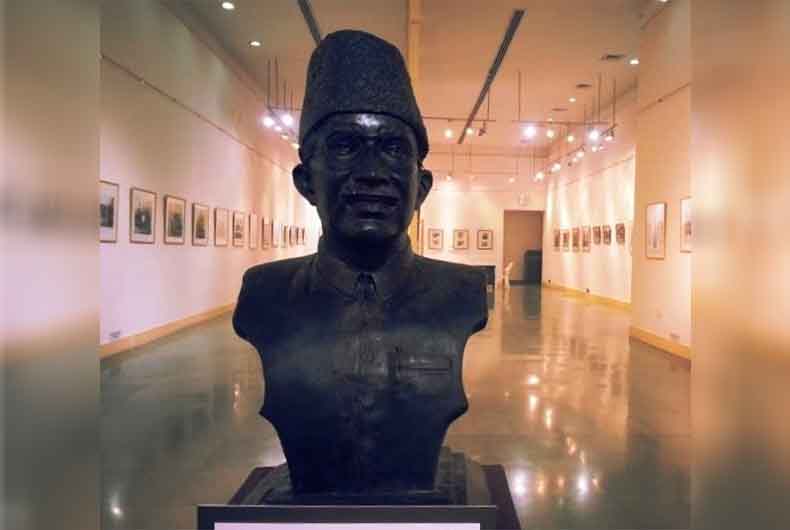
Dr M A Ansari’s bust during a photo-exhibition at M.F. Husain Art Gallery, JMI on 24 Dec. 2014. (Photo Courtesy: Aniket Dikshit)
The three most important persons who, undoubtedly, not only played the most significant role in the foundation of Jamia Millia Islamia, but also shifted it from the makeshift arrangement of Aligarh to Delhi’s Karol Bagh on 7 July, 1925, are Hakim Ajmal Khan, Abdul Majeed Khwaja and Dr Mukhtar Ahmad Ansari.
In view of upheavals faced in Aligarh, Jamia was shifted but problems existed. The problems that made many think that Jamia will not survive long. However, the trio’s efforts were no way trivial. They set the future course of Jamia as ‘an institution with a difference.’
Mukhtar Ahmad Ansari’s consistent efforts bore fruits. Not only did Jamia get its first house in Karol Bagh in 1931, it was also shifted to a much bigger plot of land of its own in 1936 in its present location in South Delhi’s Okhla, then a ‘non-descript village’ where now it has a panoramic sprawling campus.
However, the journey was not as simple as it might look to a casual viewer. Within those ten years, much sweat and blood went in to nurse the tender sapling whose seed was sown in Aligarh on 29 October, 1920. Dr Ansari’s contribution through all these years is one of the most unforgettable and astonishingly stout chapters in the history of Jamia Millia Islamia.
Born on 25 December, 1880 in Yusufpur-Mohammadabad, Ghazipur in eastern Uttar Pradesh, son of Haji Abdur Rahman and Ilahan Bibi, Mukhtar Ahmad Ansari, received primary and secondary education at Ghazipur and Allahabad, then studied medicine and graduated from Madras Medical College. He went to England from where he achieved M.D. and M.S. degrees. He earned the Master of Surgery degree from the University of Edinburgh in 1910. Being a top-class student and a pioneering surgeon he worked in some well-known hospitals of England where “he had a successful medical career”.
Dr Ansari had everything – money, fame, fortune, and life that could be lived luxuriously. This brief background is provided to underscore the significance of his passion, devotion and commitment not just for Jamia but for the country’s struggle for freedom as those were the years of heightened activism for independence during which Dr Ansari – through his active involvement in and unwavering support for freedom, emerged as a committed nationalist leader.
From England, Dr Ansari returned to India in 1910 and started medical practice at Delhi. His contact with leaders like Motilal Nehru, Hakim Ajmal Khan and Pandit Jawaharlal Nehru rekindled in him the desire to take part in the country’s political developments.
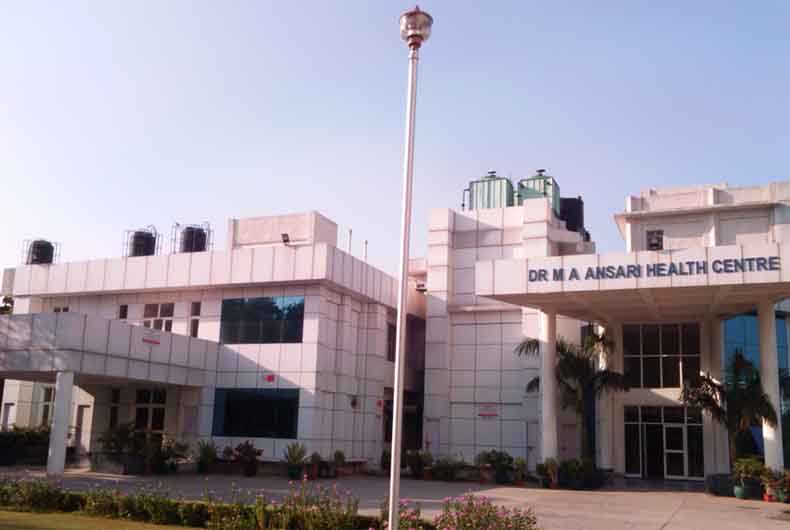
Dr M A Ansari Health Centre, Jamia Millia Islamia. (Photo: Manzar Imam)
During the Balkan Wars of 1912-13, he led a Medical Mission to Turkey to provide medical aid to the Turkish army. “The mission”, according to Dr. Burak Akçapar, Ambassador of the Republic of Turkey to India, “not only established two field hospitals, but also did other humanitarian and political work.”
This was among his first political works which won the hearts and minds of the Turkish public and leaders which created a deep bond between Turkey and Jamia. Many Turkish leaders and prominent literary figures visited Jamia. The series of ‘Extension Lectures’ that began was his brainchild. It was on his invitation that famous Turkish scholars Dr Husein Raouf Bey (1933) and Ms Halide Edib (1936) and Dr Behadjet Wahbi of Cairo (1934) then delivered their lectures at Jamia.
His role in the Khilafat Movement was pivotal and his presence both in the Congress and Muslim League was equally felt. His Delhi house ‘Darus-Salam’ was a meeting point for leading Congressmen. For many years he was General Secretary of Congress and remained a member of the Congress Working Committee all through his life.
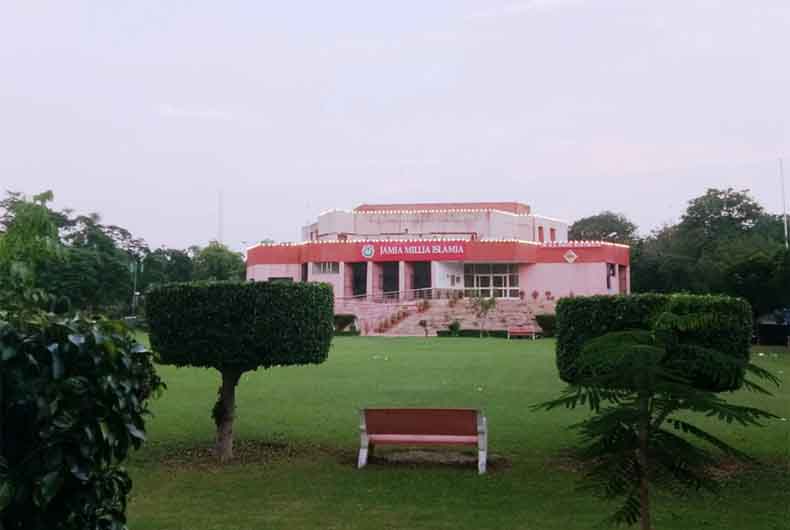
Dr M A Ansari Auditorium, Jamia Millia Islamia. (Photo: Manzar Imam)
Dr Ansari was the leader of the Khilafat delegation of 1920 which went to meet the Viceroy. He was also a member of the second delegation of Khilafat which went to England and other countries of Europe under the leadership of Maulana Mohammad Ali Jauhar. He was also president of the Delhi Khilafat Committee. During his presidential address at the Nagpur session of Muslim League in 1920 he demanded Swaraj.
When his name was proposed for the Secretary of the Foundation Committee of Jamia during its foundation, he requested not to appoint him for the post as it would require regular visits to Aligarh. Nevertheless, his interest in the activities of Jamia persisted.
Dr Ansari was among the front leaders of the Congress and was made its president in 1927. According to Prof Zafar Ahmad Nizami his name for the president of Congress was proposed at the instance of Mahatma Gandhi in 1924 who believed that “only he could make the efforts of Hindu-Muslim unity successful.”
Although Dr Ansari could not live long to see Jamia blossom into a beautiful university or see India breathing in freedom from the strangulating slavish life under the colonial rule, he had played his gigantic role both as a freedom seeker and as a founder of Jamia. He was a prominent member of the sixteen-member Foundation Committee formed on 29 October, 1920 to establish Jamia which would become a historic institution and the first one to be set up in response to call for boycott of the British Indian government-run, aided and supported academic institutions.
According to The British Medical Journal:
“As leader of the Congress movement, though at first opposed to the teaching of Gandhi on civil disobedience, he actively associated himself later with the various non-cooperative movements, and served at least one term of imprisonment.”
When it comes to Jamia as also to some other movements that were the currency of the 1920’s and 1930’s, it is very difficult to dissociate the trio of Hakim Ajmal Khan, Maulana Mohammad Ali Jauhar and Dr Mukhtar Ahmad Ansari, the “great Muslim trio of Indian politics”, as they were quite befittingly called so. However, each person has certain unique and individual personality traits and characteristics which separate him from others.
According to Dr Hamida Riaz (1988, p.119), Dr Ansari had a great passion for education. Initially, he highly appreciated Western education and culture and would keep himself completely away from what did not interest him. However, on the call of Mohammad Ali Jauhar, he participated in the medical delegation that went to Turkey and did a tremendous service. In a way, the beginning of international politics in India was made by Dr Ansari’s delegation.
Together with Hakim Ajmal Khan, Motilal Nehru and Maulana Azad, Dr Ansari formed a non-sectarian “Indian National Union.” He had opposed the Rowlatt Bill and participated in Home Rule and Non-Cooperation movements. In 1929, Dr Ansari formed the All India Muslim Nationalist Party. Besides Jamia, he was also associated with the foundation of Kashi Vidyapith, Benaras.
Faculty of Dentistry, Jamia Millia Islamia. (Photo: Manzar Imam)
Riaz (p.121) writes that all through his life he [Dr Ansari] “stayed away from sectarian groups” and continued his efforts to forge “Hindu-Muslim unity”. His wife Shamsun Nisa Begum too, was committed to the cause of women uplift.
Dr Ansari actively participated in the Jamia’s establishment, nurtured it, and, following the demise of Hakim Ajmal Khan in December 1927, served as its second Chancellor from 1928 to 1936. The financial needs that Hakim Sahab used to carry had fallen on his shoulder which he discharged diligently.
The “Ajmal Khan Fund”, set up exclusively for the purpose, was a result of his efforts. At a critical juncture when Jamia faced great financial crisis a Board of Trustees was created. Dr Ansari was appointed its chairman. It was at Gandhiji’s indication that industrialist Jamnalal Bajaj (1889-1942) was made its treasurer. Other bodies were also formed in which he was there.
As Chancellor of Jamia, Dr Ansari could not be an employee and Life Member of the ‘Anjuman Talim-e-Milli’. However, he extended all his support to all the bodies and continued to serve Jamia all his life. Remembering the services of Hakim Ajmal Khan and Dr Mukhtar Ahmad Ansari during a lecture in Jamia on 26 August 2014, former VC and renowned historian Prof Mushirul Hasan (d. 10 December 2018), terming the duo as the “real founders” of Jamia, had said, “Ansari raised money for Jamia and Hakim Ajmal Khan provided nobility and support.”
As mentioned earlier, Dr Ansari did not live long after Jamia was shifted to its present place in the national capital. He passed away on 10 May, 1936 and buried in the Jamia graveyard.
A radio speech which Dr Zakir Hussain had prepared for the 1936 Foundation Day of Jamia, which Dr Ansari could not hear as he passed away before it, sheds enough light both on the impact Dr Ansari had on Dr Zakir Husain and on his character and sphere of activity. It read:
[Dr Ansari] set out for a journey from which no one looks back…Dr Sahab’s personality was a fountain of blessings…a mainstay for anyone in times of need. His heart was a refuge where many would seek solace for their heartfelt grief.
As in life, in death too, he did not part ways from Jamia, writes Ghulam Haider, as he became the first among the founders of Jamia, to find his resting abode in Jamia Nagar where he was laid to rest three months before the primary madrasa of Jamia moved in.
Dr Mukhtar Ahmad Ansari, who died near Delhi on May 10th, at the age of 56, had been a member of the British Medical Association since 1909, and had gained distinction in India as a medical practitioner as well as in politics. In view of his services and to keep his memory as a prominent physician, Jamia has named its health centre and a big auditorium after him.
It was his sincerity for the national cause and his passionate commitment for Jamia that whenever Gandhiji would come to Jamia, he would definitely pay a visit to his grave. As Jamia celebrates 100 years of its foundation, we extend our gratitude to its architect for nurturing it with his consistent remedial care, unflinching commitment and great sacrifices!
[Sources: Celebrating India : Reflections on Eminent Indian Muslims 1857-2007, Meher Fatima Hussain (2009, Manak Publications, New Delhi), “Dr. Mukhtar Ahmed Ansari”, The British Medical Journal (Vol. 1, No. 3933 (May 23, 1936) p.1082, Mohammad Ali Jauhar, authored and published by Hamida Riaz (1988, Nagpur), Nuqoosh-e-Jamia (Jamia ki Kahani Jamia Walon ki Zabani or the Story of Jamia from Jamiites) by Ghulam Haider (2012, Maktaba Jamia Limited in collaboration with National Council for Promotion of Urdu Langue, New Delhi), www.jmi.ac.in.
Manzar Imam is a Ph.D. Candidate at Maulana Mohammad Ali Jauhar Academy of International Studies, Jamia Millia Islamia. He can be reached at manzarimam@rediffmail.com. The above article is ummid.com special series titled ‘Founders of Jamia Millia Islamia’. Read the first part here. To read the second article of the series click here. To read the 3rd article of the series, click here.]
source: http://www.ummid.com / Ummid.com / Home> India / by Manzar Imam, ummid.com / October 28th, 2020
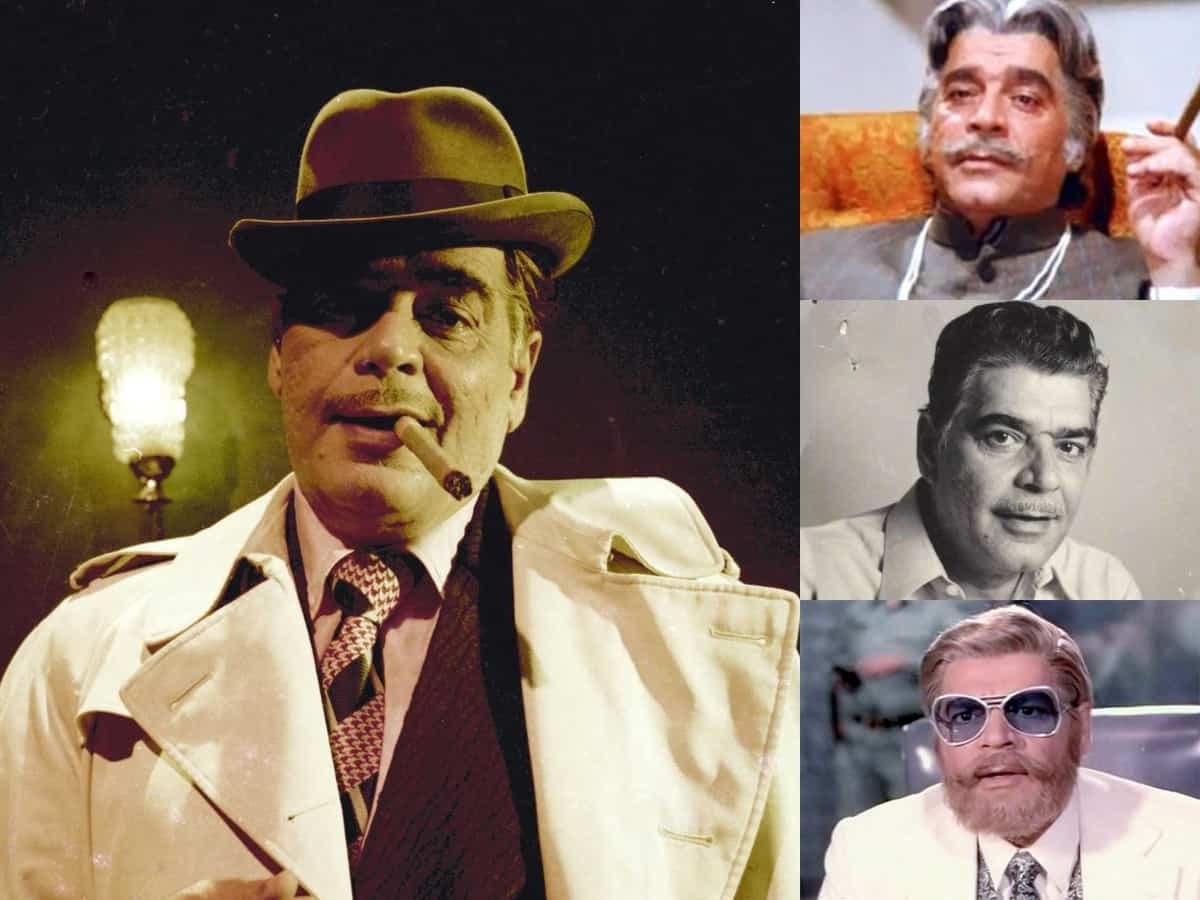
“Sara Shehar Mujhe LION Ke Naam Se Janta Hai” reminds us of the twirling mustachioed daku of Hindi cinema, Ajit. Known for his distinctive performance and incredible dialogue delivery, actor Ajit was the one who had revolutionised the way of villains’ slang in the world of cinema.
He entertained the audience, especially the movie buffs, for over 4 decades by appearing in more than 200 films.
Ajit’s Family background
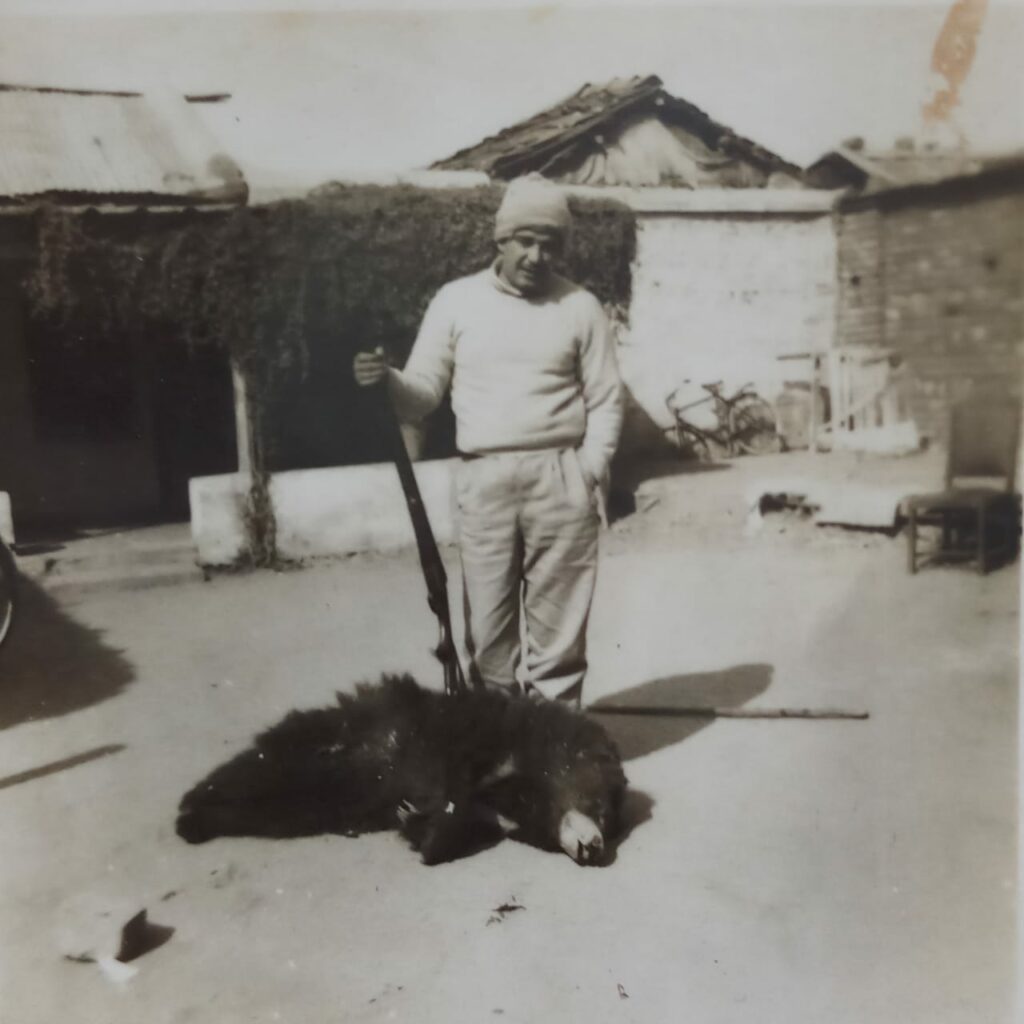
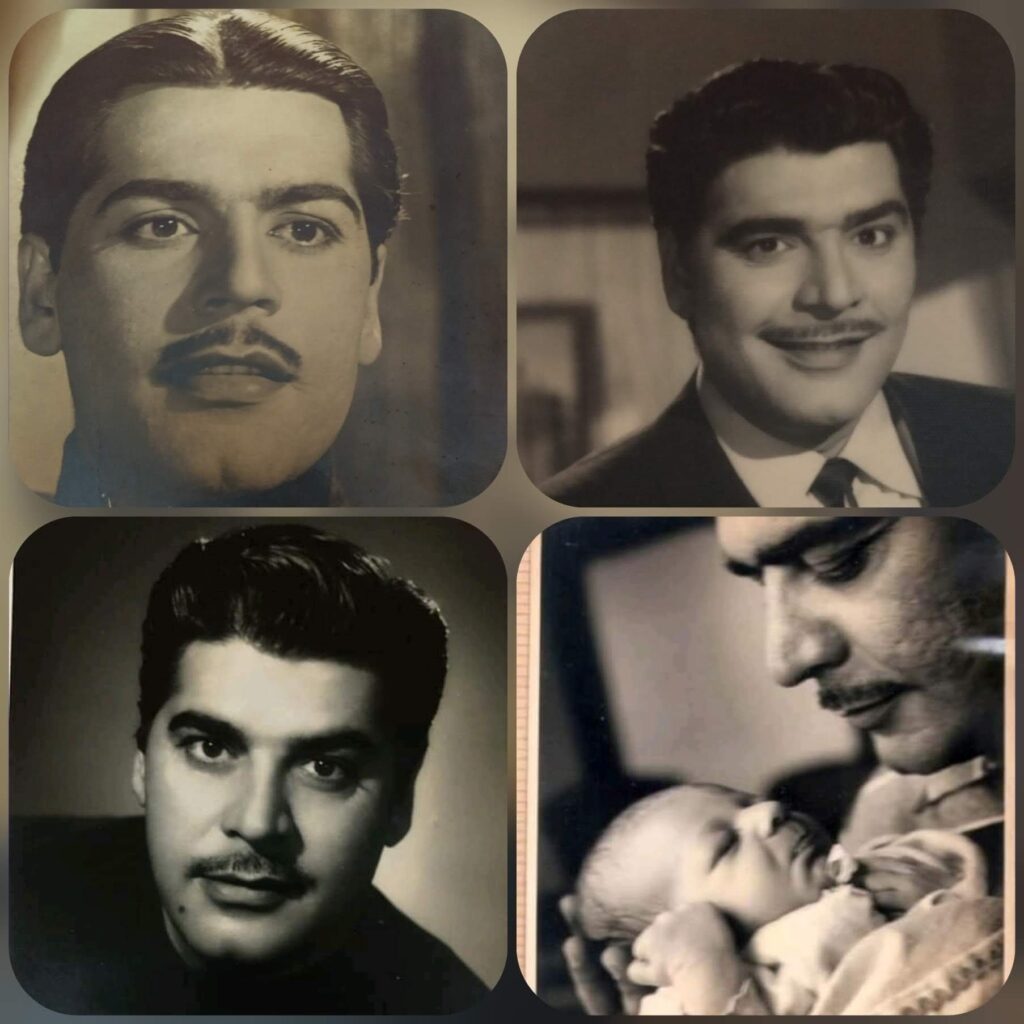
Born on 27 January, 1922 in Golconda, Hyderabad, Ajit was originally known as Hamid Ali Khan. Ajit was his stage name which he acquired after stepping into the world of cinema. His father Bashir Ali Khan worked in the Nizam’s army in Hyderabad.
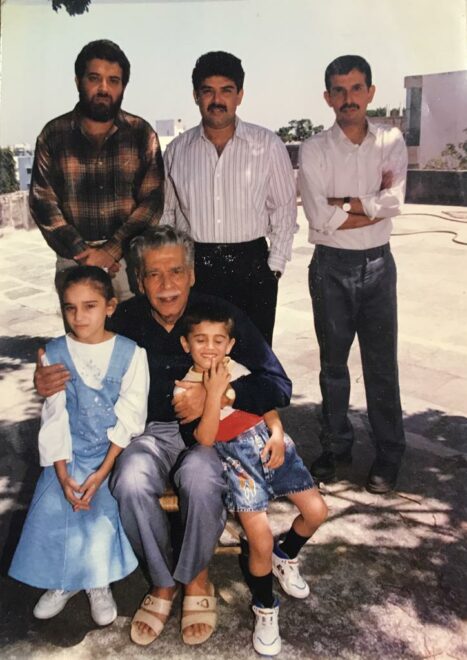
Ajit along with his sons Shahid Ali Khan, Zahid Ali Khan and Abid Ali Khan and grand children Saadia and Saeb.
Ajit did his early education from a Government Junior College, Hanamkonda in Warangaldistrict. He is survived by five sons:: Shahid Ali Khan, Zahid Ali Khan, Abid Ali Khan, Shehzad Ali Khan and Arbaaz Ali Khan.
Journey in the world of cinema
Hamid Ali Khan aka Ajit was fond of acting since childhood. He left Hyderabad and landed in Mumbai to begin his career in the film industry. He was apparently so passionate to get into Bollywood that he reportedly sold his college books to pay for his journey to Mumbai, which is the heart of the Hindi film industry.
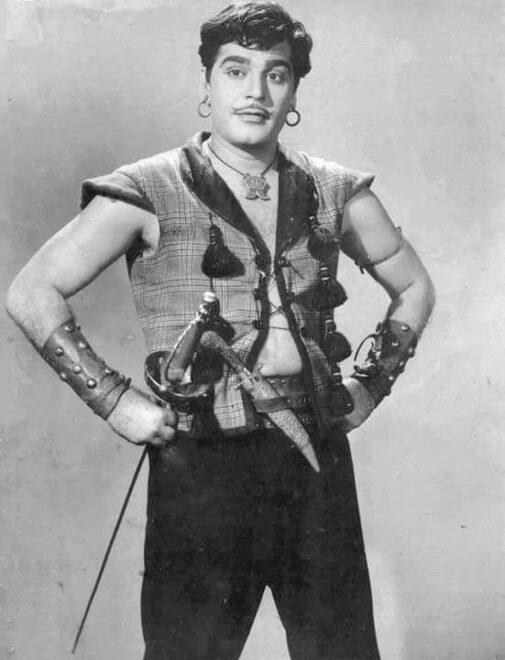
After some struggle, Ajit finally managed to get roles in a few films. He started his acting career with the film Shahe Misra opposite Geeta Bose, which was released in 1946. From 1946 to 1956, Ajit struggled to find his place in the film industry.
After Shahe Misra, he acted in various films like Sikander (with Van Mala), Hatimtai (1947), Aap Beeti (with Khursheed), Sone Ki Chidiya (with Leela Kumari), Dholak (with Meena Shori) and Chanda Ki Chandni (with Monica Desai) as leading hero. Unfortunately, almost all those films flopped as luck did not favour Ajit initially.
In 1950, director K. Amarnath who roped Ajit in his film ‘Beqasoor’ opposite Madhubala, advised him to shorten his film name. Thus on Amarnath’s advise Hamid changed his name to Ajit.
Other films in which he acted as hero include Nastik (1953), Bada Bhai, Milan, Baradari and Dholak. In all of them, his work earned him credibility. However, it would not be enough; Ajit still had to shift to supporting roles in few big ventures of Bollywood like ‘Naya Daur and Mughal-e-Azam’.
When Ajit switched to villainous characters
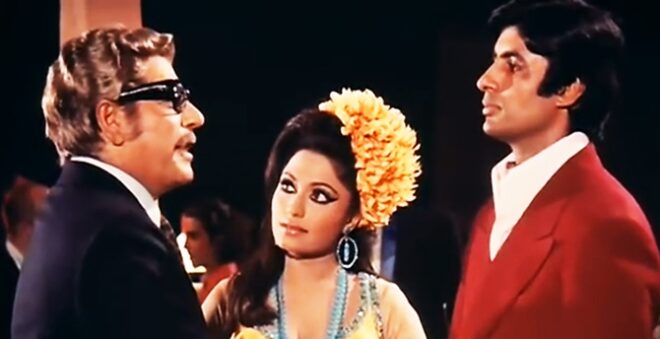
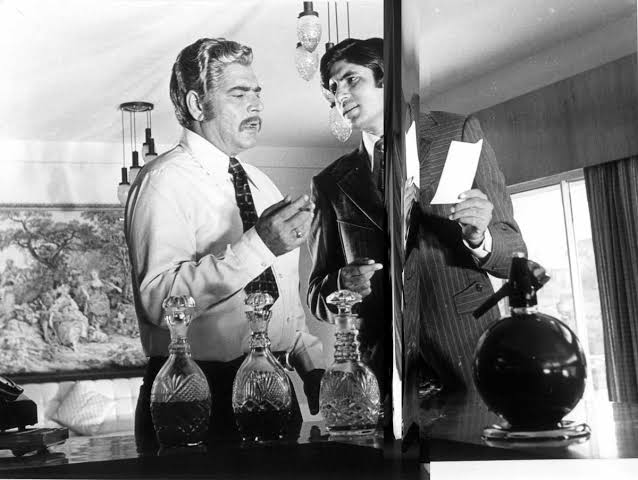
As most of his films in which he played the leading protagonist roles flopped badly, he chose to switch to antagonist characters. His first movie as a villain was Suraj, followed by films such as Zanjeer and Yaadon Ki Baaraat.
https://www.youtube.com/watch?v=W6d0q1yS2-0
Ajit’s popular dialogues
Known for his peculiar dialogues in a baritone voice, Ajit used to deliver them in Hinglish accent (Hindi+English), something that was never heard before in the industry. Few of his popular dialogues are listed below.
“Lilly don’t be silly” (Zanjeer)
“Saara shahar mujhe Loin ke naam se janta hai” (Kalicharan).
Mera jism zaroor zakhmi hai … lekin meri himmat zakhmi nahi (Mughal-E-Azam).
Rajput jaan harta hai … vachan nahi harta (Mughal-E-Azam)
Kutta jab pagal ho jaata hai toh usse goli maar dete hai (Zanjeer)
Jis tarah kuch aadmiyo ki kamzori baimaani hoti hai … is hi tarah kuch aadmiyo ki kamzori imaandari hoti hai (Zanjeer)
Apni umar se badhkar baatein nahi karte (Zanjeer)
Aashirwad toh bade aadmi dete hai … hum toh sirf rai de sakte hai (Kalicharan)
Zindagi sirf do paon se bhaagti hai … aur maut hazaaron haathon se uska rasta rokti hai (Azaad)
Over the years, his one-liners, iconic drawl and sidekicks — Mona darling and Robert (pronounced Raabert) — gave rise to a whole new genre of ‘Ajit jokes’ that would go on to entertain generations, like the Mona darling-Teja scene in Imtiaz Ali’s Tamasha starring Ranbir Kapoor and Deepika Padukone.
Believe it or not, Ajit gave a whole new definition and look of the villain which has been immortalised in the history of Hindi cinema. Fans especially those from Hyderabad still remember the late actor for his amazing dialogues delivery, antagonist roles and his major contribution to the world of Hindi cinema.
Ajit breathed his last on on October 21, 1998 (he was buried the next morning at about 8 a.m.) , leaving a huge void in the film industry that can never be filled again!
source: http://www.siasat.com / The Siasat Daily / Home> Entertainment>Bollywood News / by Rasti Amena / October 26th, 2020
With only one computer, four students, and just Rs 85 in his pocket in February 2001, Hoque has now emerged as one of the most influential edupreneurs of India. — IANS.
Guwahati :
Mahbubul Hoque, who has set up eight mega educational institutions and a university in 19 years, has turned out to be a guiding light for scores of people in northeast India.
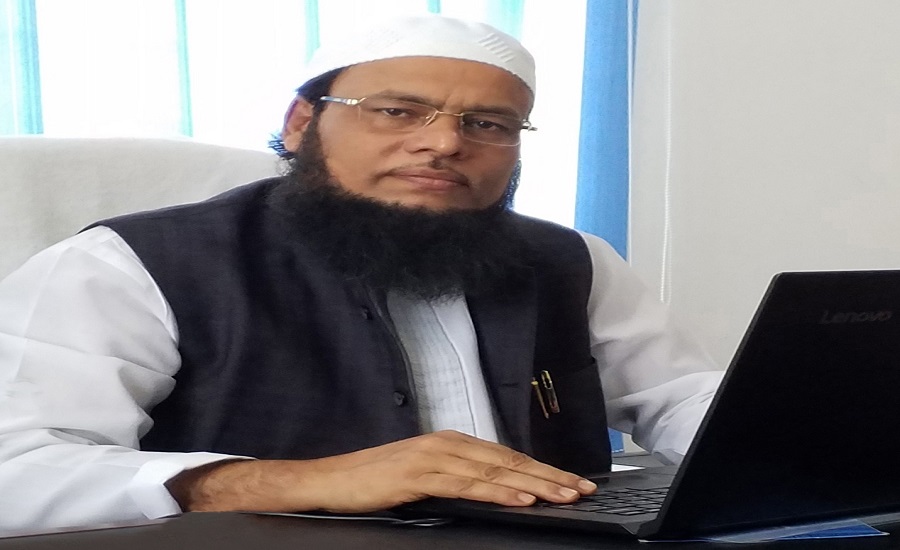
With only one computer, four students, and just Rs 85 in his pocket in February 2001, Hoque has now emerged as one of the most influential edupreneurs of India. He is the founding Chancellor of the University of Science & Technology, Meghalaya (USTM), the first private university on science and technology in the entire northeast.
The university with a student strength of over 5,000 from all the eight northeastern states is empowered by the University Grants Commission (UGC) to award degrees as specified by the UGC.
Besides the USTM, Hoque, being the founding Chairman of the Education Research and Development Foundation (ERDF), has set up nine other educational institutions in the region with a total student strength of 7,500.
These institutions include two CBSE affiliated schools, one AICTE approved engineering college, one law school, one B.Ed. college, one AICTE approved business school, one women’s college, two PCI approved pharmacy colleges in addition to one centre for coaching and guidance centre, and one educational rehabilitation centre.
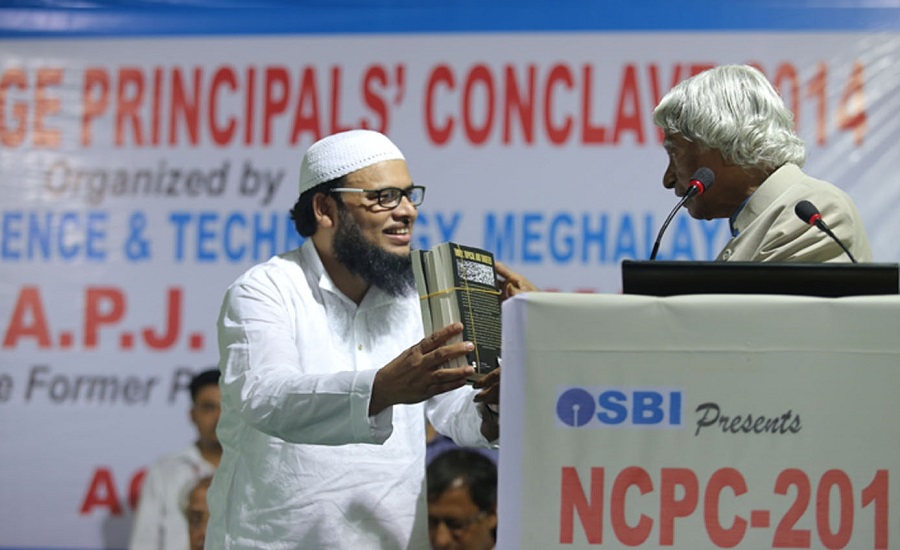
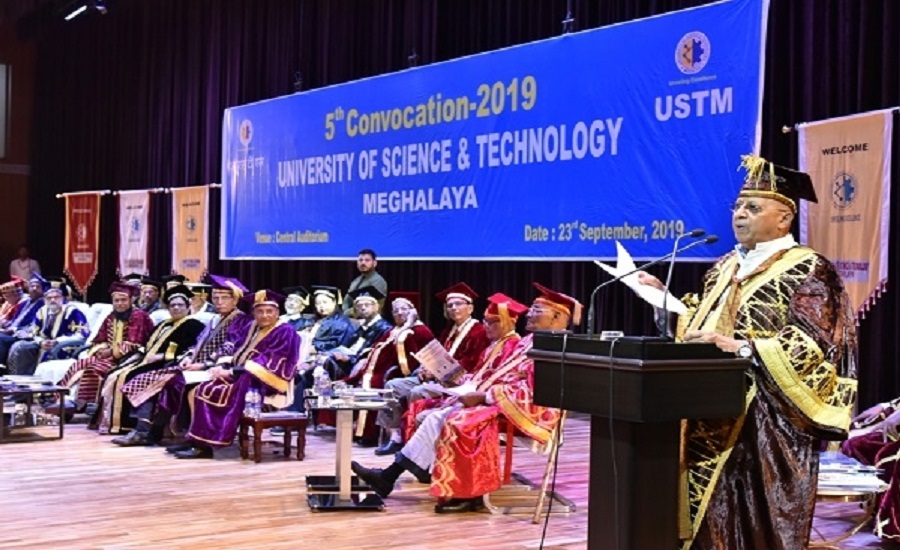
Distinguished personalities including former President A.P.J. Abdul Kalam, Nobel laureate Kailash Satyarthi, former ISRO Chairman A.S. Kiran Kumar and former UGC Chairman Ved Prakash had visited the University of Science & Technology, Meghalaya (USTM) and gave speeches in a number of events and convocations.
Speaking to IANS, Hoque said: “My institutions provide quality education from KG to PG to Ph.D levels. Out of the total number of students, more than 20 per cent belong to underprivileged backward classes who avail free education in each of the institutions where around 750 people work under the ERDF in different positions.”
“After securing the second rank in Master of Computer Applications (MCA) from the Aligarh Muslim University in 2000, I got lucrative job offers from multinational companies, both within the country and abroad. But I returned to my region and started my career as an educational entrepreneur with a strong determination to change the educational scenario of northeast India,” the 47-year-old edupreneur told IANS.
“The key focus of my vision is to provide apt teaching to poor and meritorious students of the northeast region. Of the over 5,000 students currently enrolled in USTM, over 1,200 students are availing free education. Nearly 90 per cent of USTM’s students belong to rural areas, over 38 per cent are tribals and 57 per cent are girls. The university and the other eight institutions run only on the contributions of the students,” Hoque added.
He said that more than 15 vice chancellors from different universities across the country are directly associated with the USTM, while many top personalities, including former President A.P.J. Abdul Kalam, Nobel laureate Kailash Satyarthi, former ISRO Chairman A.S. Kiran Kumar and former UGC Chairman Ved Prakash had visited the varsity and gave speeches in a number of events and convocations.
Terming the USTM as a people’s university, Hoque said it has hundreds of collaborative projects with a large number of reputed educational institutions and universities in India and abroad, including the Jawaharlal Nehru University in Delhi, IIT Guwahati, National Institute Rural Development, North East Space Application Centre, University Grant Commission in Bangladesh, Dhaka University and several institutions in Turkey.
5th Convocaion 2019 of USTM.
Over the years, the USTM has turned into a higher education hub of northeast India.
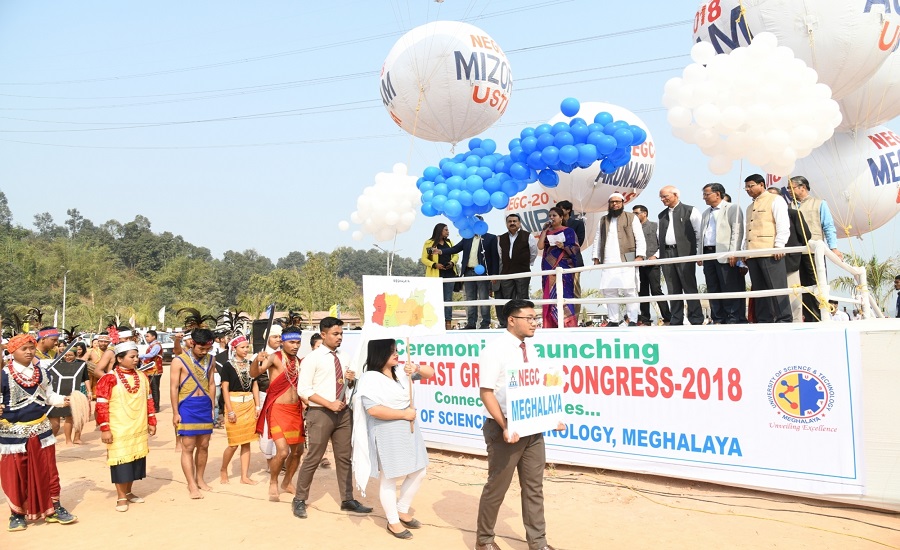
The annual three-day flagship programme — North-East Graduate Congress — sees the participation of more than 10,000 students from over 300 colleges in eight states. More than 30 ethnic communities and languages across the region come together to gain knowledge about the various new career options, enhance their inherent skills.
“This amalgamation of cultural diversity not only creates awareness, but also a sense of inclusiveness and brotherhood thereby paving the way of nation building,” he said.
For his contributions to the field of education, Hoque has received many awards, including the prestigious Shikshacharya Award 2019 bestowed by the Asom Sahitya Sabha.
He said that the USTM, located along the Assam-Meghalaya border in Ri-Bhoi district of Meghalaya, has a strong determination to continue its mission of spreading education to every nook and corner of the region.
The annual three-day flagship programme — North-East Graduate Congress — sees the participation of more than 10,000 students from over 300 colleges in eight states.
“The USTM has charted out a roadmap for its way ahead, ‘Mission Bronze’ – to make it a top university in the east by 2020, ‘Mission Silver’ – to become one of the top universities in the country by 2025, and ‘Mission Gold’ – to become a world class university by 2030,” he said.
Hoque said that ERDF has a plan of establishing a number of institutions for the betterment of education, especially in the rural areas.
He said that some of the upcoming projects include 10 more CBSE affiliated schools in rural and backward places of the northeast region, five B.Ed colleges, a medical college and hospital with allied healthcare institutions, one educational TV channel, and one newspaper each in English and Bangla emphasising on education. — IANS
Source: http://www.clarionindia.net / Clarion / Home> Big Story> Featured> India>Indian Muslims> Spotlight / by Sujit Chakroborty / October 23rd, 2020