Another success story of a girl-student who topped the CBSE 12th 2020 board exams against all odds.
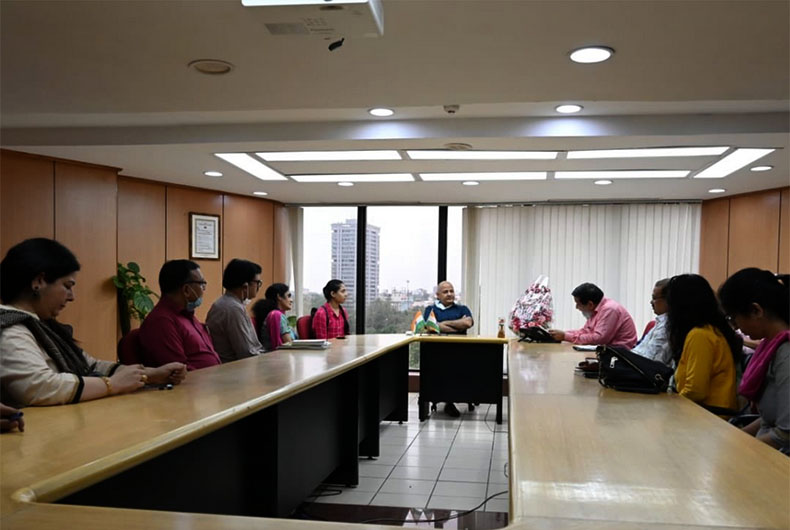
[Besides Areeba Irfan (first on Manish Sisodia’ right) the Delhi Deputy Chief Minister also met the #TeamEducation of the district and congratulated them for their smart work with our smart students. (Image: Twitter/@msisodia)]
CBSE 12th 2020 Topper:
Another success story of a girl-student who topped the CBSE 12th 2020 board exams against all odds. This time, the inspiring story is of 21-year-old Areeba Irfan who topped the CBSE XIIth 2020 exam in Southeast Delhi.
CBSE 12th result 2020 was declared on July 13. However, Areeba Irfan, who topped her district without the help of any tuition classes, hit the headlines now after Delhi Chief Minister Manish Sisodia shared on Twitter the photos of his meeting with the young achiever.
“So happy to meet our all rounder Areeba Irrfan, the 12th class #DelhiGovtSchool topper of South East district, who aspires to become an IAS Officer. So proud of her!”, Sisodia wrote on Twitter, tagging the memorable images.
Talking to Indian Express later on, Areeba – daughter of a businessman and student of Sarvodaya Kanya Vidyalaya, New Friends Colony, credited her success to Zoya, her elder sister who was among the toppers in 2019.
“I didn’t attend any tuition classes as I preferred studying by myself. But my sister Zoya helped me with all my subjects. She had also studied in the same school as me and had topped last year”, Areeba, a Delhi Government school student, told The Indian Express while also acknowledging that her teachers too took special care in helping her prepare for the board exam.
Another inspiring success story of CBSE 12th that hit the headlines was of Nargis Nasreen. Nasreen passed the 12th board exam in first division despite losing her home and all her books in February 2020 Delhi riots.
The Central Board of Secondary Education (CBSE) declared the 12th result on Monday July 13, 2020. The overall Pass Percentage of Arts, Science and Commerce combined is 88.78% – a jump by 5.38% as compared the last year when the pass percentage was 83.40.
The CBSE did not officially publish any Merit List due to the impact Covid-19 had on 2020 board exams. But, the 12th result published by the CBSE showed a staggering 38,686 class 12 students across India scoring above 95% marks.
source: http://www.ummid.com / Ummid.com / Home> Education & Careers / by Ummid.com News Network / July 23rd, 2020
Wasim and 22 other men are part of NGO Helping Hands and they stay at the burial ground till 10 pm, doing what even family members of relatives are scared to do – burying COVID-19 victims’ bodies.
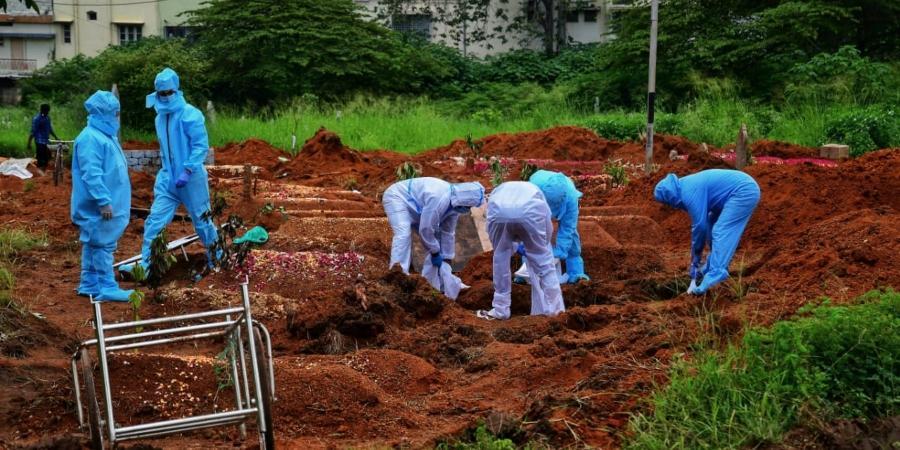
The team has completed over 100 burials of COVID-19 victims till date. (Photo | Shriram BN, EPS)
Wasim Zubair’s day begins with his prayers after which he heads to the burial ground at Quddus Saheb Edgar at 5.30 am to get a list of the deceased who will be brought for their last rites.
Wasim and 22 other men are part of NGO Helping Hands and they stay at the burial ground till 10 pm, doing what even some family members are scared to do – burying COVID-19 victims.
The task is tiring as they have to sweat it out wearing their PPE kits, which they have to constantly change after each burial. There is no incentive for them to do this, not to mention the risk they run of contracting the infection.
Ask them why they do it and Abdul Muheeb, founder of NGO Helping Hands, says, “In April, we locals would see families struggling to carry the dead body of their relatives as very few people were turning up for the last rites fearing coronavirus. Seeing them helpless, and some of them not in the right state of mind while bidding farewell to their near and dear ones made us want to help. The happiness we get when we help them perform the last rites is unparalleled.”
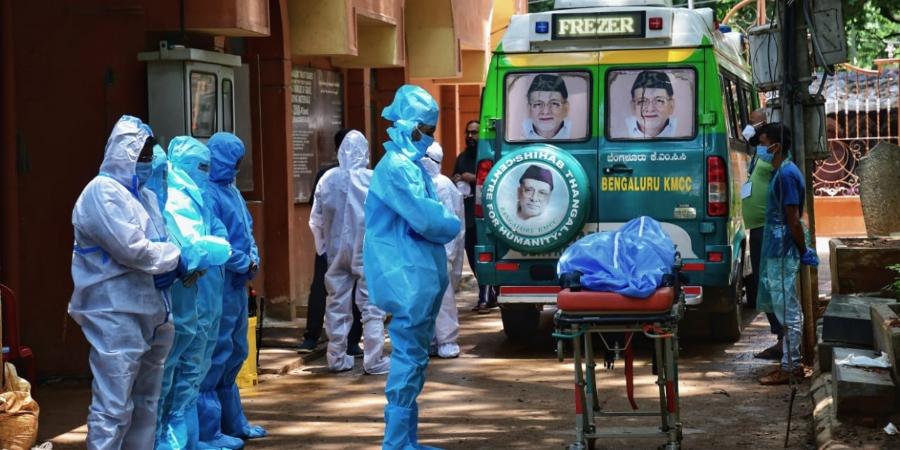
Photo | Shriram BN, EPS
The team has completed over 100 burials of COVID-19 victims till date.
“We see fear of the virus that has gripped people world over, so much so that I witnessed the son of a dead father not wanting to perform the last rites. We tell one or two family members to join us so they know where the grave is. We give them PPE kits as well,” Muheeb said.
Wasim has seen several instances of brothers, sons and grandsons of elderly COVID-19 victims hesitating at the gates of the burial ground.
A cloth of 10 metres by 10 metres is placed on the ground, one horizontally and the other vertically. With the help of the handles of the body bag, they lift the body from the stretcher on to the cloth.
They then lift the cloth and lower the body into the grave. The stretcher is then sanitised and the last Namaz also done as per religious norms.
The JCB digs 30 pits at the burial ground in advance at the beginning of each day.
Thankfully, none of the volunteers have contracted the virus so far.
Wasim says they take the necessary precautions and avoid getting too close to the body or even the primary contacts of the dead person.
“Most of our team members are youngsters. Our tagline is ‘Making it possible by his grace’. We spend our money on PPE kits but sometimes people donate a few kits to us. We don’t charge the family a single rupee,” Wasim said, speaking to The New Indian Express even as three funerals were taking place on Tuesday afternoon.
source: http://www.newindianexpress.com / The New Indian Express / Home> Good News / by Ranjani Madhavan / Express News Service / July 22nd, 2020
AHMAD ZAIDI, who is originally from Aligarh, Uttar Pradesh, and is a 1985 Electrical Engineering graduate from the Thapar Institute of Technology, Karnal, Haryana, epitomizes a brilliant success story in United States.
Zaidi is currently a vice-President at the world-renowned hi-tech giant, the Intel Corporation in the Silicon Valley in California, US. He is among the very select band of bright young minds who migrated to US from India looking to contribute to the development of high technology and to making America great and India proud.
Zaidi holds nine patents in the field of microprocessor design and architecture. In US he earned a master’s degree in electrical engineering from Virginia Polytechnic Institute and State University, Blacksburg, Virginia, in 1987.
In 2009, Zaidi was presented an award by the Malaysian minister for setting up the Embedded Silicon Design Center in Penang, Malaysia. In addition, he and his teams have been honored with multiple technical awards, including an Intel Software Quality Award in 2011 and an Intel Achievement Award in 2012.
Ahmad Zaidi is vice president of the Platform Engineering Group and general manager of the Embedded Subsystems and Intellectual Property (IP) Blocks Group at Intel Corporation. He is also responsible for Security Silicon Engineering and manages Security CPU and IP engineering for the Intel Security Group. He leads an organisation that spans sites in the United States, Malaysia, Israel, Poland and India, and is responsible for delivering hardware, software, firmware IP subsystems and soft IP blocks for Intel products across all product segments. His group is chartered with delivering IP in areas such as audio, voice, speech, sensors, security, Input/Output (I/O) technologies and software related to storage, communications and manageability.
Since joining Intel in 1987 as an engineer in the microprocessor unit at Cupertino, CA, Zaidi has progressed rapidly and has held a number of senior technical and management positions in microprocessor design, embedded systems and communications. Before assuming his current position, he was the general manager of the Chipset and System-on-Chip (SoC) IP Group where he was responsible for delivering chipset hardware, firmware and software for Intel’s client platforms in addition to leading the development of reusable IP blocks for Intel products across all segments.
Prior to that, Zaidi was the general manager at Intel Corporation of the Embedded and Communications Silicon Engineering Group, where he led a cross-geography team responsible for delivering SoC and chipset products for the embedded and communications market segment. Earlier in his Intel career, Zaidi served as director of the Silicon Engineering, Infrastructure and Network Processor divisions and as engineering manager on the first Intel® Itanium® processor.
Ahmad Zaidi lives in Cupertino, CA with his wife and two children. His father was an engineering manager at the Fertilizer Corporation in Paniput, Haryana. As a young man, Zaidi grew up in Paniput.
source: http://www.clarionindia.net/ Clarion India / Home> Indian Muslims / by Kaleem Kawaja, Clarion India / July 18th, 2020
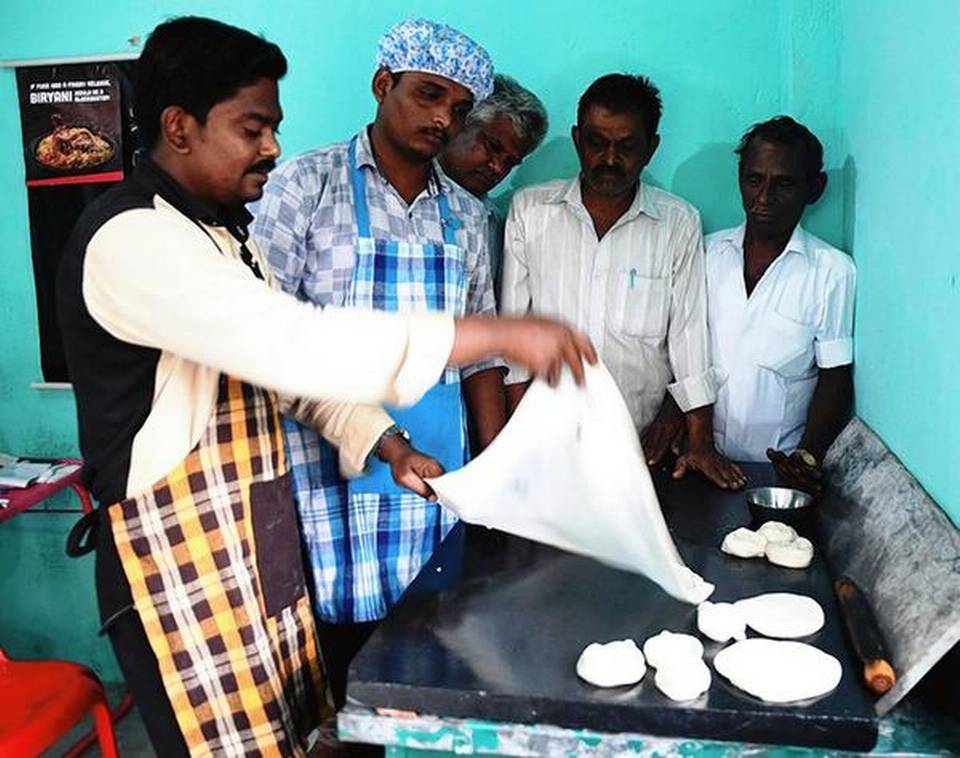
The ‘parotta master’ conducting a class on making the flat bread . | Photo Credit: G. Moorthy
Mohammed Khasim conducts a 30-day course and his batch already has 50 students
At 10 a.m. on Thursday, A. Mohammed Khasim’s student is sitting in the first chair, noting down ingredients for parotta in his notebook. Maida, salt, eggs, he writes and looks up. “cheeniyuma master?” (Sugar too, master?).
There is only one student in the morning batch of this parotta school for November, but Mr. Khasim says that A. Rajasekaran, the soon-to-be parotta master, works a day job. The veteran tries to find a way to accommodate his pupil early morning. In the evening though, his parotta school is filled with up to 50 students — some big and burly, others short and young, but all ready to perfect the art of this puffy flat bread. “My students either come with years of experience, waiting to perfect their skill but most others are fresh out of catering colleges, hoping to find good jobs outside the country,” he says.
Mr. Khasim, who began a school for people wanting to learn the art of making the perfect parottas three years ago in Koodal Nagar, says that the dish must be crispy and flaky on the outside but soft and easy to tear. The flat bread should be able to soak Madurai’s preferred gravy- chicken salna- into its layers while holding it all together steadily.
He says that the city’s undying love for the dish has led to a boom as it is now widely popular. It has also created a market in various other districts of Tamil Nadu and locations outside the country including Dubai, Sharjah, Malaysia, Singapore and the Maldives.
“This is why so many young people are waiting to learn how to make parottas. There is a large manpower shortage in the hotel industry as many people are unaware of the perfect way of rolling, shaping and making a parotta. Hoteliers in resorts outside India want to recruit south Indian masters because of our unique way of rolling out the dough without the help of a rolling pin. That is when I decided to open the school three years ago and impart my knowledge,” he says.
How it began
Mr. Khasim is a third-generation hotelier whose family has made parottas for about 70 years now. “My grandfather opened a small shop in Sikkandar Chavadi years ago and I have grown up to take care of the business. In those times, parotta would only be eaten with sambar. People began wanting spicier side dishes. That is why chicken curry and salna began making their way as potential side dishes,” he says.
Although Mr. Khasim says that he was always excellent at making parottas, making the perfect chicken curry was always a problem for him.
“When I tried to ask several masters to teach me, I realised that none of them were willing to. For six months, I worked undercover as a cook in a small hotel in Madurai to learn how to make the curry. During the first four months, the chef would make me do menial tasks when he would make his famous curry as he was paranoid about me taking over. The insecurity of losing one’s job is very prevalent in this field. That is when I decided that nobody else should suffer my fate,” Mr. Khasim says.
Mr. Khasim said that skilled parotta makers receive hefty advances amounting to about ₹50,000 and receive anywhere between ₹800-₹1,600 each day as salary.
He says that several students come to learn to start businesses since there was interest in entrepreneurship here. He says he has helped people set up small shops by taking them through the process of applying for MUDRA loans. “Some people come because they like cooking. I have taught pastors and professors too. Classes are truly interesting,” he says.
Mr. Khasim says he is in talks with Government Polytechnic College in Madurai to begin a certificate course in parotta making. “Though our students are recruited outside, people demand training certificates. The tie-up will help students secure good jobs,” he says and adds that he will be invited to teach on the campus soon.
He is also training women, particularly those who are part of self-help groups, to make good parottas and chapatis. “There is dearth of women in this job. So many of them are already great cooks. This skill will help them find better employment and make a variety of dishes,” he says.
His regular course lasts 30 days and costs ₹5,000 a month.
source: http://www.thehindu.com / The Hindu / Home> Cities> Madurai / by Sanjana Ganesh / Madurai – Novemer 30th, 2019
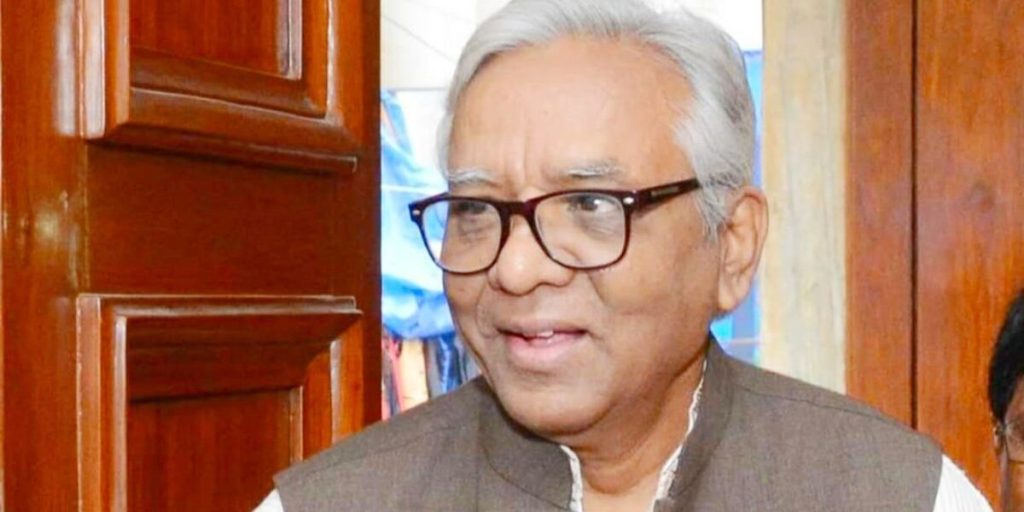
Zaheer was best known for his satirical work and wrote regular columns for various publications. He was furiously popular among readers and has made a lasting impression on Urdu literature.
Nursat Zaheer. Photo: Special arrangement
New Delhi:
Renowned Urdu writer and translator Nusrat Zaheer passed away in Saharanpur in Uttar Pradesh on Wednesday evening at the age of 69. Zaheer had been ill for the last few months. He is survived by his wife and four daughters.
Best known for his satirical writings, he wrote regular columns for various publications. Until recently, he used to write a regular weekly column titled, ‘Nami Danam’ (‘I don’t know’) for the Urdu daily Inquilab.
According to Yameen Ansari, resident editor of Inquilab (Delhi edition), his column was published across all north Indian editions of the newspaper and was very popular with the readers. “We regularly received letters and emails from readers in appreciation of his columns,” Ansari told The Wire, and added that the columnist had to stop the column due to his flailing health.
Author and translator of several books, Zaheer had been writing columns for decades for different publications. When news of his demise emerged on Wednesday, many Urdu lovers recalled his satirical columns which had appeared in the now-defunct Urdu daily, Qaumi Awaz, a newspaper founded by Jawaharlal Nehru in 1937, which ceased publication in 2008. As a journalist, Zaheer worked with Qaumi Awaz, Sahara Urdu, Doordarshan and All India Radio in different capacities.
Speaking to The Wire, senior journalist Iftikhar Gilani said, “I had been an ardent fan of Nusrat Zaheer’s satire filled columns that were published every day in Quami Awaz in the early 90s. It is not easy to write satire and to find puns in every topic around you every 24 hours.”
According to Gilani, Zaheer was a genius who didn’t get his due, like most writers of Urdu.
The late writer also helped Gilani in translating and editing his jail memoir My Days in Prison in Urdu from English. In Urdu, it was titled Tihar Mein Mere Shab o Roz and both the original as well as the translation were published by Penguin India. The translation won the Sahitya Akademi award and Gilani remembers travelling to Bangalore with Nusrat Zaheer to receive the Award.
“I wrote the first draft in Urdu, but it needed a lot of editing as I was not well versed with writing in Urdu. The publisher chose Nusrat Bhai for editing the draft. We sat down and spent many evenings to make the Urdu draft lucid and perfect,” recalled Gilani and added that “he remained a friend and a guide. I will miss his wit and humour.”
Some of his books include Tehtul Lafz, Ba-Qalam-e Khud and Kharraton Ka Mushaira. He also wrote satirical pieces for the children’s magazine Payam e Taleem, published by Maktaba Jamia, the publication division of Jamia Millia Islamia and one of the best Urdu publishing houses of India. He was also the founding editor of children’s magazine Bachon Ki Duniya, published by the National Council for Promotion of Urdu Language (NCPUL), an autonomous body of the government of India and was associated with its research journal, Fikr-o-Tahqeeq as its editor for a brief period.
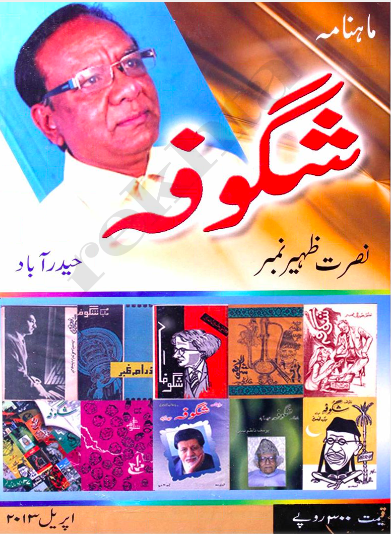
Cover of a special issue of ‘Shagoofa’ on Nusrat Zaheer. Photo: rekhta.org
In 2013, Shagoofa, a monthly magazine of Urdu satire and humour writings, published from Hyderabad brought out a special issue in his honour. His book Kharraton Ka Mushaira, a collection of articles written for Payam e Taleem won an award from the Delhi Urdu Academy.
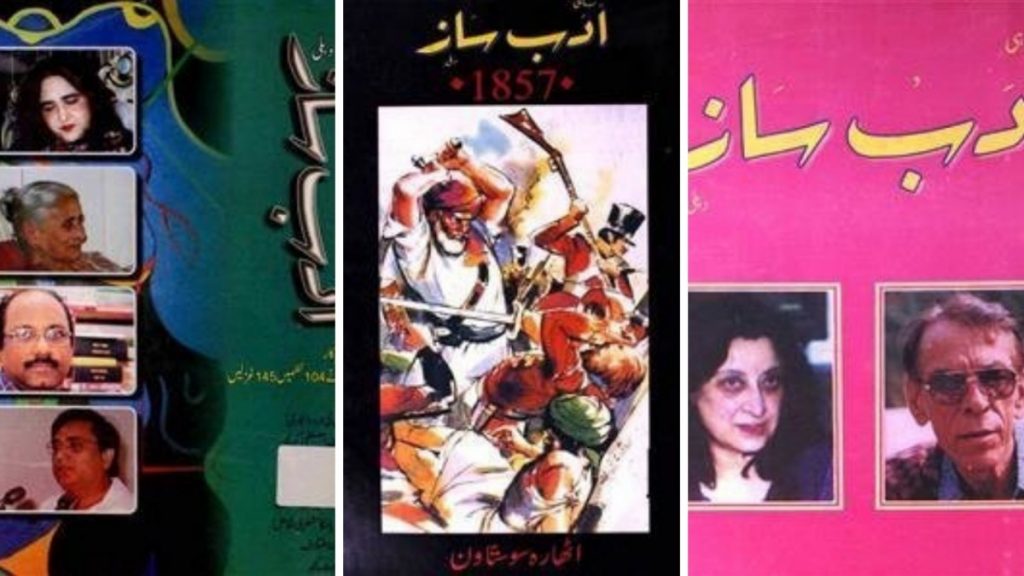
However, many believe that Zaheer will also be remembered for Adab Saaz, a quarterly literary journal founded and edited by him. According to Ather Farouqui, general secretary of Anjuman Taraqqi Urdu (Hind), it was one of the best literary journals for quite a few years.
Cover of Adab Saaz. Photo: rekhta.org
Nusrat Zaheer was associated with the Communist Party of India (CPI) in his early years. However, “he had to go to jail during the emergency as he refused to toe the party line of supporting the emergency,” Farouqui told The Wire. “He was a low profile person and committed to the values he cherished, which included his opposition to all kinds of communalism,” added Farouqui.
According to Farouqui, before falling ill, Nusrat saheb was involved in the wonderful work of translating the history of English to draw parallels between the politics of Canon and the historiography of Urdu and English. This was apart from his regular writings for several publications. “Unfortunately, he took up the job quite late in his life, without knowing that he was about to complete his journey,” Farouqui told The Wire with a great sense of loss.
In the latest issue of Urdu Adab, a journal published by Anjuman Taraqqi Urdu (Hind), Zaheer’s translation of Andrew Sanders’s Poets’ Corners: The Development of a Canon of English Literature has been published. It is the introduction of Sanders’s book, The Short Oxford History of English and the Urdu translation of it can be read here.
source: http://www.thewire.in / The Wire / Home> Books> Culture / by Mahtab Alam / July 23rd, 2020
Noted Urdu poet Mohammad Shamshuddin, popularly known as ‘Shams Jalnavi’, died here in Maharashtra on Tuesday morning due to old age, his family members said. He was 95, reports PTI.
Jalnavi penned hundreds of ‘ghazals’, ‘shers’ and ‘nazms’ (a genre of Urdu poetry) in his lifetime.
He used to attend ‘mushairas’ (poetic congregations) across the country.
Born in 1926, Jalnavi had completed his early education in Jalna and completed MA in Persian from Lahore.
Urdu lovers and people from different walks of life offered their condolence.
source: http://www.clarionindia.net / Clarion India / Home> Culture / India / July 22nd, 2020
Mohammad Shadab expressed the desire to work at the United Nations as a human rights officer.
Mohammad Shadab, son of the motor mechanic wishes to work at the United Nations. (Photo | ANI)
Aligarh :
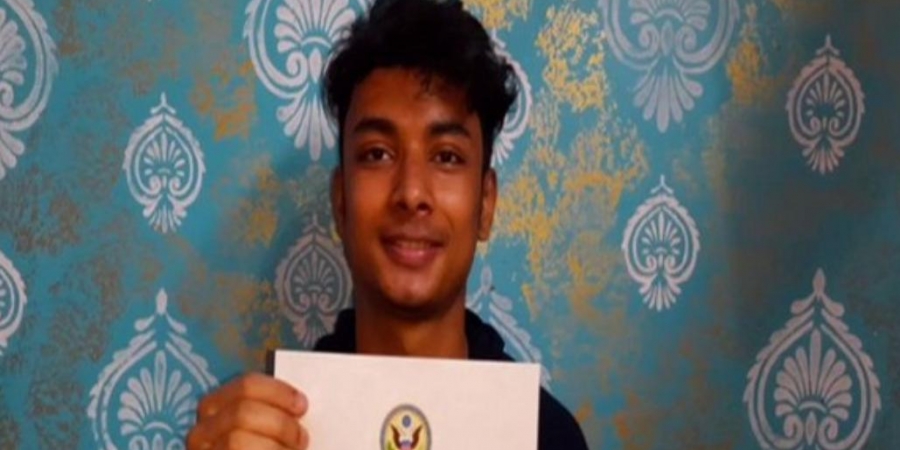
The son of a motor mechanic in Aligarh, who had received a scholarship, topped at his high school in the United States.
Mohammad Shadab, son of the motor mechanic, said, “Last year, I received the Kennedy-Lugar youth exchange scholarship worth Rs 20 lakh from the US government. Following this, I went to the States to pursue my high school education.”
Out of 800 students, Shadab was also selected Student of the Month at his school. On his achievement, he said, “It was an achievement for me to be awarded this tag.”
“I have worked really hard to top the high school,” Shabad said.
Shadab said, “The condition at home was not good and it is still not that good. I want to support my parents and make them feel proud.”
He also thanked the Indian government. “I am thankful to the Indian government for making me the flag-bearer in another county and choosing me for this scholarship.”
Shabad’s father, Arshad Noor, who is working as a motor mechanic for the past 25 years, said, “We had sent him to the US for his education and I am happy that he topped at the school.”
On being asked about his son, Arshad said, “I want my son to become an IAS officer and serve the country.”
But Shadab expressed the desire to work at the United Nations as a human rights officer.
source: http://www.newindianexpress.com / The New Indian Express / Home> Good News / by ANI / July 20th, 2020
Life in Malegaon appears to have returned to normal, even as Maharashtra struggles to contain the pandemic. As of July 15, the state had 107,963 active cases, with 10,695 deaths.
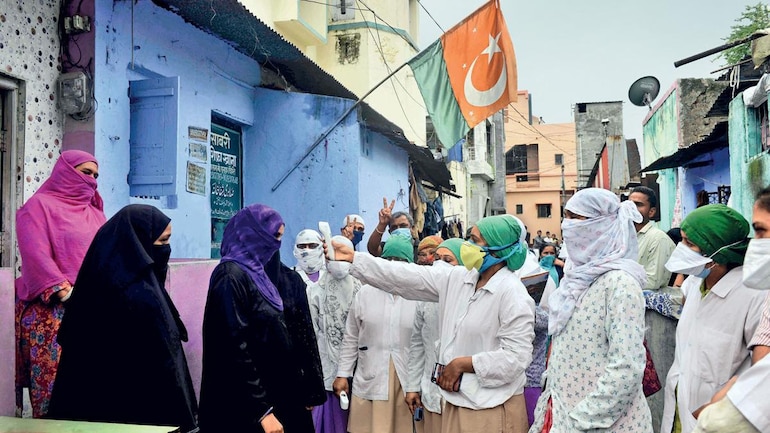
A new normal: Healthcare workers on a door-to-door Covid-19 test drive in Malegaon, July 14. / Photo by Milind Shelte
The covid-19 battle
On July 14, Malegaon’s Mohammad Ali Road, the city’s main commercial street, was full of shoppers, mirroring the sort of normalcy seen in days before the national lockdown in March, and presenting a stark contrast to the fearful retreat from public spaces seen in many areas of Maharashtra. The shops were open, selling everything from cutlery to electronics, and the restaurants and street food vendors were busy serving crowds of customers. Burqa-clad women thronged the ladies’ market. Life in Malegaon appears to have returned to normal, even as Maharashtra struggles to contain the pandemic. As of July 15, the state had 107,963 active cases, with 10,695 deaths.
Malegaon’s return to normalcy is striking and worthy of note because, till recently, the city was one of the state’s five Covid hotspots, alongside Mumbai, Pune, Nagpur and Aurangabad. Until May, the city had seen a daily average of five deaths due to Covid-19, and reported about 200 fresh cases in the early part of that month. Today, there are just 60 active cases in the city, most of them non-residents of Malegaon, with no coronavirus-linked deaths since May 25. The doubling period has improved from 2.2 days in April to 112 days on July 15, the best in Maharashtra. At 82 per cent, the rate of recovery in Malegaon is also much better than the state average (54 per cent). The turnaround was so hard to miss that, in the first week of July, the Indian Council of Medical Research (ICMR) sent a confidential letter to the state government, asking for permission to study the ‘Malegaon model’.
Malegaon is a Muslim-majority city (80 per cent residents are from the minority community), with a population of 750,000. The city administration’s success in controlling the pandemic is especially laudable given that the average population density here is 19,000 per sq. km, the state’s highest. In areas like Kamanipura, this goes up to 72,000 per sq. km, second only to Mumbai’s Dharavi, where 800,000 live in a 2.1 sq. km area. Maintaining physical distance, the standard-format safety protocol to avoid infection, is then practically impossible. The Malegaon Municipal Corporation (MMC) was also working with severe limitations, it still does not have a single ventilator.
Municipal commissioner Deepak Kasar says the MMC was struggling on two fronts. First, it had to tackle a staff shortage, with many workers refusing to report to work for fear of being infected. This even led to the MMC being unable to make use of the ambulances provided by the Bharatiya Jain Sanghatana, an NGO focused on disaster response. Second, Kasar says convincing people to come forward for screening, testing and quarantine was a Herculean task, especially since a communally sensitive environment had been created in the initial days of the pandemic.
The MMC’s task was made much more complicated by rumours on social media, one of which was that the coronavirus screening efforts were a conspiracy against Muslims. This led to people refusing to be tested and even attacks on MMC health workers who were conducting screening tests. In the last week of April and the first week of May, six ASHA (accredited social health activist) workers suffered burns after being attacked with boiling water. Many residents also reportedly refused to give their real names and symptoms to health workers. Superstition played its part, for instance, many believe the dead will not reach heaven if their eyes are open, leading to people touching infected bodies and increasing the risk of transmission. Another tradition requires women from households in which a death has taken place to isolate themselves for four months and eight days, this complicated contact tracing.
To address these problems, Kasar appealed to community leaders for help, especially the influential Mufti and local MLA Mohammad Ismail. Leaders like Ismail made appeals at mosques for people to stay at home and to cooperate with the MMC health workers. As a result, people increasingly came to see that the administration’s efforts were genuine, leading to more and more coming forward for testing. The success of the appeals to stay home was clearly visible on Eid-ul-Fitr (May 25). Malegaon’s Idgah Maidan was deserted, normally around 300,000 people gather here to offer prayers on the holy day.
Another initiative was to enlist community members for outreach, to spread information about the virus. Kasar roped in students of Ayurvedic and Unani medicine, aware that they were trusted within the communities. A Unani concoction called mansura kadha, with claimed immunity-boosting properties, prepared by the local Mohammadia Tibbia College, also played a bit role; the trust that runs the college has received requests for some 250,000 packets. The MMC also made short informational videos and uploaded them on YouTube, aiming to improve awareness about the coronavirus among Malegaon’s younger residents, especially women. Also important were the MMC’s efforts to give vulnerable households the resources they needed for home isolation. “We provided oxygen cylinders, though the police department was against the move,” says Kasar.
Maulana Imtiaz Ahmed Iqbal Ahmed, secretary of the Jamiat Ulema-e-Hind in Malegaon, says the community “scored over the fear factor…the mohalla clinics were the game-changer”. Kasar also points out that the success did not come at a major financial cost. “We did not send any patients to private hospitals, so the treatment bill was zero. We also spent less than Rs 20 lakh in the past two months on arrangements for quarantine and treatment,” he says. This stands in stark contrast to the efforts of other municipal corporations in the state; Pune has budgeted Rs 294 crore to fight Covid-19 for a population of about 4 million. Kasar says Malegaon has not only shown a decrease in Covid-19 cases but also other diseases, including those affecting the heart, lungs and kidneys. The ICMR study, once completed, will be submitted to a committee headed by Prime Minister Narendra Modi.
The MMC’s efforts have not only improved the health of Malegaon’s citizens, it has also rehabilitated the city’s reputation. Home to a local film industry and a textile cluster with around 125,000 power looms, Malegaon attracted some bad press in the noughties for being communally charged, a riot in 2001 and bomb blasts in 2006 and 2008 seemed to lend credence to its reputation for being volatile. But it has moved on since, and now with the success of the ‘Malegaon model’, it has built a case for an image makeover.
source: http://www.indiatoday.in / India Today / Home> News> Magazine> UP Front / by Kiran D Tare / New Delhi, July 18th, 2020
Female positive patients getting treated at the centre on Sunday / Times of India
Vadodara :
For so long, since the time of the pandemic outbreak, this mosque in Godhra, the second biggest in town had been offering prayers for Covid-19 patients. However, it has now taken its services a step ahead and turned the place of worship into a care centre for all positive patients.
What’s more, its healing touch does not discriminate against patients by their religion or social status! Opened last week, this facility is now facilitating treatment to nine positive patients from different communities.
The ground floor of Aadam mosque on Sheikh Majaawar Road, which was designed to accommodate female haj pilgrims, has now been converted into a designated Covid-19 care centre. The decision by the mosque’s managing trust was inspired by the rise in the number of cases in the region.
“Godhra Muslim Samaj, our maulvis and group of Muslim doctors got together and decided to offer the hall on the ground floor as Covid-19 treatment centre. We sought permission from the district collector and chief district health officer for a 50-bed facility, and after they allowed a 32-bed one, we started the facility on July 11,” said Dr Anwar Kachba. “Of these 32 beds, 16 are for patients to be kept in isolation while the other 16 are for positive patients,” Kachba added.
In the past too, the mosque had wanted to set up a similar facility for chikungunya cases, but failed.
“We had bought hospital furniture from a hospital in Ahmedabad which was closing down. This is helping us offer treatment to all,” said Abdul Kadir Hayaat, mosque’s managing trustee.
“Whatever we do not have is being supplied by the Godhra civil hospital,” said Hayaat, adding that the civil hospital is also looking after the medical treatment of the patients here. So far 11 suspected patients who tested negative have been discharged from this facility.
source: http://www.timesofindia.indiatimes.com / The Times of India / Home> News>City News> Vadodara News / by Jay Pachchigar, TNN / July 20th, 2020
(www.indiadailynews.com / India Daily News / July 20th, 2020 – source: TOI )
Dubai-based Asad Haque on the “incomparable” fruits of taking his hobby to the next level.
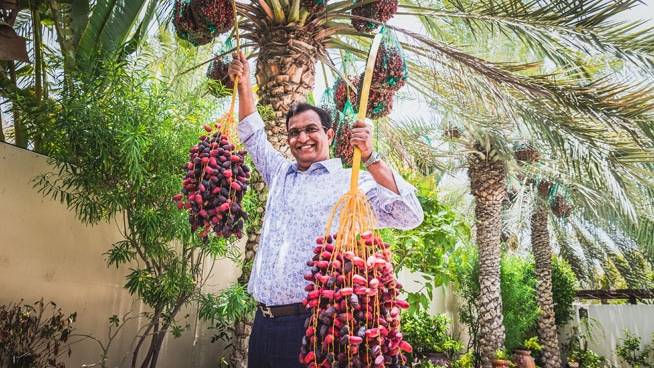
Dubai resident Asad Haque is a CEO. He’s also a date farmer. The two pursuits could not be more different from each other and yet, the Indian expat dons both hats with the ease that can only be born of passion.
Asad’s love for gardening goes back to his childhood, when he would tend to plants and flowers in the large compound around his home in Bangalore. Although he’s been a resident of the UAE for 30 years, it was only when he moved to his villa in the Meadows that he finally had the opportunity to take his hobby to the next level. It’s a mark of his love for Nature that he decided to embark on the intensely challenging pursuit of date farming while at it.
“The date palm is the one tree that suits the local terrain and can survive the terrible summer heat, while also producing a fruit both wonderful and nutritious,” he explains.
Few things are as representative of Emirati heritage as dates, a deliciously sweet fruit that has long been associated with the culture and history of not only the UAE, but also the Arab world. There is a recorded population of over 40 million date palms producing 199 varieties of dates in the UAE alone.
“The date palm has been mentioned in the Quran more than 20 times, and Muslims are well known for breaking their fasts during Ramadan with its fruit, so there is a spiritual and cultural connection too,” he adds.
Asad’s Dubai residence is home to eight of these trees – each one producing eight to 15 large bunches of fruit and up to a total of 1,000 kilograms every year. The bounty is no mean feat, considering the labour-intensive process of nurturing them from pollination to harvest.
Skilled gardeners are required to scale the trees (that can grow up to a height of 20 metres), using rope harnesses hitched around their waists and navigating the thorns that grow to about six inches long, in order to reach the flowers and pollinate the trees by hand. What follows are six to eight months of rigorous care, especially with regard to keeping pests like the red palm weevil at bay. Asad ensures he personally oversees every step of the process and loves giving the trees “baths” every other day. After 15 years, says the entrepreneur, the trees have become “like family” – and, if nourished well, can grow to about 150 years old.
“It’s been a fantastic experience here in the UAE,” says Asad, who is CEO at ICT Consultants. “Although I had a liking for gardening, it is Dubai that gave me the opportunity to nurture this hobby into a full-fledged passion.” With an annual crop so bountiful, the 54-year-old not only gifts the fruits to family and friends, but also distributes them generously among charities, labour camps and mosques, crediting his wife Reshma with “doing a beautiful job of packing them” every time.
There are other intangible ‘fruits’ of his labour that he cannot discount, he notes. “For one to take up date farming, one has to either have a lot of patience or cultivate such a trait. That’s something I’ve learnt after all these years of date farming; it’s given me a lot of patience. It also connects you to the supernatural, to creation and the Creator,” he says. “There is a deeply spiritual satisfaction that comes from seeing something through, from flowering to harvesting, that is difficult to express in words.”
Asad is quick to shoot down any notions that desert lands like the UAE are unsuitable to home farming. “Although the palm tree is the most naturally suited to the local habitat, it is not that nothing else can grow here. We grow a variety of other plants and trees in our garden: moringas, mangoes, lemons, figs, curry leaves, pomegranates and tomatoes are just a few.”
A strong advocate for cultivating a green thumb, Asad says, “Whatever you have at home – whether it’s a garden or even just a balcony – I would strongly encourage everyone to attempt growing fruits and vegetables at home. Not only are there a lot of green benefits to reap from it, but you will find a connection to nature and beyond that cannot be compared.”
karen@khaleejtimes.com
source: http://www.khaleejtimes.com / Khaleej Times / Home> WKND (Weekend) > Interview / by Karen Ann Monsy / July 16th, 2020