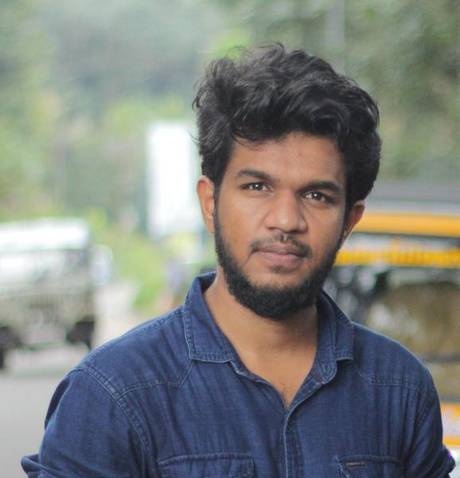
Kerala blasters E player Zakeer Mundampara is an inspiration for the people to be part of the initiatives to help the health workers and other people affected by Covid-19.
Zakeer Mundampara with his wife and daughter Mariyom. (File Photo)
Malappuram :
Kerala Blasters E player Zakeer Mundampara is an inspiration for the people to be part of the initiatives to help the health workers and other people affected by COVID-19.
The young footballer has offered his two-storey residence at Areekode for COVID-19 care and leads an initiative to distribute food kits to the families affected by the infection.
“I’m going to stay with my seven-months pregnant wife at our house in Edavannappara. We will not be using the house at Areekode for at least next couple of months. So, my wife and I have decided to provide the vacant house for COVID-19 quarantine purposes or to accommodate the medical workers in the area. The house has three bedrooms and three bathrooms. Anyone who wants to use these facilities can contact me,” the India Super League (ISL) player said.
Mundampara announced his willingness to lend the house for COVID-19 care for free through his Facebook page recently. The former Santosh Trophy player is also active in helping the people hit by the pandemic.
“Our club, Areekode Chakkamthodu FC, in association with Al Sabah FC Dubai and FC Trikkaripur, has so far distributed 133 food kits to the families affected by the pandemic in the area. We will continue with such efforts to help the people affected by COVID-19 till this crisis ends,” he adds.
Though he will be active with his volunteering activities, Mundampara has decided to spend more time at his house at Edavannappara with wife Fasila and five-year-old daughter Mariyom. “I’m going to spend most of this lockdown time with my family. I will also be finding some time for football practices and small exercises at home. Other than that, not thinking of any busy football practice schedule during this lockdown,” he says.
The 28-year-old had played for Chennaiyin FC and Mumbai City FC in the ISL before becoming a part of Kerala Blasters. Mundampara had also played for Chirag United Club Kerala, Churchill Brothers and Mohun Bagan.
source: http://www.newindianexpress.com / The New Indian Express / Home> Good News / by Vishnu Prasad K P / Express News Service / April 08th, 2020
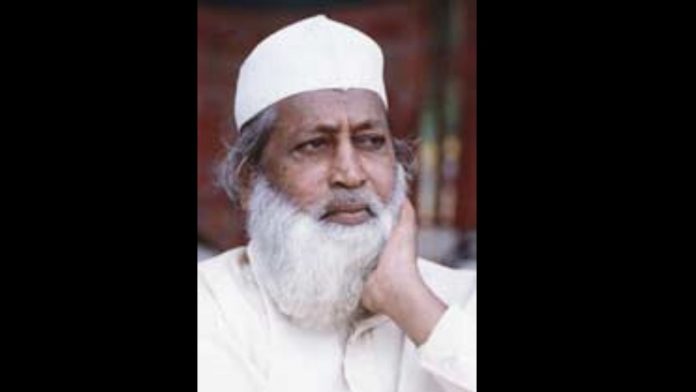
Mohammad Ilyas Babar was a staunch supporter of the Tablighi Jamaat. He also spotted, trained and took Padma Shri Olympian Sriram Singh to dizzying heights.
Ilyas Babar | Commons
Citizens of India may be angry with the Tablighi Jamaat , but let’s not forget at least one member of the Jamaat had put India on the global sporting scene with distinction.
India’s celebrated athletics coach late Mohammad Ilyas Babar was a staunch supporter of the Tablighi Jamaat. He also spotted, trained and took Padma Shri Olympian Sriram Singh to dizzying heights. Sriram won a gold medal in 800 metres in two successive Asian Games and finished a creditable seventh in the Montreal Olympic Games in 1976.
Not many would know that Babar was a commerce graduate and champion athlete of the Osmania University in Hyderabad. But after he passed out from the National Institute of Sports in Patiala with the first batch of NIS coaches in 1961, he made Delhi his base.
Rajputana Rifles in Delhi hired Babar as the athletics coach, where he spotted Sriram Singh in 1967. And the rest, as they say, is history.
Babar at the Markaz
Whenever Babar was not on the tracks with Sriram and other top Indian athletes, he would be at Delhi’s Nizamuddin. He would teach underprivileged children at the Markaz and spend hours at the teashop then run by a man called Sami.
As a young runner, I was also under Babar’s tutelage. But he never ever discussed his religious views with us. In fact, it was Sami who told us that Babar Sahib used to teach at the Markaz.
Babar was a fakir in the sense that he never sought wealth. On the contrary, he spent whatever he had on Sriram and other athletes, even at the cost of his own three children.
Going to the Olympics
During the Olympic games, we asked him to go to Montreal to be with Sriram for the greatest race of his life. But he made up his mind to go only after Sriram Singh ran a brilliant race in heats on 23 July 1976.
Through the good efforts of then foreign secretary Jagat Mehta, we got a passport for Babar in a few hours and he was on board a flight to Montreal on 24 July. He saw Sriram’s final race on 25 July and was back at Nizamuddin by the evening of 27 July. In Montreal too, he stayed two nights in a masjid.
Babar never missed a namaz. When Sriram was training on the lawns at Rajpath, Babar would spread his janamaz and offer prayers under a jamun tree.
In the current coronavirus context, it feels sad that everyone at Nizamuddin or anywhere else with similar religious leanings is being painted with a brush of hatred. But before we do that, let us think of Babar and thousands of others who served the community with distinction.
The author is a sports columnist and senior freelance journalist. Views are personal.
source: http://www.theprint.in / The Print / Home> Opinion / by Norris Pritam / April 07th, 2020
In the anxiety to label Indian architecture as Hindu, Buddhist, British imperial and Islamic, the buildings lost some of their power to evoke wonder and surprise.
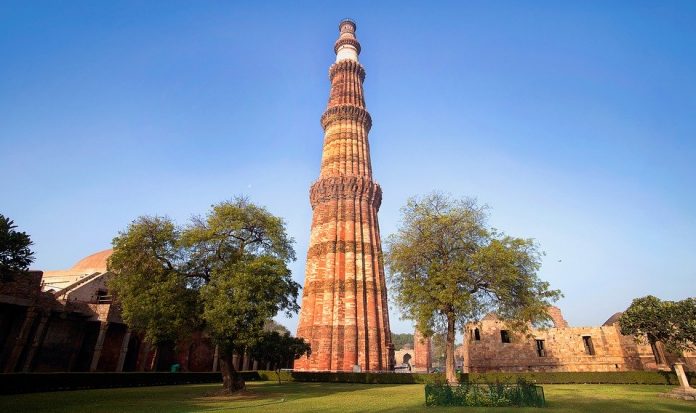
Qutub Minar in New Delhi | Commons
In the 1950s and ’60s, visitors to Delhi’s Qutub Minar often saw a crowd of schoolchildren following an unlikely Pied Piper, a frail man in a white kurta and pyjama, wearing a Gandhi cap, and giving them their first lesson in art history. Mohammad Mujeeb was one of those iconic professors who communicated just as easily with schoolchildren as he did with college students and his colleagues. He instilled in them a love for historic cities, made them see the places as works of art.
In those years, the Delhi skyline and groundline were dominated by monuments. For many families, these landscapes were synonymous with Sunday picnics. For art historians, these spaces became popular hunting grounds, and a number of case studies on architecture took shape in the 1970s.
But the lay reader was more familiar with surveys of Indian architecture. Of these, Percy Brown’s books were the most sought after. His volumes, Indian Architecture (Buddhist and Hindu), and Indian Architecture (The Islamic Period), published in 1942, contain amine of information. However, because he divided the theme in a binary, he missed out on capturing the special quality of the 14th-17th centuries — the cosmopolitanism in architecture — when rich and powerful rulers, irrespective of religion, engaged skilled artisans and engineers from across south and west Asia to design beautiful public spaces.
Architectural crossover
In that era of increasing globalisation, artisans met and exchanged recipes for architectural design, and travelled great distances, confident of their patronage. Guilds from the Middle East were employed to design the great pillars of Yorkminster, and Indian stone-masons learned structural engineering from Uzbek architects. Chinese porcelain gave its name to the funerary monument Chini Ka Rauza (China Tomb) in Agra. British tourists to Italy brought back fragments of Roman sculpture to display proudly in their country estates, while Feroz Shah Tughlaq had two Ashoka pillars (only no one knew what they were) ferried to Delhi from Meerut and Topra (Haryana), to embellish his mosque and his estate on the Ridge.
James Fergusson, in the mid-19th century, had sought to make sense of the myriad buildings in India. He found it simplest to classify them by ‘style’. Function, it was assumed, shaped the form, and buildings were labelled ‘Buddhist’, ‘Hindu’ or ‘Islamic’. The term ‘Indo-Saracenic’ was coined to describe styles with elements of both, as well as for the British imperial style, which deliberately included decorative Indian elements. In this anxiety over labels, the buildings lost some of their power to evoke wonder and surprise, to speak to the hearts and minds of the people.
Indian-Muslim architecture
Both mosques and tombs adopted from and adapted to the local environment, which is why Mujeeb insists that they be described not as ‘Muslim’ but as ‘Indian Muslim’. They, and other public areas — streets and walled gardens — made for beautiful cities, with a quality of repose and of camaraderie. Soaring arches and minars (towers) connected the earth to the sky, to heaven. (Mujeeb was too much of a rationalist to fall for the belief that djinns lived in historic buildings and could fulfil people’s prayers.)
Communal practices do shape houses of worship — and there is a fundamental difference of form between a congregational masjid (‘beauty without mystery’) and a mandir, where there is mystic communion between deity and worshipper. As for the tomb: “[It] was a symbol of unifying life, death and eternity; primitive beliefs associated with kingship gave the royal tomb a mysterious significance…The tomb of a ruler was the expression of personality, of a force which the community needed to maintain its self-confidence in a world of conflicts,” Mujeeb wrote in The Indian Muslims (1967). He was not averse to sounding tongue-in-cheek while describing Humayun’s mausoleum: “There is nothing we know of Humayun that would justify our regarding him as an outstanding personality; his tomb is much greater than he.”
The urban architecture of early modern India has some of the features of Persian or Turkish cities, but is most similar to those of Rajput kingdoms, contemporary with those of the Mughals. Both were shaped by the climate, conditioned by topography, the fact that they were built by skilled stone-masons rather than brickworkers, and by the deliberate choice of Indian ornamental motifs.
The Indian-Muslim architect rejoiced in being “free from the beginning, free from fear and hatred, from law and custom, from the conflicts of ideals and interests. There were no limits fixed except those of his own aptitude and means, and the nature and availability of structural material.” They created an architecture that was not just frozen music, but also frozen poetry. It was both the architecture of Urdu poetry and the poetry of our architecture that made cities in India the grandest in the early modern age.
This article is the seventh of an eight-part series on ‘Reading A City’ with Saha Sutra on www.sahapedia.org, an open online resource on the arts, cultures and heritage of India.
Dr Narayani Gupta writes on urban history, particularly that of Delhi. Views are personal.
Humanity comes first for a family of doctors who volunteered to treat coronavirus patients in Hyderabad.
Unmindful of their own safety, Dr. Mahboob Khan, his wife Dr Shahana Khan and daughter Dr. Rashika Khan have dedicated themselves to serve the poor and needy.
Dr. Mahboob Khan is currently posted as Medical Superintendent of the Chest Hospital, while his wife Dr. Shahana Khan is working as Assistant Professor at the Gandhi Hospital.
Dr. Shahana completed her MBBS from Kakatiya Medical College in Warangal before completing MD in Dermatology from Gandhi Medical College. Stepping into her mother’s shoes, Dr. Rashika completed her MBBS from Gandhi Medical College. She is currently serving as House Surgeon at the Kornati Hospital.
Being the Superintendent of Chest Hospital, Dr. Mahboob Khan is at the forefront of fighting coronavirus. Dr. Shahana Khan although being a dermatologist has been deputed to treat COVID patients. Similarly, Rashika has also joined in to treat positive cases from March 26.
“These are testing times. We have got the opportunity to serve mankind. I feel we are collectively working towards a common goal of serving poor and needy. We have an 18-year-old son. Had he been a doctor, he too would have joined us in serving the needy,” said, Dr. Mahboob Khan
source: http://www.newsmeter.in / News Meter / Home> Hyderabad> Must Read / by Anurag Mallick / April 03rd, 2020
The increase in Covid19 cases is wreaking havoc in India with about 1251 confirmed cases as on March 31. While Maharashtra grapples with one of the highest number of positive cases in the country, neighboring Goa has also registered five positive cases as some suspects are reportedly quarantined under medical supervision.
There can be no more overlooking the fact that a major share of the nation’s working population are daily wage laborers who have now started suffering more due to the 21 days lockdown than the dangers of contracting the disease. Fear, uncertainty and hunger has led this weaker section to now walk on foot in the absence of transport facilities as they lay stranded miles away from their home states. While there can be no proper planning seen from the government’s sides, it is a ray of hope from civil societies and individuals who are taking the lead in caring for the needs of these weaker sections at such an hour of distress. These heroes, who feel the pain of the workers in unorganized sectors are collaborating sources and coming forward to provide basic meals and necessities to the poor.
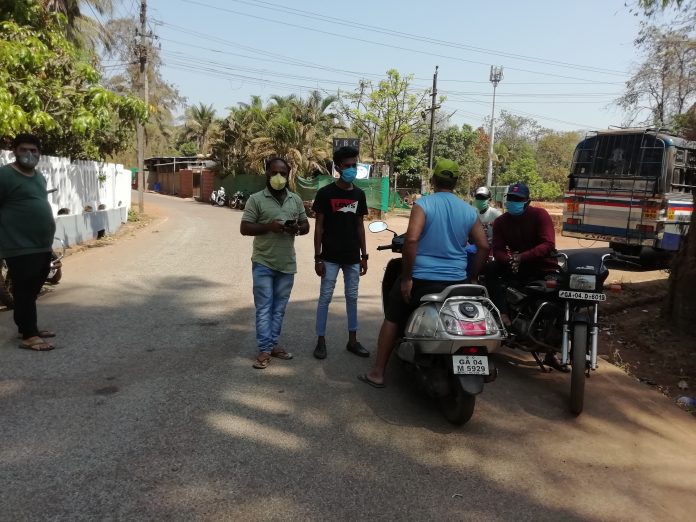
“I am doing this for the sake of Allah,” says one such hero, 33-years-old Sarfaraz who is a social activist and member of Valpoi Municipal Council. Sarfaraz Sayed from Goa has set an example before more influential personalities sitting silent at this time by identifying a cluster of about 200 migrant laborers employed across north India where along with his team, are working day and night to provide basic meals. Sarfaraz is on duty voluntarily since day 1 of the lockdown, extending help and support tirelessly to the residents of his town by distributing meals to daily wage workers. In order to keep the infection from spreading for these workers – many of whom are homeless or are away from their home towns – his team has sealed an entire block meanwhile providing all the essential commodities to the residents at their door step.
“We should not forget our poor neighbors and other marginalized as have no sources and money to feed themselves and their family members,” he said, speaking with Twocircles.net. Sarfaraz opines that since this has emerged as a global pandemic, it is a threat to the whole humanity and it is in fact, the responsibility of all the citizens to together fight against the disease. “I am thankful to him for helping my family and making essential commodities available and taking care of working class,” said Mohammad Ibrahim, a beneficiary of Sarfaraz’s free meals programme.
In the same state, another cluster of about 400 families, of whom 40per cent are migrant laborers, are being provided meals, shelter and other essentials by a team of 40 youths who are on their toes since March 15, delivering services 24 hours. “Our schedule is hectic and our distribution work is risky during this time but we are satisfied that Allah has chosen us to serve humans,” expressed a jubilant Saddam Shaikh who is volunteering to serve daily meals to the daily wage laborers. He added that the Deputy Collector and Municipal Councils, in association with the local police have issued passes to these volunteers for allowing them to fetch groceries for distribution.
“Our team personally visits him or her and sends them to quarantine for further medical observations,” said Akib Shaikh, a health care worker from the community health centre. Akib and his team are also frontliners in the country’s Corona battle. Visibly stressed, he refused to talk much about his duties and informed that since past 15 days they are keeping a strict eye on travelers who have come from other states or countries. When asked about government involvement in extending help to the poor, these heroes at the time of Corona distress expressed that as responsible citizens we must all strictly follow guidelines issues by both Central and State governments, adding that the health minister of Goa is doing a fantastic job to control the Covid19 outbreak.
A known social activist from the town Zubair Aga praised Akib and Sarfaraz’s nonstop contribution in this huge countrywide crisis. He added that these are real leaders devoting themselves to humanitarian causes as a real warrior. All praises for the health care workers, delivery service agents, and others, Zubair said, “We salute all of them who are doing commendable jobs even in such unfavorable circumstances.”
source: http://www.twocircles.net / TwoCircles.net / Home> Indian Muslim> Lead Story> Pandemic / by T.I. Inamday, TwoCircles.net / April 04th, 2020
The superstar’s decision to donate his office comes just a couple of days after he made huge contributions to the government to aid the battle against the COVID-19 pandemic.
Bollywood actor Shah Rukh Khan (File Photo | PTI)
Mumbai :
Bollywood superstar Shah Rukh Khan and his wife Gauri have offered their four-storied personal office space to Brihanmumbai Municipal Corporation (BMC), to be utilized as a quarantine facility for women, children and the elderly. This comes at a time when the nation along with the rest of the world is battling the deadly COVID 19 pandemic.
Thanking the Bollywood superstar and his wife for their act of generosity, BMC shared on social media: “#StrongerTogether We thank @iamsrk & @gaurikhan for offering their 4-storey personal office space to help expand our Quarantine capacity equipped with essentials for quarantined children, women & elderly. Indeed a thoughtful & timely gesture! #AnythingForMumbai #NaToCorona.”
We thank @iamsrk & @gaurikhan for offering their 4-storey personal office space to help expand our Quarantine capacity equipped with essentials for quarantined children, women & elderly.
With 10.5K TESTs, #FlattenTheCurve is the mantra adopted by @mybmc since 3-Feb!
4K #HomeTests so that you #StayHomeStaySafe
Thanks to @mybmc Docs & Pvt Labs in Mumbai, we’re grateful to contribute to India’s efforts at testing 43K#ProudToProtect#AnythingForMumbai#NaToCoronahttps://twitter.com/mybmc/status/1246130737620779010 …
The superstar’s decision to donate his office comes just a couple of days after he made huge contributions to the government to aid the battle against the COVID-19 pandemic.
SRK, through his IPL franchise Kolkata Knight Riders (KKR), has committed to contribute to the PM-Cares Fund. Through his film production banner, Red Chillies Entertainment, he will give to the Maharashtra CM’s Relief Fund.
The superstar has also pledged Personal Protective Equipment (PPE) for healthcare providers and workers in Maharashtra and West Bengal.
SRK’s Meer Foundation along with the foundation Ek Saath will provide daily food requirements to over 5500 families for at least a month in Mumbai. Meer Foundation is also collaborating with Roti Foundation to provide meals to underprivileged people and daily wage laborers.
source: http://www.newindianexpress.com / The New Indian Express / Home> Good News / by IANS / April 04th, 2020
IT major Wipro Ltd, Wipro Enterprises Ltd and Azim Premji Foundation, have together committed Rs 1,125 crore towards tackling the unprecedented health and humanitarian crisis arising from the COVID-19 pandemic.
“These resources will help enable the dedicated medical and service fraternity in the frontline of the battle against the pandemic and in mitigating its wide-ranging human impact, particularly on the most disadvantaged of our society,” the companies said in a statement.
Of the Rs 1,125 crore, Wipro Ltd’s commitment is Rs 100 crore, Wipro Enterprises Ltd’s Rs 25 crore, and that of the Azim Premji Foundation is Rs 1,000 crore. These sums are in addition to the annual CSR activities of Wipro, and the usual philanthropic spends of the Azim Premji Foundation, the statement added.
Integrated action will be taken for a comprehensive on-the-ground response in specific geographies, it said.
source: http://www.deccanherald.com / Deccan Herald / Home> Business> Business News / by DHMS, Bengaluru / April 02nd, 2020
A mosquito net-maker and an auto driver have been using their savings to feed the homeless and beggars every night.
Hyderabad :
A day after Chief Minister K Chandrasekhar Rao announced the state-wide lockdown and curfew from 7 pm to 6 am, the streets were uncharacteristically empty post nightfall.
While most of the residents stayed at home figuring out ways to procure essentials to sustain till the lockdown period, a group of youngsters from Sanath Nagar went around the city, braving the curfew and the police, to distribute food to the homeless and labourers at night.
Mohammed Qadeer, a mosquito net-maker, and his friend Mohammed Ghazi, an auto-rickshaw driver, have been using their savings from the day of lockdown to feed around 100-150 homeless and beggars every day at night. What they’re doing is of significance: though there are many people distributing food during the day, there is hardly anyone doing it at night due to the curfew.
The Express chanced upon the youngsters a few days ago at around 9 pm and accompanied them while they distributed food packets to the needy. While Qadeer rode a motorcycle alone, two others were on another bike holding a large crate filled with food packets – comprising dal and rice.
They moved slowly looking out for homeless or beggars sleeping on the pavements. When they approached one such person who was sleeping in front of a restaurant at Somajiguda, there was a look of disbelief on his face when he realised that he was being given food.
They were stopped by a bike-borne traffic police, who enquired what they were doing out at night. After Qadeer and others explained to the police of their service, they were let go. “This has happened every day till now. We are always stopped by the police, but they let us go when we tell them why we are out,” he said on Wednesday.
They have now started distributing food in different areas like Lakdi ka Pul. “We are not affiliated to any NGO and we do not have any external funding,” Qadeer told Express. The Sanath Nagar resident makes food at his house, with his family helping him in the cooking process.
“We take utmost care when it comes to hygiene and ensure cleanliness while cooking food,” he said. However, as of on Wednesday, Qadeer said they have been facing financial issues and that they may not be able to distribute food for two days.
source: http://www.newindianexpress.com / The New Indian Express / Home> Good News / by Ahik Sur / Express News Service / April 02nd, 2020
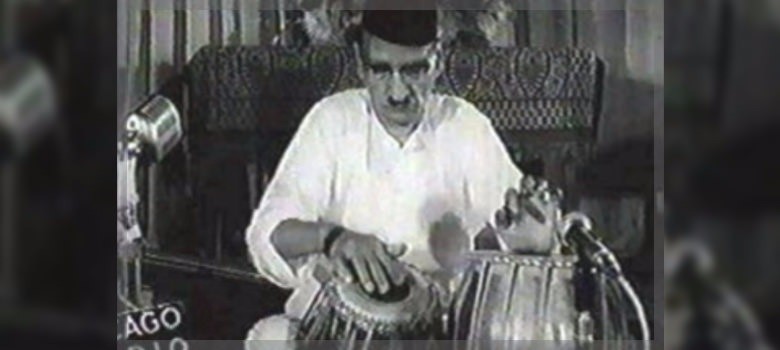
Interviewed when he was approximately 80, the musician was refreshingly honest about his career
via Youtube.com
The guru-shishya or master-disciple format of transmitting knowledge to students of Hindustani music is not restricted solely to the musical. It imparts extra-musical concepts and conventions that also form an integral part of the Hindustani music milieu.
One of the many extra-musical aspects that a student imbibes is a respect for the tradition. It is incumbent on the student to exercise humility, not just in the presence of seniors, but to approach musical knowledge and the tradition that continues to pass down this knowledge through successive generations with humility too.
Having said that, it is also true that performers seldom publicly accept their limitations, particularly when they have reached the zenith of their careers. It is certainly not expected from a performer of the eminence of Ahmed Jan Thirakwa (c.1880s-1976), one of the greatest tabla players of all time. But his candour in the interview conducted by vocalist Madhuri Mattoo for the Urdu service of the All India Radio is overwhelming.
In answer to a question at approximately 5.40” whether he ever faced a moment of failure in a concert, he readily answers in the affirmative. Mattoo ventures to attribute this singular failure to ill-health, but Thirakwa honestly lays the blame on his “ghuroor: or pride and vanity at the time. For those who believe that the performers on stage are in direct communication with the Almighty and that they personify humility, Thirakwa’s answer comes as a revelation. It illustrates that even the most accomplished of musicians have foibles and are therefore as human as anyone else. It also proves that while honesty is difficult to come by, it can perhaps be seen among those like Thirakwa, who are confident of their work and are not insecure about their position in the musician fraternity.
——
Interview of Ustad Ahmedjaan Thirakwa – Madhuri Mattoo
source: htttp://youtube.com
__________________
Recorded when he was 80 or thereabouts, Thirakwa describes his early training, at first in vocal music and then in tabla. Without a moment’s hesitation, he sings a vocal bandish or composition that displays the intense musicality he was seeped in right from his childhood. Similarly, he describes his training in Mumbai and his concerts across the country, including his employment at the court of the Nawab of Rampur.
Thirakwa admits that he had never performed overseas, despite having been requested to do so by Jawaharlal Nehru, when was prime minister. In a manner that is amazingly disarming, he says he did not comply with the request as he was not comfortable with air travel. Madhuri Mattoo tries convincing him to undertake such travel in future, as audiences overseas were keen to hear him. Thirakwa responds that he has flown from Calcutta to Guwahati and is now aware of what air travel entails. But his self-respect is evident when he states that he will travel overseas only if he is invited, as he has never requested anyone for performance opportunities and would never do so in future as well.
The interview moves on to illustrations of compositions from various schools of tabla playing. The audio clip ends with a solo recital by the maestro.
source: http://www.scroll.in / Scroll.in / Home> Sonic Saturday / by Aneesh Pradhan / February 13th, 2016
The editor-cinematographer has a popular Instagram page ‘cuts.zzz’ dedicated to such mash-up videos
Perhaps one of the most forwarded videos on social media during this lockdown has been US President Donald Trump ‘singing’ Mappilapattu. In this video, which has got 4.25 lakh views on Instagram page, ‘cuts.zzz‘, the president is depicted singing a traditional folk song of the Muslim community in Kerala, with Indian Prime Minister Narendra Modi, First Lady Melanie Trump, Ivanka Trump, Jared Kushner, and thousands of people cheering him on.
The “mash-up video” features the filmi version of the popular Mappila song, ‘Aminathathede Ponnumolaanu’, from the Malayalam movie Honey Bee 2.5, sung by actor-director Lal. The mastermind behind the video is editor-cinematographer-director Ajmal Sabu. With accolades coming in from the world over for his editing skills in creating the impression that Trump himself is singing those lines, the 24-year-old is on a high. The viral video has so far got over eight lakh views on Facebook as well.
“I didn’t expect such a reach for the video. I am getting messages from across India and even abroad,” says Ajmal over phone from his home at Changanassery in Kottayam district. He adds, “My professional commitments have been stalled due to the lockdown. So, instead of wasting time I thought of doing something interesting. I came across this song in a video my friend had sent me. I was hearing that version of the song for the first time and felt that I should put it to use somewhere. As the ‘Namaste Trump’ event at Sardar Patel Stadium in Ahmedabad, Gujarat, was a much-discussed event, I thought of giving it a try. And it clicked!” says the 24-year-old.
Mass appeal
Ajmal started his Instagram page for mash-up videos two years ago and most of them have gone viral. There are over 50 videos on the page, with another popular one being American wrestler and WWE superstar Big Show and WWE’s chief branding officer Stephanie McMahon supposedly saying the dialogues of Nakulan (Suresh Gopi) and Ganga (Sobhana) from an iconic scene in the Malayalam movie, Manichitrathazhu.
_________________________________________
Fact file
An alumnus of Maya Academy of Advanced Cinematics in Pune, from where he learnt animation, VFX and post production, Ajmal started out as a cinematographer with a Marathi film, Dhap. He was an assistant director in the Malayalam films Kappirithuruthu and Love Action Drama. He has also been a spot editor and is much sought-after in Malayalam film industry for making promo cuts, teasers and trailers of movies. He has directed short films and has done cinematography and editing in music videos, short films, documentaries and ad films.
He is all set to turn independent as an editor and cinematographer with a Malayalam film. “If the lockdown wasn’t there, the shoot would have begun on April 10. It is a good project and I still can’t believe that I am doing it,” he says.
__________________________________________
The first mash-up video he created was of the Joker-Batman scene from The Dark Knight with dialogues from Maheshinte Prathikaram, picturised on Soubin Shahir and Alencier. Among other videos that fetched lakhs of likes are those of Bruno Mars dancing to the tune of ‘Margazhiye malligaye’ from Megham, Rihanna’s video with the track of Popy umbrella ad, scene from Guardians of Galaxy with dialogues from Aniyathipravu and Modi’s speech at a rally with lottery announcement.
Ajmal says that there is no short cut to creating these videos. “It takes several hours to mix and match the scenes. I spent seven to eight hours on the Trump video alone. If you are taking a song or dance number, matching rhythm and steps are not that difficult. But the toughest part is lip sync. It is possible to experiment with all videos. However, you have to keep on trying to get the perfect match,” he says, adding, “At the same time you shouldn’t compromise on humour.”
source: http://www.thehindu.com / The Hindu / Home> Entertainment> Movies / by Athira M / Thiruvananthapuram – April 01st, 2020