Born as Salma Begum in a Muslim family of a small town Dibai, District Bulandshahar in the northern state of India, Uttar Pradesh, she went on to become the first Muslim woman in the world to do her PhD in Sanskrit (1969), India’s ancient language. After marriage she changed her name to Salma Mahfooz.
“My father, Ishtiaque Ahmed and mother, Ehsaan Fatima encouraged me to pursue my higher studies in Sanskrit as I was deeply interested in the language.
After completing high school from the UP board, I came to Aligarh Muslim University (AMU) for higher studies in 1961 and opted for Sanskrit,” says Dr. Salma Mahfooz.
Salma Mahfooz completed her BA and MA in Sanskrit and finally went on to write her PhD thesis in Sanskrit on the ‘Types of Heroines in Sanskrit Dramas’ under the supervision of India’s acclaimed Sanskrit scholar Dr. Ram Suresh Tripathi. She also did an MA in Hindi literature.
“In my PhD thesis, I have analysed several roles that a woman portrays in multiple Sanskrit literary forms,” says Dr. Salma Mahfooz.
She taught Sanskrit at Rani Bhagyawati College in Bijnor and later joined AMU as a Lecturer.
Under the fellowship of India’s regulatory body for higher education, University Grants Commission, she authored a book ‘A Critical Study of ‘Sirre Akbar visa-vis-The Upanishads’ by Dara Shikoh (1615 – 1659), the eldest son of Mughal Emperor Shah Jahan
“I have taught Upanishads, Hindu religious texts, and various other Sanskrit literature components,” adds Dr. Salma Mahfooz.
A practicing Muslim, Salma Mahfooz has studied Hindu scriptures and texts, including The Bhagavad Gita, a 700-verse Sanskrit scripture that is part of the Hindu epic Mahabharata, and Kama Sutra, an ancient Indian Sanskrit text on sexuality and eroticism.
She was a Senior Research Fellow and Research Associate at the University Grants Commission and also headed the Sanskrit Department of the Aligarh Muslim University.
source: http://www.youtube.com / www.cineink.com / Cine Ink / January 10th, 2019
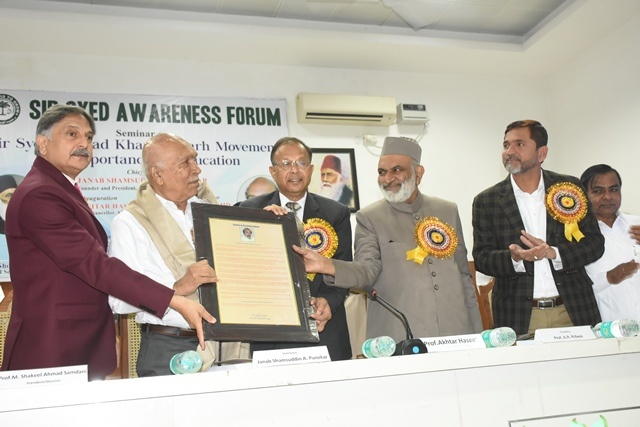
Mohsin E Millat Award being presented to Mr. Shamsuddin Punekar by Prof. Shakeel Samdani, Prof. Akhtar Hasbeeb and Prof. A.R.Kidwai
Aligarh:
“Those who are getting education from the great institution established by Sir Syed Ahmad Khan are having the blessings of Almighty on them. Had the Aligarh Muslim University (AMU) not existed, then the Indians would have remained educationally backward for a long period of time. I really admire Sir Syed Ahmad Khan that he started an educational movement and that movement gave me inspiration to do social and educational work” said edupreneur Shamsuddin Abdullah Punekar while addressing a seminar organized by Sir Syed Awareness Forum (SAF) on “Sir Syed, Aligarh Movement and Importance of Education” at Auditorium, University Polytechnic, Aligarh Muslim University, Aligarh.
Mr. Punekar was also conferred “Mohsin E Millat Award” for his services in the field of education. He is the man who established 24 educational institutions in Karnataka and running them successfully.
The award was conferred by Prof. Akhtar Haseeb, Pro Vice Chancellor, AMU and Prof. Shakeel Samdani, President of Sir Syed Awareness Forum, Aligarh..
Mr. Punekar further said that it is the duty of the old boys of this university to take inspiration from the life of Sir Syed and spare some time and money for social and educational work. He told the audience in detail about his life and struggle in establishing 24 educational institutions in Karnataka. He exhorted the audience to save our youth by guiding them on the right path. At last, he congratulated Prof. Shakeel Samdani for organizing such a wonderful seminar.
While inaugurating the seminar, Prof. Akhtar Haseeb, Pro-Vice Chancellor, AMU said that the seed of scientific education planted by Sir Syed has grown up into a tree in the form of Aligarh Muslim University and its three centres. Sir Syed always preached the ideals of tolerance, secularism and brotherhood. He, while congratulating Prof. Shakeel Samdani for successfully organizing the seminar, said that there is no substitute of hard work and those who keep on working hard will see its benefits sooner or later. In the last he advised the audience that whatever has been transpired in the seminar should be transformed into action.
Prof. Shakeel Samdani, Director of the seminar and Dean, Faculty of Law, AMU while highlighting the objectives of the SAF, said that this forum was established 15 years ago with the mission to enlighten the ideals of Sir Syed to the students and the forum has been successful in doing so. The purpose of this forum is to make the students aware about the mission and vision of Sir Syed including constitutional ideals of secularism, tolerance, peace and harmony. Prof. Samdani furhter said that in comparison to North India, South Indian Muslims adopted Aligarh Movement and established hundreds of high qualtiy institutions. The same movement should be restarted in north India by the Muslims.
U.P. Ratan Awardee, Dr. Lokesh Sharma said that no one can repay the debt of Sir Syed Ahmad Khan. Sir Syed lost everything for the upliftment of the community. Without caring about his opposition and criticism Sir Syed continued to work for scientific education and he successfully achieved his goal.
Prof. A.R. Kidwai, Director, UGC Academic Staff Collge, AMU while delivering his presidential remarks said that, Sir Syed worked a lot for scientific education and he became a defender of scientific education. He also discussed the tour of Sir Syed to England, where he saw the lifestyle, education system, syllabus, buildings of them and tried to replicate them in AMU.
Dr. Swati Rao while addressing the gathering said that education is incomplete without proper upbringing. She further said that Urdu language is an Indian language and it can be called as the language of communal harmony. She wondered by Urdu language is not getting justice in the country.
Prof. Mohibul Haque said that Sir Syed was one who influenced the time. Sir Syed and Raja Ram Mohan Roy were the first who started socio-religious movement in India. Sir Syed launched educational movement for regeneration of Muslim community and he was the pioneer of interfaith understanding.
The notable feature of the seminar was that it was attended by 32 delegates from Karnataka, Maharashtra and Andhra Pradesh. 2 delegates came from Turkey and gave an international touch to the seminar. A large number of academicians, faculty members and students of AMU were present in this seminar.
The seminar was moderated by Ayesha Samdani, MBBS student, at AMU. The seminar was started by the recitation of verses from the Holy Quran by Dr. Obaid Iqbal Asim, Abdullah Samdani welcomed the guests and vote of thanks was proposed by Khansa.
The seminar was made successful with the tireless efforts of Adv. Shoeb Ali, General Secretary, SAF, Dr. Haider Ali, Inchage, Mrs. Anjum Tasneem, Mohd. Nasir, Hunain Khalid, Kashif Sultan, Chitranshu, Manasvee, Samreen, Anas, Shubham, Zakia Khan, Samra Hashim, Pawan Varshney, Yusuf Iqbal, Md. Sabeeh, Sachin Varshney, Rahul Singh, Shelja, Talat Anjum, Razia Chauhan, Shreya Singh, Salman, Moiz, Adnan, Chirag and others.
source: http://www.muslimmirror.com / Muslim Mirror / Home> Education> Indian Muslim> Positive Story / by Abdullah Samdani / November 17th, 2019
As many as 798 candidates have cleared the Combined Medical Services Examination 2019 conducted by the Union Public Service Commission against 919 vacant positions. Among the successful candidates, there are 41 Muslims.
The examinations were held in two parts. The Computer Based Examination (Part-I) was held on July 21, 2019 and Personality Test (Part-II) was held from October to December 2019. The final results were declared on December 27.
The successful candidates, in order of merit, have been recommended for appointment to the posts of:
(i) Assistant Divisional Medical Officer in the Railways
(ii) Assistant Medical Officer in Indian Ordnance Factories Health Service
(iii) Junior Scale Posts in Central Health Service
(iv) General Duty Medical Officer in New Delhi Municipal Council
(v) General Duty Medical Officer Gr-II in East Delhi Municipal Corporation, North Delhi Municipal Corporation and South Delhi Municipal Corporation.
List of the successful Muslim candidates:
Name
Rank
1
SAHANA B
6
2
FATIMA RASHID
86
3
SABAHAT ZAFAR
103
4
MOHAMMAD AKHAL ALISHA
179
5
MODASSAR FERAZ
186
6
SAID JABIR
234
7
SYED SAHIL HUSSAIN RIZVI
242
8
ABOOTHAHIR VM
286
9
P SHAIK HUSNA NAAZ
288
10
JUBAIRIYA K H
303
11
MAHSOOMA T A
304
12
FARHAT KAUSAR
335
13
SHAMEEL K K
344
14
SHABNA A
353
15
BEEGUM THASNEEM S S
365
16
TASNEEM MUHAMMED SHERIEF
383
17
THASLEEM SHAREEF
384
18
SUBAHANA NAZIR
411
19
MADHIHA M
443
20
SHABNA T K
485
21
ANSHAD BEGUM
494
22
SHAIK JAWAD HUSSAIN
583
23
RAFSAL MUHAMMAD
590
24
MOHAMMED ASIF
591
25
RAFIYA FATIMA
597
26
MOHAMMED SADIQUE M P
600
27
MOHD NAWAZ
620
28
AYSHA M
629
29
SHAHEENA PARVEEN H
648
30
NIDA SHABBIR
650
31
MOHAMMAD ASLAM ANSARI
651
32
SAJIL HAQ C G
665
33
ALAUDDIN ANSARI
667
34
DANISH AHMAD KHAN
688
35
SOMY KHAN
709
36
MOHAMMED SADATH ALI P V
717
37
SAHANASHREE G
736
38
TAHIR MEHMOOD
742
39
MEMON NAURIN ZAHIDBHAI
750
40
HAIK MOHAMMED ILIYAZ BASHA
753
41
AMEENA M
794
source: http://www.caravandaily.com / CaravanDaily.com / Home> Big Story> Indian Muslims / by Caravan News / January 01st, 2020
After the induction of 36 ministers on Monday, the 43-member council of minsters (CoM), led by chief minister (CM) Uddhav Thackeray, has seen the Maratha community dominate the Cabinet, followed by legislators from the Other Backward Classes (OBC). Significantly, the Muslim community, represented by four ministers, has also got one of the highest representations in the Maharashtra Vikas Aghadi (MVA) Cabinet.
In terms of regions, most of the ministers are from western Maharashtra and Vidarbha.
In Thackeray’s 43-member Cabinet, there are 19 ministers from the Maratha community, with deputy chief minister Ajit Pawar, senior Congress ministers Ashok Chavan and Balasaheb Thorat, senior Nationalist Congress Party (NCP) ministers Jayant Patil, Dilip Walse-Patil and Anil Deshmukh and Shiv Sena ministers Eknath Shinde and Gulabrao Patil, being the prominent faces.
OBC community is represented by former deputy CM Chhagan Bhujbal, Dhananjay Munde, Jitendra Awhad, Vijay Wadettiwar and Sanjay Rathod.
From the Muslim community, Thackeray has inducted party legislator Abdul Sattar, as well as Hasan Mushrif and Nawab Malik from NCP, and Aslam Shaikh from the Congress.
The other caste-based representations include Nitin Raut, Varsha Gaikwad and Sanjay Bansode, who are from the Scheduled Caste (SC) community, while seven-time legislator KC Padvi is the lone tribal representative in the Cabinet.
The region-wise distribution of the ministerial berths is dictated by the number of seats each of the three parties has won in a particular region, as well as how a party has countered the Bharatiya Janata Party (BJP) in the Assembly polls.
Thirteen ministers were chosen from western Maharashtra, as the Congress and NCP gained the maximum support in the region. It was followed by Vidarbha (8), Marathwada (7), north Maharashtra (4) and Konkan (2). From the Mumbai Metropolitan Region, four ministers, including Aaditya Thackeray, are from Mumbai and two are from Thane.
“Sangli and Kolhapur have received the maximum representation from the Congress and NCP, with ministers such as Jayant Patil, Hasan Mushrif, Satej Patil, Vishwajeet Kadam along with first-time minister Rajendra Patil Yadravkar, making it to the cabinet. Satara also has been given fair representation with the induction of Balasaheb Patil. These districts had given the two parties the most number of MLAs by defeating the BJP candidates,” said a Congress leader, who did not wish to be named.
The three ruling parties have inducted Balasaheb Thorat, Prasad Tanpure and Shantaram Gadakh from Ahmednagar to limit Radhakrishna Vikhe Patil and Madhukar Pichad’s influence in the region at check. The duo had deserted the Congress and NCP to join BJP.
Congress has picked the maximum number of ministers from Vidarbha, where it had gained majorly in the Assembly polls. Congress’s Nitin Raut, Vijay Wadettiwar, Yashomati Thakur and Sunil Kedar got the Cabinet berths, while Nana Patole was elected as the speaker of the lower house after the new government came to power. From the region, NCP chose Anil Deshmukh and Rajendra Shingane, while Sena has inducted Sanjay Rathod and Bachchu Kadu. However, most of the MLA’s who won in Vidarbha are from BJP.
An NCP leader said that though the three ruling parties had decided to have better coordination in terms of representation to the region, it could not do so while finalising the names for the ministerial berths.
“For instance, Eknath Shinde (Sena) and Jitendra Awhad (NCP) both belong to Thane district, while in Sindhudurg and Ratnagiri, Sena and NCP could give only one berth despite their dominance there,” he said.
Prakash Pawar, political analyst from Kolhapur, believes that the three parties did not choose ministers on the basis of caste and region alone. “I don’t think the induction of the ministers was on the basis of caste or region. The ruling parties have tried to keep BJP, the single largest party in the Assembly, in check owing to the uncertainty over the alliance lasting for five years. This is not a natural alliance and thus it will always be under threat from BJP. By giving a fair representation to OBCs, the ruling parties have also tried to attract BJP’s traditional vote-bank of OBCs,” Pawar said.
source: http://www.hindustantimes.com / Hindustan Times / Home> Mumbai News / by Surendra P Gangan / December 31st, 2019
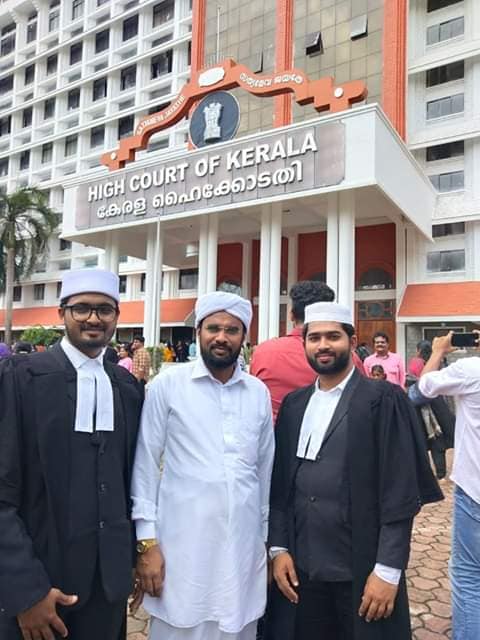
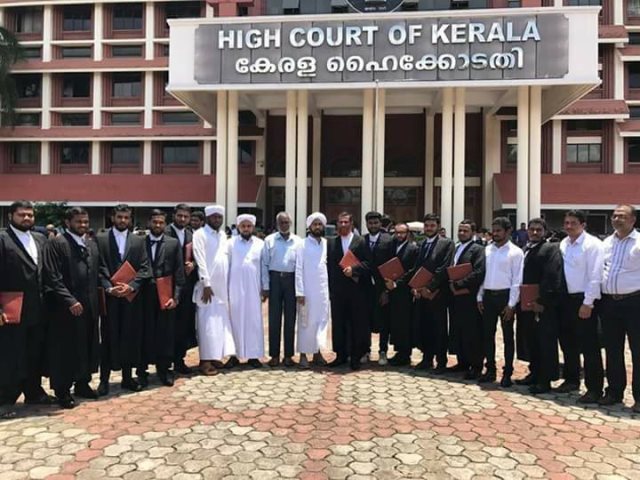
Jamia Markaz at Karanthur in Kozhikode is on a roll as the first batch of 20 Muslim religious scholars from Markaz Law College turned lawyers. Thanks to the mission of Kanthapuram A P Aboobacker Musliyar alias Sheik Abubakr Ahmad, the founder and chancellor of Jamia Markaz in ensuring students overall growth– Intellectual, Spiritual and Social.
And rightly the Governor of Kerala Arif Mohammed Khan during an event at Jamia Markaz a week ago had eulogised the services of Aboobacker Musliyar by saying– Kerala Muslims are blessed as they have visionary religious leadership. Not just imparting education, the Markaz hones the skills of students in different spheres thereby making them face the challenges in life after their course.
Joy knew no bounds for the Musliyars turned lawyers clad in black pants and white shirts with the advocate gowns after they got enrolled at the Kerala State Bar Council in Kochi. Interestingly, the enrolment event was like a festival with family members, college management and scores of friends and relatives accompanying them. Markaz Law College is the first project launched under the Knowledge City of Markazu Saquafathi Sunniyya which is affiliated to the University of Calicut and is recognised by the Bar Council of India. The law college started in October 2014 at the markaz campus offers three year LLB course.
Notably, the religious scholars after completing their post-graduation in Islamic theology took up law course. Quite interestingly, fifty year-old Dr Hussain Saquafi C S,the vice chancellor of Jamia Markaz was one among the first batch of students to get enrolled as advocate at the bar council in Kochi. Enthusiam was writ large on the face of newly enrolled advocates, who are all set to begin their legal practice. Meanwhile, a few are preparing for governemnt postings as munsif cum magistrate while a major chunk of them are keen to specialise in criminology, human rights, corporate law and constitutional law.
Jamia Markaz (Islamic University) was established in 1978 in a sprawling campus at Karanthur in Kozhikode grew from strength to strength to emerge as a centre of social, cultural progress as well as educational excellence for the entire communities across the country as a whole Muslims in particular. Sheikh Abubakr Ahmad is the grand Mufti of India, who is also the General Secretary of the All India Sunni Jamiyyathul Ulama besides Chancellor of the Jamia Markaz and Chairman of the Siraj Daily and President of Islamic Educational Board of India.
source: http://www.muslimmirror.com / Muslim Mirror / Home> Education> Indian Muslim / by M Rafi Ahmed, Muslim Mirror / November 01st, 2019
The JMM-Congress-RJD combine is heading for a clear mandate in the Jharkahnd Assembly polls
Ranchi:
Dr Sarfaraz Ahmad of Jharkhand Mukti Morcha (JMM) and Irfan Ansari of the Indian National Congress (INC) are set to win the 2019 Jharkhand Assembly election from their respective constituencies by comfortable margins.
According to the update by the State Election Commission, Dr Sarfaraz Ahmad of JMM is well ahead of his nearest rival sitting MLA from Gandey assembly seat Jai Prakash Verma of BJP. The State Election Commission said Dr Sarfaraz is leading by 10,279 votes at 07:00 pm in Gandey Vidhan Sabha seat.
State Election Commission also showed Irfan Ansari of Congress leading by 9,137 votes in Jamtara assembly seat. Here BJP candidate Birendra Mandal tried to unseat Irfan Ansari from the Jamtara seat, but failed.
The JMM-Congress-RJD combine is heading for a clear mandate in the Jharkahnd Assembly polls and is set to form the new government, as per the latest Election Commission counting trends.
Of the most prestigious of the contests, Chief Minister Raghubar Das is trailing rebel BJP candidate Saryu Rai in the Jamshedpur East seat by over 1,000 votes.
As per the votes counted so far, the Jharkhand Mukti Morcha (JMM), the Congress and the Rashtriya Janata Dal (RJD) together have won or leading in 47 constituencies out of the 81 seats.
The Bharatiya Janata Party (BJP) has won 03 seats and is leading in 22. The All Jharkhand Students Union (AJSU) has won one seat and is leading in two. The Jharkhand Vikas Morcha-Prajatantrik (JVM-P) is leading in three seats.
AJSU chief Sudesh Mahto has won the Silli seat by 20,000 plus votes. JVM-P chief Babulal Marandi is leading by 15,000 votes in the Dhanwar seat.
Jharkahnd Urban Development Minister C.P. Singh has retained the Ranchi seat by 3,000 votes. Speaker Dinesh Oraon, Labour Minister Raj Paliwar, Education Minister Neera Yadav many other stalwarts and trailing.
The JMM-Cong-RJD alliance chief ministerial candidate Hemant Soren (JMM chief) is leading in both Dumka and Barhet seats.
source: http://www.ummid.com / Ummid.com / Home> India / by ummid.com with inputs from IANS / December 23rd, 2019
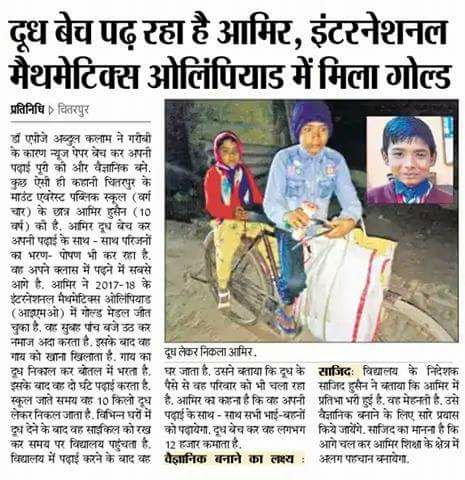
We have acknowledged a lot of legendary stories of underprivileged children who knocked out every difficulties on their way to achieve a great successful life ahead. One bright example is Dr. APJ Abdul Kalam, who, out of poverty, used to sell newspapers in his early childhood to earn for his livelihood and studies. Dr. Bhim Rao Ambedkar couldn’t study in a small room due to the presence of his other fourteen siblings, so he used to sleep early and get up in the midnight to study when all others were fast asleep. Dr. Rajendra Prasad studied under the street lights, etc.
Here is a similar story of a child named Aamir Ahmad of fourth class. Aamir has won gold medal in the International Mathematics Olympiad (IMO) in 2017-2018.
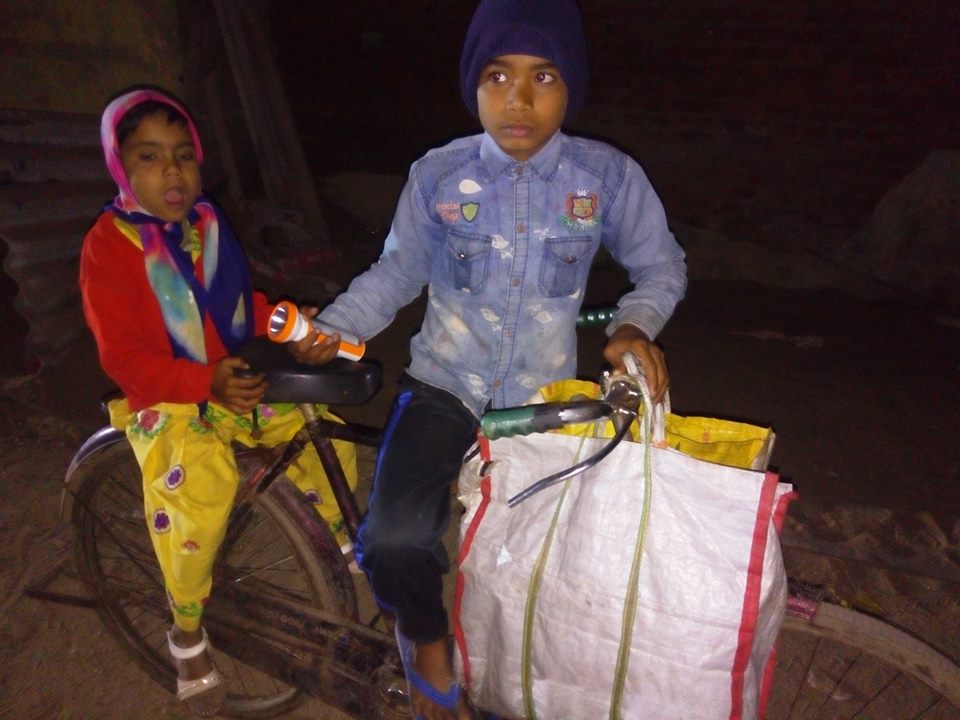
It was a cold night. It was the wedding reception party of a friend. We had our fine dinner by 9 pm. Now it was time for the talks for the gathering of friends. We set a bonfire in front of the friend’s house. And the laughter began. We indulged in the entertainment of anecdotes and jokes around married life. Then a bicycle bell rings. We were blocking the road with our gathering. A little boy on a cycle with his younger littler sister on the back carriage of the bicycle. He wanted us to move so that he could go on his way.
Aamir with his sister. Picture taken from Author’s FB page
My eyes fell on the boy. With a woolen cap on his head and a shirt with all buttons buttoned up till neck for it was cold out there, maybe he didn’t have a sweater. I recognized the boy. He was Aamir from my school. I called him out, “Aamir”. He replied, “yes, sir”. I approached him. His bicycle’s handle was laden with 10-12 one and two-litre bottles and a 3 year old sister on the back. Some 20-25 kilogram load. I asked him “where are you going in this cold night?” He replied, “I am out to sell milk, house to house.” I said “day after tomorrow you have level-2 exam of International Mathematics Olympiad”. He replied immediately, “Yes, sir. I have finished revising 7 chapters of the 14 from IMO practice book before leaving home and will finish the remaining 7 chapters after going back home before I sleep.”
I was stunned. I knew he was from an economically poor family but I didn’t know that he used to sell milk every morning and evening. I didn’t have any words to say. I stood there looking at him with a gasp. He kept looking at me if I had to tell something. I could say anything but okay bye. He wished ‘salaam’ and left to go about his work.
I was shaken from inside. I kept thinking how many such kids are struggling day in day out to make their dreams come true with all their sweat and blood, with no proper clothes to wear according to the weather, with no food to fill their stomachs two times a day but with courage to dream of reaching the stars.
Aamir is the eldest of his siblings. He tops in his class exams. Has already earned a gold medal in International Mathematics Olympiad. Tomorrow (11th Feb, 2017) he is going to Bishop Cotton School, Ranchi, to attempt level-2 of the IMO.
I only pray that this 10 year old Aamir becomes exemplary for kids of his age sucked up in Android culture and becomes a new Kalam for the country.
(Note: The original write-up(Hindi) is translated into English by Kashish Azeem and Adeel Ahmed)
source: http://www.thecompanion.in / The Companion / Home> Education / by Sajid Hussain / February 14th, 2018
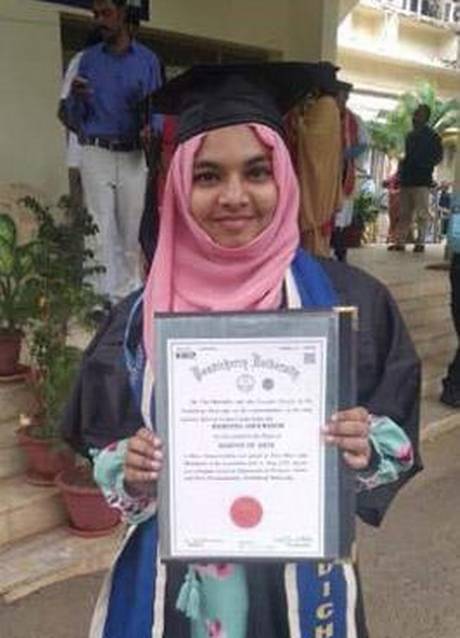
Rabeeha Abdurehim later accepted her certificate but turned down the medal. | Photo Credit: Special Arrangement
Pondy University student later accepts M.A. degree but rejects medal in solidarity with CAA protesters
A student who completed her masters in Mass Communication with a gold medal from Pondicherry University, Rabeeha Abdurehim, has alleged that she was prevented from attending the convocation ceremony attended by President Ram Nath Kovind on Monday.
Rabeeha Abdurehim, who hails from Kozhikode in Kerala, told reporters after the ceremony that she was asked to leave the hall before the President arrived.
“As I was on the radar of authorities (for participation in anti-Citizenship Amendment Act protests), I was asked to leave the hall and was allowed only after the President left. Later, I received my degree and refused to accept the gold medal,” she told reporters.
Ms. Rabeeha said her decision to reject the gold medal was also to express solidarity with students who faced police brutality while staging protests against the CAA.
‘Take a strong stand’
“Educated youth should take a strong stand against the legislation and fascist regime,” she said.
Ms. Rabeeha did her masters in the School of Media and Communication of Pondicherry University. Another gold medallist from the same school, Karthika B. Kurup had announced her decision to boycott the convocation in support of the protest against the CAA.
S.I. Humayun, officer-in-charge, Pondicherry University, said the student’s decision to not receive the medal from the President was her “personal decision” and the University had nothing to comment on it.
The official also denied knowledge of what actually led her to getting ousted as she had been duly registered and had taken a seat.
‘She was asked to leave’
“All we know is that there was commotion in the hall and she was asked to leave. She was allowed back after departure of the President.”
The official also denied the charge that she was asked to leave for wearing a hijab as was being claimed on social media.
“This is borne out by the student’s Facebook post where she herself has denied it,” said the official.
In her Facebook post, Ms. Rabeeha said that while she dreamt often about the moment she would receive a gold medal and master’s certificate, “never did I imagine it would end up being in a way in which I could send a strong peaceful message across India.”
“As a woman, as a student, as an Indian, today in my graduation I reject the gold medal awarded to me in solidarity with all the students and publicwho are fighting against CAA and NRC. This is my way of showing the world what education means to us youth, not medals and certificates but… standing up against injustice, fascism and bigotry,” she said.
“And even though (for ‘unknown’ reasons) I was send (sic) out of the auditorium where 100s of students sat awaiting their medals when the president came and was only allowed inside when he left, I feel at peace for the fact that I was able to take a stand as an educated youth”.
A post script to this added: “I have been seeing news which says I was asked to remove my scarf. That is false. No one asked me to remove anything. No one told me why I was kept outside.”
source: http://www.thehindu.com / The Hindu / Home> News> Cities> Puducherry / by Special Correspondent / Puducherry – December 23rd, 2019
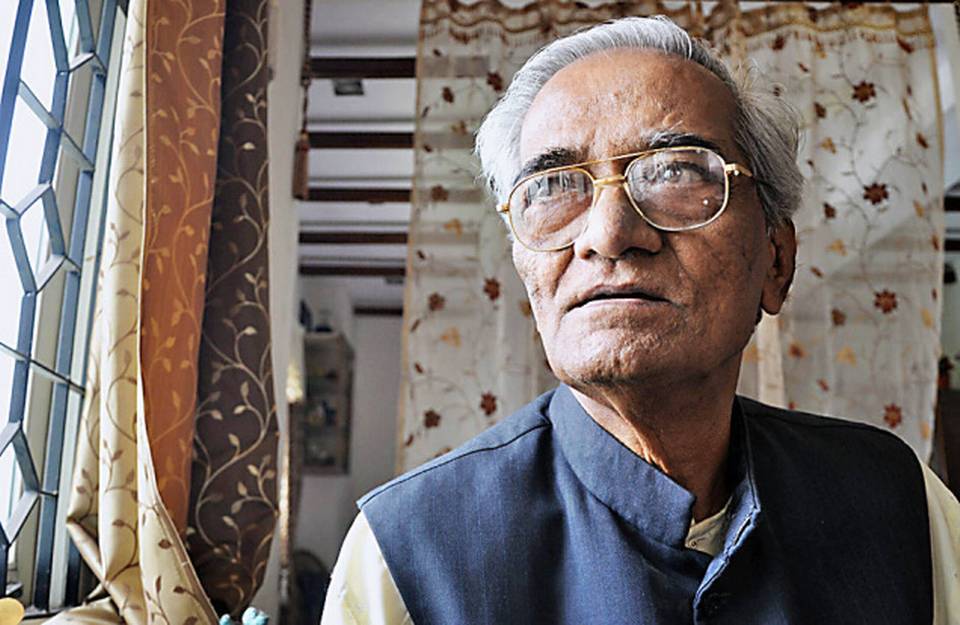
Padma Shri Mujtaba Hussain who completed 50 years of humour writing in Urdu. Photo: G. Ramakrishna | Photo Credit: G_RAMAKRISHNA
Many people have learned Urdu just to read his articles
Laughter is the shortest distance between two people. But in this case, it spans the entire Indian sub-continent. Whatever he writes, creates ripples of laughter across the Urdu world.
No prizes for guessing who the writer is. If it is Urdu and humour ,it ought to be Mujtaba Hussain.
For the past half a century, this Padma Shri recipient has been dishing out what is in great short supply today – humour.
Mr. Hussain’s writings open up the lips and the heart and at the same time show the pearls and the soul.
At 77, he is anything but tired.
This Hyderabadi humorist doesn’t believe in resting on laurels. Week after week, he churns out sharp and witty write-ups that are lapped up by his growing fans club.
Two books recently published by the Educational Publishing House, Delhi, bring out some of the finest writes-ups about Mr. Hussain penned by critics and writers of no mean repute.
The book “Mujtaba Hussain Jaisa Dekha Jaisa Paya” is all about his personality while “Mujtaba Hussain Aayeinon ke Beech” deals with his art and style.
At a time when the Urdu language has few takers, Mr. Hussain has revived interest in it through his satirical writings.
Many people have learnt Urdu just to read his articles.
Today a number of people have done research on him and many waiting to do Ph.D on his art.
The enduring appeal of his writings is a tribute to his uncanny sense of humour and the Urdu language itself.
Well known writer-journalist, Khushwant Singh, is an unabashed admirer of Mr. Hussain and feels he is rare among Indian writers of humour.
Pakistan writer, Syed Arif Hussaini, calls Mr. Hussain a purveyor of wit and humour.
“He excels in his field due to simplicity of his language, racy style and absence of overlapping themes,” he says.
Sure, Mr. Hussain’s brand of humour is wholesome and straightforward.
He creates humour without offending anyone. Borrowed brilliance is not his forte, says Mohd Ali Siddique, Pakistan’s well known critic.
No compromises
In a bid to tickle the funny bone, Mr. Hussain doesn’t compromise on the language either.
The simple but literary touch in his works comes as a breath of fresh air.
“His humour is laced with a bitter truth which only a honest person can perceive,” says his daughter, Rashida Samdani. Those who have read his “Apni Yad Mein” composition will know. It is a masterpiece of self obituary wherein the author highlights his own follies while taking pot-shots at life.
The two publications unveil interesting facets of Mr. Hussain’s personality. Several real life incidents are cited to show his ready repartee, subtle intellect and scintillating humour even during trying times.
Man knows how to cry from birth, but laughter takes some learning. But with Mr. Hussain’s ready wit, the job sure becomes easier.
source: http://www.thehindu.com / The Hindu / Home> News> Cities> Hyderabad / by J.S. Ifthekhar / Hyderabad – April 01st, 2013