A total of 2,102 students passed with 2nd Division and 2,608 cleared the exam with 3rd Division
SEBA AHM 2019 Result: The Board of Secondary Education Assam (SEBA) has declared the result of AHM Class 10th Examination 2019, also known as Assam Madrassa Board Examination 2019, on its official website sebaonline.org as well as on a number of other websites today i.e. Wednesday May 15 at 09:00 am.
According to the Board of Secondary Education Assam (SEBA), a total of 9,441 appeared for the 2019 Madrassa exam in 2019. Of them, 600 scored First Division + Distinction + Star. A total of 2,102 students passed with 2nd Division and 2,608 cleared the exam with 3rd Division.
Selim Ahmed scored 561 out of the total 600 marks and bagged the first position in the SEBA AHM Merit List 2019. Abdul Aziz came 2nd with 553 marks and Ilias Ali came 3rd with 547 marks.
SEBA HSLC Class 10 Toppers 2019
According to the Board of Secondary Education Assam (SEBA), Meghashree Borah has topped the Assam board Class 10 exams. Meghashree Borah has scored 594 out of 600 and is the topper. She is a student of Shankardev Shishu Bidya Niketan, Narayanpur.
Chinmoy Hazarika and Pratyashi Medhi have secured second position by scoring 593 out of 600. Scoring 591 marks, Anushree Bhuyan and Afreen Ahmed have secured the 3rd rank in the SEBA 2019 Merit List.
As many as 16,848 students have got Distinction+Star, 5,522 have got Distinction and 71,022 students have passed with 2nd division and 82,889 students have passed with 3rd division in the 2019 SEBA Assam HSLC 2019 exam.
The state has recored an overall pass percentage of 60.23% – an improvement by about 06% as compared to 2018 when the pass percentage was 54.46%
Click on High School Leaving Certificate Examination (HSLC & AHM) Results, 2019.
Enter your Roll No and Click on Get Results button.
SEBA Secretary said the Assam board Class 10 HSLC AHM result 2019 will also be available on results.sebaonline.org, resultsassam.nic.in, examresults.net, exametc.com, indiaresults.com, assamonline.in, results.siksha, knowyourresult.com, assamresult.in.
Steps to Check SEBA HSLC Result 2019 via SMS
If you are a BSNL user SMS SEBA19 give space type roll number to 57766. If you are Idea/Jio/Vodafone users SMS AS10 give space type roll number and send to 58888111. If you are AirTel users type AS10 give space type roll number and send to 520701.
SEBA HSLC AHM Result on Mobile App
Android users should download SEBA Result 2019 App from Google Play Store. Install it in your phones to check SEBA Matric result 2019.
The board secretary further said that the students wil be able to collect their mark sheets from the respective schools from 11 am on Wednesday itself. This year, around 3,50,000 students had registered for the examination that was conducted from February 14 to March 2, 2019 at various centres across the state of Assam.
SEBA HSLC/AHM Result
The overall pass percentage of SEBA 10th 2018 exam was 54.46%. A total of 1,75,976 students had appeared for the exam. Of them 95,813 had passed. The board said some 31,562 students have got the first division, 41,195 second division and a total of 22,956 students had got third division in 2018.
Top 03 rank holders in 2018 were: 1st Raktim Bhuyan (593 marks), 2nd Abinash Kalita and Preetpal Bezbaruah (592 marks) and 3rd Sultana Ayishah Siddique, Jintee Devi, and Arbi Chaliha (591 marks).
source: http://www.ummid.com / Ummid.com / Home> Education & Career / by ummid.com News Network / May 15th, 2019
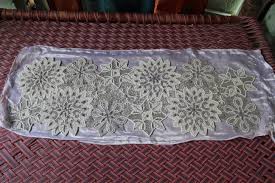
Rifat’s Christmas-themed snowflake panel that she embroidered with her sister and with help from two of her nieces.
Rifat Bano (30) sits on the brick floor of her home in Marehra, Etah, chatting with her sister Sabina and their two nieces. Between them is a snow-white satin cloth stretched tautly on a rectangular wooden frame.
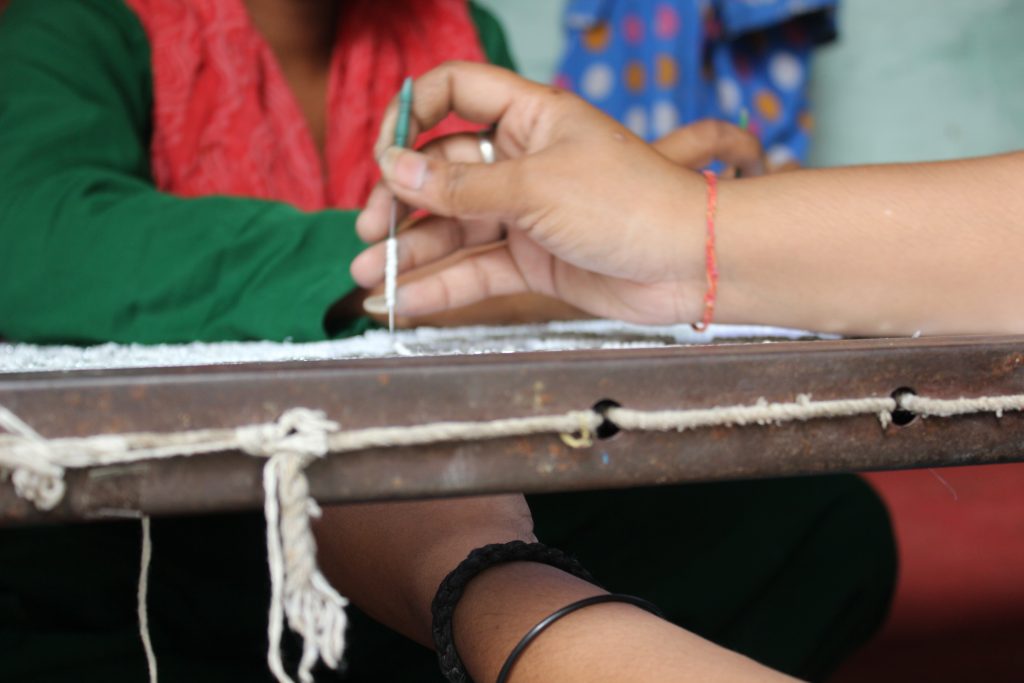
Her hands move at a habitual pace: one places an index-finger-length hooked needle, filled with white and silver beads, on a specific point in the cloth panel. As the needle goes through the cloth, the hand underneath guides a plastic wire to latch onto the needle’s hooked tip, which pierces the cloth. As the needle withdraws, it stitches the bead onto the cloth.
A single panel is usually embroidered by two or three women who sit around the karchob. Here, Rifat Bano guides the needle through the panel as sister Sabina sits on the opposite side embroidering.
This is Karchobi ka kaam or Karchobi work, a style of beaded embroidery that, according to noted historian Professor Irfan Habib, is an import from Iran that came to India around the 17th century.
A more commercialized form of this craft was introduced in Marehra about 20-25 years ago by a man named Ajmeri. Embroiderers says that Ajmeri had relatives in Sikandra Rao and learned the work there and then brought it to Marehra, where he was from.
He first trained his wife, who then trained women in her predominantly Muslim neighbourhood, which is the reason that even today the majority of embroiderers in Marehra are Muslim women.
About 700-800 women are now employed in the Karchobi industry in Marehra, says Matsyanath Trivedi, the Block Development Officer. It is now more widespread in Marehra than Sikandra Rao, so that Rifat Bano says, “Marehra mein aisa koi ghar nahi milega aap ko jahaan Karchobi ka kaam nahi hota ho – You won’t find a single house in Marehra where Karchobi work is not being done.”
She herself started doing Karchobi embroidery when she was just 9 years old. Her family was against it, as it strains the eyes but she went ahead and learned it, in secret.
Three years later, when her father, a fruit seller, died, she had to continue this work to support her family, eventually becoming the primary breadwinner. “Pehle shauq tha, phir shauq majboori ban gayee (At first it was my interest but then it became my necessity),” she says.
Setting it up
All embroiderers have to go through a set of preparatory steps before starting on the embroidery process. First, they mount the fabric on the karchob.
Irfan Habib, in a 1973 paper titled “Indian Textile Industry in the 17th Century”, wrote that in Persian, “kar-chob” refers to “the wooden frame” that holds “the fabric taut, when [it is] being embroidered.”
The more popular Zardozi is also done on a karchob. However, while Zardozi exclusively uses silver or gold thread, Karchobi embroidery also makes use of cotton, wool, and silk threads points out Professor Ishrat Alam at the Department of History in Aligarh Muslim University (AMU), whose research focuses on the textile industry in medieval India.
Noor (21), who has been an embroiderer for the last 4-5 years, says that the quality of the embroidery improves if the cloth panel is stretched as tightly as possible across the frame.
Next, a paper stencil of the design is placed on top of the mounted fabric and a paste made of chalk powder and kerosene is rubbed on it with a cotton rag.
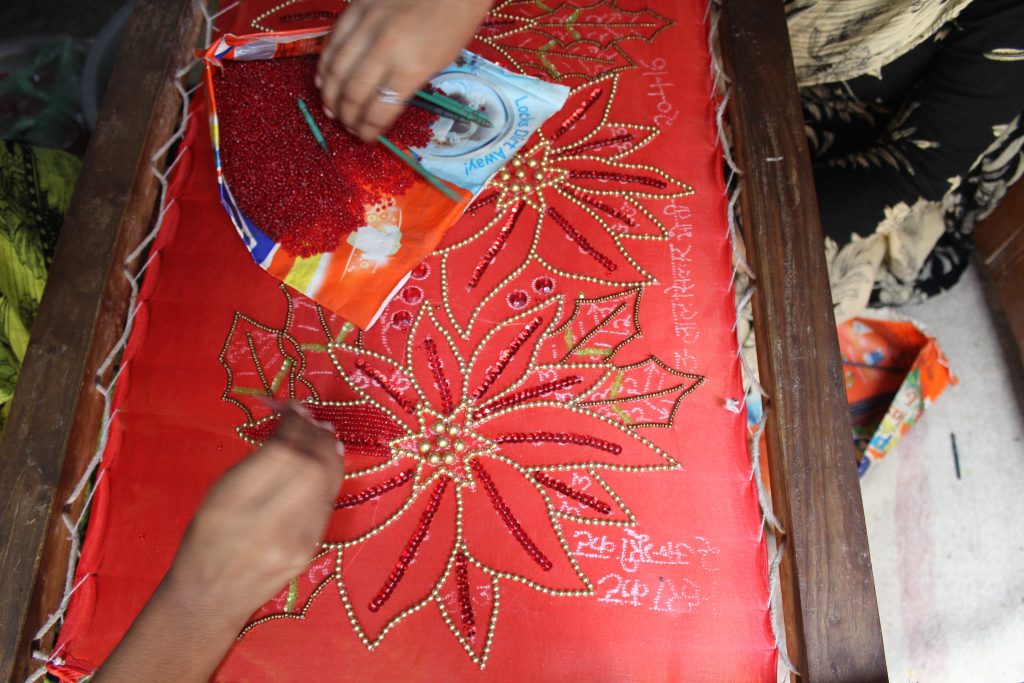
The design gets imprinted on the fabric as do the embroidery instructions. These are numbers that correspond to a bead’s colour and tell an embroiderer where to place a particular coloured bead.
For instance, Noor can be seen embroidering red beads where it says “3”. This means that the number “3” corresponds to red-coloured beads; similarly where it says “2”, she has to embroider golden beads, as in the image below.
The white chalk design tells the embroiderers where the place beads of a specific colour.
A single design usually requires the use of beads of several different colours and an embroiderer has to be careful to use the right-coloured beads, says Khalida Begum. It is only then that the embroidery work begins.
Rifat Bano says that she is able to embroider about two pieces a day but it also depends on the design. A complex design can take longer, such as the Day of the Dead panel that took sisters Zehra Fatima (21) and Aisha Fatima (23) two days to complete.
The Day of the Dead or Dias de los Muertos is a two-day Mexican celebration of remembering deceased family members and is celebrated by people of Mexican heritage throughout the work, including the US.
Their panel used Day of the Dead motifs such as skulls and flowers that required the use of different shades of blue, orange and red beads, totalling 14 different coloured beads.
Wages and health
Considering the intricate nature of the work, Aisha said that they should be getting paid at least Rs. 200 for this panel, instead of Rs. 140 that they were going to earn: “Kaam ko dekho to kaam ismein ek ek sui ka hai. Hame sasta lag raha hai ye,” (If you look at the work, this requires the use of one needle per stitch. We think the wages are low.)
It’s not just Aisha; all the embroiderers that I spoke to said that their wages were low and did not reflect the intensity of their labour.
The state government has not stipulated the minimum wages for Karchobi embroiderers. However, the minimum wage in Uttar Pradesh for the handloom industry, specifically for Zari embroidery is Rs. 5750 for unskilled, Rs. 6325 for semi-skilled, and Rs. 7085 for skilled workers.
All the embroiderers who this reporter spoke to had been doing this work for at least four years and some had been doing it for over a decade. They were all at least semi-skilled workers. But even in the best-case scenario, where they earned Rs 200 a day, their monthly income did not exceed Rs 6000, which is less than the stipulated monthly minimum wage.
Khalida Begum has been working as an embroiderer for more than 20 years. She says that in fact, her income has decreased from what she earned seven to eight years ago, as more women have taken up Karchobi work. With a large workforce and limited work, the embroiderers have lost their bargaining power.
Rifat Bano says, “Agar ham karte hain to theek hain, nahin karte hain to theek hain. Ek hamare band karne se koi pharak bhee nahin padega”–If we do this work, it’s fine, if we don’t do it, that’s also fine. It won’t make a difference if we decide not to do it).
Karchobi embroidery also takes a toll on the embroiderers’ health.
Back in Rifat Bano’s home, her and other embroiderers joke about gaining weight around the stomach from sitting all day. One person is especially called out and they burst out laughing.
They say that their eyes hurt from embroidering. And what about your fingers, I ask. “Gosht laati hai saath mein–(the needle) brings back flesh (when it comes out),” says Noor. Rifat Bano points to deep red bloodstains on the floor next to her where she has shaken off blood from her index finger.
pix 06
Noor, going back to the discussion about weight gain, says that if you leave Marehra, and therefore Karchobi, for 15 days, you can get back to your real size. Her elder sister, Farha, agrees and says that she only lost weight after she got married and moved out of Marehra.
Then Noor announces that she is only going to do Karchobi embroidery for 10 more years.
“Phir kya karegee?–Then what will you do?” asks Rifat Bano.
Noor retorts: “Kuch na karoongee. Kuch India mein dimagh lagaoongee main to.” (Nothing I’ll do. I’ll give some of my attention to India.)
The names of all the embroiderers have been changed to protect their identities. Some of them specifically requested it. They said that talking about their wages and problems with their work could lead to them being singled out by their communities. This reporter decided to change all their names as a result. The companies too have not been named as she felt that it could pose a threat to these women’s livelihoods.
All images by the author.
Meher Ali is an independent journalist based in Aligarh. She reports on refugee, human rights, and social justice issues. She also blogs about the cultural heritage of Aligarh and its surrounding areas.
source: http://www.twocircles.net / TwoCircles.net / Home> Indian Muslim> Lead Story / by Meher Ali / May 12th, 2019
The Delhi Unit of Khudai Khidmatgar with Rahnuma Foundation inaugurated Justice Sachar Education and Training centre on labour Day 1st May in the Haji Colony slum of Okhla.
The centre was inaugurated by the Delhi Minority Commission, Chairperson Dr. Zafarul Islam Khan.
The centre honours the memory of late Justice Rajendra Sachar, who devoted his entire life for the upliftment and protection of the under privileged section in this country.
Also, this centre is dedicated to the un organised workers, hence it is inaugurated on labour day.
Khudai Khidmatgar Delhi Unit is working with Ragpickers, Domestic Workers, Rickshaw Pullers and Construction Labours from quite a number of years.
The institute will provide free coaching and counselling to the children of these workers living in slum areas.
Special invitee for this inaugural programme was Dr. Zafarul Islam Khan, Chairman Delhi Minority Commission, Khudai Khidmatgar Convenor Faisal Khan, Khudai Khidmatgar NLC member Inamul Hasan, Rahnuma Foundation Chairperson Sayed Tahseen Ahamed, Khudai Khidmatgar NRC Member Manoj Selvaraj, Centre Co Ordinator Chand Sheikh, Domestic Workers Leader Tanzeela Khatoon, Afsana, Noori, Rikshaw Puller Leader Afzal and others participated.
source: http://www.twocircles.net / TwoCircles.net / Home> India News> Indian Muslim> Lead Story / May 12th, 2019
Dubai-based couple share their menu of fresh bakes and nutrient-packed dishes
From left: Nadira Ahmad, M.K. Ahmad, Shijna, Zain, Tanaaz and Sajith Ansar get ready to enjoy a nutrient-packed Indian iftar at their villa at Mudon. Image Credit: Clint Egbert/Gulf News
Dubai:
When Dubai-based Indian businessman M.K. Ahmad and his wife Nadira were at their daughter Shijna’s home at Mudon for iftar last Thursday, he couldn’t help himself from contrasting the fancy spread she had laid out on the dining table with the rather modest meal he would have during Ramadan when he first came to the UAE in 1965.
“I was a bachelor back then and a group of us boys would just have some biryani. We could not have imagined the kind of foods that are available now, with so many healthy options to choose from,” he said.
Shijna and her entrepreneur husband Sajith Ansar, however, will not have it any other way. As their two children Tanaaz, 15 and Zain, nine, put it, it’s a much-awaited “snack party”.
“I try to pack in as many nutrients as possible into the menu,” said Shijna, a passionate cook.
“I avoid frying and bake wherever possible, use stuff like gluten free oat flour, quinoa, fresh fruits, vegetables, lean chicken and chia seeds in my dishes so they are filling and full of antioxidants.”
The chia pudding, a hot favourite with the family, for instance has a blend of mixed berries, gluten free oats, chia seeds, mixed nuts and wheat germ powder. Just like the special homemade banana bread which is baked with gluten free oat flour, almond flour, some quinoa and bananas.
I try and avoid frying and bake wherever possible, use stuff like gluten free oat flour, quinoa, fresh fruits, vegetables, lean chicken and chia seeds in my dishes.
– Shijna Sajith | Dubai resident
“My mum loves to try out new things and they are always delicious,” said Zain, going over the colourful spread on the table that among other things includes fajitas stuffed with chicken, baked oat cups with chilli chicken, cinnamon and cream cheese pie, lemonade and orange juice.
There is also Ari Pathiri (rice flour rolls) with chicken stew that Nadira has made, giving the menu a traditional touch. “We are a Keralite family and relish this combination, especially when it is prepared by my wife. She is a fantastic cook,” said Ahmad, adding that the couple feel blessed to enjoy iftars with their three children and their families, including six grandchildren, all of whom are settled in the UAE.
“I am his favourite,” claimed Tanaaz. “Do you know, he swam all the way from India when he first arrived?”
Tanaaz embellishing the chia seed pudding with fruits and nuts Image Credit: Clint Egbert/Gulf News
“Yes, she is right,” said the proud grandfather. “A group of us bachelors just decided to come here by sea from Mumbai. It was like an adventure, but after I came here, there was no question of going back. This country has given us so much over the decades. We feel truly blessed.”
Sajith, who has been in Dubai for 18 years, can’t agree more. He cherishes the bonding with his family. “Ramadan is a time when we connect with our loved ones and focus on the spiritual,” he said.
Shijna and Sajith Ansar. They have two children, Tanaaz, 15 and Zain, 9, and the family lives in Mudon in Dubai. Image Credit: Supplied
“Being in a place like Dubai makes Ramadan extra special. Everyone is very respectful and mindful that you are fasting. Even non-Muslims here join the fast in the spirit of Ramadan.”
Mix the dry ingredients and keep aside. Beat eggs and coconut sugar till fluffy. Add rest of the ingredients and mix well. Pour coconut oil and toss in the walnuts. Bake the mixture at 175C/ 350F for 60 min.
Allow it to cool before serving.
source: http://www.gulfnews.com / Home> Community / by Sharmila Dhal, Deputy UAE Editor / May 12th, 2019
Mappila paattu (Muslim traditional song) singer and Folklore Academy vice-chairman Eranholi Moosa, 76, passed away at Thalassery on Monday.
Eranholi Moosa
Kannur :
Mappila paattu (Muslim traditional song) singer and Folklore Academy vice-chairman Eranholi Moosa, 76, passed away at Thalassery on Monday. The death occurred at his residence at Chalil. He had been undergoing treatment for pulmonary diseases for one month at a private hospital in Kozhikode. He was shifted to his house around one week ago as per the advice of the doctors.
As the man who started his career by singing in marriage houses in the light of paraffin lamps, the music career of Moosa has been one of many ups and downs. He is considered as the most popular face of mappila paattu in Kerala, especially North Malabar. His was also instrumental in popularising the art form in the region.
Son of Eranholi Valiyakath Abu and Aasya, Moosa started singing at a very early age and was easily noticed through his ease of singing. During his early career he used to sing for many low profile cultural organisations and soon became a familiar face among the lovers of ‘mappila paattu’. He had also learnt music under Saratchandra Marathe for two years.
He is the lone mappila paattu singer, who had performed in the Gulf for the most number of times. Moosa made his debut in Abu Dhabi in 1974. It is said that Moosa went on to sing in around 1,000 stages in the Gulf countries over the years. Eranholi Moosa rose to be a popular figure when he started singing to the tunes of legendary Raghavan Master in All India Radio.
He is survived by wife Kunhamina and children Naseera, Sajida, Sameera, Nizar, Nazar and Sadique.
His mortal remains will be placed at Thalassery Town Hall on Tuesday upto 11 am for the public to pay last respects to their beloved singer. The funeral will be held at Mattambram Juma Masjid Khabarstan.
source: http://www.newindianexpress.com / The New Indian Express / Home> States> Kerala / by Express News Service / May 07th, 2019
Ever since the news of the results filtered in, Sajid, his wife Abida and the teachers at the Binanipuram Government High School have been flooded with congratulatory calls from government quarters and the media.
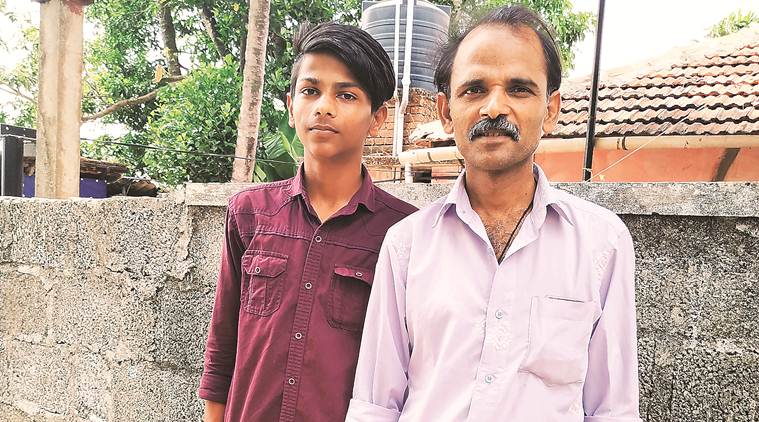
Bhutto Sajid (right) with his son Dilshad. (Express photo: Vishnu Varma)
Bhutto Sajid, 41, is an ‘angootha chaap’ (illiterate). Born into a poor peasant family in Bihar’s Darbhanga, Sajid’s family didn’t have the financial means to send him to school. Doing odd jobs, first in his village and then later in Delhi, Sajid was among the first wave of migrant workers in 1999 travelling thousands of miles to Kerala, a state grappling with a shortage of labour after its own people left in droves looking for jobs in Gulf countries.
In the past two decades, Sajid has made Kerala home, working in a small shoe factory in the industrial area of Edayar in Ernakulam district and living with his wife and five kids.
If the lack of education suppressed Sajid’s dreams in life, on Sunday, in a bittersweet moment for him, his eldest child, Muhammad Dilshad, made him and his family proud by topping from his Malayalam-medium government school in the Class X Board examinations and securing A+ grade in all subjects.
“Hum gareeb the, nahi padh paye. But mera beta mera sar uncha kar diya (We were poor so couldn’t study. But my son has made me proud),” Sajid said.
Ever since the news of the results filtered in, Sajid, his wife Abida and the teachers at the Binanipuram Government High School have been flooded with congratulatory calls from government quarters and the media.
Sudhi TS, the mathematics teacher at the school who took a special interest in Dilshad’s studies, said he is more happy with his student’s performance than his own son who also appeared for the board examinations this year.
“I used to tease my son by telling him that Dilshad would score better than him. That would get him jolted and serious about studying,” Sudhi said.
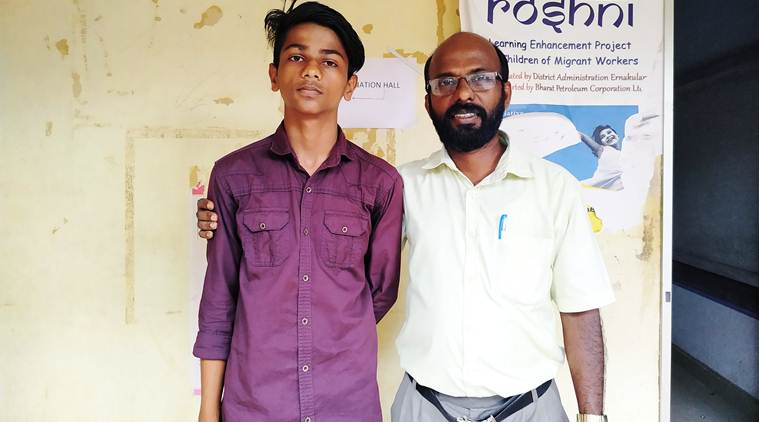
Muhammad Dilshad with his Mathematics teacher Sudhi TS at the school. Sudhi opted out of a transfer so he could help Dilshad with his studies. (Express photo/Vishnu Varma)
“In fact, I had the opportunity of a transfer to another school here two years back. I have an asthma condition and this is an industrial area. But I stayed on just to help him (Dilshad) out. I wanted to see him do well in the exams because he has a bright future ahead,” he said, adding that he would often fix special classes at 6 am in the morning for Dilshad’s batch.
The six-decade-old government school, located in an industrial belt on the fringes of Kochi where a large section of inter-state workers are employed, receives a sizeable number of applications of children of such workers into all grades. In Dilshad’s class of 12 students who wrote the board examinations this year, four of them, including him, hail from northern states.
But, the primary hurdle for such students in excelling at studies has been the medium of instruction. Most subjects, with the exception of English and Hindi, are taught in Malayalam at schools like these, which end up making the learning process arduous.
To solve this particular problem, the Ernakulam district administration flagged off the ‘Roshni’ project two years ago through which schools with a large concentration of migrant students were identified. The project, a brainchild of Ernakulam district collector Mohammed Y Safirulla, involves an extra hour of language proficiency class in the morning before regular classes begin.
Teachers under ‘Roshni’ have been trained to use code-switching methodology to help students, from classes I to VII, in familiarising with the Malayalam language. To attract more students to the programme, a round of nutritious breakfast is offered at the school as an incentive.
source: http://www.indianexpress.com / The Indian Express / Home> Education / by Vishnu Varma / May 11th, 2019
The Mysore District Athletic Association (MDAA) conferred the prestigious Nandi Awards to the top sports persons of Mysuru district for the year 2018-19 at a function held at Maharaja’s College Centenary Hall on May 9.
In addition to this, Vidya Vikas Educational Trust was given the Best Sports Promoters Award. Mohammad Nouman, Senior Sports Journalist, Prajavani, Mysuru, was conferred the Distinguished Sports Journalist Award while Nagesh Panathale, Senior Photo-Journalist, Vijaya Karnataka, Mysuru, was conferred the Distinguished Sports Photographer Award.
The function was presided by Vasu, Chairman, MDAA. V.R. Beedu, Dronacharya Award winner for Lifetime Achievement in Athletics as a coach, was the guest of honour.
Dr. P. Krishnaiah, Director (In-Charge), Department of Physical Education, University of Mysore, K.Suresh, Assistant Director, DYES, Mahesh Ballal, Vice-President, MDAA, Somashekar, President, MDAA and B. Srikanth, Hon. Secretary, MDAA were among those present at the function.
source: http://www.starofmysore.com / Star of Mysore / Home> Sports / May 10th, 2019
Den Thimmaiah emerged as the fastest driver at the National level 4-wheel Autocross Championship organised at Begoorkolli.
Organised at the fields belonging to the members of Chendira, Ippumada, Chekkera and Thethira families by JCI Ponnampet Golden, he emerged victorious as he clocked in at 2.02 minutes at the 850-meter rally course.
He also won the Coorg Local Open, 1,400-1,600cc category and Indian Open categories, adding three victories to his name.
In ‘The Coorg Local Open’ category, Den Thimmaiah won the first place, followed by Kokengada Darshan and Karavanda Thimmiah respectively.
Mohamad Shiek won the first place, Shrihari the second and C.K. Somanna the third place in the 800 cc category.
In the 1,001-1,400 cc category, the first place was won by Ismail Khan, second by Harshad Pasha and the third by Sparsh Nanjappa.
Den Thimmaiah won the first place while Dhruva Chandrashekar and Kokengada Darshan won the second and third place respectively in the 1,400-1,600 cc category.
The first place was bagged by Den Thimmaiah while the second and third place were won by Dhruva Chandrashekar and Roopesh respectively in the Indian Open Class.
In the XUV class, Mekerira Kariappa won the first place while Shriganesh won the second place.
In the Women’s category, Puttichanda Dayan Somaiah won the first place and Pooja Karumbaiah won the second place.
Over 40 participants took part in the event.
JCI Ponnampet Golden President Koniyanda Kavya Sanju, Mondovi Motors Gonicoppa showroom manager Manoj, JCI secretary Kotangada Nanaiah, JCI leaders Kotrangada Subbaiah, Arasu Nanjappa, Katimada Giri, Nirin Monappa, Robin Subbaiah, Pullangada Natesh distributed prizes to the winners.
source: http://www.starofmysore.com / Star of Mysore / Home> Sports / May 09th, 2019
Students with special needs and health complications defeated all their challenges to come out with flying colours in the class 10 examination, with help from online videos, peers, faculty, and private tutors.
Krishna Rao, diagnosed with Asperger Syndrome, scored 75% in the board examination. A student of Sri Kumaran Children’s Home, Krishna faced problems owing to illegible handwriting and had social issues “My teachers helped me a lot as did the private tutor. Reading the newspaper daily even during exams also helped,” he said.
He said the faculty also ensured that he was not bullied or treated differently from the rest and sensitised other students about his condition. He has score well in Sanskrit (81) and Social Science (93). He aims to pursue political science and legal studies.
Kushal Katariya, who has almost overcome his dyslexia, is a student of Delhi Public School-South. He scored 68% in the examination. Though he found the teachers at his school to be supportive, he attributes his success to his private tutors who went out of their way to ensure that he did well. “I found online videos very helpful. I used to watch motivational speeches on a daily basis to remain focussed,” he said.
There were nine students in Delhi Public School-North with special needs, and all of them scored above 75%.
Mohammad Jamshed, a student who had a bone marrow transplant this academic year, could not attend a majority of the classes, but managed to get 80%. Owing to lack of attendance, he had to obtain special permission from the CBSE chairman to write the board examination. “My teachers helped me a lot. They came home and taught me,” he said. His method of studying involved daily planning and breaking down concepts into basic units for easy comprehension. Jamshed aims to pursue commerce to become an entrepreneur.
Medha Jayanth, a student of Kendriya Vidyalaya Indian Institute Of Science, scored 75.4%. She has been diagnosed with cerebral palsy. “I’ve been studying at KV for 10 years and the comfortable environment helped me score well,” she said. She aims to pursue commerce and follow her father’s footsteps by completing Chartered Accountancy.
source: http://www.thehindu.com / The Hindu / Home> News> Cities> Bengaluru / by Sanjana N / Bengaluru – May 07th, 2019
Pista House managing director M.A. Majeed at a press conference in the city on Sunday.
‘Regular consumers will benefit from its health boosters and high nutritional value’
Days ahead of the month of Ramzan, haleem-maker Pista House on Sunday announced that this year, their brand of the scrumptious dish would contain Chakhao – black rice sourced from Manipur.
According to restaurateur and Pista House managing director M.A. Majeed, black rice is healthier and consumed by Chinese royalty on account of its rich nutritional value. The black rice-enriched haleem, considered by many a Ramzan delicacy, is a collaborative effort between Pista House and North East Foundation.
“Black Rice is extremely rich in antioxidants, fibre, iron and vitamin E and has anti-carcinogenic characteristics. Regular consumers will benefit from its health boosters and higher nutritional value,” said Bhanu Pratap Singh, CEO of North East Foundation.
Mr. Majeed said each bowl would be priced at ₹170. This is an increase of ₹10 since last year.
source: http://www.thehindu.com / The Hindu / Home> News> Cities> Hyderabad / by Staff Reporter / Hyderabad – May 05th, 2019