All posts by mpositiveone@gmail.com

Hasan Patel of George Mitchell School in Leyton has won an Eton scholarship

Leyton, East London, UNITED KINGDOM :
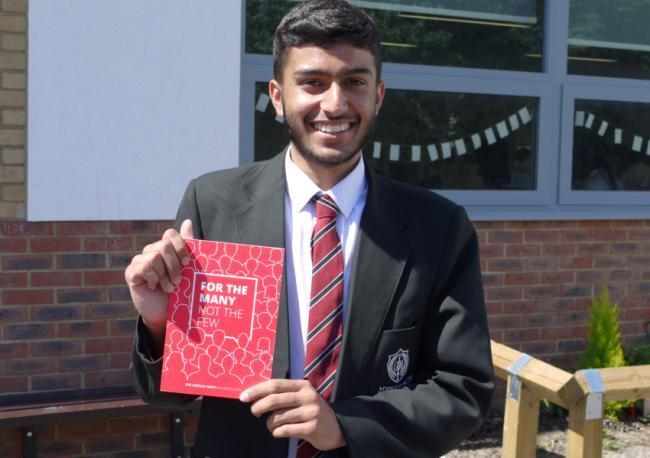
Hasan Patel of George Mitchell School in Leyton

An East End teen who shares his two bed council house with his parents and two brothers has won a £76,000 scholarship to Prince William and Harry’s old school Eton College.

Hasan Patel, 16, became the youngest speaker at a major political party conference, beating former Conservative leader William Hague.

He now has an army of followers after his rousing speech at the Labour conference last August when he was 15.

The state school student from a council estate, will rub shoulders with the elite when he joins the world-famous Berkshire school next September.

The rising political star, who currently studies at George Mitchell School in Leyton, will enter the sixth from to study A-Levels in four subjects; History, Geography, Politics and Drama and Theatre Studies.

It is a far cry from the two-bedroom council flat he shares with dad Abdul, 69, mum Aysha, 49, and two brothers Yusuf, 17, and Adam, 21.

He won his place after coming through a gruelling three-day assessment at the Berkshire School which included three entrance exams, seven interviews and a group interview.

Aged just 15 at the time, he was a year younger than the previous youngest speaker, former Conservative party leader William Hague.

Speaking of his future at Eton, he said: “I am very much there to provoke lively debate.

“I am a boy from a Leyton council estate who receives free school meals. My parents are on welfare and I share a room with my brothers.

“My dad was very smart and politically engaged but lived in abject poverty in India.

“The students at Eton are from the most privileged corners of society, we could not be any more different.

“My views may be different to them because my life experiences are very different. I think that is what impressed Eton, they wanted someone who could offer a different perspective.

“Eton is a place where they encourage debate, I genuinely believe I can offer something to the school.

He added: “My politics won’t change because I am entering a different type of environment.

“I may be attending Eton but I will still be the same boy from East London when I arrive and when I leave.I am not joining the elite but simply benefiting from the education my family would never in a million years be able to afford.

“This opportunity will allow me to return to my community better armed to tackle the many social problems we face.”

Hasan was mentored throughout the application process by his school’s Headteacher Saeed Hussain.

Hasan said: “George Mitchell is an exceptional school. The support I have received from the school, and particularly from my Headteacher, has been incredible.

“This is a place which gives us the students the tools and support to pursue our dreams. I have been here since I was three years old when I joined the nursery; it has played a crucial part in developing me into the person I am today.

Headteacher Saeed Hussain said: “Hasan is a truly exceptional young man. Aside from being incredibly bright he is one of the most engaged and motivated students I have known in my years of teaching.

“He is the type of person who will seize this opportunity generously offered by Eton. His is a name I expect we will all be hearing more of in the near future.”

Hasan’s dad left India in the early 1970s to build a better life for himself and his family. His mum moved over in the mid-1990s.

source: http://www.guardian-series.co.uk / East London & West Essex GUARDIAN / Home> News / January 22nd, 2019
Beyond Sacred: Kerala Muslims Build An Inspiring Mosque With A Modern Art Gallery

Fort Kochi, KERALA :

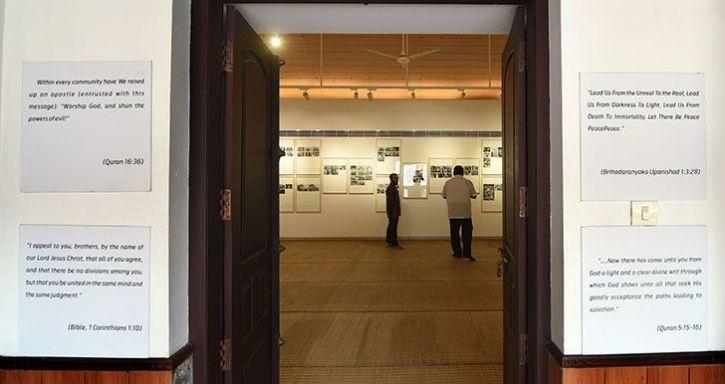
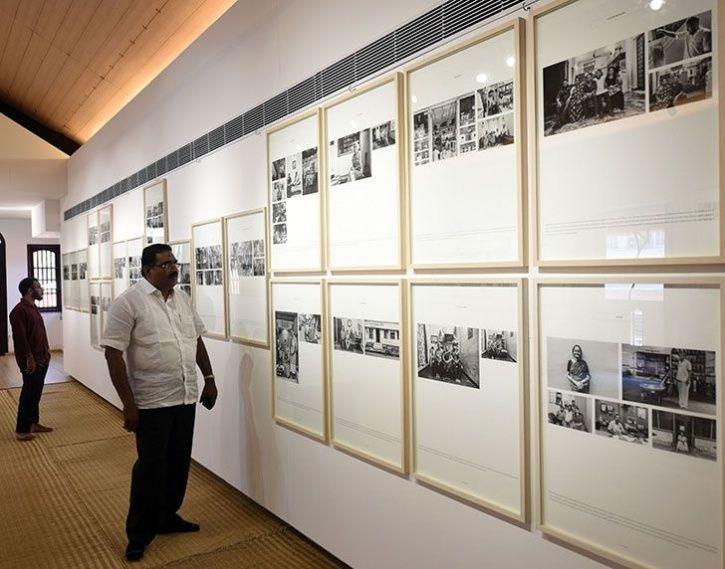
For the past 10 months, the faithful offering jumu’ah (Friday afternoon prayer) at Masjid-ul Islam in a lane opposite the RDO office in Fort Kochi have been doing so in a hybrid space — for, inside the mosque is a modern art gallery which was opened in April last year.

On Fridays, when it is prayer time, white curtains are hung from discreet hooks covering the art works; currently on show is a photo documentation of 42 communities found in the 5.5 sq km area of Mattancherry and Fort Kochi.

“The only reason why we are covering them during prayers is to ensure that people are not distracted,” says K A Mohammed Ashraf, chairman of the mosque committee, a businessman who set up the place of worship with his own funds four years ago.

Mosque01MPOs30jan2019

Kerala mosque welcomes all, irrespective of faith & gender

The mosque has a board welcoming all, irrespective of faith and gender, and celebrates the diversity of religion with citations from revered spiritual texts. “We want to be inclusive. We don’t have restrictions on the type of dress one should wear,” Ashraf says, adding that the gallery, close to biennale venue, is visited by lot of foreigners.

As one climbs the marble-paved, narrow flight of stairs to the Islamic Heritage Centre (IHC) art gallery on the second floor of the building, two quotes welcome you: a sukta from the Rigveda on the right and a verse from the Quran on the left, epitomising the shared destinies of both religions. The balcony space has several other quotes that build on the syncretic tradition.

On one side of the art gallery, neatly-labelled wooden shelves showcase books ranging from religious texts to even novels and poetry. “This is not much but we are trying to source some rare books. A large reference library is also on the anvil,” says Ashraf, who also runs Masjidul Islam charitable trust.

BCCL
BCCL

The IHC and the gallery is a joint initiative of the trust and Forum for Faith and Fraternity (3F) who are fascinated by the golden age of Islam between AD 8 and AD 14, when mosques were centres of learning and art and science flourished.

“We want people to understand the principles of pluralism, cultural diversity and the importance of upholding these traits in the contemporary world,” says Ashraf who feels this is the only mosque in India which houses an art gallery.

C H Abdul Rahim, chairman, 3F, describes their organisation as a small group of professionals working silently to promote cultural diversity through study of different religions.

“It is a myth that Islam is antithetical to art. It has always promoted art and music and historically mosques were seats of learning,” said Rahim, former executive director of KIMS and a chartered accountant.

The show Transcendence by Biju Ibrahim is emblematic of this vision of plurality. From Lohanas, who are followers of Jhulelal, to Dhakni Muslims and 24 Telugu Manai Chettiars, Biju’s photographs capture vibrant communities in all their diversity.

“I don’t think there is any place in the world that houses so much diversity within such a small geographic space,” says Biju, who began working on the project in 2017 as a resident of Uru Art Harbour.

Most of these community members have strived to preserve their language and culture within their home but share a common identity when they step out of the four walls. “The show began in April but once the biennale kicked off I added five more panels to the exhibition,” he says. His show will be on till end of March.

Originally Published In The Times Of India

source: http://www.indiatimes.com / India Times / Home> News> India / by Binu Karunakaran / TNN / January 14th, 2019

Tumakuru armyman who gunned down seven militants gets Sena Medal for gallantry

Tumakuru , KARNATAKA :

He was involved in a major operation at Arwani in 2017 where he came face to face with a terrorist and had gunned him down.

Mohammed Sadik
Mohammed Sadik

Tumakuru :

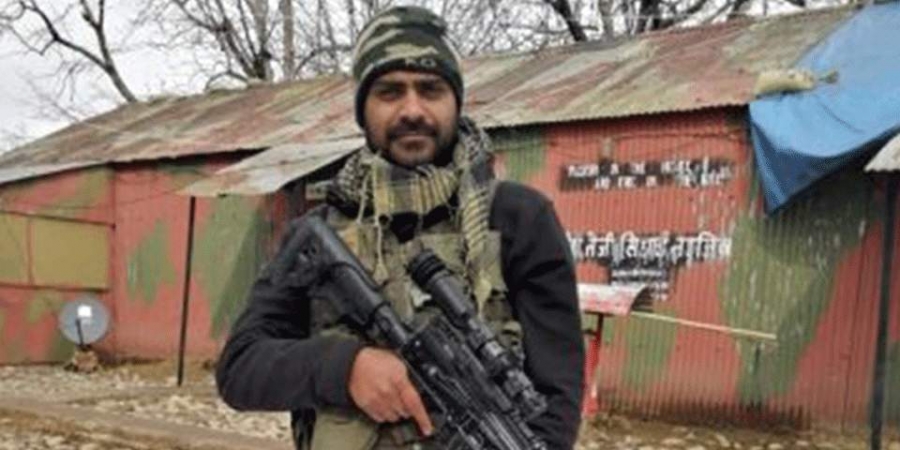
An Indian Army Naik hailing from Tumakuru, who has gunned down seven militants in his 15-year service, most of it in Jammu and Kashmir region, has won the Sena Medal for gallantry this year. Mohammed Sadik (34) of the 1st Rashtriya Rifles, the army’s elite counter-insurgency unit, had eliminated three terrorists in a fierce gunbattle at Kulgam in July 2018. He was involved in a major operation at Arwani in 2017 where he came face to face with a terrorist and had gunned him down.

“I joined the army with a great passion. ‘Desh seva is Esha seva’ (serving the country is serving the god) for me”, said a proud Sadik when contacted over phone. Sadik’s mother Shirajunnisa, wife Rahamath Unnisa and two-and-half-year-old son Ayman were beaming with pride and joy at the Mahatma Gandhi stadium here on Saturday. They had been invited for a felicitation by the district administration on the occasion of the 70th Republic Day celebrations. Flexes with his pictures were put up at many places in the city to inspire youths.

“His father late Mohamed Salim used to hawk popsicles in different villages besides doing small seasonal businesses. Their’s was an economically backward family”, recalled Dandina Thimme Gowda, a local resident.

SADIK joined the army as a jawan on January 21, 2004, and served in J&K region for eight years, in Sudan as part of the UN peacekeeping force for a year, and for two years with the elite NSG in New Delhi.
He dreamed of joining the army even while he was studying in Class 3 at a government school at Bhovi Colony in Tiptur town.

After his primary education, Sadik completed his middle-schooling at the government school at Dandinashivara village and three years of higher secondary education at Digvijaya High School at Ammasandra in Turuvekere taluk of the district. After completing his SSLC board examination in his first attempt, he got selected for the army in at a recruitment rally held at Madras Engineering Group (MEG) at Bengaluru. He later did his Bachelors of Arts (BA) through distance education.

Impressed by PM Modi’s ‘Beti Bachao, Beti Padao’ slogan, Sadik brought his adopted sister’s daughter Shifa Annum to his household so that she can pursue her education. He also dreams of her becoming an army officer. His mother Shirajunnisa, wife Rahamath Unnisa and two-and-half-year-old son Ayman live in a small rented house at the Poor House Colony area in Tumakuru.

“We knew the risk involved in the army, that too in J&K. We are proud of him as he has been serving the motherland,” said the proud mother and wife. He is the only son of his parents.

source: http://www.newindianexpress.com / The New Indian Express / Home> States> Karnataka / by Devaraj B. Hirehalli / Express News Service / January 27th, 2019

How Muslim MLA numbers have jumped

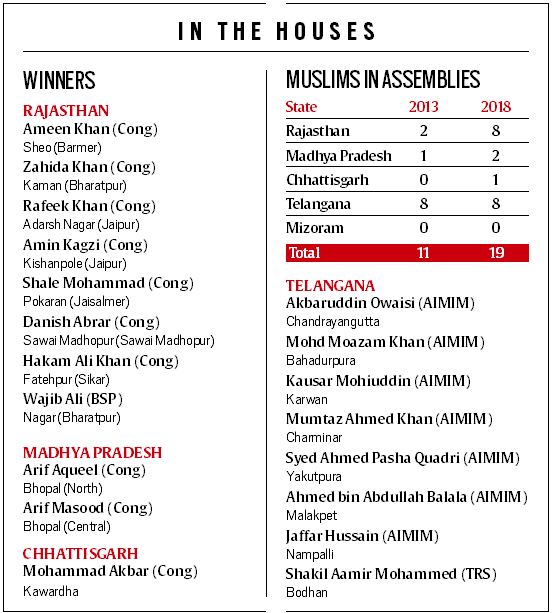
The number of Muslim MLAs in the Madhya Pradesh and Chhattisgarh Assemblies are now two and one, up from one and none respectively in the 2013 Houses.

The big change is in Rajasthan, where the number of Muslim MLAs has gone up to eight from just two in the 2013 House.

The number of Muslim MLAs in Madhya Pradesh, Rajasthan, and Chhattisgarh jumped from three after the 2013 elections to 11 Tuesday as the Congress swept the BJP out of power in the three heartland states. In all, 19 Muslims were elected in the five states that went to polls. The big change is in Rajasthan, where the number of Muslim MLAs has gone up to eight from just two in the 2013 House. The number of Muslim MLAs in the Madhya Pradesh and Chhattisgarh Assemblies are now two and one, up from one and none respectively in the 2013 Houses.

RAJASTHAN
The Congress fielded 15 Muslim candidates, seven of whom won. One Muslim candidate won on a BSP ticket. The BJP fielded only one Muslim candidate, Yoonus Khan, against Sachin Pilot in Tonk, who lost.

In Pokaran, Shale Mohammad of the Congress edged out the BJP’s Mahant Pratap Puri — the chief priest of the Taratara sect in Barmer, who models himself on UP Chief Minister Yogi Adityanath — by just 872 votes.

MADHYA PRADESH
After a decade, the House will have more than one Muslim member. Both MLAs in the new Assembly belong to the Congress. Arif Aqueel has represented the Muslim-dominated Bhopal (North) seat six times since the 1990s, and was the only Muslim in the Assemblies elected in 2008 and 2013.

The other Muslim member in the 2018 House is Arif Masood from Bhopal (Central).

The only Muslim candidate fielded by the BJP in 2018 was former Congress Minister Rasool Ahmed Siddique’s daughter Fatima, who lost to Aqueel.

CHHATTISGARH
In a state where Muslims are 2% of the population, the Congress fielded two candidates from the community, and the BJP fielded none. One of the Congress candidates, Mohammad Akbar, won the Kawardha seat with the biggest margin in the state: 59,284. The Congress’s other Muslim candidate, Badruddin Qureshi, lost at Vaishali Nagar.

TELANGANA
Parties in Telangana fielded 26 Muslim candidates at the 119 seats. Eight — seven from the All India Majlis-e-Ittehad-ul Muslimeen (AIMIM) and one from the Telangana Rashtra Samithi (TRS) — won.

The AIMIM fielded eight Muslims; only the one at Rajendranagar — Mirza Rahmat Baig — lost, coming in behind the candidates of the TRS and TDP.

The BJP fielded one Muslim, Shehazadi Syed, who lost to Akbaruddin Owaisi of the AIMIM at Chandrayangutta. The Congress fielded 9 Muslims and the TDP one; all lost. The TRS fielded eight Muslim candidates; Shakil Aamir Mohammed won in Bodhan.

source: http://www.indianexpress.com / The Indian Express / Home> Explained / by Express News Service – Bhopal, Hyderabad, Jaipur, New Delhi, Raipur / December 14th, 2018

‘Meeting of three Abdul Khaders’

KERALA :

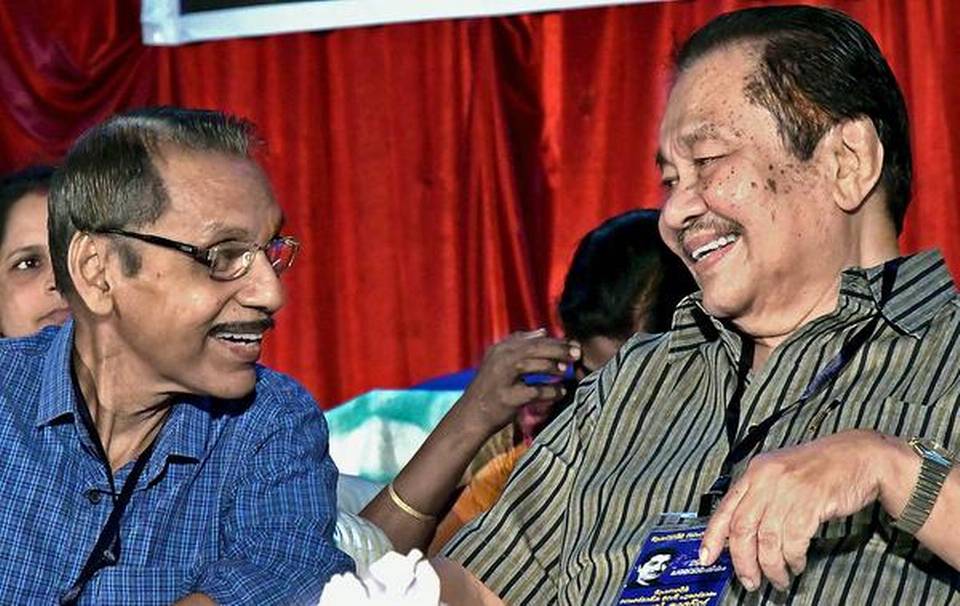
Writer U.A. Khader shares a lighter moment with lyricist Poovachal Khader during a meeting to commemorate actor Prem Nazir in Kozhikode on Tuesday. | Photo Credit: S_RAMESHKURUP

Prem Nazir Samskarika Vedi’s award presented to lyricist Poovachal Khader

“The coincidental meeting of three Abdul Khaders” was how writer U.A. Khader described the 29th death anniversary commemoration meet of actor Prem Nazir in Kozhikode on Tuesday. The first being the actor whose real name was Abdul Khader, the second, the writer himself and the third Poovachal Khader, noted lyricist and poet who bagged the Prem Nazir Samskarika Vedi’s 10th anniversary award on Tuesday.

‘Memories still alive’

Prem Nazir, who holds many a record in Malayalam cinema, passed away in 1989 at the age of 62. “It is not for nothing that his memories are still alive in the minds of cinema viewers,” said the writer, adding that Prem Nazir had immortalised many of his characters. He cited the actor’s performance as Bhranthan Velayudhan in Iruttinte Athmavu as a classical one.

Film producer P.V. Gangadharan, who presented the award to Poovachal Khader, recalled how Prem Nazir supported him in his early days as a producer.

The Prem Nazir Samskarika Vedi has been presenting the award to many known and lesser known personalities in cinema over the last 10 years. Actors T.R. Omana, Shantha Devi and Sreelatha Namboothiri were some of the recipients of the award in previous years. Poovachal Khader, a relative of Prem Nazir, is also the president of Thiruvananthapuram-based Prem Nazir Foundation.

source: http://www.thehindu.com / The Hindu / Home> News> Cities> Kozhikode / by Staff Reporter / Kozhikode – January 17th, 2018

Nizam’s jewels set to go on display in Delhi again

Hyderabad, TELANGANA :

The date of inauguration of the exhibition hasn’t been decided yet, but most of the groundwork for the event has been completed.

For the first time in almost 12 years, the National Museum in Delhi is preparing to display the priceless jewellery collection of the Nizam of Hyderabad.

The date of inauguration of the exhibition hasn’t been decided yet, but most of the groundwork for the event has been completed. The National Museum exhibited the jewellery for the first time in 2001 and again e in 2007. There have also been two exhibitions of the jewellery at the Salarjung Museum in Hyderabad during the same period.

“In India, jewellery is an integral part of lifestyle. Among them, the Nizam’s collection of jewels is especially unique. It, therefore holds a significant position in the history of gemology and jewellery,” said Sanjib Kumar Singh , curator of the exhibition.

Soon after India’s independence and the annexation of erstwhile princely state of Hyderabad, the seventh and last Nizam, Mir Osman Ali Khan, created 54 trusts. The jewels, now in the custody of the Indian government, were part of the assets of these exclusive trusts. In March 1951, HEH the Nizam’s Jewellery Trust was created and it took over 103 items including state regalia; in February 1952, HEH the Nizam’s Supplemental Jewellery Trust took custody of 144 pieces of jewellery.

Negotiations began in 1972 between the Indian government and the family for the sale of the priceless heritage. In 1995, the Indian government finally acquired a part of the inventory for Rs. 217 crore. The actual value of this precious legacy is difficult to asses because it not only represents some of the finest jewels found in the Indian subcontinent, but also stands as a silent witness to the history of the Deccan region.

According to the government, the present collection comprises a total of 173 items acquired from the two trusts. The actual number of pieces, if pairs and groups of ornaments are split up, is 325 not, including 22 unset emeralds, and the 185-carat Jacob diamond, one of the world’s largest by size.

The collection includes turban ornaments, necklaces, earrings, armbands, bracelets, bells, buttons and cufflinks , anklets, watch chains and rings—all jewels once worn by the once fabulously wealthy Nizams of Hyderabad, their wives, children and grandchildren.

“This collection is a national treasure and comprises of jewels of fine beauty and rarity. I believe the jewels should be on permanent display as they belong to the people of India,” says art historian Deepthi Sasidharan, who has co-authored the book, Treasures of the Deccan–Jewels of the Nizams, published recently.

The exhibition is likely to feature around 33 showcases. The National Museum proposes to charge visitors Rs 50 for a 30-minute tour of the exhibition.

source: http://www.hindustantimes.com / Hindustan Times / Home> India / by Vanita Srivastava, Hindustan Times, New Delhi / January 11th, 2019

Rare language ‘Nawaiti’ gets own software

KARNATAKA :

This is expected to boost the writing of people belonging to Nawayat community from Bhatkal, who use the Persian script to write their unique language ‘Nawaiti’ — a rare language and script.

Karwar :

A 1,000-year-old language is complete only now after a team of software engineers from Mumbai developed three of its characters to crack its Unicode script.

This is expected to boost the writing of people belonging to Nawayat community from Bhatkal, who use the Persian script to write their unique language ‘Nawaiti’ — a rare language and script.

Nawayat is an Indian-Muslim community, which lives in Bhatkal of the Uttara Kannada district.

Mohammed Mohsin Shabandri, a community member, pointed out that due to three missing characters in Unicode fonts, people were not able to write as they pronounced.

“About three years ago, we decided to develop these three characters and called a meeting of Nawaiti-speaking people. After eliciting their opinion and conducting proper research, we finalised three new characters,” he said.

“Nawaiti is an endangered language. Three months ago, we approached a software development firm in Mumbai. After studying the language, they developed phonetic characters and its software, which is called ‘Nawayat language solution’,” he said.

source: http://www.newindianexpress.com / The New Indian Express / Home> States> Karnataka / by Arunkumar Huralimath / Express News Service / January 16th, 2019

Meet ‘Mullah Ji’, the Muzaffarnagar Man Who Lights Up Kumbh for Sadhus

Muzaffarnagar, UTTAR PRADESH :

Mehmood is an electrician whose business of setting up lights for festivals spans from Janmasthami celebrations in Muzaffarnagar to the famous Nauchandi Mela in Meerut

Prayagraj:

In a sea of saffron, he stands out with his skull cap and gray beard. To the first time visitor, a board reading ‘Mullah Ji Light waale’ (Mullah Ji, the lighting man) at the Kumbh Mela may be an odd sight but to the Sadhus who have gathered at the confluence of the Ganga and the Yamuna , Mohammed Mehmood aka Mullah Ji is a permanent feature of every Kumbh. To some, he is even a friend.

Mehmood is a 76-year-old businessman from Muzaffarnagar in Western UP. In 1986, he acquainted himself with the Sadhus of the Juna Akhara – the largest and one of the fiercest Akharas of the Naga Sadhus; an ancient order of warrior monks. They hired him to set up the lights around their tents. Today, every six years, he travels over 800 kms to Allahabad, now named Prayagraj, and camps out at the Kumbh Mela.

Sandwiched between the tents of the Juna Akhara, he talks of his journey to Kumbh. “I am an electrician. When you come here at night, you will see that the entire area where Sadhus have pitched their tents is dazzling with bright lights of all colours. That is my doing,” he says proudly. Mehmood’s business of setting up lights for festivals spans from Janmasthami celebrations in Muzaffarnagar to the famous Nauchandi Mela in Meerut. ‘Mullah Ji’ had started his business from scratch.

“The first Kumbh I ever attended was the 1986 Kumbh in Haridwar. Apart from the mela that happens in Nashik, I have attended every one. I haven’t kept count of how many Kumbh Melas I have attended, maybe you can do the maths,” he jokes, sipping a cup of tea at his 11th mela.

Naga Baba Sangam Giri, a warrior monk from the Juna Akhara, is Mehmood’s neighbor on the sands in Kumbh. “I have seen him at nearly every Kumbh Mela I’ve been to. I never even bothered to ask him, his real name. For us he is, and will always be, simply ‘Mullah Ji’ – our friend,” he says, adding, “For Hindus, we are gurus. For Muslims, we are Pirs. They (Muslims) worship niraakar (a formless God) and we worship aakar (idol worship). There may be different routes, but we are all going to the same place. There are 25 different ways to get to Allahabad. Everyone takes a different route to the railway station. But eventually, everyone ends up at the railway station.”

Mehmood says he is treated with respect among the Sadhus. The day that stops, he says, that will be his last Kumbh. “The Babas make me feel at home. Sometimes they ask me to sit on their gaddi (padded mattress), but I respect them too much to do that. I read my namaz five times a day in the presence of these Sadhus and they always give me the space,” he said.

If the Sadhus hadn’t treated Mehmood differently, he probably would not have come to Kumbh, he recalls in nostalgia.

Over the last three decades, Kumbh has become an integral part of his life. Will Mullah Ji come back for his 12th Kumbh? “Inshallah! If Allah commands me to, I will come back,” he says.

source: http://www.news18.com / News18 / Home> English> India / by Uday Singh Rana / January 15th, 2019

Delhi Youth Welfare Association and American Federation of Muslims of Indian Origin felicitate meritorous students

NEW DELHI :

DYWAwadsMPOs15jan2019

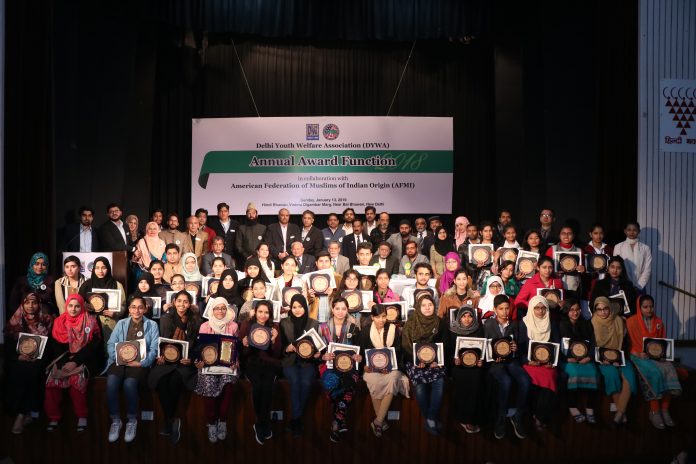
Delhi Youth Welfare Association (DYWA) in collaboration with American Federation of Muslims of Indian Origin (AFMI), organized the DYWA Annual Award Celebration on 13thJanuary 2019 at Hindi Bhawan, Rouse Avenue, New Delhi.

96 students from 15 schools were felicitated with a shields, certificates and cash prizes. Five special awards were also given. Maulana Azad Education Foundation (best government organisation), Society for Promotion of Education (best non-government organization), Shehnaz (best student, class XII), Nikhat Urooj and Iffat Zareen (best students, Urdu Language/Literature in class XII) and Rabea Girls’ Public School (the school with highest number of individual awards in class X & XII).

This was the 28th edition of annual awards.

Various educationists, social activists and political leaders such as Arfa Khanum (Senior Journalist, The Wire), Dr. A.S. Nakadar (Founder Trustee and Former President AFMI), Dr. Aslam Abdullah (Editor, Muslim Observer and Director Islamic Society of Nevada) attended the convention as guests.

Siraj Hussain, former vice chancellor, Jamia Hamdard University, was the chief guest at the event. He shared a few tips on how to become civil servants. “Befriend as many books as you can. And choose best universities to pursue higher education,” he said.

Dr. Nakadar encouraged students to identify their latent talents. “Stop comparing yourself with others. It will make you better person and best among the people,” he said.

Arfa Khanum shared her journey from a small town in Uttar Pradesh to charting a successful career in journalism. “Being in Delhi is a privileged which many of you may have overlooked. You must make use the resources available to you to the optimum. You are the future of India and you would decide what this nation wants,” she said.

Aslam Abdullah underlined the perils of patriarchy. “We ought to treat at par with men. That is a perquisite for us to bring about any change,” he said.

DYWA is a well-known organization of old Delhi and has been working in the field of education for the last 28 years and AFMI (American Federation of Muslims of Indian origin) is a philanthropic charity formed by American Muslims of Indian Origin in the year 1989.

source: http://www.twocircles.net / TwoCircles.net / Home> Education> India News> Indian Muslim> Lead Story / by TCN News / January 15th, 2019

Farnaaz Islam: Engineer by profession, artist by passion

Guwahati, ASSAM :

Many prizes have come her way in subsequent years and there has not been any looking back ever after that

Farnaaz Islam
Farnaaz Islam

Farnaaz Islam of Guwahati is an engineer by qualification but a flourishing artist by passion. She is one of the two artists from Assam who feature in the 11th Contemporary Painting Exhibition organised by the Bengal Art Foundation (BAF) which is going on now at the Gauhati Artists’ Guild here.

BAF is a platform and a beacon light for practising artists. The Foundation is committed to support artists around the country who are working with a contemporary attitude to art by projecting their works through exhibitions, art workshops, art seminars at major centres and creating awareness among the collectors and the connoisseurs of art in the country.

The Foundation is also inviting artists from various countries to integrate and create bonhomie among the practising artists of the world. It is indeed an honour and privilege to be featured in a BAF exhibition. Farnaaz has attained the feat at an early age.

Farnaaz did her schooling at the Blue Bells School and Holy Child School in Guwahati. Her father is a doctor and a professor at Gauhati Medical College and her mother is a lecturer. She herself has done M Tech in Electronics and Communications Engineering. But more than her profession, it is her passion for painting that is taking her places these days.

An art work by Farnaaz

Expressing gratitude to her parents, Farnaaz says, “I have memories of my parents dropping me at Gauhati Artists’ Guild, my alma mater for painting lessons, and then my parents taking me to various art competitions, and me getting a 2nd prize in an art competition organised by the Productivity Council of India when I was just a KG student.”

Many prizes have come her way in subsequent years and there has not been any looking back ever after that.

Speaking on the sidelines of the painting exhibition, Farnaaz further added, “I learnt to draw before I could speak …no matter how clichéd that sounds…it’s true… my parents encouraged me a lot. My mentors were my teachers at Gauhati Artists’ Guild, especially Debananda Ulup sir, Kishore Kumar Das sir, and Aminul Haque sir… each one of them a legend by their own merits.”

Farnaaz has in the recent past organised a solo exhibition of her paintings at the State Art Gallery  Guwahati. It was Debananda Ulup who introduced her to Ashoke Roy, the founder of Bengal Art Foundation paving the way for her to make an entry in the current exhibition in Guwahati which commenced on January 9 and will continue through to January 14.

Asked about her most memorable experience, Farnaaz says, “My most memorable experience was my grooming at Gauhati Artists’ Guild… at the age of 12, I completed the Visual Arts course there. It was an awful feeling; I can’t express it in words.”

As for the future, Farnaaz wants to continue experimenting with acrylic and watercolour using various styles, and learn more and more tricks of the trade until she is able to open her own you-tube art channel.

source: http://wwwnenow.in / NorthEast Now / Home> North East News> Assam / January 12th, 2019