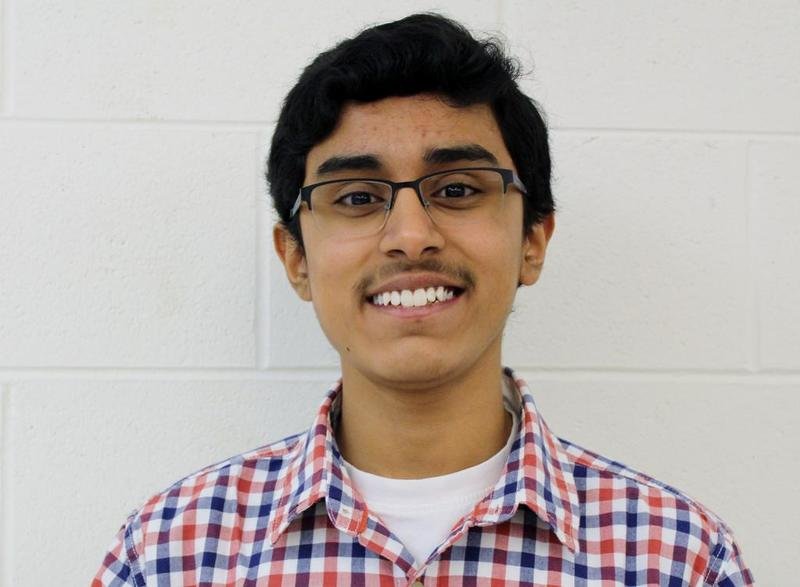
A Plainfield South High School sophomore is traveling to a national science competition, after he created and programmed a self-driving car.
Amaan Khan, 15, will compete this week in the National Junior Science and Humanities Symposium in Maryland, after winning the Illinois Junior Science and Humanities Symposium (JSHS) in March, according to a news release from Plainfield District 202.
Khan created and programmed a self-driving car that can drive within designated lanes, stop and go at lights and avoid obstacles.
He won a $2,000 college scholarship and free trip to the national competition. He is one of two students from Illinois heading to Maryland to compete Tuesday through Saturday with 93 students from across the nation.
Competitors must submit a research paper and present their projects before a panel of judges and an audience of their peers.
Khan became interested in robotics and artificial intelligence last year, after he built a voice-controlled toy car. He took online college courses and watched college lecture courses and YouTube videos to teach himself computer programming.
“As I was learning I kept building the project,” Khan said. “I’d learn one thing, implement it, learn another thing and implement that.”
Patrick and Samantha Scanlan, PSHS science teachers, have supported Khan along the journey.
Samantha Scanlan helped Khan register for the contest. Patrick Scanlan helped Khan polish his oral presentation.
“[Khan] knows what he wants and seeks out the resources to do it,” Patrick Scanlan said. “And if there’s something he needs to learn, he’s able to figure out what he needs to be successful.”
The JSHS is designed to challenge and engage students in science, technology, engineering or math.
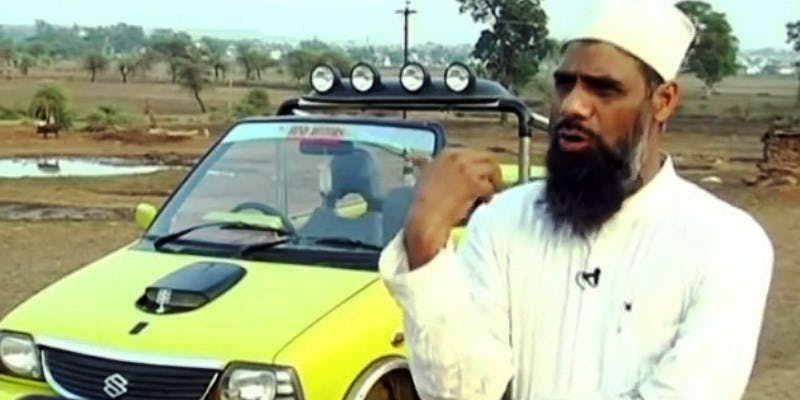
44-year-old car mechanic Mohammad Raees Markani from Madhya Pradesh has invented a car that runs on water.
This 12th pass took five years to develop the final product. The car runs on acetylene gas, which is formed from a chemical reaction between calcium carbide and water. Raees now has a patent for his water car. According to Mirror, Raees has been modifying an 800 cc engine for the last five years – and now believes he has made the scientific breakthrough. The eco-friendly car uses a mix of water and carbides.
Raees who has been a mechanic for the last 15 years told Mirror, “The gas is used for several industrial purposes including welding and portable lighting for miners. But in my case, I am using it to propel the car engines . I have made other changes to the engines, which helps the overall performance of the car. So basically, it is just about the water.”
“The market for environmentally friendly cars is getting bigger and automobile companies around the world are looking for eco-friendly ways to reduce pollution. So a car like mine can be a good alternative. It costs close to nothing to operate and it is environment friendly,” added Raees.
Image : Pultan
The Chinese automobile companies have invited Raees to develop the idea further. All the companies that are interested in Raees’s water car project will have to meet his one condition – any plant to make new cars will be established only in his hometown in Madhya Pradesh. “I want things to change in my hometown. So this is where my work should continue,” Raees stated.
NEW DELHI / TAMIL NADU / TELANGANA / Minnesota – Washington DC, U.S.A. :
For many in the lecture hall during the 9th Annual Marilyn Koering Award ceremony, devoted teacher, research scientist, mentor, and patient advocate Marilyn Koering, PhD, Professor Emeritus of Anatomy and Cell Biology at the George Washington University (GW) School of Medicine and Health Sciences (SMHS), was an inspiration.
“She had a tremendous impact on my life,” said Koering’s sister, Susan, who travels from Minneapolis Minnesota each year to present the award. “Going to the same college, going into the medical world … she was an inspiration to me.”
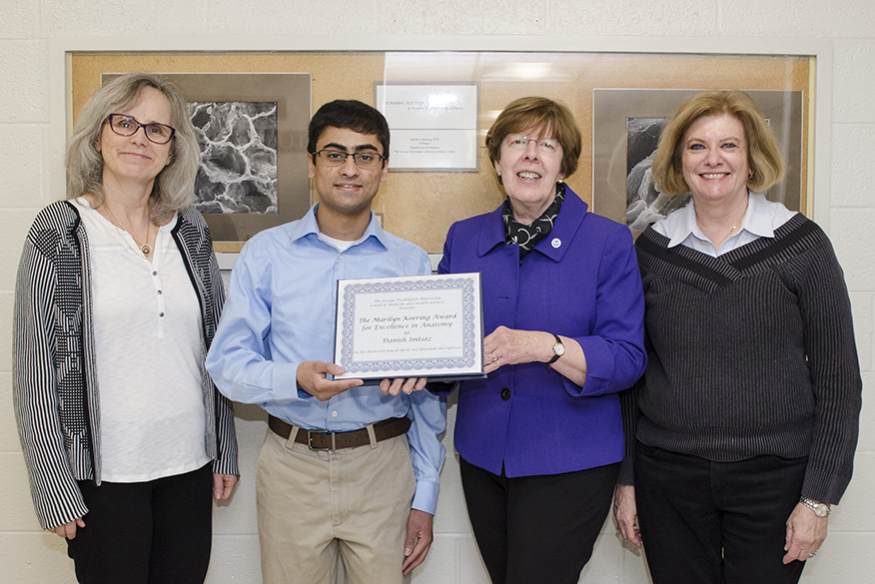
The award is presented each year by Koering’s sister to the first-year medical student with the highest overall grade in the anatomical sciences. This year, Danish Imtiaz earned that distinction.
“I feel extremely honored to receive this award in the name of the esteemed Dr. Koering,” Imtiaz said, adding that her legacy will inspire him to continue exploring the anatomical sciences.
“I would like to thank Dr. Koering’s family for the award,” he said. “And also, I would like to thank the anatomy and histology professors at GW SMHS for their excellent instruction. I hope to continue to work hard and learn more about the anatomical sciences from them.”
Kenna Peusner, PhD, professor of anatomy and regenerative biology at SMHS, organized the award and introduced the speakers at the assembly. Peusner said that Marilyn Koering was dedicated to her students, teaching histology to more than 5,000 GW medical and graduate students. For 34 years, Koering taught in the classroom and labs at the SMHS until her retirement in 2003. She passed away in 2008 after a fierce battle against malignant melanoma.
“After Marilyn was diagnosed with melanoma, she fought the cancer for 21 years through essays, appearances on television, addressing cancer support groups, and writing letters to pharmaceutical companies and the federal government to gain support for patients who volunteered for experimental treatments,” Peusner recalled.
Mary Ann Stepp, PhD, professor of anatomy and regenerative biology at SMHS, who knew Koering both as a member of the faculty and as a student, spoke on her remembrances.
“When I came here and entered the Anatomy Department, the Chairman … saw my weaknesses in the anatomical sciences, so I was assigned to learn histology with the first-year medical students,” Stepp explained. “So I sat in the classroom with the medical students, and got to know Marilyn not only as a faculty member, but as a mentor. She was an excellent teacher; she really cared about making sure that the students understood what they were doing and how to do it well.”
During the ceremony, Susan Koering told a story of her 6-year-old grandniece, whom she said Marilyn would have loved. One day, she asked the young girl what she wants to be when she grows up. Her response: “A mommy.”
“I said, ‘Well, OK, but how about a scientist?’ And then about a month later I asked again ‘What are you going to be when you grow up?’ This time she said ‘a scientist,’” Koering said to laughter.
source: http://www.smhs.gnu.edu / GW, George Washington University, School of Medicine & Health Sciences / Home> News / by Katherine Dvorak / April 23rd, 2018
Karim’s had transformed from a local purveyor of aloo gosht into a monument. It was visited by princes and prime ministers, eulogised by journalists, studied by historians, and patronised by tourists.
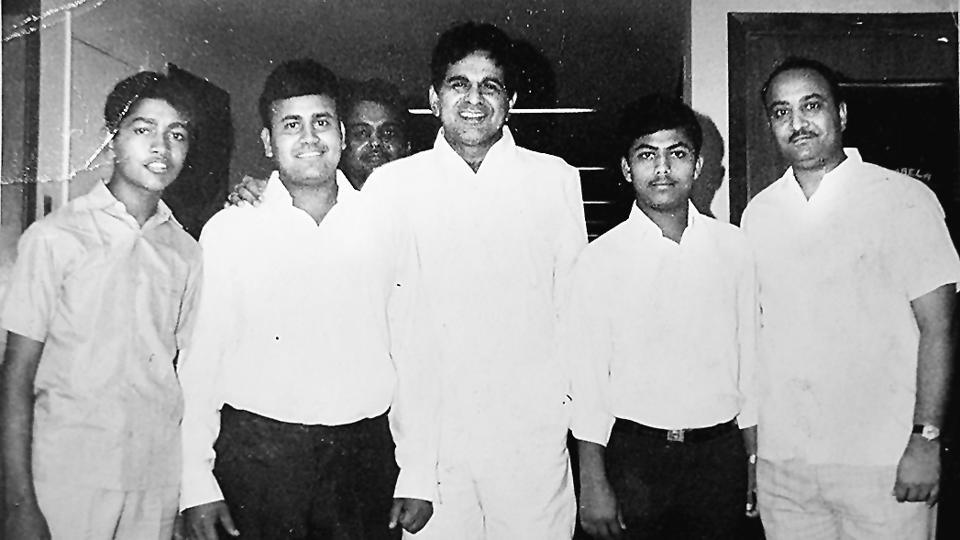
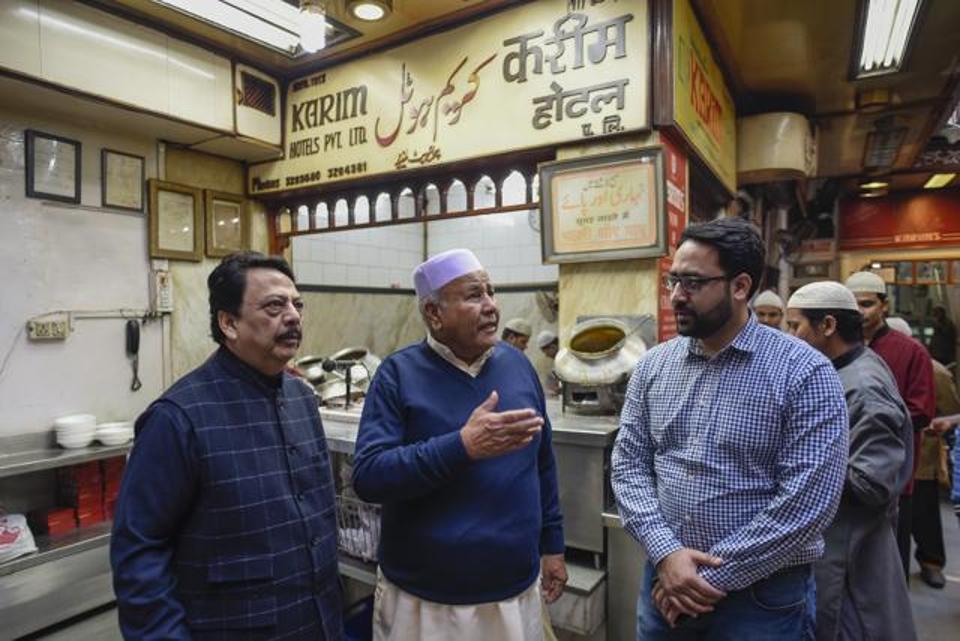
Haji Zahooruddin (extreme right) with Bollywood star Dilip Kumar.(Image courtesy Zain-al-Abedin,Zaeemuddin Ahmed and family))
When Haji Zahooruddin started working at Karim’s over 70 years ago, the business consisted of a single restaurant run by his father and grandfather. On January 27, when he died at the age of 85, Zahooruddin was the managing director of a small empire, with 26 outlets overseen by around a dozen other family members.
Karim’s had transformed from a local purveyor of aloo gosht into a monument. It was visited by princes and prime ministers, eulogised by journalists, studied by historians, and patronised by tourists.
Much though Karim’s success was the result of adaptation to changing times — with the addition of Punjabi butter chicken to the Mughlai menu, for example, and the establishment of small take-out joints throughout the city — Zahooruddin devoted himself to protecting Karim’s most valuable asset: its heritage.
“This is time-tested Mughlai food and we do it well,” he told an English daily in 2013, “so why should we change?”
Karim’s changed only as much as it had to. Striking this balance enabled Zahooruddin’s “number one contribution”, said Shahid Siddiqui, a regular at the restaurant who has written extensively about Old Delhi. “He introduced the food of the old city to New Delhi and to the public in general.”
The Karim’s family attributes their culinary lineage to Mohammad Awaiz, a chef in the royal court of the last Mughal emperor, Bahadur Shah Zafar. When the British sacked Delhi and expelled the king to Rangoon, Awaiz fled. He settled in Ghaziabad and found other work, but taught his son, Haji Karimuddin, everything he knew about Mughal cuisine. During the coronation of King George V in Delhi in 1911, Karimuddin returned to the imperial city and set up a food stall. In two years, he made enough money to open a restaurant.
Karimuddin’s son, Haji Nooruddin, had four sons of his own, including Zahooruddin, who was born around 1932. He started working at Karim’s at the age of 12. The young boy learned the power of belonging to the Karim’s family when a particularly strict teacher demanded Zahooruddin hand over the food in his tiffin box every day at lunchtime. Zahooruddin may have gone hungry, but he was spared the beatings inflicted on his classmates.
He spent his whole adult life working at the restaurant, learning its traditions zubaani (orally) and mixing spices with his male relatives — the only ones allowed to know Karim’s recipes. In the late 1940s, he married Samar Jahan, also a resident of Old Delhi, and had four children, two of them sons who have spent their careers working at Karim’s. Four of Zahooruddin’s grandchildren now manage branches of the restaurant.
Zahooruddin’s son Zaid-ul-Abedin, his brother Salahuddin, and nephew Zaeemuddin, three of the current directors of Karim’s, say that his focus was always on Karim’s buniyaad, both in terms of values and dishes. (Burhaan Kinu/HT PHOTO)
Clients and business associates found Zahooruddin to be a commanding figure, and heeded his advice. For newlyweds, he recommended nahari; to the sick, thigh meat for its high degree of bone marrow; to one fat customer, Siddiqui remembered Zahooruddin making the suggestion, improbable for a restaurateur, that the man eat a little less. If a customer said something was wrong with their mutton or chicken, Zahooruddin would keep the piece of meat and show it to his butcher in disapproval. “Babu would scold me sometimes,” said Javed Qureshi, whose family has supplied Karim’s with meat for decades, “but he loved me like a son.” Qureshi is one of many people who refer to Zahooruddin as “Babu” (father).
As time went on, Karim’s business grew, and its legend along with it. The family opened a second branch in Nizamuddin in the years before the Emergency. The former Presidents Fakhruddin Ali Ahmed and Zakir Husain became devoted customers, the latter ordering his food to Rashtrapati Bhavan. Indira Gandhi was also fond of Karim’s, but had security guards oversee the meals cooked for her.
The obvious antiquity of Karim’s Jama Masjid alleyway, its family’s claims of royal patronage, their distinctive Old Delhi Urdu, their promotion of old-fashioned dishes such as mutton brains — all this was stimulus for myth-making and myth-debunking. Historians debate whether Karim’s famous ‘istoo’ is authentically Mughal or secretly British. Some trace the family’s origins to a Saudi Arabian soldier who became Babur’s personal cook, but Zaeemuddin Ahmed, Zahooruddin’s nephew, said the family does not know anything about their ancestors prior to Awaiz.
In 1988, when Karim’s registered itself as a company, Zahooruddin was made chairman. When his brother Alimuddin Ahmed died in 2007, Zahooruddin took over from him as managing director. A slim gentleman with a well-trimmed moustache, he became the public face of his venerable restaurant. He attended numerous award ceremonies and made an appearance on the NDTV show Foodistan. At such moments, Zahooruddin smiled with the discomfort of a dignified man in a flamboyant place.
The public image of him as an embodiment of Old Delhi customs was shared by those who knew him personally. When Faiz-ul-Islam, his friend of over 40 years, returned from Haj, Zahooruddin invited 200 of Islam’s friends for a free breakfast at Karim’s, in keeping with his sense of mehmannawazi (hospitality). “He did it without takalluf (hesitation) and without a single line on his forehead,” said Fazl-ul-Islam, Islam’s son.
Zahooruddin performed culinary experiments, sometimes inventing his own dishes, while also sampling the food from different outlets of Karim’s every week to ensure his standards were being upheld. He insisted that the core of the menu — qorma, nahari, mutton burra, kebab — remain untouched.
“Babu used to say, ‘If we let others own a franchise, will they give the same attention to the quality of spices we use?’” said Zain-ul-Abedin, Zahooruddin’s son. “For example, he would say that cloves are something most people don’t eat: they take it out and put it aside on the plate. So another restaurant owner may think, ‘What is the use of putting in the cloves or buying the best-quality cloves?’ But clove adds to the taste, its juices mix with the food and bring out the smell of meat.”
What he was selling, after all, was not just food. Visit Humayun’s Tomb, and you’ll find a silent testament to the dead. Visit Zahooruddin’s restaurant, and you’ll find traces of the past still alive.
source: http://www.hindustantimes.com / Hindustan Times / Home> Delhi / by Alex Traub and Zehra Kazmi, Hindustan Times / February 01st, 2018
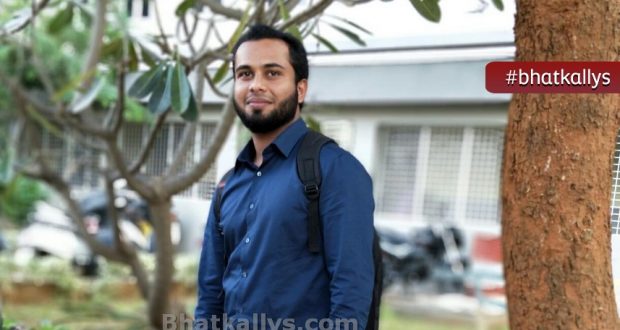
Bhatkal lad Abdul Bais Kadli, secured Best Oral Presentation Award during the International Conference on Desalination (InDACON-2018) on 20th April 2018 at National Institute of Technology, Tiruchinapalli, Tamilnadu.
Abdul presented his paper entitled ‘Optimisation and Modelling Of Desalination Of Water Using Biological Waste By Rsm And ANN’ during the event and secured the award.
The event was organized by National Institute of Technology, Tiruchinapalli, Tamilnadu at their campus on 20th and 21st April 2018.
Abdul Bais is a student of 8th semester chemical engineering at Siddaganga Institute Of Technology, Tumakuru and was representing his college in the event.
He is also a alumni of Anjuman Hami-e-Muslimeen Bhatkal where he completed his high schooling and Pre-University education, he was also a recipient of the prestigious academic award of the institution ‘Viqare Islamia’ in 2012 his teachers and management and Anjuman expressed their happiness over Abdul’s achievement and congratulated him while also wishing him luck for his future endeavors.
(Bhatkallys News Bureau/ Shaikh Zabi)
source: http://www.bhatkallys.com / Bhatkallys.com / Home> Bhatkallys News / by Shaikh Zabi, Bhatkallys News Bureau / April 23rd, 2018
In his quivering voice you could hear the rustle of silk and the muffled sound of a broken heart. Few singers could put the listener in a blue mood like Talat Mahmood, who passed away on May 9 exactly 10 years ago.
And thanks to a website created by his son Khalid that gets about 1,50,000 hits every week from Indians and Pakistanis all over the world – “and a few Israelis”, Khalid adds – his memory is fresh as ever.
“Talat saab came from Lucknow and his Urdu pronunciation was perfect. He could exactly reproduce a song the way a composer had conjured up in his mind. He was an original singer whose distinctive voice was near impossible to duplicate,” recalls masterclass music director Khayyam.
One of the veteran music composer’s memorable compositions – Shaam-e-gham ki kasam (film: Footpath) – was sung by Talat, also known as king of ghazals. Khayyam recalls that in that memorable song he had experimented with the orchestration by not using any rhythm instrument like tabla.
“We used a piano, guitar and solo vox, a basic version of the synthesizer used in those days. Recording the number took plenty of time. But Talat saab ke mathe pe shikan nahi aayee,” he says.
Senior lyricist Naqsh Lyallpuri remembers a recording with the singer. The song was Zindagi kis mod pe laayi mujhe, from the film “Diwali ki Raat”. Snehal Bhatkar was the music director. Says Lyallpuri, “We had only two musicians at the rehearsal. They were playing the tabla and the sitar. But the producer liked his singing so much that he said, there is no need for any other instrument. We recorded the song with just those two instruments.”
Lyallpuri remembers Talat as an extremely soft spoken man. Which Khayyam affirms. “He was a perfect gentleman. With him there was no loose talk. He was always well-dressed: his shoes shining and his trousers perfectly creased.”
To honour his father’s memory, Khalid Mahmood set up a website, talatmahmood.net, just a few months after the singer’s death in 1998 at the age of 74. Apart from the huge number hits every day, he also gets about 200-300 emails every week.
“The choice for me was between doing a book and setting up a website. I settled for the latter because it is more accessible,” says Khalid.
Talat recorded his first track way back in 1941 and sang around 750 songs in 12 languages. He also acted in over a dozen movies such as “Dil-e-Nadaan”, “Lala Rukh” and “Ek Gaon Ki Kahani”.
Few know that the singer-actor aroused mass hysteria when he arrived in Trinidad in West Indies on a concert tour in 1968. Fans thronged the roads from the airport to the city. The local group, West Indies Steel Band, composed a Calypso track in his honour. They sang, “Talat Mahmood we are proud and glad, to have a personality like you here in Trinidad.”
Talat is long gone. But as long as the human heart knows how to fall in love and emerge with ache, his velvet voice will live on.
(avijit.ghosh@timesgroup.com)
source: http://www.timesofindia.indiatimes.com / The Times of India / News> India News / May 09th, 2008
Mr. Firoz Bakht Ahmed is grandnephew of Maulana Abul Kalam Azad, first Education Minister of India.
Hyderabad :
Firoz Bakht Ahmed, educationist, noted social activist and columnist has been nominated as the Chancellor of Maulana Azad National Urdu University (MANUU) for a period of 3 years, said a statement from the varsity.
According to a notification released by the registrar, MANUU today, President of India in his capacity as Visitor of the University has appointed Mr. Firoz Bakht as the fifth Chancellor of the University.
Mr. Firoz Bakht succeeds Mr. Zafar Sareshwala.
Mr. Firoz Bakht is grandnephew of Maulana Abul Kalam Azad, first Education Minister of India. The University is named after Maulana Abul Kalam Azad, a scholar par excellence, a prolific writer, an inimitable orator, a gallant freedom fighter, a visionary of the post independent Indian education system and an architect of technical and scientific education in Independent India.
He is a prolific writer and authored many books in Urdu and Hindi, especially on Children’s Literature.
He is also a freelance journalist and columnist. His columns and articles appear regularly in various widely circulated newspapers across India.
Mr. Firoz Bakht was also associated with Madrassa modernisation and Urdu medium schools upliftment.
He was appointed by the courts in various committees/enquiry committees assisting the judicial procedures for prompt justice.
He was also associated with MANUU before its inception in 1997 as foundation panel member.
Maulana Azad National Urdu University (MANUU)
Maulana Azad National Urdu University (MANUU) is a Central University, established by an Act of Parliament with all India jurisdiction in 1998. The headquarters and main campus of MANUU is in Gachibowli, Hyderabad. It is spread over 200 acres. MANUU is recognized as a major higher education service provider across the remote areas of the country for marginalized and first generation learners of Urdu medium through its regular and distance mode programs.
MANUU commenced with distance education programs in 1998 and consolidated its academic and research base in Urdu medium regular programs in 2004.
Presently, MANUU is in the process of consolidating the existing institutions, while expanding it to reach the unreached through various intervention measures. Further, to meet the rising aspirations of its youth in general and Urdu speaking community in specific, the University is making considerable progress in all fronts of academics, research and governance with specific vision, mission and objectives.
source: http://www.ndtv.com / NDTV / Home> Education> by NDTV Education Team / May 17th, 2018
Could the Tiger’s position — now behind a glass case, its crank handle inaccessible to the public — be an apology for the disrespect permitted in East India House?
The artefact sitting in V&A was iconic, identifiable and far away from home
The day I saw Tipu’s Tiger behind its glass case at the Victoria and Albert Museum in London was a day of significance. That morning, after months of being cooped up in Oxford, some friends and I took the train to Marylebone and found the absence of dreaming spires refreshing to say the least. At noon, a friend from India was waiting for me on the other side of the busy Camden High Street. As we hugged amidst the crush of gliding Londoners, her muffled exclamation might have been: ‘It’s so crazy we’re meeting here of all places, so far from home.’
That phrase would be borrowed by me on two separate occasions during the day. In the evening, I stood before Julian Barnes at the Royal Institution and told him how I had read ‘A Short History of Hairdressing’ over and over again to teach myself the ‘architecture’ of a short story. I felt a potent urge then to parrot my friend. It was ‘crazy’ to see and hear Barnes in the flesh, so far from my bedroom in Kolkata, the only other place he had seemed real and, dare I say, attainable through his prose and through the material object, that is, his books in my hands, the only feasible rendezvous with the man.
I had never thought then it would happen: to have someone I studied so minutely sit before me and confess he didn’t think as highly of his short prose as I did.
Iconic meeting
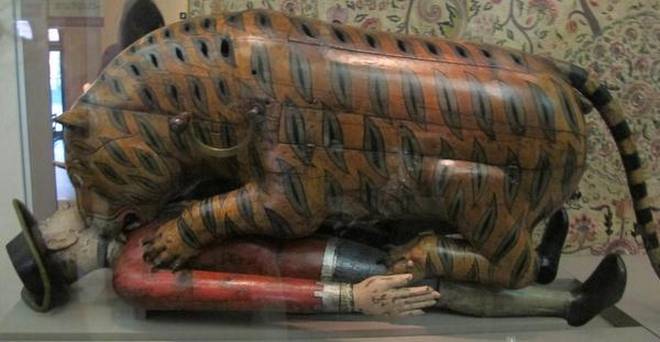
The second occasion I was inclined to echo her words that day was when I stood in the South Asia section of the V&A before Tipu’s Tiger, which had always been relegated to the Did You Know section of our history books. It was not exactly like meeting an old friend or a revered author, but it bore all the characteristics of such a meeting. Like Barnes and my Kolkata friend, it was instantly iconic, identifiable from a distance, and a ready reminder of my distance from India. In fact, standing before the wooden automaton, slightly disconcerted, I addressed it and thought: ‘You are so far away from home.’
The possible inspiration for the mechanical figure seems fitting to some. Hector Munro Jr, whose father defeated Tipu’s father Hyder Ali in the Second Anglo-Mysore War in 1781, was mauled by a royal Bengal tiger at Saugor Island in 1792 and died from the injuries. This must have seemed like divine intervention to Tipu, a wrong set right. The carved and painted, almost life-size, wooden musical automaton was created for the Sultan, whose personal emblem was a tiger and whose hatred of the British was well-known.
The last laugh
With the fall, however, of Seringapatam and the execution of Tipu in the Fourth Mysore War of 1799, the Tiger travelled from the music room of Tipu’s summer palace to the Company’s East India House at Leadenhall Street in London, where the public was given access to view and play with it.
Its wooden body with a keyboard embedded in the flank was thrown open to the English masses who came in and played ‘God Save the King’ and ‘Rule, Brittania!’ upon it. If Tipu thought he had been mocking the Englishmen with the Tiger, they were now having the last laugh.
I deal with issues of empire and post-colonial anxiety almost on a daily basis, especially in a place like Oxford, especially on a course called World Literatures in English. Of course, when I first saw it, I silently demanded a restoration of the tiger to its previous owner, to its previous nation. My anger at seeing the Tiger in an English museum, so far away from home, was justifiable. The Tiger was not borrowed. Nor was it touring, as it had to New York’s MoMA in the 50s. Instead, it was a ‘permanent’ acquisition at the V&A.
Of collaborations
For every Indian schoolchild, the Tiger, just an artefact but nonetheless awe-inspiring, was not an affordable train or flight away, like Fatehpur Sikri or Sher Shah’s tomb.
For me, the Tiger’s distance from my home was a reiteration of the national and racial distinctions not only of the Anglo-Mysore variety, but also of the Jadavpur-Oxford type that I faced every day. Besides dodging questions like ‘If you’re from India, how’s your English so good?’ for the past few months, I had had to clarify to a white friend who subsisted on the chic-ideal of Zadie Smith that India has Bengalis too, and no, I did not have relatives in Brick Lane, not that I knew of anyway.
Seeing Tipu’s Tiger that day catalysed a recollection of an afternoon in 2016 in the Victoria Memorial Hall with Thomas Daniell and his nephew William. Their tranquil scenes of India, while in stark contrast to the ferocity of the Tiger, do something interesting.
The English hands of the Daniells reproduce the Indian hands of the architects behind the buildings and locations they sketch. Their canvas becomes a surface of Anglo-Indian collaboration, similar to how it is conjectured that the mechanics of the Tiger have an Indo-French history.
This recollection, and the subsequent contemplation on collaboration, made me think of several works of restoration that the V&A carried out upon the Tiger, especially after the bombing of London in World War II. Could this act of restoration be seen as an act of reparation? Could the Tiger’s position — now behind a glass case, its crank handle inaccessible to the public — be an apology for the disrespect permitted in East India House?
The Tiger, so far from home, is an icon that reminds me of a past based on plunder and pillage by the nation it sits in. Yet, its 18th century splendour has weathered war and wear so well. Do present acts of safekeeping obliterate the violent history of its, for want of a better word, theft?
I am persuaded to wonder if the Tiger is now a collaboration between Tipu’s Mysore craftsmen and its modern conservationists in England and if I should be thankful for the restoration. Are the acquisition and conservation of an Indian object in a British museum and the works of British painters displayed in a Calcutta museum an instance of transnational collaboration and exchange? But in the case of Tipu’s Tiger, this then also begs the question: how long is too long before we forget that what is ‘acquired’ is what was once ‘removed’ from its home?
The writer, a Felix Scholar, is studying World Literatures in English at Oxford
source: http://www.thehindu.com / The Hindu / Home> Society> History & Culture / by Rohit Chakraborty / May 05th, 2018
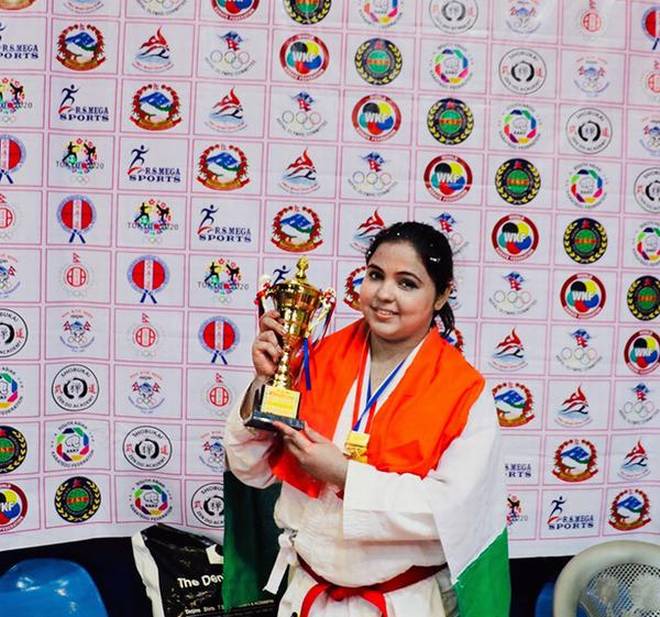
Syeda Falak with the trophy won at 4th International Karate Championship held in Kathmandu, Nepal.By Arrangement
Syeda Falak of Hyderabad won gold in the fourth International Karate Championship in the senior female category in Kathmandu (Nepal).
In a championship featuring competitors from Nepal, India, Srilanka, Bhutan, Nigeria, Pakistan and Bangladesh, the girl from Old City cleared the first three rounds with ease and got the better of the rival from the host’s nation in the finals. Falak was also awarded the ‘Best Female Fighter’ too. “This is a huge morale-booster as I prepare for the major championships ahead,” says the 23-year-old Hyderabadi.
Some of her earlier major achievements include gold medal in the International Open Championship in Kolkata late last year, besides finishing third in the WKF Series in Istanbul, Turkey, and being three-time gold medallist in the nationals in 68-plus category (kumite).
source: http://www.thehindu.com / The Hindu / Home> National> Telangana / by V.V. Subrahmanyam / Hyderabad – May 14th, 2018