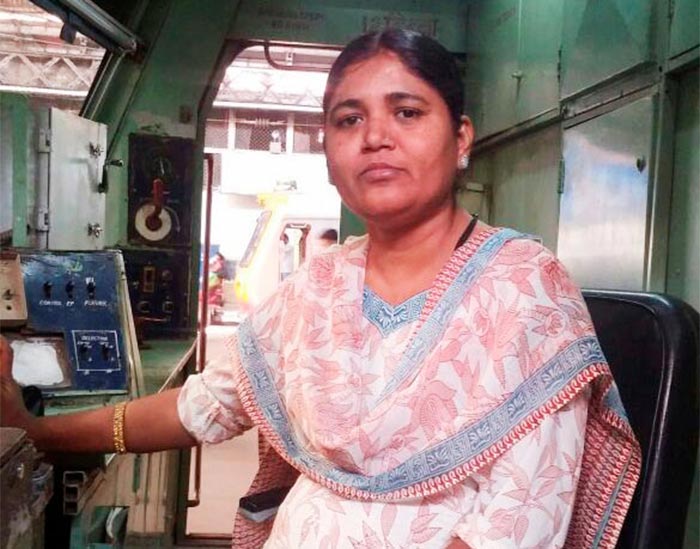
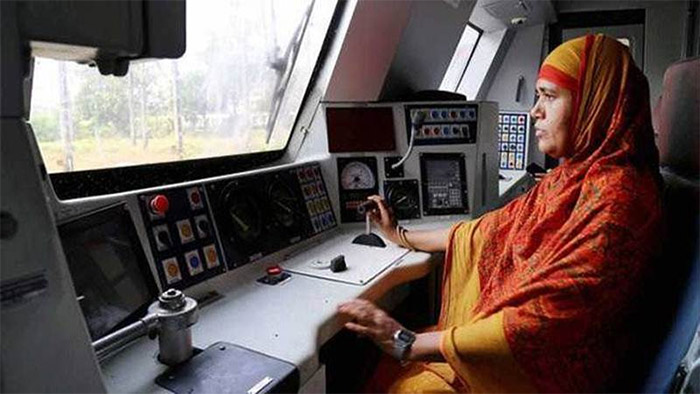
Women are going places, they say. But Mumbai’s Motorwoman, Mumtaz Kazi takes people places by driving them in Mumbai’s local trains. Not only is she one of the few motorwomen the world has seen, but she’s also a first in Asia, to begin with.
In a career span of more than 20 years, Mumtaz has driven various kinds of trains. She is also Asia’s first woman train driver.
Sure that didn’t come easy, did it?
From a very young age, Mumtaz wanted to be in Railways. Her father was a Trunk Superintendent at Churchgate railway station. She grew up in the railway quarters and used to watch the trains pass by.
She was born and brought up in Mumbai and went to Seth Anandilal Poddar High School. In 1989, just after her SSC, she applied for the job of the motorman.
Since that very year there was a change in the railway recruitment board policy in India, Mumtaz could sit for the examinations and applied for it.
She did extremely well in examinations, leaving everyone impressed with her ambitiousness. And, was appointed in 1991 just after her class twelve examination.
While she was extremely happy about the job, she faced a bit of resistance from her father’s side upon her decision. Her father, Allahrakhu Ismail Kathawala, asked her to complete her Diploma in Medical Laboratory Technology (DMLT) course first.
After much convincing, Mumtaz’s father gave in and gave her his blessings. And, she became the first motorwoman. In its 1995 edition Limca Book of Records acknowledged Mumtaz’s success and she became the first woman diesel engine driver in Asia at the age of 20.
Not only that, Mumtaz also went on to become the first train driver to possess the skill of driving both Electric and Diesel engine.
Throughout her journey, Mumtaz was the courageous support system to her family. It was because of her, they could buy a home in Mumbai and she also helped with her brothers’ education. Both her brothers, Imtiyaz and Feroz, are engineers and settled abroad.
But that’s not the only thing for which she makes all look up to her. When she’s not driving trains and being on the job, she is a homemaker and loves spending time with her family.
She got married to an electrical engingeer from Nandoorbar, Maqsood Kazi, in 2002 and is a proud mother of two kids Tausif Ahmed and Fateen.
In the year 2015, she was awarded Railways General Manager Award.
And, in 2017, on International Women’s Day, she was awarded the Nari Shakti Award by President Pranab Mukherjee.
Mumbai’s local train is one of the busiest railway network and Mumtaz, like a boss, pilots the busiest local trains. With her grit and determination, Mumtaz, over the course of more than two decades, has set an example that there’s no job that women can’t do. After all, the levers on the train don’t know if it’s a man or a woman’s hands operating them.
source: http://www.storypick.com / StoryPick. / Home> Culture / by Rachna Srivastava / March 10th, 2017
UTTAR PRADESH / Mumbai, MAHARASHTRA / New York, USA :
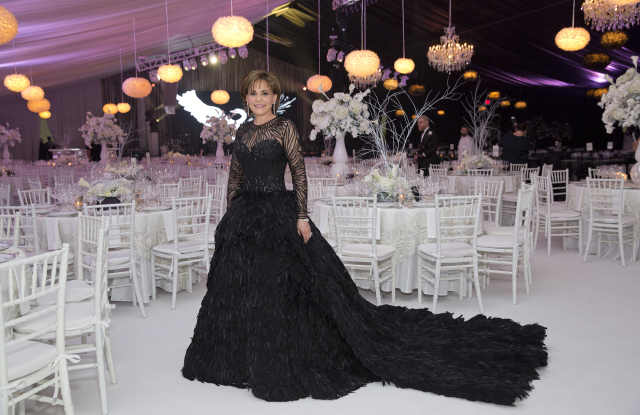
Khan designed the dress for Houston Ballet Ball chair Hallie Vanderhider.
Hallie Vanderhider / Photo by Jenny Antill
Black Swan :
Guests at The Houston Ballet Ball were encouraged to don black, white or a mix of both as an ode to Tchaikovsky’s ballet “Swan Lake,” but Houston Ballet Ball chair Hallie Vanderhider took the concept further — much further, enlisting the design prowess of Naeem Khan to create her feather-laden gown.
Vanderhider and Tootsies creative director Fady Armanious flew to New York and met with Khan to discuss a gown that would capture the elegance and dark beauty that Vanderhider had envisioned for the ball. Within a few sketches, the trio had landed upon an all-black gown covered in 3,500 natural black coque feathers, weighing in at 7.25 pounds.
“It was a magical moment. Naeem totally captured the essence of Swan Lake,” Vanderhider said. “He is such an amazing talent and has a great sense of humor.
Khan encouraged Vanderhider to embrace the mysterious elements of the dress, reminding her, “This isn’t a mother-of-the-bride gown.” The gown’s sheer long sleeves and bodice were finished with intricate beading.
source: http://www.wwd.com / WWD / Home> Fashion> Fashion Scoops / by Heather Staible / February 22nd, 2018
Mysuru girl Rifah Taskeen drives into the Golden Book of World Records.
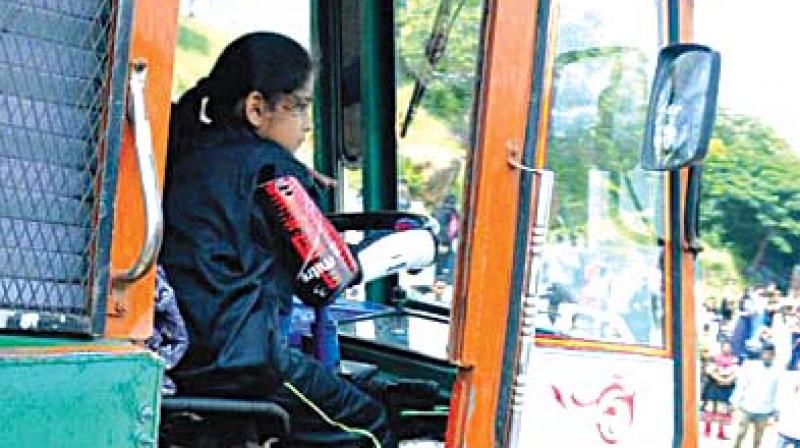
Rifah Taskeen drives a truck in Mysuru on Sunday.
Mysuru:
Amazing though it may seem, seven-year-old Rifah Taskeen at last got permission from the state government to participate in a record breaking event and drove 16 vehicles, in a bid to become the youngest to drive multiple wheeled vehicles at Idgah ground and St Joseph’s school ground at Bannimantap here on Sunday
In her bid to enter the Golden book of world records, the tiny wonder drove a lorry, Mahindra Bolero, Tata Ace, Mahindra Scorpio, Toyota Fortuner, Maruti 800, Maruti van, Maruti Esteem, Maruti Zen, Santro, Ford, an ambulance, a Hyundai Verna, a Tata Indica and a Quad bike among others (Her father had modified and lowered the level of the seats in the vehicles to suit her height).
Mr Santhosh Agarwal of Golden Book of World records, who represents South India, participated as an observer in the event. Rifah aimed for the record after permission was granted by Primary and Secondary Education minister Tanveer Sait and Mysuru city police Commisioner Dr A Subramanyeswara Rao. Her aim now is to become the youngest pilot. Her parents are in touch with a few airlines and a firm has agreed to train her, according to her father Tajuddin.
Tears flooded the eyes of Bibi Fathima, mother of Rifah, a class 2 student of St Joseph’s school at Bannimantap after seeing her feat. Principal of her school Maria Gracilda had no words to express her happiness as Rifah stunned people at the event, with her amazing confidence.
Rifah’s father Tajuddin, a contractor of floor tiles and a former racer who has won several national level contests, has worked as stuntman and dancer in several movies while her mother is a government school teacher. They reside in NR Mohalla here. Owing to constraints, Tajuddin couldn’t fulfill his dream of contesting in races at the international level. He started training Rifah ever since she was a baby. “I used to put her on my lap when I used to drive. She learnt driving at the age of 3,” Mr Tajuddin disclosed.
Rifah has performed stunts at school during Republic Day and Independence Day programmes. She even launched Chinnara Dasara hosted by the department of women and child development, in the presence of chairperson of Karnataka Commission for the Protection of Child Rights Krupa Amar Alva, during Dasara recently. But due to lack of permission from the authorities, the event to break the record was delayed. “My only aim is to drive a Formula 1 car and also become a pilot,” Rifah said.
source: http://www.deccanchronicle.com / Deccan Chronicle / Home> Nation> Current Affairs / by Deccan Chronicle / by Shilpa P / November 06th, 2017
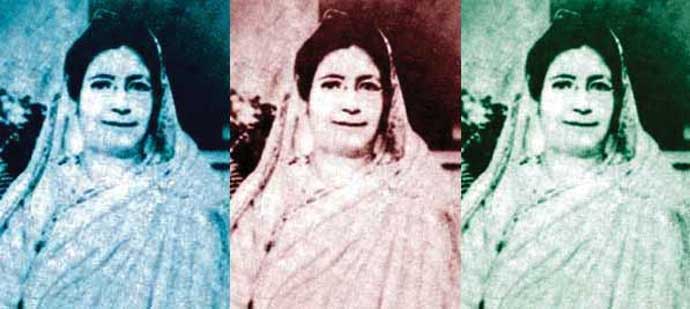
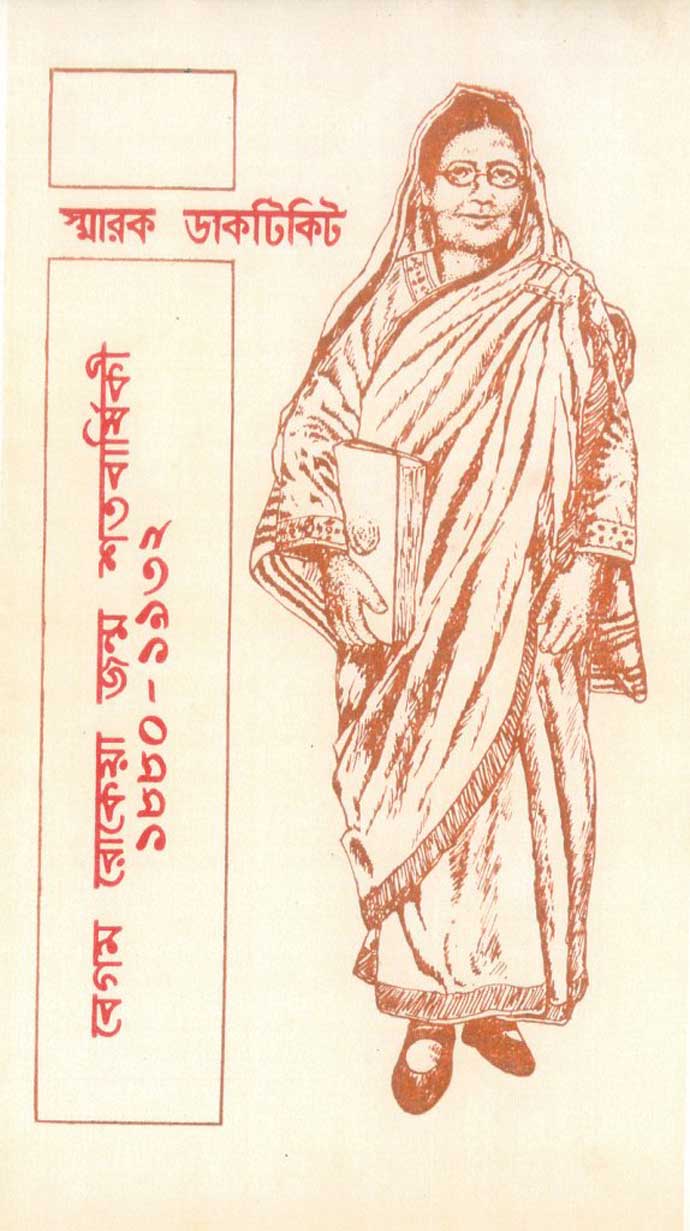
Rokeya Begum was an educationist, writer, social activist and effectively, India’s first Bengali Islamist-feminist.
As a Muslim reformist, her activism was neither half-baked nor exclusionist, yet little is known of her meaningful contributions to society.
Sometimes when wars are long and without any imminent hope of triumph or an end, it’s best to count on the smaller victories. Such as the taking down of Omprakash Mishra’s misogynist cringe-pop video or Uber apologising for their presumptuous and sexist offer on “Wife Appreciation Day” or Hulu’s The Handmaid’s Tale bagging the Emmy for “Best Drama Series” leaving behind popular shows like Westworldand Stranger Things.
The Handmaid’s Tale is to feminists what the BJP manifesto is to Arnab Goswami. Though Margaret Atwood’s evergreen dystopian thriller published in 1985 was one of its kind, it wasn’t the first. Eighty years before that, Begum Rokeya Sakhawat Hossain published her feminist utopian fantasy Sultana’s Dream, a novella investigating the ironies of a technologically advanced, gender-reversed India (one where men were confined to the “zenana” — the part of a house for the seclusion of women, or as Rokeya terms it, the “mardana” — imagined in the dreams of a woman named Sultana.
Born in 1880 to a wealthy Zamindar family in Pairabondh (present Bangladesh), Rokeya Begum was an educationist, writer, social activist and effectively, India’s first Bengali Islamist-feminist. While Savitri Phule and Pandita Rama Bai re-emerged through the obliterating clouds of India’s redacted history-telling, the narrative on Rokeya’s work remains shrouded, at least, in India.
Her father, an orthodox Muslim, persisted that the women maintained purdah and allowed them to be educated in Arabic (only) to enable them to read the Quran. Rokeya and her sister Karimunnesa, learned Bengali and English at the behest of their supportive brothers, who educated them on the sly. Perhaps this phase of her own life contributed amply to her tenacious belief that the lives of Muslim women could not be ameliorated without proper education. Added to that was her own sister who remained a key inspiration for Rokeya’s writings and her social work.
Karimunnesa, a seasoned poet, had been married off before the age of 15, putting what might have been a lucrative future to an abrupt end. This had further consolidated Rokeya’s faith in educational and individual rights for women — chiefly Muslim women, who, in that era, lived like showpieces in a glass casket but with an iron curtain.
With this line of thought and the support of her husband (Sakhawat Hossain, whom she was married to at the age of 16 and who died in 1909) and the money he had set aside, Rokeya went on to establish Sakhawat Girls Memorial High School, five months after his demise.
She started the school in Bhagalpur (a majority-Urdu speaking area in erstwhile East Bengal) with merely five students and was forced to shift the school to Kolkata in 1911 due to property feuds with her husband’s family. It remains one of the city’s most popular schools for girls and is now run by the state government of West Bengal.
Today, Rokeya’s memory is as fleeting — even for her benefactors — as Sultana’s dream. Photo: http://nationalwomansparty.org
In 1916, she founded the Anjuman-e-Khawateen-e-Islam (Islamic Women’s Association), which was her other organisational contribution to Bengali Muslim women. Through this organisation she offered financial and educational support to downtrodden Muslim women, over and above raising public opinion regarding the issue of Muslim women’s rights. That Rokeya was way ahead of her times finds semblance in the curricula of the school she established, which included physical and vocational training in an attempt to arm women with financial independence. She coined the term “manoshik dashhotto” or mental slavery, referring to the absence of individuality that pervaded the entire gamut of Muslim women and attributed it as the root cause for their subjugation. This rings true even today.
A century ago, Rokeya approached her adversaries with a wit and logic that is hard to find in today’s generation (which appears to be self-deprecatingly volatile). Insightfully, Rokeya tapped into the quintessential Muslim male ego and inversed it to men’s disadvantage, instead of directly antagonising them with liberal arguments.
She writes, “The Muslim society is paying a greater price for the lack of any system of education for their women. I have been informed by a reliable source that some educated Muslim youths of well-to-do families are setting conditions that if they can’t find educated Muslim women, they will not marry. They even threaten to become Christians and marry someone from that community if they fail to find educated Muslim women.”
Critics might question the ethic behind this approach, but the truth is, even now, “the threat to minority identity” continues to be the most veritable impediment to the realisation of Muslim women’s rights.
Keeping this in mind and the socio-politico environment of that era, perhaps by playing on their fears was not only ingenious but also the only way out.
In 1926, when she was invited to chair the Bengal Women’s Educational Conference, she said, “Although I am grateful to you for the respect that you have expressed towards me by inviting me to preside over the conference, I am forced to say that you have not made the right choice. I have been locked up in the socially oppressive iron casket of ‘porda’ for all my life. I have not been able to mix very well with people – as a matter of fact, I do not even know what is expected of a chairperson. I do not know if one is supposed to laugh, or to cry.”
Having lost her husband early and her two children who died at infancy, Begum Rokeya was not just subjected to scathing criticisms for her views but also faced unforgiving social exclusion. Despite the variegated hindrances she faced, in lieu of her gender, her community and the very fabric of the milieu that she had set out to change, she worked tirelessly and fearlessly to carve a way out for many Bengali Muslim women like myself.
Begum Rokeya died on December 9, 1932, and up until 11pm on December 8, 1932, she was working on an unfinished article titled, “Narir Odhikar“, which translates to women’s rights. The over-arching principle that governed her literary and social work was feminism and through it she heralded the discourse into Bengal. As a Muslim reformist from that era, Rokeya’s activism was neither half-baked nor exclusionist as the classist and sexist Aligarh movement led by Syed Ahmed Khan, yet little is known of her meaningful contributions to society. Today, Rokeya’s memory is as fleeting — even for her benefactors — as Sultana’s dream.
source: http://www.dailyo.in / Daily O / Home> Variety / by Suman Quazi / September 21st, 2017
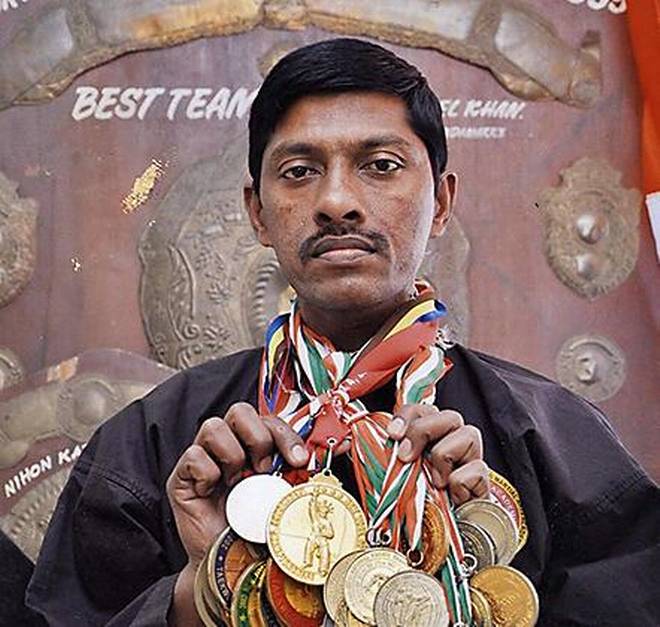
Martial arts exponent Pathan Jameel Khan represents the other side of Indian sport?
Well, yes, if his ordeal in getting even a decent job or sponsorship to take part in international sporting events is any hint. For this 40-year-old Jameel, winner of 15 gold, 13 silver and 17 bronze at the national and international events including two 2016 World Cup silver in the US is now struggling to meet both ends for want of financial support.
At a time, when cash incentives are being showered on truly deserving outstanding achievers, Jameel gently asks what is that he should do more to get the attention of the powers-that-be.
A native of Mandamarri village in Adilabad district, Jameel, whose father is a vegetable vendor, moved over to Hyderabad to pursue his passion in karate. His diligence and consistency at the highest level have won acclaim including an offer from a martial arts organisation to settle down in US with a chance to represent US. But for the love of the country, he spurned that and came back to India with hope of getting some help. But, as things stand, Jameel, a BA from Dr.Ambedkar Open University, is still staring at an uncertain future – even shunted out from one rented accommodation to the other for not being able to raise even the rental by the first week of the month. His lone source of income – training about 20 karate kids in Mehdipatnam – is always doubtful as it depends on the payment of fee by the students. Still, he has the grace to train about 500 girls of a Government-aided school free of cost to make them good in self-defence daily even now.
It may be recalled here that Telangana Government has been pretty generous in showering cash incentives on some of the deserving athletes in the recent past, running into lakhs but the fact that there are some big achievers like Jameel who are out of its radar is a sorry story of the powers-that-be not getting the right info. “May be, I am paying a price of not having the right connection or Godfathers to take up my cause,” moans a dejected Jameel even as he pursues the dream of representing India at this age in the 2020 Tokyo Olympics where karate is being introduced for the first time.
source: http://www.thehindu.com / The Hindu / Home> News> Cities> Hyderabad / by V.V. Subrahmanyam / Hyderabad – September 29th, 2016
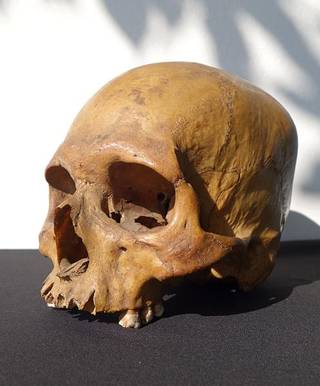
The resting place: The skull was found in a store room of The Lord Clyde pub in London. | Photo Credit: Special Arrangement
Skull of soldier, executed by the East India Company for rebellion in 1857, found its way to London pub; it’s now with historian Kim Wagner
Headhunting is usually associated with primitive tribes and contemporary terrorists, but the colonial rulers of India also collected heads of Indian soldiers as war trophies.
A 160-year-old skull of sepoy Alam Beg, now in the possession of a historian in London, is proof that colonial rulers who brought many modern practices to India were also at times inhuman.
In 1857, Alam Beg, also known as Alum Bheg, was a soldier with the 46th Bengal Native Infantry, an arm of the East India Company.
The Mutiny that year, after having covered the north Indian heartland, spread to Sialkot (now in Pakistan), where Alam Beg and his companions tried to follow their fellow soldiers and attacked the Europeans posted there. On July 9, 1857, they killed seven Europeans, including an entire Scottish family.
Alam Beg, along with his comrades, left Sialkot and trekked all the way to the Tibetan frontier only to be turned away by the guards on the Tibetan side. He was reportedly arrested from Madhopur, a scenic town on the northern part of the Indian Punjab and taken back to Sialkot. A year later, he was tried for the brutal killing of the Scottish family and blown up from the mouth of a cannon. The Mutiny ended soon after. Alam Beg’s tragic story surfaced more than a century later thanks to an Irish captain Arthur Robert George Costello, who was present at his execution.
The skull of Alam Beg. | Photo Credit: Special Arrangement
Present at execution
The Irishman was a captain in the 7th Dragoon Guards, dispatched to India after the Mutiny had shaken the bonds between the East India Company and the native soldiers. Costello had not seen any episodes of the Mutiny but was present at the execution, said historian Kim Wagner, who possesses the skull now.
Costello picked up the skull and returned to London with it. In 1963, the skull was discovered in a store room of The Lord Clyde pub of London, after it had changed hands. The new owners were less than happy to find this war ‘trophy’ from 1857, but treated it as a solemn object from a disturbing past of British history in the subcontinent. The owners of the pub learnt from a note left in an eye socket that it belonged to Alam Beg, who played a leading role in the mutiny of sepoys in Sialkot. They desired to repatriate the skull to the soldier’s family. For years, they tried but failed. It is not known how the skull of Alam Beg ended up in the Victorian-era pub. But it is possible that the Irish captain who witnessed the execution of the leader of the mutinous soldiers visited the pub or someone deposited it there, given the fact that it had links with the history of the Indian Mutiny. In fact the pub was named after Collin Thomson, also known as Lord Clyde, who was a military commander and played a role in crushing the mutiny in north and northwest India. So it is possible that soldiers after their Indian stint would visit the pub.
In 2014, the owners of the pub contacted Kim Wagner who has been writing about South Asian history for years. They urged him to take the skull and return it to the descendants of Alam Beg. Mr. Wagner brought it home and the skull finally added to his research on South Asia which was published late last year as “The Skull of Alum Bheg: The Life and Death of a Rebel of 1857.” The historian believed that only by making people aware of the skull that Alam Beg can be returned to his motherland.
His research showed that most of the soldiers of the 46th Bengal Native Infantry were from modern states of Uttar Pradesh and Bihar and Havildar Alam Beg most probably hailed from Uttar Pradesh. Though he wanted to return him to a dignified family grave yard of Beg’s family, it was not possible as the East India Company left no records of the soldiers of the 46th Bengal Native Infantry.
“There are no longer any records for sepoys of the Bengal Army – the best I could do was locate the area where the 46th regiment recruited from,” Mr. Wagner said.
The Mutiny of 1857 was crushed mercilessly and many gruesome incidents of that era find mention in official records. In 2014, around the time when Mr. Wagner began writing his book on Alam Beg, Ajnala in Punjab’s Amritsar hit the headlines when authorities discovered skeletons of 282 soldiers who were executed after the Mutiny. They apparently had surrendered hoping for a fair trial, but the Deputy Commissioner of the district Frederick Henry Cooper ordered execution of the rebels. They were buried with medals and even money of the East India Company that many of them had in their pockets. The grisly discovery is yet to receive a closure as the family members of those soldiers remain untraced.
Similar is the condition of Alam Beg as his journey back home remains incomplete but Mr. Wagner believed that his only physical remain should find a proper peaceful burial. Mr. Wagner is aware that the government of Prime Minister Narendra Modi has been vocal about honouring the fallen soldiers of India in various colonial era battles. He says that something similar can be done in case of Alam Beg as well.
“After all these years, it is high time for Alum Bheg to return home…he was probably born in what is today India, he was executed in what is now Pakistan,” Mr. Wagner wrote in his book proposing that a burial for Alam Beg near the India-Pakistan border would be the most suitable tribute to his sacrifice.
The historian said that in the absence of the descendants of such soldiers, it is the Indian government that should bring back Alam Beg to his motherland.
Headhunting by colonial rulers from Europe was a rampant practice in the 19th century and activists worldwide have been vocal in demanding human remains from Western museums and collectors should be returned to their countries of origin. Such a movement is yet to begin in India whose soldiers from the colonial past in many instances continue to remain anonymous and abroad.
source: http://www.thehindu.com / The Hindu / Home> News> National / by Kallol Bhattacharjee / New Delhi – February 04th, 2018
The 24-year-old golfer from Bengaluru had produced amazing play over the last two days, including a hole-in-one at Nedumbassery’s CIAL Golf Club, but suddenly everything appeared to be going up in smoke.
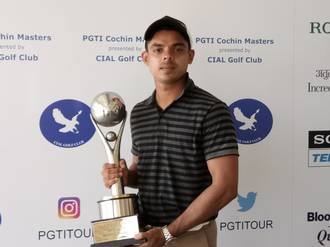
Bengaluru golfer Syed Saqib Ahmed with the PGTI Cochin Masters Trophy, his maiden pro title, on Saturday. – STAN RAYAN
For a brief moment, as he came up with successive bogeys on the 15th and 16th holes in the final round on Saturday, Syed Saqib Ahmedfelt his title chances slipping away in the PGTI Cochin Masters.
He then found out from his friends that Delhi’s Honey Baisoya, his nearest challenger who had started half hour earlier, had finished with a seven under and realised that he had to buck up. And Saqib found his touch just in time, produced birdies in the last two holes, and lifted his maiden professional title.
“I really felt the pressure after the bogeys on the 15th and 16th because both the par fives are actually easy holes,” said Saqib who finished with a three-shot lead (total 278) over the pre-tournament favourite Baisoya who came second.
“But I had a birdie on the 17th, which I think is one of the toughest holes. And the 18th went like a dream, I really didn’t think I could handle it so well. This is really a big burden off my head.”
The title ended three years of waiting for Saqib. “I dedicate this, my first pro title, to my parents and to my grandfather,” said the young man and then turned emotional.
Another Bengaluru player, M. Dharma, and Chandigarh’s Abhijit Singh Chadha finished joint third. V.J. Kurian, Managing Director, Cochin International Airport Limited, gave away the prizes. The Pro-Am event will be played on Sunday.
The final placings (par 288, four day total, top 10): 1. Syed Saqib Ahmed (278), 2. Honey Baisoya (281), 3. M. Dharma & Abhijit Singh Chadha (both 283), 5. Ankur Chadha (284), 6. Veer Ahlawat, Maniram, Gaurav Pratap Singh (all 285), 9. Arjun Prasad & Karandeep Kochhar (286).
source: http://www.sportstarlive.com / SportStar / Home> Golf / by Stan Ryan / Kochi – February 03rd, 2018
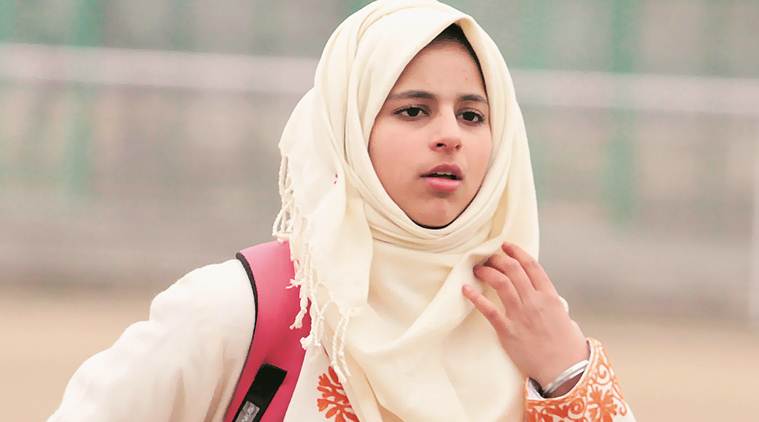
Arwa Imtiyaz Bhat is not a coach or player, but performs a more important role for deaf and mute sportspersons in Srinagar
‘I will keep fighting for them, their rights.’ (Express photo by Shuaib Masoodi)
It’s a white winter morning in Srinagar, and a 16-year-old girl has set out from her cramped home on the city’s outskirts to help a group of badminton players prepare for a tournament at the indoor stadium.
Arwa Imtiyaz Bhat is not a coach, or a player. But this Class X student performs a more important role. She translates the sound of silence.
The players are among the around 250 sportspersons registered with the J&K Sports Association for the Deaf, and Arwa, who is well versed in sign language, is their voice, their mentor. Often giving up classes at school, she’s accompanied J&K teams to tournaments across the country, from Delhi to Chennai, fielding calls from worried families, helping liaise with organisers and officials.
She says the reward is not money — she’s not paid any — but moments such as those last December when the J&K team won four gold, three silver and two bronze medals in the National Games for the Deaf in Ranchi.
“My mother Rehana can’t speak or hear. Her brother Mohammad Saleem, a good badminton player, is also deaf and mute. And ever since I can remember, I have seen them struggle, facing discrimination outside and within our family. I could not stand that, and decided to do whatever I could to help anyone in that situation… I learned how to communicate in sign language from my uncle who had undergone training in Delhi,” says Arwa.
It hasn’t been easy, she admits, especially convincing parents of deaf and mute children to let go.
“When the J&K deaf team was planning to go to Ranchi, the parents sought an assurance from me that they would be safe and secure. I had to finally give them a guarantee. At times, I have had to fight with the families of players for permission to let them play,’’ she says.
According to Waheed ur Rehmad Parra, secretary, J&K Sports Council, Arwa is an inspiration.
“I am surprised by the dedication of this girl. And I try my best to help out and speed up paperwork of any team with which this girl is involved. She is an inspiration for all of us, and she should never feel that she has been let down by the system,” he says.
“There are very few people in the world who really care about deaf and mute children such as mine,” says Nazir Ahmad Bhat from Baramulla, whose two sons Mohammad Ashraf and Showkat Ahmad are sportspersons.
“Whenever my children go for any sports activity, Arwa keeps me informed, even when they are outside the state. At times, we call her so many times every day for information about my sons, she never loses patience,’’ says Bhat.
But for Arwa, who dreams of becoming a doctor, and her family, all of this has come at a cost.
“Last year, I had to accompany these players to different parts of Kashmir and various offices of sports organisations. I missed a lot of classes and was reprimanded by my teachers,” says Arwa.
At home, Arwa’s parents say it’s time someone showed similar concern for their daughter.
“I am an autorickshaw driver, and I want to provide my children, especially Arwa, with a good education. But I struggle to do that because I find it very difficult to keep my house running,’’ says Arwa’s father, Imtiyaz Ahmad Bhat. Arwa’s younger brother Abu Zar is a student of Class V but her elder brother Arbaz dropped out of school in Class X four years ago after he met an accident.
“I don’t think my dream of becoming a doctor will ever come true because I belong to a very poor family. At times, my father doesn’t have money to even deposit my school fees. This is why I was moved from the Fayaz Educational Institute in Naikbagh to the Government High School in Nowgam. But I will still try to complete my education,’’ says Arwa.
Yet, at the end of the day, Arwa says the joy that she sees on the faces of her players is what makes her go to sleep with a smile.
“Whenever they win any game or event, I hug them. At that moment, many of these players struggle to control their emotions and finally break down… I will keep fighting for them, their rights. Here, I am the only person who can highlight their misery.’’
source: http://www.indianexpress.com / The Indian Express / Home> India / by Mir Ehsan / Srinagar / February 05th, 2018
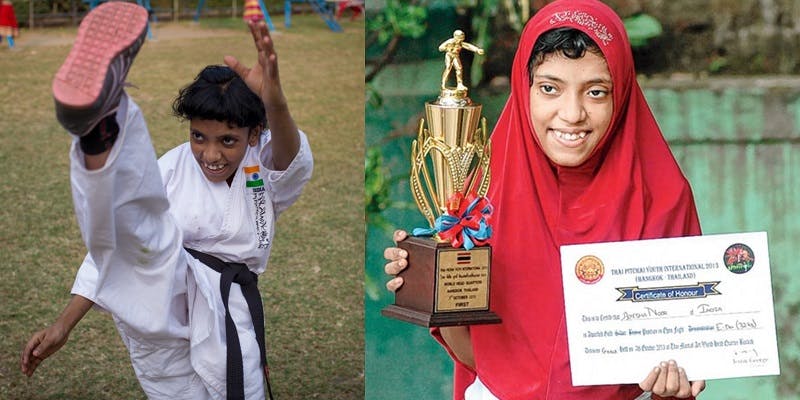
Ayesha Noor was born in a slum in Kolkata. Suffering from epileptic seizures, Ayesha was asked to leave school when she was just five. Only a year later, she decided to learn karate. Today, at the age of 19, Ayesha is an inspiration for many.
Images (L) Huffington Post (R) YourStory.com
Ayesha is the winner of two gold medals at the national level and has brought home three gold medals from international events. She also trains girls in Kolkata in self-defence. “I become a sherni (tigress) when I teach karate,” Ayesha told Huffington Post.
Ayesha’s journey hasn’t been an easy one. Her father passed away when she was just 13. Life has been difficult for the family of three that lives in a one-room house in a Kolkata slum. While her mother works as a tailor, her brother sells slippers to make a living.
Despite her inspirational triumphs in the international arena, Ayesha wants to teach karate to people across the world. Her coach and mentor MA Ali told Business Standard, “She is a completely different personality once she hits the ring and the fighter in her takes over.”
source: http://www.yourstory.com / YourStory.com / Home> HerStory> Think Change India / November 16th, 2016
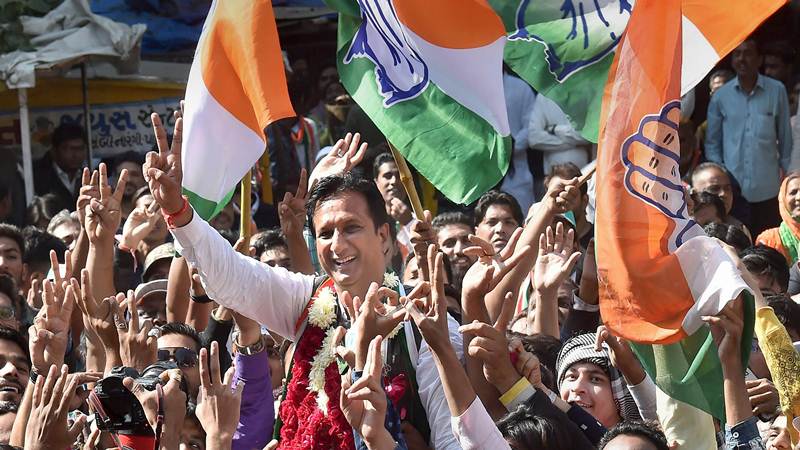
Congress party’s Jamalpur – Khadia seat candidate Imran Khedawala flashes victory sign along wih his supporters. PTI photo by Santosh Hirlekar
Ahmedabad:
Three Muslim candidates, all fielded by the Congress, emerged victorious in the Gujarat Assembly elections this time, against two in the previous House. The ruling BJP did not put up any Muslim candidate in the state where the minority community accounts for 9.67 per cent of the population. The Congress this time put up six Muslim candidates, three of them in urban seats.
The party nominees romped home in Jamalpur-Khadia, Dariapur in Ahmedabad and Wankaner in Rajkot. Whereas the party candidates in Surat-West, Vagra in Bharuch and Bhuj rpt Bhuj lost to their BJP rivals.
Javid Peerzada (Wankaner), Gyasuddin Sheikh (Dariapur) and Imran Khedawala (Jamalpur-Khadia) are the candidates who made it to the Assembly on Congress’ ticket. The Congress nominee wrested the Jamalpur-Khadia seat from the BJP.
The Aam Aadmi Party, which entered the Gujarat polls for the first time, fielded Muslim candidate Usman Gani Sherasiya from Wankaner seat. He finished way behind other nominees by securing just 2,808 votes.
The Janata Dal (United), which contested independently this time, unlike in 2012 when it was in alliance with the Congress, put up a Muslim candidate in Dariapur, but he got only 82 votes, as per figures of the Election Commission.
The Muslim candidates fielded by the BSP and the NCP in Jamalpur-Khadia also failed to make a mark.
In the 2012 Assembly elections also, the Congress had offered tickets to six Muslims, out of whom two had won.
source: http://www.freepressjournal.in / The Free Press Journal / Home> Elections / by PTI / December 19th, 2017