Syed Ghayorul Hasan Rizvi assumed charge of the Chairman of the National Commission for Minorities in New Delhi today. After assuming the charge, Shri Rizvi said that the Commission will work for the welfare and development of minorities.
Syed Ghayorul Hasan Rizvi is a graduate in Arts and also holds Diploma in Mechanics. He served as Chairman, U.P Minority Finance Development Corporation Ltd.
Shri Rizvi has been actively participating in social service. He worked for the improvement of the basic facilities and working conditions of Beedi workers and Weaver community in Uttar Pradesh. He also worked for Communal Harmony and National Integrity.
BCK/AK
source: http://www.pib.nic.in / Press Information Bureau, Government of India, Ministry of Minority Affairs / May 26th, 2017
Actor Adaa Khan says that along with getting good reviews for her role of Shesha in Naagin, she has also been complimented by people comparing her look with that of Sridevi in the film Nagina.
Actor Adaa Khan played the role of Sesha in the TV show Naagin and its sequel, Naagin 2.
For actor Adaa Khan, the TV show Naagin and its sequel hold a special place in her heart. The reason is not just that the shows were a hit, but also because her look in the serials was compared to that of Sridevi in the 1986 movie Nagina.
“The response to Naagin and Naagin 2 was encouraging for all of us,” says Adaa. “That the audience loved my portrayal of Shesha added to my happiness. I enjoyed playing the character, as it had several layers to it. I feel that doing the show has been a turning point in my career.”
The Amrit Manthan actor also got several compliments for the way she looked in the serials. Many have compared her look in Naagin to that of actor Sridevi in Nagina. “I have been praised for the way I looked on the show. But the best [compliment] was when people said that I looked like Sridevi. I am a huge Sridevi fan, so getting such compliments made me feel really special,” says Adaa.
Naagin 2 recently ended and Adaa says that she will miss her co-stars from the show — working together for so long, they really became close to each other. “Working with Mouni (Roy) and Sudha Chandran was, in a word, wonderful. We all used to have so much fun on the sets and now I am missing that already. I feel Naagin was one show where everyone had put in a lot of hard work and that helped in making the show such a success,” says Adaa.
source: http://www.hindustantimes.com / Hindustan Times / Home> Entertainment> TV / by Shreya Mukherjee , Hindustan Times / July 16th, 2017
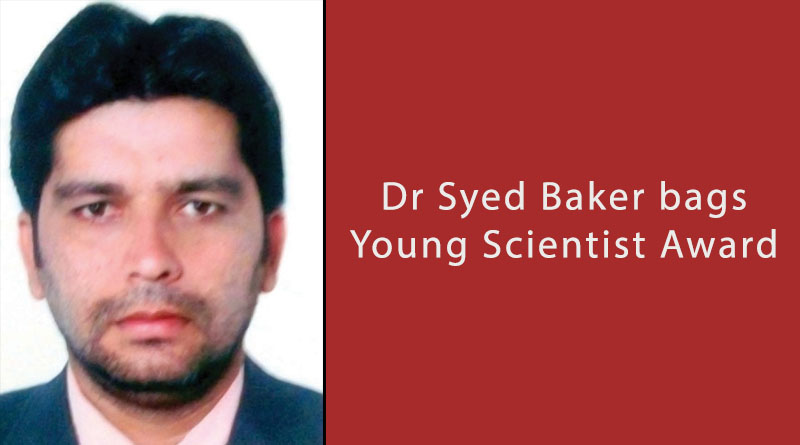
City based researcher Dr Syed Baker has been conferred with Young Scientist Award by Siberian Federal University, Russia. Dr Syed is one among the seven candidates to have been awarded across the globe and one among three Indian with only researcher from Karnataka.
He has completed Ph.D in Microbiology from University of Mysore under the supervision of Dr S Satish and was also honoured with National Post-Doctoral Fellowship from SERB Government of India under the supervision of Dr Nagendra Prasad, Department of Biotechnology and SJCE.
During his research tenure, he was also selected as exchange research for Finland in 2013 which was awarded by CIMO, Government of Finland.
He was also awarded Senior Research Fellowship and Research Associate from Indian Council of Medical Research.
During his research stay he will be working on developing smart nonmaterial towards combating drug resistant microbial pathogens.
source: http://www.citytoday.news / City Today / Home> Mysore / by Editor / June 03rd, 2016
Bringing string of accolades to the Aligarh Muslim University (AMU), one after the other; Shah Faaiz Alam, a Mechanical Engineering Postgraduate student of the Zakir Hussain College of Engineering and Technology, AMU has been selected by the Indian Air Force under Permanent Commission for the Aeronautical Engineering (Mechanical) Branch.
Alam, earlier brought laurels to his alma mater by getting recommended by Air Force Selection Board, Dehradun. Alam achievements did not stop there as he later made it to the All-India merit list securing 5th All-India rank under the technical stream.
He will now be joining the Air Force Academy, Hyderabad in July for the commencement of training for a period of six months. Alam will be further sent to Air Force Technical College (AFTC), Bangalore for further advanced technical training of 52 weeks under the rank of ‘Under-Training Flying Officer’.
Professor Mohd Altamash Siddiqui, Chairperson, Department of Mechanical Enginneering and Dr Nafis Ahmad II have congratulated Mr Alam for the achievement.
source: http://www.twocircles.net / TwoCircles / Home> Indian Muslim / by TCN News / July 03rd, 2017
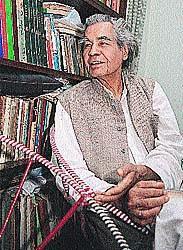
IT was perhaps in the early 1970s that I first heard Ali Sardar Jafri at a mushaira (poetic soiree) in Delhi. I do not have a very vivid recollection of all he chose to recite on that evening because the dais had a galaxy of eminent Urdu poets. Yet I still cherish the memory since he had made a great impression on me and other young men on account of his fiery poetry. What struck me most was the freshness of imagery, the transparent commitment to the man-on-the-street, and the intensely felt love for this country and its composite culture.
When the Sardar recited “har aashiq hai Sardar yahan, har maashooqa Sultana hai” (Here, every lover is Sardar and every beloved is Sultana), I was struck by the boldness of expression. I knew that romantic poetry was all about self-expression, but this was something absolutely new. Normally, lovers fashion themselves after Majnu and their beloveds after Laila, but here was a poet who identified himself and his beloved Sultana, who later became his wife, with every lover and beloved. Majnu and Laila were no longer the measure, the yardstick. It was the poet himself and his love that became the new symbols of lovers. This was a startling example of transmutation of literary symbolism. Here, one was faced with a totally new aesthetics.
So much has been written about Ali Sardar Jafri’s contribution to the progressive writers’ movement. He was one of its leaders, and insofar as Urdu poetry is concerned, its tallest leader in India. He belonged to a generation that began with participatio n in the freedom struggle and gradually moved from nationalism to Marxism. This was no fashionable Marxism embraced for its intellectual attraction. This was a Marxism that dislocated them from their comfortable aristocratic or upper middle class existen ce and compelled them to live the hard life. The many possibilities of fundamental social and economic change opened up before this generation, which remained unsatisfied with the attainment of political freedom alone. This was a generation that produced the likes of Shambhu Mitra, Bijon Bhattacharya, Mrinal Sen, Utpal Dutt, Balraj Sahni, Sahir Ludhianvi, Kaifi Azmi, Rajinder Singh Bedi, Shailendra, Salil Chaudhury, Majrooh Sultanpuri, Ramvilas Sharma, Kedarnath Agrawal, Nagarjun, Shamsher, Makhdoom Moh iuddin, Faiz Ahmad Faiz, Ismat Chugtai, Krishen Chander and a host of other equally eminent creative talents.
It was not without reason that the legendary Premchand had presided over the first ever conference of the Progressive Writers’ Association held in Lucknow in 1936. The clarion call he issued then, to “change the measure” of beauty, remains to this day a landmark event in the evolution of Indian literature.
Ali Sardar Jafri never forgot Premchand’s call. In fact, he uses this as an epigram to begin his celebrated poem Samandar ki Beti (Daughter of the Ocean) with. Unlike many other writers and poets, Jafri did not go to Bombay (now Mumbai) to write for Hindi films. He went there to work as a full-time activist of the undivided Communist Party of India (CPI). His involvement with writing film lyrics came much later and he was to set a standard of lyrical beauty that has remained unique. His composi tion for the film Footpath, “Shaam-e-gham ki kasam, aaj ghamgeen hain ham“, rendered in Talat Mahmood’s silken voice, remains memorable even today. Jafri even produced a film Gyarah Hazar Ladkiyan (Eleven Thousand Girls) in 1960 for friend Khwaja Ahmad Abbas. Incidentally, it was Abbas to whose film Anhonee Jafri lent his pen for the first time in 1952.
BORN in an aristocratic Muslim family of Balrampur, Uttar Pradesh in 1913, Ali Sardar Jafri plunged into politics early and joined the national movement. He went to jail several times on account of his political activities. He left for Bombay in 1942 and spent most of his life in this metropolis. A friend of revolutionary Turkish poet Nazim Hikmat and Nobel Prize winner Chilean poet Pablo Neruda, Jafri remained the leader of progressive Urdu writers till the end. He began his literary career with a collection of short stories Manzil (Destination) in 1938 and made a mark as a poet with Parvaz (Strength to Fly) in 1943. His Nai Duniya ko Salam (Salute to the New World) and Asia Jaag Utha (Asia has awakened) were translated int o many Indian as well as foreign languages.
Jafri also came to be respected as an editor of critical editions of the works of Mir Taqi ‘Mir’ and Ghalib, the two poets who influenced the course of Urdu poetry the most. He also edited the works of Kabir and Meera. Jafri wrote erudite introductions t o all these books, establishing himself as an extraordinarily perceptive critic. As a poet, his unique contribution was to get the free verse its rightful place in the Urdu literary world. Josh Malihabadi, his senior by many years, had effected a sort of shift from the dominant form of ghazal to nazm, which was not bound by the rules of rhyme. Yet, even Josh’s nazm followed conventions of literary metres and was not exactly “free”. It was Ali Sardar Jafri who, like Suryakant Tripathi ‘Nira la’ in Hindi, freed the nazm from its metrical shackles. If Josh was hailed as Shair-e-Inqilab (The Poet of Revolution), Jafri came to be known as Shair-e-Awam (The Poet of the People).
While Marxism permeated his whole being and writing, it never became an ideological cage for him. Jafri encompassed the great humanistic traditions and compassion of the Sufi and Bhakti movements, the love of nature found in the works of Kalidas, and an assimilative vision of India’s composite culture. In no other Urdu poet – perhaps with the sole exception of Nazir Akbarabadi who lived in the 18th century – would one find quite the same kind of effusive celebration of Krishna with his Gokul, Gautam Bud dha with his disciple Anand and Chandalika, glory of the Vedas, the Radha of Vidyapati’s poetry, and so on. True to his commitment, he penned beautiful poems on Karl Marx and Paul Robeson too.
Several honours came to Jafri during his long literary career. These included the Padmashri, the Pakistan government’s Iqbal Award, the Uttar Pradesh Urdu Academy Award, the Kumaran Asan Award and the Toronto Urdu Literary Academy Award. The irony of it was that in 1986, the same Aligarh Muslim University that had expelled him on account of his participation in the freedom struggle, honoured him (or rather itself), by conferring the D.Litt. on him. In 1998, he won the Jnanpith award.
Such was the force of his personality and the power of his pen that even Prime Minister Atal Behari Vajpayee, a life-long member of the Rashtriya Swayamsevak Sangh (RSS), had to concede in his speech while giving away the Jnanpith award that one could di ffer with Jafri’s views but not with his vision. When Vajpayee made his bus trip to Lahore last year, Jafri went along as a special invitee, chosen since he best symbolised the essential unity of mankind. Among the Indian Prime Minister’s main gifts to his Pakistan counterpart was a collection of Jafri’s poems entitled Sarhad (Border).
Ali Sardar Jafri was steeped in the best traditions of secularism. He fought against imperialism all through his life while remaining aware that imperialism had a great capacity to take on newer forms. His Marxist convictions gave him a strong sense of s ocial justice and equality between classes, castes, religions, languages, and sexes. With his demise at the age of 86, Urdu literature has lost a man who broadened its horizons and deepened its perceptions. Truly he was the Sardar of Urdu literature.
Such was the force of his personality and the power of his pen that even Prime Minister Atal Behari Vajpayee, a life-long member of the Rashtriya Swayamsevak Sangh (RSS), had to concede in his speech while giving away the Jnanpith award that one could di ffer with Jafri’s views but not with his vision. When Vajpayee made his bus trip to Lahore last year, Jafri went along as a special invitee, chosen since he best symbolised the essential unity of mankind. Among the Indian Prime Minister’s main gifts to h is Pakistan counterpart was a collection of Jafri’s poems entitled Sarhad (Border).
Ali Sardar Jafri was steeped in the best traditions of secularism. He fought against imperialism all through his life while remaining aware that imperialism had a great capacity to take on newer forms. His Marxist convictions gave him a strong sense of s ocial justice and equality between classes, castes, religions, languages, and sexes. With his demise at the age of 86, Urdu literature has lost a man who broadened its horizons and deepened its perceptions. Truly he was the Sardar of Urdu literature.
source: http://www.frontline.in / Frontline / Home> Obituary / by Kuldeep Kumar / Volume 17, Issue 17, August 19 – September 01, 2000
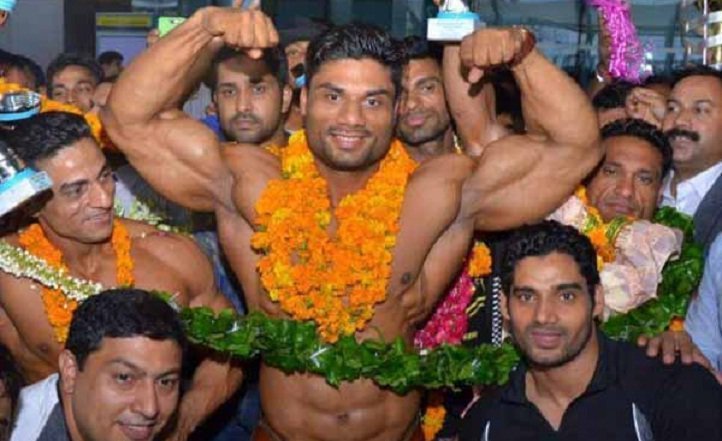
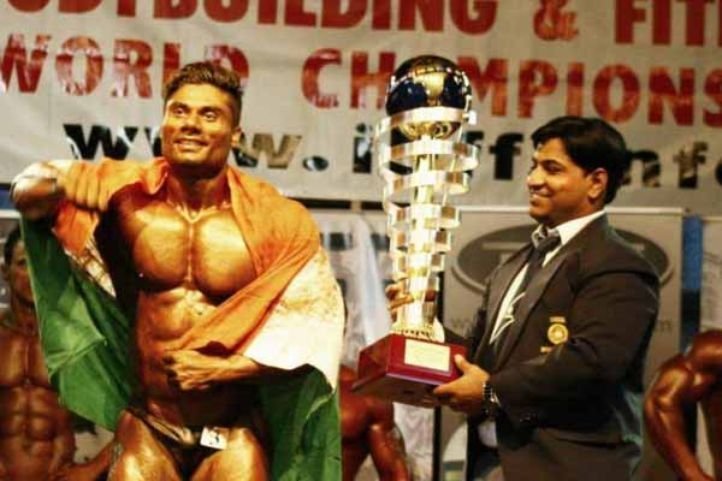
Indian bodybuilder Wasim Khan has won the International Bodybuilding Fitness Federation (IBFF) championship held recently on June 21 at Koper Slovenia, Slovenia
Khan not only won gold medal in one category but also won the overall title. In total, he won three medals. About 350 body builders from 37 countries participated in this event.
Source: Sahara Samay
The Indian bodybuilding team created history at the World Championships by winning four titles. Suresh Kadam who is the general secretary of IBFF said that it was the first time in bodybuilding that the Indian team had performed so well and also bagged the most coveted title of ‘Mr World’.
Khan will be aiming for Mr Olympia next, which happens to be the most coveted title in bodybuilding. Kadam also said that Khan has the potential to win the coveted title of Mr. Olympia.
Khan said, “I want to thank all my fans who always there for me in my tough times and Allah who gave me power to move forward to follow my passion (sic).” He thanked his wife by saying that she was the only person who believed in him and supported him throughout his struggle in his career.
Source: Sahara Samay
He was also thankful to India for providing him opportunity to showcase his talent.
This is not the first time that Khan has made the nation proud. Last year he had won ‘Mr Universe’ title at IBFF event in Rome.
Two other Indian bodybuilders, Sashi Kumar and Tarun Dutta, also won silver medal in their respective categories.
We congratulate Khan and the Indian bodybuilding team for this landmark victory. Here’s to more six packs!
source: http://www.scoopwhoop.com / Scoop Whoop / Home / by Saswat Singhdeo / July 06th, 2015
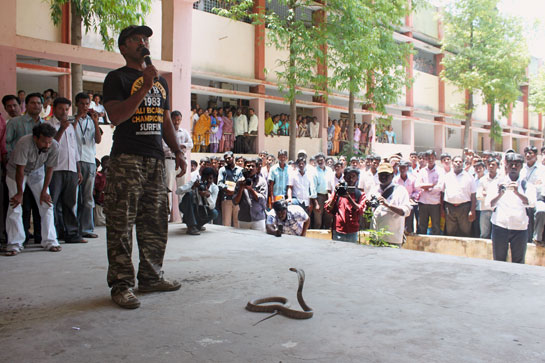
Sadiq Ali’s fascination for animals began in childhood and became his life’s mission. Ali, who was born in 1966 near Chennai, belonged to a family in the leather business. As a result, he often saw taxidermists and tanners visiting his house to meet his grandfather. He also had the opportunity to interact with Irulas (a local tribe) who lived nearby.
Photo Courtesy: WNCT.
From them, he learnt to handle snakes at a very young age. Not surprisingly, he graduated as a leather technology professional, and moved to Ooty in 1991 after which he began taking more interest in conservation-related activities. In 2012, he decided to dedicate his life to the conservation and protection of wildlife and founded the Wildlife and Nature Conservation Trust (WNCT).
WNCT’s mission statement is, “We have not inherited the earth and her wild heritage from our forefathers, but borrowed it from our future generations. Hence it is the duty of all citizens to protect the last few remaining forests of this country.”
The Ooty-based NGO works in the Western Ghats, one of the largest forest areas in south India. With several rivers and streams originating from the Nilgiris, this is a vital watershed for south India. The region is also home to around 6,000 elephants and many other critically-endangered species of flora and fauna.
As in other parts of the country, these forests face direct and indirect threats from humans. Encroachment of forest land by the land mafia is on the rise. So is pollution caused by garbage dumped into rivers and forest land. Poaching of wildlife has severely affected the populations of many species. Sand and granite mining and other construction activities continue unabated. The forest is becoming increasingly fragmented leading to man-animal conflict. WNCT is actively addressing all of these issues.
Though WNCT is a young organisation, its founder Ali has been involved in rescue and rehabilitation of wildlife in the Nilgiri biosphere for over a decade. WNCT helps bridge the divide among stakeholders like the Forest Department, local communities and the general public. It also supports the Forest Department through capacity-building initiatives such as camps and seminars. WNCT runs a round-the-clock rescue team, which helps concerned authorities mitigate conflict scenarios. They have carried out scores of successful rescue and rehabilitation missions.
“We have an effective team of members that quickly responds to calls regarding wild animals entering human habitations or in distress. They are well trained to handle such situations and there are many instances when government authorities and local communities take help from us to resolve conflict situations,” says Ali.
WNCT believes in an inclusive working style, actively engaging with stakeholders and enforcement authorities. They have a network of informers and volunteers who watch for illegal wildlife activities. They are also actively involved in seizing wild animals in illegal possession and highlighting such cases. These animals are released into their natural habitats after requisite medical treatment.
WNCT understands that investing in conservation-awareness drives for the younger generation and local communities are vital for a secure future. They impart conservation awareness to students and local communities whenever an opportunity arises. They feel that more people should be empowered in conservation activities.
“We work extensively with colleges and educational institutions to make young minds understand the importance of protecting nature. Conservation requires a lot of passion, love, experience and resources and we would like to work with like-minded NGOs to further the cause,” says Ali.
WNCT needs a SUV which will help their rescue team reach inaccessible locations faster. Contact them if you know someone planning to sell their SUV or would like to donate one. If anyone wishes to volunteer or share information about the illegal trade or captivity of wildlife, they can email WNCT on info@wnct.in.
Wildlife and Nature Conservation Trust
No. 97, 2nd Floor (Ooty Coffee House Building), Commercial Road
Ooty – 643001, Tamil Nadu, India.
Tel.: +91 96550 23288
For more information, visit: www.wnct.in
Author: Anirudh C. Nair
First appeared in: Sanctuary Asia, Vol. XXXIII No. 5, October 2013.
source: http://www.sanctuaryasia.in / Sanctuary Asia / Home> Resources/ NGO Profies / by Anirudh C Nair / Volume XXXIII No.5, October 2013
Sayyed Sarfaraj has been elected as the new deputy chairperson of Valpoi municipal council (VMC), the polls for which were held on Wednesday. The post had fallen vacant after former sarpanch Shehnij Shaikh resigned on June 12.
In the absence of any other nomination, Sarfaraj was elected unanimously.
Shripad Arlekar was the presiding officer for the polls, while chairperson Parvin Shaikh, and councillors Akhtar Shaha, Ramdas Shirodkar, Anil Katkar, Parveen Khan, Anjali Chari, Shehnij Shaikh were among those present.
Sarfaraj said he will work with others under the guidance of health minister Vishwajit Rane.
source: http://www.timesofindia.indiatimes.com / The Times of India / News> City News> Goa News / TNN / July 07th, 2017
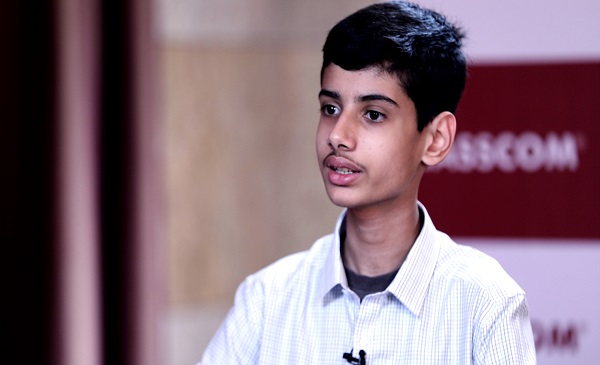
Co-founder of Ati Motors, Saad Nasser hopes to release his first autonomous goods vehicle prototype in the next 2 years
14-year old Saad Nasser’s start-up is building an autonomous goods vehicle
Saad Nasser, all of 14 years old, is no ordinary teen. Having read books on Java before the age of 5 and learnt C++ programming by the age of 7, Saad is a self-taught child prodigy with a lot to talk about. Saad is the co-founder of an autonomous vehicle start-up called Ati Motors, based out of Bangalore and is aiming to build the world’s first autonomous goods vehicle. But there is one more twist to this. This will be not like your regular goods vehicle but designed to offer the maneuverability of a two wheeler vehicle in order to run it on hilly areas apart from campuses.
Saad has been a winner at the Intel IRIS Science Fair 2012, 2013, 2014, 2016. His project on tiled processors won him the Sam Pitroda Award for Research and Creativeness as the best project of the fair.
BOOM caught up with Saad at the NASSCOM India Leadership Forum where we spoke to him about his entrepreneurial journey at such a young age.
source: http://www.boomlive.in / Boom / Home> Uncategorized / by Jency Jacob / February 24th, 2017
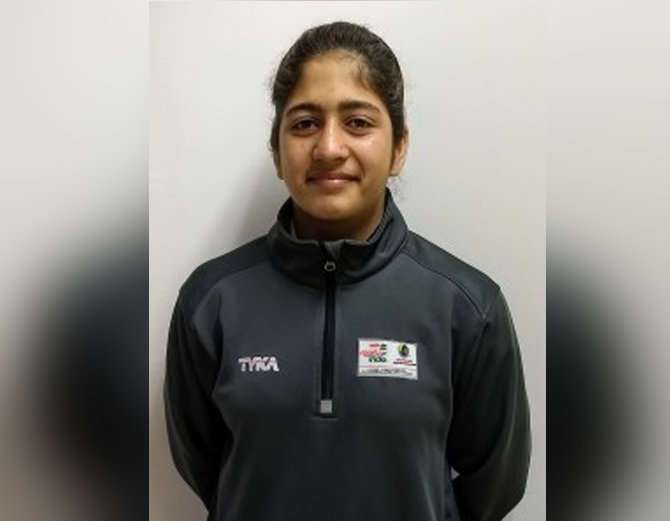
Firdaus from Shahpura, Bhilwara(Udaipur) brought home the long awaited medal in swimming. The region waited for 10 long years to make its name in swimming.
On Wednesday, Firdaus won a Silver and continuing in the 44th National Swimming Competition on Thursday, she bagged a Gold in Pune in 400 metre individual medley event. She is the first one to win a Gold medal in any National Event from Shahpura region. She completed the event in 5.31.18 minutes and grabbed the Gold.
She also won a Bronze in 100 metre Butterfly stroke on Thursday. This way she became the recipient of 3 medals in swimming. President of Swimming association Anil Vyas and Secretary Chandragupt Singh Chauhan announced a reward of 1.51 lakh for Firdaus.
Firdaus has won a total of 55 gold in various competitions in the country including Junior Swimming Competition of Pune. She has even represented Rajasthan in Indian Olympics in Tiruvanthapuram. Firdaus’s younger sister Fiza has also represented in National games 5 times inspired by elder sister.
Firdaus wishes to win Gold for the country in International level Swimming competitions. Additional Chief Secretary Youth and Sports affairs J C Mohanty congratulated Firdaus over telcon. He said that Firdaus has increased Rajasthan’s honour in the field of swimming. He added that girls are nowhere behind in winning honours for their country.
source: http://www.udaipurtimes.com / Udaipur Times.com / Home> News> Beyond Udaipur / by Monika S /July 07th, 2017