Most victims of the UK hate crimes were Muslim girls and women aged from 14 to 45 in traditional Islam dress. The perpetrators were mainly while males aged 15 to 35 (File photo)
Kochi :
The Kerala high court on Tuesday granted permission to Muslim girls to wear hijab, a customary religious dress, for the All India Pre-Medical Test-2016 but on condition that they should be present at the hall an hour before the exam for frisking if necessary.
The order was issued by Justice Muhammed Mushtaq while hearing a writ petition by one Amnah Bint Basheer challenging the dress code prescribed for the candidates by CBSE in the bulletin relating to conduct of AIPMET-2016.
The judge allowed the plea on condition that the girls shall be present at the hall half an hour before the exam and, if required, the invigilator can search the body.
The petitioner contended that the instructions contained in the AIPMET-2016 bulletin regarding dress code, as per her religious beliefs and practises, would amount to violative of exercise of religious freedom.
The court issued directions to CBSE to permit Muslim girl students to wear hijab for attending the AIPMET .
Last year, a single Judge of the Kerala high court had allowed two Muslim girl students to wear hijab while appearing for the CBSE AIPMT-2015.
source: http://www.timesofindia.indiatimes.com / The Times of India / News Home> India> PTI / April 26th, 2016
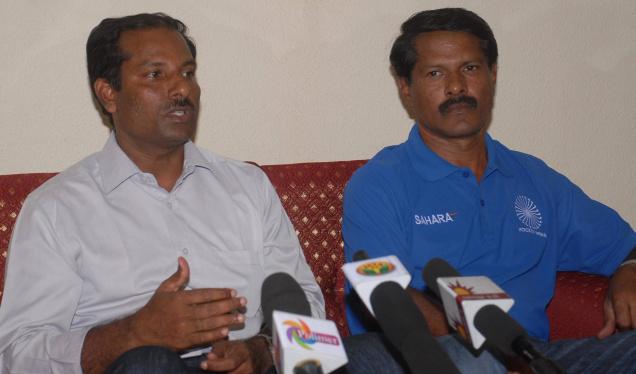
National hockey coaches Md. Riaz (left) and C R. Kumar were felicitated by the Hockey Unit of Tamil Nadu in Chennai on Wednesday. / The Hindu
National hockey coaches, former Olympian, Md. Riaz and international C. R. Kumar, were felicitated on Wednesday by the Hockey Unit of Tamil Nadu (HUTN) at the Mayor Radhakrishnan Stadium.
Md. Riaz was assistant to the Australian coach, Michael Nobbs, at Ordos, where India triumphed in the inaugural Asian Champions Trophy on Sunday beating Pakistan via the tie-breaker by four goals to two.
Complimenting the players for the single-minded devotion in achieving the target against a formidable rival, Md. Riaz said the victory opened a new chapter for Indian hockey.
He was particularly impressed by the role played by Kullu as full back and Sunil and Walmiki in the attack. “These youngsters have a tremendous future,” Md. Riaz noted.
Refusing to be drawn into a discussion related to the prize money fiasco after the return, Md. Riaz felt that the ministry should treat the support staff as part of the players’ group and be made eligible for full cash awards.
At the moment, the assistant coaches get only 50 per cent of what a player gets from the Government as cash incentives.
Although officially defender Rupinder and goal-keeper Sreejesh, who played an outstanding role in the tie- breaker, represent Tami Nadu because of their employment here, Riaz is the only official in the team hailing from the State.
He deserves suitable recognition from the State Government, which has enhanced the cash awards for achievements in international competitions.
C. R. Kumar, the chief coach for the women’s team, is striving his best to carve a new path. India finished fourth in the four-team event, but missed the bronze, which it was defending, went down to Japan after dominating the proceedings.
Ms. Renuka Lakshmi, Secretary, HUTN, welcomed the gathering and congratulated the men’s team for the victory at Ordos. She also expressed her thanks to the Chief Minister, Ms. J. Jayalalithaa, for hiking the prize money to achievers and hoped that the sportspersons in the State would take advantage of the incentives offered by the State Government and strive for excellence in all competitions.
source: http://www.thehindu.com / The Hindu / Home> Sport / by Special Correspondent / Chennai – September 16th, 2011
The Tamil Nadu State men’s hockey team left on Thursday night for the Senior National (B division) championship to be held Saifai, Uttar Pradesh from April 8 to 21.
Md. Riaz, former India captain and Olympian, who was with the team for eight days during the State camp at the insistence of Chelladurai Abdullah, president, Hockey Unit of Tamil Nadu, said he is confident that the team will do well in the Nationals.
“Given the group (Bihar, Madhya Bharat & J&K) that TN is in, I think they can top it and can, possibly, go further,” he said.
Riaz said he coached the boys on trapping the ball inside the circle, off the ball running, and how to play collective hockey.
The drawback
The drawback of the team, according to Riaz, was that since most of the boys from the districts have hardly played on synthetic surfaces, trained as they are on gravel surfaces, their deflections were below par. “So I taught them how to play the ‘slap’ shot as the boys are used only to the push shot,” said Raiz.
Riaz refused to be drawn into the debate on selectors picking mostly youngsters ignoring the senior players and arguably better players from Chennai.
“I was given this team and I did my best with it,” he said.
source: http://www.thehindu.com / The Hindu / Home> Sport> Hockey / by Special Correspondent / Chennai – April 07th, 2016
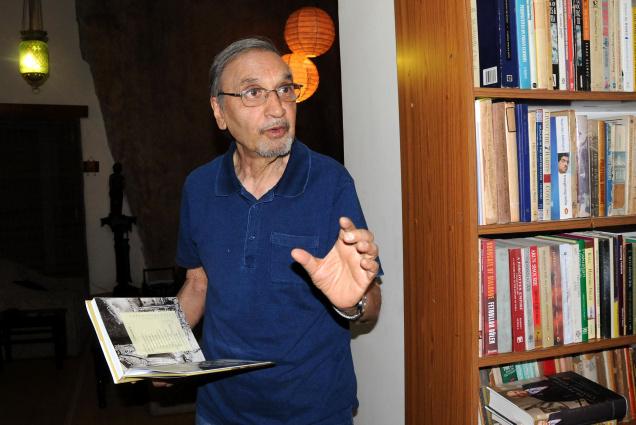
Narendra Luther talks about weaving in amusing legends and fact-filled anecdotes in his new book ‘Legendotes of Hyderabad’
Hyderabad, TELANGANA :
‘Don’t google the meaning of ‘legendotes’ for there is no such word,’ historian Narendra Luther says in the introduction to his new book ‘Legendotes of Hyderabad’ (Niyogi Books; Rs. 995). A combination of legend and anecdotes, ‘legendotes’ is also an encapsulation of nuggets of history, backed by research, presented in the style of a coffee table book illustrated with photographs of people and buildings that provide a window to the past. “To my surprise, the publishers were eager to have more photographs,” he says with a smile, speaking to us ahead of the launch of his book on Thursday in the presence of historian Aloka Parasher Sen.
“During the course of my research on Hyderabad over the years, I came across both legends and anecdotes. Legends are generally considered gossips of history, but some of those are also stuff that makes up history. Former historians, I believe, walked on the highway of history whereas I feel many pieces of history lie scattered in the lanes and by lanes of the city. I collected a few of these and applied tests of historicity and veracity before documenting them,” explains Luther. Narendra Luther focuses both on stories that are now popular knowledge and lesser-known facts that give readers fresh insights into the history of Hyderabad and Secunderabad. “These are not mere ‘he said, she said’ facts put together,” he emphasises.
Luther also prefers to gather information from people than just documents from the archives: “I believe in interviewing people to know about history than merely going through archives; they have given me a wealth of information,” he says, referring to how he got the late Zahid Ali Kamil to share the story of Kazim Razvi, who led the Razakars movement. The author draws our attention to rocks of Hyderabad that are 2500 million years old and as he points out, ‘older than the Himalayas’ and traces the origin of Hyderabad, including the much-debated tale of romance that gave birth to Bhagnagar. “The historicity of Bhagmati has been established beyond doubt,” says Luther, and states his earlier research while penning a biography of Mohd. Quli Qutb Shah that led him to a document mentioning an old seal of ‘qazi of Bhagnagar’. “And in the court of Jehangir, there was a reference to the city of Bhagnagar in the South, established by Quli Qutb Shah in memory of his beloved,” he adds.
The book contains quirky stories of a dog made to sit on a throne by Sultan Tana Shah in recognition of it raising an alarm spotting an intruder, Aurangzeb’s visit to Bhagnagar and Stalin’s orders on the red revolt. There’s also a perceivable effort to make history relevant to the times we live in, in the chapters that detail how the King Kothi got its name, the story of Lal Bazaar in the then Lashkar that later came to be called Secunderabad. “I’ve given historical citations even for amusing stories,” smiles Luther, citing the story of seven kulchas and how the kulcha was represented on the Nizam’s flag. “This was contradicted by the man himself, the first Nizam, who said the ‘circle’ was a moon that denoted his name Kamaruddin (‘Kamar’ in Persian means moon). But later when the sixth Nizam was approving the design of the flag in 1899, issued a written mentioning the big white circle as a kulcha.” Like his previous works, this book too is an ode to Hyderabad.
Hyderabad connection to ‘Jai Hind!’
Did you know that it was a Hyderabadi who coined the slogan Jai Hind? Zain-ul Abideen Hasan was pursuing engineering in Germany at the time when Netaji Subhash Chandra Bose visited Germany and urged Indian students to join his movement to liberate India. Abid Hasan gave up his studies and became Netaji’s secretary and interpreter. ‘Legendotes of Hyderabad’ discloses why Abid came to be called ‘Safrani’ in later years and how he coined the term ‘Jai Hind’ as the greeting for his army and for independent India.
source: http://www.thehindu.com / The Hindu / Home> Features> MetroPlus / by Sangeetha Devi Dundoo / Hyderabad – January 30th, 2014
Meeting the 35-year-old who recently moved SC seeking a ban on instantaneous triple talaq. She thus becomes the first Muslim woman to challenge a personal law practice, citing her fundamental rights.
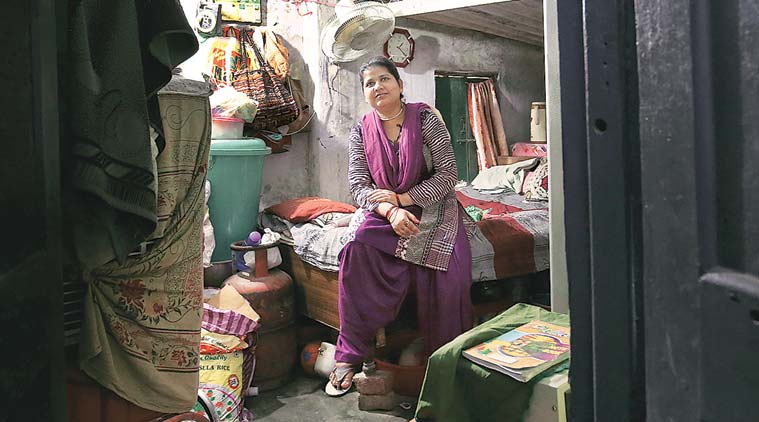
At her parents’ home in Kashipur. Shayara hasn’t met her two children since she left Allahabad last April. (Express Photo by Ravi Kanojia)
The photograph of the bride in her wedding finery, her kohl-rimmed hazel eyes peering into the camera, bears little resemblance to Shayara Banu of today. The wedding album titled ‘Romantic Moments’ also features photographs of a two-wheeler, household furniture, utensils and jewellery that were given away at the time of the wedding.
Next to the album is a polythene bag with medicines for the “infections” Banu claims to have caught from multiple abortions and a heavy dose of anti-depressants. For the last 15 years of her marriage, she says, her greatest dread has been the word talaq being uttered thrice by her husband Rizwan Ahmed. Last year in October, while she was at her parents’ home in Uttarakhand’s Kashipur district, her fears came true: Rizwan sent her the talaq-nama from Allahabad.
On the advice of her family, the 35-year-old is using her case as a plank to challenge the triad of instantaneous triple talaq (talaq-e-bidat), polygamy and halala (a practice where divorced women, in case they want to go back to their husbands, have to consummate a second marriage). Her petition in the Supreme Court makes no mention of the contentious Uniform Civil Code, neither does it ask for codification of the Muslim personal law. She has sought equality before law and protection against discrimination on the basis of her gender and religion.
“Soon after the wedding, they started demanding a four-wheeler and more money. But that wasn’t the only problem. From the very beginning, my husband would threaten to give me talaq each time he found some fault with me. For the first two years of marriage, when I didn’t bear a child, my mother-in-law would egg him on to divorce me,” says Shayara, who is today mother to a 14-year-old boy and a 12-year-old girl, both of whom are away from her, in her husband’s custody.
Shayara says that a year after her marriage to Rizwan, a property dealer based in Allahabad, UP, she wasn’t allowed to attend her sister’s wedding in the same city. In the last 14 years, she says, she wasn’t allowed to visit her sister, who lives within a half-hour distance from her house in Allahabad.
She lost count of the number of abortions she was forced to undergo by Rizwan. “Six or seven times maybe. I would often plead with him to allow me to undergo tubectomy, but he wouldn’t relent,” she says.
Her mother Feroza Begum says the emotional and physical battering turned Shayara into a bundle of nerves. Until last year, she says, her daughter never uttered a word about her agony, not even about how he allegedly tried to throttle her once. “Dimaag kharab ho gaya tha Shayara ka tension le le kar. Yahan aakar hamne ilaaj karaya (Shayara had lost her mind with all that stress. We got her treated after she came here),” says Feroza.
Last year in April, when her condition deteriorated, Shayara says Rizwan asked her to pack a small bag and asked her father to meet them half-way in Moradabad, from where he could take her home. She was told that she could return once she recovered entirely. “As I regained my health slowly, I would call him and ask him to come take me back but he didn’t want me to come and wouldn’t let me speak with my children either,” she says. She waited restlessly for six months, and it was then that the talaq-nama came.
Rizwan denies having ever beaten Shayara, though he admits to keeping her away from her relatives as he “didn’t want anything to do with them”. He also admits to the multiple abortions. Vasectomy and tubectomy, he says, are considered to be “bahut haram”. “I have given her talaq the way Shariat and Hadith allow me to. I cannot take her back now, it will be against the Shariat. It is not good to go against what the religion has prescribed,” says Rizwan over the phone from Allahabad.
*******
For over three decades now, the tiny Army quarter at the cantonment of RTSD-Hempur (Remount Training School and Depot) in Kashipur tehsil has been home to Iqbal, an accountant in the Army, and his family: wife, three daughters, son, daughter-in-law and two grandchildren. Today, in this cantonment, his daughter Shayara is insulated from censure that would otherwise have come her way for taking on the practices in her community. “I grew up in Allahabad where I have seen women around me being subjected to this, but they were all too poor to go to court. When my daughter fell in the same trap, I decided it was time to do something,” he says.
The family first met Supreme Court advocate Balaji Srinivasan for inter-state transfer of a case filed by Rizwan at the Allahabad family court. “In the meantime, her husband sent her the talaq-nama by post, which then became the basis of her writ petition,” says Srinivasan.
In her petition, she has challenged ‘instantaneous triple talaq’ and not triple talaq itself, which is allowed by the Quran as long as the three utterances are spread over 90 days.
There have been PILs filed by NGOs and individuals in the Supreme Court but, he says, those didn’t stand as they weren’t filed by an affected party or because they pleaded that Uniform Civil Code be introduced. Shayara’s is the first such case where a Muslim woman has challenged a personal practice citing fundamental rights guaranteed by the Indian Constitution.
************
Outside the Army cantonment, Shayara’s case is yet to make news in the rest of Kashipur. The religious heads of the small town got wind of the case only recently after local newspapers approached them for their views on the matter.
About 14 km away from her house lives 65-year-old Ataur Rehman, the imam of the town for 25 years before he retired two years ago. Scattered across his room, that doubles up as a unani clinic, are vials of pills and medicines. Having just gotten off the Persian rug on which he takes his afternoon siesta, before his next batch of patients start streaming in, Rehman is still heavy-eyed. But in a resounding voice, he explains that the courts or the State have no business interfering in religious matters.
He says that the recommended way of giving talaq is for a Muslim man to utter it once, give the woman some time to mend her ways, utter it again, give her some more time, before making the third and final utterance. “However, even if it is uttered thrice in one go, it is valid. Kami auraton ki bhi hoti hai. Bina wajah koi aadmi talaq nahi deta (Women are also at fault. No man gives talaq without a reason),” he says.
The Muslim Personal Law (Shariat) Application Act, 1937, allows Indian Muslims to be governed by the Shariat. The absence of codification has legally allowed community leaders to hold the practices as sacrosanct. The Dissolution of Muslim Marriages Act, 1939, however, codifies a woman’s right to seek divorce by approaching the court.
Rehman believes that a woman’s right to khula only allows her to plead with her husband for divorce and doesn’t actually give her the right to divorce her husband. “I don’t care what the Act says, but if the woman is given the right to talaq, she won’t live with her man even for six months, she will leave. Women can’t have the right to give talaq, it’s without doubt a man’s prerogative.”
Polygamy, Rehman says, is allowed as long as the man can take care of all four wives equally and halala is required as it will ensure that the man “thinks twice before divorcing his wife”.
*************
A post-graduate in sociology, Shayara, the eldest of four siblings, is the most educated in the family. “Mujhe samaj ke bare mein seekhna tha (I wanted to learn about society),” she says. Her ambition was to teach, which she did very briefly for a few months before she got married.
If the court rules in her favour, holding triple talaq to be null and void, she will be faced with taking a call on whether she wants to go back to Allahabad. “I might go back, for the sake of my children, that is, if he shows an inclination to change,” she says.
Her family, however, is more determined. Their objection is to the manner in which her husband divorced her and not to the divorce itself. Her mother says that if the apex court holds her triple talaq to be invalid, they will approach the court to seek divorce through the legal route. Her father says, “A person who has brought her to this state, kept her like a prisoner all these years, why go back to him? But I always leave it to my children to take the final call.”
On her part, Shayara’s low-pitched voice wavers throughout as she talks about her past or her uncertain future. The only time it takes on a resolute tone is when she talks about the present. “Shah Bano got a ruling in her favour from the Supreme Court but it was later overturned by the government, denying divorced Muslim women their right to maintenance. Had her case been a success, it would have been one battle less for us,” says Shayara.
TAGGED ON
* Thirty-ONE years after the SC urged the government in the Shah Bano case to frame a uniform civil code, a two-judge bench in October 2015 suo motu ordered registration of a PIL.
* Justices Anil R Dave and Adarsh K Goel sought responses from the Attorney General and the National Legal Services Authority of India on whether “gender discrimination” suffered by Muslim women should not be considered a violation of fundamental rights.
* The bench was hearing a matter related to succession when it said it is time to focus on rights of Muslim women. The judges asked for the case to be placed before the CJI to constitute a bench. It is now being heard with Shayara Bano case.
source: http://www.indianexpress.com / The Indian Express / Home> India> India – News – India / by Shalini Nair / Kashipur – April 24th, 2016
She’s helped revive traditional weaves and, like the Mahatma, dreams of a loom in every home
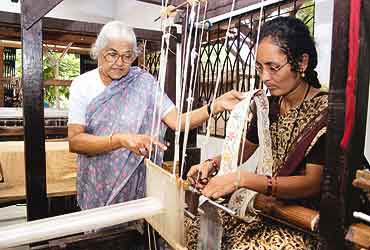
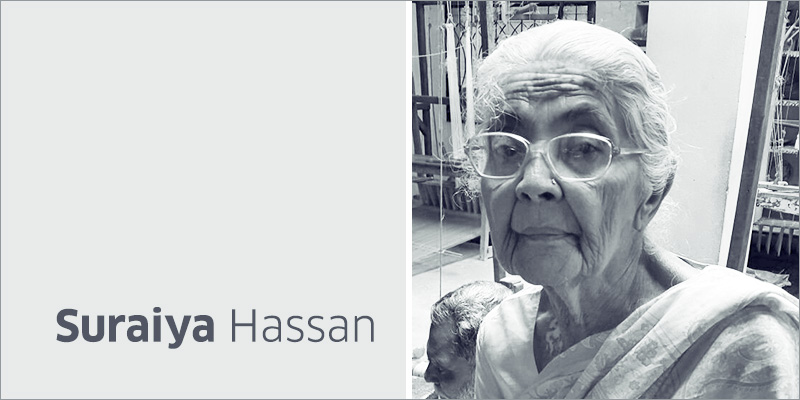
At 75, Suraiya Hasan Bose has energy levels that can put a teenager to shame. But when she chats, she exhibits the languid grace of a long-forgotten nawabi culture. As women work magic on the looms at her weavers’ workshop at Dargah Hussain Shah Wali (a village on the outskirts of Hyderabad), in the adjacent Safrani Memorial School run by her, children race around with unbridled enthusiasm.
Suraiya employs a large number of poor women, many of them widows, from the village. These women are trained to work on himroo, jamawar and paithani—fabrics that were brought into India by the Mughals. “I want to see these women stand on their own feet. I wish to see looms in all their homes and hope they can train future generations too,” she says. Suraiya’s unassuming demeanour envelops the large room as the women go about their work.
On the other side of the fence, the children’s learning curve, under Suraiya’s tutelage, spreads an air of hope. Like the women, students of the school too come from poor households—children of farmers, labourers or vegetable vendors. Suraiya charges them a nominal fee.
Suraiya attributes her passion to her father Badrul Hasan. Mahatma Gandhi too has been her idol. When Gandhi first visited Hyderabad, it was in front of Suraiya’s house that the first bonfire of English mill-made cloth was lit. Suraiya’s father died when she was only five but she had others to look up to. Her uncle Abid Hasan Safrani was the personal secretary to Subhash Chandra Bose and she was married to Bose’s nephew Aurobindo Bose. “My late husband was based in Calcutta, and used to be in and out of jail. Both our families understood the importance of Gandhi’s ideals of preserving traditional handlooms.” It is after her uncle that the weaving society and school are named since he was the one to encourage Suraiya to follow her passion for handspun textiles.
While Suraiya is credited with the single-handed revival of the Nizami-Persian fabrics of himroo, paithani and mashroo in Andhra Pradesh, she has also worked extensively in the village of Kanchanpalli, close to Warangal. In the early ’70s, due to lack of patronage, weavers in Kanchanpalli had almost given up their profession. They merely made decorative calendars woven with portraits. Suraiya encouraged them to make durrees. Today, over 500 weaver families in Kanchanpalli make a living through durrees and other weaves.
In Warangal too, when Suraiya began her efforts to revive weavers and fast-vanishing forms of royal designs, there were just two such families. Following Suraiya’s constant efforts, there are now a thousand families involved in weaving, research and development of textiles. Several of them also come to Suraiya’s workshop to learn the intricate art of himroo. Now, Suraiya plans to train women from the nearby villages of Hafizpet and Miyapur.
Funds are slow to come by but Suraiya believes if the passion is there, money will soon follow. As the school bell rings and children rush out, Suraiya says, “Half my heart is with them. Since they come from the poorer quarters, we also teach them to use cutlery, to speak softly and even pick up any garbage they find on roads and put them into dustbins. We basically want them to be honest and respectful citizens.”
Despite Suraiya’s busy schedule, she is at the school every day at 8 am. “What’s heartening is, marriage is not a priority for the girls passing out from my school. College is. That’s our greatest achievement,” she says, her eyes shining through her bifocals.
Her future plans? Adding weaving classes to the school curriculum. For like Gandhi, Suraiya’s dream is to see a loom in every home.
Contact Suraiya at: Safrani School premises, 1-86, Dargah Hussain Shah Wali, PO: Golconda, Hyderabad: 500008 Tel: (040) 23563792, 23560992.
source: http://www.outlookindia.com / Outlook / Home> Making A Difference / by Madhavi Tata / October 31st, 2005
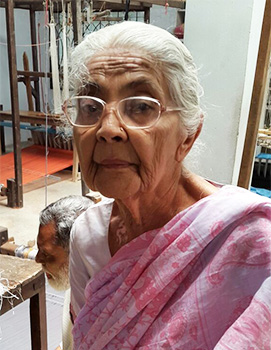
“Haan ji, bol rahi hoon. Boliye..”, the grand old lady of Indian weaving greets me into the conversation. Engaged in revival work of four different textile forms of Aurangabad, Suraiya has a fascinating tale to narrate.
Her journey began soon after she finished her Intermediate. Suraiya joined the Cottage Industries Emporium, a government institution where she learnt the art of salesmanship and production of textiles and handicrafts. It was a great learning experience spanning well over four years, says Suraiya.
It was while working here that a professor from a foreign country, Suraiya says it would be London, came to their Emporium and she was put in charge of showing her around. “She touched and felt everything and was so impressed with me describing the importance of each and every fabric and handicraft product that she thought I was wasting my time here,” says Suraiya on a lighter note recalling her toddler steps into the weaving industry. Eventually it was this lady who introduced Suraiya to her mentor Pupul Jaykar, of the Handloom Handicrafts Corporation of India in New Delhi.
It was a move Suraiya had not contemplated in life and it truly got her where she perhaps wanted to be. “Maine kabhi aisa socha nahi tha, lekin ye ek achchi opportunity thi, so I decided to go along,” says Suraiya (I had never thought of such a career move but when opportunity came knocking, I didn’t say no).
It helped that she had her uncle (chacha) Abid Hassan Safrani living in Delhi. He was with the Ministry of External Affairs initially and at one point was personal secretary to the legendary Netaji Subhash Chandra Bose, recalls Suraiya.
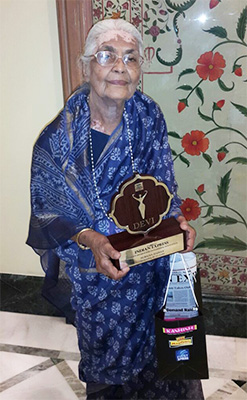
Suraiya Hasan was recently honoured with the Devi Award
Her association with Bose’s family
Suraiya was soon introduced to the Bose family through their ladies. From casual visits, the journeys
Little did she understand the importance of being married to Bose’s nephew except that Aurobindo too was a busy politician. “He was a trade union secretary with many big companies,” says Suraiya of her husband. She however, never got a chance to meet Subhash Chandra Bose.became personal and Suraiya got to know the family from close quarters. She then got married to Aurobindo Bose, Subhas Chandra Bose’s nephew.
From Delhi back to Hyderabad
After superannuation, Abid Hassan moved to Hyderabadand bought some land there. He was the one who called Suraiya back to the Nizam’s city and asked her to set up an independent handloom production unit.
“I wasted no time and got to my hometown to set up this unit. It was an exhaustive task but I would say worth the effort,” says Suraiya. It was here that she started work on the revival of four signature Persian fabric forms native to Aurangabad – Paithani, Jamawar, Himroo and Mashru. Thus was born Suraiya’s Weaving Studio, Suraiya’s weaving unit in Hyderabad.
During my visits to Aurangabad, I had seen many artisans work tirelessly on keeping this art alive, but in a very small way, often at their own homes. I therefore decided to make this sector a little organized in the hope that this dying art will have people following it
While she concentrated on her art, her husband used to visit her in Hyderabad when he had free time on his hand.
She is still in touch with the Bose family though the visits have dwindled in number after her husband passed away.
Social enterprise
Suraiya selected a group of people to pass on her art. It was the widows, with no place to go to and children to feed that she thought would be her right target audience. “I used to sit with them for hours together and help them pick up the nuances. To train one artisan easily takes close to 3-4 months on an average and I later got an expert to help me with the training part. Doing it alone was becoming a Herculean task,” says Suraiya.
While she created an opportunity for widows to pick up the art, she helped by setting up a school in the same compound for their children. Called the Safrani Memorial High School, this institute houses classes for students from Nursery to Std 10, where children of her artisans attend school free of cost.
Aged 84 now, Suraiya says she has lots of work yet to do. When she is not supervising the work of her artisans, she goes to teach students in her school. She takes pride in the fact that they have all performed well and some have even gone abroad.
Well this love for education is not by chance, Suraiya says she would have inherited it from her father. He after all was the proud owner of Hyderabad Book Depot on Abids Road, most likely the first book store in Hyderabad which stocked foreign publications.
source: http://www.her.yourstory.com / YourStory.com / Home> Her Story> Inspiration / by Saraswati Mukherjee / January 12th, 2015
“He never ever mentioned his life with the INA, let alone the story that he had been the one to coin the greeting ‘Jai Hind’. To the rest of the world he might have been a freedom fighter, but to us he was always `Uncle Safrani’.”
Much loved Uncle…
To the rest of the world he might have been a freedom fighter and a soldier who fought alongside Netaji, but to us he was always “Uncle Safrani”.
Only much later did we realise that his real name was Zain-al-Abdin, or Abid Hasan as he preferred to call himself and that the stories he told us of his days in the Indian National Army were actually true.
“Compared to us, Safrani was a man of the world,” says my Mother looking back on the first time they met him, in 1948, on board a ship that was taking them to start the first of the Embassies that were just being opened.
Safrani was bound for Cairo, my parents were due to get off at Genoa and make the rest of the trip by land to Paris.
What they did not know then, was that they had been booked on a cargo ship. Some cabins had been hastily converted to accommodate First Class passengers. It would take the long route, going up the Persian Gulf, stopping at various ports to unload goods.
For my young parents who were leaving the country for the first time, with two small girls, my sister Surya who was two years old and myself, who was five, on a ship belonging to the Sindia Steamship Company as it was known then, Safrani was a wonderful guide. They had never left the shores of India.
He on the other hand was not only a member of the old Hyderabad elite, but had also studied for a while in Germany and travelled all over South East Asia, as Secretary to Subhas Chandra Bose.
“Safrani was one of those men who could make friends with all kinds of people. He was all over the ship. When it docked he would be the first to get off and go straight to the bazaars and return by evening with all manner of beautiful things. He was also a scholar who spent long hours with his Persian and Urdu poetry. There was nothing he did not know and seeing how raw we were, he made it his business to educate us in all the finer points of life. For instance, when we docked at the port of Basra he ran ashore and bought so many carpets that he ran out of money. But this did not worry him, he just made arrangements to borrow money on credit so that he could buy more. ” recalls my Mother.
In the evenings when the ship was at sea, he would take us to the top most deck and point out the stars to us and whisper stories to us about all the ancient sailors like Sindbad who had crossed these very seas. To us, he would become like Sindbad the Sailor himself. During the day, dolphins would follow us racing by our side, while as we made our way into Aden, where the local Indians received us like fabulous guests that had been sent by the newly Independent government of India to conquer the world, Safrani showed us how to be gracious in accepting the hospitality of strangers, who could also be family.
At Port Said, he transformed himself into an Arab prince, bargaining with the chattering hordes of intrepid vendors who climbed up from their small boats into the ship, teaching my parents to sip bitter coffee from small glasses and to taste the sticky sweet lumps of baklava.
By the time the ship sailed into the Mediterranean, Safrani had become the perfect European gentleman, as debonair as David Niven, as effusive as Signor Peperino, with his flowing moustache and his ability to charm the ladies, with his manner of bowing down to kiss a hand. Or as was the case with us to imprint our tender young cheeks with moist and noisy lip-smacking kisses. He became for us the kissing Uncle.
It was also a way in which he kept track of some of his possessions, the beautiful carpets, the pieces of porcelain and small paintings that he had left with us, just as a token of his friendship he said. “I want you to enjoy them as long as you like and when I need to sell something , I will come and collect a carpet or two.”
We were the guardians of his generosity. For though he bought beautiful things with the lavish style of an oriental Pasha, his house was always so full of people that he had quite often to sell them to keep the coffers flowing.
He left one ceramic vase with us. It still stands on a pedestal in a corner, converted now into a lamp stand, its deep blue and copper red tones changing colour with the reflection of the light. “It’s a very rare vase from China. Don’t ever sell it,” he advised, though he himself regularly sold many of his most cherished possessions.
When we lived in Geneva, he happened to be in Berne. His boss at that time was a dog-lover of epic proportions, so every evening as we stood beside him and listened, he talked to the dog, a large Alsatian, who had been left behind in his care, in Urdu, on the telephone.
On another occasion, he told us how the dog had finally died and he was “Chief Mourner” the had conducted the funeral honours. “It was a very touching occasion. I was so moved, I jumped into the open grave and recited some prayers over the dog’s body that I held in my own arms, before laying him into the earth,” he told us. Since he was laughing so much at the memory, we never knew whether any of this was true. Or whether like all the stories he had told us in the past, they were the stuff of the legendary quality that he wove around himself.
“He never mentioned his life with the INA, let alone the story that he had been the one to coin the greeting, “Jai Hind!” remarks my Mother, “Though it sounds very typical of him. He was a free spirit.”
Much later when one of us was passing through Denmark, where he was the Ambassador, we enjoyed the full force of his hospitality. He drove to the airport himself and though when we reached his house, it seemed to be so full of guests that evening, he had to find a room for us, right up in the attic. But as ever it was a fabulous evening. The dinner when it arrived was as full and rich as one of the tables from the days of the old Hyderabad style hospitality. He always managed to have as a hostess, one of his beautiful nieces from Hyderabad, who would quietly attend to the guests and see that no one was without food and drink.
When it was over, he insisted that we should go and enjoy the “Tivoli Gardens,” that was the star attraction of Copenhagen. As we looked at the giant Ferris wheels and the nightly display of fireworks exploding over the skyline of the City, Uncle Safrani had become like Barnum, a grand ring-master presiding over the “Greatest Show on Earth”.
And then we did not see him again.
We had heard that he had returned to his family home after retirement and become a gentleman farmer.
This is my final memory of him.
On a visit to a silk weaving unit on the outskirts of Hyderabad I found that someone had started a small farm, and on it a school for the children of the nearby village.
The owner, who had died some time back had created an enchanted garden of fruit trees. The fields next door were covered with jasmine bushes, dotted with fat creamy jasmine buds, that the children from the school came to harvest in the early morning. The air was filled with their fragrance as all over the field the butterflies were busy doing their own kind of harvesting.
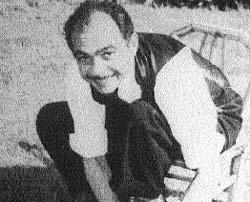
One of this man’s nieces, a really beautiful woman even in her later age, was running a weaving centre. She was pre-occupied in reviving some of the old Hyderabadi silk and cotton weaving traditions and did not have much time to talk. On her table was a photograph of a familiar face, the same moustache, the full lips ready to form themselves into a kiss, the all embracing smile, the jaunty glint in the eye.
“Safrani!” I exclaimed.
The beautiful niece, still glowing in her old age looked at the picture. “My Uncle” she said, quietly.
source: http://www.thehindu.com / The Hindu / Home> Young World / by Geeta Doctor / Online Edition / Saturday – March 23rd, 2002
When we talk of “Freedom Fighters”, we generally mean those people who fought for the independence of India within the country. Many Indians fought for the freedom of the country from outside India too.
Indian National Army
It was Captain Mohan Singh, an Indian officer of the British Indian Army, who first set up the Azad Hind Fouj (Indian National Army) on the defeat of the British by Japan on February 15, 1942.
Abid Hasan
A young enthusiastic and courageous man from Hyderabad also joined this force. His name was Zain-al-Abdin Hasan. He preferred to be called Abid Hasan and later became known as Abid Hasan Safrani.
Abid Hasan’s mother Hajia Begum was anti-British, so her children were sent to Germany for higher studies. And Abid went to do a degree in engineering.
Meeting with Bose
Netaji addressed a meeting of Indian prisoners of war in Germany and asked them to join the INA. Abid met him and was inspired by the charismatic leader. He told Bose that he would join him after finishing his studies. Netaji said tauntingly that if he was caught in such small considerations, he would not be able to achieve anything big in life. Stung by that remark, Abid decided to give up his studies. He became Netaji’s secretary and interpreter.
Abid Hasan was made a major in the INA. Netaji wanted an Indian form of addressing each other. Abid first suggested “Hello” and was snubbed for that. He later suggested “Jai Hind”, which Netaji liked and adopted it as the formal manner of greeting for revolutionaries and members of INA.Later Nehru used it in his Independence Day address from the ramparts of the Red Fort.
The Indian National Army
INA provided a common kitchen for its soldiers irrespective of their religious affiliations. But there were many differences of opinion within its ranks. One of the controversial issues was the design of the national flag. TheHindus wanted a saffron flag, while the Muslims insisted on green. Later the Hindus gave up their insistence. Abid Hasan was impressed by this gesture that he decided to append “saffron” to his name. Since then, he became to be known as Safrani.
After the famous trial of the INA, all the members of the INA were released. In 1946, Safrani came to Hyderabad and joined the Congress Party. The party was riven with factionalism. Disgusted, he gave up politics and joined the Bengal Lamp Company. He was posted at Karachi. On the partition of India, he came back to Hyderabad.
Diplomatic career
In 1948, he was taken into the newly created Indian Foreign Service. On retirement in 1969, he returned to Hyderabad. Safrani passed away in 1984 at the age of 73.
source: http://www.thehindu.com / The Hindu / Home> Features / Online Edition / by Narendra Luther / Saturday – October 20th, 2001
Abid Hasan’s grandnephew recounts the story behind creation of a salutation to replace religion-based greetings for Indian soldiers.
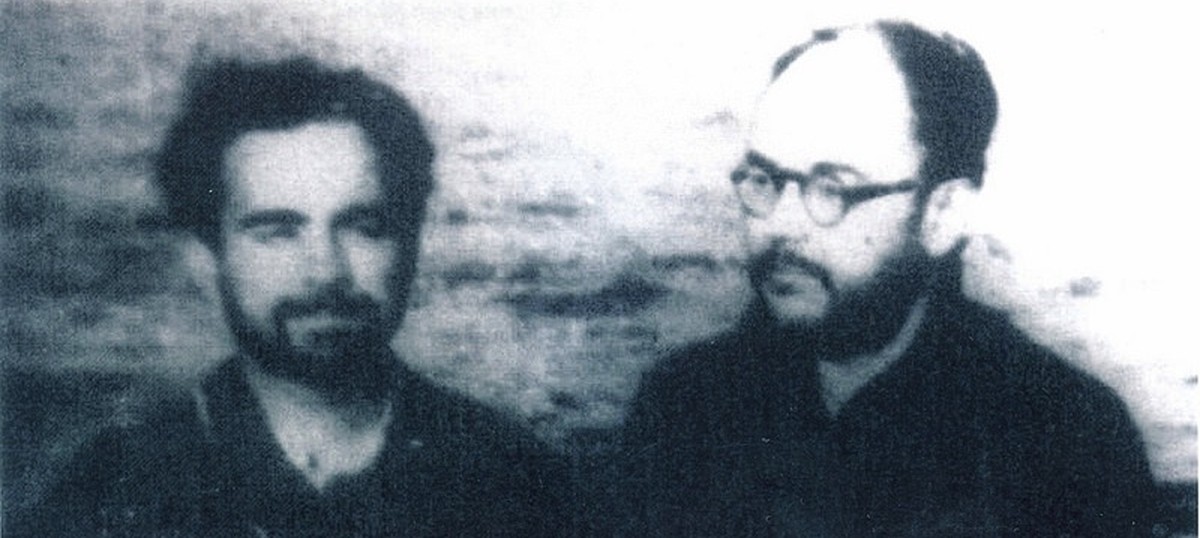
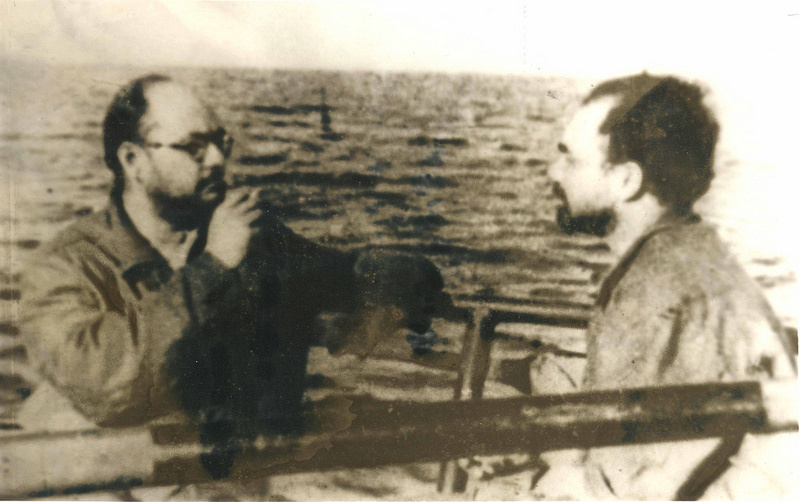
Image credit: Photo courtesy: Anvar Alikhan | Netaji Subhash Chandra Bose with his aide Abid Hasan during their journey to Japan from Germany in 1943.
Netaji Subhash Chandra Bose had a problem. It was 1941. He was in Germany, and was spending a lot of his time in the Konigsbruck prisoner-of-war camp, trying to recruit Indian soldiers captured by Rommel’s army in North Africa into his new Azad Hind Fauj.
But what troubled him was that the soldiers of the Indian Army had historically been organised into regiments based on ethnic and religious lines – the Rajputs, the Baluchis, the Sikhs, and so on. And even here, in the prisoner-of-war camps, they tended to cluster into their own little ethnic and religious groups.
Netaji, however, was very clear that his new Azad Hind Fauj would be a completely integrated army with men of every community and caste fighting shoulder-to-shoulder for an integrated India. After all, how could it be any other way?
But to integrate the soldiers was a complex issue that had to be tackled at many levels. For starters, each community greeted each other with their own salutation: the Hindu soldiers said, “Namaste” or “Ram, Ram ji”; the Muslims said, “Salaam alaikum”, and the Sikhs said, “Sat Sri Akal”. Netaji believed the first thing he had to do was to replace these religion-based greetings with a common salutation that would help bond everybody together.
And this task he entrusted to his aide, Abid Hasan.
The great rallying cry
Hasan was a Hyderabadi who’d been a disciple of Mahatma Gandhi as a teenager, and had spent time at his Sabarmati Ashram. Later, when his contemporaries all went to university in England, Hasan chose to go, instead, to Germany. And it was there that, in 1941, he met Netaji, and dropped out of engineering college to became his aide.
Now, pondering over the task Netaji had set him, Hasan was wandering around the Konigsbruck POW camp, when he overheard two Rajput soldiers greet each other with “Jai Ramji ki”. And that triggered off in his mind the idea of “Jai Hindustan ki”.
This, in turn, led to the shorter, more rousing “Jai Hind”.
Netaji was delighted with Hasan’s idea, which worked so well that “Jai Hind” soon went beyond its original brief to become a rallying cry of the Indian National Army. Later, of course, it would be adopted as the national slogan when, at the time of Independence, Jawaharlal Nehru raised it, stirringly, at the Red Fort.
It is ironic now, in the time of the Bharat Mata ki Jai controversy, to think that Jai Hind was a slogan created specifically to help unite the people of India, rather than divide them.
Later, in 1943, when Netaji was searching for an anthem for his Arzi Hukumat-e-Azad Hind, or the Provisional Government of Free India, he decided on Rabindranath Tagore’s poem, Jana Gana Mana. But to make it more accessible to the common man, Netaji wanted it translated from Tagore’s classical Bengali into simple Hindi. And for that, once again, he turned to Hasan, along with two other INA officers, Mumtaz Hussain and JR Bhonsle, while the tune itself was composed by Capt Ram Singh. Netaji’s vivid brief to them was, apparently, that when the anthem played, it should be so rousing that auditorium itself should shatter in half to reveal the sky above.
It is a mark of the kind of man Netaji was, to combine such a wide sweep of vision, with such minute attention to its details.
Chalo Dilli!
So what became of Abid Hasan?
When Netaji made his historic escape from Germany to Japan by submarine in 1943, he took Hasan along with him. It was the longest submarine voyage in history till then, beginning in the Baltic Sea in a German submarine, transferring off the coast of Madagascar into a Japanese submarine, and then sailing across the Indian Ocean to land in Sumatra, nearly four months later (a voyage that is interestingly portrayed in Shyam Benegal’s The Forgotten Hero, with Rajit Kapur playing the part of Hasan). From Sumatra the two of them were then flown in a Japanese Air Force plane to Tokyo.
Netaji Subhas Chandra Bose with his aide Abid Husain on their famous voyage from Germany to Japan in 1943. Photo courtesy: Anvar Alikhan
Hasan (by then Major Hasan) fought in the historic Battle of Imphal in 1944 – which Netaji believed would be the INA’s great breakthrough into the plains of India at the head of General Mutaguchi’s 15th Japanese Division, culminating in his dream of “Chalo Dilli!” But, unfortunately, everything went wrong.
A spy code-named Silver tipped off the Allies about the attack. The Allied defenders fought back with unexpected desperation; the monsoon broke early, and torrential rains cut off the INA’s and Japanese supply lines, while the Allies managed to supply their troops by air. The expected defection of Indian soldiers from the Allied side to the INA didn’t happen; instead, demoralised INA soldiers and officers began to surrender to the Allies. Also, significantly, the Japanese, invincible until now, were, for the first time, under real pressure on various fronts, both geographical and metaphorical. The tide of the war had imperceptibly, but decisively, turned.
The four-month-long Battle of Imphal (along with the Battle of Kohima nearby) has been voted the greatest battle fought in the history of the British Army. But what that meant for the Indian National Army was that instead of leading to an advance upon Delhi, the battle ended with the long, dejected retreat back to Rangoon, which Hasan orchestrated.
That last, fateful flight
In August 1945, Hasan was one of the key aides whom Netaji picked to accompany him on his final flight, along with SA Ayer, a minister in his Cabinet; Colonel Habeeb-ur-Rahman, his secretary; Colonel Pritam Singh; Colonel Gulzara Singh and Debnath Das. The plan was that they would fly together from Singapore to Tokyo, via Bangkok, Saigon, Taipei, and Manchuria.
But at Saigon Netaji suddenly asked Hasan to remain behind to finish some work, and meet up with him in Tokyo. Ultimately Netaji took off in a Japanese Mitsubishi Ki21 bomber, accompanied only by Rahman.
And the rest we know.
Or don’t know.
It all depends, essentially, on your point of view. (Although it is interesting to note that the top INA officials who were closest to Netaji say that he died in the crash.)
At the end of the war, Hasan was imprisoned by the British and, along with other close Netaji associates, was grilled by British Intelligence about Netaji and his plans. But like the others – including Habeeb-ur Rahman, Pritam Singh and John Thivy, founder of the Malayan Indian Congress – he refused to talk. Some of them were taken away and never seen again; nobody knew whose turn would be next.
After Independence, Hasan joined the newly-formed Indian Foreign Service, and took on the surname Safrani (after the saffron colour in the Indian flag). He would ultimately retire as Ambassador to Denmark – the coast of which he had quietly slipped past at the start of his secret submarine journey to Japan in 1943.
After Independence, Abid Hasan joined the newly-formed Indian Foreign Service, and took on the surname Safrani. Photo courtesy: Anvar Alikhan
He also happened to be (and it’s now time for a disclosure) a favourite grand-uncle of mine.
I asked him once, in an unguarded moment, what really happened to Netaji, and he said, “Arre beta, yeh sab bilkul bakwas hai.” This is all complete nonsense.
But was he telling me the truth?
Or was it just a cover-up for some secret he didn’t want to reveal?