All posts by mpositiveone@gmail.com

India recalls Begum Hazrat Mahal’s contribution to freedom struggle

Uttar Pradesh (India) / Kathmandu (Nepal) :

BegumHazratMPOs08apr2016

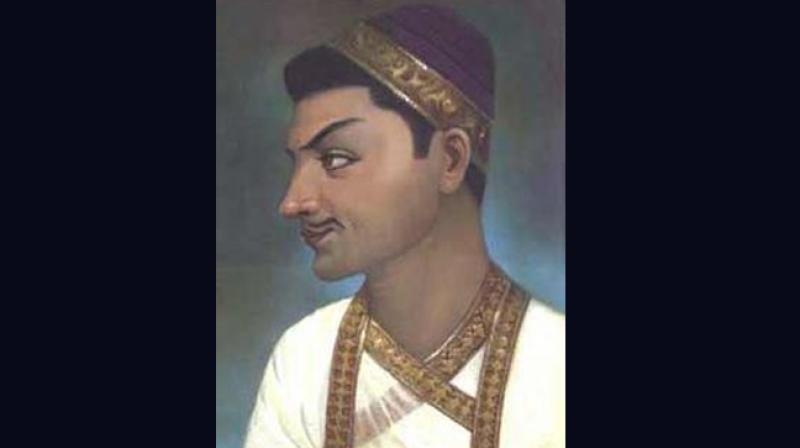
Begum Hazrat Mahal was one of the freedom fighters of the first freedom movement of India, Rae said she had always been remembered for her contributions in India’s freedom struggle.

Kathmandu :

India today said Begum Hazrat Mahal, who had rebelled against British colonial rule in the country in 1857-58, will always be remembered for her contribution in India’s freedom struggle and described her as a “source of inspiration”. Recalling Begum’s contributions towards the freedom movement of India, India’s Ambassador to Nepal Ranjit Rae laid a wreath on her tomb to commemorate her 137th death anniversary here.

“We must remember her with great honour as she has been a source of inspiration for us all,” Rae said. Begum of Awadh and the first wife of Nawab Wajid Ali Shah, who was one of the heroes of freedom struggle of 1857, died on April 7, 1879 during her refuge in Nepal. Noting that Mahal was one of the freedom fighters of the first freedom movement of India, Rae said she had always been remembered for her contributions in India’s freedom struggle. 

He also offered to provide necessary assistance to protect and preserve one and a half century old Hazrat Mahal tomb located in the heart of Kathmandu. “Hazrat Mahal has been a symbol of age old tie between Nepal and India,” Rae said. Begum fiercely fought the British East India Company during the Indian Mutiny of 1857-58, with the help of her commander Raja Jailal Singh.

When her forces regained power of Lucknow for a brief stint, her son Brijis Qadra was declared ruler of Awadh. When the forces under the command of the British re-captured Lucknow and most of Awadh, she was forced to retreat. She then took refuge in Kathmandu along with 10-year-old Qadr and some other loyal supporters. Begum’s rebellion was ignited by the demolition of temples and mosques by the East India Company to make way for roads.

source: http://www.india.com / India.com / Home> News> World / by Wires English / April 07th, 2016

Kanpur’s woman qazi tells Fadnavis to study ‘secular’ Indian Constitution

Kanpur, UTTAR PRADESH :

Kanpur  :

(ANI): Heena Zaheer, a woman Qazi, on Sunday criticised Maharashtra Chief Minister Devendra Fadnavis for his ‘Bharat Mata ki Jai’ statement and said people in such higher positions need to study the Constitution of India.

“It is not at all good. The people holding such higher positions in the government need to study the Constitution of India. They should understand that ‘do’s and don’ts’ are set according to the Constitution,” Zaheer told ANI.

“If it was written in the Constitution that we should chant ‘Bharat Mata ki Jai’ slogan, we would do that. But that is not the case. Our Constitution is very secular and there is no such policy,” she added.

Joining the ongoing debate on nationalism, which is being linked to chanting of certain slogans in recent times, Fadnavis said that every Indian will have to chant ‘Bharat Mata ki Jai’, adding that those who can’t say this shouldn’t live in the country.

The Jamat-e-Islami Hind (JIH) yesterday came out to back the fatwa issued by leading Islamic seminary Darul Uloom in Deoband against chanting of “Bharat Mata ki jai”. The JIH said that the attempts being made to use the slogan as a symbol of patriotism are wrong.

Darul Uloom Deoband on Friday issued a fatwa against chanting of ‘Bharat Mata Ki Jai’, saying that the slogan goes against the tenets of Islam.

“Bharat Mata, according to some Hindu sects, is a goddess and they worship her. For Muslims participating in worshiping a goddess would be un-Islamic, the fatwa said.

AIMIM leader Asaduddin Owaisi had stirred a hornet’s nest by rejecting RSS chief Mohan Bhagwat’s suggestion that the young generation be taught patriotic slogans like ‘Bharat Mata ki Jai’ stating that he won’t chant the slogan “even if a knife is put to his throat”. (ANI)

source: http://www.timesofindia.indiatimes.com / The Times of India / News Home> City> Kanpur / ANI / April 03rd, 2016

History Revisted : How knowledge travelled from East to West (and back again) in the early modern world

The flow of scholarly work between the Mughals and Europe involved translation, re-translation, re-interpretation and development.

Mughals&EuropeMPOs01apr072016

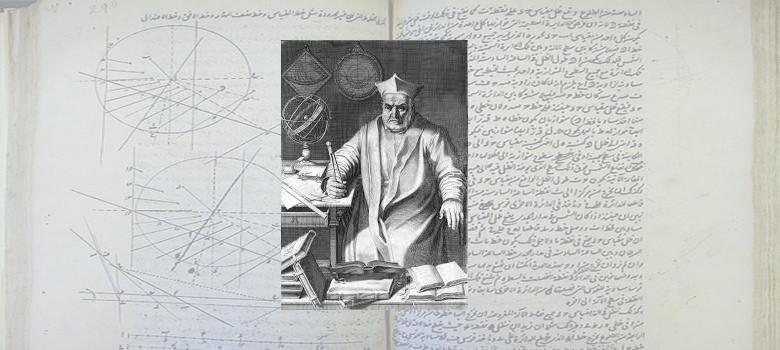
Christoph Clavius was born in Bamberg in either 1538 or 1537 (an amusing discrepancy for a scientist whose fame derives from his work on calendar reform) and was initiated into the Jesuit order by Saint Ignatius Loyola in Rome in 1555, and passed away in 1612, an eminent scholar.

Many of Clavius’ works were influenced by Latin translations of Arabic scientific works, including those of Ibn Rushd (in particular his commentary on Aristotle), the astronomers Abū Ma‘shar, al-Biṭrūjī and al-Farghānī, as well as the mathematician Thābit b. Qurra, among many other scientists writing in Arabic and Persian whose works Clavius cites.

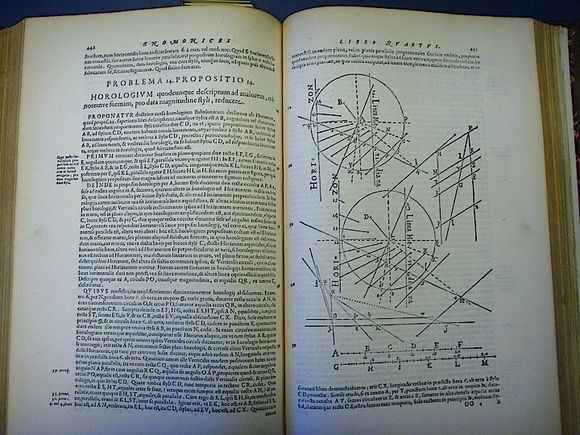
Book 4 of Christoph Clavius, Gnomonices Libri Octo, published in Rome in 1581 (533.k.2, pp. 442-43).

Clavius is an excellent example of the many Jesuit scientists of his age who continued to teach Ptolemaic astronomy (i.e. a geocentric vision of the solar system, indeed the universe, in which the planets and stars orbited the earth in concentric circles), despite the rise of – and often despite their own familiarity with and endorsement of – Copernican astronomy.

Christoph Clavius’ Gnomonices Libri Octo, on the art of gnomonics (timekeeping through the use of a sundial), was published in 1581

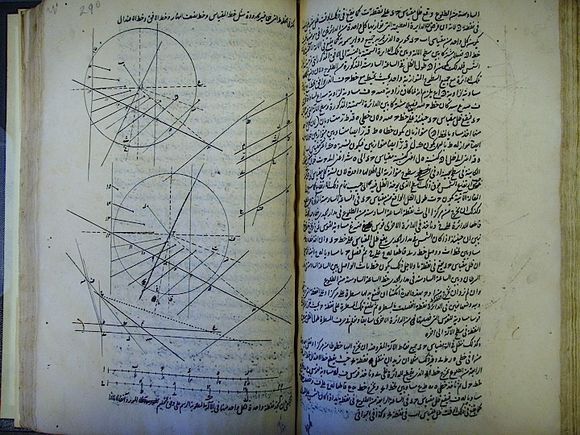
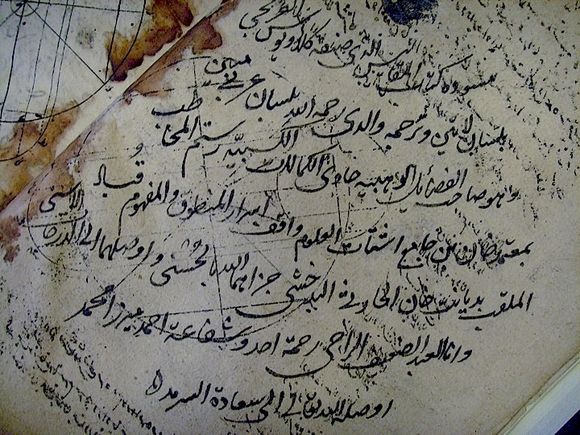
Mu‘tamid Khān's Arabic translation of the identical passage (IO Islamic 1308, ff. 289v-290).
Mu‘tamid Khān’s Arabic translation of the identical passage (IO Islamic 1308, ff. 289v-290).

Arabic version

This work also exists in a fascinating Arabic translation emanating from the Mughal empire that was purchased by Richard Johnson (1753-1807), a well-known collector of manuscripts and miniature paintings who worked for the East India Company.

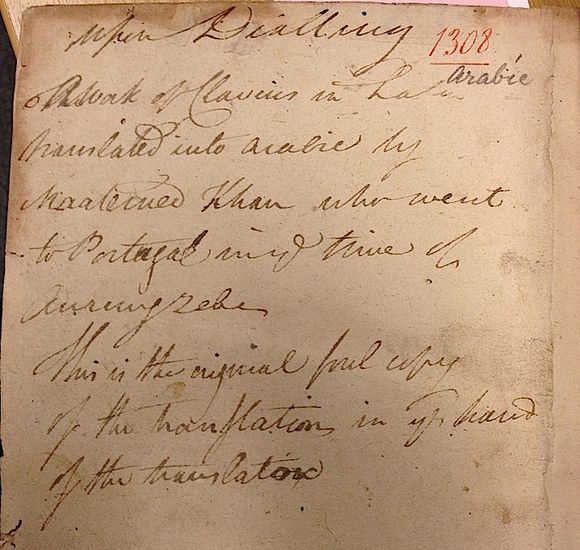
Johnson made an annotation on the flyleaf of the manuscript that the translator of Clavius’ work was sent to Portugal by Aurangzeb – presumably to study or in some diplomatic capacity.

The full note reads, “Upon Dialling. Work of Clavius in Latin translated into Arabic by Maatemed Khan who went to Portugal in the time of Aurungzebe. This is the original foul copy of the translation in the hand of the translator (i.e., the ‘foul copy’ being the first draft, in contrast to the ‘fair copy’).”

Richard Johnson's explanatory note (IO Islamic 1308).
Richard Johnson’s explanatory note (IO Islamic 1308).

A further note, in Arabic, added by the translator’s son, reads: “Draft of the Book of Measures [Kitāb al-Maqāyīs] which was composed by Clavius the Frank [Kalāwīūs al-Firinjī] in the Latin language, and my father, God have mercy on him, translated it into the [clear – mubīn?] Arabic language, possessor of virtuous talents including the perfection of acquired knowledge,

Rustam called Mu‘tamad Khān, the son of Qubād, gatherer of proofs of knowledge, perceiving the secrets of the spoken and the tacit, given the name Diyānat Khān al-Ḥārithī al-Badakhshī, may God be fair with both of them and elevate them.

Signed: I, who am a feeble slave begging for the mercy of the One and the intercession of the Prophet, Mīrzā Muḥammad, may God cause him to attain eternal happiness”.

Note by Muʻtamad Khān's son (IO Islamic 1308, f.1v).
Note by Muʻtamad Khān’s son (IO Islamic 1308, f.1v).
 Complex process

This translation offers some fascinating possibilities.

The first is the demonstration of how knowledge circulated in the early modern world.

Clavius’ work, which responded to and was inspired by Arabic mathematicians and scientists in Latin translation, here a generation after its publication is translated back into Arabic to be read, presumably by elites at the court of Aurangzeb, where the work’s translator and his son were courtiers.

This translation demonstrates the complexity of knowledge flows – that they were synchronic as well as diachronic, and also involved a process not just of translation, but of re-translation, re-interpretation and development as they travelled.

Furthermore, the inscriptions taken in tandem, one in English made by an East India official, the other in Arabic by a Mughal courtier, open the possibility that already in Aurangzeb’s reign, Mughal elites travelled to Europe perhaps to study.

In the case of Mu‘tamid Khan, the translator of this text, he mastered the technical idiom of geometry and mathematics in Latin, and then translated it into an equally complex scholarly language, Arabic. Not an uncommon intellectual feat at the Mughal court, this process of scientific translation remains to be studied in depth.

It is also possible that the presence of the Jesuits at Goa had an influence on the production of this translation, but firm evidence remains to be found.

 This article first appeared on the British Library’s Asian and African Studies blog.

source: http://www.scroll.in / Scroll.in / Home> History Revisited / by Nur Sobers-Khan / March 30th, 2016

Mehbooba Mufti Sworn In As First Woman Chief Minister Of Jammu And Kashmir

Srinagar, JAMMU & KASHMIR :

Srinagar :  

Mehbooba Mufti  of the Peoples Democratic Party or PDP took oath this morning as the first woman Chief Minister of the country’s only Muslim majority state, Jammu and Kashmir, at the head of a coalition government that includes the BJP.

The 56-year-old succeeds her father Mufti Mohammad Saeed who died in January this year. 23 ministers are taking oath along with Ms Mufti , including members of the BJP, whose Nirmal Singh will be Deputy chief minister.

In an indication of the struggles that lie ahead for Ms Mufti, senior PDP leader and lawmaker Tariq Karra boycotted the oath ceremony.

“I had a meeting Mehboobaji till late last night. I wanted three ministers who have played a dubious role and are responsible for the failure of Mufti Mohammad Saeed to be dropped,” Mr Karra told NDTV.

Mr Karra wanted Ms Mufti to exclude key PDP leaders Altaf Bukhari, Naeem Akhtar and Haseeb Drabu from her council of ministers. He alleges that they plotted to form government in alliance with the BJP without Ms Mufti as she refused to take oath for three months after her father’s death.

Ms Mufti dropped Mr Bukhari, but not the others. She has instead replaced two lawmakers who were junior ministers in Mufti Saeed’s team.

Mr Karra is no lightweight. In 2014, he defeated former union minister Farooq Abdullah of the National Conference in the general elections.

Ms Mufti has been criticised for delaying government formation as she wanted the BJP-led Centre to agree to several demands. But  the BJP stood its ground saying it would agree to no pre-conditions for an alliance .

Last week, after a long stalemate, Ms Mufti’s meeting Prime Minister Narendra Modi cleared the way for a PDP-BJP government to take oath. But her struggle to manage a difficult coalition remains.

Former J&K chief minister and Ms Mufti’s main rival Omar Abdullah has prophesied that Mehbooba will face “more alliance contradictions” in the partnership with the BJP, an ideological opposite.

State elections in December 2014 gave no party a majority in the 70 member J&K assembly. The PDP, with 28 seats and the BJP with 25 had formed government after weeks of hard negotiations last year.

source: http://www.ndtv.com / NDTV / Home> All India / by Surabhi Malik / April 04th, 2016

Video Link : http://www.youtube.com

Mumbai cinema turned into mosque

Mumbai, MAHARASHTRA :

CinemaMumbaiMPOs04apr2016

Mumbai :

Cinema buffs of a certain vintage still wax eloquent about Mumbai’s erstwhile Alexandra Cinema’s hammy film title translations. On its marquee, Alfred Hitchcock’s ’39 Steps’ was dubbed ‘Ek Kum Chaalis Lambe’, ‘Double Impact’ became ‘Ram Aur Shyam’ and ‘Bruce Lee – The Legend’ morphed into the quintessentially-Bombaiya ‘Dadaon Ka Dada — Bruce Lee’.

By the early 2000s, however, Alexandra Cinema had graduated from showing Hollywood fare to B and C-grade films interspersed with adult films. It was a time when local residents asked school bus drivers to switch routes so that impressionable school kids weren’t exposed to the “dirty” posters.

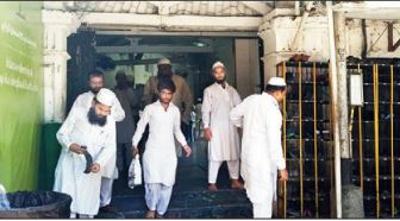
Then about three years ago, in a startling about-face, the cinema hall took on a new avatar as a mosque-cum-Islamic institution. Today, the Dolby Digital speakers, which once blared item numbers, call the faithful to prayer and the audience’s catcalls have given way to an imam chanting Quranic verses five times a day.

The transformation began in 2011, when south Mumbai-based builder Rafiq Dudhwala bought the sprawling 15,000sq ft property for several crores and donated it to an Islamic NGO, Deeniyat, which deals in printing, distribution and the sale of Islamic books to Urdu and Arabic schools across the country. The huge structure stands bang opposite the Maharashtra College at Belasis road near Mumbai Central’s Nagpada junction.

At one time, scores of cinema halls dotted this 3km radius. Ardeshir Irani, who began his career as an exhibitor in the early days of Indian cinema, opened Alexandra Cinema in 1921 along with co-owner Abdulally Esoofally, another tent showman-turned-movie magnate.

From the outside, the theatre looks the same but its interiors have been transformed.

Dudhwala declined to comment on the transformation but the change was welcomed by residents of surrounding Muslim-dominated areas like Clare road, Nagpada, Agripada and Mumbai

source: http://www.timesofindia.indiatimes.com / The Times of India / News Home> India / by Ahmed Ali, TNN / April 03rd, 2016

PM gifts replica of Kerala mosque to Saudi King

Riyadh, KINGDOM OF SAUDI ARABIA :

ModiMPOs04apr2016

Riyadh :

Prime Minister Narendra Modi today gifted Saudi King Salman bin Abdulaziz a gold-plated replica of Kerala’s Cheraman Juma Masjid, believed to be the first mosque built in India by Arab traders around 629 AD.

“PM @narendramodi gifted His Majesty King Salman bin Abdulaziz Al Saud a gold-plated replica of the Cheraman Juma Masjid in Kerala,” the prime minister’s office tweeted.

The mosque in Karala’s Thrissur district is believed to be the first mosque built in India by Arab traders around 629 AD.

“Cheraman Juma Masjid is symbolic of active trade relations between India and Saudi Arabia since ancient times,” it said.

According to oral tradition, Cheraman Perumal was the Chera King and a contemporary of the Holy Prophet who went to Arabia and embraced Islam after meeting the Holy Prophet at Mecca, the PMO said.

Before he died in Oman due to some illness on the way back to India, he wrote letters asking the local rulers, to whom he had handed over his empire, to extend all help they could to Arab merchants who were planning to visit India.

The mosque has an ancient oil lamp that is always kept burning and believed to be over a thousand years old. People from all religions bring oil for the lamp as an offering.

Many believe that the mosque is a testimony to Islam’s arrival to India long before the Mughals came in from the northwest.

Modi, who is on a two-day visit to Saudi Arabia, was today received at the Royal Court here by King Salman.

He is the fourth Indian Prime Minister to visit Saudi Arabia after Manmohan Singh in 2010, Indira Gandhi in 1982 and Jawaharlal Nehru in 1956.

source:  http://www.ptinews.com / Press Trust of India / Home> International / by Manash Pratim Bhuyan / Riyadh – April 03rd, 2016

NIA officer Mohammed Tanzil given martyr status, probe into murder widens

Mohammed Tanzil Ahmad, who has been with the NIA ever since the organisation was formed in February 2009, had been investigating many cases especially related to the banned terror outfit Indian Mujahideen.

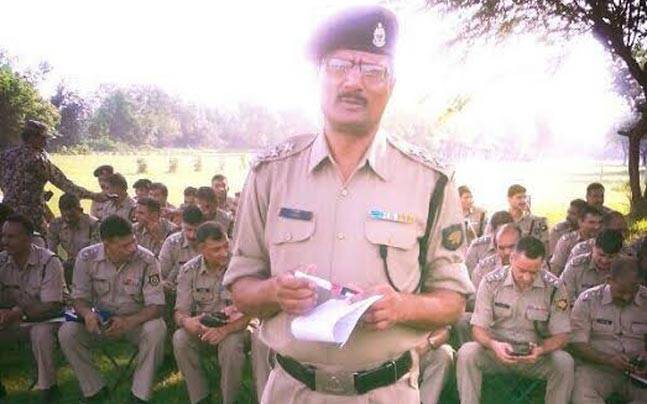
National Investigation Agency officer Mohammed Tanzil Ahmad. (ANI photo)

National Investigation Agency (NIA) officer Mohammed Tanzil Ahmad, who was shot dead by two unidentified motorbike-borne assailants in Uttar Pradesh’s Bijnor, has been given martyr status today.

NIA IG Sanjiv Kumar Singh announced that all provisions shall be provided to the deceased officer’s family. The Border Security Force (BSF) has granted Rs 20 lakhs to Ahmad’s family.

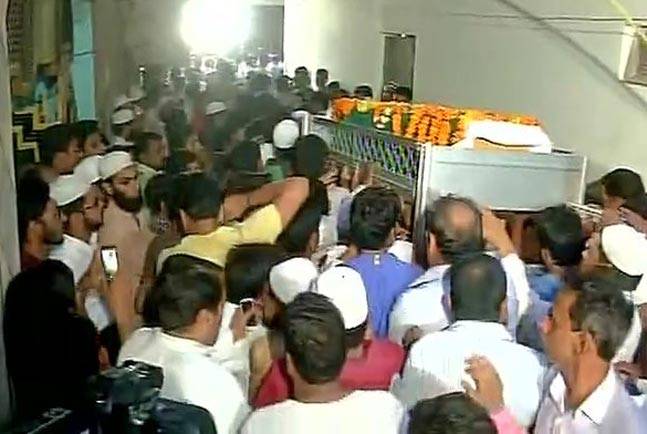
Mohammad Tanzil’s last rites were performed late in the evening amid Inquilab Zinadabad slogans, raised by locals. Delhi Chief Minister Arvind Kejriwal  paid tribute to the NIA officer.

Six teams comprising of officials of the Anti-Terrorism Squad (ATS) and the National Investigation Agency (NIA) have been formed to probe into the brutal attack.

Mohammad Tanzil's last rites were performed late in the evening. (photo: ANI)
Mohammad Tanzil’s last rites were performed late in the evening. (photo: ANI)

The NIA IG refused to comment on Tanzil Ahmad’s involvement in cases pertaining to terrorist outfits like the Islamic State, Indian Mujahideen or Students Islamic Movement of India (SIMI).

An assistant commandant with the BSF, Tanzil Ahmad was on deputation with the NIA. A Bijnor native, Ahmad was posted as an inspector-rank officer at the NIA headquarters in New Delhi.

Home Minister Rajnath Singh  said that he has been apprised of the incident and that a comprehensive report is being prepared.

“Whatever’s necessary is being done. We are talking (to NIA officials),” Singh said.

45-year-old Ahmad, who has been with the NIA ever since the organisation was formed in February 2009, had been investigating several cases related to the banned terror outfit Indian Mujahideen. His superiors termed him as a thorough professional in intelligence gathering as well as investigation.

Superintendent of Police (Bijnor) Subhash Singh Baghel said, Ahmad came to Bijnor on Friday to attend his niece’s marriage. Ahmad’s family lives in Sahaspur village in Bijnor.

At around 8.00 pm on Saturday evening, Ahmad and his family left their home for the marriage function organised at Bandhan Guest House at Sohara village, which is around nine kilometers from their residence.

“After attending the function, Tanzil and his family were returning home at around 1.00 am. When their vehicle was around 300 meters away from their residence, two youths on a motorcycle waved their hand. When Tanzil stopped his car, they fired several rounds and escaped. Tanzil and his wife were in the front seat, while his two children, 14-year-old daughter and a 12-year-old were in the back seat,” the SP said.

Hearing the sound of gunshots, locals rushed to the spot and one of them informed the Bijnor police. A police team was rushed to the spot and the officer along with his wife were rushed to a nearby hospital, where doctors referred them to Moradabad. Tanzil Ahmad was declared dead by doctors upon reaching the Moradabad hospital while his wife was referred to Delhi.

source:  http://www.indiatoday.intoday.in / IndiaToday.in / Home> News> India /  Arunava Chatterjee / New Delhi – April 03rd, 2016

Hyderabad body to honour city founder

Hyderabad, TELANGANA :
Trust plans to take it up with the govt to issue a stamp and coin in the king’s name besides building a fitting memorial in his honour.
 The Trust plans to host an international seminar on the relevance of the king in today's world.
The Trust plans to host an international seminar on the relevance of the king in today’s world.
Hyderabad:
The Deccan Heritage Trust is planning to host year long celebrations to mark the 450th birthday of Muhammad Quli Qutub Shah, the  founder of Hyderabad city, which falls  on  April 4, 2016. The Trust plans to host an international seminar on the relevance of the king in today’s world.

According to Dr Mohammed Safiullah, historian and expert on Hyderabad, the Trust plans to take it up with the government to issue a stamp and coin in the king’s name besides building a fitting memorial in his honour.

source: http://www.deccanchronicle.com / Deccan Chronicle / Home> Nation> Current Affairs / Deccan Chronicle / April 03rd, 2016

Vinay, Uthappa bag grand double at KSCA awards

VinayKF03apr2016

Bengaluru, KARNATAKA :

State skipper Vinay Kumar and right-handed batsman Robin Uthappa bagged a grand double at the Karnataka State Cricket Association annual awards ceremony on Saturday.

Uthappa won the best batsman award in Ranji Trophy and Syed Mushtaq Ali tournaments while Vinay picked up the best bowler’s honour in Ranji Trophy and Vijay Hazare Trophy.

D Nischal of Jawahar Sports Club, who amassed 989 runs, was adjudged the best batsman in Group I, Division tournament for Sir Mirza Ismail Shield. Anand Doddamani of Bangalore Ocassionals, who picked up 48 wickets was named the best bowler.

“I congratulate all the teams and award winners. It’s a good sign that we have completed all the league tournaments on time,” said KSCA Secretary Brijesh Patel, speaking on the occasion.

The award winners:

Ranji Trophy: Best batsman: Robin Uthappa; Best bowler: R Vinay Kumar.
Vijay Hazare One-Day: Best batsman: Manish Pandey; Best bowler: R Vinay Kumar.
Syed Mushtaq Ali T20: Best batsman: Robin Uthappa; Best bowler: KC Cariappa.

U-14 inter-school BT Ramaiah Shield (Division III): Best batsman: Jasper (Mallya Aditi International School). Best bowler: PM Dharshan (Sri Sai Ram Vidyamandir).

U-14 inter-school BT Ramaiah Shield (Division II): Best batsman: P Abheek (Vidyaniketan Public School). Best bowler: S Yashas (Vidyaniketan PS).

U-14 inter-school BT Ramaiah Shield (Division I): Best batsman: Danish Altaf (St Joseph’s Boys’ HS).

Best bowler: Shray Singh (Delhi Public School, East).
U-16 inter-school (Division III): Best batsman: M Danish (KV, Hebbal). Best bowler: Stany (Baldwin Boys).

U-16 inter-school (Division II): Best batsman: Udbhav Gaurav (Jain IRS). Best bowler: Satvik Gunda (Jain IRS).

Under-16 inter-school (Division I): Best batsman: Shubhang Hegde (Vidyaniketan School). Best bowler: Shubhang Hegde (Vidyaniketan School).
U-14 inter-zonal: Best Batsman: Gautam Dileep. Best bowler: SM Shamanth.
U-16 inter-zonal: Best batsman: Aadarsh Prajwal. Best bowler: Shubhang Hegde.
U-19 inter-zonal: Best batsman: Nikin Jose. Best bowler: G Naveen

Under-23 inter-zonal SA Srinivasan Memorial: Best batsman: Sumanth Bharadwaj. Best bowler: Likith Bannur

Safi Darashah: Best batsman: Abishek Reddy. Best bowler: Mitrakant Yadav
Under-16 inter-club: Best batsman: Sai Prajwal (Jawahar SC). Best bowler: Rishi Bhansali (Jawahar SC).

Under-19 inter-club: Best batsman: V Abhiram (Swastic Union CC-2); Best bowler: BM Shreyas (Jawahar SC).

Under-14 inter-club: Best batsman: BN Yashwant (Swastic Union CC-2). Best bowler: Vishruth Dev (Herons CC).

Group I, Division V for JB Mallaradhya Shield: Best batsman: Vinay (Kengeri Cricketers). Best bowler: Suhas (Engrades CC).

Group I, Division IV for Metro Shield: Best batsman: Yere Goud (Visweswapuram CC-2). Best bowler: Pranav Bhatia (Dolphins).

Group I, Division III for Sri Nassur Memorial Shield: Best batsman: KV Darshan (Friend XI). Best bowler: Latif Patel (City Cricketers).

Group I, Division II: Best Batsman: B Tanu (Jayanagar Colts). Best Bowler: Vinu Prasad (Swastic Union 2).

Group I, Division I: Best Batsman: D Nischal (Jawahar SC (1)). Best Bowler: Anand Doddamani (Bangalore Occasionals).

YS Ramaswamy Memorial: Best Batsman: Sadiq Kirmani (Malleswaram Gymkhana). Best Bowler: B Naveen (FUCC).

KSCA Inter-club T20 for Group I: Best Batsman: CM Gautam (Swastic Union). Best Bowler: Dikanshu Negi (Jawans CC).

Group II, Division III: Best Batsman: Keerthi (BWSSB). Best Bowler: Kemparaju Gowda (ITI SC).

Group II, Division II: Best Bats
man: Nihar Shilar (BEML RC). Best Bowler: IG Anil (RBI).
Special Tournament for Zonal Champions and top teams of Group I: Winners: Swastic Union CC (2).

Inter-collegiate Women’s Tournament: Best Batswoman: Pooja Panchal. Best Bowler: G Divya. Winners: Jain College.

Inter-zonal U-19 Women’s Tournament: Best Batswoman: Sanjana Batni. Best Bowler: Harshitha Jha.

Women: U-16: Best batswoman: Vrinda Dinesh; Best bowler: Shreyanka Patil.
U-19: Best batswoman: Shubha Satish; Best bowler: C Prathyusha.
U-23: Best batswoman: G Divya; Best bowler: C Prathyusha.

Senior women (one-day): Best batswoman: Karuna Jain; Best bowler: C Prathyusha.
Senior women (T20): Best batswoman: G Divya; Best bowler: Akanksha Kohli.
Boys: U-14: Best batsman: Prithvi Sadanand; Best bowler: M Shamanth.
Men: U-16. (Vijay Merchant Trophy): Best batsman: Sudhanshu Sonkar; Shubhang Hegde.

U-19 (Vinoo Mankad Trophy): Best batsman: B.R. Sharath; Best bowler: Vyshak V.
U-19 (Cooch Behar): Best batsman: BR Sharath & Sujith Gowda; Best bowler: Likith Bannur.

U-23 (C K Nayudu): Best batsman: D Nischal; Best bowler: Prasidh Krishna.
U-25 (P S Ram Mohan Rao Trophy): Best batsman: K N Bharath; Best bowler: Mitrakanth Yadav.

source: http://www.deccanherald.com / Deccan Herald / Home> Sports / DHNS, Bengaluru – April 03rd, 2016