All posts by mpositiveone@gmail.com

Sana Iqbal on a mission of positivity for the youth

Sana began the ride in November from Goa, where she had been participating in a rally. So far she has covered 10 States and Kochi is the 50th city she has visited.

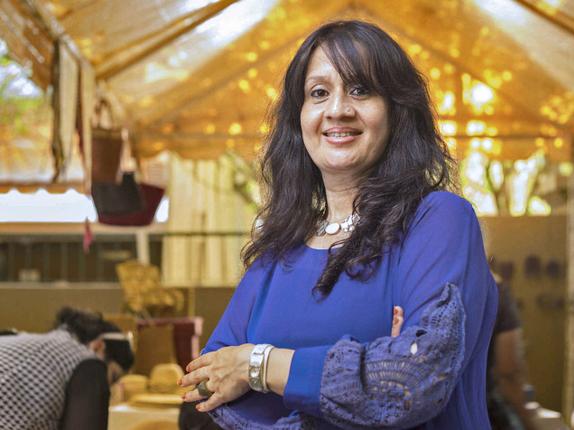
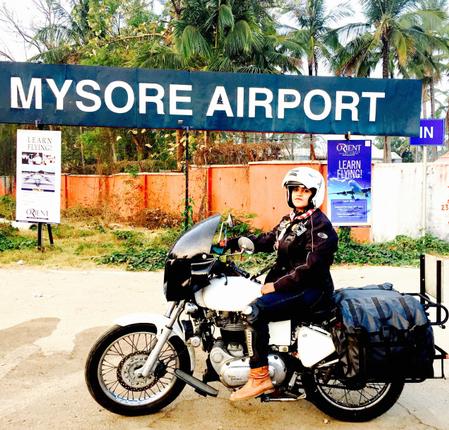
Sana Iqbal, a solo biker, is on a mission to create awareness against suicide and on depression

The wheels of life often take unchartered routes and open new vistas, just as they did for biker and life coach Sana Iqbal from Hyderabad. A personal reversal had driven the young mother to abject depression, even to a point when she hoped a bike accident on the highway would bring a quick end to her misery. But then things changed. Today, the 28-year-old is journeying solo across the length and breadth of the country conducting sessions on tackling issues related to the young. So Sana talks on matters that trouble young minds from subjects as innocuous as acne problems to complex ones on relationships, career, marriage, depression and suicide. She is simultaneously pursuing a Master’s in Psychology and does corporate training sessions on behavioural skills.

Though she began young as a biker, as early as in school, she took to hardcore riding only last September. Till then she drove not beyond 20 km of central Hyderabad. But in a desperate state, Sana undertook a long solo journey. There she found support and encouragement from unexpected quarters. Passers-by cheered her, children gathered around her in curiosity and waved her luck as she rode; little gestures that alleviated her grief. A change in mindset came about. She felt that solution to life’s problems was in perception, in looking at the other side. With it also came a desire to help society with this thinking, to propagate a positive attitude among youngsters and her peers.

“When the aspirations of a normal life fail then extraordinary things happen.” she says on her decision to undertake this ride of a lifetime, a mission. Make happiness contagious is her message to fellow beings, which is imprinted boldly on a placard fixed to her Royal Enfield.

Sana02MPOs10apr2016

Sana began the ride in November from Goa, where she had been participating in a rally. So far she has covered 10 States and Kochi is the 50th city she has visited. She starts her day early and ends at sunset. Local people and truck drivers are her navigators and she rides along where the road takes her to. She carries a knife with her, one that she has never needed. “Our country is the safest place for women,” she says, dispelling the prevailing idea that India is unsafe for women. As a lone female rider she has not encountered any problems that have required help. On the contrary she has found camaraderie everywhere she has been to. In Jhansi where her bike had a flat, she was not charged any fee. In fact, the gentleman commended her efforts and requested her to disseminate the message that Uttar Pradesh is safe and not a lawless state as thought to be. An accident in Rajasthan left her frightened but she changed a hostile situation by her approach. “When the man whose car had hit my bike came to see what had happened, when I least expected the gesture, I said thank you. He was so startled at my response and wondered why I was not threatening him,” she recalls pointing out that kind words can change a situation.

To control one’s anger and to be forgiving are two messages that she wishes to give youngsters. India’s burgeoning biker community is her network, friends that help her with boarding, lodging and connectivity.

In the city, Sana addressed students at Chinmaya Vidyalaya and at SCMS College. From here she moves on to Thiruvananthapuram and Kanyakumari. The North East States are next on her plan.

“Every State has a different traffic sense. Kerala has narrow roads and Rajasthan wide ones but it has a lot of animal traffic. Each place has its beauty,” says Sana preparing her onward mission. “We all want to ‘be the change’ but only a few step out to bring in that change. I hope my act will help do so,” she says, putting on her helmet.

source: http://www.thehindu.com / The Hindu / Home> Features> MetroPlus / by Priyadershini S / Kochi – March 16th, 2016
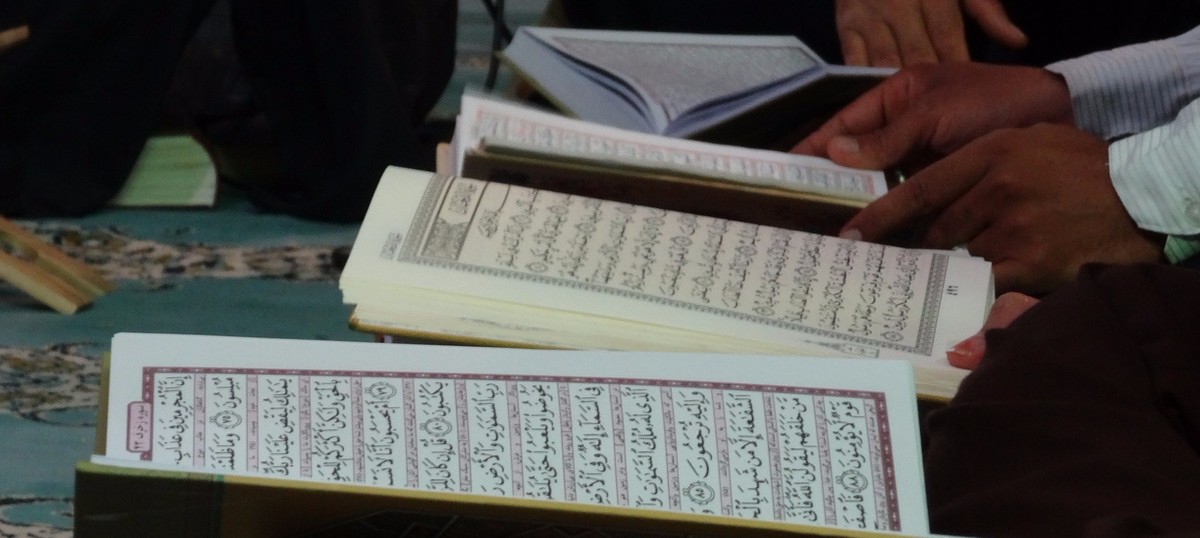
The British Library’s oldest Qur’an manuscript now online

It is one of the largest of known fragments of an early Qurʼān written in the māʼil script.

Image credit: Pixabay

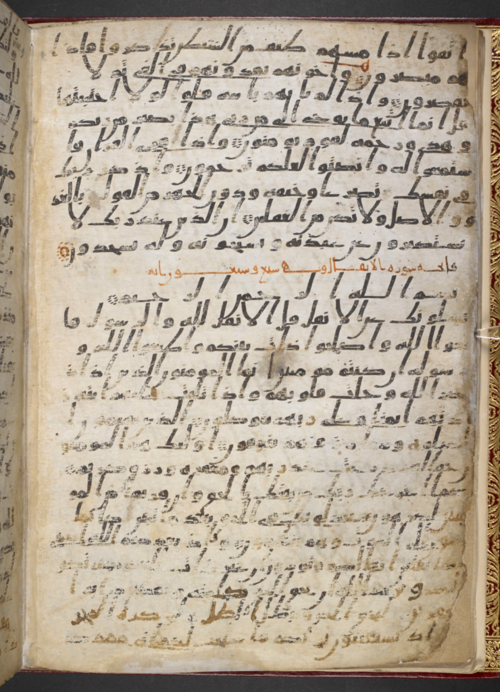
The British Library’s oldest Qur’ān manuscript, Or.2165, dating from the eighth century, has now been fully digitised and is available on the British Library’s digitised manuscripts site. Among the most ancient copies of the Qurʼān, it comprises 121 folios containing over two-thirds of the complete text and is one of the largest of known fragments of an early Qurʼān written in the māʼil script.

The end of Sūrah 7 (Sūrat al-A‘rāf, ‘The Heights’) and the beginning of Sūrah 8 (Sūrat al-Anfāl, ‘The Spoils of War’). The heading in red ink gives the title of the Sūrah and says that it contains 77 verses (British Library Or.2165, folio 7v)

This manuscript was purchased by the British Museum in 1879 from the Reverend Greville John Chester (1830-1892) as noted on a fly leaf at the back of the manuscript. Chester was an ordained clergyman interested in archaeology, Egyptology and natural history and made numerous trips to Egypt and the Near East, where he acquired objects and manuscripts, which are now in the collections of major UK cultural and library institutions. It is very likely he acquired this Qur’ān when he was in Egypt.

Acquisition details recorded at the end of the manuscript (British Library Or.2165, endpaper)

The earliest Qur’ān manuscripts were produced in the mid-to-late seventh century, and ancient copies from this period have not survived intact and exist only in fragments. Or.2165 contains three series of consecutive leaves (Sūrah 7:40 – Sūrah 9:96; Sūrah 10:9 – Sūrah 39:48; Sūrah 40:63 – Sūrah 43:71) from the so-called mā’il Qur’ān, which is about two-thirds of the Qur’ān text and is one of the oldest Qur’āns in the world. It probably dates from the eighth century, and as far as can be ascertained, was produced in the Hijaz region of the Arabian Peninsula.

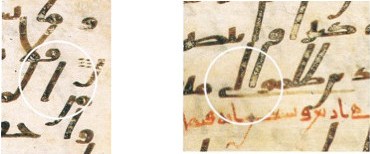
The Arabic word mā’il (by which this Qur’ān is known) means ‘sloping’ and refers to the sloping style of the script – one of a number of early Arabic scripts collectively named ‘Hijazi’ after the region in which they were developed. The main characteristic of mā’il is its pronounced slant to the right. It can also be recognised by the distinctive traits of some of its letters, for example, the letter alif does not curve at the bottom but is rigid, and the letter yā’, occurring at the end of a word, turns and extends backwards frequently underlying the preceding words.

Left: the letter alif; six small dashes mark the end of the verse. Right: the letter yā’; the Sūrah heading in red ink was added later

In early Qur’āns there are no vowel signs, and this early style of script is also notable for its lack of diacritical marks to distinguish between letters of similar shape. Verse numbering had also not yet been established; the end of each verse was indicated by six small dashes in two stacks of three. The sūrah headings were added much later in red ink in the recognisable space purposely left blank to distinguish between the end and the beginning of chapters. Red circles surrounded by red dots to mark the end of every ten verses were also added later.

The beginning of Sūrah 12 (Sūrat Yūsuf, ‘Joseph’) showing the verse markers and also the red headings and circles which were added later (British Library Or.2165, folios 23v-24r)

As with all early Qur’āns, the text is written on vellum and would have been bound into a codex or muṣḥaf – originally a collection of sheets of vellum placed between two boards. Each double sheet was folded into two leaves, which were assembled into gatherings then sewn together and bound as quires into a codex.

The importance of Or.2165, in addition to all other known early Qur’ān fragments, cannot be overestimated. They provide the only available evidence for the early development of the written recording of the Qur’ān text and help towards our understanding of how early Qur’ān codices were produced.

This article first appeared on the British Library’s Asian and African Studies blog.

source: http://www.scroll.in / Scroll.in / Home> Historical Writing / by Colin F. Baker, The British Library / April 08th, 2016

Quality ten-pin bowling centre the need of the hour: Hameed

Guntur, ANDHRA PRADESH / NEW DELHI :

Vijayawada :

There is no professional ten-pin bowling centre in the country and the need of the hour is promote the sport in a more organised manner, according to Shaikh Abdul Hameed, country’s leading bowling player, who bagged Asian and Commonwealth Games medals, representing India.

Speaking to media persons while announcing a tournament to be conduced at PVR Mall on M.G. Road here on Thursday, the 43-year-old veteran admitted that bowling alleys were confined mostly to the malls in cities and it was time they spread their wing. “Ten-pin game is a costly affair. Just to lay one lane it will cost Rs. 32 lakh. Only in Chandigarh we have a 16-lane alley while a standard alley as per the rules of the World Tenpin Association should have 24,” he added.

He said efforts were made to erase the entertainment tag attached the game and make it more competitive and systematic.

“Though the game has it origins in the country from the 60s it has turned professional only in early 2000,” says the double gold medallist at the Manchester Commonwealth Games, who won the title “Bowling Ekalvya” for learning the game all by himself.

Born in Guntur, Hameed, a south paw, shifted base to Delhi and was hooked to ten-pin bowling in his twenties.

“For the past 16 years I am playing bowling with passion and took part in several international tournaments in 120 countries. I am the only Indian who won the Thailand tour tiles of Asian Bowling Federation (ABF) in 2014,” he added.

A fighter to the core

Mr. Hameed is well-known for his legal fight against Government of India protesting the manner in which the Arjuna awards were shortlisted. “After a long fight I won the case in the courts and the points system was introduced. I still remember many players who received Arjuna awards thanking me for my fight.”

Technique

He said to be a successful bowler more than the strength and fitness it was technique that was needed to flatten the ten pins played in a cage.

“I want the Andhra Pradesh government to establish a quality bowling complex in the Amravati region and I wish to express make a request to Chief Minister Chandrababu Naidu, who is well known for promoting sports and games.”

source: http://www.thehindu.com / The Hindu / Home> News> Cities> Vijayawada / by Special Correspondent / Vijayawada – April 08th, 2016

Seminar to know Kalam the poet

Chennai, TAMIL NADU :

Lucknow:

Hindi-urdu Sahitya Award Committee, Uttar Pradesh is organising an International Literary Seminar on the poetic contribution of the former Indian President APJ Abdul Kalam to literature.

The seminar is part of the annual celebrations of the committee which will be held on April 9 at Rai Umanath Bali Auditorium in Qaiserbagh.

Getting together people from both Hindi and Urdu backgrounds, the seminar will have writer and poet Ganga Prasad Vimal, Irtiza Karim, chairperson National Council for Promotion of Urdu Language, Yogendra Narayan and Qazi OR Hashmi, Jamia Millia Islamia among other academicians and poets.

source: http://www.timesofindia.indiatimes.com / The Times of India / News Home> City> Lucknow / TNN / April 08th, 2016

‘Help the Poor and Needy irrespective of Caste and Creed ’

Mysuru, KARNATAKA :

Imam-e-Haram of Holy Place of Mecca addresses thousands of Muslim brethren in city.

ImameHaramMPOs09apr2016

Mysuru :

Imam-e-Haram of Holy Place of Mecca in Saudi Arabia, Dr. Saleh Bin Mohamed bin Ibrahim Al Talib, arrived by a special chartered flight from Bengaluru and landed at Mandakalli Air Port in city at 11.45 am yesterday.

Hazrath Moulana Syed Arshid Madni, President, Jamiath-e-Ulema, Ameer-e-Shariath Karnataka Hazrath Moulana Mufthi Mohamed Ashraf Ali Baqvi, former Mayor and Corporator Ayub Khan and Javeed Ahmed, Joint Secretary, Siddiqia Arabic College, accompanied the visiting Imam-e-Haram from Bengaluru to Mysuru.

Tanveer Sait, former Minister and MLA N.R. Constituency, Vasu, MLA, Chamraja Constituency, Hazrath Moulana Shabbir Ahmed Saheb Rishadi, President, Jamiath-e-Ulema, Mysuru Unit, Moulana Hafiz Arshad Ahmed, General Secretary, Jamiath-e-Ulema, Mysuru Unit, Abdul Azeez Chand, Secretary, Siddiqia Arabic College, Corporators K.C Shoukath Pasha, Suhail Baig, Ayaz Pasha alias Pandu and Feroz Khan, Janab Ariff Ahmed Mehkri, Chairman, Mysuru District Wakf Advisory Committee, Md Mumtaz Ahmed, Secretary, Mysuru District Relief Committee and others welcomed and garlanded the visiting dignitary.

Later, he was taken to Rajiv Nagar Eidgah Maidan in a convey of more than 50 cars and same number of motor bikes followed the convey. And other Muslim Brethren welcomed him standing both the side of the Road from Mandakalli to Rajiv Nagar Eidgah Maidan, where Muslim Brethren from Mysuru, Mandya, Hassan, Kodagu and Chamrajanagar Districts were waiting since 7 am in spite of scorching Sun.

In the history of Mysuru city, this is the first time that Imam-e-Haram from Holy place of Mecca in Saudi Arabia is visiting Mysuru to address the gathering and to lead the prayer.

Later, addressing the gathering in Arabic language, Imam-e-Haram Dr. Saleh Bin Mohamed appealed to Muslim Brethren to spread the message of peace and humanity and to help poor and needy irrespective of caste and creed. The same was translated to Urdu by Hazrath Moulana Syed Arshad Madni Saheb, President, Jamiath-ul-Ulema.

On the occasion, Imam-e-Haram also prayed for copious rains. More than 2.50 lakh members were attended the prayer at Eidgah Maidan.

Hazrath Moulana Mahmood Ul Hassan Saheb, Moulana Salman Ahmed Saheb Nadvi, Hazrath Moulana Mohamed Naseem Saheb, former President, All India Mili Council, Mysuru District and other eminent personalities were present on the occasion.

Superintendent of Police Abhinav Khare supervised the Police bundobast. Traffic Police diverted the traffic for smooth movement of the vehicles.

source: http://www.starofmysore.com / Star of Mysore / Home> General News / Saturday,  April 09th, 2015

Women Icons – Before Sanjukta Parashar, there was another gritty female cop from Assam

The media may not remember Yamin Hazarika, but for many she is still an Assamese icon.

Yamin01MPOs09apr2016

Guwahati, ASSAM :

Since last week, there has been a flurry of news items in social and mainstream media about Sanjukta Parashar, the superintendent of police in Assam’s Sonitpur district. They gave instances of her bravado, heaped richly-deserved praises on her, and many of them described her as the “first female IPS officer from Assam”.

Sadly for me, the articles were a reminder that popular history, both in Assam and the rest of India, has forgotten all about Yamin Hazarika. That petite lady wore a heavy mantle at a time when women were still defining their roles in India. She was selected in 1979 for the state police services DANIPS (Delhi Andaman Nicobar Islands Police Services) and made it to Indira Gandhi’s security team. While it’s unclear whether she was later promoted to the Indian Police Services, most people in Assam saw Hazarika as no less than an IPS officer and a trailblazer in every way.

To those growing up in Guwahati in the ’90s, Hazarika was one of the few modern female Assamese icons. I met her only twice in my school years but she left a lasting impression on my young mind. She belonged to the Assamese Muslim community, from which few women icons had emerged until then. That impression stayed with me. So last week, when the news reports on Parashar began appearing, I decided to learn more about Hazarika. Who was she truly? To find out, I met her 80-year-old mother and her younger brother Yusuf Hazarika at their home in Guwahati.

Breaking barriers

Yamin Hazarika was born in the late 1950s in Lakhtokia, Guwahati, to Shameem Hazarika and Mohammed Serajul Hazarika. She was the second of five siblings.

Lakhtokia is one of the oldest pockets in Guwahati city that was designed by the British and houses some of the most elite and accomplished Assamese Muslims. Former Indian President Fakhruddin Ali Ahmed too was from Lakhtokia, and as my conversation with Hazarika’s brother revealed, their family is related to the late president.

Yamin02MPOs09apr2016

Her grandfather Ikram Rasul was the superintendent of excise in colonial times and was posted in Sylhet. Due to his involvement in the freedom movement, the family said, he was sacked from the job. Hazarika’s mother Shameem was one of the first female car drivers in Guwahati.

Hazarika started her schooling at St Mary’s Convent in Guwahati and passed her senior Cambridge examinations from Pine Mount Convent in Shillong. After that, she left for Delhi to read history at IP College. “She was a bright and studious girl who was always into her books and was completely no-nonsense,” recalled her brother.

After graduation, Hazarika pursued law in Guwahati and appeared for the UPSC examinations twice – first in 1977-78 and then in 1978-79 – clearing both times. She finished her police training at the Maharaj Ranjit Singh Punjab Police Academy in Phillaur, Punjab, where she met her future husband, Rajeev Sagar, who was an IPS officer from the Haryana cadre.

Yamin03MPOs09apr2016

“The results were delayed by over a year when she appeared the first time,” said Yusuf. “Those came out in 1979. By then she had already cracked her second attempt and qualified for the DANIPS [Delhi Andaman Nicobar Islands Police Services] and was part of Indira Gandhi’s security team.”

Does DANIPS qualify as part of the IPS system? One serving IPS officer said a DANIPS official is on par with an IPS officer since DANIPS is a feeder cadre for the IPS. “Yamin was indeed the first Assamese woman to be an IPS officer,” the serving officer insisted, though Scroll could not independently verify this claim. A query to the Ministry of Home Affairs revealed that DANIPS officials get promoted to IPS after certain years’ service. Either way, Hazarika went on to serve in important positions.

Hazarika was posted as  assistant commissioner of police in Chanakyapuri, Delhi, and after some time she was promoted to the position of deputy commissioner of police (crimes against women cell) in the capital. In 1998, she was sent to Bosnia as part of the UN peacekeeping force for three months. It was there that she was diagnosed with leukaemia and she had to return to India. Hazarika received treatment at the Tata Memorial Centre in Mumbai and at Delhi’s All India Institute of Medical Sciences, but she succumbed to cancer on July 25, 1999. She was only 43.

Strong but mild-mannered

The few articles on the web on Hazarika describe how she oversaw stringent measures to cut down sexual harassment of women on the capital’s streets. Yet, despite her strong cop persona, Yamin was mild-mannered. “Innu was a very simple and soft spoken lady,” said her brother. “She would hardly raise her voice or be rude.”

Her daughter Huma Hazarika Sharma added: “She was a strong person. Though she was a strict disciplinarian, she was also a fun-loving person. Everyone in the police force who interacted with her still has incredible things to say.”

An officer at the Hauz Khas police station in Delhi, where Hazarika was posted, spoke at length of the time when he served under her. “She was a very tough lady and even today I will salute her,” he said. “I learned so much from her. I cried a lot the day she died.”

Yamin Hazarika may have faded from the media’s memory, but she is still the first female Assamese icon for many. That includes me.

Shaheen Ahmed is a research scholar at the Jawaharlal Nehru University, Delhi, and a former journalist.

source: http://www.scroll.in / Scroll.in / Home> Women Icons / by Shaheen Ahmed / June 17th, 2015

Forgotten histories: A library in a Guwahati mosque shares the fate of an old Assamese community

Guwahati,  ASSAM  : 

Sirat Library finds few mentions in recorded history and it is even fading from the personal histories of the Khilonjia Muslims who live around it.

Image credit: Shaheen Ahmed

Every time Assam heads into an election, the political discourse in the state invariably veers towards the issue of indigeniety. Who is an original inhabitant (and who is not) becomes a central question, with all the political parties nudging the electorate’s collective memory to recall real and imagined injustices.

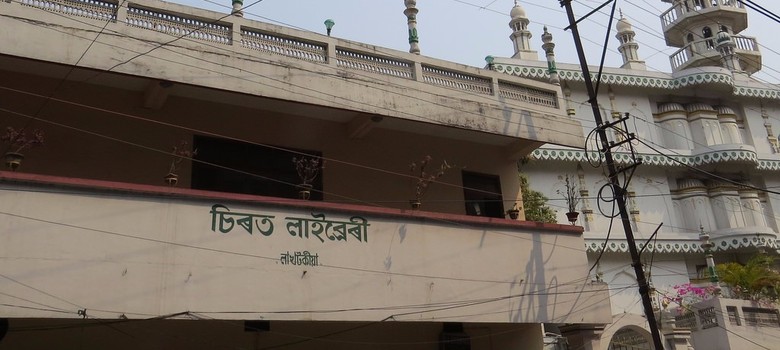
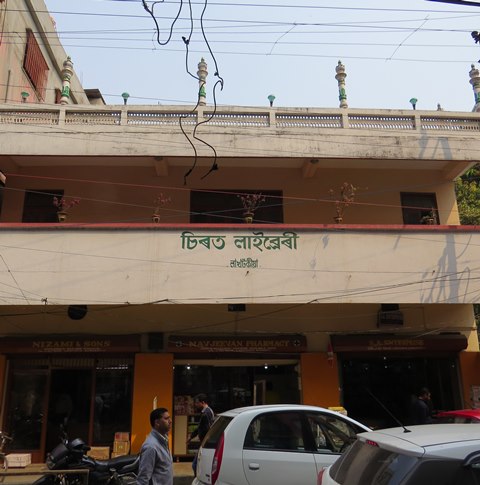
With elections having kicked off in Assam again, my thoughts returned to something else, to my childhood when I would accompany my parents to a concrete structure in Guwahati’s Lakhtokia area. The structure was architecturally nondescript, but the images and the experiences of it still coalesced to form fragments of my memory. Known locally as Sirat Library – although the Assamese pronunciation Sirot often rendered the name incomprehensible – it was located within the precincts of a mosque called Lakhtokia Masjid No. 1.

I vaguely recall public meetings being held in the small library. And till the early 2000s, it moonlighted as a voting booth. For a child, it was an unusual sight to see so many people of different religions line up to cast their votes and even more unusual to see them do so in a library inside a mosque.

The structure still stands today. But the only sight that greets a visitor is of a small room bereft of books or readers. Its holdings are restricted to a small glass cupboard and a few Islamic texts in it.

Legacy of the past

The history of the library is really important to the Khilonjia Muslims or ethnic Assamese Muslims living in Guwahati. Khilonjia Muslims have been in Assam since before the Ahom invasion in the 13th century and they have always been known to relate to their ethnic, rather than their religious, identity.

Shehabuddin Talish, the official scribe of Mir Jumlah, the Nawab of Bengal who invaded Assam in 1662, described their encounter with the Muslims in Assam: “The Muslims whom we met in Assam are Assamese in their habits, and Muhammadans but in name.”

The famous colonial historian Sir Edward Gait, in his monumental work A History of Assam published in 1905, extensively employed Talish’s descriptions to map out a definitive chart of Assam’s history. Nevertheless, historical narratives of Khilonjia Muslims remain sketchy. The same fate is shared by the library in Lakhtokia.

There are no written records of when or who constructed the library. It is, however, believed that the structure is among of the oldest libraries in Guwahati, and the mosque it is a part of is among the three oldest mosques constructed in the colonial period.

The mosque finds a mention in an article in 1885 in the journal Assam Bandhu, which was edited by the Assamese intellectual Gunabhiram Barua. The land for the mosque was donated by Col. Jalnur Ali Ahmed, the father of the fifth President of India, Fakhruddin Ali Ahmed. Col. Ahmed was a distinguished Assamese of his time: he was the second Assamese associated with the Imperial Medical Services and the first Assamese to receive an M.D. degree from London.

Personal histories

Writer-lawyer Akdas Ali Mir, one of the inhabitants of the locality, points to a letter written in 1915 by AHW Benting, the then Commissioner of Assam, which is probably one of the earliest and only clues to tracing the history of the library. “Benting had issued directions in an Order Letter to shift the Makhtab (primary Islamic school) established by the British from the mosque to the present location, where the Junior Madrassa High School is in Guwahati.”

Mir continued: “We can surmise that Sirat Library is the spot where the Makhtab was and then got converted into a library.” This may be true as Sirat is an Arabic word meaning a “way of life”.

As with all public libraries in the state, Sirat Library too was awarded a monthly grant from the government for its upkeep. But the actual running was done by the area’s Assamese Muslims, with people taking turns as librarians. Renowned Assamese filmmaker Altaf Majid remembers his childhood days spent in the library reading in the quiet. “My uncle used to be the librarian for many years. Every Friday afternoon he would take me to the iconic Lawyers’ Book Stall in nearby Pan Bazaar to buy books. In fact I read the Mahabharata in Bengali in Sirat Library in the 1960s.”

Majid continued: “This library was also a repository of well-known pulp fiction of the period. They were in English, Assamese and Bengali. In fact, I also read my first English novel in this library as well as the famous Bengali Mohan Detective Series and the Assamese adventure series Pa-Phu.”

Credit: Shaheen Ahmed

Mukimuddin Ahmed, another resident, talks of the days in the late 1950s when he would act as the librarian in the evenings. “I was paid Rs 5 every month as the librarian and I worked for a year. Every afternoon after school I would go to the residences to collect the newspapers for the library. In the evenings after the readers had finished reading them I would then return them to the respective households.”

Assamese Muslim women had a strong role to play in the library’s upkeep. In the late 1960s, the only Assamese Muslim women’s social organisation, Anjumaan-E-Khawaateenein Islam, contributed Rs 10,000 to construct the new building for the library from the earlier Assam-type house construction. Noted Assamese woman writer Alimun Nessa Piyar donated furniture to the library in 1960.

As Helena Barranha and Susana S. Martins poignantly observed , “Memory has become both an intellectual challenge and a commodity for easy consumption.” This is true for contemporary India in general, and Sirat Library epitomises the trend. The erasure of the library from popular memory testifies to the erasure of cultural traditions that were once so integral to the Assamese society.

source: http://www.scroll.in / Scroll.in / Home> Memory Lane / by Shaheen Ahmed / April 05th, 2016

HIDDEN HISTORIES – In Aziz Ul Mulk’s Garden

Madras (now Chennai),  TAMIL NADU :

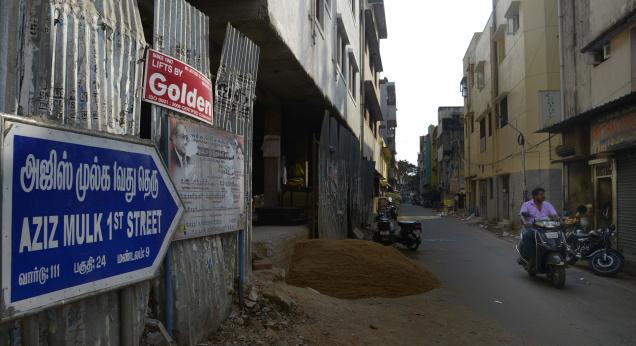
A view of Aziz Mulk Street off Model School Road. / Photo: V. Ganesan

Just beyond the Gemini flyover, Model School Road, Anna Salai and Graeme’s Road enclose a perfect rabbit’s warren of streets. There are nine of them, and they all take their name from Aziz Ul Mulk, a Muslim nobleman who once owned the entire area.

This was known as Aziz Baugh till the early 20th Century and was most likely more of a garden than the residence of the owner. When Sir William Thomas Denison, Governor of Madras, was leaving the city in 1866, he, his wife and daughter were invited for a farewell hosted by the Muslims at the ‘Gardens of Azeez Ool Moolk Bahadoor, Graemes Road, at 7 1/2 pm, on Saturday, the 24th of March’.

‘An evening entertainment in the gardens of a man bearing such a name!’ enthused Denison in his diary. He expected something out of the Arabian Nights and was not disappointed. The first family alighted in front of a wide, open verandah that was brilliantly lit, the brightness being enhanced by ‘suspended globular mirrors’. The hosts, all clad in white but sporting red turbans and sashes, stood on either side of the steps and ushered the guests to sofas at the rear of the verandah. A formal address was presented.

Dinner was in a shamiana to the side of this pavilion and ‘old Azeez Ool Moolk’ led Lady Denison to it, while the Governor was escorted by Nazim Jung, his son ‘who is an active intriguing man, a sort of politician in his way, and the presiding genius of the present entertainment’. Dinner was served in European style and described as a ‘tedious affair’ in which the English found much to their amazement that the hosts ate nothing but a ‘biscuit and some fruit’. Thereafter, the group moved to another shamiana where a nautch was presented.

‘Eight dancing girls, all dressed alike, stood in the centre of the apartment, each holding one of a cluster of eight ropes, which were suspended from the ceiling; and then with a slow and graceful movement passed to and fro, in and out, in such a manner as, by this movement only, to twist the eight ropes into a regular plait through their whole length, and then to untwist them, the whole being done by the dance only, without the application of the hands’. We would recognise this today as pinnal kolattam.

All this gaiety hid the fact that Aziz Ul Mulk was heavily indebted, mortgaging much of his valuables with the bank of Girdar Das Vallaba Das. Like the aristocrat in Satyajit Ray’s Jalsaghar, he was clearly spending his money on entertainment he could ill afford. Aziz Ul Mulk’s death is not recorded, but by 1868, the intriguing son — Sumsaum Ud Dowlah Bahadur aka Nazim Jung — was dead. The family finances must have declined thereafter, for, by 1902, we find the area recognised as a slum. Certainly, there is no trace of the garden where a Governor once dined.

source:  http://www.thehindu.com / The Hindu / Home> Features> MetroPlus> Hidden Histories / by Sriram V / Chennai – April 08th, 2016

If you love a biriyani…

Chennai, TAMIL NADU :

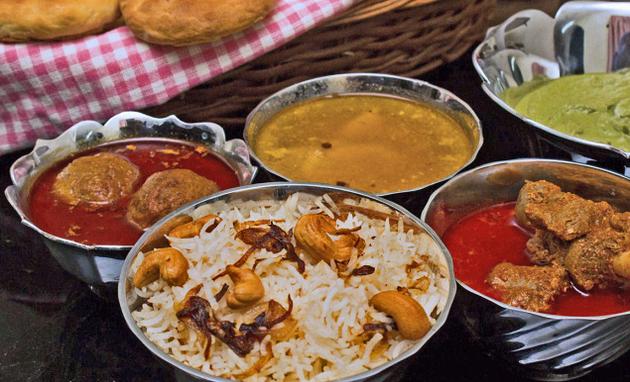
All things Mughlai Biriyani, kebabs and more / Photos:Special Arrangement

Tasneem Ayub Khan will tell you how to make it, writes K. JESHI

Fourteen ingredients. “That’s all you need to make Dhakni biriyani,” says Tasneem Ayub. “One has to know the right proportion of ingredients, the order in which they have to be added, the time and, most importantly, the confidence. Anyone who loves cooking can easily learn,” she says.

A home chef and home baker, Tasneem runs Ammee’s Kitchen in Chennai. She conducts workshops on how to make biriyani.

“Everyone loves biriyani and so they are eager to make the yummy mughlai biriyani. It is not as difficult as it is made out to be. Keep it simple is what I tell them,” explains Tasneem.

BiriyaniMPos08apr2016

Tasneem draws her inspiration from her mom. “She was a fabulous cook. She worked full-time, as the principal of Ethiraj College, yet she ensured that she made tasty food before she stepped out for work. I have learnt all my recipes from her.”

While Tasneem’s father’s ancestors come from Pakistan, her mother is from Kozhikode in North Kerala, a foodie’s paradise. “I love my mom’s meen moily, a Kerala special; the fish curry, appam and stew. I haven’t changed a thing from my mom’s recipes. ”

Tasneem says it’s a misconception that Mughlai dishes are high on spices. “The Mughals didn’t use spices. It was all about rich, creamy bases made from cashew or almond paste, inspired by Persian and Turkish style of cooking. They never use lime in any of the preparations. I follow the same style.”

She calls herself a traditionalist.

“I stick to the original recipes. Cooking gives me the utmost joy. Even when I am unwell, I crawl to the kitchen and cook. I try out Italian, and Mediterranean cuisines, but there is nothing to beat the versatility of Indian cuisine. I tell people at my classes to try and buy organic ingredients. And, don’t buy anything readymade, even curd or yoghurt. Make them at home. I make my own ginger-garlic paste,” she says.

Tasneem is currently working on a book, a compilation of recipes collected from friends and family members.

“I want to give it a personal touch with the recipes in their own handwriting,” she says.

And, what is her favourite food? “Dal chawal. I love to have it with the pickles I make at home as well!”

To know more about her recipes visit: www.facebook.com/ Ammees

Kitchen Or mail her at ammeeskitchen @gmail.com

source: http://www.thehindu.com / The Hindu / Home> Cities> Coimbatore / Coimbatore – April 06th, 2016

India recalls Hazrat Mahal’s role in freedom struggle

Uttar Pradesh (India) / Kathmandu (Nepal) :

Kathmandu : (PTI) 

India today said Begum Hazrat Mahal, who had rebelled against British colonial rule in the country in 1857-58, will always be remembered for her contribution in India’s freedom struggle and described her as a “source of inspiration”.

Recalling Begum’s contributions towards the freedom movement of India, India’s Ambassador to Nepal Ranjit Rae laid a wreath on her tomb to commemorate her 137th death anniversary here.

“We must remember her with great honour as she has been a source of inspiration for us all,” Rae said.

Begum of Awadh and the first wife of Nawab Wajid Ali Shah, who was one of the heroes of freedom struggle of 1857, died on April 7, 1879 during her refuge in Nepal.

Noting that Mahal was one of the freedom fighters of the first freedom movement of India, Rae said she had always been remembered for her contributions in India’s freedom struggle.

He also offered to provide necessary assistance to protect and preserve one and a half century old Hazrat Mahal tomb located in the heart of Kathmandu.

“Hazrat Mahal has been a symbol of age old tie between Nepal and India,” Rae said.

Begum fiercely fought the British East India Company during the Indian Mutiny of 1857-58, with the help of her commander Raja Jailal Singh. When her forces regained power of Lucknow for a brief stint, her son Brijis Qadra was declared ruler of Awadh.

When the forces under the command of the British re-captured Lucknow and most of Awadh, she was forced to retreat. She then took refuge in Kathmandu along with 10-year-old Qadr and some other loyal supporters.

Begum’s rebellion was ignited by the demolition of temples and mosques by the East India Company to make way for roads.

source: http://www.ptinews.com / Press Trust of India (PTI) / Home> International / by Shrish B Pradhan / Kathmandu – PTI,  April 07th, 2016