Two quick thinking interns perform a miracle on a road accident victim
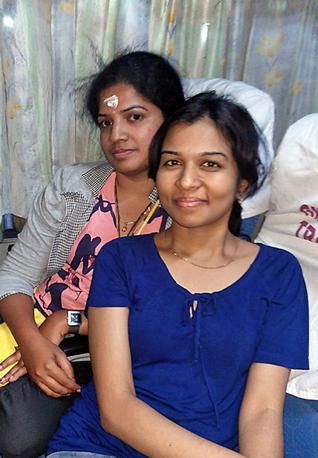
The mini-bus echoed with laughter and song of doctors and interns returning from a trek to Anantagiri hills on Sunday evening before it stopped at a roadside eatery in Bandalguda. All the doctors stepped out to stretch and walk into Dwaraka hotel, when a miracle happened. Rather, two doctors Dr Faizah Anjum and Dr Savitri Devi, performed a miracle on a road accident victim.
Armed with just a pen and a newspaper the quick thinking doctors created a bespoke contraption to save a life. “It was 7 p.m., as the other doctors went into the restaurant we were resting when the driver said he would move the bus as there was an accident. We rushed there and waded through the crowd to see the victim lying on the road near the divider. He had feeble pulse and his pupils were dilated and we got to work,” says Dr Faizah Anjum.
The accident victim was a 30-your-old man, who while running on the road, slammed onto an onrushing RTC bus and fell aside near the divider, informed an official of Narsingi police station.
“We started work on him right there without moving him on the road itself,” says Savitri.
“We kept a pen to keep his tongue from blocking the air passage. While Savitri used the newspaper to blow air into his lungs, I kept working on his chest for the CPR. After about 20 minutes, the patient came to his senses and started breathing on his own and even started screaming. Then the ambulance came and we gave him an IV drip before he was taken to the tertiary care centre of Osmania General Hospital,” said Faizah.
source: http://www.thehindu.com / The Hindu / Home> Cities> Hyderabad / by Serish Nanisetti / Hyderabad – January 13th, 2016
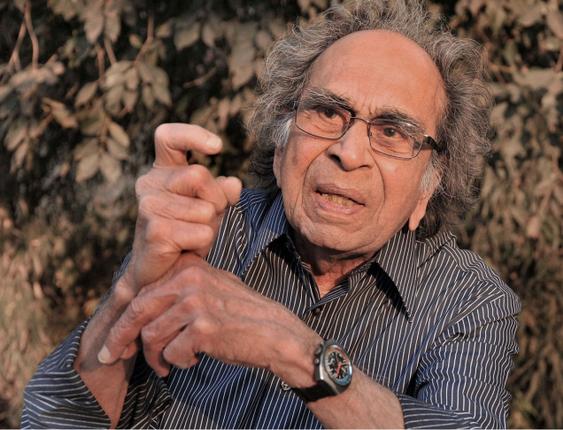
Internationally-renowned mime artist Irshad Panjatam left job at Begumpet airport to follow his dream.— Photo: G. Ramakrishna
Hyderabad, TELANGANA / Berlin, GERMANY :
When 85-year old mime artist Irshad Panjatam was about 18-years-old, he had joined the Begumpet airport as a ground apprentice engineer. Getting such a job back then was perhaps not easy, which is why many at his workplace advised him against quitting, when he took the decision a year after joining.
“I left the job because tightening nuts and bolts, was not what I wanted to do,” recalled Mr. Panjatam, who is in Hyderabad currently. Though he eventually become an artiste, it was not until 1958 that he discovered his true calling in pantomime, which then changed his life and has made him the internationally renowned mime artiste that he is.
Remembering that crucial moment, Mr. Panjatam takes a ride through memory lane during an interview to YUNUS Y. LASANIA .
Excerpts:
How did you get introduced to and develop your skills? Was the art form present in India back then?
I never knew the word pantomime. When I was working with the Hindustani Theatre in New Delhi, I was part of famous Sanskrit play. During rehearsals in the third act, the main actor was not there, so I took stage in his place. Dr. Charles Fabri, a very famous art critic, was present in the rehearsal room.
I started performing, but the musicians were not ready to support me, hence my movements were absolutely silent; without music and without song. Dr. Fabri said it was a very good pantomime act, and then he gave me a book on it. I read the introductory lines and learnt what mime was. It was 1958, and the art form was not present here. I learnt everything on my own.
What was your first performance like? How was the reception to your performances?
I started with short stories like Aesop’s Fables. I showed it to some of my good friends who were also my critics. In 1962, the Indian Arts and Crafts Society, a prestigious organisation of Delhi at that time, put me on stage for my first mime performance. The house was full, and it was well received. After that my friends told me that I was alone here (as an artiste), and that I had to go abroad and perform to know where I stood.
Your first international performance took place in the neighbouring Pakistan. How did that happen?
When I was performing in Delhi, a delegation from the Women’s College in Lahore was present. One of the girls asked me when I was coming to perform in Pakistan, and gave me her college’s address. So my journey began with Pakistan in 1963. I left with Rs.5 in my pocket on the Amritsar Express train, and performed at her college, for which I earned Rs.350 (Pakistani currency).
From there on, I travelled to Afghanistan, Iran, Iraq, Syria, Turkey, Yugoslavia (currently Bosnia and Herzegova, Croatia, Macedonia, Montenegro, Serbia and Slovenia), Germany, France, and Britain, where I had performed. It was always about luck, as I was received well and nobody had has criticised my work.
You settled in Berlin, Germany, and have also acted in German movies. Did you come to India often after you shifted from Hyderabad?
I met my wife Ingrid in Bombay. She had come to India as an Indian art student, and was doing archive work in Uttar Pradesh between 1971/72. We settled in Berlin where I started a school called the ‘Pantomime Workshop of Irshad Panjatan’. I used to visit India once in three or four years.
I closed my school in 1995 after the doctor’s advice to not perform. Later, I started my career in German films, and the one that made me famous is ‘Der Schuh des Manitu (Manitu’s Shoe), which broke all records, as it was viewed about 40 million times. I was doing about one or two movies in a year after that.
How would you describe pantomime is your words?
It is an art of telling a story, experiencing a mood or emotions without resorting to words and only with body movements. I never play with any music or dialogues – I am a pure mime. Silence has power.
My German film ‘Der Schuh des Manitu (Manitu’s Shoe) was viewed about 40 million times
source: http://www.thehindu.com / The Hindu / Home> National> Telangana / by Yunus Y. Lasania / January 05th, 2016
City’s upcoming tennis player Mustafa M. Raja registered his first tournament win of the year 2016 by winning “The Talent’s Cup 2016-17”, 10 years and Under Tennis Tournament held at the Talent Sports Academy, Begur Road, Bengaluru recently.
Mustafa displayed fine form throughout the tournament winning matches with relative ease. Results – Round 1: 6-1, R2: 6-1, Quarter Finals: 6-0, Semi Finals: 6-1 and in the finals he defeated Jason: 4-2, 4-1.
Mustafa studies at Excel Public School and trains with Nagaraj at the Nagaraj Tennis Academy, SJCE campus. He is the son of Murtuza Raja and Farida Raja of Mysuru.
source: http://www.starofmysore.com / Star of Mysore / Home> Sports News / January 11th, 2016
Girls once again roost the rule in Lucknow University’s medal tally, with Samiya Ahmad, MSc Mathematics student sweeping with 12 medals. In the list of 159 medals released by LU on Thursday, 72% winners who will awarded on the convocation ceremony to be held in January end or February first week are in girl’s kitty. There are around 192 medals which will be awarded on the convocation day.
Securing 85.5% in MSc Mathematics, Samiya Ahmad has won the maximum of 12 medals. With 71.9% marks, MA Ancient History topper Arun Kumar will be awarded nine medals. Ajendra Singh. MSc Physics topper Ajendra Singh will be conferred with seven medals. He has secured 77.2% marks in his examinations. Law student Ambika Mehrotra will be awarded six medals for securing 70% marks in her examinations.
source: http://www.timesofindia.indiatimes.com / The Times of India / News Home> City> Lucknow / by Isha Jain, TNN / January 07th, 2015
Exercising its powers under provisions in Section 28(1)(G) of the Karnataka Universities Act 2000, the Karnataka Government has nominated six members to the Syndicate of the University of Mysore (UoM) through a circular issued by In-Charge Principal Secretary to the Department of Education K.L. Subramanya.
Those nominated to the UoM Syndicate are Prof. D. Nanjundaiah, resident of Vijayanagar 2nd Stage, Ln. H. Ramesh, resident of Kestur Koppal in K.R. Nagar taluk, Mohammed Abbas Salam Tanveer, resident of Chamaraja Mohalla, Shruthi Tharun Giri, resident of Yadavagiri , Kumar, retired Principal and a resident of Kuvempunagar and M.S.S. Kumar (Marballi Kumar), resident of Marballi in Mysuru taluk.
Ln. H. Ramesh, who retired after serving as Accounts Officer at KPTCL, is now serving as the Vice-President of the State Unit of KPTCL Employees Union, President of KPTCL Housing Co-operative Society besides serving as the Regional President of Lions Club of Mysore Kuvempunagar.
M.S.S. Kumar (Marballi Kumar), son of former Taluk Board President late M.D. Shivappa, is the General Secretary of Mysore District Congress Committee besides serving the Greater Mysuru Housing Society as its President.
Shruthi Tharun Giri
The only lady nominated to the Syndicate
The only lady nominated to the Syndicate is Shruthi Tharun Giri. She holds a Post Graduate Degree in International Relations from the University of Nottingham, England and has a Bachelors Degree in Political Science from the prestigious Lady Shriram College in New Delhi.
Shruthi Tharun Giri is married to Tharun Giri, Managing Director of Windflower Resorts and Spa, Mysuru.
Shruthi has experience in opening Placement Cells in Colleges and has also helped her husband set up a chain of Ayurvedic Spas, which have gone on to win numerous awards and recognition.
She is also actively involved in local charity organisations with focus on providing education and infrastructure for under privileged women and children.
source: http://www.starofmysore.com / Star of Mysore / Home> General News / Sunday – January 10th, 2016
Two weeks ago, in a quiz designed by Pavan Jha, we had posed a few questions on veteran actor Dilip Kumar to The Hindu readers. As promised, here are the answers:
01. Which Dilip Kumar-starrer was an adaption of Emily Bronte’s classic novel Wuthering Heights? Certain portions of the film were supposedly directed by him without credits.
Dil Diya Dard Liya (1966). The official director was A.R. Kardar.
02. Which film initially had Jayalalithaa cast opposite Dilip Kumar, only for her to be replaced subsequently by another heroine?
B.R. Chopra’s Dastaan (1972). Jayalalithaa was replaced by Bindu.
03. A big star of the ’60s, known for idolising Dilip Kumar and aping his acting style, made his debut playing the uncredited role of Dilip saab’s friend. Who is the star and which Dilip Kumar film is it?
Rajendra Kumar in Jogan (1950).
04. We see Dilip saab shooting for a film in Hrishikesh Mukherjee’s Guddi. Which film is it?
Phir Kab Milogi (1974), which had Dilip Kumar in a guest appearance.
05. A remarkable moment in his career. What’s so special about the occasion? Name the film and its director.
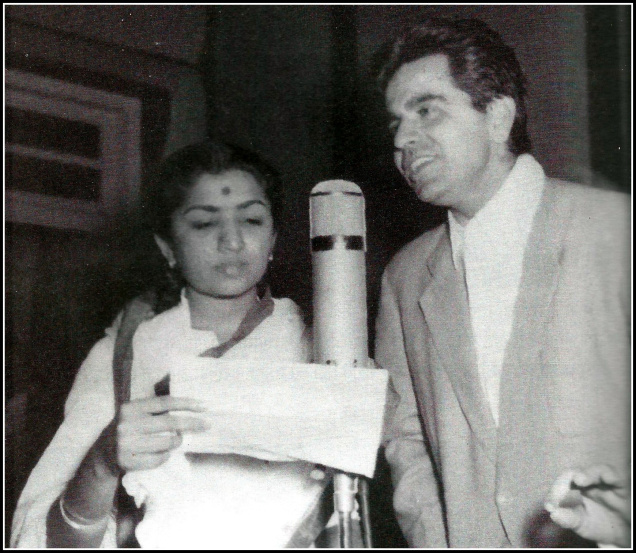
With Lata Mangeshkar at the recording of the song Laagi nahin chhoote ram from Hrishikesh Mukherjee’s Musafir (1957). This was Dilip saab’s only full-fledged attempt at singing in a film
06. In which film produced by Madhubala was Dilip Kumar replaced by Kishore Kumar? All because their personal and professional relationship had taken an ugly turn.
Dhake Ki Malmal (1956).
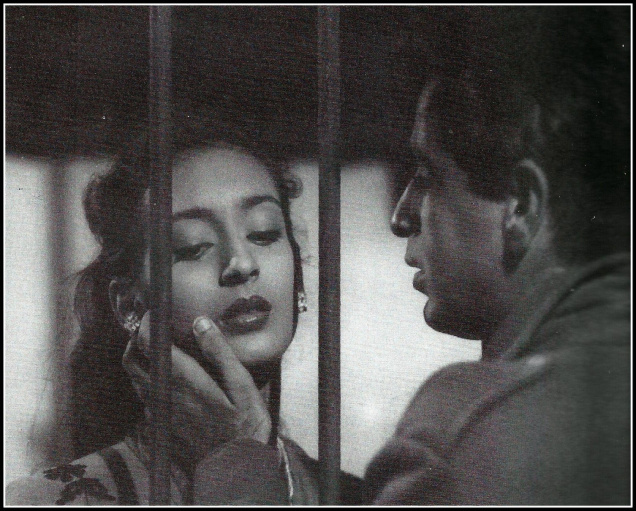
07. Dilip Kumar and Nutan never worked together in their prime, only later in the ’80s. However, there was one film starring them which was shelved in the ’50s. Identify the film.
Ramesh Saigal’s Shikwa (1954). In this shelved film, Dilip saab played an undertrial Army officer.
08. Dilip Kumar’s eldest brother Ayub Sarwar started a film starring him in an unusual title role but it never got completed. Which film is it?
Kala Aadmi
And the winner is…
No one! Most people mistook Gopi (1970) to be the film in which Jayalalithaa had been cast opposite Dilip Kumar. No one got all the answers right. The maximum correct responses were six out of eight and they came from: Seshagiri Row Karry (srkarry@yahoo.com), Unnikrishnan Menon (unnikrishnanmenon8@gmail.com), Sowmya Divyanathan (sowmyadivyanathan1980@gmail.com), Kumar Shashi (kushana007@gmail.com), Smitha V. (smithav1986@yahoo.com), Rajeev (rajeevmarcz@rediffmail.com), Sohrab Alam (sohrabalam15@gmail.com), Dhananjay Jha (desiringdj@gmail.com) and Rajeev Malhotra (gm.finance@mriu.edu.in). Congratulations and better luck with our next quiz.
source: http://www.thehindu.com / The Hindu / Home> Opinion> Comment / January 02nd, 2016
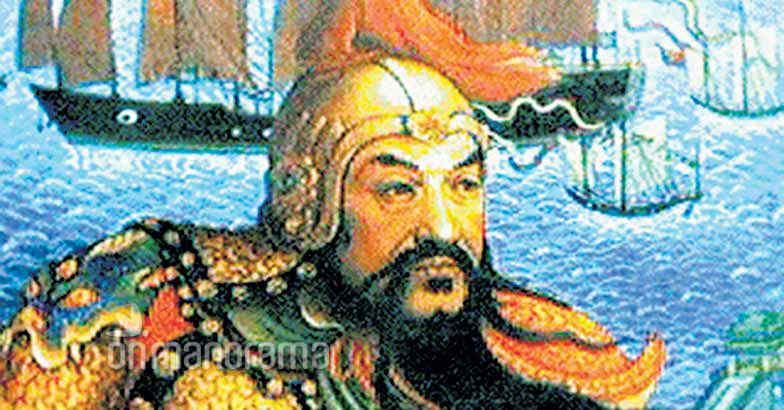
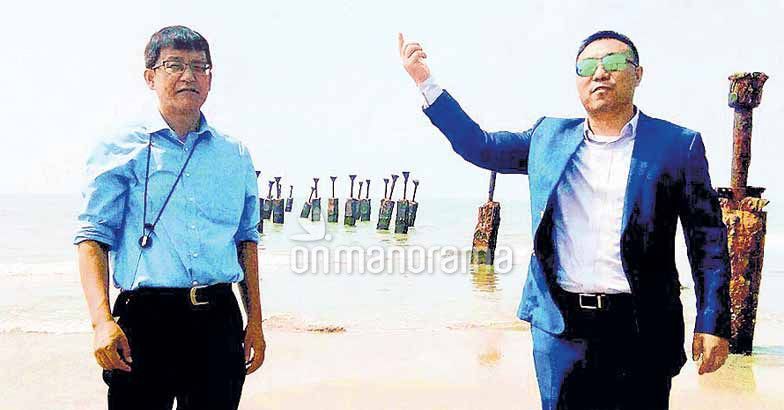
Two Chinese have come to the land of Zamorin to find the final resting place of the Chinese explorer who conquered seas through willpower.
The goal of these researchers is to find the grave and the trading points of Zheng He, the explorer who landed in Kozhikode seven times on ships .
They are professor Haiyun Ma, a Chinese descendant who teaches history at Frostburg State University in the US, and Dr Shaojin Chai, a senior researcher at the UAE’s culture ministry .
Zheng He is a hero in China, where students learn about his adventures. They only know that he died in Kozhikode due to sudden illness. Chinese researchers have come to find out if there is anything in Kozhikode that reminds of him .
A Chinese had been buried at Cheenedath mosque in Valiyangadi. Though the team visited the mosque, they could not find anything specific. Haiyun Ma and Shaojin came to Kozhikode with the help of Abbas Panakkal, a fellow at Griffith University, Australia.
english.manoramonline.com
The man who brought Ma Huan
Zheng He, born in 1371, began his travel at the age of 28. He landed in Kozhikode in 1430 with Chinese silk, vessels, jars and fishing nets. He was received by the Zamorin. He returned to China with spices and other goods many times. Over the period, he brought 2,800 Chinese to Kozhikode. One among them was Ma Huan, a historian. It is said that Zheng He even took elephants and horses from here. It is not clear whether Zheng He, a Muslim, was buried on land or at sea .
source: http://www.english.manoramaonline.com / OnManorama / Home> News> Kerala / by Lenin Chandran / Saturday – January 09th, 2015
The top seeds quelled the challenge of German wildcards Angelique Kerber and Andrea Petkovic 7-5, 6-1 in mere 69 minutes.
Hyderabad, TELANGANA :
Sania Mirza and Martina Hingis carried the dominance of 2015 into the new season, winning their sixth consecutive title by lifting the WTA Brisbane trophy, in Brisbane on Saturday.
The top seeds quelled the challenge of German wildcards Angelique Kerber and Andrea Petkovic 7-5, 6-1 in mere 69 minutes.
Sania and Martina, the world number one team, have now stitched a 26-match winning streak together, which has brought them six titles in a row at the US Open, Guangzhou, Wuhan, Beijing, WTA Finals and now here.
It is the longest winning streak since Italians Sara Errani and Roberta Vinci’s 25 in a row in 2012. Sara and Roberta had won five titles in a row.
The top seeds drew the first blood by breaking the rivals in the second game but the joy was short-lived as Kerber and Petkovic reeled off four straight games to take a 4-2 lead in the opening set.
Sania and Martina though were not perturbed, having defused such situations many times in the last few months.
They went about their business calmly and restored the parity with another break.
Soon it was 4-4 and the Indo-Swiss combination held the ninth game, forcing Kerber and Petkovic to serve under pressure and remain alive in the set. The unseeded team though did not crack and stayed solid to make it 5-5.
Kerber and Petkovic again served at 5-6 to stretch it to a tie-breaker but offered two break chances to Sania and Martina and the top seeds obliged on second to nose ahead.
The top seeds controlled the game better in the second set, racing to a 3-0 lead by breaking their rivals in the second game.
It was a cakewalk for them from there, losing only one game before closing the match in their favour.
source: http://www.thehindu.com / The Hindu / Home> Sport> Tennis / PTI / Brisbane – January 09th, 2016
A senior professor and his student occupy a table at Wazir Hotel, off the busy Mohammed Ali Road at crowded Bhendi Bazaar. Over endless cups of tea the professor, a sort of walking encyclopedia on people he met in the past, reminisces about Wazir Hotel’s heyday when it was a favourite haunt of poets, lyricists, musicians, singers and qawwals. Lyricists like Shakil Badayuni, Sahir Ludhianvi and Majrooh Sultanpuri chatted up the music maestro Naushad even as legendary qawwal Aziz Nazan discussed details of his delightful mehfils. And then the professor orders tea yet again but the waiter places two empty cups on the table announcing that the tea is over and the hotel is downing shutters forever. That was in 1986.
This scene from senior Urdu journalist-playwright Saeed Hameed-penned and Mujeeb Khan-directed play ‘Wazir Hotel’ after the long vanished famous eatery is part of Imambada-based Urdu Markaz’s second Bhendi Bazaar Urdu Festival (Jan 8-10). Aimed to revive that fast fading flavor of an era when shairi thrived and culture flourished, the festival celebrates a spirit which today lives in tales and memories.
Many memories will come alive when television actor Neha Sharad reads letters of Safia Akhtar (poet-lyricist Javed Akhtar’s mother) to her husband Jan Nisar Akhtar while ghazal exponent Pooja Gaitonde sings some of Jan Nisar Akhtar’s famous film songs, including the immensely romantic Main tumhi se poochhti hoon mujhe tumse pyaar kyun hai (Black Cat). “This festival dispels many myths and one of them is that Urdu belongs to Muslims alone,” explains Gaitonde.
“The idea is to tell people what Bhendi Bazaar symbolized and can still offer if earnest efforts are made,” says Zubair Azmi, director of Urdu Markaz and the festival. The festival maintains its “secular” character. So, apart from a mushaira featuring non-Muslim poets of Urdu, a discussion titled “Celebrating Urdu” will see non-Muslim intellectuals like Jnanpith Awardee novelist Bhalchandra Nemade and Sudheendra Kulkarni talk about Urdu’s contributions to our celebrated composite culture. “The festival is fast becoming a platform to showcase Bhendi Bazaar’s cultural ethos and promote communal harmony,” says local MLA Amin Patel. While admitting Patel’s “critical facilitation” to host the fest, Azmi agrees with him that the fest needs to be held on a larger scale.
It is not the old-timers alone who will get their antennae recharged through a medley of plays, soirees and singing of Sufi kalams and old Bollywood numbers, but even the young and restless can look forward to fun-filled sessions. “Workshops on drama, fiction, scriptwriting and poetry will engage college students to learning the finer points of these arts,” informs the festival’s reception committee chairman Farid Khan.
source: http://www.timesofindia.indiatimes.com / The Times of India / News Home> City> Mumbai / by Mohammed Wajihuddin / January 03rd, 2016
Javeed Ahmed, a 1984 batch Indian Police Service officer, was appointed DGP after Jagmohan Yadav retired on December 31. (Photo: @ANI_news Twitter handle)
Lucknow, UTTAR PRADESH / Patna, BIHAR :
Javeed Ahmed, a 1984 batch Indian Police Service officer, was on Friday appointed as the director general of police by the Uttar Pradesh government.
Ahmed, who had earlier served as the joint director of the Central Bureau of Investigation during central deputation, was serving as the director general (railways). The post fell vacant after Jagmohan Yadav retired on Thursday.
State principal secretary (home) Debashish Panda said Ahmed will take the charge on Friday.
There was a race among IPS officers for the top post after Yadav’s retirement. The officers played all the cards – caste, religion, loyalty to the ruling party, experience as well as closeness to the family members of the ruling Yadav family – to outdo each other for the coveted post.
No consensus could be reached even after several rounds of meetings. Suspense continued till late on Thursday night as home department officers remained in the office awaiting finalisation of the new DGP.
Sources said since chief minister Akhilesh Yadav was at his native village Safai, it was decided that the name of the new DGP will be announced on Friday.
source: http://www.hindustantimes.com / Hindustan Times / HT Correspondent, Lucknow / January 01st, 2015