All posts by mpositiveone@gmail.com

Love, loss and longing: The journey of a Princess

Hyderabad, ANDHRA PRADESH (present TELANGANA) :

PrincessNilouferMPOs08jan2016

Princess Niloufer, the beloved daughter-in-law of the last Nizam of Hyderabad, may have left the city shortly after the Police Action in 1948. But even a good six decades later, she continues to be an enigma that at once intrigues and haunts Hyderabadis. On her centenary year, even as a photo exhibition by Birad Rajaram Yagnik attempts to reveal unknown vignettes of her life, and a documentary film on her is being worked on by historian Arvind Acharya, Hyderabad Times looks back at the dramatic life of the much loved princess of the city of Pearls. Surely, it was nothing short of a movie!

A fairytale set in 19th Century

When Niloufer Farhat Begum Sahiba was born in Istanbul, in January 1916, the Ottoman Empire was already fast crumbling. When she was barely a toddler, the Ottoman surrender was formalised aboard a British warship (October 1918). And by the time she was seven, the 700 year-old empire had officially fallen. In the backdrop of this downfall, the princess had to leave her fairytale life in Istanbul behind, and move to France with her mother in 1924, never to return. aged eight at that time, Niloufer would go on to lead a very ordinary life, learning to read and write French along with Urdu. Her exercise books had her learning about geography of the world. she stuck bits and pieces of the map in separate pages, oblivious to what the future held for her — a future where she would be remembered as the beloved princess of three cities. And yet, hold reign over none.

The romance with Hyderabad

Cut to 1931. In Hyderabad, Mir Osman Ali Khan, the seventh Nizam — also the world’s richest man — was looking for suitable brides for his sons. And that’s how Niloufer, just 15, found herself in Hyderabad. In a grand, royal wedding held in Nice in November 1931, Niloufer married Moazzam Jah, the Nizam’s younger son.

The Nizam had chosen Durru Shehvar (Niloufer’s first cousin) for his elder son — so the shift to a foreign land was less daunting perhaps. Another reason that made Hyderabad feel like home was that the Princess found a father figure in the Nizam. Though known to be officious and keen on protocol otherwise, the Nizam considered Niloufer his daughter. He even let her call him ‘father’. Life in the Hill Fort Palace was grand, Hyderabad was at its cultural peak, and the Princess took on many avatars — fashionista, socialite, philanthropist.

The sartorial queen

Between 1933 and 1948, Niloufer became a fashionista through whom the world got acquainted with Hyderabad. Her sarees, her choice of jewellery, her lifestyle became a talking point. Photographers, especially a crafty portrait photographer, Antony Beauchamp, loved her easy beauty. the international press adored her. Niloufer is credited with adding Parisian grace to the Indian saree. Her sarees were crafted specially for her, by Madhav Das in Mumbai. She loved chiffons and crepes, and wore them often with a broad woven Banaras brocade border. In fact, Mme. Fernande Cecithe, who was originally hired as a midwife for the princess, later created excellent designs to be embroidered on her sarees too. Her wardrobe is still studied by fashion students across the globe and her collection of sarees are now treasured at the New York Institute of Fashion Technology.

The socialite princess with a golden heart

One of the very prominent facets of Niloufer’s social life was the Lady Hydari Club, through which she also initiatied events and dos to raise funds. In 1941, Niloufer decided to organise the staging of a play Ondine (by dramatist Jean Giraudoux) to raise funds for London, which was recuperating from the damages of World War II. She was told by her father-in-law that a princess must not be seen acting in a play. So, her secretary at that time, Fatima Ghani, who would accompany her all the time and therefore even knew the dialogues, took on the princess’ role of a knight-errant Hans von Wittenstein zu Wittenstein.

But it wasn’t until 1949, that Niloufer’s biggest contribution to Hyderabad was going to emerge. When her maid, Rafath Unnisa Begum, died in childbirth, she was so shattered that she decided to ensure that no more such deaths take place. she decided to set up a maternity hospital, which stands today as Niloufer Hospital in Nampally.

The truth behind the glamourous veneer

She was one of the most beautiful women of her time. She was a much loved princess, both at home and overseas. But Niloufer had long learned that the glamour of all this was just that — an eyewash at best. At the heart of it all, there was pain and emptiness. She spent her best years in Hyderabad, craving to experience motherhood — a desire that was never fulfilled.

By this time, Niloufer had already witnessed her first cousin Durru Shehvar give birth to two sons, Prince Mukarram Jah in 1933 and Prince Muffakham Jah in 1939. Her childlessness put much strain on her marriage. In 1948, Moazzam took a second wife, Razia Begum. And by 1951, Niloufer had decided to split from her Hyderabadi commitments.

She moved back to France with her mother. Nice, back then had many members of royalty in exile, allowing Niloufer to still be socially active. As she aged gracefully, her photos from the era show her wearing the string of pearls that her mother had gifted her at birth.

However, irrespective of where she was based, Niloufer never severed her Indian ties. Her friendship with Jawharlal Nehru was one such connection. One of her letters following the assassination of Gandhi read: “Dear Pandit, You have heard and read the cry of so many millions of hearts — you have felt perhaps more than anyone else that great silence that set the void and the loneliness after he (Gandhi) was no more”. The duo continued to stay in touch, Niloufer wrote to Nehru even during the elections and Nehru who was on the road canvasing for the polls, replied, “But I want to tell you that you will always be welcome here whenever you care to come.”

Finding love again
After a good 11 years of being single, Niloufer met Edward Pope and found love once again. In February 1964, she married Pope in the presence of Nawab Ali Yawar Jung who was the Best Man.

Niloufer died in 1989 and was buried in a grave in Bobigny near Paris. The Muslims-only cemetery that is a two-hour drive from Paris not only has her mother resting there, but also all the members of her Seljuk dynasty. Surely, a life as romantic, as magnanimous, and as dramatic as Niloufer’s, deserves to be immortalised.

source: http://www.timesofindia.indiatimes.com / The Times of India / News Home> City> Hyderabad / by Samyuktha K, TNN / January 06th, 2015

MDFA ‘B’ Division Football : Hat-Trick by Arbaz Khan

Mysuru, KARNATAKA :

Inspiring play by right-out Arbaz Khan, who scored a hat-trick (29th, 50th & 56th) and a goal each by Imran (second minute), Toufeeq (55th) and Usman (69th), helped Lion FC to register facile 6-3 win over Ganesha FC and top Group ‘A’ with 14 points (4 wins & 2 draws) and qualified for the super-league stage in the MDFA ‘B’ Division league for the Govindaraju Memorial Trophy played at the University Grounds here yesterday.

Arbaz Khan continued his fine run in the ‘B’ Division matches and scored his third successive hat-trick in the tournament.

Left-out Amudo scored a brace (4th & 65th), while Yogi (48th) scored the other goal Ganesha FC, who also completed their league engagements with 13 points (4 wins, 1 draw and 1 loss) and finished runner-up in the group.

Asher of Lion FC committed two fouls in the 34th & 55th minutes of the games and received two yellow cards and cannot play the next game for his team.

source: http://www.starofmysore.com / Star of Mysore / Home> Sports News / January 07th, 2015

KSCA Mysore Zone M. Gopalaswamy Memorial Cricket Tourney : Fahad Shines in Vidyaranya CC’s Win

Mysuru, KARNATAKA :

A well compiled century by left-handed opener V.K. Fahad (104, 4x6s, 6x6s) and useful contributions from Kiran (87), K. Dilip (65) and Syed Zain (61) helped Vidyaranya CC to register a big 216-run win over Jawahars CC in the first round of the KSCA Mysore Zone Sri M. Gopalaswamy Memorial cricket tourney tie played at the Maharaja’s College grounds here on Wednesday.

Batting first, Vidyaranya CC scored 386 for six in 50 overs. In reply, Jawahars CC were restricted to 170 for seven in 50 overs. Faizan (67 n.o.) and Md. Ahmed Sherif (36) were the scorers. Medium-pacer M.G. Naveen took two for 34 for Vidyaranya CC.

Scores

Vidyaranya CC: 386 for 6 in 50 overs (V.K. Fahad 104, Kiran 87, K. Dilip 65, Syed Zain 61, Raghu 2 for 72, Keteshwar 2 for 78) bt Jawahars CC: 170 for 7 in 50 overs (Faizan 67 n.o., Md. Ahmed Sherif 36, M.G. Naveen 2 for 34).

source: http://www.starofmysore.com / Star of Mysore / Home> Sports News / January 07th, 2015

Dharun shatters hurdles record

A. Dharun
A. Dharun

TAMIL NADU :

Mangalore University’s A. Dharun broke the men’s 400m hurdles record as he won his second gold at the 76th National inter-university athletics championship at Patiala on Friday. The 19-year-old Tamil Nadu-born Dharun had won the 400m flat on Thursday.

Meanwhile, Bharathiar’s University international Mohammed Salahuddin, son of former international Mohammed Nizamuddin, won the men’s triple jump gold while Mangalore’s K.A. Bharath and Lucknow’s Vijay Laxmi took the men’s and women’s 800m title.

The results: Men: 800m: 1. K.A. Bharath (Mangalore) 1:53.42s, 2. Anand K. Madhu (MGU, Ktm) 1:53.77, 3. Vellayatthevan (Madras) 1:53.83.400m hurdles: 1. A. Dharun (Mangalore) 51.34m NMR, OR 51.51; 2. Jasdeep Singh (Punjabi, Pat.) 52.63,  E. Anees Rahman (MGU, Kt3. Mm) 53.58.E. 

Triple jump: 1. S.N. Mohammed Salahuddin (Bharathiar, Cbe) 15.76m, 2. S. Unais (MGU, Ktm) 15.69, 3. N. Abdulla Aboobacker (MGU, Ktm) 15.56. Javelin: 1. Neeraj Chopra (Punjab, Chd) 79.95m, 2. Ganesh Pathak (Rajiv Gandhi, Bhopal) 75.37m, 3. Ajay Kumar (Punjabi, Pat.) 73.61.

Women: 800m: 1. Vijay Laxmi (Lucknow) 2:09.15s, 2. Shipra Sarkar (Calcutta) 2:09.99, 3. K. Priya (Madras) 2:12.83.

400m hurdles: 1. Veerpal Kaur (Punjabi, Pat.) 1:01.88s, 2. M. Loganayaki (Periyar, Salem) 1:02.31, 3. Jerin Joseph (MGU, Ktm) 1:02.52.

5000m walk: 1. Priyanka (Punjabi, Pat.) 23:28.19s, 2. Bhawna Jat (Mohanlal Sukhadia, Udpr) 24:38.65, 3. K. Mary Margaret (MGU, Ktm) 24:44.83.

Heptathlon: 1. Swapna Barman (Calcutta) 5302 pts, 2. Sowmiya (Madras) 4656, 3. Anila Jose (MGU) 4535.

source:  http://www.thehindu.com / The Hindu / Home> Sport> Other Sports / Kochi – January 02nd, 2016

Rhythm divine

Kolkata, WEST BENGAL &  UTTAR PRADESH :

At the age of 104, Ustad Abdul Rashid Khan continues to enthral music lovers across the country with his vocal stamina, virtuosity and lyricism.Vandana Shukla has the honour of meeting the maestro

UstadRashidKhanMPOs01jan2015

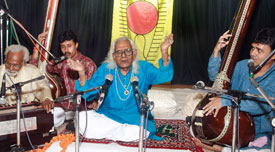
As he is brought to the stage, resplendent in silk kurtaadorned with gold chains, the audience gapes. His age alone makes him a phenomenon worth watching. By the end of his 90-minute recital, they are awestruck—Ustad Abdul Rashid Khan’s gamak taan can make a 25 year-old sulk for want of stamina. But there is no arrogance, only a childlike simplicity when the 104 year-old Ustad removes his black topi and shows us a layer of black hair sprouting from beneath his glorious silver. We wonder about his teeth; after a 100 years, the teeth are said to reappear as well. “The new ones will come only when the old ones fall,” chirps his grandson Bilal Khan, who accompanies him on the tabla.

A direct descendant and proponent of the third son of Miyan Tansen, Surat Sen, Ustad Abdul Rashid Khan sings like autumn leaves surrendered to the winds—in complete abandon. Sitting cross-legged while rendering Puriya Dhanashree, his arms spread like wings, releasing permutations of notes that even connoisseurs find hard to keep track of, floating across labyrinthine octaves. Those who came to the show to satisfy their curiosity about his age now find themselves impelled to stay mesmerised by his artistry. “He enjoys God’s blessings,” says eminent vocalist Pandit Ulhas Kashalkar. “Most vocalists can’t sing beyond the age of 80 years but he still sings with so much power.”

Ustad Abdul Rashid Khan has no concrete answers to offer on his longevity or mastery over music. All he allows us is a glimpse of an amazing mind and soul that live in complete surrender to the Almighty. He is creative like a child, energetic like a young man, and wise like a wizard. Two years ago, while arriving for a concert in Brindavan, he found people greeting each other with ‘Radhe Radhe’. He didn’t have any compositions using the term Radhe, though there were many with references to Krishna. Within 10 minutes of the drive that took him from the hotel to the concert hall, he composed two beautiful bandish.

The amazing vigour that defines Ustad Abdul Rashid Khan's voice is as remarkable as his mesmerising control over complex notes
The amazing vigour that defines
Ustad Abdul Rashid Khan’s voice is as remarkable
as his mesmerising control over complex notes

He still travels extensively, his concert tours sometimes running for a month at a stretch. We meet him in Chandigarh a day after he has performed at Kamani Auditorium in Delhi; the day before that, he was in Lucknow. In the days ahead, he will go back to Delhi for two consecutive concerts, and then to Varanasi and Allahabad. He attempts an explanation: “When I sing, only God is with me, I do not see anything; I do not do anything; everything is done by Allah!” His faith in the divine was reinforced many years ago. “I was close to
50 when I was given mercury in my food at Khagra in West Bengal,” he recounts. “In those days, when two artists engaged in a duel; one had to lose. The person who lost poisoned me out of envy. I lost my fingers and toes; how my vocal cords were spared was a miracle. I live so that I can sing, and it is His will.”

Ustad refuses to dwell upon what has been lost. “I don’t take any medication. I have only heard of older, and younger, people suffering from diabetes and high blood pressure,” he says with a chuckle. Still, he is a stickler for his routine—he doesn’t eat lunch because it interferes with his namaaz. He compensates with a good breakfast and dinner, which includes chicken, meat and a sweet, preferably rasmalai or gulab jamun.

His appetite for rhythm and rhyme is equally hearty. Gifted with a natural mastery over words—he has penned thousands of verses and compositions under the pen name Rasan Piya—Ford Foundation and ITC Sangeet Research Academy (ITCSRA) have recorded about 2,000 of his compositions for their archives. In the view of Ustad Mashkoor Ali Khan of the Kirana gharana, it is these recordings that enabled the world to learn about Ustad’s talent. “Once people heard him in Kolkata, they realised what a reservoir of knowledge he has,” he says. “It was then that ITCSRA decided to invite him to Kolkata. He has produced many shagird. He is an amazing vocalist; for his age it is no less than a miracle. This apart, he is an extraordinary composer.”

How many of his compositions does the Ustad remember? “Arre baap re!” he chortles. “I don’t remember anything. I just remember Allah.” Hundreds of bandish were, in fact, chewed by a goat, Bilal tells us teasingly and adds, “People plagiarise his compositions; somebody earned thousands of dollars by fusing his Bhairavi composition with French music, and recently I heard a group from Pakistan sing his composition as their own.” With his characteristically naughty smile, Ustad dismisses Bilal and says, “Let them steal; I will compose 10 new ones. Why should I feel sad over such triviality?”

As a child, he was forced by his father to leave kushti (wrestling), his great passion, fearing he might pull a muscle in the neck that might affect his vocal cords. “I had to leave akhada, I could not disobey,” he says. “He was my father and guru. In those days, discipline was foremost and so was obedience. My grandfather Ustad Bade Yusuf Khan was given the stage after 22 years of taleem. We were made to see that each raga had a personality, and you could not disrespect it by hurting its character, by singing it at a wrong time and season.” Those roots continue to nourish him. “Music has been my life and it has given me everything,” he says with candour. “Bismillah Khan, whom I revere, once asked violinist Dr M Rajam, who was heading the music department at Benaras Hindu University, to wait till he arrived. He wanted to hear my concert.” This is something he misses today, the paucity of good listeners who truly appreciated the value of music.

Does he, then, worry that the tradition is being diluted? “No,” he replies firmly. “There are organisations like ITCSRA, Devi Foundation and SPICMACAY [Society for the Promotion of Indian Classical Music and Culture Among Youth] that are doing a lot to save this tradition.” Part of this effort is to embrace change. For instance, girls were not taught music in his gharana—he deprived his own daughters of musical training—and his sons grew up to become contractors. But today, Ustad is proud of his female disciples, who include Rupali Kulkarni, Pampa Banerjee and Shashi Tripathi. “I was nine when Baba started teaching me,” recalls Kulkarni, a station director with Vividh Bharati. “He was as loving as a father while being an exacting teacher. He would get mejalebi, yet lay a lot of emphasis on varjish [exercise], telling me that controlling one’s breath and singing require a lot of stamina. He composed such difficult yet beautiful compositions for me.”

Ustad’s grandson Asad Ali Khan is equally fulsome in his praise—he is the only grandchild that Ustad has trained vocally and lives and travels with him, like Bilal. “In my opinion, there is no teacher in India more knowledgeable than Baba,” he says in a tone that borders on reverence. “He is my Baba; at the same time, he is the best teacher one could have. He never gave me special treatment and treated me like any other disciple. He never loses his temper, yet he makes us do what he wants. He is also fun to be with.”

Ustad too revels in the company of his disciples, particularly when they tour together for concerts. He speaks to them well into the night, not letting them sleep! “Why waste the night sleeping when there is so much to say and sing?” he wonders. When he is not on the road, he teaches music at Kolkata ITCSRA from 11 am to 4 pm. Ustad’s memory remains as active as the maestro himself. He still remembers all his students (past and present), the names of his 15 grandchildren, who all live in Rae Bareilly, and all the dates and places of significance to his life. He is reticent, though, on the subject of his wife—he lost her when his children were young and he appears to have drawn a gentle veil over that chapter. Indeed, setbacks or successes, the Ustad has handled them all with consummate dignity—and faith. As he tells us, “Himmat… sirf himmat se hi safar tay hota hai, aur himmat voh deta hai. (Only courage takes you along, and courage comes with His grace).

Featured in Harmony Magazine
December 2010

source: http://www.harmonyindia.org / Harmony India.org /  Home> H People> Diary 100 / Featured in Harmony – Celebrate Age magazine,  December 2010

A 110 year-old doctor

Kolkata, WEST BENGAL :

Repository of the ancient wisdom of Unani medicine, 110 year-old Syed Mohammed Sharfuddin Quadri lives a Spartan and frugal life that has worked wonders for him, as Partha Mukherjee discovers

DrSharfuddinMPOs01jan2016

Almost 55 years ago, while I was journeying through a field in a cart, I caught sight of an old towering neem tree, immersed in soundless symphony with a swarm of fireflies. Barely five years old then, I didn’t know that the silhouette of a tree in hushed twilight silence would be a metaphor for a man around whom the sparkle of life never dims, even when ‘night’ tiptoes into his life.

Syed Mohammed Sharfuddin Quadri is famous for treating India’s first president Rajendra Prasad in Gaya in 1942-43 for breathlessness. Fondly known as Hakim saab, he has a photographic memory, sense of humour, never-say-die spirit and, above all, energy that never runs out. On 25 December 2011, he will turn 110. Yet he works for 17 hours at a stretch, preparing concoctions from dry fruits, herbs and roots and advising close to 100 patients (free of cost) every day. At 5 pm, every day through the year, Hakim saab attends to his patients at his Wellesley Square clinic in central Kolkata as well as those in the US. “Abba has patients all over America,” says his 40 year-old son Mohammed Sadique, who assists Quadri in his clinic. “He gives instructions to them over email or through a video conference. Earlier, he used to go to California, Los Angeles and New York, but now he’s restricted because of his gout.”

Sharfuddin Quadri answers all questions, except those about his achievements. Founder of the Unani Medical College and Hospital in Kolkata, Quadri published a magazine titled Hikmat-e-Bangala (Hikmat means Unani medicine) in 1959, which folded up soon for lack of funds. “Success means how much one has been able to help others,” he says, adding that he does honour the Padma Bhushan he was awarded by the President in 2007. He brings out the medal attached to his pocket by a silk ribbon. “I carry it to show my respect to the recognition of Unani treatment. Though I would be happier if I were given a grant so I could at least cover the place with a shed where my patients wait.” Indeed, patients wait for him for hours, sometimes till midnight, even in the rains. “There is no help from the government to collect herbs at a reasonable price,” adds Mohammed Sadique, Quadri’s youngest son (he has six siblings) who assists his father. “Sometime Abba is so frustrated that he thinks of giving up. If medicines aren’t available what is the use of continuing the treatment?”

From a family of hakim in the remote village of Kumrava in Nawada district of Bihar, Quadri trained in Unani treatment from Shafakhana Darsgah Tibbia (Gaya) in 1930. After immersing himself in the freedom movement, he started his practice in Calcutta where his family shifted in 1935-36. “Herbal medicines have a magical effect on our body; besides they have no side-effects,” he says sipping neem juice. If diagnosed, every disease responds to Unani treatment, Quadri claims, adding that with medication one must strictly follow instructions on diet and lifestyle as well. “During the diagnosis, one has to study the dam [blood], balgham [phlegm], safra[yellow bile], and sauda [black bile] of the patient [just like kapha, vata and pitta, the three dosha in Ayurveda], as they are the roots of all diseases,” he explains. “Anyone with any sort of ailment definitely has an abnormality in one of these.”

DrSharfuddinMPOs02jan2016

As for his own frugal diet—neem juice and half a piece of bread—he says, “The less you eat the more you live; the more you eat, the more you court ailments and health hazards. And to lead a healthy life you should have a healthy mind. My father lived to be 122 and never allowed any ignoble thought to cross his mind.”

How does he keep himself so physically fit even at 110? “I never sleep at night; I read books on Unani medicine when others are fast asleep. In the calm of the night, I try to explore things I don’t know about and let them melt into my inner self.” Unani medicine, he says, actually has its roots in Greece following extensive research by Hippocrates (460-377 BC). “It was he who laid the foundation of clinical medicine based on diet and symptoms.” He adds that a number of Greek scholars after Hippocrates—Galen (131-200 AD) followed by Arab physicians Rhazes (850-932 AD) and Avicenna (980-1037 AD)—enriched the system considerably. Rhazes and Avicenna authored Al-Hawi and Al-Qanun respectively, which were later translated into Latin and other European languages and taught in medieval European universities. They are said to have influenced western medical thought.

Unani medicine disappeared from the country of its origin, but found roots in India through Arab traders long before the Mughals. The Khiljis, Tughlaqs and Mughal emperors provided state patronage to Unani scholars and employed many as court physicians. The British imposed strict restrictions on every form of treatment but allopathy. Despite suspension of aid to Unani institutions, the system survived owing to the commitment ofhakim like Ajmal Khan, who served as the president of Indian National Congress in 1921—the Unani physician and scholar founded the Ayurvedic and Unani Medical College in Delhi.

Quadri reads till 4 am, when the city wakes up to fight for the day. “After my daily ablutions, I go to the mosque for namaz which involves many a yogic mudra—I do each of them,” he shares. “I walk back home at 5 am and sleep till 9, after which I go to my clinic. There’s no time to waste till 5 pm, when I go to the clinic, which I believe is the key to my fitness.”

Sharfuddin Quadri thanks his health for having been witness to an eventful century. The Dandi March with Mahatma Gandhi, confinement in Cuttack Jail and a memorable encounter with Maulana Abul Kalam Azad. “In 1943-44, in Ramgarh—then in Hazaribagh and now in Jharkhand—Maulana Azad was addressing the people and suddenly the skies opened up in a heavy downpur making everyone rush for sheds. Azad roared, ‘You are so scared of raindrops, what will happen when the British will rain bombs and bullets on you?’ And then no one moved even an inch.”

Finding his shadow lengthen by the day, Sharfuddin Quadri remembers Rabindranath Tagore through his lines and a brief meeting in 1912: Moron jedin diner seshe asbe tomar duare/sedin tumi kee dhan debe uhare?(When Death will knock at your door at the end of the day/What will you offer him as a gift?) “I wonder what I will be ready with to welcome the inevitable,” he signs off.

Featured in Harmony – Celebrate Age Magazine
July 2011

source: http://www.harmonyindia.org / Harmony India.org /  Home> H People> Diary 100 / Featured in Harmony – Celebrate Age magazine, July 2011

Alleging ‘victimisation’, Dalit IAS officer applies for VRS, converts to Islam

Jaipur, RAJASTHAN :

RSRTC Chairperson Umrao Salodiya at press confrence where announced his decision to convert to Islam and apply for VRS from service, in Jaipur on Thursday. Photo: Rohit Jain Paras / The Hindu

After being denied the promotion that would make him the State’s Chief Secretary, senior IAS officer Umrao Salodia, a 1978 batch IAS officer from the Dalit community, on Thursday, appealed to Chief Minister Vasundhara Raje for Voluntary Retirement. Mr. Salodia, who alleged the Raje government of “victimising him on the basis of caste” also converted to Islam, on Thursday.

In a letter addressed to Ms. Raje, Mr. Salodia wrote: “For the first time after independence of the country, myself, an IAS officer from the SC/ST category would have been appointed today [on Thursday] as Chief Secretary [of Rajasthan] on the basis of seniority.”

In the letter, Mr. Salodia alleged that the current Chief Secretary C.S. Rajan was given a three-month extension, till March next year, to deny him the opportunity of becoming Rajasthan’s Chief Secretary.

“I hereby apply for Voluntary Retirement by giving a three-month notice under the All India Service Rules,” Mr. Salodia stated in the letter, adding that he must be granted the Voluntary Retirement as he did not wish to work under a junior officer.

In another drastic step, Mr. Salodia converted to Islam, on Thursday. While addressing the media he said that he believed in the equality that Islam, unlike Hinduism which discriminates on the basis of caste, offered to all its followers. “After conversion my name is Umrao Khan,” he said.

BJP dismisses claims

Rajasthan Parliamentary Affairs Minister Rajendra Rathore dismissed Mr Salodia’s claims. Addressing the media, on Thursday, Mr Rathore said that Mr Salodia had acted in violation of the law as he spoke against the government. “Mr Salodia’s allegations are baseless. Had the government discriminated on the basis of caste, the Rajasthan Assembly Speaker [Kailash Meghwal] would not be from the SC/ST community.”

“The government will get the matter investigated and will take a disciplinary action against Mr Salodia based on the results of the investigation,” Mr. Rathore said.

Congress condemns BJP govt

Condemning the Bharatiya Janata Party government in Rajasthan for “acts of discrimination against the Dalits”, Rajasthan Pradesh Congress Committee president Sachin Pilot said, “Mr Salodia’s appeal for Voluntary Retirement has put the working of the BJP government [in Rajasthan] under question. Also, it is tragic that the indifference of the BJP government led the senior officer to convert to Islam.”

Mr. Pilot added that Mr Salodia’s reaction is an expression of the increasing acts of discrimination against the Dalits in the State.

Mr Salodia, a 1978 batch IAS officer from Rajasthan cadre, is the Chairman of Rajasthan State Road Transport Corporation (RSRTC).

source:  http://www.thehindu.com / The Hindu / Home> National> Other States / by Kavita Upadhayay / Jaipur – December 31st, 2015

The spinner’s end

djHassanMPOs01jan2016

Bangalore , KARNATAKA :

DJ Hassan has been spinning magic since 2008. A remixer, producer, harmony-arranger and DJ trainer since seven years, Hassan has mastered his music in genres like house and electro Bollywood.

Though he started his journey by learning to spin hip-hop tracks, he is now devoting his time completely to Bollywood. A common name at club gigs and private events, DJ Hassan is known for belting out chartbusters and has his aces up his sleeve from ‘Desi Girl’ to ‘Dabangg’.

He is also a feted DJ internationally, in many places including Doha, Dubai and Sri Lanka.

How did 2015 treat you in the realm of music?
It was a great year for me. I went places and played all across the country. I mainly played at major parties. My biggest event was playing at a private party, where about 3000 people enjoyed the tunes that I spun.

What are you looking forward to in 2016?
All my shows. I plan everything two months in advance so I know that in the end, it will turn out great.

What’s the scenario like for young DJs entering the scene?
The younger lot have to struggle for about four years to survive in the market. Only then, they can establish themselves. Most people think that they can get by in DJing with high-end laptops and expensive mixers but without talent and hard work, they won’t be able to make a name for themselves in the industry.

Comment on the music scene in the City.
There is a lot of space to co-exist. People are extremely open-minded about classical, fusion, Western and Bollywood in Bengaluru.

There are also newer genres coming up by the day as youngsters listen to different kinds of music, travel more and are aware of world music. The crowd is the ‘shuffling’ sorts, who don’t stay in one place and have different influences in music, which is good for musicians and bands to experiment.

Álthough you started with hip-hop tracks and then moved to Bollywood, you are often considered as a Bollywood DJ. What is it that connects you to Bollywood music?
The sheer universality of the genre. It has a certain depth and is a genre that will stay on. At the end of the day, everyone wants to go back home and listen to Bollywood music.

The future of the DJ industry?
The youngsters are spoiling the market by accepting small-budget shows. They also don’t know how to attract the crowd in this industry. They should learn to stay true to themselves and their talent.

Your plans for the New Year?
I’m welcoming 2016 by playing an exclusive set on December 31 at Sutra, Lalit Ashok.

Any New Year resolutions?
I will get to know only in 2016.

source:  http://www.deccanherald.com / Deccan Herald / Home> Supplements> MetroLife / by Anushka Sivakumar, DHNS / December 31st, 2015

117 Muslim meritorious students from across India felicitated, AFMI Bhopal convention concludes

Bhopal,  MADHYA PRADESH :

[Topper meritorious students with their medals, Certificates of Excellence and scholarship cheques posing with MP Chief Minister and other dignitaries]
[Topper meritorious students with their medals, Certificates of Excellence and scholarship cheques posing with MP Chief Minister and other dignitaries]
Bhopal:

Madhya Pradesh Chief Minister Shivraj Singh Chouhan seeing in flesh and blood the rich crop of talent in Muslims on parade when meritorious students from all over India, which had amongst them a 100 per cent achiever in Higher Secondary Board examination, were being felicitated was so much overwhelmed and elated that when addressing the gathering he expressed his delight and pleasure in an unambiguous manner.

Chief Minister Chouhan, who was floored at the spectacle of overflowing talent in Muslim students, spontaneously announced Rs.10,000/- each honorarium for all the 117 meritorious students in the country who were to be feted by AFMI (American Federation of Muslims of Indian Origin).

The occasion was the inaugural function on the opening day of the two-day 24th International Convention on Education and Gala Award Programme of AFMI (American Federation of Muslims of Indian Origin), which concluded here on December 27, 2015 in the central Indian state capital Bhopal, in the walled city at Four Seasons Lawn, Ahmadabad Palace.

The 2-day convention on December 26-27 was held under the aegis of Association of Indian Muslims (AIM) Bhopal. Next year it will be the Silver Jubilee celebrations of AFMI and the 25th International Convention on Education and Gala Award Programme would be held in New Delhi in the last week of December 2016.

100 pc Achiever Saima Rasheed
Amongst the meritorious students was Saima Rasheed, with unique achievement of having garnered 100 per cent marks in Std. XII in Punjab Higher Secondary Board examination 2015. The topper, who aspires to become an IAS officer, was the cynosure of all eyes at the felicitation programme. She gave all credit to her parents and teachers who guided her to achieve this great success. She received a gold medal, Certificate of Excellence and a special cheque of Rs.10,000/ on the occasion to a thunderous applause.

The AFMI had selected 117 talented students for felicitation during the two day convention from 22 states viz. Andhra Pradesh, Uttar Pradesh, Punjab, New Delhi, Gujarat, Odisha, Telangana, Tamil Nadu, West Bengal, Maharashtra, Rajasthan, Chhattisgarh, Jharkhand, Assam, Bihar, Kerala, Karnataka, Jammu-Kashmir, Manipur, Uttarakhand, Haryana and Madhya Pradesh. All the students were honoured with gold, silver and bronze medals along with Certificate of Excellence and scholarships as per their performance in the X and XII Board examinations.

Local MLA Syed Arif Aqeel, Vice Chancellor of Bhoj Open University Dr. Tariq Zafar, former Vice Chancellor of Aligarh Muslim University Padma Shri Dr. Mahmood-ur-Rehman (IAS retd.), convocation’s Chairman Owais Arab, parents of meritorious students and distinguished citizens attended the function. While the Chancellor of Maulana Azad National Urdu University, (MANUU) Zafar Sareshwala, who was to be guest of honour, was conspicuous by his absence on the occasion.

Speaking as chief guest on the first day Chouhan said that education builds human beings. Education is very necessary. The Madhya Pradesh Government has provided necessary assistance and facilities in education sector without any discrimination. Scholarship schemes have been implemented for poor students belonging to minorities, weaker section and general category. The scholarships are being given to 1,60,000 students in the state. Economic assistance worth Rs.15 lakh is also being provided for study in foreign countries. Cycles are given free of cost to students who go outside village to study. The students who are not able to get benefits of these schemes are provided higher education loans on guarantee of state government, he added.

He said girl students securing over 60 per cent marks in examinations are given benefit of “Gaon Ki Beti” scheme. Earlier, only a couple of students used to get selected in prestigious national institutes, this year 1700 students of the state have achieved this distinction through proper guidance and extension of facilities.

Souvenir released
Turning philosophical, Chouhan said that life becomes meaningless without brotherhood. India has given message of love and brotherhood. Everyone is respected and loved in India. He said that “Mazhab NaheeN Sikhata Aapas Mein Bair Rakhna, Hindi HaiN Hum Watan Hai HindostaN Hamara”. Therefore, festivals of all religions are held at Chief Minister’s House with utmost joy, fervour and honour. The Chief Minister released a souvenir “Clarion The Unity” on the occasion.

Dr. Mahmood-ur-Rehman, a retired IAS and former Vice Chancellor of Aligarh Muslim University (1995-2000), who presided over the inaugural function, stressed to provide quality education to Muslim children and youth not just for jobs alone but to mould their character in their formative age so as to become responsible citizens. He expressed concern over the fact that Muslim students are unable to go to good schools due to prevailing poverty in the community and as such are devoid of quality education.

He lamented over the fact that only about 2.5 per cent of Muslims population appear in the IAS and allied services examinations and as such their selection in these prestigious services is also in the same minimal ratio. If percentage of participation in these examinations is high then their selection would also increase and thereby give the community the much needed self confidence and then it can hope to look up and not be looed down upon, he added.

[Saima Rasheed, who accomplished unique achievement of having garnered 100 per cent marks in Std. XII in Punjab Higher Secondary Board examination 2015, being presented gold medal, Certificate of Excellence and a special cheque of Rs. 10,000/- by Madhya Pradesh Chief Minister Shivraj Singh Chouhan at the AFMI Internation Convention in Bhopal.]
[Saima Rasheed, who accomplished unique achievement of having garnered 100 per cent marks in Std. XII in Punjab Higher Secondary Board examination 2015, being presented gold medal, Certificate of Excellence and a special cheque of Rs. 10,000/- by Madhya Pradesh Chief Minister Shivraj Singh Chouhan at the AFMI Internation Convention in Bhopal.]
Dr. AS Nakadar, the founding trustee of AFMI, welcomed the Chief Minister and other distinguished guests present on the occasion. He thanked Owais Arab, president of AIM, who was the chairman of organising committee, and his entire team of dedicated volunteer force and Aziz Bhai of AFMI office in Gujarat.

Dr. Nakadar, who is an alumna of Bhopal-based Gandhi Medical College, informed that the first medals were awarded by AFMI in 1993, with a modest start of 46 students who had demonstrated high academic achievement from five different states. Beginning was then made by rewarding students securing over 90 percent marks. As this practice of awarding meritorious students of Board examinations continued the cut off percentage continued to increase over the years with percentage of marks even as high as 99.9. However, this year it has been has been unique when a Muslim girl from Punjab Board scored cent per cent marks. AFMI will take care of entire education of this girl’s education, he declared.

He pointed out that analysis shows that competition has become so keen that the difference of marks between a gold medallist and a silver medallist is hardly 0.1 per cent (1/10th of 1 per cent) and in some states students receiving 96 per cent don’t even get a bronze medal. Motivation theory recognizes the importance of extrinsic motivation from rewards and recognition for performance. Accordingly, this leads us to believe that an award system encourages students to be more competitive and, therefore, perform better at the exams. Hence, it is reasonable to conclude that AFMI’s medal program has contributed positively to student achievement at the Board Exams, he added.

Turning his attention to the meritorious Muslim students on the occasion Dr. Nakadar said: “We are honoured in celebrating your achievements. You are joy, pride and our future. Don’t think what you are but think what you want to be”.

Be bold and courageous
Dr. Nakadar advised students not to be intimidated but to be bold and courageous in solving the problems in life. When you enter into real life you will realise that real life is not what you learnt in the college. It is tough and merciless. In real life you will face different kinds of multiple problems. Meet these problems with courage, compassion, love and hope.

Continuing, he urged students not be afraid of these problems. Discard fear because it is your worst enemy. There are various kinds of fears you will come across. Fear of what you are; Fear of your beliefs; Fear of failures; Fear of rejection, Fear of not knowing what is next and so on.

To conquer all these fears remember one cardinal principal: Refuse to be afraid and meet these problems and challenges with courage, Dr. Nakadar opined. He said: “Be positive in your approach and towards life if you do that then be rest assured you will conquer peaks after peaks”.

Talking to the assemblage Dr. Nakadar said it is our duty to see India not only survives but gets to the top of the world by adhering to the principles of pluralism, justice and equality. “We know that pluralism is the Achilles Heel of our society’s foundation. And it is this ethos that has led our social, economic and political progress in a democratic setup. We must adhere to this ethos and propagate it. Our fight is an intellectual fight and for this we need to empower ourselves with quality education”, he remarked.

India which is Bharat, he cautioned, is going through a very difficult period and some people in Bharat and the West have questioned the survival of Bharat’s beautiful pluralistic mosaic. “Remember, you are a vital part of Bharat and make sure that the vital part is not weak. If you are weak, then you weaken the whole body of Bharat. It is the duty of all of us to see that Bharat prospers”, Dr. Nakadar concluded.

On the second day of the convention Prof. Akhtar-ul-Wasey, National Commissioner for Linguistic Minorities, New Delhi, who presided over the inaugural function, lauded the efforts of AFMI for nearly two-and-half decades to banish illiteracy from the Muslim Ummah and uplift it educationally so that it is at par with others in all walks of life. He praised the dedication and sincerity of Dr. Nakadar and his entire team leaving no stone unturned to achieve their target.

Prof. Wasey reminded that there is no differentiation between “Deen and Duniya” (Religion & worldly affairs) in Islam as both are entwined together and are complimentary to each other. A perfect balance between spirituality and materialism is the key to success to life here and Hereafter which the Almighty has ordained, he pointed out.

During the two days lectures on Emerging Trends in Academic Fields were delivered. The speakers and their topics were: 1. Ayub Khan (Toronto-Canada), on “Technology and Internet Resources for students”; 2. Dr. Hussain Nagamia (Tampa-Florida-USA), on “Emerging Trends in medical education”; 3. Er. Shafi Lokhandwala, (Livonia-MI-USA), on “Emerging trends in Technological field”; 4. Dr. Khutbuddin, (Indianapolis-Indiana-USA), on “Psychological strategies for youths to achieve goals” and 5. Ali Qureshi (Albuquerqui-NM-USA) on “Progressive way on Model education with limited resources”.

Wing Commander (Rtd.) Dr. Ashraf, Dr. Mohsin U Khan of Zaheer Science Foundation-(New Delhi); Mrs. Darakshan Khan (Chicago-IL-USA); Mrs. Husena Ponawala (NY-NY—USA); Siraj Thakore (Toronto-ON-Canada); Tayeb Poonawala (NY-NY-USA); Afroz Ahmed, Member (Environmental and Rehabilitation) Narmada Control Authority, Shameem Tariq from Mumbai etc. also addressed the gathering with a focus on students to motivate them to unravel their hidden talent and achieve great heights in life.
Prof. (Mrs.) Tahira Abbasi spoke about the aims and objects of Association of Indian Muslims, (AIM), which hosted the function, and its activities over the years.

The two-day programme was compeered jointly by Dr. Afaq Nadeem, Lecturer in CTE of MANUU, and Mrs. Rushda Aejaz with aplomb. (pervezbari@yahoo.co.in)

source:  http://www.ummid.com / Ummid.com / Home> Education & Career / by Pervez Bari, ummid.com / Thursday – December 31st, 2015

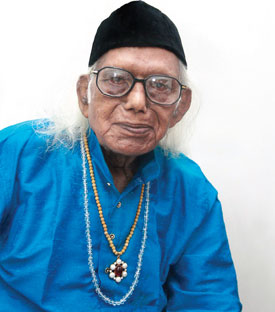
Gandhian Hakim Quadri passes away at 114

Kolkata , WEST BENGAL :

He accompanied Mahatma Gandhi on his Dandi March and later spent several days with him in a prison in Cuttack. In 2007, he was conferred with the Padma Bhushan for his fight against the British in the freedom movement.

Late on Monday night, Syed Mohammad Sharfuddin Quadri, who was affectionately referred to as hakim sahab, passed away three days after celebrating his 114th birthday. His family had moved to `Calcutta’ in the mid-1930s.

Quadri, a renowned Unani practitioner, who was instrumental in founding the Unani Medical College and Hospital in Abdul Halim Lane in central Kolkata, was born on December 25, in 1901 when Kolkata was still the capital of the country and Mahatma Gandhi had not returned to India.

“My father was imprisoned with Gandhiji by the British in Cuttack. He would accompany him everywhere during the Civil Disobedi ence Movement,” said son Manzar Sadique in the family’s home in 849 Rippon Street. “In October, abba had travelled to Lucknow where he was the chief guest at a conference of Unani practitioners. Chief minister Ak hilesh Yadav had invited him over to his house,” in forms Sadique.

Hakimji He began his day with Fajar (the morning namaaz) at the break of dawn followed by his visit to his chamber, Swadeshi dawakhana on Haji Mohammed Mohsin Square, where patients would already be waiting for him. He would examine more than 100 patients everyday at free of cost, says son Sadique.

The centurion who specialized in treating infertility would never miss his customary walk after work. “He suffered from arthritis which is why he took special care of his fitness,” said Quadri’s son.

Hakim told his followers that he learned the secret to remain fit from his father who lived till 121.

source:  http://www.timesofindia.indiatimes.com / The Times of India / News Home>  City> Kolkata / by Zeeshan Javed, TNN / December 31st, 2015