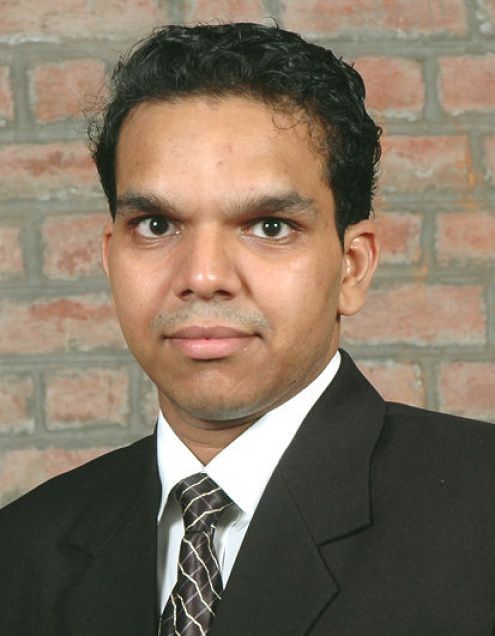
The Sports Ministry today confirmed that Wimbledon doubles champion Sania Mirza has been recommended for the Rajiv Gandhi Khel Ratna but made it clear that the final decision rests with only the Awards Committee.
Sania won her career’s first ever women’s doubles Grand Slam title with Swiss partner Martina Hingis in June. She also became world number one before winning the Grass Court major.
Sports Secretary Ajit Sharan said the Sports Minister Sarbanada Sonowal has indeed recommended to the tennis exponent for the highest honour given for achievement in sports.
“We had got a late recommendation from AITA but the Minister accepted that and recommended the same to the Awards Committee,” Sharan told PTI.
“But the final decision to give the honour rests with the Awards Committee,” he clarified.
Sania, who has won three mixed doubles Grand Slams in her career, is reportedly competing with Squash player Deepika Pallikal and discus thrower Vikas Gowda for the prestigious award.
Sania’s father and coach Imran Mirza said it was a great honour for her to be recommended for the Khel Ratna.
“It is a great honour to be nominated for the Khel Ratna award. This is surely going to inspire her to earn more laurels for the country,” Imran Mirza told.
source: http://www.outlookindia.com / Outlook / Home> News / New Delhi – August 01st, 2015
The passing away of the ‘People’s President’ and the ‘Missiles Man’ A.P.J. Abdul Kalam has shocked the Soliga tribal people in the B.R. Hills, who fondly remember him as he used to frequently visit the Vivekananda Girijana Kalyana Kendra (VGKK) there, when he was working as scientist at the Defence Research and Development Organisation (DRDO).
In fact, Dr. Kalam’s first visit to Chamarajanagar district was in 1998 and the last one was on October 16, 2006, when he participated in the silver jubilee celebrations of the VGKK. Incidentally, the day had a special significance as it coincided with the 76th birthday of Dr. Kalam.
Dr. Kalam was attracted by the beautiful environment of B.R. Hills. The tribal reminisce the way Dr. Kalam interacted with their children, including the youths. He was pleased to see the establishment of the New Tribal Hospital and development of roads, besides creation of facilities for their education. It was Dr. Kalam’s ideology to have “One Village One Product” for a comprehensive development of 128 tribal podus. He had advocated this ideology to ensure that the products produced by the tribal people by using modern technology could become viable and competitive commercial products at national and international levels.
Dr. Kalam had suggested the tribals in the B.R. Hills to embark on a bamboo mission. According to him, the mission should envisage an integrated programme of expansion bamboo plantations, their scientific management and promotion of value-added products of bamboo at community levels, besides development of entrepreneurial skills of tribal people. He had also suggested cultivation of Jatropha in about 1,000 acres of land, particularly on wastelands in hilly regions, to bring about rural prosperity through production of bio-diesel.
Another novel programme suggested by Dr. Kalam to VGKK was to consider creation of B.R. Hills PURA, encompassing all the 128 tribal hamlets and the 20,000-population. According to him, PURA was “providing urban amenities to rural areas”, envisaging provision of physical, electronic and knowledge connectivity for achieving economic connectivity. This would, according to Dr. Kalam, bring into focus the development of skills in cottage industry, dry-land agriculture, production of honey, handicrafts and processed food for which core competence was existing among tribal communities. The most important aspect of PURA concept was to create market avenues for the products.
His visit on October 16, 2006 to participate in silver jubilee celebrations of the VGKK coincided with the 76th birthday of the ‘People’s President’
source: http://www.thehindu.com / The Hindu / Home> National> Karnataka / Correspondent / Chamarajanagar – July 30th, 2015
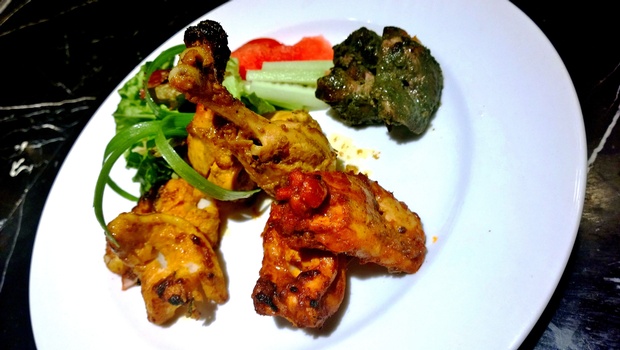
For celebrity chef Izzat Hussain, who started out life as a Unani practioner, creating food that is easy to digest and beneficial to the health of countless patrons is de rigueur. Thus, his USP is preparing mouth-watering dishes without water! Yes, you read it right, without water.
“To maintain consistency in the taste of my food, I don’t use water as its taste varies from region to region,” the chef told IANS at an ongoing Awadhi food festival here.
So, what does he substitute water with? A variety of liquids but principally milk.
“There is a certain consistency I find in milk and that’s why it’s my preferred choice. It definitely enhances the overall taste. I use milk for my dishes, milk for kneading dough, cream for pickles and so on,” Izzat explained.
chef Izzat Hussain. | IANS
With an enviable lineage tracing back to Nawab Wajid Ali Shah, the last nawab of Oudh, Hussain is known the world over for his Awadhi cuisine.
“There is a strong need to keep the trust and taste of the people who come to savour authentic and healthy food,” he said at the Radisson Blu hotel here.
Having practised Unani, Hussain said he gives a lot of importance to the health of his patrons. “I take great pride in creating food that is easy to digest and beneficial to one’s health,” he emphasised.
Asked about the idea behind the food festival, the celebrity chef said: “The concept of good food and genuine ‘nawabi’ cuisine is changing with every passing day. With these food festivals, I intend to keep alive the originality and heritage of these delicacies and present authentic food on the platter.”
Hussain also debunked the popular belief that Mughlai food needs a lot of oil to prepare and is difficult to digest.
“People think that Mughlai food contains a lot of oil and ghee, but the fact is that these foods take much less oil to prepare compared with other dishes. In fact, it gives us an option to drain out most of the oil once the food is cooked,” Hussain said.
Hussain has a unique distinction of giving to the culinary world a loaf named after him. The flat bread or chapati – named Izzat ki Roti – is made by mixing mixed-grain flour with secret Unani herbs.
Now he plans to develop a concoction of green tea and mulethi (medicinal spice liquorice) which, he said, could be a healthy alternative to normal tea and coffee.
Talking about the food festival, he said it is “one of the best” Delhi has seen in the recent past.
The lavish fare on offer at the festival includes mouth-watering reshmi galouti kebab, malai boti kebab, mutton nehari, murgh begum pasand, mutton dum biryani and murgh tursh pulao, among others for the non-vegetarians.
For vegetarians, paneer kebab, Izzati kebab, Shahi Korma, Chakundari Paneer, Kathal Stew, Kathal Biryani, and Kaju Biryani are on offer.
So, whether you are a vegetarian or a non-vegetarian, you can certainly dig in the platter on offer at the food festival and lick your fingers amid the lush ambience and strains of ‘qawwali’ singing in the background at the Radisson Blu hotel.
source: http://www.newindianexpress.com / The New Indian Express / Home> LifeStyle> Food / by IANS / July 29th, 2015
I write this obituary from the C-130 Air force plane with Dr. Kalam’s mortal remains a few feet behind me to be taken to Rameshwaram. He is draped in the national flag, the tricolor he served and deserves. He was the hero of my generation – I remember how I used to be glued to his Presidential address just as I was finishing school. He was an ocean of experience, ideas and motivation and to capture his personality and contributions in a few hundred words is a near impossible task. But as Dr. Kalam always said, “don’t stop trying” so here goes my attempt.
Srijan Pal Singh
“Funny guy! Are you smashing?” This is what I would hear from Dr. Kalam at every single dinner or lunch we had together. “Smashing” was the typical “Kalam call-sign” for asking whether the food was good. “Funny guy” was of course a more complicated expression, which could mean a whole variety of things. Depending on the tone in which it was said, it could mean good, not good, embarrassing or simply a casual reference. If you were working with Dr. Kalam, being able to decipher his usage of the word “funny” was almost a mandatory art to know which could be learnt only through experience. It took me a good one year to figure it out! Funny!
Dr. Kalam was a teacher, mentor, guide, co-author, friend, boss from whom I received care like a mother and concern like a father. I had the great fortune of working with him closely, travelling with him so frequently for over six years, till the point he left us all. He was infectiously optimistic, to him there was never an end. He never really watched TV, but still was a cricket fan – asking me scores on matches when we travelled between functions. His favorite cricketers were Dhoni and Sachin. I remember if I told him India was not doing well in a particular match, he would reply, “Watch! Our captain will come and do something unique.”
Uniqueness was so common to him. He had a voracious appetite for knowledge. The library and reading room occupying half of his 10 Rajaji Road House would be spilling books into bedroom and sometimes right upto the garden. He never departed on a journey without carrying a couple of books in his hand baggage. On the very last day of life, I remember lifting his hand baggage – it was heavy. I said, “Sir! Your bag is getting heavier!” He replied, “That is because I am reading more!”
To me the line which separated Dr. Kalam from the rest was not just his knowledge. It was his sensitivity and humility. He always introduced everybody as friend — whether it be his secretaries, his driver, his gardener, his cook or the people who maintained his house or even a stranger he just met. To him the world was truly flat, and there was no place for hierarchies and ranks in his life. I have had lunch and dinner with him at least 2000 times – often being the second to come to the table. Not once did he start eating on his own, not once did he miss asking whether I was liking the food.
He had the gift of empathy – and his memory of other people’s difficulties was impeccable. That was his art of winning over people. If he saw anyone with even with a small cold on a day he would offer you medicine or hot soup. The next day his first words would be – “Are you repaired?” No matter what you replied, his reaction would be, “Funny fellow you are!”
Dr. Kalam’s greatest faith was the nation and its youth. Even in the final two hours of his life, we discussed on terrorism as a threat to sustainability and the issue of Parliament becoming dysfunctional – two recent pieces of news which had pained him the most. He trusted the youth, particularly his students, to come up with a solution for these issues. He was an eternal believer in the power of the ignited mind of the youth – which he termed as most powerful, on the earth, above the earth and under the earth.
What next? We are bereft of Dr. Kalam as a physical form but we are still blessed with Dr. Kalam as an idea, a vision and a dream. His thoughts and missions about empowering rural areas, about clean energy, about value based education, about creativity, innovation and integrity are still flying high.
When I was his student in 2008 at IIMA, he told me in an after-class conversation, “If you are blessed with intelligence, and empowered with education – it is your responsibility to change the world”. That statement changed my life. He often said, “my dream is to see a billion smiles on billion faces”. Let us give our eternally optimistic, grand old friend, inspiration, mentor and beloved People’s President of the nation a reason to smile, wherever he is now. Salute you Kalam sir!
Srijan Pal Singh was an advisor to Dr. A.P.J. Abdul Kalam.
source: http://www.thehindu.com / The Hindu / Home> National / by Srijan Pal Singh / July 29th, 2015
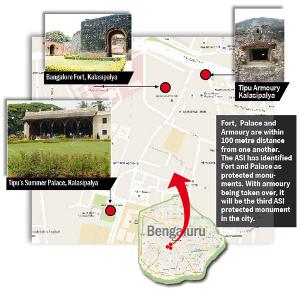
At this non-descript place hidden in the chaotic Kalasipalyam, Mysore ruler Tipu Sultan had stacked his ammunition cache. The 200-year-old armoury of Tipu Sultan behind Bangalore Medical College, which till now was treated like nobody’s baby, will soon be taken over by the Archaeological Survey of India (ASI) and declared a protected monument.
Fort, Palace and Armoury are within 100 metre distance from one another. The ASI has identified Fort and Palace as protected monuments. With armoury being taken over, it will be the third ASI protected monument in the city
It will be the third ASI-listed protected monument in the city after Tipu’s Palace and Tipu’s Fort, all situated near KR Market.
The three monuments – armoury, palace and fort – are situated within a 100 metres of each other. Commissioner, state department of archaeology, museums and heritage, C G Betsurmath wrote to ASI approving the takeover about three weeks ago.
For several years now, the armoury has been in news, albeit for wrong reasons. Lack of upkeep resulting in condition of the structure deteriorating; the unkempt place turning into a gamblers’ den; the state archaeology department and BBMP passing on the buck of responsibility to each other, and so on. Only in 2002, it was, that the 18th century armoury saw some conservation by Indian National Trust for Art and Cultural Heritage (Intach), Bangalore Chapter. The not-for-profit non-governmental organisation shifted a retaining wall and exposed the original steps leading to the monument after removing the compound wall. A toilet illegally built on the southern wall of the structure was also removed.
Of the recent development, Arun Raj T, superintending archaeologist, ASI, Bengaluru circle told Bangalore Mirror: “The state government wrote to us saying they have no objections in ASI taking over Tipu’s Armoury. It is good news and a result of continuous effort of Intach. This is the first step and we have a process to follow. We will have to write to our Delhi office and complete some formalities with the Bruhut Bengaluru Mahanagara Palike. Given the historical importance, it is necessary to protect the armoury and connect the three monuments (fort, palace and armoury) as these three are remnants in the city that date back to Tipu’s period.”
However, there is a small hitch – a school building adjacent to the armoury. ASI and BBMP will have to conduct a joint survey of the place and find a solution. “The school almost abuts the armoury and once the armoury is declared a protected area, the school will have to be vacated considering that a buffer has to be maintained around our monuments. In that case, we would need BBMP’s help in relocating the school,” added Arun Raj.
Intach, Bangalore Chapter, which has campaigned for the armoury is overjoyed. In fact, a month ago, Intach had written to BBMP suggesting that they hand over the armoury to ASI. “ Once it is declared a protected monument, there will be no threat to the armoury in terms of encroachment and will be well maintained. We have been pushing for this for a long time and finally, the move has come through,” said Meera Iyer, co-convener of Intach.
History has it that this armoury was built below the ground level to store ammunition and the structure style is so relevant that it still being followed by the army. Armoury also called magazine is always built below the ground level, has just one entrance and is not exposed to the outside world by growing grass on the exteriors.
According to historian Suresh Moona who has chronicled the city’s history, this armoury in Kalasipalyam housed missiles and ammunitions and in a nearby area, Taramandalpet, rockets were experimented. Taramandalpet is close to Jumma Masjid Road near Raja Market where Tipu’s missile manufacturing unit functioned. Every night, rockets would be fired, which looked like a cluster of stars in the sky – hence the name Taramandalpet.
Pride of the city
» Under ASI Bangalore Circle of ASI, there are 207 monuments.
» In Bengaluru, there are two ASI-listed monuments – Tipu Fort and Tipu Palace; Bengaluru district houses six monuments including the fort at Devanahalli and Hunting Lodge on Nandi Hills.
» Monuments in Hampi are the most well-known; Tipu’s properties in Srirangapatna have also become popular tourist attractions.
source: http://www.bangaloremirror.com / Bangalore Mirror / Home> Bangalore> Others / by Kushala S, Bangalore Mirror Bureau / July 30th, 2015
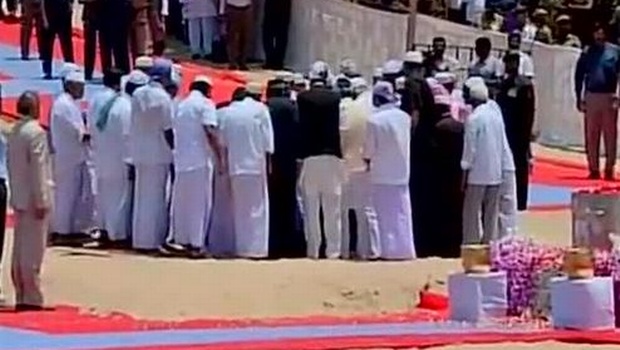
Former president A.P.J. Abdul Kalam was laid to rest on Thursday here with full military honours in the presence of Prime Minister Narendra Modi and several other leaders.
The People’s President’s body, draped in the Indian tricolour was brought to the burial site at Pei Karumbu in a flower-bedecked gun carriage, escorted by columns of the three armed services.
A gun salute was accorded to the former supreme commander of the armed forces and a military band played the haunting Last Post.
Modi, who arrived here on Thursday morning, paid his last respects to the country’s youth icon and most popular president by laying a wreath.
Tamil Nadu Governor K. Rosaiah, union Ministers M. Venkaiah Naidu, Manohar Parrikar and Pon Radhakrishnan, Tamil Nadu ministers like O.Panneerselvam, Natham R. Viswanathan and others also paid their last respects to Kalam.
Kerala Governor P. Sathasivam, Kerala Chief Minister Oommen Chandy were also present, as was Andhra Pradesh Chief Minister N. Chandrababu Naidu.
Congress vice president Rahul Gandhi and other party leaders also paid their last respects to Kalam – also known as India’s Missile Man.
Earlier the mortal remains of Kalam were taken to the family mosque for prayers.
His family members also reached here.
“All our relatives have also arrived to attend the last rites,” A.P.J.M.K. Sheik Saleem, the former president’s brother’s grandson, told IANS.
The Tamil Nadu government declared a public holiday on Thursday under the Negotiable Instruments Act. Banks, insurance companies, schools and colleges are closed throughout the state.
The government has also ordered closure of liquor shops and bars throughout the state.
Around 30,000 jewellery shops would also remain closed, while petrol bunks stopped sales for an hour between 10-11 a.m. as a mark of respect for Kalam.
Movie-theatre owners too have decided to shut down for the day while fishermen have decided not to venture into the sea.
Political parties like the DMK and the AIADMK have cancelled their functions.
Interestingly, the decision of private sector organisations to voluntarily shut shows that Kalam was truly a People’s President.
Born in Rameswaram on October 15, 1931, Kalam, as a boy, hawked newspapers to supplement his family’s income. His father owned a boat and his mother constantly struggled to keep the family sufficiently fed and clothed.
His sister pawned jewellery with a moneylender so that the studious Kalam could carry Rs.600 when he left Rameswaram to join the Madras Institute of Technology.
source: http://www.newindianexpress.com / The New Indian Express / Home> States> Tamil Nadu / by IANS / July 30th, 2015
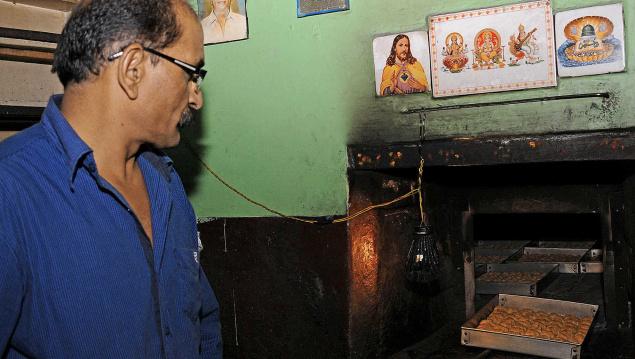
Wheat varkey being prepared in a bakery in Udhagamandalam.- Photo: M. Sathyamoorthy
Rajkumar starts work at 3 a.m. every day at his baking station, preparing and baking the “Ooty Varkey” for nearly six hours daily. Their family has been making varkey in Ooty for more than seven decades now and they have customers coming in from different parts of the State and also from Bangalore and Puducherry. They make about 100 kg of Varkey a day and have added more varieties to cater to the demands of the customers.
This is one of the popular products that tourists to the Nilgiris want to take home. There are nearly 150 bakers in Ooty who make Varkey and they plan to submit details soon to get the Geographical Indication certificate for “Ooty Varkey”. Some of them, such as Rajkumar, follow the recipe that the family has used for several years now.
K. Mohammed Farook, President of Ooty Bakery Owners Association, told The Hindu that there were many in the plains who sell the product as “Ooty Varkey”. Getting the certificate will benefit the bakers in Ooty. The bakers in the Nilgiris procure the raw materials locally.
The quality of water and the weather in the Nilgiris give a special taste to the Varkey, he says. “We have collected the details and will submit the final copy to the officials soon for the GI certificate,” he said.
source: http://www.thehindu.com / The Hindu / Home> News> Cities> Coimbatore / by M. Soundariya Preetha / Coimbatore – July 27th, 2015
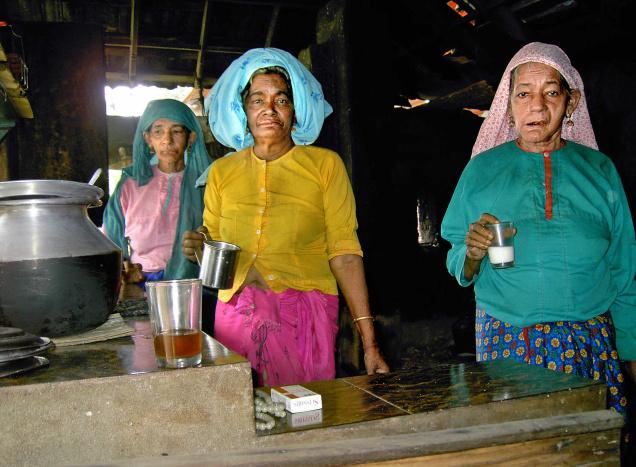
Rabia (middle) at her Makani at Panangangara along with her sisters.
The rustic hands which served thousands of people with tasty ethnic tea at a village makani at Panangangara near Perinthalmanna have stopped moving. Rabia, 70, will not serve any moretea either for the local people or the passersby.
Rabia passed away on Saturday, leaving behind a legacy of serving people with tea for over half a century. In fact, she served tea for generations.
The tea shop she managed on the veranda of her house on the Palakkad-Kozhikode highway at Panangangara had long become a talk of the village largely because of the unique taste of the tea she mixedand her simple behaviour. She was helped by her sisters Fatimakutty and Sulaikha.
Many a traveller, including foreigners, has had the taste of Rabia’s tea. Started 60 years ago by her late father T.K. Saithali, Rabia and her sisters insisted on carrying forward the Makani tradition that existed in Malabar. Although Makani does not mean anything more than a shop, the very mention of it in the villages of Malappuram brings memories of ethnic culture, language and food.
source: http://www.thehindu.com / The Hindu / Home> National> Kerala / by Abdul Latheef Naha / Malappuram – July 26th, 2015
The Rampur Raza Library is renowned globally for its collection of ancient manuscripts from South Asia. The library has now organised an exhibition of Qurans, inviting scholars to view ancient manuscripts of the holy Quran in the month of Ramzan.
Some of the manuscripts on display are among the oldest pieces of Arabic calligraphy. A 7th century Quran written on parchment in the early Kufic script, attributed to Hazrat Ali (d. AD 661) is on display. Viewers are lining up to see this rare manuscript.
An 8th century manuscript of the Quran is attributed to Imam Jafar Sadiq, whose unique penmanship is widely appreciated.
A 9th century script is attributed to Imam Abul Hasan Musa, who served as prime minister to three caliphs of Baghdad. He died on July 20, 941 AD. His Quran is in the early Naskh style, popular in the 10th century. This form of calligraphy continues to be in vogue, with some changes.
Maulana Mohammad Irshad Nadvi, who is coordinating the exhibition, said, “The library also has a copy of a Quran written by master calligrapher of the 13th century Baghdad, Yaqut-al Musta Simi. It is decorated in gold and precious lapis lazuli.”
Nadvi said another masterpiece of Arabic manuscript by this calligrapher, titled Diwan-al-Hadira and dating to 1221 AD is part of the royal library of Sultan Ibrahim Adil Shah of Bijapur.
The exhibition also displays calligraphy in Arabic that created its own pseudo-geography, with exquisite and richly illustrated figures of human beings, animals and birds. Some of this came from the pen of 13th century calligrapher Zakaria bin Mahmud al-Qazvini.
Among the assets of the library on display is the Arabic manuscript Sharhal-Kafia of Razi. It bears marginal notes by Nawab Sadullah Khan, prime minister of Mughal emperor Shah Jahan. Among the many seals on this manuscript is one of emperor Aurangzeb.
Jacob Thorek Jensen, who is visiting the exhibition from Denmark and serves as advisor to a Danish culture agency, said, “This is a brilliant show of the elaborate calligraphy of writers of the Quran.”
Library spokesman Himanshu Singh said visitors to the library and the exhibition come from different faiths.
source: http://www.timesofindia.indiatimes.com / The Times of India / Home> City> Bareilly / by Nazar Abbas, TNN / July 16th, 2015
Khwaja Moinuddin Chisti Urdu, Arabi-Farsi University in Lucknow has approved the recognition to degrees offered by Manzar-E-Islam Madrassa of Dargah Ala Hazrat. With this affiliation, children studying at the Dargah Ala Hazrat madrassa in Bareilly can go on to study at a university.
As madrassa marksheets are not accepted as valid at universities, students of the madrassa seldom make the transition to modern universities. Officials of Dargah Ala Hazrat are seeking similar affiliation from Jamia Millia Islamia University, Mahatma Jyotiba Phule (MJP) Rohilkhand University and Aligarh Muslim University (AMU). This madrassa is already affiliated to Jamia Hamdard University, Delhi.
“Khwaja Moinuddin Chisti Urdu, Arabi-Farsi University has now given affiliation to our madrassa. As the focus of the madrassa is more on religious teachings, the students do not get proper modern education, including lessons on English, Mathematics, Science, Computer Applications and other subjects,” said Mufti Mohammed Salim Noori of Manzar-E-Islam madrassa.
He added that at this madrassa, students get “alim” (considered to be of intermediate level) degree to students who pass out from here. However, as it is not accepted in most of the varsities, the children of the madrassa are seldom able to take admission in universities for modern education. For moving to modern universities, these students are required to take enrolment in a proper school and have to clear an intermediate exam. “Appearing for intermediate exams from school is a long and tedious process. However, as we have entered into tie-up with this varsity, the students holding alim degree of our madrassa will directly get admission and they need not to again give intermediate exams from a school,” said Maulana Subhan Raza Khan alias Subhani Miyan, chairperson of Dargah Ala Hazrat.
For seeking admission in varied courses of Khwaja Moinuddin Chisti Urdu, Arabi-Farsi University and Jamia Hamdard University, the madrassa students will have to either come in the merit list or clear the entrance exams.
The officials of the shrine added that after Ramzan, they will also approach authorities at Jamia Millia Islamia University, MJP Rohilkhand University and AMU for similar affiliation for the betterment of students studying in madrassa. The affiliation has made the madrassa students happy. “I am excited to study in a university as I will get an opportunity to become part of nation’s mainstream. We will be in a better position to take on the world,” said Mohd Khalid, a student.
source: http://www.timesofindia.indiatimes.com / The Times of India / Home> City> Bareilly / by Priyangi Agarwal, TNN / June 28th, 2015