Hazrath Moulana Mohammed Zaka Ulla and Corporator K.C. Shoukath Pasha were unanimously elected as President and General Secretary respectively of All India Milli Council, Mysuru District Unit, at a meeting held recently at Madrasa-e-Ashraf Ul Uloom in Kesare here.
The meeting was held under the supervision of Hazrath Moulana Qadeer Ahmed, President, All India Milli Council (AIMC), Karnataka State Unit; Hazrath Moulana Mufthi Baqar Arshad, Vice-President, AIMC, Karnataka State Unit and Syed Shahid Ahmed, General Secretary, AIMC, Karnataka State Unit.
Hazrath Moulana Mohammed Zaka Ulla is also the President of Majlis Ul Ulema and Khateeb & Imam, Masjid-e-Firdose, Bannimantap while Corporator Shoukath Pasha is also the member of District Planning Committee. This is the second term of Pasha as General Secretary of AIMC, Mysuru.
Both the newly elected office- bearers were felicitated on the occasion.
Hazrath Moulana Mohammed Usman Shariff, Sir Khazi of Mysore, Taj Mohammed Khan, Member, AIMC, Karnataka State Unit, Hazrath Moulana Mohammed Naseem, outgoing President, AIMC, Mysuru, Hazrath Moulana Ahmed Khan Rishadi, Moulana Mohammed Ibrahim, former Mayor and Corporator Ayub Khan, Corporator Suhail Baig, JD (S) leader Azeez Ulla, Syed Zaheer Ahmed, General Secretary, Central Muslim Welfare Council, Mohammed Zaheer Ul Haq, Mohammed Mumtaz Ahmed, Secretary, Mysuru District Relief Committee, Syed Akram Pasha, Syed Jalal, Secretary, Muslim Boys Orphanage and others were present on the occasion.
source: http://www.starofmysore.com / Star of Mysore / Home> General News / Monday – March 02nd, 2015
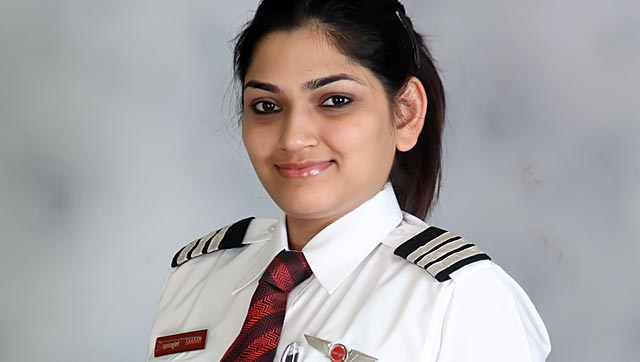
Saarah Hameed Ahmed, India’s only Muslim woman pilot
“People initially think I’m Christian and then gawk when I tell them my full name,” laughs Saarah Hameed Ahmed (25) the Bengaluru girl who is the only known Muslim among the 600-odd women pilots employed in the Indian aviation sector. “I just love the look on people’s faces when they discover I am Muslim.”
People’s reaction to her choice of profession is a constant source of entertainment for Saarah. Many want to know how a girl can handle a machine that’s many times her size, she says as she cracks up again. “Poor things; they don’t know that my fingers are all I need to fly,” she says twiddling her thumbs.
Of course, the reactions are not always amusing or sensitive. Saarah says she too has had to face the brunt of Islamophobia that gripped the world post 9/11. But each time she has managed to win people over with a combination of humour and tact, she says.
However, Saarah’s first battles were fought at home and within the community. She says that she still faces taunts from people who believe a girl’s only job is to get married and produce children.
“Initially none of us encouraged her. In our community girls don’t usually take up professions where they have to stay away from home and live in hotels without an escort,” confesses her father Hameed Hussain Ahmed, a professional photographer. When Saarah showed no signs of relenting, he spoke to his friend Atif Fareed, who is a senior pilot in the US.
“Fareed told me that I should consider myself lucky because most Muslim girls don’t even dream of flying. If he hadn’t convinced me, I might have made the blunder of killing Saarah’s dreams,” he says.
In 2007, when she was just 18, Saarah enrolled with a flying school in the US. “Those days most Muslim students were being denied US Visas. When she got the Visa without any trouble I saw it as a final message from God,” says the deeply religious Ahmed.
Saarah’s mother, Naseema Ahmed, says she never had any doubts about sending her to the US. Her proudest moment, she says, was when a group of Muslim girls surrounded Saarah at a wedding and started asking her for tips to become a pilot.
Saarah has other dreams too. “I really want to get married and have children,” she says. But finding the right man is proving to be tough. “I don’t understand people who just look at my photo and want to get their sons married to me. Don’t they want to know what I have studied or where I work?”
Many of her suitors have either wanted her to quit her job or move cities. “My father has shooed away people asking them to get their sons to quit his job and move cities,” Saarah says letting out another blast of laughter.
She also has a Women’s Day message for Muslim girls like herself: “Don’t fret over what the community thinks of you. And don’t let them kill your dreams.” And what is she planning on women’s day? “Fly, of course! My airline [Spicejet] is very keen that I fly on Women’s Day.”
Waiting in the wings
Ayesha Aziz, 18, is another aspiring pilot. A native of Baramulla, Kashmir, she has already obtained a basic flying licence.
Fatima Salva Syeda, 26, is a licenced commercial pilot. But she has to qualify additional training before she can be a professional pilot.
source: http://www.hindustantimes.com / Hindustan Times / Home> India / by Sudipto Mondal – Hindustan Times, Bengaluru / March 08th, 2015
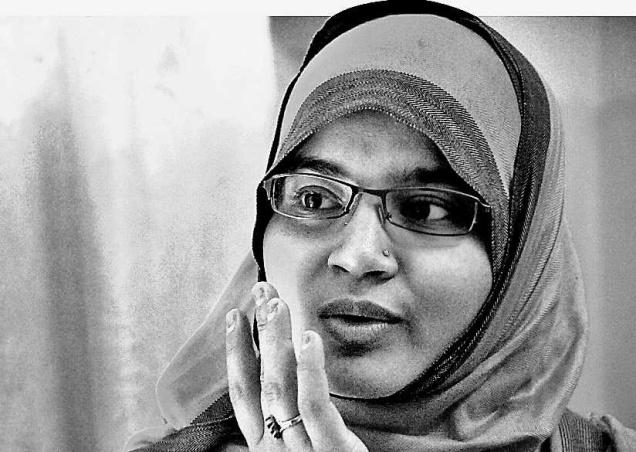
Capt. Fatima, the only Muslim woman in India to hold commercial pilot’s licence, needs financial help for additional training
She looks the typical Muslim woman next door – plain, timid and hesitant. It will be a surprise if she can drive a four-wheeler. Hold your breath – she can even fly an aircraft. Meet Capt. Syeda Salva Fatima, the only Muslim woman in India to hold the commercial pilot’s licence.
She is the shining example of Muslim women’s empowerment. What makes her ascent interesting is that she hails from the poverty-stricken old city of Hyderabad where life is a continuous struggle. Even more surprising is her decision to step into a domain which is predominantly male. But her black burqa and red scarf doesn’t betray her accomplishments.
Right from her school days, Fatima used to collect newspaper articles about aviation and pour over pictures of aircraft for hours. Her father, Syed Ashfaq Ahmed, a bakery worker, never imagined that his daughter would become a pilot one day. The dice was cast when she took admission in an institute which offered free EAMCET coaching. “What would you like to become,” the instructor asked. Pat came the reply, “Pilot”. It was a pleasant surprise to everyone present, more so to her father who struggled to make the ends meet. Seeing her determination, Zahid Ali Khan, Editor, Siasat daily, who was present at the time, asked Fatima to meet him later. “I couldn’t believe my ears when he offered to support me financially to undertake the pilot training,” recalls an overwhelmed Fatima.
After five years of rigorous training at the Andhra Pradesh Aviation Academy, Fatima obtained Commercial Pilot’s Licence, Private Pilot’s Licence and Flight Radio Telephone Operator Licence on March 11, 2013. She has logged in a total of 200 hours of flying on Cessna 152 and172, including 123 hours of solo flight. Now she has hit a rough weather. She needs to undergo Type Rating, an additional training beyond the scope of the initial licence and aircraft class training, on Air Bus A-320 or Boeing to be able to fly any aircraft. The training costs about Rs. 30 lakh which the 26-year-old couldn’t think of. But having come this far, she doesn’t want to give up. The Captain courageous has sent an SOS to the Civil Aviation Minister, Ashok Gajapathi Raju. She can be reached on: 9966073368.
Capt. Fatima, the only Muslim woman in India to hold a commercial pilot’s licence, needs financial help for additional training
source: http://www.thehindu.com / The Hindu / Home> News> Cities> Hyderabad / by Swathi V / Hyderabad – March 07th, 2015
India advanced to the quarterfinals of the World Cup after prevailing over West Indies by four wickets here on Friday. Set a target of 183, M.S. Dhoni’s men stumbled, losing frequent wickets. It was left to the captain and R. Ashwin to wrap it up.
Against good fast bowling on a pitch reputed to be the quickest in the world, India’s toporder floundered. Virat Kohli made 33, looking fluent until he fell to a short-pitched delivery. India needed 49 runs when the sixth wicket fell. But Dhoni pulled the chestnuts out of the fire with an unbeaten 45. The foundation for the win was laid by Mohammed Shami and Umesh Yadav, who subdued West Indies with a fantastic exhibition of hostile fast bowling.
‘Captain Cool’ delivers
The Indian juggernaut wobbled and juddered but pulled through all right. M.S. Dhoni’s steady hand saw his team home in a nervous run-chase at the WACA ground here on Friday, as India defeated West Indies by four wickets to book a spot in the quarterfinals of the World Cup.
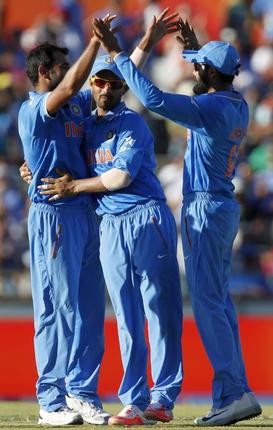
Mohammed Shami is congratulated by teammates after taking the wicket of West Indies batsman Darren Sammy in Perth on Friday./ AP
Mohammed Shami, later declared ‘man-of-the-match, and Umesh Yadav put on a demonstration of blistering fast bowling to help limit West Indies to 182. In pursuit, India had sunk to 134 for six when Dhoni and R. Ashwin were united at the crease. The pair added 51 runs in an unbroken seventh-wicket partnership to take the team home.
Jerome Taylor’s opening spell made it clear India’s run-chase was not going to be straightforward. He hurtled in from around the wicket at Shikhar Dhawan, bowling seriously fast and leaving him little room.
Dhawan soon pushed at one and was consumed in the slips. Rohit Sharma received a marvellous out-swinger, bowled at just the right length to draw him forward, and he fell for 7. Virat Kohli then briefly batted as if the difficulties of those before him had been some sort of mirage. He hit two firm drives and whipped Taylor off his pads for successive boundaries. But when Kohli chose to pull Andre Russell (of the Mr. T hairstyle) from outside the off-stump, he dragged it down the throat of the long-leg fielder.
The size of the target meant the game was never going to be won by containing the chasing side. It helped to have another speed-merchant in Kemar Roach, who replaced the spinner Suleiman Benn in the team.
Roach was wayward at first but he struck in his fifth over, having Ajinkya Rahane caught behind. The batsman reviewed the decision but replays proved inconclusive.
India lurched to 78 for four, when Suresh Raina walked out. He was predictably met with a barrage of short-pitched deliveries but it was eventually Dwayne Smith’s gentle medium-pace that did for him. When Ravindra Jadeja departed, also playing the pull shot, India still needed 49 runs for victory.
M.S. Dhoni, though, found a competent ally in Ashwin. The two mostly steered clear of the shots that had claimed some of their predecessors — although Dhoni did scythe Russell over third-man for six. The captain remained unbeaten on 45, scoring the winning runs in full, headgear-less glory.
In the dull heat of the afternoon, India produced an hour of the most irrepressible, furious fast bowling. Yadav and Shami bowled quick, bowled short, and generally put it where the batsman didn’t want it.
They moved the ball lightly in the air, and off the pitch, and beat the bat as a matter of routine. Smith was struggling against Shami and he soon nicked off, trying to cut a short ball that was too close.
Shami welcomed Marlon Samuels with one that whizzed past his nose; Gayle got another in the same region.
Discomfiting pace
That Yadav worked up a discomfiting pace — steadily in the high 140s — was no surprise. That he did it with accuracy early on was; Gayle was forced to play out a maiden over and the West Indian innings was crawling.
The exit of Samuels, who was run-out chasing a single his partner had no interest in, seemed to spark Gayle into action. He swung freely — that two edges flew in the direction of third-man and were dropped did not bother him — and sent a ball from Yadav sailing over the long-on boundary. But India had no reason to be worried by this approach.
Gayle soon top-edged a rising delivery from Shami and was caught at mid-wicket.
Thereafter, the West Indians batted as if they were in a rush to catch the last ferry to Fremantle (which leaves the Barrack Street jetty at 5.30 p.m.). They sank to 124 for eight, Shami taking a third, and it was only the intervention of Jason Holder that dragged the total to 182. The ball had grown older now and there was none of the menace of the opening period, but the young captain batted admirably to make 57.
It couldn’t stop India, though, from marching into the last eight with two Group B games in hand.
source: http://www.thehindu.com / The Hindu / Home> Sport> Cricket> World Cup / by Shreedutta Chidananda / Perth – March 06th, 2015
Radha Viswanathan re-lives moments of living and performing with an icon, to Ranjani Govind.
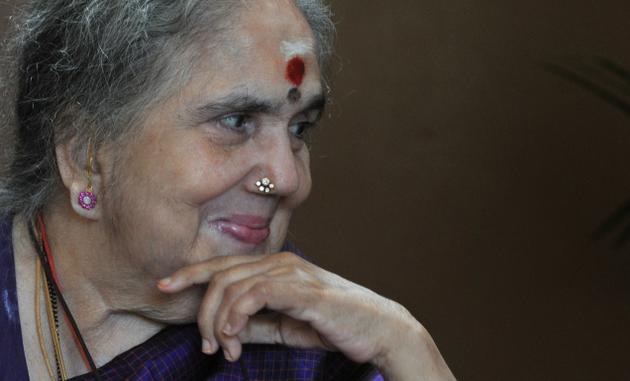
“It’s comforting to see my grand-daughter Aishwarya become a serious performer. I remember the days when I would wonder whether there would be anyone in the family to carry the legacy forward. My prayers seem to be answered,” says the 80-year-old Radha Viswanathan, daughter of M.S. Subbulakshmi, during a recent interview in Bengaluru.
Radha was recently honoured during the release of an album of a nearly 40-year-old soundtrack of MS and hers, in Bengaluru, with veteran mridangam vidwan T.K. Murthy and former ISRO chairman K. Radhakrishnan participating. The album was recorded in Mumbai by the National Centre of Performing Arts (NCPA) and is now being brought out in association with Sony Music.
Radha is happy that the rare gems from the 1970s, was now being shared with rasikas. “It is a historic occasion for our family.”
Radha, who accompanied her mother for over 60 years, be it at live concerts or recordings, cherishes every memory of the time she spent with her iconic mother. “I was blessed to have a mother who was an embodiment of compassion,” she says, as she gets nostalgic. Radha’s mobility might have been restricted to a wheelchair owing to several health issues, but her zest for life, passion for music and elephantine memory keep her as youthful as ever. She can leave you stumped with her recollection of events, rolling back to instances when as a four-year-old she remembered the time when MS entered her family.
Talking about her computer-like memory, Radha says, “Storing information is inherent to my persona. Every time I sang a kriti leant instantly at class, Semmangudi mama would say, ‘You have a camphor-like brain, catching everything instantly!’” recalls Radha, who always made notations of the trickiest of sangatis.
Looking settled in her son V. Shrinivasan’s home, the contentment is apparent on her still radiant face. “It’s rewarding to have taught Aishwarya nearly 500 kritis. Do you realise that it is authentic Semmangudi, Musiri and T. Brinda schooling that I have passed on? My younger grand-daughter Saundarya too is catching up,” she says.
But why didn’t MS train other students? “My mother was too busy an artist to teach. She was incredibly humble and used to continuously learn from others and considered herself a student all her life,” says Radha. There were instances when Radha learnt from Semmangudi Srinivasa Iyer as MS was too busy. Radha would later sing what she had learnt to her mother. “In fact, we practised together to get the nuances right,” she remembers.
Radha stepped on to the music platform as a four-year-old, singing tail-enders or the so-called ‘tukkadas.’ “That was the beginning of my musical journey. But later I learnt from Mayavaram Krishna Iyer and GNB’s sishya, T.R Balu,” she says. Once when MS was unwell, Musiri came visiting. Radha had then sung ‘Saraseeruha’ in Nattai and ‘Sudhamayi’ in Amruthavarshini. Fourteen years later, when the same kritis were presented at the Central College of Music where Musiri was the principal, he remembered, “I recall Radha singing these kritis as a six-year-old. Even then, I knew she would go a long way.”
It was Musiri who had advised them about the importance of ‘voice synchrony;’ he had told Radha, “Your voice should blend with MS’s and sound like a single, integrated tenor.” No wonder their Vishnu Sahasranamam recording is known for this quality! “In the line, “Amaaani Maanado Maanyo,” when MS briefly stopped to take a breath, it had to be re-recorded, but Amma insisted it be left alone. ‘Let people know that Radha sang along,’ Amma said.”
What was special as far as their voice experimentation was concerned were the lessons that MS and Radha got from T. Brinda and T. Muktha, who had by then set a trend in high-and low-octave singing. Kritis such as ‘Janani Ninnuvina’ in Ritigowla, ‘Raave Himagiri’ in Thodi and ‘Teera teeyaga raada’ in Gowlipantu that saw MS taking to the base and Radha singing in the higher octaves, became a rage with audiences.
Father Sadasivam’s love for dance saw Radha and Anandi (daughter of Kalki Krishnamurthy) team up and learn Bharatanatyam from Vazhuvoor Ramaiah Pillai. Her ability to learn and absorb was so amazing that Radha had her arangetram, along with Anandi, as an 11-year-old! They performed to packed audiences, effortlessly. “Even here, Amma would sing padams for us. Who can forget the rave reviews that the two got for their superb pairing in ‘Maalai Pozhudinilae’ and ‘Thayae Yashoda’?
Says Radha’s son, Shrinivasan, “In 2010, when my mother was asked to do abhinaya at the Cleveland Tyagaraja Aradhana, she obliged and left the the audiences in tears. And mind you, she was sitting all the while!”
It was her love for song and dance that Radha saw act as the young Bharatan in ‘Shakuntalai’ in 1940 and as Bala Meera in ‘Meera’ in 1946. “By the time, the Hindi version came, I had grown taller and so I did not act in it,” she says. When Radha was13, she had led the chorus in ‘Meera’ and had the music director Bhattacharya refer to her as ‘my boss.’
Born in 1934, December 11, in Gobichettipalayam, Radha was married to Viswanathan and went to Ahmedabad. But Radha’s passion for music and MS’s need for a vocal support soon brought them together and they travelled the world and became ambassadors of Carnatic music.
From Radha’s memory bank
* MS always advised me and my sister Vijaya to have a smile on our faces while singing.
* We took classes from Semmangudi, Musiri, Brinda-Muktha, K.V. Narayanaswamy, Siddeshwari Devi in Hindustani, Sandhyavandanam Srinivasa Rao and Meera bhajans from Dilip Kumar Roy.
* Radha still remembers the first concert at The Music Academy. Prime Minister Nehru was to inaugurate. The Udaipur Maharaja, mesmerised by our Kalyani rendering, had offered MS his kingdom!
* She recalls MS’s ‘never-question’ attitude towards her father Sadasivam’s ‘concert listing’ as a mark of respect for his knowledge and intuitive knack of planning.
* Once, Radha danced in front of Mahatma Gandhi with MS singing ‘Ghana Shyam Aaaye Re’ at the Birla House in Delhi. “And Gandhiji really enjoyed my performance!”
From the NCPA archives
The CD with 16 songs of M.S. Subbulakshmi and Radha Vishwanathan that Sony Music has released in association with the National Centre of Performing Arts (NCPA), is part of “Masters Works” series,” which was recorded in the 1970s.
Shridhar Subramaniam, president, Sony Music said, “Two more live concerts of MS and Radha, with Karaikkudi Mani on the mridangam will be released in two months. Also in the pipeline is one with Alla Rakha and Zakir Hussain on the tabla.”
NCPA had 5000 hours of live and studio-recordings in several genres mainly done in Mumbai from 1971 for their archival and academic purposes and directed towards student-researchers. Soon, recordings of Pandit Jasraj, Ustad Bismillah Khan, Ustad Rashid Khan, Gangubai Hangal, Dr. M. Balamuralikrishna and M. L. Vasanthakumari, were released by Sony Music.
source: http://www.thehindu.com / The Hindu / Home> Features> Friday Review / by Ranjan Govind / February 26th, 2015
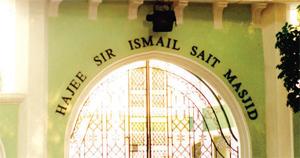
The history of Bangalore is a colourful tapestry whose warp is interwoven with countless political and cultural narratives. But the equally significant weft consisted of traders and businessmen whose lives extended beyond commercial success to large acts of philanthropy. Despite these extensive contributions that benefitted the city and its people, their memories are now preserved primarily in the hearts of old Bangaloreans, personal family records and physical fragments across the city; a memorial, a building or a road. The Hajee Sir Ismail Sait Masjid was built over 100 years ago and gives Mosque Road it name. It was initially meant to accommodate about three hundred people but the largesse of its builder went far beyond its walls.
Haji Sir Ismail Sait was born on March 7th 1859 and following his father’s untimely demise, moved from Mysore to Bangalore around 1870. Being from the mercantile Cutchi Memon community, he followed suit after being educated in both Bangalore and Chennai. Arif Hussain, at the Hazrat Haider Shah Jeelani Dargah, tells me an anecdote (unverified) about his early years where he was advised by the saint, his spiritual mentor, to initially trade in goods that were white in colour (like eggs, garlic and milk) to ensure wealth and success. The young Ismail Sait evidently had a nose for business and saintly advice. His English Warehouse near St. Mark’s Road soon sold not just milk powder but every conceivable import from England. Branches were opened in Hyderabad and Chennai, where he was the first to bring in imported kerosene from America in the late 19th century through Spencer and Co.
The entrepreneurial streak also ran through trading in military provisions, timber and mining. He was a banker, mill owner and export-importer. Over time, he was also Chairman of Chamber of Commerce Mysore; Director in the Mysore Sandalwood Factory, Binny Mills and the Mysore Iron Works, Bhadravathi. It was a diverse portfolio but India was opening up to the world and opportunities were yours for the taking. Business was supported by memberships in several distinguished clubs including the Willingdon Sports Club, Bombay, Calcutta Club and the National Liberal Club of London. “He had great business sense and wonderful PR skills” says Zafar Sait, his great-grandson.
But public service was a priority. Healthcare and education were key concerns. The Gosha Hospital (1925) near Queens Road was built with personal funds for reclusive Mohammedan `purdah nashin’ ladies. It was formally opened with 20 beds. Philanthropic friends donated clocks, beds, `frigidaires’, aluminiumware and other supplies. He also built schools, mosques and rest houses in Bangalore, Whitefield and Mysore. Staggering sums of money were donated to the Mysore State University, Aligarh University and medical institutions including Victoria and Bowring Hospitals. His will made strict provisions for educating family members, `both male and female’ and providing alms to the poor.
In 1911, he was nominated to the Madras Legislative Council and received the title’ Fakhr-ut- Tujjar from the Mysore Maharaja in 1919. Family photographs show a dapper gentleman dressed in traditional Cutchi Memon robes, and then in European attire when he was knighted in 1923. When Hajee Sir Ismail Sait passed away in 1934, he left behind his wife Ayesha Bai, five sons, two daughters and a legacy of philanthropy that Shabbir Malik Sait, his great grandson says continues even to this day. He belonged to a time when we gave back what we received in equal measure.
The writer is a cultural documentarian and blogs at aturquoisecloud.wordpress.com
source: http://www.bangaloremirror.com / BangaloreMirror.com / Home> Bangalore> Others / by Aliyeh Rizvi, Bangalore Mirror Bureau / May 05th, 2014
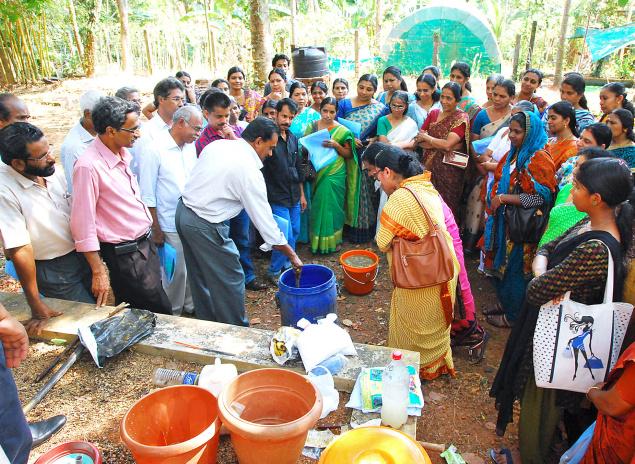
An expert demonstrates how to prepare organic fertilizers during a training programme organised by the National Horticulture Mission on the CWRDM campus at Kunnamangalam in the city. / The Hindu
Along with vegetables, spices also need to be cultivated organically, say experts.
Spreading awareness among people about the importance of producing toxin-free spices through organic cultivation was the main thrust of a training programme in homestead water management and organic spice cultivation organised by the National Horticulture Mission in collaboration with the Centre for Water Resources Development and Management (CWRDM) on its campus at Kunnamangalam here.
Around 60 housewives, who are members of the farmers club aided by the National Bank for Agriculture and Rural Development (NABARD), participated in the two-day training programme, which was inaugurated by the Kunnamangalam MLA P.T.A. Raheem on Monday.
Water resources
In various sessions, scientists as well as experts from the centre and the Agricultural Department spoke on how to go about managing the available water resources in a common household for the cultivation of essential spices including ginger, turmeric and pepper.
E. Abdul Hameed, Technical officer of CWRDM, talked about the things to be done while cultivating spices in the backyard.
While CWRDM scientist Dinesh Kumar spoke about the role of spices in the protection of health, K.R Prasannakumar, another expert from the centre, spoke on the role of soil fertility and use of organic fertilizers for spices cultivation.
P. Vikraman, former Principal Agricultural Officer, demonstrated on how to prepare organic fertilizers and pesticides.
The scientists also clarified various doubts raised by the participants during the programme.
One kg of ginger and turmeric rhizomes each as well as five saplings of pepper were distributed free to the participants at the end of the session. CWRDM executive director N.B. Narasimha Prasad presided over the function. CWRDM Training Education and Extension Division (TEED) head Kamalam Joseph and NABARD District Development manager K.P. Padmakumar among others spoke. Details about organic spices cultivation can be had from the organisers. Ph: 9447276177.
source: http://www.thehindu.com / The Hindu / Home> News> Cities> Kozhikode / by Jabir Musthari / Kozhikode – March 04th, 2015
If you spot clean roads around La Martiniere Girls College and a no-polythene zone in zoo, the credit for it goes to Rehana Ali. It was Rehana’s dedication and positive approach that has brought about a small but imperative change.
Rehana, who teaches at La Martiniere Girls College, formed community, ‘Protection of Environment and Animals’, 18 years back. Since then she has pursued her mission with ant-like persistence. Pointing out people for littering the roads or taking students to clean them, she has made several efforts to keep the road and surroundings clean. “It is because of my profession that I do not hesitate in accosting people. Whenever I see anyone throwing wrappers on the streets, I ask them not to do so,” she shares.
Besides raising awareness among her students, Rehana also encourages them to join the noble cause. Every week, all students of the school deposit two paper bags, which are then collectively sent to the zoo. For more than a decade now, Rehana has been supplying paper bags with the participation of her students.
source: http://www.timesofindia.indiatimes.com / The Times of India / Home> City> Lucknow / TNN / March 05th, 2015
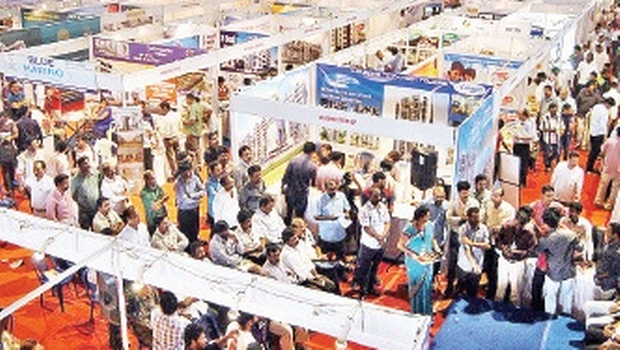
Large numbers of people visiting the CREDAI expo that concluded in Visakhapatnam on Sunday | Express Photo
Visakhapatnam :
The three-day Vizag Property Expo-2015 concluded on a grand note here Sunday with the Visakhapatnam unit of Confederation of Real Estate Developers Associations of India (CREDAI) announcing ‘BR Raju Memorial Award’ to three meritorious students from the architecture department of the Andhra University College of Engineering for the eighth consecutive year.
HRD minister Ganta Srinivasa Rao gave away the award to the meritorious students during the valedictory held at Swarna Bharati Indoor Stadium. Sneha Patel of first year, Sheik Aasmeena of second year and K Sai Harshitha of third year from the AU architecture department bagged the award for scoring the highest grade in studies for 2014. They were each presented an award along with `1 lakh cash prize. The award was instituted in 2007 in memory of BR Raju, who served the CREDAI in various capacities.
Crowds swelled at the venue on the last day of the property expo, which had more than 60 builders and another 20 material suppliers offering over 200 projects in and around the city. The organisers said that the expo witnessed more than one lakh footfalls in the past three days. The CREDAI Visakhapatnam chapter authorities said that there were numerous inquiries over the prices of plots and flats, while there was a good response for villas and commercial spaces as well.
Pendurthi MLA Bandaru Satyanarayana Murthy, Yelamanchili MLA Panchakarla Ramesh Babu, State Bank of India deputy general manager KN Nayak, CREDAI Andhra Pradesh chairman K Subba Raju, president Are Siva Reddy, CREDAI-Visakhapatnam chapter chairman B Raja Srinivas, president K Rama Krishna Rao and secretary P Koteswara Rao were present.
source: http://www.newindianexpress.com / The New Indian Express / Home> States> Andhra Pradesh / by Express News Service / March 02nd, 2015
Imagine poetry being ‘sold’ off the streets. Yes, you heard that right! With a noble mission to revive Telugu poetry in the two states, 50-year-old Sheik Sadiq Ali is seen pushing around his cart which doesn’t sell vegetables, but poetry!
“The declining state of Telugu poetry has always bothered me. So I decided to take it to the masses and what better way to do it than a pushcart,” Sadiq explains. While most people lecture on the need for reviving the Telugu poetry from air-conditioned auditoriums, he decided to do stay connected with lovers of literature. Though he doesn’t have shortage of resources to hold book exhibitions, the 50-year-old decided to use a push-cart for his mission. To buttress his argument for adopting this unconventional method to promote Telugu poetry, he says: “Pusharts are something that people feel comfortable with. They have been a part of our culture for ages. It will be inappropriate for a non-traditional object to promote traditional poetry”.
Sadiq now takes his pushcart around town, one area at a time, holding forth on poetry and inviting people to read books. With over 135 titles on his pushcart, Sadiq literally carries a mobile bookstore to your doorstep. “What surprises me is the kind of response I receive from people of all age groups. Those who are new to Telugu poetry spend some time reading a book and end up buying it. These are small steps towards the bigger mission,” says an earnest Sadiq.
A native of Kalluru in Khammam distruct and a postgraduate in Telugu literature from Osmania University, Sadiq has books by various Telugu poets on his cart. The cart – ‘Thopudu Bandi’ – adorns pictures of famous Telugu poets like Sri Sri, Arudra and Maqdoom Mohinuddin. “People on Facebook started seeing what I am doing and sent in their books. So if someone buys the book, the poet gets the money, which in a way encouraging poetry,” he elaborates.
Sadiq, who was a journalist with a Telugu daily, Udayam, which was shut down long ago – embarked on his his ‘literary’ journey on February 22 when he travelled from Ramnagar to People’s Plaza in the city. Ever since, he has been travelling to one part of the city everyday promoting Telugu literature in his own unique way. And he does not intend to stop until he covers all the districts in Telangana and Andhra Pradesh. “There is a lot to be done and there is not much time. All I want is to bring back the golden era of Telugu poetry,” he says with an air of determination. His initiative has reached many through social networking sites and people like Chukka Ramaiah, a well-known educationist, have heaped praise on him for this unique initiative.
But Sadiq, who left his marriage bureau business, isn’t pushing around the 200-kilo cart full of poetry for fame or money. “I have enough to make ends meet. What I am doing isn’t for a living. It is out of passion. It is for the love of Telugu poetry,” he says with a broad smile and a sense of pride.
A fifty-year-old man pushes his cart on the roads of Hyderabad. He isn’t selling vegetables or trying to earn a living with the cart, but he is a man on a mission to revive Telugu poetry in the two Telugu speaking states.
Meet Sheik Sadiq Ali, who gave up his business to revive the art of Telugu poetry in Andhra Pradesh and Telangana.
While most people talk about reviving Telugu poetry from air-conditioned auditoriums with an ‘intellectual’ audience, Sadiq decided to do exactly the opposite. “The declining state of Telugu poetry has always bothered me. So I decided to take it to the masses and what better way to do it than a pushcart,” he explains.
Despite the availability of funds, the 50-year-old decided to use a cart over an exhibition or a display truck. And the reason: “Carts are something that people feel comfortable with. Carts have been a part of our culture for ages. It will be incorrect to a non-traditional object to promote traditional poetry,” elaborates Sadiq.s
source: http://www.timesofindia.indiatimes.com / The Times of India / Home> City> Hyderabad / by Bhavneet Singh, TNN / March 03rd, 2015