All posts by mpositiveone@gmail.com

A celebration of Urdu

Urdu’s finest poets, authors, performers and artists from India and other countries like Pakistan, US and Canada come together to bring alive the lyrical beauty and resonating eloquence of the language.

Eminent names such as Javed Akhtar, Rekha Bhardwaj, Gopi Chand Narang, Zia Mohyeddin, Intizar Hussain, Rakshanda Jalil, Ashok Vajpayee, Musaffar Ali, Nida Fazri, Purshottam Agarwal are set to participate in two-day festival, ‘Jashn-e-Rekhta’ that begins here March 14.

The festival is organised by Rekhta Foundation, a non profit body, in collaboration with India International Centre (IIC) to bring the glorious past, the beauty, power and versatility of Urdu.

All the genres of the language can be found in one place through live performances, panel discussions, film screenings and interactive sessions, organisers said in a statement.

The language of lovers, idealists and poets will be celebrated through qawwalis, gazal renditions, mushaira and the 16th-century Urdu oral storytelling art form – Dastangoi.

“Marking its debut year the festival aims to bring the quintessential spirit of Urdu – its inclusive ethos and creative richness and it an annual affair,” organisers said.

National award winning playback singer Rekha Bhardwaj, is set to open the festival on March 13 with her melodious songs.

Other days will see vocalist Vidya Shah and Danish Hussain pay tribute to Begum Akhtar on her birth centenary. A qawwali performance by Dhruv Sangari and an evening dedicated to ghazals by Radhika Chopra and Hamid Ali Khan are in the line up.

Among the debates lined up at the festival is one titled “Changing Face of Mushaira”, which is set to feature Kumar Vishwas of the Aam Aadmi Party with Munawwar Rana, Satyapal Anand and Ravish Kumar.

“The World of Women in Urdu Literature” would see Azra Abbas, Sukrita Paul Kumar and Tarannum Riyaz debate and moderated by Baran Farooqi.

One of the interesting debates include “Internet ke Duniya mein Urdu” moderated by Pervaiz Alam and features Ajmal Kamal, Ali Madeeh Hashmi, Lalit Kumar and Rana Safvi.

“Urdu and Hindi: Convergence and Divergence” would see Ashok Vajpeyi, Kedarnath Singh and Shamim Hanfi in discussion.

Lyricist Javed Akhtar will be in conversation with Sukrita Paul Kumar on the first day which will also see the screening of the film “Garam Hava”.

Book exhibitions, calligraphic art and street plays are among the other highlights of the festival.

Organisers say they want to make the festival a “one stop destination” for Urdu admirers.

source: http://www.business-standard.com / Business Standard / Home> PTI Stories> National> News / PTI / New Delhi – March 10th, 2015
The last LUNA moped in city showroom sold

City hotelier Nadeem buys the moped for Rs. 12,000

NadeemMPOs12mar2015

Mysuru :

Luna, the much sought moped by many in earlier days, will now remain as memories as the last moped was sold at a showroom in city recently.

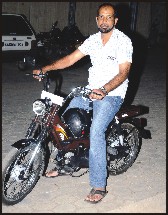
Nadeem Ahmed Khan of Taj Biriyani on Mysuru-Bengaluru highway, out of love for the moped, bought the Luna TFR 49CC moped manufactured by Kinetic Engineering at Kangtani Motors on Chamaraja Double Road bearing Engine No. CJ 13028771 and Chassis No. CJ 03023920 for Rs. 12,000 which included Rs. 1,610 lifetime tax and has got it registered at RTO (East).

In the mid-1980s, the Luna moped from the Pune-based Kinetic Group was a popular brand on Indian roads – a low-cost two-wheeler that helped bicycle riders upgrade to a better mode of transport. It was sleek, stylish, sported a chrome body and had both a regular as well as a pedal kick start.

It was a much sought moped for middle income group as it was giving a mileage of about 40 to 50 km per litre with a speed of 50 km per hour. The customers had to wait for months for the moped to be delivered to them after booking it.

With the advancement of science and technology in automobile sector and new vehicles with latest technologies being launched, the demand for Luna decreased or almost stopped which made the manufacturer stop producing the moped.

Nadeem, speaking to Star of Mysore said that he bought the moped out of love towards it and added that money was not a concern to him as the moped would not be available in the market anymore.

He said that he would keep the moped at his house and would use it occasionally.

It may be recalled that Nadeem had got a sheep from Australia during last Bakrid, had also purchased a huge sea fish and lobsters to serve for his customers at Taj Biriyani.

source: http://www.starofmysore.com / Star of Mysore / Home> General News / March 10th, 2015

Biriyani that Royalty relishes

Created at Sri Kanteerava Narasimharaja Wadiyar Sports Club, Mysuru

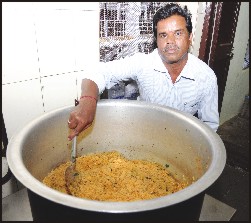
Narayan is seen preparing the famous mutton Biryani at Mysore Sports Club

by S.N. Venkatnag Sobers

In his recent interview to The Sunday Times, Yaduveer Krishnadatta Chamaraja Wadiyar, who has been adopted to the Mysore Royal Family of Wadiyars, when asked about his favourite food said, ‘‘I cannot say I have a favourite. But, if cornered, I would probably have to go with the famous Biryani from the Mysore Sports Club.”

In fact, he is not alone. Thousands of Mysoreans have been relishing the famous mouth-watering mutton biryani at the Mysore Sports Club over the past few decades.

The man behind the famous mutton biryani is Narayan, who has been working at the Mysore Sports Club for the past 32 years. Wanting to discover the man who created a Biryani that satiated the royal palate, Star of Mysore went to Sports Club to talk to this master chef. He is Narayan.

Speaking to Star of Mysore, Narayan said that members of the Royal Family including late Srikanta Datta Narasimharaja Wadiyar, Chaduranga Kantharaj Urs, Gayathri Devi, Yaduveer Krishnadatta Chamaraja Wadiyar and others were fond of the biryani cooked by him.

Mysore Sports Club introduced Mutton Biryani to its guests in 1989 and since then, it has been relished by many. Earlier to this, cooks from outside were invited to prepare biryani during events organised at the club.

Narayan said that he learnt the art cooking biryani through his guru Abdul Sattar, who lived in Mandi Mohalla.

“When I joined the Sports Club as a kitchen assistant, the then Secretaries B.A. Nanaiah and Dr. N.M. Srinivas encouraged me to learn the art of cooking biryani and since then, I have been cooking the delicacy,” he said.

Speaking about his cooking style, Narayan said that he starts preparing for biryani at around 12 noon by marinating mutton and adding necessary masala. Once the mutton is cooked, the half cooked basmati rice is added to mutton and is kept for blending for about one-and-a-half hours. Later, the hot biryani is served to the guests at the Club from 7.15 pm.

Everyday around 15-20 kg mutton biryani is prepared at Mysore Sports Club and not bit of it remains in the end. In fact, the biryani is so famous that even the non-members of Mysore Sports Club do not miss out a chance tickling their taste buds whenever they get an opportunity to visit the club. In fact most of the non-members demand the club members not to book them rooms at the Club but for a parcel of mutton biryani.

Given an opportunity, one must visit the Mysore Sports Club to savour this gastronomic delight.

source:http://www.starofmysore.com / Star of Mysore / Home> Feature Articles / Thursday – March 05th, 2015

American ‘bansuria’ revives his Bong links

Kolkata :

He was born in Woodstock and became a raga exponent in Kolkata, his bansuri featuring in a Grammy-winning album and Oscar-winning film along the way.

Flautist Steve Gorn is in town to perform at a concert presented by Calcutta Classical Guitar Society in association with Flute Lover’s Association on Wednesday.

Gorn had first come to India in 1970. He visited Kolkata a year later. “I had a Western music background. My father was a pianist and I played jazz saxophone and Western flute. During the late 1960s, though, many in our generation got influenced by Ustad Bismillah Khan’s shehnai. I came to Varanasi to explore Indian classical music and even tried the the shehnai. But since I was already playing the flute, I shifted to bansuri,” he said.

Gorn next travelled to Kolkata and began learning bansuri from Gaur Goswami, a disciple of the legendary Pandit Pannalal Ghosh. “I stayed around Gariahat and would take a tram to Shyambazar. That year, 1971, was a troubled time because of the Bangladesh war. Bombs were going off, curfews were imposed and thousands of refugees strea- med in. But I was young and couldn’t gauge the political situation. Now of course I know things better,” he told TOI.

“But back then, the music used to be a lot different from what it is now. Kolkata had an old-world charm and the music I love comes from that era — the music of stalwarts such as sitar maestro Pandit Nikhil Banerjee. For me, it is the ‘bhav’ or ‘ras’ of Indian classical music that is more important than anything else,” he said.

By 1972, Gorn and his wife had spent about 16 months in India. Then came a long gap and he returned again in 1986. “But Indian classical music continued to influence my compositions for films, dance shows and theaters,” he said. It also took him around the globe. Last year, he performed in China, Japan, Bulgaria, Czech Republic and Holland. “That’s why I speak only smattering of Hindi and Bengali,” he says apologetically.

Pandit Hariprasad Chaurasia heaps praises on Gorn. “He is a very good musician and a nice human being. We are very good friends and I have visited his home many times,” the flute maestro told TOI on Tuesday.

In 2004, Gorn played the flute for “Born Into Brothels” which was shot in Sonagachi and bagged an Oscar. “One scene is very close to my heart — a boy flies a kite and the flute melody also rises with its flight,” he said.

In 2011, he featured in the Grammy-winning album “Miho – Journey to the Mountain”. “Dhruba, the nephew of Pannalal Ghosh, played sarangi in the album. Miho is a museum in Japan and the music director was invited to visit and create music reflect the Asian artworks that were on display,” he told TOI.

Gorn has also been a part of several Grammy-nominated albums, including two this year.

source: http://www.timesofindia.indiatimes.com / The Times of India / Home> City> Kolkata / by Shounak Ghosal, TNN / March 11th, 2015

Mourners’ merry memories of Meena Shah; Lucknow’s Padma Shri Shuttler Passes Away

Lucknow :

Her curly hair swayed and sari fluttered in the air as she rode down Hazratganj, on a bright green Vespa scooter, back in the 1960s. This is the picturesque memory of ace badminton player Meena Shah several Lucknowites shared on Tuesday, after she breathed her last, early morning following a cardiac arrest at a city hospital. She had just celebrated her 78th birthday on January 31. At a time women could not move out of the four walls of the house, Meena flicked her wrist effortlessly with a badminton racket in hand. Unmarried, the Muslim woman taught the game to three generations of her friends and their families.

An Arjuna awardee and Padma Shri recipient, Shah ruled the badminton circle for several years. Winner of the singles title in the Senior National Badminton Championships for seven years in a row (1959-1965), Meena was among the first Indian women in sports. She had also won the women’s doubles title thrice and the mixed double’s crown twice. Shah had also been conferred with the prestigious Uttar Pradesh Laxman Award.

“Meena and I have been friends since 1960 and since 1979 and I had been taking care of Baby as I used to call her fondly,” said Mauveen Shaw, who had been her support at their home in Qaiserbagh, recalling how Shah would help any stray animal. “I remember we saw an injured horse lying on the pavement around Parivartan Chowk area. Everyday both of us took grass from La Matiniere Girls College, where I taught and we fed the horse. For the next few days, every time the horse heard the scooter horn, it would neigh in response,” shared Meena’s closest friend. There were times Meena would forget to refuel the scooter and stranded till the next fueling station, they would drag the vehicle to the horse, added Shaw.

“We used to play gulli danda together at the Lalbagh grounds, even before we were coached by T N Seth for badminton around the same time,” said Shah’s childhood friend Ann Marie Kalra, adding, “With one agile movement of her wrist, she would make her opponent run across the entire court, running and gasping for breath, while she stood there smiling triumphantly.” Ann’s daughter Jaya Kalra said, “The scooter was called ‘Chhappan battees’ by everyone in the social circle, and she would always take along more than three people on it at a time. I remember the times when because of her illness in the later years, she would tie the shuttle to a thread on the clothes line and keep hitting at it. She could not walk without support at that time, but her love for the game was phenomenal. She taught everyone and children she loved most.”

Recalling the first time he saw Shah playing at the Asian Badminton Championship held in Lucknow, retired officer K K Bali said, “She was playing there with the likes of Nandu Natekar, Suresh Goel and if I remember correctly, Prakash Padukone. Her heavy frame never came in the way of her game. She had racy movement and fast reflexes.”

Mohammad Haider, head, legal and regulatory affairs in a private telecom major said, “I remember being taught by her in the badminton court outside her house. Her turns and technique were sharp.”

An admirer Rana Safvi recalled, “I had met her in school when I was in class VII. She was an icon, not just for budding badminton players, but for all women of that time.”

‘Loss for entire baddie frat’

President of the Badminton Association of India (BAI) Akhilesh Das Gupta condoled death of Padma Shri Meena Shah on March 10. Gupta said it was a loss not just for Lucknow but for the Indian badminton fraternity. General secretary Vijai Sinha informed that two minutes of silence were observed at BBD Uttar Pradesh Badminton Academy, as a tribute to the seven times senior national badminton champion.

source: http://www.timesofindia.indiatimes.com / The Times of India / Home> City> Lucknow / by Yusra Husain, TNN / March 11th, 2015

‘RSN Memorial Award’ for Freedom Fighter

Ramashesh and Sanjhi Artist Huseni

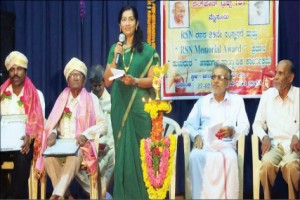
Zoo Authority of Karnataka (ZAK) Chairperson Rehana Banu is seen delivering inaugural address during the award function organised by R.S. Naidu Art and Cultural Welfare Trust in memory of Freedom Fighter R.S. Naidu at Nadabrahma Sangeetha Sabha in city recently as Sanjhi Artist S.F. Huseni, Freedom Fighter M.R. Ramashesh, Brahmana Association Chairman Raghuram and R.S. Naidu Trust President P.Y. Venkatadri look on.

Mysuru :

Freedom fighter M.R. Ramashesh and Sanjhi Artist S.F. Huseni were conferred with ‘RSN Memorial Award’ at a programme organised by R.S. Naidu Art and Cultural Welfare Trust in memory of freedom fighter R.S. Naidu at Nadabrahma Sangeetha Sabha in city recently.

Speaking after inaugurating the programme, Zoo Authority of Karnataka (ZAK) Chairperson Rehana Banu said, “Many artists across the country have contributed in their respective fields despite lack of encouragement and recognition. They should be lauded for their commitment and passion. We should encourage the artists through felicitation programmes.”

After the award function, Indu Shekhar and Troupe presented a musical programme.

Renowned artists of Mysuru and Bengaluru sang the old film songs sung by P.B. Sreenivas, S.P. Balasubramanyam, P. Susheela, S. Janaki and others. They even sang the songs from the movies of Dr. Rajkumar, Dr. Vishnuvardhan and Puttanna Kanagal.

The following songs were sung on the occasion: ‘Hindusthanu endu mareyada…’ from the movie Amrutha Ghalige, ‘Snehada kadalalli…’, ‘Aseya bhava olavina jeeva’, ‘Karunada thayi’, ‘Haadu haleyadaadarenu’, ‘Jeeva veene needu midithada sangeetha’, which made the audience to travel down the memory lane.

Mike Chandru compered the musical programme.

Singers including Indrani Anantharam, CFTRI Krishnamurthy, KEB Gangadhar, Srinivas Hemanth, Vijayanand, Joyce Peters, Anantharam, Kiran Kumar, Geethalakshmi Keni, Vijay Manasa and others took part in the function.

R.S. Naidu Art and Cultural Welfare Trust President P.Y. Venkatadri and Trustee M.K. Ramesh; K. Raghuram, Chairman, Brahmana Association; Mysuru Anand and Parthasarathy were present on the occasion.

source: http://www.starofmysore.com / Star of Mysore / Home> General News / Wednesday – March 04th, 2015

Disciplined Shami is a coach’s delight

ShamiMPOs10mar2015

Adelaide :

For Mohammad Shami, who destroyed the West Indies top order at the Western Australia Cricket Ground (WACA) on Friday, it was a great moment. Former Indian captain Sourav Ganguly, who had played a vital role in his success, was watching him perform from the commentary box.

Shami, whose parents hail from the north Indian state of Uttar Pradesh, got selected into the Bengal team in 2010 due to Ganguly’s initiative. It was Shami’s dream to be at the nets and bowl to Ganguly and on Friday, he had Ganguly praising the strapping seam bowler for his haul of three for 35. 

Many couldn’t believe that it was an Indian pacer who was making West Indies batsmen struggle when Shami kept beating them repeatedly with tight line and movement. The fact that he was returning from an injury was not at all visible in his bowling. In fact, he recovered in time for the match with an ultrasound-guided injection.

Speaking to BCCI tv, Shami revealed how difficult it was not be carried away by the bounce of the WACA wicket and hit the right spots. “It was really important not to get carried away by the bounce. Since the wicket had so much of bounce on it, the pacers tried to bang a lot of deliveries short and in the bargain couldn’t help but give away wides. In our case, we were getting a lot of wickets by bowling short and we wanted to use the bounce. We would not have wanted to give that many away but we were getting wickets off those bouncers,” he said.

http://gulfnews.com/sport/cricket/world-cup/india/disciplined-shami-is-a…

News from e-generator.net

source: http://www.siasat.com / The Siasat Daily / Home> Sports / Sunday – Monday 08th, 2015

Now, a women’s sport too

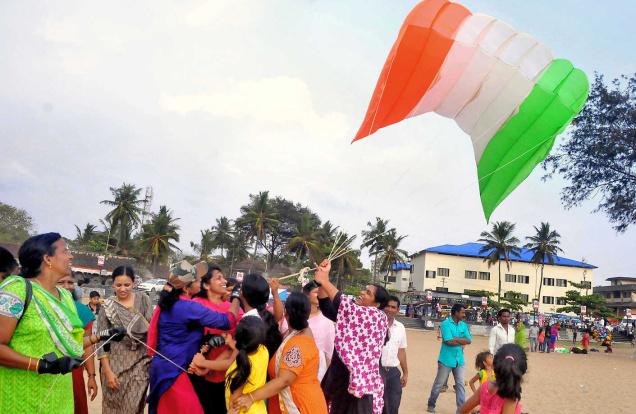
Women, who participated in the kite flying training programme on Sunday on Kozhikode beach, trying to control a kite.— Photo: K. Ragesh

It takes eight to 10 men to control the 1,000-kg circular kite of the One India Kite team. Founder of the team Abdulla Maliyekkal was quite apprehensive when he gave the reins of the kite to a group of women . His apprehension was not misplaced considering how the women struggled with it initially, but it gave way to happiness watching the first professional all-women kite team in the country take form.

The team named ‘Incredible India’ was launched on the Kozhikode beach on Sunday, on the occasion of International Women’s Day.

Training in style

Supported by their parent group One India Kite Team, the women who have undergone training in the nuances of kite flying, took off in style flying the Circular kite and the Kathakali kite amidst the curious Sunday crowd on the beach. “This is the most relaxing experience I have ever had. Controlling a kite is not child’s play. It takes great coordination and team work. Hence while flying the kites, we forget everything else,” said Mini Nair, team captain.

The team now plans to take part in kite festivals across the country and abroad where they plan to present some kites of their own.

As part of the launch of the women’s team, the One India Kite Team, in association with the women’s wing of Junior Chamber International, Calicut, had organised a kite-flying training programme for women, which was attended by 25 women. “The training was given by expert kite flyers Abdulla Maliyekkal, Hashim Kadakkalakam and Shyam Padman.

source: http:// www.thehindu.com / The Hindu / Home> News> National> Kerala / by Aabha Anoop / March 09th, 2015

Meet the Muslims who make ‘Holikas’ for Holi eve

Meerut:

Nine months ago, Teer Gran in Meerut was in the news for all the wrong reasons – communal clashes had broken out, claiming one life. Several people were injured. Few are aware, however, that Teer Gran is home to the Muslim families that make the colourful Holikas that Hindu communities traditionally burn on Holi eve. This locality is also called ‘Holi Mohalla’.

Around 25 Muslim families here make more than a 1,000 Holikas which find their way to various west UP cities besides Meerut. Mohd Yunus, 50, has a small shop near the lane leading to Bhairon Temple. On Tuesday, there were numerous life-size effigies, decked up and colourful, with feminine features, lining his shop.

“Holika symbolizes victory of good over evil. Hindu legend has it that after demon king Hiranyakashipu demanded that he be worshipped, his son Prahlad remained defiant, and said he would only worship Lord Vishnu. The king’s sister Holika, on instructions from her brother, attempted to burn Prahlad alive by taking him in her lap and sitting on a pyre. Holika had a magic shawl with which she could save herself from burning. She hoped her nephew would be reduced to cinders. When the fire was set, however, the shawl flew and enveloped Prahlad instead. Holika was burnt to death. Prahlad escaped unhurt,” Yunus explains.

For generations, Yunus’ family has been making effigies of Holika that are burnt on the eve of Holi festivities.

“We have no records, but for hundreds of years our family has been making these effigies.” There are about 25 Muslim families that make Holikas in Holi Mohalla. The effigies are made with waste paper, masks and colours.

Shaukat Ali, another resident of the area, said, “We need to make about 1,000 Holikas every year. These travel to Muzaffarnagar, Baghpat and Muradnagar.”

The Holika effigies are the work of entire families. With time, interestingly, volumes have grown. Mohd Wasim, an effigy maker, said, “Earlier, communities would select one place to burn the Holika, which was made on order, and would be quite tall and expensive – we have made effigies 20 feet tall, costing about Rs 2,000, at least. Now, as cities have expanded, even small colonies have their own Holika burning ceremony. Volumes have grown, but the size of each Holikas has shrunk. These days, we make Holikas about five feet tall, costing about Rs 250 each, at most.”

While the Muslim families here make Holikas ahead of Holi, they also make effigies of Ravana ahead of Dusshera. “The Ravanas are rather more difficult to make. For the rest of the year, we make decorations for temples and mosques,” Wasim said.

Asked of his experience during the riots last year, Yunus said, “Buddhi bhrasht ho jaati hai logon ki (people go out of their minds) in time of riots. No one wants riots. These are all politically motivated, and everyone only suffers a loss. Thankfully for us, every time communal tension happens here, Hindu friends ask me to move to a safer place and take responsibility for my shop.

source: http://www.timesofindia.indiatimes.com / The Times of India / Home> City> Meerut / by Sandeep Rai / March 03rd, 2015

Sommer House: Tales from the jazz age

SommerHouseBF09mar2015

Bengaluru: 

Back in the 1950s, when Bangalore was like something out of a F. Scott Fitzgerald bok, Whitefield was a small township on the outskirts of the city. On arriving at the railway station, one took a horse-drawn carriage home through the small, winding streets. It wasn’t long, however, before development put paid to much of that old world charm.

The Sommer House, a colonial bungalow that has been restored to its former beauty by long-time resident Sulaiman Jamal, aims to recreate some of that old world charm. Thrown open to the public on Monday evening, as a community center that gives senior citizens and retired army officials that long lost society whirl, Jamal, whose association with the area began when he set up his factory there said: “We have lived in Whitefield for ten years now, but when I first visited, it was a pretty wild place,  Every six months, another bungalow would be torn down.”

The two-bedroom gabled roof Sommer House, bought two years ago by Jamal, replete with antique furniture, is home to a piano that belonged, back in the day, to the Defence Services Cinema. The cottage, sits surrounded by a garden, with restored vintage cars dotting the property.

Jamal would like the House to host programmes like piano nights, dancing, catered dinners and plays. Most importantly, it will also have a free catered dinner every month for senior citizens.
Beth Chapman, Pre­sident, Overseas Women’s Club, has helped put Sulaiman’s ideas in motion.

“I’m always looking for old bungalows and the stories that surround them,” she said.
“The house is opposite Forum Value Mall and people expected a superstructure here,” Sulaiman explained. “They wonder what the catch is, but there is none. We want the people of Whitefield to feel a sense of belonging with what is now a community center.”

source: http://www.deccanchronicle.com / Deccan Chronicle / Home> News> Current Affairs / DC / Darshana Ramdev / June 18th, 2013