All posts by mpositiveone@gmail.com

Digi life for old records

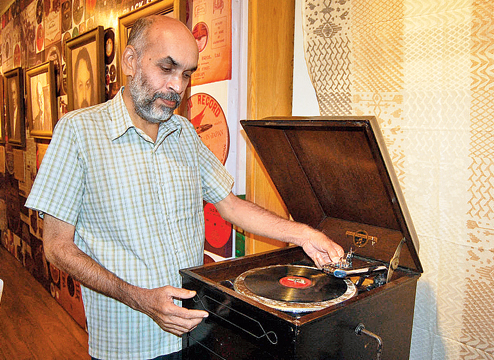
Suresh Chandvankar at the inauguration of the digitising centre at Weavers Studio. Picture by Bibhas Lodh

If you have inherited a collection of old gramophone records you have no idea how to preserve or perhaps even where to play, this is the address where to head. Weavers Studio Centre for the Arts has opened a digitising centre in its gallery space in Ballygunge Place where old and rare records are being digitised.

“We want collectors to come forward. We will digitise and archive their records and return the discs to them along with a CD of what we archived. We have started with 400 records and can digitise two records per day,” said founder Darshan Shah. Early 20th century single-sided cardboard Nicole, shellac Pathe, paper records and pre-World War I Beka-Grand records form part of their acquisition, sourced from flea markets. “We are working on a wide range of genres — Hindustani and Carnatic classical, folk, early film or theatre music, Bengali songs and speeches of leaders,” Shah added.

The centre wishes to disseminate the digitised content among music lovers and researchers through audio-visual exhibitions, listening kiosks and portals, guided listening sessions etc. It has set up a permanent listening facility for visitors to enjoy the digitised sound, on two computers with headphones and 10 Android phones gifted by Tata Docomo. On each phone, close to 150 audio clips have been uploaded, which are being changed depending on the theme of the exhibition organised most recently by the centre. “We can take the phones to schools or to other cities when we hold travelling exhibitions,” Shah said.

Schools are also being invited to send students over to experience India’s audio history. One can walk in and listen to any of the digitised material like the “Tryst with destiny” speech of Jawaharlal Nehru or Swami Vivekananda’s Chicago address, or voices of Subhas Chandra Bose and Mahatma Gandhi. There are also 70 versions of Vande Mataram. The listening facility is available on weekdays, 3pm to 7pm.

The centre was inaugurated by Suresh Chandvankar, the secretary of the Society of Indian Record Collectors in Mumbai. “In Calcutta, where India’s first commercial recording was done in 1902 by Gauhar Jaan for The Gramophone Company, there are people with knowledge in the field but not many are ready to come forward and share it. This is the first time that a digital archive is being set up and exhibitions on records being held by a private body unsupported by the government,” said Chandvankar, who has bought an apartment on the outskirts of Mumbai just to store his collection of records.

Even after a record has been digitised, Chandvankar argues for its preservation. “Digital can never replace the physical form. When a new technology comes, the physical recording will be needed again.”

The future of preservation, he believes, is a virtual archive. “Put all digital material on Cloud. And for outreach, the best channel is social media,” he advised. “But when it comes to sound quality, aficionados abroad are getting tired of the digital sound. So a revival of the disc is on the cards. In fact, many of my collector friends believe that the 78 rpm disc has the best sound quality.”

source: http://www.telegraphindia.com / The Telegraph, Calcutta / Front Page> Calcutta> Story / by Sudeshna Banerjee / Sunday – November 16th, 2014
Prez’s doc recalls days at GSVM

An alumnus of Ganesh Shankar Vidyarthi Memorial Medical College, Padma Shri Dr Mohsin Wali needs no introduction.

He has the distinction of serving three presidents, including Pranab Mukherjee, as physician.

At the age of 33, he became the youngest ever physician to the then president R Venkataraman and later Shankar Dayal Sharma.

Besides, he was also appointed to serve the family of former president Zakir Hussain. He was in the city to deliver a talk in the national conference — Wellness Con-2014 – organized by CSJM University’s Institute of Health Sciences on Saturday. Later, he spoke at length with TOI about his days spent in the city, his selection as President’s physician in 1990 and his experiences in the Rashtrapati Bhawan. “In 1990, I was working with Ram Manohar Lohia Hospital in Delhi. One day hospital CMS called me to inform that he has recommended my name as physician to the then President Venkataraman.

I was shocked. But the biggest surprise was my appointment for the same.

Even my wife Naaz did not believe me and said that I cannot be appointed to such a high post and I merely said that it is an exception,” said Dr M Wali with a broad smile on his face.

During interview, the then president Venkatraman asked him as to how would he treat him and Dr Wali replied, “Sir, I will treat you like any other patient while maintaining dignity for you in my heart.”

This clinched his selection, added Dr Wali, who also had to appear before another president Shankar Dayal Sharma for an interview before been appointed as his physician.

Dr Wali also claimed that he took care of medical problems of former prime minister VP Singh for 15 years.

Recalling his days at GSVM Medical College, Dr Wali said, “I used to stay in room number 108 on the third floor. I was interested in surgery so I used to lurk around operation theatres even at 2am. My sincerity attracted the attention of my seniors and I got a chance to get involved in operations despite being a third year MBBS student.” His hard work earned him seniors’ respect and he was allotted a hostel room with PG students despite pursuing MBBS (graduation course).

Dr Wali is the first doctor in his family. “My maternal uncle motivated me into becoming a doctor,” he said.

A meritorious student since school days, he cleared medical entrance exams of Agra and AMU medical colleges too but opted for GSVM for his MBBS and MD courses.

Dr Wali has been discharging his service since June 1980 and is known for working beyond the call of duty. He also treats staff of the Rashtrapati Bhawan which he is not entitled to. “I treat them because they come to me. That’s my duty and I cannot run away from it,” said Dr Wali.

source: http://www.timesofindia.indiatimes.com / The Times of India / Home> City> Kanpur / by Abhinav Malhotra / November 17th, 2014

Expo on lost Kalamkari textile in city

Kolkata :

They had originated and proliferated in India, possibly in Tanjore, in the late 16th or early 17th century under the patronage of the Mughal emperors. But, with the passage of time, Kalamkari paintings on textiles faded into oblivion.

Thousands of miles away, a museum in France on the Swiss border has preserved some of the oldest specimens of Kalamkari paintings on textiles. These are very rare to find even in museums within the country.

For a fortnight starting on Wednesday, the textile gallery of the Indian Museum will showcase the world famous ‘Tapis Moghol’ — some of the most elaborate designs replete with mysterious animals, birds, foliage and flowers — that hold the key to many stories of the times. The ‘Tapis Moghol’, that dates back to the late 16th or early 17th century, has been preserved for the world at the En Musea De L’Impression Sur Etoffes De Mulhouse or the Museum of Printed Textiles at Mulhouse, France.

Kalamkari paintings in its earliest form were motifs painted on large wall hangings that were used to decorate the altar behind the deity. Kalamkari, though, is not a lost art form in the sense that it is still practised in both the painted and block printed versions. But, we have lost most of the original designs that were popular when it was used as an altar backdrop in South Indian temples.

“A gentleman called Funffrock, who was an employee of the French East India Company, was posted in Tanjore. The Frenchman was immensely interested in the traditional art form and got a cotton cloth, measuring eight feet by eight feet, done up with rich intricate designs that showcased the best motifs of that time. With time, this became the focal exhibit, around which the other collections of the period grew. The exhibition will give the city a glimpse of the Funffrock collection,” explained Ruby Palchowdhury, spokesperson of the Crafts Council of West Bengal, which is a wing of the Crafts Council of India and is funded by the Centre.

Textile and culture ministries and the Alliance Francaise have funded the expo that will have 25 panels to show off design details and the stories underneath. The exhibition has been curated by ethnic historian Lotika Varadarajan.

source: http://www.timesofindia.indiatimes.com / The Times of India / Home> City> Kolkata / by Jhumli Mukherjee Pandey, TNN / November 16th, 2014

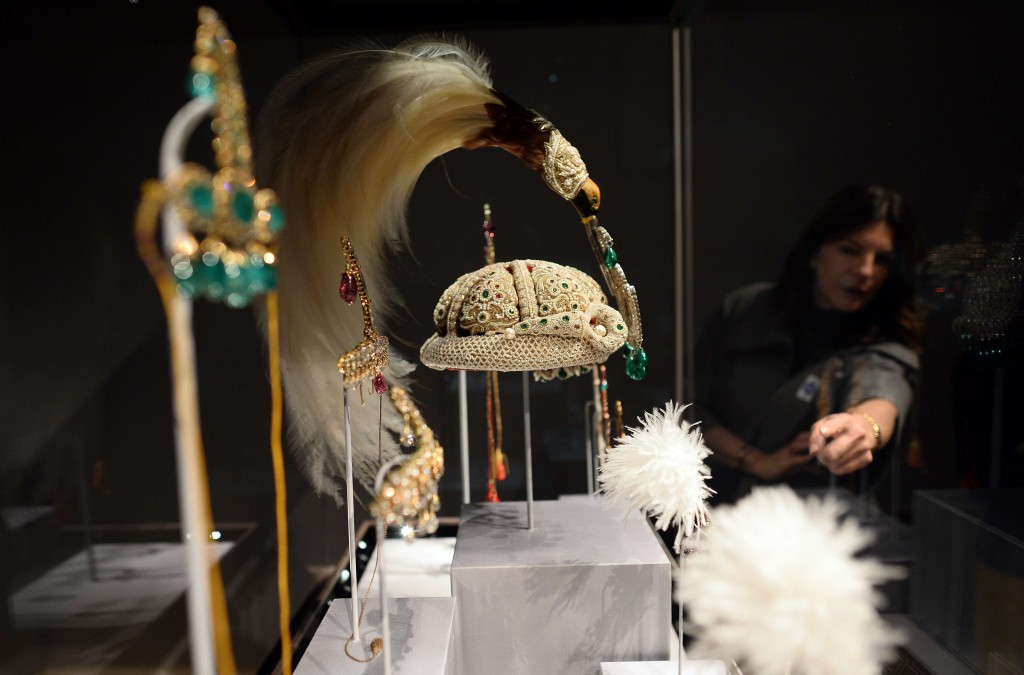
Rare Mughal-era jewels go on display at New York exhibit

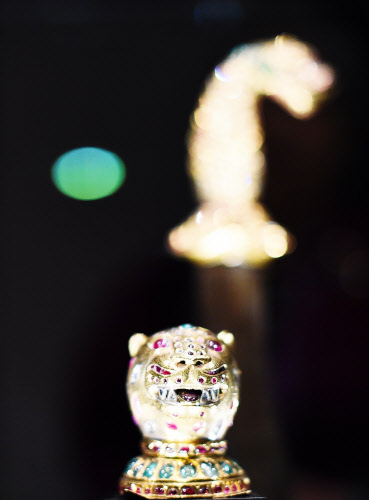
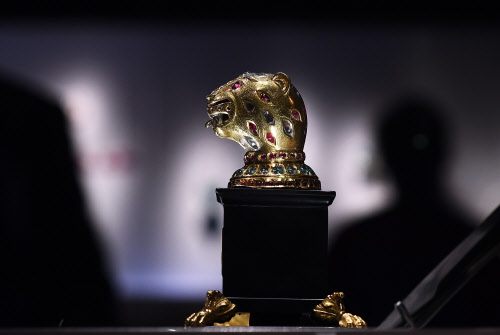
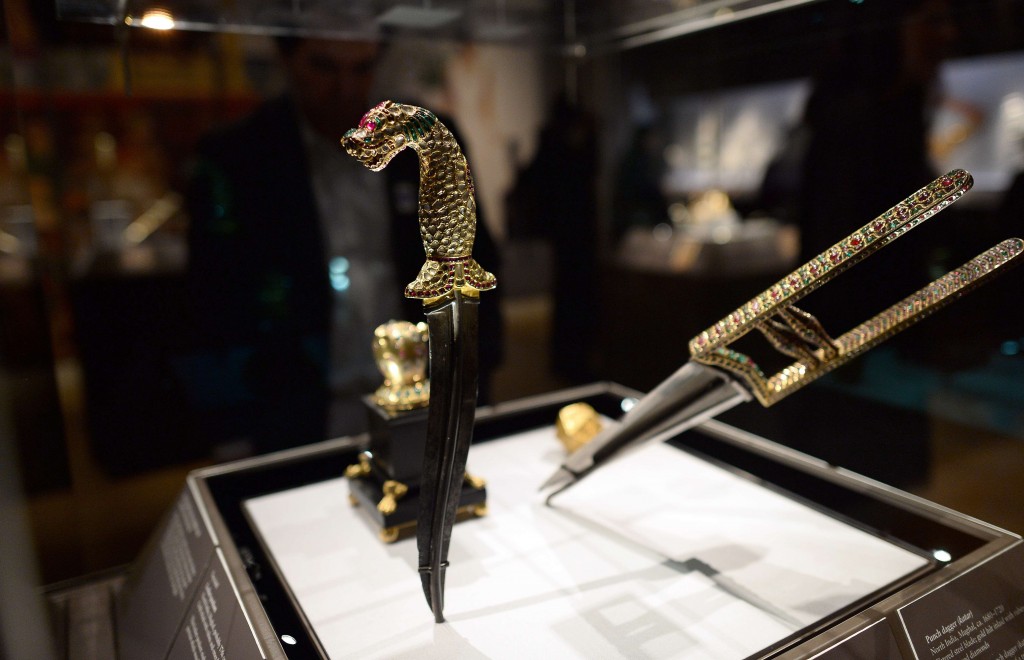
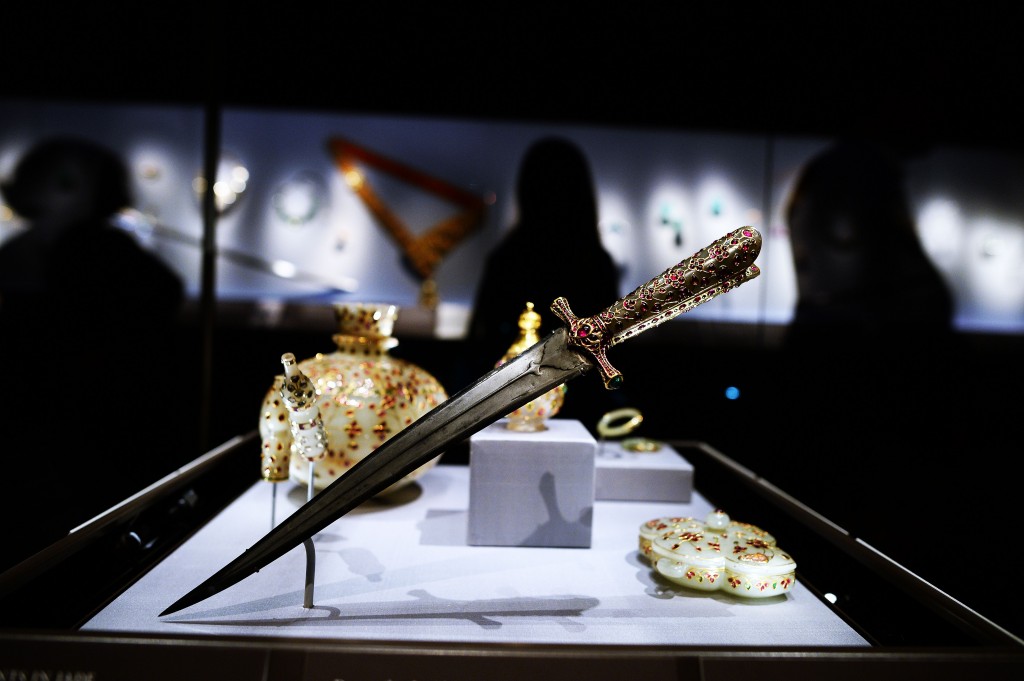
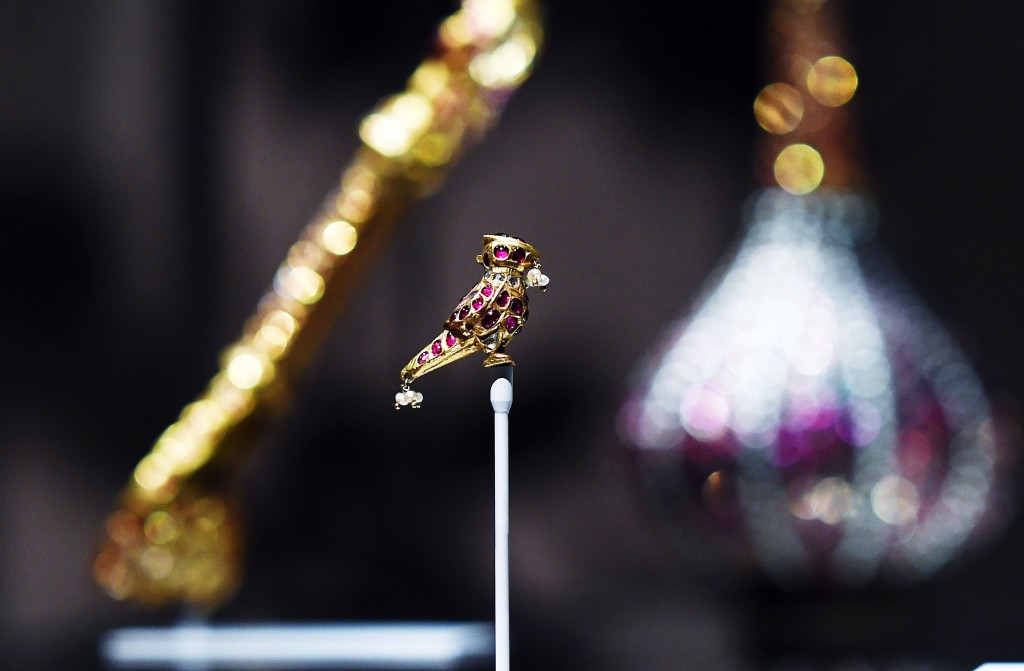
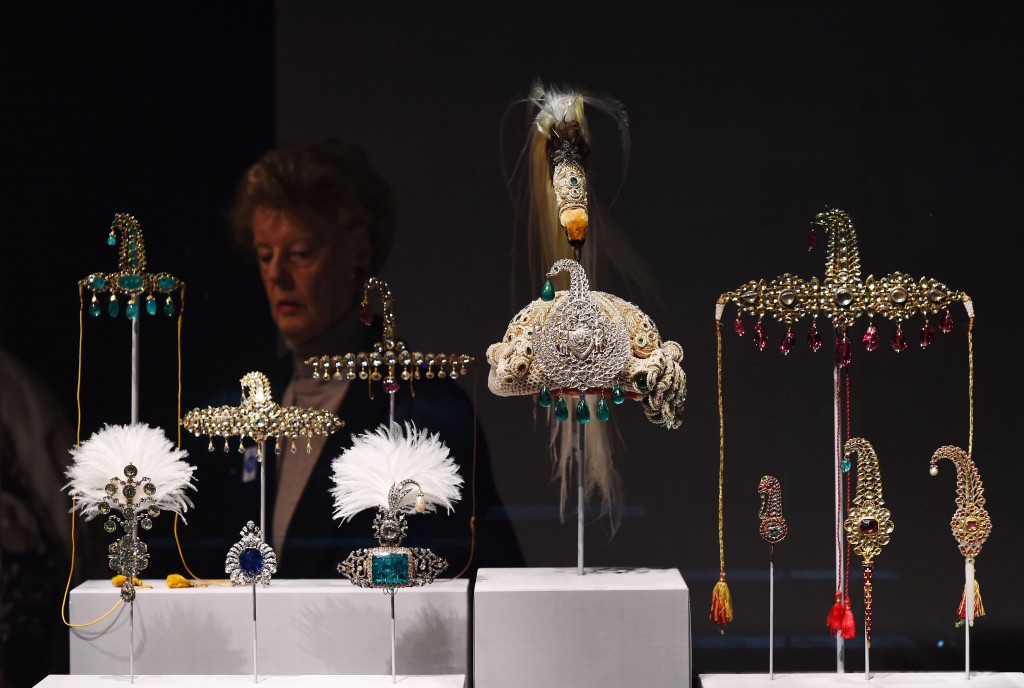
About 60 jeweled items, including a gem-set tiger head finial originally from Tipu Sultan’s throne and a jade dagger owned by Mughal emperors Jahangir and Shah Jahan, has been displayed at an exhibition at the prestigious Metropolitan Museum of Art.

Photo01MPOs17nov2014

The objects are from the private collection formed by Qatar’s Sheikh Hamad bin Abdullah Al-Thani and will be presented at the museum in the exhibition ‘Treasures from India: Jewels from the Al-Thani Collection’ opening October 28 till January 25.

Photo02MPOs17nov2014 

The display includes historical works from the Mughal period in the 17th century and from various courts and centres of the 18th and 19th centuries, including Hyderabad.

Photo03MPOs17nov2014

A highlight of the exhibition, made possible by iconic jewellery designer and manufacturer Cartier, would be a gem-set tiger head finial originally from the throne of Tipu Sultan that incorporated numerous cabochon diamonds, rubies and emeralds in a kundan setting.

Photo04MPOs17nov2014

Among the Mughal works will be a jade dagger — originally owned by two emperors — the hilt was made for Jahangir and it was re-bladed for his son Shah Jahan, who built the Taj Mahal.

Photo05MPOs17nov2014

In the 19th century, the dagger was in the collection Samuel Morse, inventor of the Morse code.

Photo06MPOs17nov2014


Photo07MPOs17nov2014

(Courtesy: PTI and AFP)

DISCLAIMER : Views expressed above are the author’s own.

source: http://www.blogs.timesofindia.indiatimes.com / The Times of India / Home / Team TOI in The Photo Blog / October 28th, 2014

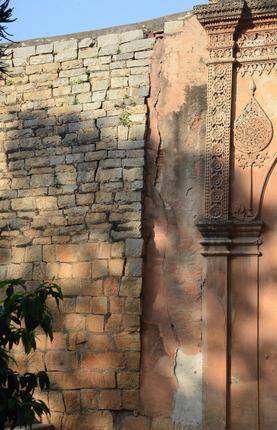
Cracks in Tipu’s fort

Karnataka : Bengaluru : 15/11/2014 . Crack on the wall of Tipu's fort near K R Market in Bangalore on 15th November 2014 . Photo : Bhagya Prakash K
Karnataka : Bengaluru : 15/11/2014 . Crack on the wall of Tipu’s fort near K R Market in Bangalore on 15th November 2014 . Photo : Bhagya Prakash K

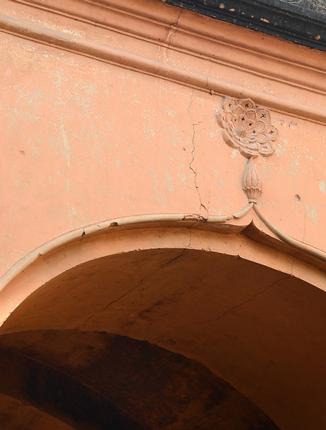
Once the nucleus of an ambitious plan to build a new city – Bengaluru – by the city’s founder Kempe Gowda, Tipu Sultan Fort or Bangalore Fort today is a far cry from its former state of glory. Visitors are now greeted by cracks that have developed in the fort walls above the temple that one sees after entering the protected monument nestled in the busy K.R. Market area.

The cracks, it is learnt, appeared recently although the fort was restored only two years back. The Archaeological Survey of India (ASI) officials blame it on the age of the monument. “Essential steps for its conservation were taken two years ago, but there are no major plans as of now,” an official said.

Karnataka : Bengaluru : 15/11/2014 . Crack on the wall of Tipu's fort near K R Market in Bangalore on 15th November 2014 . Photo : Bhagya Prakash K / The Hindu
Karnataka : Bengaluru : 15/11/2014 . Crack on the wall of Tipu’s fort near K R Market in Bangalore on 15th November 2014 . Photo : Bhagya Prakash K / The Hindu

The ASI will now to analyse the cracks to ascertain their width and depth before taking up conservation work.

Incidentally, the Namma Metro’s underground section, where blasting work had been taken up, passes beneath the fort. However, the ASI official said that the cracks in the fort walls had nothing to do with Namma Metro work.

Meera Iyer, co-convenor, Indian National Trust for Art and Cultural Heritage (INTACH), said there is a need for better maintenance. “There is not much supervision though there are security guards,” she added.

In fact, the ASI has barred access to public to the top portion of the fort, which leads to the dungeon where British prisoners were kept as the space was used for “inappropriate activities” such as gambling.

Ms. Iyer suggested that the fort should be used as public space for cultural activities, like it had been done a couple of times when a music concert and a play about Tipu Sultan were organised. To this proposal, an ASI official said with prior permission from the New Delhi head office of ASI, non-private cultural events can be held.

Historian S.K. Aruni mentioned that restoration of a wall that had collapsed due to heavy rain three years ago may have caused the cracks. “It is natural to see another part develop cracks if restoration work is undertaken,” he explained.

source: http://www.thehindu.com / The Hindu / Home> News> Cities> Bengaluru / by K.C. Deepika / Bengaluru – November 16th, 2014

N.R. constituency gets Rs.3.71 crore for development of 5 schools

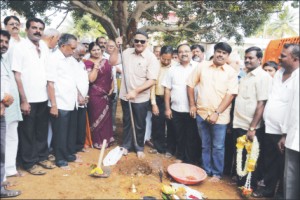
NR MLA Tanveer Sait performed ‘Guddali pooja’ for road development works yesterday in teachers layout on Dr. Rajkumar road , taken up under the CM’s Rs. 100 crore special grant for the city. Corporator Rajani Annaiah, leaders Manjunath, Annaiah and others are also seen in the picture.

Mysuru :

Under the Rashtriya Madhyamik Shikshan Abhiyaan, the Union Minister of Human Resource Development has released Rs.3.71 crore for constructing additional classrooms in 5 government high schools in N.R. Constituency.

N.R. MLA Tanveer Sait on Sunday visited the Government High School at HUDCO layout, Bannimantap and exchanged ideas with officials on the construction of 10 classrooms in the school.

Speaking on the occasion, Tanveer Sait said the school was built 23 years ago and some of the classrooms have become dilapidated over the years. As such, it has been decided to demolish such classrooms and construct 10 new ones at a cost of Rs.76 lakh, and added that the MUDA will rebuild the school’s toilet.

The MLA also said that under the Rashtriya Madhyamik Shikshan Abhiyaan, Rs.43 lakh has been released for construction of 5 classrooms at Nizamia Government High School on Ashoka road, Rs. 76 lakh for construction of 10 classrooms at Government high school, Giriabovepalya and Rs.28 lakh for construction of 3 classrooms at Government High School, Rajendranagar.

Pointing out that MUDA too has come forward for developing the infrastructure in these schools, Tanveer Sait said Nagarjuna construction company has been awarded the contract for the construction of classrooms and toilets in the 5 schools and added that the works are expected to be complete in 4 years. The Abhiyaan’s planning officer Betta Nayaka, MUDA Engineer Veerabhadrappa, Sudhakar of Nagarjuna construction, BEO Susheelamma,  MCC officer Nagaraj,  BJP leader Dhanaraj,  NR Constituency Educational Committee President  Prof. Nabi Jaan,  Secretary  Fayaz Ahmed Shariff and others were present.

source: http://www.starofmysore.com / Star of Mysore / Home> General News / Monday , November 10th, 2014

He repaid debt of 1984 to Muslims

New Delhi :

Harbans Singh was about 30 years old when anti-Sikh riots broke out in Trilokpuri in 1984. Unfortunately, he was just the person the mob was looking out for, and he would have been lynched had not his Muslim neighbours come to rescue by hiding him in a burqa and giving him shelter. Singh said last Thursday it was time for him to acknowledge this debt by opening the doors to his Muslim neighbours who were under threat.

Amid reports of communal clashes in the area, Singh’s was a touching example of solidarity and warmth along with a few others of different faiths.

Block 20, where Singh lives, was where the first instance of violence was reported on Diwali evening. After hearing about large-scale mobilization against Muslims, Singh got in touch with his Muslim neighbours just before stone pelting started.

“It was like 1984 once again when we left our houses and lived with Muslim neighbours. We dared not step outside, and if in desperation we had to, we did so in burqas. My family and I managed to stay alive because of them. So this time I returned the favour,” said Singh.

Mohammed Qurban, who lives in the opposite house, had to lock his door, send his children away and stay at Singh’s. “His presence alone was reassuring. There was chaos all around. We saw people baying for our blood, but to see others not getting in the frenzy and welcoming us to their houses gave us a lot of strength,” said Qurban.

Medina mosque in Block 29 is a 100 feet away from the lane where Qurban and Singh live. It was in the confines of this mosque where some Muslims took shelter during riots. A cleric here, who has barely stepped out since, says Hindu neighbours have often dropped by to check up on him and his community members.

“An unmistakable sense of safety has been instilled in people living here because of our Hindu neighbours. We didn’t interact much earlier but now they come here often to ask about out well being,” said the cleric.

source: http://www.timesofindia.indiatimes.com / The Times of India / Home> City> Delhi / by  Suhas Munshi, TNN / October 31st, 2014

First campus radio is into sixth year

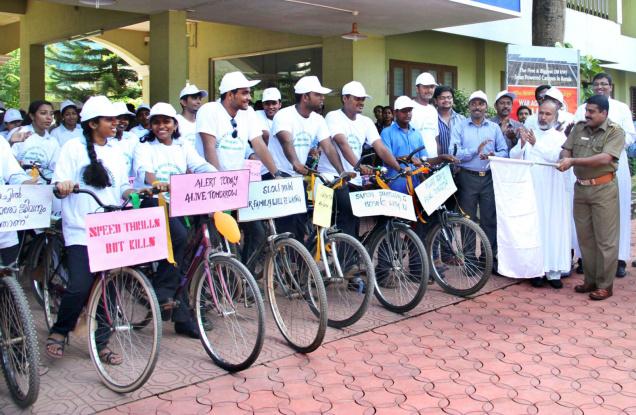
Schoolchildren taking out a road safety awareness cycle rally in connection with the fifth anniversary of Kerala’s first campus-based community radio service, ‘Radio Macfast,’ at Thiruvalla. / by Special Arrangement / The Hindu

Radio Macfast Awards to be presented tomorrow

Home Minister Ramesh Chennithala will inaugurate the fifth anniversary celebrations of the first campus-based community radio in the State, “Radio Macfast-90.4”, to be held at the St. John’s Cathedral Hall in Thiruvalla on Saturday.

According to Fr. Pradeep Vazhatharamalayil, Radio Macfast chairman, Revenue Minister Adoor Prakash will present this year’s Radio Macfast Awards to Kaviyur Sivaprasad, award-winning film maker; Roy Abraham Kallivayalil, global general secretary of the World Psychiatry Association; and Jacob Joseph, social worker who runs a charity home at Othera in Thiruvalla, on the occasion.

Metropolitan Archbishop of Thiruvalla Thomas Mar Coorilos will preside over the meeting.

To be feted

Fr. Vazhatharamalayil said 15 eminent personalities from different walks of life would also be honoured as part of the anniversary celebrations. Those to be honoured are: Kurien Oommen, renowned Chest Physician who has won World Health Organisation award for his contributions to the anti-Tuberculosis drive in the State; A.C. Rajeevkumar, Ayurvedic physician; B.G. Gokulan, Ayurvedic physician popularising traditional ophthalmology across the country; P.N. Suresh, Vice Chancellor of Kerala Kalamandalam Deemed University; Kailash, film actor; K.V. Alexander, sports personality; M.S. Sunil, social worker; C.P. Monai, writer; N. Rajeev, president of Eraviperoor grama panchayat which won the State Award; T.K. Sajeev, president of Kaviyur grama panchayat that bagged the government’s Best Panchayat Award; C.P. Robert, district coordinator of CARD Krishi Vigyan Kendra; Thomas Koshy (Lalan), social worker; Fr Thomas Payyampallil, Bodhana Social Service Society director; and Shaji Paulose, Homoeopath.

Anto Antony, MP, will inaugurate the Radio Village project and Mathew T. Thomas, MLA, will launch the new Radio Macfast Android Mobile Application on the occasion.

Delsy Sam, municipal chairperson; Blessy, filmmaker; and M. Salim, president of of Thiruvalla Merchants Association, will address the function.

source: http://www.thehindu.com / The Hindu / Home> News> National> Kerala / by Special Correspondent / Pathanamthitha – November 14th, 2014

Tipu Sultan birth anniversary

The 264th birth anniversary celebrations of Tipu Sultan has been jointly organised by the office-bearers of Mysore City (District) Congress Committee and KPCC Minority Department at Mysore City Congress Committee office,  Devaraja Market Building, Sayyaji Rao Road, tomorrow at 11 am.

DCC President C.  Dasegowda will preside.

For details, call Mob: 93417-98906.

source: http://www.starofmysore.com / Star of Mysore / Home>In Brief  / Sunday , November 09th, 2014

How Begum Hazrat Mahal got her share of fame

Lucknow  :

Begum Hazrat Mahal’s wouldn’t have been an inspiring tale of patriotism had it not been for Pandit Jawaharlal Nehru. The Royal Family of Avadh is in possession of testimony written by Begum’s descendant Prince Anjum Qader.

Great grandson of Begum Hazrat Mahal, Kaukab Qader was present at function to honour martyrs of 1857 revolution in Lucknow and was saddened that the contribution of his ancestor was second to none, yet she was ignored. He and his younger brother Anjum decided to meet Pandit Nehru. In Anjum’s own confession written two years after Pandit Nehru’s death, “I prepared a memorandum and, picking up our youngest brother Nayyer from Aligarh Muslim University, we arrived in New Delhi on August 15, 1957.”

Their claim to the 1857 legacy made news and attracted the PM’s attention. Anjum was bowled over by Nehru’s ‘disarming charm’. All praises for the Queen of Oudh, he inquired about her grave so that something to perpetuate her memory there could be done. In response, Anjum said it was government’s duty to search for it and honour the Begum’s final resting place. Jawaharlal Nehru frankly admitted the lapse and promised to do the needful.”

The 10-minute appointment lasted for an hour and ended with the family providing the PM some reference material. Two months later, Indian government informed the family that the Begum’s grave was found in Kathmandu city and Indian Embassy in Nepal was taking care of it.

On May 9, 1958, Indian government announced state recognition for 1857 Freedom Struggle leaders including Begum Hazrat Mahal. UP government too promised a memorial. “Although we are not aware of the happenings behind the scenes, Mr. Nehru’s hand could easily be felt in the changed attitude,” Anjum writes. Soon after, the famous Victoria Park in Lucknow was renamed after the nawab begum who never gave in to British. Months later, Nehru held his public meeting in the same park.

source: http://www.timesofindia.indiatimes.com / The Times of India / Home> City> Lucknow / by Shailvee Sharda, TNN / November 13th, 2014