All posts by mpositiveone@gmail.com

Farman Basha wins bronze at Incheon Para Asian Games

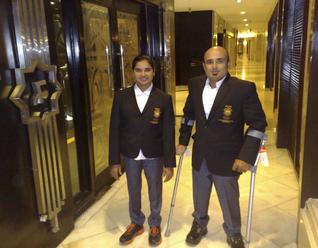
A file photo of weightlifters Farman Basha and Sakina Khatum in Scotland.

‘I owe a lot to my physio, Dr. Rajkumar Amaravathi’

Farman Basha did India proud at the Asian Para Games in South Korea on Sunday by winning a bronze medal in power-lifting in the men’s 49kg category. Basha, a resident of T.C. Palya in the city, lifted 155-kg weight to finish behind Vietnam’s Le van Cong and Iraq’s Mustafa Salman Radhi.

“The competition was very tough. I hadn’t expected a medal. I owe a lot to my physio, Dr. Rajkumar Amaravathi,” he said from Incheon. The 40-year-old made up for the disappointment of Commonwealth Games held in August, when he failed to complete all his lifts. “I was heartbroken after what happened at Glasgow. My shoulder was injured then. But I am better now,” he said.

At the previous edition of the Para Asian Games at Guangzhou four years ago, Mr. Basha had won a bronze medal — later upgraded to silver — in the men’s 48-kg category. “We have only one person as support staff – Mohd. Jawahir Rahi. He too deserves many thanks,” he said.

source: http://www.thehindu.com / The Hindu / Home> National> Karnataka / by Sports Teporter / Bangalore – October 20th, 2014

Ghostly grandeur of Fatehpur Sikri

Fatehpur Sikri :  Revisiting Akbar’s Masterpiece
Lucy Peck , Roli Books, 2014, pp 145, Rs 795

As I flip through the pages of this handy hardcover with its lacy jharokha artwork that recalls the rosy orange sandstone elegance of its subject, my mind rewinds to my own Fatehpur Sikri experience, years back — the ghostly vacant expanse of a Mughal city, a beautiful haunting, desolate oasis of huge stables, green gardens, a musically serene marble mausoleum to a Sufi saint, as well as the high and mighty Buland Darwaza off whose walls boys jumped, for a few paise, into a baoli stepwell all the way below. So it’s been a pleasure to revisit this masterpiece from the 16th century, a period of Renaissance under the relatively benign Mughal, Akbar.

In this new book, architect, conservationist, Mughal-India specialist author Lucy Peck attempts to dispel popular myths that accompany this well-preserved piece of history, the abandoned city of Fatehpur Sikri. The very first page sports an exquisite ‘company’-style painting from 1836, depicting the marble dargah of Sheikh Salim al-Din Chisti, the saint who satisfied Emperor Akbar with the happy prediction of a long-awaited heir (PrinSalim, later to become King Jahangir), and two more to boot. Ironically, this city of victory, an enigmatic, silent, solid, spectator from the past, owes its own birth to the progeny-predicting powers of a Sufi sheikh.

The remaining 130-odd pages are equally satisfactory, glossy and replete with well-researched text, conjectures and surmises, interesting trivia, paintings, maps and excellent photographs, old and new, overall perspectives, as well as close-ups of the designs that grace lintels, awnings, and all the minutiae of mahals adorning a geometrically designed Indo-Persian city.

Peck is on sure ground as she collates information from diverse sources — the skeptical yet informative Muslim cleric Bada’uni, the official biographer Abu’l-Fazl with his Akbarnama and Ain-i-Akbari, Latin memoirist Monserrate — people who lived in Akbar’s court during his reign. Peck also quotes from a few 17th-century European travellers — like Peter Mundy and William Finch. She simultaneously reveals that many travellers’ tales and court records have not survived the centuries.

Unlike historian John Keay, who refers to Fatehpur Sikri as Akbar’s ‘wildest extravaganza and weirdest folly’, Peck is kinder to Akbar. She talks of the ‘romantic enigma’ that was Fatehpur Sikri, a city that was planned and built quickly from 1571 to 1585, and then equally promptly abandoned, as per general belief. Yet, Peck believes ‘that the fable of Fatehpur Sikri’s desertion is misleading’.

The king and his courtiers left, but some ladies of the royal family (including Akbar’s mother) lived on for decades, as did members and descendants of Sheikh Salim Chishti’s family, a few of whom became powerful members of the royal court. In subsequent years, a few became unofficial guides to gullible international travellers who furthered the spread of myths about the city. Lucy Peck attempts to deflate a commonly held myth about water shortage leading to Fatehpur Sikri’s abandonment. She points to the presence of numerous baolis (stepwells), taals and hammams (royal and common baths), as well as the historical reality of later Mughal construction continuing in and around Sikri village that strides a ridge plateau beside a lake (now farmland) formed by the Yamuna basin.
The author transports the reader through Akbar’s world and his times, delineates his character and philosophy personified in his syncretic sect, the Din-i-Ilahi, which was the very touchstone of his own and the new city’s existence. Through his years at Fatehpur Sikri, Akbar became less and less Islamic, more all-encompassing and secular, filling his court with people of diverse faiths.

The visual delight that is Fatehpur Sikri — with its unique architectural specialties like a single central-columned Diwan-i-Khas, the multi-gated three-sided wall, the lesser-known, interestingly named buildings like Samosa Mahal and Tansen’s Biradari — cannot blind one to an important truth: that this city continues to be a holistic experience, traversing the centuries, still speaking to us. And Lucy Peck’s book helps greatly in this process.

source: http://www.deccanherald.com / Deccan Herald / Home> Supplements> Sunday Herald Books / by Lalitha Subramanian / October 19th, 2014
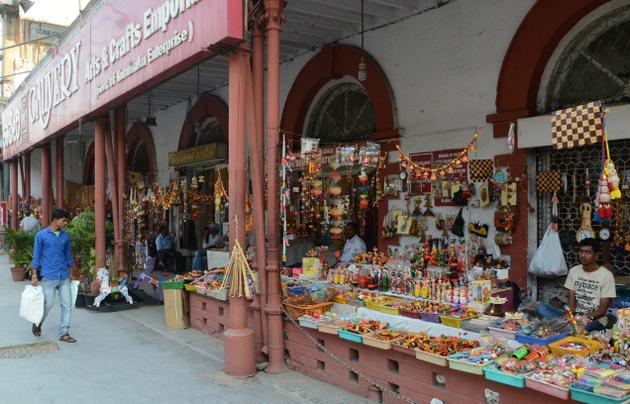
Creators of timeless art pieces struggling with medical bills

CauveryEmporiumMPOs23oct2014

Mir Adil Hussain (55) is an expert at making agarbathi stands, walking sticks and key chains, which have all been displayed and sold at the famous Cauvery Emporium in Bangalore for over 30 years. But now his family has been running from pillar to post to make arrangements for his medical bills after he recently suffered a heart attack.

With no medical benefits or insurance provided to the artisans who toil hard to put up a display at the emporium, Mr. Hussain’s family has had to raise loans to pay for his treatment. His brother, Mir Shabbir Ali, who also worked in the emporium for 45 years, died of cancer this July.

Mir Shabbir Ali
Mir Shabbir Ali

“We spent Rs. 12 lakh on his hospital bills, but were neither reimbursed nor given compensation. A meagre Rs. 5,000 was offered as death compensation and that too two months after he died. There are no pension benefits either,” said Mir Hassan Ali, a family member.

The plight is the same for 140 artisans and their families whose works have impressed thousands of customers at the emporium managed by Karnataka State Handicrafts Development Corporation (KSHDC).

Suresh Pushpangathan, whose father worked as an artisan for 25 years, had to wait till August this year to avail Rs. 5,000 compensation. His father had passed away in November 2013.

“Many artisans’ families are dependent on their work for their bread and butter. If the artisans’ licence or ID card is transferred to another member of their family, they can continue to work there. But, the transfer process just doesn’t progress despite providing all the paperwork,” said Mr. Pushpangathan.

Purushottam L, President of the Karnataka Sandalwood Artisans Association, said that these 140 artisans are treated as individual workers and not permanent employees. “It is a government undertaking and their ID cards are issued by the Small Scale Industries Department. They can work as long as their cards are renewed every year,” he said.

“About 20 acres of land had been allotted to the artisans in 1996 near Peenya by the State government, which had promised to build about 200 houses in a five acre plot, but is yet to deliver its promise.” he said.

However, KSHDC Managing Director G.S. Kariyappa said, “The corporation is not getting grants and is only a facilitator. According to Government of India guidelines, a separate nodal agency has been appointed for the welfare of artisans.”

source: http://www.thehindu.com / The Hindu / Home> News> Cities> Bangalore / by Vinayshree Jagadeesh / Bangalore – October 19th, 2014

73 students from Jamia Residential Coaching clears IAS Prelims

New Delhi:

Seventy Three students from the Residential Coaching Academy run by the Centre for Coaching and Career Planning, Jamia Millia Islamia, New Delhi, have cleared Civil Services (Preliminary) Examination 2014. These students appeared at the civil services (Prelims) examination conducted by the Union Public Service Commission on 24th August, 2014.

The Residential Coaching Academy in Jamia Millia Islamia, funded by the UGC, offered free coaching and residential facilities to students belonging to SC, ST, Women and Minorities. They were selected for comprehensive coaching on the basis of an all-India written test followed by individual interviews. They were subsequently taught in a variety of optional and compulsory subjects. Classroom teaching was followed by test series. The students received feedback on their individual performance in respect of various tests.

Jamia’s Residential Coaching Academy has distinguished itself as a unique centre where civil-service aspirants find an enabling environment. Highly responsive faculty, round-the-clock library facility, interactive sessions with invited speakers and guests, personal endeavours and group synergy prepare students for the kind of aim they are set to realize. This has been borne out by the results they have shown now and earlier. In addition to the civil services, many students of the Centre for Coaching and Career Planning get selected in a variety of central and state service.

Prof. Talat Ahmad, Vice Chancellor, Jamia Millia Islamia has already initiated measures to strengthen the functioning of the Residential Coaching Academy. Dr. Saleem Ali, IPS (Retd.) has been appointed as Honorary Director, Centre for Coaching & Career Planning since August, 2014. Last year 53 Jamia students had cracked civil services preliminary examination.

source: http://www.twocircles.net / TwoCircles.net / Home / by TCN News / October 21st, 2014

Mangalore: All cultural associations merge in first ever press meet

Mangalore :

The first ever joint press meet of Karnataka Tulu, Beary, Konkani, Kodava Sahitya academy and Karnataka Arebashe Sanskriti and Sahitya academy presidents was organized at Hotel Srinivas, here on Monday October 13.

All cultural associations came together and explained their mission and vision of preserving the culture and languages of the state collectively.

B A Mohammad Hanif president of Karnataka Beary Sahitya academy briefed the press regarding the activities of Sahitya academy and their importance in the present society. He said, “Karnataka government has established seven language academies and six cultural academies in the state. It is a prime responsibility of these academies to promote and save the culture and languages of the state. Tulu, Beary and Konkani Sahitya academies are centred in and around Mangalore and Kodava Sahitya academy and Karnataka Arebashe Sanskriti and Sahitya Academy are deep rooted in Madikeri”.

“District administration has included Tulu, Beary, Konkani, Karnataka Arebashe Sahitya academy in the decision making committee and asked our collaboration in Karavali Utsav which is indeed a very good news. We also request to district administration to include Kodava Sahitya academy in decision making committee?.

“We have planned to organize joint cultural Utsav and programmes in Madikeri, Sullia and Puttur regions in the coming days. Government of Karnataka has also asked our opinion in shortlisting the candidates for Rajyotsava awards, the second highest civilian honour award of the state”.

“We are also planning to have a joint ‘Convention 2015’  a cultural extravaganza next year in month of April or May in Mangalore. To mark unity and togetherness for the coming years of working together, we have organized the first ever joint press meet today”, he informed.

Roy Castelino, president of Karnataka Konkani Sahitya academy, said, “The government has allotted Rs 65 lac for Sahitya academy to organize cultural programmes. If the government raises the funds to Rs one crore, we can reach to all parts of Karnataka and effectively organize the programmes. We have also shortage of permanent staffs. We appoint many on temporary basis during the events. This is the reason why funds are not fully utilized”.

Janaki Brahmavar, president, Karnataka Tulu Sahitya academy, Biddathanda Thammaiah, president of Kodava Sahitya academy and Girish Kollya Karnataka Arebashe Sanskriti and Sahitya academy president and members of Karnataka Tulu, Beary, Konkani, Kodava Sahitya academy and members of Karnataka Arebashe Sanskriti and Sahitya academy were also present during the press meet.

source: http://www.daijiworld.com / DaijiWorld.com / Home> Karnataka / DaijiWorld Media Network – Mangalore (CLP) / Mangalore – Tuesday, October 14th, 2014

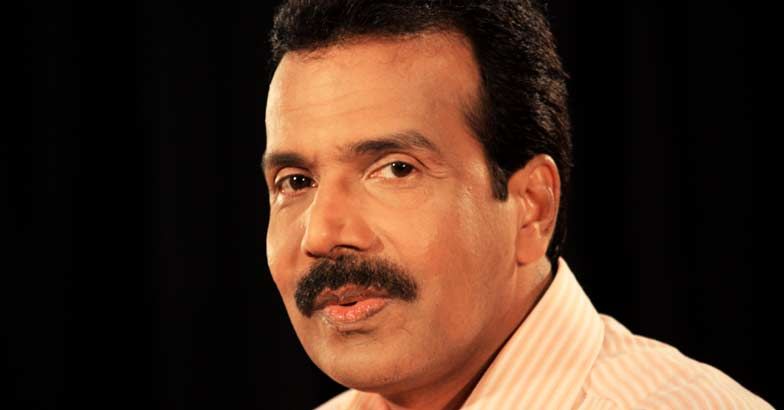
Johny Lukos bags Madhyamasree award

Johny Lukos, news director, Manorama News channel

New York:

Johny Lukos, news director, Manorama News channel bagged the Madhyamasree Award instituted by India Press Club of North America (IPCNA). M.G. Radhakrishnan, Editor, Asianet News has also won the award.

The award has been conferred in view of his outstanding contribution to contemporary journalism. The award will be presented on November 8 at a ceremony to be held in New York, India Press Club president Taj Mathew informed.

The awardees will share a cash prize of Rs 1.5 lakh among them. The winners were announced after the shortlisted candidates were evaluated by Malayalam film actor, Mohanlal.

source: http://www.english.manoramaonline.com / On Manorama / by The Correspondent / Saturday – October 18th, 2014

Ismail Ali Khan to Head TSERC

Hyderabad :

Ismail Ali Khan has been  appointed as the chairman of the newly created Electricity Regulatory Commission of Telangana state here on Tuesday. L Manohar Reddy and H Srinivasulu have been made other members of the ERC.

Ali Khan, who hails from Asifabad in Adilabad district, is presently member of the Bihar State Electricity Regulatory Commission. He earlier worked as member of the Planning Commission.

source: http://www.newindianexpress.com / The New Indian Express / Home> States> Telangana / by Express News Service / October 22nd, 2014

A smile worth a crore, but she’s worth it

Ranchi :

It costs over Rs 1.2 crore a year to keep her healthy, a sum her petty plywood trader father in Kantatoli can’t imagine.

Ranchi girl Sadaf Naaz (19), who suffers from Gaucher’s disease that strikes one in 100,000 people, is getting a sponsor for the enzymes she needs six years after her diagnosis.

UK-based Shire Pharmaceuticals Limited has started sponsoring expenses incurred on her enzymes and medicines that will annually cost over USD 200,000 (around Rs 1.2 crore). Sadaf got the first dose at AIIMS, New Delhi, on October 1 and second on October 15. They have called her again after a fortnight.

Like any rare disease, Gaucher can fox experts. It occurs when a lipid, glucosylceramide, accumulates in the bone marrow, lungs, spleen, liver and sometimes the brain.

In layman terms, it means Sadaf has lived with liver malfunction for as long as she can recall. Gaucher’s disease also causes patients to bruise and break bones very easily. Lungs don’t function well, too.

Sadaf was diagnosed with Gaucher’s disease at Christian Medical College (CMC) in Vellore in 2008. Before this, she underwent a liver operation at AIIMS, but her disease was undetected. That wasn’t surprising, considering that the genetic enzyme disorder occurs mostly among Jewish children of Eastern European descent.

Once her disease was diagnosed, Sadaf’s parents Muzib Quraishi and Shabnam were faced with the spectre of sponsorships. Regular enzyme replacement being the only treatment, it was soon clear to the parents that only movie stars and industrialists could afford it.

Ranchi-born Brooklyn paediatrician Jamil Akhtar offered to appear before the medical board at AIIMS to explain her case and find sponsors in the US. But, he wasn’t called. The Gaucher Foundation, US, apparently didn’t show much interest. Neither did the Indian government.

Time ticked by, making her parents desperate. This February 28, Muzib and Shabnam stormed a meet on the disease at NIMHANS, Bangalore, where eminent doctors and pharma companies from across the world had come.

“We threatened to immolate ourselves before them if our daughter was left doomed to die a painful death. Seeing our child suffering made us desperate. That’s when AIIMS doctors Neerja Gupta and Madhulika Kabra heard us out,” said mother Shabnam.

The AIIMS doctor duo spoke to representatives of UK-based Shire about Sadaf. “Things looked up,” she said.

Father Muzib added that when the UK pharma firm decided to sponsor Sadaf’s treatment, they gifted her a new life. “Special thanks to The Telegraph for its coverage. The news reports played a crucial role,” he smiled.

source: http://www.telegraphindia.com / The Telegraph, Calcutta / Front Page> Story / by Sudhir Kumar Mishra / Ranchi – October 21st, 2014

Book to renew Kolkata’s tie with Wajid Ali Shah

Kolkata :

“It’s the only book I’ve read twice. And my favourite line is ‘life can’t be divided into chapters’,” mused Shahanshah Mirza, great-great-grandson of Wajid Ali Shah, referring to ‘The Last King in India’ by Rosie Llewellyn-Jones. The British historian has made waves by compiling facts about the legendary nawab whose memory still divides opinion.

Rosie smiled: “Thanks for helping me investigate the mind of the last king. The British opposed him because they wanted to take his kingdom. Mirza nodded: “You’ve dealt with his seclusion rather well.” He thought the agony associated with the annexation of Awadh is well portrayed in the book.

Rosie begins with a chapter following this act, when the nawab’s mother travels to petition Queen Victoria for justice. Unknown to her, the Queen had no power to return Awadh. The bleak start sets the tone for the book — the British duplicity, with the king caught between forces over which he had no control.

For inputs, Rosie has watched ‘Shatranj Ke Khilari’ “several times”. “Ray did a lot of research,” said Rosie. “When Ray met my father in 1978, he was asked if it was easy getting Amjad Khan into Wajid’s skin. He had said ‘Amjad was blinking a lot. When a ruler is angry, he doesn’t blink. His eyes are wide open’,”
said Mirza.

Rosie’s Kolkata connect goes a long way — since she found Mirza on the royal family website in 2004. “I came here and we did a lot of research together,” she said. The cover is a painting of the nawab which belongs to Mirza’s relative Sultan Ali Sadiq.

Rosie pointed out: “In nearly all his pictures, the king has his left breast exposed.” Mirza explained: “I guess the poet in the nawab wanted to show that his heart was always open.”

The book will be unveiled for the third time on Sunday after a London launch in June followed by another such ceremony in the nawab’s very own Lucknow last month. “Now it is Kolkata’s turn and we had to have Shahanshah,” said Rosie. Mirza has given Rosie inputs on the king settling down in Metiabruz (or Metiaburj, which literally means a clay tower). An old watchtower had once stood there, guarding the Hooghly river bend, giving the place its name.

“The book shows that even 127 years after his death,
Wajid Ali Shah, who himself authored 117 books (Rosie found some of them at the London Library), is still a subject of interest.”

The king contributed greatly to Kolkata’s culture. Kathak and kite-flying were introduced by him. He opened a menagerie which attracted a lot of visitors. According to Rosie, the king tried, within his limited resources (he had to live off a pension given to him by the British), to recreate a miniature Lucknow in Garden Reach-Metiabruz where he lived his last 31 years. He brought with him the music, the poetry, the cuisine, the adab that had made Lucknow under him the byword of culture and etiquette.

“His Calcutta stay changed many aspects of its social life. The British failed to fathom (deliberately) the love that he enjoyed from his subjects,” said his great-great-grandson.

The British, who deposed him to Calcutta in 1856, could hardly accept a ruler who believed that his subjects singing his songs was enough guarantee that he was seen as a good ruler. “Do Queen Victoria’s subjects sing her songs?” Satyajit Ray makes Wajid ask his chief minister in ‘Shatranj Ke Khilari’, thus capturing the differing notions of kingship.

source: http://www.timesofindia.indiatimes.com / The Times of India / Home> City> Kolkata / by Ajanta Chakraborty, TNN / October 12th, 2014

Meet Tabassum Bano – the first female e-rickshaw driver of Allahabad

Tortured by her in-laws for dowry, Tabassum was thrown out of the house with her six months old son, she decided to not give up.

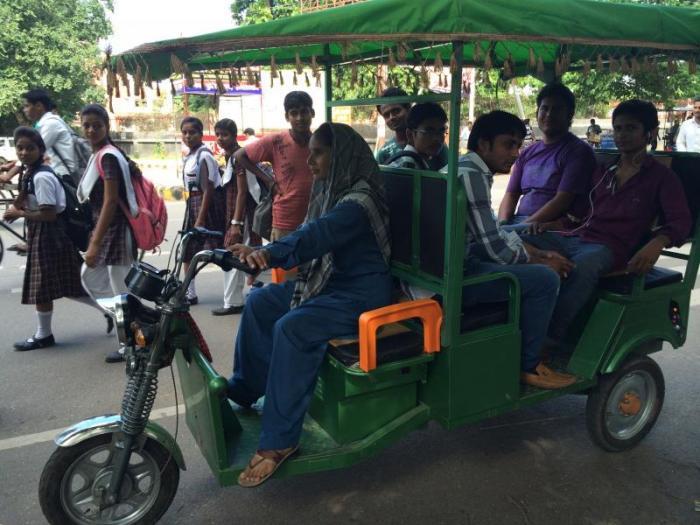
Tabassum Bano riding the e-riskshaw  - Mohammad Anas
Tabassum Bano riding the e-riskshaw – Mohammad Anas

Tabassum Bano decided to fight and not surrender despite facing so many hardships some years back. She had been tortured physically and mentally by her in-laws for dowry, she was thrown out of the house with her six months old son, but Bano didn’t give up. She braved all the difficulties and challenges of her life. Confident and self dependent, Bano has set an example of courage as the first female e-rickshaw driver of Allahabad.

“I came to Allahabad in the year 2005. My family lives in a small village Narsimhagarh in Pratapgarh. One year after marriage, my in-laws started torturing me for more dowry. My son was just six months old at that time. One day they even took my clothes off and threw me out of the house. Tired of their torture, I had even thought of committing suicide, but my child gave me the reason to live and fight,” Bano broke into tears as she narrated her life story to iamin.

“Finally, I decided to get divorce from my husband and made up my mind to come to Allahabad and start a new life. With just two rupees in hand and my son in my arms, I began my journey from Pratapgarh by foot and reached Allahabad after walking 50 kilometres. Once when I wa at new Yamuna bridge, out of hunger, my son started crying uncontrollably and I became restless and helpless in this unknown city. An old man saw us and brought us to Sister Sheeba Jones. My life changed since that day,” said Bano who lives in a rented room at Teliyarganj colony in Allahabad with her son.

Bano gives the credit to Sister Sheeba for changing her life. “Sister Sheeba first taught me how to ride a scooty and then four-wheelers.” Besides riding the e-rickshaw, Bano also works as a maid in houses to bear her expenses of her family members.

Yes, apart from her own son, Bano is taking care of six other members of the family. “After my brother-in-law’s death, I took care of my sister and her three children. My brother died in the year 2011 and his daughter is also my responsibility. There is no male member in our family. I take care of my old mother too,” said Bano.

Besides work, Bano who was an illiterate before coming to Allahabad started studying and cleared class X examination. Her son Abdullah studies in a reputed English school in the city. “I want a better life for my son so, I work hard to send him in a good English medium school.”

Sharing her experience as a female e-rickshaw driver, Bano asserted, “I want to change people’s attitude towards women. There are different types of people in our society. Some people stare at me awkwardly while some praise and encourage me. I want to show that women are strong and can face challenges.”

Bano also uses her scooty to carry people. She sometimes drops school children to their homes free of cost in her e-rickshaw. Tabassum is surely an inspiration for women in the country.

source: http://www.iamin.in / I am in DNA of Allahabad / Home> Allahabad> Trending News / by Mohammad Anas, Edited by : Longjam Dineshwori/ Tuesday – October 21st, 2014