All posts by mpositiveone@gmail.com

I am a closed-door rebel: Irshad Kamil

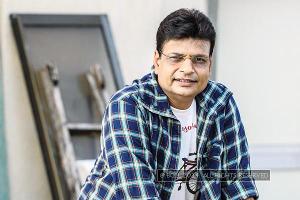
Irshad Kamil, 42, is simple, sensitive with very high self-esteem. He is a man of commitment and a man who has no qualms in acknowledging the work of his contemporaries that he loves, given the highly competitive nature of the business. While he never raises his voice, he is a closed-door rebel that explains many of his lyrics, be it those of the film Rockstar or of a song like Patakha Guddi in Highway. His current song Manwa Laage Re from Happy New Year is extremely popular. His home, in one corner of Lokhandwala, has a lovely vibration and we sit down over a cup of coffee for our interview, where he talks about the childlike Pritam, his intelligent wife Tasveer and his special connection with Imtiaz Ali. Excerpts:
IrshadKamilMPOs22oct2014

Have you made friends in the industry?
Sandesh, Imtiaz Ali and Pritam are my friends. Pritam is quite like a child, who is so forgetful, so unharmful and so lovely. He is very unapologetic about every action and is a gem. Imtiaz I could now call a chaddi buddy. We know each other from the days of Socha Na Tha, when he was not the star Imtiaz Ali. He is very clear in his vision and knows what he wants. He is very concerned and sincere, very witty and sometimes unpredictable. He is very cool.

The lyricists you look upto?
Sahir Ludhianvi, as I love the way he captured slice-of-life with a tinge of philosophy. Anand Bakshi sahab for his simplicity and yet, how he managed to remain poetic, the folk of Shailendra sahab and the experimentation of languages by Majrooh Sultanpuri sahab.

Who do you love the most in the world? 
My wife Tasveer. She knows me and understands me. We have been married for 12 years. She is from Chandigarh and we did theatre together. What I like most about her is her innocence, her intelligence, her creative mind, her analytical power and her aura. She likes my honesty, my humility and the way I think and approach things in my life.

What are you like?
I am true to the core, very sincere and committed. If I have said yes to something, come what may, I will do it and will put in my 100%. I am very simple. I am extremely sensitive and may sometimes land up opening myself more than needed. My dressing sense is bad and I am a bit lazy. I am also quite stubborn, particularly with myself. I am a very closed-door rebel. But the effect of that is always positive. So if maine apne saath koi zid karli, toh aise hi hoga. So if I have to trouble myself to achieve it, I will. And while I am otherwise stubborn, when it comes to writing lyrics, I am very open. In my childhood, my mother told me one thing that stayed with me. Kids usually come back home from school to complain to their parents, ‘I wrote so well, but still my teacher has deducted my marks.’ I now understand that actually a child uses it as a defence mechanism. I must have been in Class VI when I came back home and told my mom, ‘I wrote so well, but still my teacher took out so many mistakes and has given me only 6 marks out of 10.’ Unlike what I expected, my mother said, ‘If someone points out something wrong, it means that there has to be some problem there. It can’t be smooth.’ What she said then has stayed with me till today.

So whether you are an actor or director or producer or music director, if you have found some fault in what I have written, there has to be some problem with it and before my defence comes up, I first try and understand what the problem is. And if I find that there is a problem, I will change it. But I have a lot of gussa and woh bada solid hai. If I am angry, I will let the other person know that I am very angry without raising my voice. I am very strong and I am my own emotional anchor. And while I am very emotional and sensitive, I am not an emotional fool. I am emotional with only people who value my emotion. I get hurt very easily, but can’t express myself and that is probably my raw material to write. I always say, ‘Pyaar bhi de aur pyaar ke gum bhi de Maula, hum shayar insse hi sher banate hain.’

How did you come into films?

We are Punjabi Muslims and I was born in Malerkotla in Punjab. I did my diploma in journalism from Punjab University, a post graduation in Hindi language followed by a Ph.D in contemporary Hindi poetry. My first job was as a journalist in an English newspaper in Chandigarh, where I covered education and entertainment. I interviewed many stars who came to Chandigarh, including Pooja Bhatt and Manoj Bajpayee. I then worked for a Hindi newspaper as a junior person and would often be asked to check and correct errors in articles written by others. One night, I was in office till 1.30. It was winters and I was riding back on my motorcycle when I thought to myself, ‘Did I ever think that I will do journalism when I grow up? I didn’t want to become Khushwant Singh. Then why am I doing this?’ The next morning, I went to office and resigned. My senior thought maybe I had gone through some emotional atyachaar staying alone in the University and that is why I was leaving. He tried to convince me, but I had decided. While I was doing my Ph.D, I got an offer to teach and again, I asked myself, ‘Am I born to do this? I don’t want to teach.’ And I refused the offer. It was at that time that Lekh Tandon had come to Chandigarh to shoot for TV and was looking for a writer. The joint director of Haryana Cultural Affairs department, Mr Kamal Tiwari sahab, introduced me to him. Mr Lekh Tandon got me to Mumbai and I started writing for TV.

I started getting little money and took up a place to stay on rent. This was 2001. TV involves a lot of labour and while it gives you money, there is no creativity involved. Mentally, I would feel very low and I would tell myself, ‘I didn’t come here to do this.’ I had started feeling angry with myself that whatever I do, I keep thinking, am I born to do this. I would ask myself, ‘Tum kya karne ke liye bane ho yaar?’ But right from my childhood, I wanted to be a lyricist and I would tell my friends, ‘Geet likhne jaa raha hoon.’ My friends would like my work and it became my dream to become a lyricist. After quitting TV, I met music director Sandesh who was working on Socha Na Tha and through him, I met Imtiaz Ali. We hit it off really well right from day one and he asked me to write the lyrics of Socha Na Tha. Even though I first worked on Socha Na Tha, my first film to be released was Sudhir Mishra’s Chameli. I struggled a lot till 2007 when Jab We Met happened and I got my first Filmfare award for Ajj Din Chadheya in Love Aaj Kal. I never looked back after that.

You have done all Imtiaz’s films and your best work is with him. Is there a reason for that?

Imtiaz has a lot of faith in me and when someone trusts you like that, you want to give everything to it. I can’t let him down and I have to give back the trust he has entrusted in me.

How does it feel when someone comes and tells you to write an item song?
I find it very difficult. Because when someone comes saying, ‘Please write an item song like this,’ I know that in reality, he can write the song himself what he is asking me to write. They start telling you the lines and that becomes even more difficult.

Given that you were such a rebel, was there someone in your family who understood you?
Only my mother whom I lost in 2010. I loved her too much and I have started a scholarship on her name, Begum Iqbal Bano, after she died. She was the only person with whom I could discuss anything about my life, I could fight with her, I could get annoyed with her, and could take anger of somewhere else on her. Her going away was a loss to me. You expect your mother to take it. And the beauty is that you know that you are not being fair to her, but she still does not make you feel that aap zyasti kar rahe ho. She knew me internally. I was the youngest child, but looking at me, she knew I was different and a rebel. I remember when I left my job as a journalist, I did not tell or discuss with anyone at home before or after leaving my job. I did not do anything in my life after discussing with anyone, whatever I did, I took the decision first and then told everyone. Then after a few days, someone from home had called my office and found out that I had quit the job a fortnight back. I went home by which time my entire family knew and there was a full battalion waiting to ask me questions. My mother said nothing to me. I later asked her why she had said nothing to me. And she very casually said, ‘Maine socha if you have left your job, you must have thought of something. Tu kaunsa bewakoof hai.’ It was a very innocent statement, but I know that she had a lot of confidence in me.

source: http://www.timesofindia.indiatimes.com / The Times of India / Home> Entertainment> Hindi> Music / by Priya Gupta, TNN / October 22nd, 2014

Now Sai Paranjpye’s Katha to be remade

After Chashme Buddoor, director Sai Paranjpe’s another cult film Katha is all set to be remade.

Anjum Rizvi has brought Sai Paranjpe and critic-filmmaker-author Khalid Mohamed together for the project. The film, directed by Khalid under Sai’s guidance will be moulded to suit 2015.

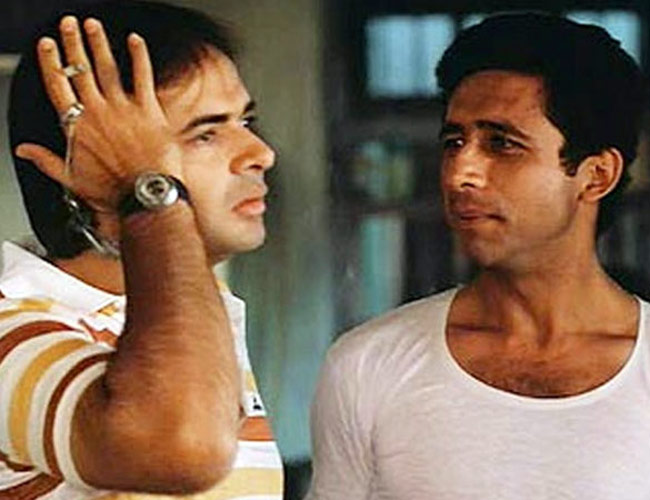
Farooq Sheikh and Naseeruddin Shah in a still from Katha

Anjum plans to stick to the essence of the original film in order to remain true to Sai’s original vision. “We don’t intend to play around with the story or commercialise it. It will be true to its tortoise and hare story line,” he told a leading newspaper.

“Sai is Khalid’s friend and when he sounded her out she was very keen, though she made it clear that she would not direct the film. The story, screenplay and dialogue are by Sai and updated by Khalid,” he added.

The film is expected to roll in December and the casting is on. The original Katha featured Naseeruddin Shah, Farooq Shaikh and Deepti Naval.

source: http: //www.indiatoday.intoday.in / IndiaToday.in / Home> Movies / October 16th, 2014

The show stops for Sania


Indian tennis player Sania Mirza walks on the ramp as she displays a creation by designer Ritu Pande during Wills Lifestyle India Fashion Week. / AP
Sania Mirza may not be fashion conscious but took time out to be at the Wills Lifestyle India Fashion Week as a showstopper

Tennis sensation Sania Mirza, who did the nation proud by winning gold in the mixed doubles in the recently concluded Asian Games in Korea, was a showstopper at the ongoing Wills Lifestyle India Fashion Week in the Capital.

This was Sania’s first ramp-walk in Delhi and fashion pundits and the movers and shakers of the city were in full strength to watch how perfectly she walked with her extravagant attire and stilettos. Last year, Sania had walked as a showstopper for designer duo Shantanu-Nikhil. This time round the designer was Ritu Pande, known for playing on textures, colours, patterns and silhouettes.

“In real life I like wearing garments which are simple and elegant. I am comfortable wearing T-shirts, jeans and jackets. The anarkali I am wearing today has been designed in a manner that I can walk in the city. Normally what you see in fashion events are outfits which you cannot wear for events or otherwise.”

The long flowy anarkali accentuated by tie dyed gold and ivory with embroidered French gold lace heavily appliquéd for the collection titled “Lady in Lace”.

Speaking about the designer, Sania said, “Ritu Pande’s work is different from her contemporaries. It is classy, elegant and has finesse. I especially loved the outfit she designed for me. It is spectacular.”

Sania did not face pangs of nervousness as showstopper. She walked till the edge of the rostrum where she posed, flashing her million dollar smile before the paparazzi.

“I guess I am used to pressure now. Once I start walking on the ramp my confidence level increases.”

Unlike models who work in the interiors of air-conditioned five star hotels, Sania works for uninterrupted hours under the glare of scorching sun.

“My schedule is such that I am outdoors for eight hours. I am used to it but yes I have to take good care of myself. I drink a lot of coconut water, which is quite beneficial.”

Speaking about her victory at Asian Games, Sania said, “Earlier, some people had expressed apprehension about the team but we proved that we could still win medals.”

The sportsperson hoped to play good tennis for some more years.

Last year, Sania opened the Sania Mirza Tennis Academy in Hyderabad, with which she is trying to harness talent, especially in rural areas, where the youth do not often get professional guidance or training.

“Yes, we have talent in the rural areas.”

Though Sania is a big Salman Khan fan and quite a few Bollywood biggies including Shahid Kapoor, she has no plans to enter the film world.

Would she like a biopic be made on her and does pugilist Mary Kom’s struggle to become a woman boxer match her journey to become India’s number one tennis player?

“I haven’t watched the film, so I cannot comment. But, yes, it is good that biopics are being made on sports personalities. I am not sure that I would like to share my personal life though.”

source: http://www.thehindu.com / The Hindu / Home> Features> MetroPlus> Fashion / by Madhur Tankha / October 12th, 2014

Mammootty’s ‘My Tree Challenge’ a Hit Abroad, Accepted by Australian Mayor

Kochi :

The ‘My Tree Challenge’ campaign, launched by actor Mammootty recently for planting trees, has crossed the oceans and reached other continents, with an Australian mayor accepting the challenge.

Stuart Slade, Mayor of the Glenorchy City Council, has planted a gumtree at the Tolosa park in the capital of Tasmania, an  island city in Australia.

The mayor, who named the tree ‘Gandhi’ as  an honour to Mahatma Gandhi, has also challenged the mayors of Melbourne, New York, Paris and London to plant trees.

Slade thanked Mammootty for the concept, while acknowledging it as a solace to the  planet that is fast becoming polluted. He also invited Mammootty to Tasmania, and urged him to pay respect to the Gandhi tree.

The Mayor, who is an enthusiast of India and the country’s development, came to know about the My Tree Challenge from Sajini Sumar, chairperson of the Multi-cultural Women’s Council of Tasmanaia.

The My Tree Challenge, a campaign involving planting of saplings and challenging others to do so, was launched by Mammootty on August 30 – inspired by the ‘Ice Bucket Challenge’. He had asked Bollywood actor Shah Rukh Khan and Tamil actors Vijay and Suriya to take up the challenge.

Mammootty had also planted a tamarind tree on the premises of Grand Hyatt Hotel, Dubai.

source: http://www.newindianexpress.com / The New Indian Express / Home> States> Kerala / by Express News Service / October 21st, 2014

Cyclone memorial cries for attention

Structure built to remember 30,00 who died in cyclone

A view of cylcone victims memorial constructed during British rule at Gilakaladindi near Machilipatnam in Krishna District of Andhra Pradesh. Photo: Ch. Vijaya Bhaskar / The Hindu

People tend to recollect harrowing times of Diviseema uppena, a cyclone that devastated Machilipatnam, whenever a cyclone hits the State. But, here is a cyclone memorial which has faded in the memories of times gone by.

Great tragedy

Close to 30,000 people were swept away by the giant ocean wave over Machilipatnam town on the night of the cyclone of November 1, 1864. Following the great tragedy, Manuel Fruvall had constructed the memorial in the memory of his brother’s family and 30,000 people of this tiny town who died in the cyclone, at Bandarkota village near here.

A plaque put up outside the this monument says that the memorial was constructed in remembrance of Anthony and Maria Fruvall, their sons Peter Manuel and Daniel and their daughter Honey and her children Joseph and Georgiana and 30,000 people who were swept into the eternity by the ocean.

In 1860s, the total population of the town was around 60,000. In remembrance of then Machilipatnam Chief Magistrate G. Thornhill, who strove to control post-cyclone deaths due to spread of several diseases, Mr. Fravell also dedicated the memorial to him, says amateur Historian Md. Silar.

Many people of the town do not even know where the monument is located there. But, fishermen community in the vicinity recollected that thousands were killed in 1864 cyclone.

Many demanded that the government come up with a plan to restore and preserve the memorial.

Mr. Silar says that the monument commemorates the fate of thousands of people.

The memorial withstood vagaries of nature. But, now stands testimony to negligence by government machinery.

Dilapidated monument

The dilapidated monument is surrounded by the bushes and trees. “Our repeated appeals to the District Collector and authorities concerned to protect the heritage fell on deaf ears,” he adds.

source: http://www.thehindu.com / The Hindu / Home> News> Cities> Vijayawada / by G. V. R. Subba Rao / Machilipatnam – October 16th, 2014

Mukhtiar Ali: I am a woman when I sing…

Sufi music

MukhtiarAliMPOs21oct2014

Mukhtiar Ali, who is the 26th generation Sufi singer from Rajasthan belonging to the Mirasi community, insists that Sufi kalam is about looking for Him — evoking Him who is present within ‘us’.

His rendition of ‘Kabeer khada bazaar mein, maange sabki khair…’ sure worked wonders on a few hundred souls gathered at Vanaranga in Mysore recently. Evoking the mysticism and deep sense of spirituality which are the essential elements of Sufi music, Mukhtiar Ali filled every bit of space. His voice alternating between honeyed and lilting tones, soothed many a hearts and filled them with love and deep sense of total surrender.

Mukhtiar Ali, who is the 26th generation Sufi singer from Rajasthan belonging to the Mirasi community, insists that Sufi kalam is about looking for Him — evoking Him who is present within ‘us’. Living in the hot and arid Pugal in Rajasthan, Mukhtiar has been witness to many contradictory shades in the world of music. Much like the music he sings, his talks too, are not devoid of hidden meanings.

“Bahut dekh liye. Par abhi bahut kuch dekhna baaki hai (I have much, but there is a lot left to see),” he says when asked about whether Sufi music is ‘back’ for good. After the success of ‘Had – Unhad’ — a documentary film made by Shabnam Virmani that shot him to fame; Ali has seen a lot of ‘shift’ in attitude in his own community. Ali admits Sufi was not his first love, but will surely remain his only love. “I tried my hands at agriculture, tailoring, weaving, and worked with Urmul Trust for few years before finally turning towards Sufi,” he says.

The carrier of an oral tradition, with no written notes to refer to; or formal documentation of learning process of Sufi music, Mukhtiar slips into notes with ease. Has it ever unnerved him before others? No, he says. Recollecting his experience with formally trained musicians, Mukhtiar says he was in Chennai recently to attend a mega music festival. Musicians from various disciplines had gathered for the same. There was a 10-day rehearsal as a run-up to the final recording and everyone was “counting something” at their finger tips and asked Mukhtiar to do the same, as he was to join them at the middle note of the song. He was nervous initially and then gathered enough courage to tell them “Bhayya, aap gao. I will catch the note perfectly alright, wherever I am to join you. But, don’t ask me to do this counting. I have never done it all my life!” After that, it was a smooth sailing for Ali who recorded well on the final day, while most others had lost their energy owing to the 10-day rehearsals!

Expressing his discomfort over closed spaces, Mukhtiar feels he sings the best when he is ‘with’ people. “I love open air theatres or informal gatherings. I feel euphoric when people egg me on. I am the best Meera, or Radha they would have heard. I surrender totally when I sing for people… like a woman who sings for her lover. ‘He’ is my focus and I look for Him in the gathering. Get me into an airconditioned, sound-proofed studio, I am a restless soul who is at his worst fidgety self,” he says.

Have the generations of singing eroded Sufi of its essence? Do they still sing Bulle Shah with as much dedication? “Bulle Shah is still the same. He still churns your stomach when you listen to anyone sing his kalaam. But the contemporary Sufiana Kalam (Sufi songs) has no ‘dum’. You don’t feel a thing when you sing them,” he reveals. How does he best describe the contemporary Sufi writing then? Pat comes the reply: “Clever play of words, but minus the essential essence.
“Bollywood has ‘used’  Sufi, often, to cater to the taste of its audience. Everything is diluted and coloured suitably to be served to them. At the same time, we cannot refute the fact that Bollywood has been the best vehicle Sufi music has found to reach the masses. ‘Dama Dam Mast Kalandar’ is as necessary today in concerts as is ‘Kabir Khada Bazaar Mein, Maange Sabki Khair’…. We cannot deny this,” he observes.

source: http://www.deccanherald.com / Deccan Herald / Home> Supplements> Sunday Herald Art & Culture / by Preethi Nagaraj / January 09th, 2010

Girl Power: The Alisha Abdullah Racing Academy launched report

AlishaMPOs21oct2014

Silverscreen goes to the launch of the Alisha Abdullah Racing Academy for Women

We walked into the venue of Alisha Abdullah’s racing academy launch on a wet, wet day. An older gentleman in a bright blue shirt was on the piano, playing a song that obviously held deep meaning for him. Before we could get closer to investigate, a bold dash of colour grabbed our attention.

There was no evidence of the biker chick in the Alisha Abdullah we saw yesterday. In a neat pink blazer and with her hair in an intricate braid, she looked like your average fashion conscious Chennai-ite. Albeit one with a higher purpose. After ushering us inside, she went away to pose for the photographers. Hashtag pretty in pink.

When Alisha’s father arrived with one of the guests of the evening – Akbar Ebrahim, the father of Indian Moto Sports – the event began. Akbar has literally seen Alisha grow – from that of a child obsessed with racing to a woman who has raced with the best of them. The fact that she has never considered her gender a ‘restriction’ and has excelled in what is essentially a man’s sport is an immense source of pride to both Akbar and Abdullah. “Motor sports is not the easiest place for anybody, much less a young girl. She could have thrown  a fit about many things, but she bore it all stoically and it is this strength that will help her with this new initiative of hers,” said a beaming Akbar on stage.

********

When it was Alisha’s time to speak, she used it wisely. She spoke of the time when she felt intimidated at the races in Thailand; a ‘smaller’ country than India. “I thought I would easily finish in the top three, but I was beaten by eight very powerful women racers. I couldn’t compete on the same level and it got me thinking. What do they have that we Indian girls don’t?”

It was with this aim – to provide talented racers in India the guidance needed to survive in races abroad – that the academy was started. “I have been thinking about this for over three years. After a lot of brainstorming sessions with dad and mom, it was only this year that I could finally set up something concrete.” Alisha plans to recruit a hundred students for the academy and provide free training for them. And she will be doing this while juggling her successful and ‘satisfying’ racing career and the cinema opportunities too. “I want to use my stardom for the betterment and empowerment of women. When my film released, many women got in touch with me and asked me to help them drive super-bikes. It’s this need that I want to satisfy.”

********

The academy was then duly launched by Renuka David, Bruce Schwack and Ashok Verghese.

Alisha hopes to begin the school soon and if all goes well, she will also embark on an extensive promotional tour to publicise it.

source: http://www.silverscreen.in / SilverScreen.in / Home> Events / Vandhana / October 21st, 2014

Tamil poet Iqbal named for Singapore’s highest cultural award

Indian-origin Singaporean poet and writer K.T.M. Iqbal will be awarded Cultural Medallion, the country’s highest cultural award by President Tony Tan Keng Yam on Thursday night in Singapore.

It is the highest recognition for the 74-year-old Tamil poet whose achievements include more than 200 children’s songs written for Radio Singapore in the 1970s and 1980s, as well as seven collections of poetry.

Mr. Iqbal said he was “delighted” to receive the award which was “an incredible honour”.

“My first love is poetry. We have been together for 60 years. I never imagined this would bring me the Cultural Medallion award,” The Straits Times quoted Mr. Iqbal as saying.

Mr. Iqbal learned the basics of Venpa, a form of classical Tamil poetry from a poetry-writing workshop. “I would sit on the street in the evening to write or an idea might come when I was on the bus,” said Mr. Iqbal.

The poet, also a retired bank executive, has received recognition in the education system of Singapore also.

Mr. Iqbal’s compositions are studied in schools and some of them have appeared in the subway stations as part of efforts to bring the arts close to the community.

Mr. Iqbal migrated to Singapore at the age of 11 with his father from Kadayanallur in South India in 1951.

A Tamil newspaper Malaya Nanban, which is now defunct, introduced him to the simple but evocative compositions of Tamil poet Mathithasan. The poet’s vivid depiction of people and values in society inspired the young Iqbal to start penning poems.

The retired bank executive continues to pen poems and hopes to produce an edited collection of his best Tamil poems and an English translation of it.

Along with the award, Mr. Iqbal will get 80,000 Singapore Dollar grant, which can be used to fund artistic endeavours over their lifetime, according to The Straits Times.

“The money once spent is gone. But to have the nation recognise your contribution is great and it will encourage people to keep writing poetry,” said Mr. Iqbal.

The award will also be given to sculptor Chong Fah Cheong, 68, and 51-year old Alvin Tan, the artistic director of a theatre company, The Necessary Stage. Recipients are each eligible for a 80,000 Singapore Dollar grant.

The award, instituted 35 years ago, has been presented to 115 artists to date, including Mr. Iqbal, Mr. Chong and Mr. Tan.

source: http://www.thehindu.com / The Hindu / Home> News> National / by PTI / Singapore , October 16th, 2014

Telling it as it is

Poet-activist Salma / by  Jack Llewellyn-Karsk
Poet-activist Salma / by Jack Llewellyn-Karsk

Poet-activist Salma on her experiences at the Writers of India Festival, Paris

On May 26, this year, poet Salma received a letter inviting her to be a guest of honour at the Writers of India Festival, Paris, in September. The festival, a new collaboration between Columbia University, New York, and the Bibliothèque nationale de France, featured a series of lectures and discussions with more than 12 Indian writers at Reid Hall, Columbia and BnF in Paris. Salma talks about her journey as a poet, her experiences in Paris and how poetry can make an impact.

You used to write secretly when you were young as you were confined to the house from the age of 13. Did you ever think at that time that you would be an established writer?

(Laughs) I was very confident my words would reach the world. I still remember this scene vividly. I was 16. I was standing with my sister in the kitchen and she was rolling out chapatis. ‘You had better learn to cook,’ my sister said. Otherwise, people will say we did not bring you up properly. I told my sister — I’m going to be a famous writer. I’ll go to many countries and attend many conferences. I don’t need to learn to cook!

And now, you have just attended the Writers of India festival. How was the experience?

There were several readings and discussions every day and at least five events were happening at the same time. Everything was well organised. They had French translators. I was the only one to have a screening of my film Salma! It was followed by an interview with senior journalist, Judith Oriol — she came prepared with an in-depth questionnaire.

What was the audience reaction to your film, which documents the story of your life?

Many of them got very emotional. It was hard for people to believe that so many women do not have even the basic rights and that it is a struggle.

Is poetry part of our everyday culture?

Thirukkural

What made you write poems, not stories?

Like many girls in a Muslim community, I was not allowed to leave the house in my small town Thuvarankurichi. I had many conflicting feelings and I wanted the freedom to live life, do many things. A poem can be a powerful expression and all my pent-up emotions came through in verse.

Can you read from one of your poems presented at the festival?

A few lines from Naan Illadha Avan Ulagam (His world beyond me). It is about a mother and son.

He, who had asked me

on a night of the moon’s full retreat

if the sun too would be gone someday,

has no more answers to seek from me.

How have your experiences impacted your writing?

It is an unbelievable life, to be a writer. My poems are for everyone, but I especially wanted to reach out to women, and make a difference for them. They must realise their lives. They must understand their identity.

Your family’s resistance to your writing – did that change?

There were many changes that happened over time, but the big shift happened when I entered politics. At that point, my family had no choice but to accept it.

(Salma won a seat reserved for women in Thuvarankurichi in the 2001 panchayat elections and was elected MLA in 2006).

Your writing got acceptance when it was connected with a larger purpose — political and social. Can writing by itself bring about social change?

Writing alone cannot bring change. We need political will to usher in change.

The theme of the festival in Paris was on the impact of globalisation on cultural creation and consumption. Did the festival address these ideas?

I got the chance to be on the same platform as award-winning writers Jeet Thayil, Vikram Chandra and Kiran Desai and there were stimulating exchanges. All participants had to contribute essays on globalisation, which will be published in the form of a booklet.

In India, many do not consider storytelling and poetry real professions. How did you find it in other countries?

People respect writers. A writer receives more adulation than a politician, in some ways. From the time I landed at the airport, people used to ask me to recite a poem in Tamil, just because they wanted to hear how it sounded!

source: http://www.thehindu.com / The Hindu / Home> Books> Author / by Sujatha Shankar Kumar / October 17th, 2014

Deve Gowda to launch Mysore Varsity Alumni Assn.

Mysore :

Former Prime Minister, H.D. Deve Gowda will be launching the Alumni Association and various other programmes of University of Mysore at 10.30 am on Oct. 16 at Crawford Hall.

As part of the centenary celebrations, the ex-PM will release a booklet, Convocation Address Vol.II, Centenary Account Gateway and lay foundation stone for School of Planning and Architecture.

MPs R. Dhruvanarayan, C.S. Puttaraju and Pratap Simha will be the guests of honour. Prof. K.S. Rangappa, VC, will preside.

On the occasion, two of the oldest Alumni — former VCs Prof. D. Javaregowda and Prof. B. Sheikh Ali — will be felicitated.

source: http://www.starofmysore.com / Star of Mysore / Home>General  News / Wednesday ,  October 15th, 2014