Entrance test for “Teach For Kashmir” was conducted at SP College with over 100 students appearing in the exam.
“IAS topper Dr Shah Faesal and Rafiq Shah KAS also visited the centre and appreciated the efforts of the team for taking up such an initiative,” a host said.
Faesal said that such initiatives should be appreciated by the community as they will prove quite useful in encouraging and motivating students of J&K in qualifying various national level entrance tests,” the event spokesperson said.
Pertinently, Teach For Kashmir is a joint initiative undertaken by Saood Nazir, Imbesat Ahmad and Saif Khan, all of whom are pursuing their undergraduate studies at IIT Kharagpur and aspire to provide guidance for IIT JEE and various other engineering entrance examinations for 2 months,” the spokesperson added.
source: http://www.greaterkashmir.com / Greater Kashmir, Srinagar / Home> Srinagar City / GK News Network / Srinagar – May 06th, 2013
Eleven student teams from across the country have conceptualised innovative, implementable ideas that can make a huge impact and a difference to one’s daily life. The products, a result of those ideas, range from a one-stop smart card that can be used for 14 different kinds of public transport, to a clock that alerts a mother on the days her newborn is due to get vaccinations.
These ideas were showcased at the National Student Challenge (NCS), a competition held by the Indian Institute of Human Settlements (IIHS). Students had prepared for the challenge for more than six months. The competition was spread across various fields such as urban culture, basic services, urban poor, human development, safety and violence, livelihood, transport and mobility, affordable housing, etc.
The third edition of NCS saw the participation of over 1,100 teams from across the country, of which 25 were selected for the semi-finals that were held on Wednesday. Nina Nair, chief people officer and head, NCS said, “The concept of NCS is aimed at challenging the youth to stop wringing their hands and to do something about the things that irk them. This year, however, we made it mandatory that they come up with concepts that can be implemented. Thinking up ideas is easy; implementing it is the real hurdle. The 25 teams have done extensive research on the workability of their ideas.”
Here’s a look at some of the innovative ideas.
Innokart
In the wake of the Food Safety and Standards Authority of India recently issuing notices to street food vendors on maintaining cleanliness and hygiene, this innovation by a team of four from Jamia Millia Islamia, Delhi comes as a blessing in disguise for vendors.
Their idea: an improved food cart. Targeted at meal vendors, the cart comes complete with segregated dustbins, folding flaps where customers can stand and eat and storage and advertising space. “We studied vendors outside Nizammuddin railway station and in Saraikale Khan, Chandni Chowk, Sarojini Nagar and Karol Bagh. We found that most of the carts were huge and space-occupying. Vendors also dirtied the area around them. We will team up with National Association of Street Vendors in India to educate vendors on the importance of the carts,” said Huma Parvez and Nida Haque, who along with their team members Faiza Jamal and Ahmed Faraz Khan conceptualised Innokart.
Transpact
Two students from Jadavpur University, Kolkata have developed a concept that facilitates cashless transactions on any mode of public transport. Their idea: a one-stop smart card to integrate ticketing across 14 modes of transport. If their idea is implemented, a commuter needs only carry just one currency-loaded smart card which can be used use as a ticket on buses, Metros, taxis and autos. Since the origin of their idea is in Kolkata, the team has included travel on tram and ferry too. “It erradicates the change problem,” said Avishek Das. “We have also seen a lot of illegal tokens flood the existing system as well as paper wastage. To eliminate all that and to centralise the transport system, we came up with this concept.”
His teammate, Arunima Sen, added, “With this system we can also record patterns on commuter traffic and bring accountability to those running the system.”
Infilight
On a 20-day education yatra, Saif Khan and Imbesat Ahmed from IIT, Kharagpur stumbled on the poor electricity situation in villages of Bihar. Even though there were schools and teachers, the students could not pursue their studies, revise for exams and do their homework after coming back home due to long power cuts. But almost every child above Std VIII possessed a bicycle, thanks to the Bihar government’s Cycle Yojna scheme. It triggered the idea of a cost-effective lighting solution powered by bicycles. “Our innovation comes with a rechargeable battery that can be fitted to a dynamo which in turn is fixed to a bicycle. Using the energy generated from cycling, the dynamo recharges the batteries which can be used to power LED lamps that we will provide in the kit,” said Saif. The easy-to-fit device will be dust, shock and water resistant.
DRP
To address the problem of over seven lakh homeless people in India, a group of three from Piloo Mody College of Architecture, Cuttack has invented night shelters for homeless people. Their idea: prototype kiosks that can accommodate up to three people at night and can be used as small shops for grocery and other knick knacks. “Most of the people who are homeless in the cities are either beggars or daily wage labourers. These 7.35 sq mtr kiosks made of scrap block boards can be assembled anywhere and cost only Rs 1,200 to produce,” said Debadyuti Nandy, who along with teammates Rajarshi Das and Sraman Ghosh designed the kiosk.
Padawans
Have an elderly relative at home and are worried about his/her safety while you are away at work? No problem, says this group of friends who are from Vydehi Institute of Medical Sciences, University College London and Amity, Noida. Their idea: a portable, wireless emergency alert device in the form of a bracelet or pendant that automatically sends out an alert when the person wearing it is debilitated or incapacitated. “The aged usually suffer from various kinds of diseases and it is not possible to keep an eye on them all the time. Our device, which can be triggered by the press of a button, will send a message via a bay station to the hospital the patient is registered with, and to a close relative. Each device will have a medical ID that paramedics using our app can check to get access to critical health information,” says Shankhanil Chowdhury, who along with his brother Saurav Chowdhury and friend Prasenjit Lahiri developed the concept.
Badlaav
Two students have conceptualised a device that can serve as a timely reminder for mothers to get newborns vaccinated. Their idea: a wall clock that has an automated display issuing notification at regular intervals in visual and audio format from six weeks to 18 months of the child’s birth. The reminders are as per specified by doctors. Asmita Misra who worked on the concept designed by her teammate Sahil Goyal, learnt during one of her field researches that parents had no idea when to get their child vaccinated. “We found that they were given a card but did not know how to read it. An in-house alert system was the need of the hour. For illiterate mothers, we have installed a small audio reminder that will start reminding the family three weeks prior to the date of vaccination – once every week,” she said.
Kaizen
Railway terminals are often a garbage dump with travellers and commuters throwing away used mineral water bottles and other plastic items. This not-so-pleasant sight caught the attention of a group of friends studying at Vellore Institute of Technology who have come up with an idea to improve the recycling process. Their idea: development and deployment of plastic collection machines in cities to deposit plastic bottles in exchange for a nominal amount of cash. “Ragpickers usually sort out plastic bottles at source. We plan to have them bring the collected mass to our kiosks at railway stations. And like systems in the West, they will get paid for feeding the bottles into the machines which will then compress it, thus enabling the transportation of more bottles at one go. These machines will also have sensors to detect pet bottles from ordinary plastic and separate them. The amount ragpickers bring in will be weighed and they will be paid a fee that is at least Rs 2 higher than what they get per kilo now,” said Yashanshu Jain, a of the team members who has worked on the concept. The other members of the team are Sarang Surve, Piyush Pangarkar and Rohit Kumar Tiwari.
source: http://www.bangaloremirror.com / Bangalore Mirror / Home> Bangalore> Others / by Tapasya Mitra Mazumder, Bangalore Mirror Bureau / December 17th, 2013
Anisa Sayyed leads in the women’s 25m pistol event at the halfway stage. / Photo: Sandeep Saxena / The Hindu
Anisa Sayyed improved with every round as she led with a score of 289 at the half way stage in the women’s 25-metre sports pistol event of the 57th National shooting championship at the Karni Singh Range, Tughlakabad, on Monday.
The Commonwealth Games double gold medallist shot rounds of 94, 97 and 98 to stay ahead of World Cup medallist Sonia Rai (287) apart from Olympians and World Cup gold medallists Heena Sidhu and Rahi Sarnobat both of whom ended up with 286, along with Anita Devi.
Backed by coach Jaspal Rana, who kept her focused on the task with sound technical advice during the course of the competition, Anisa was able to assert herself in the precision stage. The rapid fire section will be shot on Tuesday, and will be followed by the final.
The best score
At the 10-metre range, there was not much change at the top in men’s air pistol, as the 579, shot by Parveen Kumar of Haryana, remained the best score.
Kapil Kumar of Air Force shot 578 to jump into the second place as he also finished strongly with a last round of 100 like Parveen. More than being assured of a berth in the final of the men’s section, Kapil Kumar was rewarded for his efforts with the gold in the junior section in a field of 80.
In the youth section, Samarjit Singh topped with 567 in a field of 135. Anmol Jain took the silver, one point ahead of the Asian Youth Games medallist Shainki Nagar.
The free pistol gold medallist Prakash Nanjappa (574), who had won a World Cup bronze this season in air pistol, was in danger of not making the men’s final in air pistol, even as Commonwealth Games triple gold medallist Omkar Singh (572) slipped out from the top eight.
Asian Games bronze medallist Vijay Kumar, more famous for his rapid fire silver in the London Games, was also below par, as he shot a total of 570, the same as another quality shooter Zakir Khan.
Heavy fog
While the 25-metre range was affected by heavy fog in the morning, it was worse in the outdoor shotgun ranges. The organisers were forced to restrict the men’s action to only one round instead of two, but they managed to complete two rounds of women’s trap, after having planned to hold just one round.
Defending champion Shreyasi Singh shot rounds of 22 and 23 to be in lead. Olympian Shagun Chowdhary was one point behind following identical rounds of 22.
Snehlata Rajawat, Ria Rajeshwari Kumari and Shikha Bhaduria were on 42 while World Cup silver medallist Seema Tomar was on 41 along with Varsha Tomar and Faisa Khiji.
Among the men, Mansher Singh and Darius Chenai led with perfect rounds of 25, while Birendeep Sodhi, Prithviraj Tondaiman and Kynan Chenai had rounds of 24.
Asian champion and former World champion, Manavjit Sandhu missed two birds towards the end and was on 23, the same as the president of the National Rifle Association of India (NRAI), Raninder Singh, among many others.
The results: Air pistol: Junior men: 1. Kapil Kumar 578; 2. Arun 571; 3. Karanpratap Singh Randhawa 571.
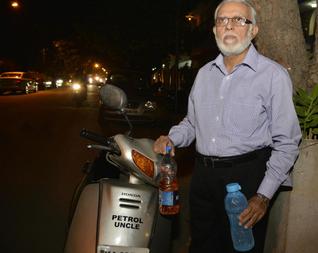
Mohammad Arif Sait helps motorists who run out of fuel at night
Kindness in a bottle:Mohammad Arif Sait sits outside the petrol outlet on Coles Road, offering desperate motorists a spot of fuel and water.— Photo: K. Murali Kumar / The Hindu
A fuel tank that reads empty at an inopportune time, especially at night with no petrol station in sight, is every motorist’s nightmare. Making sure that such desperate motorists who cross his path aren’t stranded is ‘Petrol Uncle’ Mohammad Arif Sait.
Mr. Sait sits outside a petrol outlet on Coles Road (near Fraser Town) from 11 p.m. to 12.30 a.m. every day with 10 bottles of petrol, worth at least Rs. 50 each, to help motorists who arrive after the outlet is closed at 11 p.m. He has done this for the last five years.
“There hasn’t been a single night when people haven’t come pushing their vehicle to the petrol station. I give them water to drink, and petrol to reach the nearest open pump,” he says proudly.
What goes around
It started when his scooter ran out of petrol one night. “I went in an auto and fetched petrol in a bottle from the nearest petrol outlet. I refilled the bottle and kept it with me. The same night, I saw a person pushing his vehicle on the road. He had run out of petrol. I gave him the bottle. He thanked me profusely. This prompted me to do this regularly,” Mr. Sait said.
He takes his spot every night after shutting his footwear store on Commercial Street.
He refuses to accept the money offered for the petrol by those he helps. All he asks is that the motorist fill the bottle at the nearest open fuel station and return it, so he can give it to others.
“Initially I used to spend around Rs. 1,000 a month,” he says. “The cost was nothing compared to the satisfaction I got from helping those in need. Now, I do not have to spend any money. Motorists refill the bottle return it to me.”
Mr. Sait’s family has not been able to convince him to stop this “service” even after two heart surgeries and a fractured leg. “I have made it clear I will continue this service till my last day. In fact, I feel healthier because of all the blessings.”
Recently, he was approached by a company to act in its ad films. A Kannada film director too has offered him a special appearance.
source: http://www.thehindu.com / The Hindu / Home> National> Karnataka / by Staff Reporter / Bangalore – December 17th, 2013
Constructing Life, a digital artwork by Shibu Arakkal, son of noted artist Yusuf Arakkal, has won first prize at the prestigious Florence Biennale.
Based in Bangalore, Shibu said the event saw the participation of 475 artists under the categories of painting, sculpture, art on paper, video art, digital art, photography and installations. “Although, I applied under the photography category, the international panel of jurists awarded me under digital art due to the technique execution of my work”, he said. Shibu received the Lorenzo il Magnifico gold prize in digital art for 2013.
“Since none of us was told about the nominations, the winners were in for a pleasant surprise at the ceremony on December 8. My work measures 8 feet x 6 feet, comprising 12 panels. It’s a digital photo giclee print on canvas,” Shibu explained. The awards were presented by brothers Pasquale Celona and Piero Celona, president and vice-president of the Biennale.
Describing the artwork, he said: “Our daily lives and quality of life are not only signified by the physical buildings we inhabit but also speak about our tastes, culture and sophistication. One of our most serious endeavours in life is to create one such dwelling to exist and flourish in. Sophisticated and design-minded buildings are visually very different from the hard and weather-beaten appearances of the people who construct these structures. And yet there is such character in their form and faces! It is these ideas that have taken root in my mind to create portraits of the construction worker in a series that will question our ideas of what ‘interesting’ is.”
source: http://www.timesofindia.indiatimes.com / The Times of India / Home> City> Bangalore / by G S Kumar, TNN / December 17th, 2013
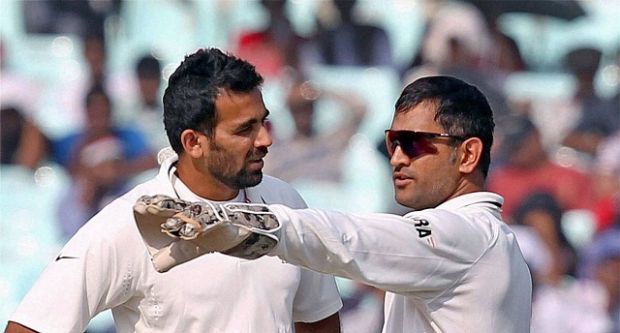
Former India skipper Sunil Gavaskar feels that the presence of pace ace Zaheer Khan would help the inexperienced quickies in the much-awaited IndiaSouth Africa Test series.
“Zaheer’s return is a blessing for India. Even if he doesn’t pick too many wickets, it will be a big plus for the likes of Bhuvneshwar Kumar, Mohammed Shami, Umesh Yadav and Ishant Sharma to have Zaheer around because he will be the one to give them those little tips that can be so handy . In the pressure of a Test match, sometimes all you need is a little word and not a long lecture. Zaheer is capable of doing that very well,“ Gavaskar told the BCCI website.
Gavaskar said that the battle between Zaheer and Graeme Smith would be an intriguing one. “Zaheer has that confidence against Smith and that will give him an upper-hand.
However, Smith is a worldclass batsman and will be out there to prove that he is not Zaheer’s bunny,“ added Gavaskar.
“This series is going to be very crucial for R. Ashwin.
Since he has played most of his cricket at home, he is used to getting wickets reg ularly in helpful conditions. Here he will have to rely on flight and variation as there won’t be much spin on offer. He will also have to be much more patient and assume the role of a stock bowler for Dhoni who could keep the pressure from one end and allow the strike bowlers to pick wickets from the other end. Also, don’t forget that he can bat too,“ said Gavaskar.
The 64-year-old former opening batsman also stated that it is a great opportunity for the next generation batsmen to rise to the occasion.
“We need to be patient with them and give them the time to settle down. Once you know they have the ability, you need to stand by them. We have seen that with Virat and Rohit,“ and added: “For me the biggest strength of this Indian batting is the fact that most of them can change gears when required.“
source: http://www.deccanchronicle.com / Deccan Chronicle / Home> Sports> Cricket / DC / December 16th, 2013
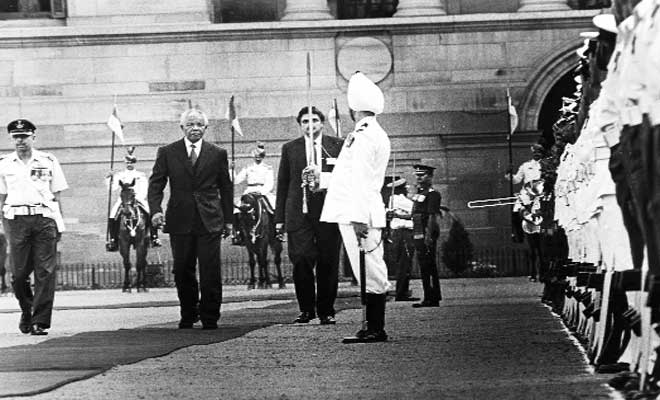
While Nelson Mandela was a symbol of the struggle against oppression across the globe, he and his movement always had a very special connection with India.
A Bharat Ratna awardee in 1990, he is the only non-Indian to receive the honour. (He was also given the Nishan e Pakistan in 1992).
Mahatma Gandhi, who evolved and perfected his technique of Satyagraha in South Africa, was a source of great inspiration to Mandela. On his India visit in 1990, Mandela, when informed of a veteran journalist’s 13-year-old daughter, who was his fan, said “Tell her that I was in fact inspired by a man who was born right here in India.”
Mandela used Gandhi’s tactics at several points as he went about evolving his own philosophy. In the early sixties, the ANC had a militant wing called the Umkhonto We Sizwe (Spear of the Nation) which Mandela was part of. In 1962, Mandela spoke of the need for forceful action and quoted Gandhi as saying: “If the choice is between cowardice and violence, I will pick violence.” Later, he once again used Gandhi as a guide in his efforts to build bridges between seemingly irreconciliable forces.
Several of Mandela’s closest comrades and associates were of Indian origin. Two of his closest comrades, Ahmed Kathrada, and Ismail Meer, with whom he spent almost all of his prison years, were Indian.
An Indian, Sonny Venkatrathnam, also jailed at Robben Island in the 1970s for his role in anti-apartheid activities, got his wife to smuggle ‘The Collected Works of Shakespeare’ inside the prison and passed it off as the Robben Island Bible. Nelson Mandela, Ahmed Kathrada, Chris Hani and others read Shakespeare’s plays as a relief from the boredom of having to break stones all day.
Mandela kept a diary while in prison, and hid it in the grass to ensure that the wardens do not destroy it. After twelve years in prison with Mandela, another Indian, Mac (Sathyandranath) Maharaj, who was released after 12 years, as opposed to Mandela’s 27 years, transcribed his notes and smuggled the account out, which was known to the world on its release in 1976 as The Long Walk to Freedom.
source: http://www.indianexpress.com / The Indian Express / Home / by Seema Chisti / New Delhi , Saturday – December 07th, 2013
She broke a gender barrier by learning to drive an autorickshaw. Now, Jazeera V is taking on the might of the sand mafia in Kerala. Ankit Agrawal reports.
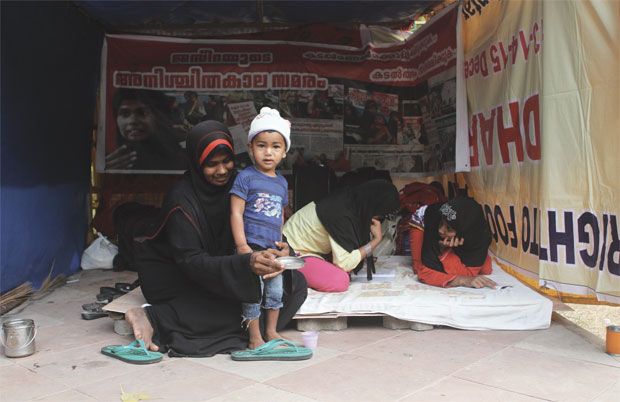
Mother courage Jazeera V with her three children at the protest site near Jantar Mantar / Photo: Ankit Agrawal
It’s 10 am and Jazeera V, a tall, burqa- clad woman, is having breakfast with her three children near Jantar Mantar in New Delhi. A 31-year-old autorickshaw driver, she has come all the way from Kerala to raise her voice against illegal sand mining on the beach near her village, Puthiyangadi, 30 km from the district headquarters of Kannur. She had seen how the rampant sand mining was causing erosion of the beach.
Sitting on a pavement in front of Kerala House, she has turned the little patch into her personal zone of dissent. She asks this reporter to wait until she finishes some daily chores: sweeping the spot where she has been doing a sit-in since 6 October, fetching water and helping her youngest child, 18-month-old Mohammad, have a bath.
Jazeera was born in a conservative family. “I was not allowed to play or read story books,” she recalls. Not one to be cowed down easily even as a child, Jazeera resisted this discrimination by going outdoors to play, just like the boys. But her family stopped sending her to school when she turned 14, and three years later, in 1999, forced her to get married.
However, three days after the wedding, she realised she could not imagine a life together with her husband. “He used to get drunk and have extra-marital affairs,” she says. “When I protested, my brothers thrashed me and locked me up in the house.” They insisted that she must protect the family’s “honour”. She said her husband, too, must fulfil his responsibilities towards her. Finally, in 2004, she shifted to Ernakulam with her elder daughter Rizwana, leaving her younger daughter Shifana with her mother.
At Ernakulam, she worked first as a domestic help and then as a saleswoman for a publishing house. Despite her family’s repeated attempts to make her return to her husband, she remained firm that that she wanted a divorce.
Later, Jazeera broke another gender barrier when she learnt to drive an autorickshaw in Kannur and bought one with financial assistance through the Prime Minister’s Rozgar Yojana. She moved to Kottayam and started working there as an autorickshaw driver. In 2011, she married Abdul Salam, a teacher at a local madrassa.
“It was in December 2011 that I first noticed the erosion of the beach near my village due to illegal sand mining that had been going on for at least four years,” she recalls. “I was expecting my third child and had come to visit my mother in Puthiyangadi.” She was shocked to learn that one of her brothers was also involved in the illegal mining . “I was pained by the damage being done to the coast. I was born there, so I took it personally,” she says. She told her brother that she would complain to the police if he didn’t end his involvement with the sand mafia . The threat worked. This was Jazeera’s first victory in what would turn out to be a long struggle.
Initially, Jazeera was the only one in her village to stand up against sand mining . The other villagers were not keen to join her as the illegal mining provided them with a source of livelihood. Moreover, several powerful people were allegedly part of the sand mafia.
Jazeera decided to carry on her struggle alone. She lodged a complaint with the local police and provided them photographs of the mining activities as evidence. No wonder the sand mafia saw her as a threat and attacked Jazeera and her children, not once but thrice.
Following her protest, the Kannur district administration set up a checkpost on a 1½ km stretch of the Neerozhukkumchal beach in the immediate vicinity of her house. That was not enough to stop the illegal digging as this was a stretch that had already been mined so intensely that there was little sand left. The mining was continuing unabated elsewhere on the beach. When Jazeera confronted the guard posted at the checkpost, he said he couldn’t do anything about what happens in other parts of the beach.
Convinced that the district administration did not really intend to stop the illegal mining, Jazeera took her fight to the state capital Thiruvananthapuram on 2 August this year, and sat in protest outside the state secretariat. On the third day of her sit-in, CM Oommen Chandy invited her for a discussion but refused to give any written assurance on steps to be taken to stop the illegal mining .
Jazeera decided to continue her protest. An NGO was allegedly roped in to take her children away from her in the name of “rescuing” them. A determined Jazeera somehow managed to thwart that attempt. Even as she is completely immersed in the struggle, she says she is taking “proper care” of her children and “they are not begging on the streets”. This reporter saw Elizabeth Philip, a documentary filmmaker, teach Jazeera’s children at the protest site in New Delhi.
“We know how much our mother cares for the beach,” chips in Rizwana, Jazeera’s 12-year-old daughter. “That’s why we are also protesting with her.”
After 64 days of the sit-in protest at Thiruvananthapuram, Jazeera took her fight to New Delhi. Several human rights organisations have come out in her support. Following media reports, on 10 October, the statutory apex human rights body, National Human Rights Commission (NHRC), issued notices to the Kerala government and the Kannur district administration. In its reply to the NHRC, the district administration claimed there was no sand mining on the Neerozhukkumchal beach. However, Jazeera has been demanding an end to illegal sand mining on the entire coastline of Kerala, not just that one beach.
The state revenue department also replied to the NHRC citing the action taken under the Kerala Protection of River Banks and Regulation of Removal of Sand Act, 2001. On 18 November, the rights body observed that this law didn’t apply to the seashores and reprimanded the department for not stating if any steps were taken to stop illegalsand mining along the coastline.
In October, Union Rural Development Minister Jairam Ramesh wrote to Chandy in support of Jazeera’s demands, but the CM is yet to reply. Social activist Medha Patkar also wrote to Chandy, reminding him of recent judgments of the Supreme Court and directives of the National Green Tribunal.
Though leaders of some political parties have shown their support for Jazeera’s cause, no party has taken a public stand yet on the issue. “Our state secretary visited her to show solidarity,” says CPI leader Annie Raja, who is also the general secretary of the National Federation of Indian Women. “Unfortunately, Jazeera is fighting alone but it is not as if we don’t care for her cause.”
F Faizi, an ecologist with the Convention for Bio-Diversity Alliance, says that sand mining is happening on a large scale in Kannur, Alappuzha, Kollam and parts of Thiruvananthapuram. Though Jazeera’s agitation has ensured that the extent of mining is somewhat reduced at the moment, the mining mafia’s clout leaves no room for complacence. Currently, Jazeera is mulling over filing a public interest petition on the issue.
While this reporter was leaving Jantar Mantar, Jazeera was talking to a family who had come to show their support. Perhaps, people like these are Jazeera’s greatest strength.
source: http://www.tehelka.com / Tehelka / Home> Current Affairs / by Ankit Agrawal ankit.agrawal@tehelka.com / Issue 50 , Vol. 10
(Published in Tehelka Magazine, Volume 10 Issue 50, Dated 14 December 2013)
Actor Naseeruddin Shah, a veteran in the Hindi film world, says Indian filmmakers’ fascination for the Academy Awards is “laughable”. He believes “we are never going to win any”.
The 63-year-old, who has featured in films like “Masoom”, “Sarfarosh”, “Iqbal” and “The Dirty Picture”, was asked what he makes of the current scenario of Indian filmmakers fighting with each other to make it to the Oscars.
“The fascination with the Oscar…I find it laughable, because we are never going to win any. I mean those who are hoping about it just forget about it, because it’s never going to happen. It’s like chasing the rainbow,” he said.
This year, Gujarati film “The Good Road” is India’s official submission for the foreign language film category at the 86th Academy Awards.
Naseeruddin says the fascination for an Oscar is futile.
“It’s just a yearning for worldwide recognition and we feel that Oscars guarantees us that, so that’s why there is this hankering for an Oscar. It’s ridiculous. I think everybody should just keep making the kind of films they want to make,” he added. Meanwhile, the actor is currently busy promoting his film “Dedh Ishqiya”. He shares the frame with Bollywood’s dancing diva Madhuri Dixit and sets the record straight about his reported “steamy scenes” with her in the movie.
“There are no such scenes in the film. I think people just enjoy talking about this kind of stuff, so I am assuring those who want to see ‘Dedh Ishqiya’ that there are no steamy scenes between Madhuri and myself. It’s all poetry but its good poetry,” he said.
Directed by Abhishek Chaubey, “Dedh Ishqiya” also features Arshad Warsi and Huma Qureshi.
source: http://www.deccanherald.com / Deccan Herald / Home> Entertainment / IANS / Mumbai – December 16th, 2013
Ahmed Kathrada, the Indian-origin veteran anti-apartheid activist and aide of Nelson Mandela, moved many mourners to tears when he paid a poignant tribute to the late statesman during the state funeral at Qunu village in South Africa’s Eastern Cape province Sunday.
“When Walter (Sisulu) died, I lost a father, when you died I lost a brother, now I don’t know who to turn to,” Kathrada said.
Ahmed Kathrada, the Indian-origin veteran anti-apartheid activist and aide of Nelson Mandela, moved many mourners to tears when he paid a poignant tribute to the late statesman.
A long-time friend of Mandela, Kathrada said the last time he saw Mandela alive was when he visited him in hospital, South Africa’s government news agency SA News reported.
“He tightly held my hand… and brought all emotions… Farewell my dear brother, my mentor my leader… I have lost a brother.”
Kathrada and Mandela were both imprisoned in Robben Island for their political views.
“I recall the tall, healthy strong man, the boxer, the prisoner who rigorously exercised every morning. Now the inevitable has happened. He left us to join the ‘A team of the ANC’.
“Together, we shared ideas and walked side by side in the shadow of death,” Kathrada said.
“We are deeply grateful to Madiba… We are deeply grateful that dignity has been restored to the people of South Africa, we are deeply grateful to Chapter 9 institutions that zealously guard our Constitution,” he added.
Mandela, South Africa’s first democratically elected black president, died of illness in his Johannesburg home Dec 5 at the age of 95.
source: http://www.economictimes.indiatimes.com / The Economic Times / Home> News> World News – International / by IANS / December 15th, 2013