All posts by mpositiveone@gmail.com

‘The Great Akbar’ of Independence struggle

Azad’s greatest gift was to postulate an equation between Islam and Indian nationalism on the one hand, and between Islam and the universal principles, on the other

Height about 5’ 5’’; exceptionally thin; noticeably fair; age about 33 years; has practically no hair on his face though he does not shave; long sharp face with prominent nose. This is the “official” description of Maulana Abul Kalam Azad, the golden boy of the Independence struggle. With his confidence, charm and sincerity, Azad impressed people of his age group with his sharp and swift mind. Later in years, he especially cultivated a look of venerable age to give a suitable background to his learning. His genius and method were too individual to found a school, but his writings and lectures exerted a profound influence owing to the breadth of view and patient learning. Rajaji described him as ‘The Great Akbar of Today’.

Unease with conformity

The study of Azad’s early life is, however, hampered by a deficiency of data. But there is ample evidence to indicate his discomfort with the traditional order of things. This was enough to rouse his scorn. So is his unease with taqlid or conformity. Is Islamic doctrine so rigid and dogmatic that it leaves no room for intellectual creativity? With this bent of mind, he broke off the shackles of fossilised theology, and critiqued all those elements in theology that inhibited the progress of empirical science and the unlimited process of their utilisation. His views on the spread of a materialistic way of life and the stagnation and retardation of religious life became well-known, but this phase in his life — when he “saw in religion only ignorance” — proved to be momentary. Once he regained his faith, he worked out a synthesis between the reformist and orthodox philosophies. He did not go too far in this journey, but went far enough to disturb thestatus quo.

The awakening at Aligarh’s M.A.O. College fostered ideas on reforms, interpretation, and innovation among the Muslim intelligentsia. Syed Ahmad Khan moulded young Azad’s thinking. He did his very best to read his writings and admired them. He also admired Shibli Nomani, founder of the Nadwat al-ulama in Lucknow. And when the Nadwa alim turned pan-Islamist after the European intervention in the Balkan States, Azad too stressed that the bonding with the Turks was unique insofar as they were a part of the Islamic community as well as its last political centre.

One has only to cast a glance at some of Azad’s early writings to realise that he entered the valley of doubts and uncertainties to demolish the suppositions that had guided theologians. He opposed the ‘scripturalists’ or the ‘literalists,’ because they advocated rigid adherence to the fundamentals of Islam, as literally interpreted from the Koran and the Sunna. His interest in the externals of religion, too, diminished. At the same time, he was consistent in his authentic inward piety. Just as he was ready to comprehend the whole Koran within the verses of the first Surah, so he conceived and pursued the politics of Islam within the Koran’s dimension of piety.

The Muslim communities were divided by geographical situation, by differences of dialect and custom and, in some cases, by the deeper chasm of sectarianism, but pan-Islamism inflamed their passions, a feeling that, although they had been ground down under the wheels of history, they thought of themselves as a mighty society spread worldwide. Azad, for one, was attached to the common inheritance of Islamic culture and explored the treasures of thought and emotion which belonged to the umma. He proceeded naturally from the conviction that education, liberalism and faith in progress were requisites for Muslim empowerment.

Setting a great example of moral leadership during World War I, Azad became the soul of the Congress party. He opposed Partition heart and soul, while a great body of his compatriots clamoured for a Muslim nation. He could not conceal the contempt that he felt for them, and at no stage in his public career did he stoop to compromise. The spectacle of Indians working out a new way of life and boldly defying the accumulated prejudices and animus of the past was one which aroused his interest and curiosity. Without looking around to find a mirror that might reflect radical faces, he identified pluralism to be the weapon of the strong and the weak against the British. He preferred the conviction of Dara Shikoh, the eldest Mughal prince and a victim of Aurangzeb’s conspiracy, that in the search for the ultimate Truth, mosques as well as temples validly mediate the one candle’s light.

Harmonious and creative Islam

Azad’s greatest gift was to postulate an equation between Islam and Indian nationalism on the one hand, and between Islam and the universal principles, on the other. He did so to enlarge our conception of what is possible, enrich our intellectual imagination, and diminish dogmatism which closes the mind to ijtehad. With his belief in an integrated, harmonious and creative Islam, he adumbrated the outlook of a religious humanist, very much in the line of the humanism embodied in the classical Persian Sufi poetical tradition. He envisaged an Islam not of sectarian belligerence but of confident partnership in a cultural and spiritual diversity where a strident divisiveness would be its betrayal.

Maulana Abul Kalam Azad, Minister of Education in free India and sponsor of an ‘official’ history of the 1857 Rebellion, referred to the two communities standing ‘shoulder to shoulder’ to liberate themselves from the British yoke. Why did Azad and others think that it was worth their while to make this point? Probably, to record the regret that “the British swept away and rooted out the late Mughals’ pluralistic and philosophically composite nationalism,” and to bemoan that they ensured that common action by Hindus and Muslims would in future not be accomplished easily.

Shakespeare’s view of life in one of his plays is that, “round the lonely great ones of this earth there is inevitably a conspiracy of envy and hatred, hatched by the base and common sort.” On December 30, 1941, the gates of Naini prison outside Allahabad opened for Azad; on August 9, 1942, the new gate of the old Ahmednagar Fort prison closed behind him.

Earlier, its mention would invariably bring to his mind several forgotten footprints of time and presented, page after page, six centuries of history. And yet, “in this world of thousand caprices and moods, so many doors are opened to be closed and so many are closed to be later thrown open.” Hence, between July 15 and August 5, 1942, he went around the country for consultation with the Congress leaders.

Azad spent a total of 10 years in jail. Thrown into a new world whose geography did not extend beyond a hundred yards and where the population was no more than 15 faces, he was overwhelmed by the morning sunlight and the evening darkness. Like Antonio Gramsci, Azad conceived of writing something that might absorb him and give a focus to his inner life. For this, he read a great deal. He drew the guidance and motivation from the reading of Scriptures. It is important to realise — and important particularly for the full knowledge and comprehension of times past — that internment kindled Azad’s Islam into warmth and fervour. Like Aurobindo Ghose who found God as a result of the wrath of the government, he felt comforted and serene. And like the future sage of Pondicherry, he found it impossible to explain the love of motherland or sacrifice to the thick-skinned Britons in India.

Independence came with Nehru’s ‘tryst with destiny’ speech, but Partition plunged Azad’s spirits into depression. “There is no more certain test of statesmanship,” wrote H.A.L. Fisher in his History of Europe, “than the capacity to resist the political intoxication of victory.” Though hurt and wounded by a colossal tragedy, the otherwise distraught Azad carried his tribulations with a stoical dignity and pursued his active role through stresses of inner disquiet. Ultimately, he suffered for the sake of truth. He had noted in one of his many elegant passages that, “the flowering trees whose offspring once represented beauty and grace were now lying in a heap in a corner, like burnt out bushes and trampled up grass.” The story which opened with the bright colours of the Al-Hilal and Al-Balagh closed in deep shadow.

Like the Urdu poet, Mir Taqi Mir, Azad could only voice affirmation of the historical process or protest against the iniquities of time and the suffering it caused to the sensitive mind and soul. He had indeed no small talk, and no time for it, or for little human foibles, but in his famous speech after independence at the Red Fort in Delhi, he lambasted those Muslims who threw themselves more and more deeply into the communal vortex. At the same time it must be said to his credit that, in the turmoil raging around the Muslim communities, Azad secured them the comfort of peace and security. Lesser men found conflict in the rich variety of life, but Azad was big enough not only to see the essential unity behind all that diversity but also to realise that only in this unity can there be hope for India as a whole and for those great and varied currents of national life.

(Mushirul Hasan is a historian of modern India. He has edited a book Azad’s Legacies: Islam Pluralism and Nationhood (forthcoming)

source: http://www.thehindu.com / The Hindu / Home> Opinion> Lead / by Mushirul Hasan / November 08th, 2013
On 125th birth anniversary, Maulana Abul Kalam Azad lies a forgotten man

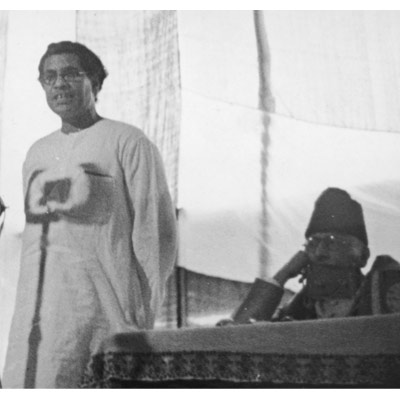
Bengali political theorist Manabendra Nath Roy (1887 - 1954) addresses the Indian National Congress, circa 1940. On the right is Muslim statesman Abul Kalam Azad (1888 - 1958), the President of the Congress
Bengali political theorist Manabendra Nath Roy (1887 – 1954) addresses the Indian National Congress, circa 1940. On the right is Muslim statesman Abul Kalam Azad (1888 – 1958), the President of the Congress

Its red sandstone boundary walls are defaced with posters and betel juice marks. Shopkeepers hang cases full of clothes and jewellery on them. Inside the walls the dry fountains gather dust and filth. This is the state of the maosoleum of Maulana Abul Kalam Azad, independent India’s first education minister, whose 125th birth anniversary will be observed Monday.

Situated in the heart of the bustling Meena Bazar, the garden-tomb of India’s prominent independence leader and close associate of Jawaharlal Nehru, the country’s first prime minister, the mausoleum is surrounded by numerous shops selling food, mobiles, CDs, clothes and other knick-knacks. Open sewers and a dump yard nearby tell a tale of unbelievable civic and governmental neglect.

Apart from the apathy of the authorities in maintaining the site, what stands out is that even most residents are not even aware about the mausoleum of a leader who is credited with establishing a national education system and modern institutes of higher education, including the Indian Institutes of Technology. His birth anniversary is also observed as National Education Day.

Walking down the winding by-lanes in search of the mausoleum, one is startled to learn that most of the locals are oblivious of his name, leave alone the location of the memorial. It’s indeed ironic how the man who persuaded thousands of Muslims during partition to stay back in India is now a forgotten man.

The boundary walls of his mausoleum have become billboards for local politicians, quacks and restaurants, while the temporary stalls adjacent to these walls have further damaged it by hammering nails and creating deep holes in places.

The gate has a lock, but it might as well not have one.

As you enter the small black iron-gate, a short staircase leads to a garden where people, mostly shopkeepers, are having lunch or a siesta. It is perhaps the only place offering peace and tranquillity in the midst of a maddening market and has thus become the resting place for many. That is another reason why the mausoleum is at least still maintained, though empty packets and wrappers of eatables and plastic bottles are scattered around the boundary walls.

In one corner is the mausoleum made of white marble with a patch of green grass on top. A canopy and a short boundary wall, both made of white marble, cover it from rain and sun – and more importantly, bird droppings. The fountains and pools, on the front and on the sides of the mausoleum, are empty and full of dust and filth, while the garden has patches of grass. Lichen covers the trunks of many trees.

The famous Urdu Park in front of the mausoleum, where Azad along with Sardar Patel, independent India’s first home minister and now much in the news, and C. Rajagopalachari, India’s first governor-general, delivered the historic 1942 Quit India address, is a playground for amateur cricketers during daytime and a haven for drug addicts and drunkards at night.

Sadly, it seems no one cares. For the locals, the mausoleum was just what it was – a mausoleum. “I know it’s a mazar (mausoleum) but I don’t know whose it is,” Abdul, a shopkeeper selling blankets near the boundary wall of the memorial, told IANS.

Similarly, tourists who come in droves to visit the nearby Jama Masjid and Meena Bazar, famous for affordable women’s apparel and accessories, give the memorial a miss as they are oblivious of its existence and importance.

Azad’s grandnephew Firoz Bakht Ahmed is not surprised at the neglect. “Since independence, he (Azad) never got the importance that he deserved. The government as well as the people have forgotten him. It’s a tragedy,” Ahmed told IANS. He said leaders like Azad, Patel and many more deserved much more recognition and respect. “There should be chapters in schools where students are taught about them and not just a handful of freedom fighters,” he said.

Talking about the poor maintenance of the memorial, Ahmed said that squatters should be removed from near the site and proper security arrangements put in place. “He was a freedom fighter and a nationalist leader known for his secular thoughts and was one of the few Muslim leaders who strongly opposed the partition of India. But sadly, he is not remembered now,” he added.

source: http://www.dnaindia.com / D NA  / Home> India> Report / Agency: IANS / Sunday – November 10th, 2013

Rare self-portraits by MF Husain on display in Dubai

Dubai : 

An exhibition containing 25 rare self-portraits by MF Hussain, in commemoration of his birth centenary has been put on display here.

Husain, who died in 2011, spent a number of years in the city, is being honoured with the exhibition titled ‘Maqbool’, to mark his 100th birthday. The exhibition, curated by Dadiba Pundole, will run until December 12 at the Sovereign Art Gallery .

Six other art works by Husain are also on display at the same venue. The self-portraits show various stages of his life participating in different activities.

The exhibition also showcases the vast range of mediums that Husain used in his work — pencil sketches, oil paintings on canvas, and several mixed-mediums including the use of Arabic calligraphy.

source:  http://www.timesofindia.indiatimes.com / The Times of India / Home> India / PTI / November 25th, 2013

Braving adversity : A tale of courage

Here’s a story of exemplary courage and determination. A story of how a young boy, who lost his hands and a leg in a mishap, braved adversities to literally guide the 

City out of chaos.

Like any other restless child, 11-year-old Salman was flying a kite atop his house when he suddenly saw the kite descending. In a bid to get hold of the kite, he ran towards the parapet wall on the terrace. He then slipped over the wall and fell straight on to a live wire. Salman lost both his arms and a leg in the process.

Today, 21 years after the incident, unable to find a job to feed his family, Salman stands at a busy junction near Miller’s Road directing traffic. He is there from 11 am to 8 pm. He has been at this spot for the last 18 years.

Salman was employed at a few places before he decided to do this. His previous employees sacked him citing silly reasons. One said he didn’t know English and couldn’t communicate well, the other said they wanted people who could run around.

“After I lost my hands and one of my limbs, I couldn’t go to school. I don’t know how to read and write and after being humiliated at several places, I thought I could help people by easing the traffic at this busy junction where there is no traffic police at any time of the day,” says Salman.

Salman is a familiar face to those living in the vicinity and this stretch where he stands, connects Miller’s Road to Benson Town.

It is a one-way but violations are aplenty and although there is a steep turning, people drive at high speed unmindful of the traffic ahead. Salman gets tipped anything between Rs 5 and Rs 20 a day.

“I don’t ask for alms but people generously give me some money and together I manage to make about Rs 200 a day. This just about covers my transport and food expenses for a day. It is better than working in a stifling environment where you are looked down upon,” he beams.

The residents say Salman’s presence has made a significant difference in easing the congestion.

Mujib, a businessman who lives across the street, says he never fails to tip Salman.
“People wait for Salman to come and motorists actually listen to him and follow his
directions. He’s doing a service that even the traffic cops don’t do with as much dedication.”

Nasir, who works with a logistic firm and lives in Benson Town, says he has been seeing Salman for the last couple of years.

“It’s a great service that he’s doing. If not for him, this narrow road would have been chaotic. We miss him on days when he’s not around,” Nasir sums up.

source: http://www.deccanherald.com / Deccan Herald / Home> Supplements> Metrolife / by Nina C. George / DHNS, November 25th, 2013

Rare Mughal exhibits from British Library in Delhi

Rare exhibits including Shah Jahan’s recipe book, a route map from Delhi to Quandhar, a river front map of Agra, a bird’s eye view of Red Fort are among other Mughal miniatures set to go on display here.

Titled ‘Mughal India: Life, Art and Culture’, an exhibintion tracing the evolution of Mughal art and empire between the 16th and 19th centuries has been curated by Malini Roy for the British Library in London in March this year.

The exhibition of replicas of exquisite paintings from the British Library’s Central and South Asian collections is scheduled to be inaugurated by Vice President Hamid Ansari  and Union External Affairs Minister, Salman Khurshid .

An initiative by Roli Books in collaboration with Indra Gandhi National Centre for Arst (IGNCA), the facsimile edition of the original exhibition will be on display in the capital from November 22 to December 31.

“The exhibition at British Library is not like we visit a museum. Hence, they aren’t on display unless something particularly asks to see these exhibits. And how many Indians would get to see that? So, we chose to bring the same exhibition here as well,” says Pramod Kapoor, Founder and Publisher, Roli Books.

“Besides the exhibition a series of lectures, workshops and discussions by noted art historians and scholars from India as well as London including William Dalrymple, M J Akbar and Pushpesh Pant will also be held,” he added.

The Mughal Empire was a period of great cultural and educational enlightenment and has directly influenced many modern areas of Indian culture.

source: http://www.business-standard.com / Business Standard / Home> PTI Stories> National> News / by Press Trust of India / New Delhi – November 20th, 2013

The funny side of faith

We Muslims eat biryani,” says stand-up comedian Azeem Bantwalla. “Then because we feel bad that we have killed a goat, we don’t eat for one month. Then again we eat biriyani.”

Azeem (24) is performing at the ‘Pant on Fire’ stand-up comedy show at the JT Performing Arts Centre in Kochi. Comedian Sourabh Pant introduces Azeem, who is off-stage, saying, “Azeem is a Muslim with a sense of humour. That’s an oxymoron. It’s like a Congress politician who says, ‘cheque payments.’”

And in walks a tall (6’3”) and gangly person, wearing spectacles and looking more like an eager college student rather than a comedian. And he swings the bat straightaway: “When Iran sent a rocket into space, they also sent a monkey along with it. We Indians would never do that. We know that a flying monkey is useful only if your wife is stuck in Sri Lanka,” he quips.

As the crowd bursts into laughter, Azeem gets into the groove easily. But there is a small gasp when Azeem ventures into territory, which would have been considered forbidden because of its sensitivity. “As a Muslim, all you do on Eid is to eat biryani,” he says. “Honestly, I don’t even know why we call it Eid. We should just call it ‘lunch’!”

Off-stage, a more relaxed Azeem says, “In India, talking about Muslims and Islam are sensitive topics. But being a Muslim, I feel that I have a license to do so. If not me, then who else would?”

Of course, Azeem is careful about the way he tells his jokes. “I don’t want to offend anybody,” he says. “Basically, I am analysing the idiosyncrasies of the religion. Poking fun is one thing, and being insulting another. And that is not my aim,” he clarifies.

He remembers how once during a show in Mumbai, he noticed a bearded Muslim wearing a skull cap and his burqa-clad wife sitting in the front row. “They laughed the most at the Muslim jokes,” says Azeem. “In fact, they were enjoying the show as much as the rest of the audience.”

Interestingly, Azeem, a Gujarati, who was born and brought up in Mumbai, stumbled into his passion in quite a convoluted way. He graduated in engineering from the Rajiv Gandhi Institute of Technology in 2010. At that time, because of recession, he could not get a job. “I sat at home and did nothing for six months,” he says.

It was during this period that Azeem got an opportunity to write humour for a show on UTV Bindaas. Later, he secured an opening as a writer for a Delhi-based magazine. In September 2011, he did an interview with one of India’s top comedians Vir Das. “It was while talking to him that I got interested in stand-up comedy,” says Azeem.

That very month, he got an opportunity to perform at The Comedy Store in Mumbai. The joke which got an enthusiastic response went like this: “Facebook is a lot like Delhi. You can poke all the women you want and get away with it.”

And when the crowd laughed and applauded, it was a giddy experience for Azeem. “There is no preparing you for the rush of energy that comes from the audience,” he says. “Your adrenalin starts pumping. It is like doing bungee jumping.”

A hooked Azeem has now performed in Pune, Bangalore, Kochi, and Baroda, apart from doing several shows in Mumbai. He is a rising star in an art form which is rapidly gaining popularity across India.

source: http://www.newindianexpress.com / The New Indian Express > Magazine / The New Sunday Express / Home> Magazine / by Shevlin Sebastian / November 24th, 2013

Abracadabra : Passing thoughts on men and mice

Kennedy, Sabu and Anekaroti

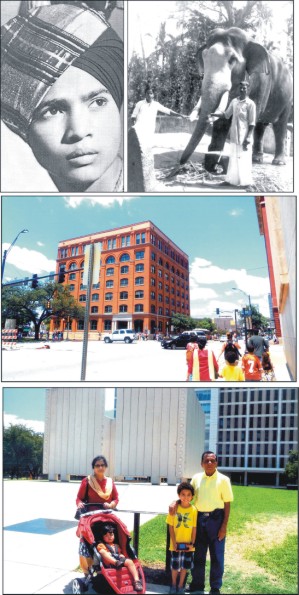
(1-Top Left )Sabu, the elephant boy. (2-Top Right) Sabu with his father, a mahout (3- Middle) This is the rear of the building from where Kennedy was shot and killed. (4-Bottom) The memorial like a wall with vertical lines at the spot where Kennedy delivered his last speech. Dr. Sunder Raj is seen standing by the side of the information plaque.
(1-Top Left )Sabu, the elephant boy.
(2-Top Right) Sabu with his father, a mahout
(3- Middle) This is the rear of the building from where Kennedy was shot and killed.
(4-Bottom) The memorial like a wall with vertical lines at the spot where Kennedy delivered his last speech. Dr. Sunder Raj is seen standing by the side of the information plaque.

A couple of days back, an old friend of mine from Bangalore had come to meet me and casually asked if Dr. J.K. Sunder Raj, a well-known family doctor of our city, had hung his stethoscope. Since I am in regular contact with him either in the Sports Club or Mysore Race Club or in connection with the Zoo (where he treats the gorillas), I answered in the negative.

“What makes you think Dr. Sunder Raj has called it a day and closed shop?” I asked.

It seems my friend had gone to see him at his clinic on Old Mysore Bank Road in city and found there was no clinic. That was news for me too. I called him on telephone to check. Yes, indeed he had closed his city clinic, but continues his service to the sick families from his house on Vivekananda Road in Yadavagiri. It was then that the good doctor said he was wanting to see me personally to hand over a unique newspaper that he had purchased in Dallas, Texas, where he had been recently to be with his daughter.

As promised, he came to my office with his special newspaper and more. The cover page of the newspaper is produced here… and the headline is self-speaking.

The daily newspaper ‘The Dallas Times Herald’, in its Friday evening Nov. 22, 1963 Final Edition, had carried world’s most shocking and tragic news of the day that happened in the city from where the paper was published. The assassination of US President John F. Kennedy. Looking at the paper that appeared as pulled out from the well-preserved archive, I wondered how our doctor managed to get the paper which will have huge antique value ! He asked me to take it easy. There is nothing like grabbing an old copy of that day of tragedy of Nov. 22, 1963. The credit for making available this copy of the newspaper to tourists should go to the Curator of Kennedy Museum at Dallas where Dr. Sunder Raj purchased it by paying $ 4.60. The cover price of the newspaper in 1963 was five cents.

The Museum authorities periodically print this historic newspaper as it was printed on that tragic day and sell them. What better souvenir one would want for visiting the Kennedy Museum ?

I took a copy of it before returning the original to the doctor and wondered if anything like this is being done at Gandhi Museum or Nehru Museum in our country. Readers with information on this may please write or e-mail to me.

Dr. Sunder Raj also gave me two photographs he had taken — one of the building from where Lee Oswald, the assassin, shot the President from the sixth floor which has now been converted into a Museum and another, the spot where President Kennedy delivered his last speech.

Dr. Sunder Raj also had two more surprise photographs with him which were of personal nature. One was a photograph he had clicked in the year 1951-52 at the elephant stables of the Maharaja, known famously as ‘Anekaroti.’ Now the new generation as also of the old generation may not know that the Anekaroti ever existed in Mysore, attracting huge number of tourists those days.

The stable was located where the JSS Hospital Complex is now. There used to be 20 to 25 elephants, well fed and healthy, says the doctor. The area of the Anekaroti used to be green and cool with plenty of trees, adds Dr. Sunder Raj.

The doctor recalls: Once a team of Hollywood film-makers visited Mysore in around 1950. They also visited the then famous Anekaroti. As they went around Anekaroti, they saw a young, bright and handsome boy playing with a huge elephant. His name was Sabu Dastagir who later became a famous Hollywood actor under the name Mysore Sabu (27.1.1924 – 2.12.1963). He was born in Karapore in H.D. Kote, the famous hunting forest of the Maharaja of Mysore. His father was a mahout (elephant attendant) and trainer of elephants. Sabu, his son, too was following his father’s profession where he was spotted by the Hollywood film-maker Robert J. Flaherty.

Dr. Sunder Raj says that Robert Flaherty persuaded Sabu’s father to let him take Sabu to Hollywood. Once in the US, Sabu was taught English and given training in acting.

Sabu acted in several English movies, specially connected to the jungles. His first movie was ‘Elephant Boy’ which was a great hit. Other movies were ‘Song of India,’ ‘The Jungle Book,’ ‘The Thief of Baghdad’ etc. It is sad that such a talented Mysore boy died young at the age of 39.

To those working to develop Mysore as a tourist destination, I may suggest that they revive the ‘Anekaroti’ which is sure to become a tourist attraction. Some lessons from the ‘elephant show’ of Bangkok’s ‘Rose Garden’ may be learnt and incorporated to this Anekaroti. Howzzat?

source: http://www.starofmysore.com / Star of Mysore / Home> Abracadabra….Abracadabra / by  K.B. Ganapathy, Editor  e-mail kbg@starofmysore.com / November 18th, 2013

Ruins in perfect preservation

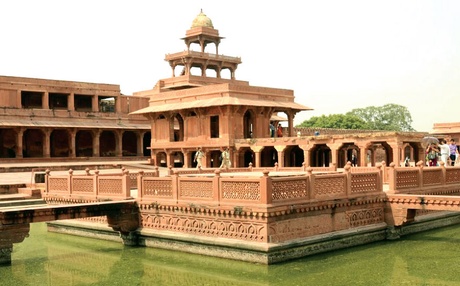
Akbar’s tribute to Sheikh Salim Chisti, Fatehpur Sikri is an abandoned city of red and white sandstone.

Fatehpur Sikri is considered the greatest Mughal city ever built and there is a fascinating story on how the idea behind its construction came about.

As Akbar grew older, his principal anxiety was the lack of a male heir. He learnt of a dervish called Sheikh Salim Chisti, the last of the many great sages in the Chisti line and journeyed to seek his blessings in the tiny town of Sikri — 23 miles west of Agra.  Sheikh recited blessings and made promises. Soon thereafter in 1569, Akbar’s Hindu wife gave birth to a son, Salim, later known as Jahangir followed by two more sons, Murad and Daniyal.

Akbar’s response to Chisti’s magic  probably ranks as one of the most outstanding examples in history of royal gratitude. He commanded that a city be built on the spot where the saint’s retreat was situated and the Sheikh was made the spiritual mentor of the entire metropolis. Almost overnight an army of labourers was mobilised to fashion the city of Akbar’s dreams and by 1570, the construction was in full swing using a kind of pre-fabrication technique.

Wrote Father Monserrate, “The house was built of stone made ready before it was brought thither so that there was neither hammer nor any tool heard in the house when it was building.”

Most of the city was completed in seven years, which was a remarkable feat considering the fact that the Taj Mahal took 22 long years to construct.

Emperor Akbar designed many of the structures himself and worked in the pits with the stonemasons cutting bricks and carving sandstone corbels. Huge battlements and a wall with nine gates appeared and a five story mosque  known as Panch Mahal was later constructed in the style of a Buddhist temple.

A huge rectangular courtyard was erected bounded by symmetrical gardens. There were three palaces, waterworks and baths, a mint for stamping coins with Akbar’s profile, a Turkish palace for his Turkish wife, a Hindu palace for his Hindu wife, a Muslim palace for his Muslim wives, an enamelled hall for the emperor to play hide and seek with all his wives, a court on which to play pachisi with human pieces, viaducts, stables, octagonal towers, domed pigeon houses and more.

There was also a seventy foot octagonal tower built in honour of a pet elephant, a girl’s school, a zoo, a sewage system and the largest gateway in the east — the Buland Darwaza — which served as a gateway to the city.

In Fatehpur Sikri, Akbar gathered the finest singers, the boldest statesmen and the wisest philosophers. His cabinet, known then as the ‘nine gems’ was reputed to hold the nine most capable men in the world.

After 15 years of life at Fatehpur Sikri, the fickle sovereign began to grow bored with his magnificent project. The harsh landscape around Sikri was not conducive to gaiety and drinking water was inaccessible (a manmade lake, dug nearby collected only brackish water).

In 1585, when a military campaign called him to Northwest India, he moved his headquarters to Lahore and abandoned Fatehpur Sikri forever.

The story that Akbar left the city to oblige Sheikh Chisti when he complained that the noise was disturbing his devotions is apocryphal, for Salim died some years before the city was abandoned.

As quickly as it had been populated, the magnificent city emptied.

A few years later, the city was described by a European as “ruinate, lying like a waste district, and very dangerous to pass through at night”.

Today, except for a small community that lives at the foot of the city and lives off the largesse of occasional tourists, the city of Fatehpur Sikri is unoccupied, a ghostly red and white necropolis of sandstone courtyards and endless silent corridors, which are all in a state of perfect preservation.

It really seems too perfect.

In fact, the ingredients of the time — resilient mortar used between the bricks have never been chemically analysed with any real success.

source: http://www.newindianexpress.com / The New Indian Express / Home> Education> Student / by Anjali Sharma – ENS / November 21st, 2013

Works from Adil Shahi era to be available in Kannada

Seven volumes of the translation are likely to be released in January

The Persian and Arabic literature dating back to the times of the Adil Shahi dynasty, that ruled Bijapur, will soon be available in Kannada, with the ambitious translation project nearing completion. The seven volumes are likely to be released in January.

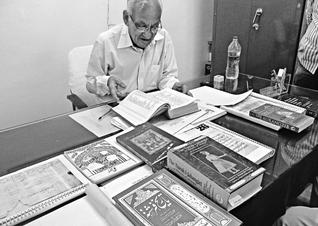
Krishna Kolhar Kulkarni, director, Adil Shahi Literature Translation Project, hopes that some misconceptions about this phase of history will be dispelled once the project is completed.— photo: RAJENDRA SINGH HAJERI / The Hindu

Krishna Kolhar Kulkarni, director, Adil Shahi Literature Translation Project, says this was the first effort of its kind and a major portion of the work had been completed. He hoped that some misconceptions about this phase of history (from 15th to 17th century) would be dispelled once the project was completed.

In English

Meanwhile, the Archaeological Survey of India (ASI) has expressed willingness to fund the translation works of these books into English. “The ASI officials said this when I was in Delhi to collect some books for translation,” said Mr. Kulkarni, adding that it will be taken up after the Kannada project.

He said in the first phase, 10 rare books of the Adil Shahi era written in Persian, have been taken up for translation into Kannada, of which the translation of six books is underway. Stating that most of the books taken up for translation were written in the 17th century, he said the project will translate some of the rarest books, some not even heard of.

Mr. Kulkarni said books include ‘Tareekh-e-Farishta’ by Mohammad Farishta and ‘Ibrahim Nama’ by Abdulla Dehelvi.

“Among them, ‘Mohammad Nama’ by Kazi Nurallah is believed to have only two copies in the world, that too are reproduced versions and not original. We have succeeded in getting a copy for translation,” he said.

Mr. Kulkarni said these books have been collected from the Salar Jung Museum, Hyderabad, the archives of Andhra Pradesh and the ASI headquarter, New Delhi.

“We are making all arrangements to get some books from London Museum for translation,” he said.

While collecting some known books, he said he came across some unknown books of the era written by several foreign authors.

Informing that the committee has meticulously selected a dozen translators, Mr. Kulkarni said that some 3,500 translated pages in seven volumes will be released in January.

He added that the committee has also collected hundreds of manuscripts, Farmans (orders), Sanads (deeds) and poetries written in Persian, which will also be translated.

source: http://www.thehindu.com / The Hindu / Home> National / by Firoz Rozindar / Biijapur – September 16th, 2013

Tryst with Adil Shahi

The septuagenarian professor’s enthusiasm to translate, from Persian to Kannada, the ancient history of a dynasty that ruled Bijapur deserves to be recognised and applauded

Prof. Krishna Kolhar Kulkarni(74), historian and research scholar based in Bijapur, has been conferred the annual Kanakashree award, in recognition of his extensive research on Dasa Sahitya. He is also an expert on Gamaka art and is the president of Karnataka Gamaka Kala Parishat. He also heads the Adil Shahi Literature Translation Project. Prof Kulkarni has written over 50 books on various subjects.

Bijapur has a special place in the history of Karnataka (as well as that of south India). “The Adil Shahi dynasty ruled the Bijapur Sultanate in the Deccan region from 1490 to 1686,”explains Prof Kulkarni. “They developed Bijapur as a great city that at times it surpassed the glory of Delhi and Agra of the Mughals in the north. It was a seat of education, culture, trade and commerce. It was even called the Banaras of the South. The Adil Shahi dynasty invited scholars and writers from all over the world and several first- hand account of the visiting travelers are recorded in Persian and Arabic. As they covered the Gujarathi, Marathi, Tamil and Kannada provinces a peculiar language that was an amalgamation of all these languages came into existence called the Dakhani. Many literary works were published in Dakhani during their rule. In fact it was here that mushaira – poetic symposium evolved and later travelled to north.

“The 200 years of Adil Shahi rule with Bijapur as their seat of power is an important aspect of Indian history. They were the contemporaries of the great Mughals of the north. The Adil Shahi writings are as important as the Akbar nama, Babar nama and Jehangir nama that document the history of the Mughals. The Adil Shahis recorded the history of their time in Persian and Arabic and there are first person accounts of very important historical incidents. All these were not translated to Kannada or even to English. Only Captain Briggs translated some extracts to suit the purpose of the British government, failing which detailed translations are not available. In fact the Adil Shahi documents dispel some misconceptions about this phase of history (from 15th to 17th century). Hence, the importance of the translation project. We have completed seven volumes. In the first phase, ten rare books of the Adil Shahi era, written in Persian, have been taken up for translation into Kannada, of which the translation of six books is underway. Some books are so rare that they are not even heard of until now!” Prof Kulkarni himself has authored several books pertaining to this era.

“Actually I was researching about Mahipathidasa who carried several works of Purandaradasa and Kanakadasa and arrived at Bijpaur after the collapse of Vijayanagara empire. He was the treasurer at the court of Adil Shahi king. He renounced his position and gave up his wealth to become a dasa. There are not many Persian scholars who also know Kannada and can translate. With great difficulty I found some and started the translation project. Prof Kalburgi of Hampi University took interest and helped me. Now the Archaeological Survey of India (ASI) has expressed willingness to fund the translation works of these books into English, and we can translate them from English to Kannada.”

The seven volumes that are ready will be launched in January. Prof Kulkarni also has plans to establish a museum in Bijapur to preserve the valuable manuscripts. He has collected rare manuscripts from Salar Jung Museum in Hyderabad, British Archives and other sources. “We need to preserve them for the next generation. Otherwise precious historical documents will be lost” he says with concern.

source: http://www.bangaloremirror.com / Bangalore Mirror / Home> Entertainment> Lounge / by Pratibha Nandakumar, Bangalore Mirror Bureau / November 22nd, 2013