All posts by mpositiveone@gmail.com

Shah Rukh Khan helps light-man’s daughter go back to school

Shah Rukh Khan sponsored a girl's education. (Photo: Facebook)
Shah Rukh Khan sponsored a girl’s education. (Photo: Facebook)

The King Khan of Bollywood, Shah Rukh Khan, believes in doing a good deed with his right hand while not letting his left hand know about it. A recent addition to his philanthropy is providing financial aid to a 5 year old daughter of a light-man.

Mohammed Azaz Shaikh has been a light-man in Bollywood for the last 12 years and also a freelancer for Balaji Telefilms till the start of 2013. Azaz is married to Zarina Parveen has two children, son Sohail, eight, and daughter Nisha, five. The family was going through a difficult time and Mohammed had to take up odd jobs as means of earning his daily bread, later things got worse and being unable to pay the fees on time, he was forced to discontinue his daughter’s education.

It was luck by chance when Zarina participated in ‘Lux Chennai Express Contest’ and was declared as the winner. Shaikh’s wife met Shah Rukh Khan on October 19, at a function held at a hotel in Mumbai. She not only got an opportunity to enact the legendary train scene with King Khan but after finding out about her family’s condition, SRK called her backstage and offered help by sponsoring her daughter’s education.

A reporter saw a person from SRK’s office take down the complete address and telephone details of the couple.

source: http://www.indianexpress.com / The Indian Express / Home / BollywoodHungamaNews Network / Mumbai, Wednesday – October 23rd, 2013

Idea of Taj Mahal was born here

Ahmedabad :

The Moghul great Shah Jahan, who built the greatest monument for love anywhere in the world — the  Taj Mahal  — had his early training in Ahmedabad. The great builder was inspired by the architectural marvels of Gujarat and honed his skills as a builder in Ahmedabad. Also giving him company was Mumtaz Mahal who stayed with him in Ahmedabad around 1618 when he was serving as governor of Gujarat for his father Emperor Jehangir.

Today, Shahibaug in Ahmedabad is named after him and the present Sardar Patel Smarak was built by him to give employment to locals during a famine. Shah Jahan had not built any monuments before coming to Ahmedabad. Then, he was known as prince Khurram. If historian James Douglas  is to be believed, Ahmedabad’s  picturesque architecture, which was already two centuries old then, inspired Shah Jahan to erect great architectural marvels later in Agra.

Douglas notes in his book ‘Western India’ published in 1893 that the Moghul king acquired a taste for architecture and cultivated it during his stay in this city. He writes, “Shah Jahan in Ahmedabad was watching the flecked light as it fall on panement of marble or alabastar; alone and silent , observing, measuring, comparing, digesting, perhaps copying, drinking in all wisdom, deftness of hand, cunning craft and workmanship, beauty of colour, harmony of form.

Shah Jahan, who ruled as an emperor from 1627 to 1658, also got the Azamkhan Sarai built near the Bhadra fort. Taj Mahal, which was completed in 1653, sent Shah Jahan’s earlier construction into oblivion. But a connoisseur like Douglas was quick to recognise the roots of the architectural revolution in India . He paid the ultimate tribute to the city: “The bud was here: The blossom and fruit to be in Agra? Everything has a beginning, Greece  before Rome, Damacus before Cairo , Agra follows Ahmedabad.”

He further wrote: “Ten of Ahmedabad’s mosques were built before Columbus discovered America…It was here the master builder drank in the elements of his taste which was to display such glorious results elsewhere.”

source: http://www.articles.timesofindia.indiatimes.com / The Times of India / Home> City> Ahmedabad / by Ashish Vashi , TNN / November 22nd, 2013

Sharon Stone’s Taj memories set in stone

This wasn’t the typical Sharon Stone you see posing in glamorous gowns on red carpets across the world. The star decided to ditch the gowns for a much more casual black smock with her hair tied up in a ponytail, and traded the fashion poses for the more awkward touristy ones, as she went about dropping to her haunches and leaning alarmingly far back to capture her friends, with the Taj Mahal in the background, at the best angle possible.

(Sharon Stone strikes the…)

Stone took her sweet time on this visit. Not only was her camera trained on every stone carving, she’d also stop to point the lens at cows, cute Indian babies or other locals. When two Indian women pointed their camera at her, the actress was so fascinated with their sindoor that she started clicking them back. It took them 10 seconds to change their expression from bewilderment to a smile.

This was also not a typical Hollywood celebrity visit to an Indian monument. Missing, for starters, was the sea of paparazzi we’d witnessed when Tom Cruise was here in 2011. There wasn’t even one bodyguard in sight. Instead, Stone chose to sightsee with six of her closest friends, including family friend Tikka Shatrujit Singh.

“I have known her for eight years, she’s a crusader,” Singh said. When asked if he catches up with the star regularly, Singh replied, “It’s because she’s here in India for the first time that I got to spend so much time with her. Wahan pe kahan time milta hai? Bade Hollywood star hain.”

The Taj Mahal didn’t fail to impress the Basic Instinct actress, who was teary-eyed when the guide told her the story behind the monument, and she broke down at Shah Jahan and Mumtaz Mahal’s graves. Stone continued to whisper ‘beautiful’ and ‘magical’, until it was time to leave.
When asked about her lasting impressions of India, Stone chose to be bitingly frank rather than politically correct. Calling India a poem that was both beautiful and sorrowful, she said, “I think that there are things that are required to gracefully bridge the gap between the eccentricity of wealth and the slumber of the poverty. For example, the millions of people that are defecating in the streets, I think it’s not only of service to those people to create a sanitary system, but also for the wealthy people. It’s not logical or intelligent to breathe that in the air. And so, for modern sense of grace, and a higher elevated sense of that same poetry, it seems logical to produce the sanitization system.”

She also spoke about CBI Chief Ranjit Sinha’s recent “rape is inevitable” remark. “When we see public officials making statements that, you know, ‘rape is inevitable’, ‘when it happens to you, enjoy it’ – it lacks the logic that rape is not a gender issue and that lacks compassion, and should be regarded in that way. So, I think it’s a sense of creating maybe one step further in the use of modern communication to achieve that goal,” she said.

“For example, if six out of 10 people aren’t registered to vote, it’s illogical that we don’t use the six billion cellphones or the cellphones that the six billion people on the planet have to register people to vote. Because, if you have everyone voting, then you have a more logical sense of fluidity among the people. And a more modern sense of the inevitable. Because the world, with communication as it exists, is taking an inevitable step towards understanding what’s happening on a global sense,” she elaborated.

source: http://www.articles.timesofindia.indiatimes.com / The Times of India / Home> Entertainment> Hollywood> Taj Mahal / by Kritika Kapoor, TNN / November 22nd, 2013

Ali Sher recounts early days of Indian Open

New Delhi :

As the Indian Open turns 50 this November, it presents an opportunity to look back at the evolution of Indian golf in the last decade.

Taking a stroll back memory lane, India’s first professional golfer to win the trophy, Ali Sher, believes the playing crowd has grown dramatically in the country over the last decade which, in turn, has yielded positive results.

(India's first professional…)
(India’s first professional…)

Speaking at the launch of the golden jubilee of the $1.25m event, Sher – who won the title in 1991 – said the game has come a long way from being considered as a sport meant only for grey-haired people.

“A lot has changed since 1991. There was a big gap in having an Indian winner after PG Sethi won it in 1965. People dismissed golf as a sport for the oldies and it appeared to be boring. Now, in the last five-six years, more Indians have started winning tournaments and that has created an awareness for the sport in the country,” Sher said.

Sher, then a caddie at the Delhi Golf Club (DGC), recounted the struggles during his playing days: “There were no clubs at that time, we used to make clubs and drivers with wood and play with the stick. Now there are metal drivers. Now getting equipment has also become easy, balls are of very good quality,” he said.

“When I won in 1991, many thought it was a fluke. But after the win in 1993, I was taken seriously. Apart from being noticed when I travelled in buses, the biggest change for me was that I was given a membership at DGC after 1991,” Sher quipped.

Another winner, Vijay Kumar , who clinched the title in 2002, echoed his views. “It has been easier to play golf now. One can easily get equipment, like balls, shoes etc. There are a lot of opportunities to improve one’s game,” Kumar said.

source: http://www.articles.timesofindia.indiatimes.com / The Times of India / Home>  Sports> Golf> Vijay Kumar / TNN / October 22nd, 2013

WRITE ANGLE : Aurangzeb, revisited

Two works provide a peek into Mughal emperor Aurangzeb’s life

Aurangzeb, the convenient bigot of history, is finally getting a fresh coat of paint. Long projected as the bad guy for students who are told history is just a bout between heroes and villains, the tide could well be turning for the Mughal emperor who ruled Hindustan for half a century. No, he has suddenly not become a knight in gleaming armour. But, attempts are being made to look at him from a fresh perspective.

Around a year ago, William Dalrymple co-edited Princes and Painters in Mughal Delhi, 1707-1857 wherein he talked briefly of scholars taking a fresh look at Aurangzeb. Some even tried to redress the balance, which has forever been loaded in favour of Akbar. It always seemed that if Akbar was the greatest Mughal ruler, there had to be the worst one too. If Akbar was secular, brave and wise, there had to be an emperor who was bigoted, cruel and stubborn. In short, history never allowed Aurangzeb any redeeming qualities; the only exception being a mention of his simple lifestyle.

Though brief and almost fleeting in nature, William’s essay was more than a little footnote, because, all along, students had been taught that Aurangzeb was a man who banished all forms of arts from his court. Then, Dalrymple, who with the skills of a raconteur has done more for history than many seasoned academics, told us that scholars have now shown that Aurangzeb was “a pragmatic ruler who frequently patronised Hindu institutions, whose reign was less orthodox, less tyrannical and centralised than previously thought”.

The book even has a few paintings, attributable to Hunhar, Hashim and Bhawanidas, depicting a majestic looking Aurangzeb in a shaft of light in his durbar, or having confabulations with his courtiers. Some paintings were from the early years of Aurangzeb’s reign, others from the last few. Together, they put to rest all assumptions about the emperor banning painters and paintings.

Now at a completely different level comes Rajmohan Gandhi with Punjab: A History from Aurangzeb to Mountbatten. Gandhi, erudite and insightful, does not come anywhere near holding a brief for Aurangzeb. In fact, at many places, he reinforces some age-old assertions about him. Why, at a couple of places, even his possibly human reactions are projected as only a little short of dramatic. For instance, while talking of Dara’s death, Gandhi quotes: “His body was exhibited on an elephant to the populace, while his head was brought to Aurangzeb, who had it wiped and washed in his presence, and being satisfied of its identity, shed tears.”

But there are also those comments that show the more positive side of the emperor. “Diligent in religious observance, Aurangzeb was a tenacious fighter as well. The empire under Aurangzeb’s long rule increased in area. New territories annexed included Little Tibet beyond Kashmir in the north, Chittagong beyond Dhaka in the east, and, in the south, the Muslim kingdoms of Golconda and Bijapur.”

Soon, the emperor’s simplicity, which has often been talked about in textbooks, is given space. Gandhi happily reiterates, “‘Of small stature, with a long nose, a round beard and an olive skin’, Aurangzeb, ‘usually wore plain white muslin’ and ‘applied himself assiduously to business’. At times he was seen with ‘a cheerful, smiling countenance….Under him the Mughal empire reached its greatest limits’.” Then come the emperor’s words of atonement. Gandhi reproduces Aurangzeb’s words written to his favourite Kam Baksh, “Son of my soul…Now I am going alone. I grieve for your helplessness. But what is the use? I have greatly sinned, and I know not what torment awaits me…Let not Muslims be slain and reproach fall on my useless head. I am sore troubled.” Aurangzeb and guilt? Aurangzeb and art? The two disparate works may not help overhaul the emperor’s image — nor do they intend to do so — but they help give a hitherto unseen little peek into Aurangzeb’s life. They may not bring about a storm of fresh discussions on him, but the winds of change are blowing. Ever so gently.

source: http://www.thehindu.com / The Hindu / Home> Books> Columns / by Ziya Us Salam / Chennai – August 02nd, 2013

WRITE ANGLE : Who is Dara Shukoh?

Gopal Gandhi’s Dara Shukoh: A Play raises the relevance of Dara Shikoh in contemporary India.

Few men who read history in school remember Dara Shikoh, the philosopher-prince of Mughal India. He is but a fleeting figure even if an enlightened one. The spotlight is well and truly on Aurangzeb, terse, taciturn, untamed. In a world looking for convenient, even if inaccurate, summations, Dara is reduced by our historians to being a favourite son of Shah Jahan, and Aurangzeb, a fratricidal ruler who did not hesitate to put to the sword his own. That almost all kings in the years of yore did the same matters little. That Dara had a life before the fatal battle of Samugarh with Aurangzeb, that he had a life quite removed from that of any of his brothers is never pointed out. For most, Aurangzeb is a convenient villain, Dara the easy but fallible hero.

However, today as our nation faces the prospect of being ruled by revisionist politicians — ironically, they seem to be getting mixed up with their history lessons too — it is important to take some time out, and realise what we lost when Dara lost, and what we can gain if we imbibe his spirit. With such a thought, I picked up Gopal Gandhi’s Dara Shukoh: A Play. It was released some time ago and I had all but left it on the shelf with the likes of Dilip Hiro’s Baburnamah for company.

However, the events unfolding in the run-up to the general elections made me go back to it. Dara is relevant, even necessary today. The book instantly set in motion a series of conjectures: what if the heterodox Dara and not the more orthodox Aurangzeb had won the battle of brothers? If mid-17th Century India had thrown up a different victor, would the nation have been partitioned? Didn’t medieval India throw up a man who was wedded to pluralism of thought and faith much before the founding fathers of our Constitution made it a benchmark for future generations? And would Hindus and Muslims have lived here, as Sir Syed Ahmed Khan said, like the two eyes of the nation? Imagine if a Sufi had outlasted a warrior! Imagine.

The questions shall never be answered. But revisit Dara we must. Understand what he stood for, preach many of his things, and we might just end up with a nation that takes pride in its pluralist culture, a society where Hindus read both the Vedas and the Quran, the Muslims appreciate that the concept of one universal God precedes their arrival here; appreciation rather than mere tolerance of each other’s culture being the hallmark. Follow this, and the need to combat the challenge thrown up by communal elements disappears. Who can argue with a man who drinks from the common nectar of Sufis and bhakti saints?

And Gopal Gandhi, with an enviable and apt lineage for such a project, goes about demolishing many prejudices, exposing many lies. He chooses to spell him Shukoh, explaining beautifully that ‘Shikoh’ in Persian means ‘terror’ while ‘Shukoh’ stands for ‘glory’. Gandhi’s Dara is not a tragic figure; rather he is a man whose time is now. Gandhi chooses not to dwell much on a failed general — a poet is doomed to be a failure on a battlefield anyway. He stays focussed on the undercurrents of the thoughts of the man who translated the Upanishads into Persian — ideas that did not endear him to the radical elements on both sides of the religious divide. A play may not necessarily be an ideal substitute for a history textbook, but hey, did not Rajkumar Hirani’s Lage Raho Munnabhai do more for introducing Mahatma Gandhi to the bubblegum brigade than any academic book or lecture?

The best help often comes from the source least expected. A play, a film, a book, a philosopher may yet show us the way. After all, amidst all the political mudslinging and a society being rapidly polarised, we could do worse than heed Dara’s words. Remember what he said when his followers screamed, “Shuja — his brother and fellow claimant to the throne — murdabad”? Dara replied, “Let us not wish death to any one/That is base;/All of us have God’s breath in us,/In any case./We live and have our being/ With his grace.”

In this age, Dara deserves attention.

source: http://www.thehindu.com / The Hindu / Home> Books> Columns / by Ziya Us Salam / Chennai – November 22nd, 2013

Glory on the greens : Caddies dominate golf as Ali Sher wins Wills Indian Open

The usual crowds which arrived for their week-end game at the exclusive Delhi Golf Club (DGC) on March 30 were in for a surprise-offerings laddus by beaming caddies. Eighty kilos of laddus were distributed that day. One man picked up the tab: 26-year-old Ali Sher, a former caddie who had just won Rs.5 lakh with a historic victory at the Wills Indian Open Golf Championship which has a total prize money of $1,50,000 (Rs.30 lakh). He became only the second Indian to win the prestigious title-after a gap of 26 years.

Ali Sher’s spectacular Indian Open win along with Basad Ali’s fourth place and Santosh Kumar’s joint ninth place, against tough foreign competition, is the most decisive sign that the caddie-turned-professional is storming Indian golf. About 115 of the 126 professionals now playing in India started out as caddies. The top three Indian professionals-Basad Ali, Rohtas Singh and Ali Sher-have won 15 of the 29 tournaments in the 1990-91 Indian circuit. Delhi’s Rishi Narain is the only non-caddie to have won a tournament on the same circuit.

Ali Sher's family and relatives
Ali Sher’s family and relatives
What the top caddie-professionals have in common is hard work. “I practise for four to five hours a day,” says Ali Sher who struggled through his early years as caddie. “Ali Sher has a fantastic swing,” says Rishi Narain.

Ali Sher wears his glory lightly as does his family. In the dung-littered Nizamuddin basti where he lives with his wife Sitara Begum, four children, three brothers (Ali Hasan and Ali Jan are professional golfers), his mother and cousins (Nazuruddin and little Yousuf are caddies), there are no unwrapped packets of glittering presents.

Keeping Ali Sher company at the top is Calcutta’s Basad Ali, 33, for whom topping the Indian circuit has become something of a habit. His affair with golf began on the day his father found him a job as a caddie in the Royal Calcutta Golf Club. He isn’t even sure he wants his children to take to the game. “They have to study,” he says

Ali Sher's moment of triumph
Ali Sher’s moment of triumph
“The DGC can do a lot more for caddies,” says Arjuna Award winner and amateur golfer Vikramjit Singh, who is a member. Now playing caddies-forecaddies get Rs.15 for four hours and caddies Rs25, apart from tips-are not even given club facilities. If Ali Sher or Basad Ali need to get a bite or a drink of water after a hard day, they have to walk past the annexe of the DGC where members look out onto the undulating greens sipping their sundowners, to the canteen where caddies huddle on the dirty floor.

“They have to groom themselves better,” says a condescending Rishi Narain. That must be why Basad Ali had to wait outside the club annexe while someone went in to get him the Grindlays Bank cheque for Rs.1,24,000 that he had won at the Indian Open.

Ali Sher’s Indian Open victory – which he followed up with a record score in the Addi Open-should encourage more sponsors, apart from infusing more talent into the game and grading tournament for caddies. Then the hundreds of caddies will have more to dream about.

source: http://www.indiatoday.intoday.in / India Today.in / Home> Archive> Sport> Story / by Binoo K. John / April 30th, 1991

Former Indian Open golf champion Ali Sher walks down memory lane

Sher, who along with two other Indian winners C Muniyappa (2009) and Vijay Kumar (2002), launched the Indian Open trophy for the 50th edition of the tournament, said Indian golf has come a long way since then.

GolfMPos23nov2013

The first Indian professional golfer to win the prestigious Indian Open, Ali Sher on Monday walked down memory lane, ruminating about his early playing days when golf was considered a “boring” game for the “oldies” and clubs used to made of “wood”.

Sher, who along with two other Indian winners C Muniyappa (2009) and Vijay Kumar (2002), launched the Indian Open trophy for the 50th edition of the tournament, said Indian golf has come a long way since then.

“It has been 50 years and it is great for the Indian golfers. I remember, it was PG Sethi who was the first amateur to win the title in 1965. There was a big gap after that, before I won it in 1991,” Sher said.

“At that time, golf was not so popular. It was considered a boring game for the oldies. But slowly there was awareness and now for the past five years, the youngsters are playing well and with Indians winning now, there is an awareness for golf in India.”

The diminutive Indian had broken the foreign stranglehold in 1991 when he first shot a 67 to take the lead with the help of a hole-in-one on the 184-yard seventh on the second day and then finished with a dramatic birdie on the final hole to trigger a revolution in Indian golf.

A caddie at the Delhi Golf Club, Sher had scripted a story which only grew more memorable when he repeated his feat in 1993, beating another Indian Feroz Ali by one stroke.

“I used to go with my father to the club and got interested. There were no clubs at that time, we used to make clubs and drivers with wood and play with the stick. Now there are metal drivers. Now getting equipment has also become easy, balls are of very good quality,” continued Sher, who has the best score of nine-under.”

source: http://www.sports.ndtv.com / NDTV Sports / Sports Home> Golf> News / Press Trust of India / Monday – October 21st, 2013

Sepia notes: Harbinger of change

DilipKumarMPos23nov2013

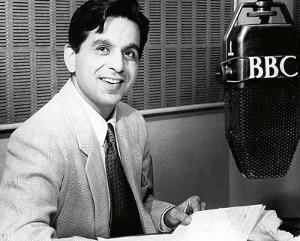
Dilip Kumar takes part at a special broadcast of BBC Indian Service during his visit to London in April 1953.

Born to a dry fruit merchant in December 11,1922, Yusuf Khan started his career as a manager at Bombay Army Canteen. But fate had other plans for him. A chance encounter with Devika Rani of Bombay Talkies landed this shy and debonair young man in Tinsel Town.

Of this Ashok Raj in his book Hero wrote: The Silent Era to Dilip Kumar says: “Devika Rani had gone out for shopping to a local market. At one fruit shop, she looked keenly at the young man engrossed at selling his merchandise. It was by mere chance that the shy shopkeeper had only replaced his father that day. Devika Rani found this young man with a sensitive face and expressive eyes quite unusual. She gave him her visiting card and asked him to meet her at the studio.”

Bombay Talkies not only changed his destiny but also his name — Yusuf Khan became Dilip Kumar and made his debut in Tinsel Town with Jwar Bhata (1944).

It has been 70 long years since Yusuf was ‘spotted’ and today he is considered as the ‘first modern Indian actor’ who freed himself from the theatrical mannerisms and developed a more natural and distinctive style, which stressed on silent pauses and hand gestures and films like Andaz, Jogan, Daag, Baabul, Aan, Daag, Foot Path, Madhumati, Devdas, Naya Daur and Ganga Jumna stand testimony to his versatility.

source: http://www.mumbaimirror.com / Mumbai Mirror / Home> Entertainment> Bollywood / by Mumbai Mirror / October 19th, 2013

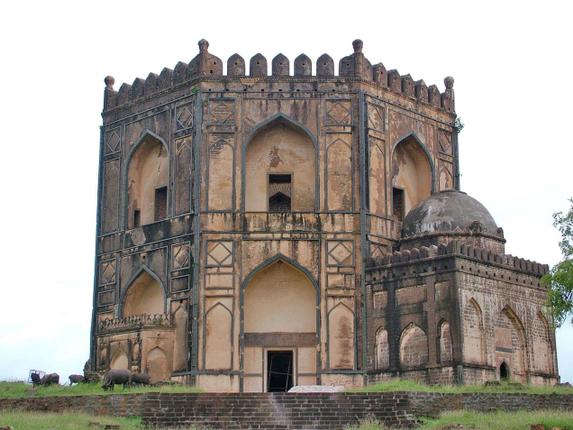
Bidar only South Indian monument to figure in latest World Monuments Fund list

According to the World Monuments Fund, the sites in the list are crying for immediate attention for preservation, protection, and adaptive reuse. / The Hindu

House of Sheikh Salim Chisti in Fatehpur Sikri and Juna Mahal in Rajasthan are also on the list

The historic city of Bidar figures in the 2014 World Monuments Watch list released by the World Monuments Fund (WMF), a New York-based NGO working for the protection of monuments.

WMF president Bonnie Burnham announced the list in New York on October 8, according to P.C. Jaffer, Deputy Commissioner of Bidar. The WMF had received 741 proposals from 166 countries. But the final list contains 67 sites from 41 countries.

The three sites in India to figure in the list are the house of Sheikh Salim Chisti in Fatehpur Sikri, Juna Mahal in Rajasthan and “the historic city of Bidar”. These, according to the list, are sites are in need of immediate attention for preservation, protection, and adaptive reuse.

Benefits

Mr. Jaffer said the announcement would benefit the city in many ways. It would attract worldwide attention, leading to increased tourist footfalls. It would also help the government get technical advice and support from institutions specialised in the preservation of monuments.

“It could also help us raise funds from the government or donor agencies for protection and preservation of monuments,” Dr. Jaffer said.

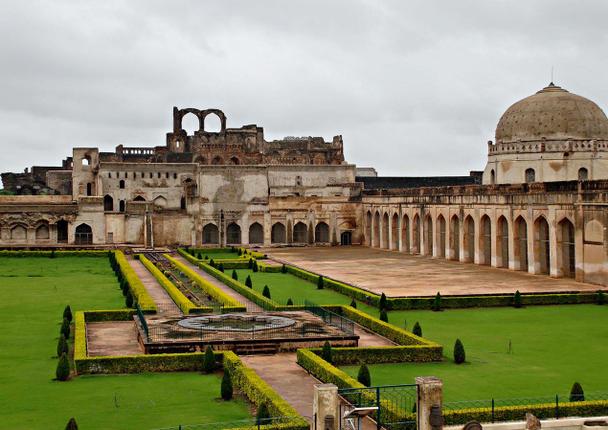
Bidar has three national monuments - Bidar Fort, Ashtur tombs and the Madrasa of Mahmud Gawan. / The Hindu
Bidar has three national monuments – Bidar Fort, Ashtur tombs and the Madrasa of Mahmud Gawan. / The Hindu

Bidar has three national monuments – Bidar Fort, Ashtur tombs and the Madrasa of Mahmud Gawan. The city also has 20 sites recognised by the State Department of Archaeology and Heritage and over 40 unrecognised sites of the medieval periods.

Facebook page

“We will upload the WMF recommendations on the district website. We will also open a Facebook page on Bidar on the WMF watch list and raise awareness about the issue,” the Deputy Commissioner said.

Two interpretations centres would be set up in the Bidar Fort and at Ashtur at a total cost of Rs. 80 lakh. This would provide information to tourists on the architectural and cultural aspects of monuments. In this background, an international seminar on Bidar’s heritage would be organised in January.

According to a release issued by Ms. Burnham, a copy of which was sent to the district administration, the list contains sites that are facing several preservation challenges like climate change, armed violence, neglect by authorities, lack of resources or even increased tourism activity that can damage monuments. An independent panel of international experts on archaeology, culture and preservation had prepared the list, Ms. Burnham said.

Over 150 sites have been preserved and protected by the WMF and its associate organisations in several countries since 1996. Famous sites restored by the WMF personnel include Venice in Italy, Gokarna Mahadev temple in Nepal, and the Citadelle Laferrière in northern Haiti.

The WMF also takes up restoration works on sites referred by Unesco.

source: http://www.thehindu.com / The Hindu / Home> News> National> Karnataka / by Rishikesh Bahadur Desai / Bidar – October 10th, 2013