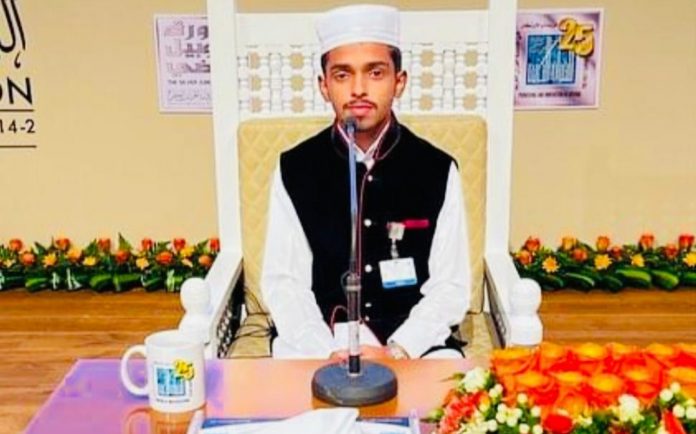
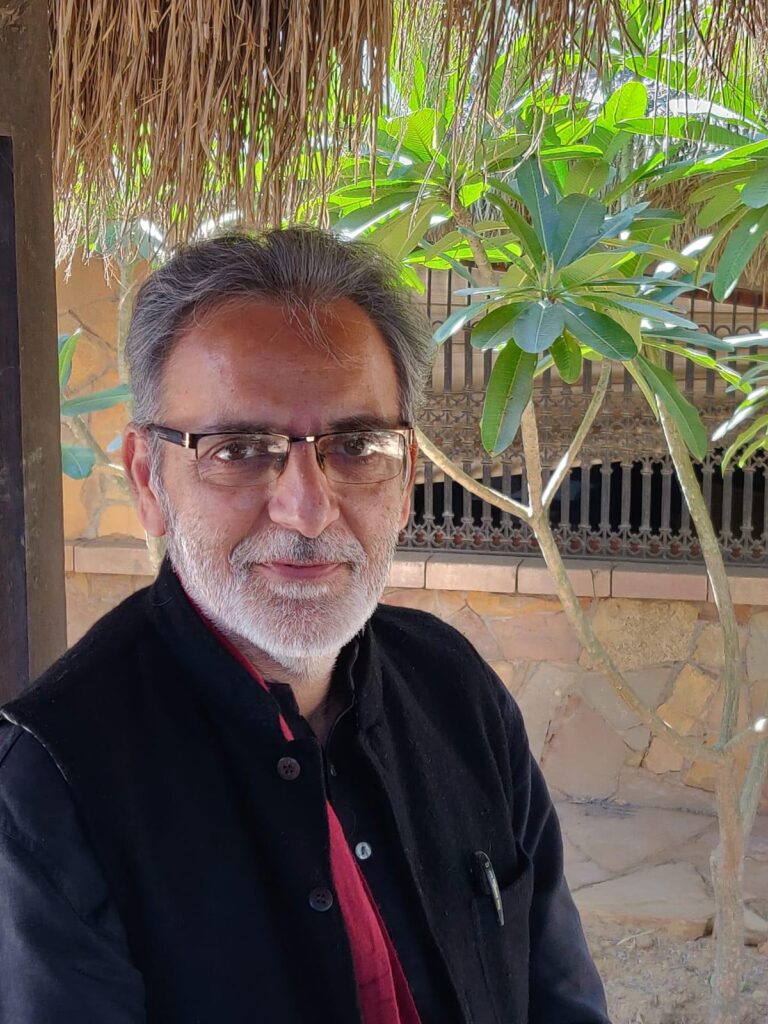
Hafiz Zainul Abid, a student of Jamia Markaz, Kozhikode has won the 6th rank in Dubai international Holy Qur’an Award.
The silver jubilee contest was presided over by His Highness Sheikh Mohammed bin Rashid Al Maktoum, Ruler of Dubai, where Hafiz Zainul Abid represented India from Kerala. He is the disciple of Sheikh Aboobakar Ahmed in Kozhikode Jamia Markaz studying Shariah and BA English.
Contestants from 65 countries worldwide have participated in the event, which started on 3rd April 2022. The contest is the largest Qur’an award in its kind in the world providing the biggest cash prize to the winners; 2.5 lakh dirhams to the first prize winner. Zainul Abid, only one contestant represented India won 6th Rank bagged 55,000 dirhams as cash prize along with certificates. .
Mr. Abid also participated in various international contests including the Tanzania international Holy Qur’an Award last year.
source: http://www.muslimmirror.com / Muslim Mirror / Home> Education> Postitive Story / by Muslim Mirror Network / April 29th, 2022
Gulbarga University has selected Yenepoya Abdulla Kunhi, chancellor of Yenepoya University, managing director of Yenepoya Group of Institutes and social and religious leader for an honorary doctorate.
The 39th and 40th convocation of the university will be held together and three people each have been selected for honorary doctorate. The honorary doctorate on Yenepoya Abdulla Kunhi will be conferred on the 40th convocation considering his immense achievements in the educational sector.
He has served as the trustee of Islamic Academy of Education, promoter of the Centre for Development Studies, president of Yenepoya Moidin Kunhi Memorial Educational and Charitable Trust, president of Malja-Ul-Islam English medium school, vice president of Badria Educational Institute, president of Takwa Open university, trustee of P A Education trust, president of Yenepoya Institute of Medical Sciences, partner in Moidin Kunhi and Company, managing director of Canara Wood and Plywood Industries, trustee of Yenepoya Saw Mills, convener of Yenepoya Vineers, partner in Yenepoya Transport company, partner in Yenepoya hotels, partner in Yenepoya Builders and Developers, president of Yenepoya Energy Private Limited and SLV Power Private Limited, chief promoter of Yenepoya Football Club, vice president of Islamic Trust, president of Malja-Ul-Islam Orphanage, president of Masjid Zeenath Baksh and Idga Juma Masjid, president of Islamic Cultural Centre, president of Karnataka Muslim Jamat, Dakshina Kannada district unit etc.
Yenepoya Abdulla Kunhi stays at Vas Lane in city his wife P K Nasreen. His two sons and two daughters are also serving in the Yenepoya group of organizations.
source: http://www.daijiworld.com / Daijiworld.com / Home> National-World / by Daijiworld Media Network – Mangaluru (EP) / April 25th, 2022
Sophore (Suvyyapur) Town (Baramulla District), JAMMU & KASHMIR :
Atiqa Bano
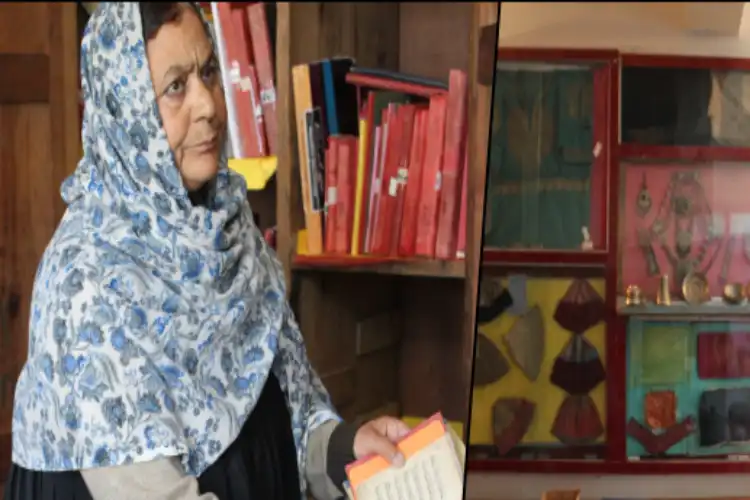
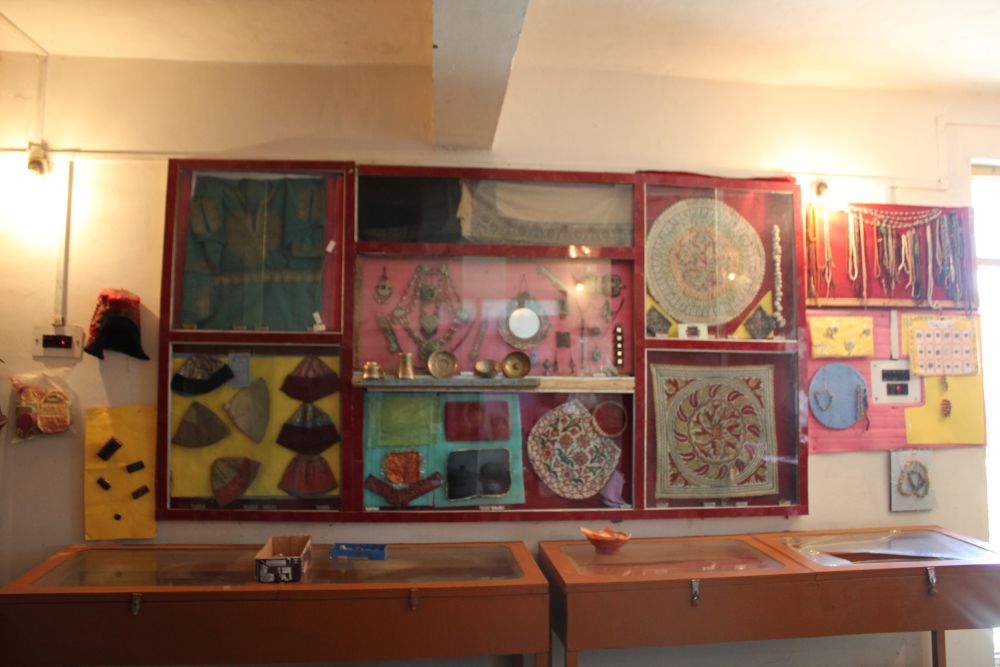
Atiqa Bano’s vision that the generations to come must know how people lived in Kashmir over centuries had made this retired Kashmiri educationist collect ancient households articles like hey mats (Waguv), multipurpose earthen pots, wooden doors, latches, and possibly all things used by humans over two centuries and create the first-ever private museum in the Valley.
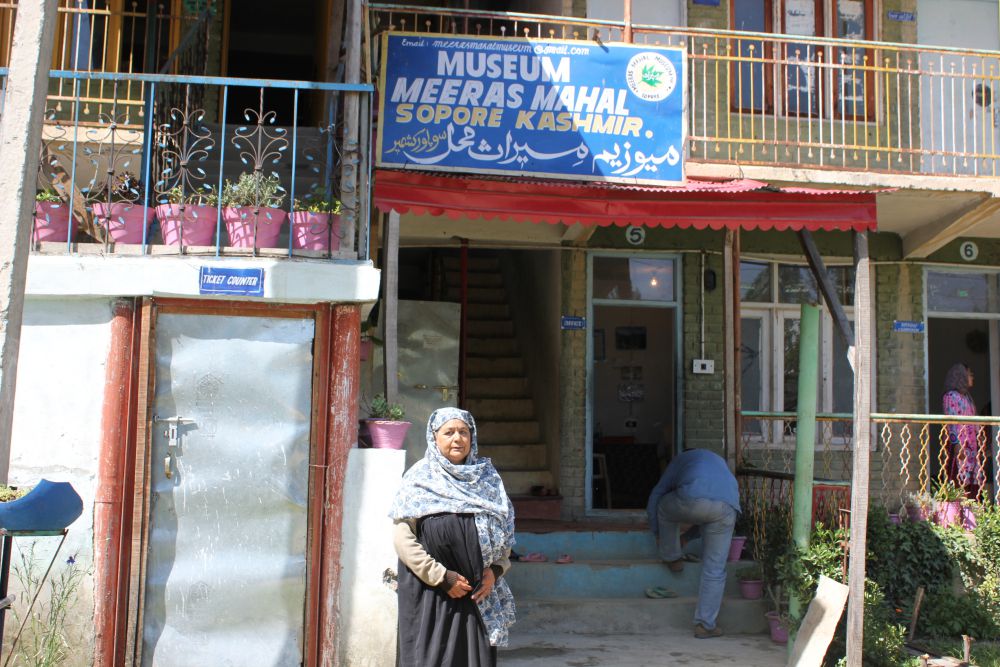
Called “Meras Mahal” (The palace of heritage), it houses more than 5,000 artifacts reflecting the social and cultural life of Kashmir over two centuries.
Atiqa Bano standing in front of Meeras Mahal
Atiqa Bano passed away in 2017 and her family continued to struggle to maintain it and not let forces of Nature damage this treasure trove. However, they always lacked resources for this gigantic task.
Finally, Atiqa Bano’s love of her labour is all set for a major revamp and scientific conservation as this historic treasure had attracted the attention of the Indian National Trust for Art and Heritage (INTACH), J&K Chapter.
Atiqa Bano, an educationist, had made great efforts to collect the exhibits over two decades after she retired from the J&K Government services in 1998. A woman of strong resolve, Atiqaji, as she was popularly called, had taken to looking after her father after her mother’s death. She had chosen to remain single and devote her life to education, women’s welfare, and society.
Household items on display in Meeras Mahal
It was during her campaigns for women’s empowerment that she was drawn to the collection of rare kitchenware, old ornaments, agricultural tools, clothing, earthenware, and manuscripts lying around in many Kashmiri households. It dawned upon her that with the changing times, all these human inventions would be lost to time if not preserved for posterity.
She started collecting artifacts in 2002 and continued her mission till her death.
Atiqa Bano is gone from this world, but her memory and work is commemorated for posterity, and, as she wished, for the generations to come.
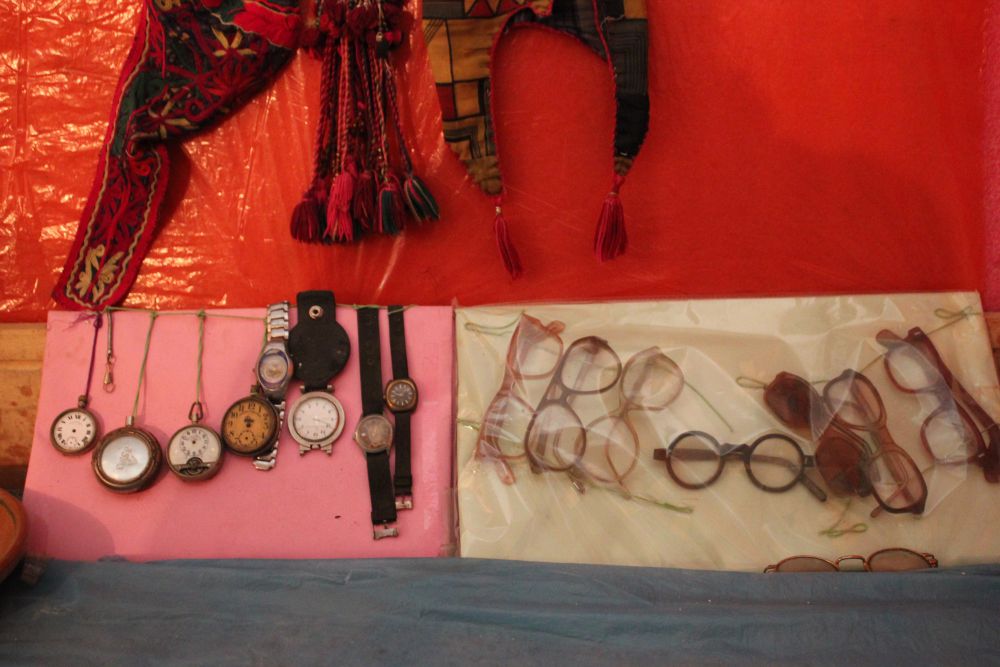
A collection of watches and eye glasses on display at Meeras Mahal
Realizing the importance of Atiqaji’s rich heritage collection, the J&K Chapter of INTACH and HELP Foundation have taken up the gigantic task of rejuvenating Meeras Mahal.
Saleem Beg, head of the INTACH, J&K Chapter, said, “Saima Iqbal and INTACH team are digitizing, curating and contextualizing the rich collection of vernacular objects after preventive conservation. The museum will have a thematic display demonstrated through sketches and write-ups supported by an elaborate digital presence.”
Saima Iqbal said, the work, supported by ALIPH- an international alliance for the protection of heritage in conflict areas, is getting streamlined. She stated that a team comprising a web designer, photographer, conservator, curator, and illustrator is working in tandem as all are interdependent and need to work in sync.
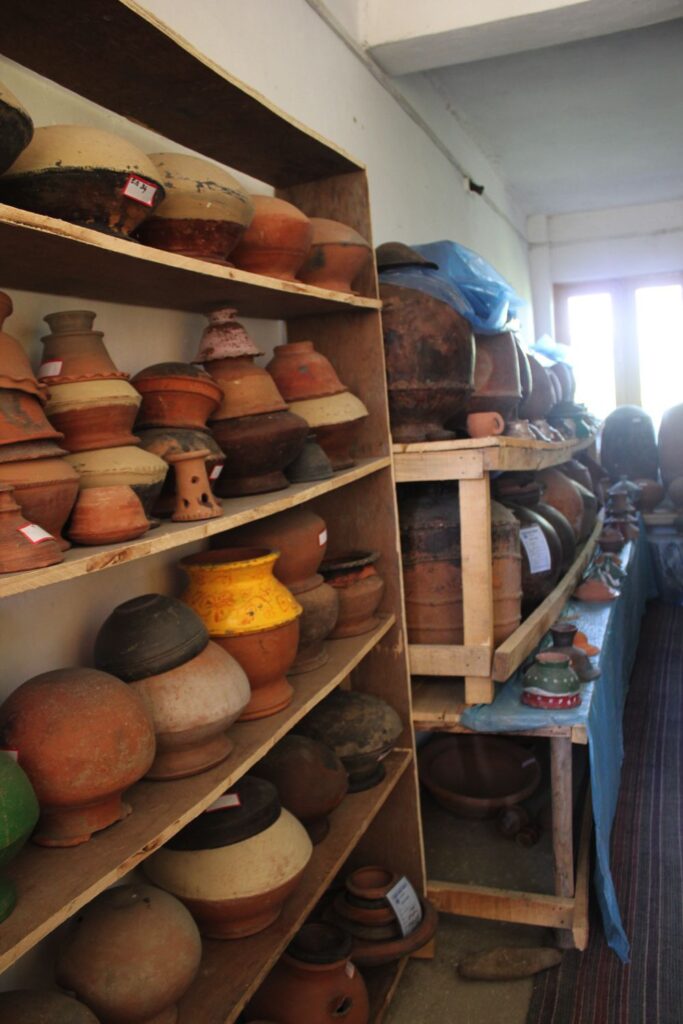
Earthenware used in Kashmiri households in Meeras Mahal
“I have to say that the challenges are many and we are making the best use of available meager resources here but the passion is alive and the project will be a great success”, she said.
“The first article preserved in the museum is Kondul, an earthen bowl that holds smoldering embers in Kangri, a personal and portable heating device of Kashmiri, said Muzamil Bashir Masoodi, Caretaker or (Honorary) President of the five-member Trust of prominent literary personalities, constituted to look after the museum.
Muzamil, who is also Atiqa Ji’s nephew had been taking a keen interest in maintaining and preserving the rare articles of the museum. The initially preserved items also included hand-written books of Ghulam Mohammad Hanfie, a scholar, Ateeqa Ji’s grandfather.
“All the items are counted one by one like 10 different Charkhas (spinning wheels) are counted as 10 separate items”, explained Muzamil.
The museum was initially set up in their private B. Ed College, Kashmir Women’s College of Education, at Noorbagh, Sopore. It was shifted in 2012 and called Meeras Mahal to a Hostel building of the College, at Highland Colony, where the rare items are “stored” due to the paucity of space.
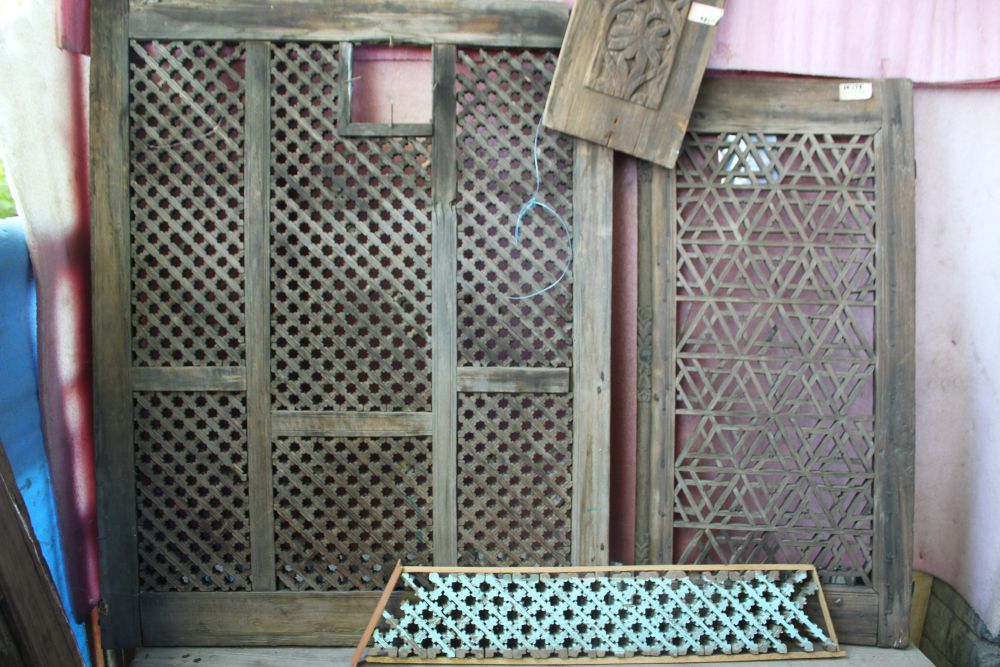
Doors and windows used in Kashmiri architecture
Muzammil said that “we cannot provide the normal gap of at least two feet between the items”, which makes it difficult to maintain the entire treasure. “There has been no support from the Government”, he said. He said so far he has been getting a token amount from the college funds for maintaining the museum.
“During the Covid restrictions, when everything was closed, we managed to be in the museum to provide basic maintenance,” Muzamil said. He had submitted a detailed project report, for conservation and preservation of the museum to the UT Government in 2019.”
Nothing has came his way so far.
source: http://www.awazthevoice.in / Awaz, The Voice / Home> Culture / by Ehsan Fazli, Srinagar / April 11th, 2022
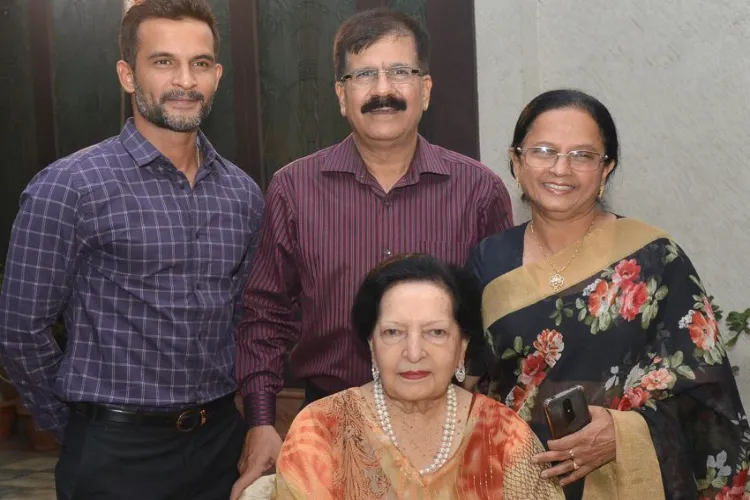
Whether it is a hundred-year-old dish Kuzi or Fish Salad or Badam Ka Kund or the Noorani Seviyaan, Shahnoor Jehan, the descendent of a Sultan of Yemen, dishes out these mystic 100-year old cuisines for the connoisseurs and the gourmands.
Even as the erstwhile nawabs of India deal with the loss of their titular legacy, tables laden with succulent meats, and the foods flavoured with freshly ground spices and their untranslatable code of tehzeeb- their last standing bastions of power, wealth, and heritage – Shahnoor Jehan, whose grandmother Muzaffar Unissa Begum hailed from the family of the Sultan of Yemen, has kept it alive.
Meeting this soft-spoken lady was a quiet grounding experience given her repertoire of knowledge on food.
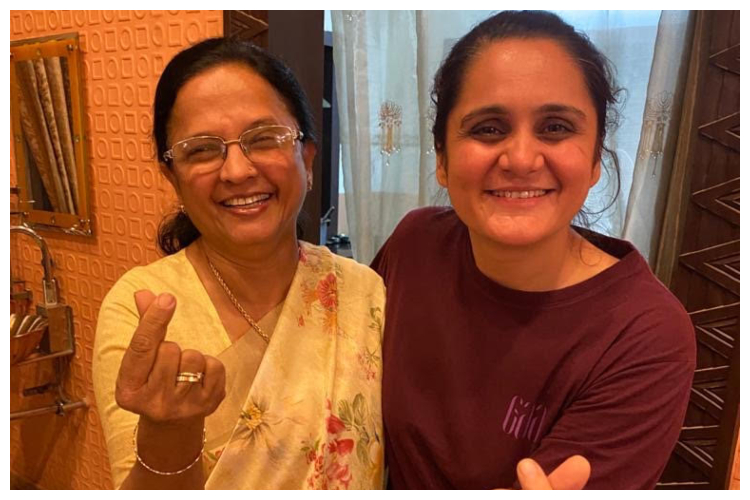
Shahnoor Jehan with her daughter
Daughter of an IAS officer and wife of a very supportive businessman Adil Mirza, Shahnoor Jehan was also encouraged by her adorable children Shohrab Mirza and Nimrah Mirza to use her knowledge and the knowhow inherited from her blue-blooded family and preserve the 100-year-old recipes for posterity. Khassa, a food brand, is a reality because of the support Shahnoor Jehan got from her family.
Shahnoor Jehan says, “There’s a certain etiquette that embraces all nawabi culture. It’s not so much about the commonality of ingredients or dishes but the way the food is prepared and served and the way we host our guests. And for these families, it’s comforting if you understand that,” she says. “Khassa is just that.”
In earlier days people never said “food is ready’ while inviting guests to the table,; they would say but said “Khassa Taiyaar Hain.” Shahnoor Jehan has preserved her well-guarded recipes dating back to several generations.
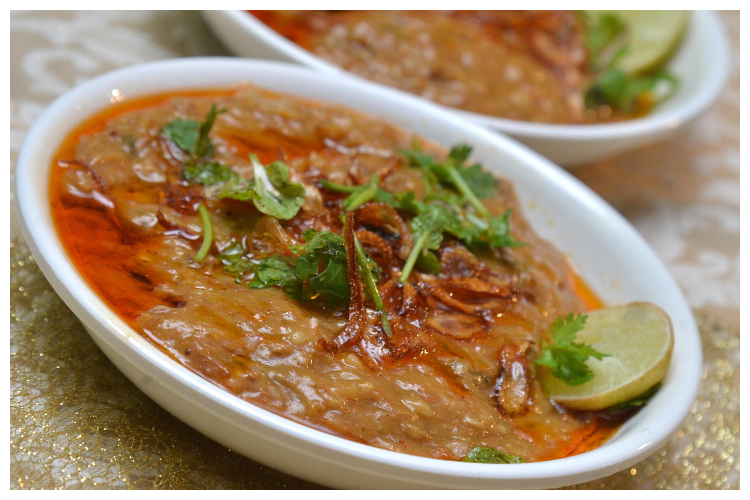
A dish from Shahnoor Jahan’s cook book
Her cookbook which she has preserved to date from her school days takes on a narrative beyond food; it’s about legends, anecdotes, and antiquities that comprise heritage. It is this inherited legacy that has made her take up cooking as a passion and make it her business. “I think cooking was a hidden talent in me. Most of the time friends appreciating my cooking made me ponder over the possibility of taking it up as my profession and when my kids and family support came, I converted my culinary skills into a startup.”
“Till I got married, I never had any experience of cooking; it was only an interest. It was my grandmother and mother who inspired me initially and the realization and confidence that I can cook well came with the appreciation I got from my friends and family who eagerly awaited the indulgence. The original cuisine is slowly fading away. I kept up the tradition of preparing dishes on charcoal and grounding spices made by hand..”
Begum Shahnoor Jehan the granddaughter of Nawab Ahmed Baig and her Grandmother Muzaffar Unissa Begum shares a princely legacy of the Sultan of Yemen and her food is an amalgamation of Mughal, Turkish and Arabic and influences of Hyderabadi cuisine.
She has infused local foods like rice, wheat, and meat dishes and the skilled use of spices herbs, and natural edibles in Khassa,
Owner of brand Khassa, Shahnoor Jehan serves cuisines like mutton haleem, mutton Shikamaru, dum ka murgh, or whether it is her signature dish a hundred-year-old dish called the Kuzi- leg of mutton cooked in pure almonds, saffron, and spices like black pepper enriched further with dry fruits, sugar candy ( Rock Mishri ) saffron, and silver foil are steeped in history.
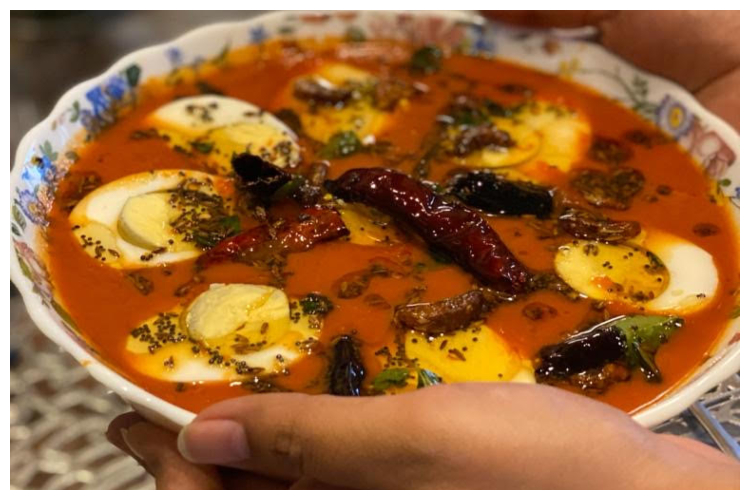
Shahnoor Jahan’s recipies
While Khassa has been in the limelight for its iconic Kuzi, mutton roast or the kebabs like Shikampoor Shahnoor has also drool-worthy desserts to her credit that you can never say ever! Whether they are the innovative desserts like the Noorani Seviyan or the most rich ones like the Badam ka Kund– a traditional Hyderabadi dessert rich in almonds infused with saffron and cooked for hours together to get that creamy finish.
Says Shahnoor Jehan some of the recipes are native but they have been prepared and perfected down the generations at Shah Manzil, which is the present-day Raj Bhavan (the official residence of the State Governor). They have been part of Shahnoors family legacy for generations over a hundred years of age Adds Shahnoor my maternal Grandmother Muzzafar Unissa Begum, the daughter of the Sultan of erstwhile Yemen, and her grandfather Nawab Ahmed Baig, the son of late Shehzoor Jung, was influenced prominently by the flavours of Yemen, where she was from. I picked up most of her techniques and recipes which were well guarded and preserved by Shahnoor Jehan’s mother Faiq Jehan Till date Shahnoor continues to preserve the diaries and books belonging to her royal family. She adds that while her mother has been an inspiration for her she did pick up a few techniques from her mother-in-law Shaheda Begum she adds.
Today this luxury dining has come alive with her cuisine “Khassa” which is offered to her customers by way of food based on orders from her customers. It is indeed a luxe dining experience as nothing is too extravagant at her end whether it is the use of the saffron or the almonds, or whether it is the use of gold and silver foil, they season most of her meals. Only the finest cuts of meat make it to your orders. Whether it is ordering the mutton roast -chunks of meat soaked in sauces, ginger garlic paste, pepper, and roasted or whether it is Kairi Ka Do Pyaaza chunks of meat cooked alongside with raw mangoes spices and silky onion gravy a seasonal specialty.
Shahnoor says some of her dishes are cooked languorously , sometimes for entire day-the dum (where food is cooked for hours over low heat in lagan and smoked with the piece of burning coals placed on top to flavor the food , and these remain her techniques of choice.
Shahnoor Jahan with Khassa
In the earlier days, the chefs or the bawarchis at her Shah Manzil sometimes specialized in just one dish. Kitchens were considered laboratories, and chefs artists were encouraged to experiment innovate and create. Today we are preserving this past heritage as an agenda. She recalls the Nawabs of yore were patrons of food, helping the food to evolve Now dining With The Khassa brings back some of the grandeur and is a beautiful reminder of the lavish brilliance of nawabi food.
Says Shahnoor Jehan we want to bring a culinary slice of Yemen and the Nawabs of Hyderabad at Khassa with dishes that resonate with our philosophy of cooking with the choicest of ingredients.
Her spread in her menu looks fit for a king. There are Shammi Kebab-succulent pieces of tender lamb cooked with spices a melt-in-the-mouth experience and the Mutton Shikampur, the iconic kebabs from the royal kitchens of Hyderabad. The main course consists of Tamatar ka Kut a classic Hyderabadi dish and a rich tomato gravy topped with mild temperate spices and boiled eggs. Mutton Dalcha, is an age-old recipe of mutton cooked with lentils and bottlegourd. There are classic dishes such as Chicken or Mutton Korma cooked in rich gravy sauce or the traditional Kairi Do Pyaza a tangy lamb preparation. Her signature dishes include Haleem, Kuzi, Fish Salad Mutton Roast, Dum Ka Murgh, or the Dum Ka Raan all slow-cooked in mild spices.
Also, there are desserts to die for whether it is the Zafrani Badami Kheer, Sheer Khorma, or the Qubani ka Meetha.
Khassa indeed brings the hidden treasures of food that is heavy on aroma and boasts of rich flavours that will hit the spot if you’re looking for a feast.
www.khassabyshahnoorjehan.com
source: http://www.awazthevoice.in / Awaz, The Voice / Home> Culture / by Ratna G. Chotrani, Hyderabad / April 17th, 2022
From pre-wedding shoots to the selection of bridal outfits, the stress, especially on the bride-to-be, is tremendous.
Shaharabanu shows one of the many bridal outfits which is available at The Rainbow Free Bridal Boutique, opened just weeks ago | Express
Madikeri :
From pre-wedding shoots to the selection of bridal outfits, the stress, especially on the bride-to-be, is tremendous. It is the day when she hopes to look her most beautiful.
However, not every bride can afford a dream wedding, and many young women are forced to stick to simple and inexpensive wear. The Rainbow Free Bridal Boutique in Kodagu is taking these weddings up by a notch. Established by Shaharabanu (20), the Free Bridal Boutique is just weeks old, and operates from the rural part of Chettalli in Madikeri taluk.
Shaharabanu, who quit studies after completing PU examinations last year, is a YouTuber, and had also worked as a beautician for some time. The strong calling to do charity work has manifested itself in the form of this boutique.
“I always looked forward to doing charity work, but my family is not very well-to-do. Financial hurdles are many. However, a unique initiative has been started by one of my friends in Kerala, which led to the establishment of the Rainbow Free Bridal Boutique, a first of its kind in Karnataka,” explained Shaharabanu.
So, what is so unique about this boutique? It provides free bridal dresses to brides from economically weaker sections of society. “Weddings are very special to girls, and almost every girl dreams of wearing a special outfit on that day. However, many cannot afford these bridal outfits, and hence, I started a boutique to collect bridal clothes from women from rich families,” she explained.
She laid out her plan on social media platforms and received positive feedback and support. Responding to her social media post, many women donated their wedding attire, like sarees which they had worn for their own nuptials, and fancy outfits from their trousseau.
The clothes were collected and dry cleaned. “I have collected many wedding clothes, some even from my family members. These clothes will be handed over to brides from weaker sections of society, including orphaned girls who are unable to afford wedding clothes,” she said.
“Our generation is very active on social media and we often make new friends virtually. A WhatsApp group of like-minded girls who were on Instagram was created almost a year ago. In the group, one of the girls, who was poor, requested us to help her out for her wedding,” recalls Shaharabanu.
However, she felt helpless with her family’s meagre earnings, since her parents, Ameena and Maanu from Chettalli, are daily wage workers. Despite the impediments, the girls managed to collect funds and bought their friend a new bridal outfit, she added.
Following the incident, she realised that many girls face this challenge before their wedding, which the girls discussed in the group. That is when one of the girls from Kerala informed her about a boutique that donates bridal dresses to girls from poor families. “This boutique was started by a Kannur resident, Sabeeda, and I contacted her for support. Initially, when everyone was reluctant to donate their bridal wear to my boutique, Sabeeda helped me and brought many dresses all the way from Kannur to Chettalli,” she recalled.
When dresses were donated to a couple of poor girls, residents from Madikeri and Virajpet came forward and donated their bridal outfits. “My house is small. I had to make space to keep the dresses without damaging them. I bought a shelf for this purpose which is in my mother’s room, where the dresses are kept neatly,” she said. “It has been just 15 days since I started the boutique. There is no bar on religion or community of the brides. They can book the service and visit my place in Chettalli to select the dresses they want from what’s available. They can keep the outfits for themselves. This service is for those brides across the state who are battling economic hardship,” she said.
To ensure that the dresses reach the needy, she asks the beneficiary to submit a letter from the religious committees concerned, about the family’s financial situation. In just two weeks, more than 40 brides from across the state contacted the boutique, and Shaharabanu is working towards making their weddings special. “I ask the girls to visit my place 20 days prior to the wedding day. Their happy faces when they find the right bridal dress give me immense pleasure and satisfaction,” she added.
source: http://www.newindianexpress.com / The New Indian Express / Home> Good News/ by Prajna GR, Express News Service / April 24th, 2022
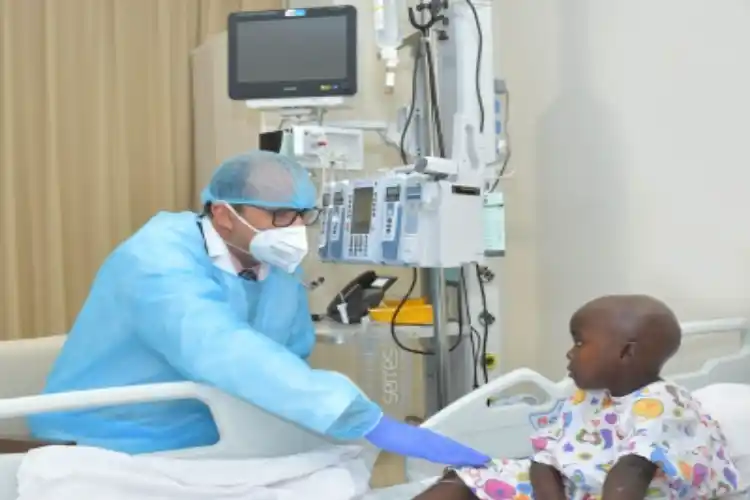
Dr Zainul Aabideen, with his patient, a 5-year-old Ugandan girl.
Abu Dhabi/Thiruvananthapuram :
A Malayali doctor in Abu Dhabi wrote himself into record books when he performed the first pediatric stem cell bone marrow transplant in the UAE.
Dr Zainul Aabideen, a native of Kannur in Kerala, presently Head of the Department of Pediatric Hematology and Oncology at Burjeel Medical City successfully performed the advanced allogeneic procedure on a five-year-old girl from Uganda with sickle cell disease.
Billed as the first such surgery done in the UAE, the patient’s 10-year-old sister donated her bone marrow for the transplant treatment at Burjeel Medical City, a flagship hospital of VPS Healthcare.
Sickle cell disease is a genetic disorder, which results in an abnormality in the hemoglobin found in red blood cells, causing them to become sickle-shaped and leading to several complications including anemia, swelling in the hands and feet, frequent pain, acute chest syndrome, and sometimes stroke.
Prior to the treatment, the child has been regularly admitted to the hospital due to complications arising from her disease since birth.
“As this was a life-threatening condition, the only curative option was bone marrow transplantation. Before this procedure, the patient suffered a lot. The entire care team here at the hospital and the child’s parents are delighted that the transplant will relieve this pain from her life,” said Zainul Aabideen, who headed a team of highly specialised doctors, including a pediatric intensive care team, for the procedure.
The patient has responded well to the treatment and will be discharged in a few days after a five-week stay at the hospital.
Earlier, pediatric patients in the UAE who had to undergo allogeneic stem cell bone marrow transplants travelled to the US, the UK, India, and other European countries.
Zainul Aabideen, completed his MBBS from Calicut University in Kerala and a post-graduate degree in Pediatrics from the University of Mumbai.
He then moved to the United Kingdom to specialise and undertake further training in pediatric hematology, pediatric oncology, and pediatric bone marrow transplantation in various hospitals in the UK.
source: http://www.awazthevoice.in / Awaz / Home> Health / by awazthevoice.in / April 20th, 2022
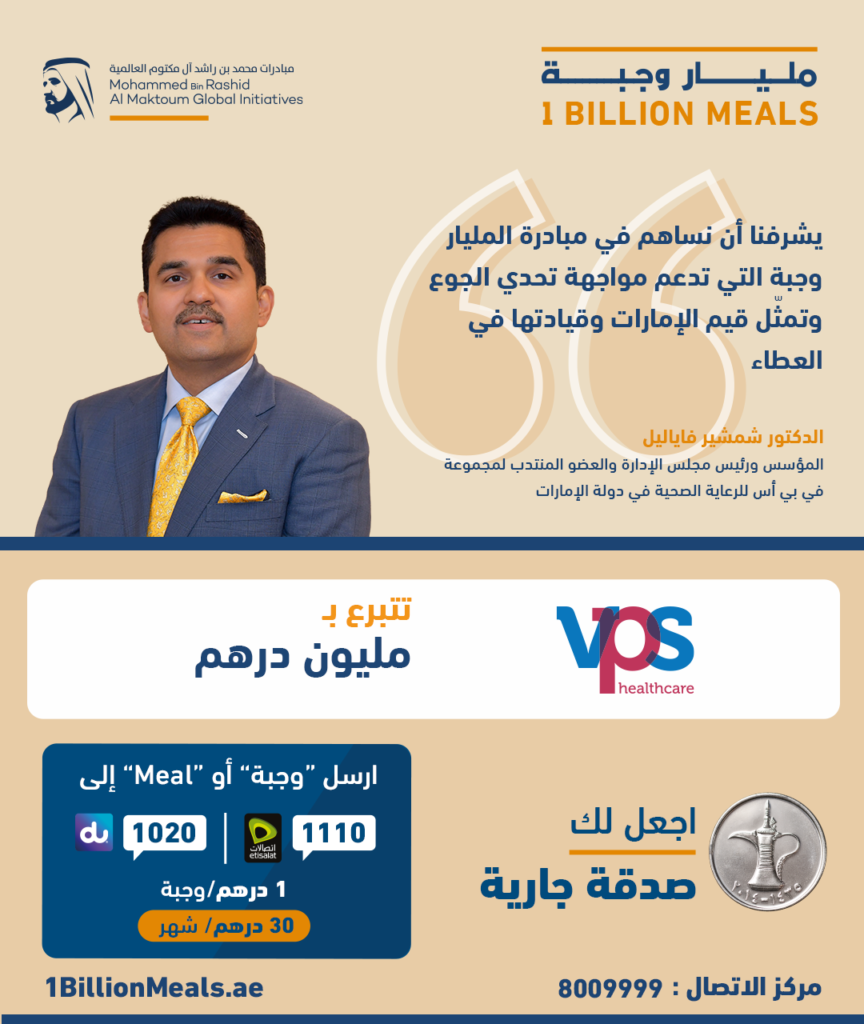
Dr. Shamsheer Vayalil, Chairman and Managing Director of VPS Healthcare Group, has announced a donation of AED1 million to the 1 Billion Meals initiative, the largest of its kind in the region, which aims to assist and provide sustainable food support to the underprivileged and most needy groups in 50 countries in the Middle East, North Africa and the world – in particular children, refugees, displaced persons, and victims of disasters and crises.
The 1 Billion Meals initiative, organised by the Mohammed bin Rashid Al Maktoum Global Initiatives (MBRGI), provides food support in coordination with the United Nations’ World Food Programme (WFP), the Food Banking Regional Network (FBRN), the Mohammed bin Rashid Al Maktoum Humanitarian and Charity Establishment (MBRCH), the United Nations High Commissioner for Refugees (UNHCR), the UAE Food Bank, as well as a number of local charity and humanitarian organisations in beneficiary countries.
Dr. Shamsheer Vayalil said: “We are honoured to contribute to the 1 Billion Meals initiative organised by MBRGI to provide aid and relief to those undernourished, which supports the global battle against hunger and represents the values of the UAE and its wise leadership in giving and expanding the scope of humanitarian work. This is especially true given the escalation of the global hunger crisis and the increase in the number of people affected by it, especially children, refugees, displaced persons, and victims of disasters and crises.”
The initiative, organised by the Mohammed bin Rashid Al Maktoum Global Initiatives (MBRGI), is a continuation of last year’s 100 Million Meals campaign, which ended up distributing 220 million meals, prompting the new goal of one billion meals.
Donors can contribute to the 1 Billion Meals initiative through the following donation channels – the campaign’s official website: www.1billionmeals.ae; bank transfer to the campaign’s account at Emirates NBD, number: AE300260001015333439802.
Donors can also opt to donate AED1 a day through a monthly subscription by sending “Meal” or “وجبة” via SMS to 1020 on the du network or 1110 on the Etisalat network.
Donations can also be made through campaign’s call centre via a toll-free number 8009999.
Becoming the youngest female lifter wasn’t an easy task but Maryam Mohammed’s focus helped her achieve it
Maryam Mohammed lifting weight during the tournament
Bengaluru:
Among the many champions who participated in the event, it was 13-year-old Maryam Mohammed who became the youngest female lifter to set a deadlift record in the Push-Pull Championship. Sports establishment Professional Raw organised the first championship at Onyx Fitness which Mohammed was a part of. There were over 300 athletes from across the country who registered themselves for the event.
It’s not the first win for the young lifter either. Speaking to CE, she says, “It’s the fourth competition that I have won so far. I started powerlifting two and half years ago, when the pandemic started and schools went online.” Her father, Mohammed Azmat, who is a powerlifter himself, has been doing it for over three decades now. “He’s my biggest inspiration. He’s the one who trains me and my younger brother has also started participating in competitions now,” Mohammed says.
She spends her weekdays on school work and uses her weekends to train. The basement of their home has been converted into a gym set-up which has helped her practice more. “I know there are many strong people out there but all I do is focus on the bar and just lift it. There’s nothing else to do,” she says, adding that her younger brother is more focused, something she is working on.
While Mohammed is hoping to get better and win more awards, her father encourages another strategy. “Medals can always be achieved but if they grow up without character, it won’t be of any use,” he says, pointing out that Mohammed always grew up watching him practice in their home set-up. “After she was born, my wife needed my help at home. So, I set up a gym to spend more time at home. Maryam grew up watching me lift weights and when she was finally ready, she showed interest,” he explains.
He adds that neither of the children was ‘forced’ into following in their father’s footsteps. “Seeing them be happy with what they want to do is what I encourage them to follow. They were never forced to follow my footsteps but it’s definitely an icing on top for them to have shown interest,” Azmat says.
source: http://www.newindianexpress.com / The New Indian Express / Home> Cities> Bengaluru / by Anila Kurian, Express News Service / April 18th, 2022
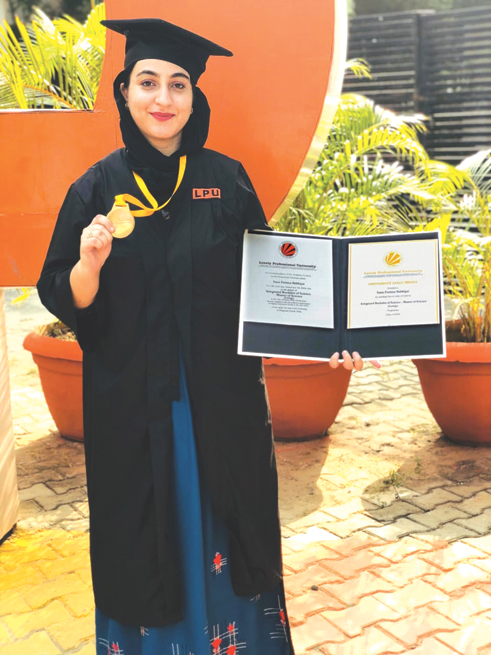
Once again showing her excellence in the field of education, Kishtwar girl identified as Sana Fatima Siddiqui Daughter of Syed Ajaz Ahmed Resident of Bunastan Kishtwar was awarded University Gold Medal for standing First in Order of Merit in Integrated BSc- MSc Zoology program, Class of 2019 at 10th Annual Convocation Ceremony of Lovely Professional University by Mr. Michael Ashwin Satyandre Adhin, Hon’ble Vice-President of Suriname (South American Country).
The convocation was recently held at Ludhiana.
Speaking to Early Times, Sana attributed her success to her parents, siblings, friends and family members added that without support from parents and family it is not possible for girls to get her admissions in universities which are far away from home. She said that she will continue her hardwork to bring lure for her parents and Kishtwar District in future as well.
She also thanked her teachers who guided her from time to time through out her life.
source: http://www.earlytimes.in / Early Times / Home> News Details / by Early Times Report / September 10th, 2019
Making amends for wrongs done requires compassion and a human touch, says Sandeep Virmani of Hunnarshala Foundation
In 2013, Muzaffarnagar in Uttar Pradesh experienced one of the worst communal riots in recent history. Some 62 people died and more than 50,000 were displaced.
Hunnarshala Foundation helped resettle about 250 families who could not return to their original villages. It was a challenging project for the not-for-profit organisation, which has been working with communities in the area of housing and infrastructure for over 20 years now.
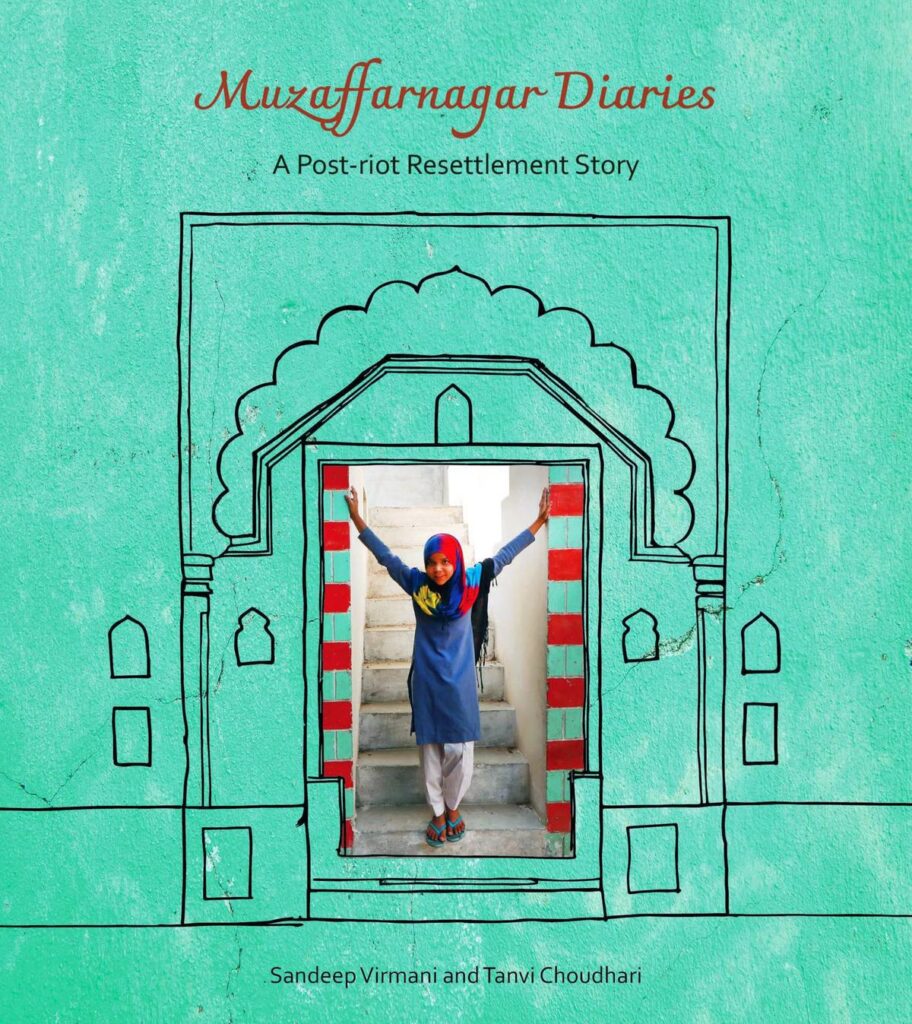
Muzaffarnagar Diaries: A Post-Riot Resettlement Story talks of how the project fell in place. Sandeep Virmani, Executive Vice-Chairman of Hunnarshala, spoke about the importance of empathetic resettlement in the context of this project. Excerpts from the interview:
What is the magnitude of the problem of internally displaced persons (IDPs) in India?
IDPs are people displaced from their homes and communities due to natural disasters, conflicts or development projects. In India, at any given point, we have between 40 lakh and 80 lakh people living in camps, away from home. Of these, about 20,000 are displaced due to conflicts — ethnic, armed, communal, or even targeted violence. India consistently features in the 10 worst affected countries in the world. Conflict victims are the worst hit since invariably, the state is involved in abetting violence or allowing it to happen. For this reason, unlike after natural disasters, very few people come forward to help.
How does Indian law fall short when it comes to reparative justice, especially for victims of incidents such as the 2002 Gujarat riots or the 2013 Muzaffarnagar riots?
Unlike cross-border refugees, IDPs don’t have any rights. Even though the Constitution requires the state to take responsibility for the safety of its citizens, there are no laws, policies, or statutory frameworks for reparative justice. The UN has ‘The Guiding Principles on Internal Displacement’ but these are not binding. Consequently, almost every such event requires the intervention of the courts to provide justice.
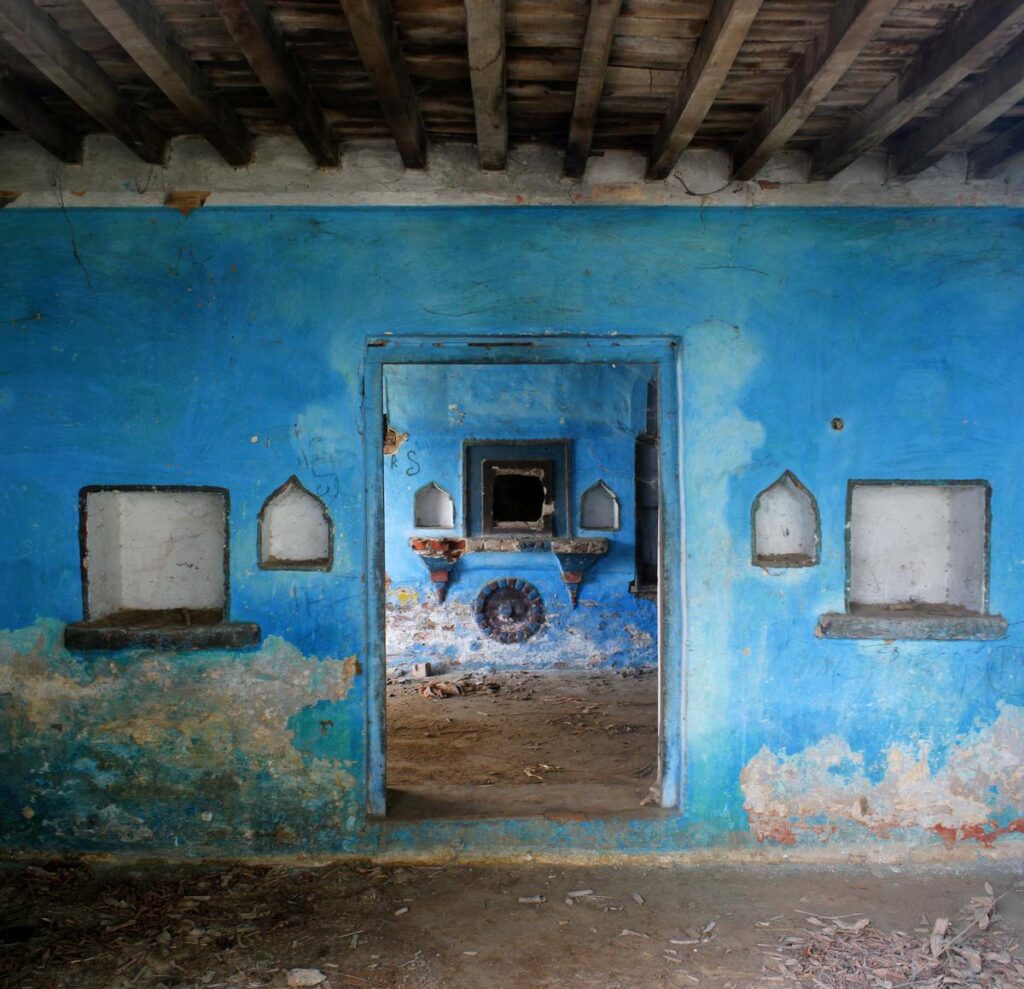
Ruins of a house in Kutba, Muzaffarnagar, after the riots.
The government grants compensation; ₹15 lakh was given per family after the Muzaffarnagar riots. But you call this the ‘compensation trap’?
Invariably, governments directed by the courts want to weigh the losses of IDPs financially and get away with compensation. While compensation for families who lost a member was raised to ₹15 lakh, displaced families who will never be able to return to their villages got ₹5 lakh. But making amends for wrongs done, so that the scars of displacement and loss are healed, requires compassion and a human touch. It requires apology, handholding until they are physically settled, integrated into a new society, so that they and their children can let go of fear. The shock and betrayal, sometimes even unfounded guilt, never leaves one.
When you took up this project, you went to Kutba to see the ruins of the destroyed homes. Can you talk a bit about the ‘culture of spaces’?
The design and skills used in building homes is the collective cultural expression of a community’s values. When you lose everything, you look for hope in two places: community and expression. The process of rebuilding provides both. However, after incidents like the Muzaffarnagar and Shamli riots, most families were scattered in unfamiliar places. It became difficult for them to get new homes. Most used the compensation to rebuild livelihoods and get some land but could not build homes. We helped the community procure land together, so that they were reunited. Giving a house is charity; one is grateful, but it doesn’t rebuild lost confidence. And, invariably, donors and governments give ‘modern’ houses, disregarding cultural moorings.
We wanted to understand their histories, ways of living, skills, aesthetic expressions, identities, before we facilitated the rehabilitation. So, we went to their old village in Kutba. It was difficult; there was fear of the dominant Hindu community, at whose hands they had experienced betrayal, violence, death. People with whom they had lived over generations, people who had convinced them not to migrate to Pakistan in 1947. A mason named Nawab finally agreed to take us there with police escort.
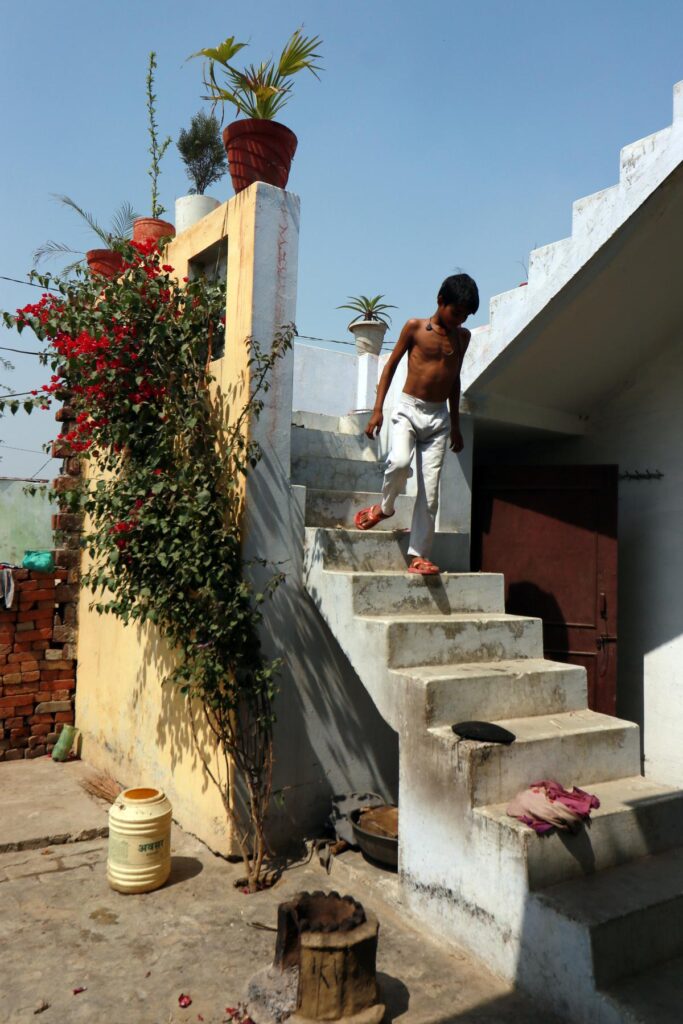
The central stairway in a new house built in Kairana, Shamli district (the ‘chulha’ or stove keeps changing places).
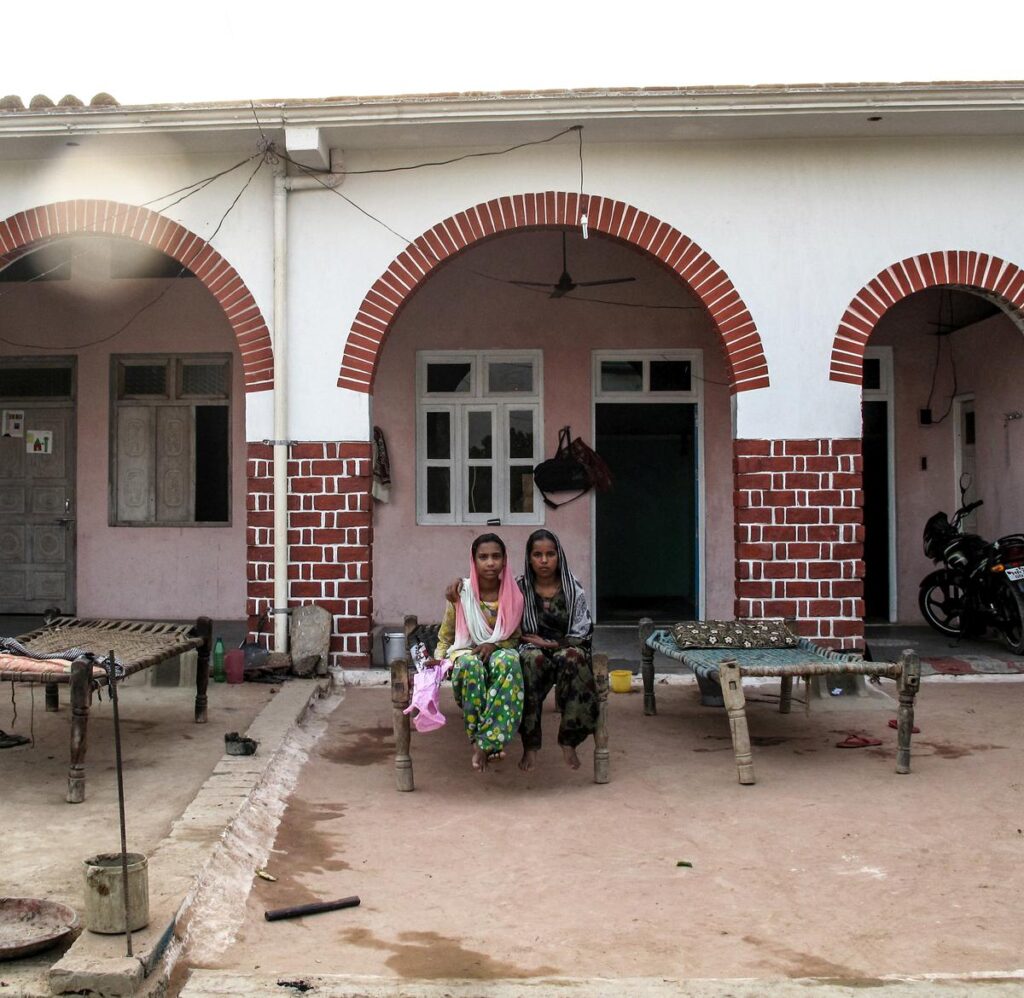
We found a unique lifestyle. For example, the khat (bed) determines the width of the veranda and even the staircase (it is carried to the first floor). The chulha (stove) shifts through the year from kitchen to veranda to courtyard. The old men sit at the juncture of street and house in a unique space called the ‘gallery’. The mother-in-law sits at the other end of the gallery, at a spot from where she can see every part of the house. The sitting room must be accessed straight from the street through a separate door. The houses always have potential for expansion to make room for newly-weds. Families make intricate patterns on coloured cement oxide floors with stencils made from newspapers. They mould concrete into aesthetic forms. The more elaborate the gate, the more the prestige… we found many such features.
A new house in Arya Puri, Muzaffarnagar district, for a rehabilitated family. The house incorporates the classic archways and verandah and makes room for the all-important ‘khats’ (cots).
Your book speaks of how the villagers rejected open-brick facades for painted concrete. Is it a challenge to promote low-cost or green building in the hinterland?
On the contrary, villages are familiar with the advantages of, say, earthen walls or mud mortar for putting bricks together. It is possible to have an informed conversation with them, unlike urban people who reject such technologies based on bias or get fixated on a technology even when not appropriate. In rural homes, many parts of the house are left unplastered due to lack of funds, so exposed material has a different connotation — it means poverty. That is why they wanted to plaster and colour their walls.
Western UP is a seismic zone, but existing building practices are poor due to lack of resources; there is hardly any foundation, very thin mud mortar walls hold up heavy roofs. One shudders to think of earthquakes. We insisted on increasing costs by 15-20% to ensure safe housing. The villagers are extremely proud of this; they say they have the strongest homes in the city now.
Sandeep Virmani of Hunnarshala Foundation.
What is the nature of the partnership you entered into with the community?
In Shamli, we signed an agreement with each family articulating the roles of the family, the rehabilitation committee, and our organisations. We financed one room, the staircase, and the sanitation. The families paid for the rest.
Misereor Germany gave funding and HT Parekh Foundation supported all sanitation work. It was the government’s responsibility to provide roads, water and electricity, but finally we had to raise money for that too. The villagers were extremely resourceful. They got cheap material and support from former employers. Many local people helped, including a supplier who not just gave extensive credit, but also cash when funding was delayed.
NGOs Sadbhavana and Vanangna supported the rehabilitation committee to ensure that children gave their board exams in their old exam centres and didn’t lose a year. We helped with enrolments into schools, new identity papers, and resuming pensions. We also conducted psycho-social counselling with the children to help them overcome the trauma of loss and separation.
You insisted, for instance, that women be part of the Rehabilitation Committee. Do you think such interventions can have a lasting impact on social mores?
When a big social upheaval happens, it provides opportunities for making paradigm shifts in social norms such as patriarchy. Women are ready to change their roles in a new location where everyone has to contribute; men are ready to turn a blind eye to women in unconventional roles. This provides women the opportunity to not only demonstrate their abilities but also assure men that it doesn’t threaten them. For instance, women are very good at bringing consensus on difficult decisions. It particularly helps the girl child, as they see what is happening and adopt the changes permanently.
And what did you in turn learn from these families?
Perhaps the biggest contribution from the IDPs of Muzaffarnagar has been the building of the daat chat or shallow domes. When we visited the old homes in Kutba, we saw an array of beautifully crafted roofs made with bricks. These roofs look flat but are in fact very shallow domes, where all the bricks are in compression. It allows for flattening the top of the roof and building another storey on top. The masons who build these roofs are expert craftsmen. The importance of the shallow dome roof is that it can reduce the use of cement and steel by 70-75%. This is important; these two contribute most to carbon emissions from the building industry. The roof is cheaper than RCC and more durable. We saw homes with roofs that are 300-400 years old!
We researched and tested the roofs for seismic safety and invited the artisans to share their knowledge at a national conference in Delhi. Since then, many architects are adopting the shallow dome. Artisans are invited to architecture schools to demonstrate and teach the next generation.
Perhaps this is a befitting recognition of a culture and a people who did not deserve to be violently removed from their ancestral homes.
vaishna.r@thehindu.co.in
source: http://www.thehindu.com / The Hindu / Home> Society – In Conversation / by Vaishna Roy / April 16th, 2022