So far, Jamiat Ulama-i-Hind has constructed 311 houses, mosques and schools at different places in the riot-affected district of UP
Maulana Arshad Madani handed over the keys of the houses to the victims of Muzaffarnagar riots
New Delhi :
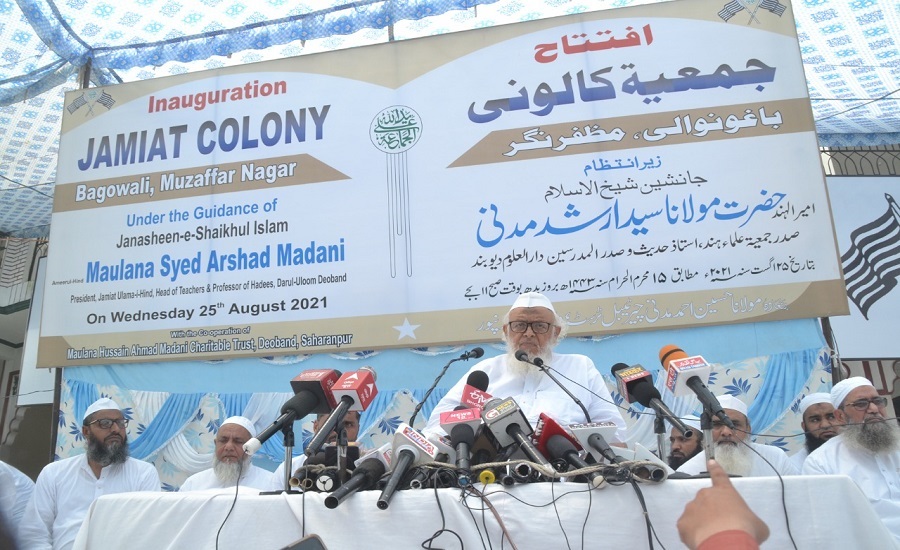
President of Jamiat Ulama-i-Hind Maulana Arshad Madani on Wednesday handed over keys of newly-built houses to 66 families who lost their homes in the deadly Muzaffarnagar riots in 2013, the group said in a statement.
Thousands of families were displaced due to riots. “These people were still living in extreme despair in different places. Jamiat Ulama-i-Hind has continued its relief and assistance from the very beginning as per its long tradition,” the Jamiat statement said, adding the group has constructed 311 houses, mosques and schools at different places in the district and the victims have been settled in them.
In March 2019, Maulana Madani had inaugurated the proposed Jamiat Colony consisting of 151 houses in Bagowali village of Muzaffarnagar. “At that time, the keys of 85 houses were handed over to the riot victims,” said the statement. “Today, Maulana Madani handed over the keys of the remaining 66 houses to the victims. A school for the religious education of the children of the victims and a mosque have also been built in the same colony.”
So far, 466 houses have been constructed for the Muzaffarnagar riot victims, and they have been resettled in them.
Addressing a grand function for handing over the keys of the houses to the beneficiaries, Maulana Madani said that “the riots in the city of Muzaffarnagar in Uttar Pradesh can also be listed as horrific because for the first time, a large number of Muslims had left their homes due to the fear of their lives. In these riots, the police showed the partiality which caused the killing and looting in the rural areas of Muzaffarnagar.”
source: http://www.clarionindia.net / Clarion / Home> Big Story> India. Indian Muslims / by Team Clarion / August 25th, 2021
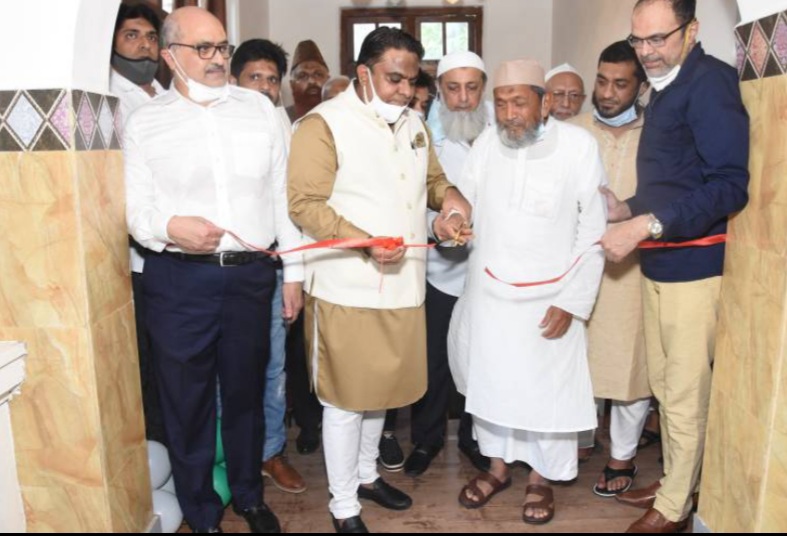
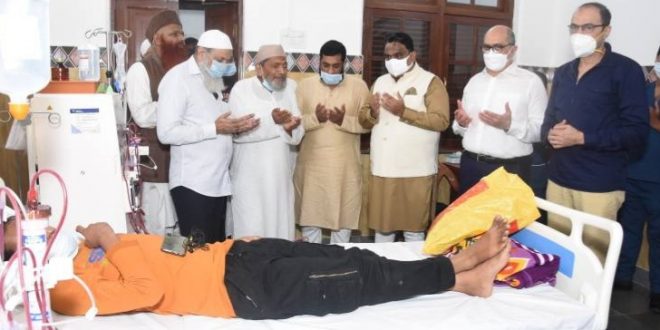
On the eve of 75th year of Independence of India, Sahara Medical Center inaugurated a Free Dialysis Services at Hakim Ajmal Khan Dispensary situated in Madanpura – Agripada area on 16th August, 2021, Monday.
It is the outcome of a joint effort initiated by the Late Hafiz Reshamwala, Trustee of Sahara Medical Center and a well-known Social Worker, Rais Shaikh MLA – Bhiwandi and House Leader of Samajwadi Party in Mumbai Municipal Corporation said, Hani A Farid. He said, “On this momentous occasion of 75th Independence Day, We dedicate Free Dialysis Centre to Mumbaikers, specially the people of Madanpura and Agripada. We will start to serve 16 Patients a day and will gradually increase the capacity in the future.”
“Affordable Healthcare gained prominence during this time of Pandemic. Sahara Medical Centre’s Free Dialysis Service is a blessing in disguise, it is totally “Free”. It will serve thousands of patients and will relieve poor families from the recurring health care expenses” said Rais Shaikh- MLA and Member of the Standing Committee BMC.
Dialysis is a recurring expense with each session costing around Rs.800 to Rs.3000 per session in a private dialysis centers and Hospitals. Patients need 3 sessions in a week which is beyond the budget of an average family.
Sahara Medical Center, situated in Agripada is a well-known Welfare Trust serving in the field of Medical and Health with its diagnostic center since last 20 years. It has facility such as X-Ray, Blood and other Tests facilities.
source: http://www.muslimmirror.com / Muslim Mirror / Home> Indian Muslim / by Rehan Ansari / August 16th, 2021
Amid disastrous floods in Maharashtra, a Madrassa opens door to flood-affected people.
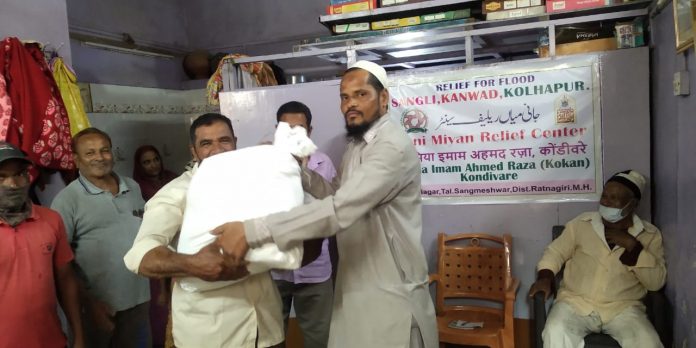
Amidst scenes of chaos and mayhem, a Madrasa called Darul Ulum Imam Ahmed Raza in Kondivare, Ratnagiri, located 30-35 km from Chiplun and 100-150 km from Mahad in Maharashtra, offered its space to flood affected people. Named as Jani Miya Relief Center after the founder of the Madrasa, Ismail Ahmed Jani Miya, the centre offered relief, aid and succor to the affected people. One of its kind, the relief centre transformed the space of the university prayer hall, spanning across an area of 126×80 sq feet, into a makeshift mall where items of sustenance and daily use – starting from a hair comb to mattresses and ration were provided free of cost.
MAHARASHTRA :
The districts of Ratnagiri and Raigad in Maharashtra were centres of a severe flood that hit the Konkan region on July 22. The worst-hit was Chiplun in Ratnagiri and Mahad in Raigad. The region, which is surrounded by the Sahyadri hills and two rivers Vashishthi and Shiv, is prone to flooding. This year the flooding occurred at an unprecedented level, aggravated by the over-flowing of the Koyna dam whose water regularly arrives at a reservoir close to Chiplun.
Talking to TwoCircles.net, Pankaj Dalwi, an environmentalist working in the Konkan said there are other factors such as extensive deforestation and poor urban planning as the cause of growing calamities.
A jarring example of a 21st-century man-made disaster, the flooding caused massive damage in terms of human life and livelihood. Hundreds of people in affected areas died (at least 209 deaths according to an Al- Jazeera report), thousands got displaced and entire villages and roads were turned into layers of debris and mud.
Amidst scenes of chaos and mayhem, a Madrasa called Darul Ulum Imam Ahmed Raza in Kondivare, Ratnagiri, located 30-35 km from Chiplun and 100-150 km from Mahad, offered its space to flood affected people. Named as Jani Miya Relief Center after the founder of the Madrasa, Ismail Ahmed Jani Miya, the centre offered relief, aid and succor to the affected people. One of its kind, the relief centre transformed the space of the university prayer hall, spanning across an area of 126×80 sq feet, into a makeshift mall where items of sustenance and daily use – starting from a hair comb to mattresses and ration were provided free of cost.
The flood had left entire communities without basic items of survival and the provisions provided by the relief centre were crucial for the survival of the affected community.
The members of the Madrasa undertook the mammoth task of providing a lifeline to the affected even if that meant working day and night, in rain or in cold.
TwoCircles.net spoke to fifty-year-old Qazi Mohammed Abdul Rahim Maqbooli, an important member of the Madrasa, about how they organized a centralized system of distribution.
Talking about how it all started, he said, “We first started distributing small ration kits and other essential items through a coupon system. Our volunteers visited each house, looked at the condition of the house, the number of family members in the household and issued coupons accordingly. These coupons were to be brought to the mall for receiving the provisions. Impressed by our fair and efficient system of distribution, trusts and NGOs providing relief from areas like Mumbai, Nasik, Malegaon, Rajasthan, Gujarat, Bhiwandi and many more started sending all kinds of items from combs, buckets, flex sheets, blankets, cylinders, stove, utensils, and so on to our mall. The mall became the distribution point for all items big and small,” he said.
The arrangements included well-thought-out needs of different members of the community of afflicted people. “We even gave out the special essentials required by women, old people, and babies including pads, diapers, small blankets for infants and so on,” Qazi told TwoCircles.net.
When asked about the challenges faced by the volunteer team in its operation, Qazi said that, “Sometimes people turned up without coupon. We didn’t want to turn them down and send them empty-handed. So we gave them basic ration kits with food essentials. We wanted to make sure that at least 1000-2000 rupees worth of goods is given to everyone.”
The Madrasa did not restrict itself to setting up the mall and distributing goods. They hired buses and drivers to drive people from their houses to the mall and back. “Our volunteers helped people load the bus with their goods that drove them and sometimes, all the way to Mahad, which is at least 100 kilometres away. Sometimes, we also delivered mattresses and other heavy items to the doorstep of the affected houses.”
The Madrasa sent out an appeal for help and mobilized a strong volunteer base of people of all ages from the nearby villages.
Qazi recalls that what was especially striking was the enthusiasm with which young volunteers and students of madrasa served the community. “This is what we teach our students in the school – to help everyone and work for the public good. My brother, Mufti Qazi Muhammed Ibrahim Maqbooli, who is also the principal of the school, and I provide free education and necessary items such as bags, stationery, books etc. free of cost to all our students.”
“At the Madrasa, we believe in serving humanity no matter what religion a person belongs to. Some Hindus in the area were hesitant about whether they will also receive the relief goods or not. We went to their houses to reassure them that we served everyone irrespective of religion,” Qazi said.
Talking about his motivation in serving the public, Qazi said, “Our parents always taught us to serve people. My father is bedridden and needs constant support and care. Despite this, all members of my family gave all their time to relief work. Last year, when the cyclone devastated thousands of homes in Konkan and there was no electricity for 3 months, we distributed ration kits to all affected areas. To me, the message of our faith is to love, share and view everyone with equality.”
What stands out in this brave example of relief work is not the generosity and benevolence of a charitable institution, but the humility and empathy of people who understand what it means to live in human society. Through their exemplary action, the people of the Madrasa and the volunteers of the region showed what it means to truly care and serve the people by opening up their spaces, giving their valuable time and providing labour for the welfare of a disaster-struck community.
source: http://www.twocircles.net / TwoCircles.net / Home> Lead Story / by Nikita D, Twocircles.net / August 23rd, 2021
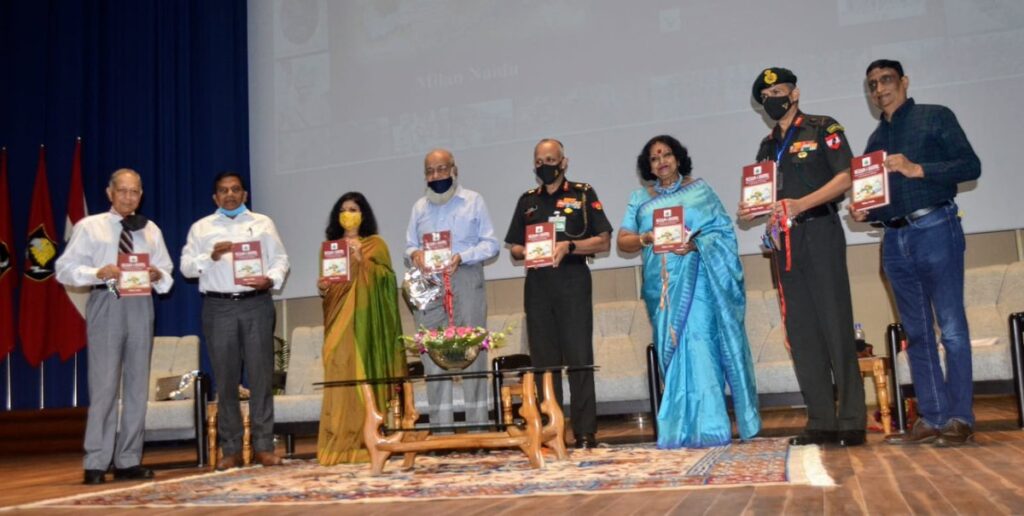
A book entitled “Nizaam-I-Bhopal”, highlighting the forgotten facets of Bhopal’s military history, penned by Lt. Gen. (Retd.) Milan Lalit Kumar Naidu, PVSM, AVSM YSM, the former Vice-Chief of Army Staff, was recently released.
The book was released by current Vice-Chief of Army Staff Lt. Gen. C. P. Mohanty at Dronachal, the headquarters of Sudarshan Chakra Corps, in Bhopal.
Lt. Gen. Naidu’s untiring efforts gave shape to his book “Nizaam-I-Bhopal”. It took five years of research, poring through Farsi (Persian) and Urdu records that led to the book.
It is only befitting that this wistful narrative is brought out by Bhopal’s very own son, Milan Naidu, who personifies that gentility, sophistication and aesthetic refinement to do justice to any literature to do with Bhopal. As a thoroughbred officer-and-a-gentleman with the highest military credentials and an illustrious career behind him only could have produced such an exquisite and masterful body of work “Nizaam-I-Bhopal”. The unforgiving ravages of time, circumstances and dominant instincts that governed its leadership from time-to-time, have been minutely analysed, explained and postulated for posterity. The rich, unsung and often unknown facets and tapestry of Bhopal’s military traditions, legacy and its continuing imprints are generously captured, documented and brought alive in this book.
In the book “Nizaam-I-Bhopal” Lt. Gen. Milan Naidu (Retd.) has charted the transformation story of rag-tag forces of the Indian princely states, from the 18th century to that modern Army. He has lucidly described the socio-economic-politico environment which existed in those times and analysed the evolution, rules, service conditions, ceremonials and battles fought by state forces, with special reference to Bhopal State.
The Book is a historical analysis of the Militaries of the Bhopal Princely State. Bhopal had the singular position in the comity of Princely States in British India, with a 175 years’ continuous line of Begums rulers. They were visionaries, educated and erudite. They displayed tremendous administrative ability, leadership qualities and diplomatic acumen, coupled with comparable skill at horse riding and arms. These Rulers set the tone of the Militaries and its motivation. The Bhopal Battalion, as part of the Indian Expeditionary Force, was the first non-Europeans to have disembarked at Marseilles in France to fight the War on foreign shores battling the weather and enemy alike.
A Bhopal battalion was even awarded one of only nine Victoria Crosses given out to Indian soldiers in Mesopotamia in the Great War. That same unit is part of Pakistan now. In the 1965 India-Pak war this battalion was awarded “Nishan-e-Haider”. The icing on the cake was that its Militaries were demobilized in a peaceful and a placid manner, to be absorbed by the Civvy Street in a symbiotic equation.
With such historical genesis and background of the State Forces, Lt. Gen. Naidu (Retd.) helps us to understand how much of our present Army developed its traditions, values and ethos; the singular character which it win the Kargil war despite the severe adversities.
This book is of true historical value, especially of the painstaking research, much from many primary sources, obtaining information from abroad (including Pakistan), interviewing progeny of the soldiers, and finally putting all of it in order.
The author’s observations on the governance and policies of the rulers help us to trace the developmental process of the state. How these issues impinged at various times on the States Forces is reflected subtly. Some of the anecdotes narrated in the book are hilarious and some quite poignant.
Kalim Akhtar, a historian and researcher says: “It is interesting to read how the Bhopal army collaborated with the British and fought the World Wars as well. It presents a true picture of history after years of research of Farsi (Persian) and Urdu records maintained in libraries, as far as the UK. It will be of great interest to lovers of history and especially those who love Bhopal.”
While Iram Khan, a housewife, in her comments about the book says: “It is well researched and attention grasping and would recommend it to anyone who has even a slight curiosity about the old world charm that the city of Bhopal still exudes”.
Meanwhile, the author of the book, Milan Naidu joined the National Defence Academy and was commissioned into the famed Rajput Regiment in 1967. He served for 41 years, holding several key positions – including worked as Military Attaché in Germany; Commanded 5th Battalion the Rajput Regiment in Sri Lanka; Commander of the Corps in Ladakh and GOC-in-C Army Training and Doctrine Command at Shimla before being made the Army Vice-Chief. He attended Canadian Forces Command and Staff College Course in Toronto. After retirement, he was appointed a member of the Armed Forces Tribunal at New Delhi.
His other assignments include: Working Chairperson of the Organising Committee for the Military World Games 2007; Member of the Executive Council of the Indian Golf Union; Chairperson of the Centre for Land Warfare Studies; Member of the Executive Council of the United Service Institution of India.
Lt. Gen. Naidu (Retd.) was born and brought up in Bhopal, the state capital of Madhya Pradesh. He did his schooling from Bhopal passing out X Class (Matric) from St Josephs Higher Secondary School, Bhopal in 1963. I may mention here that he was seven years senior to me in the school where I too studied in the sixties.
He did his M.Sc. in Defence Studies from Madras University in1984-85. Later on he did M. Phil in Defence Management in 1989-90. He completed Post Graduate Diploma in Environment and Ecology, Barkatullah University, Bhopal in 1996-97.
He won the Junior Small Bore in the National Shooting Championship in 1963. He was awarded ‘Shooting Blue’ in NDA.
source: http://www.maeeshat.in / maeeshat.in / Home> Books> Business / by Pervez Bari / August 02nd, 2021
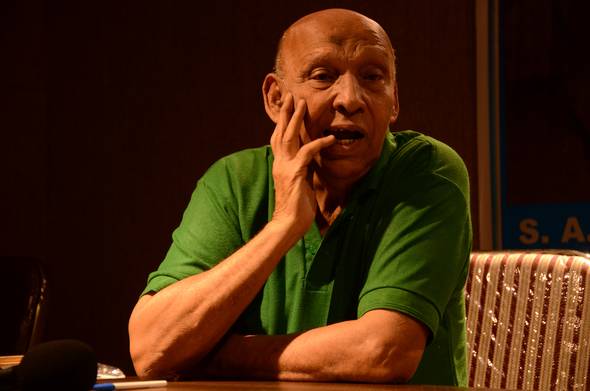
Hakim had represented India in the 1960 Olympics and is the son of the legendary football coach S.A. Rahim.
File image of Syed Shahid Hakim.
Former Olympic footballer and ex-national football coach Syed Shahid Hakim passed away in a private hospital in Gulbarga on Sunday morning. He was 82 and survived by his wife and two daughters.
“He suffered a cardiac arrest at 8 am today and passed away at 8.30 am. He has been getting treatment after he was admitted to the hospital two days ago following the first stroke,” Sadia Syeda, wife of Hakim, informed Sportstar from Gulbarga.
Hakim, son of the legendary football coach S.A. Rahim, was part of the Indian squad for the 1960 Rome Olympics.
The former SAI national coach successfully battled COVID-19 last year in a private hospital in Hyderabad.
Only last week, he was among the many former internationals who were felicitated in Hyderabad.
A vocal critic, Hakim was known for his frank views on contemporary topics in Indian football.
“I was not in the starting XI. The team was packed with heavyweights; only in case of an injury to some of the big names, players like me had a chance in the Rome Olympics,” said Hakim in a recent interview to Sportstar, recapping those experiences.
Hakim became only the second footballer to win the prestigious Dhyan Chand Award for Life Time Achievement in Sports and Games in 2017 and served as the Chief Project Director at Sports Authority of India (SAI).
Hakim, besides playing for nearly 25 years, was also a qualified FIFA referee. He officiated in 33 international games, including the 1988 AFC Asian Cup in Qatar.
At the domestic level, he was part of the triumphant Services’ Santosh Trophy squad in 1960. He was also part of the squad from 1960-66. At the club level, he played for City College Old Boys (Hyderabad) and Indian Air Force.
A former assistant coach of the Indian National team, he also coached Mahindra and Mahindra in 1998-99 and guided it to victory in the Durand Cup in 1998. He also coached Salgaocar SC, Hindustan FC, and Bengal Mumbai Club.
Former India captains Victor Amalraj, Shabbir Ali, Telangana Football Association secretary G.P. Palguna were among those who expressed condolences to the family members.
source: http://www.sportstar.thehindu.com / Sportstar / Home> Football / by V V Subrahmanyam / August 22nd, 2021
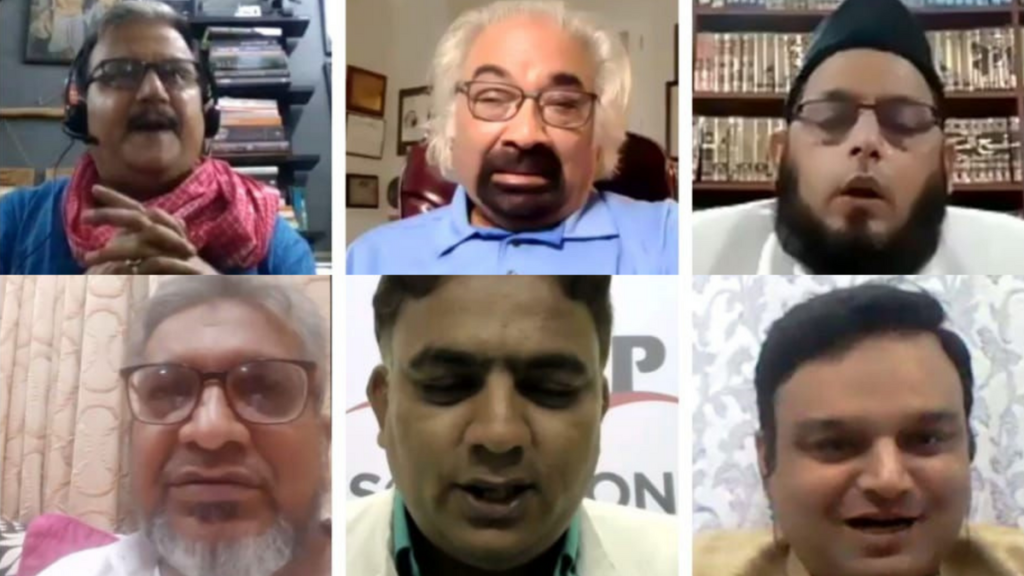
(L-R: Dr Manoj Kumar Jha, Sam Pitroda, Maulana Khalid Rashid Farangi Mahali, Navaid Hamid, Aamir Edresy and Farooque Siddiqui)
inners of 1st AMP National Awards for Social Excellence 2021 was announced on the evening of Independence Day, 15th August in a ceremony attended by guests and a large gathering of participants from across India.
Association of Muslim Professionals (AMP) is an organisation of volunteer Muslim professionals, who are working towards the socio-economic empowerment and development of Muslims in India. Started in 2007 by Aamir Edresy, AMP is present in more than 100 Cities of India and as many as 16 countries globally.
15 Organizations were given the National Award of Excellence 2021 and the Best NGO Award was given to a minimum of 3 Organizations from all the States of India. Also, the Special Jury Award was given to some top performers of every state.
Apart from NGOs, 200 Individual Change Makers were also awarded, including The Cognate‘s Founder, Editor Shaik Zakeer Hussain. These are individuals who worked in the last year for the welfare of the people, especially during the Corona crisis.
While speaking to the audience Former Advisor to Prime Minister Mr Sam Pitroda said that an active civil society is the most important element of any successful democracy. It is the duty of the people who are governing the country to involve civil society in all its decision and policymaking. He congratulated the winners and spoke about the importance of collaboration in today’s world.
Mr Navaid Hamid (President All India Muslim Majlis e Mushwarat) said that it takes courage to appreciate and recognize the efforts of others. He said this spirit is continuously increasing in Muslims and most of the organizations are now open and ready to work with each other. He further said that he hopes AMP will be the torchbearer in this movement of change and will take the community to greater heights.
Rajya Sabha Member Dr Manoj Kumar Jha said that it is very heartening to note that close to 1000+ nomination has come from three States of Bihar, Uttar Pradesh & Jharkhand where we together really need to do a much better job as these three states is at bottom of all index with respect to education, employment and empowerment.
Renowned Islamic Scholar Maulana Khalid Rashid Farangi Mahali from Lucknow spoke about the importance of social work and helping the needy and poor in the light of Islamic teachings. He appreciated the efforts of all the organizations and specially AMP in establishing this platform to work jointly.
In his inaugural speech, AMP President Mr Aamir Edresy spoke about AMP’s efforts in the last 14 years for the welfare of the Muslim community and nation. He spoke about the importance of partnership and collaboration among Muslim organizations across India for better results and wider reach.
National Award for Social Excellence was awarded to Rahmani 30, All India Ideal Teachers Association, Centre For Information And Guidance India (CIGI), Hamdard National Foundation, Human Welfare Foundation, Indian Civil Liberties Union (ICLU), Jamia Markazu Ssaquafathi Ssunniyya, Mercy Mission, Millat Foundation For Education Research & Development (MFERD), Minhaj Interfaith And Welfare Foundation, Quill Foundation, Rehab India Foundation, Safa Baitul Maal, Taraqqi Foundation and Zakat Foundation Of India.
The Lifetime Achievement award was presented to the President of All India Muslim OBC Organization Mr Shabbir Ahmed Ansari Sahab for his relentless service for the cause of not only Muslims but for all for the last 50 Years.
Mr Farooque Siddiqui (Head of AMP NGO Connect Initiative) hosted the event. While introducing the Awards Mr Farooque Siddiqui said that getting nominations of 2300+ organizations is a stepping stone for a big transformation of the rural part of the nation. He said that this Award function is just the beginning and we will work closely with all NGOs who all have shown their interest in joining hands with us in Community/Nation Building.
Dr Zahida Khan gave the welcome speech and Mr Shoeb Syed (AMP West Zone Head) gave the vote of thanks. The awards were presented by AMP Team including Mr Reyaz Alam (AMP Bihar Head), Mr Qamar Faheem (AMP Jharkhand Secretary), Miss. Shaheen Islam (AMP UP Head), Mr Chand Mohammed Shaikh (AMP Rajasthan Head), Mr Sayeed (AMP Hyderabad Head), Mr Manzar Hussain (AMP East Zone Head) and Mr Saphat Ajmeri (AMP Central Zone Secretary).
The program was concluded with the Dua by AMP North Zone Head Mr Ameen Mohammed.
source: http://www.thecongnate.com / The Cognate / Home> News / by The Cognate News Desk / August 17th, 2021
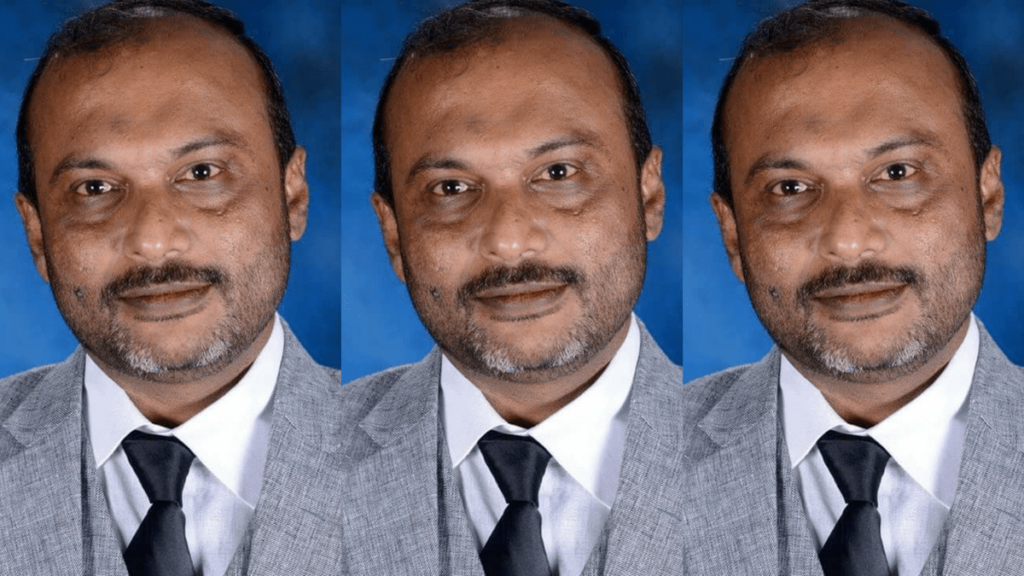
Renowned Bengaluru-based advocate Anees Ali Khan passed away Saturday following a cardiac arrest.
Adv Anees Ali Khan was said to be suffering from kidney ailments for a while. He passed away while he was being taken to a hospital. He is survived by his wife and three children.
Widely regarded as one of the best criminal lawyers in the city, Adv Anees was one of the counsels for the accused in the Bengaluru riots case in which over a dozen people were arrested under UAPA.
He was on the board of many community-based organisations and had recently joined the Aam Aadmi Party (AAP). He was the Organising Secretary of AAP in Bengaluru.
Condoling his passing away, human rights organisation, NCHRO said, “At the time, where Bar Associations influenced by communal elements passed resolution not to represent some of the accused, he dared to represent the innocents, won reversals, or release in fabricated terror cases.”
Adv. Anees Ali Khan Bengaluru,defender of human rights passes away. At the time, where Bar Associations influenced by communal elements passed resolution not to represent some of the accused,he dared to represent the innocents, won reversals, or release in fabricated terror cases.
0726 AM , Aug 21st, 2021
______
source: http://www.thecongnate.com / The Cognate / Home> News / by Shaik Zakeer Hussain / August 21st, 2021
This year’s seven Wikimedian of the Year award winners were announced today at the 2021 virtual Wikimania convening .
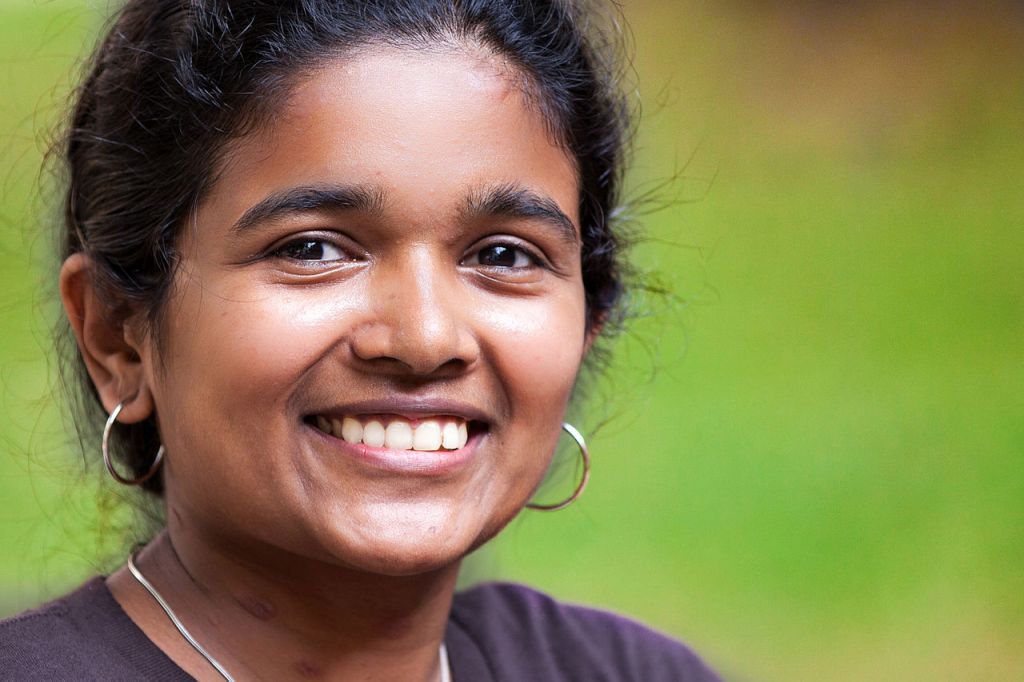
Read the interview below with Dr. Netha Hussain, recipient of the Honourable Mention Award.
Dr. Netha Hussain has been a Wikimedia volunteer for over a decade, as well as a medical doctor and researcher who has contributed to English and Malayalam languages of Wikipedia, Wikidata, Wikimedia Commons, and Meta-Wiki.
Throughout the COVID-19 pandemic, Netha wrote, updated, and translated dozens of Wikipedia articles to ensure reliable information about the pandemic is available for everyone. She also recently launched a project to improve information about vaccine safety topics on Wikipedia, helping combat misinformation. In the process, Netha has collaborated with Wikimedians around the world and inspired many others to ensure information is verifiable and reliable.
“The idea of sharing free knowledge with millions of people around the world excites me, and this serves as a motivation to keep doing more.”
Additionally, Netha has contributed to outreach and research surrounding the diversity of participation and content on Wikimedia projects, particularly of the gender gap. In 2020, she was recognized by Red Hat as a 2020 Women in Open Source Award winner.
The Wikimedian of the Year Honourable Mention award recognizes exceptional Wikimedians who already have a strong presence in the movement, as well as public exposure such as press coverage, local recognition, and national titles. pix02
This recognition is one of seven awards made this year to celebrate contributors who have made an exceptional impact on our movement. The awards were announced at this year’s virtual Wikimania celebration by Wikipedia Founder Jimmy Wales (watch the announcement!).
“Dr. Hussain is a role model in the Wikimedia movement for her staggering medical and scientific contributions to Wikipedia, contributions she balances alongside her own medical career. Throughout the COVID-19 pandemic, her work has brought increased visibility to Wikipedia’s unique role as a source for reliable public health information about the virus and the vaccines. In addition, her constant advocacy to address the gender gap and her support for Indic communities demonstrate the values of collaboration and contribution that are integral to our movement.”
– Jimmy Wales
We spoke with Netha to learn more about her experiences and perspectives on the Wikimedia movement. Here are some highlights:
Q: Can you share a favorite memory from your time contributing to Wikimedia?
“Creating my first article is a special memory that I cherish to this day. The process did take a long time because, back in 2010, I was running on a 128 kbps internet connection in a six year old desktop computer on an old version of the browser.
I wanted to create an article about an Indian cuisine called chutney in Malayalam language Wikipedia. I wasn’t sure about the rules one has to follow while editing, but I thought I will make a try anyway. I created some text and saved it as a new Wikipedia page. The next day, I was surprised to find out that other editors have improved upon that page by adding media and more content. This was the first nudge which paved the way for the rest of my Wikimedia volunteering journey.
Another memory was when I saw that a pathology image that I added to Wikimedia Commons was re-used on a prominent medical website. This made me reflect on the scarcity of good quality medical images in online sources, and prompted me to start the first of its kind GLAM [galleries, libraries, archives, and museums] collaboration with Government Medical College, Kozhikode.”
Q: What motivates you to contribute to Wikimedia projects?
“I am motivated by the satisfaction of having done a small part in making the world a better place. The idea of sharing free knowledge with millions of people around the world excites me, and this serves as a motivation to keep doing more.”
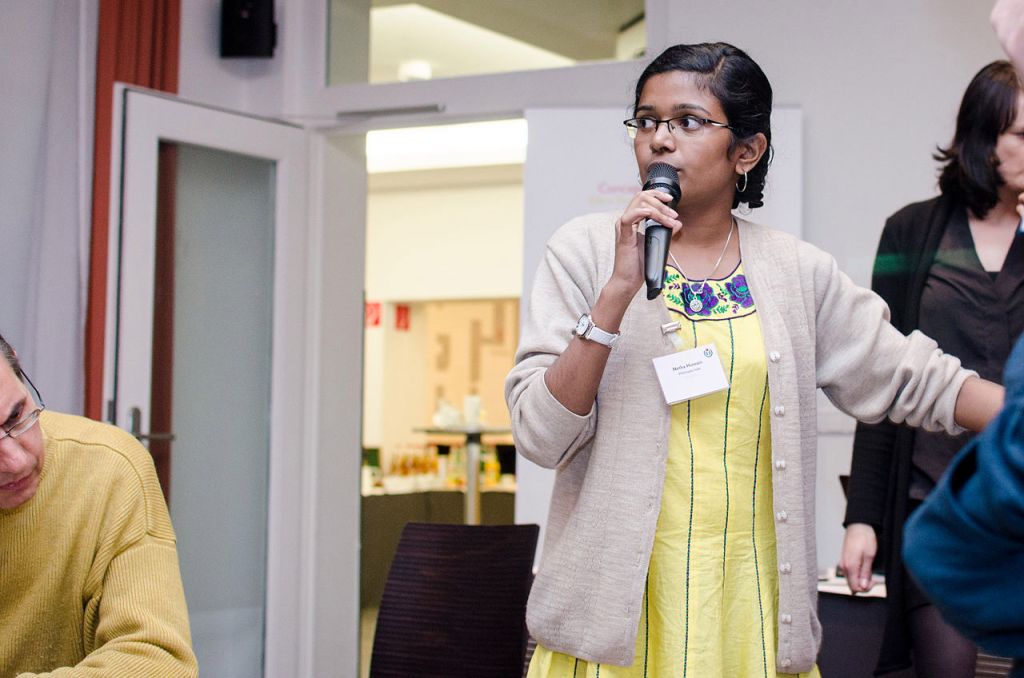
Netha Hussain presenting at the Wikimedia Diversity Conference in 2013 (Christopher Schwarzkopf (WMDE), CC BY-SA 3.0)
Q: How has Wikipedia helped tackle COVID-19 disinformation and misinformation?
“Wikimedia was able to play a large role in tackling COVID-19 disinformation because of its people, technology, and policies.
The people who make up the Wikimedia movement are experts from a wide variety of subject areas. They perform tasks such as copyediting, structuring, and adding rich media to Wikimedia pages. Wikimedia has robust policies around verifiability, neutrality, and original research, which warrants the use of sources with high credibility. The technology used in Wikimedia provides a simple interface for editing and has provisions to counter vandalism.
All these factors taken together, as well as learnings from the movement’s previous experience in responding to crisis situations helped Wikimedia tackle disinformation effectively.”
“It is hard to imagine all the ways that Wikimedia will influence the future of the ecosystem of free knowledge in medicine, but I am convinced that Wikimedia will continue to occupy a central role in the process.”
Q: How does your work on Wikipedia contribute to the future of medicine?
“I was a medical student when I started contributing to Wikimedia in 2010. At that time, I worked on concepts that I learned at medical school. Later on, I focused on building content around specific topic areas. My current focus is on creating content related to COVID-19 and vaccination. The articles created by me in English and Malayalam languages are being edited several times by other editors and are becoming richer and more comprehensive by the day. I think that these articles will continue to educate (and perhaps also entertain and enlighten) people in the future.
The text and media that I and fellow editors created will continue to be remixed, curated and magnified several times by third party sources such as search engines, websites, and virtual assistants. Additionally, the edit history of the work that we performed on Wikimedia is likely to serve as a historical documentation of how events unfolded in time and how scientific evidence changed over time.
Our discussions on talk pages would serve as a reminder for how and why we made some decisions regarding the policy or structure of Wikimedia entities. The metadata of our edits are likely to act as data points for researching about trends and patterns in editing, paving way for insightful conclusions regarding the growth and diversification of Wikimedia projects. The structured data contributed by us would serve as the database for search engine and machine learning algorithms. It is hard to imagine all the ways that Wikimedia will influence the future of the ecosystem of free knowledge in medicine, but I am convinced that Wikimedia will continue to occupy a central role in the process.”
“In the process of researching health conditions and treatment options, people…eventually to Wikimedia projects. Therefore, it is important that Wikimedians should work in the interest of public health.”
Q: What is Wikipedia’s role in public health?
“Wikipedia is the largest non-profit website in terms of pageviews. Wikipedia has become a popular source of healthcare information because of its simplicity of content, higher ranking in search results, easiness in accessibility, availability of citations, presence of photo/video illustrations, ability to edit quickly and possibility to navigate in multiple language editions.
Most often, in the process of researching health conditions and treatment options, people go online, and eventually to Wikimedia projects. Therefore, it is important that Wikimedians should work in the interest of public health and invest resources for making its medical content reliable, comprehensive and updated.”
“I wish everyone knew that they have something to contribute to the Wikimedia movement.”
Q: What is one thing you wish everyone knew about Wikimedia projects?
“I wish everyone knew that they have something to contribute to the Wikimedia movement. People usually shy away from contributing to Wikimedia because they think that the expertise they have is trivial or irrelevant for Wikimedia.
We need not only content creators and curators, but those interested in technology, outreach, fundraising, strategizing, to name a few. We need to make non-content related contributions more visible and rewarding so that everyone knows what is possible for them to do on Wikimedia projects, and enjoys doing what they love or care about.”
Congratulations, Netha!
About the 2021 Wikimedian of the Year Awards
The Wikimedian of the Year is an annual award that honours contributors to Wikimedia projects, including Wikipedia editors, to highlight major achievements within the Wikimedia movement in the previous year. The tradition dates back to 2011 and has evolved since then in dynamic ways to welcome and celebrate Wikimedians from different backgrounds and experiences. This year’s celebration is bigger and more inclusive than ever before, recognizing seven exceptional contributors to the Wikimedia movement in six categories , including Newcomer of the Year, 20th Year Honouree, Rich Media and Tech contributors, and Honourable Mentions, as well as the Wikimedian of the Year.
*This interview has been edited for clarity and length.
source: http://www.diff.wikimedia.org / Wikimedia.org / Home> Wikimania 2021 / by Wikimedia Foundation / August 15th, 2021
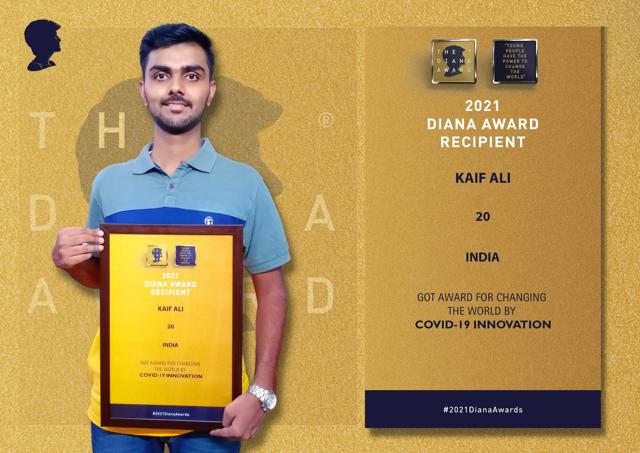
Born and brought up in New Delhi, twenty-year-old Kaif Ali is an architecture student at Faculty of Architecture & Ekistics, Jamia Millia Islamia, New Delhi. Ali was honoured with The Diana Award 2021 for his work on Covid-19 Innovation–Space era recently, which is a module for demountable and portable shelter space for Covid-19 era. This is his story.
New Delhi :
Every child has drawn their family with a house in the background and most probably made sandcastles at beaches too. However, in the grownup’s world, not everyone can have a house built like that. Twenty-year-old Kaif Ali, an undergraduate student of Jamia Millia Islamia, New Delhi after entering the world of architecture found out that homelessness is a major issue in the world and there are many without proper houses.
Born and brought up in New Delhi, twenty-year-old Kaif Ali told TwoCircles.net, “Just 200 meters away from my apartment is a settlement made above the sewage lines. In nights, the people there sleep on footpaths since snakes sneak out of sewage.”
Ali could not help noticing how unjustly the metropolitan city is majorly designed commercially for a few per cent of the population. After witnessing these inequalities, Ali wanted to take up architecture as a profession and develop a sustainable model.
Beyond survival Homeless people are of many types, which include urban poor, migrant labourers and refugees. However, the government made arrangements for these homeless people can barely be called a home. There is no privacy nor any sense of security as sought by a family since most facilities are gender-separated. Open cooking and sanitation, poor waste management, unavailability of electricity and potable water, the list go on.
Ali recollects that it was a documentary called “Cry for Syria” that sensitized him into the refugee crisis. As an attempt to address the issue, Ali went on to design shelter spaces for Syrian refugees, during his early college days.
When asked whether he is concerned about these temporary shelter spaces becoming the permanent settlement of refugees and others, as is the norm, Ali said that his concept of shelter is a home for living and not for mere survival. Therefore, along with houses, Ali also designs schools, gyms, and other recreational spaces using the same modular technology, which facilitates easy assembling and dismantling.
Quoting a few success stories of refugee assimilation with the host country, Ali believes that if refugees are housed holistically, they will not remain on the fringes. “Shelter is the start of all,” he said.
From housing to quarantining For the last two years, Ali has invested himself in designing shelter spaces for the homeless. As the Covid-19 pandemic broke out, Ali witnessed the dire demand for quarantining thousands in cramped up cities.
That is how he began working with his project last March and designed a portable intermediary quarantine facility of 2.5m x 6m, using PUF panels or shipping containers, which can be assembled with ease, have massive room for expansion, with natural ventilation and 6 layers of social distancing.
The facility can also be later used as refugee camps or disaster relief camps.
Kaif Ali was awarded the international Diana Award 2021 for the same. His design follows all Covid-19 protocols and is more efficient than home quarantine or mass quarantining facilities.
Ali’s quests stem from his immediate realities. Even his intermediary quarantine shelter came up observing the spread of the virus in enclosed spaces through the air, even before WHO confirmed the spread through the air. “That is the power of observation and study. I apprehended that Covid-19 would spread through the air from my study and by keeping this in mind, I have designed the quarantine facility,” Ali said.
Thinking architecture ‘out of the box’ Having varied interests, Ali is good at juggling different pursuits. The twenty-year-old has taken home several awards in architecture and photography. It is the introduction to various international competitions that expanded Ali’s network.
Upon winning Climate Innovation Lab conducted by Climate Technology Centre and Network, Ali has been receiving mentorship of Biplab Ketan Paul, IIT Kanpur incubation mentor and social entrepreneur.
Referring to Ali’s Covid-19 relief work, Paul said proudly, “Kaif Ali is a good samaritan.”
Soon, Ali’s design would shelter the people of Lagos in Nigeria. His project has received appreciation across the world from architects of Germany, Iran, South Africa, Turkey, the US, & Brazil. Ali has also featured in the United Nations top 11 emerging innovation start-ups solving climate action.
Twenty-year-old Ali has not shied away from approaching several state governments. After the Karnataka government appreciated him, organizations working with the Maharashtra government are willing to implement his project.
To make his designs financially viable, Ali said he uses his father’s counsel, who is in the construction business. “His advice comes in handy, especially when deciding the materials and other factors. It is the context that is my foremost priority,” Ali said, elaborating that climate and clients’ context guides his design.
Moreover, Ali aspires to make the language of architecture accessible to common people. His drawings are easily readable for policymakers and politicians alike. “Future architectures cannot limit themselves to space and cost crises alone. In times of rising refugees of climate, wars and poverty, expanding socially responsible entrepreneurial perspective in architecture is a must,” concludes Ali.
source: http://www.twocircles.net / TwoCircles.net / Home> Lead Story / by Arfa Backer, TwoCircles.net / July 30th, 2021
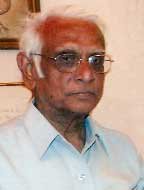
Ruler of Oman, Sultan Qaboos bin Said has honoured Dr. M.I.H.Farooqi, with an award of US$ 25,000 (Rs 12 lakh) in appreciation of his books Plants of the Quran and Medicinal plants in the Traditions of Prophet Mohammad.
Both the books contain scientific descriptions of plants mentioned in the Qu’ran and Sunnah .
Dr. Farooqi is a well-known Lucknow-based plant chemist with more than 125 research papers to his credit, published in Indian and foreign journals.
He is also the author of several books and more than hundred articles in English, Hindi and Urdu on science subjects of common interest like environment, modern technology, medicinal plants, economic plants, Islamic science and Prophetic Medicine.
Plants of the Quran has been translated and published in several languages including Hindi, Urdu, Persian, Kannada, Malayalam and Indonesian languages. Based on Quranic and Prophetic Plants, UNESCO has approved Multimillion Dollars Project of Quranic Botanical Gardens in the Gulf countries.
Works on the establishment of such gardens in Sharjah and Qatar have already started.
(Dr. MIH Farooqi may be contacted at mihfarooqi[@]gmail.com)
source: http://www.milligazette.com / The Milli Gazette / Home> News> Focus / by The Milli Gazette / March 26th, 2011