Category Archives: Amazing Feats

Dilip Kumar, the pole star of a golden age of Hindi cinema, no more

Mumbai, MAHARASHTRA :

Dilip Kumar (1922 – 2021): The end of an era
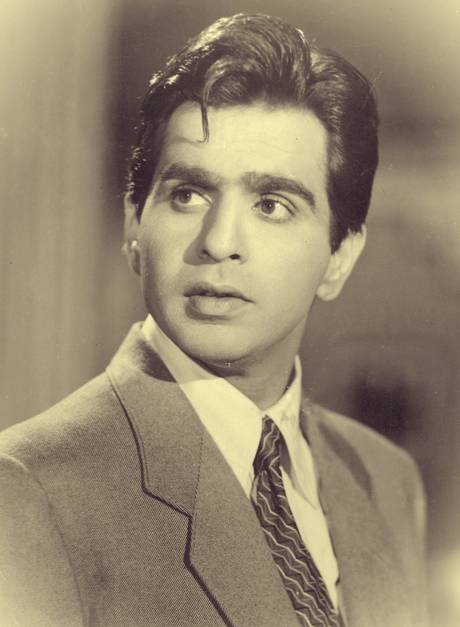
Actor Dilip Kumar  

The right blend of star and actor, he was part of the discovery of cinema in India as a means of mass communication seen today

When Marlon Brando was struggling to find a footing in Hollywood, a shy Pathan boy from Peshawar was practising method acting in what was then the Bombay film industry, helping it come out of the Parsi theatre’s influence. As Dilip Kumar transcends to a new stage , the pole star of the golden age of Hindi cinema would be remembered for setting a template of acting for generations to come.

A veritable cultural icon who inspired economist Meghnad Desai to draw parallels between his films and the newly independent India’s tryst with socialism and capitalism in his seminal work, Nehru’s Hero: Dilip Kumar in the Life of India, there is a bit of Dilip Kumar in everyone’s life.

Discovered and later rechristened by Devika Rani of the famed Bombay Talkies, Dilip Kumar, along with Raj Kapoor and Dev Anand, were part of the discovery of cinema in India as a means of mass communication as we see it today. They had had few examples to follow and perhaps it worked to their advantage as each one carved out his own niche.

Out of the three, Dilip Kumar’s naturalistic style never became stale or dated. The right blend of star and actor who could keep both the public and the purist engaged with his craft, he kept his performances subtle, understated but always believable.

Not just his younger contemporaries like Rajendra Kumar, Manoj Kumar and Dharmendra, generations of dependable actors, from Amitabh Bachchan to Shah Rukh Khan and Aamir Khan to Irrfan, built edifices of their performances on the foundation laid by Dilip Kumar. Mr. Bachchan, who played Dilip Kumar’s son in Shakti, once said there was such finality to Dilip sahib’s performances that once he enacted a scene, there was no alternative to it. Irrfan once told this journalist that he often wondered when trained actors like him found it difficult to deal with scars left by tragic roles, how Dilip Kumar, who learnt the craft on his own, came to terms with it. Well, he did approach doctors in London, who advised him to consider lighter roles.

Film historians often label the thespian as the tragedy king for his moving portrayal of a loner who loses everything in love in a series of films such as Jugnu, Deedar and Devdas, but the eight-time Filmfare Award winner was equally compelling as a winsome romantic in Shabnam, Azaad and Kohinoor. Not to forget his intense performances as a revolutionary in Shaheed and a trade union leader in Paigham.

Be it the lawyer who rapes a village girl in Mehboob Khan’s Amar, the journalist who becomes black-marketeer in Zia Sarhady’s Footpath, the atheist in love with a mendicant in Kidar Sharma’s Jogan or the wheel-chair bound Raja Sahib in Aadmi, a role earlier essayed by Sivaji Ganesan, the Padma Vibhushan constantly lunged for complex characters where he was expected to evoke multiple emotions in a single frame.

He experimented not just with characters but also directorial styles. Both Amar and Footpath deal with moral guilt but while Mehboob Khan visualised a mass entertainer, Zia’s treatment was neo-realist. With Tapan Sinha’s Sagina Mahto, he ventured into parallel cinema and earned praise from his contemporaries.

At the time of Mughal-e-Azam, he was the top draw, but the narrative demanded Kumar to play second fiddle to Prithviraj Kapoor, a senior and a friend of his father. He delivered a restrained performance, a subtle counterpoint to the bombastic Kapoor that is etched in the minds of cinegoers. The way he caresses the luminous face of Madhubala with a feather is perhaps the most elegant romantic sequence filmed without a dialogue.

The one that stands out and inspired many adaptations is the dacoit in Gunga Jumna, his ambitious home production where the sophisticated Kumar transformed into an Awadhi speaking rustic who’s forced to pick up the gun.

He played serious roles with such dignity that he didn’t need to be loud to make people laugh. He brought his craft to comic roles as well. In Ram Aur Shyam, the scene that still leaves everyone in splits is the one where Shyam starts playing a poor copy of Ram.

It is this constant urge for variety and chiselling of the craft that the megastar, despite the world at his feet, chose to do only around 60 films spanning over almost five decades. He refused Guru Dutt’s Pyaasa for he found the character similar to Devdas. He said no to David Lean for Lawrence of Arabia as he was not keen to commit the amount of time that the director was asking from him.

In a BBC interview, he once said that when the director came to him with a 30-year-old character, he tried to find and build the first 29 years of his life from the script so that, “I start identifying with the character. Often directors leave it to me to interpret the character.”

Known to help out his colleagues in finding a rhythm that suited the narrative, the actor is said to have ghost directed many films such as Gunga Jumna, Ram Aur Shyam and Aadmi.

He took the preparation for a character to a different level. For “Madhuban Mein Radhika Nache Re” from Kohinoor, where he played sitar on screen, he trained with sitarist Ustad Halim Jaffar Khan for six months.

It is said while filming for Dil Diya Dard Liya, he ran four rounds of the studio because in the next sequence he was supposed to snatch a rifle from Pran, playing the villain, in a state of breathlessness.

Even in his second innings, when his mannerisms became marked, he impressed with power-packed performances in Shakti, Mashaal and Karma.

Off-screen, as a philanthropist, he always maintained that “industrialisation has made us narrow-minded”. He would always say “being developed and being civilised are two different things”.

In the late 1960s, when an argument was made about films promoting alcoholism and that they could be used to promote population control, Dilip Kumar said he was for promoting good values through films but that didn’t mean films become “instructional” or a “vehicle for propaganda”.

A connoisseur of the finer things of life, he had an abiding love for poetry and literature. Often, when he had to sidestep a controversial topic, he would come up with an Urdu couplet that would capture his emotion on the subject. Once when he was asked about his relationship with Madhubala, Kumar invoked Sahir Ludhianvi: “Mohabbat tark ki maine, garebaan see liya maine, zamane ab toh khush ho, zehar ye bhi pi liya maine” (Love I have renounced and sewn the collar [of the soul/ conscience] that was ripped; O world, now you be happy, for this poison as well I have sipped).

Deeply entrenched in Indian ethos, he never got over his childhood connection with his home town Peshawar where the young Yusuf Khan would be found dribbling a football or listening to stories at Qissa Khawani Bazaar. He remained a symbol of the undivided India as the Pakistan government bestowed upon him its highest civilian honour, the Nishan-e-Imtiaz. He wrote to the then Prime Minister Atal Bihari Vajpayee that if he considered it prudent, he would surrender the award. However, many feel it made his wait for the coveted Bharat Ratna longer.

source: http://www.thehindu.com / The Hindu / Home> Entertainment / by Anuj Kumar / New Delhi – July 07th, 2021
Reviving Forgotten Memories

Kolar / Mysuru, KARNATAKA:

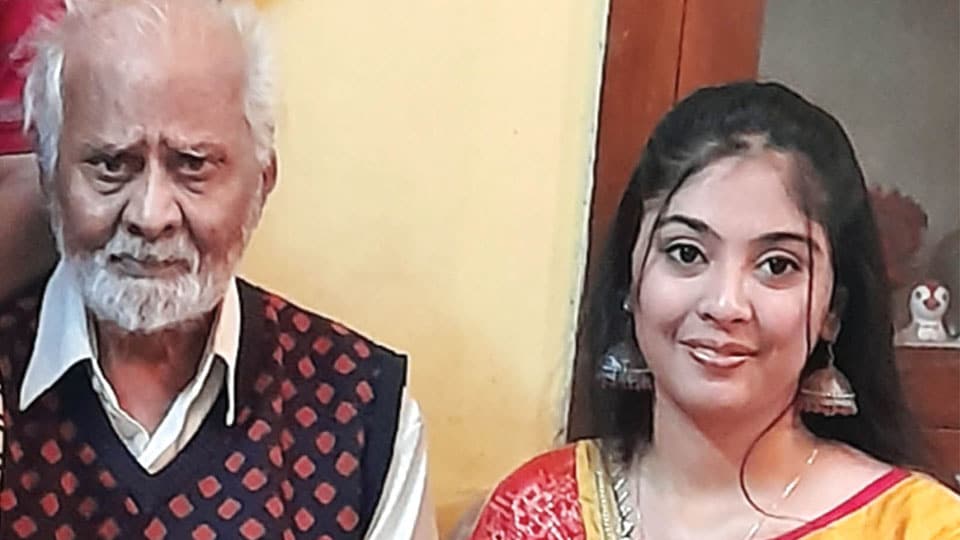
A grand-daughter connects with her nonagenarian grandfather Mohammed Nizamuddin, a trend-setter of football in Mysore State

Indians have seen many names coming forth. It could be in the field of science, technology, freedom struggle, sports etc. — few known, few unknown and a few remained in oblivion.

One such sportsman was a young boy from Kolar, my grandfather Mohammed Nizamuddin, who was a terrific football player and was the trend-setter of football in Karnataka, then called the Mysore State. He played and won many matches. Now as a nonagenarian, he is leading a simple life as a retired Tahsildar, enjoying his success in life with utmost gratitude faraway from fandom.

Journey of football dream

It was a normal day. Out of boredom (lockdown effect) I just thought of talking to my grandfather about his football days. But looking at the sparkle in his eyes and hearing his excited voice, my time-pass conversation became one of the most enlightened high voltage story-telling session. He began with his life as a kid who played football as a mere game, but it was in his teens that football became his passion. He started playing for his University first and then for his State.

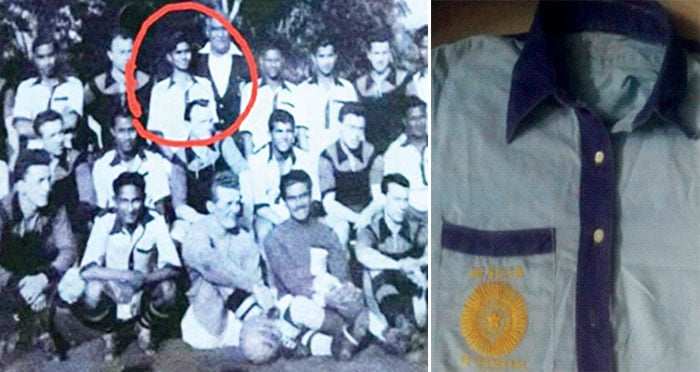
Mohammed Nizamuddin (standing second from left) and his team seen with the Secretary of All India Football Federation.

Born on June 20, 1929, his football career as such started with Mysore University, where he was the captain of his football team and he, along with his team, won many trophies. His University Professors and those who used to see his matches started encouraging him. He was also much appreciated among his team members and slowly his popularity began to grow. 

Looking at his skills, a well-known team of Karnataka at that time “The Bangalore Blues” approached him and he became a part of that team. As the saying goes “It takes a right moment to strike”, that moment in my grandfather’s life came as an opportunity to play the Santosh Trophy for his State (then Mysore State).

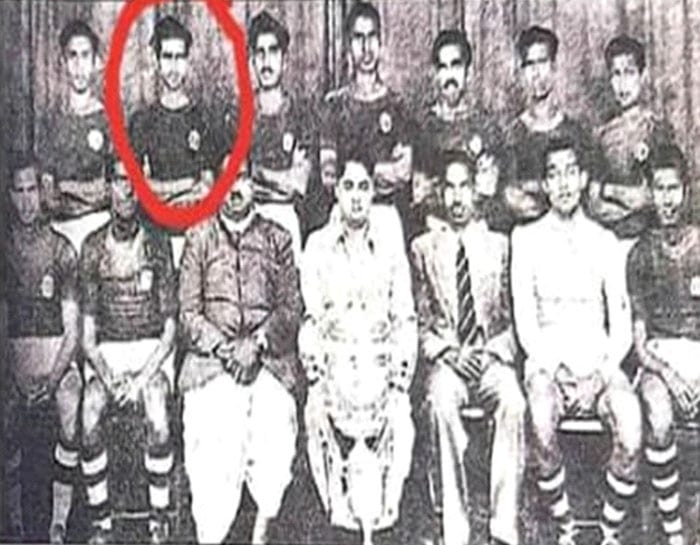
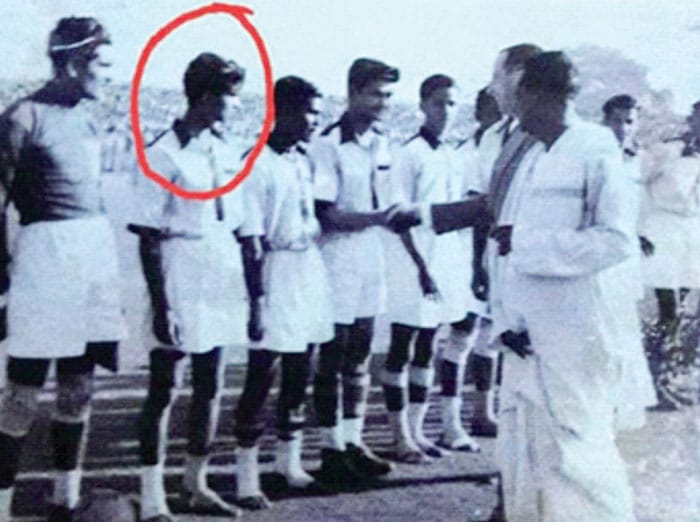
Mohammedan Sporting Club members with the Austrian team at All India Football Federation in 1953. The encircled person is Mohammed Nizamuddin.

1952 – SANTOSH TROPHY

Santosh Trophy is a State-level Football Tournament where many States participate. My grandfather played for the Mysore State. Mysore State in 1956 had won this trophy after a wait of 6 long years. The State was playing well and had entered the semi-finals. It was an interesting nail-biting match. The match was against Orissa (now, Odisha) and Mysore State (now, Karnataka) won by two goals — both scored by my grandfather (Lo, a new star was born in Mohammed Nizamuddin).

Then came the finals. As usual there was a lot of expectancy from the star goal scorer. The match was against Bengal (a very strong team of that time). Mysore won by a goal (again a right goal at right time) and guess what? That one winning goal was scored by none other than Mohammed Nizamuddin.

After six years, Mysore had finally won the Santosh Trophy and so the celebration went on for days. He became a sensation among the youths, who copied his walking style and waited for hours just to shake their hands with him. Such was his euphoria. He also played for the Netaji Club in Mysore.

Later he was invited by Mohammedan Sporting Club (Kolkata) to play for their Club. For nearly 8 years he was with the Mohammedan Sporting Club playing several tournaments like Rover’s Cup, National Championships and scoring many winning goals. 

Bangalore Blues team (Pic. courtesy: Times of India).

In 1956, Mohammedan Sporting Club made a major come back in the Rover’s Cup. They won the trophy after a gap of 12 years and Mohammed Nizamuddin was responsible for the major goals scored, which led to the lifting of the Rover’s Cup in 1956 and 1959 matches.

Throughout his career span of 15-20 years in the national football, he had come across many people from different backgrounds like general public, celebrities etc. and not to forget the numerous countries he has visited. All of these have had a great influence on him (he keeps telling me and my sister about the different places he visited, their culture etc.). For great achievements it requires great support too. One such strong pillar of support to my grandfather was his father Abdul Razaq. Along with his father, there were many people like his University College Principal, his Professors, his coaches etc., who encouraged and supported him to the fullest. They played a key role in his success too and he is forever grateful to them.

In the 1960s, he gracefully retired from his football career. A very simple man with simple but strong principles, he never took his celebrity status to his head. He did not crave for limelight instead he opted for a simple life as a Government servant (Tahsildar) and discharged his duties with utmost sincerity.

Even today, when he looks back at his life, he says with pride in his eyes that he was neither dependent nor a burden to anybody in the family and that God blessed him with the best.

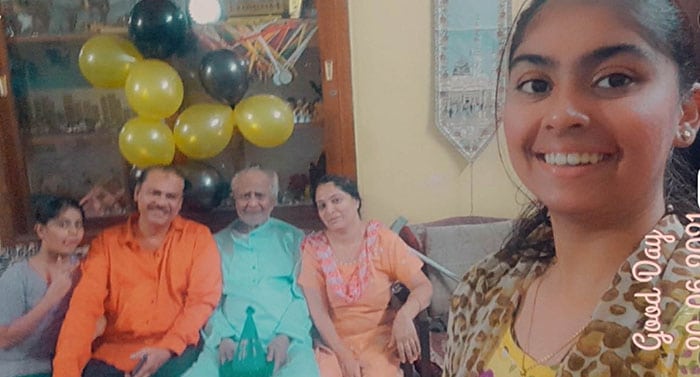
Mohammed Nizamuddin with his family members on his birthday celebration this year.

A BA graduate from University of Mysore, Mohammed Nizamuddin served as Tahsildar in many places including Gundlupet, Yadgir, Sullia and Malavalli. After his retirement, he served as Estate Officer of WAKF Board in Srirangapatna.

His wife passed away 9 years ago. He has 4 children (1 son and 3 daughters). He stays in Bannimantap A Layout in Mysuru with his son, daughter-in-law and two grand-daughters.

source: http://www.starofmysore.com / Star of Mysore / Home> Feature Articles / by Areebah Tasdeeq / July 07th, 2021

Meet Manjuwara Mullah from Assam’s riverine sandbank who is leading Muslim women to social, financial empowerment

Rupakuchi Village (Barpeta District), ASSAM:

Manjuwara Mullah from the north-eastern state of Assam is a social activist whose initiative Amrapari has changed the lives of many women in the poorest region of Assam. This is her story.

Manjuwara Mullah | Picture by Amrapari

Guwahati :

As a woman social activist Manjuwara Mullah from Barpeta district’s Rupakuchi village in the north-eastern state of Assam would get anxious when distress phone calls from numerous women from the Char areas would pour in seeking her help to get their male family members back home during the Covid-19 lockdown. She faced twin problems — getting the sole breadwinners of the families back home and ensure income for these people so that the impoverished families can sustain the pandemic as well as the economic hardship.

The people of the riverine sandbanks, known as Char areas in Assam, are one of the poorest in the state, have the highest illiteracy rates, a fewer number of landholders and very limited source of income. This crisis, along with the devastating yearly floods force massive labour migration from Char areas of the state to southern Indian states where they work as daily wagers.

For 36-year-old Mullah facilitating the process of getting the migrant labourers back home was an immensely difficult job, and as the migrant labourers took the uphill task of travelling thousands of kilometres to their homes, she started to focus on the women members of the migrants’ families and how they could be engaged in something that earns them money to fend for their families.

Being an activist and with academic exposure to the workings of non-profit organizations, Mullah incorporated her learnings from the sector to form a collective called Amrapari, which eventually turned into a non-profit organization, intending to employ the organic and traditional knowledge of the women from Char areas to provide them financial independence.

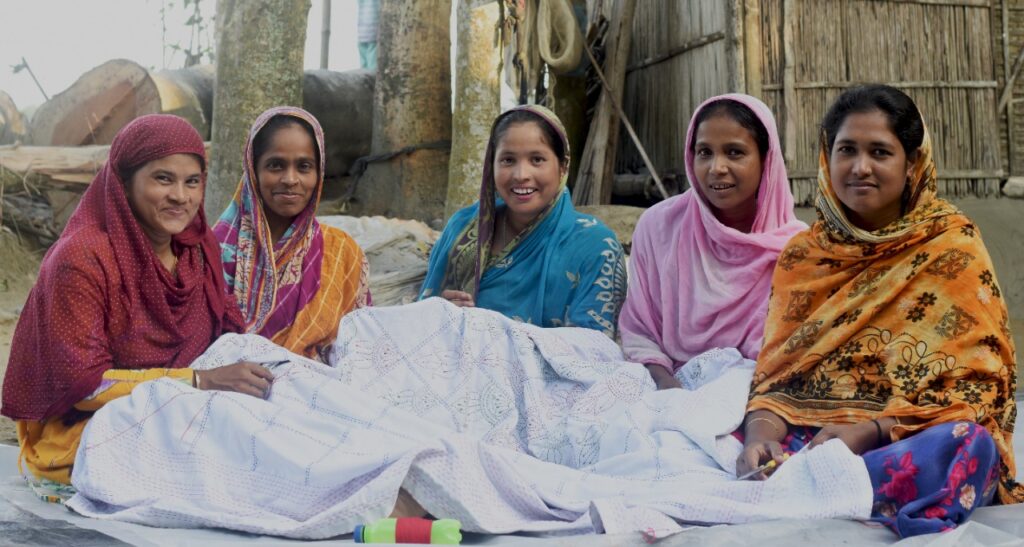
Amrapari, a Bangali as well as Miya (dialect) phrase for “we can”, initiative weaponized the traditional knowledge of the women of stitching Kanthas, an embroidery craft on clothes with multiple usage (used as bed covers or also as summer blankets) and also considered as a traditional and cultural artefact of the Bengali origin Muslims of Assam.

“I have been working with urban as well as rural communities for more than a decade. That’s how I am connected with the people at large. My work involved microfinance for the upliftment of women, citizenship issues, child marriage and women rights in the chars. When I got to know about the ensuing financial hardships of these families with whom I have been connected, I was in a lot of distress,” Mullah said when she narrated the circumstances that led to the foundation of Amrapari initiative.

The Char areas are also grappling with issues of girl-child rights violation, women rights violation apart from women in the family facing the economic burdens as men generally migrate for work to other states.

“Amid the trying times of coronavirus induced hardships, I was thinking about change in the Char areas. Merely supporting the women would not help them in the long term. Until they are financially independent their social condition will not change much,” she said.

The women from Char areas and the community, in general, are traditionally skilled in stitching kanthas. “I facilitated the use of the craft and ancestral knowledge to weave for their independence and empowerment,” she said.

The initiative is currently operating from Rupakuchi village, around 130-kilometers away northwest from state capital Guwahati, and sandwiched between Beki and Chaulkhua river which cause ravaging floods and erosions during the monsoon months.

At least 35 women are working as stakeholders, following a model of cooperative benefit sharing at Amrapari.

Women supported by Amrapari doing stitching work | Photo by Amrapari

Mullah said that during the initial days of the organization, Anjuman Ara Begum, a human rights activist, helped her a lot. “We discussed at lengths with women from villages and they said that they know stitching and were interested in engaging with the traditional craft,” she said.

More than monetary gain
For 24-year-old Nur Nehar from Rupakuchi village, her engagement with Amrapari means she can bear the educational expenses of her two children.

Married in 2009 as a child bride, Nehar used to stitch small fishing nets at her village which would earn her a meagre amount and living on the constant fear of being uprooted from her house by the annual flooding waters from Chaulkhua river, she is now confident that she will be able to earn the months ends by weaving the quilts.

“Though I knew stitching, but I didn’t know the designer works. It was Manjuwara madam who introduced the designs to us,” Nehar told TwoCircles.net, being happy with the fact that she has earned Rs 15,000 by working with Amrapari.

Moreover, the small initiative has been a ray of hope for many women from remote Muslim villages. Many find respite from the mental trauma that they endured when their husbands had done injustice to them.

A note on the social media page of Amrapari narrates the mental trauma that a woman had to go through. The post reads, “The most painful incident that had happened in my life was when my husband married twice. My mental health was badly affected. But upon working here, I can distract myself and pay the fees of my kids for their education which matters the most,” said one of the members from the group no. 2.”

It has also boosted confidence among many of the participants associated with the organization.

30-year-old Inuara Begum was said, “I would get shy and angry when I first saw my photograph in the posters. But now my photos have become some kind of viral on (social media). The people here and my family encouraged me so much so that I am not shy anymore. This has given me a lot of courage.”

For Umme Sabira Khatun, who is in her mid-twenties and coordinates among the women groups at Amrapari, her imaginations becoming arts on the kanthas is more than satisfactory. “Amrapari has given that platform where I can see my designs turn into appealing arts which I could never have imagined before,” Sabira said.

Mullah said that more than financial aid to the women, Amrapari envisages empowering the women from very remote places. “The experiences shared by the women reflect their own sense of self-identification as well as their independence,” she said.

Promoting their products via social media and e-commerce platforms, the women from Amrapari have been able to tap the market for their traditional kanthas and the women are extending their range of products as well.

source: http://www.twocircles.net / TwoCircles.net / Home> Lead Story / by Mahibul Hoque, TwoCircles.net / May 28th, 2021

Find out why Aslam TP and Mujeeb Rahman are walking from Kasargod to Kanyakumari

Kasaragod, KERALA :

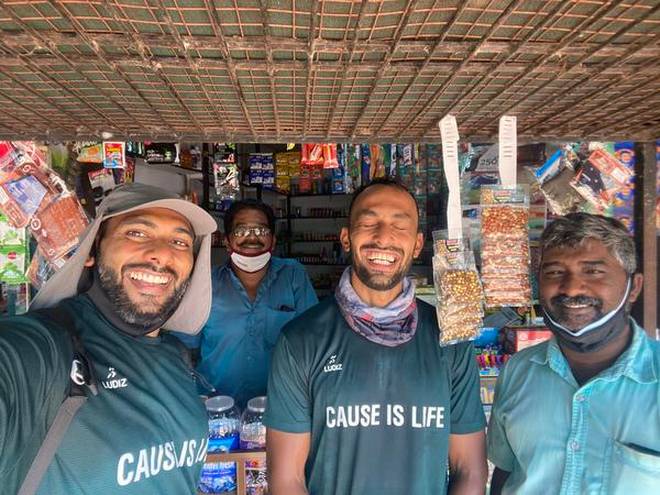
Mujeeb (left) and Aslam share a laugh with locals along the highway   | Photo Credit: Special Arrangement

The two will cover a distance of 600-odd kilometres on foot, to raise money for children’s education

Ambling through the streets of Kozhikode, a visibly tired Aslam TP and his childhood friend Mujeeb Rahman are intercepted by an auto driver.

He wants to know where they are heading, and why they looked so drained. When Aslam tells him about the cause they are trying to raise money for, the auto driver promptly pulls out ₹100 from his pocket and hands it over.

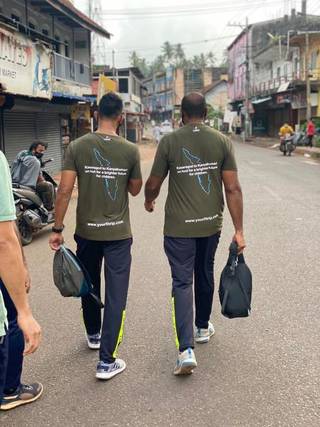
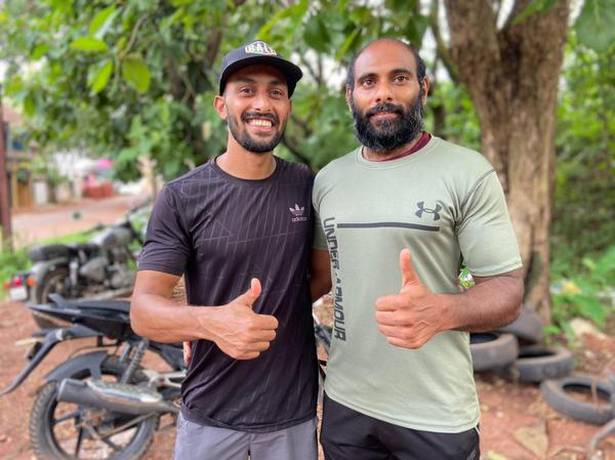
In just seven days of their walk, Aslam and Mujeeb have been met with overwhelming tales of generosity, and as a result, 62% of their target amount (₹7 lakh) has been raised. They are covering a distance of 600-odd kilometres on foot, from Kasargod in Kerala to Kanyakumari in Tamil Nadu, to raise money for children’s education in Kasargod for the Najath Educational and Charitable Society. With the amount raised, they will buy smartphones for online classes. “We walked from Vadakara to Kozhikode on Monday, covering around 49 kilometres, the longest stretch so far,” say Aslam over a call from Kozhikode, Kerala. A serial fund raiser, Aslam took up a similar challenge in Bali last year, where he cycled 397 kilometres to support the education of 45 Balinese children. Currently, he runs a company called Yourfitrip in Bali, which encourages fitness holidays. These include surfing, kayaking, volcano trekking… activities that have helped Aslam stay fit over the years.

He also runs a community called Cause is Life that connects blood donors to receivers. It kept him and his pan-India volunteers busy through the second wave of COVID-19. Just before the lockdown this year, Aslam was in Nagaland, setting up Yourfitrip there, running up hills and walking from one village to another meeting the locals.

“For this walk, Mujeeb and I trained in Kasargod, our hometown, walking 15 to 18 kilometres everyday. We are training our brain to know that we are good to go, even when we are tired,” he laughs. They prepare a chart, based on which their daily route is fixed. “We average about 30-35 kilometres a day. On somedays, it goes up to 45 to 48.”

They start walking at 6.30am and wind up for the night by 7pm. “In case of emergency, we have a backup car that stays 15 kilometres ahead of us,” he adds. They take the highway, spilling into Tamil Nadu from Nagercoil before heading to Kanyakumari. With everything functional in Kerala and food available for takeaway, things have so far been under control.

Aslam says he will complete the walk in 21 to 23 days. Though planned as a 21-day project, the end date is uncertain as they get enveloped by hospitality from people they come across. So far, the duo has been pleasantly surprised by receptions planned in their honour, invites for meals from strangers, and the willingness of people to contribute even if it means handing over the last penny in their pocket. At one of the villages, a group followed them in a car as they wanted to be part of this mission. “I want people to know that we are collectively strong and can do so many things to give others a better future,” he says as he and Mujeeb stretch, lunge and soldier on, with the rain for company.

For details, check out Aslam’s Instagram handle @aslucha

source: http://www.thehindu.com / The Hindu / Home> Society / by Priyadarshini Paitandy / June 30th, 2021

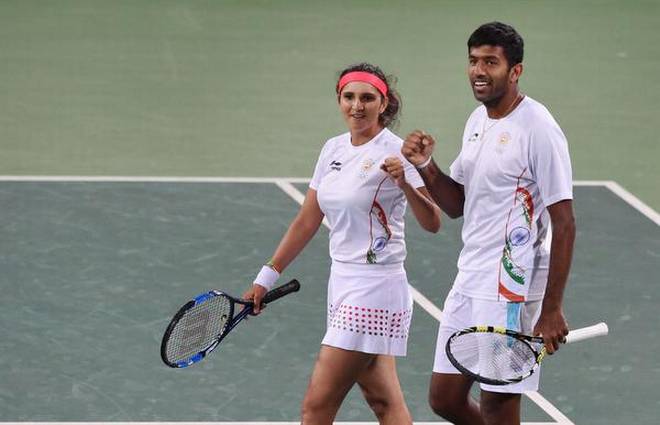
Rohan Bopanna-Sania Mirza pair wins historic all-Indian Wimbledon match

Hyderabad, TELANGANA :

File photo of Sania Mirza and Rohan Bopanna.   | Photo Credit: PTI

It was the first time in open era that two Indian teams competed against each other at a Grand Slam tournament.

The experienced pair of Rohan Bopanna and Sania Mirza defeated the brand new combination of Ramkaumar Ramanathan and Ankita Raina 6-2 7-6 (5) in the historic all-Indian mixed doubles first round match at the Wimbledon here on Friday.

It was the first time in open era that two Indian teams competed against each other at a Grand Slam tournament.

The contest finally brought a Grand Slam debut for Ramkumar, who has made 21 attempts to qualify for the singles main draw of a tennis major.

While the first set ended quickly in favour of the veterans, Ramkumar and Raina presented a good fight in the second set, which even they led for a brief period with a break of serve.

Bopanna was clearly the best player on the court with his powerful serve and solid ground strokes from the baseline as well as the ability to execute a superior net game.

On expected lines, Ramkumar served big while Raina gave her all after growing in confidence.

Mirza’s serve is still not at its best and would improve as she plays more matches.

Mirza has moved has also moved to women’s doubles second round with Bethanie Mattek-Sands while Raina and her American partner Lauren Davis lost in straight sets to the US pair of Asia Muhammad and Jessica Pegula on Thursday night.

The 14th seeds disposed off the challenge from the Raina-Davis pair 6-3 6-2 in 70 minutes.

Bopanna and Divij Sharan are already out, having lost their men’s doubles opening round match.

source: http://www.thehindu.com / The Hindu / Home> Sport> Tennis / by PTI / London, July 02nd, 2021

How a dry fish seller’s son from Kasaragod became most sought after navigator in motorsports world

Mogral Village (Kasaragod), KERALA :

Another proud moment for Kasaragod as Musa Sharif gets nominated for Rajiv Gandhi Khel Ratna, announced district collector D Sajith Babu on his Facebook page.

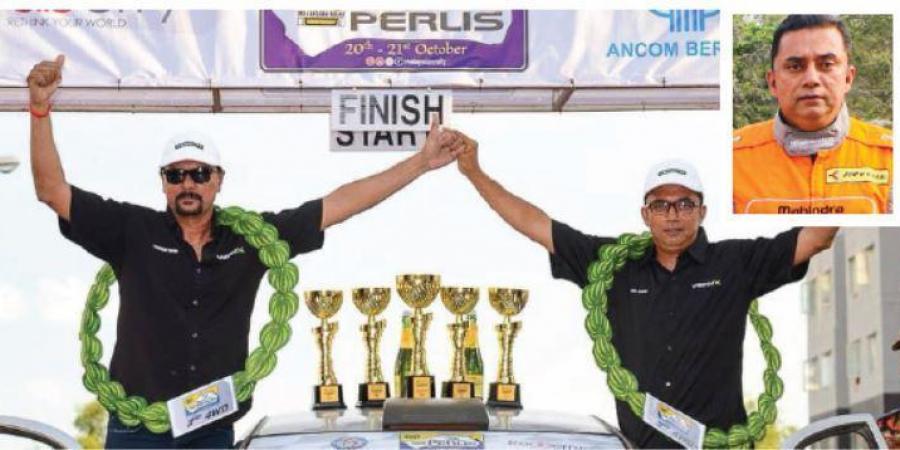
Musa Sharif (right and inset) with Karamjith Singh, Malaysia’s most-decorated rally driver, at the Rally of Perlis in 2018

Kasargod :

Another proud moment for Kasaragod, announced district collector D Sajith Babu on his Facebook page.

Congratulations to the pride of Kasaragod Musa Sharif, said Kasaragod MLA Nellikkunnu.

“Let’s hope the Rajiv Gandhi Khel Ratna will reach Kasaragod through Musa Sharif,” he said.

For Kasaragod — a district with few sporting heroes —  Asia’s ace navigator Musa Sharif, 49, is a legend. He is the most experienced and sought-after co-driver in India’s motorsports world.

Acknowledging his contributions to motorsports in India, the Federation of Motor Sports Clubs of India (FMSCI) has nominated Sharif for the highest sporting honour of India.

“I am honoured by the nomination for Rajiv Gandhi Khel Ratna. Normally, drivers get all the attention. But navigators enjoy the blind trust of the drivers and share the podium with them,” he said. 

Since 2007, he has been the navigator of champion Gaurav Gill, who won the Arjuna Award in 2019, the year when the government recognised FMSCI as the national federation for motorsports. Musa has been a navigator for 29 years. “Coming January, it will be 30 years,” he says.

In these three decades, he has navigated for 49 drivers in 296 rallies, of which 67 were international rallies.

“I never had an off-year,” he chips in.

He has won 21 championships, including eight national championships — seven of them with Gill. Musa has travelled long rough terrains to be where he is today.

He was born to the late Zainuddin Perwad and Aysha in Mogral, a fishing village in Kasaragod. His father used to sell dry fish. 

He got hooked to driving when he got admission for Bachelor of Business Management in Badriya College in Mangaluru, 40km from his home.

Thrice in a week, he used to take his TVS Shogun or Yamaha RX100 to the college. Rest of the days, he would take the bus.

When he came to know of racing events in the city, he thought of giving it a try.

The first race he took part in was the rally organised by Karavali Auto Sports Club in Mangaluru in 1993. Congress’s Mangaluru MLA U T Khader was one of his co-racers.

He won the first championship in his fourth rally. In two years, Team MRF signed him as a navigator and he shifted gear to four-wheel racing.

He started his career as a navigator with Satish Bhat.  In 1997, he joined JK Tyre and then returned to Team MRF in 2001.

In 2013, he joined Mahindra Adventure. Since 2007, Musa Sharif and Gill are together, participating in 63 rallies, and winning in 36 rallies.

Together, they won the Rally of Coimbatore for Mahindra Adventure in January — to emerge national champions again.

His international wins came with Lohitt Urs (Asia Cross Country); Arjun Rao (Malaysian Rally Group N); Sanjay Takle (Malaysian Rally Championship) and Saneem Sani of Thrissur (UAE Rally Championship).

Every driver has a different call sign and navigators have to get adjusted to it. “Before the race, the driver and the navigator take the road twice, and prepare a ‘pace note’. It will be like a story of the road, the turns, and dips, the rise, the angle of the curves,” he said.

On the first trip, the driver gives the notes and the navigator takes them own.

On the second trip, the navigator will guide the driver based on the notes and will make corrections, if needed.

“On the race day, the driver would blindly trust the navigator and go by his command,” he said. 

The navigator
The Federation of Motor Sports Clubs of India (FMSCI) nominated Musa Sharif from Mogral in Kasaragod for the Rajiv Gandhi Khel Ratna

The stats
29 years | 49 drivers
296 rallies | 67 international rallies | 21 championships
8 National championships
7 with Gaurav Gill

source: http://www.newindianexpress.com / The New Indian Express / Home> Good News / by George Poikayil / Express News Service / July 03rd, 2021

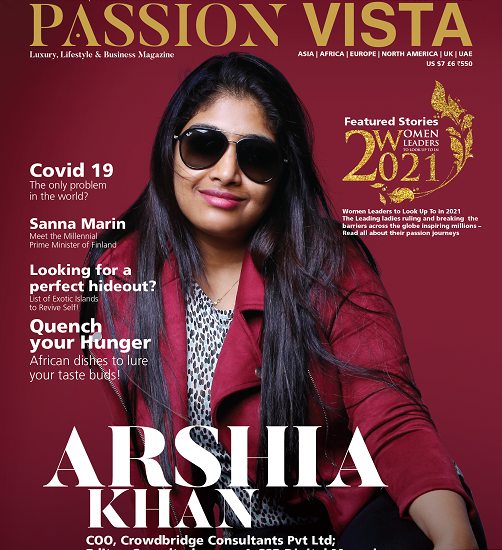
Arshia Khan

Mumbai, MAHARASHTRA / Doha, QATAR :

COO, Crowdbridge Consultants Pvt Ltd;
Editor, Crowdteck.com – A CSR Digital Magazine;
Associate Director, Crowd Central Technology

Against all odds, Arshia Khan lives to tell the tale. The year was 1985; city, Mumbai. The building Arshia’s family was residing in, collapsed, and they lost everything including her elder brother. Arshia was declared dead and taken to a morgue. Destiny however had other plans. Arshia suffered a loss of eyesight and memory, but thanks to God’s grace and timely medical intervention led by Dr Machiswala, she gradually bounced back to normalcy.

From then on, Arshia’s fighting spirit battled every obstacle in her path to emerge victorious.

One of six siblings, Arshia grew up in humble surroundings. Despite being the lone breadwinner, her father ensured good education for all. And so Arshia attended St Anne’s High School in Bandra, Mumbai which is also alma mater to renowned personalities like actor Aamir Khan and politician Baba Siddiqui.

Valuing everything that life had to offer, Arshia worked hard and excelled at everything in school. From being among the top three rankers in class to winning scholarships and best students awards, Arshia was God’s favourite child.

Following an interest towards daily affairs and national issues, Arshia pursued a degree in Mass Media (Journalism) at Rizvi College of Management. During this time, she was academically adopted on merit by an NGO called MESCO, which supports educational necessities of worthy students. The selfless service of MESCO went a long way in encouraging her to participate in social causes. Now one of her co-ventures that she is passionate about is Crowd Bridge Consultants Pvt Ltd which covers all that creates and promotes social development, wellbeing and betterment.

At Rizvi College, Arshia was mentored by (late) Prof P K Ravindranath who was an iconic journalist in his days. Following her mentor’s advice, ‘If you want to be a journalist, be on the ground, network, and build relationships’, she didn’t pursue her masters. She started networking, which eventually landed her a job at the Indian Express Newspapers. She learnt everything about journalism and media at The Indian Express. In 2010, she moved to Network 18 Media and Investments Ltd. as a Features Editor, managing a bigger team. She later diversified into the PR industry and worked at Perfect Relations’ healthcare arm – Imprimis. Two years hence, she moved to Adfactors, the PR giant, as an account manager.

As her professional life flourished, marital bliss followed. Soon after having her first baby Yahya in 2017, Arshia moved to Doha, Qatar. During 2017 – 18, she worked as a freelance consultant. By the end of 2018, she joined Crowd Central Technology as the Head of Content. Crowd Central’s CEO, Waseem Ahmed Kazi, always spoke at length about how he wanted to make a positive difference in society. Their thoughts resonated, and eventually Arshia was leading an exciting new venture, Crowdteck.com – a CSR Digital Magazine.

The objective of the magazine is to encourage good work in humanitarian causes, irrespective of cast, creed or religion. Their aim to restore faith in humanity helped them to connect with a global audience, and their online global readership quadrupled in two years.

From Mumbai to Qatar, what has been Arshia’s biggest challenge? “I have always been a passionate journalist, but was naïve about the business aspect until 2018 when I was promoted as the Associate Director at Crowd Central Technology. This big push meant that I was not only dealing with publishing of content but also specialised areas like revenue, business, and the like. As I was delegated the responsibility of handling international business across India, I learnt the specifics of a brick-and-mortar business model, including the online implications of its cyber footprint,” shares Arshia.

Although professionally satisfying and rewarding, this leap posed some challenges at the personal level. “My husband and I would work separate shifts and take turns to be with our toddler. It can be heart-breaking to leave your months-old toddler for work, and all new mothers will relate to this.”

However Arshia was lucky to be working with a company like Crowd Central Technology, which not only accommodated her requests as a new mother but also rewarded and motivated her to continue unabated.

On the other hand is Arshia’s most gratifying moment. Without a blink, she says, “Motherhood! Being a mother has been a blissful journey, which has taught me that patience and perseverance take you far. My child has disciplined me in more ways than one, and I can’t thank the Almighty enough for this little bundle of joy.”

As a parting note, inspirational Arshia shares a very important piece of advice, “I was embarrassed to seek aid or assistance of any kind. It is important that we inculcate the habit of reaching out for help in our children, who will be future leaders.”

source: http://www.passionvista.com / Passion Vista / Home> Collector’s Edition – Featured Stories – Women Leaders 2021 / April 2021

Mohammed Mubin Mallick: Meet The Man Behind Delivery-Robot That Served Food At COVID 19 Quarantine Center In Beijing

Kolkata, WEST BENGAL / KUWAIT :

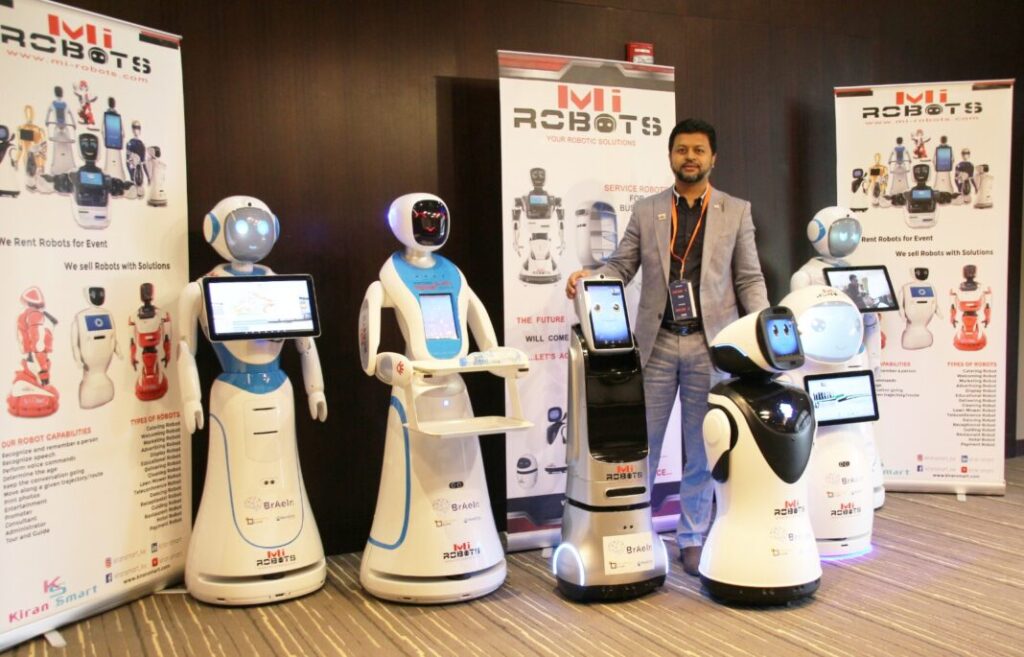
Robotsman’ Mohammed Mubin Mallick.

Bengaluru :

When his friends were busy playing with toy guns, Mohammed Mubin Mallick was building robots like a pro.  For Mubin, robotics was a passion that eventually became his profession.

From an amateur innovator to a global leader in robot solutions, 39-year-old Mubin has come a long way to earn a sobriquet of `Robotman’ of India and middle east. A native of Kolkata, he holds MBA degree from Cardiff University, United Kingdom.

Being the school captain, Mubin grew up as an achiever, bagging awards in various recreational activities like sports, dance, speech, etc. He continues to be an achiever even today. Recently, he received Agata Lo Tauro Special International Award 2020 and a certificate for being the Mentor for ROBOCON 2020.

Mubin ventured into digital solutions and robotics solutions with his IT service company `Kiran Smart’. Always on the lookout to cater to the market’s needs, he set out to innovate and take steps beyond what others already offered.

Since the time he realized that he had the power to think out-of-the-box and innovate, Mubin dreamt of building a company that he could run depending on his ideas. The cradle for his innovation comes from very munificent thoughts of wanting to create job opportunities and donating the profits. It is for this reason that Mubin doesn’t want to leave any stone unturned to make his firm a global leading light.

“Our company Kiran Smart is into IT Solutions and Services for the past 15 years. We have been looking for diversification in our business portfolio. We did diversification into Digital Transformation and then recently we launched and started Robotics and Artificial Intelligence. Our market research on Humanoid Service Robots indicated a considerable demand for Robots. Therefore, our company decided to launch a brand Called Mi-Robots,” he said.

The pandemic, however, came as a blessing in disguise for Mubin and his company. “One of our delivery Robots serving food in China in 2019 December to COVID 19 quarantine centre became breaking news around the world. This news around the world helped us gained the trust of the people,” he said.

It was in 2017 that he came across a humanoid robot. He invested time in GITEX technology and ultimately made his passion and childhood dream come true. Understanding the working of robots and offering solutions related to them is Mubin’s only focus now.

“To be very honest, there were many challenges which cannot be listed here. Apparently, the major aspect was the financial crunch. Firstly, it is very crucial to survive in the local market. Secondly, we need smart and loyal team members who can run the company,” he said.

Over the years, Mubin learned both professional and personal lives play a considerable role in making an achiever or a failure. According to him, success in personal lives has a direct and positive impact on professional lives.

“To overcome these challenges, we adopted different strategies like inviting investors locally and globally. Apart from in-house human resources, we tied up with international firms to induct more innovative people to work with us remotely. Finally, our satisfied customers are our revenue. We do the regular follow-ups and technology updates with our customers so that we can fulfill their needs as per their growing needs,” he said.

Mubin is dealing with different kinds of Robots. These include Delivery Robots for restaurant and hotels, Educational Robots for Schools, hospitality Robots for hotels, UVC Disinfection Robots for all, Spray Dry Mist Disinfection Robot, Humidifier Robots for Home and Office, and Robots for children. 

“Robots have played a major role during the pandemic as they helped people tremendously. For example, Disinfection robots are used to disinfect the places and those robots are UVC Lights Robots and Dry Mist Spray Robots. Many robots are used to check the temperature of people. Robots are used in hospitals to carry hand sanitizer, masks, and gloves in hospitals, hotels, shopping malls, restaurants, and many places,” he said.

Even corporates are using to communicate with their remote employees so that managers and team leaders can stay focused on live meetings. “Many universities across the globe have launched courses for Robotics and Machine Learning. There is data supporting the popularity of Robot installation in restaurants, hotels, hospitals, warehouses, home delivery, and schools,” he said.

Headquartered in Kuwait, Mubin’s Robots are going places. From all GCC to Africa, UK, Canada, Mexico and few European countries, Mubin is trying to introduce technology for making the life of the common man easy.

“It is really difficult to define the demand or maximum interest was shown by any specific country in this future technology because most of the countries are working on all the innovative technologies to lead the world. So, according to me, I see South Korea, China, Japan, Singapore, Canada, and UAE from the Middle East. The global market for robots is expected to grow at a compound annual growth rate (CAGR) of around 26 percent to reach just under 210 billion U.S. dollars by 2025,” he said.

His company, `Kiran Smart’, is a reflection of Mubin’s achievements. It has been recognized as the Top Most Robotics Company of 2020. The firm also received awards from the Ministry of Awqaf as the Most Innovative Company. KISR honored Kiran Smart for being their Most Innovative Supporter in Science and Technology for their Children’s Exhibition.

His message for the youth who aspire to reach as far as he has is boosting, “Don’t give up even if you fail. Failure teaches you a lesson and makes you stronger. Accept the reality, believe in yourself, and try again! Caring for humanity and seeing a smile on people’s faces keeps us motivated in life. People should be thankful to God, respectful to their parents, and be humble,” he said.

*The author is a Bengaluru-based freelance journalist.

source: http://www.indiatomorrow.net / India Tomorrow / Home> Education> Featured / by Rashida Bakait / February 10th, 2021

Decoding history cast in stone

Birur town (Kadur taluk-Chikkamagaluru District), KARNATAKA :

It became an abiding interest  while studying Kannada at the pre-university level at Pandit Jawaharlal Nehru Memorial College.

Shivamogga :

To D Ismail, the mastigallu (masti stone) is a fascinating storyteller. It talks about the history and the people as he peers into the inscrutable inscriptions whether it is in Modi lipi or Halegannada (ancient Kannada).

The epigraphist from Birur town in Chikkamagaluru district took a fancy to the knowledge hidden in stones, and is one among a small number of people who can understand ‘Modi lipi’, a cursive script used to write several languages, including Kannada. It is just like English running hand, he says. It became an abiding interest  while studying Kannada at the pre-university level at Pandit Jawaharlal Nehru Memorial College.

Ismail (63) says Modi lipi is a kind of early Kannada writing found from the times of Ashoka to the 18th century, which was used to record events and facts about emperors and their empires. In English, it is termed ‘cacography’, which according to the Kannada dictionary, means ‘illegible handwriting’, seen mostly in ancient stone inscriptions called mastigallu and veeragallu (hero stone).

Ismail is studying stone inscriptions to analyse their contents for anything related to astronomy and is compiling a research paper on the subject ‘Astronomy in Inscriptions’. Other issues that he is studying include natural calamities, music and life events, recorded in inscriptions to understand the culture of people going back to the Cholas, Gangas, Rashtrakutas and others who ruled South India.

The curiosity that drew him to these stones soon became his passion. “I studied various books related to Modi script, and under the guidance of epigraphist Shambhu Lingappa, I visited ancient sites in and around Birur, Kadur and Chikkamagaluru with him. I learned to read inscriptions in Modi script and also in Halegannada. I started reading books written by famous epigraphists like M M Kalburgi, Chidanandamurthy, A V Narasimhamurthy and others.”

Though Ismail could not pursue his education after pre-university, he never missed an opportunity to upgrade his Halegannada-related knowledge. Today, he is a well-known epigraphist who offers guidance to students of Kannada literature researching inscriptions and Halegannada in various universities. He has a rare collection of more than 5,000 books related to epigraphy, Halegannada, mastigallu and veeragallu.

He has written a book titled ‘Madhya Karnatakadalli Beeradevaru’ (still a manuscript) about Beeradevaru, a deity worshipped by the Kuruba community. The book throws light on the community, where they came from, and how they settled in Shivamogga, Chikkamagaluru and Chitradurga districts. He has travelled the length and breadth of these districts to collect information and did a field survey for more than two years.

He suggests that people interested in inscriptions read the book ‘Kannada Lipiya Ugama Mathu Vikasa’ by A V Narasimhamurthy, and ‘Lipi, Lipikara, Lipi Vyavasaya’ by Shettar, for those who want to learn Halegannada.

Ismail is one of the four sons of E M Dastagir Saab and Razia Begum of Birur, who have had a grocery business at M G Circle in Birur town for many decades. Even today, Ismail is the one who opens the grocery shop in the morning and takes care of the business.

He has a rare collection of more than 5,000 books related to epigraphy, Halegannada, mastigallu and veeragallu.

source: http://www.newindianexpress.com / The New Indian Express / Home> States> Karnataka / by Ramachandra V Gunari / Express News Service / June 27th, 2021

Two Kerala Ayurveda docs get UAE Golden Visa

Thrissur, KERALA / Dubai, U.A. E :

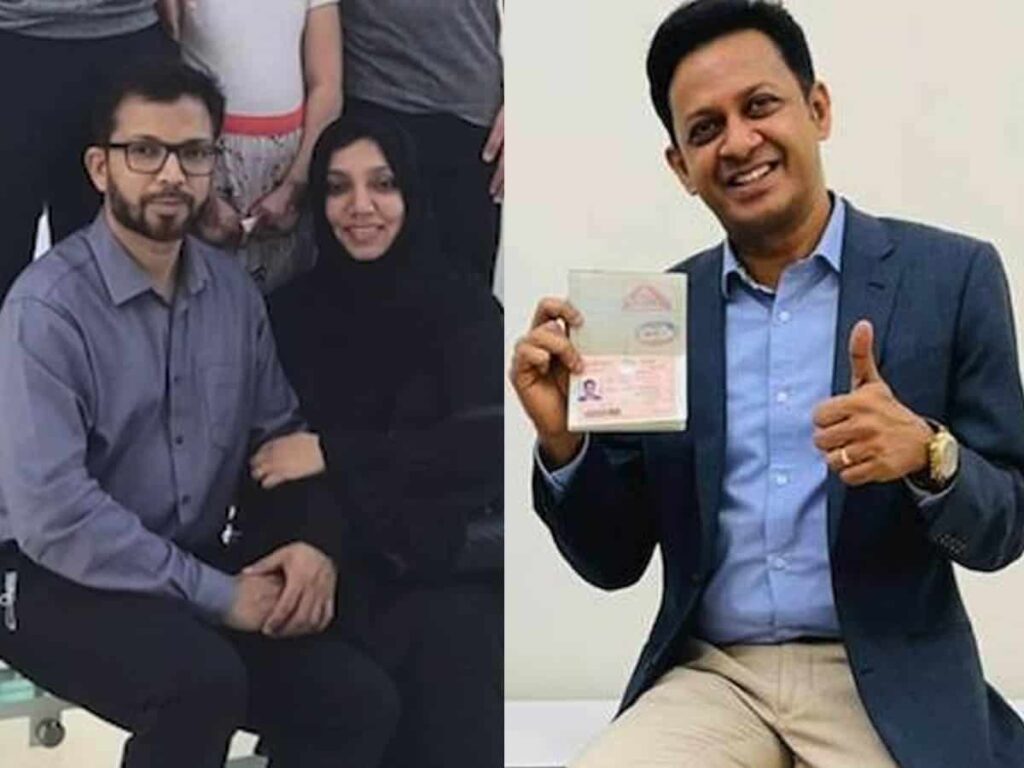
Left Dr Jasna Jamal with family. Right Dr Shyam Vishwanathan

Abu Dhabi: 

Two Ayurveda doctors, who are originally from India’s Kerala state and now based in the United Arab Emirates (UAE), have received the Gulf nation’s coveted Golden Visa, according to a media report on Saturday.

A Golden Visa enables foreigners to live, work and study in the country without the need of a national sponsor and with 100 per cent ownership of their business on the UAE mainland.

They are issued for five or 10 years and are renewed automatically.

Both Shyam Vishwanathan Pillai and Jasna Jamal were granted the Golden Visas by the UAE’s Federal Authority for Identity and Citizenship (ICA).

Vishwanathan, CEO of Vaidyashala at the Burjeel Day Surgery Centre in Abu Dhabi, received it under the medical professionals and doctors category on June 17, the Khaleej Times report said.

“My sincere gratitude to the rulers and policymakers of UAE for the kind support to Ayurveda and Ayurveda practitioners,” Shyam, from Kollam, told the newspaper.

“I truly appreciate their vision in integrating the Ayurveda for the wellbeing of UAE residents and at the same time keeping in place strong measures to ensure the quality delivery of Ayurveda practice,” he added.

Shyam came to Dubai in 2002.

A resident of Al Mamzar in Dubai, Jamal, from Thrissur, was given the Golden Visa on June 24.

She moved to the UAE 12 years ago soon after getting married.

With over 16 years of experience in Ayurveda, Jamal established her own Ayurveda clinic in Al Mamzar.

source: http://www.siasat.com / The Siasat Daily / Home> News> Middle East / by IANS/ June 26th, 2021