Category Archives: Amazing Feats

Mughal bastion

AGRA, UTTAR PRADESH :

The Agra Fort, a World Heritage Site, is the only fort in India to have been inhabited by all the early Mughal emperors.

The Amar Singh Gate of the Agra Fort is on the southern side of the fort complex and is its public entrance.

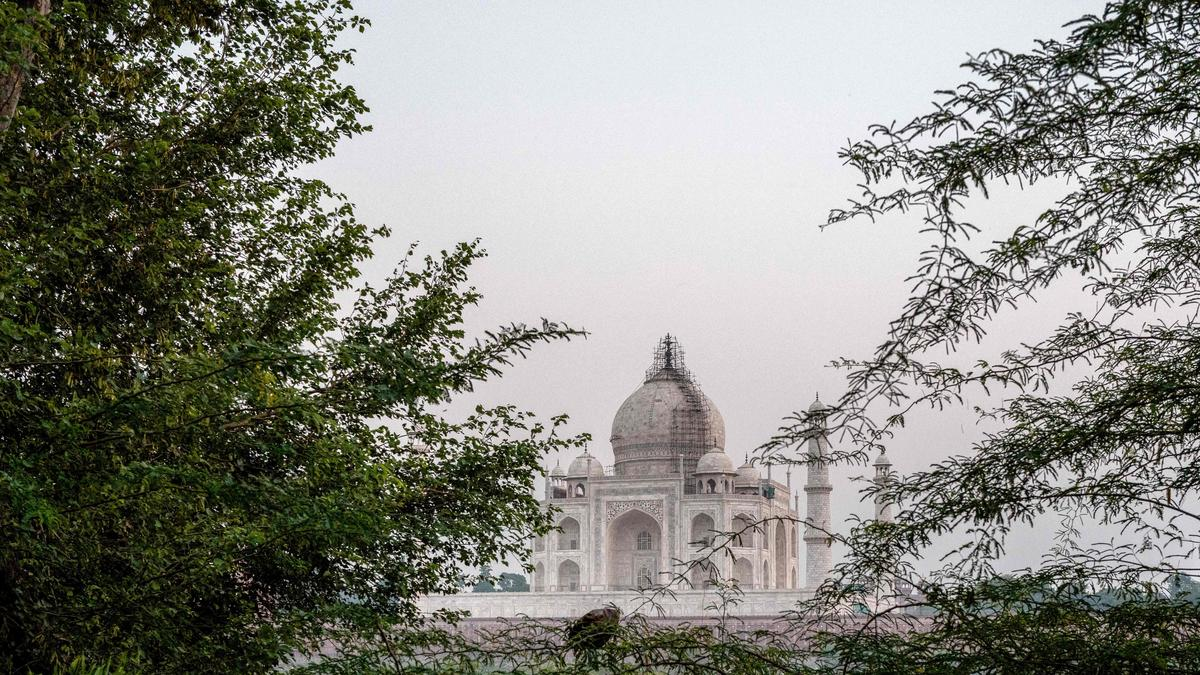
SITUATED on the right bank of the Yamuna river, very close to the iconic Taj Mahal, is the Agra Fort, also known as the Red Fort. Declared a World Heritage Site in 1983, it is the only fort in India that was inhabited by all the early Mughal emperors. The fort, therefore, provides a useful template not only for the development of Mughal and Indo-Islamic architecture but also the evolution of Mughal palace forts, polity and ideas of kingship. The fort’s palaces and pavilions inspired the Red Fort (Lal Qila) in Delhi and buildings in Fatehpur Sikri and Lahore. However, the history of the Agra Fort is not just connected with the Mughals—who held sway over the fort, certainly between Akbar and Aurangzeb—but also with Mahmud of Ghazni, the Rajputs, the Lodis, the Surs, the Marathas, the Jats, the Durranis and finally, the British, before the greater part of the complex was handed over to the Indian Army in 1947.

The fort complex

A poem written in 1134 C.E. by Masud ibn Saad Salman, a Persian poet, mentions that the fort of Agra was captured by Mahmud of Ghazni. Later, towards the second half of the 15th century, a Rajput king called Badal Singh constructed a brick fort at the site and called it Badalgarh fort. The fort gained prominence when the Sultan of Delhi Sikandar Lodi (regnal years 1489-1517) decided to shift his capital from Delhi to Agra. Thereafter, the Badalgarh fort became the residence for the Lodi sultans.

From the Lodis, the fort passed into the hands of the Mughals. After defeating Ibrahim Lodi at the First Battle of Panipat (1526), Babur (regnal years 1526-30), the first Mughal emperor, ordered his son Humayun to take charge of Agra and the fort’s treasures. Babur built some paradise gardens in Agra and a baoli (stepwell) within the fort complex. Humayun (regnal years 1530-40 and 1555-56) was crowned at the fort in 1530 but preferred to rule from Delhi. The Afghan chieftain Sher Shah defeated him at Bilgram in 1540, occupied the Agra Fort, and garrisoned it thoroughly. An exiled Humayun could recapture his throne only in 1555 but died soon afterwards.

With the arrival of Akbar (regnal years 1556-1605) in 1558, Agra’s and the fort’s fortunes changed completely. After staying in the Badalgarh fort for a few years, he decided to rebuild it as the site of his government, and the old brick fort gave way to a new one in red sandstone. Approximately 4,000 builders are said to have worked every day for eight years (1565-73) to complete this renovation task. The historian Michael Fisher points out that Akbar created his court complex within the existing fort, demonstrating his early architectural aesthetic—uniform red sandstone surfaces highlighted with white marble. A new citadel-city came into being. The Jesuit missionary Antonio Monserrate, who saw the fort complex in 1580, recorded that besides the emperor’s palace there were “mansions of his nobles, the magazines, the treasury, the arsenal, the stables of the cavalry, the shops and huts of drug-sellers, barbers, and all manner of common workmen”. Abul Fazl, Akbar’s court historian, records that 500 buildings were built there in the Bengali and Gujarati styles.

Akbar’s successor, Jahangir (regnal years 1605-27), used to visit Agra at regular intervals and even stayed in this fort. However, he focussed his efforts more on building forts and palaces in Lahore and Kashmir. The Agra Fort was modified considerably during the reign of Shah Jahan (regnal years 1628-58). Between 1628 and 1637, he destroyed many existing buildings, renovating some and constructing three new marble palace courtyards (alongside three mosques) according to his own architectural taste. Aurangzeb (regnal years 1658-1707) deposed Shah Jahan, his father, to take control of the fort and built two barbicans around the gates and on the riverside to strengthen its defences. When the British took over the fort in 1803, they destroyed many buildings to make way for military structures. The complex now has only around two dozen monuments left, mostly those built by Akbar and Shah Jahan.

Gates, palaces and courtyards

The fort has a semicircular shape and is surrounded by a broad deep moat. Its eastern side, some 725 metres long, faces the bank of the Yamuna. Spread over 94 acres (38 hectares) of land, the fort complex is enclosed by a double-battlemented wall of red sandstone punctuated at regular intervals by massive circular bastions. It has a circumference of almost 2.5 kilometres and its walls are around 21 m high. The fort has four gates, one on each side. Of these, the Delhi Gate (in the north) and the Amar Singh Gate (in the south, now the public entrance to the fort) are the most prominent ones. The other two gates are the Elephant Gate (Hathi Pol Gate) and the Khizri Gate (also known as the water gate because it opened on the eastern riverfront side where the ghats were located). R. Nath, a historian of Mughal architecture, points out that the Delhi and Amar Singh Gates are architecturally similar: both have a drawbridge, a crooked entrance with dangerous trap points and a steep rise.

Most buildings are concentrated in the south-eastern corner of the fort complex in a band-like succession of courtyards along the riverfront. Shah Jahan did not alter Akbar’s riverfront alignment in his building programme. The Yamuna, Nath says, provided a river frontage, a pleasing landscape and fresh air and a constant supply of water. After ascending the ramp through the Amar Singh Gate, one can see, on the eastern side, two courtyards of Akbar’s time: Jahangiri Mahal and Akbari Mahal. In the south to north direction, there are three courtyards that Shah Jahan rebuilt along the riverfront: the Anguri Bagh (Grape Garden), the Machli Bhawan (Fish House) and the Diwan-i-Aam (Hall of Public Audience). The overall symmetrical planning of imperial residences, the art historian Ebba Koch argues, became mandatory only during Shah Jahan’s reign. In Akbar’s time, the regular planning of large-scale residential architecture was deployed only in temporary Mughal camps. In the Agra Fort, she clarifies, the residential axis was met at an angle by the (broken) public axis formed by an open bazaar street stretching from the Hathi Pol Gate to the Diwan-i-Aam courtyard.

Nath says both Akbari Mahal and Jahangiri Mahal were built in the mid 1560s and formed a part of the original Bengali Mahal , which according to Abul Fazl was the newly constructed palace where Akbar seemingly moved in on May 11, 1569. Nath opines that the two palaces probably got separated and acquired their respective nomenclature through guidebooks written in the 19th century. The oldest red stone palace in the southern part of the fort complex became known as Akbari Mahal, and the stone palace in the northern part, where a monolithic granite bowl (7.62 m × 1.42 m) built by Jahangir in 1611 was discovered, became known as Jahangiri Mahal.

Both palaces have a crooked entrance and enclosing walls to ensure privacy and security. While Akbari Mahal is in a partly preserved state, Jahangiri Mahal is in reasonably good shape. Faced with finely carved red sandstone, Jahangiri Mahal, Nath tells us, presents a complex arrangement of verandas, courtyards, galleries and rooms and halls around a quadrangle. While historians agree that the palace represents an amalgamation of various architectural styles and techniques, they differ on the exact nature of these influences. Ebba Koch contends that it combines (a later altered) symmetrical Timurid ground plan patterned on the mausoleum of Khwaja Ahmad Yasawi, a famous Sufi poet and teacher, in Turkestan, which was built between 1394 and 1399 and has the elevation of an open courtyard building. Further, the building brings together various Transoxanian features, such as the veranda of the east front with its high slender columns, along with courtyard halls styled in the broader Gujarat-Malwa-Rajasthan tradition, which the Mughals learned from the early 16th century architecture of Raja Man Singh (a noble at Akbar’s court) of Gwalior. Nath maintains that the multi-storey arrangement of palaces around inner courts reflects the catuhsala (four-sided) plan of the elevation of the chowk (quadrangle), a part of ancient Indian residential architectural tradition.

The indigenous component, according to Nath, further manifests in the duchhati (double ceiling, one above the other) composition with a central, three-openings dalan ; double floor apartments on the sides; a whispering gallery around a hall; and a portal composition with jharokha (balcony) windows. Ebba Koch and Nath have different opinions on the architecture of the rooms, halls and ceiling inside the complex. Ebba Koch feels that most of the rooms are not trabeate (a form of architecture that uses horizontal beams, or lintels, as distinct from the arcuate style, which uses arches and vaults/domes) but are a veritable pattern book of the vaulting of the time: stucco domes with geometrical patterns and/or arch netting, ribbed domes, lotus domes carved in sandstone, pyramidal vaults with a cut top, coved ceilings, etc. To Nath, the dominant architecture is trabeate as evidenced by the pillars, beams and lintels, flat ceilings (sometimes ladao ceiling consisting of ribs and panels), chajja s (eaves) and chattri s (pavilions).

The historian William G. Klingelhofer says the striking architectural elements of Jahangiri Mahal include the innovative use of Timurid geometric designs, creative adaptations of Indian art forms such as makara (crocodile) and peacock brackets and various vault designs, and the inclusion of creatures from indigenous art tradition such as the hamsa (swan), the parrot and the elephant.

As far as the functionality of the palace is concerned, most scholars, including Ebba Koch and Nath, hold that it was primarily meant for imperial women and served as Akbar’s harem and residence. Klingelhofer, however, argues: “Architectural space and design seem to have been a flexible commodity in early Mughal building, adaptable to many and diverse purposes.” It is therefore not really important to understand the exact function of each space or for that matter which rooms were provided for the palace harem, the library, temple and audiences. The palace, he elaborates, served a much broader purpose; it “was constructed at the conceptual centre of a larger Agra scheme and was intended to serve as the primary architectural embodiment of the imperial seat”. Between the red sandstone Jahangiri Mahal and the white marble Khas Mahal (Special Palace) lies a palace called Shahjahani Mahal, though there is not enough evidence to claim that Shah Jahan built it. It has a hall, side rooms and an octagonal riverside pavilion. The brick mason and red sandstone construction was plastered in white stucco and painted in colourful floral designs. The so-called Somnath Gate is kept here in one of the rooms on the western side. The subterranean three-storey chambers below Jahangiri Mahal and the area lying to the north contain the phansighar (gallows) and Babur’s baoli.

Anguri Bagh

The Anguri Bagh complex is a three-layered architectural zone set in the harem complex: the upper riverfront terrace is occupied by the Khas Mahal flanked by two identical oblong pavilions; the intermediate layer is occupied by a scalloped, trefoiled tank; and the lower zone is occupied by the Anguri Bagh (one can see a grapevine on the lawns). The Khas Mahal is built along the lines of what Ebba Koch says is the favourite Mughal pavilion theme: the combination of an enclosed inner hall (now called tanabi khana or tambi khana ) with a pillared porch or veranda (the Mughal iwan ). The court historian Lahauri calls it Aramgah (bedchamber). The spacious inner hall has beautiful Yamuna-facing marble screens with glasswork while the white marble surface is beautifully painted in floral and stylised patterns. It also has a number of oblong niches in its wall meant possibly to hold portraits of emperors and princes. The exterior porch is made up of five nine-cusped arches (popularly known as the Shahjahani arches) supported on square piers and is three-aisles deep. It has a chajja , supported by beautifully carved and moulded brackets, projecting from all sides. There are two chattri s on the parapet on the riverside but not on the Anguri Bagh side. The marble building is secured on the north and south by thin marble curtains ( sarapada ) to ensure purdah, or seclusion.

The Khas Mahal is flanked by two identical buildings with gilded bangladar/bangla roofs (a curved circular roof and a chajja ): on the left (north) is the Bangla-i-Darshan (Imperial Viewing Pavilion), and on the right (south) lies the bangla of Jahanara, a pavilion that belonged to Shah Jahan’s daughter Jahanara. Bangladar was an architectural device used in buildings in the Bengal region. After Akbar annexed the Gaur kingdom, Nath says, many Bengali craftsmen dispersed to other regions, and some naturally sought patronage at the Mughal court. Both these pavilions were originally made in red sandstone but stuccoed with white shell-plaster later to give them the semblance of white marble. There are square rooms towards the side of the pavilions.

In the Bangla-i-Darshan, which has pillar brackets and lintel openings, the emperor made an appearance every morning to his subjects gathered below the fort. Ebba Koch points out that the bangla of Jahanara, with its multi-cusped Shahjahani arches, had no ceremonial function but indicated her status at the court and provided imperial symmetry. It formed a part of Jahanara’s apartments located towards the end of the southern wing, and the three courtyard wings and northern rooms of Jahangiri Mahal were adopted for her and other women.

The Anguri Bagh happens to be the only garden in the main palace complex. It is laid out in the form of a rectangular charbagh (fourfold garden) divided by marble walkways intersecting at the centre in a marble pool. Each quarter has geometrically drawn parterres. The garden is enclosed by two-storey living apartments formed of a modular sequence of open, pillared verandas and small enclosed rooms ( hujra s). Nath underscores that the water devices at the Anguri Bagh—tanks, fountains, waterfalls, candle niches and water channels—demonstrate how running and splashing water had become an integral part of Shahjahani architecture. Akbar, on the other hand, was more fond of hammam s (bathhouses). Water was supplied to the fort through well-laid-out water systems from the Khizri Gate and the overhead tanks in the Jahangiri Mahal complex.

‘Chain of justice’

Located between the Anguri Bagh and the adjoining Machli Bhawan is a spacious octagonal tower called the Muthamman Burj or Shah Burj (imperial/king’s tower). This housed the original jharokha from where Akbar and Jahangir appeared before the people every morning ( jharokha darshan ). The burj was also where Jahangir instituted his famous “chain of justice” in 1605 to redress the grievances of the people. The tower was rebuilt by Shah Jahan in white marble, profusely inlaid and roofed with a gilded copper dome. Five of its sides project outward towards the river and are rotated by a chajja supported by brackets. Pillars, brackets, and a railing/balustrade with jali work decorate the structure. On the western side, the tower leads to a dalan /hall with three alcoves and a shallow water basin sunk in the centre. The palace has deep ornamental niches along with dados (bas reliefs) inlaid in polychrome stones and carved plants. Ebba Koch mentions that this was where the emperor met his highest dignitaries and his sons in secret council and also worked with the court historians Qazwini and Lahauri on editing the official history of his reign. Shah Jahan was imprisoned in this burj by Aurangzeb and died there in full view of the Taj Mahal. His coffin was taken out of the door at the base of the tower and then transported on a boat over the Yamuna to the Taj where he was eventually buried.

To the west of the Muthamman Burj is the entrance to a group of basement rooms with waterfalls and pools called Shish Mahal (Mirror Palace, which Lahauri called tahkhana ) because the facade has mirror mosaic set in white stucco ( ayina bandi or ayina kari ). The structure (now closed to the public) has extra thick walls and ceilings to ensure coolness and a dim interior to allow for the play of light and mirrors. Nath argues that the art of glass mosaic was originally Byzantine and spread with Islam. The Mughals Indianised it by associating it with exquisite relief and incised stucco work, something lacking in the Byzantine glass art. Further, he elaborates, unlike the saintly figures and florals featured in Byzantine glass art, the Mughals used Persian motifs, floral and stylised.

The Machli Bhawan complex, lying north of the Anguri Bagh, contains the Hall of Private Audience (earlier known as the ghusl khana or bathhouse but popularly called the Diwan-i-Khas) and the hammam , which are both on the riverside terrace on the pattern of the riverfront gardens. Below, on the ground floor, were vaulted rooms housing government offices, including the treasury.

The Diwan-i-Khas, occupying the south-eastern corner of the complex, is a large pavilion meant for meetings of the private council, exclusive law court, musical performances or inspection of the work of artists employed by the emperor. According to Lahauri, it was built in 1635, around the same time when other buildings of the harem were being completed. The exterior is protected by a broad chajja supported by brackets. The chattri s, pinnacles and kangura s (merlons) that once adorned the building are now missing. This marble building has two halls with coved ceilings, both connected by three archways—the enclosed inner hall/ tanabi khana and the outer dalan /Mughal iwan. The outer hall, having double pillars, is beautifully inlaid with floral designs and carved dados similar to the Taj Mahal and multi-foiled niches. Lahauri describes the oblong inner hall as being ornamented with paintings and floral designs and adorned in gold.

Opposite the Diwan-i-Khas, on the northern side of the terrace, lies the hammam rebuilt and refashioned by Shah Jahan. Consisting of various rooms and halls, the structure was decorated among other things by inlay work on the dados and glass mosaic on the walls and arches. It had provisions for both cold water ( sard khanah ) and warm water ( garmkhanah ). The structure now lies in a ruined state and is closed to the public. Ebba Koch points out that parts of the hammam were taken down by Lord Hastings in 1815 and its pillars were scattered. The facing and some pillars, she mentions, were sold at an auction by Lord William Bentinck (Governor General from 1828 to 1835), giving rise to the rumour that he also wanted to take down and sell the Taj Mahal.

Along the riverfront, between the Diwan-i-Khas and the hammam lies Jahangir’s finely carved black throne, which was brought from Allahabad in 1610. The crack in the throne is attributed to the uprising of the Jats of Bharatpur who temporarily controlled the fort around 1765. (There is another white throne lying opposite the black one on the terrace.)

The ground-level courtyard is enclosed by two-storey-high arcaded wings with Shahjahani columns and multi-cusped arches. It contained government offices behind the arcaded galleries. The open court in the centre was used by the emperor to inspect his hunting animals—hounds, hawks and cheetahs—and horses working out. It was also used for animal fights. A marble seat with a baldachin projects from the centre of the southern wing. It is decorated by baluster columns and semicircular arches with a rich naturalistic acanthus decoration—inspired by European engravings—which Ebba Koch argues was of a type first used exclusively in the architecture framing the appearances of Shah Jahan.

Located in the middle of the eastern side of the fort is the spacious court known as the Diwan-i-Aam. According to Lahauri, a cloth tent and, later, a wooden hall were used for the purposes of Diwan-i-Aam before the present structure came into being under Shah Jahan.

The main audience hall is a rectangular, pillared building standing on a red sandstone plinth. It has four rows of pillars and pilasters on the north-south axis and 10 along the east-west alignment. The hall has double columns on all the three external sides (similar to the Chaunsath Khamba at Nizamuddin in Delhi, which is square in shape though). Resting on square bases, these pillars were once carved or stuccoed and the outlines of the bases, shafts, capitals and cusps were gilded. They support engrailed or nine-cusped Shahjahani arches. The emperor’s jharokha , or throne chamber, projects from the eastern wall of the hall. Its walls, pillars and even the ceiling have stylised floral designs in pietra dura inlay, which is characteristic of Shahjahani architecture. Ebba Koch says that the naturalistic plant decoration symbolically represented the bloom brought about by the just rule of Shah Jahan. The jharokha walls have china khana niches—possibly used to keep porcelain vessels—which the contemporary poet Kalim wrote was a tribute of China to the court of Shah Jahan. The hall has a flat roof and the exterior is protected by chajja s in turn supported by brackets. While the hall is made of red sandstone, it is white-plastered to give the effect of marble. The courtyard of the Diwan-i-Aam is surrounded by narrow galleries/ dalan s/verandas with multi-cusped arches. Shah Jahan held court at the Diwan-i-Aam twice a day and attended to administrative matters. All the courtiers and honoured visitors who assembled there, Fisher points out, “would stand deferentially with crossed arms in hierarchically arranged semicircles [separated by railings] centred on his throne, moving outward from highest to lowest”. The audience hall served a larger symbolic purpose that went beyond being a place where administrative matters were dealt with or foreign dignitaries were received; it also reinforced Shah Jahan’s position as the head of the spiritual domain.

On account of its 40 pillar sites, the Diwan-i-Aam was also known as Chihil Sutun (Forty-Pillared)—the name by which the ruins of Persepolis (in present-day Iran) were widely referred to then. By recreating the famous audience halls of the ancient kings of Iran, Ebba Koch argues, the Mughal emperor claimed the status of these kings, who were considered exemplary rulers in the Islamic world. However, unlike the original Iranian halls, she substantiates, those of the Mughals followed the plan of a mosque (the closest parallel could be the Pathar Masjid in Srinagar) with a wider aisle in the centre. While in the mosque the central aisle leads to the mihrab (the niche that shows the direction of Mecca), in the case of the Diwan-i-Aam, it leads to the emperor’s jharokha . Ebba Koch points out that the idea that Shah Jahan’s authority was not only worldly but also spiritual was further reinforced by the presence of a mosque right opposite the audience hall at the centre of the west wing. Nath puts forward a somewhat similar concept albeit rooted in Indian thought and philosophy—the 40-pillar sites made up of 27 bays, representing the 27 nakshatra s (constellations) denoting the incarnation of the jagat (universe) presided by the emperor sitting like a sun. The audience hall of the Agra Fort served as a model for those in the palaces of Lahore and Shahjahanabad.

Scholars are divided on whether or not Akbar built a mosque within the fort premises. There are, however, three surviving mosques built by Shah Jahan. Describing the Shahjahani mosques, Ebba Koch says they are of two main architectural types and both had already started becoming distinct during Jahangir’s time. To the first category belong the great city mosques, such as the Jami Masjid of Agra built by Jahanara in 1648, which has prayer halls with massive pishtaq s (having a high portal/facade gateway) surmounted by three or five domes and courtyards surrounded by continuous arcaded galleries with axial gates. To the second category belong smaller mosques, mostly with a direct imperial connection, which have an additive system of vaulted bays—they may have flat or coved ceilings, domes or even high bangla vaults—and could appear without pishtaq s and outer domes. Also unlike the first category, they do not have minarets, for example, the Moti Masjid (Pearl Mosque, 1647-53), the Mina Masjid (or Gem Mosque, completed in 1637, it was the emperor’s private mosque) and the Nagina Masjid (Jewel Mosque). The Nagina Masjid is covered by bangla vaults and chajja s, which, according to Ebba Koch, is the first time such a motif appears in a Mughal mosque.

Agra Fort after Akbar/Shah Jahan

Akbar’s fort was one of the strongest and most defensible structures of its times. Even rebellions carried out by his son Jahangir (1599) and grandson Shah Jahan (1622) failed to break through its defences. The complex took much of its current form during the reign of Shah Jahan, and it continued to remain his imperial residence even after 1638 when he shifted his capital to Delhi. Aurangzeb’s efforts to capture the fort with the help of military power and guns proved futile, and he finally succeeded in breaking its defences by cutting the water supply through the Khizri Gate side. A desperate Shah Jahan wrote:

“…Only yesterday, I was the master of nine hundred thousand troopers

and today I am in need of a pitcher of water…”

The emperor finally surrendered in 1658 and spent the rest of his life imprisoned in the fort. Agra began to lose much of its imperial charm after Shah Jahan’s death (1666) even though Aurangzeb continued to hold court at the fort. In 1666, during Aurangzeb’s reign, the Maratha king Shivaji visited Agra to meet the Mughal emperor in the Diwan-i-Khas. Aurangzeb’s death in 1707 threw both Mughal power and the imperial stronghold into disarray. The history of the Agra Fort, for most of the 18th century, remains a story of multiple sieges and pillage, and it changed hands many times, including those of the Jats and the Marathas. The Marathas gained control of the area south of Delhi after defeating the Mughals around the mid 18th century. After their loss to the Afghan and Rohilla forces led by Ahmad Shah Durrani at the Third Battle of Panipat (1761), the fort came under the control of the Durranis. The Marathas were able to regain control in 1785 under the reign of Mahadji Shinde. Subsequently, the Marathas lost to the British in the Second Anglo-Maratha War (1803) and with it the fort. Colluding with European officers working in the Maratha garrison, Lord Lake was able to breach the fort in the south-eastern side (Bengali Burj).

With the establishment of the British military garrison at the fort, many Mughal structures were pulled down to construct residential quarters, barracks, stores and so on. The grand courtyard of the Diwan-i-Aam, for example, was converted into an arsenal, and many buildings and pavilions were whitewashed and subdivided with mud partitions for the private use of officers.

It is interesting to note, however, that the British used the artefacts associated with the fort to play divisive politics. Nath says that the British deliberately planted the torso of a horse at the edge of the moat near the public entrance to perpetuate the escape story of Rao Amar Singh, a Rajput nobleman affiliated with the royal house of Marwar. Amar Singh killed Salabat Khan (one of Shah Jahan’s important officers) in front of a full court in 1644. It was popularly believed that he escaped the Mughals by jumping across the moat on his horse. The fact is, Nath says, that Amar Singh and his followers were killed while trying to escape. Thanks to this episode, however, the gate eventually became known as the Amar Singh Gate. A big statue of him stands at the traffic intersection in front of the fort. Another such artefact—now kept in a glass enclosure in the Shahjahani Palace but not related to the fort or the Mughals in any way—is the Somnath Gate, which was brought to India from Afghanistan in 1842. To enlist the support of Hindus, Governor General Lord Ellenborough made a speech on the occasion wherein he proclaimed that he had brought back the sandalwood gate taken away by Mahmud of Ghazni from the Somnath temple. A historical insult, he claimed, had been avenged after 800 years. It was soon discovered that the gate, made of deodar wood and carrying Islamic motifs, actually belonged to the tomb of Mahmud of Ghazni, a fact corroborated by the Arabic inscription on the structure. Thereafter, it was left abandoned in the Agra Fort.

The fort came under some conservation efforts towards the late 19th century with the involvement of the Public Works Department. Lord Curzon’s restoration campaign at the beginning of the 20th century saw many military structures being removed from the premises. Independence, however, brought the military back to the Agra Fort, and a large part of the complex, including the Khizri and Hathi Pol Gates, the Meena Bazaar and the Moti Masjid, remains under the control of the Indian Army and is inaccessible to the public. In recent decades, there has been a growing demand from archaeologists, historians, conservationists and heritage enthusiasts that the Army vacate the premises.

Shashank Shekhar Sinha has taught history in undergraduate colleges of the University of Delhi. He does independent research on tribes, gender, violence, culture and heritage .

source: http://www.frontline.thehindu.com / Frontline / Home> Arts & Culture> Heritage> Agra Fort / by Shashank Shekhar Sinha / January 30th, 2019

Sarangi maestro Ustaad Sultan Khan is no more

Jodhpur, RAJASTHAN :

The Padma Bhushan awardee, who hailed from Jodhpur, died of kidney failure in Mumbai.

Sarangi maestro and classical singer Ustad Sultan Khan, the soulful voice behind hits such as Piya basanti re and Albela sajan, passed away in Mumbai on Sunday after kidney failure.

The Padma Bhushan awardee, 71, who hailed from a family of sarangi players in Jodhpur, was on dialysis for the past three months and died on his way to the hospital, family sources said.

Khan is survived by his second wife Bano, son Sabir – also a well-known sarangi player – and two daughters. His funeral will take place in Jodhpur on Monday.

Credited for reviving the sarangi, Khan is famous for his extraordinary control over the instrument and his husky voice. He started performing at the age of 11, and later collaborated at the international level with sitar maestro Ravi Shankar, on George Harrison’s 1974 Dark Horse World Tour.

Khan’s was a family of sarangi masters from Rajasthan. He was initially tutored by his father, Ustad Gulab Khan. Later, he trained under Ustad Amir Khan, a classical vocalist of the Indore gharana. After establishing himself as a sarangi player, Khan worked with Bollywood musicians, such as Lata Mangeshkar and Sanjay Leela Bhansali, apart from collaborating with western musicians, such as Ornette Coleman, George Harrison and Duran Duran.

Apart from the Padma Bhushan, Khan won numerous musical awards, including the Sangeet Natak Academy Award (twice), the Gold Medallist Award of Maharashtra and the American Academy of Artists Award in 1998.

Khan was also a member of the Indian fusion group Tabla Beat Science with Zakir Hussain and American bassist Bill Laswell.

The news of Khan’s death came through a post by music composer Salim Merchant (of Salim-Sulaiman fame) on Twitter.

“I lost my ustad – Ustad Sultan Khan, my guru my friend my idol. He passed away this afternoon. We will never have a sarangi maestro like him,” he tweeted.

Eminent sarod player Amjad Ali Khan also condoled his death, saying it was a great loss to the music world. “I am deeply saddened at his demise. He gave a different meaning and dimension to the sarangi ,” he said.

Among the other musicians who expressed grief were music director Vishal Dadlani, and singers Shreya Ghoshal, Abhijeet Sawant and Shaan. “Just heard about the loss of our dear ustad sa’ab :(I had the gr8 fortune and honour of working with him. Too saddened,” Ghoshal tweeted.

Actors Akshay Kumar, Rahul Bose and Dia Mirza also wrote on Twitter. “This has not been a good year what with so many great personalities leaving us. My thoughts and prayers with his (Khan’s) family,” Akshay said.

“He played on the soundtrack of my directorial feature, Everybody Says I’m Fine! Ustad Sultan Khan saab had a huge heart and an impish sense of humour,” Bose recalled.

source: http://www.indiatoday.in / India Today / Home> News> West / by India Today Online, Mumbai / November 28th, 2011

The medieval splendour of Bijapur

Vijayapura (formerly) Bijapur, KARNATAKA :

The myriad monuments of Bijapur, such as the Gol Gumbaz, the Jami Masjid, the Malik-e-Maidan and the Ibrahim Rauza, continue to evoke the grandeur of its past as the capital city of a sultanate that held sway for two centuries.

The Ibrahim Rauza contains the tomb of Ibrahim Adil Shah II (r. 1580-1627). The tomb and the mosque in the complex were built by Malik Sandal, the celebrated Abyssinian architect in the Adil Shahi Sultanate of Bijapur.

DURING the reigns of Ibrahim Adil Shah II (r. 1580-1627) and Mohammed Adil Shah (r. 1627-1656) over the Deccan Sultanate of Bijapur, there lived an architect of Abyssinian origin called Malik Sandal who, some historians aver, learnt his trade in Turkey before being lured to the lands of the Deccan. Among the many splendorous monuments that this architect designed is the Ibrahim Rauza, the tomb of Ibrahim Adil Shah II, which the architectural historian Helen Philon describes “as the most beautiful and splendid of all Adil Shahi funerary monuments”. Malik Sandal used the services of a guild of builders whom he trained, called the imaratwale (builders).

Almost four centuries after Malik Sandal’s time, a descendant of this guild of builders continues to live in the city of Bijapur (now Vijayapura). While he has abandoned the profession of his ancestors, Abdul Gani Imaratwale often wanders into monuments that his forebears must have built, laying one basaltic block over another. His wanderings are not nostalgic strolls but serious forays of a historian of the medieval Sultanate of Bijapur who teaches at the Anjuman Degree College in Vijayapura. Seeking a deeper understanding of the history of Bijapur, Imaratwale often finds himself staring for hours at something as obscure as the fish motifs that adorn many of the monuments in this grand city. Bijapur in its heyday, rivalled and, at times, surpassed its Mughal contemporaries such as Delhi, Agra and Lahore in magnificence.

Imaratwale, who has published several books on various aspects of medieval Bijapur, has now brought out his latest edited volume, Studies in Bijapur Sultanate . His co-editor in this work is Maqsood Afzal Jagirdar, who is the direct descendant of Afzal Khan (d. 1659), a powerful generalissimo of the Adil Shahis. Thus, the two editors of the volume, apart from being scholars, have primordial familial links with the history of the Adil Shahi Sultanate of Bijapur.

Studies in Bijapur Sultanate consists of 43 academic papers, of which 17 are from an academic seminar that took place in 1983 in Bijapur when Imaratwale was a young historian, while the remainder are the outputs of modern research. In the latter section, the majority of the papers are authored by Imaratwale, followed by Jagirdar. The work of a few more scholars complete the volume.

The inclusion of unpublished papers from the seminar of 1983 is an academic scoop of sorts as they add tremendously to our understanding of the history of this epoch. Scholars from New Delhi, Hyderabad, Pune, Kolhapur, Bangalore (now Bengaluru) and Mysore (now Mysuru) had made the journey to Bijapur to participate in this pathbreaking seminar. On the second day of the seminar, they were taken around Bijapur in horse-drawn tongas to see the Gol Gumbaz, Jama Masjid, the massive cannon called the Malik-e-Maidan and the Ibrahim Rauza. Many of these historians, who had spent most of their academic lives researching the Deccan and south India, have since passed away, making this exercise of publishing their papers even more precious.

The Bijapur Sultanate was founded in 1489 by the Persian migrant Yusuf Adil Khan (known as Shah in later histories) (r. 1489-1510), who was a protege of the Bahmani Prime Minister Mahmud Gawan. At the time, the almost 150-year-old Bahmani Sultanate that stretched across the northern Deccan was in its death throes because of internecine differences among the native and foreign components in its nobility. The execution of Mahmud Gawan in 1481 at the behest of Mohammed Shah III (r. 1463-1482), the last notable king of the Bahmani throne who ruled from Bidar, catalysed the breakneck speed at which this empire unravelled as governors of different provinces gradually assumed independent power.

Over the next two decades, the boundaries of the northern Deccan would have to be redrawn to account for the birth of five new principalities, or Sultanates, of the Deccan that emerged from the implosion of the Bahmani Empire. The Deccan Sultanates that emerged were Bijapur (the Adil Shahi Sultanate), Golconda (the Qutb Shahi Sultanate), Ahmednagar (the Nizam Shahi Sultanate), Bidar (the Barid Shahi Sultanate) and Berar (the Imad Shahi Sultanate). Of these five, the three Sultanates of Bijapur, Golconda and Ahmednagar survived as robust and strong states into the 17th century when the imperial ambitions of the Mughals snuffed them out forever. The last great Mughal, Aurangzeb (r. 1658-1707), personally led campaigns to the Deccan, vanquishing Bijapur and Golconda in 1686 and 1687 respectively, ending the era of the Deccan Sultanates. Thus, historians like S.K. Aruni argue that the Deccan Sultanates formidably “resisted the north Indian imperialism” of the Mughals. Nine Sultans ruled the Adil Shahi Sultanate of Bijapur over the two centuries of its independent existence between 1489 and 1686. They ruled over a linguistically diverse land from their headquarters of Bijapur that lay at the nebulous meeting point of the Kannada- and Marathi-speaking lands. Their reign would later extend into the Tamil-speaking areas of the deep south as well. Like the other Deccan Sultanates of Ahmednagar and Golconda, which were ruled by ardent Shiites (as opposed to the Sunni Mughals), Bijapur, too, had a Shiite orientation that manifested in its close relationship with the Shiite Safavid dynasty of Persia.

Here, it is important to mention that even though Yusuf Adil Shah was the first Muslim king in India to declare himself as Shiite, his descendants often vacillated between Shiism and the Sunni creed. These rulers also never imposed their Shiite creed on their fellow Muslims, which is vindicated by the fact that Shiites continue to remain a negligible minority among modern Muslims even in the city of Vijayapura. Sufi saints such as Sayyed Hashim Husaini Alvi (the full name of Hazrat Hashimpeer) were also patronised by the ruling clique.

Like the Bahmanis before them, the Sultans of Bijapur ruled over a variety of people. Among the nobility itself, the factional schism between the Afaqis (or the foreign component which Imaratwale prefers to call Gharibuddiyar ) and the Dakhnis (or the native component) that had been the bane of the Bahmani court continued to fester in the Bijapur court as well. There were also Habshis or the Abyssinians who were an important faction in the court as well. Among its non-Muslim population, the Bijapur rulers formed a tight patron-client relationship with the Maratha nobility, with at least one prominent historian of the medieval Deccan, P.M. Joshi, comparing this relationship to the one that existed between the Mughals and the Rajputs in Hindustan or north India.

Imaratwale lists some of the prominent Maratha families that served the Adil Shahis militarily. These include the “Nimbalkars of Phaltan, Ghatges of Maun, Manes of Muswar, Ghorpades of Mudhol, Dafles of Jath, Sawants of Wari, etc.”. Marathi-speaking brahmins also served Bijapur in its civil administrative work. This relationship dates back to the founder of the dynasty, Yusuf Adil Shah, who married a Maratha noblewoman, and before him to the Bahmanis who had built a close relationship with the Marathas.

Bijapur was often involved in wars with the empire of Vijayanagara, its powerful neighbour in the south. In direct confrontations such as the battles that took place in 1510 and 1520, Vijayanagara (that was ruled by Krishnadevaraya [r. 1510-1529] at the time) was able to trump Bijapur. In the chequerboard of the medieval Deccan, victories or losses were never permanent, which meant that Bijapur would often ally with Vijayanagara over the next few decades in conflicts with its sibling Sultanates, until a final breach in this fluctuating relationship led to the Battle of Talikota in 1565. Four (of the five) Deccan Sultanates, including Bijapur, set aside their squabbles to briefly ally in this ultimate battle, which sounded the death knell for Vijayanagara. Historians have argued that the confederation of Sultanates, while having the smaller army, gained an immense advantage because of their advances in artillery pioneered by engineers such as Fatehullah Shirazi who lived in Bijapur during the reign of Ali Adil Shah I (r. 1558-1579). Bijapur benefited tremendously from this battle as it paved the path for the southern expansion of its territory across the Tungabhadra river as they were able to defeat a number of vassals of Vijayanagara over the next century.

Moment of glory

The victory at Talikota also led to the commencement of a golden period for Bijapur which saw a flurry of construction as Hindu artisans from the defeated capital of Vijayanagara sought new patrons. Bijapur entered its moment of glory with the ascension of Ibrahim Adil Shah II in 1580, who ruled for almost 50 years and is considered the greatest Adil Shahi Sultan. Part of his reign coincided with the reign of the greatest Mughal king, Akbar (r. 1556-1605), and aspects of Ibrahim Adil Shah II’s personality were similar to those of Akbar as the Bijapur ruler also had an eclectic outlook and, some argue, tried to establish a syncretic religious creed on the lines of Din-i-Ilahi .

In fact, Ibrahim Adil Shah II was addressed as “Jagat Guru”, for, as an aesthete steeped in musical and literary pursuits, he was a devotee of Goddess Saraswati. In some of the farmans (royal edicts) issued during his rule, he is referred to as Az Puja Shri Saraswati . Ibrahim Adil Shah II’s own composition, the Kitab-e-Nauras , contains lavish praise of Saraswati. Ibrahim Adil Shah II was also more comfortable in Marathi, a consequence of the ruling dynasty’s close links with Maratha nobility and the status that the language had as the lingua franca, than with Persian, which he spoke with some difficulty. He also patronised poets in his court, including Mulla Zuhuri, who wrote: “If they make the elixir of mirth and pleasure/They make it from the holy dust of Bijapur”.

A Mughal envoy, Asad Baig, who visited Bijapur during the reign of Ibrahim Adil Shah II, describes it thus: “In one street [of the bazaar in Bijapur] were thousands of people drinking; and dancers, lovers and pleasure seekers assembled. None quarrelled or disputed with one another and this state of things was perpetual. Perhaps no other place in the world could present a more wonderful spectacle to the eye of the traveller.” On his return to the court of Akbar, he took along with him fabulous gifts, including tobacco and Chanchal, the favourite elephant of the Sultan, who was “accustomed to drinking two mans [one man is equal to 37.324 kilograms] of wine daily”.

Mohammed Adil Shah (r. 1627-1656) also displayed some of his father’s penchant for art, music and literature, apart from being a wise ruler. It is his remains that are interred in the Gol Gumbaz, the awe-inspiring mausoleum that has one of the largest free-standing domes in the world.

At its peak in the first half of the 17th century, the boundaries of the Bijapur Sultanate touched both the Arabian Sea and the Bay of Bengal. In the West, Bijapur traded with Persia, Arabia, East Africa and Europe through its entrepots of Chaul, Dabhol, Bhatkal and Goa (which it lost to the Portuguese in 1510). Leaving the eastern Deccan in the hands of its neighbour, the Sultanate of Golconda, Bijapur’s tentacle of power extended south and south-east across Bangalore, Mysore, Tanjore and Madurai. This vast swathe meant that it was the second largest kingdom in India at the time after the Mughal Empire. The territory of the Sultanate encompassed regions in the modern Indian States of Karnataka, Maharashtra, Goa, Telangana, Andhra Pradesh and Tamil Nadu.

Evan as Bijapur reached the apogee of its power, its clashes with the Mughals who had become its northern neighbour after gobbling up the Sultanate of Ahmednagar, and increasingly fractious wrangling with the Marathas who had coalesced under Shivaji’s leadership, restricted its power. The early rise of Shivaji, who became the first Chhatrapati of the Maratha Empire reigning between 1674 and 1680, can be indirectly attributed to the Adil Shahis. His father Shahji was one of the chief generals of the Bijapur army during the reign of Mohammed Adil Shah and Ali Adil Shah II (r. 1656-1672) and was even granted a string of titles and the jagir (landholding) of Bangalore for his services.

The decline of the Bijapur Sultanate set in after the ascension of Ali Adil Shah II, who was unable to complete the building of his own tomb (the incomplete structure is erroneously called Barakaman and was possibly conceived to be larger than the Gol Gumbaz), and continued under Sikandar Adil Shah (r. 1672-1686) who, after a year-long siege of Bijapur, was captured by Mughal forces in 1686 ending the saga of the Adil Shahis.

The Adil Shahis’ liberal religious policies, their broad outlook towards their subjects of various ethnicities, their patronage of art and literature also ensured that their reign engendered a unique Deccani culture in their territories, vestiges of which continue to linger on in modern Karnataka and Maharashtra. Their legacy in language can be seen in Dakhni Urdu, which continues to be spoken by Deccani and south Indian Muslims even to this day. In the implementation of justice, the “Adil Shahi kings preferred Hindu law for Hindu subjects and the Muslims were governed by Shariah .” The farmans of the Adil Shahis were in Persian but often appended by a translation in Marathi or Kannada. The historian and archaeologist Dr A. Sundara has demonstrated that the Deccani architectural style of the Adil Shahis even had an impact on temple architecture.

Imaratwale makes the important point that “Hindus enjoyed socio-religious freedom” during the Adil Shahi period. Many of the Persian histories written during the Adil Shahi period mention how the Hindu population celebrated festivals such as Ugadi, Holi, Deepavali and Dasara, and the rulers financially supported “annual fairs and the maintenance of religious places such as temples and mathas ”. The contemporary Persian histories that Imaratwale relies upon are valuable sources of Bijapur history. Chief among these is Tarikh-e-Farishtah of Muhammad Qasim Hindu Shah Astrabadi, who wrote this history under the patronage of Ibrahim Adil Shah II.

While modern Vijayapura, also the district headquarters, is a nondescript city, its myriad monuments continue to evoke the grandeur of its past. Both religious structures, be they tombs or mosques, and secular structures, such as forts, tanks, palaces, markets and gardens, still vie for the attention of the modern-day tourist. The detritus of majestic structures that survives in its suburbs and neighbouring towns and villages such as Afzalpur, Tikota, Kumatagi, Ainapur, Aliabad and Nauraspur, also beckon discerning visitors.

Abdul Gani Imaratwale can be contacted at dr.imaratwale@gmail.com

source: http://www.frontline.thehindu.com / Frontline / Home> Arts & Culture> Heritage / by Vikhar Ahmed Sayeed / July 09th, 2021

Hyderabad Banker Hafiz Syed Musa Kaleem Falahi Honoured with Global Islamic Finance Award in Malaysia

Hyderabad, TELANGANA :

Kuala Lumpur:

Hafiz Syed Musa Kaleem Falahi, an Islamic finance expert from Hyderabad, has been honoured with the Global Islamic Finance Award 2025 at the Global Islamic Finance Summit held in Kuala Lumpur. The award was presented by former Maldivian President Mohamed Waheed Hassan.

The summit was attended by Malaysian Prime Minister Anwar Ibrahim, Deputy Prime Minister Ahmad Zahid Hamidi, and several global dignitaries, alongside leading figures from the international Islamic banking and finance sector. Organised annually by the International Islamic Finance Committee, the summit recognises outstanding contributions in advancing Islamic banking and financial services worldwide.

Falahi, who currently serves as Chief Business and Investment Officer at Siraj Finance in Abu Dhabi, brings over two decades of experience in Islamic banking. He has played a pioneering role in developing Islamic financial products across retail, small, and medium enterprise sectors. Previously, he served as President and CEO of the Islamic Bank of Afghanistan, where he established institutions across major cities, and has also been associated with Dubai Islamic Bank.

Son of the late Maulana Syed Yusuf, former Secretary of Jamaat-e-Islami Hind, and Editor Radiance Viewsweekly, Falahi is recognised as one of South Asia’s leading Islamic finance professionals. The Kuala Lumpur summit also saw participation from prominent figures such as Sheikh Ebrahim bin Khalifa of Bahrain. Leaders at the event emphasised the critical role of Islamic banking in guiding the Muslim world toward sustainable economic development.

source: http://www.radiancenews.com / Radiance News / Home> Pride of the Nation> Awards> Latest News / by Radiance News Bureau / September 18th, 2025

Marium Fatima Becomes Bihar’s First Woman FIDE Master

Muzaffarpur, BIHAR :

Muzaffarpur :

Marium Fatima from Muzaffarpur has created history by becoming Bihar’s first Woman FIDE Master (WFM). The young chess player achieved this milestone after an impressive performance at the Barbera del Valles Open Chess Championship in Barcelona, Spain, where her rating crossed 2100, earning her the FIDE title.

Marium, originally from Chandwara Jamiran Gachi in Muzaffarpur, said she owes her success to her parents and the Bihar Chess Association. She added that her next target is to achieve the Grandmaster norm, which requires a rating of 2400. “There is no Grandmaster from Bihar yet, and I want to be the first to achieve that distinction,” she said.

Her success has been widely celebrated in the state. Director General of Bihar State Sports Authority Ravindran Shankaran congratulated her, while officials from the All Bihar Chess Association and Muzaffarpur Chess Association praised her achievement.

Secretary Dharmendra Kumar, Joint Secretary Nandkishore Srivastava, President Vinay Kumar, and others expressed pride that Marium has brought recognition not only to Bihar but to the entire country.

India has already established itself as a chess powerhouse, producing world-class players such as D Gukesh and R Praggnanandhaa from Tamil Nadu. With Marium’s breakthrough, Bihar is also carving out its place in the national chess landscape.

There are currently eight Women Grandmasters in India. Marium aspires to become the ninth, while also inspiring the next generation of players from Bihar to pursue the game at the highest level.

source: http://www.radiancenews.com / Radiance News / Home> Latest News > Pride of the Nation> Markers of Excellence> Report / by Radiance News Bureau / September 22nd, 2025

Matiar Rahman’s artificial leaf is groundbreaking invention

Kadamba Village (Kalia, Bardhaman District), WEST BENGAL / Cambridge, U. K :

Dr. Matiar Rahman, Scientists, Cambridge University, The UK

Dr. Matiar Rahman, a Bengali researcher at Cambridge University, is hailed as the “father of the artificial leaf”. He received this title for his pioneering innovation of a device that converts sunlight into liquid fuel while reducing carbon emissions.

Explaining his work, Rahman told the media: “Carbon dioxide is vital for photosynthesis in plants, but in excess it becomes dangerous—it’s one of the chief drivers of global warming. Humanity now faces both a climate crisis and an energy crisis. Fossil fuels are depleting fast. Our research aims to address both challenges at once.”

Many believe this breakthrough could play a decisive role in safeguarding Earth’s fragile environment. Yet, behind this extraordinary success lies a story of hardship, persistence, and unwavering determination.

Dr. Rahman was born into a lower-middle-class family where survival often outweighed comfort. His father worked either as a low-paid employee or as a daily labourer, while his mother managed the household. As a child, he often walked barefoot to school, studied from borrowed books, and read by the dim glow of a kerosene lamp in a house without electricity. There were days when the family survived on a single meal.

In his village, pursuing science was seen as impractical. Neighbours would often remark: “Study science and you’ll end up jobless.” Affording higher education was a formidable hurdle, and to continue his studies, Matiar took up tutoring and part-time jobs. Despite financial strain and social discouragement, he refused to give up.

Excelling at a government university in India, he won a scholarship that paved the way for studies abroad. Eventually, he secured admission into Cambridge University for research. But life overseas was far from easy. He struggled with a new language, culture, and climate, and at times also faced racial prejudice. Yet he endured with quiet resilience.

Through all these adversities, he continued his research and achieved a breakthrough: the development of the “artificial leaf,” a device that captures sunlight to generate renewable fuel. His life affirms a timeless truth: poverty cannot stop a dreamer who dares to dream. His story is not just one of scientific achievement but also an inspiration to countless young dreamers across the globe.

Human civilization now stands at a crossroads. Carbon dioxide levels are soaring, global warming is intensifying, summers are lengthening, glaciers are retreating, biodiversity is collapsing, and ecosystems are at risk. The greatest challenge of our era is to avert environmental catastrophe. Scientists worldwide are racing against time to find solutions, and among them is Bengali researcher Dr. Matiar Rahman, whose work offers fresh hope.

Alongside fellow scientist Subhajit Bhattacharya at Cambridge, Dr. Rahman has successfully created an Artificial Leaf that produces liquid fuel and oxygen using only sunlight, water, and carbon dioxide. Their research was published in Nature Energy, a leading sub-journal of Nature.

A native of Kadamba village in Kalna, Bardhaman district, and an alumnus of Jadavpur University, Dr. Rahman now works under Professor Erwin Reisner, a Cambridge professor and Fellow of St. John’s College.

After schooling at Ambika Kalna Maharaja High School, he earned a Chemistry degree from Jadavpur University, completed his Master’s at IIT Madras, pursued his PhD at the University of Bern in Switzerland, and later joined Cambridge as a Marie Curie Fellow. Today, he is a Senior Scientist with the same university.

Discussing his breakthrough, Dr. Rahman explains: “Converting CO₂ into fuel usually requires huge amounts of energy, often from fossil fuels. But our method uses sunlight alone.” With atmospheric CO₂ now averaging around 424 ppm, he warns: “Unless we reduce this excess, global warming cannot be controlled. Our solution is to convert atmospheric CO₂ into fuel, offering an alternative to fossil fuels while ensuring net-zero emissions.”

The device mimics photosynthesis in nature. Just as leaves use sunlight, water, and CO₂ to produce sugar and oxygen, the artificial leaf uses sunlight and CO₂-dissolved water to produce liquid fuels—such as ethanol and propanol—alongside oxygen.

It consists of two core components: one side has a solar cell and a bimetallic catalyst that captures solar energy and breaks down CO₂ into fuel molecules, while the other side uses nanomaterials to split water into oxygen. Both processes run simultaneously, keeping the system electron-neutral. Simply immerse the device in CO₂-mixed water and expose it to sunlight, and it starts working.

Unlike earlier global attempts that required large amounts of external energy, often fossil-based, Dr. Rahman’s system relies directly on solar power. For the first time, scientists have produced multi-carbon liquid fuels through artificial photosynthesis, earning them publication in Nature. Dr. Rahman is the paper’s first author, with Professor Reisner as principal investigator.

From a modest village school in Bengal to a pioneering laboratory in Cambridge, Matiar Rahman’s journey shows how dedication can change destinies. Reflecting on his path, he says: “At every stage—school, college, university, research—you must prepare yourself well. Step by step, nothing is impossible.”

source: http://www.awazthevoice.in / Awaz, The Voice / Home> Changemaker / by Debkishore Chakraborty, Kolkata / September 09th, 2025

10-Year-Old Indian Atiqa Mir Scripts History By Winning UAE Race

Srinagar, JAMMU & KASHMIR / Dubai, U.A.E :

Indian racing’s 10-year-old prodigy Atiqa Mir on Sunday created history by becoming the first woman in UAE karting to win a race in the Minimax category.

File photo of Atiqa Mir.© X (formerly Twitter)

Indian racing’s 10-year-old prodigy Atiqa Mir on Sunday created history by becoming the first woman in UAE karting to win a race in the Minimax category.

In a competitive field of 14 drivers including seasoned European race winners, Atiqa was the lone female but that was hardly a factor as she completed a commanding victory from pole position in the prestigious DAMC Championship opener at the Dubai Kartdrome.

In the finals, Atiqa kept it clean and within track limits to cross the chequered flag before anyone else.

The win makes her the first ever female to take a pole and a final win in the MiniMax category, marking a perfect start to her Middle Eastern Karting leg.

Recognising her rare talent, Formula 1 had signed her for its F1 Academy DYD program earlier this year, another first for an Indian driver.

“Im so happy with this win. Dubai Kartdrome is where I started karting so this track will always remain close to my heart. I got limited running in preparation for this race, but nonetheless I was still able to be on pace. Big thanks to my sponsors AKCEL Academy for all their support,” said Atiqa.

Fresh off a successful European season, Atiqa was in Dubai for a quick stop and will head to Slovakia next for Champions of the Future Academy Round 4 where she drives for the F1 DYD program.

Atiqa hails from a racing family with her father, Asif Nazir Mir, being a former Formula Asia vice-champion. She idolises reigning Formula 1 world champion Max Verstappen and her ultimate goal is to reach the pinnacle of motorsport.

(Except for the headline, this story has not been edited by NDTV staff and is published from a syndicated feed.)

source: http://www.sports.ndtv.com / NDTV & NDTV Sports / Home> Sports Home> Other Sports> News / by Press Trust of India / September 14th, 2025

‘Special honour’: Mohammed Siraj named ICC Player of the Month for August after Manchester Test heroics

Hyderabad, TELANGANA :

Siraj ended the Anderson Tendulkar trophy as the highest wicket-taker with 23 wickets from five games.

Player of the match India’s Mohammed Siraj after India won the match against England on day five of the fifth cricket test match between England and India at The Kia Oval in London, Monday, Aug. 4, 2025. (AP Photo/Kirsty Wigglesworth)

Following his brilliant effort vs England in the 5th and final Test in Manchester last month, pacer Mohammed Siraj was on Monday selected as the ICC Player of the Month for August. Siraj had snapped up 3 wickets in the 5th day of the final Test, finishing with 9 scalps, helping India win the match by 6 runs and tie the series 2-2.

“It is a special honour to be named ICC Player of the Month. The Anderson–Tendulkar Trophy was a memorable series, and it was one of the most intense contests I have been part of. I am proud that I could contribute with some important spells, especially in the decisive moments. Bowling against a top batting line-up in their home conditions was challenging, but it also brought out the best in me,” said Siraj.

Siraj ended the Anderson Tendulkar trophy as the highest wicket-taker with 23 wickets from five games. Not only was he able to play all the games, but also kept his pace high through the five Tests and was able to come back and pick up crucial wickets spell after spell.

Ben Stokes, England’s captain, would hail him as a “warrior”, Joe Root would say he is “someone you want on your team”. Root would also observe that Siraj’s stares and verbals are part of a “fake anger”. “He has got this fake anger about him sometimes, which I can see straight through. You can tell he is actually a really nice lad. But he tries incredibly hard. He is a very skilful player,” he says.

Also, Ireland all-rounder Orla Prendergast was also named the player of the month alongside Siraj with the cricketer winning the award ahead of Pakistan’s wicketkeeper-batter Muneeba Ali and the Netherlands’ seam bowler Iris Zwilling.

Prendergast was named the Player of the Series in a home T20I series, helping win 2-1 against Pakistan. She scored 144 runs and took four wickets in that series and maintained her fine form in the ICC Women’s T20 World Cup Europe Qualifier, aggregating 244 runs and finishing with seven wickets in the month of August.

(with agency inputs)

source: http://www.indianexpress.com / The Indian Express / Home> edition India> News> Sports> Cricket / by Sports Desk / September 15th, 2025

Dr. Abdullah Honoured with Outstanding Community Service Award in Washington, DC

Aligarh, UTTAR PRADESH / Washington D.C, U.S.A :

Dr. Abdullah receives the Outstanding Community Service Award in Washington, DC

Aligarh:

Dr. Abdullah, one of the eminent alumni of Aligarh Muslim University (AMU), has been conferred with the Outstanding Community Service Award 2025 by the National Council of Asian Indian Associations (NCAIA), Washington, DC. This prestigious recognition was presented during the 79th Independence Day celebrations of India, honouring Dr. Abdullah’s lifelong dedication to education, social welfare, and cultural advancement.

A highly respected community leader in the United States, Dr. Abdullah has devoted his life to championing causes that uplift the underserved and to promote cultural harmony. For decades, he has worked with passion to advance education, build stronger social bonds, and create pathways for collective progress.

Recognising his extraordinary contributions, NCAIA leaders commended his ability to inspire and mobilise people, calling his service “a true embodiment of the spirit of volunteerism and leadership that NCAIA seeks to promote.”

“His selfless dedication has touched countless lives and continues to leave a profound impact,” remarked Anjana Bordoloi, President of NCAIA.

Deeply connected to his alma mater, Dr. Abdullah has always acknowledged AMU as the foundation of his values, vision, and commitment to service. His contributions stand as a testament to the enduring legacy of AMU alumni who continue to shape communities and institutions across the globe.

On behalf of Aligarh Muslim University and the AMU Alumni Affairs Committee, heartiest congratulations are extended to Dr. Abdullah on this well-deserved honour, said Prof Sartaj Tabbasum Chairman AAAC.

source: http://www.radiancenews.com / Radiance News / Home> Pride of the Nation> Awards> Latest News / by Radiance News Bureau / September 16th, 2025

Arafath Sheikh, 12-Year-Old Karting Sensation from Pune, Wins Rotax Max National Championships; Set to Represent India at World Finals in Sarno, Italy

Pune, MAHARASHTRA :

Arafath Sheikh, 12-Year-Old Karting Sensation from Pune, Wins Rotax Max National Championships; Set to Represent India at World Finals in Sarno, Italy

Pune (Maharashtra) :

Crest Motorsports is thrilled to announce that Arafath Sheikh, a remarkable 12-year-old karting prodigy from Pune, has emerged victorious in the Rotax Max National Championships. His impressive win not only showcases his talent but also secures his spot to represent India at the prestigious World Finals taking place from October 18 to October 26 in Sarno, Italy.

Arafath’s journey to the top was anything but easy. Over the past six months, he faced tough competition across five rounds of high-stakes kart racing. His unwavering dedication, consistent fitness training,sim training and relentless pursuit of excellence have culminated in making him the fastest go-kart race driver in the country today.

Mentored by his father, Sayeed Sheikh, who shares a deep passion for motorsports, Arafath has honed his skills at Pune Kartdrome, a race track owned by his father. Under his father’s guidance, Arafath has developed into an exceptional driver and recently made history as the youngest driver to race for the Mumbai Falcons Racing Team, where he clinched their first championship in karting. His extraordinary talent has garnered him as a fully sponsored driver and the Indian hopes for next formula driver, paving the way for a promising future in motorsports with Mumbai Falcons a 4 times UAE champions in formula racing.

Arafath Sheikh’s impressive track record includes an astonishing 27 national podiums and 5 international podiums. He has been 3 times micro vice- champion and 1 time okj vice champion.Notably, he is recognized as the youngest Asian driver to begin racing at the tender age of 6. Starting his racing career in the Bambino category in the UAE, Arafath has maintained an unbroken trajectory in the world of competitive karting ever since.

Arafath current coach and head tunner Paul Carr(Age 67) had come to provide assistance from the UK .He has worked with 21 formula 1 drivers in the past as well including big names as lando norris. Suresh and Nizam were directly involved with Paul Carr for getting Arafath win this national championships.

As he prepares for the World Finals in Sarno, Arafath is eager to showcase his skills on the international stage and make India proud. The entire Motorsports family and his supporters & sponsors are excited to cheer him on as he embarks on this incredible journey for the world finals.

Speaking to arafath he would also like to thank The Bishop’s school camp for their support and blessings. His nutrition expert Aruna Prasad and physical trainer Dr Moses.

Join us in wishing Arafath Sheikh all the best at the World Finals as he represents team India on the global karting stage!

(ADVERTORIAL DISCLAIMER: The above press release has been provided by India PR Distribution. ANI will not be responsible in any way for the content of the same)

Disclaimer: No Business Standard Journalist was involved in creation of this content

source: http://www.business-standard.com / Business Standard / Home> Partner Content> Press Releases ANI / October 03rd, 2024