In 1936 he joined Indore Fine Art College where he trained under Devlalikar Sahab. Later he switched to Mumbai where he took admission in the JJ School of Art. The rest is history.
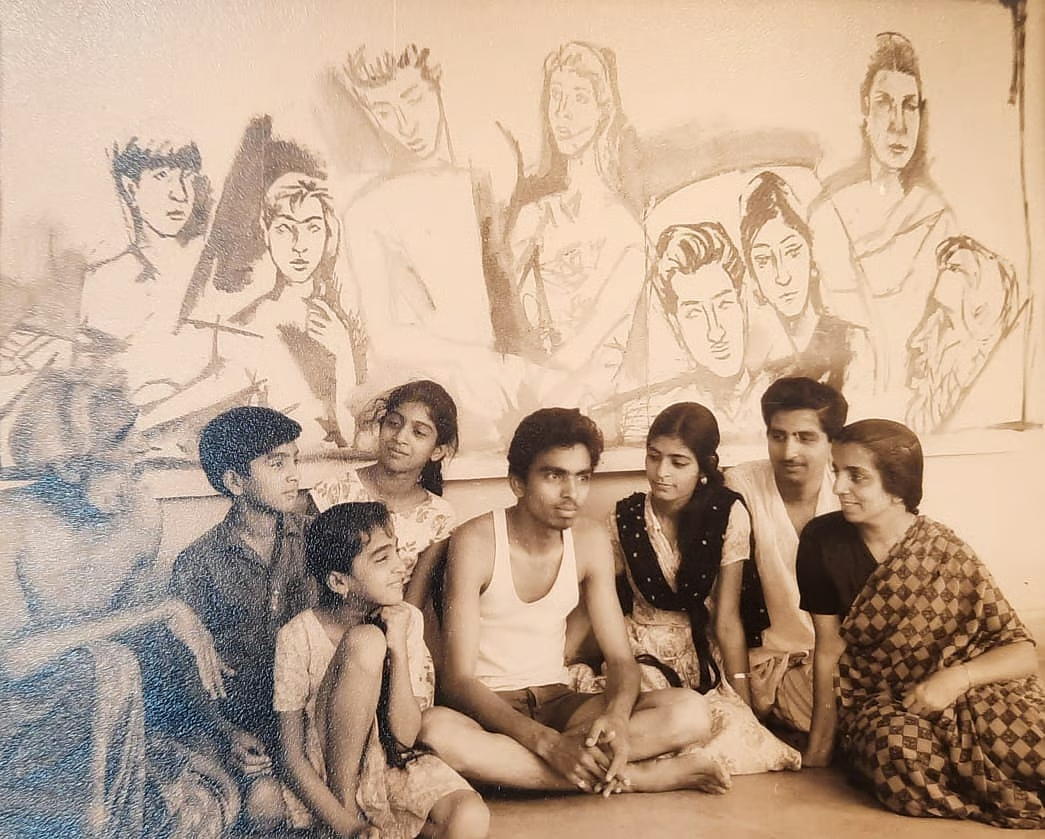
Husain made portrait of his family members and clicked a photograph. | The Zafar Ansari museum of achieves
Indore (Madhya Pradesh):
Maqbool Fida Husain is too well known to need an introduction, and most people are also aware of his connection with Indore. However, not very commonly known is the fact that his penchant for drawing horses started when he was a young lad in Indore.
While talking to Free Press, historian Zafar Ansari said, “Husain lived in Indore at a very young age in Chhawni area near Chhawni Bohra Mosque. When Husain was a teenager his Nana (maternal grandfather), who worked as a timekeeper in the Malwa Mill, wanted to make him a draftsman, but Husain was not interested. At one point he went to a Madrasa for becoming Alim but not much came of it.
His grandfather also bought him a camera and he got trained under the renowned photographer Ramchandra Rao and Pratap Rao but Husain did not show much interest in that art form. He started his painting career in Kagzipura area where he used to make Bada ghoda and Chhota ghoda.
His love for painting horses started here and it remained throughout his life as a professional painter.”
In 1936 he joined Indore Fine Art College where he trained under Devlalikar Sahab. Later he switched to Mumbai where he took admission in the JJ School of Art. The rest is history.
source: http://www.freepressjournal.in / The Free Press Journal / Home> Indore / by Staff Reporter / June 09th, 2023
On a quiet October morning in Delhi, when most people begin their day scrolling through screens, Dr. Istikhar Ali adjusted his helmet, whispered a small prayer, and kick-started a motorcycle that would soon become a moving classroom, a counselling room, a travelling research lab – and sometimes, a silent companion.
His destination? Unknown.
His purpose? Crystal clear.
He wanted to take the conversation about mental health to places where such conversations were never held before.
This is the story of a young public-health scholar who turned India’s highways into corridors of compassion, its villages into forums of reflection, and its communities into partners in healing.
A Beginning Rooted in Delhi, Inspired by JNU
My first conversation with him began on a nostalgic note – about Delhi.
“I stayed four years in Delhi and visited JNU several times,” I told him.
He smiled and replied, “Strange… you came so close, but destiny didn’t let us meet. Maybe it waited for this moment.”
From there, he unfolded his journey – from his early education, his family’s values, to the rigorous intellectual environment of Jawaharlal Nehru University (JNU), where his academic foundation in public health took shape. JNU not only gave him knowledge; it gave him a lens to look at human suffering not as isolated incidents, but as products of social, economic, and political realities. His research, activism, and writing reflect this lens deeply.
In his widely-read Scroll article, “Weary, Wary and Alone: From Delhi to Kerala, the Mental Distress Indians Struggle With” he documents the harsh truths he encountered during earlier travels: loneliness, anxiety, financial uncertainty, and the silent emotional burdens people carry across India.
In 26 days, he spoke to hundreds – students, farmers, teachers, journalists – each revealing how deeply mental suffering is woven into everyday life.
India, after all, is a country where, one in every seven Indians suffers from a mental health condition, over 200 million people face mental-health related distress, and close to 90% receive no treatment or support (NIMHANS & WHO reports).
Against this backdrop, one young man decided to ride, literally, into the heart of the problem.
The Ride Begins (Delhi to Kerala — 3,500 km of Listening, Healing, and Hope)
On 10 October 2025 – World Mental Health Day, Dr. Istikhar Ali began a 3,500 km solo motorcycle journey titled, “Ride for Mental Health: Beyond the Stigma.”
Supported by Snehi India and fuelled by nothing but conviction, he had no fixed plan – only a direction, and a determination to reach people who do not visit clinics, do not read scholarly journals, but silently battle overwhelming emotional storms.
Every village, every town, every stop became a lesson in lived experience. Where formal institutions build walls, he created bridges – conducting, 10+ public sessions, 30+ group discussions, hundreds of one-to-one conversations, workshops in universities and NGOs, corner meetings in markets, talks in madrasas, community centres and mosques and media interviews across states.
What makes his journey unique is that it wasn’t a mental-health “campaign”. It was a human campaign. He listened more than he spoke. He observed before he intervened. He met people where they were, not where textbooks expect them to be. And sometimes, the roads listened to him too.
A Day with Him: My Encounter in South Goa
When I met him in South Goa, he had just completed a long stretch from Ratnagiri. Dusty, exhausted, carrying nothing but essentials on his bike, he still greeted me with an unmistakable warmth. We spent hours discussing his work, his fears, his determination.
At one point he said: “Azhar Bhai, I started this journey without any detailed plan. But at every turn, God opened a door. And today, He brought me to you before I move from Madgaon towards Udupi.”
His humility was striking. At a time when the world is becoming increasingly self-obsessed and digitally distracted, here was a man riding across states not for adventure but for others.
His mission is a reminder that:
Mental health is not an individual struggle.
It is shaped by society, economy, politics, faith, family, and culture.
Healing requires communities, not just clinics.
If he can bring even 1% improvement in awareness among the millions struggling silently, it will be a monumental contribution. Great reformers and thinkers across history started with small circles that eventually created waves. His work stands in that lineage – contemporary, deeply relevant, and urgently needed.
Stories from the Road – Where Pain Meets Courage
Across his ride, he encountered:
A college student in Udaipur hiding panic attacks from his family,
A migrant worker in Ankleshwar battling depression after job loss,
A young girl in Goa openly speaking about anxiety for the first time,
A madrasa student in Malappuram sharing the emotional pressure of expectations, and
A group of activists in Kerala discussing burnout and resilience.
Each conversation re-affirmed what he often says: “Mental health is not a private burden; it’s a public responsibility.”
Ending Where Faith and Learning Meet
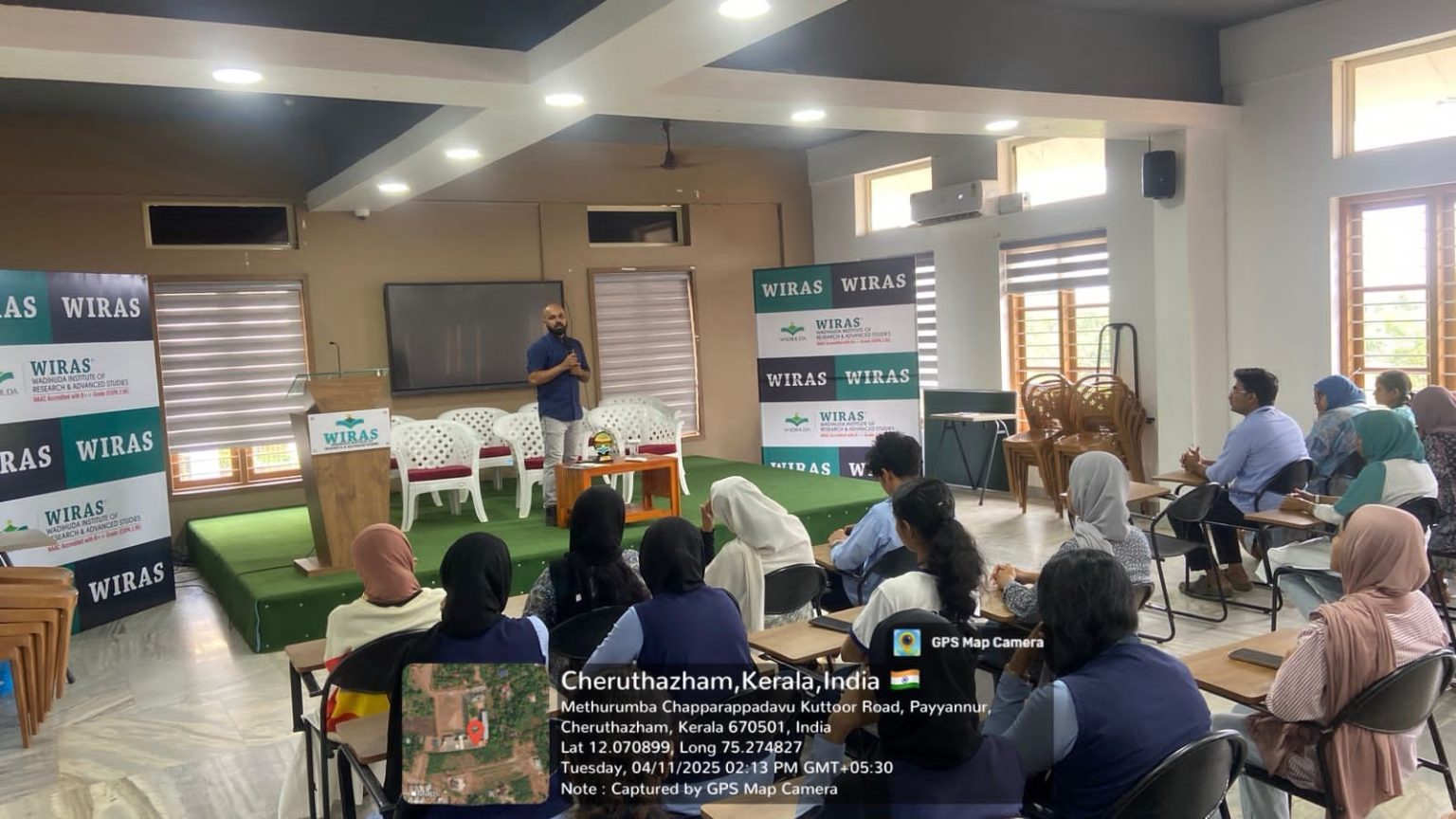
Dr. Istikhar chose Wadihuda Institute of Research and Advanced Studies in Kannur as his final stop – not for symbolism, but for a deeper message. Malappuram is a place where faith meets social service, education meets responsibility, and spirituality meets community welfare. He believes mental-health awareness must be integrated with ta’leem (education), tarbiyya (character development) and dawah (community engagement).
His concluding session, “Mental Health Beyond Silence and Survival: Faith, Education and Community Resilience,” aims to bring together students, scholars, educators and community leaders to build a culture of emotional support and resilience.
A Scholar, A Listener, A Traveller – But Above All, A Servant of Humanity
Dr. Istikhar Ali is a rare combination:
A public health scholar trained at JNU,
A DAAD Fellow with international exposure,
A grassroots listener who sits with people on sidewalks,
A writer whose words reflect lived struggle, and
A traveller who rides not for thrill but for purpose.
He is not simply creating awareness; he is creating a movement. In an era of self-promotion, he chooses selfless service. In a time of noise, he chooses conversations that matter. In a society crushed by unspoken mental suffering, he chooses courage – both his and others’. His journey teaches us that healing is not always found in hospitals. Sometimes, it begins on dusty roads, under bus shelters, in chai shops, in classrooms, in mosques, in marketplaces, and in the hearts of people who finally feel heard.
The Road Ahead
When he concluded his ride in Kerala, his mission didn’t end; it expanded. He plans to compile a publication and visual report from the stories collected, build alliances with educational institutions, create youth-led support networks, train community volunteers, continue travelling across new states and to develop research documenting the social roots of mental distress.
Every revolution starts with a single step. He started with a motorcycle engine roaring in Delhi. Dr. Istikhar Ali is not merely riding a bike across India. He is riding across stigma, across silence, across fear – to build a more compassionate society.
His journey is a reminder that the greatest service to God is service to His people, and that mental health is not a luxury; it’s an essential human right.
source: http://www.radiancenews.com / Radiance News / Home> Features> Focus / by Syed Azharuddin / Radiance News Bureau / November 17th, 2025
Archeological Survey of India says the monument, which residents claim is the Akbarabadi Mosque demolished by the British in 1857, is definitely a ‘contemporary’ of the 17th century Red Fort.
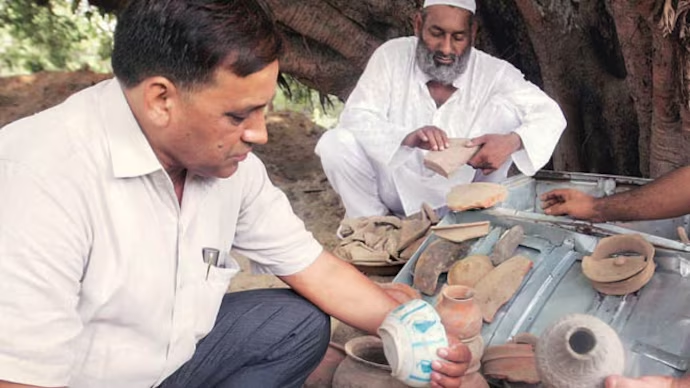
Archaeologist D.N. Dimri(l) shows the artefacts unearthed from the site at Matia Mahal, Old Delhi.
Remains of a historical monument, unearthed a few steps from Jama Masjid, belong to the golden age of Mughal Empire.
Archeological Survey of India said the monument, which residents claim is the Akbarabadi Mosque demolished by the British in 1857, is definitely a “contemporary” of the 17th century Red Fort, though whether it was a mosque or not will be known only after a detailed survey of the area.
The site in Matia Mahal, near Daryaganj, has been drawing visitors in hordes since the past three weeks after the first proofs of the historical structure – pottery and carved stones – were discovered in the area.
On Wednesday, a 10 metre wide wall was discovered a few feet under the ground. Residents claimed the wall was a part of the boundary of the main prayer enclosure, supposed to be about 85 metre wide.
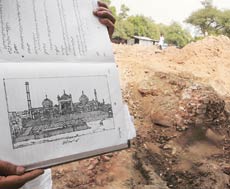
A sketch of the lost Akbarabadi Mosque. ASI officials said the discovery of the site is “indeed remarkable”.
“What we have here is a structure definitely of the time of the Red Fort. It is important due to its proximity both to the Jama Masjid and the Red Fort. The articles discovered from the site – Chinese porcelain, glaze pottery – belong to the period of the Mughals. What the structure exactly is will be known only after detailed survey,” superintending archaeologist Dr D.N. Dimri said.
But residents are confident that evidence of the structure being a mosque is present in the archives.
“We have maps clearly showing the structure of the Akbarabadi mosque in a book authored by the great scholar Sir Syed Ahmad Khan. There are illustrations of the mosque in the development plan of this area, issued by the Delhi government,” Matia Mahal MLA Shoaib Iqbal said.
source: http://www.indiatoday.in / India Today / Home> News> India> North / by Mail Today Bureau / published by AtMigration / July 07th, 2012
Binziya was forced to abandon her studies when her family arranged her marriage in 1997.
Malappuram :
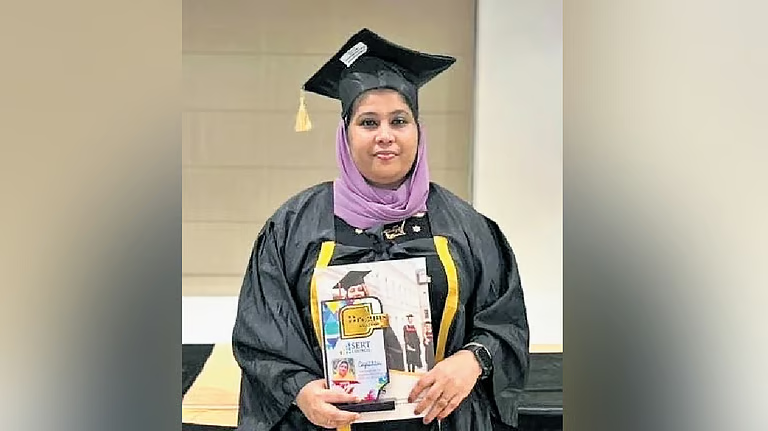
Married off at 14, confined within domestic boundaries for decades, and once ashamed to admit she had studied only up to Class 9, a woman from Malappuram has now rewritten her destiny through education. After 29 years of marriage, Makkaraparambha native Binziya has emerged with a postgraduate degree in psychology, proving that dreams delayed are never dreams denied.
Binziya was forced to abandon her studies when her family arranged her marriage in 1997. One year later, she became a mother. As the eldest daughter-in-law in a large joint family, she was tasked with looking after her husband’s younger siblings and managing all household responsibilities.
“I was still a child. But I had to act like a grown woman because everyone expected me to be one,” she recalls. Education became a distant memory as cooking, cleaning and childcare took over her life. “There was no space for my wishes. My daughter and later my son became my world. But deep inside, I always missed learning.”
A turning point came when the family shifted to their own home. She came to know about the government’s literacy mission and decided to ask her husband if she could attempt the Class 10 equivalency examination. “My husband supported me without hesitation. When I passed with good marks, I cried. I felt alive again,” she says. She went on to complete her higher secondary education next before enrolling for a BA English programme through distance education in 2020.
But her heart was always set on psychology. “I have gone through many emotional struggles in life. Who understands pain better than a woman? I wanted to learn psychology so that I could help others like me,” she says.
The biggest driving force behind her educational pursuit was her own self-respect. “Whenever someone asked me how much I had studied, I felt ashamed to say Class 9. That shame pushed me to continue learning. I wanted to feel proud of myself,” she explains.
Her years of effort finally came to fruition as she completed her MA in psychology. Binziya says she hopes her story encourages other women who were denied opportunities. “There are many women like me in Malappuram who are married off too early and remain confined to their homes. I want them to know that education is still possible.”
She is also proud of the change within her own family. “My daughter completed her Plus-II before marriage. She has finished her degree and is preparing for postgraduate studies. It makes me happy that she will not have to carry the same regrets I once had.”
Binziya now dreams of becoming a practising psychologist and providing support to homemakers who struggle.
source: http://www.newindianexpress.com / The New Indian Express / Home> Kerala / by Lakshmi Athira / November 28th, 2025
The device includes a ‘Help Me’ button that alerts the teacher whenever a student needs intervention, improving classroom management.
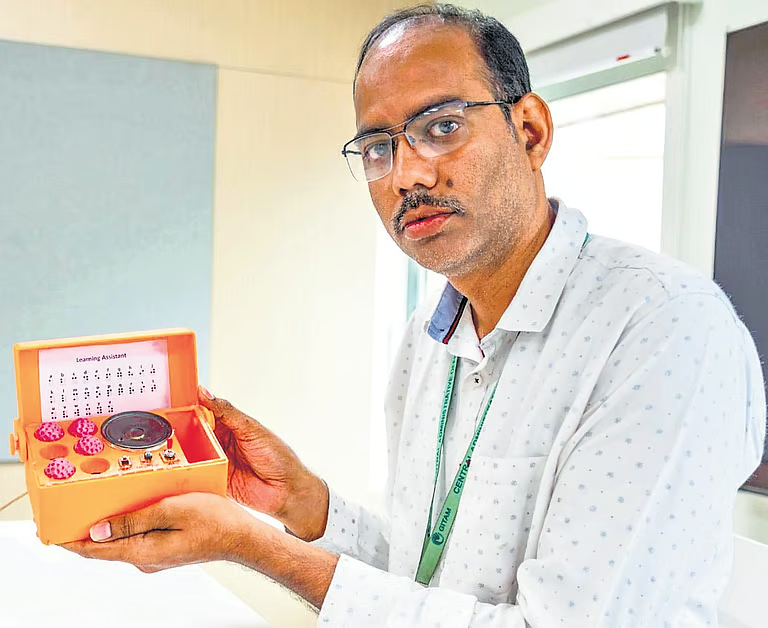
Mohammed Khwaja Muinuddin Chisti, Assistant Professor in the Department of EECE from GITAM Deemed to be University, has developed an embedded Braille Learning Assistant Embedded Kit (LAEK).Photo | G Satyanarayana
Visakhapatnam :
For many visually impaired children, the journey to literacy begins with the touch of a fingertip. But mastering Braille is often a slow and demanding process that requires constant one-on-one support from teachers, a challenge in schools where trained instructors are scarce and classrooms are full. For families living far from specialised schools, opportunities are even fewer, leaving children dependent on others for even the basics of reading and communication.
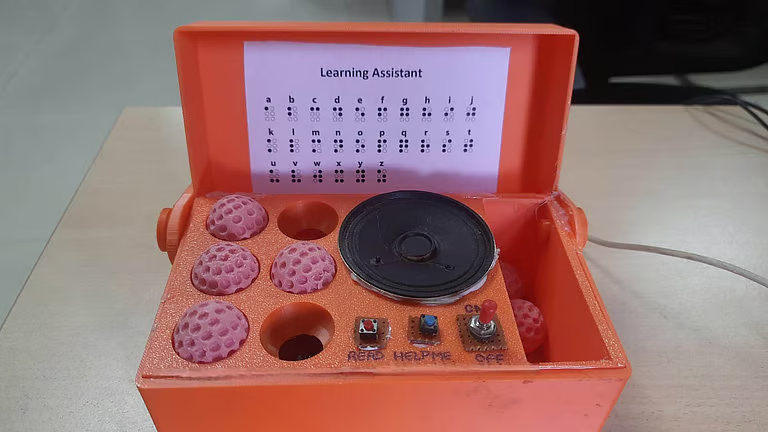
A faculty member at GITAM Deemed to be University, Visakhapatnam, is hoping to change that. Mohammed Khwaja Muinuddin Chisti, Assistant Professor in the Department of EECE, has developed an embedded Braille Learning Assistant Embedded Kit (LAEK), a simple, sensor-based device that allows visually impaired children to learn Braille independently, either at home or in school.
The device is a 3 × 2 hollow hemispherical Braille cell fitted with sensors that identify the dot patterns placed by the student. Once the pattern is detected, the system decodes it and provides audio feedback by announcing the corresponding letter, number or instruction. This makes it possible for students to practise and revise lessons without waiting for a teacher to guide every step. “In many schools, one teacher has to train 30 or 40 visually impaired children, and each child needs personal attention for Braille practice,” Chisti remarked, adding, “Many students hesitate to ask the same doubt again. I wanted to create something that lets them learn comfortably at their own pace.”
The device includes a ‘Help Me’ button that alerts the teacher whenever a student needs intervention, improving classroom management. The balls used to form patterns are designed to stay within reach even if dropped, and the device is chargeable, eliminating the difficulty of replacing batteries.
“The tool is also aimed at children who cannot attend blind schools due to distance or lack of accessibility. Parents can guide their child’s learning at home using the same pattern-based method followed in classrooms. Depending on the child’s learning ability, all basic Braille alphabets can be learnt within a few weeks,” Chisti stated.
Before developing this tool, Chisti created a ‘Walking Assistant’ device, a wearable tool that alerts visually impaired users about obstacles through vibrations and sound. His interactions with students and teachers during that project sparked the idea for a more focused educational device.
“When I visited blind schools to donate the walking aids, I saw the kind of effort teachers put in, and how much time it takes for each child to grasp Braille,” he said.
“I felt technology could ease that pressure and help children become confident, independent learners.”
The new learning assistant has been filed for patent registration. Chisti hopes to manufacture and distribute multiple units to blind schools using research grants and donor support.
Future upgrades may include computer vision and speech recognition to help students identify people around them and navigate with greater confidence.
source: http://www.newindianexpress.com / The New Indian Express / Home> Good News / by Usha Peri / November 30th, 2025
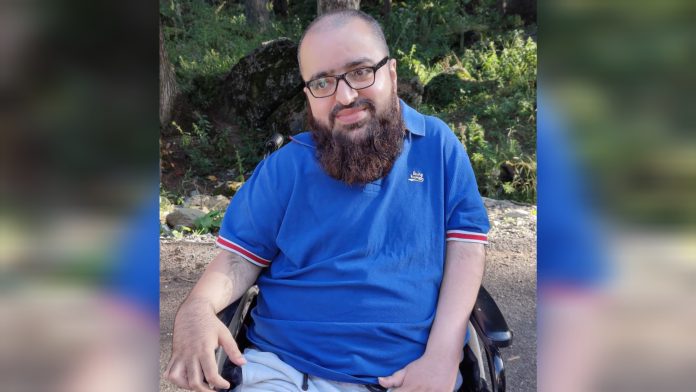
In Kashmir, a short Instagram reel posted last year unexpectedly drew significant attention. The video showed a man in a wheelchair presenting traditional Kashmiri clothing from his home. Its simplicity and warmth resonated widely, resulting in thousands of views within a short span. Behind this viral moment is Shahid, a 36-year-old resident of Gopalpora in Mattan, Anantnag, who now runs an online apparel venture he calls Adorn by Shahid.
Shahid’s life took a difficult turn early in childhood. He remembers being an energetic eight-year-old before sudden pain led doctors to diagnose him with a brain tumor. Although the surgery was successful, it left the left side of his body paralysed, forcing him to pause his studies. He recalls the aftermath as a period marked by long recovery and growing isolation. Many of the friends who once visited gradually stopped coming, which motivated him to pursue his education independently. Over several years, he completed his graduation privately.
As he grew older, Shahid hoped to find stability through a government job. He applied repeatedly, but because of his physical condition, his applications were consistently rejected. These setbacks eventually convinced him to look for a path he could shape himself.
Social media became that path. After observing others promote their work online, he decided to try something similar. With emotional and financial support from his family—especially his parents, siblings, and extended relatives—he launched his online business a year ago. What began as a small initiative gradually developed into a promising venture.
His Instagram account now showcases a variety of Kashmiri garments, including pherans, embroidered suits, shawls, and other traditional pieces. The viral reel that drew widespread attention introduced him to a much larger audience. Shahid says the feedback has been overwhelmingly positive. Since he works from home, managing orders and responding to messages online suits him well. Although he oversees the entire operation, his cousins and niece frequently help him film videos and create reels.
Despite limited mobility, Shahid’s outlook remains grounded and optimistic. He believes that difficulties can affect anyone, but what truly matters is having support and encouragement. For him, running this business represents independence, dignity, and the chance to express himself creatively. The same home where he once spent years recovering is now a workspace where he engages with customers from within and outside Kashmir.
Encouraged by continued online support, Shahid hopes to expand. He plans to open a physical store in the future so customers can visit and interact with him directly. Social media, he says, has given him opportunities he once couldn’t imagine, and he is determined to build on this momentum.
Shahid’s journey reflects resilience shaped by experience and determination. Rather than focusing on the limitations imposed by his childhood illness, he has chosen to rebuild his life through entrepreneurship, family support, and steady persistence.
source: http://www.muslimmirror.com / Muslim Mirror / Home> Positive Story / by Babra Wani / November 30th, 2025
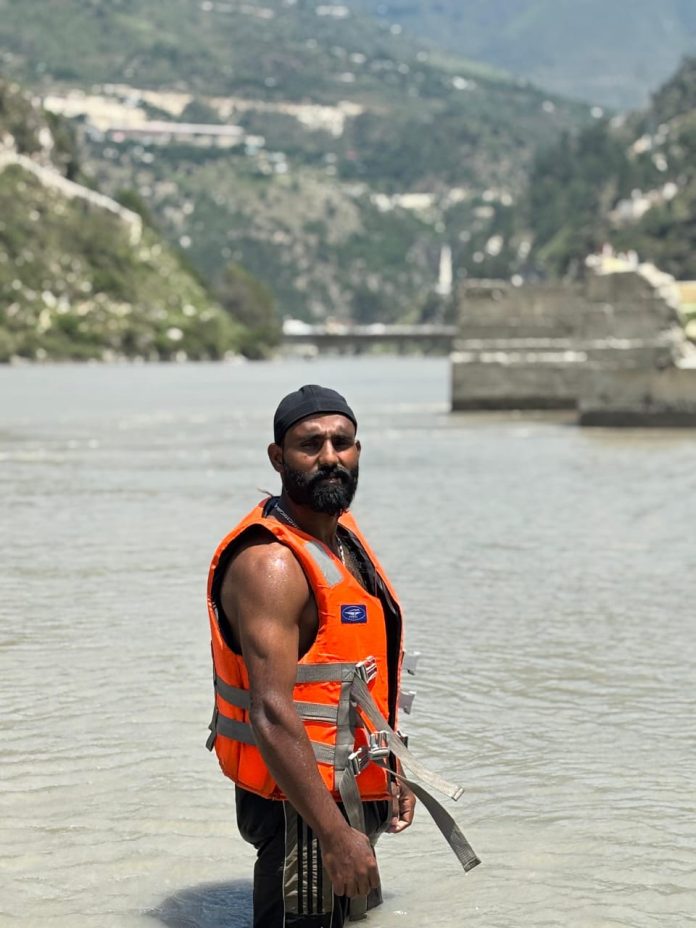
On the jagged banks of the Chenab, where the river churns like a living force and the sound of its roar rises above the valley’s silence, one man stands as the last hope for those it swallows. He is neither a government employee nor a trained professional in the formal sense. He has no salary, no official title, and no protective gear. Yet for more than fifteen years, Hamza Sheikh has been the first to dive in when someone disappears beneath the grey water.
He is soft in voice, and almost shy in demeanour. But behind that calmness lies a kind of courage that borders on the extraordinary. In his own estimate, he has pulled “more than four to five hundred” bodies from the Chenab. And astonishingly, “in my 15-year journey, at least three hundred alive I have brought out.”
There are few stories like Hamza’s today—stories of a single man whose work is stitched into community memory, whose bravery is understood more by the grieving families he has helped than by any government record. His entire training, he says, comes from growing up near the river.
“This is Chenab,” he explains, gesturing towards its violent surface. “We have been living here since childhood. This is our training.”
A River That Became a Graveyard
The Chenab was not always a death trap. Hamza recalls a time when accidents were rare, when the banks were bustling with a small city called Pul Doda.
“There used to be a market here earlier… at least 450 shops,” he says. “The dam destroyed everything.”
When the dam collapsed during the 2008 earthquake, the river changed forever. What was once shallow and predictable became deep, erratic, and unforgiving. Entire markets and neighbourhoods were consumed by water. People promised rehabilitation never received land. The river became in parts a silent grave, in parts a raging beast.
It was around this time that Hamza’s role became essential. His family had lost their land and livelihood; he found purpose in saving others from what had taken so much from his own.
He still remembers the first dead body he pulled out. “I was about 10–11 years old… a body came running. I caught it. His condition was very bad. He had worms.”
That moment, shocking as it was, shaped his life. Since then, the river has rarely let him rest.
Inside the Mind of a Man Who Jumps In
The Chenab is deceptive. From afar, it looks like any fierce river. Up close, it is a trap. The water is icy, visibility is zero, the current can drag down cars, and the depth changes unpredictably.
“Many people run away after hearing the noise of Chenab,” Hamza says. “But for us, it is very common.”
He describes rescue attempts that sound superhuman. In many cases he dives blind, because “we close our eyes, because there is sand. We can’t see anything. We go 15–20 feet without oxygen.”
The riverbed is lined with boulders sharp enough to slice flesh. Some sections are calm for a few metres and then suddenly erupt in turbulence strong enough to flip a vehicle. Somewhere in the river’s deepest pockets, Hamza says, lie bodies that never surfaced.
“Imagine a chopper went here 15 years ago,” he says. “We didn’t find it. Neither the body nor the chopper.”
And yet, he returns each time.
When asked if he is ever scared, he shrugs. “Chenab is like our home.”
A Body in the River Is Only the Beginning
The most difficult part of Hamza’s job is not the water—it is what the water does to the dead.
He recounts incidents that would break most people. One case remains etched in him: a woman whose remains had been in the river for days.
“When I pulled her, her skin came out,” he says quietly. “There were worms. Her hands were full of worms.”
There are other stories—bodies broken by rocks, faces eaten away by the river’s minerals, limbs separated, the smell of decay rising even from the coldest water. But Hamza refuses to turn away.
“Emotions come,” he admits. “Because if someone’s family reaches their house, then it is a matter of reward. We don’t take money. We do it with the intention of reward.”
For families waiting on the bank, Hamza is not a rescuer; he is closure.
The Line Between Saving and Being Pulled Under
The living, Hamza says, are far more dangerous to rescue than the dead.
“A living person can drown you too,” he explains. “He will take a slap from you… he will take him too if you are not trained.”
He recalls one incident from 2017: a woman who had jumped in during the fast flow of mid-summer.
“I jumped without a jacket emotionally. I was in the water for half an hour. Sometimes she was drowning me and sometimes I was saving her.”
Both survived—but the memory remains a reminder of how narrow the margin is between life and death in the Chenab.
Some rescues haunt him differently. In Katra, a college girl jumped; her body surfaced only two months later. “At that time,” he says, “I was very sad.”
He remembers another scene—two girls swept away in a torrent so strong it resembled the sea.
“No one dared to go down,” he recalls. “I went into the water.”
Injuries That Tell a Story
Hamza lifts his cap to show a scar running diagonally across his head. It is long, thick, and uneven—evidence of how much he has risked.
“My head was cut from here,” he says softly. “There were 60 stitches inside. The blood was flowing and I came out. I didn’t know that my face was bleeding.”
It happened during a car rescue, when he was pushed beneath a rock and had to “adjust without any equipment.”
There are other injuries—bruises, cuts, nights spent shivering after hours of diving, the long-term damage cold water inflicts on the body—but Hamza doesn’t dwell on them. The river has taken more from others, he says, than it has from him.
Hamza’s work is made all the more remarkable by the fact that he does it with almost nothing.
“We have a boat, but we don’t have it,” he says with a faint, ironic smile. Their earlier boat, gifted years ago, “died in the water the next day.” Now he must request one from Doda each time there is an emergency.
He has no oxygen tank, no wetsuit, no underwater torch, no sonar, no rope strong enough to withstand Chenab currents.
“It takes four days to call an NDRF officer,” he says. “The dead body is in the water and rots. Even NDRF officers are not able to get into the water.”
He tells of one such officer whose rope snapped. “He had just got married… I saved him from the side without any equipment.”
The irony is bitter: the man who rescues even trained personnel is himself unprotected.
No official has offered him financial aid, let alone a salary. “I only got praise and nothing else,” he says.
Each time the phone rings, Hamza says, he thinks of the family waiting on the bank.
“We think and we get a phone call. We have to go… we get emotional.”
He recalls the day two of his classmates drowned. He watched their parents crying helplessly.
“I couldn’t bear it,” he says. No one else dared to enter the water that day. He went alone.
He has not always succeeded. “There were 11 people… I found only one,” he says. “Till date, I haven’t found any of the others.”
But it does not stop him.
“Whoever we went to save, we brought him alive,” he insists. It is his source of pride—and perhaps also his armour against grief.
The Man the River Has Not Defeated
As Hamza talks, the Chenab roars behind him—its sound too steady, too relentless. It is a reminder of how small one man is compared to a river that has eaten cities, choppers, buses, families.
And yet, when someone goes missing, people do not call the authorities first. They call Hamza.
Not because he is invincible. Not because he is paid. But because for fifteen years, whether at midnight or dawn, whether in winter cold enough to freeze blood or monsoon floods that turn the valley into a bowl of water, he has shown up.
“This is our training,” he says again. “Wherever Chenab goes, wherever there is someone, we go.”
It is perhaps the simplest explanation for what he does—but not nearly enough to describe the magnitude of it.
In a valley full of quiet resilience, Hamza remains its quietest hero: anonymous, unrecognised, and yet carrying within him the memories of hundreds of tragedies, hundreds of families, and hundreds of lives he pulled—sometimes limp, sometimes breathing—from a river that never gives anything back.
source: http://www.muslimmirror.com / Muslim Mirror / Home> Indian Muslim> Positive Story / by Babra Wani / November 18th, 2025
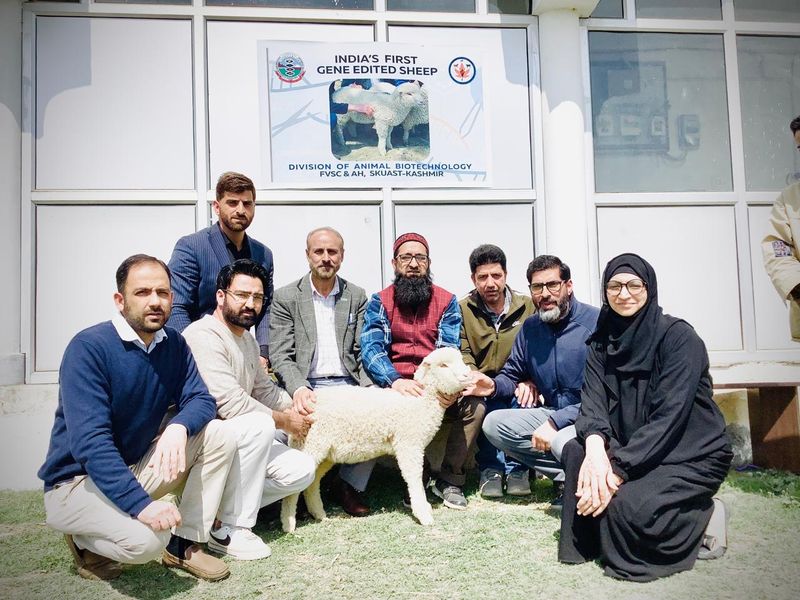
A team from SKUAST-Kashmir with country’s first gene-edited sheep.
In a landmark achievement in the field of animal biotechnology, Sher-e-Kashmir University of Agricultural Sciences and Technology (SKUAST), Kashmir, has successfully produced India’s first gene-edited sheep. University officials are calling it a “historic milestone” in genetic research and livestock development.
“This is a major breakthrough at the national level. It is the first of its kind in India, and everyone at the university is thrilled,” said Dr Riyaz Ahmad Shah, Professor of Animal Biotechnology, who led the expert team behind the project.
Dr Shah revealed that a female gene-edited lamb was born four months ago. The team specifically targeted the myostatin gene, which regulates muscle growth, making changes at the embryonic level. “The gene editing was carried out using CRISPR-Cas9 technology,” Shah explained. This revolutionary tool has broad applications in medicine, agriculture, and biotechnology. Importantly, he noted, “The edited sheep contains no foreign DNA,” distinguishing it from transgenic organisms and easing its path under India’s evolving biotech regulatory framework.
“All international biosafety protocols were strictly followed throughout the process,” he added.
The university views this achievement as a major step in placing India on the global map of advanced genome editing technologies. It also positions SKUAST-Kashmir at the forefront of reproductive biotechnology research.
Experts say the lamb’s muscle growth is expected to be enhanced due to the gene editing, although a few years of observation will be required to fully understand the differences between the edited lamb and a normal one.
Notably, Dr Shah and his team were also behind the creation of “Noori,” India’s first cloned Pashmina goat, in 2012. Noori lived for 11 years before passing away in 2023.
Vice Chancellor of SKUAST-Kashmir, Prof Nazir Ahmad Ganai, recently briefed Lieutenant Governor Manoj Sinha about the development. “This is not just the birth of a lamb, but the birth of a new era in livestock genetics in India,” Prof Ganai remarked.
University officials said the Lieutenant Governor praised the team’s efforts and their contribution to advancing scientific research in the region.
Looking ahead, the university plans to produce more gene-edited sheep. “We’re exploring possibilities in other areas like twin births and disease resistance,” said Shah. “For now, we are closely monitoring the lamb for safety and other parameters. Everything is normal so far.”
The team is also in the process of selecting a name for the pioneering lamb. “We’ll announce it soon,” Shah said.
source: http://www.tribuneindia.com / The Tribune / Home> Jammu & Kashmir / by Adil Akhzer / May 27th, 2025
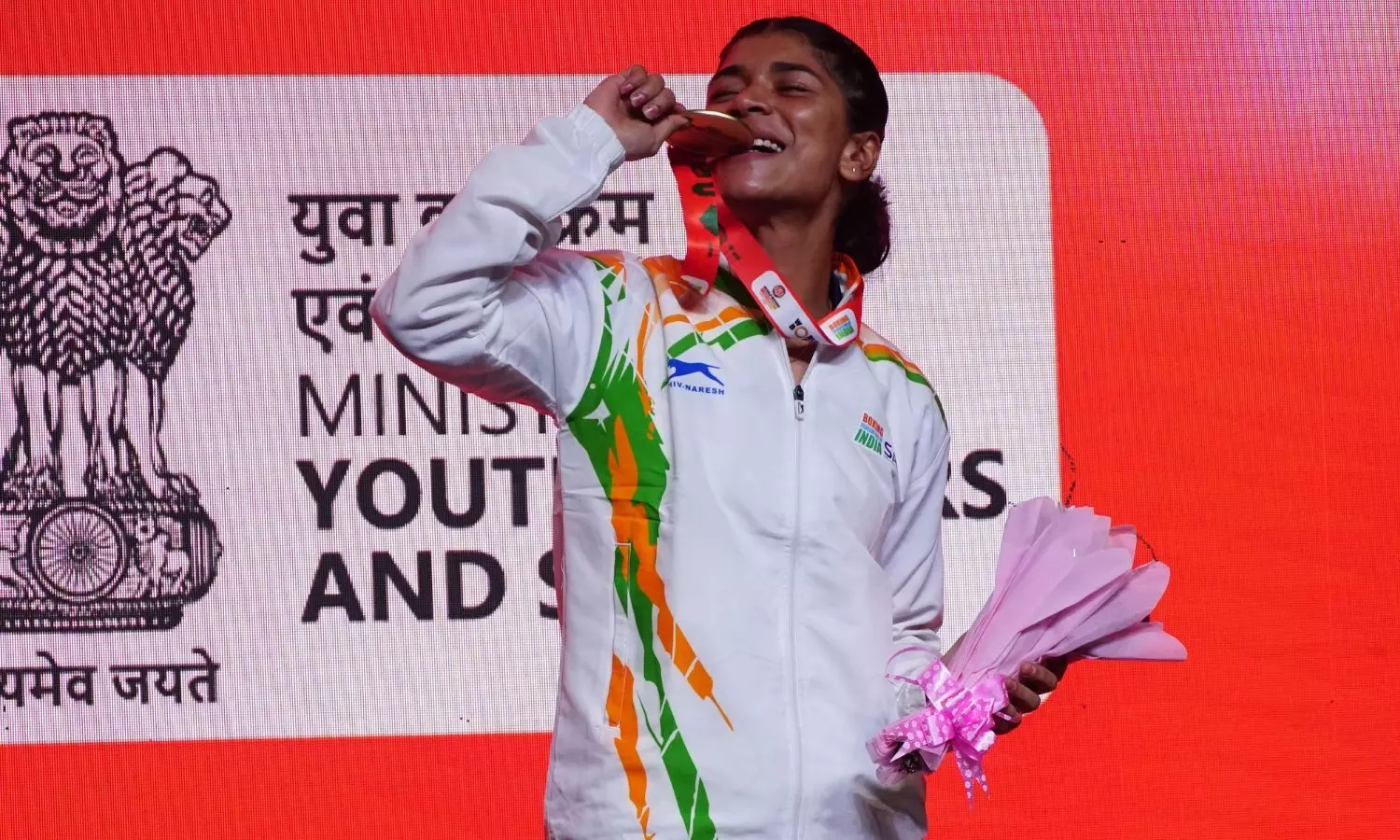
Nikhat clinched the women’s 51 kg gold medal at the 2025 World Boxing Cup Finals in Greater Noida.
Nikhat Zareen clinched the 51 Kg gold medal at the World Boxing Cup Finals 2025. (Photo Credits: The Bridge)
Greater Noida:
Star Indian boxer Nikhat Zareen has once again captured headlines after winning the gold medal at the 2025 World Boxing Cup Finals on Thursday.
The two-time World Champion delivered a commanding 5–0 victory over Guo Yi-xuan of Chinese Taipei in the women’s 51 kg final, returning to the top of the podium after 32 months.
Her last gold also came on home soil in 2023, when she clinched her second world title at the New Delhi World Championships.
“I always believe in manifestation, so I manifested that this time also, in India, I would repeat that. It’s always a pleasure to play in front of a home crowd, and today I did it,” Nikhat Zareen told the media after her win.
Bouncing back from two consecutive setbacks
Nikhat endured a difficult run in her last two major tournaments, the Paris Olympics and the World Boxing Championships, returning empty-handed from both.
At the Paris Games, competing as the reigning World Champion, she exited in the Round of 16 against eventual champion Wu Yu of China.
Later, at the 2025 World Championships in Liverpool, her first international event of the year, she fell in the quarterfinals to Turkiye’s Buse Naz Cakıroğlu.
Now, she has turned back the clock, returning to winning ways in front of her home crowd and putting behind her the disappointment of missing out on key medals.
“This medal is a big boost for my confidence. After a long time, I reached the final and won the gold. I’m very happy that I can once again compete as a gold medal contender,” Nikhat said, relieved to end her medal drought.
Nikhat also mentioned that she had very little time after the World Championships to prepare for this event. Within days, she shifted to Patiala to join the training camp.
“I spent a few days with my family, but then moved to Patiala for training since the Finals were in India and I didn’t want to disappoint fans. In Patiala, I sparred with boxers across weight categories, from 48 kg to 54 kg and even 57 kg, which helped me a lot,” she added.
Nikhat’s Road to the title
The World Cup Finals, expected to be a top-tier competition with the world’s best eight players in each weight category, did not fully live up to expectations as several major nations skipped the event.
In the women’s 51 kg category, only five boxers participated, which meant Nikhat received a bye in the quarterfinals and secured a medal without stepping into the ring.
Her campaign began in the semifinals against Uzbekistan’s Gulsevar Ganieva, where she won by unanimous decision to enter the final.
However, it wasn’t her most convincing bout, marked by frequent clinches and several clumsy falls near the ropes.
“The first bout was not as good as everyone expected, but I’m happy that I at least won and reached the final after so long,” Nikhat said after the semifinal.
In the final against Guo Yi-xuan, Nikhat looked much more composed, displaying sharper footwork and cleaner punches to seal the title at home.
“Today, I played against a boxer who moves a lot and is a counter-puncher. So I also opted for counter boxing instead of going all-out, which could have disadvantaged me,” Nikhat explained.
Future Plans
Nikhat shared that she often has to travel for training because there is no proper boxing academy near her home, something she now hopes to build herself for upcoming talent from Telangana.
“I mostly have to travel to Pune or IIS for training and don’t have a fixed location. So if the Telangana government allocates land, I will build my own academy where I can train and support rising boxers from the region,” she said.
This win may not carry immense competitive weight due to the limited field, but it has undoubtedly reignited her confidence after a challenging year.
With a packed 2026 season ahead, including major events like the Commonwealth Games and Asian Games, Nikhat will aim to use this momentum to elevate her performance further.
Her parting words, “This is just the start, and a lot more has to be done,” reflect the grit and hunger she will need as she prepares to face stronger opponents on the global stage.
source: http://www.thebridge.in / The Bridge / Home> Boxing / by Deepanshu Jain / November 21st, 2025
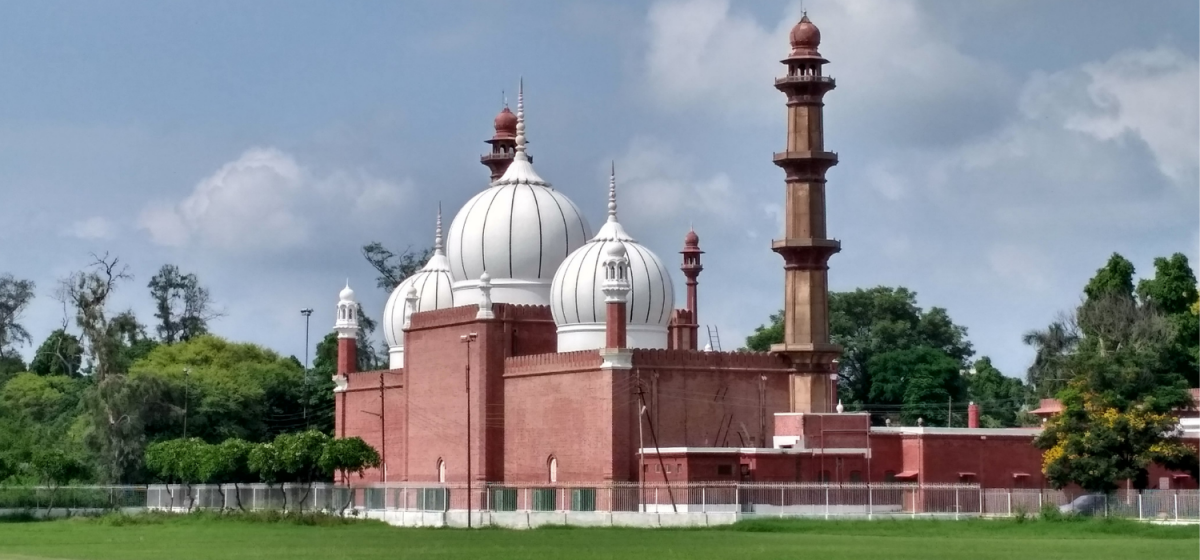
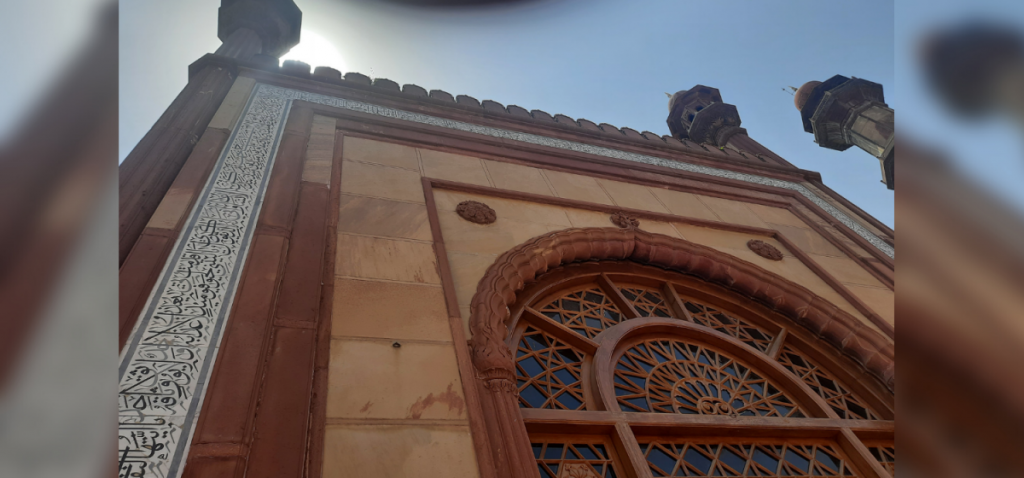
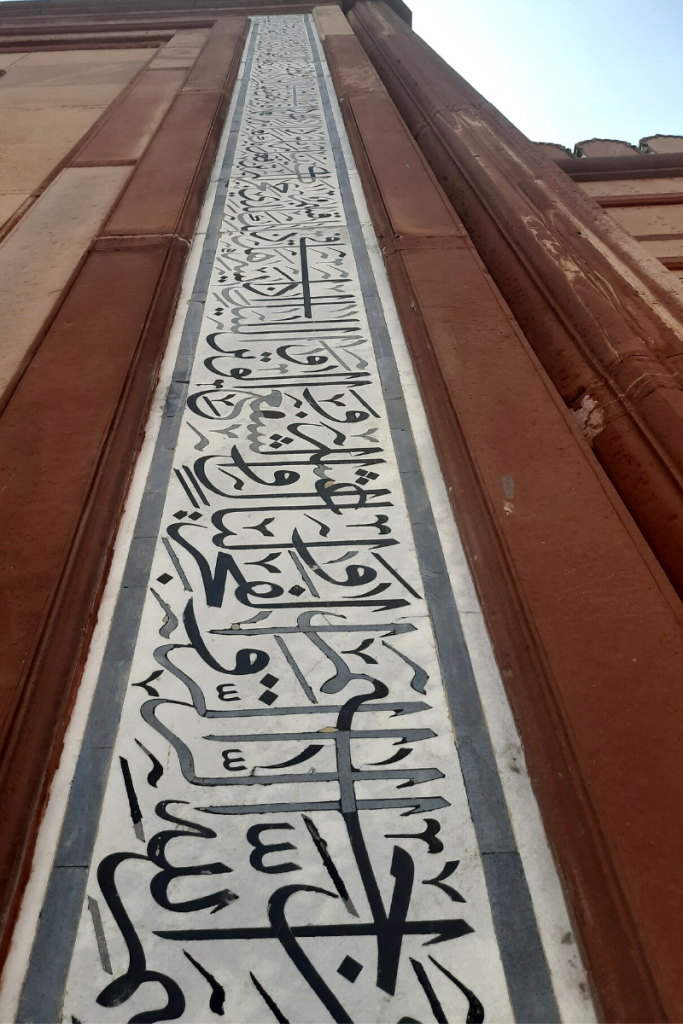
The imposing walls of both the Taj Mahal and Aligarh Muslim University’s Jama Masjid have Quranic verses crafted onto white marbles in black paint.
Jama Masjid on Aligarh Muslim University campus. Photo: Author provided.
Constructed nearly 250 years apart, the Taj Mahal in Agra and Jama Masjid at the Aligarh Muslim University (AMU) have an interesting connection.
The construction of the Taj Mahal began in 1632 and was completed in 1653, while the construction of Jama Masjid at AMU began in 1879 and was completed in 1915.
While the Taj Mahal, which is the tomb of Mughal emperor Shahjahan and his wife Mumtaz Mahal, attracts millions of visitors every year, AMU’s Jama Masjid is the main mosque of the university. AMU’s Jama Masjid is, perhaps, the last enduring symbol of the Mughals, constructed when the Mughals lost their kingdom during British rule.
A surprising connection
As one enters the Taj Mahal, beautiful calligraphy adorns all four corners. Several verses from the Holy Quran crafted in black calligraphy on white marble can be seen. This is a unique form of calligraphy, and expert artisans from Persia were involved in creating it. Similar calligraphy can be seem inscribed at the tomb of Mughal King Akbar at Sikandra, Agra, and also at the AMU Jama Masjid.
A closer look at the white marble with Quranic verses in black colour adorning the walls of Jama Masjid in Aligarh Muslim University. Photo: Special arrangement.
In fact, it is believed that the artisan responsible for the calligraphy at the Taj Mahal also brought his expertise to AMU’s Jama Masjid.
Since there is a difference of nearly 250 years between the construction of both architectural wonders, it is interesting to study how this was possible.
During Shah Jahan’s regime, several buildings were constructed, including the Taj Mahal and Delhi’s historic Jama Masjid. The calligraphist used was the same.
Professor Nadeem Ali Rezavi of the Centre of Advanced Studies, Department of History, Aligarh Muslim University, says that the master calligraphist in most of the buildings constructed during Shah Jahan’s regime is the same person.
“His name was Abdul Haq, and later due to his craftsmanship, his rank was elevated. He was given the title of Amanat Khan. In fact, he even signed the bands on this calligraphy with dates,” says Rezavi.
Still, there is a gap of over two centuries between these two buildings, Taj Mahal and AMU’s Jama Masjid.
The connection between the two monuments becomes clear with the involvement of Akbarabadi, one of Shah Jahan’s queens. Her original name was Aiza-un-Nisa. She, in 1650, commissioned the construction of a mosque situated in Daryaganj, Delhi, during the same period. In that mosque, Quranic calligraphy was done by the same artisan in black paint on white marble. This was around the same time as when the Taj Mahal was built.
After nearly two centuries, the Daryaganj mosque was demolished by the Britishers following the 1857 revolt. This was when Britishers gained control over the Red Fort, and the last Mughal emperor Bahadur Shah Zafar was sent in exile to Rangoon. They destroyed many buildings which were supposed to have harboured the rebels. At the site of the destroyed Akbarabadi Mosque, a park was developed and came to be known as Edward Park in 1911, which is now called Subhash Park.
During the same period, Sir Syed Ahmed Khan, the founder of the Mohammadan Anglo Oriental College (which later became AMU) felt the oppression against Muslims after the revolt. He nurtured the idea of setting up an educational institution to try and uplift the community.
A visionary man, Sir Syed had the taste for collecting things, particularly artefacts which had archaeological and historical importance. He was aware of the demolition of the Akbarabadi Mosque in Delhi.
As per the AMU Gazette, the scraps generated at the demolished Akbarabadi mosque were sold to a dealer and later purchased by Sahabzada Suleman Jah Bahadur. These remains were thus sold after over 200 years. These were presented to Sir Syed Ahmed Khan, who planned to use them in the Jama Masjid of the educational institution.
A closer look at the white marble with Quranic verses in black colour adorning the walls of Jama Masjid in Aligarh Muslim University. Photo: Special arrangement.
The white marbles with black calligraphy now present in the Jama Masjid of AMU depict Surah Fajr from the Holy Quran. Thus centuries apart, the two buildings carry the work of the same artisan.
“Even if you compare, it is the same thing and the only difference is in the scale. The artisans are the same who have shown their skills in the construction of the Taj Mahal,” says Prof. Rezavi.
Thus AMU’s Jama Masjid is, perhaps, the last enduring symbol of the Mughals, constructed when the Mughals lost their kingdom during the British rule. On the other hand, the domes of AMU’s Jama Masjid employed techniques of the Mughal era: they are “true domes” as they were built using lime mortar and vousseurs (wedge cornered stones/bricks).
“It is a brick structure, guava-shaped, carrying white marble with black stripes. This is the last true dome. After this, the particular technology faded out, and the buildings constructed after them have concrete domes,” said Rezavi.
Later, in 2016, AMU authorities began the conservation of the Jama Masjid. Now revived at the cost of Rs 90 lakh, the Jama Masjid has a Hauz in the courtyard, three domes, seven arches and two lofty minarets cornered by a Cricket Pavilion at its rear end. Sir Syed, the founder of the institution, was also buried in the same compound.
Faisal Fareed is a senior Lucknow-based journalist.
This article went live on June fifth, two thousand twenty one, at zero minutes past seven in the morning.
source: http://www.thewire.in / The Wire / Home> History / by Faisal Fareed / June 05th, 2021