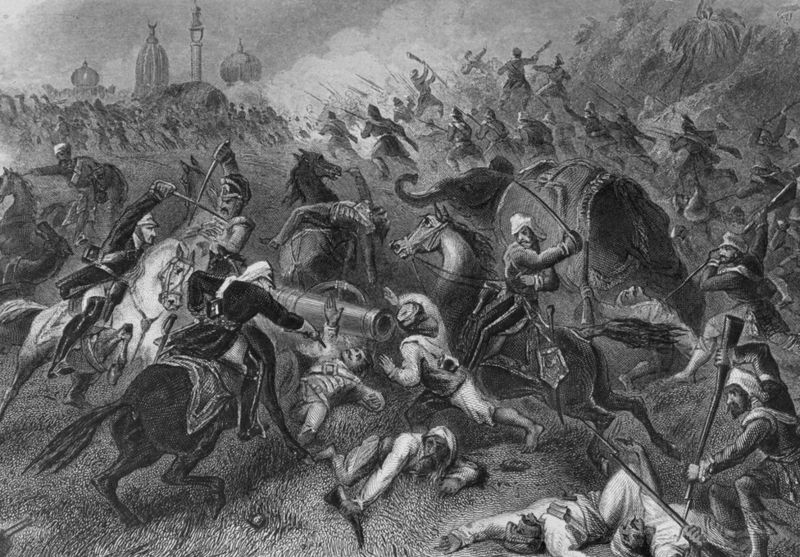
An old woman wearing green clothes, which fully covered her body (Burqa), carrying sword and gun, and riding a horse used to exhort the residents of Delhi to fight against the British forces during the summers of 1857. This old woman used to gather civilians behind her and attack the British forces stationed at ridge and Kashmiri Gate. People could never know her whereabouts. Out of nowhere, she used to appear on a horse and after the attack would disappear.
In a letter dated, 29th July, 1857, Lieutenant Hudson wrote to Deputy Commissioner of Ambala that this Muslim woman was very dangerous. The woman was weird and incited the Delhites to revolt against the British. She led the people into the skirmishes and was an able commander, who could manage untrained civilians into war against the trained British army. Hudson further noticed that she was excellent at fighting with swords and shooting with guns. She killed many British soldiers during the different skirmishes.
Hudson paid a tribute to the bravery of this woman by comparing her with Joan of Arc of France. He contended that the courage, leadership and valour of this green wearing Muslim woman was no less than Joan of Arc.
During one of the battles at the ridge in Delhi she fell from the horseback and was captured. Army General, looking at an old Muslim woman, felt unthreatened and ordered her release when Hudson intervened. Hudson told the General that this woman was the actual commander of the Indians and hence really dangerous. Afterwards, it was decided that the old woman would be shifted to a prison in Ambala.
This brave old woman was shifted to Ambala in July, 1857. Neither we know her name nor we have any idea of what happened to her in Ambala but surely this old Muslim woman clad in a green burqa is one of those unsung heroes of the 1857 who ignited a flame which later liberated India from the foreign rule.
source: http://www.heritagetimes.com / Heritage Times / Home> / by Saqib Salim / October 07th, 2020
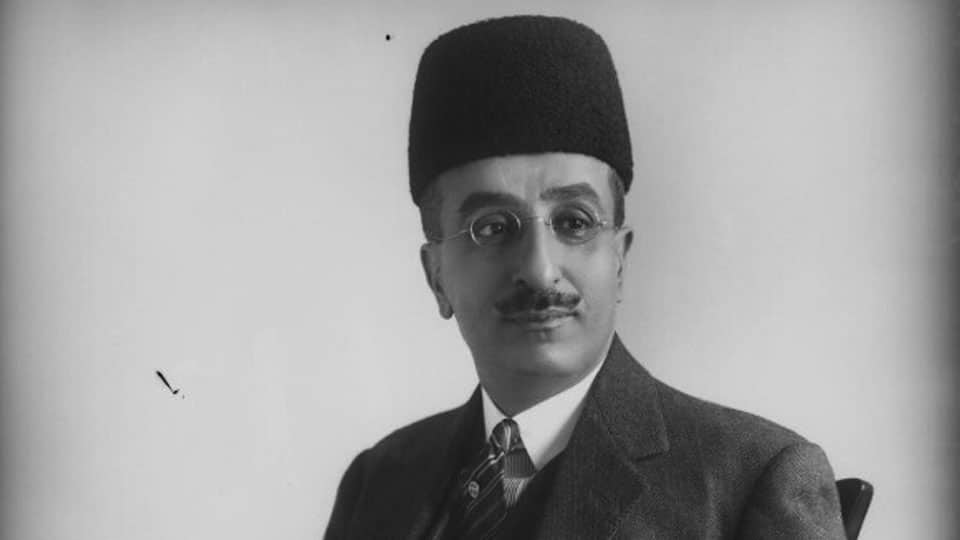
October 24th was the 137th birth anniversary of Sir Mirza Ismail, one of the Dewans of the erstwhile Mysore State who later went on to become the Dewan of the Princely States of Jaipur and Hyderabad too.
To mark this event, the Anjuman-E-Hadiqatul Adab, Mysuru, conducted a webinar that was well-received by the large number of viewers who logged in. I can say with some confidence that the Anjuman requires no introduction to most Mysureans because it is well-known for the annual Eid Milan get-together which it has been hosting over the past fifteen years to promote communal harmony and camaraderie among people of different faiths.
This event is as old as my column is because it is with my report of the first Eid Milan, which I filed for Star of Mysore, that my column was born! However, this year’s Eid Milan unfortunately could not be conducted because COVID-19 wiped out all celebrations from the entire face of this earth. Let’s all hope that things will change for the better before it is time to hold the Eid Milan next year.
Niranjan Nikam, the well-known senior journalist, who again does not need any introduction to most Mysureans, was the principal speaker at the webinar. He spoke on ‘The Unknown side of Sir Mirza Ismail,’ a topic which I suggested because I felt that by being slightly unusual, it would certainly be a crowd-puller! And Niranjan rose up to the expectations of his large virtual audience admirably well. Through some very painstakingly collected and well-curated references, Niranjan brought out many very interesting anecdotes from the life of Sir Mirza which were very noteworthy because I don’t think they are known to present day Mysureans.
Although it is understandable and expected too, that any speaker worth his salt will come well-informed and well-prepared for his talk, it quickly became evident to me that Niranjan was privy to much inside information which left me more than a little amazed. Take for instance the revelation that upon his death, the body of Sir Mirza that had already been interred was once again exhumed when there was a hue and cry from many grieving members of the public that they did not get a chance to see it and pay their last respects to their dear leader.
The body was once again displayed on a platform of sand for many more hours till late in the night and till all the people assembled there were satisfied that they had paid their homage to the man before it was interred into the grave once again. I have never heard of anything like this having happened, anywhere in the world in connection with the death of any public figure. DVG, the well-known Kannada writer, in his account about Sir Mirza has said that among the mourners was a frail old lady who was weeping bitterly saying that Sir Mirza, once while on his morning rounds, in response to her humble plea summoned one of the municipal engineers and ordered him to immediately provide a water tap to the street she lived in!
R.K. Narayan, the famous writer says in his autobiography, ‘My Days’ on page 138 that when his writing was not very paying, with him having got just 40 pounds for his book ‘The Dark Room’, it was Sir Mirza who got him a free railway pass and a government grant and commissioned him to write his book on Mysore, which Narayan was keen on writing.
As Niranjan’s talk progressed, the pieces of a most interesting jigsaw puzzle began to fall in place one by one. Niranjan revealed that his wife Pamela and he were associated for over ten months with the production of a book on Agha Aly Asker, the paternal grandfather of Sir Mirza, written by Sir Mirza’s very charming and graceful nephew Maj. Mohammed Mirza’s wife Syeda Mirza who stays in Bengaluru. The book which the speaker had brought with him, says that Sir Mirza who shared a very close working association and more significantly a very intimate friendship with the then Maharaja of Mysore, Sri Nalwadi Krishnaraja Wadiyar, would not have been a part of the history and growth of Mysore if his very enterprising grandfather, Agha Aly Asker, as a sixteen-year-old lad had not overheard a conversation between two people who were sipping tea in a chaikhana at his hometown, Shiraz in Iran. Learning that there was a great demand for Arab horses in the court of the Maharaja of a distant kingdom called Mysore, he decided to try his luck in selling them where they were in demand. So, he wasted no time in buying two hundred fine steeds and setting sail with them to India from Iran in the year 1824. The most surprising fact is that every one of those two hundred horses survived this long and arduous journey over sea and land, reaching Bangalore, alive and kicking!
The man who sold the horses to the Maharaja endeared himself to his customer and settled down in Bangalore which soon became his ‘Karmabhumi’ according to the writer Syeda Mirza. At that time Mummadi Krishnaraja Wadiyar, the then Maharaja of Mysore was about to become a victim of the very vicious Doctrine of Lapse imposed on Indian royalty by a very scheming British regime by which it could annex any kingdom if the ruler did not have a direct heir. It is reported that Agha Aly Asker became very close to the Maharaja because he could through his good relationship with Sir Mark Cubbon, the British Commissioner, get the Crown to restore the kingdom’s reins into the Maharaja’s hands, which understandably must have been a very difficult task. Meanwhile Sir Mark Cubbon commissioned Aly Asker to build more than a hundred bungalows around High Grounds, Richmond Town and the Bangalore Cantonment, many of which still stand in testimony to his abilities. We also have the Ali Asker Road named after him in Bengaluru on which his own house too still stands, although in a very vestigial state.
The close relationship between his family and the Mysore royal family continued down the line with his grandson, Sir Mirza Ismail becoming the classmate of the young Maharaja Sri Nalwadi Krishnaraja Wadiyar at the private royal school that was being run in the Summer Palace in Bangalore. Sir Mirza, who graduated from the Central College, Bangalore in the year 1905 and held many high posts was the first Indian to become the Private Secretary to the Maharaja. At the age of forty-two, he also went on to become the youngest Dewan of the State of Mysore in the year 1926 after A.R. Banerjee relinquished office.
His love for Mysore was so intense that in a speech that was aired on All India Radio, which can still easily be found on its archives in the internet, Sir Mirza says: I want Mysoreans to wash with Mysore soap, dry themselves with Mysore towels, clothe themselves in Mysore silk, ride Mysore horses, eat abundant Mysore food, drink Mysore coffee, sweetened with Mysore sugar, equip their houses with Mysore furniture, light them with Mysore lamps and write on Mysore paper!
Sir Mirza in his autobiography, ‘My Public Life’ says that the passing away of his dear friend, the Maharaja was the greatest sorrow that he had known! Towards the last phase of his active public life Sir Mirza seemed to have lapsed into a slightly disillusioned frame of mind. Here in Mysore he was seen by his detractors as a Muslim who was unusually close and influential with a Hindu Maharaja only because of his childhood friendship. At Jaipur he was seen as anti-Hindu while at Hyderabad he was seen as anti-Muslim because he did not support its existence as an independent State, without integration into the Indian Union!
It is said that once when the Maharaja and he were doing their morning rounds together on horseback, Sir Mirza, for reasons best known to him, expressed his desire to step down from his post. The Maharaja smiled and pointing towards the Chamundi Hill said: “You can do it when I go there.” He meant the cremation ground at the foot of the hill! And, that is how it was. Sir Mirza’s death came calling at the age of seventy-five while he was still very active. His demise was mourned not only here at home but across the world too, with newspapers in many countries writing about his very productive life.
Reporting on Sir Mirza’s resignation as Dewan of Mysore, The Ceylon News on May, 12th, 1941 said, Truth is a paradox and so is greatness. Sir Mirza too was a man of paradoxes. He was an autocrat with democratic instincts. A dictator with a weakness for having a constitution. A capitalist with socialist leanings. An idealist with an intense practical outlook. A dreamer with the astute mind of a businessman. A most charming man but a very stern and strict official. A perfect host but an indifferent friend. And he had no bosom friends, except the late Maharaja of Mysore!
The most amazing thing that Niranjan revealed in his talk was that the grand-old-man of India, Sir C. Rajagopalachari, fondly known as Rajaji, the first Indian to become the Governor General of India, at the time of the imminent partition told Sir Mirza to accept the invitation of Mohammed Ali Jinnah and go over to Pakistan. When a shell-shocked and very outraged Sir Mirza angrily asked him why, he said, “that way we will have someone in Pakistan who will love India and thus ensure that the Pakistanis too will do the same!” A wry but a terrific compliment indeed !
e-mail: kjnmysore@rediffmail.com
source: http://www.starofmysore.com / Star of Mysore / Home> Columns, Over A Cup of Evening Tea / November 07th, 2020
Premji pipped HCL Technologies’ Shiv Nadar, who had earlier topped the list collated by Hurun Report India and Edelgive Foundation, by a wide margin.
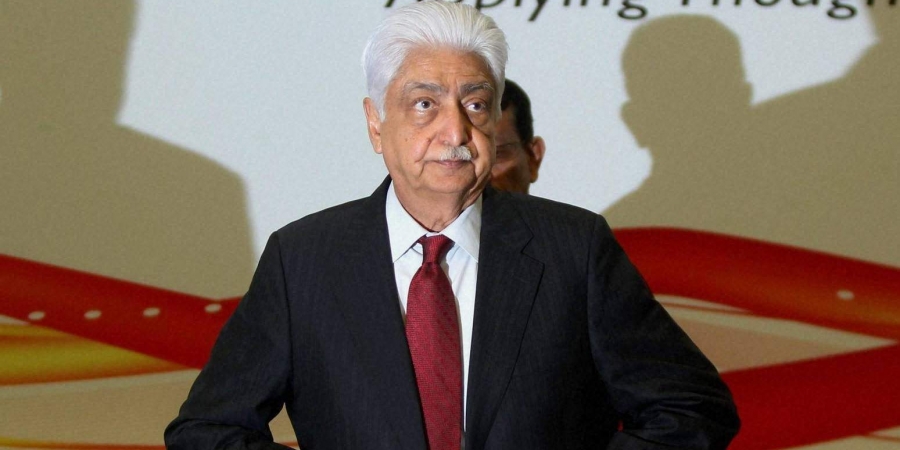
Wipro Chairman Azim Premji (File Photo | PTI)
Mumbai :
IT major Wipro’s Azim Premji donated Rs 22 crore a day or Rs 7,904 crore in a year to emerge as the most generous Indian in FY20 and top a list of philanthropy.
Premji pipped HCL Technologies’ Shiv Nadar, who had earlier topped the list collated by Hurun Report India and Edelgive Foundation, by a wide margin.
Nadar’s donations stood at Rs 795 crore for FY20 as against Rs 826 crore in the year-ago period.
Premji had donated Rs 426 crore in the previous fiscal.
Richest Indian Mukesh Ambani of Reliance Industries retained the third spot among the list of givers by donating Rs 458 crore as against Rs 402 crore a year ago, it said.
The raging pandemic had the corporate honchos repurposing their donations to fight the COVID infections, and the top giver on this turned out to be Tata Sons with a Rs 1,500- crore commitment, followed by Premji at Rs 1,125 crore and Ambani’s Rs 510 crore.
A bulk of the corporate commitments seemed to be given to the PM-CARES Fund, with Reliance Industries committing Rs 500 crore, and Aditya Birla Group donating Rs 400 crore, the report said.
It can be noted that Tatas’ commitment also includes a Rs 500 crore donation to the newly created fund.
Premji’s generosity pulled the total donations up by 175 per cent to Rs 12,050 crore in FY20, the list said.
Azim Premji Endowment Fund owns 13.6 per cent of the promoter’s shareholding in Wipro and has the right to receive all money earned from promoter shares, the report said.
The number of individuals who have donated more than Rs 10 crore increased marginally to 78 from the year-ago period’s 72, the report said.
With a donation of Rs 27 crore, Amit Chandra and Archana Chandra of ATE Chandra foundation are the first and only professional managers to ever enter the list.
The list has three of Infosys’ co-founders with Nandan Nilekani (Rs 159 crore), S Gopalkrishnan (Rs 50 crore) and S D Shibulal (Rs 32 crore).
The list of 109 individuals who have donated over Rs 5 crore has seven women, led by Rohini Nilekani’s Rs 47 crore.
Education is the highest beneficiary sector with 90 philanthropists, led by Premji and Nadar, donating Rs 9,324 crore, the report said, adding healthcare came second with 84 donors and was followed by disaster relief and rehabilitation with 41 donors.
The financial capital led by donor count at 36, followed by New Delhi at 20 and Bengaluru at 10.
E-commerce firm Flipkart’s co-founder Binny Bansal was the youngest donor at 37 with a commitment of Rs 5.3 crore and the average age of the donors on the list was 66 years, it said.
source: http://www.newindianexpress.com / The New Indian Express / Home> Business / by PTI / November 10th, 2020
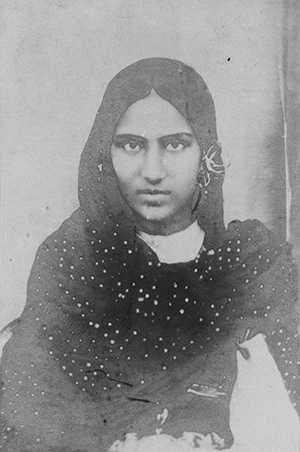
Syeda Muhammadi Begum was the first woman in the Indian sub-continent to be the editor of a weekly magazine,‘Tehzeeb-e-Niswaan’. The Urdu magazine was dedicated to emancipate the women. The magazine came out with its first edition on 1st July, 1898.
Muhammadi Begum started her work along with her husband Mumtaz Ali. Mumtaz, who had also written a book stressing upon the rights of women, ‘Huqooq-e-Niswaan’, was a Darul Uloom, Deoband educated Lahore based publisher. He was a close associate of Sir Syed Ahmad Khan during the later years of the leader of Aligarh Movement. In fact, a hostel has been named after Mumtal Ali in AMU. Muhammadi and her husband realised that its was important that Muslim women also access modern education along with Muslim men. It must be kept in mind that when the magazine was launched Aligarh College was only a boys institution and there was no women’s college in Aligarh.
In fact, Sir Syed Ahmad Khan disagreed with Mumtaz and Muhammadi on women’s education. It was not until the demise of Sir Syed that they actually launched the magazine for women.
Muhammadi Begum, born in 1878 in Shahpur, Punjab, married Mumtaz Ali in 1897 after the death of his first wife. Syed Muhammad Shafi, father of Muhammadi, was the Principal of Wazeerabad High School and ensured that his daughters received modern education. In fact, Muhammadi used to play cricket and ride horses as well in those days when women were kept inside homes. When she married Mumtaz, he was already owning a publishing house and a printing press in Lahore.
Within a year, Muhammadi learned the art of publishing, editing and proofreading from her husband. She could read English, Hindi, Urdu, Persian and Arabic. Soon the first Urdu weekly dedicated to the cause of women was launched, ‘Tehzeeb-e-Niswaan’.
As expected, people did not take such progressive magazine positively. Muhammadi and Mumtaz used to send free complimentary copies to the well known educated people. In return they would receive the copies back along with letters abusing Muhammadi. The magazine picked very slowly and even after three months only 70 people subscribed to the magazine, after three years 345 and after five years 428.
Muhammadi had one son, Imtiaz Ali, whom he used to affectionately call Taj. She used to write stories, poems, plays and lullabies especially for him. She trained him to be a man of literary taste. Imtiaz grew up to edit the magazine and established himself as one of the greats of Urdu literature.
Muhammadi later launched another magazine for women, ‘Musheer-e-Madar’, in 1905. Which did not survive much after her death. She also established schools for women. A very interesting experiment carried out by Muhammadi was of an all-Women shop. This shop was operated by the women and for the women and no man was allowed inside the shop for any work. Interestingly, the title of Ashraf Ali Thanvi’s Bahishti Zewar is inspired by one of the poems written by Muhammadi.
From 1897, Muhammadi’s life was busy with social work. She edited magazines, wrote essays, stories, poems and held public meetings to emancipate the women of India. This hard work took a great toll on her health and left this world at a young age of 30, in 1908.
(Author is a well known historian)
source: http://www.heritagetimes.com / Heritage Times / Home> Women / by Saquib Salim / September 14th, 2020
Jamia Millia’s Prof. Imran Ali adjudged India’s number 1 scientist by University of Stanford
The list has been published in the globally renowned journal PLOS Biology. Prof. Ali is at 24th rank in the world while number one in the country. PLOS Biology has published the list of 68,80,389 (Sixty Eight Lakh Eighty Thousand Three Hundred Eighty Nine) scientists excelling in different scientific fields in the research paper entitled “Updated science-wide author databases of standardized citation indicators” authored by John P A Ioannidis et al, an India Today report added.
Apart from Prof. Ali many elite researchers from Jamia Millia Islamia secured top 2% position in the list of 60 lakh plus Global Scientists. Prof. Faizan Ahmad, INSA Senior Scientist at the Centre for Interdisciplinary Research in Basic Sciences has been adjudged as 4th top scientist in the country in the field of Biophysics. Other elite scientists from the university who secured their names in the coveted 2% top scientists list are as follows:
Prof. Mohammad Sami, Centre for Theoretical Physics: All India Rank: 10 in Nuclear & Particle Physics
Prof. Anjan Ananda Sen, Centre for Theoretical Physics: All India Rank: 31 in Nuclear & Particle Physics
Prof. Sharif Ahmad, Department of Chemistry: All India Rank: 1048 in Polymers
Prof. Haseeb Ahsan, Faculty of Dentistry, All India Rank: 377 in Biochemistry & Molecular Biology
Prof. Sushant Ghosh, Centre for Theoretical Physics; All India Rank: 782 in Nuclear & Particle Physics
Prof. Tabrez A. Khan, Department of Chemistry; All India Rank: 831 in Environmental Sciences
Dr. Rafiq Ahmad, Ramalingaswami Fellow, Centre for Nanoscience and Nanotechnology; All India Rank: 1182 in Analytical Chemistry
Dr. Atiqur Rahman, Department of Geography, All India Rank: 1219 in Geological & Geomatics Engineering
Dr. Abid Haleem, Department of Mechanical Engineering, All India Rank: 1422 in Business & Management
Dr. Arun Kumar, Department of Physics, All India Rank: 1540 in Energy
Prof. Tokeer Ahmad, Department of Chemistry: All India Rank: 1687 in Materials
Dr. Md. Imtaiyaz Hassan, Centre for Interdisciplinary Research in Basic Sciences; All India Rank: 1746 in Biophysics
Professor Najma Akhtar, Vice-Chancellor, Jamia Millia Islamia expressed her happiness and congratulated all the scientists as they brought laurels to the University exactly when it was celebrating 100th years of its foundation. This array of scientists once again proved that JMI is excelling well in both high-quality research and teaching, she said.
source: http://www.varthabharati.in / Vartha Bharati / Home>India / by Vartha Bharati / November 06th, 2020
Khushboo Mirza was part of the dedicated teams of Chandrayaan 1 and Chandrayaan 2 missions.
Khushboo has reached such heights that schools and colleges in Uttar Pradesh invite her to give talks. Photos: By special arrangement
Chaugori Mohalla is a small Muslim neighbourhood in Uttar Pradesh’s Amroha town, about 200 km from Delhi. To reach the place, one needs to get off NH-24 from Itarsi, about 40 km before Moradabad, and a bumpy 10-km drive on a rough and dusty road would lead to the destination.
The narrow lane has old concrete houses with Urdu nameplates. Men wearing skull caps and women clad in burqas still give the locality a traditional look. Amroha, which is inhabited by both Hindus and Muslims, is called Aman Ki Nagri (town of peace). It has never witnessed a communal riot.
Hailing from this nondescript peaceful town is a young woman, Khushboo Mirza who is locally known as the woman who went to moon. Not for nothing, she has now reached the position of a director-level grade of Scientist F at the Indian Space Research Organisation (ISRO) and was part of the teams of Chandrayaan 1 and Chandrayaan 2 missions.
Khushboo is thrilled over her recent promotion which means she is just two levels below that of the position held by Abdul Kalam and the incumbent ISRO chairperson, Dr K Sivan.
But her life was not without troubles. Born on July 24, 1985, Khushboo lost her father Sikandar Mirza when she was just seven years old. In an unusual move, her mother Farhat broke religious norms to run her husband’s petrol pump to send her children to school. Khushboo studied in a Hindi-medium school till Class 10. She applied for B.Tech at Aligarh Muslim University (AMU) and bagged the seat under the sports quota as she was a volleyball player.
Khushboo at work at an ISRO lab
When Khushboo graduated in 2006, she was offered a software engineer job by American multinational company Adobe. But she applied to ISRO as she wanted to serve “Indian Science”. After joining the space agency, she was first drafted into the dedicated team for the Chandrayaan 1 mission in 2008. Khushboo received the ISRO Team Excellence Award in April 2015. She was also a part of the Chandrayaan 2 mission in 2019.
Even when she was accomplishing achievements in the space, her mother had to face criticism from some of the villagers. But Farhat ignored them and travelled with her daughter to ISRO training programmes across the country.
Khushboo then sought Farhat’s permission to shed the burqa and wear jeans to work. “She wanted to wear jeans, and I allowed her,” Farhat said. “In the absence of her father, and given the fact that she had to travel miles, many people said a lot of unkind things. But I told my daughter to work hard,” added Farhat.
Khushboo maintained the orthodoxy and tradition, and followed religious norms, but they had no impact on her work.
“I do follow our religion and do Namaz five times a day, besides observing fast during the fasting period. But I also wear western clothes. We belong to a progressive family, where modernity can exist along with tradition,” said Khushboo, who once celebrated Eid with her colleagues in an ISRO lab.
She has reached such heights that schools and colleges in Uttar Pradesh invite her to give talks. She keeps telling children, particularly girls, to concentrate on education which alone can provide them with a good future. She has also impressed many Muslim girls to consider education seriously. Khushboo feels that the necessary facilities for primary and high school education in the villages must be stepped up.
Khushboo with her mother Farhat Mirza
Many people in Uttar Pradesh think that she had made a journey to the moon and congratulate her and this why she is called the Moon Girl. Khushboo has emerged as a Muslim icon and a woman icon in Uttar Pradesh. Neither Khushboo nor her family members stereotype women, especially Muslim women. They believe that anyone in the country can fare well if they are provided with a good education.
With education and hard work, success is bound to come. There is no need to bring in religion or orthodoxy here, she said. “Times have changed and the attitude of people towards Muslim girls also needs to change. Our families do educate us.”
The success story of Khushboo Mirza is expected to inspire girls across the country and persuade families to educate their children, raising hopes of a better future not just for these families but the whole country.
source: http://www.thefederal.com / The Federal / Home> Features / by R. Rangaraj / July 19th, 2020
Asman Khan, a 21-year-old female Congress candidate from Jaipur, recently became one of the city’s youngest councillors. Contesting from ward number 81 in Jaipur Heritage Municipal Corporation elections 2020, Khan won the seat in her first attempt .
Here are some things you must know about Asman Khan:
• Coming from a middle-class family, Asman Khan is the middle child among six brothers and sisters. She says she has received immense support from her family. ” I was scared initially but my family supported me “
• Her father Salim Khan has been associated with the Congress party as a party worker for quite some time now. He even had plans to contest the municipal elections himself. However, their ward became reserved for women. Consequently, he convinced his daughter to contest elections.
•Khan is currently an undergraduate student a Muslim Girls Degree College, Jaipur, and will take her final year exams soon . She will devote her entire attention to her ward’s welfare only after taking her final exams.
• Asman Khan became one of the youngest councillors in her first attempt. Describing her decision to contest elections as a “sudden” one, she told Times of India , “I always wanted to serve the public and this election has given me an opportunity to do so.”
• Talking to News18, Khan said that although there were a lot of contenders for the post, she emerged as a favourite because she is a young student.
• Khan has mentioned that she received a lot of love from her ward’s members during her campaigning. She also ensured that the public voiced their plight to her.
• As per Asma Khan, the major everyday problems being faced by her ward include mismanagement of garbage, sewerage, and dysfunctional street lights. She also wants to ensure that Muslim girls in her ward receive adequate training and opportunities. Khan hopes to work extensively for the development of her council in the next five years.
• Asman Khan has plans to pursue a post-graduation degree in humanities. She also aims to further her political career and ambitions in the future. Picture Credits: Times of India
Tarini Gandhiok is an intern with SheThePeople.TV.
source: http://www.shethepeople.tv / She The People / Home / by Tarini Gandhok / November 04th, 2020
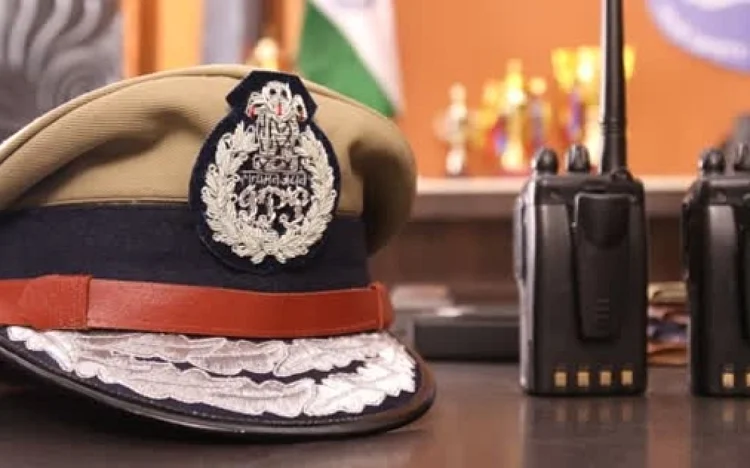
Twenty police officers of the state police will be awarded President Medal for their exemplary work in police department. Awards will be given in two categories: Vishishit Sewa and Sarahaniya Sewa categories.
The DGP announced the awards and congratulated the awardees for their achievements.
The Vishishit award will be given to the ADG training and the director of the MP Police academy Bhori Anuradha Shankar, inspector and Liberian DrFarid Vazmi, inspector and steno in PHQ Rakesh Mohan Dixit and Bharat Kumar Bhawsar.
The Sarahaniya Sewa Award will be given to AIG RRS Parihar posted at PHQ, deputy commandant of 23rd SAF Shanu Aftab Ali, SP radio training schoolIndore Santosh Kori, ASP narcotics Indore Dilip Kumar Soni, inspector Deepak Kadam, head constable posted in 7th SAF Bhopal Seetaram Tiwari, head constable posted in Pawai of Panna district Pyare Garg, head constable crime branch Bhopal Rajkumar Goutam, constable Mangal Singh Yadav posted in 7th SAF Bhopal, constable Rajesh Kumar Pandey posted in 25th SAF Bhopal, constable posted at in administration section at PHQ Ravi Naresh Mishra, Subedar Sunil Kumar Tiwari and Balram Singh Rajput posted at PHQ, inspector Ramraja Gupta of Hosangabad, inspector posted in EOW Bhopal Rajiv Choudhary and sub inspector Anil Kumar Nigam.
source: http://www.freepressjournal.in / The Free Press Journal / Home> Bhopal / by Staff Reporter / August 14th, 2020
Her research group’s interest in the malaria parasite is driven by the desire to understand (a) the molecular workings and functions of the relict plastid (apicoplast) of Plasmodium, (b) mechanisms of protein translation employed by Plasmodium organelles and (c) human genetic factors and susceptibility to severe P. falciparum malaria in endemic and non-endemic regions of India.
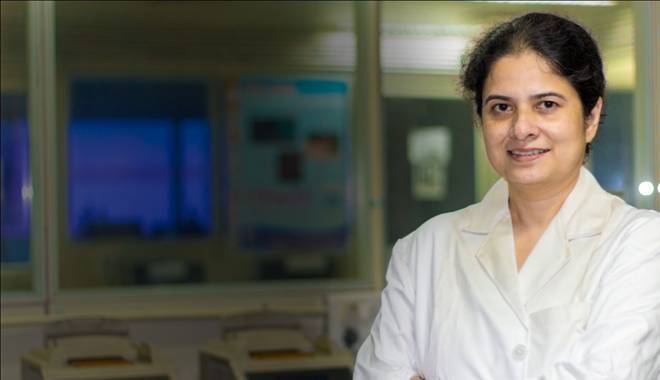
Dr. Saman Habib, Chief Scientist and Professor (AcSIR) in Molecular Biology Division, CSIR-CDRI, Lucknow brought the laurels to the Institute again through her outstanding work for understanding the malaria parasite.
She is elected as fellow of Indian National Science Academy, New Delhi.
Her research group’s interest in the malaria parasite is driven by the desire to understand (a) the molecular workings and functions of the relict plastid (apicoplast) of Plasmodium, (b) mechanisms of protein translation employed by Plasmodium organelles and (c) human genetic factors and susceptibility to severe P. falciparum malaria in endemic and non-endemic regions of India.
Other important honours and awards in her credit:
Fellow of Indian Academy of Sciences, Bangalore (2016)
Fellow of The National Academy of Sciences India, Allahabad (2015)
National Women Bio-scientist Award, Department of Biotechnology, Govt. of India (2012)
Prof. BK Bachhawat Memorial Lecture Award, National Academy of Sciences, India (2008)
CSIR Young Scientist Award, CSIR (2001)
source: http://www.smestreet.com / SME Street / Home> News> Covid-19 / by SME Street Edit Desk / October 22nd, 2020
Yusufpur- Mohammadabad (Ghazipur) , UTTAR PRADESH / NEW DELHI :
As Jamia celebrates 100 years of its foundation, we extend our gratitude to Dr Mukhtar Ansari for his contribution
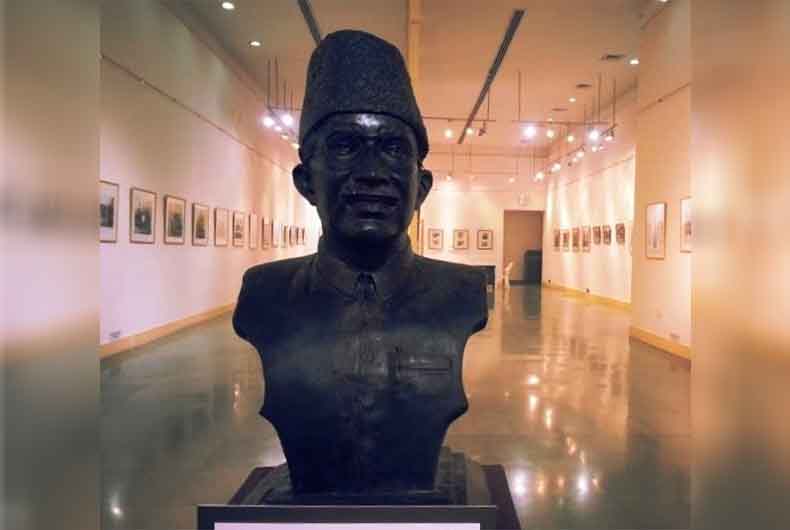
Dr M A Ansari’s bust during a photo-exhibition at M.F. Husain Art Gallery, JMI on 24 Dec. 2014. (Photo Courtesy: Aniket Dikshit)
The three most important persons who, undoubtedly, not only played the most significant role in the foundation of Jamia Millia Islamia, but also shifted it from the makeshift arrangement of Aligarh to Delhi’s Karol Bagh on 7 July, 1925, are Hakim Ajmal Khan, Abdul Majeed Khwaja and Dr Mukhtar Ahmad Ansari.
In view of upheavals faced in Aligarh, Jamia was shifted but problems existed. The problems that made many think that Jamia will not survive long. However, the trio’s efforts were no way trivial. They set the future course of Jamia as ‘an institution with a difference.’
Mukhtar Ahmad Ansari’s consistent efforts bore fruits. Not only did Jamia get its first house in Karol Bagh in 1931, it was also shifted to a much bigger plot of land of its own in 1936 in its present location in South Delhi’s Okhla, then a ‘non-descript village’ where now it has a panoramic sprawling campus.
However, the journey was not as simple as it might look to a casual viewer. Within those ten years, much sweat and blood went in to nurse the tender sapling whose seed was sown in Aligarh on 29 October, 1920. Dr Ansari’s contribution through all these years is one of the most unforgettable and astonishingly stout chapters in the history of Jamia Millia Islamia.
Born on 25 December, 1880 in Yusufpur-Mohammadabad, Ghazipur in eastern Uttar Pradesh, son of Haji Abdur Rahman and Ilahan Bibi, Mukhtar Ahmad Ansari, received primary and secondary education at Ghazipur and Allahabad, then studied medicine and graduated from Madras Medical College. He went to England from where he achieved M.D. and M.S. degrees. He earned the Master of Surgery degree from the University of Edinburgh in 1910. Being a top-class student and a pioneering surgeon he worked in some well-known hospitals of England where “he had a successful medical career”.
Dr Ansari had everything – money, fame, fortune, and life that could be lived luxuriously. This brief background is provided to underscore the significance of his passion, devotion and commitment not just for Jamia but for the country’s struggle for freedom as those were the years of heightened activism for independence during which Dr Ansari – through his active involvement in and unwavering support for freedom, emerged as a committed nationalist leader.
From England, Dr Ansari returned to India in 1910 and started medical practice at Delhi. His contact with leaders like Motilal Nehru, Hakim Ajmal Khan and Pandit Jawaharlal Nehru rekindled in him the desire to take part in the country’s political developments.
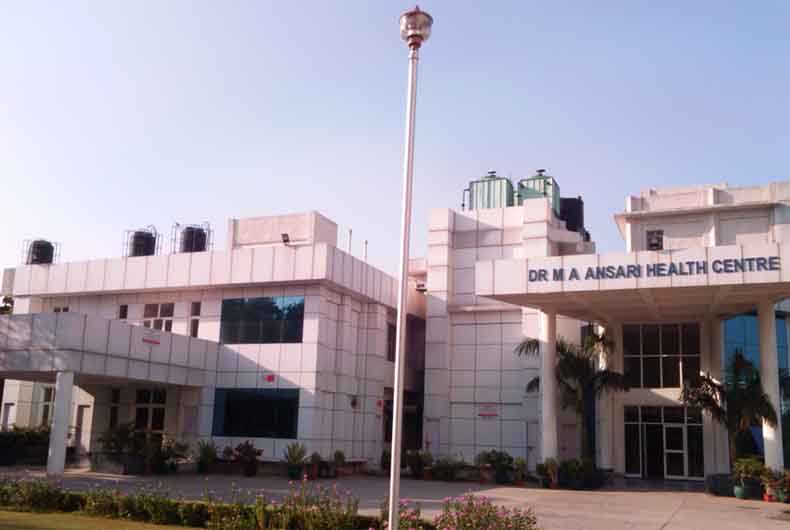
Dr M A Ansari Health Centre, Jamia Millia Islamia. (Photo: Manzar Imam)
During the Balkan Wars of 1912-13, he led a Medical Mission to Turkey to provide medical aid to the Turkish army. “The mission”, according to Dr. Burak Akçapar, Ambassador of the Republic of Turkey to India, “not only established two field hospitals, but also did other humanitarian and political work.”
This was among his first political works which won the hearts and minds of the Turkish public and leaders which created a deep bond between Turkey and Jamia. Many Turkish leaders and prominent literary figures visited Jamia. The series of ‘Extension Lectures’ that began was his brainchild. It was on his invitation that famous Turkish scholars Dr Husein Raouf Bey (1933) and Ms Halide Edib (1936) and Dr Behadjet Wahbi of Cairo (1934) then delivered their lectures at Jamia.
His role in the Khilafat Movement was pivotal and his presence both in the Congress and Muslim League was equally felt. His Delhi house ‘Darus-Salam’ was a meeting point for leading Congressmen. For many years he was General Secretary of Congress and remained a member of the Congress Working Committee all through his life.
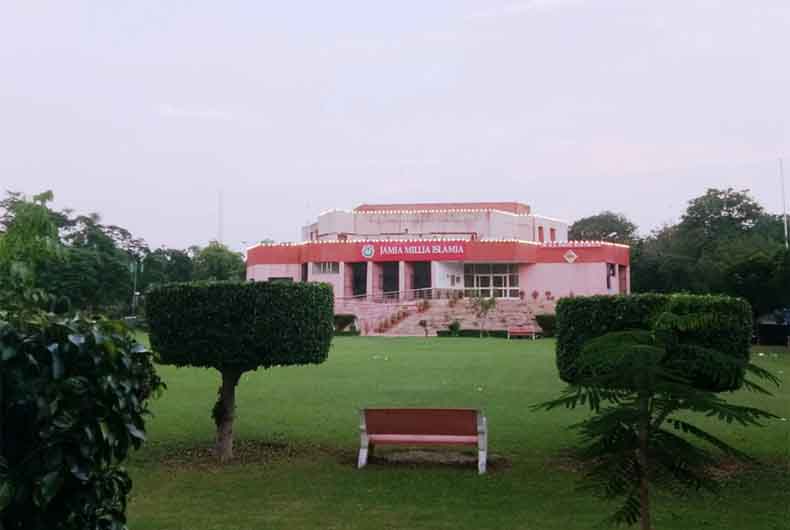
Dr M A Ansari Auditorium, Jamia Millia Islamia. (Photo: Manzar Imam)
Dr Ansari was the leader of the Khilafat delegation of 1920 which went to meet the Viceroy. He was also a member of the second delegation of Khilafat which went to England and other countries of Europe under the leadership of Maulana Mohammad Ali Jauhar. He was also president of the Delhi Khilafat Committee. During his presidential address at the Nagpur session of Muslim League in 1920 he demanded Swaraj.
When his name was proposed for the Secretary of the Foundation Committee of Jamia during its foundation, he requested not to appoint him for the post as it would require regular visits to Aligarh. Nevertheless, his interest in the activities of Jamia persisted.
Dr Ansari was among the front leaders of the Congress and was made its president in 1927. According to Prof Zafar Ahmad Nizami his name for the president of Congress was proposed at the instance of Mahatma Gandhi in 1924 who believed that “only he could make the efforts of Hindu-Muslim unity successful.”
Although Dr Ansari could not live long to see Jamia blossom into a beautiful university or see India breathing in freedom from the strangulating slavish life under the colonial rule, he had played his gigantic role both as a freedom seeker and as a founder of Jamia. He was a prominent member of the sixteen-member Foundation Committee formed on 29 October, 1920 to establish Jamia which would become a historic institution and the first one to be set up in response to call for boycott of the British Indian government-run, aided and supported academic institutions.
According to The British Medical Journal:
“As leader of the Congress movement, though at first opposed to the teaching of Gandhi on civil disobedience, he actively associated himself later with the various non-cooperative movements, and served at least one term of imprisonment.”
When it comes to Jamia as also to some other movements that were the currency of the 1920’s and 1930’s, it is very difficult to dissociate the trio of Hakim Ajmal Khan, Maulana Mohammad Ali Jauhar and Dr Mukhtar Ahmad Ansari, the “great Muslim trio of Indian politics”, as they were quite befittingly called so. However, each person has certain unique and individual personality traits and characteristics which separate him from others.
According to Dr Hamida Riaz (1988, p.119), Dr Ansari had a great passion for education. Initially, he highly appreciated Western education and culture and would keep himself completely away from what did not interest him. However, on the call of Mohammad Ali Jauhar, he participated in the medical delegation that went to Turkey and did a tremendous service. In a way, the beginning of international politics in India was made by Dr Ansari’s delegation.
Together with Hakim Ajmal Khan, Motilal Nehru and Maulana Azad, Dr Ansari formed a non-sectarian “Indian National Union.” He had opposed the Rowlatt Bill and participated in Home Rule and Non-Cooperation movements. In 1929, Dr Ansari formed the All India Muslim Nationalist Party. Besides Jamia, he was also associated with the foundation of Kashi Vidyapith, Benaras.
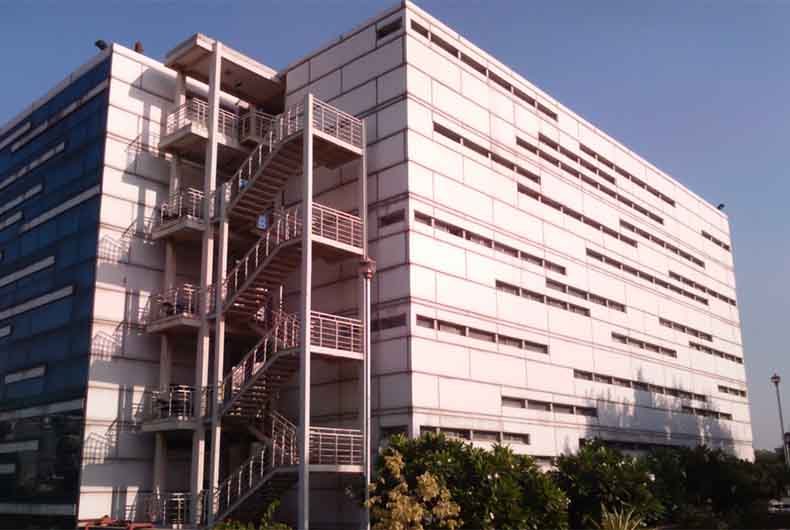
Faculty of Dentistry, Jamia Millia Islamia. (Photo: Manzar Imam)
Riaz (p.121) writes that all through his life he [Dr Ansari] “stayed away from sectarian groups” and continued his efforts to forge “Hindu-Muslim unity”. His wife Shamsun Nisa Begum too, was committed to the cause of women uplift.
Dr Ansari actively participated in the Jamia’s establishment, nurtured it, and, following the demise of Hakim Ajmal Khan in December 1927, served as its second Chancellor from 1928 to 1936. The financial needs that Hakim Sahab used to carry had fallen on his shoulder which he discharged diligently.
The “Ajmal Khan Fund”, set up exclusively for the purpose, was a result of his efforts. At a critical juncture when Jamia faced great financial crisis a Board of Trustees was created. Dr Ansari was appointed its chairman. It was at Gandhiji’s indication that industrialist Jamnalal Bajaj (1889-1942) was made its treasurer. Other bodies were also formed in which he was there.
As Chancellor of Jamia, Dr Ansari could not be an employee and Life Member of the ‘Anjuman Talim-e-Milli’. However, he extended all his support to all the bodies and continued to serve Jamia all his life. Remembering the services of Hakim Ajmal Khan and Dr Mukhtar Ahmad Ansari during a lecture in Jamia on 26 August 2014, former VC and renowned historian Prof Mushirul Hasan (d. 10 December 2018), terming the duo as the “real founders” of Jamia, had said, “Ansari raised money for Jamia and Hakim Ajmal Khan provided nobility and support.”
As mentioned earlier, Dr Ansari did not live long after Jamia was shifted to its present place in the national capital. He passed away on 10 May, 1936 and buried in the Jamia graveyard.
A radio speech which Dr Zakir Hussain had prepared for the 1936 Foundation Day of Jamia, which Dr Ansari could not hear as he passed away before it, sheds enough light both on the impact Dr Ansari had on Dr Zakir Husain and on his character and sphere of activity. It read:
[Dr Ansari] set out for a journey from which no one looks back…Dr Sahab’s personality was a fountain of blessings…a mainstay for anyone in times of need. His heart was a refuge where many would seek solace for their heartfelt grief.
As in life, in death too, he did not part ways from Jamia, writes Ghulam Haider, as he became the first among the founders of Jamia, to find his resting abode in Jamia Nagar where he was laid to rest three months before the primary madrasa of Jamia moved in.
Dr Mukhtar Ahmad Ansari, who died near Delhi on May 10th, at the age of 56, had been a member of the British Medical Association since 1909, and had gained distinction in India as a medical practitioner as well as in politics. In view of his services and to keep his memory as a prominent physician, Jamia has named its health centre and a big auditorium after him.
It was his sincerity for the national cause and his passionate commitment for Jamia that whenever Gandhiji would come to Jamia, he would definitely pay a visit to his grave. As Jamia celebrates 100 years of its foundation, we extend our gratitude to its architect for nurturing it with his consistent remedial care, unflinching commitment and great sacrifices!
[Sources: Celebrating India : Reflections on Eminent Indian Muslims 1857-2007, Meher Fatima Hussain (2009, Manak Publications, New Delhi), “Dr. Mukhtar Ahmed Ansari”, The British Medical Journal (Vol. 1, No. 3933 (May 23, 1936) p.1082, Mohammad Ali Jauhar, authored and published by Hamida Riaz (1988, Nagpur), Nuqoosh-e-Jamia (Jamia ki Kahani Jamia Walon ki Zabani or the Story of Jamia from Jamiites) by Ghulam Haider (2012, Maktaba Jamia Limited in collaboration with National Council for Promotion of Urdu Langue, New Delhi), www.jmi.ac.in.
Manzar Imam is a Ph.D. Candidate at Maulana Mohammad Ali Jauhar Academy of International Studies, Jamia Millia Islamia. He can be reached at manzarimam@rediffmail.com. The above article is ummid.com special series titled ‘Founders of Jamia Millia Islamia’. Read the first part here. To read the second article of the series click here. To read the 3rd article of the series, click here.]
source: http://www.ummid.com / Ummid.com / Home> India / by Manzar Imam, ummid.com / October 28th, 2020