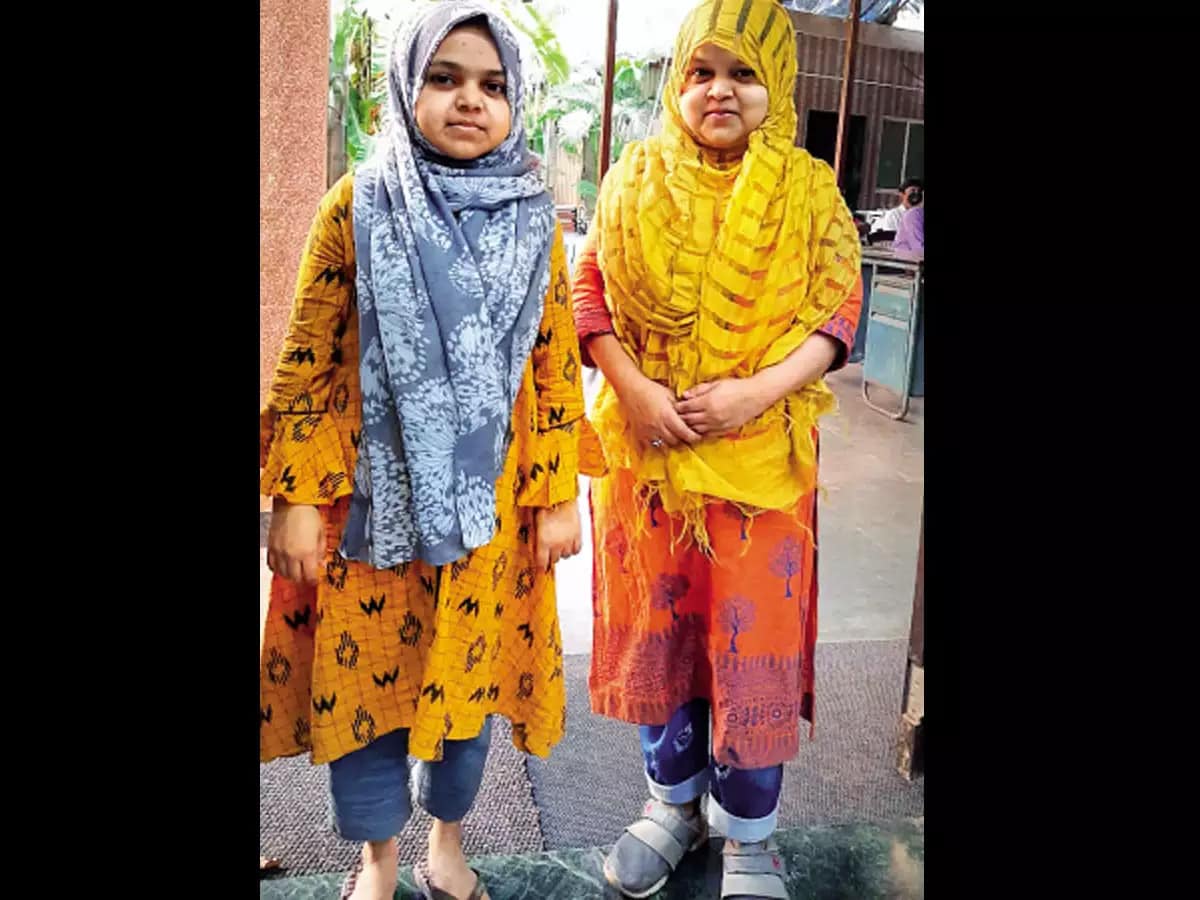
For years their diminutive stature made some wonder if they would do anything meaningful with their lives, but the Idrisi sisters—Zubaida (23) who is 3.5-foot tall and Humaira (22) who is 3.9—have already become mini-celebrities in their Nagpada neighbourhood. They qualified in this year’s medical entrance exam (NEET) and recently secured their MBBS admission; Humaira has got into Topiwala Nair Medical College at Mumbai Central and Zubaida at Government Medical College in Jalgaon.
The Idrisi sisters who live with three other siblings and parents—father Ahsanullah who is a tailor and mother Rukhsar a homemaker—in the crowded Kazipura near Nagpada junction could have not made it to the MBBS course but for a chance meeting with Ashfaque Moosa of Khidmat Charitable Trust last year.
A local NGO runs a dispensary in a corner of P T Mane Garden at Nagpada, which Zubaida and Humaira visited to pick up medicine for their grandmother. Moosa, who is called Ashfaque Bhai, was at the dispensary then and asked the two about their education. On hearing that they had abandoned their dream to be doctors and subsequently graduated in science from the nearby Maharashtra College, Ashfaque Bhai told them not give up on it. “If a six-footer needs 600 marks in NEET to get into MBBS, you need less than half of that,” he joked. On further enquiries, the sisters found their condition was covered in the reserved category of “differently disabled” and they could take a shot at NEET.
“Ashfaque uncle hamari gudiyon ke liye farishta bankar aae (Ashfaque uncle came as an angel for my dolls),” says the sisters’ burqa-clad mother Rukhsar. “He showed them the path and my beloved daughters never looked back since the day they met him.”
Ashfaque Bhai says the girls had full support of their poor parents but were discouraged from even trying to clear NEET. “Someone told them to become lab technicians or join BUMS, a Unani medicine course. But I saw the burning desire in them and that desire only needed a proper direction,” says Ashfaque Bhai who helps arrange scholarships for needy and deserving students.
Next, with a revived MBBS dream in their eyes, the sisters landed up at a coaching institute in Ghatkopar and were almost turned away by a staffer citing their “inadequate” height when the director saw them and asked them to wait. Their photographs were sent to the institute’s headquarters in Kota, which approved their admission with 60% concession in fees. Every day, the sisters would travel by crowded local trains from Byculla to Ghatkopar and back, till the lockdown began. They even took help of lectures on YouTube. “They got so involved in studies that I had to remind them about dinner and lunch,” says their mother. “My dolls have made us proud.”
Rukhsar says she and her husband found out about the insufficient growth hormones in Zubaida and Humaira after they turned five and stopped growing. One doctor said their treatment would cost over Rs 11 lakh. “We had no money to go for costly treatment but I wanted my daughters to get educated and stand on their feet as I didn’t want them to depend on anybody’s mercy or charity,” says Rukhsar.
Career counselor Kazim Malik, who knows the sisters well, says they will need to work hard to complete MBBS, which they have resolved to do to achieve great heights.
Mohammed Wajihuddin, a senior journalist, is associated with The Times of India, Mumbai. This piece has been picked up from his blog.
source: http://www.siasat.com / The Siasat Daily / Home> Featured News / by Mohammed Wajihuddin / November 30th, 2020
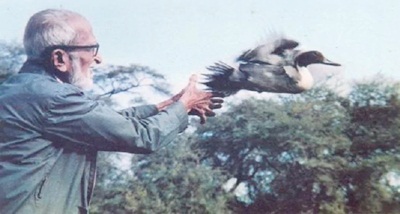
Today is the Birth Anniversary of renowned ornithologist Salim Ali. Born in Mumbai on 12th November in 1896, Sálim Moizuddin Abdul Ali was not only a bird lover but also a naturalist. He is often referred to as the ‘Birdman of India’. He was the first Indian to conduct systematic bird surveys across India and wrote several books that popularized ornithology in India. His research work is considered highly influential in the development of ornithology. He was a well-known environmental crusader who often stood for protecting the wildlife.
Salim Ali played a pivotal role in establishment of Bharatpur Bird Sanctuary (Keoladeo National Park) and prevented the destruction of what is now the Silent Valley National Park. Along with Sidney Dillon Ripley, he wrote the landmark ten-volume Handbook of the Birds of India and Pakistan, a second edition of which was completed after his death.
He was awarded the Padma Bhushan in 1958 and the Padma Vibhushan in 1976, India’s third and second highest civilian honours respectively. Besides the Padma Bhushan and the Padma Vibhushan, Ali received the Gold Medal of the British Ornithologists’ Union in 1967. He was the first non-British citizen to receive the honour.
source: http://www.newsonair.com / All India Radio (AIR), News Services Division / Home> News Highlights / November 12th, 2020
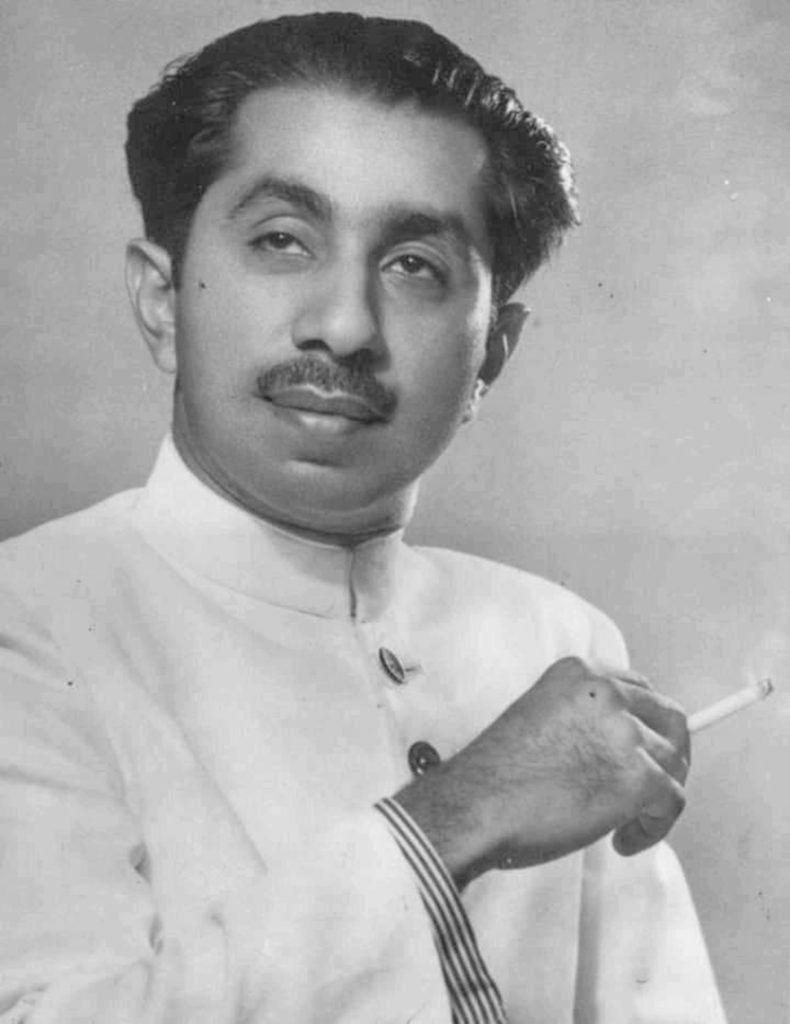
Allah Baksh Sumroo, a premier of Sindh province—equivalent to the current post of a chief minister—was a committed patriot, whom the Muslim League hated to the extreme. Sumroo’s story directly challenges the ongoing communal and divisive rhetoric where Muslims are projected as a comprador class that was wholeheartedly behind the Muslim League’s two-nation theory.
______________________________
The narrative that all Muslims got together to seek India’s partition on the basis of the two-nation theory is now a few decades old. It has acquired salience again, with some hyperventilating neo-nationalists reiterating that all Muslims are traitors as they joined Muhammad Ali Jinnah and his Muslim League to divide India. These people forget that a large number of Muslims, who consciously decided to stay back, had a choice—either to leave and be Pakistanis or stay back in India and choose their homeland. Many opted for the latter. A similar choice was made by many Hindus who decided to stay back in Pakistan. However, staying back in a democratic, secular and plural India was different from opting for a regressive and sectarian Islamist Pakistan. The future of both, who stayed behind, has proved that so tellingly.
Unfortunate political developments and the prevalent communal rhetoric in India has forced me to go back to the history afresh. There is a concerted campaign to malign all Indian Muslims as leftover Pakistanis, who are enemies within the country; the narrative is that these fifth columnists should be shunted out to Pakistan in the so-called national interest. But merely indicting all Muslims for the sake of petty majoritarian politics goes against the facts of history.
We are a nation obsessed with history, more often concerned with correcting the presumed historical wrongs than learning anything from the past. With this compulsive preoccupation, some of us live perpetually in the past. Even so, most people believe that Maulana Azad, an Independence-era leader, fought a lone battle for a united India, while a majority of Indian Muslims vouched for Muhammad Ali Jinnah, the founder of Pakistan, and his Muslim League. This has no factual basis and any extent of living in the past will help unravel actual facts.
To put the record straight, some unsung heroes from our recent history should be talked about. There are many historical characters that were crucial to countering the politics of hate and division of the country around the time of partition. Among them was Allah Baksh Sumroo, who served as a premier of the Sindh province—equivalent to the current post of a chief minister—for two terms between 1938 and 1942. Sumroo was a committed patriot, whom the Muslim League hated to the extreme. He belonged to a feudal Sindhi family but was known for a frugal living and commitment to democratic values. Sumroo wore khadi even as a young man of twenty. We hear about using flags as a power symbol so often these days, but he never used a flag on his official car even in those feudal and colonial times.
What is important to remember today is his commitment to undivided India. Sumroo emerged as a major challenge to the divisive politics of communalists of all hues, particularly the Muslim League. Azad was undoubtedly a national face, espousing composite nationalism, but he actually derived strength from such regional but powerful voices like Sumroo.
To go into the details of his massive anti-Muslim League politics would require a much longer discussion. Let me just refer to one of the most important episodes in the history of our sad partition of the country. The Muslim League passed a resolution recommending the creation of an independent state of Muslims on 23 March 1940 at Lahore. Soon, Sumroo organised a huge conference of patriotic Muslims between 27 and 30 April 1940 in Delhi, called the Azad Muslim Conference. According to some estimates, there were not less than seventy-five thousand people who gathered from all over India to condemn the Muslim League for its divisive politics.
Most of these people came from a large number of political and social organisations, largely representing the backward and artisanal sections of the Muslim society. This representation at the conference was an indicator that the Muslim League spoke for the ashraf, or the privileged sections of the Muslim society while the majority of Muslims—the ajlaf, or the backward sections—remained almost untouched by the League’s rhetoric. The British identified a collaborative section of the Muslim community, helped in forming the Muslim League but this section largely represented the affluent—the zamindars, and business and professional classes. The leadership that emerged in the League had little clue to the highly differentiated Muslim society they claimed to represent. Azad could see this early. Referring to Indian Muslims at the time, he wrote in his weekly Urdu language newspaper, Al Hilal, in 1912:
The most unfortunate part of their life is that they have a section of elite who are in the forefront and leading them. Those are the self-proclaimed leaders of the community. They have put the crown on their own head, with their own hands, instead of the masses doing the same. They indulged in all sorts of exhibitionism of power and the worst is show of their wealth. And by so doing they had converted the millat [class] of downtrodden men in their community as their slaves and camp followers. And now if anyone tries to question their validity as leaders or defy them, they are successfully suppressed and annihilated by those selfish leaders; as they have the power of money.
Sumroo’s presidential address at the Azad Muslim Conference in April 1940 also exposed the misplaced arguments of the League, particularly in the name of religion and culture. All through his speech he spoke extensively on the shared history and heritage, stressed on the compositeness of Indian nation and nationalism and emphasised that the compact between diverse communities cannot be severed. Strongly condemning the two-nation theory exponents, The Sunday Statesman of 28 April 1940 quoted him saying in his speech:
A majority of the 90,000,000 Indian Muslims who are descendants of the earlier inhabitants of India are in no sense other than the sons of the soil with the Dravidian and the Aryan and have as much right to be reckoned among the earliest settlers of this common land. The nationals of different countries cannot divest themselves of their nationality merely by embracing one or another faith. In its universal sweep Islam, the faith, can run in and out of as many nationalities and regional cultures as may be found in world.
He underlined the long history of shared heritage of Hindus and Muslims, as mentioned in a Hindustan Times report on the same day:
It is a vicious fallacy for Hindu, Muslim and other inhabitants of India to arrogate to themselves an exclusively proprietary right over either the whole or any particular part of India. The country as an indivisible whole and as one federated and composite unit belongs to all the inhabitants of the country alike and is as much the inalienable and imprescriptible heritage of the Indian Muslim as of other Indians.
Sumroo made these detailed references to the shared history and intermixing of Hindu and Muslim cultures over the centuries to counter both the League as well as those who were arguing for Hindutva majoritarianism. He was aware, like Azad, of the forces which threatened the future of united composite India. Sumroo needs to be talked about today more seriously to counter all those who threaten fellow Muslim citizens to go to Pakistan.
In his address, Sumroo provided a counter for another argument put forth by neo-nationalists today—that Muslims asked for Pakistan and once it was granted by dividing the country, all of them should have moved there. This would have settled the issue forever. All those who make such insinuations today need to know what popular Muslim leaders like Sumroo said of the creation of Pakistan:
It was based on false understanding that India is inhabited by two nations, Hindu and Muslim. It is much more to the point to say that all Indian Mussalmans are proud to be Indian nationals and they are equally proud that their spiritual level and creedal realm is Islam. As Indian nationals—Muslims and Hindus and others, inhabit the land and share every inch of the motherland and all its material and cultural treasures alike according to the measures of their just and fair rights and requirements as the proud sons of the soil.
Azad, too, sent a message of support to the Azad Muslim conference as he was not able to attend it. He expressed his solidarity with the conference and wished that the deliberations would be fruitful for the great cause of the freedom of the country and the Muslims.
This fight for composite and inclusive Indian nationalism, which looks so alarming and threatening today, is more than few decades old. Azad and Sumroo challenged these regressive and divisive forces in the 1930s and 1940s. They almost took the battle to the enemy’s camp by organising a huge conference in Delhi, which unnerved the Muslim League leadership. Sumroo was assassinated in 1943. It was suspected to be the League’s handiwork.
We can comprehend his stature and the sense of loss on his death by reading some of the reactions in contemporary press and also the pain expressed by several nationalist leaders. The Hindustan Times described him as follows:
… finest of Sindhis, one of the truest of Musalmans, one of the noblest sons of India who loved his peasants for he loved the land; and he used to wear khaddar even in the twenties, for he loved the poor. Both the Hindus and Muslims looked up to him as a leader … He had an all-India mind and in the midst of division and strife, pinned his faith on an independent united India, and dreamt the dream of the united State of Asia in the years to come …
His murder was seen as a national calamity by several papers. The Amrita Bazar Patrika called him “one of the most vigorous personalities, endowed with a high sense of duty and rare courage of conviction, who easily commanded the respect and admiration of all, even of those who differed from him on some or the other public questions.” Commenting on his death, the newspaper added, “A life so full of promise has been cut short. And India is much poorer today by the death of the young man of 42 whose sturdy patriotism and devotion to duty would be cherished long after the present unhappy situation has ended and India has come into her own.”
The right wing in India often says that Subhas Chandra Bose, a leader of the anticolonial struggle, did not find his rightful place in Indian history. I find it politically motivated and not really a sincere observation. It is people like Sumroo, who seem to be lost in our history records, even in the writings of the so-called liberal and Marxist historians, except for a chapter in a book by Shamshul Islam titled Muslims Against Partition of India.
Another prominent Muslim voice from the past, who can rightfully represent our composite nationalist ethos is Saifuddin Kitchlew, a Kashmiri freedom fighter whose family moved to Punjab. It was his arrest along with Dr Satyapal, a political leader, that triggered the protests leading to the Jallianwala Bagh massacre in 1919. Most of us are oblivious to his contributions as well. Kitchlew had also mourned the loss of Sumroo saying:
At this critical period of the freedom movement in the country the death of a man like Mr Allah Baksh is a thundering blow to the forces of nationalism. Mr Allah Baksh was a thorough going nationalist. Mr Allah Baksh is dead but his work will remain.
It is necessary to know about such men and women from our past as their profiles directly challenge the ongoing communal and divisive rhetoric where Muslims are projected as a comprador class that was wholeheartedly behind the League’s two-nation theory. Azad was surely the prime political figure, an Islamic scholar, who stressed on the composite nationalism. However, he was not fighting a lone battle against the Muslim League, as Jinnah wanted the British and the Muslims to believe. He was hated and derided as a show boy of the Congress party, precisely to show that most of the other Muslims and their leaders were with the idea of Pakistan. This falsehood needs to be exposed, particularly in the midst of the ongoing divisive politics.
S IRFAN HABIB is a historian and author. He was earlier the Maulana Azad Chair at the National University of Educational Planning and Administration, New Delhi.
source: http://www.caravanmagazine.in / The Caravan / Home> Commentary – History / by S Irfan Habib / July 28th, 2020
Aimed at helping the visually impaired, it fits into a smartphone’s port
Four students from the Indian Institute of Technology – Madras have come together to develop a handy device for the visually impaired.
The assistive device fits into the port of a smartphone and helps them to type, learn and read braille content. It also allows them to self-navigate through space and recognise people and objects.
Four students — Sundar Raman P., Adil Mohammed K., Shivam Maheshwari and Andrea Elizabeth Biju — got together to develop the device. While Sundar is a final-year electrical engineering student, Adil and Shivam are pursuing second- and third-year engineering design. Andrea is a second-year student of aerospace engineering.
The students improvised on an existing product that allows the visually impaired to read PDF files on their phone. But it is a cumbersome exercise as the reader must carry a separate device. Sundar said the aim was to leverage the smartphone’s capability, as most people carry one today.
The team came up with Cube, a compact device that fits into the smartphone’s charging port or earphone jack. It has four refreshable braille cells (24 dots) on one side and a camera on the other.
The camera on the device, along with the smartphone’s camera, is used to capture and process (computer vision) a wide field of view to provide the user navigation information through tactile braille cells about the proximity and nature of the obstacles.
The refreshable braille cells project symbols to convey time, proximity to obstacles etc. and help in learning and typing on the smartphone in braille.
Currently, the visually impaired rely on slow audio feedback to type. But Cube intends to change that, said Sundar. The device can be folded to the back of the phone using a flexible connector.
Vishnu Suresh, a fourth-year student of Integrated MA in English Studies, who tried it out, said being able to type on the phone was like typing on a braille typewriter. “It has a keyboard through which we can type the way we type on a braille typewriter. It is perfect,” he said
source: http://www.thehindu.com / The Hindu / Home> News> Cities> Chennai / by R Sujatha / Chennai – November 26th, 2020
Piraman Village (Bharuch District) GUJARAT / NEW DELHI :
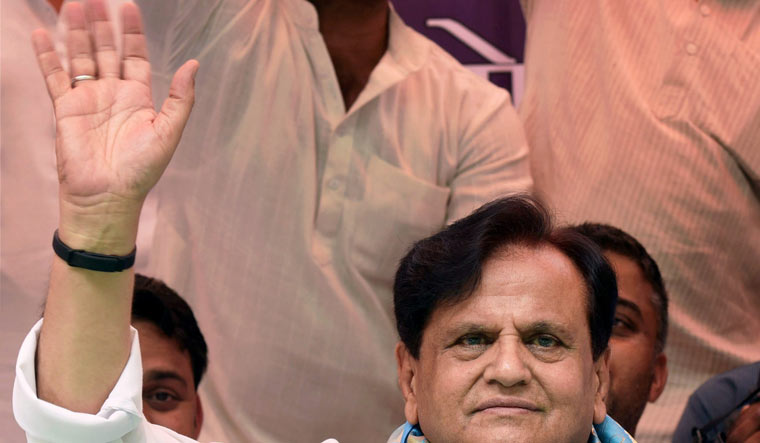
Ahmed Patel was one-point contact person for Congress leaders, workers from Gujarat
Ahmed Patel | PTI
When the COVID-19 pandemic started spreading in India in March, many journalists in Gujarat received a call from Ahmed Patel asking about their well-being and also that of their families.
“Hope you and your family are doing well. Do let me know in case any help is needed,” he said.
Even several Congress workers received a call from him. He personally called up a reputed hospital in Ahmedabad to book a room for his colleague, Rajya Sabha member Shaktisinh Gohil, who tested positive for COVID-19.
On Wednesday, when the nation lost Ahmed Patel of post-COVID-19 complications , for the Gujarat Congress, it is a loss that the party and its leaders cannot even imagine.
Ahmed Patel was the one-point contact person for the leaders and party workers from Gujarat. Ahmed Patel was accessible 24×7.
A three-time Lok Sabha member and five-time Rajya Sabha member, Ahmed Patel was a man who was in New Delhi but did not forget his roots in Gujarat and was ever ready to help Gujarat and raise concerns when it mattered.
He had friends across party lines and Prime Minister Narendra Modi and people of Ahmed Patel’s age called him ‘Babubhai’, a name he got from his native Piraman village in Bharuch district of Gujarat. There is a likelihood that he might be buried beside the graves of his parents in Piraman.
Not many know that Ahmed Patel was instrumental in running many gaushalas (cow shelters) in Gujarat. A Congress leader in Rajkot, Dr. Hemang Vasavda, recalled how during drought Ahmed Patel aided gaushalas and the way he stayed in Kutch during the killer earthquake of 2001 to guide the party workers.
Totally dedicated to the party without aspiring for any post and easily accessible is how former Gujarat Congress president Arjun Modhwadia described Ahmed Patel. “We have lost a friend, philosopher and a guide,” he said.
Tributes came from the young working president of Gujarat Congress Hardik Patel as well. Hardik recalled how Ahmed Patel inspired him before he joined the party over two years ago. “I remember how he offered me mango ras and puri in peak summer in New Delhi when I went to meet him,” he recalled.
Hardik also said that when he was in jail, Ahmed Patel often called up his parents to comfort them and say that lawyers would be arranged for his case.
Ahmed Patel reaching out to party workers and meeting them personally during his visits to Gujarat in their good and bad times is something that the rank and file of Gujarat Congress is not able to forget.
The manner in which Ahmed Patel won the Rajya Sabha election from Gujarat in a nail-biter in mid-2017 strengthened the Congress and it put up a good show in the Assembly election later that year.
source: http://www.theweek.in / The Week / Home> News> India / by Nandini Oza / November 25th, 2020
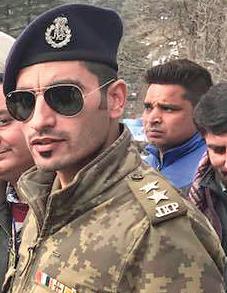
The 33-year-old officer says he chose the location outside his office so that he could monitor and supervise the arrangements.
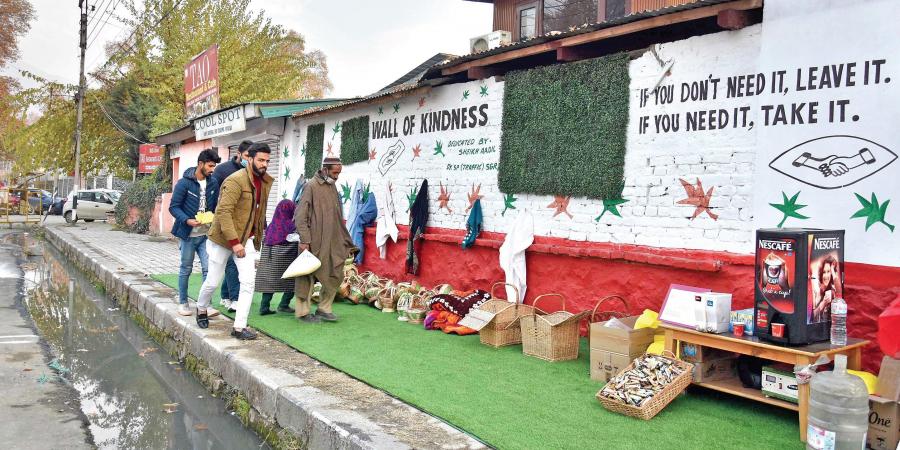
From food items to hangers filled with warm clothes, ‘Wall of Kindness’ in Srinagar brings warmth during this harsh winter | Zahoor Punjabi
As the mercury drops to 2 degree Celsius on a windy Saturday evening in Srinagar, a youngster, Zubair Ahmad, puts up a blanket on a hanger mounted on the ‘Wall of Kindness’, a unique wall set up for the needy and homeless, outside the office of the traffic police department.
Ahmad is among thousands of residents who have come forward to donate their clothes — jackets, coats, suits, mufflers, among others — for those in need of warm clothes during the chilly winter, as a gesture of their “kindness”.
And the ‘architect’ behind the Wall of Kindness initiative is Sheikh Aadil Mushtaq, a 2015-batch Kashmir Police Service (KPS) officer from Baramulla district who is posted as deputy superintendent of police (DSP) traffic police in Srinagar.
Moved by the deplorable conditions of the poor — hit by two shutdowns, after the abrogations of Article 370 in August last year and the Covid-19 lockdown in March — the young police officer took the initiative on November 13 on the occasion of World Kindness Day. The Wall of Kindness was first started in Mashhad in Iran in 2016 and later, the charity initiative spread to other parts of the world.
Starting from food items to hangers filled with warm clothes to sanitary pads, the Wall of Kindness in the heart of summer capital brings warmth during this harsh winter. Painted in white, the wall has a message, too: “If you don’t need it, leave it. If you need it, take it.” “It is not a new idea. It is a corollary effort. This Wall of Kindness is an interface that I have dedicated to the people of Srinagar,” Aadil says.
The 33-year-old officer says he chose the location outside his office so that he could monitor and supervise the arrangements. According to Aadil, there has been an overwhelming response to the initiative. “Every day, hundreds of people come and donate items such as woollen clothes, food and blankets etc.” The DSP, who is pursuing post-graduation diploma in cybercrime, says with the onset of winter, the arrangements for kangris (earthen hot pots) have also been made at the wall.
A coffee and tea vending machine has also been set up there by the donors. “Any homeless or an underprivileged person can have a cup of tea or coffee to beat the chilling winter,” the officer says, adding that it is being ensured that the items reach the needy only. “My initiative has been successful. The things are reaching the needy and the deserving people, and this was the main purpose of my initiative,” Aadil says. Asked whether people have been hesitant in donating, the officer says: “I have been lucky here. The kind of love and affection I get from people is overwhelming.
Without their help, it would have been impossible. I don’t have to instruct much. People are themselves cooperating and donating items.” “I am not doing it as a police officer. Being a police officer is my second identity. I am a responsible citizen first, and I have certain responsibilities towards the people of Jammu and Kashmir,” says DSP. Aadil says he has been receiving calls from people from Jammu and other places who want to join the initiative and generously donate for the destitute.
The police officer says the winter in Kashmir is harsh and many people struggle in the absence of warm clothing. He said he and other police personnel wanted to help those people. The clothes hanging on the wall catch the attention of people who stop to take a look. Locals have, however, appreciated the initiative. Ahmad, a local who has also donated a pair of blankets, says the initiative should be appreciated to encourage others.
“It hardly matters whether the initiative has been taken by a police officer or a civilian. What matters is that we need to be compassionate towards people, who have been economically hit by two lockdowns since August 5 last year. We need to be compassionate towards each other and help each other in the trying times like Covid-19 pandemic. We should come up with such initiatives regularly,” he says.
Moved by deplorable conditions of the poor in Srinagar, after two lockdowns in seven months, a young traffic police officer sets up a ‘Wall of Kindness’ where people can donate clothes for those in need, reports Fayaz Wani.
source: http://www.newindianexpress.com / The New Indian Express / Home> Good News / by Fayaz Wani / Express News Service / November 22nd, 2020
These are not the boats of the National Disaster Response Force (NDRF) or Disaster Response Force (DRF) of the Greater Hyderabad Municipal Corporation (GHMC)
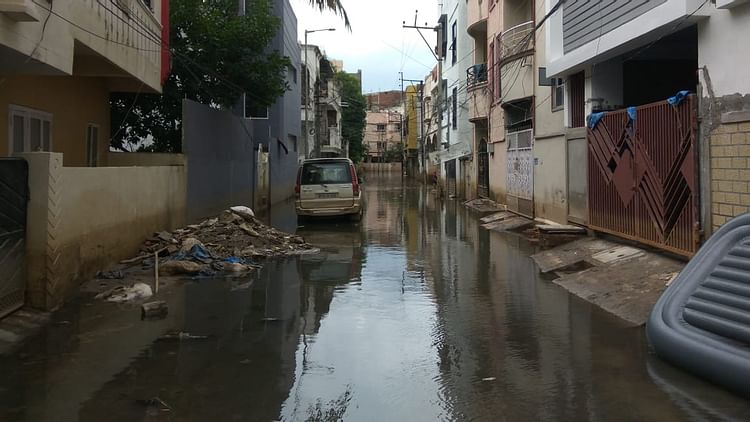
With heavy rains and flash floods inundating Hyderabad’s Nadeem Colony, authorities pressed into service a few boats for rescue and relief operations, but a week later a couple of boats are still seen floating in the flooded waters in the area.
Abdul Qadeer and his friends sail from door to door, supplying free food, milk packets and water bottles to those still trapped in inundated houses. There was another inflatable boat seen floating in the area to provide relief.
These are not the boats of the National Disaster Response Force (NDRF) or Disaster Response Force (DRF) of the Greater Hyderabad Municipal Corporation (GHMC).
With the colony facing perennial problems of water-logging and as there is no end in sight to recurring floods, a couple of residents of the colony have procured boats to remain prepared for the worst.
Abdul Bari, a relative of Abdul Qadeer, brought the inflatable boat with a seating capacity of 5-6 persons from a recent trip to the US.
Though Abdul Qadeer’s house is also inundated with 2-3 feet of water, this did not deter him and some others from helping those who are the worst hit. “The next lane still has five feet of water and this boat is the only means to reach out to the people who have taken shelter on the first or second floor of their houses,” Abdul Qadeer told IANS.
A senior accountant in a private engineering college, he has been living in the colony in Toli Chowki area since 1989. Whenever it rains heavily, the colony gets inundated but the residents have learnt to live with a couple of feet of water every year. “This is the third worst flood. We earlier saw a similar situation in 1989 and 2000,” said Abdul Qadeer.
The colony is located near Shah Hatim pond, which gets stormwater from various uphill localities in Jubilee Hills. The residents in this colony of 500 to 600 families deny that they built the houses in Full Tank Level (FTL).
According to them, the main reason for water logging is the encroachments on the pond. “The pond in 1989 was spread over 35-40 acres but now it is just 17 acres because of encroachments,” he said.
Syed Azhar, a businessman who has been living in the colony for 20 years, said a part of the pond was filled with debris to build houses and a golf course.
The flow of stormwater was also disrupted due to encroachments which led to narrowing of the drains at various points.
Several visits by public representatives and officials and assurances over the years have failed to change the destiny of the colony.
Despite their houses still remaining under water and with no electricity for more than a week, people like Abdul Qadeer are doing their bit to help those worst hit.
Asia Begum, who had to shift to her sister’s house in another colony, cooks food for 50-70 people every day and brings it to Nadeem Colony for distribution. “This is the testing time for all and this is the time to earn good rewards,” she said.
Some families are not ready to leave the houses as they either fear thefts or have no relatives where they can shift. “They can’t go to any other place. In these pandemic times even the guests are not being welcomed,” said Abdul Bari, who also comes here from another area in the city to take part in relief work.
One of the worst floods in Hyderabad’s history last week claimed 33 lives and inundated hundreds of colonies in and around the city.
source: http://www.nationalherald.com / National Herald / Home> National / by IANS / October 20th, 2020
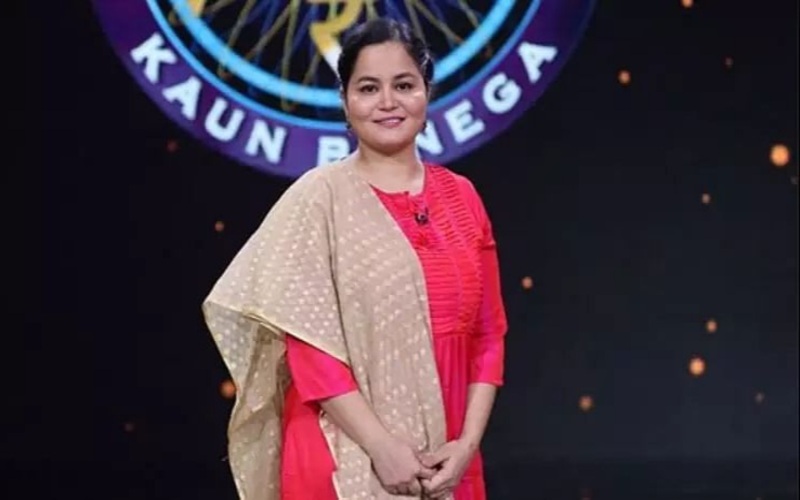
The Wednesday episode of KBC (Kaun Banega Crorepati) was memorable for the Season 12 as the show got its first crorepati in Delhi-based Nazia Nasim. The contestant was lauded not only for her historic victory, but also for not using any lifeline till late during the game.
On November 11, she won the prize money of Rs 1 crore after answering 15 questions correctly. Nasim was the roll-over contestant of Tuesday’s game, during which she had earned Rs 40,000 already. Although Nazia couldn’t answer the 16th jackpot question of Rs 7 crore, she is hailed as the first crorepati after the season premiered on September 28, 2020.
Here are 10 things to know about Nazia Nasim.
Nasim hails from Ranchi, Jharkhand. She moved to Delhi in 2004 to do a PG diploma in advertising and PR from Indian Institute of Mass Communication. Currently, Nasim is working as a communication manager.
She got married in 2008. Along with her husband and 10-year-old son, she resides in the National Capital Delhi.
Nasim’s credits her inspiration of participating in KBC to her mother who has been a die-hard fan of the show and host Amitabh Bachchan. She and her father used to go to the telephone booth early morning to answer KBC’s participatory questions. After having tried for more than 8-10 seasons for 20 years, she finally had to chance to try her knowledge at the game show.
For Nasim, winning the prize money was a ‘Slumdog Millionaire moment’ as she just had to refresh the knowledge she had acquired over the years to answer the questions as she hadn’t prepared much for the show. Slumdog Millionaire is a 2009 Academy Award winning film about the journey of a teenager from slums of Mumbai becoming a millionaire.
Nasim revealed that she would use her prize money for medical expenses of her parents and in-laws. She also wants to get his son proper soccer training as he is an enthusiast of the sport. Moreover, she would donate 2.5 percent of the money for charity (zakat).
Nasim identifies herself as a feminist as she is a big propagator of women’s rights. She hopes that her victory helps cultivate confidence in women and girls from small towns to thrive.
The first crorepati of KBC 12 feels that the show is much more than just money as it provides a stage and opportunity for a person from a decent family to appear on national television and talk to a celebrity.
On talking about not winning the jackpot amount Rs 7 crore, she said that she had gone on the show to fulfill her mother’s dream.
The question that fetched Nasim one crore rupees was, “Which of these actresses once won a National Film Award for Best Playback Singer?” which she answered correctly as Roopa Ganguly.
Nasim’s strategy on the game show was eliminating every wrong option, which did eventually lead her to the right answer. Notably, she didn’t use any lifeline till the 11th question.
Shikha Chandra is an intern with SheThePeople.TV
source: http://www.shethepeople.tv / She The People / Home / by Shikha Chandra / November 13th, 2020
Nasheet Shadani is one of the handful ‘creative strategists’ Facebook employs around the world. He is also a great lover of the Urdu language and runs a unique platform called Ishq Urdu on, where else, Facebook, with 254,000 followers. The Cannes award-winning adman who has worked with ad agencies like McCann, Grey and Ogilvy and Mather tells Grin why he is dedicating his life to reviving the medieval Indian language of great poets.
From Shadani’s Project Urdu.
There are around 70 million Urdu speakers in the world — most of them in South Asia. ‘But most websites, blogs represent Urdu in a very boring way. Most are just e-books, directly uploading content from books. Many thought that Urdu is a language spoken by some kind of obscure species. There was no curation and at times it gave an impression that it is indeed spoken by obscure species. The need to modernize the language in terms of visual look and feel as well as curation was badly needed,’ says Shadani. Several great Indian poets including the 17th century maestro Mirza Ghalib wrote in Urdu.
Shadani grew up speaking the language in Old Delhi and studied fine arts at the Jamia Millia Islamia university. He learnt Urdu calligraphy while he was working on a project called Save Calligraphy and redesigned Ogilvy’s logo in Urdu which won awards at the Cannes Lions Festival in design.
Ogilvy in Urdu.
‘This made me realize how culturally rooted works with a good cause can make a huge difference. Soon, I started immersing myself in the language which was followed by a series of discoveries. From thoughtful Urdu poetry to Angaray (which was the start of ‘Progressive Writers Movement’) to Bollywood , I started feeling an urge to share this knowledge with friends through my personal Facebook profile,’ Shadani, who soon moved onto to creating Ishq Urdu.
The project took off the ground in August 2015 with the goal to make people realize that they are already speaking Urdu in their day to day routine and listening to Urdu all the time through Bollywood songs and dialogues. ‘Most people think that Urdu is limited to its poetry but the truth is that Urdu has an entire ecosystem around it. To help solve this problem, we came up with our first campaign Bollywood Without Urdu where we removed Urdu words from iconic Bollywood songs and dialogues to highlight the importance of Urdu in our day to day life,’ says Shadani. For instance, the famous dialogue Mogambo khush hua would not sound the same without the Urdu word khush in it.
Shadani says he is touched when Urdu lovers from all across the globe connect with him and share their stories which pushes him towards his goal of making the language cool, contemporary and relevant in today’s world.
~
source: http://www.grin.news / Grin.news / November 22nd, 2017
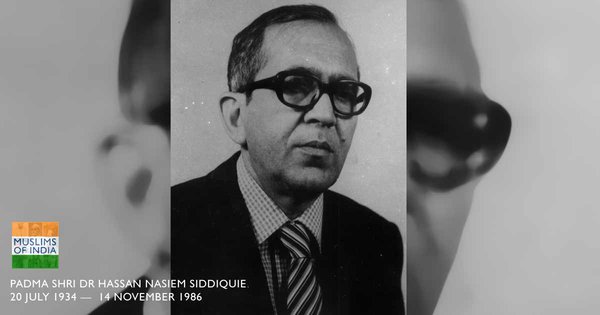
A scientist, a visionary, a family man. He was responsible for pioneering research work in the field of Marine Geology.
Dr. Siddiquie was born on 20 July 1934 to M. A. Siddiquie, a civil surgeon, and his homemaker wife Ahmedi Begum in Bijnor, Uttar Pradesh in India. The eldest of 6 sons and two daughters, he completed his intermediate studies from Osmania University (Hyderabad) then went on to acquire BSc and MSc (Geology) degrees from Aligarh Muslim University (Aligarh). He started his career at a young age, as a geologist with Geological Survey of India, Kolkata. After 17 years of service in GSI, he was offered the position of Head of Geological Oceanography Division in CSIR’s National Institute of Oceanography in Goa. Here he served in various capacities and later became Director in 1985.
After an impeccable career and service to the nation, he passed away on 14th November 1986 after a massive heart attack. He is survived by his wife Talat and three children.
Dr. Siddiquie left behind a legacy of extensive research and survey work done in the exploration of petroleum and minerals, infrastructure development, exploration of polymetallic nodules, studies on sediments, studies on Foraminifera, paleoclimatic studies and Antarctica He was associated with several oil projects which included piping, route identification, bathymetric and shallow seismic surveys for ONGC and Oil India. He is also credited with the initiation of managanese nodule program in India and this coordinated program was reported to have earned India a place among the seven registered Pioneer Investors of the International Seabed Authority of the United Nations.
He served as the deputy leader of the first Indian expedition to Antarctica and he coordinated the marine science programs for Dakshin Gangotri, the permanent Indian station in the southernmost continent. He authored several peer-reviewed research papers and articles throughout his career.
For his work and efforts he was awarded the Shanti Swaroop Bhatnagar Prize (1978), the Padma Shri (1983), National Mineral Award and the State Award of the Government of Goa (1986 Posthumously).
H. N. Siddiquie was the member/ fellow of various boards and councils including the elected member of Indian National Science Academy and the National Academy of Sciences, India. Indian Geophysical Union has instituted the Dr. H. N. Siddique Memorial Lecture series in his honor.
A tall, handsome man of friendly demeanor; he had an impressive personality. He was also very religious and adhered to the tenets of Islam. A mentor and inspiration to many; he is still remembered, admired and respected by all who met him.