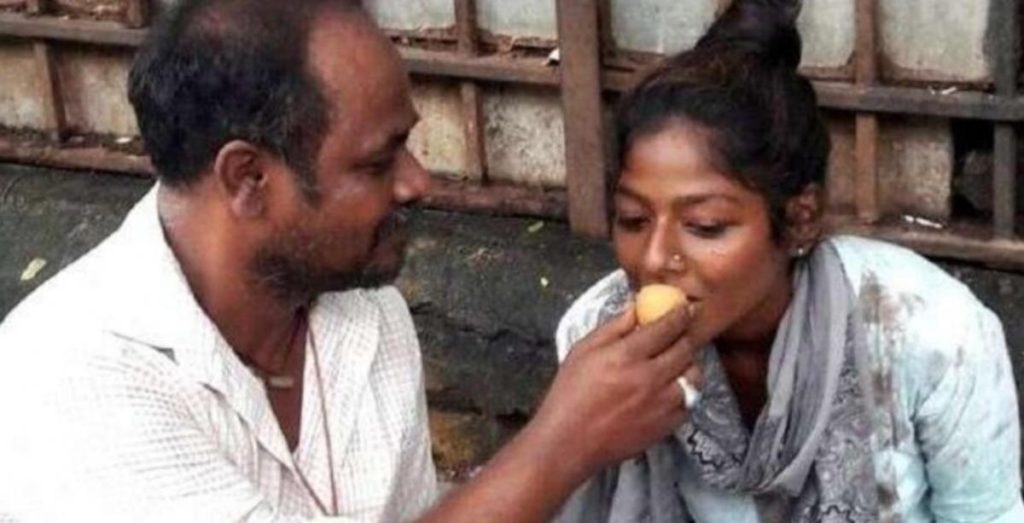
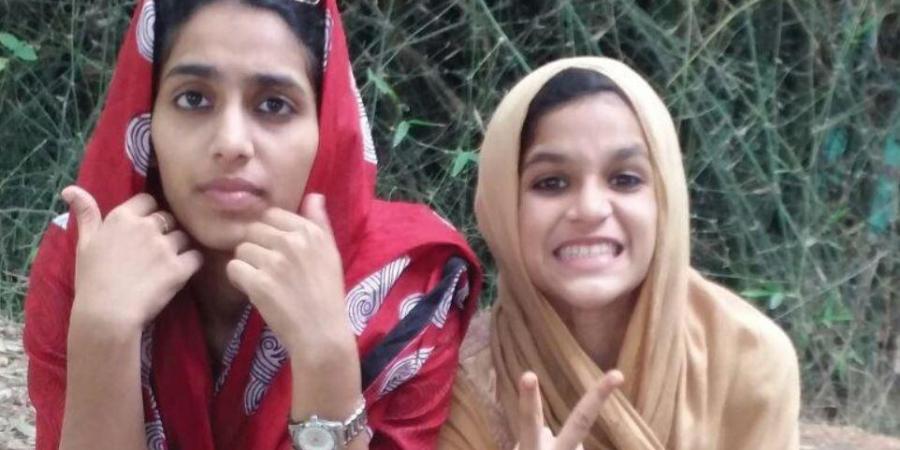
Mumbai girl Asma is a student of Hirjeebhoy Allarakhia and Laljeebhoy Sajan Girls High School.
Asma Salim Shaikh from Mumbai passed Maharashtra SSC exams despite staying at a footpath
A Mumbai girl, who stays at a footpath, along with her family, caught the limelight after she scored 40 per cent marks in Maharasthra SSC exams.
Asma Salim Shaikh’s father Salim Shaikh said, “It’s the happiest day of her life, because she has scored 40 per cent in Maharashtra SSC exam.”
Asma is a student of Hirjeebhoy Allarakhia and Laljeebhoy Sajan Girls High School. She has spent her life on the pavement outside Azad Maidan near CST. She did not have access to basic amenities like a place to study or stationary. She used to study on the footpath under the streetlight. Seventeen-year-old Asma now plans to take Arts in Junior college.
Asma celebrates with her father
Her video in which she is seen celebrating the feat with her father went viral over social media. The video has received more than 2 lakh views and more than 10,000 likes.
Asma stated that her father sells lemonade on the roadside to earn a living. The financial condition of the house is not good. Despite this, her father got her admission done in a Mumbai school and allowed and supported her to complete her school.
Asma said, “I studied under street lights as I did not have means to get a comfortable place for studying. Now, I will pursue Arts in junior college.”
The girl got the support of former Union Minister of State Milind Deora saying that he will help the girl in every possible way.
In a similar development, Bharti Khandekar, who lived with her parents and two younger brothers on a footpath in the Shivaji Nagar Market area in Indore, secured 68 per cent marks in the Madhya Pradesh state board examinations.
Her story was highlighted by the media and this led to Indore Municipal Corporation deciding to allot the family a flat.
Municipal commissioner Pratibha Pal said that, “Under a scheme for the economically weaker section, we have allotted them a one-BHK (bedroom-hall-kitchen) flat in Bhoori Tekri area.”
She further stated that when she met Bharti, she was amazed by her confidence. Bharti stated that she wants to be an IAS officer when she grows up.
source: http://www.ibtimes.com / International Business Times / Home> India / by Anjali Singh Deswal / July 30th, 2020
Baroda, MADHYA PRADESH / Paris, FRANCE / London, UNITED KINGDOM :
If the proposal is passed, it will be the first time that non-white people will be featured on British coins or notes.
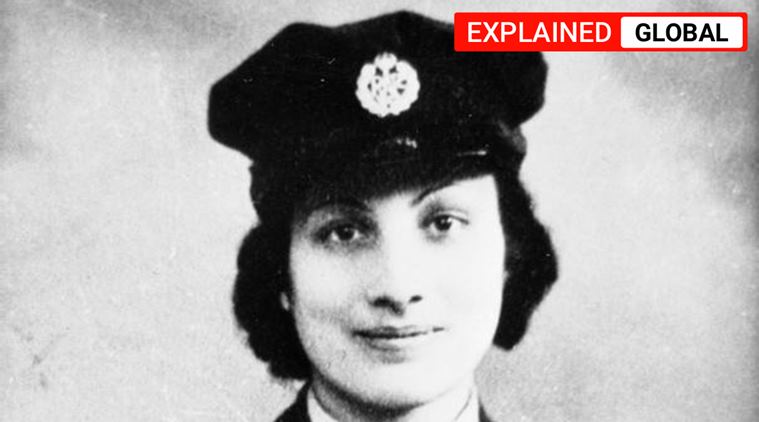
Born in Moscow to an Indian father and an American mother, Noor’s family moved to London and then to Paris during the First World War. (Source: Wikimedia Commons)
British media reported this week that Rishi Sunak, the Chancellor of the Exchequer, is considering a proposal to feature historical figures from the Black, Asian and minority ethnic (BAME) community of the country on a set of coins titled ‘Service to the Nation’.
If the proposal is passed, it will be the first time that non-white people will be featured on British coins or notes. The plan has been submitted to the Royal Mint, which is to come up with proposals and designs.
Zehra Zaidi of the advocacy campaign ‘Banknotes of Colour’, along with a group of historians and MPs, had written to the Chancellor proposing some historical figures. Among them were the Indian-origin British spy Noor Inayat Khan, as well as Khudadad Khan, the first soldier of the British Indian Army to receive the Victoria Cross. Khudadad Khan, who belonged to the Chakwal district of Punjab in present-day Pakistan, died in 1971.
The continuing Black Lives Matter protests in the United States , triggered by the killing of George Floyd by a police officer in Minneapolis in May, which have put a spotlight on the lack of BAME representation in the UK, and have compelled authorities to take appropriate steps.
Who was Noor Inayat Khan?
Born in Moscow to an Indian father and an American mother, her family moved to London and then to Paris during the First World War. Although Noor started working as a children’s writer in Paris, she escaped to England after the fall of France (when it was invaded by Germany) during the Second World War.
In November 1940, she joined the Women’s Auxiliary Air Force, an arm of the UK’s Royal Air Force to train as a wireless operator. She then did a stint at the secret intelligence organisation set up by Winston Churchill called Special Operations Executive (SOE).
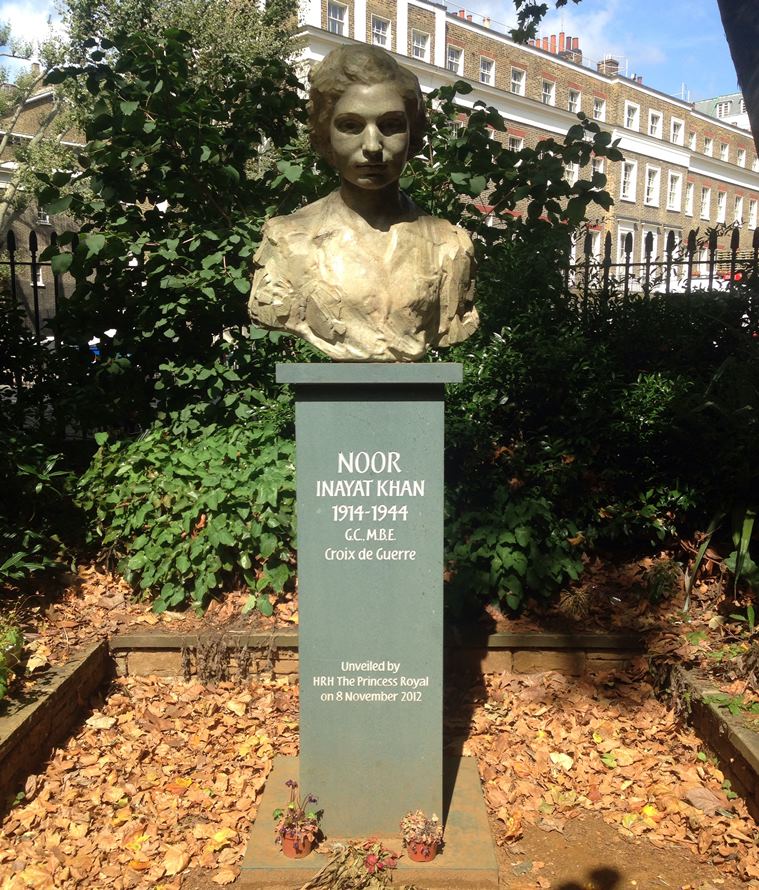
A bust of Noor Inayat Khan in Gordon Square, London. (Source: Wikimedia Commons)
She became the first radio operator to be sent to Paris to work for SOE’s Prosper resistance network under the codename Madeleine. She was just 29 then, and had signed up for a job in which people were not expected to be alive for longer than six weeks.
Even as many members of the network were being arrested by the Nazi secret police Gestapo, Noor chose to stay put — and spent the summer moving from one place to another, sending messages back to London, until she was arrested in 1943.
She was executed at the Dachau concentration camp in southern Germany near Munich. Noor was awarded the highest honour in the UK, the George Cross, in 1949, and the French Croix de Guerre with the silver star posthumously.
What was Noor’s connection to India?
She was connected to India through her father Inayat Khan. He was founder of the Sufi Order of the West, which is now known as the Inayati Order. He had migrated to the West as n Hindustani classical musician, and then moved to teaching Sufism.
Inayat Khan was born in Baroda. His maternal grandfather was the noted musician Ustad Maula Bakhsh Khan, who founded the music academy Gyanshala, which now serves as the Faculty of Performing Arts at Maharaja Sayajirao University. Maula Bakhsh’s wife, Qasim Bibi, was a granddaughter of Tipu Sultan of Mysore.
Inayat returned to India in 1926 and chose the site of his burial at the Nizamuddin Dargah complex in New Delhi. The Inayat Khan dargah still stands in a corner of the complex.
Besides being a GC, what other honours has Noor received?
In 2014, Britain’s Royal Mail had issued a postage stamp in honour of Noor as part of a set of 10 stamps in the ‘Remarkable Lives’ series. In 2012, a memorial with a bust of Noor was unveiled in London by Princess Anne. Shrabani Basu, author of ‘Spy Princess, The Life of Noor Inayat Khan’, and Chair of the Noor Inayat Khan Memorial Trust, had campaigned for the memorial.
In February 2019, Noor’s London home at 4 Taviton Street in Bloomsbury, the house that she left for her final mission, was honoured with a blue plaque. She was the first Indian-origin woman to be awarded the plaque.
How has Noor been represented in popular culture?
Various documentaries on women agents and the SOE have featured her story, such as Netflix’s ‘Churchill’s Secret Agents: The New Recruits’. In 2018, a play titled ‘Agent Madeleine’ premiered at the Ottawa Fringe Festival.
In 2012, Indian producers Zafar Hai and Tabrez Noorani obtained the film rights to the biography by Basu. In the film ‘Liberté: A Call to Spy’, an American historical drama, actor Radhike Apte played the role of Noor. The film had its world premiere at the Edinburgh International Film Festival last year.
source: http://www.indianexpress.com / The Indian Express / Home> Explained / by Surbhi Gupta / New Delhi / July 29th, 2020
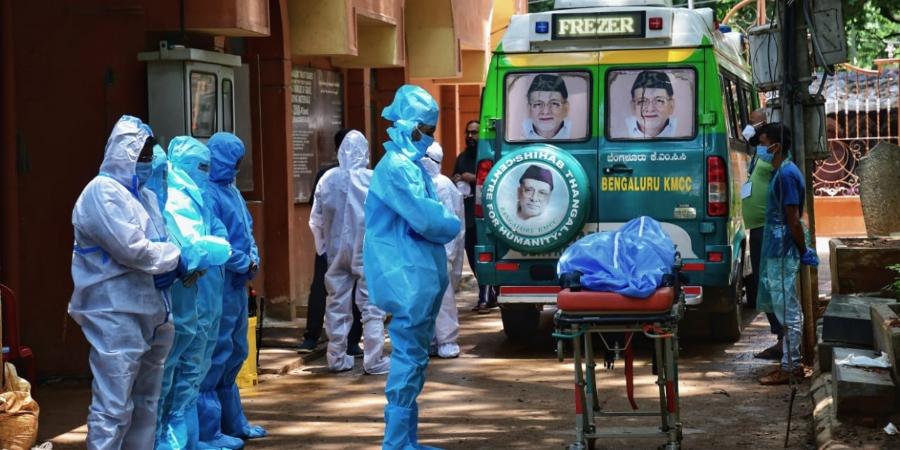
Wasim and 22 other men are part of NGO Helping Hands and they stay at the burial ground till 10 pm, doing what even family members of relatives are scared to do – burying COVID-19 victims’ bodies.
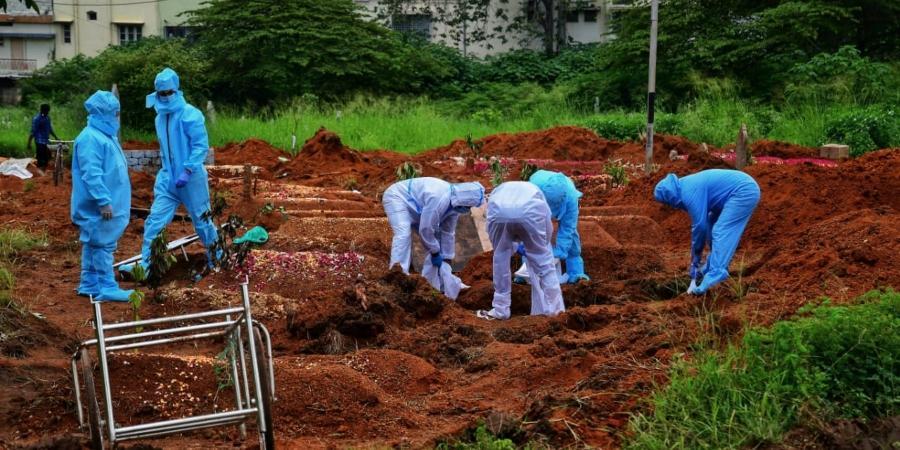
The team has completed over 100 burials of COVID-19 victims till date. (Photo | Shriram BN, EPS)
Wasim Zubair’s day begins with his prayers after which he heads to the burial ground at Quddus Saheb Edgar at 5.30 am to get a list of the deceased who will be brought for their last rites.
Wasim and 22 other men are part of NGO Helping Hands and they stay at the burial ground till 10 pm, doing what even some family members are scared to do – burying COVID-19 victims.
The task is tiring as they have to sweat it out wearing their PPE kits, which they have to constantly change after each burial. There is no incentive for them to do this, not to mention the risk they run of contracting the infection.
Ask them why they do it and Abdul Muheeb, founder of NGO Helping Hands, says, “In April, we locals would see families struggling to carry the dead body of their relatives as very few people were turning up for the last rites fearing coronavirus. Seeing them helpless, and some of them not in the right state of mind while bidding farewell to their near and dear ones made us want to help. The happiness we get when we help them perform the last rites is unparalleled.”
Photo | Shriram BN, EPS
The team has completed over 100 burials of COVID-19 victims till date.
“We see fear of the virus that has gripped people world over, so much so that I witnessed the son of a dead father not wanting to perform the last rites. We tell one or two family members to join us so they know where the grave is. We give them PPE kits as well,” Muheeb said.
Wasim has seen several instances of brothers, sons and grandsons of elderly COVID-19 victims hesitating at the gates of the burial ground.
A cloth of 10 metres by 10 metres is placed on the ground, one horizontally and the other vertically. With the help of the handles of the body bag, they lift the body from the stretcher on to the cloth.
They then lift the cloth and lower the body into the grave. The stretcher is then sanitised and the last Namaz also done as per religious norms.
The JCB digs 30 pits at the burial ground in advance at the beginning of each day.
Thankfully, none of the volunteers have contracted the virus so far.
Wasim says they take the necessary precautions and avoid getting too close to the body or even the primary contacts of the dead person.
“Most of our team members are youngsters. Our tagline is ‘Making it possible by his grace’. We spend our money on PPE kits but sometimes people donate a few kits to us. We don’t charge the family a single rupee,” Wasim said, speaking to The New Indian Express even as three funerals were taking place on Tuesday afternoon.
source: http://www.newindianexpress.com / The New Indian Express / Home> Good News / by Ranjani Madhavan / Express News Service / July 22nd, 2020
A city-level task force of medical experts, philanthropists, social activists and Medical College Alumnus Association has been set up to fight against the coronavirus pandemic.
The task force monitored by Mohammed Asif Hussain Sohail, Chairman of Sakina Foundation and President of Telangana Parents Association For Child Rights and Safety. This force also includes a group of 25 national and international organisations, Doctors Association and doctors from other countries like Dr. Aslam of America whose roots are in Hyderabad. They have come together on a single platform to combat coronavirus.
This programme has been named as ‘Hyderabad COVID Task Force.’
Member of Hyderabad COVID Task Force, Mohd Asif Hussain Sohail said, “The idea of setting up the task force was conceptualised seeing the pain and sufferings of the Hyderabadis for medical treatment, ration and food especially funerals. The Task Force aims to serve the people who are facing difficulties during the pandemic. Hyderabad Covid Task Force is going to conduct awareness on Covid-19 pandemic in colonies particularly in the city’s slums. They will provide aid to COVID-19 patients for the medical treatment, food for patients and their attendants in hospitals. It will also help the family also organise final rides, land for the burial, final ablution and even for the other community people of the deceased persons died to COVID-19,” Asif Hussain told Siasat.com.
As a large number of people in the city are also being suffering from a viral fever which has created panic among them and they are going for COVID-19 tests. In this situation the Hyderabad COVID Task Force team is undertaking the awareness programmes, counselling for corona patients, checking peoples’ medical need and etc. in each locality with volunteers and also providing online consultations with doctors and giving a medication,” said Asif Sohail.
“Each organisation had at least 50 volunteers who are working in various parts of city. Under this, the Sakina foundation is working on a pilot project which identifies the poor and needy people, their health issues and helps them with food, medication, and funerals for their deceased ones,” he added
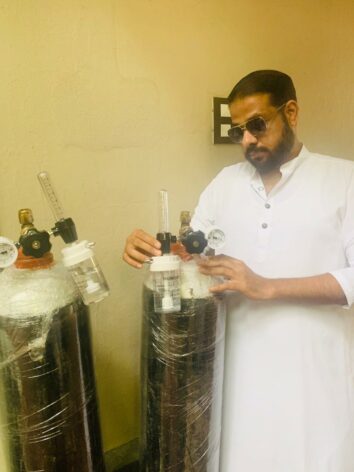
He also said that he is also supplying free Oxygen cylinders with Pulse oximeters for suspected carriers and positive cases under home isolation care by providing PPE (Personal Protection Equipment) among the deceased members during the funeral.
The organisation remains connected through a zoom call with Dr. Aslam from USA, who initiated and coordinated with other doctors, philanthropists and organisations from the USA — including DAAME (Deccan Alumni Association Middle East), DAA (Deccan College of Medical Science Alumni Association) and etc.
Asif Sohail coordinated all the doctors, NGOs, activists, and philanthropists based in Hyderabad.
source: http://www.siasat.com / The Siasat Daily / Home> News> Hyderabad / by Mohammad Hussain / July 10th, 2020
Attitude of the British government towards India after the First World War, where the Indians backed the British war efforts in hope of better treatment, exacerbated the already suppressed Indian feelings. The Rowlatt bill, satyagraha in its opposition, Jallianwala massacre, and brutal suppression of the satyagraha led Mahatma Gandhi to call for Non-Cooperation movement coupled with Khilafat movement.
Gandhi urged his followers, through Young India, on 11 August, 1920, to ‘formulate an education system completely independent of government control’. Only then, in his view, non-cooperation holds any real meaning.
Mazharul Haque was the first in Bihar to respond to Gandhi’s call of developing indigenous education system. On 22 November, 1920 Haque opened a National School in Patna with Dr. Harnandan Lal Nandkeoliyar as its principal. But, the moment of glory was yet to arrive.
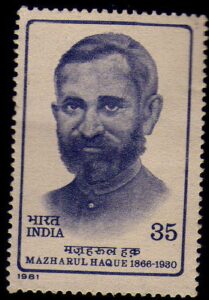
Mazharul Haque
On 11 December, 1920, One Hundred & Ten (110) students of Bihar Engineering School (B.E.S) boycotted classes and with all their belongings, with raised flags of ‘Free B.E.S’ marched to Sikandar Manzil, residence of Mazharul Haque, at Fraser Road in Patna. Students urged Haque to lead them into the non-cooperation movement. Haque left his house with 103 students, since seven (7) were taken by their parents to home, for an orchard in a rather scantily populated area on Patna- Danapur road. The orchard was a property of Khairu Mian, who donated it to the students without any hesitation. Haque, with the help of the students, made huts with straws, woods and leaves. The orchard, where now 103 students and Mazharul Haque were living, was named Sadaqat Ashram.
Sadaqt is a Persian/ Urdu word for truth while Ashram is a Sanskrit/ Hindi word for Abode. So, the place was Abode of Truth.
Now all the residents of Ashram were studying and spinning Charkha (cotton spinning wheel) and the ashram became a focal point of nationalist activities in Bihar.
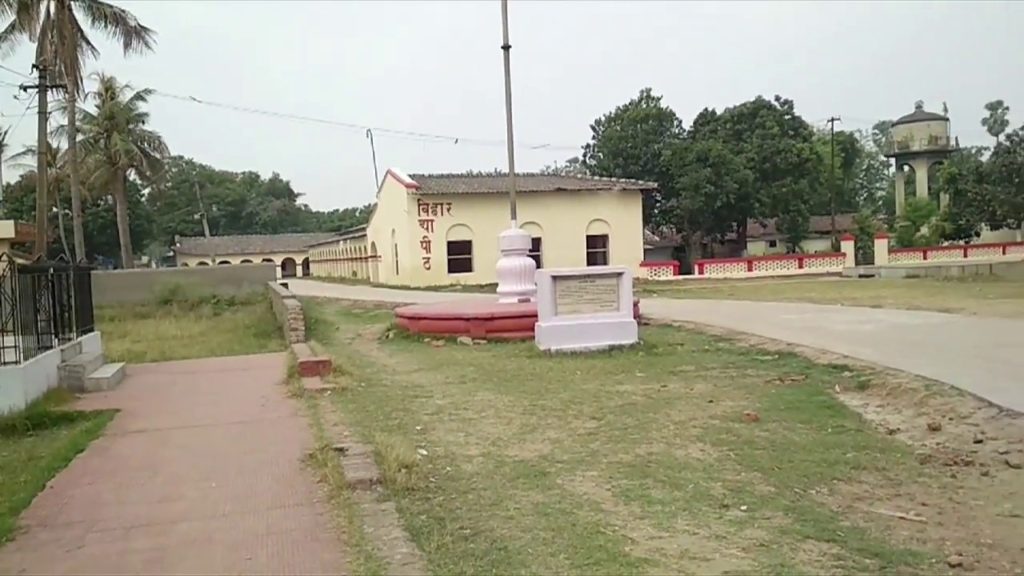
Mahatma Gandhi, in December, emphasised upon having a Bihar Vidyapith to oversee all the nationalist education and coordinate National Schools running in Patna. Dr. Rajendra Prasad and other Congress leaders were unable to raise enough funds to secure land for Vidyapith in Patna. When the difficulty was put in front of Haque, he immediately started construction of a building, with his personal funds, at the Ashram site.
On 6 February, 1921, Mahatma Gandhi, Kasturba Gandhi and Mohammad Ali arrived in Patna, by Punjab Mail, to formally inaugurate the Bihar Vidyapith (Bihar University). At the inauguration Gandhi said that without the efforts of Mazharul Haque it would have been impossible to open a National College at Patna. It was only because of Haque that Gandhi was inaugurating the Vidyapith.
Mazharul Haque was chosen as the Chancellor, Braj Kishore Prasad as the Vice Chancellor and Rajendra Prasad as the registrar of the newly formed Bihar Vidyapith.
Sadaqat Ashram did not stop at this. In September, 1921, Mazharul Haque started printing newspapers, journals and books from the Ashram. An English weekly The Motherland and an Urdu daily Sheristan were two prominent newspapers published from the Ashram. Apart from these, books like Tufan-e-Nuh, Khilafat and England, etc., were also published from the Ashram press.
Mazharul Haque set an example by renouncing his lavish lifestyle to live in Sadaqat Ashram with the students. Mahatma Gandhi wrote about Haque, “The Sadaqat Ashram near Patna is a fruit of his (Mazharul Haque’s) constructive labour. Though he did not live in it for as long as he had intended, his conception of the Ashram made it possible for the Bihar Vidyapith to find a permanent habitation. It may yet prove a cement to bind the two communities together.”
Later, Rajendra Prasad lived at Sadaqat Ashram after retirement, Jayprakash Narain launched his movement from here and presently it serves as the Bihar Congress headquarters.
With the Sadaqat Ashram, the legacy of Mazharul Haque remains alive.
(Author is a well known historian)
source: http://www.heritagetimes.in / Heritage Times / Home> Bihar / by Saquib Salim / July 08th, 2020
First to write SSLC exams using computers, Haroon is an inspiration for the new generation of visually impaired students
Photo: ANI
Malappuram :
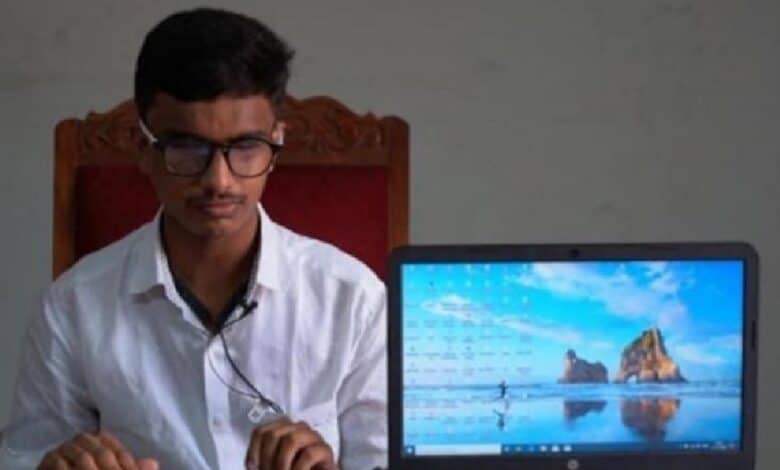
Haroon Kareem T K, a tenth-grade visually impaired student of Mankada Government Higher Secondary School and the first student in Kerala to write all Secondary School Leaving Certificate (SSLC) examinations using a computer, has scored A plus in all subjects.
Haroon’s fight to secure permission to use computers instead of the conventional scribe system was reported by ANI, following which state Education Minister C Raveendranath had issued a special order to permit him to take SSLC examination on computer.
Speaking to ANI, Haroon said that if he had used a scribe and scored all A plus then the credit would have been given to the scribe and all his efforts would be seen as ‘little’.
“By using a computer provided by the authorities, I am happy that I kept my self-pride high. Writing all subjects using a computer is not an easy task as language subjects are diverse,” he said.
Haroon’s all A plus is an inspiration for the new generation of visually impaired students who are efficient and technologically advanced.
Back in February, at first, the education department had denied his request to write the exam citing the SCERT, however, after the intervention of Raveendranath things moved away from the conventional methods of using braille or a scribe. Raveendranath had intervened in the matter after the boy reached out to him on Facebook and later met him in his office. Haroon had met Kerala speaker P Sreeramakrishnan and he facilitated a meeting with Education Minister”I am using computers to do all my class tasks and term and annual examinations since Class 8.
For visually impaired there are technologies available for onscreen reading and using various tools like Imfty editor and Dolphin Easy Reader. I am able to make the best use of the technology,” Haroon had said while speaking to ANI.
Ram Kamal of Chakshumathi, an NGO that works with print disabled kids in Kerala and works in the direction of promoting assistive technology to overcome their educational challenges was of the view that this decision of education minister will help many other visually impaired students in Kerala.”The India Government and NCERT are well in sync with the latest assistive technologies for the visually impaired and print disabled.
They modified their rules in favour of using computers officially since 2013. Karthik Swayne, the first Indian visually impaired student at Stanford University, US was one of the first beneficiaries of the rule in 2012. But in Kerala, the SCERT examination guidelines are outdated, ” he had said.
Source: ANI
source: http://www.siasat.com / The Siasat Daily / Home> Education and Career / by Safoora / source: ANI / July 02nd, 2020
In India Muslims number about 180 million and are found in good numbers in most regions. After ruling for a period of about 600 years (1200 to 1857), during which beginning from limited footholds in north India they expanded their rule and the followers of their faith through most of the Indian subcontinent, from the Khyber pass in the west to Assam in the east, and from Kashmir in the north to Kerala at the southern tip of the Indian subcontinent. At the end of the British colonial rule in 1947, when the Muslim population formed about one-third of India’s population, the subcontinent was divided between a Muslim majority Pakistan and a Hindu majority India.
Following the partition and the formation of the new India, the situation of the Muslim community, whose population was reduced to about 14 percent, has continued to decline. While discrimination in various walks of life from the government as a reaction to the partition of the country is a major factor for that, the lagging behind in education at all levels and the poor condition and standard of education in the community and the community’s schools has substantially reduced the ability of Muslims to compete with others in various walks of life. The educational backwardness is a lot more pronounced among Muslims in north and west India compared to south and east India
Since 2014 when BJP acquired power in New Delhi, the overall progress of Muslims has declined further due to substantial increase in governmental bias against them. However, every so often one comes across instances of remarkable successes. It is interesting to note that more Muslim young women compared to men are found among the list of high achievers. I recently came across two such instances.
Khushboo Mirza
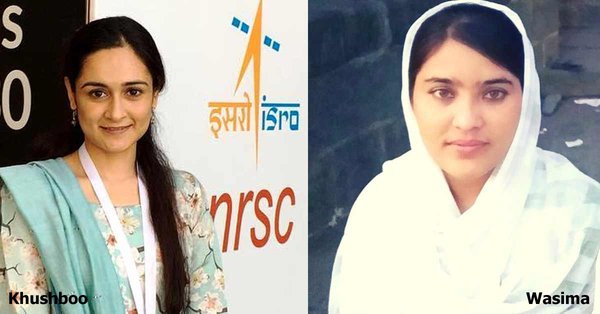
One such instance is a relatively young Muslim woman by the name Khushboo Mirza from Amroha, a city in western Uttar Pradesh. Khushboo Mirza is an electronics engineer with the Indian Space Research Organization (ISRO) since 2006 when she graduated from the engineering college of the Aligarh Muslim University, Aligarh, U.P. She was a bright student in high school and at the engineering college.
ISRO, headquartered at Bangalore, Karnataka, is one of India’s high performing, high technology organizations. At low budget it has achieved much success in launching several pathbreaking outer space exploration missions and satellites. ISRO launches a variety of communication and weather satellites on contract to various global space organizations like National Aeronautics and Space Administration (NASA) of US, Japanese Exploration Agency, Japan et al. This is in addition to space research satellites that they develop and build themselves. Some of the most notable recent ISRO missions include the Chandrayan 2, 2019, a moon orbiter that circled moon and sent data. And Chandrayan 1, 2008, that sent a satellite to impact the surface of moon.
Khushboo Mirza was a team member on the Chandrayan 1 mission. For that, she received good recognition from ISRO management. Just recently ISRO promoted Khushboo, where she will lead groups in challenging tasks.
In the last few decades several professional women in India have reached leadership positions in private sector companies, banks, Science & Technology organizations, universities and government bodies. But it is extremely rare to find a Muslim woman among them. There are two main reasons for this sad happening. One is the bias of the government authorities against Muslims and the other is the fact that a large number of Muslim families do not encourage their women to seriously focus on attaining leadership roles in their professional careers. Muslim families are happy with women becoming principal of a girl’s school.
Wasima Shaikh
The second instance that warmed my heart recently is the story of the young woman by the name Wasima Shaikh of village, Sanghavi, district Nanded, in Maharashtra. Wasima is among four children of a Muslim farm laborer in the village of Sanghavi. Her mother is also a farm labourer and they live in a small hut in the village. Her father has been sick for a few years and her mother is shouldering the responsibility for the family in these years. Wasima’s village is plagued with the problem of men habitually drinking liquor and indulging in violence. Wasima is a brilliant student who topped the list of successful candidates in in Nanded taluka in the Maharashtra State Secondary School Certificate examination. In 2015 studying on scholarship she obtained the BA degree from the Yashwant Chavan University, Nanded.
Then she sat in the tough competitive examination of the Maharashtra State Public Service Commission for an officer job in the state. To prepare for the competition she needed training from a coaching center and additional books that cost money, that her mother could not afford, especially since her brother was also studying for B.Sc. degree. To help Wasima with the coaching center fees, in her quest, her brother dropped out of college and started driving an auto-rickshaw. Wasima did succeed in the competitive examination but did not achieve a high enough rank. Due to that she was selected as a Class II sales tax officer for the Maharashtra Sales Tax Office in Nagpur.
However, both Wasima and her mother wanted that in view of her brilliant academic record she should get a better Class I Maharashtra State civil service job, like a Deputy Collector. Although her extended family members pushed strongly that she should get married now, her mother encouraged her to try the State Public Service Commission competition one more time. While working as a government Sales Tax officer Wasima prepared for and sat in the competition again in 2019. With her salary she also put her brother back in college to complete B.Sc. degree. This time her perseverance and merit paid off and she achieved third rank from top among all women competitors in Maharashtra. And just last month she has been selected for the position of a Deputy Collector in the state of Maharashtra.
On our part we Indian Muslims must strive to give better high quality educational opportunities to promising young women and men from our community. Women must be encouraged as much as men to try harder and achieve higher levels of success. That is the only way the Indian Muslim community is going to overcome the intense discrimination and injustice and deprivation from economic opportunities that is happening to them in India.
—The writer is the executive director of the Association of Indian Muslims of America, Washington DC.
source: http://www.milligazette.com / The Milli Gazette / Home> News> Education & Careers / by Kaleem Kawaja / June 30th, 2020
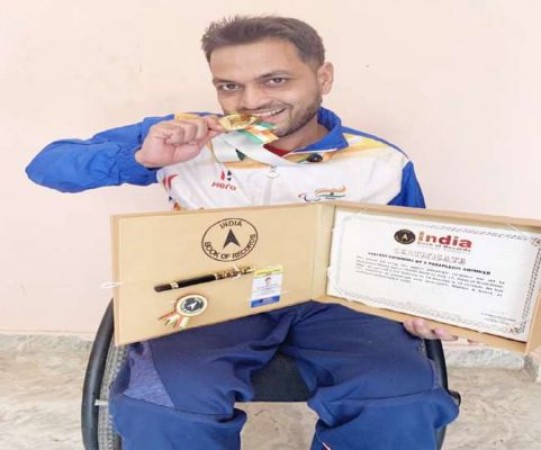
National-international para swimmer Mo Shams Alam has registered his name in the India Book of Records, performing excellently. On December 8, 2019, 24 general and differently abled swimmers took part in the Misri Lal Smriti Open Swimming Championships organized by Bihar Swimming Association at Ganga on Law College Ghat in Patna. Shams completed the first place by completing two km of swimming in 12 minutes 23 seconds. Mohammad resident of Rathaus village of Bisfi Block Shams (33), son of Naseer, says that after getting the name in the India Book of Records, now the Asian Book of Records, Limca Book of Records and Guinness World Record will apply for registration. In the Lok Sabha elections 2019, the commission made them brand ambassadors.
Did not lose courage, started working hard: Even after half of the body is paralyzed, Shams has received five dozen medals from district to international level. In the year 2010, while studying mechanical engineering, there were complaints of spine pain. Operation was done in a hospital in Mumbai. Five months later, the operation took place in another hospital. In the year 2012, the doctors said to be Divyang. Days passed with the help of wheelchairs. But, I did not lose courage. Started working hard in swimming. He wishes to pursue disabled sports talents in rural areas.
Participated in competitions in several countries: Shams, who won the title in Florida in the US in Para Swimming, has won several awards including gold medal in Para Swimming Competition in different parts of the country. Black belt shams in martial arts In the year 2018, he was selected for the Global Sports Mentoring Program organized under the joint aegis of the US Government Department of Sports and Tennessee University of America.
Record Rate Record: In the year 2017, the Umoja Beach Festival organized by a Travels Company in Goa set a record by swimming eight km in four hours and four minutes. At the Para World Series Swimming Championships held in Berlin in July 2017, with 634 players from 54 countries, they achieved seventh rank in the S5 category in performance. Participated in the wheelchair rugby championship of Patna as captain of Bihar team in August 2017. Participated in the Asian Para Games to be held in Jakarta in the year 2018. The year 2017 was conferred by the Bihar Divyang Sports Academy and the Bihar Government in the same year at the Sports Honor ceremony in Patna.
source: http://www.english.newstracklive.com / NewsTrackLive.com / Home> Sports / by Harshita Jain / June 25th, 2020
“To live like a TIGER for a day is far better than to live like a jackal for a hundred years.” – Tipu Sultan
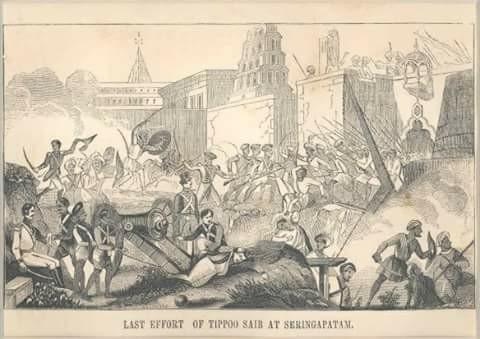
Today marks the 221th death anniversary of Sultan Fateh Ali Khan Tipu, better known as Tipu Sultan the Muslim warrior-king of Mysore, who died fighting the British today, May 4th 1799. Tipu ruled the kingdom of Mysore, which he inherited from his father Haidar Ali. His bravery, valour and skills were so talked about that French commander-in-chief Napolean Bonaparte once sought an alliance with the ruler of Mysore.
Tipu Sultan was born as Sultan Fateh Ali Sahab Tipu on November 10, 1750 in Devanahalli, present-day Bangalore. He was born to Fatima Fakhr-un-Nisa and Hyder Ali, the Sultan of Mysore. Tipu Sultan succeeded his father in 1782. The 18th-century ruler is popularly known as the Tiger of Mysore and Tipu Sahib.
We, as a citizen of India pay heartfelt tribute to Tipu Sultan, the Tiger of Mysore on his 221th death anniversary and salute his valour against the British forces. He was considered to be the first Indian freedom fighter, was a great patriot of India, who fought whole life against the British occupation and colonialism. He was glorified as India’s original Missile man by Ex-President of India A.P.J. Abdul Kamal. Tipu Sultan is revered as a pioneer in the use of rocket artillery. Sultan’s rockets were the first iron-cased rockets successfully deployed for military use. He deployed the rockets against advances of British forces and their allies during the Anglo-Mysore Wars. The rockets used during the Battle of Pollilur in 1780 and Siege of Seringapatam in 1799 were said to be more advanced than the British had previously seen.
Tipu’s portrait is in a NASA facility. It shows his passion and willingness towards scientific and technological advancements as well as innovations. It is said that Tipu was fascinated by western science and technology.
Admired by Abdul Kalam, Ex-President of India
After becoming President, in 2006, Kalam sent a top Defence scientist to Srirangapatana in Karnataka to study Tipu Sultan’s efforts to use rockets against the British over 200 years previously.
At the end of his visit to various sites associated with Tipu Sultan’s rocket launching activities at Srirangapatna, then Chief Controller of Research and Development at Defence Research and Development Organisation (DRDO), A Sivathanu Pillai declared, “There is no doubt that this is the birthplace of rocketry.”
“Now, I will report to the President what I have seen here (Srirangapatna). He (Kalam) is a rocket scientist. Naturally, he is interested to know,” Pillai had said.
After this visit, Pillai said he would recommend President Kalam to build consensus in the community of rocket scientists that Srirangapatna was the birthplace of rocketry by holding seminars and other initiatives.(courtesy: The Quint)
Tipu’s startup hubs and rockets
“Tipu Sultan was perhaps the first ruler to understand that there was a marked difference between Europe of the 1700s and 1790s, thanks to scientific innovations,“ says aerospace scientist Roddam Narasimha, who has been studying Tipu’s rockets for many years now. “He realised the power of technology , combined with discipline, and set up four innovation hubs (like modern-day tech parks) in Bengaluru, Chitradurga, Srirangapatna and Bidanur. He called them Taramandalpets.”(courtesy: The Economics Times)
He was the only Indian ruler who understood the dangers the British posed to India, and fought four wars to oust them from India – in that sense, he could be called the first freedom fighter in the subcontinent. He fought four wars against British colonialism with heroism, valour, and bravery, moreover to the last. He sacrificed his life for the nation and martyred a historical and brave death.
Tipu was a generous patron of several Hindu temples, including the Sri Ranganatha temple near his main palace at Srirangapattana, and the Sringeri Math, whose swami he respected and called Jagadguru. The Editor of Mysore Gazetteer Prof. Srikantaiah has listed 156 temples to which Tipu’s regularly paid annual grants. His progressive measures in the administration were equally commendable.
His reign is remembered for many technological and administrative innovations. Among them was introduction of new coin denominations and new coin types. He also introduced a luni-solar calendar. During his rule, he introduced a land revenue system which gave a boost to the Mysore silk industry and helped in establishing Mysore as a major economic power.
In the Fourth Anglo-Mysore War between 1798-99, he was defeated when the forces of the British East India Company, the Marathas and the Nizam of Hyderabad came together. He was killed on May 4, 1799, while defending his fort of Srirangapatna, present-day Mandya in Karnataka.
Md Irshad Ayub, Founding English Editor at Millat Times
http://www.heritagetimes.in / Heritage Times / Home / by Team HT / May 02nd, 2020
Her father K A Abootty died amid a prolonged legal battle to get justice for the death of his elder daughter Shamna.
Shamna and Shifa
Kochi :
Shifa Thasneem, the sister of Shamna Thasneem, the medical student who lost her life three years ago allegedly due to medical negligence, passed the SSLC examinations with A+ in all subjects.
The exam results were declared on Tuesday. Shifa’s success comes against all odds. Her father K A Abootty died amid a prolonged legal battle to get justice for the death of his elder daughter Shamna.
Shamna lost her life due to the medical negligence, allegedly, by her own teachers at the Ernakulam Medical College.
P K Shereefa, Shifa’s mother who is now fighting for justice, had sent a legal notice to the state chief secretary a year ago demanding compensation of Rs 1 crore for the death of her daughter.
Shifa is among the 3,406 students who secured full A+ from Ernakulam district.
source: http://www.newindianexpress.com / The New Indian Express / Home> Good News / by Express News Service / July 01st, 2020