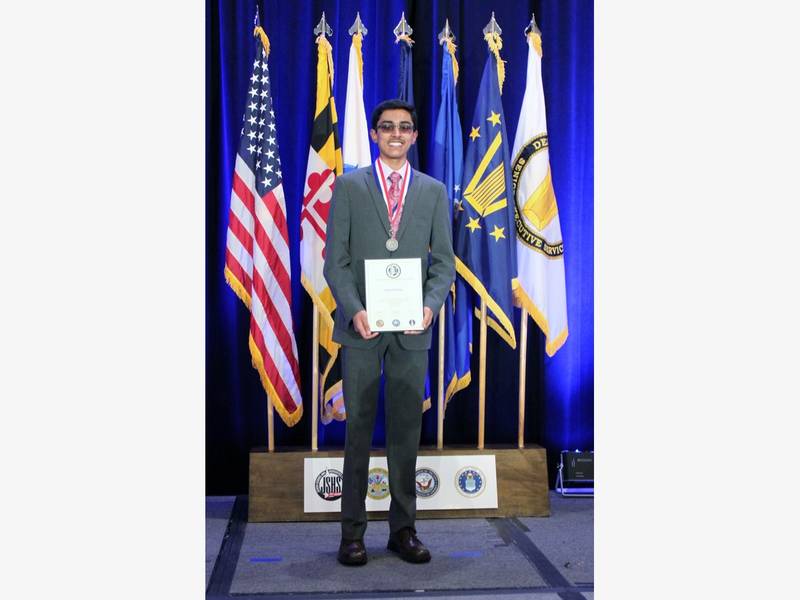
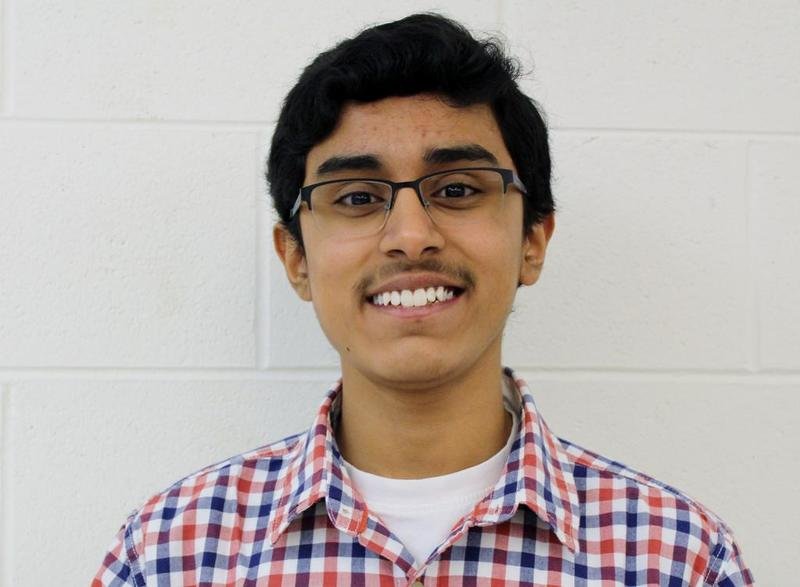
Amaan Khan placed at the National Junior Sciences and Humanities Symposium in Maryland.
PLAINFIELD, IL :
Plainfield South High School sophomore Amaan Khan won second place in the National Junior Sciences and Humanities Symposium (JSHS) held in Maryland May 2 to May 5, 2018, for creating a self-driving model car.
He advanced to the national competition after winning first place at the regional JSHS competition in March.
Khan’s model car can drive within designated lanes, stop and go at traffic lights, and avoid obstacles.
His second-place finish earned him an $8,000 scholarship in addition to the $2,000 scholarship for winning the regional event. The regional competition is open to ninth through twelfth grade students.
Most of the 97 national competitors were high school juniors and seniors. “Second in national is still really great,” Khan said.
Students compete in several categories including computer science and math, bioengineering, behavioral science, medicine, health, physics, engineering and environmental science.
Khan wants to enter the Intel International Science and Engineering Fair next year, he said.
Photo/article via District 202
source: http://www.patch.com / Plainfield Patch / Home> Kids & Family / by Shannon Antinori , Patch National Staff / May 17th, 2018
A Plainfield South High School sophomore is traveling to a national science competition, after he created and programmed a self-driving car.
Amaan Khan, 15, will compete this week in the National Junior Science and Humanities Symposium in Maryland, after winning the Illinois Junior Science and Humanities Symposium (JSHS) in March, according to a news release from Plainfield District 202.
Khan created and programmed a self-driving car that can drive within designated lanes, stop and go at lights and avoid obstacles.
He won a $2,000 college scholarship and free trip to the national competition. He is one of two students from Illinois heading to Maryland to compete Tuesday through Saturday with 93 students from across the nation.
Competitors must submit a research paper and present their projects before a panel of judges and an audience of their peers.
Khan became interested in robotics and artificial intelligence last year, after he built a voice-controlled toy car. He took online college courses and watched college lecture courses and YouTube videos to teach himself computer programming.
“As I was learning I kept building the project,” Khan said. “I’d learn one thing, implement it, learn another thing and implement that.”
Patrick and Samantha Scanlan, PSHS science teachers, have supported Khan along the journey.
Samantha Scanlan helped Khan register for the contest. Patrick Scanlan helped Khan polish his oral presentation.
“[Khan] knows what he wants and seeks out the resources to do it,” Patrick Scanlan said. “And if there’s something he needs to learn, he’s able to figure out what he needs to be successful.”
The JSHS is designed to challenge and engage students in science, technology, engineering or math.
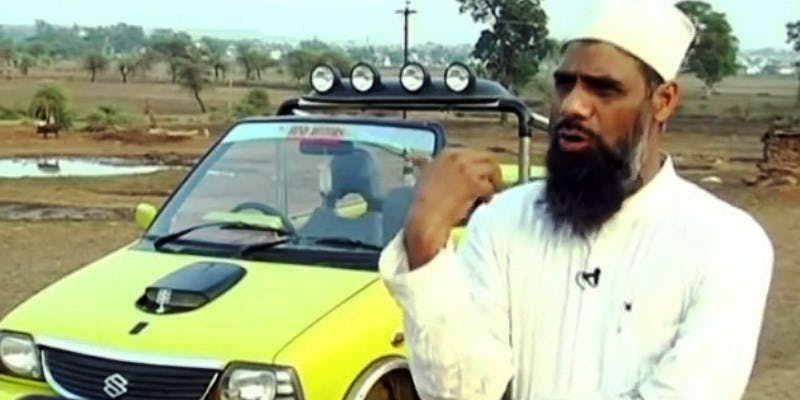
44-year-old car mechanic Mohammad Raees Markani from Madhya Pradesh has invented a car that runs on water.
This 12th pass took five years to develop the final product. The car runs on acetylene gas, which is formed from a chemical reaction between calcium carbide and water. Raees now has a patent for his water car. According to Mirror, Raees has been modifying an 800 cc engine for the last five years – and now believes he has made the scientific breakthrough. The eco-friendly car uses a mix of water and carbides.
Raees who has been a mechanic for the last 15 years told Mirror, “The gas is used for several industrial purposes including welding and portable lighting for miners. But in my case, I am using it to propel the car engines . I have made other changes to the engines, which helps the overall performance of the car. So basically, it is just about the water.”
“The market for environmentally friendly cars is getting bigger and automobile companies around the world are looking for eco-friendly ways to reduce pollution. So a car like mine can be a good alternative. It costs close to nothing to operate and it is environment friendly,” added Raees.
Image : Pultan
The Chinese automobile companies have invited Raees to develop the idea further. All the companies that are interested in Raees’s water car project will have to meet his one condition – any plant to make new cars will be established only in his hometown in Madhya Pradesh. “I want things to change in my hometown. So this is where my work should continue,” Raees stated.
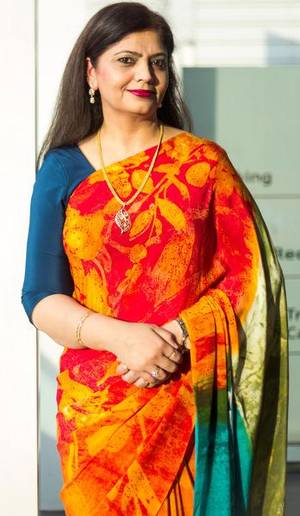
Chennai-born Rehana Ameer chats about how she got into British politics, and the need for youth to get into public affairs
Rehana Ameer was your quintessential Triplicane girl. Growing up, she dreamt of becoming a doctor, but life had other plans for her. She got into the IT sector and was sent to the UK, after which she kept shuffling between the two countries. In 2008, she made a decision – to relocate to the UK with her husband and children.
Today, 10 years later, Ameer is creating a name for herself in London. Apart from the business she runs, she’s also popular for being the first Indian-born woman to be elected as a councillor to a ward in the City of London. In the city for The Glassbox’s Meraki speaker series, Ameer opens up on how she got into the political arena and the need for younger people to spark a change in the system. Excerpts:
You’re doing well for yourself in the UK, but you’re no stranger to Chennai, right?
I was born and raised in Triplicane, and got married to another Chennaiite – from Royapettah. We moved to the UK and that’s where my journey began.
You are the first Indian-born woman to be elected to the City of London Corporation. Can you recall that day when you were announced winner?
I didn’t realise that it would become this big. There was a lot of pressure in the run-up to the elections; the campaigning was tough. There was a blast the day before elections. What helped me was my focus and keeping my eye on the prize.
After winning, I didn’t show my happiness. The person I defeated was active in the circuit for more than three decades and I had to show my respect. But within me, I was very happy that my hard work had paid off. Only after my son said, “Mama, you’ve won” three times, did it sink in.
How’s a day in your life looking after the win?
The role I’ve taken in my ward in the City of London is a voluntary civic responsibility role. In some wards, you have 10 councillors but in mine, there’s only me and another person… so the work is shared. I sit on three large committees in which we have regular weekly meetings; three days go into that. One good thing about London is that most things are largely scheduled and planned. I also run a business . Apart from that, I’m a mother and a wife.
What have your chief learnings been after becoming a Councillor?
Earlier, I had theoretical knowledge, but now I know how things work practically. I know the system and can try bringing some kind of a change. I’m also in a position to guide and advise people on how to go about tackling their issues. It’s a four-year term and it’s been just a year now, but I think I’ve been a fast learner.
You’ve grown rapidly in your political career. Did you have a godfather?
I had no political affiliations; it was more of an internal passion. If you have the skills and attitude, you’ll get support, irrespective of who you are. For me, politics is no different from any other profession. That sort of a mindset should come in India. My message has always been this: young people and women should get into politics. I know there are challenges but a start needs to be made somewhere.
But aren’t there a lot of differences between how politics work in India and back in the UK?
Yes, the outlook is different. But you don’t necessarily need to come into the forefront of politics to make some sort of change. There are many roles in the system that people might not be aware of; it can be policy, research or advisory. A new policy is not just the result of what one politician thinks… it is the result of many brains. You could be one of them.
Who’s that one politician that you have admired?
As a woman, I admired Jayalalithaa and her courage. The power she had to bring the masses together was amazing.
Did you dream of becoming someone like that growing up?
My father was the president of the local jewellery association and he was always looked up to as a leader. As a child, I remember wanting to be like that, but I never imagined I’d get into politics someday. A point came in my life when I started thinking what I’ve done for the betterment of my fellow beings. I realised that I had migrated from India to the UK and didn’t want to lead life like any other migrant. I wanted my children to do something for society and for that, I needed to lead by example… and that’s how politics happened.
source: http://www.thehindu.com / The Hindu / Home> Society / by Srinivasa Ramanujam / May 10th, 2018
A Primary school teacher and daughter of an accountant, Seerat Fatima is one among UPSC achievers in 2017 exam whose result was declared on Friday.
Seerat’s father Abdul Gani Siddiqui being an accountant in a government office was hurt by the way bureaucrats treated their subordinates, and it is when he decided that his eldest daughter would become an IAS officer. “All power resides only with officers, I used to think. This is why I wanted Seerat to become an IAS officer”, Siddiqui said to local media as per a report by Ummid News.
Despite less salary even to run the household properly, Siddiqui made sure that he gets his daughter study at St. Mary’s Convent School in Ghoorpur, which is around some 15 km from Allahabad.
After completing her graduation and B.ed from Allahabad Central University, Seerat joined a school. “I started working as a teacher because it was becoming difficult day by day to sustain on my father’s salary”, she says.
Seerat on her return from school every day would prepare till late in the night for Civil Services examination. Meanwhile, Seerat started becoming discouraged and almost decided to quit. “It was during this distressing period I watched Nawazuddin Siddiqui’s Manjhi. The film rejuvenated me and the result is in front of you all”, she says.
source: nyooz up
Seerat Fatima has cracked the 2017 UPSC Civil Services exam in her 4th attempt, with a rank of 810th from the list of 990 candidates. However, she now wants to better her rank and plans to reappear in the examination.
source: http://www.siasat.com / The Daily Siasat / Home> India> News> Top Stories / April 30th, 2018
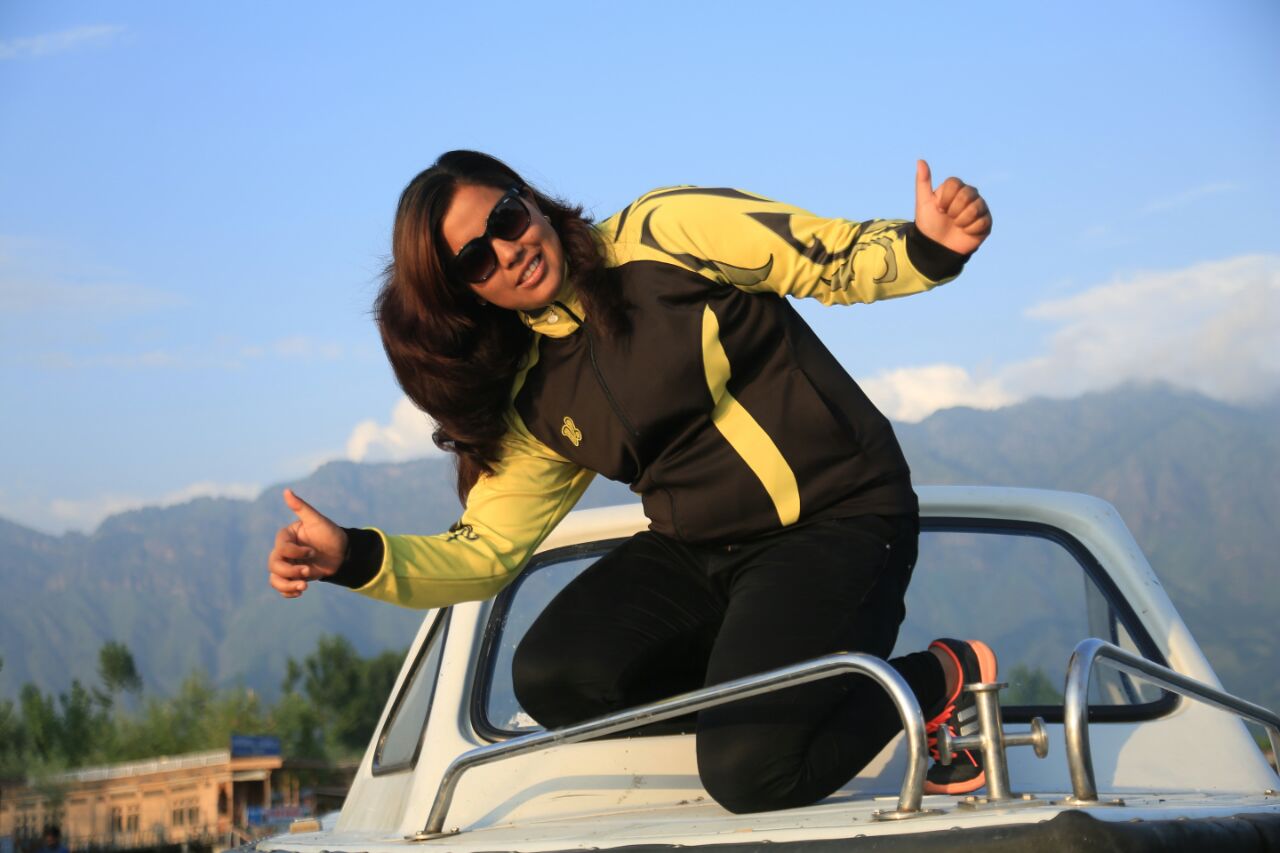
Bilquis Mir, the first water sports coach from the Valley, is the only Indian among 20 Asians to get the position.
New Delhi:
Kashmir’s kayaking star Bilquis Mir has been selected as a water sports judge for the Asian Games to be held in Indonesia later this year.
“I will be one of the judges for the water tournaments in the games. This is a very important post,” 32-year-old Mir told ThePrint.
Mir, the first water sports coach from the Valley, is the only Indian among 20 Asians picked up by the Asian Canoe Federation team for this post.
However, her journey has been one of overcoming serious obstacles. From practising water sports in the world-famous Dal Lake in Srinagar to rowing through the wild waters of Europe, Mir has overcome every challenge to bust the myth that “girls can’t play sports”.
“There was a time when I had no one to support. We are three sisters and people here prefer boys to girls. From day one, I wanted to prove them wrong,” she said.
“They also said girls can’t play sports, it is not their thing…I struggled more because water sports were not even recognised in India,” Mir added.
The 18th Asian Games will be held from 18 August to 2 September.
Mir was the coach of the Indian kayaking and canoeing team from 2010 to 2015. She also went to Japan with her team but could not qualify for the Olympics. She is determined to reach the Olympics stage soon.
“People would tell my parents that their kids are pursuing civil services with pride. When my parents would say, I am a coach, I was looked down upon,” she said.
“People said it was a waste of time. Not many understood sports, mainly water sports but I did not give up…I was the only girl to take up this sport in the Valley,” Mir added.
Mir, who has a coaching diploma from Budapest, Hungary, started kayaking and canoeing in 1996. She has represented Jammu and Kashmir for 10 years in the national water sports games.
In 2009, she became the first woman participant from India in “MOL ICF Sprint Racing World Cup” in kayaking and canoeing in Hungary.
Mir said that the popularity of water sports, particularly kayaking and canoeing, is growing in India. “They were introduced a few years ago. They have a huge scope in the country, especially in Kashmir,” she said.
Mir is currently training 300 students, half of them girls from Kashmir Valley. “I started from Dal Lake…we have natural water resources and children have natural talent. Our team has got 56 medals in national level tournaments,” she said.
Her dream is to see maximum representation of players (paddlers) from the Valley in international tournaments. She says the state government is promoting the sports and has provided world-class equipment in schools.
source: http://www.theprint.in / The Print / Home> Governanace / by Rahiba R. Parveen / April 26th, 2018
Danish Siddiqui and Adnan Abidi were part of the Reuters team that won the 2018 Pulitzer Prize for Feature Photography announced on Monday.
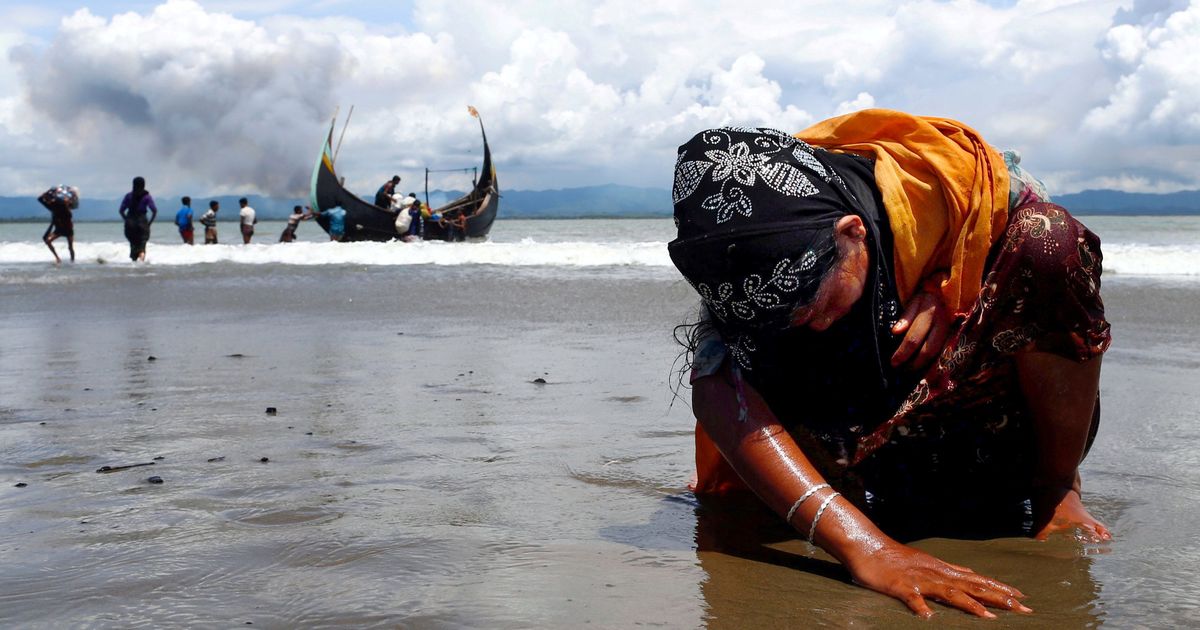
A Rohingya refugee after crossing the Bay of Bengal. | Danish Siddiqui/Reuters
A sun-burnt woman sinks to her knees on the shore, fatigued and forlorn. In the distance, a group of men unload the meagre belongings that they have carried with them in a small boat as they have made their way across the Bay of Bengal from their homes in Myanmar to the safety of Bangladesh.
This striking picture is the work of Danish Siddiqui, one of two Indians in the seven-member Reuters team that won the 2018 Pulitzer Prize for feature photography for their series documenting the violence faced by Myanmar’s minority Rohingya community and their mass exodus to Bangladesh starting from August 2017. The prestigious awards, given out by Columbia University in New York, were announced on Monday.
“A photo should draw people and tell them the whole story without being loud,” Siddiqui told Scroll.in. “You can see the helplessness and the exhaustion of the woman, paired with the action that is happening in the background with the smoke. This was the frame I wanted to show the world.”
Adnan Abidi was the other Indian in the team that won the prize. The other members of the Reuters team were Mohammad Ponir Hossain, Soe Zeya Tun, Hannah McKay, Damir Sagolj and Cathal McNaughton.
The Rohingyas, who are mainly Muslim, have been fleeing their homes in Rakhine state for several years, alleging that they are being discriminated against by the government of Buddhist-majority Myanmar. Myanmar maintains that the Rohingyas are illegal migrants from neighbouring Bangladesh.
The exodus in August was prompted by an intense campaign of violence in Rakhine. Myanmar’s military said that it had launched “clearance operations” against Rohingya militants. It denied that civilians had been targetted.
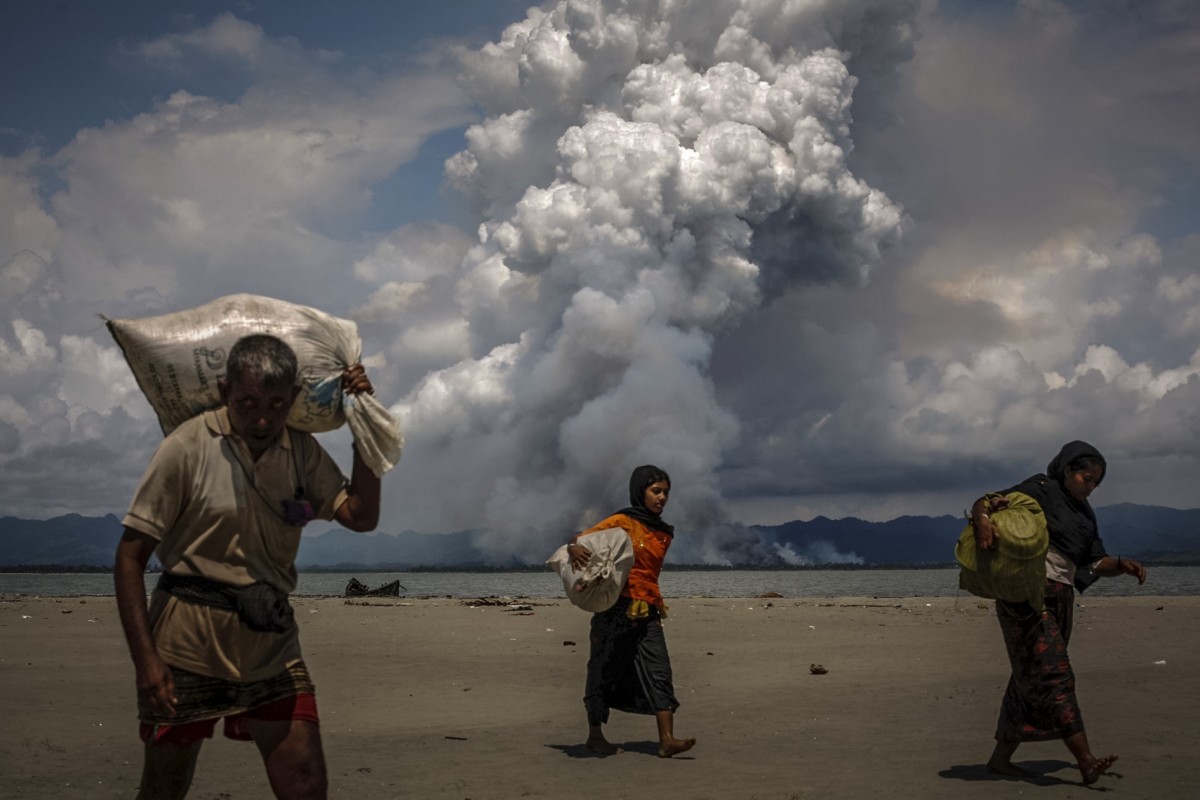
Smoke is seen on the Myanmar border as Rohingya refugees walk on the shore after crossing the Bangladesh-Myanmar border by boat through the Bay of Bengal, in Shah Porir Dwip, Bangladesh, in September 2017. Photo: Danish Siddiqui/Reuters
Complete chaos
Siddiqui was one of the first international photographers to be sent to the field at the outset of the crisis. The photographer had been on vacation in August when he saw the crisis unfold on the news channels. “I told my editors that I wanted to cover the story and within 48 hours I was on the first flight from Mumbai to Dhaka and then to Cox’s Bazar in Bangladesh,” Siddiqui said. “Since I was one of the first wave of journalists to land up there, there weren’t many restrictions, and I was permitted to even click pictures in no man’s land.”
Siddiqui spent around three weeks in the coastal villages of Bangladesh and in refugee camps. “It was completely chaotic,” he recalled. “Fishermen were carrying the refugees illegally from Myanmar to Bangladesh. The boats off coast were not going on the jetty and were landing in the middle of nowhere. Since the waves were really high, the boats were toppling and some people even died. Most of them were so traumatised. What they told me was that nobody should witness these kinds of things in their lives. For them, the first priority was to get food and water for their family.”
Adnan Abidi said that the situation was frantic. “Everybody was in pain,” he said. “We knew it was our job to shoot, but I did not want to randomly go in and click pictures. So I spoke to them and then started shooting. Everybody has lost everything and were living in a 10 by 6 plastic sheet for shelter.”
Abidi spent about 15 days in Bangladesh between late October and early November. “I have worked at Reuters for over 14 years now, but this is the most challenging story I have done till now, including the Nepal earthquake” of 2015, he said.
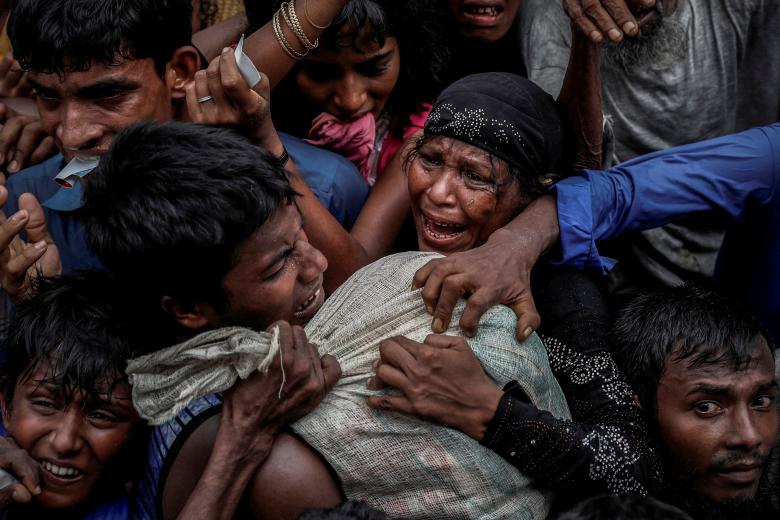
Rohingya refugees scramble for aid at a camp in Cox’s Bazar, Bangladesh September 24, 2017. REUTERS/Cathal McNaughton
Right place at the right time
Each of the 16 photographs in the series portray a different aspect of the vast human tragedy. A great news photograph, says Siddiqui, the result of both knowledge and chance. “You have to be at the right place at the right time,” he said. “It is also important to know the history and culture behind a place. You need to also know the history of the conflict. And in cases like these you have to do research on the monsoon waves. But again, news photography does not involve too much planning. We must think of what the readers want to see.”
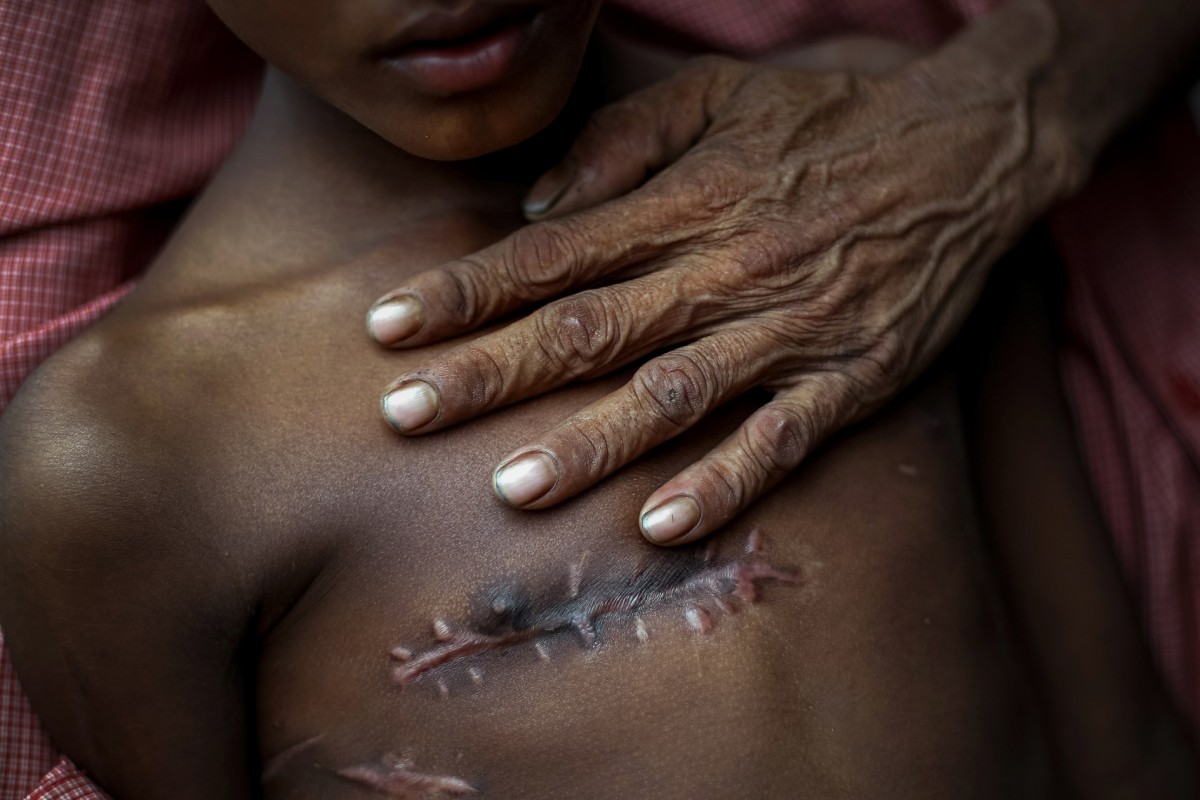
Behind Abidi’s picture of a young boy bearing a scar, there is a Rohingya translator’s presence of mind, the photographer said. “I was very tired that particular day and was having tea at a small dhaba in the camp when my translator Mohammad Farooq noticed that this kid had a scar,” Abidi said. “I quickly went to them and spent some time with them. The father explained that the seven-year-old boy had been shot on his chest.”
The picture speaks volumes. “I decided that I did not want to show the face of the kid and instead show just his chest and the father’s hands because that image says everything,” Abidi said.
Mohammed Shoaib, 7, who was shot in his chest before crossing the border from Myanmar in August, is held by his father outside a medical centre near Cox’s Bazar, Bangladesh November 5, 2017. REUTERS/Adnan Abidi.
A story to tell
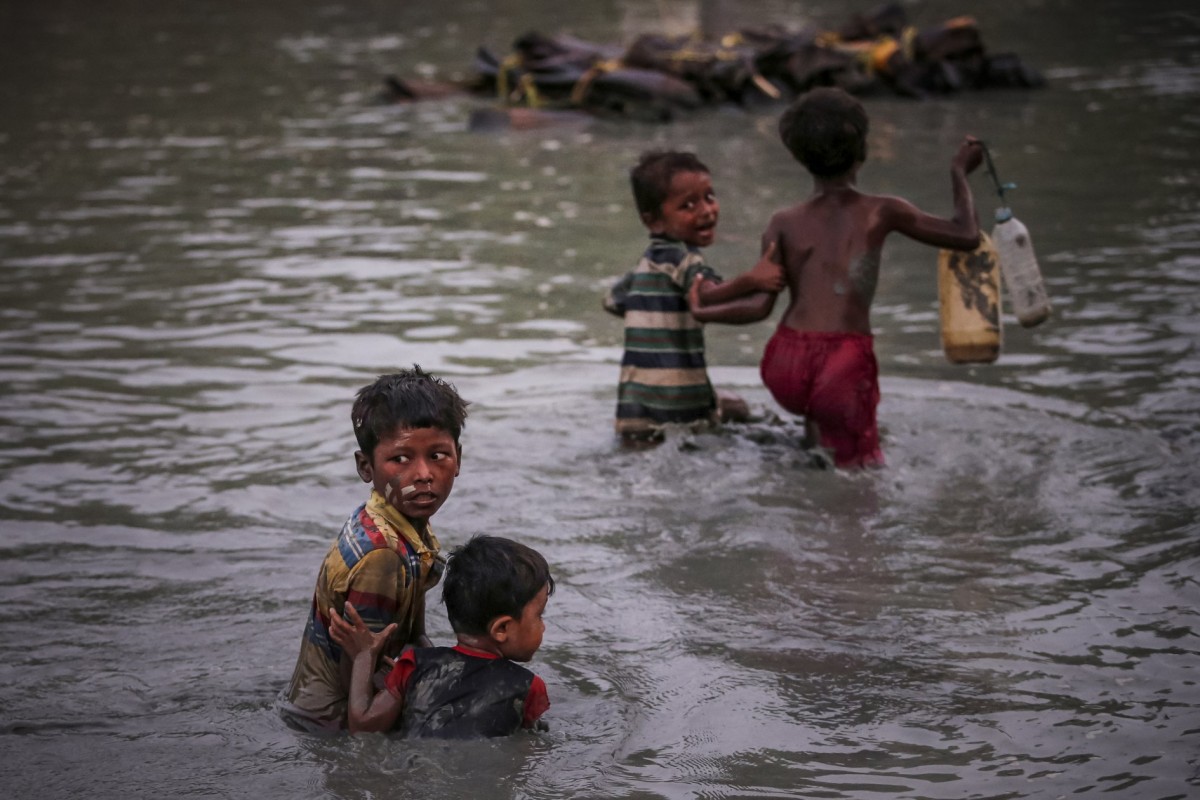
But not everything can ride solely on coincidence, the two photographers noted. When Abidi was in Palong Khali, near Cox’s Bazar, there was an influx of more than 3,000 refugees across the Naf river on November 1. Covering such sudden events needs quick thinking, Abidi said. “We could see a thin line of people crossing the river from around 2 km away from a village,” Abidi said. “So we walked to the river and when we reached there the light was really good. But there was a guard standing at the bank of the river who did not let us go inside to shoot. We pleaded with him to not send us back. He finally let us in and we kept shooting till 11 in the night.”
For Siddiqui, the biggest challenge was physical. “We had to sometimes walk hours to get to a point,” he said. “One day I had to a climb a mountain and walk for six hours barefoot, with leeches on my leg. But you could see that the refugees are also coming from the same side. As a journalist you want to be strong in front of them because I had to tell their story. They should feel that connection with me. If they see me walking by with a bottle of water before them, it will not be nice. You have to be like them.”
Rohingya siblings cross the Naf River along the Bangladesh-Myanmar border in Palong Khali, near Cox’s Bazar, Bangladesh, on November 1, 2017. Photo: Adnan Abidi/Reuters
The seven members of the Reuters team each spent about two weeks in Bangladesh on rotation. “We had photographers from different language backgrounds from Bangaldesh, India, Northern Ireland, Britain and Bosnia,” Siddiqui said. “We had a complete story. We also had pictures from the other side in Myanmar as well, which many don’t. Also as a [news] agency, we are very fast and work on getting raw emotions in a photo.”
The rotations helped the photographers cope with emotional exhaustion, Abidi said. “I followed around this kid who had lost his father and was living with his mother and eight siblings,” he recalled. “This kid was taking care of his family. There were people from NGOs and religious communities who were distributing food and money at certain camps. This kid used to follow them for many kilometers and knew where to find them just to get supplies for his family. A week of following the boy broke me down and I then decided that I could not shoot after that.”
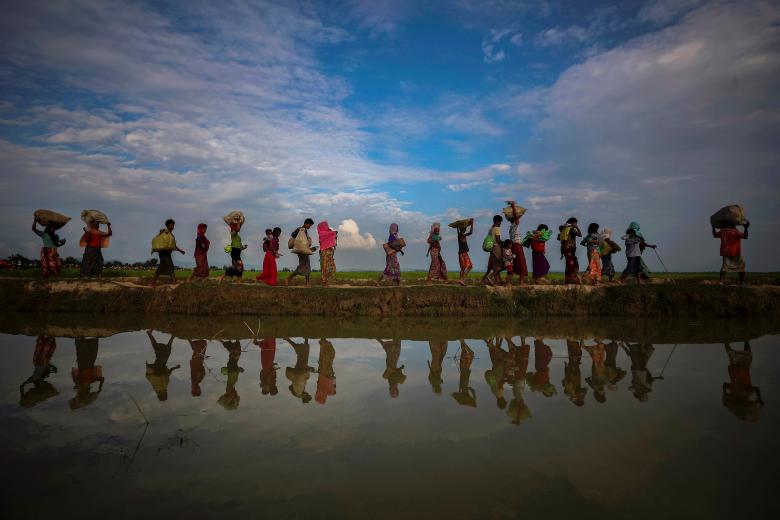
Rohingya refugees are reflected in rain water along an embankment next to paddy fields after fleeing from Myanmar into Palang Khali, near Cox’s Bazar, Bangladesh November 2, 2017. REUTERS/Hannah McKay
Finding new eyes
Siddiqui hopes that the Pulitzer Prize will attract new attention to the tragedy. “I just hope that this award makes a positive difference in the lives of these refugees,” he said. “I hope through these pictures and recognition, more people would get to know about the problem. Because it is not over yet. The crisis is not over yet. These makeshift camps are built on muddy hills which are prone to landslides when the heavy monsoon starts.”
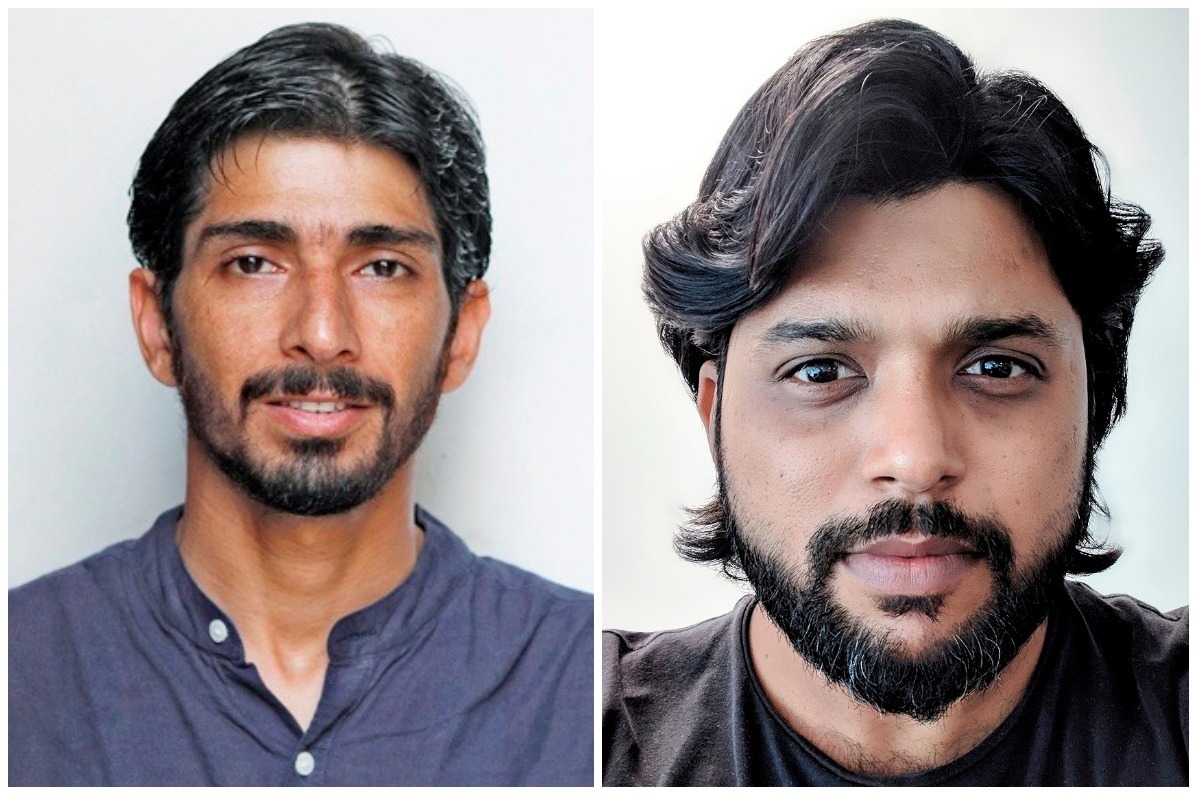
Adnan Abidi (left) and Danish Siddiqui.
Siddiqui added that his field experience had opened up his mind to the various narratives about the Rohingya community and its displacement. In August 2017, the Indian government announced that it was planning to deport all 40,000 Rohingya refugees living in the country, telling the Supreme Court in an affidavit in September that the refugees posed a “serious national security ramifications and threats”. The Supreme Court did not allow any deportations.
“How the narative in India is played out is totally different from what I saw on the ground,” Siddiqui said. “You do not know what is happening unless you are on the ground. Another big takeaway was how too much nationalism can destroy a community of more than one million people. The narrative in Myanmar is totally different. When I went there I could see how helpless people were. They had to fight for a bottle of water. Reading news reports on the crisis was completely different from being on the field and experiencing it first hand.”
source: http://www.scroll.in / Scroll.in / Home> PhotoJournalism / by Sruthi Ganapathy Raman / April 18th, 2018
International artist Wajid Khan, famous for his ‘iron nail art’, is making the tallest statue of Swami Vivekanand in India that would be installed in Uttar Pradesh.
International artist Wajid Khan, famous for his ‘iron nail art’, is making the tallest statue of Swami Vivekanand in India that would be installed in Uttar Pradesh. The statue made of ashtdhatu (alloy) will be 170-feet tall and will be installed either in Lucknow or Agra, said Khan.
He said the statue will be completed in six months. Khan is here to take part in the four-day International Art Festival being organised at the Aligarh Muslim University (AMU).
Though Wajid Khan has not studied in any university or college, he has made a mark for himself by his craftsmanship in metal statue making. He is also making a sculpture for FIFA 2022 to be held in Qatar. The project will take five years to complete.
“A 40-feet statue of Swami Vivekanand is installed in Kolkata and that is his tallest statue. Now, the work on making his 170-feet statue has started in Indore,” said Khan.
“The project is being financed by some businessmen from UP, Delhi and Gujarat. They will decide on the place where the statue will finally be installed. As of now, the first preference is Lucknow and the second is Agra. Due to any reason, if the statue is not installed these cities, the third option will be Delhi,” he added.
“The statue is being made from eight metals including iron, zinc and copper. For the time, the total cost of the statue cannot be revealed,” he said.
Wajid Khan said he is also making a 10×8 ft statue of British Queen Elizabeth, which will be installed at the Royal Palace in London.
Khan has embarked upon a new venture. A proposed retro Bhopal city will be established in 40 acres area in Bhopal and the artist will give it a 2,000 years old look. The project is being financed by some businessmen.
source: http://www.hindustantimes.com / Hindustan Times / Home> Cities> Lucknow / by Pradeep Saxena, Hindustan Times,Aligarh / March 15th, 2018
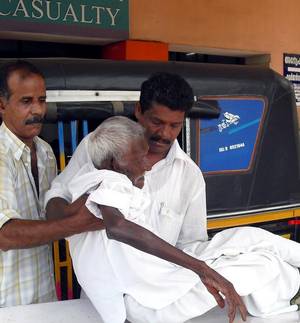
Madathil Abdul Azeez helping a patient. S. RAMESHKURUP | Photo Credit: S_RAMESHKURUP
This member of Olavanna grama panchayat has been a rescue volunteer for 35 years
“I have taken 2,628 dead bodies to hospitals across Keralafor autopsy till date,” Madhathil Abdul Azeez said, not happy with the mention of ‘more than 2,500 bodies.’ This member of the Olavanna grama panchayat has been a rescue volunteer for most of his life and has been instrumental in saving umpteen number of lives.
Azeez’s phone number is on speed dial for all those who deal with emergencies in Kozhikode and nearby districts. Whenever and wherever there is a major accident or a life-threatening situation, he will be one of the first volunteers on the spot.
“This is the mission of my life. No job or no family function is more important than helping people in life-threatening situations,” Azeez told The Hindu on the sidelines of yet another function where he was honoured for his selfless acts.
Mr. Azeez, whose life story Daivam Paranjittanu (Because God asked me to) written by Razaq Kalleri, was released on Wednesday, has been doing his duty to fellow human beings, without expecting any remuneration, for 35 years. He was one of the volunteers at Pookkipparamba when a bus caught fire there almost a decade and a half ago. He was also there at Kadalundi when a train fell into the river in 2001. Azeez was one of the first to come to the aid of those in need on the coasts of Kozhikode during Cyclone Ockhi. Though he has retrieved many bodies from massive accident sites, many of whom may have been alive, there are nine people whom he rescued personally from a hanging rope or blazing fire.
He was only 17 when he first dove into a river to rescue a child in his neighbourhood. Though he could not save the child, the dive changed his life forever. Now at 53, Azeez gets involved in situations no one else would dare to, including retrieval of dead bodies that are days old.
Having been honoured with many awards, Azeez considers the honour accorded by his friends and well-wishers on April 4 as a special one. A docu-fiction based on him — Avasanathe Kai (The Last Hand) — by Santhosh P. Velliman was also released on the occasion.
source: http://www.thehindu.com / The Hindu / Home> News> States> Kerala / by Aabha Raveendran / Kozhikode – April 07th, 2018
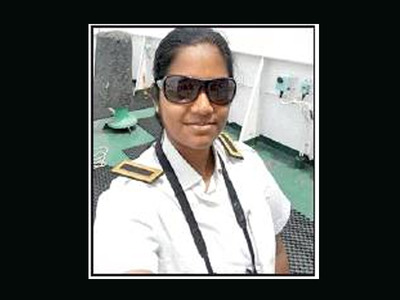
After six months, Reshma Nilofer Naha will be piloting ships from sea to the Kolkata port.
She will be the world’s first woman river pilot to do this. She will pilot ships through a distance of 223km, of which, 148km will be up the Hooghly – considered to be one of the most treacherous with its sharp ‘bars and bends’. Reshma, originally from Chennai, is now undergoing training at the Kolkata Port Trust (KoPT).
“The role of river pilots is crucial as they have knowledge of the river and can guide the ships into port. We have 67 river pilots in service and Reshma will start her job soon,” KoPT chairman Vinit Kumar said.
Reshma, a BSc (Nautical Science) graduate, was recruited by KoPT in 2011. According to JJ Biswas, director, marine department, KoPT, she also has a year’s experience at sea as a cadet. “After joining KoPT, she obtained the 2nd and 1st mates competency certificates from the Directorate General of Shipping. Recently, she cleared the Grade III Part-I examination from KoPT. In the next six months, she will qualify as a Grade III pilot,” he added.
As a Grade III pilot, Reshma will initially be assigned smaller vessels. Later, as she gets more experienced, she will graduate to Grade II and Grade I and take charge of large ships like Panamax vessels – nearly 300m-long with a capacity of 70,000 tonnes or more.
All ships calling on the ports of Kolkata or Haldia have to contact the pilot station on Sagar Island when they approach the Sandheads. From the Sandheads to the pilot boarding point at Sagar, remote pilotage is provided to the ships using Vessel Traffic Management System guidance. At a spot known as Middleton Point, a pilot vessel rendezvous with a ship and the pilot gets on board. The pilot is in charge till the ship reaches Kolkata and the harbour pilot takes over.
“The river has several sandbars and bends. A river pilot knows the channel along which the ship has to move to avoid getting stranded. Draught is also a problem and there is little scope of manoeuvring. The pilots make best use of the tides to guide ships in. People without training and experience along the river cannot handle ships,” another official said.
source: http://www.timesofindia.indiatimes.com / The Times of India / News> City News> Kolkata News / by Jayanta Gupta / TNN / April 05th, 2018