Dhamupur Village (Ghazipur District), UTTAR PRADESH :
New Delhi :
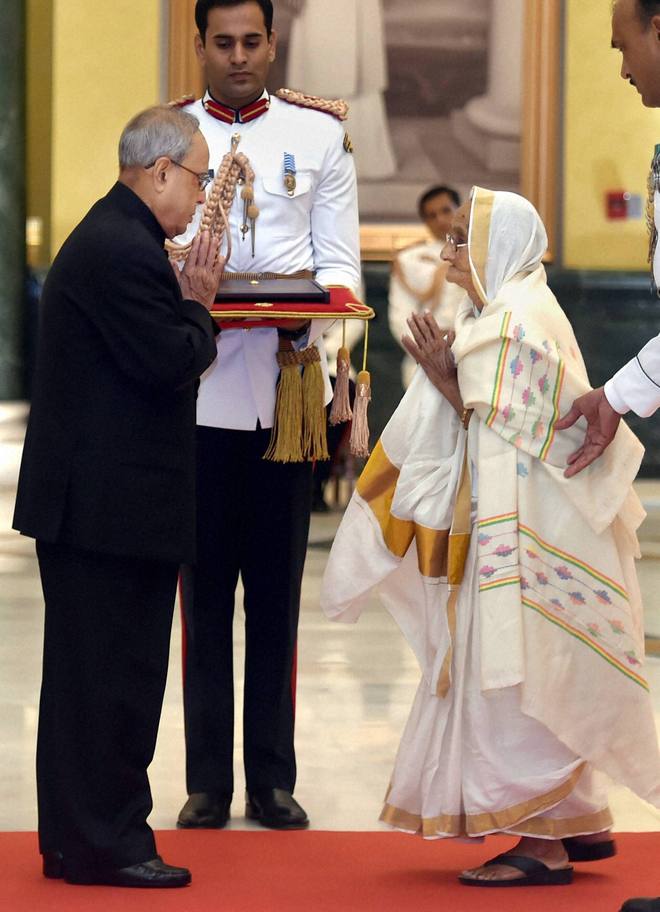
President on Tuesday felicitated 1965 war veterans as he hosted a high tea at Rashtrapati Bhawan.
President Pranab Mukherjee felicitates Rasoolan Bibi (L), widow of Param Vir Chakra awardee Abdul Hameed, and Marshal of the Indian Air Force Arjan Singh in New Delhi on Tuesday. PTI
Among those honoured were: Air Marshal Arjan Singh, a Five-Star General; Rasoolan Bibi,wife of Company Quarter Master Havildar Abdul Hamid, a recipient of Param Vir Chakra; and Zarine Mahir, daughter of Lieutenant Colonel AB Tarapore, a Commandant of Poona Horse, among others.
Prime Minister Narendra Modi paid tributes by laying a wreath at Amar Jawan Jyoti.
source: http://www.tribuneindia.com / The Tribune / Home> Nation / September 23rd, 2015
Eighty five-year-old Muraad Ali Khan, a native of Nuan village in Jhunjhunu district of the state, gets all animated whenever trouble starts brewing on the border.
His family, popularly known as ‘Cavalry Khandan’ (Cavalry family), and his six cousins had participated in India-Pakistan wars in 1965 and 1971. Though all his cousins died over the past three years following old-age problems, Ali is an active participant in the ongoing discussions and debates on deteriorating Indo-Pak relations.
Some hours after the Indian Army carried out the surgical strikes in Pakistan occupied Kashmir (PoK), 10 days after the Uri outrage, TOI spoke to Ali for his reactions to the conflict.
Not surprisingly, Ali, who has been following developments through television and newspapers like the rest of the country, was happy and congratulated the government of India and Army. “I must congratulate our forces for the act. I think our Prime Minister Narendra Modi’s tactics to isolate Pakistan is yielding results and the cancellation of the SAARC summit is proof fir it,” Ali said on Thursday.
His cousins — Captain Mohammed Ayub Khan, Captain Gaus Mohammed Khan, Captain Mohammed Sadiq Khan, Captain Yusuf Khan and Captain Gulaam Sarvar — had served the Indian Army in the 1965 and 1971 wars against Pakistan in various capacities.
He is the only surviving member of the ‘Cavalary Khandan’ who had served the Indian Army as a subedaar.
Captain Ayub was a Union minister who died on September 16 following a massive cardiac arrest. He was 85 and a recipient of Vir Chakra for his acts of valour during the 1965 India-Pakistan war. Ali’s village Nuan has at least one member from every family serving in the Army in various capacities.
“My opinion of the ongoing scenario is that India should isolate Pakistan financially, diplomatically and should continue with these surgical operations. They don’t deserve any mercy,” he added. In between, he wanted to know the number of casualties in surgical operations carried out by India. “Humari fauj Pakistan ki harqaton ka maqool jawab de sakti hai (Our Army can give appropriate answer to Pakistan). Humare sabr ka imtihaan na le Pakistan (Pakistan should avoid testing our patience),” he added.
Mohammed Shariq Khan, son of late Captain Sadiq Khan, who works as a teacher, said, “Whenever he (Ali) gets news of an army man being martyred, he gets pumped up. His blood pressure goes up. All his brothers had done a lot for the country. Our village has a good number of Qayamkhani muslims and from other communities who had fought in battles with Pakistan.”
source: http://www.timesofindia.indiatimes.com / The Times of India / News Home> City News> Jaipur / by Ashish Mehta / TNN / September 30th, 2016
A decorated soldier of the 1965 Indo-Pak war who rose to become a union minister, Capt Ayub Khan was laid to rest at his village Nuah in Jhunjhunu district with full military honours on Friday. He was born in 1932 in a Kayamkhani Muslim family of soldiers. His grandfather and father too served the Indian Army and now his cousins and their sons are continuing the family tradition.
Capt Ayub, the state’s first Muslim to win a Lok Sabha election and twice be a Congress MP from Jhunjhunu, was also a recipient of the Vir Chakra from President Dr S Radhakrishnan for destroying four Pakistani Patton tanks and capturing one in the Sialkot sector of J&K. Prime Minister Lal Bahadur Shastri had hugged the brave soldier and remarked, “I never met the Pakistani President Gen Ayub Khan but I’m proud to meet the Indian Ayub.”
In the 1965 war, Ayub was posted in the Sialkot sector that was under Lt-General P O Dunn. The 26th Infantry Division was ordered to capture Sialkot. The 18th Cavalry’s Bravo squadron, led by Risaldar Ayub Khan, was ordered to clear the Sialkot Road from Pakistan’s occupancy. The squadron moved upfront facing enemy fire. On September 9, the squadron confronted a large column of Pakistani forces with Patton tanks.
The Pakistani tanks attempted to encircle Indian troops, so the squadron commander ordered his troops to turn about and check the enemy encirclement. Ayub moved back and headed to close up with the enemy tanks that were threatening to cut off Indian troops from the rear. Ayub led from the front and destroyed four tanks before Pakistan could realize that an Indian troop had turned back to attack it.
In 1983, Ayub retired from the army and was granted the rank of Honorary Captain. Later, he joined politics and became a union minister in the cabinet of Prime Minister PV Narasimha Rao. Ayub Khan chose to wear white kurta-pyjama and sported the black army cap of the 18th cavalry, minus the crest. At 84, Capt Ayub used to sit at home and enjoy life with his family. He was no longer active in politics, as he hated the present day caste-based politics.
source: http://www.timesofindia.indiatimes.com / The Times of India / News Home> City> Jaipur / by Prakash Bhandari / TNN / September 17th, 2016
Akiyal was born with a rare heart condition known as double outlet, right ventricle
Nine-month-old Akiyal with doctor Adil Sadiq (Photo: DC)
Bengaluru:
Nine-month-old Akiyal’s father Farhan, an engineer from the Maldives, is all praise for Facebook.
“It was very difficult for us to generate funds for our son’s operation,” he says. “We could do it only because of Facebook.” Akiyal was born with a rare heart condition known as double outlet, right ventricle (DORV), a condition in which the blood vessel that carries oxygen-rich blood from the heart, is located in the wrong place.
“It was a complex surgery in the sense that the child was born with one side of the heart not developed, undeveloped left pumping chamber and a large hole in the heart along with a blockage of the artery going to the lung. He required a complex repair job, which wasn;t being done in the Maldives,” says the child’s treating doctor, Adil Sadiq, Head Cardiothoracic Surgeon, Sakra World Hospital.
Farhan says, “It was not possible to get funds in the Maldives, so my family and I decided to go online and ask for help from the social media. We went ahead with creating a Facebook page for our son.” They started the Facebook page, ‘Help Akiyal — Save A Child’s Heart’.
“We promoted the page by paying five dollars, which implied that 20,000 Facebook users would see the page,” says Farhan. In no time, people across the world saw it and donations started pouring in. “The money that we used to promote the page time and again was less than 100 dollars, but we were able to raise Rs 8 lakh over the course of the year,” adds Farhan.
This digital media approach helped Farhan to get donations from anonymous altruists in Sri Lanka, Belgium, Maldives and even Bangalore. Those who could not donate sent Akiyal their earnest prayers and blessings. By the end of the year, the page had 4,388 likes and thousands of people had visited it.
“She is now fine and we would be taking her back home to Malidives in a few days,” says an elated Farhan.
source: http://www.deccanchronicle.com / Deccan Chronicle / Home> Nation> Current Affairs / DC / by Joyeeta Chakravorty / May 25th, 2014
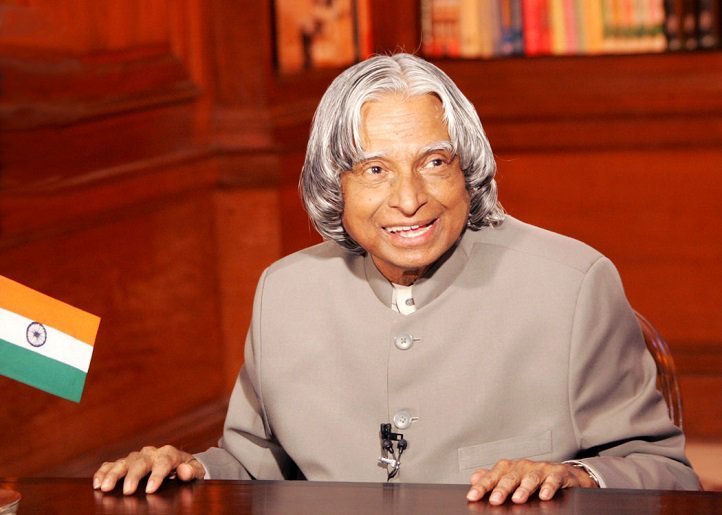
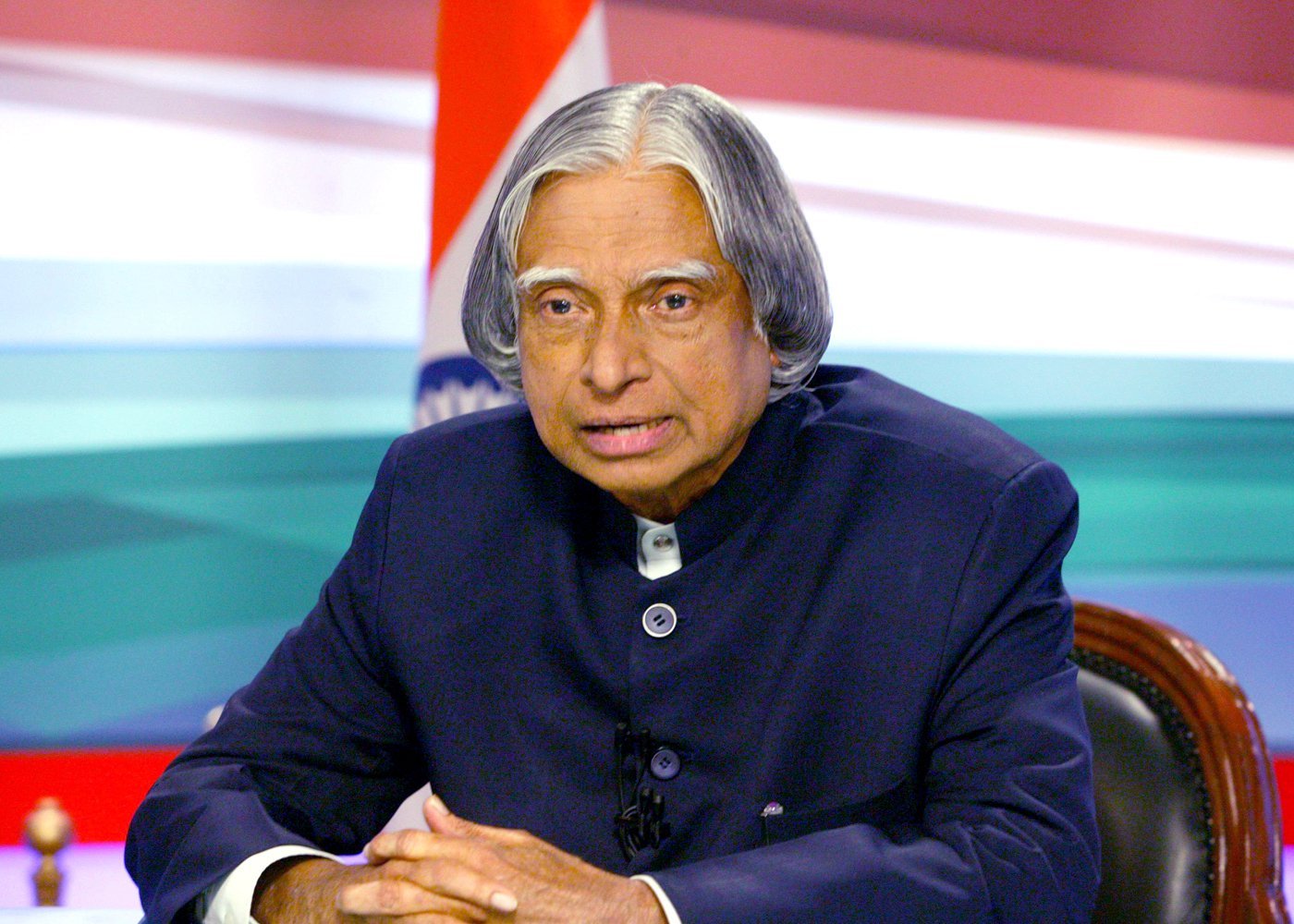
While India mulls over giving an appropriate tribute to the late former India President APJ Abdul Kalam and fights over his social media accounts, the UN has decided to name a satellite after the late scientist as a tribute to celebrate his vision.
Founded in 1999, CANEUS (CANada-Europe-US-ASia) serves to develop a common platform for space technology solutions for natural and man-made disaster management. The ‘GlobalSat for DRR’ is a UN-driven global initiative on sharing space technology for disaster risk reduction, Milind Pimprikar, chairman of CANEUS, told IANS.
The satellite will provide a common platform that will allow sharing of space and data segments, with an ability to serve individual nation’s disaster management and development needs, IANS reported.
Talking about the similarities between the satellite and Dr. Kalam, Pimprikar said, “In his ‘World Space Vision-2050’ Mr. Kalam had envisaged space faring nations joining hands to find solutions to mankind’s major problems such as natural disasters, energy and water scarcity, health-care education issues and weather prediction. Therefore we now plan to dedicate the UN GlobalSat initiative as a tribute to Late Dr. Abdul Kalam by renaming it ‘UN Kalam GlobalSat’.’
He hopes that the renaming will inspire new generations and scientists, and they’ll strive to work like Dr Kalam.
source: http://www.scoopwhoop.com / Scoop Whoop / Home / by Isha Jalan / August 08th, 2015
It all started on the 2nd of October last year when I chanced upon an article on a sports news website. It told the story of India’s first Olympic swimmer, Shamsher Khan, who represented the country in the 1956 Melbourne Olympics. Prior to that, he had set national records in all four strokes, or categories, as well as in water polo and diving, making him the only Indian to do so!
One of his contemporaries happens to be Milkha Singh, whose victories are celebrated and remembered by the entire country. On the other hand, Mr. Khan languishes in anonymity. Nobody in the country knows his name or is even aware of his whereabouts. The article identifies his village as Islampur, situated in rural Andhra Pradesh.
After reading the article, I was determined to document his untold story on camera. I decided to visit his village along with four of my friends and attempted to make a documentary on the forgotten legend.
Over the next few weeks, we pieced together Shamsher, our tribute to India’s greatest swimmer. In a series of interviews, we conversed with his contemporaries, family members, well-wishers and finally, the man himself. We encountered an interesting variety of opinions not just about his life, but also about the lack of recognition sportspersons get in India. What started as a documentation of the life of one forgotten sportsman became the story of countless unknown athletes who struggle to get by on the back of their glorious achievements.
In the end, we were faced with difficult questions about the current condition of sports in the country, to which we found no easy answers. Our only hope is to spread more awareness about Shamsher Khan, and his services to a nation that refused to recognise him.
Shamsher: The Forgotten Legend | A documentary by Bharat Misra
Blue Pencil Entertainment
Published on Jan 22, 2016
He represented India at the Olympics for the first time in swimming. He was once the national record holder in all strokes.
He saw two wars during his service in the Indian army…and then, he disappeared from limelight.
Watch as we trace the life of the legendary Shamsher Khan, who lies forgotten in today’s India, like so many gifted sports personalities…
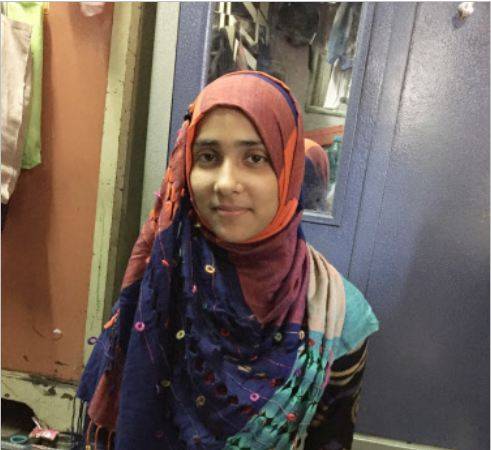
In an instance of triumph of will over circumstances, Raushan Jawwad, the fiesty 24-year-old from Jogeshwari who lost both her legs to a train accident in 2008 and later moved the Bombay high court to study medicine, managed to get the prefix of “doctor” attached to her name on Tuesday evening.
Jawwad Shaikh, her vegetable vendor father, and mother Ansary Khatoon, a homemaker, had tears in eyes when they saw people clap for their daughter while she was being conferred with the MBBS degree during the convocation ceremony.
Nine years after the accident, Raushan has become the first doctor in her family.
A bright student, she scored 92.15% in her Class X exam in 2008. A few months later, on October 16, 2008, she was pushed out of a crowded local train near Andheri station. She was on her way home after writing her college exam papers at Bandra’s Anjuman-i-Islam Girls College in the train when she fell on to the tracks and lost her legs under the moving train. Hearing Raushan’s screams, some commuters pulled the chain and the train was stopped. It took her a year to pull herself out of the trauma and resume her education.
“I am thankful to Allah for giving me the courage to continue my studies. I am now preparing for MD entrance. I want to start a hospital in my ancestral village in Azamgarh where many people face medical problems due to non-availability of good hospitals,” Raushan told TOI on Wednesday. She has expressed willingness to work for the poor in villages near Mumbai too. Last year, Raushan secured a first class in the final-year MBBS exam at KEM Hospital.
While the law allows only people with “up to 70% handicap” to study medicine, she was found to be 88% handicapped post the accident. To continue her education, Raushan had to put up a fight. She approached the Bombay high court seeking its intervention to secure an admission. Despite qualifying for the entrance exam, the government found her “unfit” to study medicine. The then high court Chief Justice Mohit Shah directed the state to give her admission. “When she can come all the way to court, why do you think she won’t be able to come to class?” asked Justice Shah.
Raushan stays with her parents, an older brother and younger sister in a 10-by-10-foot rented room in a Jogeshwari chawl.
“While studying at KEM, I used to stay in a college hostel. All my classmates, colleagues and teachers helped me a lot. The credit for my success goes to them too. They would always be very helpful and I never felt disabled when in their company,” said Raushan. When TOI first reported the accident, several people came forward to help Raushan financially. But her family did not even have a bank account.
source: http://www.timesofindia.indiatimes.com / The Times of India / News> City News> Mumbai News / by Mateen Hafeez / TNN / March 12th, 2017
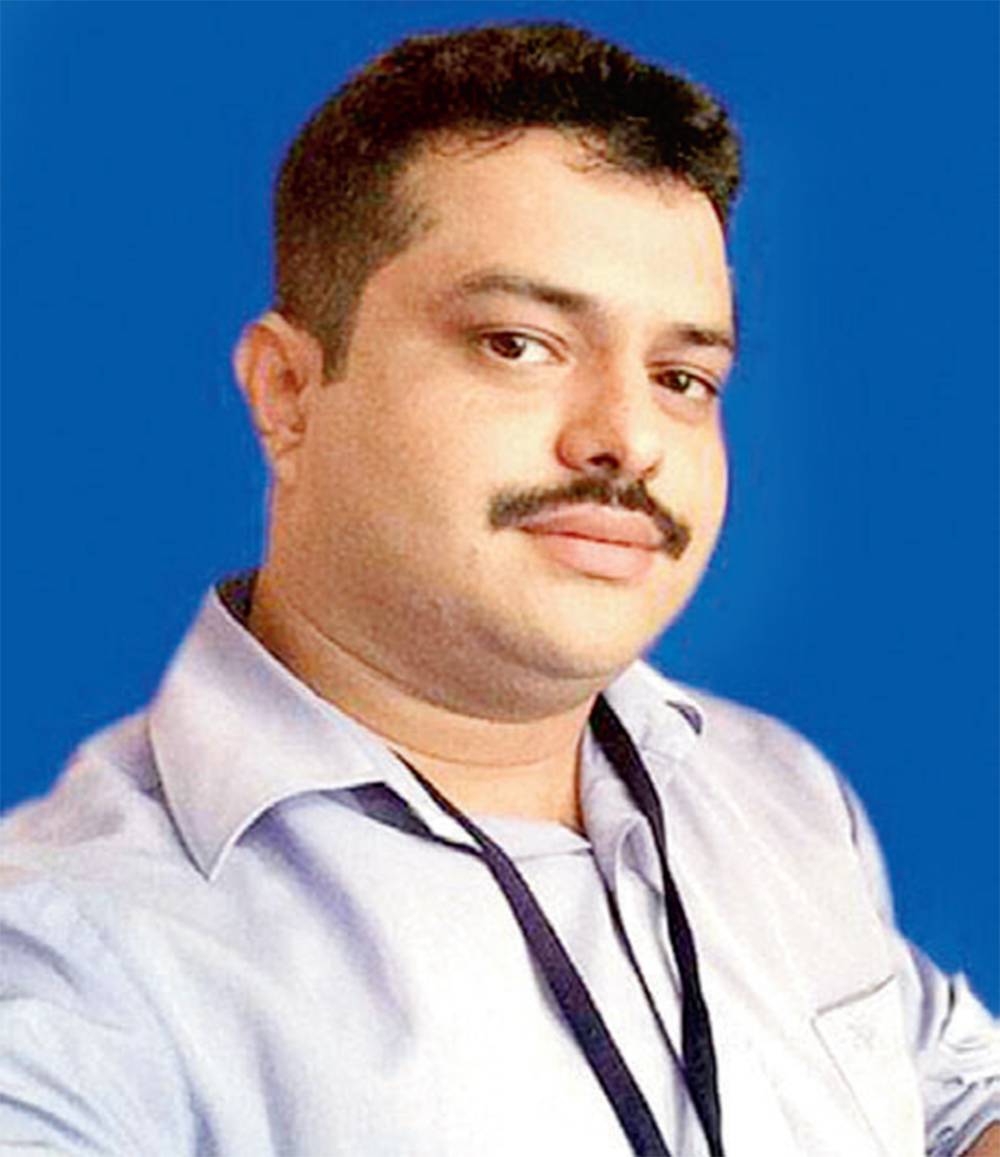
When 30-year-old Abdul Jabbar Ponnodi from Bantwal of Dakshina Kannada district was 20 years old and wanted to complete his UG course like many of his friends, he developed back pains.
Abdul Jabbar Ponnodi
For nearly one-and-a-half years, he went to a local doctor and lived on painkillers. However, after two years when the pain increased, scanning and other medical tests revealed that Abdul had developed ewing sarcoma, a rare form of cancer.
Speaking to Bangalore Mirror, he said, “Gradually my legs lost strength, I lost bladder control. I was bedridden. I was operated upon, and after radiation therapy as well as chemotherapy for nine months, my condition improved. With almost two years of physiotherapy, my legs started regaining strength. With the help of special shoes, I started moving around, started using the scooter and also started working as a salesperson in a mobile phone shop.”
For almost seven years, he worked at the mobile centre. At the same time, he also started emceeing for programmes, worked on developing a mobile application for an online portal and was active on social media as well as writing short poems.
“Unfortunately, again there was a growth near my lungs last year. It was about 12 cm, but with medicines it was reduced to one cm. I was on medication for the next six months, only to notice the growth increase to 14 cm. With chemotherapy, it has been reduced to 8 cm. I have more sessions of chemo to go,” he said. In the last ten years, he has been counselling patients at a private nursing home and has also formed a WhatsApp group where they collect funds to help needy patients.
“Whenever I get to know that someone in a family or friend or relative is suffering from cancer, I go and speak to them. Disease should be restricted to the body and not to the mind. The body can be treated, but not the mind. It is important for people to follow a diet that has more natural food and avoid preservatives,” he said.
source: http://www.bangaloremirror.indiatimes.com / Bangalore Mirror / Home> News> State / by Bangalore Mirror Bureau / March 01st, 2017
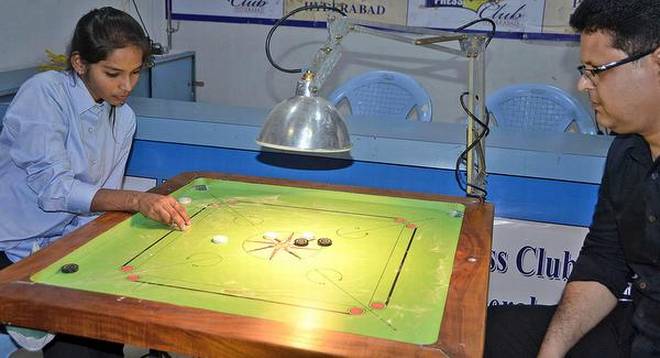
No stopping her Shaik Husna Sameera playing a friendly game with AICF president Neeraj Kumar Sampathy in Hyderabad on Saturday. | Photo Credit: V_V_SUBRAHMANYAM
Issues certificate to the carrom champ for setting a world record
For Shaik Husna Sameera, the agonising two-month wait has finally ended with the Guinness World Records (GWR) issuing the certificate recognising her feat of playing carrom for 34 hours and 45 minutes at DRRMC Indoor Stadium in Vijayawada in December last.
She broke the previous record of 32 hours and 45 seconds set by Narayan Paranjpe, Atul Kharecha, Prakash Kagal and Pramod Sen in the US in 2005.
Another record holder
With the GWR insisting that the world record be certified, she had to play with only one opponent, 22-year-old Allada Pavan, who is now employed in Bengaluru.
Interestingly, both are certified as world record holders for their feat.
“It’s a great moment. I have been waiting for this for long. Only I know what I had to go through in the last two months because of the suspense. But I must thank the AICF President Neeraj Kumar Sampathy for his support in helping me realise my dream,” said the Intermediate second year student of Sri Gayathri College at Chaitanyapuri in the city here.
“Yes, there were some doubts about the date mentioned in the proof that was submitted and there were quite a few queries too. But once they were satisfied, they declared that I did set a world record with a break of five minutes after every hour. This is a great moment for me,” said the 16-year-old Hyderabadi, who took to the sport as her mother was also a player and a qualified umpire too.
National titles
What next? “The focus is on winning the national titles. I am sure that given the kind of support from the AICF and Hyderabad Carrom Association with founder-president Haranath and S. Madan Raj going all out to help me, I hope to win the World Cup one day,” she said.
For his part, Dr. Neeraj said it was a great honour for the young champion as it’s not every day that such a record is attempted in any sport.
“And, I feel it is a huge fillip to the sport itself,” he added.
source: http://www.thehindu.com / The Hindu / Home> News> States> Telangana / by V.V. Subrahmanyam / Hyderabad – February 25t, 2017
Bengaluru had its first date with an air show 106 years ago
In 1911, Jules Wyck and Belgian adventurer Baron Pierre De Caters were the two pilots who brought their aircraft to Bengaluru
__________________________________
Bengaluru :
As the curtains were drawn on the 11th edition of Aero India on Saturday, thousands who thronged the Yelahanka Air Force Station need to know that they are not the first patrons of such a show. In fact, they are not even the first generation.
Bengaluru, India’s aviation capital, had its first date with an air show 106 years ago. February 3, 1911. Cricket hadn’t become the religion it is today in India. The Chinnaswamy Stadium was a barren land, and parts of Bengaluru were still a functional cantonment.
While people from districts neighbouring Bengaluru had made their way back then to catch what the organizers had called a “miracle in the skies,” Bengaluru’s quest for the flying machines remained intact in 2017 with at least three lakh people reported to have visited the aero show.
In 1911, Jules Wyck and Belgian adventurer Baron Pierre De Caters were the two pilots who brought their aircraft to Bengaluru, for a show that garnered a huge response. “But police had been prepared to handle the crowd here, after things had gotten slightly out of hand in Kolkata,” historian Vemagal Somashekar said.
If the elaborate preparations of the organizers a century ago are any indication then it only shows that a lacklustre event, like the 2017 edition of Aero India — just 53 aircraft on display and four aerobatic display teams — may fail to garner similar response in the coming years.
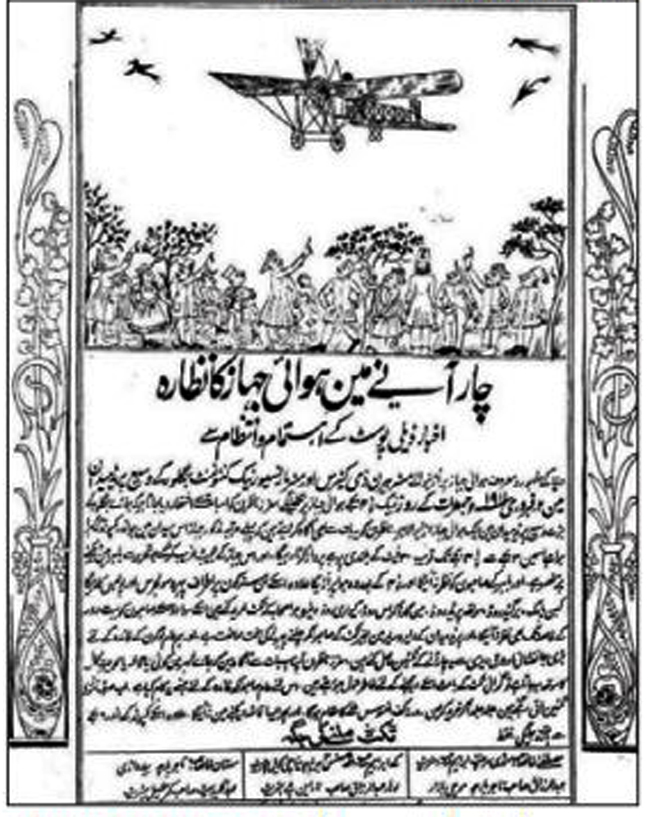
(The poster in Urdu, issued by merchants and businessmen from the Baidwadi (present day Shivajinagar) area. Photo Credit: fly.historicwings.com)
The fact that organizers did not reveal the right number of aircraft at Aero India 2017 is an indication that even they know it. When TOI enquired about the details of the show and the preparations in the run-up to the show, Mayaskar Deo Singh, director, Defence Exhibition Organisation, the nodal government agency organizing the show said: “An official release with final numbers on participation and other details will be issued so that there is no confusion.”
The official release days before the show had claimed that the number of aircraft participating would be 72, as many as the 2015 show, rated much better, had seen. Answering a specific question, defence minister Manohar Parrikar, however, had said on February 14: “There are 53 aircraft participating…”
Also, there are ways to watch the show for free, hundreds of citizens who stood with their cameras on terraces, the highway, some even got hospitality at villages around the air base.
But organizers in 1911 had figured out a plan for such free viewers. A poster in Urdu, issued by merchants and businessmen from the Baidwadi (present day Shivajinagar) area, reveals that the organizers, who had learnt that people would not buy tickets as they thought planes could be spotted even otherwise, had organized the show in such a way that only those with tickets (worth 25 paise each) had a one-hour exclusive.
“…Between 3.30pm and 4.30pm the planes will fly at a height of just 30 metre which only the ticket holders can see. For a few minutes after 4.30pm, the planes will fly a little higher,” reads a translation of the poster documented by the state archives department.
Mustafa Khan (mandi merchants, Ibrahim Sahib Street); Abdul Razak (businessman, Modi Road); Ibrahim Sahib (Meenakshi Kovil Street), Abdul Razak Sahib (steel merchant, Narayan Pillai Street) and Mastan Khan from Baidwadi (present day Shivajinagar) were the men who had signed off on the poster —they are an indication of how Bengaluru had a good trade set-up.
While TOI got a look at the poster, permission to take a photograph was denied. The poster, which has been sourced from fly.historicwings.com, further reveals as Somashekar had pointed out.
Police had been ordered to patrol major roads leading to the venue such as South Parade Road (now MG Road), Brigade Road and Church Street and even in Cubbon Park.
source: http://www.timesofindia.indiatimes.com / The Times of India / Home> News> City News> Bangalore News / Chethan Kumar, TNN / February 20th, 2017