Category Archives: Amazing Feats

In tribute to Kalam, NASA names new species after him


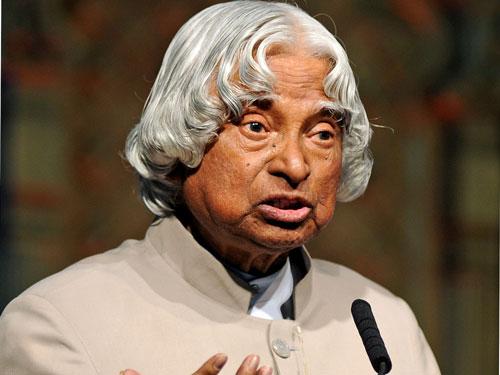
Kalam had his early training at NASA in 1963 before he set up India's first rocket-launching facility in the fishing village of Thumba in Kerala. DH Photo
Kalam had his early training at NASA in 1963 before he set up India’s first rocket-launching facility in the fishing village of Thumba in Kerala. DH Photo

In great news for India, scientists at NASA have named a new organism discovered by them after the much-loved A P J Abdul Kalam.

Till date, the new organism — a form of a bacteria — has been found only on the International Space Station (ISS) and has not been found on earth!

Researchers at the Jet Propulsion Laboratory (JPL), the foremost lab of NASA for work on inter-planetary travel, discovered the new bacteria on the filters of the International Space Station (ISS) and named it Solibacillus kalamii to honour the late president, who was a renowned aerospace scientist.

Kalam had his early training at NASA in 1963 before he set up India’s first rocket-launching facility in the fishing village of Thumba in Kerala.

“The name of the bacterium is Solibacillus kalamii, the species name is after Dr Abdul Kalam and genus name is Solibacillus which is a spore forming bacteria,” said Dr Kasthuri Venkateswaran, senior research scientist, Biotechnology and Planetary Protection Group at JPL.

The filter on which the new bug was found remained on board the ISS for 40 months. Called a high-efficiency particulate arrestance filter or HEPA filter, this part is the routine housekeeping and cleaning system on board the international space station.

This filter was later analysed at JPL and only this year did Venkateswaran publish his discovery in the International Journal of Systematic and Evolutionary Microbiology.

According to Venkateswaran, even as it orbits the earth some 400 kilometres above, the ISS is home to many types of bacteria and fungi which co-inhabit the station with the astronauts who live and work on the station.

Venkateswaran said even though Solibacillus kalamii has never been found on earth till date, it is really not an extra-terrestrial life form or ET.

“I am reasonably sure it has hitch hiked to the space station on board some cargo and then survived the hostile conditions of space,” explained Venkateswaran.

Naming the new microbe after Kalam was natural to Venkateswaran and his team.

“Being a fellow Tamilian, I am aware of the huge contributions by Dr. Kalam,” he said.
New bacteria are usually named after famous scientists.

Venkateswaran is part of a team which is asking that eternal question “are we alone in the universe?”

Towards that, his responsibilities include monitoring the bug levels on the ISS and he also has to ensure that all spacecraft that fly to other planets are free of terrestrial bugs.

One of his big jobs was to ensure that NASA’s Mars Curiosity rover — the massive car-sized almost 1000 kg buggy — was totally sterile when it left earth.

By international law, this extreme hygiene is required else other planets could get contaminated by bugs that reach the Martian or other planets hidden on human satellites.

Today the ISS is the size of a football field and its construction started with a launch in 1998 and as of now it is the largest human-made object orbiting the earth.

Weighing about 419 tonnes, it can house a maximum of six astronauts and has costs roughly USD 150 billion.

Till date, 227 astronauts have flown to the space station. This makes the space station actually a very dirty place and maintaining hygiene is critical so that humans can live on it with ease.

On the space station all the air and water is recycled, being a completely closed environment there is a rapid build- up of moulds and bacteria on the station.

These not only have to be cleaned but monitored to ensure that they do not corrode the walls of the space station and do not turn hazardous to the astronauts.

Venkateswaran’s main job is to monitor the environment of the space station so that harmful bugs do not proliferate.

He heads the ‘Microbial Observatory’ on the ISS projects to measure microorganisms associated with compartments owned by the US.

According to NASA, he also directs several research and development tasks for the JPL – Mars Program Office, which enables the cleaning, sterilisation, and validation of spacecraft components.

He directs several NASA competitive awards on the microbial monitoring of spacecraft and associated environments for the Exploration System Mission Directorate, closed habitats like ISS or its earth analogues for the Human Exploration and Operation Mission Directorate.

But is the new bug of some use.

“These spore formers tend to withstand high radiation and also produce some useful compounds protein wise which will be helpful for biotechnology applications,” Venkateswaran said.

His team has not characterised the bacteria fully but he hints that the new bug could be a key source for chemicals that can help protect against radiation damage.

source: http://www.deccanherald.com / Deccan Herald / Home / Press Trust of India, Los Angeles / May 21st, 2017
Meet the 18-year-old from Tamil Nadu who designed the world’s lightest satellite

PallaPatti,  TAMIL NADU :

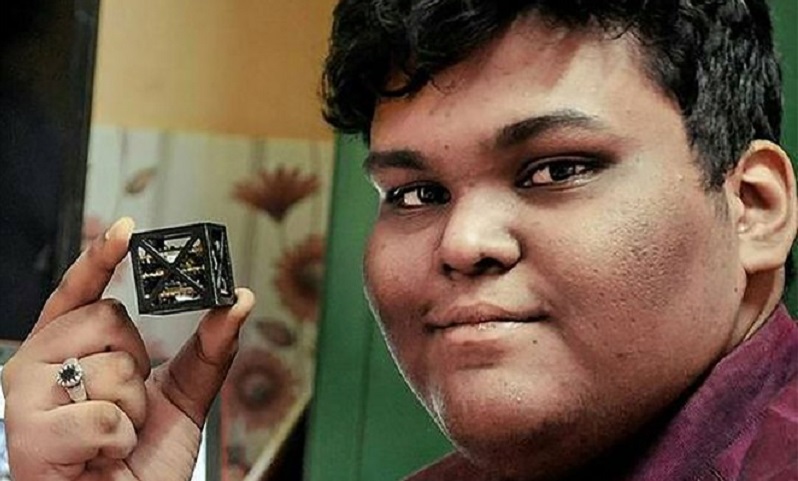
On June 21 this year, history will be made with the launch of the world’s smallest ever satellite — KalamSat. The launch will also hold special significance for India, with 18-year-old Rifath Sharook, a native of Tamil Nadu, being the brains behind the satellite. This will be the first time an Indian student’s experiment will be operated by NASA.

18-year-old Rifath Sharook; Source- New York Post

Hailing from the Tamil Nadu town of Pallapatti, Sharook has truly achieved something special with the KalamSat. The satellite will be launched by the US-based National Aeronautics and Space Administration (NASA), and weighs only 64 grams. Named after India’s former President and nuclear scientist A.P.J. Abdul Kalam, the satellite is slated to be launched from a NASA facility in Wallops Island.

PU results reveal maids of steel in Bengaluru

Bengaluru, KARNATAKA :

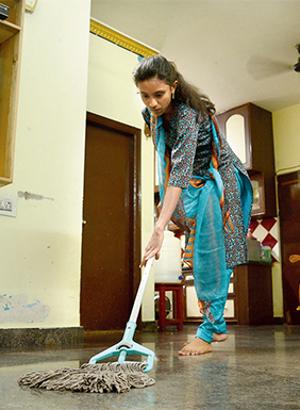
MAKING A CLEAN SWEEP: Elu Afshan working at one of her employers’ homes

by Sana Khan

Washing, cooking, cleaning, feeding, teaching, studying… the days are packed for this PU student who has managed to shine despite working in 10 households, a bed-ridden father and a mother who was frequently falling sick during her exams. We salute you, Afshan

On Thursday Elu Afshan, a PU student, managed to fulfil a part of her mother’s dream. Her mother works as a domestic help and wants that her child never has to do the work she does. With a First Class in Commerce, Afshan has a shot at taking a path different from her mother.

This student of Government PU College goes to some of the houses for domestic work, and takes care of her father, who was bed-ridden, and two younger siblings.
“My mother is the sole bread-winner of our family. Some days she gets tired or needs help, so I join her,” Afshan said. As her mother works in about 10 houses, hardly any day goes by without Afshan having to help.

After college, she used to head to the homes her mother works at and help her. “I washed vessels, clothes and cleaned the house. Everyone at the houses too was supportive and never complained about my mother’s work. Some of the persons used to send me back as they knew my exams were nearing,” Afshan said.

But being the eldest child in her family, Afshan felt the need to take on part of the responsibilities. Her brother has just finished 10th and sister is in the 8th standard.

Another chunk of the 17-year-old’s time would go in nursing her father, who has been bed-ridden since a fall.

“My father was working as a painter, but after a fall, his knee broke and he was bed-ridden for many months. That was a distressing time for us,” Afshan said.

She worked in all the houses her mother used to work. “All of employers took care of me like their kid,” she said.

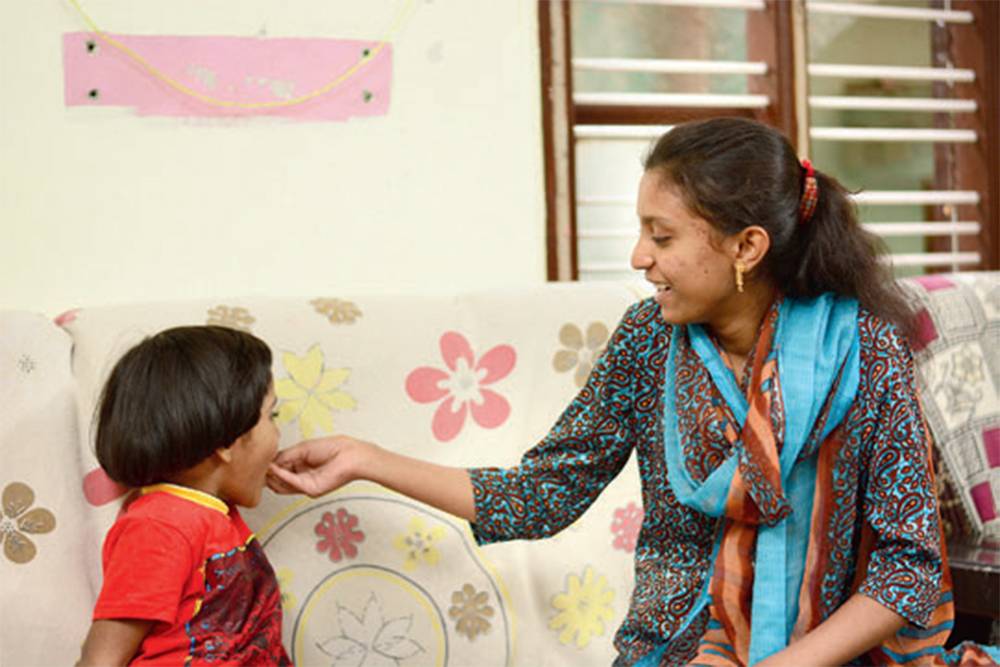
Feeding the child of the household is a delight for her too

During the exams, Afshan had a tough time as mother too started falling sick often. “It was difficult, with my father in this condition and my brother and sister also studying for their exams. I could barely study for two hours a day. There were days when I had to stay back in college to study before coming home,” she told Bangalore Mirror.

All the housework used to take the toll on Afshan on some days. There were times when she felt she should just study and not do any of the other work, but she had to help the family out.

After all this, Afshan is happy with the results.

Her mother Zaheeriunssa told BM, “I want my daughter to study well and take care of her life. She is an asset to the family. We want to give her more time to study, but sometimes it does not happen.”

Afshan said her mother treats her like a queen. On her future plans, she said, “I want to study, but my family’s condition is such that I do not know what I can do next. My mother says I must get job at an office,” she said.

source: http://www.bangaloremirror.indiatimes.com / Bangalore Mirror / Home> Bangalore> Cover Story / by Sana Khan, Bangalore Mirror Bureau / May 11th, 2017

Meet 106-year-old Changezi who cautioned Bhagat Singh against British!

NEW DELHI :

New Delhi (ANI):

Naseem Mirza Changezi, who is thriving at the ripe age of 106, has claimed to have met revolutionary freedom fighter Bhagat Singh in 1929, while the latter was living in Delhi’s Jama Masjid area and cautioned him against the power of the British.

Changezi, who was himself a freedom fighter, was given the task of ensuing regular supply of food to the young Bhagat Singh while he lived in disguise planning the bombing in the central legislative assembly.

“Shaheed Bhagat Singh wanted to see a free India. He wanted to show the British that in spite of such strengthened security, he came inside the Parliament. I tried to dissuade him, but he would not listen to me. I cautioned him about the British, told him either you will be hanged to death or you will be given life imprisonment,” Changezi told ANI.

Bhagat Singh was hanged in 1931 in Lahore jail, while Changezi is still alive.

“If the government knew about me giving shelter to Bhagat Singh, then even I would have been hanged,” he added.

Expressing disappointment, Changezi said India may have got independence, but it failed to achieve Bhagat Singh’s vision of freedom that sought a society where all communities and religions would live in complete harmony and peace.

“During the British rule, the Indians used to live in peace and brotherhood.this was not the scenario what it is now. This is not the outcome of the dream which we dreamt. We wanted unity, but what is happening? If the freedom fighters come and see this condition, then they would rather go back,” he added.

A freedom fighter himself, Changezi revealed how revolutionary leader Rashbehari Bose formed the roots of the Indian National Congress (INC) in Delhi and taught the youth to make bombs.

“He went to Punjab and taught the youth to make bombs. Then he moved to Japan. Subhash Chandra Bose went there and formed the roots of the Indian National Congress. He was going to Germany for some work where his ship capsized and he died. I was also a freedom fighter, but I didn’t want to die and I wanted to see India’s freedom,” he added.

Bragging that no doctor could uncover his secret to a long life, the 106-year-old said when people ask him remedies for increasing life span, it was simply to eat less, talk less and sleep less.

Going down the memory lane, Changezi shared his fascination of playing Hockey with legendary player Dhyan Chand during his youth.

“I used to practice Hockey in the evening. I was a Hockey champion. Dhyan Chand used to play with me,” he added.

Changezi was felicitated by the Delhi Legislative Assembly on March 23, after Chief Minister Arvind Kejriwal unveiled the busts of martyrs Bhagat Singh, Rajguru and Sukhdev in the assembly premises on the occasion of ‘Shaheedi Diwas (Martyrs’ Day)’. (ANI)

(This story has not been edited by timesofindia.com and is auto–generated from a syndicated feed we subscribe to.)

source:  http://www.timesofindia.indiatimes.com / The Times of India / Home> News Home> City> New Delhi / ANI / May 31st, 2017

Himachal IAS-IPS couple to ‘adopt’ martyr Paramjit Singh’s daughter

xxxxxxxxx

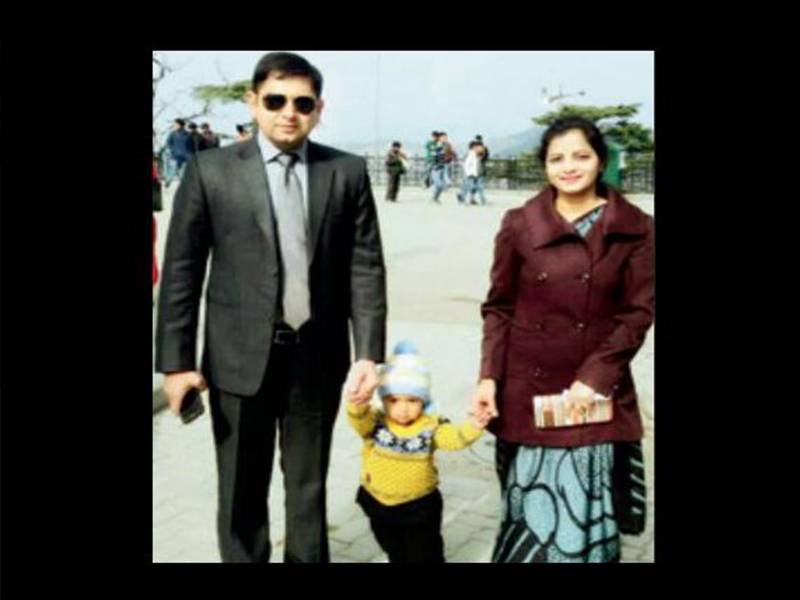
Kullu DC Yunus Khan with his SP wife Anjum Ara and son

_________________________________________________________

HIGHLIGHTS

  • The couple have offered to bear the child’s expenses from school till marriage, to ensure a good future for her
  • The child will continue to stay with her family and the IAS-IPS couple will meet her from time to time to know about her problems and solve them
  • It is difficult to assuage the pain of the martyr’s family, but they are trying to share the
  • ____________________________________________________________________


Shimla :

A Himachal-based couple has decided to ‘adopt’ the 12-year-old daughter of an Army jawan, who was beheaded by Pakistan in the Poonch district  of Jammu and Kashmir on May 1. They have offered to bear the child’s expenses from school till marriage, to ensure a good future for her.

 
As a tribute to Naib Subedar Paramjit Singh ‘s sacrifice, Kullu deputy commissioner Yunus Khan  and his wife Anjum Ara, an IPS officer, have decided to take care of his daughter, Khushdeep Kaur. “Khushdeep will continue to stay with her family. We will be paying for all her expenses and meeting her from time to time to know about her problems and solve them. If she wants to become an IAS or IPS officer or choose some other career, we are there to help,” said Ara, SP of Solan district.

Yunus said it is difficult to assuage the pain of the martyr’s family, but they are trying to share their grief. “By ensuring good education to his daughter, we are doing our duty as responsible citizens,” he said. Yunus said that it is up to Khushdeep whether she wants to continue studying at her village school or join some other school. “We would be there for her throughout her life to help her in making decisions,” he added.

source: http://www.timesofindia.indiatimes.com / The Times of India / News> City News> Shimla News / TNN / May 05th, 2017

This record holder is not all hot air

Podanoor (Coimbatore), TAMIL NADU :

BaloonsMPOs03may2017

When was the last time you blew a balloon? Probably, when you were a child?

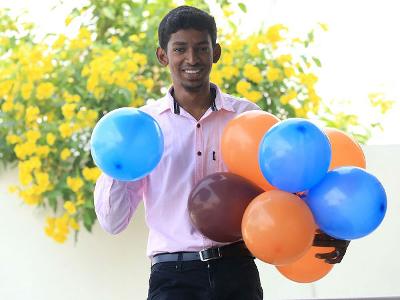
But, for 22-year-old N Sadham Hussain, son of a flower seller from Podanur, inflating balloons is the route to fame.

This engineering graduate has been in the news ever since he blew 500 balloons in a matter of 68 minutes at an event held in the city.

Hussain attempted a record in three categories- most balloons blown in a minute, most balloons blown in three minutes and the fastest time to blow 500 balloons. At the recent event, he managed to inflate 11 balloons in a minute, 29 balloons in 3 minutes and 500 balloons in 68 minutes.

“It all started in 2011 when I started doing a part-time job in balloon decorations. I was in charge of blowing balloons for birthday parties and private events. Later, I came forward to blow balloons at a symposium held at my college. (Dr NGP Institute of Technology) The pace at which I was blowing the balloons impressed a friend of mine, who later suggested that I could put the skill to good use.

That’s when I decided to give the records a shot.

Since then there has been no looking back. I blew 486 balloons in an hour at an event and that was considered a record. It’s been two years I completed my studies but I continue my passion for blowing balloons.”

Sadham now accompanies his brother in installing smart boards in schools. He already has his name etched in the Limca Book of World Records for blowing 486 balloons in one hour and 1,000 balloons in 147 minutes.

So, does he practice blowing balloons on a regular basis? “Not really! Since, I continue my job in balloon decorations and I get the opportunity to practice regularly. The only ritual I have been following from day one is to keep a glass of water and glucose next to me. You lose a lot of moisture when blowing a balloon and it’s imperative that you don’t feel tired while at it. You need a lot of stamina as well.”

However, he adds that blowing balloons is not a cakewalk while attempting a record. “The balloons diameter should be 20 cm after blowing it; you have to tie it up. Many a time I have burst a number of balloons during the process. I get extremely nervous then and lose out on time.

But, I carry on with the attempt as I have to finish inflating the maximum number of balloons at a particular time.”

The electrical engineering graduate aspires to set a world record in blowing balloons. “I want to set a world record and I am working hard towards it,” says Sadham, who is still hunting for a job that will help fulfill his dream.

source: http://www.timesofindia.indiatimes.com / The Times of India / News> City News> Coimbatore News / by P. Sangeetha / TNN / April 30th, 2017

Proud that my son fought like a lion for his country: Sher Mohammad’s mother

https://www.youtube.com/watch?v=PSs8RIAQ5GA

Meerut , UTTAR PRADESH :

Meerut:

When Fareeda Bibi  heard that her son Sher Mohammad — a CRPF constable+ who was part of the battalion that was ambushed in Sukma — had been taken to a Raipur hospital with five bullet wounds, her heart sank.

It was much later that someone in her village of Aasifabad Chanpura in Bulandshahr, UP, told her that her son had taken down at least three Maoists even as he collapsed in unbearable agony. That’s when she smiled a bit. “I am proud that my son fought like a lion for his country,” the 65-year-old said. “He is keeping alive a tradition that our family is known for.”

Sher’s father Noor Mohammad served in the Indian Army and retired with honour. His uncle Abdul Salam was also in the Army and retired 10 years ago.
“When Sher’s son Sohail, 2, grows up, I will ensure he, too, devotes his life to protect this country,” she said.

Though TOI could not independently verify details about Sher’s encounter with Maoists, the jawan told a TV channel from his hospital bed in Raipur that the 74th Battalion of the CRPF was overseeing construction of a road when about 300 Naxals ambushed them with AK-47 rifles+ .

“The 99 CRPF soldiers fought hard. We retaliated, gave them a fitting response. We were able to gun down at least 11 to 12 Naxals. I myself shot down two-three,” Sher has been quoted as saying. He was caught by machine gun fire in the waist and knee.

Sitting on a charpoy in her modest house, Fareeda said the whole village is praying for her son’s recovery.

“We know what it means to join the Army or CRPF,” she said. “There is risk, of course. But patriotism flows in our veins.”

Waris Ali, Sher’s eldest brother, was the first one to receive news of the attack through an acquaintance who saw the report on TV.

Waris told TOI: “As soon as we heard about the incident, we called up CRPF authorities in Raipur. They said Sher was being cared for, so there was no need to rush (to Raipur). I drove down this morning from Delhi, where I work, to be with my mother.”

A large number of villagers have gathered around Fareeda and Waris, consoling them and praying with them. One of them, Aqleem Ali said, “We are a big family. A large number of our relatives are in the armed forces. Sher has done something every fauji would do under such circumstances. He will come back.”

source: http://www.timesofindia.indiatimes.com / The Times of India / Home> News> City News> Meerut News / by Sandeep Rai / TNN / April 26th, 2017

The story of an Indian hero who laid down his life for the country

Mysuru, KARNATAKA :

This July, Salma Shafeeq Ghori completes 15 years without her husband Major Shafeeq Khan Ghori. It was her son’s first day at school. She had been visiting family and they had just come back home when a group of Army men knocked on the door. They had been trying to reach her the whole day with the news.
The first two days, they said his condition was critical. “It was a shock for my father-in-law and my little one who did not understand what was happening around him. Nobody wanted to believe it was him and finally after two days of wait and agony, he was brought home for a final farewell with due military honours,” Salma recollects.
MajGhori01MPOs28apr2017
The story of a brave heart
It took their son three years to understand what happened on his first day at school. His questions about his father’s return finally stopped and he accepted that he was truly gone. He stopped asking his mother – why don’t we visit him and why can’t we call him? Tell him to visit me in my dreams, I want to see him.
Relatives had often told Major Shafeeq – what you have done is enough. It is time to leave the fighting and stay with your family. He would respond with twinkling eyes, that he could die walking on the road too. At least working at the Army would give him a death he could be proud of. He hadn’t joined so he could leave.
MajGhori02MPOs28apr2017
On a more serious note, he would prepare his family members. “Live life always as though I am with you and the kids. Never deprive them of anything just because I am not there. I’ll be back soon,” That’s how life continues now, as though he is still a part of us,” Salma reminisces.
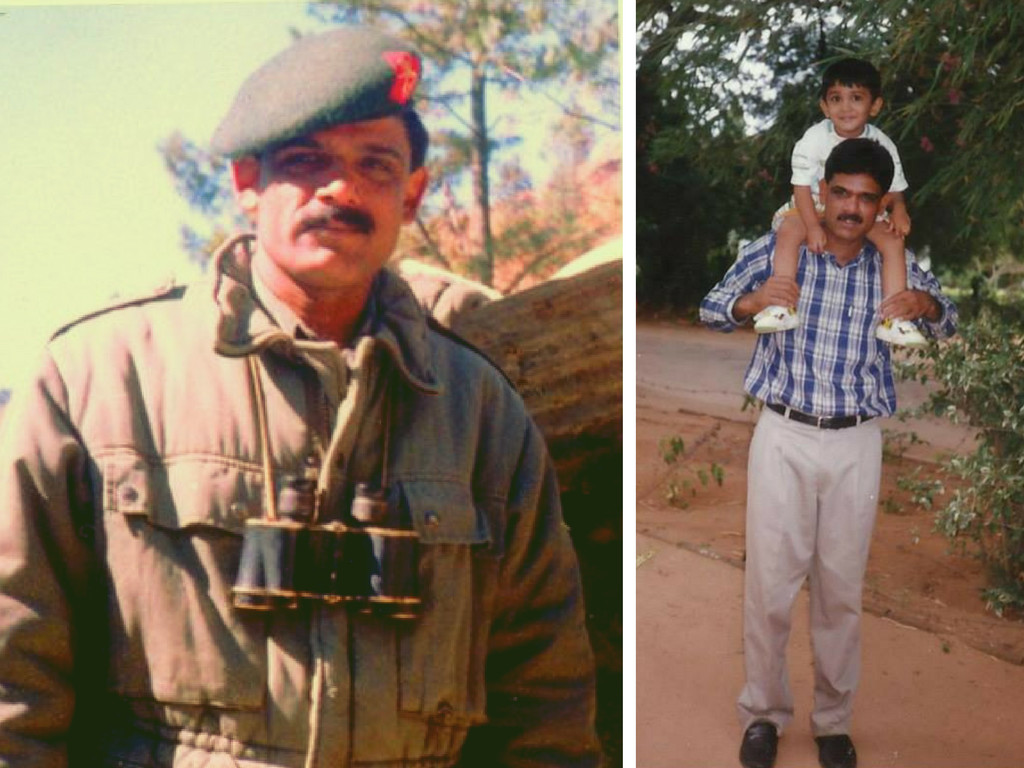
Major Shafeeq, 40, was killed in action in Operation Rakshak. He succumbed to a bullet fighting militants. His last act was saving a fellow-soldier’s life from the bullets. His field tenure was to end in another two years and he was to spend the next few years with his family in a peaceful location. He was a keen sportsperson, good at football and cricket, but his favourite pastime was singing.
“I miss daily life with him, our conversations, our travels together, the ferocious way he defended what he believed in, his love, and bringing up our children. He was a hero with a mighty heart,” Salma relates.
MajGhori03MPOs28apr2017
Putting together the pieces
Salma and Shafeeq had a happy life together for 10 years, till 2001. With two beautiful children, Salma says that she didn’t know what sorrow was. The children grew up and got busy with school, but she felt a void that nothing could fill. This changed when she made friends with Subhashini Vasanth, who ran the Vasanthratna Foundation for Arts.
Vasanthratna Foundation helps the families of Army martyrs heal through arts and vocational activities. “While looking after the families of martyrs, understanding their sorrow and pain, I realised that I was not the only one who was suffering. So many of them had it much worse than me. Spending time with these women and empathising with them has helped me overcome my own pain,” says Salma.
Many more families need peace and healing
Hundreds of soldiers in the Army die every year, leaving behind their families. Many families lose their only support and need help carrying on. Vasanthratna Foundation helps such families, giving them vocational training, counselling and support to carry on and be brave.
Donate to help the foundation support vocational training for 30 Army widows here.
source: http://www.milaap.org / Milaap / Home / August 2016

Only Hebrew teacher in Indian university is a Muslim

Gopalganj, BIHAR / NEW DELHI :

JNU professor Khurshid Imam.

New Delhi :

He has prayed in synagogues and observed the Sabbath, Judaism’s day of rest, and enjoyed crispy falafel on the streets of Jerusalem. A map of Israel hangs in his study where Yasser Arafat shares space with David Ben-Gurion. And he doesn’t mind if his 10-year-old daughter greets him with ‘Shalom’ instead of ‘Assalam Alaikum’. Meet Dr Khurshid Imam, a devout Muslim and the only teacher of Hebrew at a university in India, Jawaharlal Nehru University.

The bearded, skull cap-donning Imam hopes for a new dawn in India-Israel ties, which received a boost with foreign minister Sushma Swaraj’s West Asia visit last week. Unlike most Muslims who look upon Jews with suspicion – just as most Jews don’t trust Muslims – this assistant professor of Hebrew at the Centre of Arabic and African Studies doesn’t harbour any animosity. And he wants to use Hebrew, the ancient language in which the sacred Torah was revealed, to bring Jews and Muslims closer.

The cause of animosities between Muslims and Jews is political. Religion is a pawn in the hands of politicians who don’t want adherents of the two Abrahamic religions cementing ties,” said Khurshid Imam, 46, whose unique distinction “baffles” many of his co-religionists brought up on a heavy dose of hatred for Jews.

“Many call me ‘Mossad agent’ among Indian Muslims, a Zionist promoter and some even jokingly call me ‘nek Yahudi’ (benevolent Jew) because of my passion for Hebrew,” laughs Imam, third among six siblings who grew up in Gopalganj, Bihar, and went to Hebrew University of Jerusalem in 1998. He stayed there till 2000 post-M Phil at JNU.

“Government of Israel scholarship and Golda Meir scholarship funded my courses in Hebrew and study of the Modern Middle East,” he said. “I wanted to learn Hebrew to understand Judaism and find commonalities between Islam and Judaism.”

He also wanted to conform to a hadith (tradition) of Prophet Muhammad, who is believed to have asked some of his companions to learn Hebrew. “If the Prophet encouraged Muslims to learn Hebrew, who are clerics and community leaders to issue fatwa against those who visit Israel?” he asked.

Despite apprehensions of friends and family, Imam chose to stay amid Jewish students who he discovered were not as “rabidly anti-Muslim” as many paint them to be.

“Many Jews first thought I was a non-Arab Muslim jihadist plotting to bomb their establishments. Similarly, Arab Muslims in Israel and Palestine mistook me for a Zionist disguised as a practising Muslim. Once, some kids even threw stones at me, shouting, “Yahud, Yahud” (Jew, Jew). I was moved when several Jewish friends wept when I left Jerusalem,” recalled Imam.

He is, however, disappointed by the “cold” response from several Indian universities to his proposal for teaching Hebrew. “Khurshid’s efforts are laudable and I believe Indian universities should open their doors to Hebrew because languages help build bridges between people,” said S A Rahman, retired professor of Arabic who mentored Imam at JNU.

source: http://www.timesofindia.indiatimes.com / The Times of India / News Home> India / by Mohammed Wajihuddin / TNN / January 24th, 2016

Rehana Adeeb – victim turned survivor who is helping other women follow her path

Muzzaffarnagar,  UTTAR PRADESH :

Image: The Wire
Image: The Wire

Rehana Adeeb was raped, forced to drop out of school, married off, and was a victim of constant domestic abuse all before she was 18 years old. But now, she is a survivor who has set up her own NGO, Astitva, to help women who fall prey to gender-based violence.

Rehana was forced to marry a middle-aged man when she was just 15 years old, in Muzzaffarnagar, UP. Being born into a Muslim family and being a woman meant that she had to undergo double oppression, and the worst part is that it took a lot of time for her to realise that it was not “normal”. According to The Better India, she said,

“At first, I did not realise that something wrong was happening to me. Being a Muslim woman, I had always lived in purdah and seen the same thing happening to other women. By the time I realised that what I was going through was not right, I was already a mother of five daughters.”

One day, she happened to attend a meeting organised by a local NGO called Disha. She came from a family where even mobility for women was restricted. So, she hesitated initially, but was finally persuaded to just come and observe. Recalling her first day there, she told The Wire,

“Wearing a burqa, with a baby in tow, I attended the meeting where people said women could speak against oppression, lodge an FIR with the police, and that it is important not to be ashamed. They were singing revolutionary songs. I felt such tumult that sleep eluded me that night.”

That is when she decided that she was not ready to take on any more abuse, and that she wanted to help other women in her area attain the same. But that also meant having to face constant threats and abuse, and being ostracised by her family and neighbours as well. Ignoring all that, unflinchingly, she started working with abused women and other NGOs before starting an NGO of her own.

Astitva was started in the year 2005 to help women in Muzaffarnagar who were victims of all forms of gender-based violence, including honour killings, which were common in the area. People have started trusting her and not seeing her as a threat only recently, after she was invited as a chief guest to a conference in Beijing. Because, in her area, it is very rare for someone to be invited abroad, people are convinced she must be doing some good.

Rehana gets all forms of threats constantly because what she is doing is very much against the Khap and caste-based panchayats that have dominance in her locality. Yet, she marches on, undeterred, with emancipating as many women as possible as her only goal.

Do you have an interesting story to share? Please write to us at tci@yourstory.com. To stay updated with more positive news, please connect with us on Facebook and  Twitter. 

source: http://www.yourstory.com / Your Story.com / Home> Activism> Think Change India / April 20th, 2017