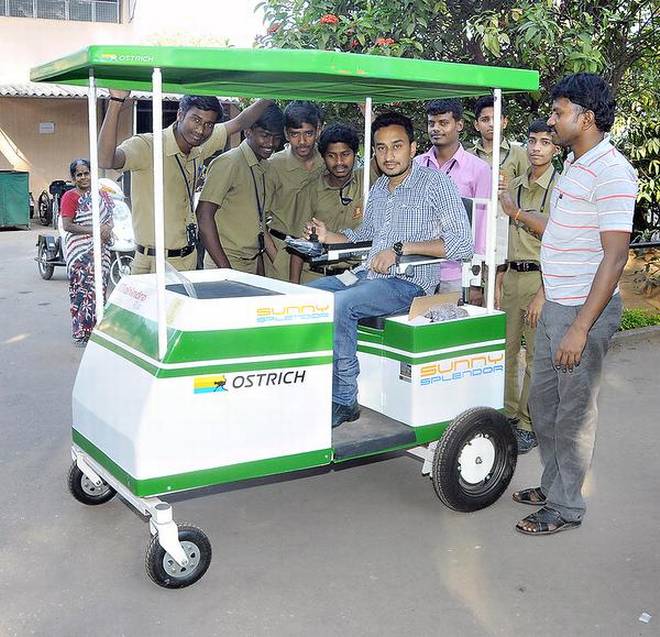
The battery-operated kiosk, Sunny Splendor, is a boon to persons with disabilities. —Photo: Sampath Kumar G.P. | Photo Credit: G_P_Sampath Kumar
Three years ago, Umesh, a lorry driver, lost his legs in a road accident. To make ends meet, he decided to sell tea on a two-wheeler, but the new venture threw up many challenges.
Dejected but not defeated, he approached an automobile firm for help. The firm, along with a wheelchair manufacturer, came up with a design for a disabled-friendly mobile kiosk to help people with disabilities earn a livelihood as part of a CSR initiative. The company approached the Association of People with Disabilities (APD), which funded the project. By 2015-end, Umesh had a prototype of the mobile kiosk.
APD rolled out three such mobile kiosks in the city in December last year to enable people with locomotive impairment and cerebral palsy start a business. The kiosk or electric vehicle named Sunny Splendor can also be charged on solar power.
Calling it ‘office on wheels’, C.N. Gopinath, executive board member of APD, said: “It plays a pivotal role in creating a perfect livelihood option for the physically challenged, who at times are constrained by financial circumstances and lack of qualification.”
Mansoor Ahmed, one of the fund raisers of the project, said the kiosk is environment and disabled-friendly. “We replaced the steering wheel with a joystick and the tires have increased brake efficiency”.
“I want to start a cosmetics and beverages business and my target audience comprises those working in tech parks. With this vehicle, I can commute to different tech parks,” said Basheer Ahmed, who is affected by polio. For Mahesh, who has been repairing mobile phones from home, the vehicle will help him broaden his customer base. “I want to run the business outside a government office. I am also planning to buy a typewriter, so I can help officials in their work”.
Four kiosks in Bengaluru
There are four such kiosks in Bengaluru. Beneficiaries can approach APD if they wish to become entrepreneurs, and have to go through a selection process before they can get their own mobile kiosk.
APD charges 10 per cent of the ₹1 lakh that costs to make a unit. “We believe they have the right to stake a claim in our ventures. This would not be possible if we operated on a charity model, which is is why we accept 10 per cent monetary contribution from them, though we do not insist this from those who cannot afford,” Mr. Mansoor Ahmed added.
source: http://www.thehindu.com / The Hindu / Home> News> States> Karnataka / by Shilpa Ramaswamy / Bengaluru – January 03rd, 2016
Calicut, KERALA / KINGDOM OF SAUDI ARABIA / KYRGYZSTAN :
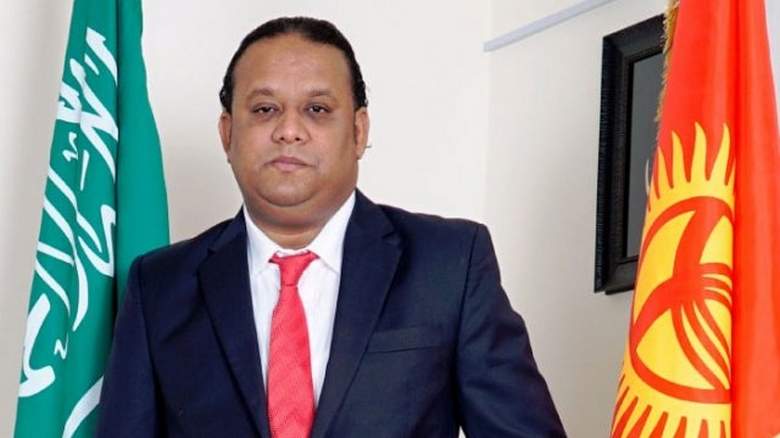
Shaik Rafik Mohammed, Chairman of Gammon Group / image credit: Twitter
The Saudi-based entrepreneur of Indian origin, was invited by the Kyrgystan Government to take up the prestigious military position in view of his earlier contribution to the country.
From among more than two million Keralite expatriates present across the world, a notable name is Shaikh Rafik Mohammed, who has now assumed a top position in the defense department of Kyrgyzstan, a Central Asian state of the former Soviet Union.
Shaikh Rafik Mohammed, Chairman, Gammon Group (UAE and Saudi Arabia), has been appointed Major General by Ali Mirza, Defence Minister of Kyrgyzstan, at an official ceremony held in the Central Asian country, Omar Abu Baker, media advisor of Rafik, told Khaleej Times.
It is a rare military position occupied by an overseas Keralite, he said on behalf of Rafik, adding that the Keralite holds Kyrgyzstan nationality conferred by its former President, Kurmanbek Saliyevich Bakiyev, whom he casually met in his 20s while working in Iran. He was conferred the military leadership at a function held in the Kyrgyzstan military head office, his representative told Khaleej Times.
The Saudi-based entrepreneur of Indian origin, whose family resides in Dubai, was invited by the Kyrgystan Government to take up the prestigious military position in view of his earlier contribution to the country.
The inspiring story of the Keralite expatriate who migrated from Calicut Kerala before completing his fifth-grade schooling culminated in his recent appointment as Major General of Kyrgyzstan. While there are scores of successful of business tycoons in the region, this could well be the first time a Malayali has occupying top military leadership of a foreign country.
Mohammed Rafik earlier worked as an advisor to the former Kyrgyzstan President Kurmanbek Saliyevich Bakiyev (2005-1010) whom he met in Iran where the young Indian entrepreneur was developing a major steel plant.
After selling the successful project to the Iranian Government, Rafik went to Kyrgystan and presented a similar project to Kurmanbek, then a governor who was preparing to contest presidential elections.
Kurmanbek promised to green-light the project if he won the election. After he got elected, the new president appointed young Rafik as his chief advisor – a milestone in his career in his mid-twenties. He remained president for two terms and Rafik developed wide network of friends in the Central Asian republic, which has witnessed a rapid flow of foreign investment and reversal of socialist mode of development to a capitalist mode of production.
As an economic diplomat, Rafik could play a key role in attracting foreign investment from many countries to the young nation by suggesting easy tax regimes that kept away foreign investors till then. From there, he was invited by Saudi Arabia to develop some projects on the free zone model of Dubai. Kyrgyzstan in the Central Asian region maintains close economic, political and strategic relationship with the Gulf region, especially Saudi Arabia. Kyrgyzstan is also a member of the Jeddah-based Organisation of Islamic Countries (OIC).
Gammon Group has a strong presence in emerging markets such as Asia, Middle East, Europe and North Africa. The diversified group is present in several areas, including infrastructure management and petrochemicals. According to the group’s website, it employs 200,000 employees in 28 countries.
“Rafik had left Kerala at a young age and he could complete only his primary school education. He went to Mumbai where the young man learnt all the tricks of business and from there to the Middle East. He has worked in the UAE, Iran, Saudi Arabia and Kyrgyzstan,” his media advisor added.
source: http://www.khaleejtimes.com / Khaleej Times / Home> News> General / by VM Satheesh, Dubai / December 31st, 2016
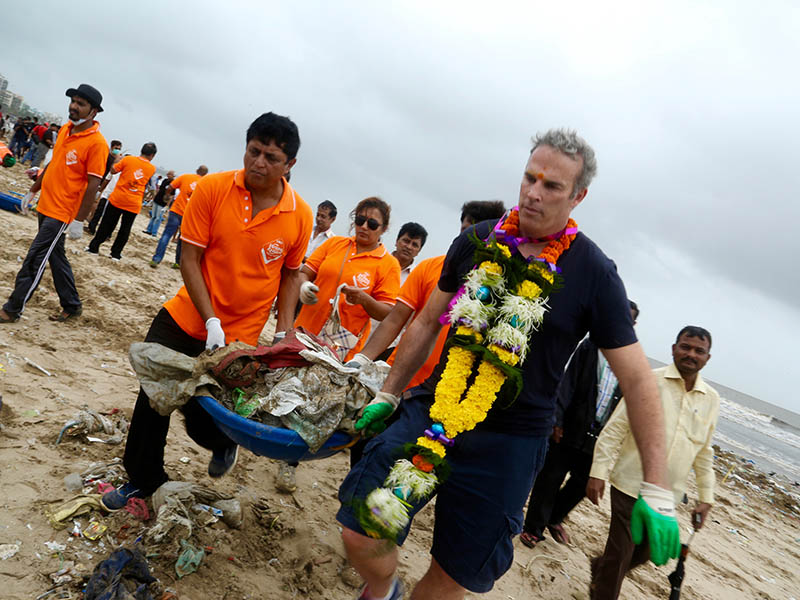
The largest beach clean-up in the world would be a reward in itself. But for spearheading it, Mumbai-based lawyer Afroz Shah has been named as one of winners of the top environmental honour of the United Nations. Shah will be among those bestowed with the Champions of the Earth award for leading the clean-up of Mumbai’s Versova Beach.
Shah will receive the award under the ‘Action and Inspiration’ category for kick-starting a volunteer campaign to pick up, by hand, all the plastic bags, cement sacks, glass bottles, pieces of clothing, and shoes, that covered the entire 2.5-km stretch of the Versova Beach, even rising many feet high in some places.
The movement grew and grew over the past year and picked up a whopping 4,000 tons of garbage.
“Shah’s efforts, and the hundreds of volunteers he’s inspired, is a wonderful example of citizen action and reminds the rest of the world that even the most ambitious, global agreements are only as good as the individual action and determination that brings them to life. His outstanding leadership is drawing global attention to the devastating impacts of marine litter,” said United Nations Environment Project (UNEP) chief Erik Solheim, who had joined Shah in the clean-up for a day in October.
Lewis Pugh, the United Nations Patron of the Oceans, too, congratulated Shah in a twitter. “So delighted that Afroz Shah has won the UN’s highest award for his incredible efforts to clean Mumbai’s beaches!!” he tweeted.
Pugh has for long hailed the Versova clean-up as the ‘largest beach clean-up in history’. He had made it a point to visit Mumbai and take part in the clean-up in July.
“This award is in honour of the hundreds of volunteers who have joined me over the past year to clean up our beach and ocean. I am an ocean lover and feel that we owe a duty to our ocean to make it free of plastic,” said Shah as part of the announcement on the UNEP website.
“I just hope this is the beginning for coastal communities across India and the world – we have to win the fight against marine dumping and that involves getting our hands dirty. We humans need to reignite our bond with the ocean and we don’t have to wait for anybody else to help us do that,” he added.
Shah and his 84-year-old neighbour, Harbansh Mathur, had started picking up garbage off the beach in July 2015. This grew into a movement, with a rising number of volunteers, outliving Mathur.
source: http://www.timesofindia.indiatimes.com / The Times of India / News> India News / TNN / December 03rd, 2016
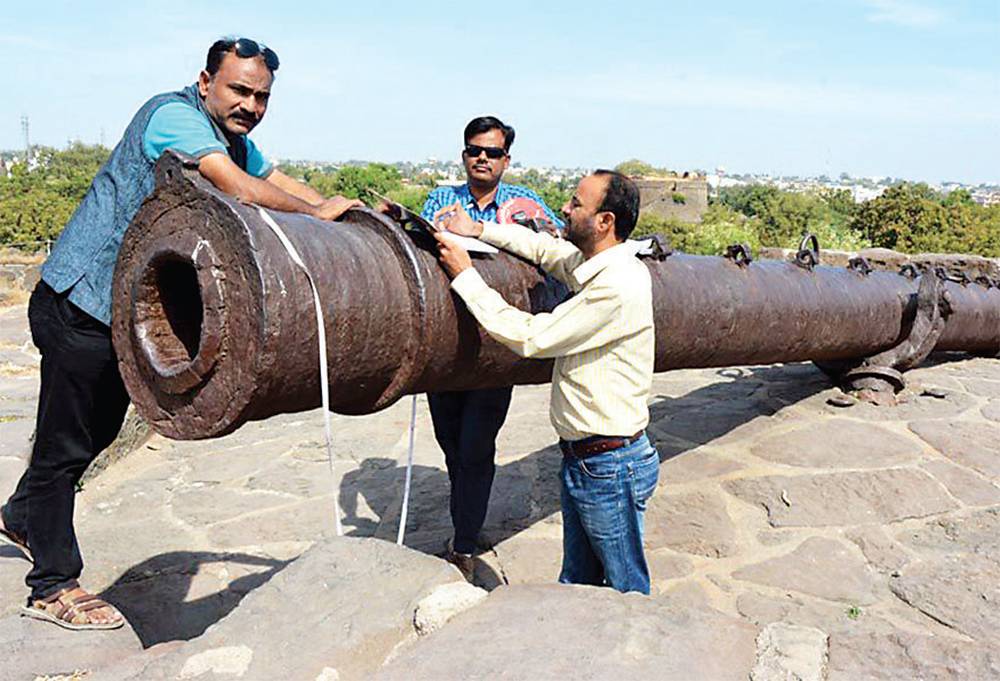
Researchers hope the government will act to protect the cannon at Gulbarga Fort
Mohammed Ayazuddin Patel, Dr Rehaman Patel and Mohammed Ismail measuring the Bara Gazi Toph
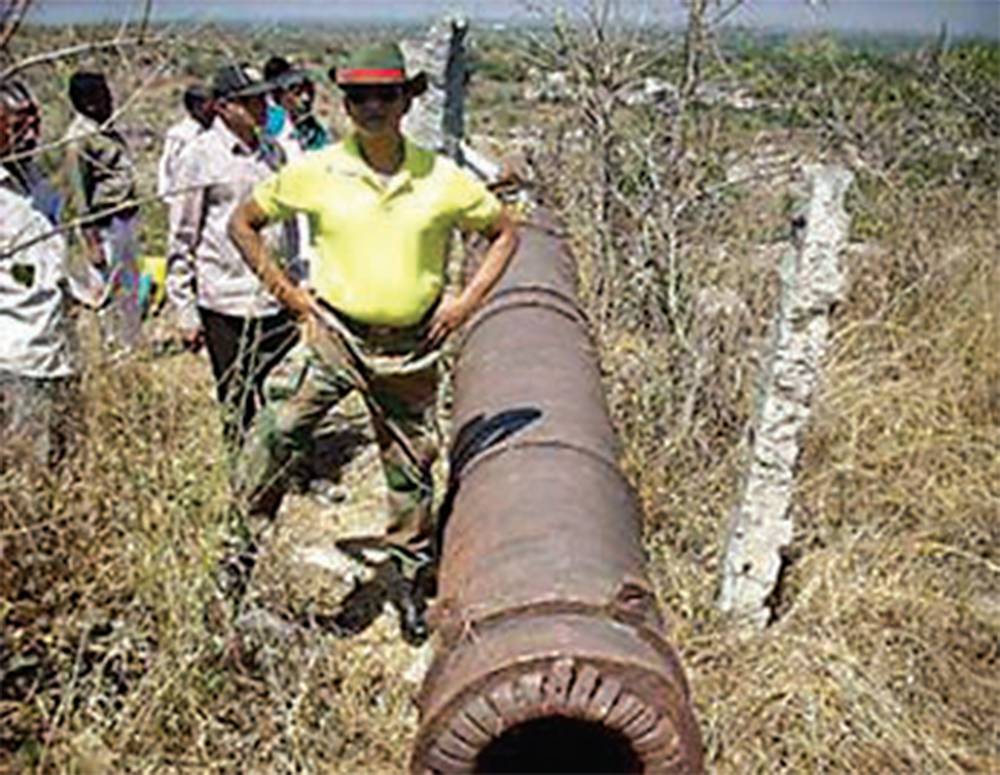
The three researchers, Mohammed Ayazuddin Patel, the national award winner, artist and photographer, Dr Rehaman Patel, artist and researcher at Indo-Islamic Art, Kalaburagi, and Mohammed Ismail, Bahmani researcher and coin collector who recently discovered a cannon in a fort in Kalaburagi, which they say is the longest in the world, are worried over its preservation.
It was their visit to Gulbarga Fort in search of the name of the first Bahmani sultan, Alauddin Hasan Bahaman Shah among the Persian inscriptions on the Jama Masjid that led to its discovery. Speaking of the cannon to Bangalore Mirror, Mohammed Ayazuddin Patel said, “Since 2010, I have been researching on the subject. The existing world record is in the name of Tsar Cannon that is 17.5 feet long and was built in the 15th century in Russia. The cannon has been named in Guinness Book of World Records, when the fact remains that the top three longest cannons exist in India. It is a matter of pride for the people of Kalaburagi and the Hyderabad-Karnataka region that the longest cannon in the world is located in Bahmani Fort and was manufactured during the reign of Bahmani Empire in the 14th century. It is made of the alloy Panch dhatu.”
The cannon is known as Bara Gazi Toph and measures about 29 feet in length. Its circumference is 7.6 feet and diameter 2 feet. The barrel is 7-inch thick. In India, the largest recorded cannon is about 23 feet long and is located in Koulas Fort in Nizamabad district of Andhra Pradesh. Asaf Jah-1 (first Nizam) granted the Koulas Fort to the Rajput king Raja Kunwar Gopal Singh Gaur in 1724 AD for his bravery in the battle of Balapur and Shakkar Keda. The biggest cannon on wheels, built by Raja Mansingh, is in Jaipur and measures 20.6 feet in length.
“The Jaipur cannon weighs about 50 tonnes. We assume that the weight of the Kalaburagi cannon could be around 70-75 tonnes. While, the firing range of the Jaipur cannon is about 35 kilometres, that of Bara Gazi Toph could be 50-55 kilometres,” Ayazuddin Patel said.
The Bahmani monarchs, who ruled from the present Kalaburagi (Ahasnabad), stand out among other rulers for their contribution to the city. The founder Alauddin Hasan Bahaman Shah (1347-1422) made Gulbarga the capital and before his death he became the master of a vast empire. Even as they extended their territory, the rulers made significant contribution to the fields of art, architecture and literature.
The Bahmani sultanate was the first independent Islamic state of the Deccan in South India and one of the larger medieval Indian kingdoms. They ruled for 191 years (1347-1538 AD). Their other capital was Bidar.
The Gulbarga Fort was significantly expanded in 1347 by Alauddin Hasan Bahmani after he cut off ties with the Delhi sultanate. Islamic monuments such as mosques,
palaces, tombs, and other structures were also built later within the refurbished fort. The Jama Masjid built within the fort in 1367, is a unique structure of Persian architectural. It is fully enclosed, and has elegant domes and arched columns, which is unlike any other mosque in India.
The biggest challenge about historic monuments in the state is their protection, a fact not going to be any easy with the region being a backward area. “The Archaeologi-cal Survey of India and state archaeology department should take steps to protect the cannon at the Bahmani Fort and it should be included in the world record list. It should be fenced. The cannon is filled with sand and pebbles, so should be properly cleaned. Also, a signboard stating its details as the longest cannon in the world is a must. The fort and Jama Masjid must be declared heritage centres,” added Ayazuddin.
The team submitted a memorandum with their pleas to the district in-charge minister Sharan-prakash Patil, the deputy commissioner, regional commissioner, as well as the departments concerned.
GIGANTIC CANNONS OF THE WORLD
Jagadamba Bhavani Tope: Located at the historic Koulas Fort in Andhra Pradesh is believed to be the largest cannon in the world. The cannon (left), which is 23 feet in length and weighs 70 tonnes, is predominantly made of iron. It has a 16-inch calibre with an explosive head of 150 kg.
Jaivana: Recorded as the world’s largest cannon on wheels, Jaivana was manufactured during the reign of Maharaja Sawai Jai Singh II (1699–1743) at a foundry in Jaipur, Rajasthan. Jaivana’s barrel measures 20.19 feet in length and 11 inches in diameter. The 50-tonne cannon is mounted on four wheels. The rear wheels are mounted on roller pin bearings, to turn it 360° and fire in any direction. It was designed to fire a 50 kg cannon ball to a distance of 35 km. This cannon was never used in any battle as the Rajput rulers of Amber had friendly relations with the Mughals.
source: http://www.bangaloremirror.indiatimes.com / Bangalore Mirror / Home> News> State / by Deepthi Sanjiv, Bangalore Mirror Bureau / December 28th, 2016
Telugu writer Syed Naseer Ahamed, with the help of Mohammed Farookh Shubli, Founder President of Youth Welfare, Vijayawada, has brought out a calendar for 2017 bearing photos of India’s Muslim freedom fighters.
Syed Naseer Ahamed has been consistently writing about Muslim freedom fighters including his pictorial album The Immortals. The calendar consists of 6 pages. Each page of two months has four photos of Muslim freedom fighters who are less known to general public. A total of 24 freedom fighters have been accommodated in six pages. Role of Muslim freedom fighters in India’s Independence has been printed often in the print edition of The Milli Gazette.
This calendar is in English. Syed Naseer Ahamed is trying to release the calendar in various centres across the country in order to inform people about the part played by Muslims in the freedom struggle of India.
For more information, please contact Syed Naseer Ahamed at syednaseerahamed2015$gmail.com.
source: http://www.milligazette.com / The Milli Gazette / Home> Online News> Community News / The Milli Gazette Online / December 23rd, 2016
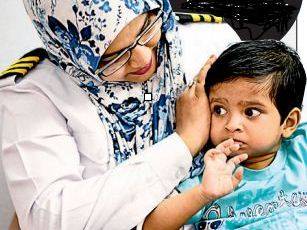
A narrow, unpaved lane in Moghulpura leads us to a first floor two-room rented apartment. Awards, shields and certificates lining the tiny drawing room wall show the dizzy heights Salwa Fatima has scaled. Daughter of a sales manager at a bakery, Fatima is the first Muslim woman pilot from the city and would soon be flying commercial planes once she finishes her advanced training.
The story of the ‘pilot girl’, as she is popularly known in the area, has in fact given wings to the dreams of many more girls from the area. They are charting new career paths and English is now a priority. “Currently two Muslim girls from the area are studying in IIT. The girls are doing much better than boys academically in some cases,” says Urdu daily Siasat chief editor Zahid Ali Khan who was instrumental in fulfilling Fatima’s dream.
Living with her parents and three siblings — two sisters and a brother — Fatima broke the chains of conservatism to dream big. So, while other girls from the community joined teaching or the few ambitious ones became doctors, Fatima had her sights set on flying higher as a pilot.
Trained first at Andhra Pradesh Aviation Academy, she completed a course in Multi-Engine Rating (MER), necessary to become a commercial pilot, this September from New Zealand. A few more months of training and she will join an airline to fly passenger planes.
But her journey began many summers ago when she read that there were just three women pilots in India. “I found that there was no Muslim woman pilot in the city and secretly dreamed to become one,” says Fatima, 28, as her father Syed Ashfaque Ahmed and mother Syed Siraj Fatima look on.
And lady luck smiled on her. Siasat chief editor Khan, who was a guest at a programme conducted by Fatima, was impressed with the girl’s fluency in English. Khan asked what she wanted to become. “When uncle (Zahid Ali Khan) heard that I dreamed to become a pilot, he told me to meet him,” she says.
Next, Khan decided to contribute to funds required for her education. He even approached some friends. “It was a revelation for me. A Muslim girl from the Old City, which is often described as backward, wanted to be a pilot. I had to support her,” says Khan.
But when she needed a massive 36.02 lakh for advanced training, Khan approached Telangana CM K Chandrasekhar Rao and the state agreed to give her a scholarship.
Fatima, who is married to a management graduate, says: “I am fortunate to have the backing of my parents, husband and in-laws.” Her mother-in-law, a retired school principal, supports her dream completely.
Fatima already has big plans for her 18-month-old daughter. “I want her to become an IAS officer,” she says.
source: http://www.timesofindia.indiatimes.com / The Times of India / News> City News> Hyderabad News / TNN / December 20th, 2016
WhatsApp group helps 60-year-old woman unite with her family after 3 years
When Nasrin Banu Mulla aka Rukiya, a 60-year-old woman left her home Navabs Chawl, Danilimda (Ganesh Nagar) in Ahmedabad to meet her daughter Muneera in Surat, little did she know that this journey would take her almost three-and-a-half years to reach Muneera’s house that was just 270 km away.
Nasrin accidentally landed in Mumbai and from there reached Udupi to start living at the Kalmadi bus stand near Malpe. Speaking to Bangalore Mirror, Rasheed Vittal who played an important role in uniting Nasrin with her family, said, “The lady was lucky because she was taken to Vishwasada Mane, a home for destitutes run by Sunil and his wife Elizabeth in Shankarapura of Udupi. She was then mentally disturbed for which she is being treated,” he said.
As her health improved, she began thinking of her children and grandchildren. On seeing children around, she would tell everyone that her grandchildren resembled them. However, she was helpless because she was illiterate and could not recollect her residential address in Ahmedabad. She did not have an address nor a telephone number for people to even help her. Totally unaware about what to do, she spent almost three years and three months in the ashram. She had a feeling that she would never meet her near and dear ones. The ashram staff too made all attempts to find her address, but failed.
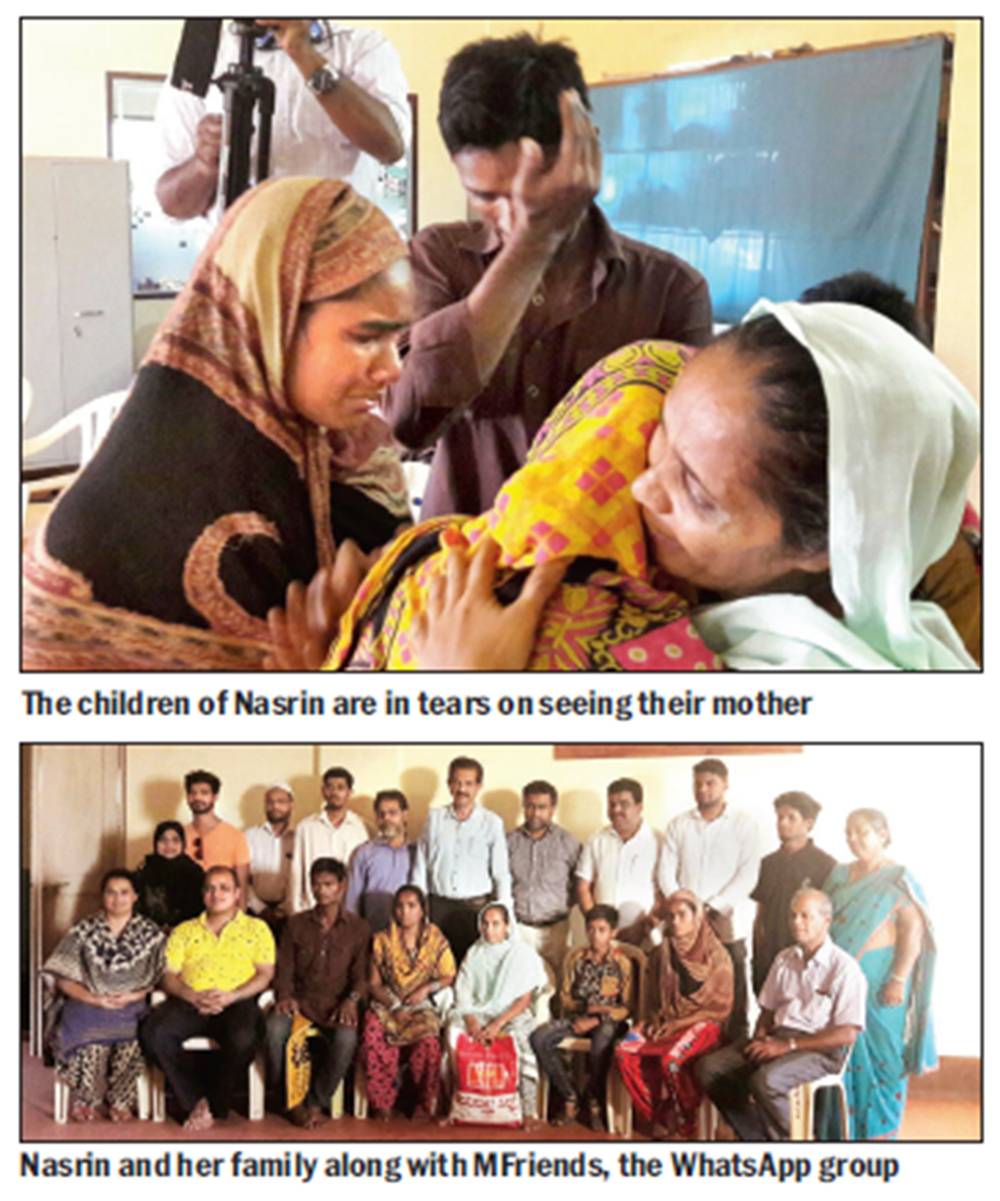
She was fortunate to meet Siraj, a resident of Krishnapur working in Saudi Arabia, on December 10. Siraj Krishnapura was on a holiday and had taken his mother to a private hospital in Mukka for treatment. During the same time, the inmates of the destitute home had been to the hospital for a checkup. Nasrin who had covered her head with a shawl caught Siraj’s attention. He approached her and she told him in a Hindi mixed with Bengali about how she was travelling to her daughter Muneera’s house in Surat but accidentally landed in Udupi. She requested Siraj to provide her with a copy of the Quran. He provided her with a mat so that she could perform Namaz and shared this experience on a WhatsApp group, MFriends, with a message that he would be returning back to the Gulf as his holidays were ending and it would be great if someone from the group helped in uniting this lady with her family.
Rasheed, who is also the founder of MFriends, said, “On December 15, we decided to take up the cause of Rukiya. I immediately contacted the orphanage head and collected more details of the woman. Along with her photo and contact numbers of the president of MFriends Haneef Haji Golthamajalu, we shared the post on social media. We then contacted Shantaram Rao, a Mangalurean social worker settled in Ahmedabad for help. Shantaram took the initiative further and saw that the post got maximum reach including mosques as well as Muslim organisations. Several newspapers in Ahmedabad reported the same. We then created a WhatsApp group called Operation Rukiya. The message spread in several Muslim dominated areas of Ahmedabad.”
Within two days, Dilavar called Rasheed Vittal claiming that Nasrin was his mother. He told them that his family had made every attempt to search for her but to no avail. After uniting the family, Rasheed said, “It was a heart touching moment to see a mother unite with her family. They all had tears in their eyes.” Nasrin is widowed and four of her five daughters are married.
source: http://www.bangaloremirror.com / Bangalore Mirror / Home> News> State / by Deepthi Sanjiv, Bangalore Mirror Bureau / December 21st, 2016
Despite a fatwa issued by a local Muslim cleric body last year warning Muslim women to not contest the municipal elections, 19 women had filed for candidacy.
Five women were elected as corporators including the newly elected mayor of Kolhapur, Hasina Faras
________________________________________________
Kolhapur :
When Hasina Faras wanted to contest the Kolhapur Municipal Corporation (KMC) polls last year, she was warned by a local body of 40-50 clerics that it was un-Islamic to do so. In fact, the clerics of the Majlis-e-Shoora-Ulama-e-Shahar had then issued a fatwa to all Muslim women not to stand for polls.
However, 19 Muslim women defied the fatwa and contested. Five of them, including Faras, were elected as corporators. A year down the line, 61-year-old Faras has become the first Muslim woman to bag the post of mayor in Kolhapur.
Political twists and turns and challenges are not new to Faras, whose family has been associated with the NCP. The religious challenge had posed a new hurdle, but she said support from her family and members of the community helped her face it.
“The fatwa went against the democratic values of the country. Kolhapur has the great legacy of Chhatrapati Shahu Maharaj. We did not pay attention to the fatwa and contested the elections. Society has changed and we have to accept the changes. Muslim women have entered every sphere of life. I will stand against extrajudicial elements in future too if similar fatwas are issued,” Faras told TOI on Wednesday.
With 50% reservation for women in the local civic bodies, the 81-member KMC House has 42 women corporators belonging to all major political parties. The mayor’s post is to be rotated between NCP and Congress after an agreement was worked out between the two ruling alliance partners last year. However, with the opposition fielding a candidate, polls were necessitated this year.
source: http://www.timeofindia.indiatimes.com / The Times of India / News> City News> Kolhapur News / by Shekhar Paigude / December 15th, 2016
For any hardcore Harry Potter fan, the Sorting Hat, and the medieval wizard Godric Gryffindor is basic knowledge. Three entomologists, who stumbled upon a new species of spider have decided to pay tribute to the character by naming it after him. Though the arachnid bears resemblance to the ‘Sorting Hat’ of Hogwarts School of Witchcraft and Wizardry, it would be hard to spot it if you are trekking in the Western Ghats.
Eriovixia gryffindori, is the new spider species discovered, details of which was published in the recent edition of Indian Journal of Arachnology.
The discovery of the arachnid was made at ‘Kans’ forestland of Central Western Ghats at Hosanagara taluk of Shivamogga district, by Javed Ahmed, Rajashree Khalap and Sumukha J N.
While Javed and Rajashree hail from Mumbai, Sumukha is from Shivamogga.
Describing the etymology of the spider, the scientists write that naming it after Gryffindor – after whom one of the four houses in Hogwarts School of Witchcraft and Wizardry is named and who once owned the Sorting Hat – was, “An ode from the authors, for magic lost, and found, in an effort to draw attention to the fascinating, but oft overlooked world of invertebrates, and their secret lives.”
Prior to it, they express their fondness of J K Rowling, author of the Harry Potter series as a ‘wordsmith extraordinaire’.
“This uniquely shaped spider derives its name from the fabulous, sentient magical artifact, the sorting hat, owned by the (fictitious) medieval wizard Godric Gryffindor, one of the four founders of Hogwarts School of Witchcraft and Wizardry, and stemming from the powerful imagination of Ms. J K Rowling….” they wrote.
While the team found a female specimen of the Gryffindor spider, they are yet to describe the holotype of a typical male of the species. The paper notes that the particular species of spider is known to be distributed only from Shivamogga district, as of now.
The spider mimics dry foliage, making it ideal for it to reside almost undetected on the forest floor.
source: http://www.newindianexpress.com / The New Indian Express / Home> Cities> Bengaluru / by Express News Service / December 13th, 2016
In 1913, Maharaja Krishna Raja Wadiyar IV appointed William Clarence Rose as the first chief manager of the Bank of Mysore. Whilst in office, Rose collected all British India banknotes of denominations five, ten, fifty and one hundred in a series. When he retired in 1925, he received a wax-paper scroll rolled into a carved silver sheath, mounted on a teak base. Everything was made from melted silver coinage issued by the Raj.
Rose passed all this onto his daughter Vera Katherine Maud Collins, who bequeathed it to her grandson Simon Collins.The latter remembers how the “gift was kept in a 1937 coronation stamp album“ and was passed on two months before his grandmother’s death in 1982. This legacy -along with other historical nuggets -is finding its way back to the city .
The collection will be housed in a museum of Indian currency, expected to come up in Bengaluru next year.
The project is the brainchild of realtor and currency collector Rezwan Razack, who has been collecting Indian paper money since 1971. Spread across 4,000 square feet and located off Brunton Road, the museum is expected to be open to the public in the latter half of 2017. “The intention of setting up the Museum of Indian Paper Money is to display all that there is in my collection. It is to create awareness about our history and our journey so far as a nation, through our currency ,“ says Razack, who is the managing director of city-based Prestige Estates Projects and chairman of the International Banknotes Society’s India chapter.
Among the world’s most prolific collectors of rare currencies, Razack has preserved bills dating back to early 1770s.These include the uni-face (onesided) notes first launched by the government of India, portrait notes of King George V & VI, cash coupons of princely states, Indian notes issued in Pakistan and Burma, special issues made for the Persian Gulf and Haj Pilgrims and all variants of Indian notes -from the Independence era till the latest demonetisation exercise.
E a ch n o t e links us to the way of life in the past and unearths lesser-known stories of our city and country, believes Razack. For instance, on display will be 100-odd Prisoner of War coupons issued by the British. “There were eight camps across India, including Bengaluru, which issued bills from one anna to ten rupees,“ he says.
The museum will comprise of interactive displays, historic facts and trivia, along with stories and essays written by Razack from his own journey and experience as a collector.Architects are working on the blueprint of the museum and estimates should be drawn up by the end of the year, Razack informs.
source: http://www.economictimes.indiatimes.com / The Economic Times / Home> ET Home> Magazines> Panache / by Divya Shekhar, ET Bureau / November 24th, 2016