A girl from Kolkata has become the first Muslim woman ever to top the West Bengal Commercial Tax Service. What makes Suraiya Ghaffar’s achievement sweeter is the fact that she has cleared the “state’s toughest examination” as a general category candidate despite qualifying for backward class quota, reflecting a growing trend among meritorious Muslim students of giving OBC reservation a miss.
In the commercial tax category itself in which Suraiya has topped, three of the top five candidates are Muslims, who despite qualifying for reservation, cleared as general category candidates. Mohammed Shabbar Khan has stood second and Mohammed Azhar Khan fifth. A total of 40 candidates have made it to the commercial tax service.
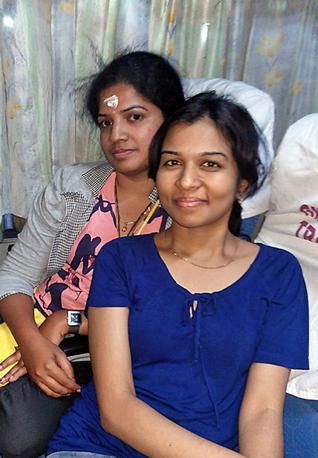
Suraiya, 23, was confident that her sound academic background would see her through. “If I wanted I could have taken the reservation route but I decided to test my skill by appearing as a general category candidate. Since age is on my side, I am entitled to several attempts,” she said, sitting in her husband’s Shibpur residence. Maqsood Hasan is in the West Bengal Police Service.
A senior official of the minority affairs and madrasah education department confirmed that Suraiya is the first Muslim girl ever to top the commercial tax service.
Close to 50,000 aspirants sat for the WBCS examination in 2014 out of which 4,000 qualified for the second stage termed as “mains”. Only 400 made it to the interview stage for the services listed in Group A and Group B. Apart from commercial tax service, Group A includes executive, labour, excise and agriculture services. Group B consists of the state’s police service. The results were declared last week.
Suraiya is the eldest of five siblings in a home with limited financial resources. Her father Abdul Ghaffar Khan works in the electricity department of the Garden Reach Shipbuilders and Engineers Limited.
Overcoming hurdles is nothing new for this girl from Metiabruz. After finishing her higher secondary from a local school, Suraiya enrolled into an Honours course in Chemistry in a college in central Kolkata for which she had to travel for almost two hours every day.
The girl, whose role model is her father, did not lose sight of her dreams, even after her marriage to Maqsood in 2014. Hard work, determination and resilience helped Suraiya sail through the written and interview rounds of WBCS in the first attempt.
When she is not glued to her books, Suraiya is inseparable from her smartphone. Beside her academic achievements, Suraiya has another accomplishment to boast of — her chemistry with her husband.
Even before marriage, Maqsood used to encourage Suraiya to sit for competitive exams. He helped her with the study material, tutorials and did all the research work for her so that she could concentrate on her studies completely.
“I would even serve food to her when the exams were approaching,” smiled Maqsood.
source: http://www.timesofindia.indiatimes.com / The Times of India / News Home> City> Kolkata / by Zeeshan Javed, TNN / January 25th, 2016
Our society needs to change; we are generating a society of merits. We need to understand our children in such a way that education is mixed with passion.
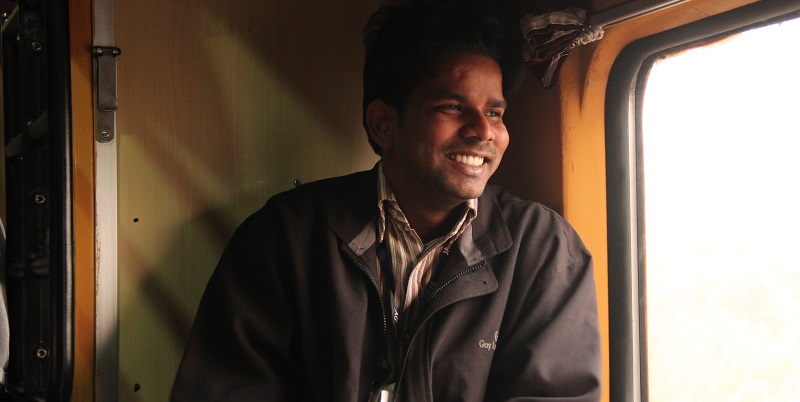
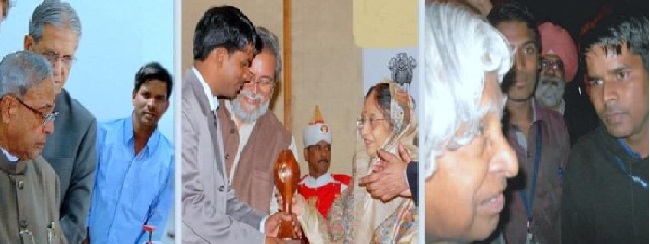
These lines describe Abdul Kaleem’s life in a nutshell. In 2009, Abdul was felicitated by the President of India for his innovations, when he was barely 22 years old. That same year, he was also honoured by the National Innovation Foundation (NIF) for Grass Root Innovation.
Innovator and entrepreneur Abdul Kaleem
But it was never about good grades or staggering dreams; as a student, Abdul always thought a little differently, a philosophy he still lives by:
“Whenever something happens, I think about the logic behind it. I keep questioning.”
And this questioning always took the form of little innovations. In the seventh grade, he saved Rs 2 from his pocket money to buy a crystal bird, which he turned into a greeting machine. It would open out with banner saying Id Mubarak whenever someone entered his room. A theft in his neighborhood caused him to create an alert mechanism that would call the last dialled number on the owner’s phone as soon as the door was opened.
But the contrast of all this sets in when one realises that Abdul was brought up in a small village in Deoria, in Uttar Pradesh born to an Urdu tutor father and an uneducated mother, where an alert mechanism was unheard of!
His parents could never understand what their child was really up to. What they wanted for him was a basic education that would lead to a secure government job. His father was disappointed to see his son’s unconventional ways, and his neighbors constantly felt the need to remind them how he was wasting his time.
But Abdul was only interested in his innovations, electronics, machines, and not the world’s opinion of them. He was undeterred; he smiles and says:
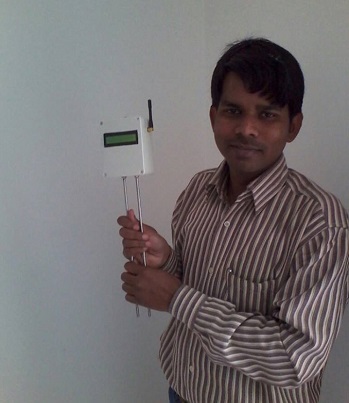
On one hand, Abdul continued to think about wider impact and what the community really needed, while on the other, he finished his high school exams and joined a Psychology course in Deoria. Staying deeply grounded to his roots, Abdul started looking deeper at his inventions. He created a device that could gauge moisture in the soil using sensors, and water pots automatically. The device would stop watering the plants once the sensors gauged enough moisture in the soil.
Next in line was a flood informer system, with a scale fitted at different areas of the river, including the centre and the bed of the river. The minute the water rose to the third level, the sirens would alert villagers to look for higher ground.
Finally, it was a visit by his Psychology professor that put him in the spotlight. He convinced Dr Nagiz Banu to visit his home and the small laboratory where he carried out his experiments. Dr Banu was reluctant, but when she entered the room, she was in for a surprise. Seeing the scale at which Abdul had mastered his experiments, she asked him to send his innovations to NIF. He did and, on 21 November 2009, Abdul was awarded for his grassroots innovations by President Pratibha Patil; what followed was a slew of other recognitions by the state.
We ask Abdul why he pursued Psychology and not Engineering, where his passion truly lay. He replies
“If you see, technology is created by perceiving Psychology, similarly as Psychology perceives the invented technology. So every subject has a correlation, it depends on how you use it.”
When we ask him what we feel is missing in innovations today, he says it is a lack of understanding of Psychology to create technology for the masses, while understanding their needs.
Abdul’s interaction and felicitation from the various Presidents of India
From innovations to business
However, Abdul says that while he may be a good inventor or engineer, he is not a good businessman. He has never understood business numbers.
Abdul constantly innovating, with his GPRS sensor
In 2011, Abdul embarked on the Jagriti Yatrawith around 350 strangers, a journey which completely transformed his outlook on where he aspired to use his potential to startup. Immediately after the Yatra, Abdul started working on a low-cost solar table lamp, another basic innovation catering to the masses.
This business idea required an initial capital of at least Rs 5 lakh. Unable to procure the funds, he shelved the idea and pursued other innovations.
Through reference of a customer Siddharth Jettar, in 2014 Abdul was introduced to G.K. Sinha, who was in awe over how solutions to complex issues came so easily to this young man. Abdul had created a universal light controlling remote for Siddharth’s house. G.K. Sinha was an angel investor, having the experience of guiding multiple startups.
He helped Abdul with starting his venture Eco tronica Pvt. Ltd.
Sinha also introduced him to Gautam Kumar, a graduate from Harvard University. Gautam felt the same potential in Abdul’s innovation and worked with him to refine his soil moisture-sensor-driven innovation and mobile weather prediction station to a requirement at Centers for International Projects Trust (CIPT), which is affiliated with the Earth Institute at Columbia University.
The low-cost weather station of sorts, powered by solar power, works on cloud computing and the installation of sensors on rooftops of buildings. The industrial setup costs as little as Rs 15,000, while the user-friendly and domestic models cost up to Rs 10,000 and Rs 5,000, respectively. Jharkhand’s Birsa Agricultural University has planned to set up this technology in the state’s Angara block. This will directly impact 700 farmers of the area.
Today, Abdul is also working on solar powered lighting with dual LED lights, which he claims should work for 24 hours with just five minutes of solar charge. He says he still doesn’t understand the revenues or sales figures because he thinks he is an innovator at heart and will remain one.
Abdul says the biggest challenge in having a manufacturing startup is getting the right vendor, who gives the right product at the lowest cost.
But there is an important lesson for all entrepreneurs when Abdul speaks. Even as Indian entrepreneurs flock to create the next Uber and Amazon, he makes us question what truly comprises innovation for the masses. He makes us question whether business models and revenues are the only success metric for a startup.
For many Indian entrepreneurs taking their product to Silicon Valley – an enduring symbol of innovation – is the highest form of success. But what about innovations for the masses? Is our entrepreneurial ecosystem based on the same system of meritocracy followed in the US?
Innovators like Abdul even make us question our prevailing education system. He rightly says we need to harbor our own culture of innovation. Our challenges are different, and the only way out is to innovate through passion and dedication to solve a problem, rather than look at is as a business.
source: http://www.yourstory.com / YourStory.com / Home> Success Stories / by Tarush Bhalla / January 20th, 2016
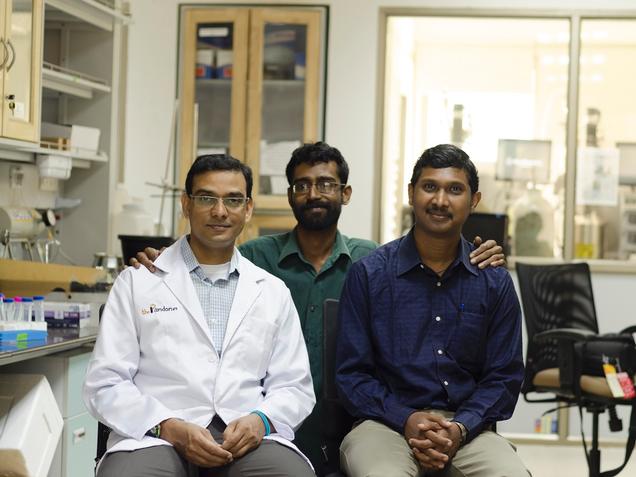
Liver team at Pandorum Technologies: Dr. Abdullah Chand, senior scientist (left); Arun Chandru, co-founder and managing director (centre); and Dr. Sivarajan T., senior scientist / @ABHINAV_MAURYA
Bengaluru, KARNATAKA :
Pandorum Technologies, a Bengaluru-based biotech startup, has developed an artificial tissue that performs the functions of the human liver.
Pandorum said these 3D printed living tissues made of human cells would enable affordable medical research with reduced dependence on animal and human trials. It will also eventually lead to full scale transplantable organs.
Arun Chandru, 30-year-old co-founder of Pandorum, said liver toxicity and drug metabolism are the key hurdles, and contributors to failed human trials.
Pandorum’s 3D bio-printed mini-livers that mimic the human liver will serve as test platforms for discovery and development of drugs and vaccines. The firm said these drugs would have better efficacy, less side-effects and be developed at lower costs.
“We developed everything here in India,” said Mr. Chandru. “We can grow thousands of these tissues in the laboratory and test the efficacy of drugs on them for diseases including cancer.”
He said large pharma companies on an average spend about $10 billion (Rs. 66,290 crore) and 10 years on research and development to get a single new drug to the market.
Tuhin Bhowmick (34), another co-founder of Pandorum, said development of artificial organs has numerous clinical uses. The cell-based miniature organs can be used to develop bio-artificial liver support systems for preserving life in patients who have developed liver failure.
“In the near future, such bio-printed organs will address the acute shortage of human organs available for surgical transplantation,” said Dr. Bhowmick, who holds a Ph.D. from the Indian Institute of Science.
Pandorum was founded by a group of friends in 2011 who were pursuing their higher studies at IISc. They came together to work on the development of artificial human organs after winning a business competition.
Surviving initially on money from friends and family, the team approached the Department of Biotechnology with their vision. The company was awarded funding support by the Biotechnology Industry Research Assistance Council in 2012. The same year, the company got incubated by the Centre for Cellular and Molecular Platforms in Bengaluru.
Mr. Chandru said they created the innovation with a funding of about Rs. 1 crore, more than half of which came from the government.
Scientists and startups across the globe are growing artificial organs made of human cells to better study diseases and help test drugs. A team of researchers led by Hebrew University professor Eduardo Mitrani is growing pancreas in a petri dish to better regulate blood sugar in diabetic patients.
The global artificial organ and bionics market is expected to reach $38.75 billion (Rs 2.5 lakh crore) by 2020 at an estimated CAGR of 9.3% from 2014 to 2020, according to a study by Grand View Research.
Pandorum’s ultimate aim is to make personalised human organs such as lungs, liver, kidney and pancreas on demand, according to Mr. Chandru.
Pandorum’s innovation takes the area of making artificial organs to the next level. Bengaluru-based bioinformatics firm Strand Life Sciences founded by IISc. professors had earlier developed a virtual liver that mimics the functions of liver through software simulation. It is a predictive method that integrates data and insights for deeper understanding of the impact of a drug on the liver. The platform can predict the toxicity of several known drugs and toxins and explain the mechanism.
source: http://www.thehindu.com / The Hindu / Home> Sci-Tech / by Peerzada Abrar / Bengaluru – December 23rd, 2015
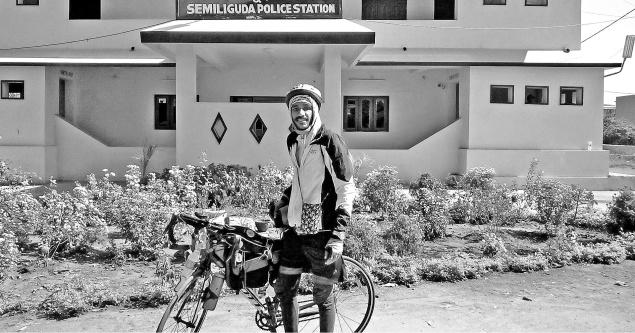
S.S.S. Shameem, Assistant Professor in Computer Application, Manipal Institute of Technology, with his cycle at Semiliguda in Koraput district of Odisha on December 26, 2015.
Manipal (Udipi) , KARNATAKA :
He began his journey on December 18 and concluded it in nine days
S.S.S. Shameem, Assistant Professor, Department of Computer Application, Manipal Institute of Technology (MIT), has just completed the first leg of solo cycle expedition, a passion he has been pursuing since two years, and calls it as “Bharat Bhraman: Ride-4-Pride.”
According to a press release issued by the Manipal University here on Thursday, Prof. Shameem had covered a distance of 1,500 km on a high-end bicycle from Bengaluru to Koraput in Odisha. Mr. Shameem, who is very lanky, proudly says, “I completed it in nine days.”
“Eastern Ghats was a bit tough, otherwise I enjoyed the first leg and plan many more such solo rides. My aim is to see and know the diversity of our country and do whatever I could. Going around the country on a bicycle gives me a great pleasure and satisfaction. Moreover, I will be, when I finish the journey, sit and look back with pride my achievements,” Prof. Shameem said.
“I began my journey from Bengaluru on December 18, 2015, and reached Koraput on December 26, 2015, via Hyderabad, Vijayawada, Vishakapatnam and Salur,” he said.
“I have been preparing for this trip for the last two years. The next cycling trip would be again taken up in December this year,” he said.
Prof. Shameem had to spend a few nights, sleeping at railway stations, police stations and religious places etc. Prof. Shameem, who is also a marathon runner, plans to alternate his cycling expeditions with running.
Therefore, he is planning to do running during summer and cycling in December. Being ambitious, Prof. Shameem is keen to get into Limca Book of Records with half marathon (21.1 km) runs.
Accordingly, he plans to do 111 half marathons in 70 days and is working on that. He calls it, “Bhaag-run Project.” He has sought details from Limca and is in touch with the athletic associations of Udupi and Mangaluru for assistance.
source: http://www.thehindu.com / The Hindu / Home> National> Karnataka / by Ganesh Prabhu / Manipal – January 22nd, 2016
“I will remove politics from education, if I become the Minister for Education,” said Babar Ali, who is said to be youngest headmaster in the world, here on Monday.
Mr. Ali, who runs a free-school at Murshidabad in West Bengal for poor students, was participating in an interactive session with the students of BGS PU College here.
During the interactive session, one of the students asked Mr. Ali what he would like to do if he were to become a Minister for Education. Welcoming the question with a smile, Mr. Ali said, “First thing I want to do is to remove politics from educational sector. Nowadays, if a person wants to get appointed as a teacher in a primary school in my State, he or she does not require merit. The applicant should have political influence and money,” he said.
At the college level, students were involved in activities of various unions that were affiliated to different political parties. “Intervention of politics dilutes the essence of education. The second area I will stress on will be to make the teachers responsible for the growth of their students,” he said.
Medium of isntruction
To another question on the medium of instruction in primary schools, Mr. Ali said that children should be taught in their mother tongue. “In West Bengal, children should be taught in Bengali and similarly, in Karnataka the medium of instruction should be Kannada. Children understand the lessons better if they are taught in their mother tongue. I have understood this through my experience,” he said.
In response to another question, Mr. Ali said that all government officials should send their children to government schools so that government schools could improve.
G. Chandrashekhar, principal of the college, told The Hindu, “We are all impressed by Mr. Ali’s achievements. At a young age, he started his own school and has been teaching poor students for free. For students, it is a rare experience to meet such a great person.”
source: http://www.thehindu.com / The Hindu / Home> National> Karnataka / by Staff Correspondent / Hassan – January 19th, 2016
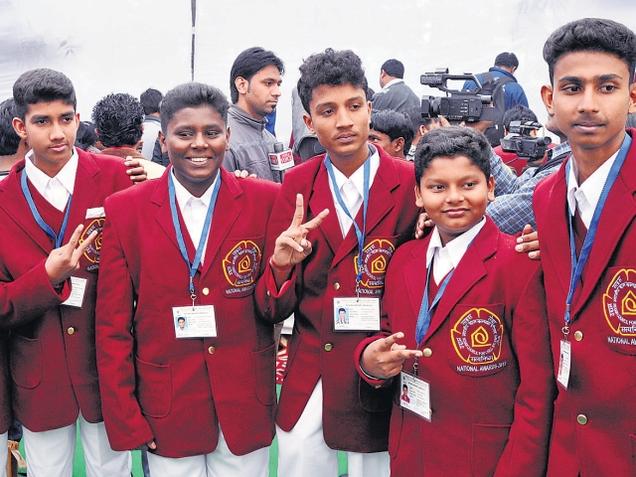
Children from the State who will be conferred with the National Bravery Awards 2016, at an interaction with the media in New Delhi on Monday. (From left) Beedhovan and Muhammad Shamnad (Kozhikode), Nithin Philip Mathew and Anandu Dileep (Kottayam), Aromal S.M. (Neyyattinkara), and Abhijith K.V. (Kannur). —PHOTO: SHANKER CHAKRAVARTY
Eight children from the southern part of the country, including six from Kerala and two from Telangana, are among the 25 National Bravery award winners this year.
The winners will receive the award, a medal, a certificate and cash price from Prime Minister Narendra Modi at his residence on January 24. The award recipients will also participate in the Republic Day parade on January 26.
One of the six winners from Kerala is Aromal SM (12), who saved two children from drowning in a 14-feet deep pond. Aromal has been honoured with the Bapu Gaidhani award.
Another winner from Kerala is Nithin Philip Mathew (13), who braved fire to save his neighbour’s family after their house caught fire in a cylinder blast.
“When I saw that my neighbour’s family was stuck inside their house because of a fire, I broke open the door and entered with the help of others to save their family,” said Nithin, who wants to become an IAS officer.
Beedhovan (14), who saved a boy from electrocution, is also one of the six winners from Kerala. Other winners from the State are Anandu Dileep (14), Abhijith K.V. (15) and Muhammad Shamnad (14) who saved people drowning. The winners from Telangana are eight-year-old Shivampet Ruchitha and 14-year-old Sai Krishna Akhil Kilambi.
source: http://www.thehindu.com / The Hindu / Home> National> Kerala / by Staff Reporter / New Delhi – January 19th, 2016
They have no cutouts in cinema theatres. They have no big fan following. They led a simple life just like anybody else until the rain gods lashed their fury on Chennai in December.
They rose to the occasion. They saved lives and brought smiles to many others. “We had to make a choice. Whether to sit at home or get out there and save people,” they said. They then became real heroes.
On Monday, 14 people, who volunteered in flood relief work and did a heroic job, were honoured with awards at the Adding Smiles Ambassador Awards 2016 organised by Adding Smiles Foundation.
“We were doing our duty to help someone who is in need,” said Blue Cross general manager Dawn Williams, one of the awardees, in a video on the awardees.
All the 14 volunteers, including Peter Van Geit, Chennai Trekking Club founder and senior citizens of Anandam Homes, were presented with ‘Real Hero Awards’.
Awards were also given to celebrities, who were active during flood relief. The team ‘Mana Madras Kosam’ with Telugu film actors including Navdeep, Kajal Agarwal and Samantha , Sathyam Cinemas and Tamil actor Parthepan were presented awards.
“I am doing whatever little I can do. I have changed myself. As you grow older, you get fearless and want to do things before you go away,” the award winning composer said.
Activist and founder of NGO Prajwala Sunitha Krishnan, team from National Award winning Tamil film Kaaka Muttai, former RBI governor C Rangarajan, national paralympic swimming champion Madhavi Latha, founder and dean of Great Lakes Institute of Management Prof Bala V Balachandran, acid attack survivor Soniya Choudhary were some of the awardees in the ‘ambassador awards’ category.
The highlight of the evening was music composer AR Rahman, who was one of the awardees in ‘Adding Smiles Ambassador Awards’ category. The category included people, who have come the hard way to live a dream and spread smiles in the life of others by way of help.
source: http://www.timesofindia.indiatimes.com / The Times of India / News Home> City> Chennai / by V. Tejonmayan, TNN / January 19th, 2016
Two quick thinking interns perform a miracle on a road accident victim
The mini-bus echoed with laughter and song of doctors and interns returning from a trek to Anantagiri hills on Sunday evening before it stopped at a roadside eatery in Bandalguda. All the doctors stepped out to stretch and walk into Dwaraka hotel, when a miracle happened. Rather, two doctors Dr Faizah Anjum and Dr Savitri Devi, performed a miracle on a road accident victim.
Armed with just a pen and a newspaper the quick thinking doctors created a bespoke contraption to save a life. “It was 7 p.m., as the other doctors went into the restaurant we were resting when the driver said he would move the bus as there was an accident. We rushed there and waded through the crowd to see the victim lying on the road near the divider. He had feeble pulse and his pupils were dilated and we got to work,” says Dr Faizah Anjum.
The accident victim was a 30-your-old man, who while running on the road, slammed onto an onrushing RTC bus and fell aside near the divider, informed an official of Narsingi police station.
“We started work on him right there without moving him on the road itself,” says Savitri.
“We kept a pen to keep his tongue from blocking the air passage. While Savitri used the newspaper to blow air into his lungs, I kept working on his chest for the CPR. After about 20 minutes, the patient came to his senses and started breathing on his own and even started screaming. Then the ambulance came and we gave him an IV drip before he was taken to the tertiary care centre of Osmania General Hospital,” said Faizah.
source: http://www.thehindu.com / The Hindu / Home> Cities> Hyderabad / by Serish Nanisetti / Hyderabad – January 13th, 2016
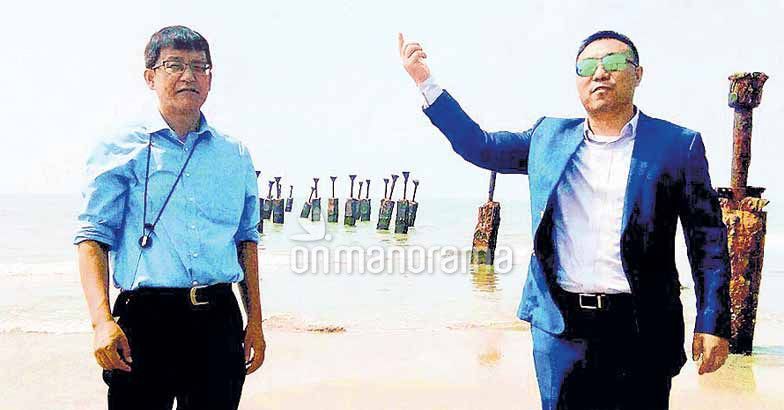
Two Chinese have come to the land of Zamorin to find the final resting place of the Chinese explorer who conquered seas through willpower.
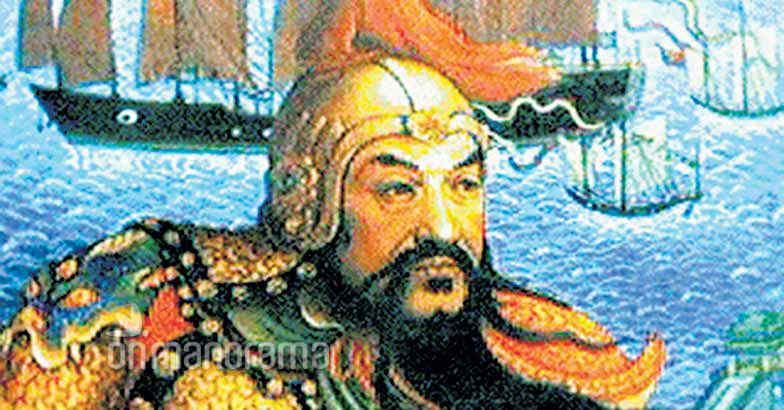
The goal of these researchers is to find the grave and the trading points of Zheng He, the explorer who landed in Kozhikode seven times on ships .
They are professor Haiyun Ma, a Chinese descendant who teaches history at Frostburg State University in the US, and Dr Shaojin Chai, a senior researcher at the UAE’s culture ministry .
Zheng He is a hero in China, where students learn about his adventures. They only know that he died in Kozhikode due to sudden illness. Chinese researchers have come to find out if there is anything in Kozhikode that reminds of him .
A Chinese had been buried at Cheenedath mosque in Valiyangadi. Though the team visited the mosque, they could not find anything specific. Haiyun Ma and Shaojin came to Kozhikode with the help of Abbas Panakkal, a fellow at Griffith University, Australia.
english.manoramonline.com
The man who brought Ma Huan
Zheng He, born in 1371, began his travel at the age of 28. He landed in Kozhikode in 1430 with Chinese silk, vessels, jars and fishing nets. He was received by the Zamorin. He returned to China with spices and other goods many times. Over the period, he brought 2,800 Chinese to Kozhikode. One among them was Ma Huan, a historian. It is said that Zheng He even took elephants and horses from here. It is not clear whether Zheng He, a Muslim, was buried on land or at sea .
source: http://www.english.manoramaonline.com / OnManorama / Home> News> Kerala / by Lenin Chandran / Saturday – January 09th, 2015
The top seeds quelled the challenge of German wildcards Angelique Kerber and Andrea Petkovic 7-5, 6-1 in mere 69 minutes.
Hyderabad, TELANGANA :
Sania Mirza and Martina Hingis carried the dominance of 2015 into the new season, winning their sixth consecutive title by lifting the WTA Brisbane trophy, in Brisbane on Saturday.
The top seeds quelled the challenge of German wildcards Angelique Kerber and Andrea Petkovic 7-5, 6-1 in mere 69 minutes.
Sania and Martina, the world number one team, have now stitched a 26-match winning streak together, which has brought them six titles in a row at the US Open, Guangzhou, Wuhan, Beijing, WTA Finals and now here.
It is the longest winning streak since Italians Sara Errani and Roberta Vinci’s 25 in a row in 2012. Sara and Roberta had won five titles in a row.
The top seeds drew the first blood by breaking the rivals in the second game but the joy was short-lived as Kerber and Petkovic reeled off four straight games to take a 4-2 lead in the opening set.
Sania and Martina though were not perturbed, having defused such situations many times in the last few months.
They went about their business calmly and restored the parity with another break.
Soon it was 4-4 and the Indo-Swiss combination held the ninth game, forcing Kerber and Petkovic to serve under pressure and remain alive in the set. The unseeded team though did not crack and stayed solid to make it 5-5.
Kerber and Petkovic again served at 5-6 to stretch it to a tie-breaker but offered two break chances to Sania and Martina and the top seeds obliged on second to nose ahead.
The top seeds controlled the game better in the second set, racing to a 3-0 lead by breaking their rivals in the second game.
It was a cakewalk for them from there, losing only one game before closing the match in their favour.
source: http://www.thehindu.com / The Hindu / Home> Sport> Tennis / PTI / Brisbane – January 09th, 2016