Category Archives: Amazing Feats

A 110 year-old doctor

Kolkata, WEST BENGAL :

Repository of the ancient wisdom of Unani medicine, 110 year-old Syed Mohammed Sharfuddin Quadri lives a Spartan and frugal life that has worked wonders for him, as Partha Mukherjee discovers

DrSharfuddinMPOs01jan2016

Almost 55 years ago, while I was journeying through a field in a cart, I caught sight of an old towering neem tree, immersed in soundless symphony with a swarm of fireflies. Barely five years old then, I didn’t know that the silhouette of a tree in hushed twilight silence would be a metaphor for a man around whom the sparkle of life never dims, even when ‘night’ tiptoes into his life.

Syed Mohammed Sharfuddin Quadri is famous for treating India’s first president Rajendra Prasad in Gaya in 1942-43 for breathlessness. Fondly known as Hakim saab, he has a photographic memory, sense of humour, never-say-die spirit and, above all, energy that never runs out. On 25 December 2011, he will turn 110. Yet he works for 17 hours at a stretch, preparing concoctions from dry fruits, herbs and roots and advising close to 100 patients (free of cost) every day. At 5 pm, every day through the year, Hakim saab attends to his patients at his Wellesley Square clinic in central Kolkata as well as those in the US. “Abba has patients all over America,” says his 40 year-old son Mohammed Sadique, who assists Quadri in his clinic. “He gives instructions to them over email or through a video conference. Earlier, he used to go to California, Los Angeles and New York, but now he’s restricted because of his gout.”

Sharfuddin Quadri answers all questions, except those about his achievements. Founder of the Unani Medical College and Hospital in Kolkata, Quadri published a magazine titled Hikmat-e-Bangala (Hikmat means Unani medicine) in 1959, which folded up soon for lack of funds. “Success means how much one has been able to help others,” he says, adding that he does honour the Padma Bhushan he was awarded by the President in 2007. He brings out the medal attached to his pocket by a silk ribbon. “I carry it to show my respect to the recognition of Unani treatment. Though I would be happier if I were given a grant so I could at least cover the place with a shed where my patients wait.” Indeed, patients wait for him for hours, sometimes till midnight, even in the rains. “There is no help from the government to collect herbs at a reasonable price,” adds Mohammed Sadique, Quadri’s youngest son (he has six siblings) who assists his father. “Sometime Abba is so frustrated that he thinks of giving up. If medicines aren’t available what is the use of continuing the treatment?”

From a family of hakim in the remote village of Kumrava in Nawada district of Bihar, Quadri trained in Unani treatment from Shafakhana Darsgah Tibbia (Gaya) in 1930. After immersing himself in the freedom movement, he started his practice in Calcutta where his family shifted in 1935-36. “Herbal medicines have a magical effect on our body; besides they have no side-effects,” he says sipping neem juice. If diagnosed, every disease responds to Unani treatment, Quadri claims, adding that with medication one must strictly follow instructions on diet and lifestyle as well. “During the diagnosis, one has to study the dam [blood], balgham [phlegm], safra[yellow bile], and sauda [black bile] of the patient [just like kapha, vata and pitta, the three dosha in Ayurveda], as they are the roots of all diseases,” he explains. “Anyone with any sort of ailment definitely has an abnormality in one of these.”

DrSharfuddinMPOs02jan2016

As for his own frugal diet—neem juice and half a piece of bread—he says, “The less you eat the more you live; the more you eat, the more you court ailments and health hazards. And to lead a healthy life you should have a healthy mind. My father lived to be 122 and never allowed any ignoble thought to cross his mind.”

How does he keep himself so physically fit even at 110? “I never sleep at night; I read books on Unani medicine when others are fast asleep. In the calm of the night, I try to explore things I don’t know about and let them melt into my inner self.” Unani medicine, he says, actually has its roots in Greece following extensive research by Hippocrates (460-377 BC). “It was he who laid the foundation of clinical medicine based on diet and symptoms.” He adds that a number of Greek scholars after Hippocrates—Galen (131-200 AD) followed by Arab physicians Rhazes (850-932 AD) and Avicenna (980-1037 AD)—enriched the system considerably. Rhazes and Avicenna authored Al-Hawi and Al-Qanun respectively, which were later translated into Latin and other European languages and taught in medieval European universities. They are said to have influenced western medical thought.

Unani medicine disappeared from the country of its origin, but found roots in India through Arab traders long before the Mughals. The Khiljis, Tughlaqs and Mughal emperors provided state patronage to Unani scholars and employed many as court physicians. The British imposed strict restrictions on every form of treatment but allopathy. Despite suspension of aid to Unani institutions, the system survived owing to the commitment ofhakim like Ajmal Khan, who served as the president of Indian National Congress in 1921—the Unani physician and scholar founded the Ayurvedic and Unani Medical College in Delhi.

Quadri reads till 4 am, when the city wakes up to fight for the day. “After my daily ablutions, I go to the mosque for namaz which involves many a yogic mudra—I do each of them,” he shares. “I walk back home at 5 am and sleep till 9, after which I go to my clinic. There’s no time to waste till 5 pm, when I go to the clinic, which I believe is the key to my fitness.”

Sharfuddin Quadri thanks his health for having been witness to an eventful century. The Dandi March with Mahatma Gandhi, confinement in Cuttack Jail and a memorable encounter with Maulana Abul Kalam Azad. “In 1943-44, in Ramgarh—then in Hazaribagh and now in Jharkhand—Maulana Azad was addressing the people and suddenly the skies opened up in a heavy downpur making everyone rush for sheds. Azad roared, ‘You are so scared of raindrops, what will happen when the British will rain bombs and bullets on you?’ And then no one moved even an inch.”

Finding his shadow lengthen by the day, Sharfuddin Quadri remembers Rabindranath Tagore through his lines and a brief meeting in 1912: Moron jedin diner seshe asbe tomar duare/sedin tumi kee dhan debe uhare?(When Death will knock at your door at the end of the day/What will you offer him as a gift?) “I wonder what I will be ready with to welcome the inevitable,” he signs off.

Featured in Harmony – Celebrate Age Magazine
July 2011

source: http://www.harmonyindia.org / Harmony India.org /  Home> H People> Diary 100 / Featured in Harmony – Celebrate Age magazine, July 2011

Meet Swimming Champ Moin Junnedi, The Boy With Over 100 Broken Bones and a Will of Steel

Image courtesy: Facebook

Belgaum, KARNATAKA  :

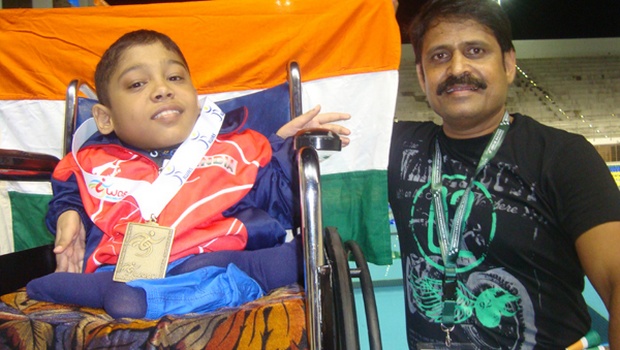
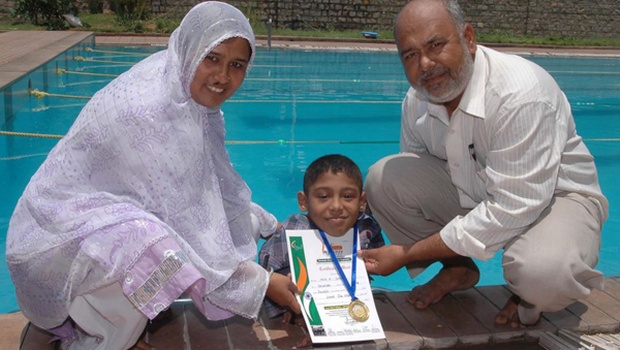
Moin Junnedi, is not your average 18-year-old, he has won seven national gold medals and one international level in para swimming competitions.

Moin suffers from osteogenesis imperfect, a brittle bone disease which makes him prone to fractures. Nevertheless, he has a will of steel that inspires every one of us. The Karnataka government honoured him on World Disability Day.

Moin’s daily struggles include that he cannot eat with his hands as both of them are turned backwards. His legs are weak and fused together. Initially, Kausar, Moin’s mother lost all hope after knowing his incurable disease, but the lost hope was recovered thanks to Umesh Kalaghatag. Umesh is a swimming coach for the disabled.

Image courtesy: Facebook

‘One should learn to never give up, no matter what the situation is. I do not feel I am disabled or have any sort of shortcoming. I love swimming and I want to be the best swimmer in the world,’ says, a visibly enthusiastic Moin.

He trained Moin for the past seven years which made him win a lot of laurels for our country.

Image courtesy: Facebook

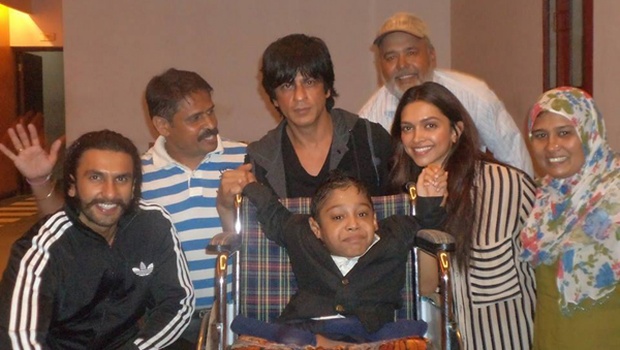
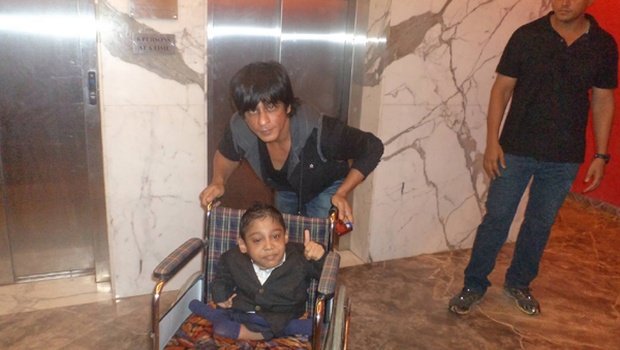
Moin is also a hardcore fan of Shah Rukh Khan and even the Bollywood Baadshah met the boy and spend time with him.

Image courtesy: Facebook

Mushtaque Junnedi his father told Times of India, “We never felt ever that Moin is disabled and never imagine house without him. He is a friend, elder and motivational force to everybody in home. All this happened thanks to his coach Umesh Kalaghatagi.”

source: http://www.newindianexpress.com / The New Indian Express / Home> Nation / by Online Desk / December 30th, 2015

Waste picker gives tips to end city’s woes

Bengaluru,  KARNATAKA :

Follow your class 5 moral science lesson on cleanliness, take steps to rein in the garbage mafia and find a solution to sanitary waste -these are not the words of an urban planner but a humble waste picker’s advice to Bengalureans. Mansoor Ahmed, 33, whose hard work fetched him a seat at the Paris climate conference, is back in the city, enlightened and overwhelmed. Still in awe of the French capital, he aims to make Bengaluru the Paris of India.

Mansoor, a waste picker from ward no 198, Jayanagar, collects dry waste from more than 1,000 houses. The passionate worker who spoke about low carbon strategies in the waste sector at the Paris summit has set a threefold agenda for Bengulureans: Keep your surroundings as clean as your house, keep a vigil on the garbage mafia by equipping each ward with cameras and find a way to effectively dispose sanitary waste.

While this is his vision for the city , Mansoor wishes to have a uniform for waste pickers, so that they feel as respectable as any other civic worker. “I have a team of 12 waste collectors and the job we do is exhausting. We show up at people’s doors at 5am and I don’t know how many residents even remember our faces. A uniform will make us feel better about ourselves,” said Mansoor.

The waste picker who doesn’t charge a single paisa for his contribution (he’s not paid by BBMP either) earns a living through his “donate dry waste project”.He collects around 25 tonnes of dry waste in a month and sells it to recycling companies, making enough money for his daily expenses.

“We still don’t have a solution for sanitary waste. We know what to do with dry waste and wet waste but with sanitary waste, we have no option but to burn it.Also, where does all of it go? Even I’m clueless. “I am not educated but still I’m passionate about keeping mine and others’ houses clean. Only if the literate follow what they have been taught in school, their education won’t go waste,” said Mansoor, signing off on a hopeful note.
Needed: A change in attitude

Asked what is the simplest thing he learnt from Paris conference that can be replicated here, Mansoor Ahmed said: “If people’s attitude changes, things will automatically change.When when we go to collect waste, residents are only bothered about the muck getting out of their homes. Whether it lands on the road or in a garbage dump is nobody’s concern. The garbage mafia is our biggest enemy; we should see that after the waste is picked up from a particular ward at 5am, no one uses it as a dumping ground.This can done only if the residents are vigilant and cameras are installed in wards”.

source:  http://www.timesofindia.indiatimes.com / The Times of India / News Home> City> Bangalore / TNN / December 11th, 2015

Bengaluru scientists find drug which could cure malaria with one dose

Bengaluru, KARNATAKA :

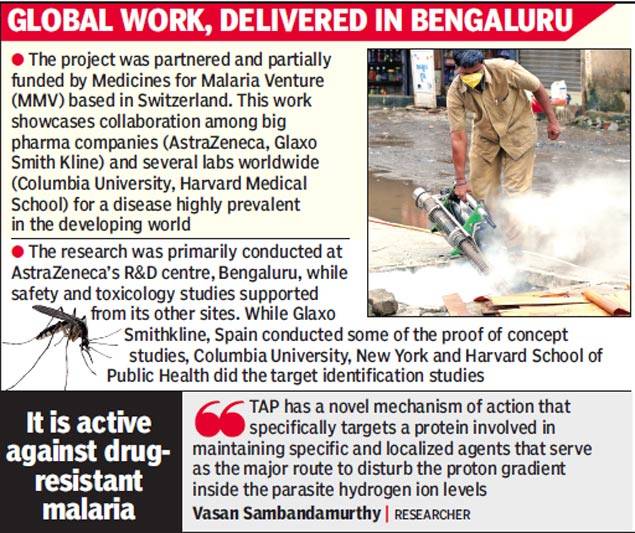
The Bengaluru solution - Triaminopyrimidine (TAP) comes with many advantages over existing drugs
The Bengaluru solution – Triaminopyrimidine (TAP) comes with many advantages over existing drugs

Bengaluru :

Three scientists from Bengaluru, who led a team of global reserchers looking for an antimalarial drug, have found a fast-killing solution.  After completing some tests, it’ll go in for clinical trials on humans. That this drug has the potential to cure the dreaded disease in one dose makes it more attractive to healthcare providers.

The Bengaluru solution — Triaminopyrimidine (TAP) — comes with many advantages over existing drugs. Vasan Sambandamurthy, one of the senior authors of the research paper, said: “It’s a fast-killing and long-acting antimalarial clinical candidate. TAP acts exclusively on the blood stage of Plasmodium falciparum (the stage responsible for clinical symptoms) in a relevant mouse model. This candidate is equally active against causative agent Plasmodium vivax.”

He added, “The compound has shown good safety margins in guinea pigs and rats. With a predicted half-life of 36 hours in humans, TAP offers potential for a single dose combination.”

The rapid spread of Plasmodium falciparum, the parasite which causes malaria in humans, has left nations battling it with a weakened arsenal and coping with thousands of deaths every year. This parasite has gradually become resistant to available medication.

The World Health Organisation (WHO) estimates that 3.2 billion people in 97 countries, including India, are at risk of being infected with malaria. In 2013, WHO reported an estimated 198 million cases and the disease was responsible for an estimated 5.84 lakh deaths, including 4.53 lakh children less than five years old.

Every person infected with malaria has to deal with millions of parasites and existing drugs have a limited effect in humans. “The half-life, which isn’t more than 2 hours, means it allows parasites to bounce back. Existing drugs are not fast-killing, which means that not only does a human need more doses but each dose is capable of only killing a few parasites,” he said.

GlobalWorkMPOs26dec2015

Besides, a potential side-effect of existing drugs is liver damage. “This doesn’t happen all the time, but the possibility does exist. Also, the parasites have become resistant to these drugs. With TAP, there are now known side-effects and the parasites are unable to develop resistance at the same pace as they do for existing drugs,” he said.

 
TAP was discovered by a team at pharmaceutical company AstraZeneca. “The main research happened in its R&D centre in Bengaluru between 2011 and 2014, which has since been shut down. It took us three years of rigorous work by teams across the globe. Today, we confidently nominate TAPs as a clinical candidate to treat drug-resistant malaria,” Vasan said. Shahul Hameed and Suresh Solapure were the two other team leaders.


Times View
The discovery of a malaria drug, yet again, highlights Bengaluru’s leadership in scientific research. The promise that the new medicine can kill the virus in a single stroke and act for a long time is good news for malaria patients. While the scientists deserve compliments on working towards a remedy free of side-effects, the companies that will eventually massproduce the drug should look at making it affordable to the aam aadmi. For their part, public health administrators must renew their battle to prevent vector-borne diseases, which cause untold suffering.

source: http://www.timesofindia.indiatimes.com / The Times of India / Home> City> Bangalore / by Chetan Kumar, TNN / April 01st, 2015

Urdu teacher writes book to highlight Muslim Scientists’ contribution to science

by A Mirsab, TwoCircles.net,

Solapur (Maharashtra): In an attempt to highlight the great work that Muslims have done in the field of science, an Assistant Teacher of Urdu High School has written a book called‘Muslim Scienedano ki Scienci Khidmat’.

The 92-page book of Junaid A. Qayyum Shaikh, 37, an Assistant Teacher at Social Urdu High School and Junior College of Science, Solapur, was launched by Prof. Dr. N N Maldar, Vice Chancelor of Solapur University.

Shaikh, who has completed Masters in Science (MSc) and Bachelor of Education (B Ed) wrote this book in Urdu. In order to reach out to more readers, he plans to translate it into other languages. He says he has received several requests for translation of the book into other languages and many are ready to even offer help.

The author used many sources in compiling the present book. Shaikh claims “Book of Knowledge by Al Jazari” an Arabic book in original that was translated by Hill and Donald in English is one of the main source for his work.

He also referred : ‘Invention in the medieval Islamic World’ by Rotlink, ‘Introduction to Historyof Science’ by Sarton and George, ’The Muslim Scientist’ by Muhammad Yasin Owadally, Article on Muslim Scientist by Altaf Hussain Memon Tahari, Muslim Sciencedan by M A Siddiqui & Fayeza Siddique, Musalmano ke Scienci Karname by Muhammad Zakriya Virk and Biography- W Hazmy,Zainurashid Z, Hussain R.

The book presents brief information of Muslim scientists’ contribution in the fields of Mechanical Technology, Transport technology, Gun powder technology, Physics, Chemistry, Botany, Zoology, Optics, etc.

Speaking with TwoCircles.net, Shaikh said, “Today most of us presume that the progress of science and technology is the contribution of Europe and American scientists only. In fact it is our lack of knowledge. The truth is that hundreds of Muslim Scientists have many inventions to their names in the field of science for centuries.”

“I felt that the newer generation is going far from the scientific history of Muslims and therefore thought that they must be reminded of contributions of Muslim Scientists so as to make it guideline and torchbearer for others who are interested in science and technology”, he said while replying to the question of trigger for him to write such book.

“This book is especially written for young Muslims, whose way of thinking is scientific and who are intersected in the research and findings related to science so that they can be motivated”, he added.

source: http://www.twocircles.net / TwoCircles.net / Home / by A. Mirsab / December 13th, 2015

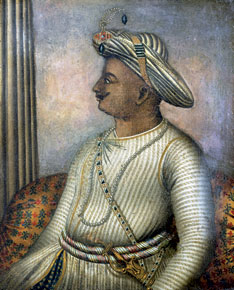
VOICES – Tipu Sultan: Noble or Savage?

TipuSultanMPOs30nov2015

In 1791, the Swami of Sringeri Math wrote to his ruler, and most generous patron, to relate a tragic tale of murder, temple destruction and violent iconoclasm.

The great temple, he related, had been attacked by a large armed party of cavalry. The invaders had mercilessly sacked the complex, stealing over Rs 60 lakh of offerings, including the temple vessels and other valuables. But it was not just a matter of looting and plunder— the raiders had deliberately violated the sanctum sanctorum. The idol of the presiding deity, Sarada, had been desecrated and pulled out of its socket.

The Swami knew that his patron was likely to be sympathetic. He was, after all, locally well-known for taking most seriously his role as protector of his Hindu subjects and their places of worship—as had been his father before him. It was the father who had begun the special relationship between the family and Sringeri, writing earlier to the Swami that ‘you are a great and holy personage. It is nothing but natural for everyone to cherish a desire to pay respects to you.’

The son had continued where his father had left off. From the beginning of his reign, he had loaded the temples of his realm with presents, honours and land. Few of his chancery records survive, but from the temple archives of the region we know, for example, that in 1784 he gave a land grant to one Venkatachala Sastri and a group of Brahmins, begging them ‘to pray for the length of his life and prosperity.’ A year later, he sent the temple complex of Melkote 12 elephants and a kettledrum, while also sending a Sanskrit verse recording his grant of lands ‘to the temples and Brahmins on the banks of the Tungabhadra.’ So it continued at the rate of at least three or four major endowments or gifts of money, bells, pensions, villages, jewels or ‘padshahlingams’ per year, for the rest of his reign, mostly in return for requests for prayers, pujas ‘for the success of the King’s armies’ or temple processions.

But it was Sringeri that had always received both the most generous presents, and as a stash of correspondence discovered within the temple in the 1950s bears witness, Tipu Sultan rose to the occasion and wrote a most heartfelt letter in response to the Swami. He put on record his horror at what the Maratha raiding party, led by their general Parasurambhau, had done to his favourite temple during their 1791 invasion of Mysore: ‘People who have sinned against such a holy place are sure to suffer the consequences of their misdeeds,’ wrote Tipu, ‘In accordance with the verse, Hasadbhih kriyate karma rudabhih anubhuyate, those who commit evil deeds smiling, will reap the consequences weeping. Treachery to gurus will undoubtedly result in the destruction of the line of descent.’

Sending a large sum of cash and a consignment of grain ‘for the consecration of Goddess Sarada’ and to ‘feed one thousand Brahmins’, Tipu asked the Swami ‘to pray for the increase of our prosperity and the destruction of our enemies.’ Shortly after this, he sent another note, along with a present of an elephant, writing that ‘wrongdoers to gurus and our country will soon perish by the grace of God! Those who took away elephants, horses, palanquins and other things from your Matha will surely be punished by God. Cloth for the Goddess has been sent through Narasimha Sastri. Please consecrate the Goddess, and pray for our welfare and the destruction of our foes.’

That the Marathas could desecrate a Hindu temple, and that Tipu Sultan could restore it, goes so firmly against all our modern expectations that it is worth examining what was going on here. How exactly could this happen?

The reality is that the pre-modern rulers of India tend to be more layered and complex figures than the one dimensional gallery of angels or devils we sometimes reduce them to. Moreover, they usually tend to behave in a far less straightforwardly sectarian manner than we might imagine. It was quite normal, for example, for Hindu rulers to endow mosques and Sufi shrines within their Kingdoms—as for example the Marathas did in the 1760s when they took over Burhanpur and Khandesh— just as it was not unknown for them to destroy the temples and state deities of their enemies when they invaded neighbouring lands. This was an old tradition, a normal way to humble an enemy and remove the sources of his power.

The Cholas, for example, were especially ruthless in this respect: when they invaded Sri Lanka and attacked Anaradhapura in 993, they sacked the town, plundered the stupas and destroyed all the temples. According the Culavamsa, the Anuradhapura chronicle:

‘They violently destroyed here and there all the monasteries,

Like blood-sucking yakkhas, they took all the treasures of Lanka.

They took away all valuables in the treasure house of the King,

They plundered what there was to plunder in vihara and the town.

The golden image of the Master [Buddha],

The two jewels which had been set as eyes in the Prince of Sages,

All these they took.

They deprived the Island of Lanka of her valuables,

Leaving the splendid town in a state as if it had been plundered by yakkhas.’

They also laid waste the temples of Manyakheta, the Rashtrakutan capital, and according to western Chalukyan inscriptions, did the same in Kalyana, ‘slaughtering women, children and Brahmins’, even raping Brahmin girls, and taking a large black stone guardian image back to Thanjavur, where it was displayed to Rajaraja Chola’s subjects as a trophy of war. Captured Chalukyan women were enslaved and also taken back to Thanjavur where they formed what one scholar has described as ‘reproductive pools’ for breeding a cadre of military men, the kaikkolas, loyal only to the Chola king.

Indeed, places of worship in state capitals often bore the brunt of successive conquests and reconquests: when Warangal fell to the Delhi Sultanate in 1323, the Tughlaqs destroyed the state temple of Svayabhu Shiva and built a congregational mosque in its place as the centre piece of the city they renamed Sultanpur. But then, at the breakup of the Sultanate, at the Hindu reconquest of the city by Kapaya Nayaka in the 1330s, the mosque seems to have been demolished and the temple restored and rebuilt over its ruins.

This was the world—often surprising to our eyes—that Tipu Sultan inhabited, and we have to make an effort to try and understand the mores of the times if we are to make sense of all this.

There is no question that Tipu was ruthless in war. He routinely and brutally converted to Islam captive enemy combatants and internal rebels, both Hindu and Christian, Indian and British, frequently destroying the temples and churches of those he conquered. He did this on a particularly horrific scale in Malabar, Mangalore and Coorg. Portuguese missionaries wrote that ‘he tied naked Christians and Hindus to the legs of elephants and made the elephants move around till the bodies of the helpless victims were torn to pieces.’

When he defeated the British in 1780, of the 7,000 prisoners he captured—one of whom was my ancestor James Dalrymple—around 300 were forcibly circumcised and given Muslim names and clothes. It is also true that he liked, especially towards the end of his reign, to describe himself as a ghazi, a Muslim Holy Warrior. Yet he clearly did not see this as being in contradiction with his duty to protect the lands and temples of his own Hindu subjects. We may see this as a massive paradox. He and his contemporaries did not.

Tipu’s patronage of the Hindu institutions of Mysore was no doubt as much a recognition of political realities, as any inherent liberalism or ‘secularism’. Tipu recruited a large number of Hindu warriors into his army—especially from the Telugu huntsman caste of Bedas or Beydaru—and he employed Brahmins to run much of his administration, particularly the revenue department, under a Hindu prime minister, Purnaiya. The palace coup which brought his father to power had been financed by Hindu bankers.

The Ranganatha Temple in his capital was not just protected but loaded with gifts which are still on display today, as are all the beautiful Vijayanagara-era images, not one of which has suffered from iconoclasm, despite standing in the middle of the capital of a ruler denounced by his British enemies as an ‘intolerant bigot’, a ‘furious fanatic’ who had ‘perpetually on his tongue the projects of Jihad’. In return for this royal patronage and protection, the Brahmin priests of his capital were expected to pray for Tipu’s success, and by studying his horoscope and the stars, to help augur his fortunes. On one occasion after a group of Malabar Christians had sided with the British, he destroyed churches in Mangalore and northern Malabar and gave the magnificent Dutch-cast bells to one of his state temples, the Venkaramana Temple in Nagar.

Yet it was not all realpolitik. Tipu, despite being a devout Muslim, believed strongly in the power of Hindu deities: in his dreams, which he diligently recorded every morning in a dream book which survived the British sack of Srirangapatna, Tipu encounters not only long-dead Sufi saints, but also Hindu gods and goddesses; in one dream sequence, which he saw on 16 November 1798, there are references to him encountering in a ruined temple idols whose eyes moved: one talked to him, and as a result, Tipu ordered the temple rebuilt. Tipu also strongly believed in the supernatural powers of holy men, both Hindu and Muslim. As he wrote in 1793 to the Swami of Sringeri: ‘You are the Jagatguru,the preceptor of the world… in whatever country holy personages like you may reside, that country will prosper with good showers and crops.’

Moreover, it is clear that for all his self-portrayal in his letters to other Muslim rulers such as Zaman Shah of Kabul, or the Ottoman Sultan in Constantinople, as a Muslim ghazi, intent on kafir conversion, his personal beliefs and cosmologies were imbricated with Hindu ideas of holiness and the supernatural: it is recorded , for example, that he made all his troops, Hindu and Muslim, take ritual baths in holy rivers ‘by the advice of his augers’ in order to wash away cowardice and make them superior in battle to the Marathas.

In this deeply syncretic world view, Tipu was a man of his time, and this vision which saw two cosmologies, Hindu and Islamic, profoundly intertwined, was one that he shared with many of his contemporaries: the Maratha leader Mahadji Scindia, for example, was well known at the time for his deep devotion to various Sufi saints.

Where Tipu does stand apart from almost all his contemporaries, however, was in his prescience about the intentions of the British, his profound alarm at the power of their East India Company, and his determination to attempt to root it out of India. He tried to warn other Indian rulers of the dangers of the increasingly arrogant and aggressive Company: ‘Know you not the custom of the English?’ he wrote in vain to the Nizam of Hyderabad in 1796. ‘Wherever they fix their talons they contrive little by little to work themselves into the whole management of affairs.’

It was these British enemies of Tipu who did most to create the image of Tipu so widely held today. In 1799, before sending into the field the largest army the East India Company ever gathered together, the Governor General, Lord Wellesley, began a campaign of vilification against Tipu, portraying him as an aggressive Muslim Monster who divided his time between oppressing his subjects and planning to drive the British into the sea. This essay in imperial villain-making opened the way for a lucrative conquest and the installation of a more pliable regime which would, in the words of Wellesley, allow the British to give the impression they were handing the country back to its rightful owners while in reality maintaining firm control.

It is, however, a truth universally acknowledged that a politician in search of a war is not necessarily over-scrupulous with matters of fact. Until recently, the British propaganda offensive against Tipu has determined the way that most people in India remember him. But as with more recent dossiers produced to justify pre-emptive military action against mineral-rich Muslim states, the evidence presented reveals far more about the desires of the attacker than it does about the reality of the attacked. For recent work by a succession of modern scholars has succeeded in reconstructing a very different Tipu to the one-dimensional fanatic invented by Wellesley. Tipu, it is now clear, was in fact one of the most innovative and far-sighted rulers of the pre-Colonial period.

What really worried the British was less that Tipu was a Muslim fanatic, something strange and alien, but that he was in fact frighteningly familiar: a modernising technocrat who used the weapons of the West against their own inventors. Indeed in many ways he beat them at their own game.

Tactically the Mysore forces were fully the match of those of the East India Company, and Tipu’s sepoys were every bit as well trained by their French mercenary officers as those of the Company were by theirs; indeed the steely discipline of the Mysore infantry amazed and worried many British observers. The Mysore army was strong in those areas where the Company was weakest and the Mysore light cavalry was ‘the best in the world’, according to Arthur Wellesley, the future Duke of Wellington.

Moreover the sepoy’s rifles and canon were based on the latest French designs, and their artillery had a heavier bore and longer range than anything possessed by the Company’s armies. Indeed, in many respects the Mysore troops were more innovative and tactically well ahead of the Company armies: firing rockets from their camel cavalry to disperse hostile cavalry, for example, long before William Congreve’s rocket system was adopted by the British army. Tipu also developed a large bullock ‘park’ of white Deccani cattle to allow him rapidly to deploy infantry and their supplies through his kingdom, a logistical innovation later borrowed by the British for their wars against the Marathas.

More worrying still for Wellesley, the defences of the island fortress of Srirangapatna were state-of-the-art and designed by French engineers on the latest scientific principles, following Sébastian de Vauban’s research into artillery-resistant fortification designs, as adapted by the Marquis de Montalembert in his book, La Fortification Perpendiculaire. These provided the most up to date defences that the 18th century could offer and also took into account the newly increased fire-power of cannon, bombs and mines, as well as the latest developments in tactics for storming and laying siege to forts. Haider and Tipu even tried to create a navy which by 1766 comprised two ships, seven smaller vessels and 40 gallivats, all commanded by a European sailor named Stannett.

All this made Tipu by far the Company’s most formidable enemy. He was responsible for a unique and catastrophic defeat of the armies of the East India Company at Pollilur in 1780 which led to the slaughter of an entire army and the capture of one in five of all the British soldiers in India: no less than 7,000 British men, along with an unknown number of women, were held captive by Tipu in his sophisticated fortress of Srirangapatna. Many were circumcised and forcibly converted to Islam. Even more humiliatingly, several British regimental drummer boys were made to wear ghagra cholis and entertain the court as nautch girls.

At the end of ten years’ captivity, one of these prisoners, James Scurry, found that he had forgotten how to sit in a chair or use a knife and fork; his English was ‘broken and confused, having lost all its vernacular idiom’, his skin had darkened to the ‘swarthy complexion of Negroes’ and he found he actively disliked wearing European clothes. This was the ultimate colonial nightmare, and in its most unpalatable form: the captive preferring the ways of his captors, the coloniser colonised.

Tipu was just as innovative in peace as he was in war. He tried to import industrial technology through French engineers and experimented with harnessing water-power to drive his machinery. He sent envoys to southern China to bring back silkworm eggs and established serriculture in Mysore—something that still enriches the region today. He introduced irrigation and built dams so that even his British enemies had to admit that his kingdom was ‘well cultivated, populous with industrious inhabitants, cities [including Bangalore] newly founded and commerce extended.’ More remarkably still, he created what amounted to a state trading company with its own ships and factories dotted across the Persian Gulf. He even asked his ambassadors to Istanbul to secure for him the ijara—farm— of Basra so that, like Europeans, he could establish an overseas settlement which would be both a base and a safe haven for his vessels. No wonder the British were terrified when they discovered that ‘Citizen Tippoo’ was in communication with Napoleon Bonaparte, whom he formally invited to visit India to liberate the country and expel the British. He had even sent Ambassadors to Paris along with a draft treaty in which he proposed an alliance to drive the British out of India.

As Christopher Bayly nicely put it, Tipu attempted to fight ‘European mercantilist power with its own weapons: state monopoly and an aggressive ideology of expansion.’ He failed only because the resources of the Company were expanding faster than those of Mysore. British propaganda might like to portray Tipu as a savage barbarian, but he was in fact something of a connoisseur and an intellectual, with a library containing some 2,000 volumes in several languages, and a large collection of modern scientific instruments including thermometers and barometers. The culture of innovation Tipu fostered in Mysore stands record to a man very different from that imagined by the Islamophobic propaganda of the British and the startling inaccuracy of Lord Wellesley’s ‘dodgy dossier’ of 1799. The fanatical bigot and savage was also something of an economic and political visionary.

Tipu knew what he was risking when he took on the British, but as he said himself, “I would rather live a day as a tiger than a lifetime as a sheep.” He duly went down fighting: when Wellesley’s army finally closed in for the kill and surrounded Srirangapatna in mid-April 1799, Tipu resisted with characteristic ingenuity and tenacity. As one British observer wrote, he ‘gave us gun for gun… night time skirmishes were made with desperate exertion… Soon the scenes became tremendously grand; shells and rockets of uncommon weight were incessantly poured upon us from the SW side, and fourteen pounders and grape from the North face of the Fort continued their havoc in the trenches; while the blaze of our batteries which frequently caught fire… was the signal for the Tiger sepoys [Tipu’s élite forces dressed in tiger-striped uniforms] to advance, and pour in galling vollies of musketry.’ It was a brave and skilful defence that ended with Tipu falling, sword in hand, at the breach in his defences near the water gate.

How should we remember Tipu today? He is certainly a complex figure, and it is anachronistic to call him ‘secular’: his was an Islamic state, albeit one run with a Hindu administration and a partially Hindu army, and led by a man who firmly believed in the power of Hindu deities. It is perfectly reasonable for the descendants of his victims—and I can count myself among them—to remember his horrible savagery in victory: in Coorg, Malabar and Mangalore he was responsible for what we today would call war crimes.

 But he was beloved by his own people, as the British discovered to their surprise when they seized his state: ‘numbers of his confidential Hindoo servants who during the war fell into our hands, acknowledged him to be a lenient and indulgent master.’ At his funeral, people lined the streets ‘many of whom prostrated themselves before the body, and expressed their grief by loud lamentations.’ So it is not far-fetched to see him as a brave proto-nationalist. For while it is true that modern ideas of nationalism and patriotism were only in their infancy, he nonetheless firmly identified the British as dangerous outsiders and there is no question he did more than any other ruler of the time to stop them taking over the country.

source: http://www.m.openthemagazine.com /  Open / Home> Quiz> Voice / by William Dalrymple / November 26th, 2015

Media, friends throng Muslim teacher’s house in Alwar after Modi’s remarks

[UK Parliamentarians and Lords calls on the Prime Minister Narendra Modi after his address, at Wembley Stadium, in London on November 13, 2015.]
[UK Parliamentarians and Lords calls on the Prime Minister Narendra Modi after his address, at Wembley Stadium, in London on November 13, 2015.]
Jaipur:

Imran Khan, a maths teacher in a government school in Alwar district, still can not believe that Prime MInister Narendra Modi mentioned his name during his speech at London’s Wembley stadium.

“It still is like a dream… PM mentioning my name is unbelievable….When PM was delivering his speech I was half asleep. I do not have a TV in my house. I came to know only after my friends and well-wishers started to call me.

“To confirm this, I watched the prime minister’s speech on YouTube….watched it again and again to confirm….reconfirm it…he was mentioning me,” Imran Khan told IANS on the phone on Saturday, a day after Modi’s address.

“You will not believe that since yesterday evening I have not been able to eat food….there are media persons….my friends….my relatives calling up….coming to meet me….absolutely no food since yesterday evening,” said a happy Imran.

“I made a small effort and it has been praised by the PM…..it feels great…really very great,” he said.

Modi, during his speech, said: “In Rajasthan’s Alwar there is a man called Imran Khan. He has made 50 mobile apps. And Alwar’s Imran Khan dedicated those apps to the students for free.”

“My India is in that Imran Khan from Alwar,” Modi said.

The 37-year-old teaches maths in a government school in Alwar district.

Imran has so far developed 52 education-oriented mobile applications since 2012.

“I do not have any background in computer technology but I had a computer in my house and I used to devote lot of time on it developing websites and other things. When I met the then district collector of my area he told me to develop apps as he said that future will belong to mobile apps. After reading some books that had chapters on apps, I started to develop mobile apps and since 2012 I have developed 52,” he said.

“My mobile apps have been downloaded by over 30 lakh users so far,” Imran claimed, adding that he considers the general science in hindi app as his completely “different” kind of one.

[Anil Sharma can be contacted at anil.s@ians.in]

source: http://www.ummid.com / Ummid.com / Home> India / by Anil Sharma, IANS / Saturday – November 14th, 2015

Disabled teen all set for Special Olympics

Hyderabad  :

Roller-skating, for 15-year-old Shams-ul-Haq, a differently-abled boy from Asif Nagar, is more than a passion. It is an obsession. As it turns out, hours of gruelling practice and patience in the rink for over a year has paid off as he has been selected to represent the country at the Special Olympics (SO) to be held in Los Angeles later this month.

The son of an Arabic teacher at a madrassa close to his home, Shams who cannot hear and speak, communicates using sign language. Beaming and with a gesture of his right hand, symbolising an airplane taking off, he says that he is going to fly to foreign locales. His father, Abdul Haq, explains, “He is leaving for Los Angeles on July 25 to compete at the Special Olympics. The competition is expected to continue till the first week of August. He is the only person who has been selected to represent India and this is a result of his determination.”

When asked how long he has been roller-skating, Haq, who is also border-line intellectually disabled, reads lips intently. He gestures with clenched fists, moving them back and forth as he simultaneously slides his feet. It is as if he wants to be certain about the question. He then raises his hand, holds up three fingers, a boisterous smile plastered across his face. “He has been interested in skating even since he was just three. He liked to play cricket but chanced upon skates and there has been no looking back. He won a state level competition in 2013 and a national competition a year later. This not only encouraged him but us too. Now he trains at the skating rink in Indira Park,” his father elaborates. Shams, a student of Greens Special School in Humayun Nagar, trains for four hours a day.

He follows a strict diet comprising nuts and low fat food.

His coach, Mohammed Noor, says that motivation is key to winning the competition is Los Angeles. But cheering for him hoarse throughout the race will not help him as he cannot hear. “The trick is to observe him keenly and soon as he makes eye contact his supporters must jump and wave arms wildly. On account of his disability, unless he sees, not hears, cheering will not be motivational for him,” Noor explains. He has also been coached to observe his competitors movements so that he can make a dash for the finish line as he cannot hear the sound of the whistle or gunshot declaring the race has begun.

Ayesha Rubina, head of the special school, says that differently-abled people should be self-sufficient. This can be achieved by giving them a degree of independence. “In Shams’ case, his parents couldn’t afford to be protective, unlike those from affluent families. This has helped him. He moves around with regular people and does his best to do whatever he can,” Rubina says.

And, what after Special Olympics? Shams picks up his skates and with a movement of the hand says it all. He wants to train others in his favourite sport.

source: http://www.timesofindia.indiatimes.com / The Times of India / News Home> City> Hyderabad / by Syed Mohammed, TNN / July 17th, 2015

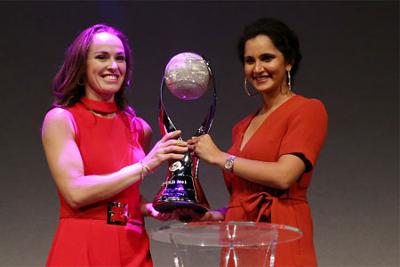
Sania Mirza-Martina Hingis secure year-End No.1 Doubles ranking

Photo Credit: Getty Image

HIGHLIGHTS

• The duo also received a trophy in acknowledgment of their feat presented by Dubai Duty Free

• Saina and Hingis are 8-1 in finals this season

• The pair also reached their 10th final of the year together at WTA Finals

Indo-Swiss pair of Sania Mirza and Martina Hingis secured the Year-End WTA No. 1 doubles ranking on Saturday. The duo also received a trophy in acknowledgment of their feat presented by Dubai Duty Free.

“Dubai Duty Free congratulates Serena, Sania and Martina on reaching the No. 1 spot in singles and doubles of the 2015 WTA Year-End ranking,” said Salah Tahlak, Senior Vice President of Corporate Communications at Dubai Duty Free as quoted by the WTA website. “We are delighted to present the Year-End No.1 trophies to these players which signifies their outstanding results in 2015. We are a proud partner of the WTA and look forward to welcoming Serena, Sania and Martina back to Dubai in February 2016 to participate in the Dubai Duty Free Tennis Championships.”

Saina and Hingis are 8-1 in finals this season, with two Grand Slam titles (Wimbledon, US Open), five WTA Premier titles (BNP Paribas Open – Indian Wells, Miami Open, Family Circle Cup – Charleston, Dongfeng Motor Wuhan Open, China Open – Beijing), and one WTA International title (Guangzhou International Women’s Open).

The pair also reached their 10th final of the year together at WTA Finals overcoming Chinese Taipei’s Chan Hao-Ching and Chan Yung-Jan 6-4, 6-2 and extended their winning streak to 21 matches with the win. Their last loss was against the Chan sisters in the semi-finals at Cincinnati.

The No.3-seeded Taiwanese went up 3-1 in the first set but the No.1-seeded Indo-Swiss duo reeled off 11 of the next 14 games to completely run away with the match.

“On the court I feel very fortunate to have Sania on my side because she’s an incredibly positive person,” Martina said after the match on Saturday.

“When I get myself down, I’m not really a morning person, so she was out there and kept fighting and kept keeping me up there. That’s why we were able to come back in the first set.”
“Once I felt better, that’s when everything started to click. They’re a great team, so they’ve always come out strong in the past six matches that we played them. And they know how to play against us.


“We came out with a strategy against them. It’s very different to what we played against players like yesterday who have more power, different strategy,” Sania said.


“We kind of have to stick to our guns, stick to what we have planned. We have to trust our abilities. That’s what really takes us through a lot of the times, is that trust in each other’s ability. We know sooner or later we’re going to break.


“It happened at 3-2. If it didn’t happen there, we would still keep fighting to make it happen.”

Sania-Martina have won eight titles together this year.

source: http://www.timesofindia.indiatimes.com / The Times of India / News Home> Sports> Tennis / by TNN & Agencies / Photo: Getty Images / October 31st, 2015

Second opinion saves woman

ShahinaBegumMPOs15oct2015

Had it not been for the second opinion at the last minute, a 29-year-old woman would have been “buried alive” as her family made all preparations for last rites after doctors at a leading private hospital opined that she had only half an hour left.

Shahina Begum, a resident of Goripalya near Mysuru Road, was unconscious for hours and was rushed to a well-known private hospital last week. Doctors who examined her declared that her condition was critical and opined that she had a very short time left to live. Her disheartened family began preparations for the funeral. Shahina was taken back home from the hospital to spend her last few minutes with the family.

Family members called the workers at the burial ground and it was decided that she would be buried after namaaz at 5 pm, said Shaik Ateeq, her brother. “We asked the family members to have food. We had also put a shamiyana in front of our house. We had to perform a ritual of dressing her up with different clothes and that was also done,” Ateeq told Deccan Herald.

It was at this stage that Dr Tanvir, the family doctor, arrived on the scene and turned it around. Shahina ’s father Mohammed Baig, a shopkeeper, said: “We had given up all hopes. That was when Dr Tanvir came. What followed was a miracle for us. He told us she could survive and that was all we wanted to hear.”

Shahina was then shifted to Shekar Hospitals for treatment. Now, she is conscious and on a semi-solid diet, on the road to recovery. She is likely to be discharged this week, her father said.

Speaking about her condition, Dr Tanvir, Intensivist, Shekar Hospitals, said she has almost recovered. “She was unconscious for a really long period. This happened because her sugar levels were extremely high. Shahina had a condition called Diabetic Ketoacidosis,” he explained.

source: http://www.deccanherald.com / Deccan Herald / Home> City / Bengaluru – DHNS, October 15th, 2015