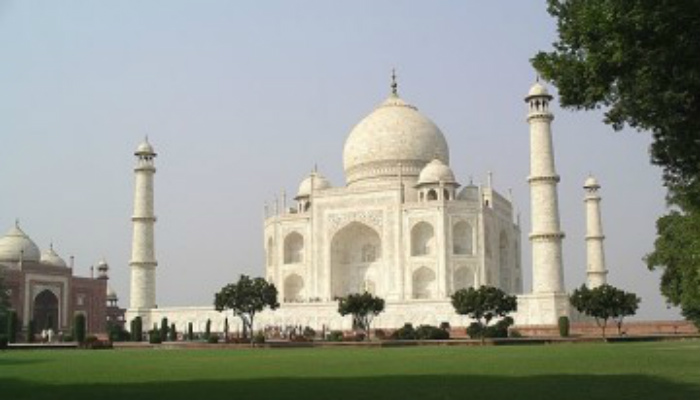
The Taj Mahal has made it to the top five of a prestigious new list of the world’s best tourist attractions.
Lonely Planet’s “Ultimate Travelist” ranks the historic mausoleum built in Agra by Mughal emperor Shah Jahan as the fifth most attractive travel hotspot in the world and describes it as a “magnificent Mughal masterpiece”.
According to the list, the architectural perfection is reached beginning with “acres of shimmering white marble. Add a few thousand semi-precious stones, carved and inlaid in intricate Islamic patterns. Take a sublime setting by a sacred river, in jewel-like formal gardens. Apply a little perfect symmetry, and tie up the whole package in an outlandish story of timeless love. And there you have the Taj Mahal”.
It notes that there’s no other building in India that so perfectly encapsulates the attitudes and atmosphere of its era.
The Temples of Angkor, a UNESCO World Heritage site in northern Cambodia, tops the list as a complex of more than 1,000 temples, shrines and tombs which attracts more than 2 million visitors annually.
The Great Barrier Reef in Australia comes in at number two, the Inca city of Machu Picchu in Peru at number three, and the Great Wall of China at four.
Travel writers and Lonely Planet staff were invited to submit ideas before voting on their favourites.
Voters were asked to consider which sights enthused, inspired, and excited them the most.
The one UK entry was the British Museum, which came in 15th on the wish list.
To celebrate the release of the new book, some of the world’s finest sand sculptors will recreate five sights from around the world on Peter’s Hill near St. Paul’s Cathedral in central London later this week.
source: http://www.focusnews.com / FocusNews.com / Home> LifeStyle> Food And Travel / Press Trust of India, New Delhi / August 21st, 2015
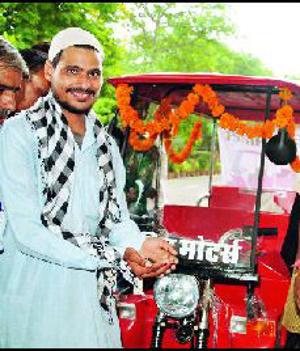
Nagpal along with social activist Sabir Qureshi (who took Aabid to the commissioner of police, Jaipur, Janga Sriniwas Rao to return the money) came to the Jaipur police commissionerate and the keys of e-rickshaw were handed over to Aabid by the commissioner.
Jaipur :
He woke up at 3.45 am to board the flight from Bengaluru to Jaipur. Sixty-six-year old Lal Chand Nagpal arrived here on Monday to salute and reward Aabid Qureshi, the honest rickshaw puller who had returned Rs 1.17 lakh he had found on the road.
After checking into a hotel, Nagpal met with the family of Aabid and in the presence of commissioner of police, Jaipur, Janga Sriniwas Rao, gifted an e-rickshaw to Aabid.
Nagpal, a businessman-turned-social activist, who had won ‘Sindhu Ratan’ award for his work had read Aabid’s story – Rickshaw puller returns Rs 1.17 lakh found on road’ appeared in Times of India on August 6 and contacted the scribe and wished to reward Aabid.
“After reading the news in Bangalore, I was so impressed with Aabid because if you lost a Rs 100 note these days, you can’t expect to get it back. And this man has returned over Rs 1 lakh despite having a very poor financial condition. I met his family and found that they were very humble. It is a good feeling while I gave them an e-rickshaw to raise bar in terms of their daily earning,” Nagpal said while talking to TOI on Monday.
Nagpal along with social activist Sabir Qureshi (who took Aabid to the commissioner of police, Jaipur, Janga Sriniwas Rao to return the money) came to the Jaipur police commissionerate and the keys of e-rickshaw were handed over to Aabid by the commissioner.
“I think this is the best example of a welfare state. A man shows honesty and another man sitting in a city rewards him. These are the real heroes of the society,” said an elated Rao.
Nagpal said, “There were few friends in Bangalore with whom I discussed the idea. They all encouraged me and also asked me to check the credentials of the man. I am satisfied and humbled after seeing the simplicity of Aabid. However, my only concern is that the people of Jaipur should now ensure that the e-rickshaw I have gifted him should only be utilized to earn his bread and butter. They should not misuse it.”
“I thought just money won’t solve the problems of his life. I am giving him a source which can ensure him a proper monthly income,” said an elated Nagpal.
Nagpal further urged the people of Muslim community who had come to welcome Aabid at the commissionerate that they should work as guarantor to ensure that Aabid should not change his path of simplicity and honesty. “Mujhe bada dukh hoga agar meri mehnat ke paise zaya honge (I will feel bad if my hard earned money will be wasted),” he added.
Aabid and his wife Ameena along with their infant daughter Anam were happiest while they were handed over the keys of e-rickshaw. “I had never thought that good act will fetch me so many things. A day after the news stories on me appeared, I had fever and went to see a doctor. The doctor after seeing me said that he had read my story in newspapers and did not charge a penny as fees as a mark of respect. I will now ensure that I should work hard to earn better in my life for my wife and family members.”
Aabid and people of his colony boarded in the e-rickshaw and departed to their destination while celebrating the moment.
source: http://www.timesofindia.indiatimes.com / The Times of India / News Home> City> Japipur / TNN / August 18th, 2015
A new app called Netradaan enables users to sign up for eye donation through their mobile phones. What makes the app all the more special is the contributions by a visually challenged person in its making.
Muhammed Ramees was born with partial eyesight. When Sunil Mathew, founder of Sightica Solutions spotted him during an interview to train visually challenged persons in using computers, he realized that Ramees was too good to be just trained in basics. That was the beginning. Together the duo went on to develop a series of Android apps.
“One of the unique features of the app is t the recipient request through which a request for cornea can be made. This will go into the database of the association. The app has English and Hindi versions, Ramees said. The app encourages users to donate their eyes through an easy to fill-and-submit donor form. “We have partnered with the Eye Bank Association of India. The donor receives an eye donation card from the association,” said Sunil, who also runs Society for Rehabilitation of the Visually Challenged (SRVC), an NGO in Kochi.
Another app called Kuluk created by them enables the blind to call for help by shaking or tapping their phone “A visually challenged person can call for help by shaking the phone or tapping it just once keeping the app on. The users can customize the number of shakes upto three. A shake or a tap prompts a call or message to emergency numbers saved on their phones,” said Sunil. Another app called Mapseeker helps the elderly or visually challenged to find important places using google maps. “This is just like the GPS but with more user-friendly features for the blind,” Ramees added. ”
Netradaan app has won the m-inclusion Awards at the mBillionth Awards held in New Delhi last week. The award honours outstanding mobile content and apps from South Asia.
“We should spread awareness regarding eye donation. What pushed us to develop this app was the long waiting list for corneas. About 45,000 corneas are imported from Sri Lanka alone every year,” said Sunil. All the apps can be downloaded from Google Playstore.
source: http://www.timesofindia.indiatimes.com / The Times of India / News Home> City> Kochi / by Sudha Nambudiri, TNN / August 04th, 2015
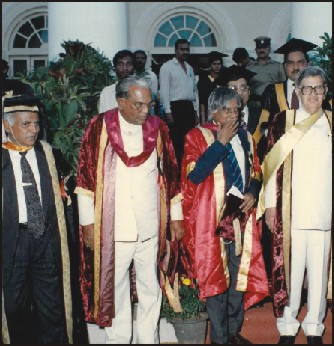
Here we publish the full text of the convocation address delivered by Dr. A.P.J. Abdul Kalam, the then Scientific Adviser to Raksha Mantri and Secretary, Department of Defence, Research & Development, at the 75th Convocation of University of Mysore on Feb. 25, 1995. — Ed.
Dr. A.P.J Abdul Kalam (second from right) seen with the then Governor-Chancellor Khurshed Alam Khan, the then Higher Education Minister and Pro-Chancellor D. Manjunath and the then Vice-Chancellor Prof. M. Madaiah during the 75th Convocation of University of Mysore on Feb.25, 1995.
by Dr. A.P.J Abdul Kalam
Dare to Dream: I am indeed delighted and honoured to participate in this 75th Convocation of University of Mysore. I have been thinking about what to share with you on this important occasion when you are entering the most eventful phase of your life after years of learning. I know that for the past twenty-years or so you have been continuously taught various aspects by teachers. I am, therefore, not going to extend this process. Instead, I would like to share with you a few of my experiences, one at a place very close to you and others at Trivandrum and Hyderabad.
These are the experiences where people have dared to dream and met with success. Of course, we have to recognise that success is always the result of sweat of individuals and also coupled with many failures. The place close to you is the site of pilgrimage not only for me but for every one who practices rocketry in our country. Let me first tell you something about this.
First War Rocket: When I was studying in school and college, Srirangapatna interested me for two reasons — the place was the scene of battle against foreign rule and also there was a reference to a new weapon introduced. In 1960, when I visited Srirangapatna with my friends, we were thrilled to walk around this historical town. We searched for the Turukhan-hally Fort built during Hyder Ali – Tipu Sultan times and used for making rockets, way back in 1794. I had a tremendous disappointment when I did not see any permanent evidence or historical recordings in Srirangapatna regarding creation or development of first war rocket in the world.
Later, in 1963, I was at Wallop’s Island, the rocket launch facility of NASA in USA, in connection with a collaborative programme of launching of sounding meteorological rockets for research of upper atmosphere. In the lobby of their command-control centre, I saw a prominently displayed picture. The war dress and the colour of the soldiers’ skin attracted my attention. Some dark complexioned soldiers were firing rockets on their white skinned opponents. The label on the painting read, “The world’s first war rocket.” It was indeed a great pleasure to see an Indian feat acknowledged on the other side of the planet. I felt excited with happiness.
I started reading the history of rockets. I had a dream I must see Tipu’s rockets. Time continued to pass. Rocket technology engulfed me and India’s first Satellite Launch Vehicle SLV-3 was launched. In 1980, we had an opportunity to visit London. There, I saw two of the war rockets captured by British at Srirangapatna, displayed at Museum of Artillery at Woolwich in London with the heading “India’s War Rocket.” Probably, Europe learnt rocketry from our Srirangapatna rocket in the eighteenth century! It was a great thrill to see an Indian innovation on a foreign soil, well-preserved and with facts not distorted.
I got the performance of these 2 kg rockets, 50 mm in dia. and about 250 mm in length analysed by our designers. What a simple and elegant design, effectively used in war ! Surely, Hyder – Tipu Sultan would have had talented men who could look at propulsion, material, ignition and build rockets and fly them for war operations. In fact, when we look back to eighteenth century ambience, it is a technology marvel.
I would like to declare today that this land is the birth place of war rockets in the world and offer it my reverence and respect. The tradition continues.
Prof. Vikram Sarabhai – Man of Vision: Nations advance along the course charted by great dreamers. Let me narrate to you an incidence which occurred in 1968. We were working on the configuration of India’s satellite launch vehicle in Thumba. One day, Prof. Vikram Sarabhai, the then Chairman, Indian Space Research Organisation (ISRO), brought Prof. Curien, President, CNES, France, to our laboratory. France was developing Diamont satellite launch vehicles at that time. After focussing on our planned efforts, as an almost spontaneous reaction, Prof. Sarabhai proposed that we should fly India’s fourth stage of SLV-3 as the Diamont’s fourth stage. We had not flown even a meteorological rocket by that time, but Prof. Sarabhai was aware of the possibilities and trusted the capabilities of his team. His dream of SLV-3 fourth stage getting into a French launch vehicle finally came true in the form of apogee boost motor for APPLE satellite, flown by ARI
ANE, the European launch vehicle. This is the vision ! He gave us a 15-year jump in our efforts. With three experimental Indian Remote Sensing (IRS) Satellites in orbit and their images being received in the USA, Satellite Ground Stations with Indian Satellite Launch Vehicle PSLV launching our own satellite from our own land, his dream visualised in 1965 has taken form through the people born at different times. Nations are thus built by men of vision who dream and prepare ground for the coming generations.
Super Computer and Parallel Processing: In 1986, Dr. V.S. Arunachalam and myself went to US to buy a Super Computer with 400 mega flop speed. The Deputy Secretary in the Department of Defence at Pentagon first put us into long series of technical discussions and then regretted the sale on the pretext that we will use it to develop long range missiles detrimental to the security interests of the world. Travelling back disappointed, Dr. Arunachalam said, “Let us make our own Super Computer.” Today, India has a 32 node 1000 M Flops PACE SPARC 10 machine available for other countries to buy. Once we decide, we work and realise even tough dreams. That is what India expects from you.
A team of young scientists and engineers under the leadership of Dr.G.Venkataraman formed ANURAG, that is, Advanced Numerical Research and Analysis Group, to develop a parallel processing computer specially for aircraft design. At that time, AGNI also was taking shape. The payload of AGNI would re-enter the atmosphere at 15 times the speed of sound. Even at this speed, we had to keep the vehicle under control and while the payload outer temperature goes to 3000 degrees centigrade, inside of payload the ambient has to be less than 30 degrees centigrade. We have in India supersonic wind tunnel. We needed hypersonic wind tunnel for designing the AGNI payload. Various wind tunnel data could provide the loads experienced during the re-entry phase of the system. There were tunnels abroad but once they knew the application, they were refused.
This time our high-tech academic institutions rose to the occasion. Prof. S.M. Deshpande of Indian Institute of Science (IISc.) with five young bright fresh scientists from DRDL with background of mathematics and fluid dynamics, developed Computational Fluid Dynamics Software for Hypersonic Regimes in just six months. This software is the original contribution with minimum computational facility available in the world. No country would have given us this type of software. But it was done through optimum partitioning, sequencing and paralleling the task. This software solution has established that brain-power excels man-made machines, even super-computers.
I have seen that India can build her own super-computer; India can fly its own rocket system within and outside the country. Both the dreams have come out of visions. This convocation ambience, where hundreds of young graduates are entering their professional lives, is ideal for thinking about the need of visions for the next two decades. What could they be?
Vision for the Nation: With the growing population, increasing unemployment, unaffordable medical care and changing value system, our society is going through certain turbulent situation. The society looks forward to prosperity. In a decade or two, prosperity and good life is possible if the nation has the vision. Vision generates progress. As an example, we can study the period between 1857 and 1947; it was the vision of freedom which not only got us independence but during the same period in India, vision of independence generated many leaders of excellence in politics, philosophy, history, science and technology and industry. Again, can we dream for a vision to make this nation great — a nation with prosperity and peace?
Enlightened Citizens: The vision of “Enlightened Citizens” calls for a mission of integrating education, occupation and health care as one single entity. For development of self, society and nation, it is essential that hundreds of clusters of villages are divided into multiple blocks of 20,000 families. And each block can be considered as a progress group with certain number of hospitals, schools and agriculture farms which could be growing cash crops, aromatic plants or fish farms.
The experience in Kerala and Tamil Nadu indicates that integration of education and occupation resulted in small families, in addition to promoting self- sustained good life. This enlightened citizen package can be extended to the whole country.
Networking of Major Rivers: We recently conducted a workshop on the subject based on Dr. K.L. Rao’s report “National Water Grid” and Capt. Dastur’s proposal of “Garland Canal.” This has all the dimensions of becoming an important vision for the nation. Nation can aim at linking multiple rivers resulting in water distribution, flood and drought control, navigation and power generation.
Above all, this will bring together the country as it happened during the independence movement, with potential revolution in agricultural output and employment generation. Experts have indicated that this is the right time to take this as a major programme as technology exists today and the country has the capability to finance such a programme.
Today we have: satellite mapping of water resources and river flow aspects; capability to use nuclear energy for large tunnelling in mountains to direct the river flows and technological strength in mechanical, civil and communication engineering. It may be a 20-year programme for the nation.
Energy Everywhere: Similarly, the third area is “Energy Everywhere.” We believe by year 2000-plus, we will have to generate almost 50% more power. Probably, we will have to look for environment clean power. In addition to hydro and thermal energy, the non-conventional energy and nuclear energy has to contribute to power generation for which technological innovation is essential. Even hydro and thermal energy would need newer technologies so that they can provide affordable electrical energy.
Conclusion: Friends! Vision for the nation is in front of you. These dreams are bigger than the individual or group of people. Great things do not just occur; you have to dream about them and work to realise them. You can be a partner to the visions for the country and begin to experience dreams coming true. What you are is God’s gift to you. What you make out of yourself will be your gift to God. I wish you a challenging profession in your respective fields and recall the famous lines:
“The chances have just begun
The best jobs haven’t been started,
the best work hasn’t been done.”
source: http://www.starofmysore.com / Star of Mysore / Home> Feature Articles / Saturday – August 01st, 2015
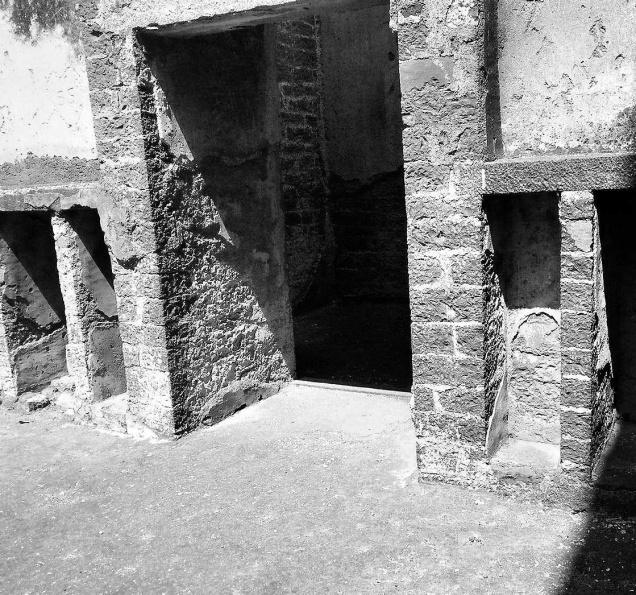
The wind-catcher at the Takht Mahal in Bidar fort.— photo: gopichand t.
This natural cooling system is in existence in the old Bidar fort
What is the warranty period on your air-conditioning system — five, seven or at the most 12 years? How about a system that has a warranty of 550 years?
Bidar fort houses this system. The Gagan Mahal, or the grand palace that has the takht (throne), has just such a natural cooling structure.
Local guides call it the ‘Bahmani AC’. Built by the Bahmani kings in the 15th century, it still functions.
Cool air gushes out from the bottom of the twin tunnels that are connected to towers on the ceiling. However, the roof of the building has collapsed, depriving visitors of a real air-conditioned experience.
The technique involved is simple. Hot air, sucked in from the surroundings, moves up a quadrangular pillar. It gets cooled, gains weight and comes down. Air is thus cooled by convection and evaporation.
The walls of the tower, exposed to the sun, attract cool humid air towards them. This happens through multiple vents, providing ample supply of cool air. Two such pillars are fixed in each room, on opposite sides of the hall.
These structures, called Badgeer, Malqaf or Hawa Khamba (wind-catcher), are also found in other buildings, including the Rangeen Mahal, Turkash Mahal or Queen’s Palace, and the Diwan-e-Khas or VIP enclosure.
There are some such structures inside the city too. Havelis of zamindars and the rich had these structures. “I had saw them while growing up in the old city,” says historian Abdul Samad Bharati.
V. Govindan Kutty, groundwater expert who has worked on the Surang Bavi system of medieval era aqua ducts in Bidar, said the method of cooling buildings involved both wind tunnels and underground water canals.
“There were several wind-catchers along the Jamuna Mori or the Shukla Teertha channels originating in the old city and ending in the Bidar fort. Some houses had basements where people would collect water. The combination of wind-catchers and underground channels led to general cooling of these houses,” Mr. Kutty said. He points out that this system is used extensively in Iran, where multiple wind-catchers are built over cisterns to chill water.
“The government should take steps to conserve these structures” says Digambar Thakur, heritage enthusiast.
This natural cooling system is in existence in the old Bidar fort
source: http://www.thehindu.com / The Hindu / Home> National> Karnataka / by Rishikesh Bahadur Desai / Bidar – July 31st, 2015
The Sports Ministry today confirmed that Wimbledon doubles champion Sania Mirza has been recommended for the Rajiv Gandhi Khel Ratna but made it clear that the final decision rests with only the Awards Committee.
Sania won her career’s first ever women’s doubles Grand Slam title with Swiss partner Martina Hingis in June. She also became world number one before winning the Grass Court major.
Sports Secretary Ajit Sharan said the Sports Minister Sarbanada Sonowal has indeed recommended to the tennis exponent for the highest honour given for achievement in sports.
“We had got a late recommendation from AITA but the Minister accepted that and recommended the same to the Awards Committee,” Sharan told PTI.
“But the final decision to give the honour rests with the Awards Committee,” he clarified.
Sania, who has won three mixed doubles Grand Slams in her career, is reportedly competing with Squash player Deepika Pallikal and discus thrower Vikas Gowda for the prestigious award.
Sania’s father and coach Imran Mirza said it was a great honour for her to be recommended for the Khel Ratna.
“It is a great honour to be nominated for the Khel Ratna award. This is surely going to inspire her to earn more laurels for the country,” Imran Mirza told.
source: http://www.outlookindia.com / Outlook / Home> News / New Delhi – August 01st, 2015
I write this obituary from the C-130 Air force plane with Dr. Kalam’s mortal remains a few feet behind me to be taken to Rameshwaram. He is draped in the national flag, the tricolor he served and deserves. He was the hero of my generation – I remember how I used to be glued to his Presidential address just as I was finishing school. He was an ocean of experience, ideas and motivation and to capture his personality and contributions in a few hundred words is a near impossible task. But as Dr. Kalam always said, “don’t stop trying” so here goes my attempt.
Srijan Pal Singh
“Funny guy! Are you smashing?” This is what I would hear from Dr. Kalam at every single dinner or lunch we had together. “Smashing” was the typical “Kalam call-sign” for asking whether the food was good. “Funny guy” was of course a more complicated expression, which could mean a whole variety of things. Depending on the tone in which it was said, it could mean good, not good, embarrassing or simply a casual reference. If you were working with Dr. Kalam, being able to decipher his usage of the word “funny” was almost a mandatory art to know which could be learnt only through experience. It took me a good one year to figure it out! Funny!
Dr. Kalam was a teacher, mentor, guide, co-author, friend, boss from whom I received care like a mother and concern like a father. I had the great fortune of working with him closely, travelling with him so frequently for over six years, till the point he left us all. He was infectiously optimistic, to him there was never an end. He never really watched TV, but still was a cricket fan – asking me scores on matches when we travelled between functions. His favorite cricketers were Dhoni and Sachin. I remember if I told him India was not doing well in a particular match, he would reply, “Watch! Our captain will come and do something unique.”
Uniqueness was so common to him. He had a voracious appetite for knowledge. The library and reading room occupying half of his 10 Rajaji Road House would be spilling books into bedroom and sometimes right upto the garden. He never departed on a journey without carrying a couple of books in his hand baggage. On the very last day of life, I remember lifting his hand baggage – it was heavy. I said, “Sir! Your bag is getting heavier!” He replied, “That is because I am reading more!”
To me the line which separated Dr. Kalam from the rest was not just his knowledge. It was his sensitivity and humility. He always introduced everybody as friend — whether it be his secretaries, his driver, his gardener, his cook or the people who maintained his house or even a stranger he just met. To him the world was truly flat, and there was no place for hierarchies and ranks in his life. I have had lunch and dinner with him at least 2000 times – often being the second to come to the table. Not once did he start eating on his own, not once did he miss asking whether I was liking the food.
He had the gift of empathy – and his memory of other people’s difficulties was impeccable. That was his art of winning over people. If he saw anyone with even with a small cold on a day he would offer you medicine or hot soup. The next day his first words would be – “Are you repaired?” No matter what you replied, his reaction would be, “Funny fellow you are!”
Dr. Kalam’s greatest faith was the nation and its youth. Even in the final two hours of his life, we discussed on terrorism as a threat to sustainability and the issue of Parliament becoming dysfunctional – two recent pieces of news which had pained him the most. He trusted the youth, particularly his students, to come up with a solution for these issues. He was an eternal believer in the power of the ignited mind of the youth – which he termed as most powerful, on the earth, above the earth and under the earth.
What next? We are bereft of Dr. Kalam as a physical form but we are still blessed with Dr. Kalam as an idea, a vision and a dream. His thoughts and missions about empowering rural areas, about clean energy, about value based education, about creativity, innovation and integrity are still flying high.
When I was his student in 2008 at IIMA, he told me in an after-class conversation, “If you are blessed with intelligence, and empowered with education – it is your responsibility to change the world”. That statement changed my life. He often said, “my dream is to see a billion smiles on billion faces”. Let us give our eternally optimistic, grand old friend, inspiration, mentor and beloved People’s President of the nation a reason to smile, wherever he is now. Salute you Kalam sir!
Srijan Pal Singh was an advisor to Dr. A.P.J. Abdul Kalam.
source: http://www.thehindu.com / The Hindu / Home> National / by Srijan Pal Singh / July 29th, 2015
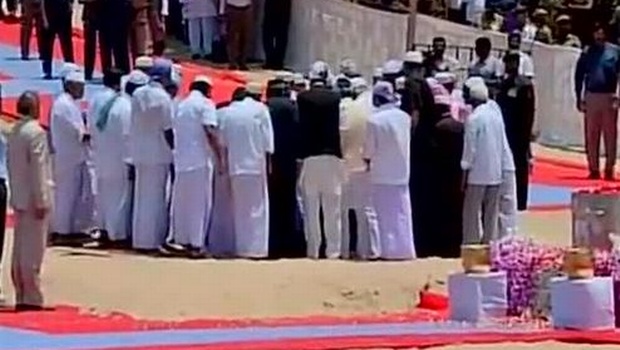
Former president A.P.J. Abdul Kalam was laid to rest on Thursday here with full military honours in the presence of Prime Minister Narendra Modi and several other leaders.
The People’s President’s body, draped in the Indian tricolour was brought to the burial site at Pei Karumbu in a flower-bedecked gun carriage, escorted by columns of the three armed services.
A gun salute was accorded to the former supreme commander of the armed forces and a military band played the haunting Last Post.
Modi, who arrived here on Thursday morning, paid his last respects to the country’s youth icon and most popular president by laying a wreath.
Tamil Nadu Governor K. Rosaiah, union Ministers M. Venkaiah Naidu, Manohar Parrikar and Pon Radhakrishnan, Tamil Nadu ministers like O.Panneerselvam, Natham R. Viswanathan and others also paid their last respects to Kalam.
Kerala Governor P. Sathasivam, Kerala Chief Minister Oommen Chandy were also present, as was Andhra Pradesh Chief Minister N. Chandrababu Naidu.
Congress vice president Rahul Gandhi and other party leaders also paid their last respects to Kalam – also known as India’s Missile Man.
Earlier the mortal remains of Kalam were taken to the family mosque for prayers.
His family members also reached here.
“All our relatives have also arrived to attend the last rites,” A.P.J.M.K. Sheik Saleem, the former president’s brother’s grandson, told IANS.
The Tamil Nadu government declared a public holiday on Thursday under the Negotiable Instruments Act. Banks, insurance companies, schools and colleges are closed throughout the state.
The government has also ordered closure of liquor shops and bars throughout the state.
Around 30,000 jewellery shops would also remain closed, while petrol bunks stopped sales for an hour between 10-11 a.m. as a mark of respect for Kalam.
Movie-theatre owners too have decided to shut down for the day while fishermen have decided not to venture into the sea.
Political parties like the DMK and the AIADMK have cancelled their functions.
Interestingly, the decision of private sector organisations to voluntarily shut shows that Kalam was truly a People’s President.
Born in Rameswaram on October 15, 1931, Kalam, as a boy, hawked newspapers to supplement his family’s income. His father owned a boat and his mother constantly struggled to keep the family sufficiently fed and clothed.
His sister pawned jewellery with a moneylender so that the studious Kalam could carry Rs.600 when he left Rameswaram to join the Madras Institute of Technology.
source: http://www.newindianexpress.com / The New Indian Express / Home> States> Tamil Nadu / by IANS / July 30th, 2015
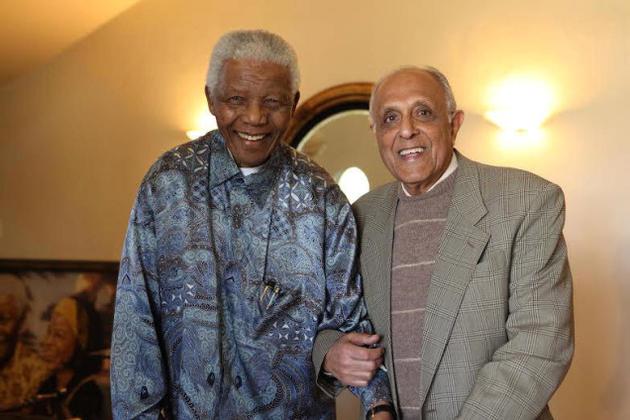
Special Camaraderie: “Throughout, Mandela retained hope, confident that sooner or later, the battle for equality would will be won.” Picture shows Nelson Mandela and Ahmed Kathrada. / by Special Arrangement / The Hindu
Ahmed Kathrada, who was on Robben Island with Nelson Mandela, recalls his famous co-prisoner’s eternal optimism.
As the world celebrated Nelson Mandela International Day on July 18 — Mandela’s birth anniversary — the air of mystery surrounding his long years of imprisonment is slowly being lifted. Mandela once called his time in prison “a long holiday”, a picture belying a life of denial and discrimination. For 10 years, Mandela was denied bread, his food was rationed, and he had to wear a humiliating uniform. Yet, according to new accounts of his time at Robben Island, where he spent 18 years in detention, Mandela was a picture of positivity.
Ahmed Kathrada was his fellow prisoner for 26 years. Prisoners with brown skin, many of whom were of Indian descent, were given preferential treatment over black prisoners. For instance, they wore trousers, while Mandela was only permitted to wear shorts. Yet, there was a sense of common cause and camaraderie. Mr. Kathrada and other prisoners would happily share their bread with Mandela and rejoiced when, three years into detention, Mandela was allowed to wear trousers. Throughout, Mandela retained hope, confident that sooner or later the battle for equality would be won.
These and other moments of joy and companionship were shared by Mr. Kathrada in a telephonic conversation with The Hindu. Mr. Kathrada also spoke of his latest book Triumph of the Human Spirit, in which he has written about his 300 visits to Robben Island as a tour guide since his release in 1990.
He is also updating his book No Bread for Nelson Mandela. “I am writing about our prison days. I was there for 26 years, Mandela for 27. I know him from 1962,” he says.
Mr. Kathrada, whose ancestors hailed from Surat, says Mandela’s personality came to the fore when hostilities were at their peak. “Mandela remained optimistic all along. When the Defiance Campaign and other movements of boycott were launched, it was with the sense that they would be successful. One does not expect immediate results. Success takes time. As an Indian you would know freedom cannot be attained in a matter of a year or two. We took heart and inspiration from the Indian struggle,” he says. “We understood that the protest had to be continuous. In South Africa, the Defiance Campaign helped in rousing public opinion. For instance, before the campaign, African National Congress had 5,000 members but following the campaign the numbers rose to over 1,00,000 members.”
Mr. Kathrada and others were arrested in July 1963 in Rivonia, Johannesburg, after which the famous Rivonia Trial began in October that year. The accused were charged with sabotage and attempts to overthrow the government by violent means. The trial ended a year later, after which Mr. Kathrada was sentenced to life imprisonment along with Mandela, Walter Sisulu, Govan Mbeki, Andrew Mlangeni, Billy Nair and others.
“For 26 years, eight of us of were together. We were sentenced to life imprisonment. When we reached the prison, Mandela was already there. As we interacted, I realised that he was a natural leader of leaders. He had already emerged as a force to reckon with in the early 60s,” he says. In the Defiance Campaign, whose aim was to get rid of six unjust laws, Mandela was the chief leader, Mr. Kathrada explains. “Thousands of volunteers were taken prisoners. It made no difference to the Apartheid government. In a prison trial, most were found not guilty. The case went to the Supreme Court. Mandela went underground and continued his political work. He was arrested in 1962 on a tour of African countries and England for mobilising support for our struggle. He continued his work underground for a year, got solidarity and financial support in England.”
Mr. Kathrada reveals that when all the important leaders were in jail in South Africa, the African National Congress policy was to continue the struggle with the support of the world, especially India and other countries. “The aim was to force the government to come to the negotiating table. Mandela started talking to the government from prison. One of his demands was to release all political prisoners, legalise the urban spots, and allow exiles to come back. The government acceded to all the requests. The ANC was allowed to function. It was in the 60s and was a big moment for us back then.”
Looking to India
Mandela and other leaders drew inspiration from India’s non-violent path to freedom, he says. “The enemy does not concede anything in a hurry. Our struggle took a long time. Contrary to what many people believed, we had a peaceful transition from apartheid to democracy.”
Mr. Kathrada left school when he was 17 to join the Transvaal Passive Resistance Council to work against the Asiatic Land Tenure and Indian Representation Act, which was popularly called the Ghetto Act. The Act, like many piecemeal concessions given by the British to Indians during the freedom movement, sought to give Indians limited political representation and defined the areas where Indians could live, trade, and own land. It was during the phase of increasing association between the African Congress and the Indian Congress that Mandela became close to Indian leaders.
Mr. Kathrada is hopeful that the path shown by Mandela is the one that South Africa will follow in the years to come. “We are only 20 years old as a democracy, but we have made considerable progress. Most of the children are now in schools; clinics and hospitals have been established. Electricity and sanitation have reached a majority of the population. Yes, challenges remain: we have hunger and poverty. But at the level of ideology, yes, it has percolated down to everybody.”
ziya.salam@thehindu.co.in
source: http://www.thehindu.com / The Hindu / Home> Opinion> Comment / by Zia Us Salam / July 21st, 2015
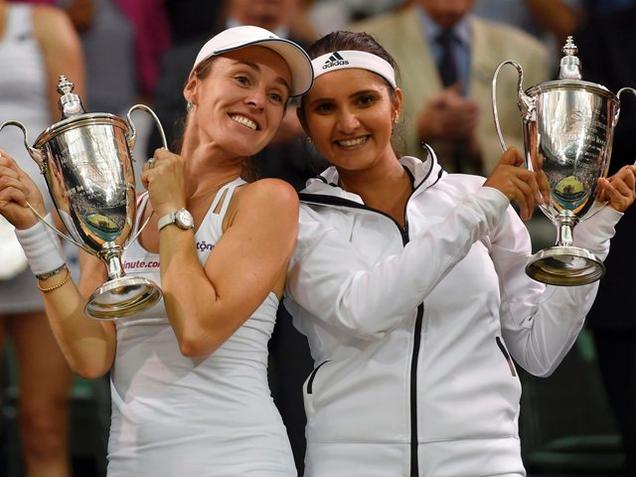
Martina Hingis and Sania Mirza pose with their trophies after winning their Women’s Doubles Final match / Reuters
Sania had come close to winning a women’s doubles Major in 2011 when she reached the French Open final with Elena Vesnina but ended up runners-up.
India’s tennis queen Sania Mirza today created history by becoming the first female player from the country to win a women’s doubles Grand Slam trophy as she clinched the Wimbledon title with Swiss partner Martina Hingis.
More than a decade after turning Pro, 28-year-old Sania laid hands on her first women’s doubles Major title when she and Hingis battled past second seed Russian team of Ekaterina Makarova and Elena Vesnina 5-7 7-6(4) 7-5 in a thrilling final.
In an interesting coincidence it was at these very historic courts that Sania had won women’s doubles junior Wimbledon championship with Russian partner Alisa Kleybanova in 2003.
Sania had come close to winning a women’s doubles Major in 2011 when she reached the French Open final with Elena Vesnina but ended up runners-up.
Already having a long list of firsts, Sania had become India’s first woman player to win a Grand Slam when she won the Australian Open with compatriot Mahesh Bhupathi in 2009.
She later added French Open (2012 with Bhupathi) and US Open (2014 with Bruno Soares) to her mixed doubles collection.
It was a remarkable turn around for the top seeds as they were trailing 2-5 in the deciding set but made a stunning comeback to reel off five straight games to clinch the issue.
Vesnina was all fired up and her smashing volleys at the net put Sania and Hingis in a lot of trouble. The Russian was left distraught as she played out of her skin.
It was third time in recent times that Sania and Hingis played the two Russians in finals — Indian Wells and Miami — and asserted their supremacy again.
Sania was broken in the very first game of the match when Vesnina hit a volley winner from the net but the top seeds immediately broke Vesnina to avoid falling behind. It was a remarkable lob from Hingis that gave them two break chances and they converted the second.
Sania and Hingis put tremendous pressure on the their rivals but the two Russians responded well and it was 5-5.
Hingis was broken in the 11th game at love after a terrific rally of powerful ground strokes from left-handed Makarova. Vesnina pounced on one return from the Swiss and hammered the volley winner close to the body of Sania.
Makarova served for the set and it was Vesnina’s smart play at the net that sealed them the opening set.
It was the first set that Sania and Hingis had dropped in this tournament.
source: http://www.thehindu.com / The Hindu / Home> Sport / by PTI / London – July 12th, 2015