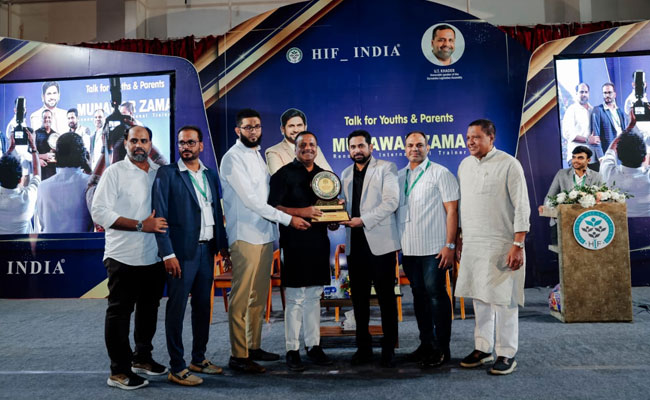
Highland Islamic Forum (HIF India) on Saturday honored motivational speaker Munawar Zama with the HIF Global Youth Icon Award here at the TMA Pai Hall in the city. Munawar Zama was in the city to hold a talk for youth and parents organised by HIF India.
The recognition was presented by UT Khader, Speaker of the Karnataka Legislative Assembly, after Zama’s address to youth and parents.
In his address, UT Khader commended Zama’s unwavering commitment to nurturing the potential of the youth, emphasizing the transformative impact of such efforts in shaping a brighter future for the world.
During the event, Munawar Zama emphasized the importance of mentorship and support systems for the younger population.
HIF members and other dignitaries including Shaz Ahmed AK as the program anchor, and Ashraf Ali – Trustee of Sana Shaheen Charitable Trust, Niyaz AK – Managing Director of AK Apple Ply Group, Naushad AK – Director of AK Apple Ply Group, and SM Farook – Director of SM Fisheries and Export, were present during the event.
HIF India President Adil Parvez presided over the event.
source: http://www.english.varthabharati.in / Vartha Bharati / Home> Karnataka / by Vartha Bharati / October 30th, 2023
Charmadi Hasanabba, a selfless social worker known for his tireless efforts in saving lives, has been honored with the Kannada Rajyotsava award by the state government for his remarkable 38 years of service to the community.
Hasanabba, born in 1951 to Ijjabba and Bifatima in Lala near Ujire in Belthangadi taluk of Dakshina Kannada district, displayed exceptional dedication to social service, especially in saving lives, irrespective of caste and creed.
Despite facing early challenges and limited educational opportunities, Hasanabba exhibited extraordinary resilience. At the age of eight, he moved to Balehonnuri and worked as a dishwasher in a small hotel, mastering the art of the hotel industry. At 18, he returned to his hometown, opened a small hotel, and built a home nearby.
Hasanabba’s journey in social service began in 1985 when he learned about daily accidents on the route frequented by truck drivers. Motivated to make a difference, he and his friends would rush to accident sites in his Maruti 800 car, providing immediate assistance and transporting the injured to hospitals. His dedication saved numerous lives, including a father-son duo from Chikkamagalur who were critically injured at Charmadi Ghat. Their recovery and gratitude inspired Hasanabba to continue his mission.
Beyond saving lives, Hasanabba actively participated in clearing roads after landslides, fearlessly navigating treacherous terrains to ensure safety for travelers. He also assisted the police as a witness in various cases, including murder and robbery.
Hasanabba’s contributions extended to community leadership as well. He served as the President of Juma Masjid from 1984 to 2015 and played a pivotal role in founding organizations like Belthangadi Taluk Muslim Union and the Muslim Unity Forum. His involvement in the Dakshina Kannada District Waqf Advisory Committee showcased his commitment to social causes.
Recognizing his outstanding service, Hasanabba received several awards, including the Beltangady Taluk and DK Zilla Kannada Rajyotsava Award, ‘Sarathy No. 1’ from the All India Drivers Association in Bangalore, the Person of the Year Award from Beary’s Welfare Association in Bangalore, the A Shyamarao Memorial Award, and the Alwas Nudisiri Awards from Beary Sahitya Academy, among others.
source: http://www.english.varthabharati.in / Vartha Bharati / Home> Karnataka / by Vartha Bharati / October 31st, 2023
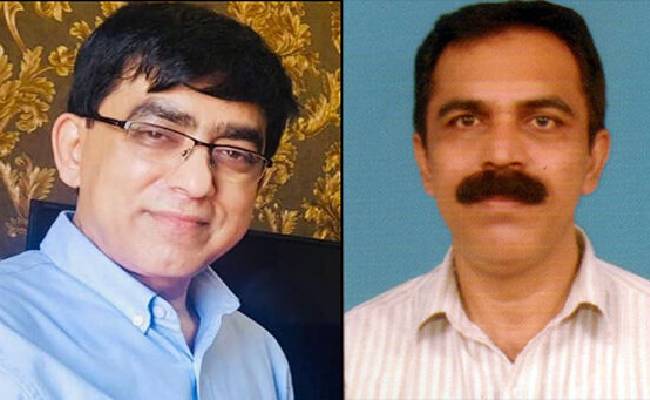
Abdulla Madumule (On the left), Ibrahim Adkasthala (On the right)
Mangaluru:
In an announcement made on Tuesday evening, the prestigious DK District Rajyotsava Awards have been revealed, recognizing the outstanding contributions of 46 individuals and 17 organizations. Among the awardees are figures such as Prominent Non-Resident Indian (NRI) businessman Abdulla Madumule, journalist Ibrahim Adkasthala, and literary expert Dr. Prabhakar Neerumarga.
Ibrahim Adkasthala is a senior correspondent at Vartha Bharati.
Additionally, recognition has been bestowed upon organizations, including the Ullal Syed Madani Charitable Trust, for their noteworthy work in various fields.
A notable recipient of this honor is Badruddin Farid Nagar, the former president of Harekala Gram Panchayat, acknowledged for his significant contributions to rural development.
The awards ceremony is scheduled to take place at Nehru Maidan in the city on November 1, starting at 9 am. Dinesh Gundu Rao, the DK District In-charge Minister, will preside over the event, with Speaker UT Khader in attendance to present the awards to the deserving recipients.
source: http://www.english.varthabharati.in / Vartha Bharati / Home> Karnataka / by Vartha Bharati / October 31st, 2023
The Muslim Educational Institutions Federation (MEIF), a prominent educational organisation operating in Dakshina Kannada and Udupi districts, has been honored with the prestigious Kannada Rajyotsava Award this year.
The Karnataka state government recognized MEIF’s significant role in revolutionizing education within the Muslim community across both districts. Founded by former Higher Education Minister of Karnataka, BA Mohidin, MEIF’s commendable efforts in education for the past 22 years have earned them this esteemed accolade.
In response to the educational gaps prevalent among Muslims in Dakshina Kannada and Udupi districts, Mohidin initiated free English classes within mosques’ madrasas during daytime. The positive reception from the community led to Jamaats in undivided Dakshina Kannada establishing English medium schools within Madrasa premises.
Encouraged by the overwhelming response, Mohidin conceptualized the Muslim Educational Institutions Federation (MEIF) in 2001. Today, MEIF comprises 180 English medium schools and pre-university colleges across Udupi and Dakshina Kannada, catering to 60,000 students and employing 6,250 teachers. Notably, students of all communities and religions study in these institutions.
MEIF’s mission centers on the belief that education is pivotal for development and strives to empower Muslim community, through education. The Federation extends guidance to member-school boards on administrative matters and conducts regular training sessions for teachers, students, and parents across its five zones. MEIF’s concerted efforts have yielded remarkable results in annual examinations, with an impressive 83 percent of students achieving distinction and first-class grades in recent years. Furthermore, pre-university students have displayed consistent improvements in their academic performances.
Operating with government approval, MEIF’s private unaided schools, primarily located in rural areas, maintain affordable tuition fees. Financially disadvantaged students receive free education, while others are charged nominal fees. Additionally, MEIF facilitates 174 SSLC students’ admission to prominent PU colleges in the districts, supporting over 300 eligible rural students in securing free seats in technology institutes in Mangaluru and Bengaluru.
MEIF has also been instrumental in adding interest among high school students in civil service careers, organizing training sessions to enhance their skills. Over the past three decades, MEIF has played a pivotal role in enhancing literacy rates and women’s education in Dakshina Kannada and Udupi districts.
Founder-chairman of MEIF and esteemed educationist PA Khader Kukkady significantly contributed to the Federation’s development. Following his tenure, Mohammed Beary Yedapadavu assumed the role of chairman, steering MEIF to greater heights. Retired officer Moosabba P Beary is currently running the Federation successfully as its President. Umar Teekay serves as the honorary chairman of MEIF, while Syed Mohamed Beary is the chief advisor. Riyaz Ahmed Kannur is the current general secretary of the federation.
source: http://www.english.varthabharati.in / Vartha Bharati / Home> Karnataka / by Vartha Bharati / October 31st, 2023
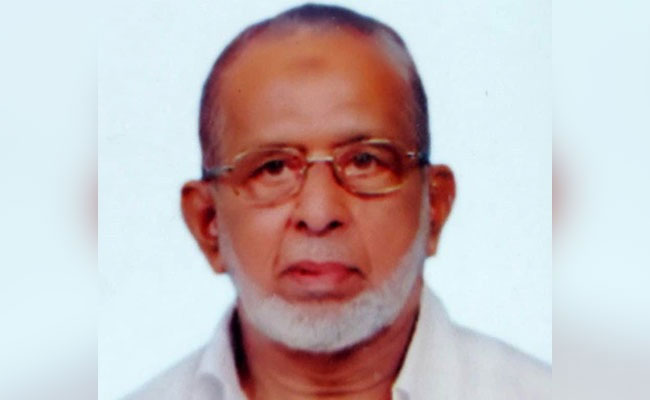
Parkala Haji Abdullah Saheb, a reputed social worker, senior socio-religious leader, successful businessman, and Honorary President of Udupi District Muslim Okkuta, has been conferred with the prestigious Karnataka Rajyotsava Award this year.
Born on the 16th of August, 1943, in Nileshwar, Kerala, to K. Ahmed and Aisha, he relocated to Udupi in 1967 at the age of 24 and commenced his career under the guidance of Dr. T. A. Pai of Manipal. With dedication and honest business practices, Abdullah Saheb transformed a small-scale venture into a thriving business, earning recognition as a prosperous businessman in Udupi.
Haji Abdullah Saheb has been a fervent supporter of students and underprivileged individuals arriving in Manipal from abroad for educational and healthcare services. He has consistently extended a helping hand to address students’ challenges and provided care for the less fortunate.
His contribution is evident in the construction of Masjid-e-Manipal in Manipal, accommodating pilgrims, the families of patients, and students seeking education and medical treatment. Additionally, he is acknowledged as a bridge fostering interfaith harmony in Manipal and Udupi.
Throughout his active involvement in renowned coastal associations such as Jamiatul Falah, Muslim Welfare Association, Millat Education Trust, and Zia Education Trust, Haji Abdullah Saheb has demonstrated his commitment to community welfare. His significant role in the establishment of Udupi District Muslim Okkuta highlights his dedication to community service. Serving as the organization’s first president, he successfully led the union for six consecutive years. Presently, he holds the honorary position of its president. In recognition of his selfless spirit and generosity, Udupi District Muslim Okkuta honored him with the Sevaratna Award for the year 2021-22.
Known for his humility, simplicity, and charitable nature, Parkala Abdullah Haji is revered as a philanthropist and community advocate.
source: http://www.english.varthabharati.in / Vartha Bharati / Home> Karnataka / by Vartha Bharati / October 31st, 2023
Karnataka government has awarded the Rajyotsava award to 68 people including ISRO Chairman S Somanath and golfer Aditi Ashok.
S Somanath, Chairman, ISRO
Here’s the complete list:
The Karnataka government’s Rajyotsava Award will be given to 68 people this year, including ISRO Chairman S Somanath and golfer Aditi Ashok, for their excellent service in their fields.
The Rajyotsava Award is the state’s second-highest civilian award given by the Karnataka government annually. The 68th Karnataka Rajyotsava Awards will be conferred on the occasion of the state’s formation day on November 1. This year is the golden jubilee of renaming Mysore state as Karnataka.
Chief Minister Siddaramaiah is the head of the Award committee, who has selected the winners.
The government also decided to give 10 awards to organisations along with 68 Rajyotsava awards on the occasion of ‘Karnataka Sambhrama’.
Minister for Kannada and Culture Shivaraj Tangadagi said that it is ensured that every district has been given representation while selecting the awardees. The awardees also include 54 men, 13 women and one transgender. The list also has two centenarians.
The Rajyotsava Awardee will get cash rewards of Rs 5 lakh, a 25-gram gold medal and a plaque.
Here’s the complete list of Rajyotsava Awardees
Music/Dance
Nayana S. More (Bengaluru)
Neela M. Kodli (Dharwad)
Shabbir Ahmed (Bengaluru)
Balesh Bhajantri (Belagavi)
Sculptures/Art/Handicraft
T. Shivashankar (Davangere)
Kalappa Vishwakarma (Raichur)
Martha Jakimovich (Bengaluru)
P. Gowraiah (Mysuru)
Yakshagana
Agrodu Mohandas Pai (Udupi)
K. Leelavathi Baipadithaya (Dakshina Kannada)
Keshappa Shillikyathara (Koppal)
Dalawai Siddappa (Vijayanagara)
Folk Art
Husenabi Buden Sab Siddi (Uttara Kannada)
Shivangi Shanmari (Davangere)
Mahadev (Mysuru)
Narasappa (Bidar)
Shankuntala Devala Naik (Kalaburagi)
H.K. Karamanchappa (Ballari)
Shambu Baligara (Gadag)
Vibhuti Gundappa (Koppal)
Chowdamma (Chikkamagaluru)
Social Service
Huchchamma Chowdri (Koppal)
Charmadi Hasanabba (Dakshina Kannada)
Roopa Naik (Davangere)
Nijagunanda Mahaswami (Belagavi)
Nagaraju G. (Bengaluru)
Administration
G.V. Balaram (Tumakuru)
Film/Cinema
‘Dingri’ Nagaraj and B. Janardhana (both Bengaluru)
Theatre
A.G. Chidambara Rao Jambe (Shivamogga)
P. Gangadhara Swami (Mysuru)
H.B. Sarojamma (Dharwad)
Thaiyabkhan M. Inamdar (Bagalkot)
Vishwanath Vamshakrutha Mata (Bagalkot),
P. Thippeswamy (Chitradurga)
Medical
C. Ramachandra (Bengaluru)
Prashanta Shetty (Dakshina Kannada)
Literature
C. Naganna (Chamarajanagar)
Subbu Holeyar (Hassan)
Satish Kulkarni (Haveri)
Lakshmipathi Kolara (Kolar)
Parappa Gurupadappa Siddapura (Vijayapura)
K. Sharifa (Bengaluru)
Education
Ramanna Havele (Raichur)
K. Chandrashekar (Kolar)
K.T. Chandru (Mandya)
Sports
Divya T.S. (Kolar)
Aditi Ashok (Bengaluru)
Ashok Gagigeppa Yenagi (Dharwad)
Judiciary
V. Gopala Gowda
Agriculture/Environment
Somanatha Reddy Poorva (Kalaburagi)
Dhyavanagouda T. Patil (Dharwad)
Shivareddy Hanuma Reddy Vasana (Bagalkot)
Miscellaneous
A.M. Madari (Vijayapura)
Haji Abdulla, Parkala (Udupi)
‘Mimikri’ Dayananda (Mysuru)
Kabbinale Vasanth Bharadwaj (Mysuru)
Lieutenant General Codanda Poovaiah Cariappa (Kodagu)
Media
Dinesh Amin Mattu (Dakshina Kannada)
Javarappa (newspaper distributor from Mysuru)
Maya Sharma (Bengaluru), and Rafi Bhandari (Vijayapura)
Science/Technology
S. Somanath (Bengaluru)
Gopalan Jagadish (Chamarajangar)
NRI Kannadigas
Seetharam Iyengar
Deepak Shetty
Shashikiran Shetty
Freedom fighter
Puttaswamy Gowda (Ramangara)
Organisations receiving the Rajyotsav Award
Here’s the list of organisations which received the award.
Karnataka Sangha (Shivamogga)
B.N. Shivarama Pustaka Prakashana (Mysuru)
Mythic Society (Bengaluru)
Karnataka Sahitya Sangha (Yadgiri)
Moulana Azad Shikshana and Samaja Kalyana Sanskrithika Sangha (Davangere)
Muslim Education Institutions Federation (Dakshina Kannada)
Sneharanga Havyasi Kala Samsthe (Bagalkot)
Chinnara Bimba (Mumbai)
Maruthi Janaseva Sangha (Dakshina Kannada)
Vidyadana Samithi (Gadag)
source: http://www.business-standard.com / Business Standard / Home> India> News / by Sudeep Singh Rawat, New Delhi / November 01st, 2023
The “SS AMU SAT” is a Nanosatellite Project which began in November 2021 under the AMU Robo Club.
Aligarh Muslim University:
The Indian National Space Promotion and Authorization Centre (IN-SPACe), working under the Department of Space, Government of India, has approved the proposal for development of “SS AMU SAT” – Aligarh Muslim University’s first satellite programme.
The leading university’s first satellite programme is to be named after its founder Sir Syed Ahmad Khan.
About SS AMU Sat
The “SS AMU SAT” is a Nanosatellite Project which began in November 2021 under the AMU Robo Club. The satellite is a 3U CubeSat with multiple objectives which include the study of economic growth in India’s poorest districts using satellite imagery and implementation of an in-house developed image compression technology for a faster multimedia transmission.
In addition to this, the satellite will also test various satellite sub-systems that have been built in-house.
SS AMU Sat Team
The project was submitted to IN-SPACe in January 2023, for approval, registration, frequency allocation and launch of SS AMU SAT.
In September 2023, the Student Satellite Committee, chaired by Dr. P K Jain, Director (PMAD), IN-SPACe, reviewed the design and approved the proposal with a condition that AMU will sign a Memorandum of Understanding (MOU) with IN-SPACe for all activities from the development of the SS AMU SAT to its launch into the Lower Earth Orbit.
The project is headed by Prof. Ekram Khan, Chairman, Department of Electronics Engineering, under the leadership of Prof. M.M. Sufiyan Beg, Principal, Zakir Husain College of Engineering and Technology.
The students’ team which is involved in the development of the project, is led by Ms Poorti Varshney and mentored by Dr. C. A. Prabhakar (Former Project Director, ISRO) and Er. Faraz Ahmad (A 2013 batch alumnus). The project has received technical support from AMU alumni working with ISRO and several industrial experts across the globe.
The team of students comprises Kulsum Ilyas, Anant Agarwal, Tarun Singh, Rabiya, Mohammad Ali, Ilma Shah, Ahsan Waseem, Azhan Kamil, Tanu Attri, Mohd. Arquam, Kanuj Chitranshu, Munira Sultan, Atifa Saeed, Kanika, Asif Ali, Syed Muhammad Suhaib, Azam, Gulam Fareed, Samad, Varun Yadav, Mudassir Ali, Tehreem Fatima, Tarannum Zafar, Yashra, Mansha and Binish Kashif
The project is tentatively scheduled to be launched in 6 months.
source: http://www.ummid.com / Ummid.com / Home> Education & Career / by ummid.com news network / October 28th, 2023
This Bollywood film from before Independence, holds the world record for most songs with 72 musical numbers.
Song and dance is an integral part of Indian cinema. While the West has a separate genre called musicals, most Indian films are by default musicals. Whether it’s a thriller, murder mystery, romantic comedy, or family drama, songs find a place in most Indian films. Yet, some films go the extra mile when it comes to including songs with the sheer number setting records. In fact, it is an Indian film that holds the world record for including most songs with a jaw-dropping 72 musical numbers in its run. And its not one of the usual suspects.
Bollywood film with 72 songs
While Hum Aapke Hain Koun created a flutter with 14 songs back in 1994, there have been a few before it as well that included over a dozen songs. Even Hollywood musicals like Chicago and Moulin Rouge had as many songs. Yet, none of them compare with the 1932 Hindi film Indrasabha, based on the play Inder Sabha. The 3 and a half-hour film was conceptualised and shot almost entirely in verse, comprising of 72 songs in total with most characters, big or small, receiving their own entry song. The mythological drama was one of the first Indian talkies, released just a year after Alam Ara.
Indrasabha’s 72 songs
Indrasabha was an adaptation of a 19th century Urdu play called Inder Sabha, written by Agha Hasan Amanat. The play was first brought to screen in 1925 but as a silent film. When Alam Ara brought the talkie revolution in India, Madan Theatre decided to bring back the film but with sound. The 1932 release utilised almost all of the plays 31 ghazals, 9 thumris, 4 holis, 15 songs, and seven other musical numbers. The film added a few of its own as well, giving it 72 songs in total. The feat earned Indrasabha a place in several record books.
source: http://www.dnaindia.com / DNA / Home> Bollywood / by DNA Web Team (headline edited) / October 26th, 2023
Even when nothing works out as you planned, don’t lose your trust in yourself, this is what Mr. Shamsudheen has to share with us.
Being the Managing Director of Nellara Groups, Address apparel, and more venture, Mr. Shamsudheen a successful Multipreneur from Kerala, has a story of dreams & hard work to share with us.
Since his teenage years, he started working to earn money to pursue his passion, establishing a business. He kept a keen interest in designing shirts, and from a native tailor, Mr. Shamsudheen acquired skills to stitch them, not knowing it would be a turning point in his life.
As he grew up, his dreams got life, and ‘Nellara food products, ’ a chain that provides premium quality food products, was born.
Still, his passion to design fashion was the same, and the concept of gifting people the best ones at an affordable range gave life to a clothing brand, ‘Address Men’s Apparel’.
With cunning strategies and proper implementation, Address caught global attention, and it is now a brand with 60+ outlets across 12 countries. Team Address focuses on designing desired outfits in premium quality that every man dreams of.
Address, a brand exclusively for men, was a dream of Mr. Shamsudheen, and with years of research and market study, the brand was revealed with an exceptional array of supreme comfort shirts. They have a well-experienced and truly professional team of fashion designers to gift everyone the best outfit.
Offering a wide range of shirts, including Supima, Cargo, and Solid shirts, Address Apparel promises superior quality garments because their team leader, Mr. Shamsudheen, believes in extending everything at the best level without compromising quality.
Mr. Shamsudheen Nellara, One who believes in making changes by marking goodness, carries the title of one of the best entrepreneurs in India with all commitment and future goals.
source: http://www.freepressjournal.in / The Free Press Journal / Home> Business / by FPJ Web Desk / July 04th, 2023
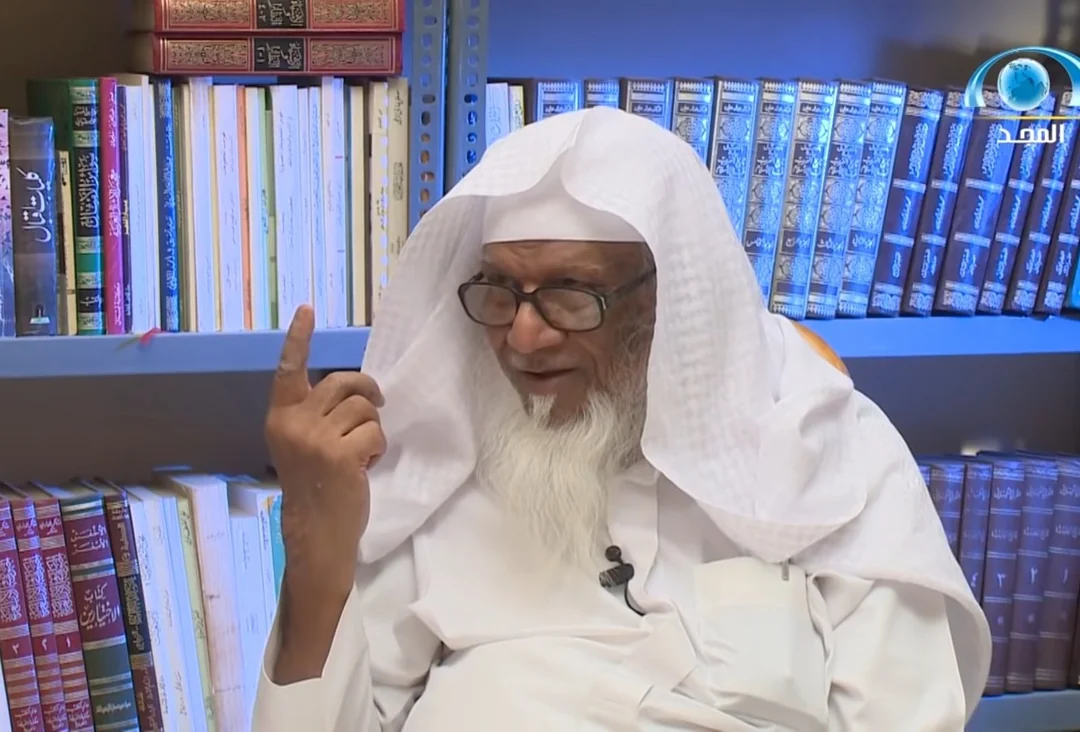
On Friday morning, author of the famous and most resourceful Madinah Arabic Book, Shaikh Dr. V Abdur Raheem, passed away in Madinah, Saudi Arabia at the age of 90.
A master of the Arabic language, a world renowned Islamic Scholar, multi-linguist, author, teacher and translator he dedicated his life to extraordinary contributions to Arabic literature by helping millions learn the Arabic language in his over 50 years of experience.
Born in 1933 in Vaniyambadi, Tamil Nadu, he obtained his B.A in English from the University of Madras and M.A in Arabic from the Aligarh Muslim University, India in 1962. He also held a M.Phil. and a Ph.D. in Arabic Philology from Al-Azhar University, Egypt.
A recipient of the National Award from the President of India in 1997 for his services in teaching, he was a self made man who learnt Arabic from the scarcest resources available to him in his little town. His three-volume series, Madinah Arabic Book, a one of a kind in its field, is the official curriculum of the Madinah University, Saudi Arabia, and is also used widely in schools and universities across the world to teach students the Arabic language.
Former Professor of Arabic Language for 30 years at the International Islamic University of Madinah, he has taught Arabic Language at Islamic Universities around the world including at Omdurman in Sudan, Germany, Washington D.C and British Guyana. An expert on European Languages and their etymology, phonetic change and semantic development he was a former Director of the ‘Institute of Teaching Arabic as a Foreign Language’, at the Islamic University of Madinah.
A close associate of the Islamic Foundation Trust (IFT), Chennai, majority of his books have been published by IFT.
Along with the Madinah Arabic Book series he has to his credit a host of other books too including ‘Let’s Begin to Read Arabic: A Beginners Guide to Learning the Arabic Language and the Qur’aan’, ‘AL-TIBYAAN – Easy way to Qur’aanic Reading’, ‘Arabic Course for Non-Native Speakers of Arabic: Originally Devised and Taught at Islaamic University, Madinah’, ‘From Esfahan To Madinah In Search of Truth: Salmaan al-Faarisi’s Hadiith’,‘Both These Lights Emanate from the Same Niche’ – Hadiith of Umm Salamah (raDiyAllaahu “anhaa).’ ‘Suurah al-Hujuraat – With Lexical and Grammatical Notes and DVDs’.
His passing is indeed a great loss to both the Muslim world and to Islamic literature.
source: http://www.thecognate.com / The Cognate / Home> News / by The Cognate News Desk / October 21st, 2023


)

)