Category Archives: Amazing Feats

Meet Saudi-return Indian farmer cultivating Gulf-like dates using tissue culture

Ariyakulam (Dharmapuri District), TAMIL NADU:

Nizamuddin S. cultivates 32 varieties of the luscious fruit as well as date palms. (Supplied)

In India there is a presumption that good, juicy dates are procured only in the Gulf Cooperation Council (GCC) countries. Little do we know that similar quality dates can be grown in India too.

Though the Kutch region in Gujarat, Punjab and Rajasthan are two major date-growing states, with Gujarat alone home to 2 million date palm trees, Tamil Nadu in south India is fast catching up.

Despite India being the one of the largest importers of dates in the world – around 3.5 million metric tons every year – there is good market for homegrown dates both locally and abroad.

India imports around 3.5 million metric tons every year. (Supplied)

Farm-cum-nursery

Meet Nizamuddin S., who cultivates 32 varieties of the luscious fruit as well as date palms. His farm-cum-nursery at Ariyakulam in Dharmapuri district in western part of Tamil Nadu literally bears fruits of hard labor and innovation.

The dangling cluster of dates on date palms at his farm are feast for the eyes. Owner of Saliah Dates, Nizamuddin got the idea of cultivating dates while working in Saudi Arabia.

Nizamuddin got the idea of cultivating dates while working in Saudi Arabia. (Supplied)

Finest Saudi dates

Responding to emails from Al Arabiya English, Nizamuddin said: “Saudi Arabia has the finest dates in the world. One fine day I thought why such dates cannot be grown in India? It seemed possible and I bought 100 plants for testing and the idea blossomed”.

There has been no looking back since then as his nursery-cum-farm now has more than 32 varieties of date palms. One of them is the Barhee dates, which costs Rs. 300 per kilogram. Barhee is the best variety and yields more than 200kg per plant.”

Tamil Nadu is an important state for dates in southern India. Here climate, soil and irrigation facilities in some coastal regions like Tirunelveli, Tuticorin and Ramanathpuram districts favor date palm cultivation.

Tamil Nadu is an important state for dates in southern India. (Supplied)

Tissue culture technology

Over decades of cultivation practices followed in different regions, regenerating dates either by seeds or offshoots and trying different imported cultivars, have led to the present date fruits of great variations in size, shape, color, weight, taste and astringency.

Moreover, controlling date palm diseases using methods, which do not pollute soil, plant and products, has not been easy.

The obvious solution was to produce date palms by adopting tissue culture technology, which enables farmers to select only the best trees as every plant produced from the cut stem is genetically identical to the parent tree.

Nizamuddin imports tissue culture plants from wherever they have been developed. (Supplied)

Transforming technology

Nizamuddin is aware that tissue culture can do wonders to the plantation. So he started to import tissue culture plants from abroad where such technologies have been developed.

“Twenty years ago first we tried seedlings. But there was an issue in the sense that we could not differentiate between a male and female plant. Only the female date palm can bear date fruits. But with tissue culture the plant is 100 percent female and we can get yield by 2 1/2 years”, says Nizamuddin.

“We import such plants from Abu Dhabi and sell all over India. We are soon planning to introduce new varieties. Ajwa dates are our first priority. Depending on how successful the yield is we will go for further new varieties. On the anvil are making different types of food products with dates like date syrup, chocolates, etc.”

source: http://www.english.alarabiya.net / AlArabiya News / Home> Features / by Aftab Husain Kola / June 21st, 2018

Pilgrim and the seven magical seeds that brought Arab coffee to shores of India

Chikkamagaluru, KARNATAKA:

India is home to 16 distinct varieties of coffee. (Supplied)

India, the world’s sixth-largest coffee grower, on an average produces about 3.2 lakh tons of coffee every year of which 75 percent are exported to countries like Italy, Germany, Russia, Belgium and Turkey. Today, India is home to 16 distinct varieties of coffee.

The journey of coffee to India has a vivid Arab connection. A devout pilgrim hailing from Chickmagalur, a picturesque hill station in India’s Karnataka state, Hazarat Shah Janab Magatabi, fondly known as Baba Budan, on his return journey, around 1600 AD via Yemen brought with him seven Coffee Arabica seeds by strapping them to his chest under his tunic.

Bababudangiri Hills in Chickmagalur where coffee was first planted in India. (Supplied)

Legend has it that Arabs were extremely protective about their coffee industry and taking the seeds outside was not allowed. The saint had known that they were magical seeds for making refreshing beverage as he had tasted the kahwa (Arabic for coffee) in Mocha, a port city of Yemen that overlooks the Red Sea.

Besides being a trading hub for coffee, Mocha was the source of the popular Mocha coffee beans. After reaching his native place, Baba Budan sowed the seeds in his hermitage garden near a hill cave at Chandragiri and the rest is history.

Chickmagalur is a picturesque hill station in India’s Karnataka state. (Supplied)

The coffee plants gradually spread as backyard plantings, and later on to the hills. The hills are now called Baba Budan Hills after the him. Today Chickmagalur, the birthplace of coffee in India, is filled with coffee plantations throughout its length and breadth.

Besides Chickmagalur, the charming region of Coorg is also one of the major grower of coffee. Coffee cultivation grew and thrived in India during the British rule and beyond.

A fall amid coffee plantations in Chickmagalur. (Supplied)

The Dutch began to harvest coffee in the Malabar region, but a major transition happened when the British led a relentless drive to set up Arabica coffee plantations across the hilly regions in South India, where the climatic conditions were more favorable for the crop.

Grown under a canopy of thick natural shade in ecologically sensitive regions of the Western and Eastern Ghats spread over Karnataka, Kerala and Tamil Nadu, Indian coffee quickly spread to non-traditional areas like Andhra Pradesh and Odisha on the Eastern Coast; Assam, Manipur, Meghalaya, Mizoram, Tripura, Nagaland and Arunachal Pradesh in the North East. Despite many states growing coffee, Karnataka and Kerala, accounting for nearly 90 percent of total production.

The charming region of Coorg is also one of the major grower of coffee. (Supplied)

In India, based on region of production, 13 regional coffees are classified: Anamalais, Bababudangiris, Biligiris, Araku Valley, Brahmaputra, Shevaroys, and Pulneys (for Arabica) and Wayanaad and Travancore (for Robusta). Coorg, Chikmagalur, Nilgiris and Manjarabad are famous for both Arabica and Robusta.

Apart from these 13, there are three Specialty Coffees classified based on their international popularity. They are Monsooned Malabar, Mysore Nuggets and Robusta Kaapi Royale.

Stall owners are thankful to Arabia for the wonderful coffee. (Supplied)

During a recent visit to Baba Budan hills, this correspondent spoke to stall owners and few tourists who still are thankful to Arabia for the wonderful coffee.

One stall owner who sells cool drinks and snacks on the hills overlooking the shrine summed up, “It is because of Baba Budan that India got coffee so early and the credit for discovering coffee goes to Arabs who invented and discovered hundreds of stuff including the coffee.”

Little wonder then a small cup of coffee has so much history behind it.

source: http://www.english.alarabiya.net / AlArabiya News / Home> Features / by Aftab Husain Kola / October 07th, 2018

On this day in 1857, Maulvi Muhammad Baqir was shot dead by Major Hudson

DELHI :

Maulvi Baqir was among the first to be arrested when the British Army entered Delhi on September 14, 1857.

On this day in 1857, Maulvi Muhammad Baqir was shot dead by Major Hudson

Maulvi Muhammad Baqir was Editor, Founder and Owner of “Delhi Urdu Akhbar“. He was shot dead on September 16, 1857 for writing articles in Nationalist tone. Maulvi Muhammad Baqir was the first journalist to lay his life during the Independence Movement of India and the Freedom Struggle of India.

Maulvi Baqir, his name sometimes also spelled as Maulvi Maqar, started the first Urdu newspaper of Delhi, Delhi Urdu Akhbar, in 1835 – a year after the British government amended the “Press Act” and allowed publications.

Delhi Urdu Akhbar” survived for nearly 21 years, proving to be a milestone in the field of Urdu Journalism. With the help of this newspaper, Maulvi Muhammad Baqar played key role in highlighting social issues as well as bringing political awakening in public and uniting them against foreign rulers.

When the Indian revolutionaries started the first war of national independence in 1857, he dedicated his newspaper to the national cause. Soon after the revolt or mutiny broke out in Meerut on May 10, 1857, Baqir gave his newspaper a new name “Akhbar uz Zafar” (Paper of Zafar) to pay tribute to Mughal Emperor Bahadur Shah Zafar who was leading the mutinying sepoys and the revolt against the British.

A staunch supporter of Hindu Muslim unity, Journalist Maulvi Baqir on June 04, 1857, printed articles in his newspaper appealing to both the communities to unite and come together, “Don’t miss this opportunity, if missed, no one will come to help, this is a good opportunity for you to get rid of British rule”.

Mohammad Baqir was used to publish his newspaper on Sundays, instead of Saturdays as a mark of his own rebellion and protest against the British, who observed Sabbath – a day of religious observance and abstinence from work, kept by Jewish people from Friday evening to Saturday evening, and by most Christians on Sunday.

Suppression of the Indian Revolt by the English

Baqir was among the first to be arrested when the British Army entered Delhi on September 14, 1857. Two days later, on September 16, he was produced before Major William S.R. Hudson who ordered to shoot him dead without trial. Major Hudson shot dead Maulvi Baqir on the same day, making him the first Indian Journalist to lay his life for the country.

It is said Maulvi Baqir was tied to the mouth of a cannon which is then fired by Major William Hudson. Some historians however have disputed this claim. Nonetheless his contributions and sacrifice were later immortalised in Russian artist Vasily Vereshchagin ‘Suppression of the Indian Revolt by the English’ painting portraying the woes of freedom fighters and the brutal way Maluvi Baqar was claimed to have been executed.

source: http://www.ummid.com / Ummid.com / Home> Life & Style / by Ummid.com News Network / September 16th, 2023

In India, 1,000 Tipu Sultan-era ancient rockets to be showcased in museum

KARNATAKA:

India rocket musuem
These were the first iron-cased rockets used in the military thus paving the way for rockets use around the world. (Supplied)

More than 1,000 unused rockets of India’s freedom fighter Tipu Sultan’s era found toward the end of July this year, will now be showcased at a newly created rocket gallery at the museum at Shivappa Nayaka Palace in Shivamogga city in the state of Karnataka.

The gallery, named as Bidanur Rocket Gallery after the famous Bidanur Fort at Nagar in Hosanagar taluk of Shivamogga district, will open to receive visitors in October.

Visitors will be able to feast on the rockets used by Tipu Sultan, the illustrious son of Karnataka, who was known as “Tiger of Mysore” for his daring acts against the British who ruled India then.

India rocket musuem
India rocket musuem

Bidanur served as an important administrative centre of Mysore State (renamed as Karnataka) and Tipu Sultan had even established a mint and an armory here.

Speaking to Al Arabiya English, R. Shejeshwara, Assistant Director of the Department of Archaeology, Museums and Heritage, said that the findings were discovered during a field excavation at a farmer’s well in Nagara village in Hosnagar Taluk, Shivamogga district, conducted by Department of Archeology, Museums and Heritage.

He said, “the shape of a cylinder and having a fuse at one end reveal that these rockets were used during the eighteenth century AD during Tipu’s time. Each unused rocket is of 7 to 10 inches in length and 1 to 3 meter in diameter and are rusted because of continuous exposure to soil moisture”.

India rocket musuem
India rocket musuem

Shejeshwara further said that like the earlier rockets found in 2002, those recovered recently also are iron-cased with black powder, a mixture of sulfur, charcoal and potassium nitrate filled inside. The 15-member crew of archaeologists, excavators and laborers took three days to unearth the armory and the ammunition.

Shejeshwara said that after the fourth Anglo-Mysore War, it is likely that Tipu’s army, stationed in Nagara, could have dumped the rockets in the well to prevent them from getting into the hands of the East India Company.

The media spotlight on the recent findings speaks volumes about how this powerful 18th century ruler of Mysore is remembered. Mysore under Tipu stood as a bulwark against the British.

Tipu conceptualized, designed and manufactured cylindrical iron tubes that ensured for great compression of the filled gunpowder and consequently, greater range (nearly 2 km). The brave freedom fighter then fastened them to swords or bamboo poles to provide stability, that would, in turn, lead to better accuracy.

Fitted with sharpnels that traveled a considerable distance, these air-borne weapons would target the enemy with edges of the sharpnels facing them.

India rocket musuem
India rocket musuem

These were the first iron-cased rockets used in the military thus paving the way for rockets use around the world.

The first rocket, which was fired by Tipu Sultan in 1792 against the British forces, is displayed at the British Museum. Though the British lost the war, they have exhibited the rocket.

After being the victims of these innovative locally-crafted rockets, the British eventually adopted the technology. Tipu Sultan wrote a military manual called Fathul Mujahideen in which he explains that 200 rocket men were assigned to each Mysorean cushoon (brigade).

Little wonder then the credit for developing the first-ever iron-clad rockets goes to Tipu Sultan and they were successfully deployed for military use.

In the Battle of Pollilur (the Second Anglo-Mysore War in 1780), Tipu’s rockets set afire the East India Company’s ammunition dumps. It was the British Army’s one of the worst ever defeats in India.

India rocket musuem
India rocket musuem

It may be recalled that a set of 24 rare and rediscovered preparatory paintings depicting the Battle of Pollilur was sold to a bidder for £769,250 at the Sotheby’s biannual Arts of the Islamic World Sale in 2010. The Britishers described these rockets filled with gunpowder on swords as “flying plagues”.

Tipu took advantage of them and established four taramandalpets (star-cluster bazaars, a name that refers to the pattern of mid-air explosions of these rockets that then pounded shrapnel on the enemy) at Srirangapatna, Bidanur, Chitradurga, and Bangalore to conduct research on Mysore rocket technology.

The armory in Kalasipalyam in Bangalore was among the four that were constructed by Tipu Sultan to store ammunition. The 18th century armory that housed the famed rockets of Tipu Sultan is hardly known.

After the death of Tipu in 1799, the British Army discovered as many as 600 launchers, 700 serviceable rockets and 9,000 empty rockets at Tipu’s fort.

One of the major beneficiary was the Royal Artillery Museum in Woolwich in the UK. The powerful ruler was killed in the fourth Anglo-Mysore war in 1799 after a slew of victories in battle against the British.

http://www.english.alarabiya.net / AlArabiya News / Home> Life > Travel & Tourism / by Aftab Alam Kola / August 09th, 2018

Kayalpattinam, a Women Dominated Model Town

Kayalpattinam, TAMIL NADU:

A small coastal town in south eastern Tamil Nadu, which has produced gems like Dr. K.V.S Habeeb Mohammed, the famous Tamil preacher, is a model in other respects too. Predominantly a women dominated town, with no cinema hall, no wine shop and even there is no police station. Almost zero crime rate but high literacy…

Dr. K.V.S Habeeb Mohammed

A small coastal town in south eastern Tamil Nadu, which has produced gems like Dr. K.V.S Habeeb Mohammed, the famous Tamil preacher, is a model in other respects too. Predominantly a women dominated town, with no cinema hall, no wine shop and even there is no police station. Almost zero crime rate but high literacy rate and God-fearing atmosphere are prominently visible features of the town. Travelers and explorers like Marco Polo and Ibn Battuta have mentioned in their diaries and famous documentarist and filmmaker Benoy K Bhel has also captured Kayalpattinam in his lenses.

Kayalpattinam is one of the coastal towns that had trade relations with Egypt and Arabia since long time. Obviously these became the entry points of Islam in India in the early times itself. Islam has left a lasting impact on this trade town. Rich Muslim traditions, Sufi heritage and centuries-old Arab connections are visible prominently. Kayalpattinam’s contribution to the Islamic spirituality and culture of the region is immense and invaluable. It has produced several religious scholars, great spiritual masters and offered a great space for local and international traders through several centuries. Kayalpattinam has contributed much to the Tamil literature.

Of the forty thousand population there are 1177 females for every 1000 males. The Arab lineage is evident in their features: complexion, physical features and culture. The town has about 30 mosques, one in each street. Madrasas and educational institutions especially imparting education to women like Aroosul Jannah Women’s Islamic college, Ayisha Siddiqua women’s Islamic college, Al Kulliyathun Nasuhiyya women’s Islamic college, Muaskarur Rahman Women’s Islamic college, are few names worth mentioning. Maqbara, tomb of Kazi Syed Alauddin, is another notable place. There are separate lanes for women to pass by, separate counters for them at shops.

The son of Kayalpattinam Dr. K.V.S. Habeeb Mohammed is a famous paediatrician, renowned speaker and author of more than 50 books. His TV talks, lectures and interfaith debates are valuable contribution to the harmony in the entire Tamil population. He is presently based in Chennai.

source: http://www.radianceweekly.net / Radiance Viewsweekly / Home> Miscellaneous / by Mohammed Atherulla Shariff / September 12th, 2023

18-year-old Kerala’s 1st DGCA-licensed woman drone pilot

Malappuram, KERALA:

It was her father, who after recognising the immense potential of drones in surveying, encouraged Rinsha to learn the skill.

Rinsha flying a drone

Kasargod: 

There are many 18-year-olds who decide to take a break just after finishing higher secondary education and before taking up higher studies. And of them, most opt to spend their time relaxing. However, Rinsha Pattakal of Malappuram is built differently. Unlike many of her peers, the 18-year-old decided to use her free time to learn a skill. And in doing so, she created history.

Thanks to her dedication, Rinsha became the first woman from the state to receive a licence from the Directorate General of Civil Aviation (DGCA) for flying drones weighing up to 25kg. It was while she was waiting for admission to BTech in Civil Engineering that Rinsha decided to take up drone flying lessons. 

The rigorous training she underwent at ASAP Kerala Community Skill Park in Kasaragod, the sole DGCA-approved drone-flying training centre in Kerala, paved the way for her historic achievement. Rinsha also credits Autonomous Unmanned Aerial Systems Pvt Ltd, an organisation in Ernakulam that provides training to aspiring drone pilots in collaboration with ASAP, for her success. 

It was her father, who after recognising the immense potential of drones in surveying, encouraged Rinsha to learn the skill. The sole woman student in the ASAP’s first-ever drone flying training batch, Rinsha has set a shining example for young women across the country with her achievement.

The comprehensive 96-hour executive programme in small-category drone piloting, which also includes a five-day DGCA Licensing training, can be successfully completed within 16 days.  The course includes specialised training in 3D mapping, unmanned aerial vehicle (UAV) survey, UAV assembly and programming, and aerial cinematography, equipping students with a wide range of skills to excel in the dynamic drone industry. “Drones are revolutionising various fields and have diverse uses such as aerial surveillance, rescue operations, traffic monitoring, weather monitoring, firefighting, drone photography, videography, agriculture, and delivery services,” Rinsha said.

In India, the DGCA Drone Remote Pilot Certificate is now a mandatory requirement for operating drones. The course at ASAP Kerala offers in-depth knowledge of drone flying rules and regulations, ensuring responsible and safe operations. Aspiring pilots above 18 years of age, who have passed Class X and possess a valid passport, are eligible to enrol in the course.

ASAP officials said Rinsha’s achievement serves as an inspiration to all and showcases Kerala’s progressive spirit. “The accomplishment not only empowers women in the field of aviation but also propels the state towards embracing cutting-edge technologies,” said an official.

source: http://www.newindianexpress.com / The New Indian Express / Home> Good News / by Pooja Nair / Express News Service / July 28th, 2023

Shoukat Ali: A Beacon of Hope on Teacher’s Day

Shergati, BIHAR:

Shoukat Ali is more than just a teacher; he is a social activist and a symbol of hope for many. His story embodies the profound impact that education and dedication can have on individuals and communities.

As we celebrate Teacher’s Day on the 5th of September, we are reminded of the countless educators who have dedicated their lives to shaping young minds and illuminating the path to a brighter future. Among these remarkable individuals, Shoukat Ali, the founder of the HOPE Foundation, shines as a beacon of hope in the world of education.

Shoukat Ali’s journey into teaching began in the slums, where he and his friends started educating underprivileged children. They founded the HOPE Foundation with a mission to provide quality education to these children. For Shoukat, education is not just a profession; it’s a lifelong commitment deeply rooted in his childhood. He recognized the importance of education early on and began teaching children in his community for free during his student days. His passion for teaching only grew stronger as he pursued higher education abroad.

With the unwavering support of his friends, Shoukat Ali’s dream took shape, and the HOPE Foundation was born. This organization’s primary focus is on creating awareness about education in remote and underserved areas, igniting the torch of knowledge and development. The dedication of his friends, who share his commitment, added strength to the foundation.

Today, the HOPE Foundation stands as a shining example of self-sustainability, with every member contributing from their income. The organization’s reach extends to slum-dwelling children across four Indian states, including Uttar Pradesh, Bihar, and West Bengal. Beyond traditional education, the foundation conducts career counseling programs for college students, spreading the message of hope and ambition.

Umran collaborates with such passionate teachers to reach the right to good education for underrepresented and marginalized communities and help them in every possible way. Looking ahead, the HOPE Foundation has ambitious plans, including introducing computer education to young girls in rural areas, equipping them with essential digital skills, and boosting their confidence. Additionally, a library for students preparing for competitive exams is in the pipeline.

The HOPE Foundation’s impact transcends education; they’ve undertaken significant work in health camps, afforestation, and disaster relief efforts. During the COVID-19 pandemic, the organization distributed essential supplies to people in various districts, exemplifying their commitment to the welfare of society.

As we celebrate Teacher’s Day, Shoukat Ali’s journey serves as a reminder of the transformative power of education and the incredible impact teachers can have on their students and communities. His dedication and tireless efforts have brought hope and opportunity to countless young minds.

In this celebration of educators, let us recognize and honor individuals like Shoukat Ali, who, through their unwavering commitment to education, inspire us all to reach for the stars, no matter where we come from. Happy Teacher’s Day!

source: http://www.umran.org.in / Umran.org.in / Home> Blog / September 03rd, 2023

Service most noble

KUWAIT / Kozhikode, KERALA:

Sana and Jassim have started a chapter of the Robin Hood Army in Kozhikode, who collect excess food and distributes among the hungry.

Sana and Jassim with their family

We all have advised our children not to waste food. We have also expressed dismay over the amount of food that gets wasted at restaurants and parties. What else? Is that all we can do? Then, meet this couple who has moved from Kuwait. They are collecting surplus food from restaurants and catering services, and donating it to the underprivileged people in Kozhikode.

Fret not anymore, if you have excess food after a function at your home or if you ordered a little too much while having dinner at a restaurant. Because Sana and Jassim’s green veiled volunteers from the newly started chapter of Robin Hood Army in Kozhikode are one phone call away. They will rush to your place to collect the food and deliver it to the needy.

In less than two months, the Robin Hood Army has fed 4,959 people in just 54 drives. A zero-fund worldwide organisation started by Neel Ghose and Anand Sinha on August 26, 2014, the Robin Hood Army is functioning in 133 cities in 13 countries. Its vision is to eliminate hunger. “More than 40 per cent of cooked food in the world is directly going to the dustbin and I believe that every religion emphasises that we shouldn’t unnecessarily waste food,” says Sana.

Sana, mother of three and hailing from Mumbai, had always wanted to dedicate her life to social service and was looking for the right NGOs to work with, when she found out about the services of RHA and applied to be their volunteer in Kozhikode.

“My vision is to make Kozhikode as a zero food wastage city and reach to each and every needy person out there – be it the need for food, education or social awareness, myself and my army will be there,” she says.

From professionals including lawyers and teachers to wheelchair-bound people, they have 45 volunteers at present. Specialised in health coaching and nutrition, Sana Jassim’s husband Mohammed Jassim personally arrives at restaurants and other venues to taste and check the quality of the food before it is donated. He had been working in Kuwait for 40 years in an oil company before he moved to Kozhikode last year.

“Our main purpose is to end wastage of food. This is a nonprofit service. Everyone who commits to volunteer will have to meet their own expenses such as fuel for the transport,” Jassim’s adds.

Presently, Sana and her team including her husband are preparing to start RHA chapters in hyper local areas such as Balussery, Wayanad, Malappuram etc. There will also be educational training for the local kids and their mothers on the beach areas as Sana thinks that even though Kerala is 100 percent literate, the quality of education offered to the underprivileged needs to be improved.

source: http://www.deccanchronicle.com / Deccan Chronicle / Home> Lifestye / by Fathima Shareef, Deccan Chronicle / April 06th, 2019

Sabhi ka khoon hai shamil yaha ki mitti me: Muslim Freedom Fighters of India

INDIA:

Uncover the remarkable contributions of Muslim freedom Fighters of India to fight for freedom from British colonial rule.

In present times, Indian Muslims find themselves subjected to demonization and unwarranted questioning of their patriotism. Communal elements seek to manipulate history by intentionally excluding Muslims and disseminating false propaganda against them through social media. The vital contributions and sacrifices made by Indian Muslims in the struggle for India’s freedom from British colonial rule are systematically obscured. However, a closer examination of history reveals that not only did Indian Muslims play an essential role in the freedom movement, but they also made significant sacrifices for the cause of anti-colonial nationalism.

Indian Muslims: Unveiling Their Crucial Role

According to a report by the Milli Chronicle, the names of 95,300 freedom fighters are etched on the India Gate in Delhi, and remarkably, 61,945 of these names belong to Muslims, signifying that 65% of these brave individuals were Muslims. The significance of this statistic is eloquently captured by the renowned writer Mr. Kushwant Singh, who boldly states that the story of Indian freedom is etched in the blood of Muslims, emphasizing their disproportionately larger contribution to the struggle, considering their smaller population percentage.

Profiles of Courage: Muslim Freedom Fighters

The annals of history are adorned with the stories of Muslim freedom fighters who put their lives on the line to liberate India from the shackles of British oppression. These individuals, driven by an unwavering determination to secure their homeland’s independence, demonstrated exceptional courage and resilience.

Sultan Haidar Ali Salabat Jung: The First Freedom Fighter


   Sultan Haidar Ali, father of Tipu Sultan, pioneered the fight against British colonial forces. A secular leader, he united both Hindus and Muslims in his quest for freedom, although his efforts were eventually betrayed.

Tipu Sultan: A Trailblazer in Battle


   Son of India’s first freedom fighter Haider Ali, Tipu Sultan pioneered the use of iron-cased rockets, utilizing them effectively to defeat British forces in several historic battles over two decades.

Shaheed Ashfaqullah Khan: A Martyr’s Legacy


   Member of the Hindustan Republican Association (HRA), Ashfaqullah Khan paid the ultimate price for India’s freedom. Notable for his daring attacks on British government trains, his sacrifice remains etched in history.

Maulana Abul Kalam Azad: A Beacon of Unity


   Maulana Azad, a key leader in the anti-colonial nationalist movement, became the youngest President of the Indian National Congress. He rallied Hindus and Muslims alike against British oppression and launched Urdu Weekly Al-Hilal to expose British misrule.

Maulana Hasrat Mohani: Champion of Change

Mohani’s powerful Urdu speeches incited Indians to stand up against British rule. His unyielding spirit saw him arrested and jailed, but his impact on India’s fight for freedom remained profound.

Khan Abdul Ghaffar Khan: The Frontier Gandhi


   A pivotal figure in the Khilafat movement, Khan Abdul Ghaffar Khan established the Khudai Khitmatgars, promoting peace and unity. Jailed for 13 years by the British, his dedication was unwavering.

Sirajud Daula: Battling Against Betrayal


   The last Nawab of Bengal, Sirajud Daula, fought valiantly against British forces. Despite betrayal, he remained a symbol of resistance against British rule.

Vakkom Majeed: Courage Amidst Oppression


   Vakkom Majeed’s resilience during the Quit India movement earned him repeated jail terms, highlighting his unwavering commitment to India’s freedom.

Fazl-e-Huq Khairabadi: Life in Exile


   Sentenced to life in the notorious Kalapani jail on Andaman, Fazl-e-Huq Khairabadi continued his fight for freedom despite insurmountable odds.

Badruddin Tayabji: Founding the INC


    Badruddin Tyabji and Qamruddin Tyabji were instrumental in establishing the Indian National Congress (INC). Badruddin’s wife, Suraiya Tayabji, designed the present Indian flag.

Shah Nawaz Khan: A Triumphant Act


    Major of Azad Hind Force, Shah Nawaz Khan was the first to hoist the tricolor at the Red Fort, symbolizing India’s victorious struggle against British imperialism.

Barrister Saifuddin Kitchlew: A Voice for Justice


    Jailed for 14 years by the British for protesting against the Jallianwala Bagh massacre and the Rowlatt Acts, Kitchlew’s opposition to the two-nation theory set him apart.

Bakht Khan: A Gallant Defender


    Bakht Khan’s courageous defense against the British in Delhi, Bengal, and Lucknow showcased his unwavering dedication to India’s freedom.

Titu Mir: Bengali Rebel


    Titu Mir’s armed resistance against British colonial authorities exemplified his determination to free India from British rule.

Syed Ahmad Barelvi: Organizing Resistance


    Syed Ahmad Barelvi’s efforts in uniting native armies against the British from Delhi to Kabul showcased his strategic prowess.

Zain-ul-Abideen: INA Officer’s Patriotic Slogan


    Zain-ul-Abideen, an officer of the Indian National Army (INA), coined the iconic patriotic slogan “Jai Hind.”

Empowering Women in the Freedom Struggle

The fight for India’s freedom was not limited to men; several Muslim women also contributed significantly to the struggle.

Begum Hazrat Mahal: A Rebel Leader


   Rebelling against the British in 1857, Begum Hazrat Mahal seized control of Lucknow from British forces, showcasing her leadership and courage.

Surayya Tyabji: Designing India’s Flag


   Wife of freedom fighter Badruddin Tayyabji, Surayya Tyabji designed the Indian flag that we proudly hoist today.

Abadi Bano Begum: A Pioneer in Politics


   Abadi Bano Begum, known as Bi Amma, actively participated in politics, matching her male counterparts in the Indian National Movement. Her sons went on to become prominent leaders.

Azizan: A Warrior’s Spirit


   Azizan organized a battalion of warrior women, displaying her remarkable skill in the art of war and refusing to yield to British pressure.

A Timeless Legacy

The contributions and sacrifices of Indian Muslims in the fight against British colonialism are immeasurable. While recounting the names of every Muslim freedom fighter may be an impossible feat, their collective impact remains undeniable. The fact that many chose to remain in India underscores their deep-rooted connection to the land. Despite attempts to distort history, India will forever be the cherished home of its Muslim citizens.

Conclusion

Urdu poet Rahat Indori’s words,

“Sabhi ka khoon hai shamil yaha ki mitti me,

Kisi ke baap ka Hindustaan thodi hai,”

encapsulate the essence of Muslim Freedom Fighters of India’ unyielding commitment to their homeland. The sacrifices and contributions of Indian Muslims in the struggle for independence stand as a testament to their unwavering dedication and indomitable spirit. Their stories deserve to be acknowledged and celebrated, inspiring future generations to honor the diverse tapestry of individuals who fought for a free and united India.

source: http://www.munsifdaily.com / The Munsif Daily / Home> News> Indai> Pan India / by Munsif Web Desk / August 18th, 2023

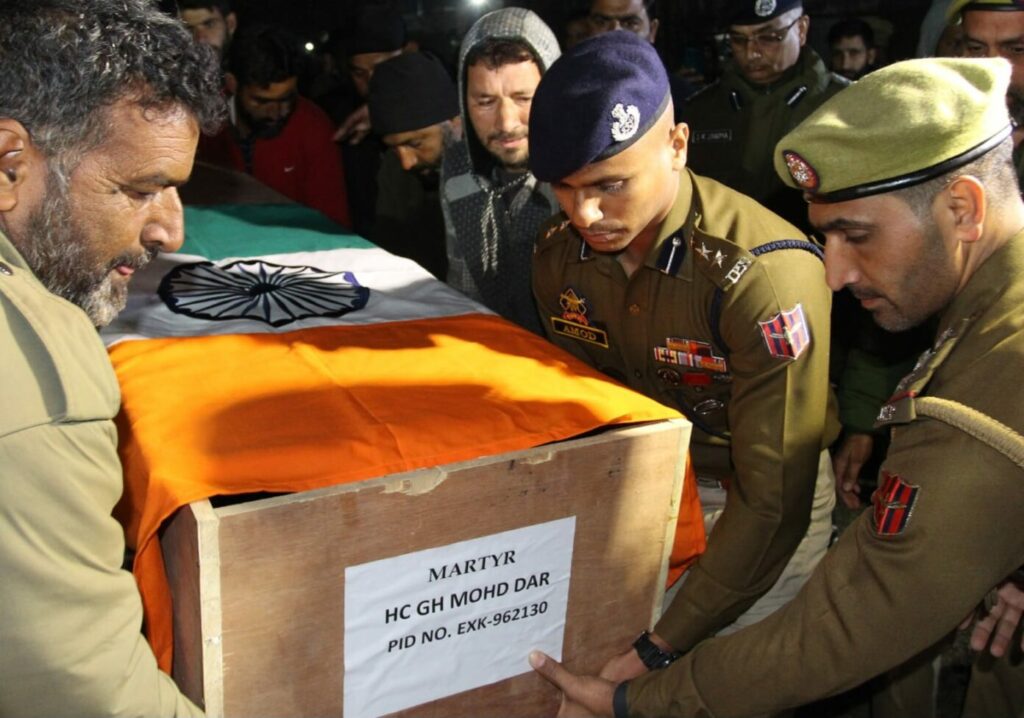
Son of former DIG, the Dy. Suptd. of Police (DSP) of J&K Police Humayun Bhat a cop who died in Anantnag terror attack ‘always led from the front’

Srinagar, JAMMU & KASHMIR:

Officials familiar with the operation said that the terrain in the particular area is difficult and “militants fired from a height upon the approaching party”.

Kashmir gunfight
Family members mourn the death of DSP of J&K Police Humayun Bhat , who was killed in a gunfight with terrorists in Anantnag district, during his funeral at his residence in Srinagar on Wednesday.(PTI Photo)

As friends and relatives crowded through the gates of Deputy Superintendent of Police Humayun Bhat’s house, distraught family members could barely say a word through their sobs. The 2018 batch J&K Police officer, who wished to carry forward the tradition of the uniform in the family, was killed along with two officers of the Indian Army as their search party was hit by a volley of terrorist gunfire in the Gadool forest in Anantnag.

Bhat’s father, Ghulam Hassan Bhat, served in the J&K Police until his retirement as DIG Central Kashmir in 2018.

An officer who spent his probation year with him described him as an eager and humble officer. “He was always eager to learn, a friend to all his colleagues. He always led his team and yesterday too he did the same,” said the officer.

Officials familiar with the operation said that the terrain in the particular area is difficult and “militants fired from a height upon the approaching party”.

Another officer who served with Bhat at Srinagar said, “He was an exceptional police officer. I remember when he joined the team, I was greatly impressed by his interest in learning practical policing. He was a dedicated team member, always ready to contribute.”

He said that Bhat was the proud son of a retired police officer and “found great joy in carrying on his father’s legacy by wearing the khaki”. “Gone too soon, his absence leaves a void that words can’t express, and our hearts ache with the loss of such a promising officer,” the officer said.

Bhat studied at Srinagar’s Burn Hall School and trained as an engineer at SSM college of engineering in North Kashmir. The family, originally from Pulwama, had been living in Srinagar for many years. He is survived by his parents, a brother, his wife and a son, who is just over a month old.

After joining the force in 2018, Bhat was posted at Srinagar, then at Pattan in North Kashmir, and he was on his third posting, as Sub Divisional Police Officer (SDPO) at Kokernag, Anantnag.

A senior officer he worked with in the early days of his career described him as brave and compassionate. “His father is one of the most outstanding professionals, a man of principle, and Humayun had those same values. He was passionate about the uniform and never brought his father’s rank into his own professional dealings.” He added that his loss at a time when things are relatively calmer in the Valley “makes this immensely difficult to reconcile with”.

A family friend described Bhat as an “extraordinary officer” and added that he was courageous, conscientious and down to earth. “Similar to his father, his qualities of head and heart endeared him to everyone who came in contact with him. His martyrdom is an irreparable loss to all of us who knew him and his father.”

source: http://www.indianexpress.com / The Indian Express / Home> News> India / by Naveed Iqbal, Srinagar (headline edited) / September 14th, 2023