Category Archives: Arts, Culture & Entertainment

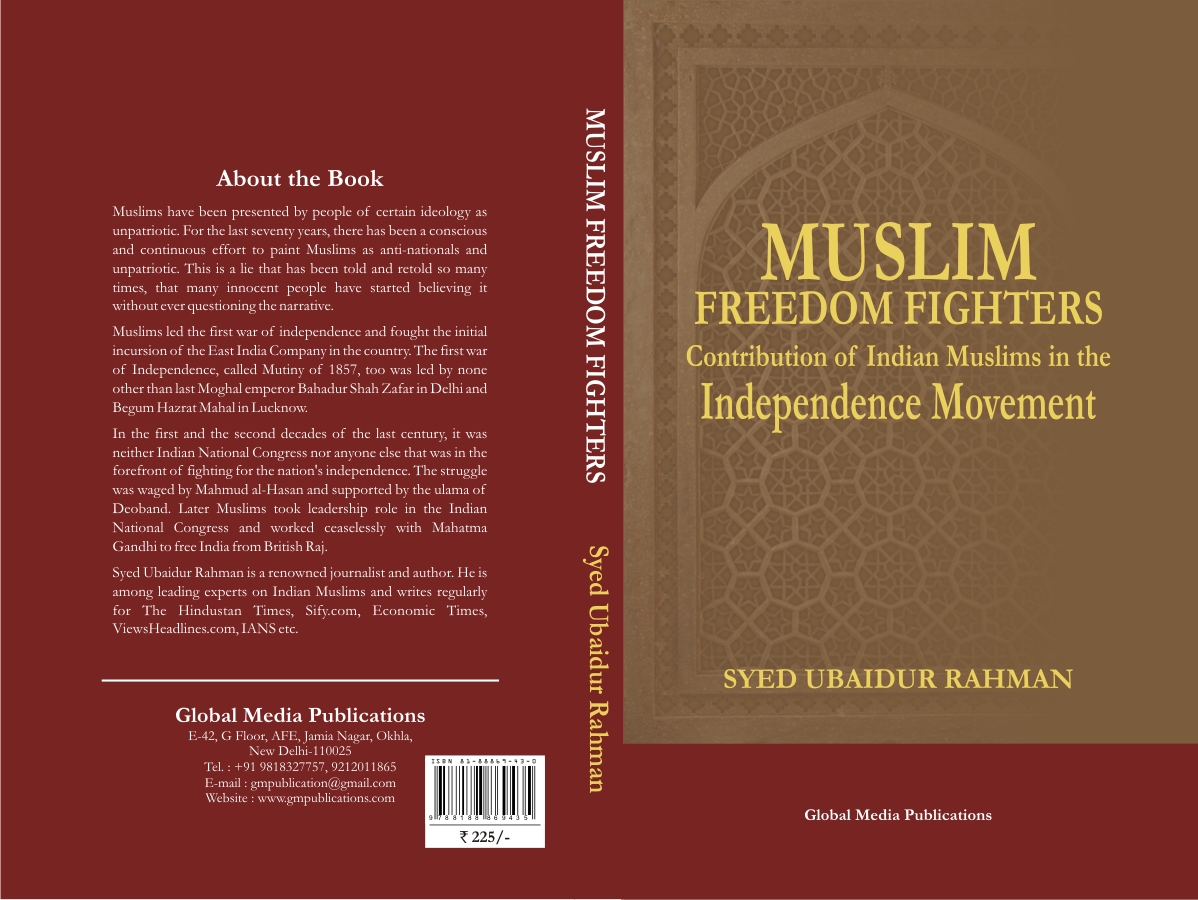
Sify columnist releases book on Indian Muslim freedom fighters

NEW DELHI :

FreedomFightersMPOs22dec2017

Patna:

In a glittering ceremony, two books on the Muslim community’s contribution to the Indian freedom movement were launched in Patna last week. The function was presided over by Harsh Mander, former IAS officer and human rights activist.

The books ‘Muslim Freedom Fighters: Contribution of Indian Muslims in the Independence Movement’ and its Urdu version ‘Muslim Mujahideen-e-Azadi aur Tehrik-e-Azadi Mein Unki Khidmat’ have been authored by well-known Delhi based author and journalist Syed Ubaidur Rahman.

The two books try to fight the oft-repeated allegations that Muslims are anti-national and have not contributed for the freedom of the nation. The books nail the lie and prove that Muslims not just participated in the freedom movement, they went on to lead the freedom struggle for a long time. The first war of Independence or Mutiny of 1857 was led by Mughal emperor Bahadur Shah Zafar in Delhi and Begum Hazrat Mahal in Lucknow.

The Independence Movement in the first two decades of the twentieth century was led by Mahmud Hasan and ulama of Deoband and they had respect and support of everyone including Hindus and Muslims.

If anyone has any doubt about the Muslim contribution in the freedom movement, the fact that the Indian National Congress had as many as nine Muslims as its president till the year 1947 will remove such doubts.

While speaking on the occasion, Harsh Mander said that the divisive forces in the country are trying to divide the nation on the basis of religion and faith. He said that the danger from such forces for the national fabric and its unity has become grave.

Mander added that the threat to the communal amity in the country was never so high as is today as divisive forces are doing every thing to pit one community against the other and create a fear psychosis among the majority community prompting it to turn it against minorities.

Khursheed Mallick, a Chicago based urologist, philanthropist and director of IMEFNA said that the book is a timely reminder to the nation that Muslims and Hindus both sacrificed for the nation and this fact must be clearly told to our young generation. He said Muslims sacrificed heavily for the cause of the freedom of the nation and efforts must be made to tell the history.

Syed Ubaidur Rahman, the author of the two books, while speaking on the occasion said Muslims have been rather loath to write about the sacrifices they have made for the cause of the Independence and freedom. He said Muslims suffered badly throughout the freedom movement. They were the worst suffers in the wake of the mutiny of 1857 and its aftermath when Muslims were hounded across North India and beyond. Tens of thousands of Muslims lost their lives for the freedom.

Syed added that ulama of Deoband played a stellar role in the freedom movement. Unlike the common perception, they were secular to the core and when they established a government in exile in Kabul in 1915, they appointed Raja Mahendra Pratap as its President and Maulana Barkatullah Bhopali as its Prime Minister.

The book documents the lives of forty renowned Muslim freedom fighters including, Shaikhul Hind Maulana Mahmud al-Hasan, Maulana Barkatullah Bhopali, Hakim Ajmal Khan, Maulana Ubaidullah Sindhi, Maulana Abul Kalam Azad, Maulana Mohammad Ali Jauhar, Dr Maghfoor Ahmad Ajazi, Dr Mukhtar Ahmad Ansari, Ashfaqulla Khan, Maulana Hasrat Mohani, Maulana Muhammad Mian Mansoor Ansari, Asaf Ali, Husain Ahmad Madani, Aruna Asaf Ali (Kulsum Zamani), Peer Ali Khan, Saifuddin Kitchlew, Mohammed Abdur Rahiman, Captain Abbas Ali, Abdul Qaiyum Ansari, Prof. Abdul Bari, Moulvi Abdul Rasul, Nawab Syed Mohammed Bahadur, Rahimtulla Mahomed Sayani, Syed Hasan Imam, Sir Syed Ali Imam, M.C. Chagla, Yusuf Meherally, Justice Fazal Ali, General Shah Nawaz Khan, Allama Fazle Haq Khairabadi, Maulana Shaukat Ali, Syed Mahmud, Maulana Mazharul Haque, Badruddin Tyabji, Col Mehboob Ahmed, Begum Hazrat Mahal, Maulana Shafi Daudi, Rafi Ahmed Kidwai, Syed Mohammad Sharfuddin Quadri, Batak Mian .

The book launch function was organized at Anjuman Taraqqi Urdu and was presided over by Abdul Qaiyum Ansari, chairman of Anjuman Taraqqi Urdu Bihar.

Syed Ubaidur Rahman is a New Delhi based writer and commentator. He has written several books on Muslims and Islam in India including Understanding Muslim Leadership in India.

source: http://www.sify.com / Sify.com / Home> SifyNews> National / by SIFY.com / Friday – December 22nd, 2017
Ustad and the world of gharanas

Indore, MADHYA PRADESH /  Kolkata, WEST BENGAL :

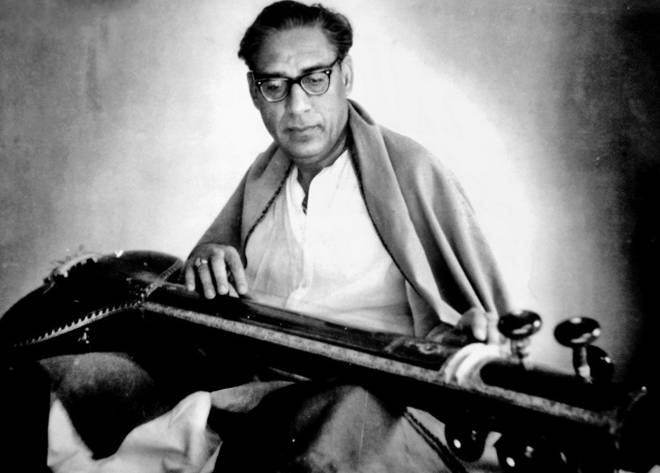
tad Amir Khan in performance. | Photo Credit: 14dfrmeena1

As the late Ustad Amir Khan’s magic continues to awe listeners, various musicians claim that he was from their gharana.

Ustad Amir Khan (born on August 15) was an introvert and a man of few words, yet Khan saheb had validated during an exhaustive interview for a documentary film on him by the Films Division, “Mai Indore (gharane) ke naam se gaa raha hoon.” (I am singing under the identity of Indore gharana.)

Obviously, his unique style took a tangible, modern form very gradually; turned his listeners around as gradually and became a rage, specially in Bengal. Generations of most eminent musicians came under his majestic charm.

On a more formal ground, his disciples like Pandit Amarnath, Pandit A. Kanan, Pandit Tejpal Singh and several others also had established themselves not only as performers but also as revered gurus.

Under the circumstances, the “three-generation” stipulation too was met during Amir Khan saheb’s lifetime that was crudely cut short by a horrible car accident when he was barely 62 and at the peak of his career.

Since his magic refuses to spare sensitive souls even now, several gharanedar musicians are screaming foul and claim Ustad Amir Khan as one of them.

Ironically no other gharana faces such sharp controversy; rife with appalling stories!

But a large number of musicians, in their pursuit to serve the cause of good music, do not care to indulge in such tactical claims to attest their blue blood. Moreover, the modern era is open to different ideas, irrespective of their origin or lineage. For example, I noticed a marked change in Pandit Ulhas Kashalkar’s singing around 1998. The pristine style of this top ranking khayal exponent, equally adept at handling three major styles, was suddenly steeped in soulful depths of a slower than usual Gwalior, Jaipur or Agra pace that usually floats around medium tempo.

Asked why, Kashalkar’s answer was simple, “Everybody is singing that way here (in Bengal) and it facilitates space for more emotions.” But this was actually a slow process initiated by Ustad Vilayat Khan.

For his 75th birthday celebration his ardent fan, Jayant Chatterjee had roped in Kashalkar to sing the legendary sitar maestro’s khayal and thumri compositions.

Hailed as “Amir Khan on the sitar”, the Ustad was very close to Khan saheb who was his elder sister’s husband but things soured later.

In “Komal Gandhar” (his autobiography, compiled by Shankarlal Bhattacharya; translated by me from Bengali to Hindi; published by Kanishka, Delhi), Ustad Vilayat Khan admitted to have “spent hours of riyaz together” with Khan saheb. A photograph adorning the living room of Maharaj Banerjee, a renowned but retired harmonium player, bears testimony to this fact.

Amir Khan (born 1912) and Vilayat Khan (born 1928) doing ‘riyaz together’ leaves a lot left unspoken. So does Ustad Vilayat Khan’s indelible impression on Kashalkar’s psyche. And what a wonderful result it has yielded ever since! Furthermore, Pandit Vijay Kichlu, the erudite founder-director of ITC Sangeet Research Academy, who actually was behind the phenomenal rise of the Academy’s young students, including Rashid Khan, gave a memorable introduction while presenting him during a Sangeet Ashram event on August 10th 2007. The date signifies that it was close to Khan saheb’s birthday and the introduction, abounding with audio-clips, significantly highlighted his deep imprint on Ustad Rashid Khan’s musical thoughts.

Pandit Buddhadev Dasgupta, veteran sarod maestro and an erudite analyst, also says that this extremely popular khayal singer with a golden voice is deeply influenced by Amir Khan’s music. So is young Arshad Ali Khan of Kirana gharana. They are not isolated cases. The list of Ustad Amir Khan’s followers or admirers is pretty impressive. Some greats, like Vidushi Kishori Amonkar and Ustad Shujaat Khan have openly admitted Khan saheb’s influence on their music.

Even four decades after his untimely demise, there are many such eminent musicians who avoid confessing his impact but their music reveals Khan saheb’s indelible stamp loud and clear. This style’s unmatched popularity had transcended all barriers during the short life-span of its creator. Moreover his disciples are carrying forward the legacy steeped in ‘abstract’ modernism. Eminent musicologist-author Vamanrao Deshpande saw this coming. He, therefore, acknowledged Indore as an independent Gharana in his book “Gharandaj Gayaki” (Marathi, published in 1961); and rightly so.

source: http://www.thehindu.com / The Hindu / Home> Friday Review / by Meena Banerjee / August 13th, 2015

Muslim teen’s essay wins Gita contest

Jaipur, RAJASTHAN :

Nadeem Khan(file photo)

JAIPUR:

A self-confessed Sanskrit lover, 16-year-old Nadeem Khan has been declared the winner of a state-level Sanskrit essay competition on Bhagvad Gita in the Rajasthan capital.
At a ‘Gita Fest’ organised by the Akshaya Patra Foundation that concluded on Monday, two other Muslim students from Jaipur, Zaheen Naqvi of Class II and Zorabia Nagori of Class IV, also bagged top positions in a contest on the recitation of Gita verses.

The winners will receive their awards on Wednesday.

A student of Class X at a government school, Khan, the son of a labourer, has had a keen interest in Sanskrit language ever since it was introduced in his curriculum in Class VI.

“I find this language best among all known to me. I never found it alien despite the fact that I rarely get a chance to speak it, even in my class. The competition has acknowledged my devotion for the language,” said Khan.

“In my Sanskrit class, the teacher rarely speaks the language. They ask us to only focus on writing in Sanskrit. I am not fluent in speaking Sanskrit,” he added.

The teenager, however, will not able to make it to the award ceremony. “I have an exam on Wednesday but my parents and grandmother will collect the prize on my behalf,” said Khan.

The foundation organised three competitions – essay on Gita, recitation of Gita verses and handwriting competitions – which saw participation by over 8,000 students from 200 schools across Rajasthan.
Tanveer Ahmed, a government employee in the health department, was upbeat about daughter Zaheen’s win. “My daughter worked very hard. Every day she would memorise verses from the Gita for hours to improve her diction and pronunciation. It’s a proud moment for us,” said Ahmed.

source: http://www.timesofindia.indiatimes.com / The  Times of India / Home> City News> Jaipur News> Schools & Colleges / by Shoeb Khan / December 20th, 2017

Date with History: Did you know that Hyder Ali commissioned Lalbagh for a Sufi Saint?

Bengaluru, KARNATAKA :

Shuttari’s Dargah

`Masjid-e-Meraj Bada Makan’ is tucked away in a nondescript lane on Lalbagh Main Road. Nothing about the structure or its adjoining dargah (now under renovation) seems `historic’. But then, first impressions can be misleading.

The story goes back to 1753, says the mosque’s secretary Abdul Shukur. Hyder Ali decided to take the blessings of a fakir in Salem before the battle of Tiruchinapally against the British. It is said he was shocked when the saint Attaullah Shah Shuttari forbade him from fighting. The commander went ahead nevertheless, a move that resulted in defeat, grave physical injury and loss of lives.

Hyder Ali then requested Shuttari to become his pir (spiritual guide). Pointing to a brickwalled home opposite the mosque, Shukur says, “Hyder Ali built this bada makan (large home) for the fakir and it continues to be occupied by his descendants.“ Local residents and historians believe Shuttari had a greater role to play.

 Syed Suleiman Ali Shuttari, the eighth-generation descendent of Attaullah Shah Shuttari, says people from far and wide visited his illustrious ancestor. They travelled in bullock-carts and stayed put in the grounds next to the mosque, waiting for the saint to finish his prayers. During one of his visits, Hyder Ali was pained to see people wait in the blistering heat. So, he commissioned the making of Lalbagh in 1760.

“Lalbagh was originally planned over 30 acres of land here, before Tipu Sultan and the British planned it across the 240 acres that we see today ,“ says Mansoor Ali, founder, Bengaluru By Foot. Mosque members go a step further to claim that Lalbagh was named after Haider Ali’s mother Lal Bi.

Popular narratives of history , however, say Hyder Ali was inspired by the Mughal gardens in Delhi and so had Lalbagh built. The horticulture department website suggests that Lalbagh derives its name from the red roses that bloom year-round in the botanical garden. After Shuttari’s death in the the 1770s, a dargah was built on his grave. Hyder Ali himself passed away in 1782.

The place also has an old well, said to be 30feet deep. Popularly known as Bada Makan Ki Boudi, it was apparently built by Haji Nasiruddin, a district commissioner and a follower of Shuttari. His great-grandson Shabaz Shariff said that Nasiruddin spent `200 to build the well. “It never dries out. In fact, it was among the only sources of water during the famine of 1876,“ he says. Though the well is locked, it continues to supply water to the mosque and the local community .

source:  http://www.economictimes.indiatimes.com / The Economic Times / ET Home> Magazines> Panache / by Divya Shekhar, ET Bureau / July 13th, 2017

Battle of Patparganj to Bahadur Shah Zafar’s trial: Delhi’s journey since 1803, at the click of a mouse

NEW DELHI :

A 100-member team of archivists is digitising over 10 crore documents to prevent further loss. The first phase of the project is expected to be completed in two years.

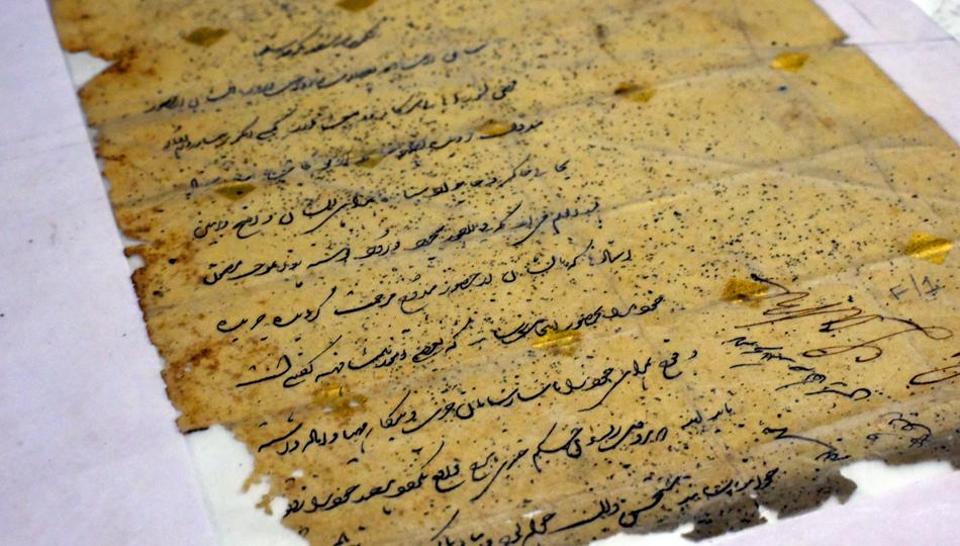
A letter from General Lake Sahib to Zaibun Nisa Baigum dated 8 October 1802 at Delhi archives.(Vipin Kumar/HT PHOTO)

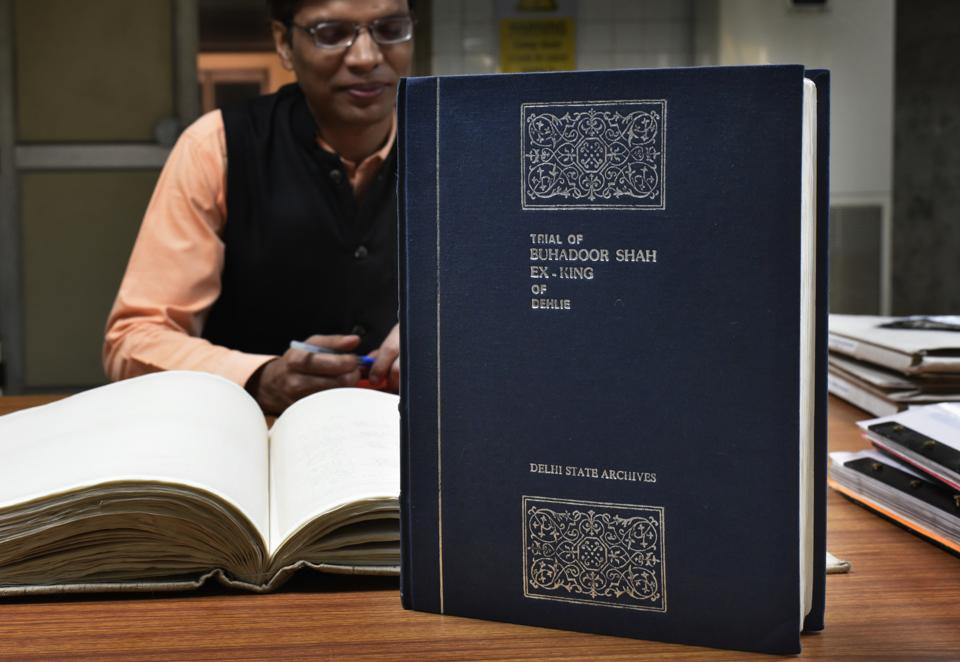
On March 9, 1858, a British court declared Delhi’s last king, Bahadur Shah Zafar, guilty of rebellion, treason and murder before exiling him to Rangoon in the then British-controlled Burma. The trial was approved and confirmed a month later by N Penny, major general commanding, Meerut division.

One hundred and fifty nine years later, the 42-day trial conducted at Diwan-e-Khaas of the Red Fort by British prosecutor Major F Harriott lies preserved word for word at the Delhi archives in the form of a hardbound book comprising 262-pages.

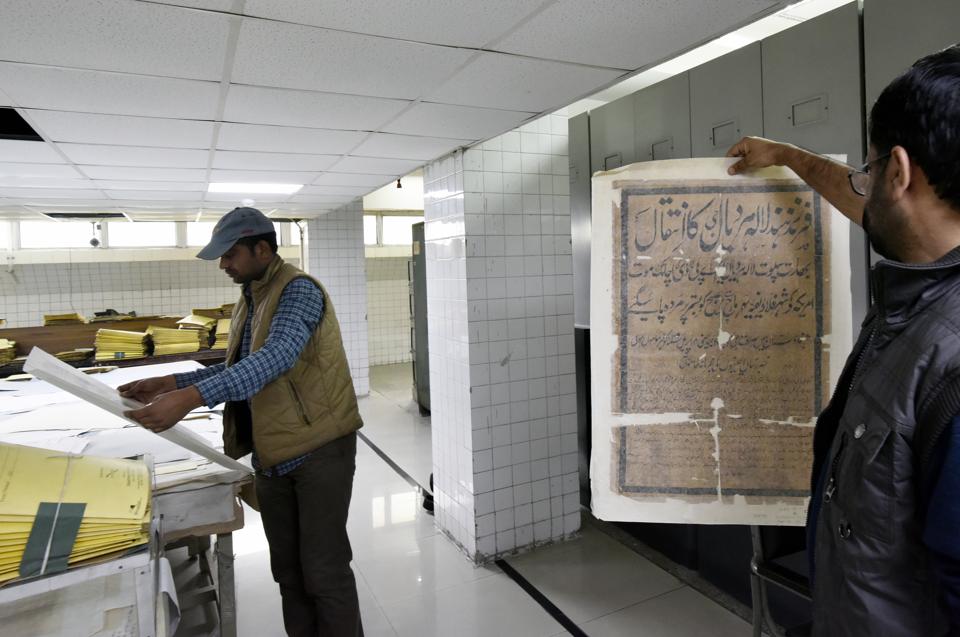
Apart from the handwritten trial papers, the Delhi archives is a repository of over 10 crore rare documents comprising Mughal firmans (imperial orders), maps, land acquisition award statements, jail records, manuscripts and government orders narrating the historical and political journey of Delhi since 1803.

So far accessible to only researchers, the treasure trove will soon be just a click away for those interested in the history of the national capital. An ambitious ‘digitisation and microfilming of archival records’ project started by Delhi government is underway with the target of converting 4 crore documents in the first phase by 2020.

An official with a copy of the trial of Bahadur Shah Zafar. (Vipin Kumar/HT PHOTO)

“Some of the records are so old that they might get damaged. So, it is required to preserve them in digital and microfilm formats for posterity,” said Sanjay Garg, the chief archivist of the archives. The Delhi Archives is city’s second repository of records from early 19th century after the National Archives of India.

Mughal firmans to land acquisition for Lutyens Delhi

In September 1803 East India Company’s forces under general Gerard Lake fought the Marathas in what is popular as Battle of Delhi, or Battle of Patparganj — named after the area now in east Delhi.The earliest documents at the Delhi Archives relate to this battle. Thought the British emerged victorious, they allowed Shah Alam II — the blind emperor of Delhi — to issue firmans in Persian language, many of which are also preserved at the archives.

“There are different sizes of royal seals in Persian language depending on the hierarchy in the Mughal courts on the firman with gold marks,” said Ashutosh Kumar Jha, assistant archivist pointing at ‘A letter from General Lake Sahib to Zaib-un-Nisa Baigum’ dating October 8, 1802.

The transfer of power to the British crown in 1958 followed setting up of a new administration and eventually the construction of the new capital, Delhi, in 1912. The Archives also have records of land acquisition during this historic shift of the national capital from Kolkata to Delhi.

“From photographs to award statements of land acquired from the owners, we have rare documents that bear testimony to how the present day Delhi came up,” said Sandeep Singh, assistant archivist. In one of the records dating March 1913, an individual named Ram Das was awarded a compensation of Rs 172, two paisa and nine annas for his 285.38 acre of land acquired by the government in Khanpur. The deal was signed by Kamruddin, revenue assistant, Delhi province.

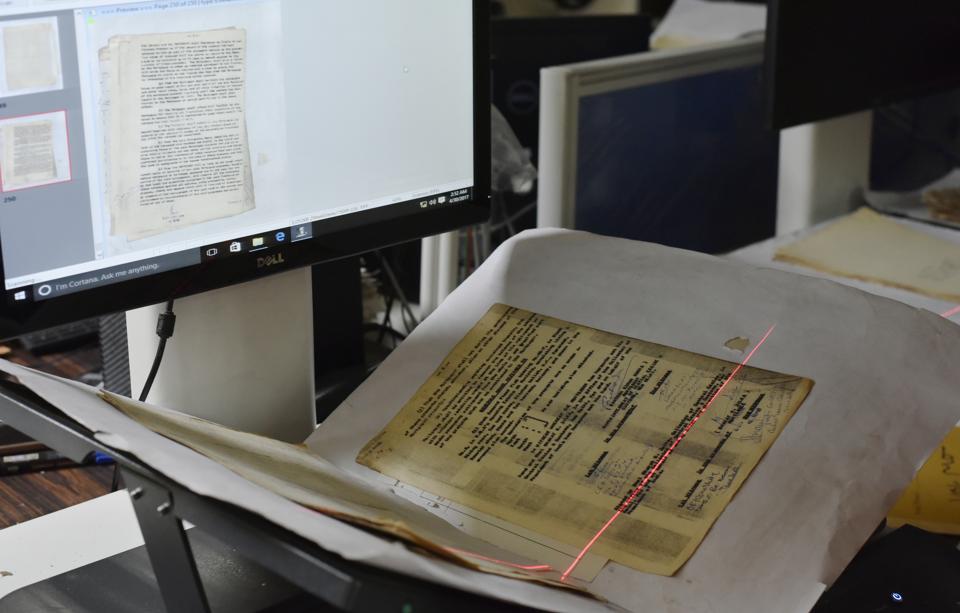
Documents being scanned for digitisation at Delhi archives. (Vipin Kumar/HT PHOTO)

Photographs, titles awarded jail documents, student activism

The repository at the archives includes pictures of construction of historical buildings housing Parliament and Rashtrapati House in early 20th century. Originally called House of Parliament, the Sansad Bhawan was designed by the British architect Edwin Lutyens and Herbert Baker in 1912-1913 and was constructed between 1921 and 1927.

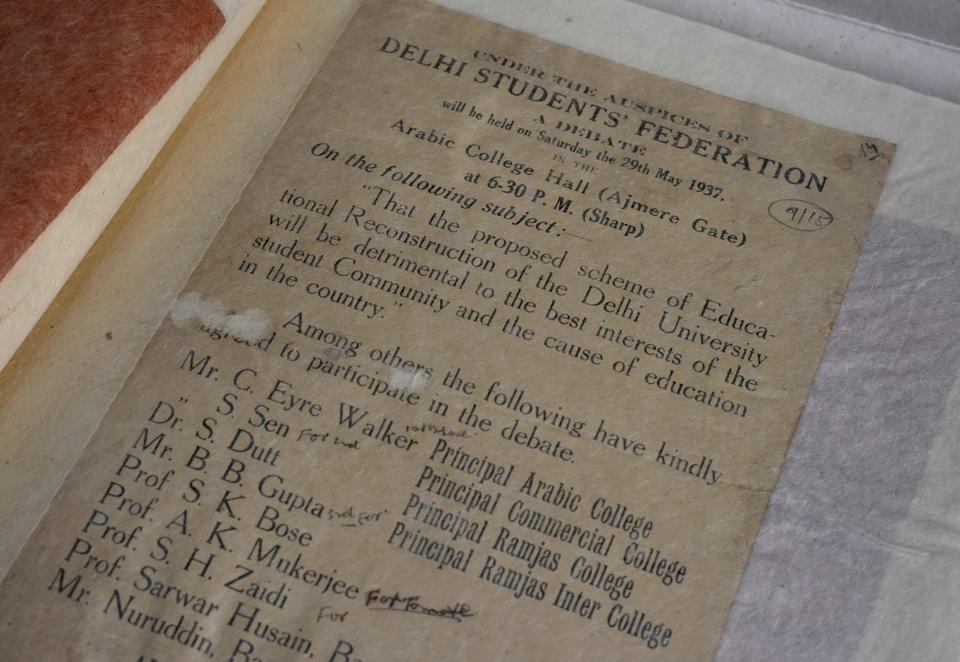
A poster of a debate being organised by Delhi Students’ Federation on May 29, 1937 at Arabic College Hall (Ajmeri Gate) is in the section of rare documents showing how teachers would support students’ concerns. The debate on why “the proposed scheme of educational reconstruction of Delhi University will be detrimental to the best interest of the students’ community and the cause of education in the country”, had C Eyre Walker, principal Arabic college, S Dutt, principal Ramjas College, and BB Gupta, principal Ramjas inter college among speakers.

A rare document dated April 7, 1912 is testimony to how ‘Khan Bahadur’ title was awarded to one Chaudhari Nabi Ahmed on the occasion of ‘His Majesty, the King- Emperor’s Birthday’.

The Delhi archives is a repository of over 10 crore rare documents comprising Mughal firmans, maps land acquisition statements, jail records, manuscripts and government orders. (Vipin Kumar/HT PHOTO)

Digitising 10 crore rare documents

The project, billed as the largest in Asia, envisages digitisation of 10 crore records stored in the four specially constructed floors of the Delhi Archives building in Qutub Institutional Area. In the first phase, four crore records are expected to be ready and uploaded on the website of the Delhi archives over a span of 30 months at a cost of Rs 25.4 crore.

The project was fist conceived in 2011 but was taken up by the incumbent government on August 31 this year. Led by Garg, a 100-member team of archivists, scholars and employers are busy with the digitisation task using computers and high-end German-made scanners.

“We have got eight scanners for now. We digitise about 50,000 pages each day,” Garg said

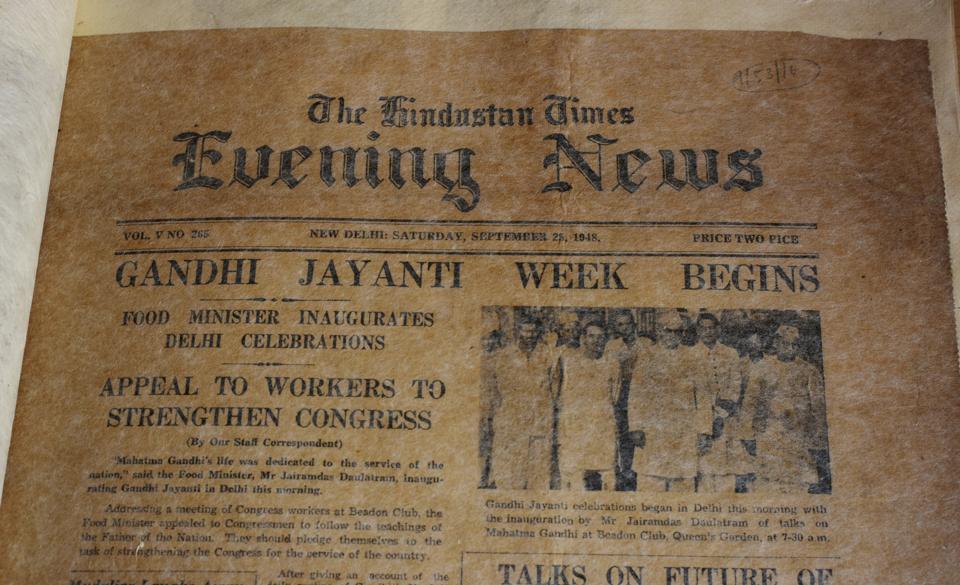
A collection of old newspapers at the archives includes a copy of Hindustan Times, Evening News, published on September 25, 1948. (Vipin Kumar/HT PHOTO)

Once digitised, the records would be transformed into microfilms.

“The thumbnails of the records with some information would be available on the website. For higher resolutions, one has to pay,” Garg said

A welcome move

“It’s a welcome move to preserve and digitise records particularly Bahadur Shah Zafar’s trial. The public will know who sided with British and who was with revolutionaries in the first war if Independence,” said historian Rana Safvi, who has translated Zahir Dehlvi’s Dastan-e-Ghadar which comprises eyewitness account of the 1857 uprising against the British

An old invite of Delhi Student Federation, now DUSU (Delhi University Student Union), at Delhi archives. (Vipin Kumar/HT PHOTO)

Established in 1972, the Delhi archives is a repository of non-current records of Delhi government under the department of art and culture. It is responsible for preservation of the archives and making them available research and references.

“We are committed to make knowledge more accessible to the common people. This is an important step towards preserving our precious heritage. While digitisation will ensure preservation of documents, making them available to a larger audience through a website and outreach events will play a key role in dissemination,” said Manish Sisodia, the minister of Art, Culture and Languages.

source: http://www.hindustantimes.com / Hindustan Times / Home> Cities / by Gulam Jeelani, Hindustan Times / December 14th, 2017

30 artistes chosen for Janapada academy awards

Kalaburagi (Gulbarga), KARNATAKA :

Thirty senior folk artistes, one from each district, and two folk experts will be presented the Karnataka  Janapada Academy awards for 2017. While the artistes will get a purse of ₹25,000 and a citation, the folk experts will get ₹50,000 and a citation.

Announcing the names of award winners here on Monday, academy chairman B. Takappa Kannuru said they had chosen these artistes at the general body meeting on October 30. The awards will be given to them at a two-day district folk convention to be held from December 28 at Sagar in Shivammoga district.

The award winners are Ganganarasamma (Ramanagaram); G. Siddanagowda (Davangere); K.R. Hosalaiah (Tumakuru); H.K. Papanna (Bengaluru city); Akkayyamma (Bengaluru Rural); Maramma (Kolar); Shanthamma (Chickballapur); D. Thimmappa (Chitradurga); K. Vasudevappa (Shivamogga); Hanumavva Walikar (Koppal); Shivamma Burrakathe (Ballari); Shivappa Hebbala (Yadavagiri); Rukmavva (Raichur); Nagappa Kashampura (Bidar); Ismail Sab (Kalaburagi); Veerabhadrappa U. Mullura (Dharwad); Jakkavva Satyappa Madara (Bagalkot); Sabavva Annappa Koli (Belagavi); Jagadeva Golavva Madyala (Vijayapura); Maharudrappa Veerappa Itagi (Haveri); Ramappa Dyamappa Koravara (Gadag); Somayya Sannagonda (Uttara Kannada); Puttaswamy (Mysuru); S.G. Jayanna (Chikkamagaluru); Krishne Gowda (Mandya); Sannashetti (Chamarajanagar); Lakshmamma (Hassan); Leela Shedthi (Dakshina Kannada); Rani Machaiah (Kodagu); and Guruva Dolu (Udupi).

The folk experts are N. Huchappa Mastara (Dr. Jee. Sham. Pa. Award) and Shalini Raghunatha (Dr. B.S. Gaddagimath Award).

source: http://www.thehindu.com / The Hindu / Home> News> States> Karnataka / by Staff Reporter / Bengaluru – December 11th, 2017

Mithibai Alumni Association to felicitate achievers

Mumbai, MAHARASHTRA :

MithibhaiAlumniMPOs13dec2017

Mumbai :

The ex-students of  Vile Parle’s Mithibai College will hold their seventh reunion Saturday December 9 at Club Millennium,  Juhu.

“We will felicitate composers Sajid-Wajid, film director Vikram Bhat, stage artiste  Paritosh Painter and Afroz Shah who initiated the Versova beach clean-up,” said Krishna Hegde, convenor,Mithibai Ex-Students Association (MESA).

The glamour quotient coupled with social messages makes the Mithibai alumni meet an awaited event. This year, performances by Purani Jeans, Cutting Chai and An Evening Down Memory Lane are on schedule.

Mithibai College has among the largest number of students worldwide and approximately one million alumni in different countries.

Hegde said, “It has been a tradition to felicitate outstanding ex-students for their achievements at our reunions. We are very excited with the names selected for this year’s  MESA Hall of Fame 2017.”

The previous edition of the reunion saw a turnout of over 500 alumni. Senior media professional Balakrishna Pillai’s batch is celebrating its silver jubilee since passing out. He said, “Our reunions are one of the largest and grandest in India. For us, reunions are not just about get-togethers but also celebrating the success of our college mates and being socially responsible. Since MESA was founded about 19 years back, besides getting the students together at regular intervals, it has arranged various blood donation drives, health camps, fund raising for Kargil jawans, supporting the education of underprivileged and other activities.”

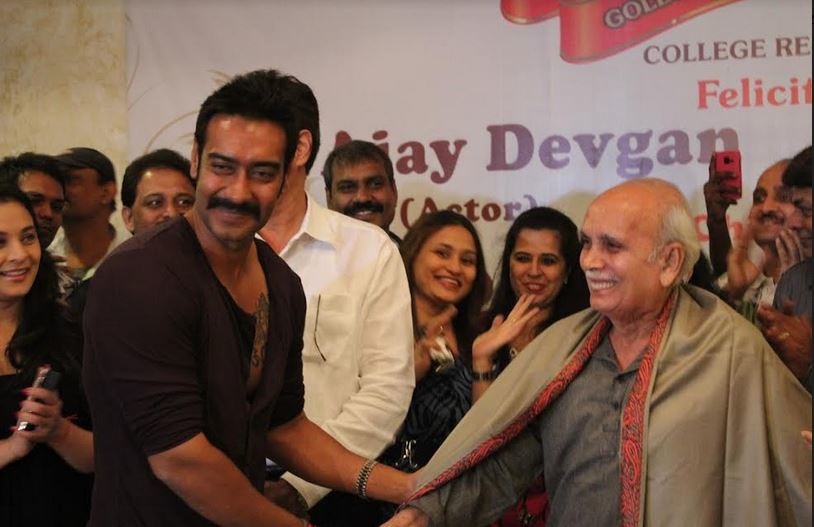
“It is not uncommon to spot a film star, industrialist or sportsperson at other college reunions but at ours, celebrities seem to outnumber the average alumni! Ex-students like Ajay Devgan, Raveena Tandon, Vivek Oberoi, Praveen Amre attend the reunions frequently,” said Khalid Khan, MESA president.

source: http://www.timesofindia.indiatimes.com / The Times of India / News> City News> Mumbai News / by Bella Jaisinghani / TNN / December 07th, 2017

How greatness sometimes runs in a family’s genes

Mumbai (formerly Bombay), MAHARASHTRATA / and all over India  :

Some months ago I was in Kolkata when news came of the death of Laeeq Futehally, a writer and critic I greatly admired.

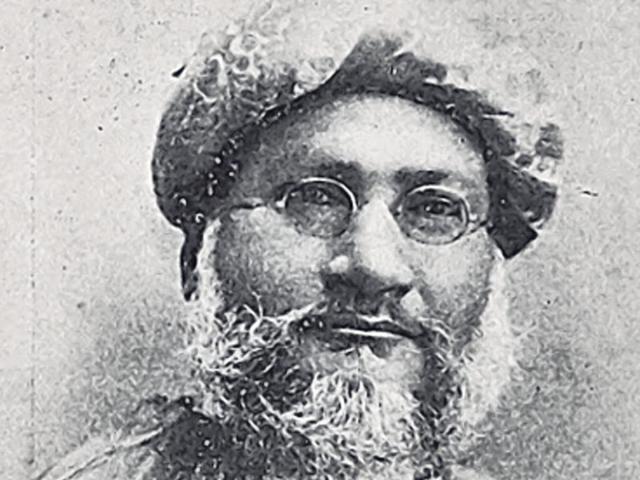
Badruddin-Tyabji-the-first-great-of-his-family

Some months ago I was in Kolkata when news came of the death of Laeeq Futehally, a writer and critic I greatly admired. The friend I was with hadn’t heard of her, so I spoke at some length of Laeeq’s own work (as literary editor of the pioneering journal Quest, and as the author of many books on varied subjects), and of the larger family to which she belonged. ‘Laeeq was a Tyabji,’ I told my friend, ‘and you can think of the Tyabjis as being the Tagores of Western India — a family of men and women of real distinction in the arts and public life’.

A look of disbelief now came over my friend’s face. For which Bengali can countenance a comparison to the Tagores? I pressed on, offering some names in illustration. The first great Tyabji was Badruddin, a judge of the Bombay High Court and an early president of the Indian National Congress. Direct descendants of Badruddin included the tennis player and legal scholar AA Fyzee (author of landmark studies on Islamic law), the politician and social reformer Saifuddin Tyabji, the conservationist Zafar Futehally, and Badruddin Tyabji Jr., a distinguished Indian diplomat and author.

My friend Laeeq Futehally was herself a descendant of Badruddin’s elder brother Shumsuddin Tyabji. Shumsuddin’s only son was Abbas Tyabji; once Chief Justice of Baroda State, he later joined the freedom struggle, being appointed leader of the Salt Satyagraha after Gandhi’s arrest. A nephew of Abbas (and grandson of Shumsuddin) was the great ornithologist Salim Ali, the author of landmark studies of Indian birds and an inspirational figure for conservationists all over the world.

The women of the Tyabji family were likewise quite remarkable. A fine study by the late Salima Tyabji (see http://cinnamonteal.in/authors/salima-tyabji/) narrates how they were the first Muslim women in Western India to emerge out of purdah, to travel overseas, to go to school and college, and to write at length of their experiences. Later generations kept the family name flying. Among Abbas Tyabji’s daughters was the formidable women’s rights activist Sharifa Hamid Ali and the mystic and Meera bhajan singer Raihana Tyabji.

Such was the background to the comment I made about the Tyabjis in Kolkata, a comment that evoked dismay bordering on disgust. But I have since found confirmation of the validity of my comparison. Reading through Gandhi’s Collected Works, I came across a letter written by him to Abbas Tyabji on the 17th April 1920. Here Gandhi says: ‘Indeed the Tagores and the Tyabjis are the rarities for India and they are her friends’.

The contributions of the Tagores are of course colossal, as well as colossally well known. The most famous of the Tagores was Rabindranath: poet, novelist, playwright, composer, artist, institution builder, the first Asian to win a Nobel Prize, and one who profoundly influenced both Gandhi and Nehru.

Rabindranath was a giant who looked farther in part because he stood on the shoulders of those who preceded him. His grandfather, Dwarkanath, was a successful entrepreneur whose wealth laid the basis for the artistic pursuits of his descendants. His father, Debendranath, was a progressive reformer and editor.

Rabindranath’s gifted siblings included the scholar and composer Dwijendranath, the actor and translator Jyotindranath, the singer, editor and social worker Swarnakumari, and Satyendranath, the first non-white member of the Indian Civil Service.

The generation that followed was also not lacking in talent. Rabindranath’s nephews included the modernist painters Abanindranath and Gaganendranath. His nieces included Sarala Devi, a singer, writer and patriot who so entranced Gandhi that he at one stage intended to make her his ‘spiritual wife’.

Which was the greater of the two families, the Tagores or the Tyabjis? Rather than answer the question, let me introduce a third and scarcely less gifted family.

These were the Sarabhais of Ahmedabad. The patriarch, Ambalal, was a textile millowner and philanthropist who was an early supporter of Mahatma Gandhi. When, in 1915, Gandhi’s funders withdrew support because he had admitted an ‘Untouchable’ family into his ashram, Ambalal Sarabhai stepped in to save the project.

Ambalal’s sister Anasuya was herself very close to Gandhi. A pioneering feminist and trade unionist, she ran schools for millworkers and their children. In 1918 she led the workers of Ahmedabad in a strike for fair pay that pitted her directly against her brother, who was representing the millowners.

Anasuya never married, although, in a daring defiance of custom and convention, she had a live-in partner, a fellow Gandhian and trade unionist, Shankerlal Banker.

As for Ambalal Sarabhai, he had seven children — all were talented, and at least four were remarkable. These were Vikram, the polymath physicist who founded both the Indian Institute of Management in Ahmedabad and the Indian Space Research Organisation; Mridula, who worked heroically to settle post-Partition refugees and, later, to bring justice to the Kashmiris and their leader Sheikh Abdullah (who had been incarcerated by the Nehru government); Gautam, a public-spirited entrepreneur who founded the National Institute of Design (NID); and Gira, a brilliant designer who assisted her brother in shaping the NID while also setting up the Calico Textile Museum.

Had Gandhi had the opportunity, he might well have added the Sarabhais to the Tagores and the Tyabjis as among the ‘rarities of India’. These three families had several things in common: the ability to defy social boundaries as well as transcend disciplinary boundaries, an apparently unending stream of creativity, and the striking independence of their women. A single column can scarcely do justice to their talents and achievements. While the Tagores have had their chroniclers, the Tyabjis and Sarabhais still await theirs.

Ramachandra Guha’s most recent book is Gandhi Before India
You can follow him on Twitter at @Ram_Guha
The views expressed by the author are personal

source: http://www.hindustantimes.com / Hindustan Times / Home> Opinion / by Ramchandra Guha / April 11th, 2015

Renowned Urdu scholar Dr Khaliq Anjum is no more

NEW DELHI  :

Renowned Urdu Scholar and former general secretary of Anjuman Taraqqi-i-Urdu Hind, Dr Khaliq Anjum passed away today in New Delhi after prolong illness. He was 81.

One f the most prominent scholar of his time, Anjum dedicated his whole life for promotion of Urdu in the country through his literary works and Anjumans and academies.

He authored several books of high literary value. One of the most important books is by him is  ‘Matni tanqeed’, or textual criticism, a fine work that discusses the methods and techniques of evaluating, editing, annotating and compiling texts. His other significant contribution is the editing and annotation of Ghalib’s Urdu letters, compiled in five volumes.

Being an expert on textual criticism, he was one of the first people in the subcontinent to adopt the German technique of compilation to edit these letters and his version of Ghalib’s letters is considered among the most authentic ones.

His other books on Ghalib include ‘Ghalib ka safar-i-Kalkutta’, ‘Ghalib Kuchh mazameen’ and the forthcoming ‘Ghalib aur shahan-i-Taimuriya’.

In addition to Ghalib and textual criticism, Dr Khaliq Anjum’s another expertise was in the field of history and archaeology. His books ‘Muraqqa-i-Dehli’, ‘Dilli ke aasar-i-qadeema’ and ‘Dargah-i-shah-i-mardan’ deal with the archaeological sites of Delhi. His profound knowledge of Delhi’s history and its historical remains is also evident from the gigantic task he has carried out in three volumes editing and annotating Sir Syed Ahmed Khan’s ‘Aasar-us-sanadeed’.

Dr Khaliq Anjum also served ministry of education and  was also a member of Inder Kumar Gujaral committee formed by then Prime Minister Indira Gandhi for the promotion of Urdu. The committee submitted a detailed report on the status of Urdu., Dr Khaliq Anjum toured the length and breadth of India to survey and to understand the issues concerning the language.

The report made several recommendations, including the one that suggestion for establishing Urdu academies in every Indian state and Urdu schools and colleges in every locality where Urdu-speaking people were 10 per cent or more of the population.

Unfortunately most of the recommendations went unheeded and the only major implementation was the establishment of Urdu academies and that, too, in some state were implemented.

Born in Delhi in 1935, Khaliq Anjum, whose real name is Khaliq Ahmed Khan, did his intermediate and graduation from Aligarh Muslim University.

Having got a Master’s in Urdu and diplomas in linguistics and library science from Delhi University, he joined Delhi University’s prestigious Karori Mal College as lecturer and taught Urdu for about 10 years. In 1970, he obtained a PhD from Delhi University. His doctoral dissertation was on Mirza Mazhar Jan-i-Janan, Urdu’s classical poet and a Sufi in his own right.

 source: http://www.theindianawaaz.com / The Indian Awaaz / Home /  by Andalib Akhter / / New Delhi – October 18th, 2016

Critics’ Choice Awards 2018 Nominations: Indian American Actor Aziz Ansari Wins One, Kumail Nanjiani Racks Up Three

Columbai, South Carolina, U S A :

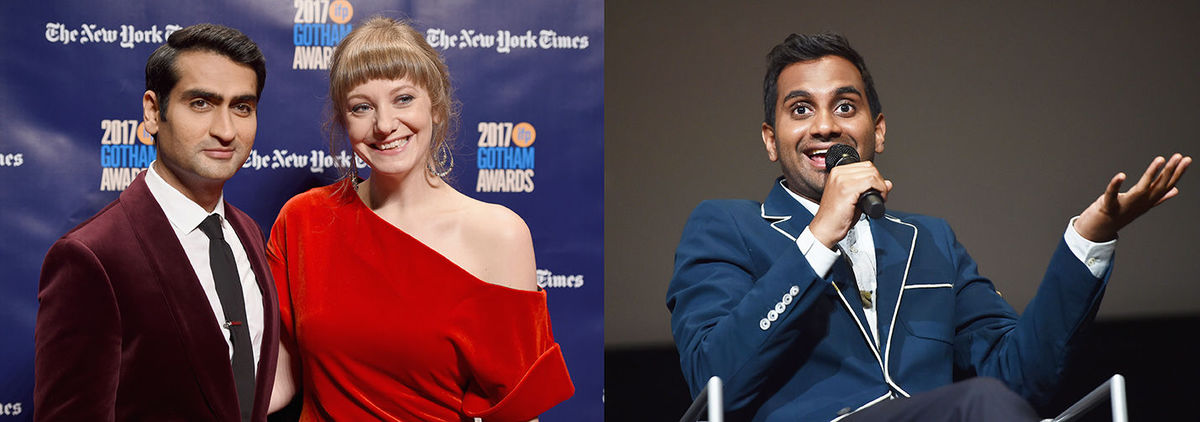
Kumail Nanjiani has scored three nominations for the 23rd annual Critics’ Choice Awards: ‘Best Original Screenplay’ alongside wife Emily V. Gordon, and ‘Best Actor in a Comedy,’ both for “The Big Sick,” and ‘Best Supporting Actor in a Comedy Series’ for HBO’s “Silicon Valley.” Indian American actor Aziz Ansari has been nominated in the ‘Best Actor in a Comedy Series’ category for his role in “Master of None.” (Dimitrios Kambouris/Getty Images for IFP; Alberto E. Rodriguez/Getty Images for Netflix)

As Hollywood begins to embrace diversity and move away from offering stereotypical roles, a few Asian actors are having breakout career moments. And now as the award season nears, it’s bringing cheer for some.

Indian American actor Aziz Ansari and Pakistani American actor Kumail Nanjiani have scored nominations for the 23rd annual Critics’ Choice Awards. For both these actors, being the contenders for this prestigious award, which some say is a barometer for predicting the Oscars, is the best way to cap a pretty successful 2017.

Ansari, who has in the past got the critics’ nod for his Netflix comedy series, “Master of None,” is back in the race owing to the second season of the series, which was lapped by the fans. He has been nominated in the ‘Best Actor in a Comedy Series’ category for his role in the Netflix drama.

Nanjiani, a critically acclaimed actor, writer and comedian, recently starred in and co-wrote “The Big Sick” with his wife, Emily V. Gordon. The film, a romantic comedy story, which was released by Amazon Studios/Lionsgate, wowed critics and audiences alike. Nanjiani, also known for his co-starring role as Dinesh in the award-winning HBO comedy series, “Silicon Valley,” has collected multiple nominations, for his work on both “The Big Sick” and “Silicon Valley.”

He is eligible for both film and television honors this year. Nanjiani is up for ‘Best Original Screenplay’ alongside wife Emily V. Gordon, and ‘Best Actor in a Comedy’ for “The Big Sick,” as well as ‘Best Supporting Actor in a Comedy Series’ for “Silicon Valley.” “The Big Sick” is also contending for the ‘Best Picture’ and the ‘Best Comedy’ awards.

CBS’ “The Big Bang Theory,” which stars Indian American actor Kunal Nayyar, is competing for the ‘Best Comedy Series’ award.

Netflix leads the television honors with 20 nominations, followed by HBO with 15, FX with 13, and ABC with 12.

The Critics’ Choice Awards are bestowed annually by the Broadcast Film Critics Association and Broadcast Television Journalists Association to honor the finest in cinematic and television achievement.  The BFCA is the largest film critics’ organization in the U.S. and Canada, representing more than 300 television, radio and online critics.  BTJA is the collective voice of journalists who regularly cover television for TV viewers, radio listeners and online audiences.

The winners will be revealed at the star-studded Critics’ Choice Awards gala to be held Jan. 11, 2018 at the Barker Hangar in Santa Monica, Calif. The awards show will air on The CW Network and will be broadcast live from 8 p.m. to 10 p.m. ET.

source: http://www.indiawest.com / India West / Home> Featured / by Reena Rathore , India-West Staff Reporter / Decembe 08th, 2017