Category Archives: Arts, Culture & Entertainment

There is no sequel to this mecca of books in Bengaluru

Bengaluru, KARNATAKA :

MeccaBookHouseBF09dec2017

Bengaluru :

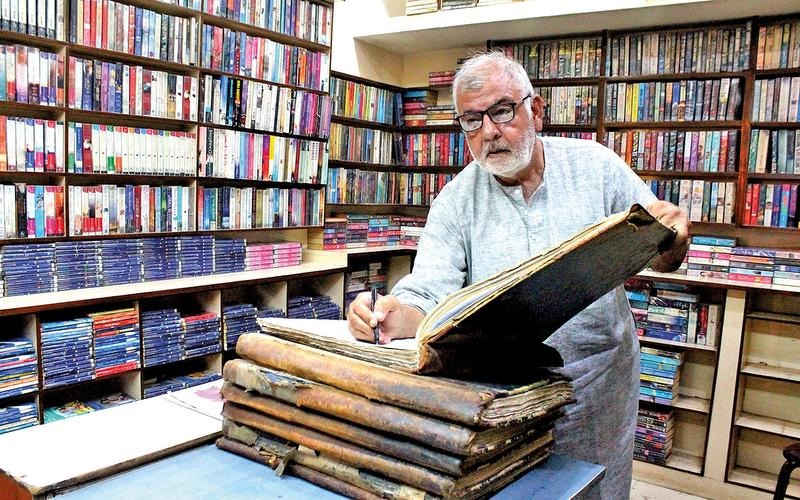
Come December-end, it is curtains for Frazer Town’s lending library Mecca Book House, which for more than 40 years was a favourite haunt for women, school children and even politicians hooked to bestsellers.

My school days at St Joseph’s Indian High School are filled with memories of me running to my father’s library after classes. The fragrance of books filled Mecca Book House, which used to be packed with readers and book borrowers. Former chief minister Veerendra Patil used to be one of them on many occasions.

For the past 37 years, my daily routine consisted of starting from home to the shop at 10 am, lunch at 1.30 pm and back to my books from 4 pm to nine in the night. But all good things have to end and that applies to my business as well. From January 1, it is going to change forever and I am unsure of how to go about it.

Childhood days

I remember the good old Bangalore days when we lived in our large family home on Infantry Road. We were 12 children and I was the eldest. My father Abdul Hameed Sait was a voracious reader and was always surrounded by books at home. I remember waking up in the middle of the night to see my old man burning the midnight oil. It wasn’t a surprise when he entered a trade that involved books, a circulating library. Thus was born Mecca Book House and a fancy store attached to it at China Bazaar, now Commercial Street, in the summer of 1975. He worked out of a small shop belonging to my grandmother that he rented for Rs 50 a month.

We became famous among Bangaloreans for our stock of Mills and Boons, John Grishams, James Pattersons and Frederick Forsyths, and were extremely popular among women. Our service got us a loving and loyal clientele.

Moving out

My work with the bookshop began in 1980 after I quit my sales job at a garment store. In 1987 we moved out of Commercial Street to set up shop in Cox Town, this time as an exclusive lending library. We became an inseparable and integral part of the Cantonment area with many book lovers, especially from the Anglo-Indian community, frequenting our shop.

Those were the good old days when people were hooked to books and would spend hours in our small shop and borrow bestsellers for a nominal fee. Many often landed with children for whom we had an exclusive kids section. Once a schoolgirl borrowed 15 books but returned them a decade later to rekindle ties with us and we were happy to see her. Customers were family.

We moved yet again in 2010 to the present location on MM Road in Fraser Town after the earlier structure was sold. But customers kept coming for books. My large brown registers have recorded details of every customer who has visited right from the 1980s. I still write down every detail in the register.

Internet and smartphones turned villain and the reading habit deteriorated. Business started to dip, but you don’t give up. Book business is an addiction but it can be punishing sometimes. We are forced to wind up as my landlady wants the place and not because I want to get beaten down by the interne age. I did try to shift the shop but am unable to do so due to skyrocketing rents and steep advances.

The word of the closure has spread and some have trouble accepting that Mecca Book House, which has been part of their lives for 42 years from its Commercial Street days, will soon be history. Of the 5,500 plus books, I managed to sell 3,500 and I’m waiting for the rest to be sold before I bid adieu to my 100sqft workplace.

I have no choice but to wind up at the age of 65. But I am content having run a lending bookstore since 1980, which gave me a lot of friends, good health and importantly the opportunity to read some of the bestselling novels from across the globe.
Ahmed is the owner of Mecca Book House

As told to Petlee Peter
(In this column, people record their impressions of Bengaluru)

source: http://www.timesofindia.indiatimes.com / The Times of India / News> City News> Bangalore  News / by Petlee Peter / TNN / December 04th, 2017

Sify columnist’s book on Muslim freedom fighters to hit shelf soon

Okhla, NEW DELHI :

Several books have been written on role of Muslims in India’s Independence movement. And from time to Muslim authors and journalists too have penned several books. This time around when there is talk about Muslims’ role in freedom movement, Okhla-based Sify columnist Syed Ubaidur Rahman has written a new book on this subject that continues to be of great interest to students, educationists, historians and journalists.

It is understood that the book is to hit shelf soon with the book already being submitted in the printing house.

“Just published… Name of the Book: Muslim Freedom Fighters: Contribution of Indian Muslims in the Independence Movement. Author: Syed Ubaidur Rahman. ISBN: 81-88869-43-0. Price Rs 225/,” Rahman wrote on his timeline getting a moderate response from users.

The book is being published by Global Media Publications and interested people can place order too by calling on this number which Rahman provided on his timeline: Tel; 9818327757, 9212011865; e-mail: gmpublication@gmail.com.”

When asked what prompted him to write this book, Rahman said it’s time to tell the young generation about the contributions of Muslims in freedom movement, instilling patriotism in them.

Interestingly, Rahman claimed to have introduced several new faces in the book whose contributions to freedom struggle have been immense but they are forgotten heroes.

Besides, writing for Sify and other national dailies from time to time, Rahman is a translator and author of several books.

source: http://www.okhlatimes.com / Okhla Times / Home>Local / by Okhla Times / December 07th, 2017

Watch: Sharjah boy, 14, flies plane

Nagpur, MAHARASHTRA / Ujjain, MAHDYA PRADESH / Sharjah, UAE :

Indian expat flies solo after record time of 25 hours training

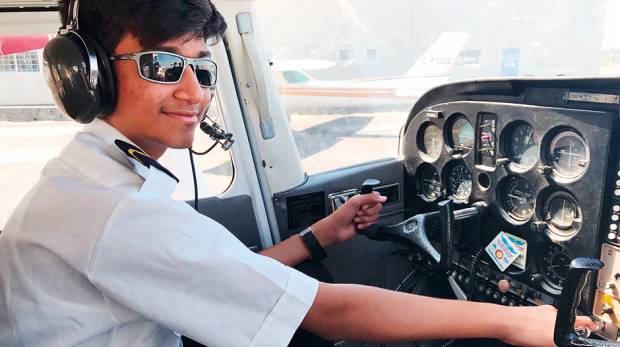
Mansoor Anis took off and landed from Langley Regional Airport in Canada to accomplish his first solo flight./ Image Credit: supplied

Sharjah:

At just 14 years old, a Sharjah teenager has become one of the youngest pilots to fly a single-engine aircraft.

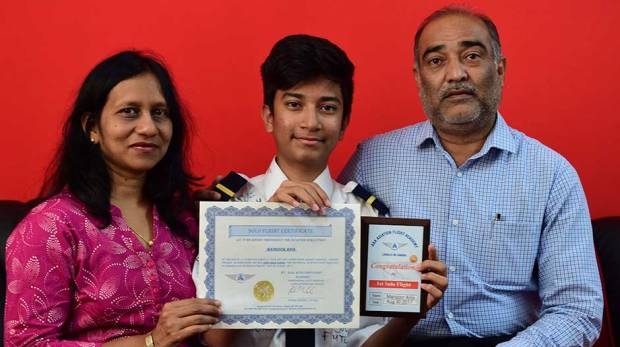
Indian expat Mansour Anis, a Grade 9 student at Delhi Private School in Sharjah, received a certificate for his first solo flight from an aviation academy in Canada last week.

Back in the UAE after his achievement, Mansour claimed that he had also set a record of being the youngest pilot to fly solo with the least number of training hours.

“He broke the previous record of a 15-year-old German pilot and a 14-year-old US pilot who took 34 hours of training. Mansour flew solo just after 25 hours of training,” Mansour’s father Ali Asgar Anis told Gulf News on Wednesday.

Summer training

Ali, a civil engineer heading the engineering department at Zulekha Hospital, said he had sent his son along with his wife Munira, a chemistry teacher with Wesgreen International School, to Canada for the training session during the summer holidays.

In some countries, like the US and UK, a person has to be at least 16 years old before taking to the air on their own. In the UAE and India, the pilot has to be at least 18 to be eligible to fly. However, in Canada, 14 is the minimum age for student pilots to join the course and try flying after meeting the requirements.

“Since he turned 14 in June, we decided to take him to Canada for setting this record,” said Munira.

Mansoor, with his parents Munira and Ali Asgar, displays the certificate he earned from an aviation academy / Image Credit: Atiq ur Rehman/Gulf News

She said her brother Qaid Faizy, a pilot with Jet Airways in Inida, has been an inspiration for Mansour since his childhood.

Fascinated about flying

“I got fascinated about flying the plane because of my uncle. He has been my inspiration and he has envisioned me to become a commercial pilot after I turn 18,” said Mansour.

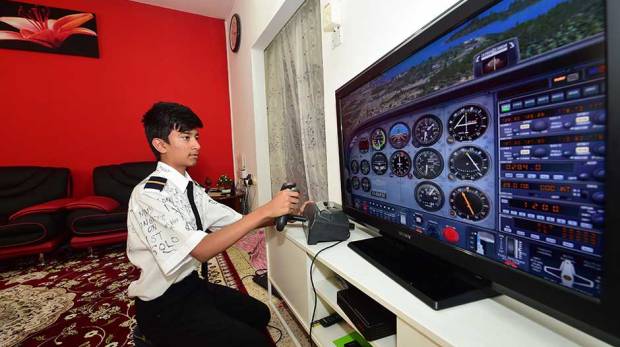
When he was about eight years, Mansour received a flight simulator as a gift from his uncle. “I learnt some basic lessons using that. My uncle has also given me and my sister the chance to visit the cockpit of an aircraft in which we flew once.”

His uncle also allowed Mansour to sit with his sister Mariya, a medicine student in Mauritius, when she once flew a Cessna aircraft at an aviation school in India, where the former used to teach, around four years ago.

Apart from the flying test, he has also passed a radio communication test / .Image Credit: Atiq ur Rehman/Gulf News

Mansour, who also flew a Cessna 152 aircraft during his solo flight, now has a student pilot permit. Apart from the flying test, he has also passed a radio communication test and scored 96 per cent in the PSTAR Test, an eligibility test for Transport Canada.

It was chief flying instructor at the AAA Academy Robert Wickins who trained Mansour during his course.

“He used to brief me about how the plane works. He taught me how to turn the aircraft. Then we went for some exercises like stall, spin, spiral dive etc. I was scared at first… but then it was fun. Also he had assured me nothing would go wrong and we can control the aircraft.”

Mansour’s solo flight was about 10-minutes long, during which he taxied the aircraft from the parking bay to the runway, took off for a flight of about five minutes and landed back.

Light aircraft

“The aircraft was really light because the instructor’s weight was not there. The plane was in the air a bit faster. I was excited and a little nervous.

“After I took off, I concentrated on flying how I did with the instructor. Everything happened very quickly,” said Mansour, who is now on cloud nine about his achievement.

“I am planning to go again to Canada next year to continue flying. If I don’t continue I will forget everything. At 16 years, I will take a recreational pilot permit. At 17, I will take private pilot license and at 18, I will take a commercial pilot license,” said the boy for whom the sky is not the limit.

source: http://www.gulfnews.com / Gulf News / Home> Society / by Sajila Saseedran, Senior Reporter / September 06th, 2017


Delhiwale: How many Sultanate kings can you name? Here’s the full list of 32

NEW DELHI :

For 320 years, Delhi was the city of sultans. Here is the list of the 32 rulers and where they rest now.

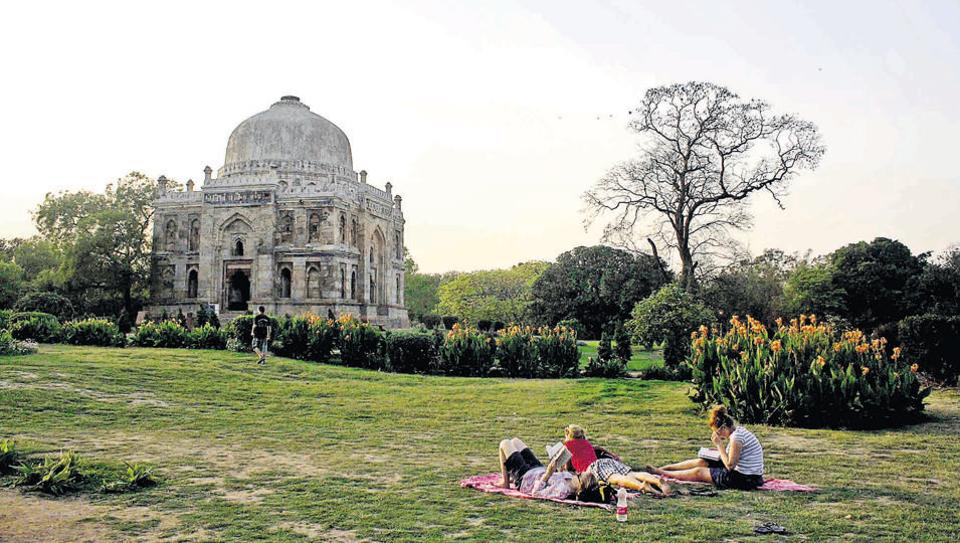
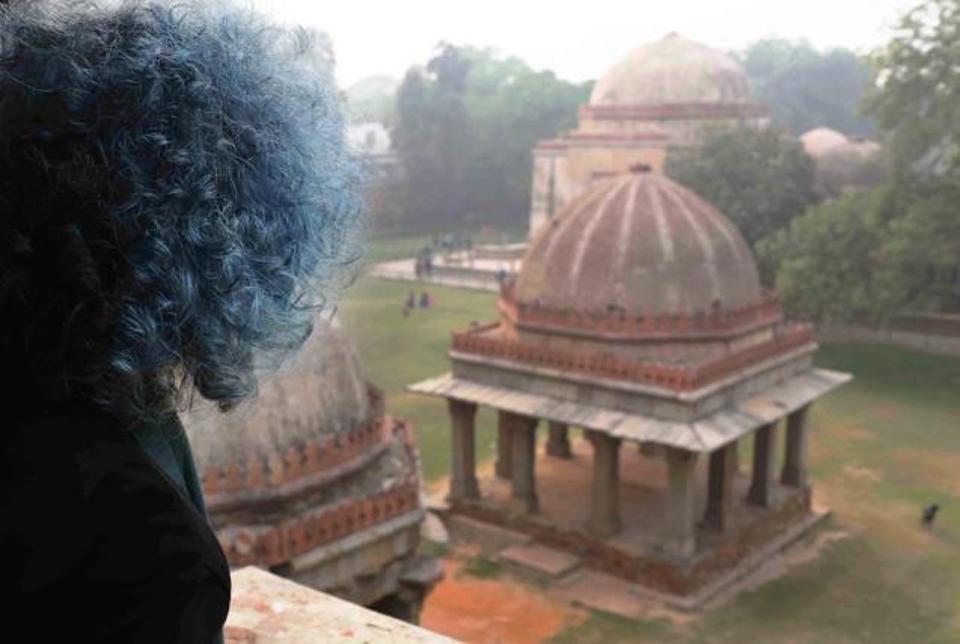
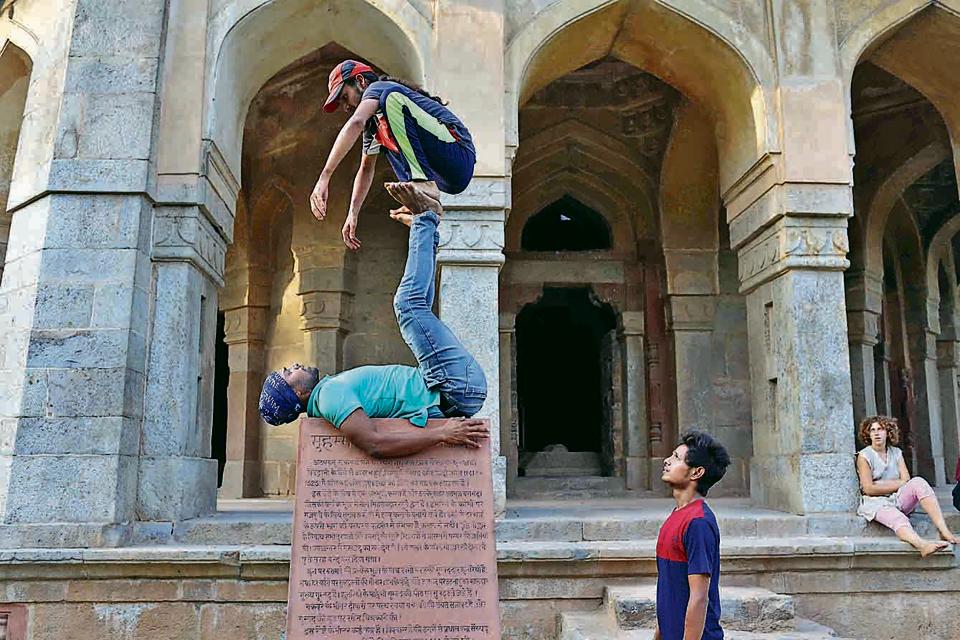
Sheesh Gumbad in Lodhi Gardens.(Mayank Austen Soofi / HT Photo)

The other day, while driving past an obscure monument, a friend demanded to know its name. We had no idea so we bluffed, “Ah, that’s a Lodhi-era tomb!”

The truth is we can’t even list all the Lodhi kings.

In any case, the Lodhi dynasty was part of the more elaborate Delhi Sultanate (not to be confused with ‘Delhi Sultanate’, a so-named member of The Sky Vengers music band). The Delhi Sultanate we are talking about spanned five dynasties, 32 rulers and 320 years. It lasted from 1206 to 1526. Today we give you the names of all the rulers of the Sultanate — one of whom was India’s first woman ruler, while the last was vanquished by Babur, the founder of the Mughal dynasty.

Sultan02MPOs03dec2017

We also used this list to hunt the graves of these Sultanate royals — right here in our city. Of course, it’s not possible to access every king’s tombstone. Quite a few of them were killed in small and big wars, at times far from Delhi. Frustratingly, history books leave no solid evidence of their burial spots.

Some others of these important men turned out to be so insignificant in the long run that their graves have been forgotten, making it impossible to trace them today. Here’s a list of all the rulers, and the graves of those we were able to locate.

SLAVE DYNASTY

Qutbuddin Aibak (1206–1210), buried in Lahore, Pakistan

Aram Shah (1210–1211), killed near Delhi, grave not known

Shams ud din Iltutmish (1211–1236), buried in Qutub Minar Complex, Mehrauli

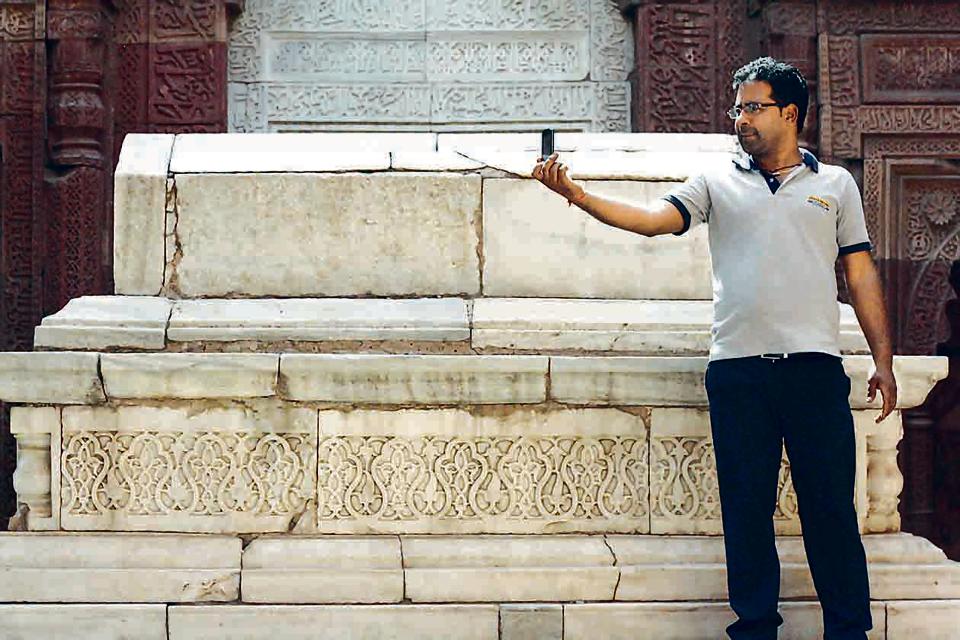
Illtutmish’s tomb in Qutub Minar complex. (Mayank Austen Soofi)

Rukn uddin Firuz (1236), believed to be buried in Sultan Ghari, near Mehrauli

Raziyat ud din Sultana (1236–1240), buried in Bulbuli Khana, Old Delhi

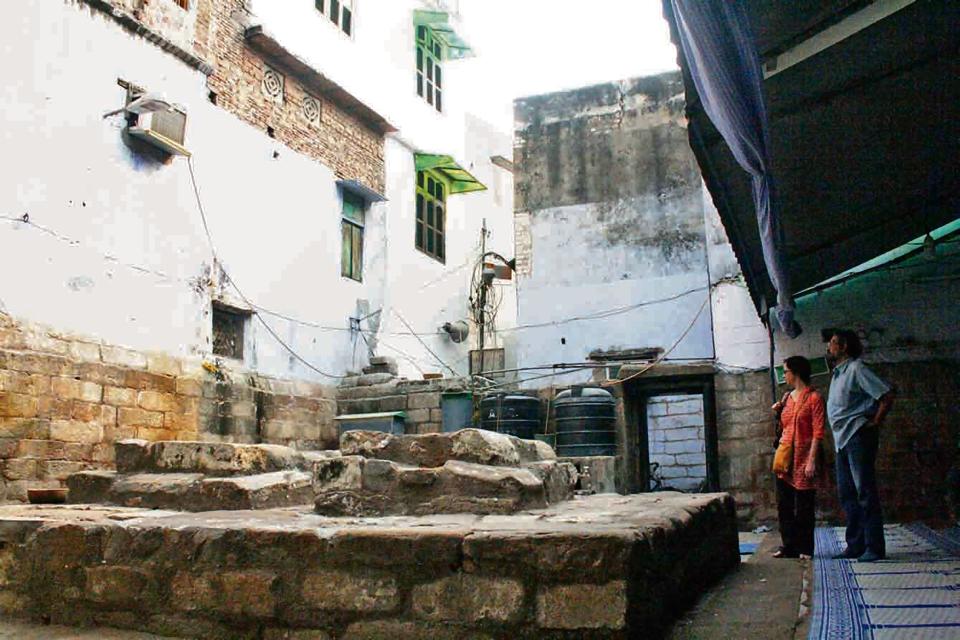
Raziya Sultan’s tomb in Bulbuli Khana, Old Delhi. (Mayank Austen Soofi)

Muiz uddin Bahram (1240–1242), grave not known

Ala uddin Masud (1242–1246), grave not known

Nasir uddin Mahmud (1246–1266), grave not known

Ghiyas uddin Balban (1266–1286), Buried in Mehrauli Archaeological Complex, near Jamali Kamali mosque

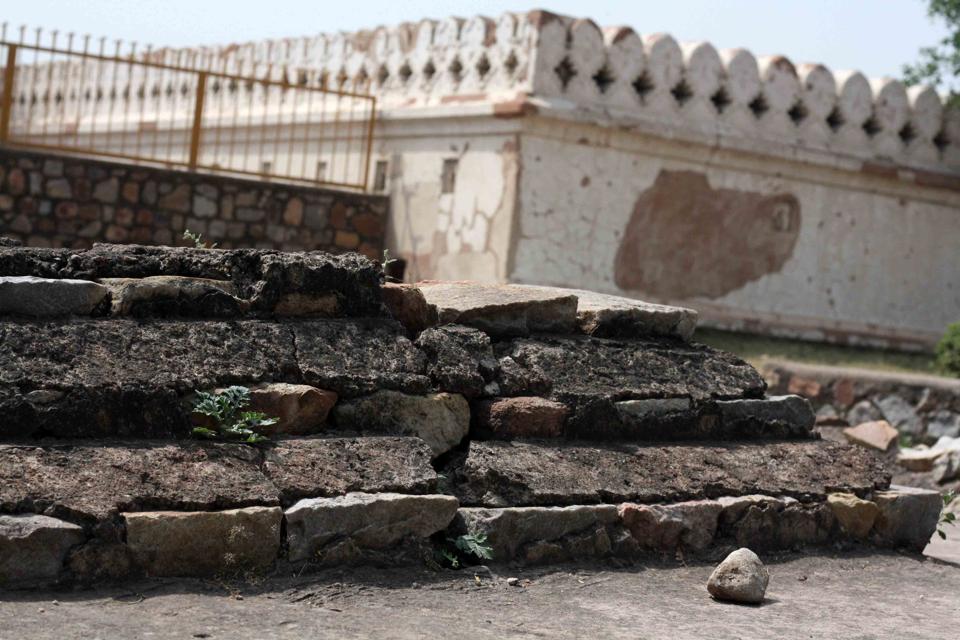
A tomb outside Jamali Kamali complex in Mehrauli. (Mayank Austen Soofi)

Muiz uddin Qaiqabad (1286–1290), grave not known

Kayumars (1290), grave not known

KHILJI DYNASTY

Jalal ud din Firuz Khilji (1290–1296), buried in Delhi but “disappeared “according to HC Fanshaw’e book Delhi, Past and Present

Alauddin Khilji (1296–1316), buried in Qutub Minar Complex, Mehrauli

Qutb uddin Mubarak Shah (1316–1320), grave not known

TUGHLAQ DYNASTY

Ghiyath al-Din Tughluq (1321–1325), buried in Tughlakabad

Muhammad bin Tughluq (1325–1351), buried in Tughlakabad

Mahmud Ibn Muhammad (1351), buried in Tughlakabad

Firuz Shah Tughlaq (1351–1388), buried in Hauz Khas Village

Ghiyas-ud-Din Tughluq II (1388–1389), grave not known

Abu Bakr Shah (1389–1390), grave not known

Nasir uddin Muhammad Shah III (1390–1393), grave not known

Ala-ud-Din Sikandar Shah I (1393), grave not known

Mahmud Nasir uddin (1393–1394), grave not known

Nusrat Shah (1394–1399), grave not known

Nasiruddin Mahmud Shah (1399–1413), not known, Timur invade Delhi in his reign

SAYYID DYNASTY

Khizr Khan (1414–1421), grave not known

Mubarak Shah (1421–1434), buried in Kotla Mubarakpur village

Muhammad Shah (1434–1445), buried in Lodhi Garden

The plaque at Mohammed Shah’s tomb in Lodhi Garden. (Mayank Austen Soofi)

Alam Shah (1445–1451), grave not known, perhaps in Badayun where he died

LODHI DYNASTY

Bahlol Lodhi (1451–1489), Chirag Dilli

Sikander Lodhi (1489–1517), Lodhi Gardens

Ibrahim Lodhi (1517–1526), buried in Panipat, Haryana

source: http://www.hindustantimes.com / Hindustan Times / Home> Cities> Delhi / by Mayank Austen Soofi, Hindustan Times /  December 02nd, 2017

Where the kathi rules

Kolkata, WEST BENGAL :

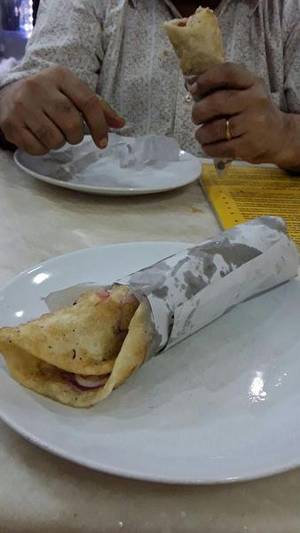
KathiRollsKOLKATA03dec2017


Old timers in Kolkata swear that a kathi roll from Nizam’s doubled the thrill of a cricket match at Eden Gardens

If you have feasted on hot, succulent double-egg kathi rolls wrapped around chunky pieces of mutton or chicken instead of home-packed cold jam sandwiches and boiled eggs at Eden Gardens, Kolkata, chances are that you managed to scoot across to Nizam’s, near New Market (24, Hogg Street, New Market) to pick up a few rolls, just as the batsmen pulled off their gloves and play broke for lunch.

Nizam’s rolls and cricket matches at Eden Gardens enjoy a long and deep relationship.

Back in the early 1950s, during an exciting Test match between the MCC and India, a group of enterprising young men hopped across the Maidan — the lungs of Kolkata (Calcutta those days) — crossed over to Chowringhee Road, and dived into the narrow and deep-set bylanes around New Market, to pick up sizzling hot kathi rolls from a then-hole-in-the-wall shop called Nizam’s.

The walls were black with soot and grime, collected over the years from wood and charcoal fire, and greasy from the fumes hissing out of fiery hot tawas and iron seekhs. The young men galloped back to the stadium with the warm newspaper-wrapped kathi rolls where other friends eagerly reached out. As they unwrapped the newspaper, the aroma wafted through the stands, turning heads and inviting a volley of queries about the source of this unique snack.

Deep-fried inspirations

One of those young men happened to be my father — a fresh graduate from Scottish Church College — taking a break from dreary balance sheets at his chartered accountancy classes and articleship.

The now 86-year-old remembers with obvious pleasure that it was his older siblings and friends who first discovered Nizam’s, at a time when the average Calcutta Bengali was still unaware or wary of eating out at these cheap eateries.

Nizam’s sold kebabs and rotis or parathas, and the ‘sahibs’ of colonial Calcutta often drove up for a late-night kebab-paratha meal. Eventually, the shop devised a way to package the meat into the paratha and wrap it up neatly in newspaper so that the sahibs wouldn’t have to soil their fingers. And thus the ‘Nizam’s roll’ was born.

Apart from occasional labour unrest followed by shut-downs, the forerunner of the Kolkata kathi rolls had a relatively steady career till recently, when there was a fire scare. A neighbouring shop went up in flames dangerously close to the walls of Nizam’s. Social media erupted in panic as someone reported that Nizam’s was gutted. “Oh no! Had the loveliest mutton rolls just recently!” wrote Maria Bhattacharya of Indian Oil Corporation on WhatsApp, while Dr Saswati Das exclaimed, “Oh dear! Can’t believe this! One of our childhood joints gone up in flames.” They were both vastly relieved to learn that Nizam’s was in fact unharmed.

“Nizam’s would invariably be our dinner destination after a night show. Thereafter, we’d walk back to the hostel. The police ticked us off so many times because of all the noise we made,” Dr Das laughs, as she recalls her student days at the Calcutta Medical College in the 1980s.

A hangout for many

Night birds flock to Nizam’s to savour its chicken, mutton, egg, aloo and beef kathi rolls, besides juicy kebabs and other Mughlai dishes, not available at home. My father remembers dropping in at Nizam’s for beef rolls well past midnight, and sitting on the benches outside munching on crisp hot rolls, with some of the prettiest and best crooners of the Park Street pubs and restaurants of the 1950s and 1960s.

Devarati Mukherjee remembers being there for late-night snacks even as a kid in the 1960s. “In winter, it was a given that on late nights we would end up at Nizam’s,” she says.

Medical Officer at IOC, Haldia, Dr Sutapa Pal’s memories of night duty at Calcutta Medical College and Nizam’s are forever married. “We’d walk to Nizam’s for a good hot meal. We were always hungry those days. Seems like another age.”

In this weekly column, we take a peek at some of the country’s most iconic restaurants.

sourcce: http://www.thehindu.com / The Hindu / Home> Life & Style> Food / by Mohua Mitra / November 30th, 2017

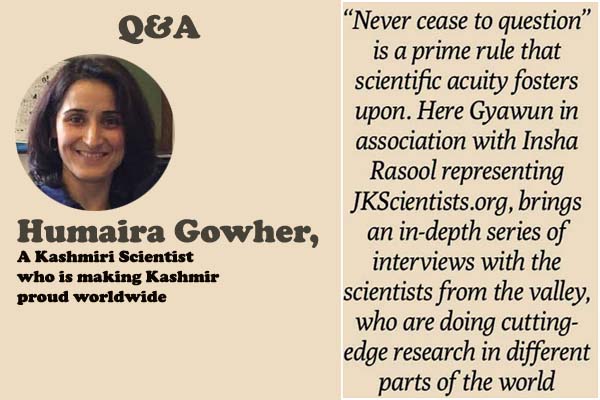
Humaira Gowher, A Kashmiri Scientist who is making Kashmir proud worldwide

Srinagar, JAMMU & KASHMIR / Indiana, USA  :
HumairaGowherMPOsaug2017

“Never cease to question” is a prime rule that scientific acuity fosters upon. Here Gyawun in association with Insha Rasool representing JKScientists.org, brings an in-depth series of interviews with the scientists from the valley, who are doing cutting-edge research in different parts of the world.

Early inquisitiveness metamorphosed a Kashmiri girl into an expert in molecular biology research at Indiana, USA.Bringing the first in the series, here we discuss with Humaira Gowher, about her early life in Kashmir, her motivations and aspects of science that she finds most exciting and more importantly, the expertise she brings to University of Purdue, West lafayette, USA. Her research currently focuses on understanding the regulation of DNA methylation in development and disease.

Tell us about yourself

My name is Humaira Gowher. I was born and raised in Srinagar until I was 19. I was always lucky being among the first few batches to attend Caset Experimental School, headed by Prof C. L. Vishen, a visionary and an exceptional educationist. He followed Montessori style of primary school teaching. Back then, it was unknown in our part of the world. It was through discussions about inventions and discoveries in Vishen’s classroom, I treasured the feeling of becoming a scientist. The further excitement in the science of life was added by lectures from Physics and Biology professors.

I received my college education from Aligarh Muslim University, where I graduated with Bachelors (Hons) and Master’s degree in Biochemistry. I was again blessed with mentors including Prof. Imrana Naseem, Ms. Aziza Rizvi, who instilled the love for biochemistry and sports during my college years. The supporting culture of the Women’s College wiped every tear and healed wounds of separation from the homeland. Women’s College, AMU, was and still continues to be a place where you experience personal freedom. It creates a no judgment zone for young teenagers, who are given different opportunities to excel in cultural, sports, or academic championships, and I am thankful for those opportunities.

What motivated you to study at IISc, which is the finest institute in India? How comfortable was the transition from AMU to IISc and did your background in biochemistry helped you to adjust there? Share your experience with us; especially in what way did it help you to shape up your career?

During my second year in the Biochemistry Master’s program, I was exposed to experimental research as a summer trainee for a couple of months in Dr. S. E. Hasnein’s lab at the National Institute of Immunology, New Delhi. I always wanted to become a scientist, however, the experience in Dr. Hasnein’s lab gave me a realistic feel of what that means and I yearned for it more than ever. I was looking forward to getting my PhD degree from a premier institution in India. I applied to the Indian Institute of Science, Bangalore and based on my high score in GATE and my performance in a series of interviews at IISc, I was able to secure a position as a PhD student in the Department of Biochemistry.

I stayed in the program for 2 years but due to family reasons, I had to move to Germany where my husband was placed in a Computer Engineering program in Essen-Duisburg University. I continued my PhD thesis work in Germany in the Department of Biochemistry, at Justus Liebig University. The field of research, “Epigenetics”, offered to me was the one I had acquired experience in and was close to my heart. It was very easy to work hard and publish, simply because I enjoyed doing it. With prior experience from IISc, I was able to finish my thesis in 2 ½ years and was awarded Summa Cum laude (Award of Excellence) for publishing 7 first author peer-reviewed manuscripts during this time.

After completion of your PhD, what kept you motivated in Science and how did you choose your position at the National Institute of Health (particularly in terms of place project and funding)?

Motivation to do science comes only from the passion to do it. It needs tremendous perseverance to stay in science given that you have to put up with failures and success is a rare occurrence. The act of doing the experiment excites me and I worry little about its failure. Similarly, I worry less about the experimental result that does not support my hypothesis, because if it does not, then I have more to do and figure out why which often is the fun part.

Like anyone else’s, my life was not just about doing science and publishing papers. It had all the other elements that helped balance it. After I finished my PhD, I continued to work in the same lab as a research associate for 2 more years until my husband got his degree. In 2005, after our first born, Hana Khan, turned 2, we decided to cross the Atlantic to continue our exciting journey. I was offered a post-doctoral fellowship at the National Institute of Health to work with Dr. Gary Felsenfeld’s, while my husband was easily assimilated in the Big IT world in the United States, thus helping us reach our respective career goals. Dr. Felsenfeld is a pioneer in chromatin biology and epigenetics. With my previous experience and his lifetime of expertise, I was looking forward to the most exciting and stimulating time in my scientific career. NIH provides a well-funded environment for your ideas to take the shape of an experiment with little to worry about the cost of doing it. Of course, one has to justify the experiment and make sure it is well-designed and expected to minimally open new ways of thinking in your field. Around Gary, at NIH, I found myself rubbing shoulders with people who had received the highest laurels for their achievements in science, had experienced the growth of knowledge, and understood the complexity of these systems.

Could you tell us about the most exciting project that you have worked on so far. How did the research community respond to the outcome of that study? 

Most exciting project….nothing I did until now was less exciting, so it is a tough question. Well, few things I discovered had more impact on the scientific world than others. During my PhD, my work was the first to show that the short catalytic domain of the mammalian DNA methyltransferases Dnmt3a and 3b are active without their large N-terminal part, which led to characterization, crystallization, and many studies of these enzymes by ours and multiple other labs around the world. My current lab continues to work on understanding the regulatory potential of these enzymes during development and in cancer. During my postdoc, my work on the regulatory elements of the genome called insulators was indeed very exciting given that these elements can control the expression of genes that are megabases away from them. It introduced me to the field of chromatin folding and architecture and its role in the regulation of gene expression, which I continue to work on.

What were the critical factors and considerations that you contemplated about while opting for the position at Purdue University, West Lafayette, USA?

I worked at NIH for some years and after gaining some experience decided to take the next step, which was to establish my own research program. In the US, most of the scientific research is supported by universities and medical schools. With my interest in teaching biochemistry, I was inclined to take a position at a state university, if offered. In 2011, due to an economic downturn in the US, only few positions were open and I was competing with over 400 applicants for each position. It took a few rounds of application and few more years and finally in 2013, I was offered a position of Assistant Professor in the Department of Biochemistry at the Purdue University. During my interview, I not only had to consider Purdue for the potential to do the research I wanted to, but also for possibilities for my husband to find a job in the vicinity and an environment where I could raise my children with dignity. Although Purdue offered my husband a possibility to work at the university under a faculty recruitment and retention program, but he got few offers from private industry in Indianapolis which was only an hour away. Purdue is one of the more diverse university campuses I have seen, which is reflected in the diverse population of students attending the neighborhood schools, thus providing a viable solution for my 10yr old Hana and 6yr old Ahmed.

What obstacles and challenges did you face while setting up your laboratory in the initial years?

Setting up a new lab has many challenges. It is like a small business and you have some investment, which you have to spend correctly to ensure the return. To make a decision on hiring people is the most challenging job since I never did it before. You interview a bunch of people for a position and hope you are looking for the right thing. I did take a lot of advice from my senior colleagues and my mentors while making these decisions. Nevertheless, of course, it did not work well every time. The other challenge is time management; you have much more responsibility now, teaching, service, research, home front, kids and yourself too…. switching hats and changing roles and doing it to its best is what drains you in initial years. Then I figured out the best possible ways of doing it. I also needed time to analyze the data, write papers, write grants, write lectures, write, write, write…something I was not previously used to at that scale.

In the recent decade, research has broadened immensely. How different does it feel to mentor a current lot of students as opposed to the training that you received at your time? What is your idea of mentoring in the current academic setting?

I agree that research has broadened and perplexingly, it is intricately connected, which makes it challenging. A student today requires knowing much more than when I started my graduate school. In research, every new idea comes from what we know from the previous research and it is challenging to keep it all together and carve your niche, which is unique. I encourage my students to read more and present the research from other peer-reviewed publications to get them to the speed. Since I traveled various continents during my education, I was exposed to various kinds of mentoring techniques, which are of course influenced by the social setup too. The objective of effective mentoring in an academic setting is to provide your mentee with all information you have acquired through your experiences and help him/her strategize his/her career path. To be able to help your mentee realize their true potential and in an honest but polite manner help them meet the reality. I mentor undergraduate, graduate, post-doctoral fellows and some high school students too. It is the most rewarding feeling when you get a Thank You card from your mentee and he/she got admission in the top school or got a job they wanted. My personal struggles in achieving and retaining the academic position come to a full circle through these achievements.

You have also written a book “How Do I Sing Nursery Rhymes in the Kashmiri Language? ” tell us something about how it happened

I left home, Kashmir, when I was about 19, a long time back. Wherever I went I simply cannot leave behind the person who my culture made out of me, my language, my hospitality, my favorite food, clothing, jokes, curses, poems, music…all that had compiled my personality in those 19-20 years. A couple of decades later, I find myself struggling with transferring this emotional relationship to all that is Kashmiri in me to my kids. Truth is that you know a culture when you can laugh at its jokes that is when you can speak its language. The Kashmiri diaspora in the United States decided to have an annual meeting to celebrate Kashmiri language, art and culture. Many of my friends complained that it was difficult to raise children bilingual with both Kashmiri and English as spoken languages. Most of us also agreed that at the baby/toddler stage, the introduction of English language happens through Nursery Rhymes and that our kids didn’t have a Kashmiri version of the popular rhymes to tune in. We thought it would be easy to have popular English rhymes translated to tune in Kashmiri so that they can simply sing them on the same rhythm.

I took this on me and thanks to a hidden poet gene (from my mother), I was able to translate six common Nursery Rhymes to English keeping the original tune in mind. My own kids could sing these within hours given that the words simply rhymed with the tune that they memorized as babies….it was truly satisfying.

What advice would you give to the students in research who are looking forward to becoming independent researchers?

If excelling is what you work toward, it is enough to advance you towards your goals.
Muslim Lifestyle Beyond Maqbara, Masjid and Madrasa

Aligarh,  UTTAR PRADESH :

Housed in the Ibn Sina Academy, Aligarh, the museum is one man’s effort to preserve articles of Muslim lifestyle or tehzeeb that include textiles, crockery, manuscripts, and musical instruments among other things.

While Taj Mahal may be the edifice of the moment, caught in the eye of a political storm and being showered with both barbs and bouquets, not very far from it is a museum of Muslim ‘tehzeeb’ that brims with tales of nobility and sophistication. Housed in the Ibn Sina Academy, Aligarh, the museum is one man’s effort to preserve articles of Muslim lifestyle or tehzeeb that include textiles, crockery, manuscripts, and musical instruments among other things.

The academy is primarily a museum of Medieval Medicine and Sciences, founded by Padma Shri Hakim Syed Zillur Rehman in the year 2000, but soon it diversified into chronicling Muslim lifestyle and tehzeeb of the past. People wonder why a science museum would be generous enough to grow into accommodating the articles of Muslim lifestyle. And he answers all of the queries with a note of hope and love for future, “I have the articles of Muslim houses preserved in the cupboards of my museum, from the royal families of Bhopal, Hyderabad, and Rampur etc.”

He said that he is preserving all this for posterity – “After acquiring education, prosperity and wealth there will be a time when they would want to know their civilizational facts, culture and past and at that time my museum will give the future generation a glimpse into their tehzeeb and lifestyle. It will respond to their search for roots.”
There are almost 4,500 articles of Muslim tehzeeb showcased in his museum – which include crockery that keeps the food warm till the last bite because of the vacuum that takes hot water, there are dupattas three meter long that were tied differently in different Muslim societies of Hyderabad and Bhopal etc., there is a fruit tray from the dining table of Begum Sultan Jahan of Bhopal, her brooch made of precious stones, with her name inscribed in gold, a chogha that belonged to the Qazi Shamsuddin of Rewari, dating back to 1830, a paandaan weighing over 5 kg and a betel stand to name a few.

There are other items that chronicle Muslim culture through objects like: gramophones, harmoniums, costumes for weddings and trays for biryanis designed keeping the sense of style and comfort of those times. There are heavy paandaan (a box for preserving items used to make paan), ugaldaan (spittoon for the pan user), fancy haath ka pankha (a hand fan), and pretty batua (wallet), gem-studded gharara (a dress item), there are also silver-lined razais (quilts). The museum grew out of his fondness for all things with rich history, some of which were also priceless – coins from ancient times, stamps, pens and other artefacts. He makes sure to mention the source of the specimens he gets from Muslim families and pin them in the cupboard with the name of the person donating it or belonging to.

Times for Muslims have also changed in many ways, he said, “Somehow they are not able to think beyond maqbara, masjid and madarsa. They are always ready to contribute in the growth of masjid and madarsa but don’t understand the values of museum of heritage and culture of Muslim families. In this time of collective ignorance about out past I designing this for the future generation that will come in search for roots,” he added. Some of the objects on display were inherited by him. Some were gifted by people who saw that he had the wherewithal to preserve priceless items for posterity.

He takes pride in showing the guests original royal orders of Mughal emperors that have come to Rehman from his father, and a paper weight made of shells that was used by Sir Syed Ahmad Khan. These orders come from Aurangzeb, Babur and calligraphy by Bahadur Shah Zafar. When asked how he continues to enrich the museum of Muslim past in times of attack on Taj Mahal, he said, “The attacks on Taj Mahal or anything associated with our past are just seasonal things, it is more to do with politics than our society and its commitment to celebrate history.”

In his view these attacks don’t mean anything in the larger picture of history, “Taj Mahal and Qutub Minar are part of our pride, we cannot be attacking them because they were made in medieval times. By that logic Connaught Place and Parliament should also be broken down because they were made angrez (British),” he added.

Rahman served as a professor and chairman, department of Ilmul Advia at the Ajmal Khan Tibbiya College, Aligarh Muslim University. After serving as a dean, faculty of Unani medicine, he retired after 40 years. He is the author of 45 books and several papers on different aspects of Unani and boasts of being the possessor of the largest collection of books on Unani medicine. Conferred the Padma Shri in 2006 for his contribution in the field of Unani medicine he is now expanding his museums to start taking items like animal skin, which formed an important part of households of the past.

Also, unsure of who will take it forward after him, Rahman has given this endeavor to a Trust to take charge of it. There is huge collection of Ghalib’s work, which he claims to be one of the largest in South Asia and attracts scholars from other parts of the country to study. In his library lined with thousands of books, manuscripts and dedicated works of Ibn Sina and medieval medicine, sciences, youngsters from all backgrounds especially economically weaker come to study in the quiet atmosphere.

source:  http://www.news18.com / News18.com / Home> News18> India> Sunday Feature  / by Eram Agha, News18.c0m / November 05th, 2017

Principals take charge

Patna, BIHAR :

Patna:

Padamlata Thakur and Ejaz Ali Arshad on Wednesday took charge as principals of Magadh Mahila College and Patna College respectively.

The Patna University issued the notification for the appointments on Tuesday night.

Thakur who took charge as 22nd principal of Magadh Mahila College was earlier working as head of the history department and she was also the coordinator of the Department of Women’s Studies.

Arshad, who was appointed principal of Patna College, had served as vice-chancellor of Maulana Mazharul Haque Arabic and Persian University, Patna, from February 2014 to February 2017.

Arshad whose tenure completed this year as VC of Maulana was working as head of Urdu department at Patna University. Arshad had also worked as dean students’ welfare at Patna University.

Thakur said: “It is a proud moment for me to become the principal of Magadh Mahila College which is one of prestigious educational institutions of Patna University.”

Thakur said she had called a meeting of teachers, staff and members of college students’ council to discuss ways for academic and infrastructure development.

“My first priority will be to look into students’ issue. As MMC is a women college, ways to strengthen gender-sensitisation cell will be a priority and so is girls security,” she said.Arshad said his priority was to restore the glory of Patna College. “Improvement in academics and infrastructure facilities will be my top priority.”

source: http://www.telegraphindia.com / The Telegraph, Calcutta,India / Home> Bihar / by Special Correspondent / November 02nd, 2017

National Education Day celebrated at Farooqia College of Pharmacy

Mysuru, KARNATAKA :

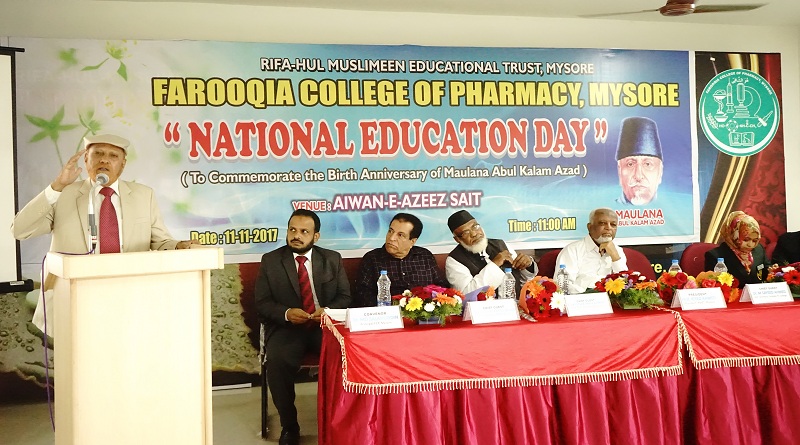
FarooqiaCollegeMPOs01dec2017

Mysuru :

The National Education Day to commemorate the birth anniversary of Bharat Ratna Maulana Abul Kalam Azad was celebrated at Farooqia College of Pharmacy at Tilaknagar here recently.

Speaking on the occasion, Taj Mohammed Khan, secretary of Farooqia Educational Institutions, encouraged the students to follow the footsteps of Maulana who fought for the freedom of India and brought a revolution in education with his reforms as first education minister of post-independent India.

Dr M Sayeed Ahmed, secretary of Farooqia PU College, who was the chief guest, gave a detailed power-point presentation on Maulana’s life.

He said it is Maulana who first opposed the partition and separation of India and Pakistan. Maulana was a firm believer in the co-existence of religions. His dream was that of a unified Independent India where Hindus and Muslims can live peacefully.

Kolar Mustafa said that nowadays the institutions like UGC, AICTE and IITs are still running without modification in their regulations due to the broad based think tank of Maulana Abul Kalam Azad.

President of RMET Prof Riyaz Ahmed in his presidential remarks briefed about the post- independent educational system and highlighted Maulana’s simplicity, who didn’t amass property and wealth for his own family members and relatives even though he was an education minister for 10 long years.

Prizes were given away to Essay Competition winners on “Life of Maulana Abul Kalam Azad after post-independent India.”

Maryam Postdar, a D Pharma student, recited verses from the Quran. Principal Dr MD Salahuddin presented a video documentary on Maulana Abul Kalam Azad’s Life.Sara Ateeq, vice-president, Pharmaceutical Society and others were present.

source: http://www.citytoday.news / City Today / Home> Headlines> Mysore / by CT Bureau / November 30th, 2017